



Abstract
According to the United Nations Population Fund (2020), half of the world’s population live in cities, and the number is estimated to rise to 75% by 2050. Although urbanization is seen as a major challenge from a health point of view, the development of urban wellness tourism offering would ideally benefit both tourists and locals. The growth rate of wellness tourism during the years 2015–2017 was almost twice as fast as global economic growth. Holistic wellness refers to the balanced elements of body, mind and spirit. This study argues that many European city destinations could provide the holistic wellness elements to their visitors.
Tourism destinations continue competing with each other in a globalised marketplace, even more post-Covid-19. As a result, cities will invest considerable resources in their marketing activities and place branding. By recognizing and highlighting wellness tourism offering in their marketing, some urban Destination Management Organisations (DMOs) could stand out in this growing competition and get their share of wellness tourism growth.
This study examines, which elements contributing to holistic wellness are currently being displayed on the visit.com websites of selected urban DMOs (N = 32) in the European Union. This is done using qualitative content analysis methodology. The findings indicate that there are several European cities that already display elements of urban wellness in their marketing. The practical implication for the DMOs in question could be to actively start developing their place brands towards urban wellness tourism niche by highlighting the supply of urban wellness they already have, for example, at their visit.com sites.
Keywords
Introduction
One of the biggest niches in tourism prior to Covid −19 was wellness tourism, which grew at the rate of 6.5% annually compared with 3.2% of tourism (GWI, 2018). During the pandemic, tourism has been almost non-existing. However, the Corona stop has given us all an opportunity to re-think our priorities, values and travel patterns (Glusac, 2021). The pause in travelling has also opened the eyes of the consumers to the positive and negative impacts of tourism (Gybels, 2021). In the fast-paced world full of deadlines and stress, people have been seeking for healthier lifestyles. Consequently, considerable amount of money has been spent in pursuit of feeling good both physically and mentally (GWI, 2019). Health tourism is divided into two sectors: medical tourism and wellness tourism (Smith and Puczkó 2009; UNWTO and ETC, 2018). Global Wellness Summit (2017) describes wellness as: ‘the active pursuit of activities, choices, and lifestyles that lead to a state of holistic health’. This supports UNWTO’s (2019b) definition of wellness tourism as: ‘a type of tourism activity, which aims to improve and balance all of the main domains of human life including physical, mental, emotional, occupational, intellectual and spiritual’. This study concentrates only on wellness tourism leaving the medical aspect aside.
According to the United Nations Population Fund (2020), half of the world’s population live in cities and the number is estimated to rise to 75% by 2050. At the same time, tourists have been seeking new experiences, and the destinations are competing against each other in the global tourism markets (Voigt and Pforr, 2014a). As a result, cities invest considerable resources in their marketing activities and place branding. Urban tourism can be defined as: ‘people visiting towns and cities other than their own’ (Heeley, 2015), and ‘its inherent attributes are characterized by non-agricultural based economy offering a broad range of cultural, architectural, technological, social and natural experiences and products for leisure and business’ as defined by UNWTO (2019b). Looking at the before mentioned attributes, for example cultural and social activities in the city, it could mean growth possibilities for urban wellness trend (Lee et al., 2020).
Many tourism destinations have already utilized the wellness trend in their online marketing and branding activities. However, when googling for wellness tourism offering, one can see that it is often marketed as retreats taking place in resorts located in natural environments with pictures of lush greeneries, water elements, fresh air or crispy snow—not in the urban setting. Yet, an urban environment can equally provide the elements of balanced wellness; body, mind and spirit as outlined by Dunn (1959), which this paper will demonstrate. The research question is: ‘which elements contributing to holistic wellness are currently being displayed on the visit.com websites for selected urban DMOs’. In order to answer this, the study looks at what 32 EU cities that belong to ‘European Cities Marketing’ (ECM), an association for Tourist Boards, Convention Bureaux and City Marketing Organizations in Europe, market at their destination landing pages.
The reminder of this article is structured as follows. First, a literature review on wellness tourism and destination management is presented followed by the research aims. Second, the methods for collecting and analysing the empirical data using an online analysis are explained. Finally, the results of this study are discussed and concluded.
Literature review
Wellness for everyone and everywhere
The Global Wellness Institute (GWI) defines wellness as ‘the active pursuit of activities, choices, and lifestyles that lead to a state of holistic health’ (2017). Wellness seems to have developed into a large consumer industry offering a wide range of products and services that help consumers to incorporate wellness activities and lifestyles in their daily lives (Grénman, 2019). GWI (2018) includes altogether ten sectors in their wellness economy report, however, not all of them tourism related. The sectors are wellness tourism, spa economy, thermal/mineral springs, wellness real estate, traditional and complementary medicine, personal care and beauty and anti-ageing, preventive and personalized medicine and public health, healthy eating, nutrition and weight loss, fitness and mind-body and workplace wellness. According to GWI (2019) wellness economy was valued at US$4.5 trillion in 2019. Compared with the global economic growth of 3.6% during the years 2015–2017, wellness tourism grew almost twice as fast with a 6.5% growth rate. Other large wellness growth sectors were wellness real estate, 6.4% and spa industry, 9.8% (GWI, 2018). However, with the current discourse and concern around global warming and climate crises, and most recently the Covid-19 pandemic, it will be interesting to see how tourism will develop in overall over the coming months and years.
Voigt (2014) raises the question whether wellness tourism indeed is conspicuous consumption with egoistic elements and luxury surroundings at five-star properties available only for the wealthy tourist, or merely a handy marketing tool for profit making. However, environmental sensitivity and social contacts are an essential part in the often sited ‘extended elements of wellness’ model by Müller et al. (2001). There are researchers who suggest that wellness tourism involves the conscious consumption of products and services that promote not only well-being but also sustainability (Voigt, 2014). The pause in travel has presented an opportunity to focus on the economic, socio-cultural and environmental aspects of tourism (Brouder et al., 2020). The change in customer values is recognized in Booking.com commissioned, independent research conducted in March 2021. The report argues that awareness regarding sustainability has increased over the years with 72% of the travellers currently believing that they ‘have to act now to save the planet for future generations’, 61% of the travellers stating they want to travel in a more sustainable way, and 47% admitting the pandemic has shifted their attitude ‘to make positive changes in their everyday lives’ (Gybels, 2021). Embracing sustainability is a must for any tourism destination for staying competitive (Ritchie and Crouch, 2003). On this basis, there is a clear case for combining sustainable and wellness tourism whenever possible. Both customers and destinations would benefit from this alliance. Of course, productization must be based on real quality and transparent certifications. The DMO will be responsible for clearer marketing and presentation of the services, for example, on their website, and for identifying the right target groups.
Tourism motivation is being used for definitions in wellness tourism. There are tourists called ‘primary wellness travellers’ whose main interest during their holiday is to enhance themselves in wellness related activities like yoga, fitness or healing treatments in a spa. This motivation also determines the destination they choose. In addition, there are the ‘secondary wellness travellers’ who, while on a holiday, may participate in an activity like yoga on the beach, out of curiosity or by chance (GWI 2017; UNWTO and ETC, 2018). Nothing hinders from using this same division when it comes to urban wellness tourism. Instead of yoga on a beach the activity for a primary urban wellness tourist can be yoga in the park or staying in an urban spa hotel and enjoying the vast cultural offers only a city provides. Wellness tourism industry comprises lodging, food and beverage, shopping, activities and excursions, and so it stretches across all travel industry segments (GWI, 2018). Typical facilities for wellness tourism include spas and wellness hotels but the facilities used vary according to the type and motivations of tourists. A wellness-specific superstructure is needed for providing successful tourism experiences for example (thermal) baths, saunas or retreats (Dvorak et al., 2014; Voigt and Pforr 2014b; UNWTO and ETC, 2018). The role of nature, natural resources and the surrounding environment are highlighted in several discussions regarding wellness practices (Anttiroiko, 2018; Dvorak et al., 2014; Voigt and Pforr 2014b).
One can easily see why wellness tourism is connected with experiences in nature. Nevertheless, people do travel to urban destinations seeking surroundings and experiences that will enhance their feeling of mental and physical well-being. Weekend city-breaks and ‘staycations’ (a holiday taken near home rather than travelling to another place) are good examples of this. In these cases, ‘generic hospitality superstructure’ (e.g. hotels, restaurants) is being used intensively. Many new accommodation and resort developments including city hotels are including spa or wellness centres in their service offering (UNWTO and ETC, 2018). Smith and Puczkó (2010) argue that most European countries are developing their health and wellness tourism offering but in different pace. Europe has been the main destination of wellness travel with 292 million trips and expenditures of US$218.8b (GWI, 2018).
The cities offer all the solutions needed for a wellness tourism experience, only in an urban setting; nature (e.g. parks, squares and urban beaches), built environments (e.g. museums, concert halls), commercial activities (e.g. spas, restaurants and gyms) and technological solutions (Anttiroiko, 2018). Interestingly, new urban tourism researchers Kramer et al. (2019) introduce a niche phenomenon, namely, ‘places of Muße’ that further supports the idea of urban wellness. Whilst lacking general definition and being somewhat unexplored still, this German word has a long history. The places of Muße can help urban visitors have a rest or escape from other tourist activities, that is, to wind down in the midst of urban hustle and ‘enjoy feelings of comfort and inspiration’. Potential places of Muße are for example: ‘parks and gardens, cemeteries, churches, museums, exhibition halls and other buildings, galleries and department stores, bars and restaurants, avenues, squares and pedestrian areas of the city’ (Kramer et al., 2019). It is up to the tourist to ‘mix & match’ the activities, services and urban spaces that nurture their mind, body and spirit according to their wellness motivation. A secondary wellness tourist can enjoy an occasional visit to an authentic Finnish Sauna while in Helsinki, even if the main motivation to travel has been to explore Finnish architecture and design or a business trip. However, this is not to deny there are specialized tourism niches for example cultural tourism, that clearly overlap with some suggested ‘urban wellness activities’.
In addition, there is a historical tradition of urban wellness, for example the spa towns of Budapest and Bath. Moreover, there are other city conceptions with dimensions that support wellness, for example, smart, liveable and sustainable cites (Anttiroiko, 2018). Liveability in this context refers to a city that develops well-being, health and cultural experiences, which in turn will attract visitors to enjoy the city. Examples of such cities are, for example, Vienna, Zurich, Copenhagen and Toronto (Anttiroiko, 2018). Wellness is part of modern society. However, research on urban wellness tourism is still very rare (Lee et al., 2020).
Wellness as a competitive advantage in urban destination marketing
In their overview Saraniemi and Kylänen (2011) point out that there are several definitions of a tourism destination depending on the research orientation. According to Voigt and Pforr (2014a) ‘at the most basic level a destination can be understood as a geographical place that is chosen by the tourists as target of their travel and which satisfies their needs’. UNWTO (2019b) defines a tourism destination as a ‘physical space with or without administrative and/or analytical boundaries in which a visitor can spend an overnight. It is the cluster (colocation) of products and services and of activities and experiences along the tourism value chain and a basic unit of analysis of tourism’. Definitions for specific wellness tourism destinations have also been discussed and health related core competences, specific natural and built resources and services play an active role in the final definition (Voigt and Pforr, 2014b; Dvorak et al., 2014; Tuominen et al., 2017). In this study, the destination in focus is a city in pre-Brexit European Union as explained later in the method section.
The destinations are often marketed by Destination Management Organisations. They are ‘the leading organizational entity with the key role of initiating, coordinating and managing certain activities such as the implementation of tourism policies, strategic planning, product development, promotion, and marketing and convention bureau activities’ (UNWTO, 2019b). In addition, Morrison and Maxim (2022) list ‘seven-plus-one’ DMO roles, in which also community and stakeholder relationships and involvement as well as crises management are included. Heeley (2016) argues that the method of marketing by DMOs globally and the consequent materials are similar both in form and content leading to what he likes to call ‘much of the muchness’, a failure to market and make a difference.
Tourism destinations compete against each other globally. (Voigt and Pforr, 2014a). This competition is based on a complex concept, namely, destination competitiveness, which is defined by destinations internal and external core competencies and resources (Dwyer and Kim, 2003; Steckenbauer et al., 2017). Competitiveness is the ability to create and integrate value-added products while sustaining destinations’ resources and maintaining its relative market position (Hassan, 2000). Competitiveness is about how resources are used while the resources available (e.g. scenery, infrastructure, events and festivals, heritage) form the concept of comparative advantage (Prideaux et al., 2014). UNWTO (2019a) maintains, that competitiveness of a destination is ‘the ability of the destination to use its natural, cultural, human, man-made and capital resources efficiently to develop and deliver quality, innovative, ethical and attractive tourism products and services in order to achieve a sustainable growth within its overall vision and strategic goals, increase the added value of the tourism sector, improve and diversify its market components and optimize its attractiveness and benefits both for visitors and the local community from a sustainable perspective’. Heeley (2015) highlights that also for the cities and towns to succeed in the global competition as urban destinations, there needs to be a reason to visit, a competitive advantage.
With the birth of low-cost airlines, there has been an increased interest in cities and their development in terms of tourism, for example, European cities had to adapt their marketing activities to attract a city break product (Morrison and Maxim, 2022). According to Anttiroiko (2018) ‘beside core wellness facilities, cities offer a range of services, activities, and environments that support hospitality, retail, and entertaining side of urban wellness’, for example, shopping, food and drink, accommodation, entertainment, sexuality, identity and lifestyle. Urban tourists can be a vital source for creating economic benefits and social growth to cities (UNWTO, 2012). The cities possess attractions and amenities for visitors, hence the growing interest by the municipal authorities (Henderson, 2017). Rising incomes and evolving lifestyles mean that also urban consumers are becoming an increasingly important driver of the consumer markets. The urban consumption is shifting towards services such as education, travel, communications and hotels and catering. In addition, the changes in urban consumer values mean that experiences are appreciated more than things. (Lan Ha, 2019)
The race of tourists is tough globally and one important element in the destination competitiveness is the destination brand. With the increasing competition between cities, we can see the importance of branding activity growing (Zenker and Martin, 2011). Tuominen et al. (2017) discuss the importance of brand identity development which should happen bottom-up together with all stakeholders, including the locals. It is noticeable that with the digital world, people can have their perceptions of a place formed even before any direct interaction from various sources like the internet, mass media, intermediaries, residents, visitors and other agents. (Cleave and Arku, 2017; Choi et al., 2007; Molinillo et al., 2018) The image of the destination is quite different online compared with that on print. The visitors upload pictures and images sharing their experiences and creating a dynamic and ever-growing material bank. The individuals formulate the destination image, not just the DMO (Hunter, 2012).
In a world where competition is just one click away, effective marketing communications are vital. DMO websites, social media (e.g. Facebook, Instagram and YouTube) and other online platforms are the most useful tools for building and promoting a destination image, in addition to traditional media (Molinillo et al., 2018). In order to enhance their competitiveness and sustainability, the destinations are faced with a need to really work on their destination management strategies. They have also realized the value of strong destination brand and destination image as important success factors in the selection of a destination. (UNWTO, 2012; Molinillo et al., 2018). However, competition has led to the ‘sameness’ of DMO marketing communications and the ‘marketing of everything’ has become their urban theme (Kavaratzis, 2012; Heeley, 2016). Understanding the needs and wants of the target markets is a key to success (Cleave and Arku, 2017) and building a strong and exciting brand identity is essential. Sometimes the product created for tourists in an urban destination is co-used with its residents, but from time to time visitors have distinct locations solely for their own use (Kavaratzis, 2012; Zenker and Braun, 2017). Anttiroiko (2018) discusses ‘liveability’ also in connection with the natural and built amenities; it is good for residents and has a particular role in place promotion and branding.
Finally, digitalization should have increased the pressure of destinations in differentiating their offering as, for example, direct customer reviews and word-of-mouth have an ever-growing importance in the choice of the destination to be visited. Therefore, cities need to assess their competitive advantages and understand which of their services and products offerings appeal to the different markets, and finally market them effectively in the right channels. This is where wellness steps into the scene as a new megatrend (Anttiroiko, 2018). Wellness tourism can utilize both natural resources of the urban location and built leisure services to create the playgrounds needed for that tourist wellness experience (Chang and Beise-Zee, 2013). A traveller with primary motivation in wellness can combine offerings to body (e.g. spa, fitness and sports), mind (e.g. cultural events, museums) and sprit (e.g. urban parks and squares) to create an urban wellness holiday, while a traveller with a secondary wellness motivation can just choose to use the high street day spa and eat local delicacies while visiting the city to meet friends and relatives. Wellness can be a competitive advantage for an urban destination, but it needs to be promoted and highlighted in marketing activities.
Methodology
Background
The study is following the footsteps of Volo’s (2008) developmental study. It is a descriptive research using qualitative conceptual content analysis methodology. The aim of the study is to examine, which elements contributing to holistic wellness are currently being displayed on the visit.com websites of selected urban DMOs in the European Union. In total, 32 DMO websites was explored to create an understanding about their composition.
Inductive reasoning was used, method being similar to the approach that might be taken by, for example, ‘a journalist’ searching for information (Volo, 2008, p.89) However, the information objective is defined in more detail as explained in Section Data Collection. There are also features of data-driven analyses in the study. The author examined and interpreted the data subjectively being almost a research instrument herself.
The selection of the cities
The starting point for the online analyses was the website of the European Cities Marketing (ECM). They profile themselves as: ‘a non-profit organisation aiming at improving the competitiveness and performance of leading cities of Europe by providing a platform for convention, leisure and city marketing professionals to exchange knowledge, the best practice and widen their network to build new business’ (ECM, 2019).
The reason for using this Association as a basis for the selection of cities was the assumption that nations, regions and cities belonging to a specialist organization like the ECM would have advanced know-how on how, what and to whom to market their tourism offering innovatively and understanding the trends. This expertise would then be reflected on their tourism websites, for example, by highlighting the comparative advantages the destination has or by creating specific niches that resonate with various travel motivations (e.g. wellness travellers, cultural travellers and business travellers). The earlier discussion about the ‘sameness’ and ‘marketing of everything’ (Heeley, 2016) was used as motivation. Additionally, an assumption that in the growing global competition, European destinations would have started to differentiate their tourism offering was also formed. When building the criteria for the online analysis, the wellness tourism niche was kept as the main framework, and this is explained more in the data collection section.
Data collection
Basis of online analyses among ECM members
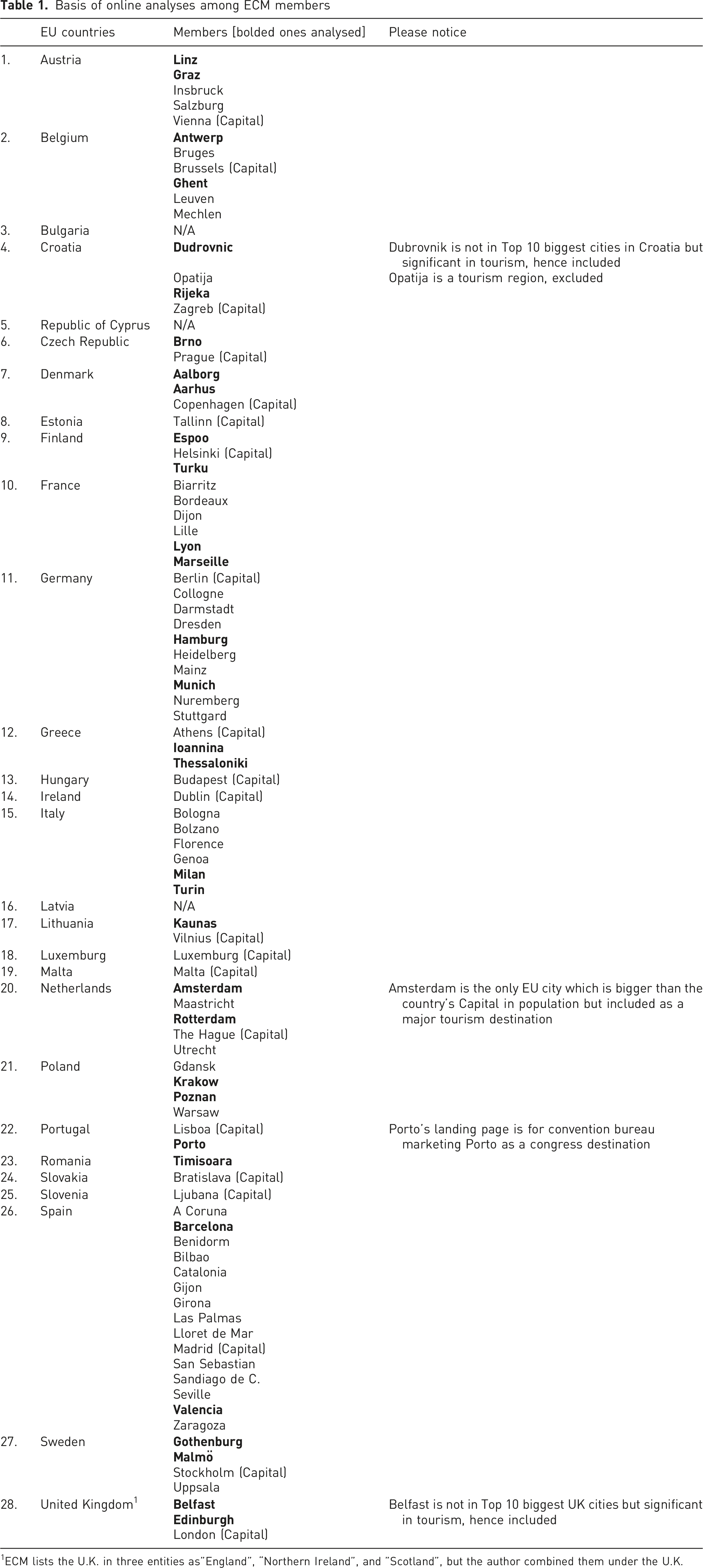
1ECM lists the U.K. in three entities as”England”, “Northern Ireland”, and ”Scotland”, but the author combined them under the U.K.
The analysis was carried out based on guidelines set at ‘WelDest’ project (Health and Well-being in Tourism Destination, an EU funded research project during the years 2012–2014). 1 However, the difference was that where WelDest looked mostly at nature-based health tourism destinations, this time the focus was on urban cities as destinations. Therefore, the criteria created by WelDest project group (Lange, 2014), was slightly altered keeping in mind the definition of wellness tourism and the need to address mind, body and spirit as discussed earlier. As the primary motivation of a wellness tourist is to engage in activities such as fitness and relaxation these are covered when the texts/ pictures/ videos of such activities are visible in the landing page (numbers 1 and 3), and/or if there is a link about this type of offering available (number 2). Natural and cultural resources both improve and balance all the main domains of human life including physical, mental, emotional, occupational, intellectual and spiritual, and so these original criteria were kept (numbers 4 and 5). In addition, all these criteria work well with both primary and secondary wellness tourism motivation, that is, they are services both groups could well utilize while on an urban holiday.
The final criteria created for online analysis: 1. The landing page mentions wellness (tourism) offering (e.g. spas, fitness, leisure and sport) 2. The landing page has a separate link/drop down menu about wellness offering 3. The pictures/ videos in the landing page promote wellness offering 4. The landing page of the destination promotes natural resources suitable for wellness tourism (e.g. urban parks, greenery) 5. The landing page of the destination promotes cultural resources suitable for wellness tourism (e.g. museums, theatres and concerts)
The analysis was done by the author manually with the help of an Excel spreadsheet created for this purpose. The link from the ECM website to members’ website was used as the main access point. With only a few exceptions, the landing page was in English, and so there was no need for further search of appropriate language. The whole idea was to have as an authentic look as possible simulating a regular tourist a regular tourist in search of a suitable destination would have, that is, while browsing through the main landing page to evaluate whether the possible customer would be able to see and identify the elements of wellness as listed above. It is common knowledge that consumers are not very eager to spend a lot of time clicking around searching for information, so this is a crucial momentum for the urban destination; the interest has to be risen quickly. While analysing, as soon as the city had three or more ticks out of the five points used, the website was being analysed in more detail. This meant a more thorough examination of texts, pictures, videos and links at the landing page was done in order to understand the connection of the information provided on wellness related service or product offering. Less than three clicks meant the site was discarded as ‘not showing wellness elements’ destination.
Findings
Analyses result (N = 32). Number of destinations filling the criteria from zero to five hits in country alphabetical order.
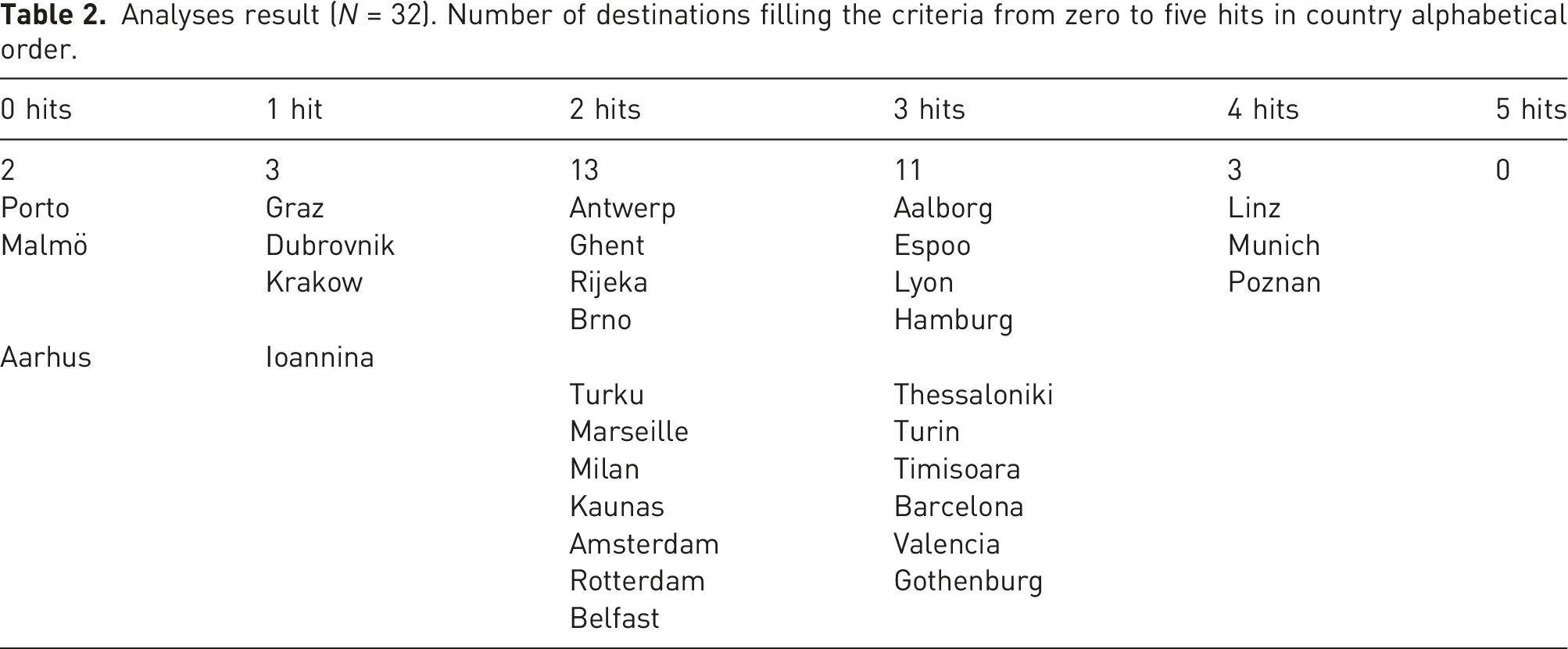
There were two cities; Porto and Malmö, which did not get any hits. They might both have the elements of holistic wellness as tourism destinations, but in the case of Porto, the link from ECM website leads directly to Porto Convention Bureau pages. Naturally, all the information in the landing page is about congresses and there is nothing reflecting wellness tourism as such. Malmö in Sweden had taken a different approach in its marketing, and the site promoted ‘Lonely Planet’ pages for more information about the touristic Malmö, and so the analysis stopped there.
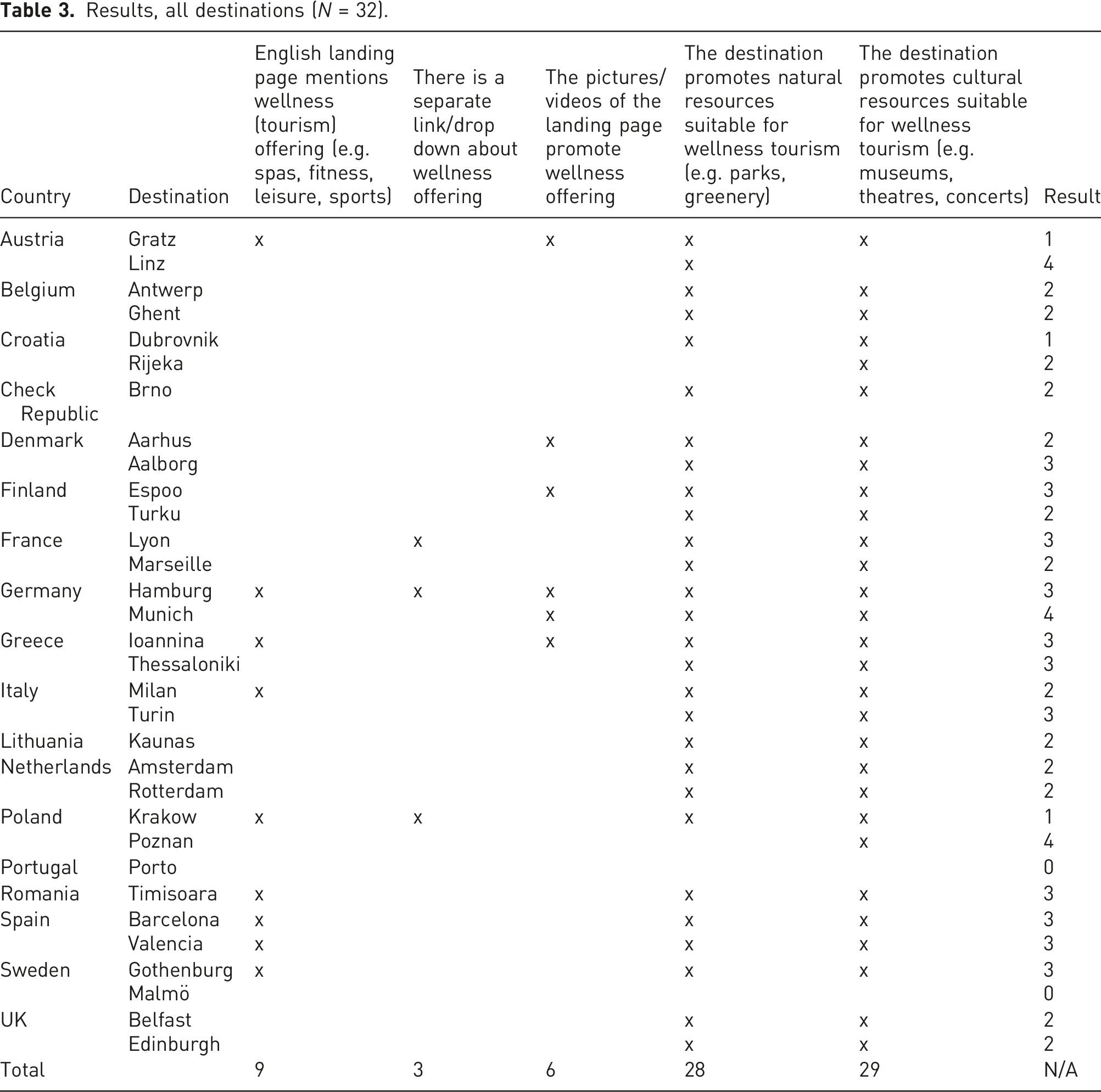
None of the cities fulfilled all the wellness criteria points but three of them had four hits out of five. The cities were Linz (Austria), Munich (Germany) and Poznan (Poland). The link of Linz directs first to the ‘City of Linz’ pages, that is, information about the services for locals. However, link to ‘tourism’ was very visible, so that was followed to a tourism site in English. The landing page is organized so that the offerings are easy to see at one glimpse. Nature, gastronomy and museums are highlighted well. Under ‘Discover Linz’ -> activities, one can find separate titles, for example, ‘nature lovers’ and ‘sports’, which both have various options ideal for wellness. Other wellness related activities and spaces included, for example, sauna, fresh lake swimming, city hiking trails, parks and green oasis, and the Botanical Gardens in the middle of the city.
The website of Munich highlighted summer, and the first glimpse already promoted sports, nature, gastronomy and culture as individual links providing more information and interesting real-life stories. A nature loving wellness tourist can for example enjoy a touch of the wilderness in the middle of the city, ‘The English Garten’, to create a place of Muße in the middle of the hustle and bustle. A sporty tourist might be surprised to find out that Munich is a world-renowned surfer metropolis hundreds of kilometres from the sea and feeding one’s body with gastronomical highlights could not be easier than in Munich. The number of still and moving pictures with lush, green nature was one of the highest in all the pages analysed and always displayed the season at hand.
Finally, Poznan in Poland was perhaps the most ‘wellness geared’ city destination in its overall marketing approach. The landing page has a word cloud with words like ‘spa’, ‘beauty’, ‘recreation’, ‘leisure’, ‘slow food’, ‘relax’ and ‘health’ in it. These words work as links for more information on the subjects. Under the word ‘health’ there are services like the ‘world of saunas’ with 14 different saunas, or the ‘salt cave’ where you sit and breathe microclimatic air. The link of ‘spas’ displays spas and hotel spas in Poznan. In addition, word links like ‘weekend’ and ‘city-break’ would prompt the urban experience for a short trip or a staycation. Unfortunately, the visual look and the technical solution of the website are very old-fashioned and not very inviting. However, Poznan was actually one of the three cities in total where wellness is visible as a link from the landing page; the other two were Lyon (France) and Hamburg (Germany). All the three urban destinations would be able to cater for a balanced wellness holiday to nurture the traveller’s body, mind and spirit.
Results, all destinations (N = 32).
Discussion and conclusions
In 2019, the travel statistics were on the raise for the ninth consecutive year (WTTC, 2021) and tourism industry was booming. The first quarter in 2020 meant zero tourism with global lockdowns. We have already seen several waves of the pandemic since autumn 2020 and tourism has not been able to really re-boot although things look somewhat more optimistic since the number of vaccinated people grow globally.
However, there are also positive aspects in the situation. During the pandemic, tourism industry has had a chance to re-think their product and services offering (Glusac, 2021). Issues like over tourism, sustainable tourism, and the connection of the pandemic to climate change have been topics in many conversations in, for example, the social media channels. An example of positive DMO product development during the pandemic is ‘Sustainable Travel Finland’ development programme by Visit Finland. Hundreds of tourism businesses, including well-being services (as they are classified in this programme), have attended the training sessions and obtained various environmental certificates becoming part of the sustainable tourism offering in their destinations and Finland (Visit Finland, 2021).
Urban wellness tourism is well suited to the post-pandemic tourism recovery. It emphasizes holistic well-being, focussing on body, mind and spirit. In many urban destinations, you can find everything you need for wellness; urban nature, sports and leisure facilities, local food and culture for example. Furthermore, you can get around the city on foot, by bike or by public transport. Generic tourist services such as hotels and restaurants are also easily accessible and there are usually plenty of sustainable options. It would be naïve to think that one could not achieve well-being and happiness in an urban setting.
No doubt, there is a growing pressure to travel once it becomes possible and, inevitably, tourism also to the urban destinations will continue. Staycations and weekend breaks into nearby urban destinations can easily have a wellness focus. Domestic travel has been a trend already during 2021 as recovering travellers stay close to home (Glusac, 2021). However, the industry has to be careful not to use wellness as a mere buzzword for marketing purposes. Destinations should only promote wellness tourism if their services and conditions in general emphasize this. Poor air quality, dirty streets, pollution and violence are not part of wellness.
The role of DMO activities in managing the destination is not going to disappear in the future. They will continue to play an active role in the branding activities as part of their management position at the destination level providing training, guidance and other support for the industry that in many regions is a major economic booster. However, it would be extremely important for urban tourist destinations to analyse their service offering and the target groups associated with it. If the strategy is to offer “everything to everyone”, it will be difficult to succeed in an increasingly competitive environment, hence, the similarity of marketing, the ‘sameness’ as Heeley (2015) put it. The re-booting phase during Covid-19 should have provided an ideal break for innovative service development for DMOs. Of course, it is clear that not every urban destination is suitable for wellness tourism. However, many small ‘second tier’ cities could have loads to offer in this area. Often it is really just a question of not realizing their potential yet.
As the holistic approach of wellness fully embraces sustainability, it would provide a branding opportunity for several urban destinations investigated in this study. A website analysis was carried out to examine the tourism offerings of 32 European cities. All but two of these cities, which were excluded from the analysis, had nature and culture-related marketing or offerings. In total, 14 out of 32 destinations, offer more than three of the set criteria already. This indicates that there are products and services in the destinations that could be used by a wellness tourist. In some cases, however, it is impossible for him/her to know that these exist, or it would require special effort and time to find the services on the main website of the destination.
This study has highlighted the elements that make up holistic wellness. There was a question in the title: Could European cities be destinations for urban wellness providing food for body, mind and spirit? This study argues yes, they could. Wellness tourists like other travellers, are free to choose the elements of wellness at the destination that bring them pleasure and well-being. For some, it is a combination of a city beach and a visit to the theatre with local food in good company afterwards. Another enjoys a good night’s sleep, pampering spa treatments and a visit to a museum. The question is how to market this offer and how to productize it better.
The study has two limitations: (1) the methodology used is developmental and the author examined the data subjectively. (2) The number of ‘clicks’ dedicated to each DMO website were limited to imitate a possible visitor glimpsing over for information. It might be possible that going through all links possible starting at the landing page, one could finally find something related to wellness tourism that is not visible with a limited number of clicks.
The future research could look at how the customer motivation and values have changed in wellness tourism during the Covid-19 pandemic, and what are the managerial implications regarding the development and marketing of tourism offering for urban destinations. Interesting research questions include for example: Will there be a need to re-think the customer segments and service offering, how would new customer segments and services affect the place brand of urban city destinations and finally, whether wellness would fit well as a niche, or will holistic wellness be the default of future tourism?
Footnotes
Declaration of conflicting interests
The author(s) declared no potential conflicts of interest with respect to the research, authorship, and/or publication of this article.
Funding
The author(s) received no financial support for the research, authorship, and/or publication of this article.
