




Abstract
COVID-19 has led to immense impacts on the hospitality sector, putting millions of jobs at risk. The uncertainty has resulted in significant psychological effects on service staff. Developing on micro-level interpersonal interactions between line managers and service staff, this article aims to propose a bottom-up approach to alleviate service staff’s anxiety and enhance their work resilience during and after the pandemic. The proposed conceptual framework synthesised the personal uncertainty constructs, self-determination theory (SDT) and leader-member exchange (LMX) to address the psychological issues that emerged from a prolonged ambiguous and unsettled period. The framework proposes that interpersonal exchanges at the micro-level can strengthen service staff’s intrinsic motivation and resilience. This article offers new insights into crisis management research and practice in the hospitality sector by developing a people-centred approach. At the micro-level, this framework offers a holistic strategy, including a flat team structure, uncertainty-embracing organisational environment, transparent decision-making process and sympathetic behaviours from leaders to facilitate service staff to develop greater coping mechanisms for the unknown future. Furthermore, this framework provides organisations preliminary guidelines to establish a longitudinal preventive strategy to strengthen employees’ work resilience.
Keywords
Introduction
Since December 2019, the global pandemic COVID-19, an immense health emergency, has raised significant challenges to public health systems and the economy (McKibbin and Roshen, 2020). The hospitality industry has been among the most affected sectors during this pandemic (Baum et al., 2020). With various control measures and travel restrictions implemented globally (Gössling et al., 2020), the tourism and hospitality sectors have experienced a severe decline in demand. In 2020, the international arrivals decreased by 74%, with one billion lower than in 2019 (UNWTO, 2021). Hence, the COVID-19 pandemic has raised issues of vulnerability in tourism and hospitality employment, such as cutting costs, reducing services and suspending operations (Gössling et al., 2020). These unexpected and unprecedented changes have resulted in massive challenges and uncertainty for customer-facing employees in the hospitality sector, particularly their psychological wellbeing (Baum et al., 2020; Jung et al., 2021).
Recent studies have addressed these adverse psychological impacts on hospitality service staff, such as occupational stressors (Wong et al., 2021), job insecurity (Vo-Thanh et al., 2021), turnover intent (Bufquin et al., 2021; Jung et al., 2021), amplification of disadvantaged groups (Baum et al., 2020), and organisational resilience (Khan et al., 2020; Melián-Alzola et al., 2020; Ngoc Su et al., 2021). However, these studies did not discuss how to leverage the micro-level leader‐member relationship as a longitudinal recovery plan and preventive strategy. With the rollout of mass vaccination programmes, some regions show a promising prospect of the hospitality sector and are reopening the business to welcome international visitors again after a long time (Miles et al., 2021). Nevertheless, fluctuating COVID-19 restrictions and guidelines, threats of new virus variants and individual readiness for in-person contacts have led to a distinct extent of uncertainty in the post-pandemic era (Ateljevic, 2020). Hence, such ‘new normal’, including vaccination passports, varied mask requirements in different venues, or the government’s various restriction plans, requires psychological adjustments and new skills for employees to accommodate varying possibilities (Kaushal and Srivastava, 2021). We acknowledge many people lost their jobs during the COVID-19 pandemic; however, the scope of this study only focuses on customer-facing staff who are still employed.
Working in a labour-intensive sector, hospitality service staff often suffer from emotional exhaustion (Wong and Wang, 2009). Indeed, employees’ psychological wellbeing in the hospitality sector has been acknowledged in recent research (Prayag, 2018). We recognise that the emotional labour of customer-facing staff would be enlarged during and post the pandemic. Our theoretical discussion builds upon Prayag’s (2018) recent call for shifting the focus of crisis and disaster management research towards a bottom-up people-focused approach. Our article proposes a framework drawing upon micro-level interpersonal interactions between hospitality line managers and service staff to alleviate employees’ anxiety and enhance their work resilience during and after this pandemic. The present framework emphasises a better understanding of individuals’ psychological needs and the quality of the leader‐member relation to enhance service staff’s intrinsic motivation and resilience during the uncertainty. Although relevant theories such as leadermember exchange (LMX) has been considerably studied in workplace wellbeing and employee engagement domains (Altinay et al., 2019), this micro-level interpersonal approach is under-researched in the context of crisis management. This article corresponds to the latest demands (Khan et al., 2020) on long-term recovery and responding strategy in the future. It develops a conceptual framework underpinned by psychological interactions to manage, develop and support hospitality customer-facing employees in the post–COVID-19 era.
This conceptual framework aims to contribute to new understandings into crisis management research and practice in the hospitality sector by focusing on the micro-level leader‐member relationship. Moreover, it offers holistic suggestions for line managers to support service staff when they experience an unknown future. Furthermore, this proposed framework provides guidelines for organisations to establish a longitudinal preventive strategy to develop employees’ sustainable work resilience.
Our discussion commences with a summary of negative impacts of COVID-19 on the hospitality sector. We then propose a framework of micro-level interpersonal interaction between the leader and team member (i.e. LMX) as an essential determinant to respond to the uncertainty during and after the COVID-19 pandemic. We unpack hospitality service staff’s psychological reactions to a prolonged, uncertain circumstance. To incorporate the importance of HRM strategy into this unprecedented incidence to the hospitality sector, we elaborate the well-established theoretical frameworks of organisational psychology, SDT and LMX to explain how an open and trusting relationship between line managers and their employees can facilitate a better coping process. More importantly, we encourage a high-quality leadermember relation as a proactive and preventive work resilience-building strategy. Finally, several theoretical implications and practical suggestions are proposed.
COVID-19 and Hospitality Human Resource Management
As a labour-intensive sector, human capital and resource is a widely discussed topic in hospitality studies. This includes the application of organisational psychology or sociology relevant theories in hospitality HRM research (Lucas and Deery, 2004). However, given the characteristics of the hospitality sector, such as the intangibility and perishability of the service, fluctuations of demands and seasonality (Tracey, 2014), several issues and challenges of hospitality HRM have been investigated, such as unusual working hours (Tsaur and Tang, 2012), poor working conditions (Ariza-Montes et al., 2019), high staff turnover rate (Iverson and Deery, 1997) and low level of remuneration (Casado-Díaz and Simon, 2016). Lacking sufficient training and skill developments not only resulted in the inconsistency of service delivery and unsatisfied customers but also affected service staff’s morale and motivation (Law et al., 2011). In addition, the requirement of performing emotional labour when interacting with customers could lead to negative impacts on customer-facing staff’s psychological wellbeing (Brunetto et al., 2014).
The COVID-19 pandemic raises new challenges for HRM in the hospitality sector. Differing from other types of disasters or crises, the uncertainty of not knowing when the pandemic will be over puts massive pressure on hospitality employees’ psychological wellbeing, particularly causing stress and anxiety (Bufquin et al., 2021; Wong et al., 2021). In addition, the uncertainty of the post–COVID-19 era and the potential subsequent financial recessions resulting in a decrease of demand (Bartik et al., 2020) and unclear career outlook (Cheer, 2020) differentiate the pandemic from other crises or disasters in the recovery stage. Compared with knowledge workers who can work remotely (Waizenegger et al., 2020) and perceive less impact from the COVID-19‐related disruptions, a customer-facing hospitality staff is more vulnerable in terms of the unpredictability of returning date, job security and health-related issues in the post–COVID-19 recovery.
Since the COVID-19 outbreak, a growing number of studies have investigated the significant impact in tourism and hospitality (e.g. Gössling et al., 2020; Higgins-Desbiolles, 2020). These studies mainly emphasise on investigating challenges and strategies of HR of hospitality workforce, which has been hit the hardest during this pandemic. Wong et al.’s (2021) study indicates that hotel occupational stressors caused by COVID-19 resulted in a high level of anxiety, and negatively impacted job satisfaction and work commitment. Compared with furloughed employees, frontline staff in restaurants during COVID-19 suffered from a higher level of psychological distress and substance use, which led to turnover intentions (Bufquin et al., 2021). Another key area of research is job insecurity during COVID-19. Baum et al. (2020) argue the casualisation and insecurity of hospitality work have been amplified during the pandemic. To protect customers and employees’ health and safety, many hospitality businesses implemented new technologies such as artificial intelligence, contactless automation technology and virtual reality in operations and marketing (Pillai et al., 2021). The digitalisation of hospitality operations during the pandemic not only requires a transformational skillset from staff but also leads to job insecurity (Koo et al., 2020).
Regarding proposed strategies and coping mechanisms, Vo-Thanh et al. (2021) argue that an organisation’s proactive responses, including open communications, reassurance and creating trust in employees during COVID-19, are crucial to reduce perceived job insecurity and maintain a high level of job performance. Leveraging the psychological contract to care for employees’ safety and wellbeing is believed as an effective tool to establish organisational trust during COVID-19 (Guzzo et al., 2021). In the same vein, Jung et al. (2021) propose an open and supportive organisational culture for employees to share their concerns and build a close tie between the line manager and employees during the pandemic. In addition, both Melián-Alzola et al. (2020) and Vo-Thanh et al. (2021) encourage hospitality firms to involve employees in the process of recovery and emphasise its positive effect in strengthening the organisation resilience. Collecting data from the first wave of the COVID-19 in Vietnam, Ngoc Su et al. (2021) present a comprehensive set of HR practices to develop organisational resilience. In the recovery stage, practices including broad resource network, talent management, job redeployment and performance management were proposed to enhance the adaptive capacity of tourism and hospitality businesses after the lockdown. These HR practices during COVID-19 showed hospitality businesses’ active response to reduce employees’ job insecurity. In our study, we expand these arguments, and focus on leveraging a sustainable micro-level leader‐member relationship to develop long-term employee resilience in the post–COVID-19 era.
Building on the growing number of studies in hospitality employees’ psychological distress during COVID-19 (Bufquin et al., 2021; Chen, 2021), our paper takes a distinctive angle by emphasising the effectiveness of the micro-level working relationship between the supervisor and customer-facing employees in the time of uncertainty, and how such relationship can re-build employees’ post-pandemic work resilience. Given that crisis management in tourism and hospitality in general focuses on the top-down governmental and sectoral level (Ritchie and Jiang, 2019), there has been a growing realisation that new conceptual frameworks to challenge contemporary norms in tourism and hospitality workforce research are demanded (Baum et al., 2016). Accordingly, we suggest a people-centred approach to understand service staff’s potential psychological responses to uncertainty through the lens of personal uncertainty construct (Clampitt et al., 2000). A conceptual framework, drawing upon SDT to analyse factors promoting employees’ psychological needs and intrinsic motivation during the uncertainty in the post–COVID-19 era was proposed. This proposed framework is also underpinned by the two-way leader‐member relation theory LMX to facilitate a persistent work commitment and resilience.
A conceptual framework to enhance post–COVID-19 work resilience
The proposed conceptual framework (Figure 1) synthesises psychological constructs of personal uncertainty (perceptual, process and outcome uncertainty) in the crisis management study and recent research evidence of SDT and LMX as high-performance practices that influenced employee engagement and creativity in hospitality (He et al., 2021). Firstly, we elaborate on individuals’ cognitive state when undergoing prolonged uncertainty and anxiety, and further explain how these psychological states and emotional reactions impact on employees’ intrinsic motivation (SDT). Secondly, we suggest a two-way (dyadic) working relationship between leaders and followers. LMX, as the groundwork to flatten communication hierarchy, stimulate employees’ strengths and enhance the perceived values of their work, is adopted in the framework to restore sustainable working resilience in the post–COVID-19 era. The detailed theoretical discussion and development of this framework are explained step by step in the following sections. A micro-level leader‐member relation risk management framework.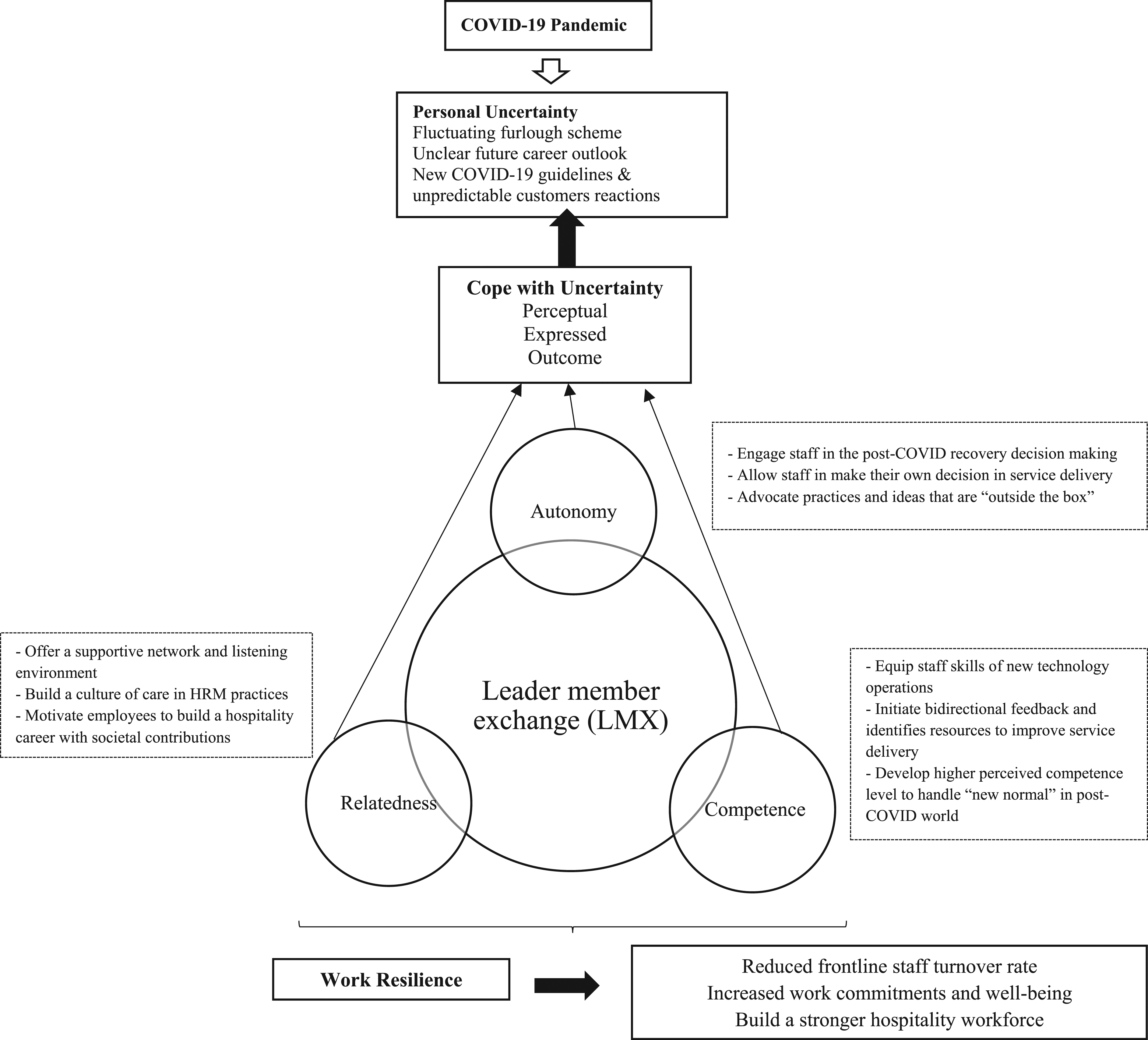
Personal uncertainty and COVID-19
Before discussing SDT and LMX in this people-centred crisis management conceptual framework, we first unpack the personal uncertainty construct and address potential issues caused by unknown situations during and after COVID-19. Uncertainty refers to that something is unclear or unsettled; uncertain individuals often have doubts as they are unsure what they know and which direction they may head to (Clampitt et al., 2000). The sources to cause uncertainty are usually derived from external factors (e.g. unexpected changes, competitions or crises) that impact individuals’ psychological states, including insecurity and anxiety.
There is a lack of theoretical understandings of individual work resilience in the hospitality sector, whereby the concept of uncertainty was largely discussed in tourists’ risk perceptions, resource and strategic management of firms (Williams and Baláž, 2015) and organisational level resilience (Melián-Alzola et al., 2020).
Given that uncertainty generates a feeling of vulnerability or anxiety (i.e. psychological insecurity) that can lead to perceptions and information distortion (Clampitt et al., 2000), service staff under uncertainty often produce premature closure, false dichotomies, rejection of relevant information and avoid new ideas or actions. In addition, anxiety caused by uncertainty makes employees difficult to develop new strategies to cope with the forthcoming circumstances. Hence, uncertainty may cause harmful impacts on workplace issues such as job security, wellbeing (e.g. stress and anxiety), work engagement, task performance and motivation to change (Frazier et al., 2017), while individuals are under an unsettled environment or workforce for the long-term. Accordingly, adverse psychological effects arising out of uncertainty may prevent service staff from taking adventurous and advanced actions while transitioning to the post–COVID-19 era. When an individual comprehends a strong psychological safety, it reduces perceived threats, removes barriers to change, and creates a context that encourages provisional attempts and tolerates failure without retaliation, renunciation or guilt (Schein and Bennis, 1965).
Figure 1 indicates that service staff in the hospitality sector have been experiencing a significant amount of uncertainty since this pandemic commenced by fluctuating furlough schemes and unclear career futures. As mentioned above, many hospitality businesses recently reopened with varied COVID-19 restrictions to boost the economy; service staff were expected to deal with unpredictable customer behaviours and reactions to these restrictions, such as wearing a mask and social distance, limit of gathering numbers and vaccine passport. The psychological discomforts resulting from this unknown long-term circumstance are recognised as influential factors affecting employee coping capability to uncertainty, including perceptual, process and outcome uncertainty. Meanwhile, service staff’s need satisfaction (i.e. intrinsic motivation) at work is usually adversely impacted by continuous psychological discomforts, such as anxiety (Kamel and Hashish, 2015).
According to Williams and Clampitt (2003), organisations that welcome and are open to uncertainty usually facilitate greater employee commitment and job satisfaction than those that neglect it. Meanwhile, employees in uncertainty-embracing organisations are able to cope better with changes and new circumstances. Specifically, workplace climate and environment play essential roles in facilitating employees’ coping skills for uncertainty. Clampitt et al. (2000) develop a personal uncertainty construct to assess how employees cope with uncertainty in the workplace. The personal uncertainty construct is underpinned by three scales.
First, perceptual uncertainty indicates employees’ willingness to actively acknowledge different perspectives, new ideas or signs of the changing situation. In the COVID-19 context, service staff’s perceptual uncertainty can be referred to the extent they accept persistent and constant changes (e.g. COVID-19 restrictions) caused by this unprecedented crisis. Additionally, Clampitt et al. (2000) recognise that continual adjustments to adapt to unfamiliar circumstances, such as disagreements with colleagues or conflicts with customers due to COVID-19 constraints, are essential. Second, process uncertainty refers to employees’ comfort in deciding on intuition or a hunch. Service staff are usually expected to react promptly to customers’ requests or actions. The capability to make a swift decision to accommodate customers’ needs within COVID-19 guidelines is essential under this unsettled period. Third, outcome uncertainty describes the degree to which employees need a detailed plan or a specific outcome before starting the project. Although some countries have lifted most COVID-19 restrictions due to successful vaccination rates, the hospitality sector still faces a great level of uncertainty by threats of new variants or a surge of infection rates. Governmental protocols are very likely put into action instantly. Therefore, service staff’s coping mechanisms with outcome uncertainty is desirable to implement new strategies without explicit instructions or consequences are essential during and post the COVID-19 era.
These three scales are all associated with individuals’ psychological capital and security, which address how employees share feelings, develop plans and implement new actions during irregular periods. In this framework, we consider that the personal uncertainty construct has a crucial position to understand service staff’s psychological safety, a cognitive state where employees hold a belief that the workplace is safe for risk-taking (Kahn, 1990; Edmondson, 1999) through unpacking the degree and stage of their cognitive reactions to uncertainty.
According to SDT, people’s psychological needs are fulfilled when individuals perceive their cognitions or ability to interpret meaning. However, uncertainty prevent people from the opportunity and ability to access information about the requirements of their roles, how those role requirements are to be met and the evaluative procedures available to ensure that the role is being performed successfully (Brashes, 2001; Martin, 2008). Precisely, uncertainty (e.g. COVID-19) causes difficulty for people to access the information they need to secure autonomy, develop competencies and identify values at the workplace as usual. Employees’ work motivation and resilience are adversely impacted while under such prolonged unsettled circumstances. Consequently, we propose a micro-level interpersonal interaction approach drawn upon LMX in this paper to understand service staff’s cognitive transformation process and identify their psychological strengths to thrive. The following section discusses how uncertainty affects the intrinsic work motivations, and elaborates how to leverage LMX in through three dimensions of SDT in the micro-level crisis management.
Psychological needs during and after the pandemic: Self-determination theory (SDT)
Following the discussion above, this section articulates the theoretical interactions between the personal uncertainty construct and the leading intrinsic work motivation concept, self-determination theory (SDT). SDT, indicating people’s cognitive resources, inherent growth tendencies and innate psychological needs (Deci, 1971), is considered as the theoretical foundation of this micro-level leader‐member relation framework during the uncertainty. SDT has been addressed in several uncertainty-related studies. For instance, SDT was identified as the uncertainty reducer in career management (Lin et al., 2015) and trust between the leader and team member (Skiba and Wildman, 2019). Accordingly, we recognise the satisfaction of basic psychological needs under SDT enhances people’s intrinsic work motivation during this unprecedented crisis.
Intrinsic motivation means people doing an activity because they find it interesting and derive spontaneous satisfaction from the activity itself (Porter and Lawler, 1968). SDT focuses on peoples’ psychological satisfaction, including the extent to which humans’ intrinsic requirements to feel autonomous, competent and related to others, to understand their strengths and thrive within organisational contexts. Compared to other conventional work motivational theories (e.g. external financial rewards or goal-setting), SDT offers a richer picture of individuals’ rooted psychological commitment to genuinely explain how people are urged to enjoy their work. SDT has been theoretically associated with positive psychology, highlighting the higher quality of engagement and wellness in the workplace and more autonomously motivates employees (Ryan and Deci, 2017). Therefore, we recognise that SDT, a theory widely used in adult development domains and workplace psychological wellbeing, is the most appropriate theory to alleviate hospitality service staff’s anxiety caused by uncertainty and facilitates sustainable work motivation during and after COVID-19.
There are three components, autonomy, competence and relatedness, underpinning SDT. Each element can be theoretically articulated with the service staff’s psychological needs during COVID-19. According to Deci and Ryan (2000), autonomy need indicates that employees demand a sense of independence and control over their work. Organisations with an autonomous working environment generally take accounts of employees’ voices, give as many choices as possible and provide a meaningful rationale for the decision-making (Deci et al., 1994). Hence, autonomous organisational culture promotes the individual’s willingness to proactively seek varied ideas and solutions to cope with fluctuating situations. When employees are given opportunities to declare thoughts and make choices at the workplace, they are more comfortable expressing their doubts, scepticism and concerns under unsure circumstances. Meanwhile, employees tend to look out for new ideas to address problems and spot changing trends. With this open and adjustable organisational climate, employees are more confident to take risks and manoeuvre appropriate actions (Williams and Clampitt, 2003). During COVID-19, service staff’s adaptability to handle challenges and changes is directly associated with perceptual and process uncertainty to cope with challenges during and after this pandemic.
Second, competence need, referring to being effective in dealing with the environment in which a person finds oneself (Deci and Ryan, 2000), can strengthen employees’ perceived capability and confidence when making decisions or taking actions in an unsettled situation. A low level of perceived competence is always a challenge for the hospitality service staff due to the high turnover rate and poor training (Poulston, 2008). According to SDT, individuals are more likely to experience a wide range of positive psychological outcomes when they feel competent. Given process uncertainty, indicating the individual’s confidence in making prompt judgements and decisions under unfamiliar situations, service staff in the hospitality sector demands a greater perceived competence level to help customers to accommodate new COVID-19 guidelines or to handle uncooperative customers via a swift decision-making process (Assaf and Scuderi, 2020). Service staff have stronger self-assurance to respond to unexpected incidents or reactions from customers when their perceived adequate competent. In addition, employees’ competence level positively correlates with outcome uncertainty, taking new actions without knowing consequences. Seeing that the recovery journey of hospitality will be slow compared to other industries (Krishnan et al., 2020), employees’ perceived capability determines the time and effort that they invest in a task during this prolonged ambiguous circumstance. Moreover, the increasing adoption of artificial intelligence and service robots in the hospitality sector due to COVID-19 (Seyitoğlu and Ivanov, 2020) has added new skill challenges for service staff. Specifically, employees’ perceived competence level affects their work commitment and persistence while experiencing a changing and unfamiliar future.
Third, relatedness need, which represents the psychological need of belonging and relatedness to the society (e.g. workplace) people attach to, has a significant association with employees’ psychological adjustment during the uncertainty (Baard et al., 2004). When employees have a stronger connection or psychological bonding with their workplace, they are more internally motivated and engaged in behaviour benefiting their organisation, colleagues and customers (Chen and Li, 2009). Considering that recent studies have addressed that hospitality service staff suffering from job insecurity (Jung et al., 2021), low work resilience (Khan et al., 2020) and psychological distress (Wong et al., 2021) during the pandemic, some researchers indicated a potential ‘domino effect’ of the high turnover rate in hospitality and tourism sectors (Bufquin et al., 2021). Hence, the relatedness need that reflects on the extent to which employees are cared for and by relational others at the workplace can enhance the meaningfulness of their job and intrinsic motivation throughout this challenging time. Specifically, service staff’s perceived values and meanings of their job determine their coping mechanism regarding perceptual, process and outcome uncertainty through actively engaging in decision-making and new strategy implementation during and after the pandemic.
Despite macro-level fiscal support, such as furlough schemes or the Eat Out to Help Out programme, offering financial security and encouraging economic activities in hospitality, we recognise service staff’s psychological and emotional responses to unknown future and changes seem to be overlooked in the existing recovery strategy. Accordingly, we propose a micro-level crisis management perspective to focus on individual-level psychological effects (i.e. personal uncertainty construct) and resources (e.g. SDT) as well as the use of relational approach (e.g. leadermember relations) in the enhancement of sustainable work motivation and resilience during and post-pandemic.
A micro-level crisis management: Leader‐member exchange (LMX) during and after the pandemic
Adhering to the discussion above, this section scrutinises leadermember exchange (LMX), the core component in our proposed framework. Introduced and developed by Dansereau et al. (1975), LMX describes an approach to evaluate the quality of the relationship between a leader and a follower (Martin et al., 2016). The LMX approach is one of the pioneering systematic leadership theories to consider the follower’s influence in leadership processes. LMX acknowledges that both parties contribute to the development and maintenance of the ongoing relationship quality (Schyns and Day, 2010), which are associated with positive work-related outcomes, including follower satisfaction, commitment and performance (Gerstner and Day, 1997), as well as citizenship behaviour (Ilies et al., 2007). However, the application of LMX in the context of crisis management is limited. We propose that applying LMX during and post COVID-19 provides a useful guideline for line managers to strengthen the level of trust with employees undergoing doubts and anxieties. An egalitarian working relationship and the extent of consensus between both parties have been confirmed to be important indicators for a high LMX quality. In other words, a shared understanding, inter alia the leader and follower both agree on the followers’ workplace contributions, enhances the quality of the relationship between the dyad (Schyns and Day, 2010). In addition, the positive LMX agreement strengthens employees’ psychological safety (Schyns and Day, 2010), which allows them to feel safe at work to grow, learn, contribute and perform effectively in a rapidly changing world (Edmondson and Lei, 2014). Psychological safety is rooted in a trust relationship between the leader and follower. When trust is presented in the dyad, employees are more likely to express their feelings, seek feedback and propose innovative solutions (Landry and Vandenberghe, 2009). Specifically, a greater psychological exchange within the pair promotes followers’ psychological assurance and cognitive strengths to adapt to the uncertainty and take inconclusive actions during an unsettled period (Liao et al., 2017; Rego et al., 2017).
Considering that hospitality service staff are required to express enthusiasm, friendliness and cheerfulness despite negative emotions that they may experience (Wong and Wang, 2009), their emotive reactions towards changes or unfamiliar events during the uncertain period requires investigations. Accordingly, the application of a people-centred strategy to improve work resilience during and post–COVID-19 is urged. The line manager, who has direct and frequent interactions with service staff, becomes the first person to recognise and acknowledge team members’ psychological responses to the pandemic. Specifically, line managers usually have a closer working relationship with frontline staff, and, indeed, portray a valuable part to not only alleviate employees’ psychological distress during the uncertain and challenging period but also to facilitate high-quality interpersonal relationships with their teams. Accordingly, our proposed framework integrates theories of personal uncertainty, SDT and LMX (Figure 1) to articulate a positive and satisfactory interpersonal relationship between the line manager and employee. It fulfils service staff’s psychological needs and support for their emotional responses during a prolonged period unpredictable crisis. The section below unpacks the theoretical interactions between LMX and SDT; in the interval, we spell out pragmatic techniques line managers can employ to alleviate their teams’ emotional burden and facilitate sustainable intrinsic work motivation under a prolonged unsettled period.
Previous studies (e.g. Dhar, 2016) have examined the positive relation between LMX and innovative behaviour with a high level of autonomy in the tourism sector. Job autonomy provides employees with an opportunity to find different combinations of work methods (Wang and Cheng, 2010). This flexibility allows employees to come out of the routine work and try out for a better solution (Shalley and Gilson, 2004). Therefore, the high-quality leader‐member relationship, offering an open communication channel and trusting rapport, encourages employees to actively seek new ideas and perspectives during the uncertainty (Schyns and Day, 2010). Involving employees in the decision-making and encouraging employees to test new ideas have been suggested by Melián-Alzola et al. (2020) as effective strategies to strengthen the hotel’s organisational resilience during COVID-19. In addition, Vo-Thanh et al. (2021) emphasise the significance of involving staff in the post–COVID-19 recovery plan to enhance their organisational citizenship behaviours and psychological safety. Hence, we consider LMX offers a robust theoretical foundation to mitigate service staff’s psychological insecurity and promote an autonomous working environment for generating and acknowledging new ideas and perspectives during the uncertainty.
Second, LMX plays a critical role to determine individuals’ perceived competence (i.e. self-efficacy). When the leader offers frequent and open communications for performance feedback; members could have acknowledged their strengths, improvement areas and development resources. Therefore, high-quality leader-member relationships contribute to self-belief in their capabilities to succeed in current and future performance (Jawahar et al., 2018).
Third, the trust, respect, empathy and openness in a high-quality LMX may serve as important contextual support that fulfils an employee’s need for relatedness. Employees usually receive greater emotional support in a high-quality working relationship. This perceived supportive network reduces psychological distress resulting in the pandemic, such as fear, anger and anxiety (Jawahar et al., 2018).
Overall, our framework (Figure 1) proposes that individuals’ intrinsic cognitive needs (i.e. autonomy, competence and relatedness) are essential determinants to support service staff remaining in the hospitality sector and strengthening work motivation and resilience through this uncertain and unsettled circumstance. Considering that contemporary literature mainly stresses macro-economics and organisational-level policy during and after COVID-19, we suggest a people-centred approach drawn on the LMX should be employed in supporting hospitality service staff’s cognitive needs since the interactions between managers and employees in hospitality sectors during this pandemic has been identified as antecedents to support employees’ psychological states and commitment to their current work (Guzzo et al., 2021; Zhang et al., 2020). We argue that LMX is a vital medium to strengthen employees’ psychological safety, self-determination and promote stronger employee resilience during this unprecedented challenge in their careers. Our framework proposes that SDT and LMX take essential roles in responding to three features of psychological uncertainty and re-build work resilience during an unsettled circumstance.
Resilience has been defined as ‘a dynamic process wherein individuals display positive adaptation despite experiences of significant adversity or trauma’ (Luthar and Cicchetti, 2000: 858). It is usually one’s developable ability to ‘bounce back’ from adversity or personal setbacks and even grow and strengthen due to this adjustment (Luthans et al., 2006). Whereas resilience was regarded as a response to threat or risk (Rutter, 1985; Campbell-Sills et al., 2006), the vulnerability and anxiety caused by uncertainty indeed deviate individuals from a positive psychological state, as so-called psychological capital which is featured by self-efficacy, optimism and hope (Luthans et al., 2006). This usually exposes individuals to a sensitive and insecure state that undermines their capability to rebound from work challenges, that is, work resilience. Therefore, LMX and SDT play a crucial role in developing psychological safety and work resilience during uncertainty.
Theoretical Contributions and Practical Implications
Theoretical contributions
Following the discussion throughout this article, several theoretical indications have emerged. Whereas individuals’ psychological needs (e.g. SDT) and leader‐member relationships (e.g. LMX) have been considerably studied in varied organisational settings, the micro-level interpersonal interaction in crisis management is still under-researched. Our proposed framework specifies that three elements under SDT, autonomy, competence and relatedness, offer a clear path to understand employees’ fundamental psychological needs during the insecure and unsettled period. This framework sheds light on crisis management theories by indicating that individuals’ work motivation would be negatively affected while lacking an autonomous communication channel to express their concerns, receive information and participate in the decision-making process. In addition, the high-quality LMX acts as a valuable vehicle to establish open intercommunication and trust relationship. A strong trust relationship within the leadermember dyad promotes employees’ willingness to actively seek alternative solutions and make decisions under uncertainty. This micro-level reciprocal psychological exchange and interaction further supports service staff’s psychological requirements, and identifies their cognitive strengths to thrive during a challenging time. Hence, our conceptual framework extends contemporary crisis management literature, which mainly stresses ‘top-down’ strategies into ‘bottom-up’ interpersonal perspectives. In addition, we also suggest a further theoretical insight of SDT and LMX into critical management circumstances, including a fast change, challenging and uncertain working environment.
Practical implications
Given that individuals’ psychological needs and interpersonal interactions between the leader‐member dyad have been highlighted in our crisis management framework, several practical applications are suggested for the hospitality sector. First, a flat team structure and egalitarian culture should be established to shorten the distance between the leader and members. This can be achieved through regular formal and informal communication channels. Open intercommunications offer each member opportunities to express their fears and concerns under uncertainty. Meanwhile, the leader can also utilise these interactive events to clarify recent COVID-19 regulations, organisations’ corresponding actions and involve members’ voices in the decision-making process. Considering continual travel policy changes (e.g. the green, amber and red list) and new COVID-19 variants, an open and egalitarian team culture promotes swift adjustments from a bottom-up approach. For instance, the team member would be more willing to seek alternatives and accommodate themselves to the changed situations when the communication structure is less hierarchical. In addition, more accessible team culture and interpersonal interaction promote trusting working relationships and service staff’s psychological safety.
Second, a long-term leadership development strategy should be considered in the hospitality sector in the future. Organisations are urged to include crisis management in their frontline manager development scheme, in particular, the relationship-based leadership approach (e.g. LMX theory), to have a better understanding of employees’ psychological needs and develop more flexible and open communication skills. Meanwhile, service staff should receive comprehensive training to cope with changes to strengthen their psychological capital and level of competence for a similar future crisis.
Future research directions
According to the theoretical discussions in this article, we first recognise a quantitative cross-validation study to examine service staff’s perceived leader‐member relationship, and their psychological security and intrinsic motivation in the hospitality sector is urged in the post-pandemic era. Second, a contextualised qualitative study to explore service staff’s psychological needs and emotional challenges along with the role line managers take during the uncertainty is crucial for future leadership development. Third, future research should empirically investigate the personal uncertainty at the employees’ level. Finally, it is essential to further investigate the skillset for leaders in hospitality to strengthen their interpersonal capability and develop a people-centred risk management scheme based on our proposed theoretical framework. We encourage future research to apply the conceptual framework in various settings both in understanding employees’ personal uncertainty and exploring strategies to develop a sustainable, trusting relationship to improve service staff’s resilience.
Conclusion
Distinguishing from previous literature related to crisis and disaster management in the hospitality sector, our theoretical exploration is grounded on the latest concern about psychological capital (Fang et al., 2020) and resilience at an individual level (Prayag, 2018). This conceptual framework draws on long-standing social psychological theories SDT and LMX to elaborate on COVID-19’s impacts on individuals’ psychological wellbeing and potentially positive effects from a high-quality interpersonal relationship. We suggest that an uncertainty-embracing organisational environment, transparent decision-making process and sympathetic behaviours of leaders help reduce employees’ anxiety during the uncertainty and promote their positive psychological states to cope with the unknown future (Laschinger and Fida, 2014). More importantly, our study echoes the recent theoretical argument that building up long-term employee resilience should be highlighted instead of interim emergency management.
Several theoretical and practical contributions are made through this article. First, we synthesise the long-lasting LMX concept and the SDT in the uncertain crisis context, which has been under-researched in organisational behaviour literature. Second, our article offers new insights into hospitality research and practice by emphasising the leader‐member interpersonal interactions during the extremely challenging period since hospitality is a sector particularly vulnerable to disaster and crisis (Faulkner, 2001). Third, we recognise an uncertainty-embracing organisational environment, transparent decision-making process and sympathetic behaviours of leaders reduce employees’ anxiety during the uncertainty and encourage employees to take innovative actions to cope with the unknown future. Finally, we suggest that a long-term strategy for employee resilience should be established, whereas previous research has indicated that the ability of business sectors to bounce back from crises and disasters essentially depends on the resilience of employees, managers and stakeholders (Hall et al., 2017). This conceptual paper aims to emphasise the importance of micro-level interpersonal interactions in supporting macro altitude business or economic strategy. More empirical research to investigate and validate the conceptual framework is urged.
Footnotes
Declaration of conflicting interests
The author(s) declared no potential conflicts of interest with respect to the research, authorship, and/or publication of this article.
Funding
The author(s) received no financial support for the research, authorship, and/or publication of this article.

Author Biographies
Yi-Ling's research focuses on the organizational behaviours, workplace wellbeing and evidence-based coaching intervention.
Wenjie has research interests in social inclusion, digital tourism and tourist behaviour.