




Abstract
Employees of retail travel agencies in sales roles can have long-lasting, direct contact with tourists which, in the case of poor customer service, can be extremely problematic for businesses. Because of this, it is important to understand how employees manage their emotions to help them to remain satisfied with their work, thus contributing to the satisfaction of tourists. However, job satisfaction, emotional intelligence and emotional labor in tourism have not previously been studied together as variables in a single model. This research analyses the mediating role of emotional intelligence in the relationship between job satisfaction and emotional labor in travel agencies, as well as job satisfaction as an antecedent of emotional labor. Data were collected from 160 employees of 45 travel agencies in the Serbian cities of Belgrade and Novi Sad. Results show that employees’ emotional intelligence mediates the positive relationship between job satisfaction and emotional labor. Management implications: Increasing employees’ emotional intelligence through training and development and actively recruiting employees with high emotional intelligence will reduce emotional exhaustion and improve customer satisfaction for retail travel agencies. Future research should include employees from other countries, in order to make comparisons and to validate results, as well as to test the created model by structural equation modelling (SEM), involving some other possible mediators, such as socio-demographics, personality traits or work motivation.
Introduction
In tourism, employees are required to ‘manage’ their own emotions in order to deliver the levels of customer service that will lead to repeat business, word of mouth recommendation and customer satisfaction. However, this can cause high levels of stress, including emotional ‘burnout’, one of the numerous aspects that might jeopardize the success of a business (Jeong et al., 2017; Prentice et al., 2013). When focusing on the factors that influence business success, it is necessary to consider the characteristic aspects of the specific context within which the research is conducted. Within tourism, this can involve service quality and customer satisfaction, but also the adequacy of human resources, or more precisely their organizational behaviour (Abrate et al., 2020; Elsetouhi et al., 2018; Wu et al., 2018). Tourism is a labor-intensive activity, that involves high levels of emotional work (Deery and Jago, 2009; Marques et al., 2018; Toprak et al., 2015). In this context, it is important to consider the role of employees as a key factor in achieving business results, through the employee’s commitment to the services they provide and the emotions they convey to customers, which reflect their satisfaction with their job and their business environment (Wu et al., 2018).
Gong et al. (2020) indicated that ‘emotional work’ might be considered as an appropriate term to describe what happens when employees interact with a service user and behave towards them in a required way. In tourism, in addition to physical and cognitive work, employees perform large amounts of emotional work requiring trained, intensive and productive effort (Prentice, 2013). Based on social exchange theory, Monterrubio (2018) indicated that an employee’s behaviour throughout the service encounter should not be considered only as the individual act of an employee, but rather as an act performed in a particular social context. Setiawan and Sayuti (2017) have described this as one kind of ‘performative work’ that takes place in tourism, where the behaviours of employees contribute to the tourist experience.
Emotional labor in the tourism industry and its antecedents and consequences is a well-researched topic (Dashper, 2020; Marques et al., 2018; Toprak et al., 2015; Xu et al., 2020). Previous studies have recognized the importance of the emotional intelligence of employees as a predictor of emotional labor (Kim et al., 2012; Lee and Ok, 2012; Tsai and Lee, 2014; Xu et al., 2020). Additionally, job satisfaction has been studied as both a predictor and as a consequence of emotional labor (Choy and Kamoche, 2020; Pang et al., 2015).
Although relationships between the individual concepts explored in this study have been investigated in other disciplines (Lee and Chelladurai, 2018; Toprak and Savaş, 2020), job satisfaction, emotional intelligence and emotional labor have not been studied previously as a combination of variables in the field of tourism, although their importance and interrelations have been emphasized in previous studies. Moreover, previous studies have not directly explored the influence of job satisfaction on emotional labor, with emotional intelligence as a mediator of this relationship. As these relations are some of the important factors for enabling successful retail travel agency businesses, the aims of this research were to:
Evaluate the direct influence of job satisfaction and emotional intelligence on emotional labor in travel agencies. Analyze the mediating role of emotional intelligence in the relationship between job satisfaction and emotional labor.
Literature review
Emotional labor
Dashper (2020) indicated that the concept of emotional labor has gone through various critiques and evaluations over the last thirty-five years, however, there is no doubt that a certain amount of emotional labor is always necessary in tourism and should be considered as a professional skill. Some employees display ‘fake’ emotions and believe that such acting should not be part of the job (surface acting), while some employees believe that such expressions should be part of the job (deep acting) (Luo et al., 2019). Researchers have identified negative consequences for those employees who regularly engage in the manifestation of superficial emotional labor. Fuentes (2011) found that superficial emotional work within travel agencies encouraged employees’ feelings of depersonalization and reduced their sense of personal involvement during work, while at the same time it also increased their level of stress. A common way of describing these negative consequences is as ‘burnout’: emotional exhaustion, depersonalization and diminished performance, which are often considered as some of the important factors that might prevent business success (Prentice et al., 2013).
The concept of ‘deep acting’ comes from theatre, where an actor needs to modify their real feelings to play a role. In many organizations, employees are trained to feel the emotions they need to manifest; to evoke thoughts, images and memories that will help them to really feel the emotions they need, making them appear real and authentic to the customer. Grandey (2000) found that this does not necessarily produce emotional exhaustion. He stated that ‘a happy worker has less reason to enter into conflict with a service user’ (p. 93). This view was confirmed in the work of Beddoe (2004) who argued that frequent experiences of positive emotions during deep acting increases the well-being of employees. Contradicting this, Prentice et al. (2013) found that there was a relationship between deep-acting and burnout, when examining the performance of employees in tourism, suggesting that emotional intelligence could play a moderating role in this relationship. In the case of surface acting, positive emotions are not experienced but are expressed, meaning that employees have fewer positive experiences during work, which can reduce their well-being. Marques et al. (2018) confirmed this difference between surface and deep-acting in the relationship with burnout, in their study of travel agencies in Portugal. In the tourism sector, the emotional work of employees is very apparent.
According to Choy and Kamoche (2020), the employees of travel agencies are required to carry out intensive emotional labor on a daily basis, in order to successfully deal with the different demands of customers and their colleagues, as well as the owners of the travel agency they work for. Toprak et al.’s (2015) study of employees in travel agencies revealed that negative outcomes of emotional labor are linked to conflicting cognitive appraisals. This means that managers and owners of travel agencies should be aware of the fact that the tourism industry is constantly facing the challenge of high employee turnover, as a consequence of high stress resulting from this emotional labor. The next two sections of this review examine the relationship between emotional labor, emotional intelligence and job satisfaction, as factors that helps to explain the impact of emotional labor on tourism employees.
Emotional intelligence and emotional labor
The concept of emotional intelligence, has been identified as important for understanding employee performance in tourism (Prentice et al., 2020), and has also been widely applied across more broad fields such as organizational behaviour (Jordan et al., 2002; Kamassi et al., 2019) and psychology (Joseph and Newman, 2010; Mayer et al., 2016). However, the concept is notable for its diverse range of definitions and explanations. In general terms, emotional intelligence can be explained as the ability to recognise and manipulate emotional information, and to understand and manage one’s own emotions as well as the emotions of others (Lopes, 2016). Researchers have shown an increasing interest in linking emotional intelligence with various aspects of organizational behaviour, including satisfaction with work and performance in the services sector, including in tourism (Cha et al., 2008; Koc and Boz, 2020; Kong et al., 2018; Mishra et al., 2019).
The two main perspectives on emotional intelligence view it as either a purely cognitive ability or as a combination of cognitive abilities and personality traits (Mayer et al., 2002; Prentice et al., 2020). The cognitive approach maintains that emotional intelligence can be best be understood by analysing four dimensions of an individual’s cognitive processes: Self-emotion appraisal; Other people’s emotions appraisal; Regulation of emotion and Use of emotion (Mayer and Salovey, 1997). This cognitive approach has been reformulated in some research into tourism workplaces as comprising of: the ability of rapid observation and assessment of emotional expression; the ability to learn and generate feelings that facilitate thinking; the ability to understand emotions, and; the ability to regulate emotions for the promotion of emotional intellectual development (Koc and Boz, 2020; Wong and Law, 2002). However, although these more recent adaptations of the cognitive model make changes to the language of the concepts, they do not propose any significant adaptations to the underlying structure of the model and have not yet been widely adopted. The mixed-base model claims that emotional intelligence is a function of the interaction between these cognitive processes and an individual’s personality, including their skills, competencies and knowledge about the situation in which they are in. (Bar-On, 2006; Goleman, 1998). This approach was not used in this research, where the focus was on the relationship between emotional intelligence and emotional labor, and where the introduction of other non-cognitive components would obscure the analysis of this central relationship. This view was reinforced in the analysis of Kamassi et al. (2019: 316) who argue that it provides a clear framework for research and focuses on ‘the unique contribution of emotional skills’. The four cognitive dimensions identified by Mayer and Salovey (1997) are a commonly used way of measuring the emotional intelligence of employees (Dirican and Erdil, 2020; Othman and Muhsin, 2020; Prentice et al., 2020), and have been used in this research to understand emotional intelligence.
Koc and Boz (2020) highlight the important influence of the ability of tourism workers to understand the feelings of other people on emotional labor. They explained that tourism employees are often faced with situations that require them to not only notice customers’ emotions, but also to respond quickly and in appropriate manner, which, among other factors, is important for tourist satisfaction. Moreover, the importance of studying emotional labor, its antecedents and outcomes in tourism and hospitality contexts was also emphasized by Wang (2019), because of the high degree of customer interactions in these industries. However, the relationship between emotional intelligence and emotional labor is still comparatively underresearched, although there are some studies on this topic in the tourism and hospitality literature.
Joseph and Newman (2010) showed that the effect of emotional intelligence on job performance is stronger for jobs requiring emotional labor. For example, and in support of this perspective, Kim et al. (2012) conducted a study among front-line hotel employees and revealed the positive influence of emotional intelligence on emotional labor. Similarly, Lee and Ok (2012) argued that emotional intelligence helps service employees in their interactions with customers, as employees who score highly on emotional intelligence perform better in social interactions. From a different perspective, Khetjenkarn and Agmapisarn (2020), in a study of hotel employees, found that the level of emotional intelligence of managers influenced the degree to which deep-acting, as an emotional labor strategy, increased burnout for their staff, due to the nature of the management interactions between managers and employees.
Lee and Madera (2019) reviewed the literature on emotional labor in tourism and hospitality and found that emotional intelligence was frequently studied as an antecedent of emotional labor, along with the influence of personality traits, but that the mediating effects of emotional intelligence on the relationship between emotional labor and other factors had not been explored. This analysis was confirmed in a meta-analysis by Xu et al. (2020), who synthesised fifty-seven studies of emotional labor in hospitality and tourism found that emotional intelligence was one of the resources drawn upon by employees carrying out emotional labor, and that emotional intelligence may act as a moderator in the relationship between emotional labor and other aspects of employee performance.
In tourism, a high level of service quality requires employees in front-line customer service roles, such as in travel agencies, to deliver appropriately individualised services to their customers. If an employee can draw on a high level of emotional intelligence as a resource for realizing individual and organizational goals, then a high level of emotional labor to meet customers’ needs could be expected. Thus, based on this, the first hypothesis can be drawn:
Hypothesis 1: Emotional intelligence of employees in retail travel agencies will positively influence employees’ deep acting and emotional effort and negatively influence their surface acting.
Job satisfaction and emotional labor
According to Khorakian et al. (2018), job satisfaction is a personal evaluation by an employee of their job, and their work context. Research that measures levels of job satisfaction can measure overall job satisfaction, or satisfaction with individual aspects of work (Hadžić et al., 2009; Lillo-Bañuls et al., 2018). Spector (1997) formulated nine aspects of job satisfaction as satisfaction with: the nature of work, operating conditions, pay, benefits, rewards, promotion, supervisor, co-workers and communication, which have become a standard set of attributes of job satisfaction that continue to be used in more recent studies (Dhamija et al., 2019; Malik and Yukun, 2019). Job satisfaction is a well-researched construct in organizational behaviour and is viewed both as an antecedent and as a consequence of many organizational outcomes (Hadžić et al., 2007, 2009; Petrović et al., 2014; Vanić and Nedeljković-Knežević, 2016; Vukonjanski et al., 2012). Researchers in this field mostly focus on the relationship between job satisfaction and job performance, emphasizing their mutual effect in both directions: job satisfaction can motivate an employee to a high level of performance and vice versa, a high level of performance can contribute to a higher salary, promotion of the employee, a better relationship with associates and especially with their superiors. Additionally, and of relevance for this research, emotional intelligence has been found to influence job satisfaction (Chiva and Alegre, 2008; Newton et al., 2016).
In the context of emotional labor, Grandey (2000) found job satisfaction to be negatively associated with surface acting. However, a study by Mowday et al. (2013), revealed that surface acting had no effect on the degree of job satisfaction, while deep acting increased job satisfaction. In terms of deep acting, Lee et al. (2011) showed that higher job satisfaction yields engagement in a positive, work-related state of mind. They also claimed that, when employees are aware of the discrepancy between felt emotions and desired emotions, they try to close the emotional gap through deep acting. This leads to increased levels of job satisfaction and lower levels of burnout (Prentice, 2013). However, in a meta-analysis of thirteen studies on this topic in tourism, Celiker et al. (2019) found that there were no clear links between these elements and burnout and job satisfaction, suggesting that the topic is worthy of further investigation. Furthermore, Choy and Kamoche (2020) indicated that emotional labor might decrease the level of job satisfaction of tourism employees, including travel agents, as a consequence of the effort required to deal with poor customer behaviour, their demands and expectations, communication difficulties, poor working environments and low wages.
Pugh (2001) showed that employees with a positive attitude toward their job usually express more positive emotions in general. Moreover, he stated that high levels of satisfaction with the job itself implies the willingness of the employees to be engaged in emotional labor in a manner that does not cause exhaustion, but satisfaction for employees and customers. Setiawan and Sayuti (2017) explained this point in the context of tourism, by showing that the ‘performative work’ carried out by tourism employees was vital for creating a positive experience for the tourist, based on a shared social understanding between host and guest, but this could only exist because of the emotional work carried out by the employee.
Analysis of the literature indicates that the majority of studies confirmed the significant influence of emotional labor on job satisfaction, while the reverse effect was less frequently discussed. However, researchers such as Xu et al. (2020), Marques et al. (2018) and Lee and Madera (2019) emphasized the importance of studying the influence of employees’ satisfaction with job conditions and the influence of job conditions on emotional labor in a tourism context. In the tourism industry, this relationship and the possible mediators of such a relationship has not been explored until now, indicating a significant research gap in this field.
Although there are no studies exploring the direct influence of job satisfaction on emotional labor, some tourism studies indicate that organizational support (Lam and Chen, 2012; Hur et al., 2013) and job characteristics (Gursoy et al., 2011; Kim, 2008) are important antecedents of emotional labor, positively predicting deep acting, whilst having negative effects on surface acting. If we consider that both organizational support and job characteristics are important aspects of job satisfaction, we may assume that job satisfaction will also influence emotional labor of employees.
This study aims to fill this gap by exploring if job satisfaction has an effect on employees’ emotional labor, and whether emotional intelligence will mediate this relationship. Thus, the second hypothesis can be drawn:
Hypothesis 2: For employees in retail travel agencies, job satisfaction will positively influence deep acting and emotional effort, and negatively influence surface acting.
The relationship between job satisfaction, emotional intelligence and emotional labor
As already mentioned, managing emotions in the workplace can cause high levels of stress, lower job satisfaction, and even cause emotional ‘burnout’; factors that might negatively affect the success of a business (Toprak et al., 2015). A study by Fuentes (2011) also found that emotional labor increases perceptions of job stress, decreases satisfaction, and increases distress. Despite this, Koc and Boz (2020) and Choy and Kamoche (2020) state that there is a lack of studies that explore organizational and job characteristics which may predict emotional labor. Both authors made the assumption that there are certain job conditions that might influence an employee’s emotional labor in the workplace. They went on to reveal that satisfaction with certain job characteristics (such as tasks, routines and the power of the role) as well as job autonomy, which are all important components of overall job satisfaction, are the most significant antecedents of emotional labor. Furthermore, given the fact that emotional labor is often related to emotional exhaustion and stress, their studies argue that individuals who are satisfied with their jobs should also possess some individual characteristics such as high emotional intelligence, in order to better cope with stress and exhaustion at work, and will score highly on measures of emotional labor. Individuals who score highly for emotional intelligence, as stated by Choy and Kamoche (2020), have a stronger ability to monitor and control one’s own and other people’s emotions and feelings, discern these emotions, and apply them to guide thoughts and behaviour, which results in a positive influence on emotional labor. In this way, employees with high levels of satisfaction with the job itself, when they have high scores for emotional intelligence, can be expected to show the willingness to be engaged in emotional labor in a manner that does not cause exhaustion, but satisfaction for employees and customers. Taking this into account, as well as the fact that some studies emphasize the importance of emotional intelligence for job outcomes in travel agencies (Cavelzani et al., 2004; In et al, 2016; Tsai and Lee, 2014), a premise of this research is that emotional intelligence will act as a mediator between job satisfaction and emotional labor; job satisfaction will influence emotional labor through emotional intelligence. Further information regarding the applications of a mediating role in social studies can be found in the literature (Fiedler et al., 2011; Hayes, 2017).
Based on the above review, the following hypothesis can be drawn:
Hypothesis 3: For employees in retail travel agencies, emotional intelligence mediates the relation between job satisfaction and surface acting, deep acting and emotional effort as aspects of emotional labor.
The relationship between job satisfaction, emotional intelligence and emotional labor is important for tourism. However, previous research did not bring these constructs together into a single model to apply to the travel agencies, or more precisely to travel agents themselves. This research used a specific combination of variables in order to evaluate the direct influence of job satisfaction and emotional intelligence on emotional labor in travel agencies, as well to analyze the mediating role of emotional intelligence in the relationship between job satisfaction and emotional labor. It is also important to note that previous researchers were mainly oriented towards job satisfaction, emotional labor and emotional intelligence of tour guides, when it comes to investigating the work of travel agencies (Gültekin and Icigen, 2019; İrigüler and Güler, 2016; Tsaur and Ku, 2019). However, customers first come in to contact with travel agents and, therefore, it is important to research relationships between emotional labor, emotional intelligence and job satisfaction among these employees, as all of three aforementioned constructs might be reflected on travel agents’ service quality.
Methods
Instrument
The preferred instrument used to measure emotional intelligence, emotional labor and job satisfaction in this study was a questionnaire. The constructs used in this research have been mainly studied using quantitative methods, using instruments whose reliability and validity have been attested to in previous research (Acosta-Prado and Zárate-Torres, 2019; Eşitti and Kasap, 2020; Khairy, 2020; Lee and Madera, 2019; Li et al., 2018; Pacheco et al., 2019; Viseu et al., 2020; Wang, 2019), so this tool was considered as the best for reaching the goals of the study in an effective manner. Moreover, the questionnaire method enables the gathering of a larger amount of data, using already validated survey scales and ensuring the anonymity of respondents (which is of particular importance when researching job-related issues, when employees may not feel comfortable providing honest answers). The questionnaire was translated from English to Serbian and reverse translated to ensure that the meaning remained the same. After this, pilot surveys were done with 20 employees of travel agencies to ensure that all the questions were clearly defined. In order to avoid any common research bias and ethical issues, respondents’ confidentiality and voluntary participation were assured, and well-established measures were used. The questionnaire used for this research had four parts. The first group of questions included socio-demographic characteristics, but also some of the aspects related to employment, such as business position and working tenure.
The second part of the questionnaire related to the emotional intelligence of the respondents, using the scale developed by Wong and Law (2002). Although the scale was developed in 2002, it has been widely applied in recent studies (Acosta-Prado and Zárate-Torres, 2019; Di et al., 2020; Kong, 2017; Kong et al., 2019; Pacheco et al., 2019), and its validity has been confirmed in many different countries and markets (Acosta-Prado and Zárate-Torres, 2019; Iliceto and Fino, 2017; Libbrecht et al., 2014; Pacheco et al., 2019), emphasizing that it is an appropriate tool for the assessment of emotional intelligence. For these reasons, it has been used in this study as part of the research instrument. The scale contains 16 items, related to the four dimensions of emotional intelligence: Self-emotions appraisal; Others’ emotion appraisal; Use of emotions, and Regulation of emotions. The respondents indicated their agreement with these items related to emotional intelligence on a 7-point Likert scale, from 1 (I strongly disagree) to 7 (I totally agree).
The third part of the questionnaire related to emotional labor and used the 20-item hospitality emotional labor scale (HELS) constructed by Chu and Murrmann (2006). This scale is the only scale that has been specifically developed for measuring emotional labor in tourism and hospitality contexts. It has been widely used in recent studies of emotional labor in tourism and hospitality (Khairy, 2020; Lee and Yang, 2019; Sezgin et al., 2019; Wang, 2019), and it was found to be the most appropriate scale to measure emotional labor in a travel agency setting. Respondents expressed their agreement with items related to their emotional labor, for the three different aspects of Surface acting, Deep acting and Emotional effort, by using a 7-point Likert scale.
The last part of the questionnaire related to respondents’ job satisfaction, measured using the Job Diagnostic Survey (JDS) by Hackman and Oldham (1975), a final scale that is widely applied in contemporary studies (Obodo et al., 2019; Owen et al., 2018; Simonet and Castille, 2020; Uzunbacak, 2020). This scale contains 5 items for measuring respondents’ job satisfaction, using a 7-point Likert scale.
Sample and procedure
The sample consisted of 160 employees of retail travel agencies from Serbia’s two largest cities – Belgrade, the capital of Serbia, and Novi Sad, the second largest city. The questionnaires were completed through standard pen and paper procedure. The research was conducted during May and June 2018. Male respondents represent 20.5% of the whole sample, while 79.5% of them are female. According to the educational background of the respondents, 18.1% of them have secondary education qualifications, 16.9% of them finished higher education (two-year college), 54.2% of the respondents finished faculty education (four-year studies), 9.6% of the respondents gained a master degree of education, while 1.2% of the respondents finished PhD studies. The majority of the respondents (86%) have more than 10 years of working tenure.
Statistical analysis
The collected data was processed using SPSS 23 (Statistical Package for Social Sciences). The statistical tests used to analyse the data were the Pearson test of correlations, regression analysis and mediation analysis, which was carried out in SPSS using the Hayes macro.
Results
Emotional labor, emotional intelligence and job satisfaction
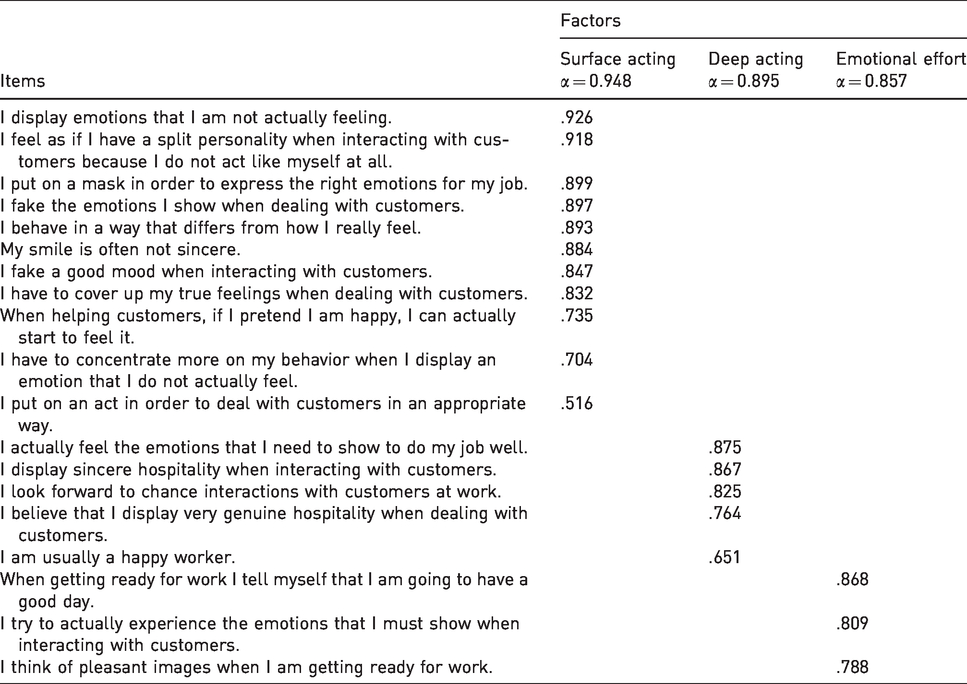
Factor analysis was conducted in order to test the structure of the emotional labor scale. The value of the Kaiser-Meyer-Olkin’s indicator exceeded the recommended level of 0.6 and, therefore, it achieved satisfactory results. Bartlett’s test of sphericity reached statistical significance (p = .000) and justified the application of this analysis. According to the results, principal component analysis revealed the presence of three components with values over 1, explaining 40.670%, 22.870% and 7.576% of the variance. After the extraction of the factors, Varimax rotation method (with the Kaiser normalization) was used. Due to the low factor loading (.110), one item (My interactions with customers are very robotic) was excluded from further analysis. Thus, factor analysis resulted in a model with 19 items grouped into the three factors (see Table 1) that explained 71.116% of the total variance. The identified factors are termed as: Surface acting, Deep acting and Emotional effort.
Emotional labor: results of factor analysis (Varimax rotation).
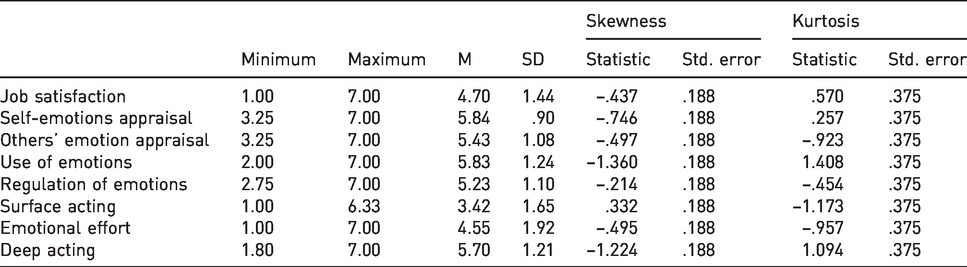
As well as emotional labor, this study measured another construct, emotional intelligence, consisting of four aspects: Self-emotions appraisal (M = 5.84); Others’ emotion appraisal (M = 5.43); Use of emotions (M = 5.83), and Regulation of emotions (M = 5.23). On the basis of the mean values amongst all of the researched aspects of emotional intelligence, it could be seen that their mean values were high and close to each other (see Table 2). Results presented within Table 2 also indicate that the mean value of the respondents’ job satisfaction is 4.70, which is lower than the mean values of their emotional intelligence (the mean value for all factors of emotional intelligence is above 5.23). Also, it could be seen that respondents’ deep acting is at a high level (M = 5.70), while their surface acting is around the average value (M = 3.42). Finally, if we consider all of the constructs together, the results presented in the Table 2 indicate that values of skewness and kurtosis are within the acceptable limits and, therefore, the distribution of the variables could be considered as normal. Cronbach’s Alpha coefficient for job satisfaction is .821, and for emotional intelligence is in a range between .798 and .921, pointing to their high reliability.
Descriptive statistics of respondents’ emotional labor, emotional intelligence and job satisfaction (N = 160).
Correlation and regression of emotional labor, emotional intelligence and job satisfaction
Correlation coefficients and the level of their significance are presented in Table 3. Job satisfaction significantly correlates with all of the variables, except with others’ emotion appraisal. Also, it should be emphasized that the correlation between job satisfaction and surface acting is negative (-.230). Further, self-emotions appraisal has significant and positive correlation with all of the variables, except with surface acting (−.382), where significant and negative correlation is recorded. Other’s emotion appraisal has significant and positive correlation with all of the variables, except with job satisfaction and surface acting. Furthermore, the results indicate that use of emotions has a significant and positive correlation with all of the variables except surface acting. Regulation of emotions has significant and positive correlation with all of the variables, except with surface acting, where research results pointed to significant and negative correlation (-.191). On the other hand, deep acting has significant and positive correlation with all of the variables, except with surface acting. Finally, there is a positive significant correlation between emotional effort and all of the other analysed variables.
Correlation of emotional labor, emotional intelligence and job satisfaction.
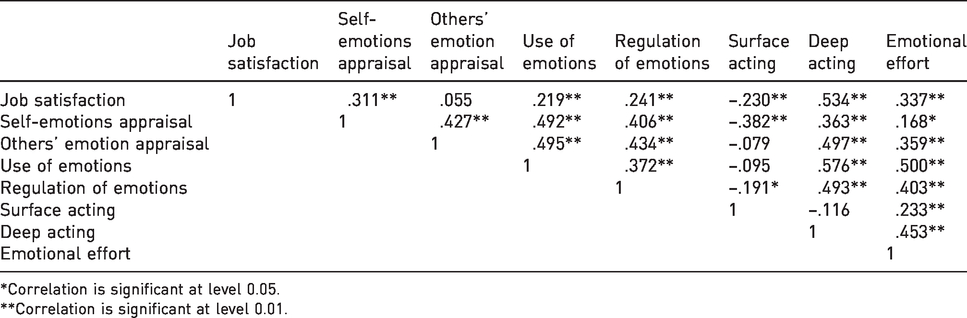
*Correlation is significant at level 0.05.
**Correlation is significant at level 0.01.
Before testing the mediating effect of emotional intelligence on the regression between job satisfaction and emotional labor, the direct effect of emotional intelligence and job satisfaction on emotional labor was explored.
The results presented in Table 4 indicate that emotional intelligence, specifically self-emotions appraisal, had a negative effect on surface acting, while others’ emotion appraisal, use of emotions and regulation of emotions had a significant positive effect on deep acting. Also, use of emotions and regulation of emotions have positive influence on emotional effort, confirming hypothesis 1. Regarding job satisfaction, the study shows that it has significant positive effect on deep acting and emotional effort, while there is a negative effect on surface acting. Therefore, Hypothesis 2 is confirmed.
Regression between job satisfaction, emotional intelligence and emotional labor.
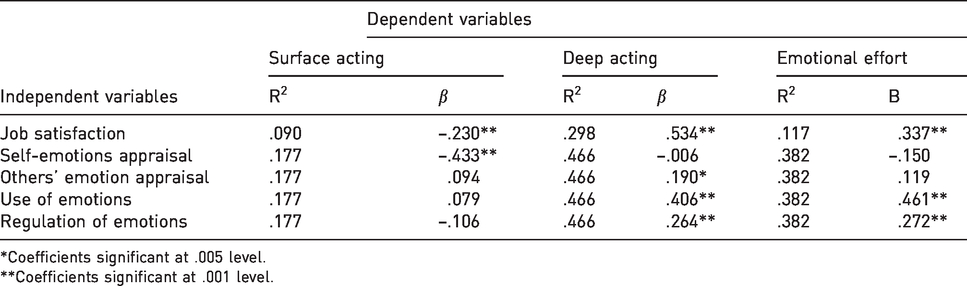
*Coefficients significant at .005 level.
**Coefficients significant at .001 level.
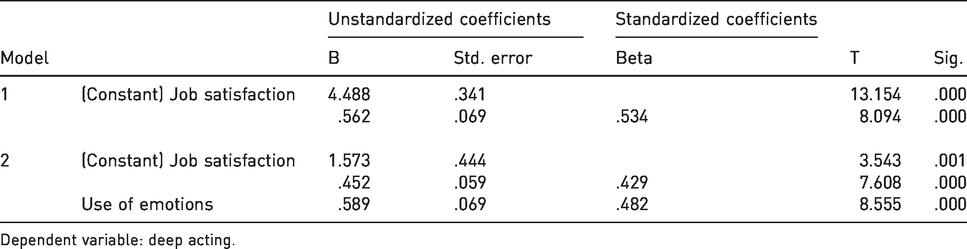
Regression coefficients: use of emotions as a mediator in the relationship between job satisfaction and deep acting.
Dependent variable: deep acting.
Mediating effects of emotional intelligence in the relationship between job satisfaction and emotional labor
One of the hypotheses of this study was that emotional intelligence mediates relationships between job satisfaction and emotional labor. The research showed that the first factor of emotional intelligence to be analysed (use of emotions) is a partial mediator in relationships between job satisfaction and deep acting. After the inclusion of use of emotions, the value of the model changed from (R2 = .285; F = 65.507; p = .000) to (R2 = .507; F = 73.185; p = .000), where mediation was significant, while job satisfaction also remained significant in both models, indicating partial mediation of use of emotions. These results are shown in Table 5.
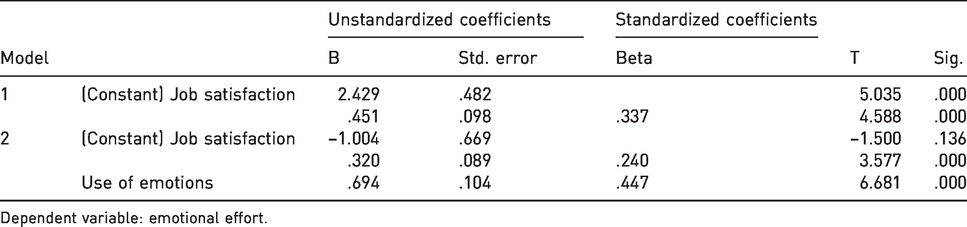
After the inclusion of use of emotions, the value of the second model including the relationship between job satisfaction and emotional effort changed from (R2 = .114; F = 21.050; p = .000) to (R2 = .304; F = 44.629; p = .000). Table 6 indicates that after the inclusion of use of emotions, the significance of job satisfaction stayed unchanged and significant, while the mediator was also significant. Again, use of emotions partially mediates relationships between job satisfaction and emotional effort.
Regression coefficients: use of emotions as a mediator in the relationship between job satisfaction and emotional effort.
Dependent variable: emotional effort.
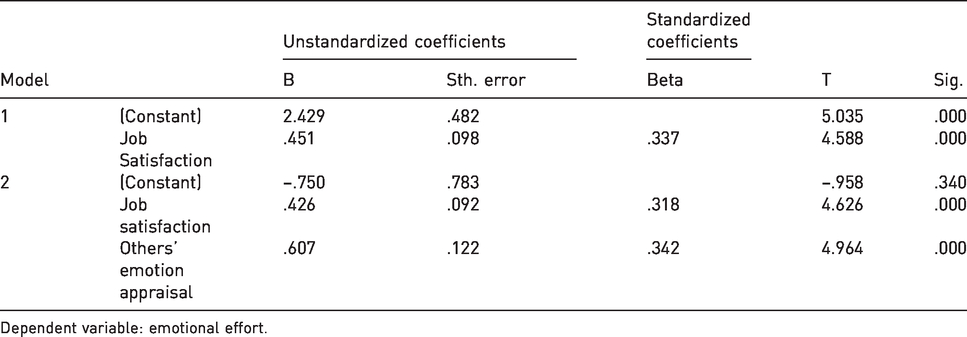
The study also tested the effect of other people’s emotions appraisal on the relationship between job satisfaction and emotional effort. After the inclusion of others’ emotion appraisal, the value of the model changed from (R2 = .114; F = 21.050; p = .000) to (R2 = .230; F = 24.641; p = .000). Table 7 shows that the significance of the effect of job satisfaction stayed unchanged, and that the mediator is significant, again indicating the partial mediation.
Regression coefficients: others’ emotion appraisal as a mediator in the relationship between job satisfaction and emotional effort.
Dependent variable: emotional effort.
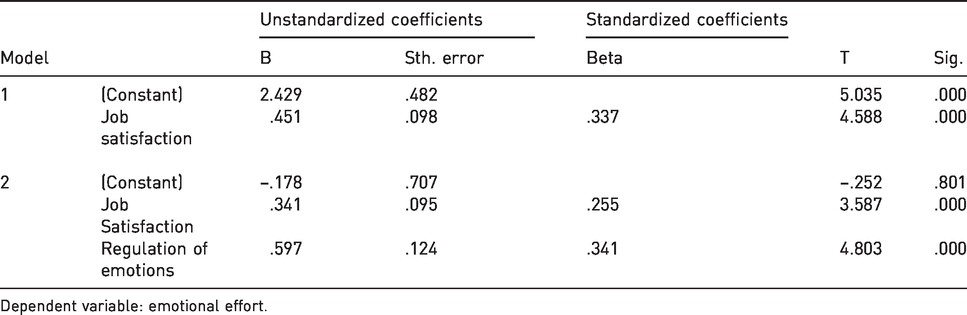
Regression coefficients: regulation of emotions as a mediator in the relationship between job satisfaction and emotional effort.
Dependent variable: emotional effort.
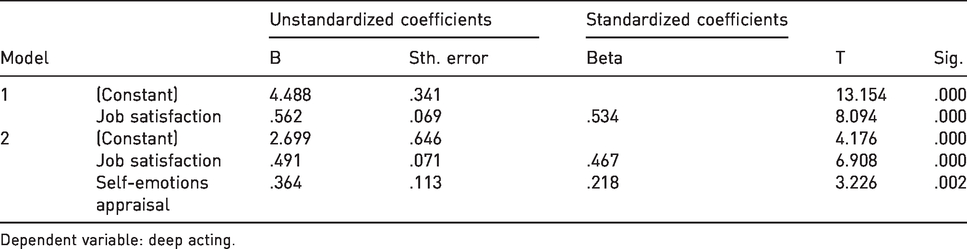
Regression coefficients: self-emotions appraisal as a mediator in the relationship between job satisfaction and deep acting.
Dependent variable: deep acting.
When testing the mediating role of regulation of emotions, the research showed that after the inclusion of the mediator, the value of the model changed from (R2 = .114; F = 21.050; p = .000) to (R2 = .224; F = 23.066; p = .000). Regulation of emotions is a partial mediator in relationships between job satisfaction and emotional effort, as shown in Table 8
After testing the mediating role of self-emotions appraisal in relationships between job satisfaction and deep acting, the value of the model changed from (R2 = .285; F = 65.507; p = .000) to (R2 = .328; F = 10.405; p = .002). Table 9 shows that after the inclusion of self-emotions appraisal, the significance of the effect of job satisfaction stayed unchanged with the mediator being significant, indicating the partial mediation of self-appraisal.
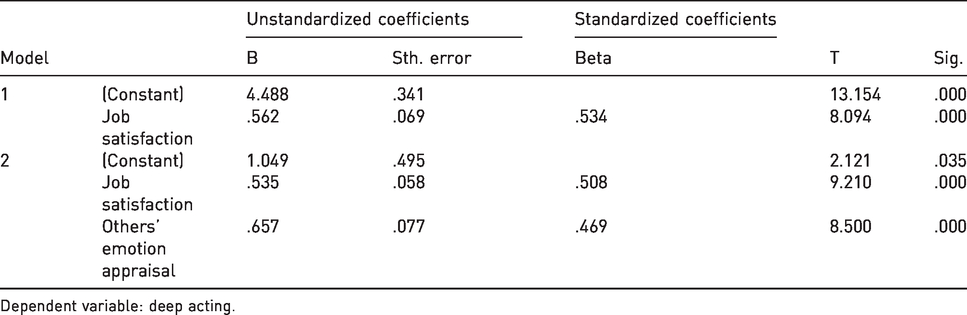
Others’ emotion appraisal inclusion also influences the change in the model value (R2 = .285; F = 65.507; p = .000) to (R2 = .505; F = 72.254; p = .002). The results in Table 10 show that after the inclusion of others’ emotion appraisal, the significance of the effect of job satisfaction stayed unchanged. Others’ emotion appraisal is a partial mediator in regression between job satisfaction and deep acting.
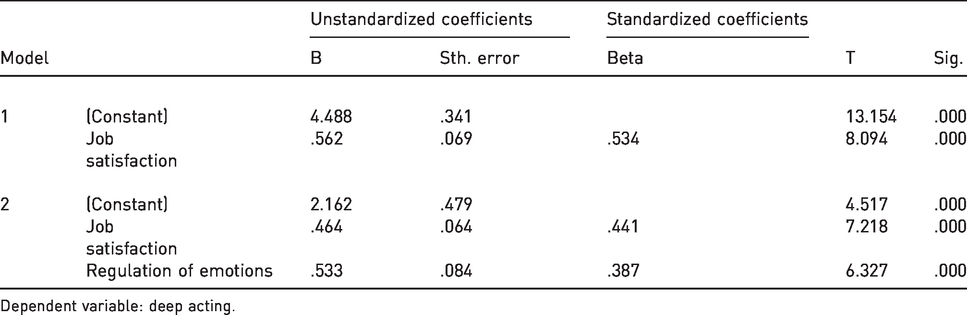
Regulation of emotions also showed as a partial mediator between job satisfaction and deep acting (the value of the model changed from (R2 = .285; F = 65.507; p = .000) to (R2 = .426; F = 40.030; p = .000)), as Table 11 indicates significant coefficient of the mediator.
Regression coefficients: others’ emotion appraisal as a mediator in the relationship between job satisfaction and deep acting.
Dependent variable: deep acting.
Regression coefficients: regulation of emotions as a mediator in the relationship between job satisfaction and deep acting.
Dependent variable: deep acting.
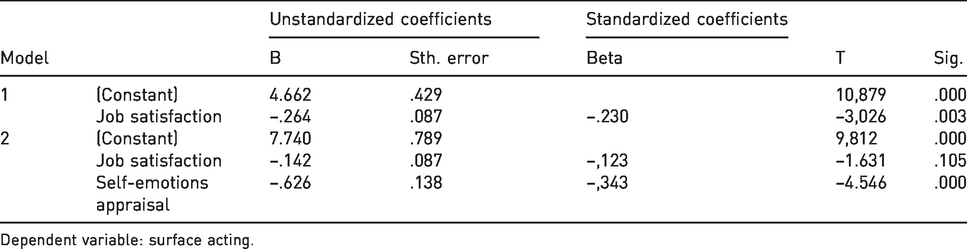
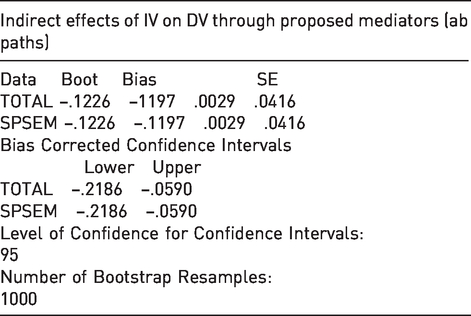
The results show that only self-emotions appraisal fully mediates the relationship between job satisfaction and surface acting. After the inclusion of self-emotions appraisal, the value of the model changed from (R2 = .053; F = 9.159; p = .003) to (R2 = .159; F = 20.670; p = .000). Table 12 indicates that after the inclusion of self-emotions appraisal, the significance of the effect of job satisfaction changed from significant (p = .003) to insignificant (p = .105), indicating the existence of full mediation. In addition, the regression coefficient for self-emotions appraisal is significant (p = .000), which confirms the mediating effect of this variable.
Regression coefficients: self-emotions appraisal as a mediator in the relationship between job satisfaction and surface acting.
Dependent variable: surface acting.
After the inclusion of self-emotions appraisal, the coefficient within the regression model, along with the independent variable job satisfaction, becomes insignificant, which indicated the need for further examination whether self-emotions appraisal is a mediator between the respondents’ surface acting and job satisfaction. According to the bootstrap results of the indirect effect (Table 13), the mediating effect of self-emotions appraisal was confirmed in regression between the job satisfaction variables and surface acting.
Bootstrap results for the indirect effect.
Hypothesis 3 is confirmed, as the emotional intelligence dimensions - use of emotions, regulation of emotions and others’ emotion appraisal are a mediator between job satisfaction and deep acting, and job satisfaction and emotional effort, while self-emotions appraisal mediates between job satisfaction and deep acting, and job satisfaction and surface acting. The mediation effects of emotional intelligence on the relation between job satisfaction and emotional labor, are summarized in Figure 1.
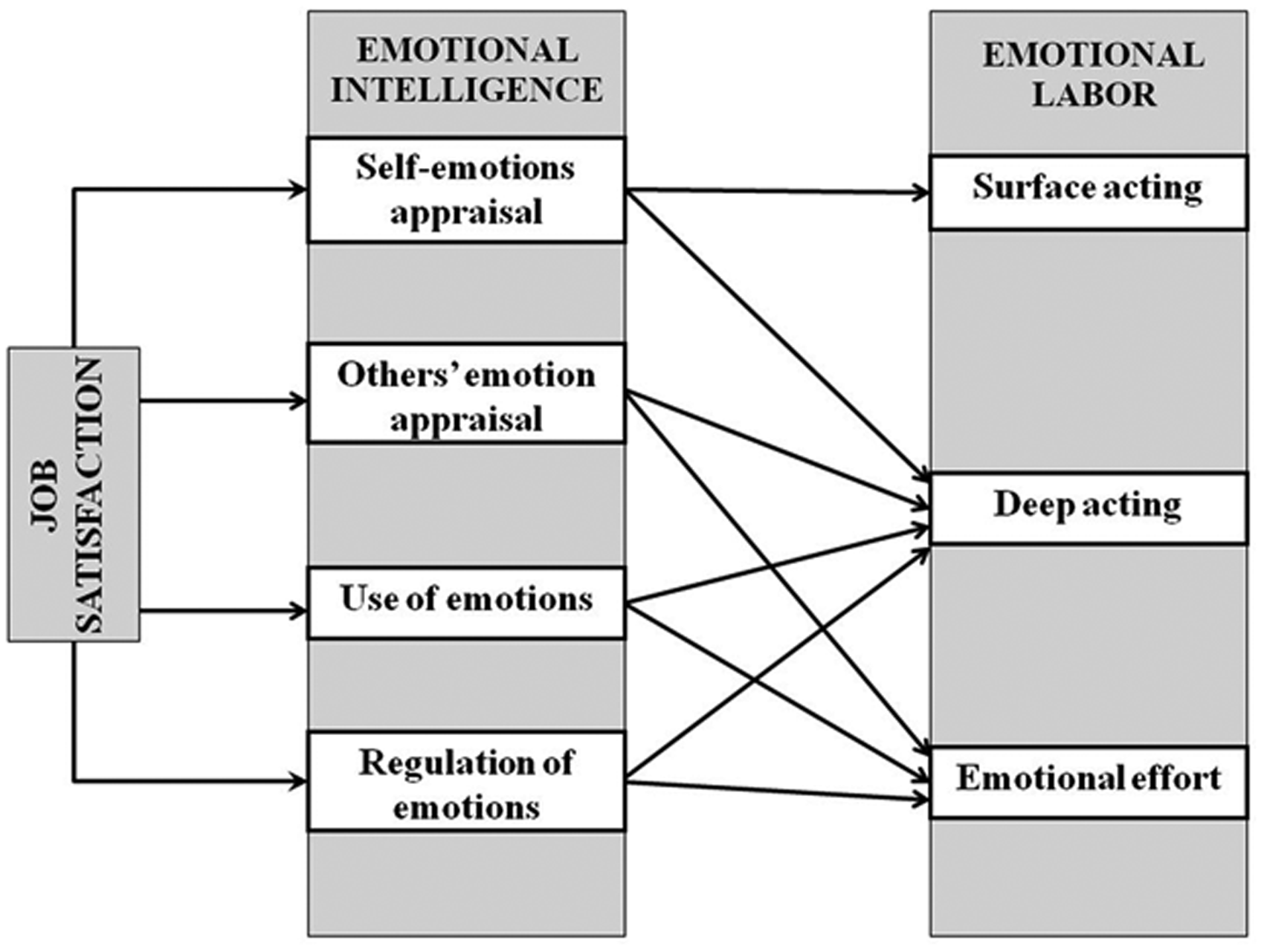
Model of the relationship between job satisfaction, emotional intelligence and job satisfaction.
Discussion
Hypothesis 1, that the Emotional intelligence of employees in retail travel agencies will positively influence employees’ deep acting and emotional effort and negatively influence their surface acting, was partially confirmed. Self-emotional appraisal was found to negatively affect surface acting, while others’ emotion appraisal, use of emotions and regulation of emotions positively influenced deep acting. Others’ emotion appraisal was the only dimension that was found to positively influence emotional effort. This indicates that, in travel agencies, employees that understand their own emotions are less likely to display fake feelings. Instead, they behave in accordance with their true feelings. Related to this, travel agency employees who show a good understanding of other people’s emotions, and self-motivated employees, capable of controlling their emotions, are more likely to be sincere and actually feel emotions that they need to show in the interaction with customers. Employees who show a good understanding of other people’s emotions try harder to feel happy and positive in such interactions. These findings are in accordance with the study conducted by Koc and Boz (2020), who emphasized that tourism employees in direct contact with customers are usually required to carry out intensive emotional labor. The same authors also indicated that such intensive contact with customers often results in difficult situations that require employees to notice customers’ emotions, as well as to have quick and appropriate reactions to these (Koc and Boz, 2020). These findings are supported by Choy and Kamoche (2020), who also indicated that the employees of travel agencies carry out intensive emotional labor on a daily basis. Moreover, Choy and Kamoche (2020) indicated that the managers and owners of travel agencies should seek and develop strategies for managing the emotional labor of their employees, in order to help them to suffer less from negative consequences of this, which could have a negative impact on success of their businesses.
Hypothesis 2, that for employees in retail travel agencies, job satisfaction will positively influence deep acting and emotional effort, and negatively influence surface acting, was confirmed, meaning that employees who are more satisfied with their work are more likely to show sincere emotions and interactions, avoiding the expression of fake feelings. These outcomes show a high level of similarity with the findings of Grandey (2000), which revealed that job satisfaction is negatively associated with surface acting and that higher emotional labor leads to decreased job satisfaction. These results also confirm Lee et al.’s (2011) findings that when employees are aware of the discrepancy between felt emotions and desired emotions, they will attempt to close the emotional gap through deep acting. Koc and Boz (2020) and Choy and Kamoche (2020) also highlighted the importance of hiring employees who can express genuine emotions when dealing with customers, confirming the foundational studies of Pugh (2001). Setiawan and Sayuti (2017) showed that for ‘performative work’ in tourism to create the optimum experience for a tourist, it must involve shared, genuine emotions that allow a shared social understanding to emerge, but that this requires significant emotional work. Prentice (2013) found that emotional intelligence was a moderator for reducing burnout in tourism employees caused by this emotional work, and this study confirms this in the case of travel agencies.
Finally, Hypothesis 3, that for employees in retail travel agencies, emotional intelligence mediates the relation between job satisfaction and surface acting, deep acting and emotional effort as aspects of emotional labor, is confirmed. The dimensions use of emotions, regulation of emotions and others’ emotion appraisal were showed to be mediators in the relationship between job satisfaction and deep acting and job satisfaction and emotional effort, while self-emotions appraisal was shown to mediate the relationship between job satisfaction and deep acting and job satisfaction and surface acting. However, full mediation was found only in the case of self-emotions, which fully mediates the relationship between job satisfaction and surface acting. This means that travel agency employees are more satisfied if they are aware of and understand their own emotions, and they tend to avoid surface acting. These findings are comparable with previous studies which have found that emotional intelligence mediates the relationship between various aspects of organizational behaviour, such as emotional labor, job satisfaction and/or job performance (Cha et al., 2008; Kong et al., 2018).
The results showed that employees who are more satisfied with their job and show higher use of emotions are more likely to be more involved in deep acting. As the sample for this study is drawn from travel agencies, where interaction between a service provider and a customer is particularly important, it is important for an employee to project positive emotions in this interaction, because these emotions will also be reflected in the satisfaction of tourists themselves.
Travel agency employees who are more satisfied with their job and show higher use of emotions are also more likely to make a greater emotional effort. Employees who are encouraged to do their best and those who feel that they are self-motivated will make a higher emotional effort. Thus, such individuals, assuming that they are satisfied with their job, are more likely to make an effort related to improving the satisfaction of tourists.
In addition, an increase in employees’ job satisfaction and their ability to evaluate the emotions of others is followed by an increase of emotional effort. The job of travel agency employees is often complicated becauseethey need to work with both tourists and stakeholders, who can present multiple and conflicting expectations. Sometimes tourists can be too demanding in their expectations regarding the service quality. This might be one of the reasons why employees of travel agencies that are satisfied with their job, highly evaluated their emotional effort.
Travel agency employees who are satisfied with their job and show higher regulation of emotions are also more likely to make greater emotional effort. The items used for the evaluation of the employees’ regulation of emotions: ‘I am able to control my temper and handle difficulties rationally’ and ‘I can always calm down quickly when I am very angry’, clearly indicate that the regulation of emotions represents an important aspect of emotional effort. If employees are satisfied with their job and if they are committed to the organization, they will be ready to make an effort in order to increase tourists’ satisfaction.
The final set of results show that travel agency employees who are satisfied with their job and show higher self-emotion appraisal are also more likely to show increased deep acting. When employees have the ability to understand their own emotions well, including the understanding of the emergence of certain feelings, it is easier for them to achieve deep acting. When the employees are able to recognize their own emotions, they will also be able to recognize their emotions related to the job itself. If employees are satisfied with the nature of the work, and if they possess the ability to understand their own emotions, they might also be aware of their positive emotions toward the job, necessary for achieving deep acting, represented by the item: ‘I actually feel the emotions that I need to show to do my job well’.
Travel agency employees who are satisfied with their work and who have the ability to recognize the emotions of other people, who highly evaluated the item ‘I am sensitive to the feelings and emotions of others’, usually have a high level of deep acting. Employees’ ability to recognize the emotions of others and their sensitivity to the feelings of other people, could facilitate their understanding of tourists’ negative emotions or their dissatisfaction. The results indicate that employees of travel agencies who are satisfied with their job and show higher regulation of emotions are also more likely to show higher deep acting.
Employees who are satisfied with their job, who also have higher self-emotion appraisal abilities, would not engage in surface acting. The research results confirmed the mediating effect of self-emotions appraisal on the regression between job satisfaction and surface acting, which indicates that the mediating effect of self-emotions appraisal neutralizes the effect of job satisfaction on surface acting. Self-emotions appraisal was measured using items including: ‘I have good understanding of my own emotions’, while surface acting related to the following item: ‘I feel as if I have a split personality when interacting with customers because I do not act like myself at all’.
Conclusions
The aims of the study were to explore the influence of job satisfaction and emotional intelligence on emotional labor in travel agencies, and to examine the mediating role of emotional intelligence in the relation between job satisfaction and emotional labor. According to the research results, self-emotional appraisal negatively influenced surface acting, while others’ emotion appraisal, use of emotions and regulation of emotions positively affected deep acting. Additionally, this research showed the positive influence of others’ emotion appraisal on emotional effort. Furthermore, this study indicates that job satisfaction positively influenced the deep acting and emotional effort of front-line travel agency employees. The negative influence of job satisfaction was recorded in the case of surface acting. It is also important to note that use of emotions, regulation of emotions and others’ emotion appraisal were confirmed as mediators in researched relationships between job satisfaction and deep acting, as well as between job satisfaction and emotional effort. Moreover, the research results showed that self-emotions appraisal mediates the researched relationship between job satisfaction and deep acting, as well as between job satisfaction and surface acting. Finally, an important finding of this research is that self-emotions appraisal represents the only dimension that completely mediates the researched relationship between job satisfaction and surface acting.
This study has certain limitations. The research results could not be generalized to the entire tourism sector, as the research was carried out among employees working in travel agencies in one country, Serbia. Thus, future research should include employees from other countries, in order to make comparisons, validate results and check whether the working conditions which differ from country to country also mediate or moderate the findings. Also, future research should test the created model by structural equation modelling (SEM), involving some other possible mediators, such as socio-demographics, personality traits or work motivation.
Footnotes
Declaration of Conflicting Interests
The author(s) declared no potential conflicts of interest with respect to the research, authorship, and/or publication of this article.
Funding
The author(s) disclosed receipt of the following financial support for the research, authorship, and/or publication of this article: The research was supported by Ministry of Education, Science and Technological Development, Serbia (Grant No. III 47007); and from RUDN University in Program 5-100 in Russian Federation.
