




Abstract
In a rapidly digitalizing world, both tourism actors and researchers are striving to keep pace with developments in tourist information search. This is not an easy task, as research results are pointing at different directions. Moreover, while tourism research is indicating the importance of analogue and digital information sources in parallel, tourism actors focus mainly on digital development. This does not make sense. This study aims to contribute to the academic debate on the importance and combination of information channels. The paper is based on a multi-method approach including surveys and interviews. Results show that tourists are hybrid information searchers who are loyal to their information channels and who dismiss too much of information. Empirically, the study is based on German tourists in Sweden.
Keywords
Introduction
Our societies are digitalizing rapidly. Local tourist actors, regional destination organizations, and national administrations are striving for a quick and efficient digitalization of their supply (Gursoy, 2019). This results in information that is becoming more and more ubiquitous and accessible with minimal effort (e.g. Lu et al., 2015; Pirolli, 2016; Zillinger, 2020).From a consumer point of view, Law et al. (2018: 627) have coined the term ‘mobile superstorm’ to describe the apparent radically changed tourist behaviour. Research from the pre-digital era has shown that tourists tend to combine information channels as they are making decisions (Fodness and Murray, 1998). But what about analogue sources in digital times? This article shows that while the importance of digital information is growing, this does not necessarily mean the end of the analogue era. The subsequent question many tourism actors are posing is: Which information channels are tourists actually using? This question is of special importance, as tourists usually reduce their search to a handful of sources (Gursoy, 2019).
Questions like these are discussed around the globe. The Nordic countries, with their strong appeal for digitalization, are no exception to this situation (DESI, 2019). There is no doubt that digitalization already has and will continue to impact tourism. New professions emerge, and this is presently visible in the production of tourist information, as for example in digital information creators (e.g. BFUF, 2018). Today, most tourism actors adopt the Internet as their primary distribution tool (Gursoy, 2019). But for long times, analogue information channels like guidebooks, brochures, and tourist information centres were the leading sources. While guidebooks are still used by many travellers (Mieli and Zillinger, 2020), interactive analogue information channels like tourist information centres are facing more difficult times. In the Swedish city of Malmö for example, both tourist information centre and tourism homepage have been closed down in an attempt to give more room to digital information as well as to information produced by visitors themselves in the spheres of web 2.0. Other comparable actions are expected. Tourism actors at all geographic scales are doing their best to keep track with technical and societal changes. It is not always easy to make the right decisions though, as giant players like Google and Tripadvisor are tricky to forecast.
In order for tourism actors to reduce insecurity, the question emerges how today’s tourists are using tourist information, and how they combine analogue and digital information channels. More research has been demanded on information use at home and during travel. Research exists, but is dissonant. This research letter aims to problematize tourism actors’ strong belief in digital progress when it comes to tourist information, and to contribute to a more nuanced discussion on the topic. It does so by presenting a multimodal approach to German tourists’ information, search behaviour in Sweden. Ultimately, this research letter aspires to increase knowledge on tourists’ actual information search, and on their way of combining analogue and digital channels.
Information search behaviour: A theoretical reference
The review of research about tourist information search behaviour shows that results are inconsistent. Historically, tourism research has agreed that tourists are using various channels in parallel when looking for information. An often cited declaration on this is the publication by Fodness and Murray (1998). Nowadays, the question is whether digital channels are about to take over. The question is also whether analogue channels will turn obsolete because of the supposed strength of digital information channels.
Today’s initial point of departure is that information and communication technology (ICT) has fundamentally influenced the way tourism services, information included, are consumed (Ukpabi and Karjaluoto, 2017). Essentially all publications point at the exponential growth of digital sources. For example, Vallespin et al. (2017) point at ICT being one of the most important influences on tourist behaviour. But while research agrees that ICT does influence information search behaviour in some way, there is no consensus about how this is done. One side is demonstrating the massive importance of digital sources in information search. Based on empirical results, Xiang et al. (2015a) and Kim et al. (2015) regard the Internet as the number one source of information. Particularly social media is perceived as an important information channel (Ukpabi and Karjaluoto, 2017). The use of digital information sources has partly been found to be a generational question (Kim et al., 2015). In their study on information technology, Law et al. (2018: 626) assert that ‘(m)obile technology has become a necessity for tourists’, and state that the usage of smartphones will continue to increase.
Other publications however conclude that while there are fundamental changes in tourist information search, we do not exactly know how. Neither do we entirely understand what these changes mean in relation to place, type of trip, or traveller characteristics (e.g. Hernàndez-Mèndez et al., 2015; Jacobsen and Munar, 2012; Pirolli, 2016; Xiang et al., 2015b). In contrast to the above mentioned research results, these authors claim the resilience of analogue information channels. Björk and Kauppinen-Räisanen (2015), Murphy et al. (2016), and Steen Jacobsen (2018) emphatically confirm the coexistence of analogue and digital information channels. Björk and Kauppinen-Räisanen (2015) analysed the chosen channels both before and during travel and state that tourists remain largely true to chosen channels. In his study on itinerant holidaymakers, Steen Jacobsen found that there is still a strong position for analogue information channels, often side by side the digital ones. For example, he concludes that guidebooks are almost as important as review sites. Further, while other authors (e.g. Kim et al., 2015) have found generational differences in the importance of digital information, Steen Jacobsen saw only small alterations. Another question is whether tourist information should be understood as an object of information only or whether it can be understood as an object of consumption (Mieli and Zillinger, 2020). This view helps researchers understand the wide recognition of values connected to tourist information.
This condensed literature review shows the discordance on the importance of digital information channels in today’s tourism. Even more so, tourism actors’ thorough belief in digital information innovations reinforces the need for a clarification in this subject. This is done by presenting an empirical study on German tourists in Sweden, which generally studies the hybridity of tourist information search. More specifically, it dives into the factors influencing the choice of information channel, information habitat, and the importance of trust.
Methods
This study was conducted in, and in cooperation with, the municipalities of Ystad and Vimmerby in Southern Sweden. Both municipalities have a clear focus on tourism. Besides Swedish tourists, the Germans are the most important ones. Data have been collected in a mixed method approach. As a first step, data on German tourists’ information search behaviour were collected by means of a survey. A questionnaire was sent via Google Forms to Germans who had previously signed up for a monthly newsletter published by the national tourism organization Visit Sweden. This approach generated 292 completed questionnaires. These were analysed by means of eta-test and linear regression. Thereafter, 136 interviews with tourists in Ystad and Vimmerby were carried out about their information search behaviour. Most interviews lasted between 7 and 10 minutes and usually included 2–4 persons. While the survey aimed at mapping information search behaviour, the interviews aimed at asking for the reasons behind such stated behaviour – in other words rather asking why-questions. All interviews were transcribed shortly thereafter. This simplified the subsequent analysis, which identified the topics ‘information combinations’, ‘benefits of different information sources’, and ‘importance of tourist information centres’. For an in depth description of the way of procedure, see Zillinger et al. (2018).
Findings
Tourists are hybrid in their information search. Before their journey, 62.8% combine digital and analogue information channels, 32.8% use analogue channels only, and 4.9% use digital channels alone. During travel, 40.6% combine sources, 55.9% rely on analogue channels, while only 3.5% trust digital channels alone. This is an overwhelming result, given that many tourism actors are paying so much attention to the digitalization of their information. The respondents’ age may have influenced this strong result. This statement is based on previous research that partly states a correlation between higher level of digital information use, the younger the tourists are. Respondents’ mean age in the survey was 54, however younger in the interviews, which supported the quantitative results. Age somewhat influences the propensity to contact a tourism information centre before travel (p = 0.05; eta2 = 0.256), but not en route (p = 0.6, eta2 =0.19). Neither does age influence the use of other information channels - except for social media (see below), nor does gender.
The use of digital devices at home in Germany was at a similar low level as during travel. On average, respondents spent 12.75 hours a week in front of a monitor, which must be seen as relatively low. Speaking in terms of Vallespin et al. (2017), there is a spillover effect from home to holiday: If little time is spent on digital devices at home, this indicates a low level of usage during travel as well, and vice versa. Human habitat is tenacious and does not change easily during holiday. This empirical result clearly shows that digital channels play their most important role in combination with analogue channels. This is interesting, as many publications on tourist information search behaviour focus on digital channels only.
Interviews revealed that analogue and digital channels are combined in order to extenuate their individual dis-/advantages. Guidebooks are good to get a first overview. For detailed information, we visit the tourist information, they often have detailed brochures that help us (…) And then we read the Internet on some special homepages about places we want to visit. (All quotes are author’s translation)
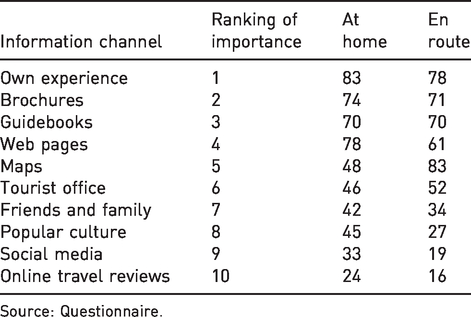
The most important information channels are own experiences, brochures, guidebooks, and web pages (see Table 1). This combination of information channels goes in line with, among others, Pirolli (2016) and Murphy et al. (2016), whose studies have proven a varied search behaviour. Concurrently, this result contradicts tourism actors’ beliefs in tourists’ singular use of digital information channels. Channels that are of importance before travel are of significance during holidays as well, similar to Björk and Kauppinen-Räisanen’s (2015) results. In other words, the studied individuals remain largely true to their chosen channels, again pointing to the importance of habitat.
Use of information channels before and during travel (in % of all answers).
Source: Questionnaire.
Tourists’ own experience is the most important information channel. While the distinguished importance surprises, the result is partly explained by the high number of previous visits to Sweden (4.6 during the last five years, on average). Some tourists have visited the places before, and now aim to show them to their fellow travellers. Others are exploring Sweden bit by bit, and know enough about the destination on a national level to rely on previous experiences. An important reason for the high importance of this information type is the aversion against too much information. ‘You do not want to know everything in advance, you want to get to know something spontaneously as well’. Arguably, if one knows too much, there is not much adventure left. Information soon becomes enough, ‘genug’. Brochures are of high importance as well. They are easily accessible both on the spot, by tourist information centres via traditional mail, and in accommodations, where German tourists often leave behind information for future German speaking guests. Brochures are experienced as appealing due to beautiful photographs and the compilation of attractions. An important value that is ascribed to this channel is the fact that they can be touched upon, that they are experienced as beautiful, and that they have the ability to give an overview: ‘They have a nice make-up, with the photographs’. One should not underestimate the importance of haptics for humans. Objects can be touched upon, carried, placed in a bag, or in a bookshelf, and altered by means of tourists' own marks and comments. In this way, an information source can become something different, for example a personal object, a souvenir, or a piece of furniture.
German tourists use web pages in two major ways, independently of age. The first step is to search for general information, which is primarily done via Google and destination organizations: ‘We go searching for information sites like Visit Sweden’. In contrast to Jacobsen and Munar’s (2012) results, the website of destination marketing organizations is of high importance. Second, tourists look for more specific information on pages such as individual accommodation or particular attractions, like hotels, parks, museums, or even supermarkets. The Internet is often combined with guidebooks, which are read due to their high level of authority and the belief that they represent opinions written by non-biased experts. Often, tourists use two or more guidebooks during the same journey. Guidebooks and maps by trend become slightly more important during travel, which is logic as they are easily accessible anywhere and anytime, independent of Wi-Fi or other circumstances. This outcome goes in line with Steen Jacobsen’s (2018) results on tourist information search behaviour on Greek islands. In contrast to web pages, guidebooks are highly valued even after the journey, as status symbols in the readers’ bookshelves. In this, tourist information may not only be regarded as a piece of knowledge, but as an object of consumption instead, which incorporates for instance hedonistic values instead of information values only.
The high trustworthiness of guidebooks stands in contrast to the low ditto of social media, which is hardly used at all by this tourist group, against tourist actors’ beliefs. ‘We are rather not the kind of social-media people. During holiday, we try to use the Internet and mobile phones as little as possible’. Age had a small influence on the use of social media, with a small significant (p = 0.006) negative relationship (r2 = −0.293). During travel, the result was slightly insignificant (p = 0.062), showing a small negative relationship as well (r2 = −0.254). The low importance of social media and online travel reviews supports results by Steen Jacobsen (2018), but contradicts results by Kim et al. (2015) and Ukpabi and Karjaluoto (2017). The reason for the non-use of especially social media like Facebook is the low level of trust. This is particularly true for ratings, which are believed to be open to manipulation. Ratings can easily be faked, or, as one interviewee expresses it, ‘getürkt’.
About 50% of the participants visit tourist information centres during their journeys, and those that do, ascribe them with a lot of positive meaning due to employees’ high level of local knowledge.Draper (2018) found similar considerations for information centres in Houston. Tourist information centres are of importance both before and during journeys. Here, the combination with digital information is obvious: At information centres, tourists receive help in ranking and verifying the information they have received elsewhere, for example on webpages. As people in general, tourists are asking for help in sorting, analysing, and understanding the information they receive. The delivery of digital bits of information may not always be enough. Some tourists aspire a personal dialogue that builds on pieces of digital information. This contradicts the study by Lyu and Hwang (2015), who found an inverted relationship between the importance of information centres and use of Internet. Tourists get in touch with the centres to ask questions to knowledgeable actors on the spot. Alternatively, they order printed information before the journey, which is sent to their homes by traditional mail. Accordingly, paper is not at all outdated when it comes to tourist information behaviour. ‘For me, a tourist information centre is pure luxury!’ declares one tourist, and thereby demonstrates the value that is assigned to these institutions. The result challenges current prophecies in the tourism industry, predicting the rapid death of tourist information centres. Tourists will survive without information centres or similar local institutions, however to a price of a lower perceived level of destination hospitality and generosity. Altogether, results clearly show that we cannot, and should not, dismiss digital information. But their importance needs to be seen in a combination with analogue material. The two kinds of information have their individual assets and drawbacks, and tourists know well enough how to combine the utility of both.
Conclusions
This research letter aims to problematize the strong belief in digital progress when it comes to tourist information and to contribute to a more nuanced discussion on the topic. It does so by presenting a multimodal approach to German tourists’ information search behaviour in Sweden. Ultimately, this research letter aspires to increase knowledge on tourists’ actual information search, and on their way of combining analogue and digital sources. Results clearly show that tourism is not in the middle of a one way road towards pure digitalization. This study supports authors that have found parallel information search behaviours in analogue and digital channels, such as Pirolli (2016) and Steen Jacobsen (2018). Thus, one system does not substitute the other. On the contrary, the advantages of individual information channels are vigorously combined in order to suit individuals’ predilections and needs. This means that tourist actors need to take care for both systems for a considerable time period ahead. This result may be perceived as rather delicate in digitalized countries, which go all in for a purely digital development strategy.
While this research note verifies earlier notions on dispersed hybridity of information search, it also puts a tentative number on it. 63% of German Sweden tourists combine analogue and digital information sources before travel, and 41% combine sources en route. Simultaneously, the study shows that these tourists are fairly loyal to information channels once used before travel. It also indicates the strength of human habitat: a highly digitalized practice at home will probably lead to a search for digital information during travel as well. Finally, results show that too much information is not understood in a positive way. Contrariwise, excessive information hinders tourists from feeling spontaneous, hampering them from an important part of being on holiday.
In delivering empirical results on information search behaviour, this article adds to the overall discussion on tourist behaviour in the digital age. Both tourism actors and researchers suffer from a weak understanding of consumers’ information search today, and the situation is exacerbated due to the combination of online and off-line channels. Without a proper perception of this question however, it is very difficult to foster efficient destination communication. While this study is unable to affirm an exact information search behaviour for all tourists of course, it safely demonstrates the coexistence of analogue and digital information channels. It also suggests the importance of trust, visuality, and non-biased information. Concluding, this study encourages future empirical studies to complete the academic discussion that is currently being held. It also encourages conceptual papers to contribute to a theory on tourist information search in the digital age.
Footnotes
Acknowledgements
The author would like to acknowledge her colleagues Lena Eskilsson, Maria Månsson, and Jan Henrik Nilsson. They have all been part of the research project “The whys or why nots of visiting a place: the significance of information for the success of an attraction” that this article is based on.
Declaration of Conflicting Interests
The author(s) declared no potential conflicts of interest with respect to the research, authorship, and/or publication of this article.
Funding
The author(s) received no financial support for the research, authorship, and/or publication of this article.
