



Abstract
The importance of ‘time’ is well-established within ethnography, yet how time is experienced and conceptualised in specific research settings remains embryonic. Duncheon and Tierney’s (2013) theory of time is developed to understand how time is accepted, valued and recorded by both the ethnographer and the participants in a neoliberal, post-covid era where virtual means of communicating are fast developing. Data mapping interventions for young people vulnerable to becoming NEET illustrate how time is experienced differently according to the site, participants, research questions, the opportunity to explore emerging issues and the management of available stakeholders and resources. How the ethnographer manages time can sometimes come into conflict with neoliberal ways of working. Nevertheless, ethnographers must retain the value of spending time becoming immersed in the daily lives of people to gain trust, give voice to participants who may otherwise be muted and resist temptations to quickly plunder fields for data.
Time, ethnography and education
The classic ethnographies of the Chicago tradition of the 1920s and 1930s were central to how ‘ethnography’, historically at least, has been viewed as a key methodological process that values the length of time needed in the field to talk with participants, understand the different layers of social interaction and nurture the intrinsic ethnographic need to produce ‘thick descriptions’ of culture (Jeffrey and Troman, 2004). The need to experience material conditions first-hand has been valued as paramount since it promotes familiarity, allowing the ethnographer to gain trust and start the process of analysis whilst immersed in the field itself (Beach and Vigo-Arrazola, 2021). This is needed to effectively manage the unequal distribution of power between the researched and the researcher (Kumar, 2016), as well as re-address the need to give voice to those deemed underrepresented and undervalued in hegemonic neoliberal discourses, such as those who are not in education, employment or training (NEET) 1 or Elective Home Educated (EHE) 2 .
The construct of time has long been debated in ethnography. Dawson (2014) encouraged ethnographers to develop their ‘temporal awareness’, so that their ‘temporal practices’ (how time is experienced by the researcher) could be better managed. He encouraged ethnographers to think about ‘temporal merging’, to establish a more nuanced understanding about how objective and subjective concepts of the past and future shape the human experiences of the present for both researchers and the researched. Dawson argues that researchers often downplay the non-linearity of lived time, and advocates that we should engage with, rather than resolve the contradictions that chronological time presents us with. Like Dawson (2014), we draw upon empirical data to provide substance to previous understandings of time.
The context in which ethnographers now work has shifted; in addition to the onset of neoliberalism in the 1980s, we have seen numerous Information and Communication Technology (ICT) revolutions from 1975 onwards, further galvanised via the COVID-19 pandemic in 2019. The advances of technological development dominate the way billions of people interact and ‘connect’, key global and societal shifts have emerged to shape education settings, as well as that of the people operating within them. Furthermore, these societal shifts have shaped how ‘ethnography’ as a process and output is operationalised (Podjed, 2021). This paper aims to understand how time in ethnography is experienced by both the researched and the researchers by applying Duncheon and Tierney’s (2013) theory of time to empirical data derived from research that aims to understand interventions for young people identified as at risk of becoming NEET in England. The relevance of neoliberalism, technological advancements and COVID-19 are outlined in their relation to ethnography itself, but also to how education settings operate and how NEET and EHE young people are understood and accessed.
The terms ‘NEET’ and ‘EHE’ are both problematic (Lorinc et al., 2020; Yates and Payne, 2006). NEET describes people by what they are not – that is not in employment, education or training. EHE is also not always an ‘elective’ option (Gillie, 2025). Both terms can label young people in a negative way and often include a heterogeneous mix of young people whose situations are varied. Whilst youth unemployment was once seen (at least partly) as a societal and structural issue, evidenced by the payment of unemployment benefit to young people, the neoliberal NEET lens sees it because of deficiencies in young people themselves (Simmons and Thompson 2011). Evidence suggests that stringent adherence to NEET-reduction targets encourages ‘firefighting’ tactics rather than working in a supportive and productive intervention landscape that works with and for NEET young people, rather than against them (Maguire, 2015). Such issues are further compounded by the fact that education and employment policies are historically and geographically based on inadequate knowledge and assumptions (Crisp and Powell, 2017) that are immersed in the marketisation and commodification of education that prioritise school survival over and above individual need (Del Col and Stahl, 2024). MacDonald (2011) deems it a neoliberal myth that better qualifications lead to better well-paid jobs. Ball (2016) argues that the very management of such institutions has altered the power relations to less democratic and caring forms, in favour of performativity and accountability agendas. In agreement with Beach and Vigo-Arrazola (2021), we maintain that ethnographers can and should go some way towards destabilising hegemonic hierarchical relationships and structures to gain influence in the struggle toward education justice and social transformation, but to do this they must first acknowledge these tensions.
In this paper we first outline the three societal shifts, neoliberalism, technological advancements and COVID-19. Next Duncheon and Tierney’s (2013) theory of clock time, socially constructed time and virtual time are outlined, before the methods and adaptation of the recurrent time mode (Jeffrey and Troman, 2004) are explained and empirical data is applied to reveal the nuances of how these societal shifts shape ethnography. Our analysis addresses both time as experienced by the participants and therefore a focus of the research project itself and time as experienced by the researchers in relation to the research process and the Higher Education Institutional (HEI) context. These two aspects are analysed ‘in sync’, as they cannot be taken in isolation. Rather, they mutually affect each other in terms of what research can and cannot make visible. The paper concludes by arguing that ethnographers must engage with societal changes and understand areas where it is vital to resist some implications pressed upon them when working within the confines of neoliberal understanding of ‘clock’ time. Ethnographers must also value the relevance of ‘socially constructed’ time and ensure they maintain valid and critical data that advances theory and recognises the benefits and challenges raised when working virtually.
Conceptualising ‘time’ is not straightforward, since what exactly constitutes the construct of ‘time’ is contested and subject to interpretation (Birth, 2004). Throughout history, changing social, cultural and institutional contexts have generated different ways of conceptualising ‘time’ (Duncheon and Tierney, 2013). There is little doubt that time is needed in the ethnographic field to strengthen relations and acutely analyse social structures and the agents that act within them (Jeffrey and Troman, 2004). Yet how time is theorised, understood and used in specific research projects remains relatively under-developed. This paper addresses this dearth by analysing how different time modes co-exist within one longitudinal, national-based ethnography. Duncheon and Tierney’s (2013) theory of time is used as an analytical lens to understand how ‘time’ is accepted and understood in our post covid, technologically advanced neoliberal society. We draw upon empirical data to discuss the tensions and delights that clock time, socially constructed time and virtual time can bring in relation to ease of access to NEET young people, EHE families and Local Authority (LA) 3 representatives within education settings, as well as highlighting the need for ethnographers to acknowledge hidden time spent and challenge dominant hegemonic discourses that may encourage ethnographers to rush processes and relation building in the field. Time is necessary and is not always valued in the same way. In this paper we acknowledge the shifting power imbalances between the researched and the researcher; but also recognise the participants (as well as the ethnographers themselves) as active agents with their own inherent power rights and needs. There is thus a need to focus on the researched and the ethnographer’s view of time, since both are inter-related and shape what is and what is not possible in ethnography.
Neoliberalism, technological advancements and COVID-19
Neoliberalism is the first identified shift that is analysed here. In the neoliberal era education systems and the research designs adapted to understanding them are managed according to free market principles, whereby concepts such as ‘time’ are acutely measured, stringently followed and in some instances fiercely resisted (Tett and Hamilton, 2019). Neoliberalism is now a major area of interest within education itself (Ball, 2016). It represents a global movement, in that there are a set of education policy changes that are occurring in countries in all continents, with very different cultural and political histories, with very few exceptions (Ball, 2016). Within the English school system examples include the establishment and growth of Multi Academy Trusts (MATs) 4 , which although state-funded operate more independently without LA oversight (Pennington et al., 2024). Alongside this, neoliberalism shapes the very way in which ethnographies are conducted whereby choices are becoming increasingly constrained by mechanisms such as the UK Research Excellence Framework (Cottle, 2022), pressures to demonstrate ‘impact’ and other rules that construct the neoliberal university (Colley, 2014). Some have argued that neoliberalism serves to mute rather than give voice to people and organisations that experience precarity (Theriault and Pierre-Mercier, 2023), such as those defined as NEET and EHE.
The second identified shift relates to technological advancements, since this provides ethnographers with new ways of studying new forms of cultures, such as those that exist in the virtual sense, for instance, (young) people now increasingly rely on digital media to form, exhibit, and reproduce social relations and identities (Gardner and Davis, 2013; Mizuko, 2008). Thirdly, the global pandemic of COVID-19 further facilitated an online and virtual presence both in terms of how schooling was conducted (so online during lockdowns) and how ethnography as a methodological process was operationalised. This shift entailed less face-to-face contact conducted in localised geographically bound spaces, with a movement to more virtual means of ‘seeing’ as well as ‘being’ in the world (Shah, 2023).
Duncheon and Tierney’s theory of time
Duncheon and Tierney (2013) offer three temporal perspectives which include, ‘clock time’; ‘socially constructed time’ and significantly for the shifts in how ethnography is now being increasingly conducted ‘virtual time’. How time is understood and experienced is an important consideration – particularly so for the ethnographic process – since how time is understood has ramifications for equity and access which may be experienced differently between the researched and the researcher where power imbalances and different competing agendas may be at play. The allocation of time is never neutral, particularly when doing research inside schools with young people who may be ‘at risk’ of becoming NEET. It is the ethnographers’ duty to firstly acknowledge these power imbalances and secondly to help mitigate them in striving for valid data – a point that becomes particularly pertinent when working with marginalised youth and sections of the EHE community – a group that are already placed at a disadvantage in the education system.
Clock time
The foundations of clock time can be traced back to the 17th century and the birth of modern science. Isaac Newton posited a model of linear and absolute time, whereby time was conceptualised as a universal and unchangeable variable (Levine, 2003). In other words, time exists independently of human experiences and consciousness, it thus runs as a detached uniform structure alongside but separate to the human experience. With the growth of industry and capitalism in the 19th century, ‘clock time’ became more ingrained into mainstream ‘Western life’, whereby young people and workers ‘clocked on’ and ‘clocked off’ for the day. Fuelled by the rise of industrialisation and factory working, clock time facilitated the synchronisation of labour and enhanced temporal awareness, whereby punctuality and precision were emphasised (Thompson, 1967). Time is viewed as a resource and ‘clock time’ constitutes the dominant temporal perspective in Western developed nations. Like a resource, ‘time’ can be perceived as well spnt, wasted, saved, invested, divided, shared, managed and budgeted for. ‘Clock time’ thus remains an important facet since it remains pertinent to contemporary society as well as across the lifespan of the ethnography itself.
There are ideological and theoretical limitations of the clock time paradigm. Ideological concerns state that clock time aligns people with a particular world order by creating structures that dictate work and leisure (Munn, 1992). Philosophers such as Karl Marx (1877) and Max Weber (1876) viewed clock time as a vehicle for social control through the regulation of work schedules. Theoretically the construct of ‘clock time’ is criticised since it suggests that studies based on time measurement rely on the false assumption that clock time is a universally accepted construct to which all must subscribe. In fact, the framing of time as a commodity is a cultural construction (Birth, 2004) and differs amongst cultures. Moreover, not all people are willing and able to allocate their time according to the economic principle of scarcity. This assumes that people can conceptualise their time use decisions within an economic framework, considering trade-offs and aiming to maximize their productivity. Yet many people (including ethnographers) do not always think about time in this way or cannot exercise autonomy over their time allocations due to social and economic obligations. Thirdly, the assumption that quantifying time allocations provides adequate understandings of an individual’s relationship with time has been questioned (Aminzade, 1992). Amounts of time devoted to an activity does not necessarily indicate its importance (Birth, 2004). Hence, the clock time paradigm assumes universal acceptance of linear, objective time and capitalist philosophy and thus serves to marginalise subjective temporal values and experiences.
Socially constructed time
The idea that time is a social construct emerged at the beginning of the 20th century when Western scholars seeking to understand other cultures began to identify that diverse societies construct reality and in turn, time differently. Anthropologists such as Malinowski (1927), and Geertz (1973) were instrumental in exposing diverse perceptions of time. Varying interpretations of time have also surfaced in research with indigenous peoples (Pickering, 2004), whilst other studies highlight that time is culturally constructed and individually perceived (Gell 1992). Furthermore, as society evolves, the way in which people experience time is continuously reconstructed and shaped by their historical experiences (Reichardt, 2000). Cultural and historical contexts, such as the shifts identified in this paper contribute to the development of numerous temporal orientations and values among people living within the same society.
Although socially constructed time offers tools for understanding subjective and diverse temporal experiences that clock time arguably cannot capture, this approach also has limitations. Theories of time as a social construction are subject to the standard criticisms of social constructionism as a whole. Subjective perceptions of time are open to interpretation and are thus unable to be objectively measured or generalised. Others have maintained that the dichotomy between clock time and socially constructed time is flawed because these perspectives are not diametrically opposed (Gershuny and Sullivan, 1998). So, while clock time focuses on time quantity, socially constructed time explores temporal diversity, quality, and meaning.
Virtual time
The rise of ICT over the past two decades has changed the landscape of contemporary society. Most households now have Internet access and new forms of ICT, including mobile phones, instant messaging, and social media, have become widespread. New technologies enhance the speed at which people can complete tasks and connect with one another, enabling instant access to media, world occurrences, and social connections. However, theorists have also suggested that by facilitating engagement in activities and relationships at any time and in any order, ICTs undermine the linear sequence of the clock (Castells, 2000). Duncheon and Tierney highlight the increasing acceleration and disorder of temporal realities and the potential for human agency to shape the impact of technology on time.
The temporal disorder caused by digital technology has been developed (Hassan, 2003). ICTs invite people to experience time virtually, whereby access to information and social relationships is infinite and temporally unrestricted. This new temporality speeds up the pace of daily life, but also blurs and largely displaces traditional temporal relationships between work, home, and leisure. While ICTs compress and disrupt the linear flow of time, they also permit people to control time in new ways (Hassan, 2003). Time is still managed as a resource, not under the linear, chronological manner of mass production, but as a differential factor with reference to the temporality of other networks, processes, or products. Essentially, individuals and organisations have the capacity to manipulate time within a digital context, thus time becomes processed. Consequently, boundaries once set by certain places are now increasingly blurred. Traditional associations of time frames with spaces are weakening. ICTs also influence the way people experience time in their daily lives by enabling more temporal flexibility and control. Scheduling and organising activities and events have become more malleable (Traxler, 2010). Mobile phones and the Internet allow contact and tasks to take place outside the constraints of time and place (Thulin and Vilhelmson, 2008; Traxler, 2010), leading some to refer to the “softening” of time. These advances have also facilitated greater levels of multitasking at a faster pace.
The limitations of this new paradigm stem from its relative infancy—scholars are still exploring the implications of the temporal transformations generated by the ICT revolution. Notably, the emergence of virtual time has differential effects for different groups and individuals (Green, 2002). Although technology potentially affords people more temporal autonomy and flexibility, an individual’s capacity to control time is still mediated by their social context.
Duncheon and Tierney suggest that the emergence of ICT has generated a new temporal paradigm. In some respects, virtual time represents an extension of socially constructed time, as people’s use of ICT shapes new temporal experiences. Yet these experiences are more varied, complex, and fast paced than those originally conceptualised by social constructionists. Meanwhile, virtual time appears to directly contradict the assumptions inherent in clock time; although ICTs largely liberate people from linear temporal organisation, societal structures and organisations remain bound by clock time. Traditional temporal theories and methodological approaches no longer suffice to understand time in people’s daily lives. The onset of virtual time signifies not only a speeding up of linear time, but also the emergence of a unique temporal paradigm. We do not suggest that virtual time renders useless the two established temporal frameworks, but rather that alone they are no longer sufficient. We now provide some empirical application of this theory in relation to the relevance of neoliberalism, ICT advancements and COVID-19.
Methodology
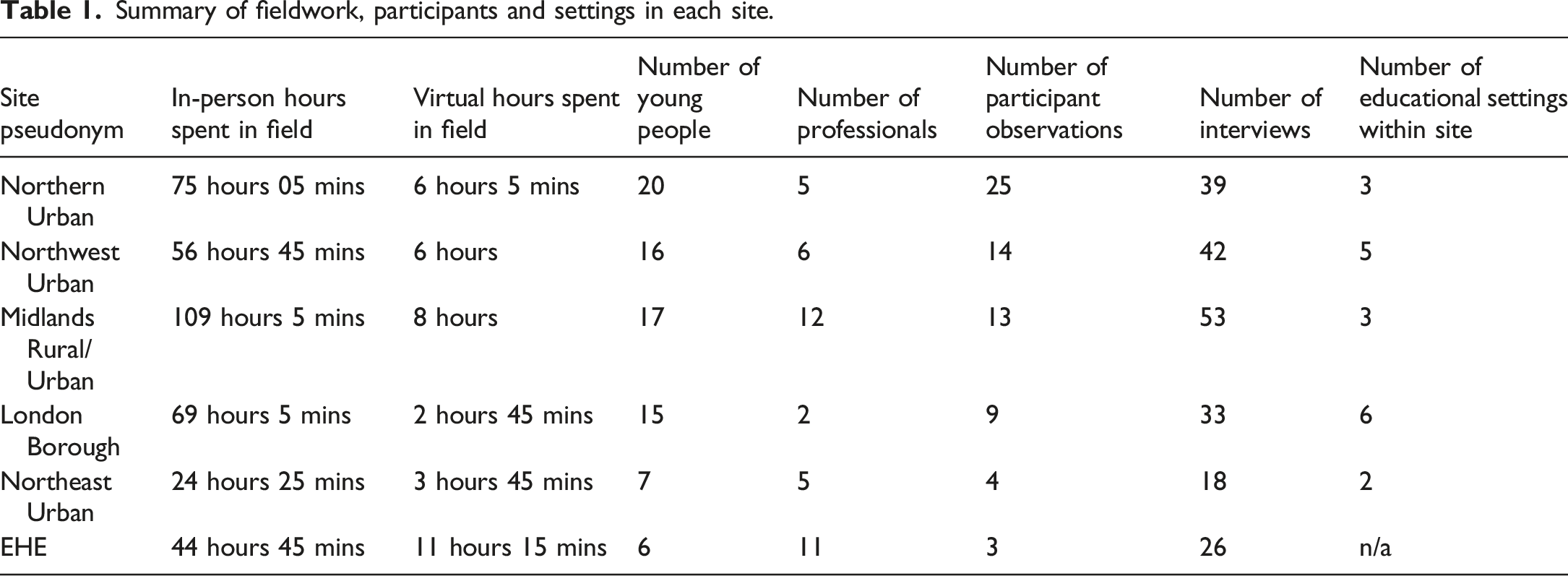
Data is derived from longitudinal research that aims to map early interventions for young people ‘at risk’ of becoming NEET. It comprises of a three-staged mixed methods design and findings from this paper are taken from the first two phases. Phase One was conducted from November 2021 to November 2022 and involved the mapping of provisions across 150 LAs in England via an online survey. 60 survey responses were analysed, alongside 25 LA semi-structured interviews. Phase Two comprised over 379 hours spent in the field, plus 38 virtual hours across six sites from September 2022 to August 2024. 68 participant observations across 19 educational settings took place to observe NEET interventions, young people’s experiences of school and related one-off events such as careers events. Two hundred interviews were conducted with 81 young people aged 14-16 years and 41 professionals.
Qualtrics was used to analyse questionnaire data harvested from Phase One and NVivo was utilised to analyse observation fieldnotes, interview and visual data gathered during Phase Two. Coding grids have been inductively devised from the prior stage of data gathering, as well as considering key literature themes and using the research questions as a guiding frame. Key codes used in specific reference to this paper include ‘clock time’; ‘socially constructed time’; ‘virtual time’ and ‘participants’ perception of research’. Findings here are derived from analysis of Phase One and Phase Two. Data has been triangulated as is customary in ethnographic research.
Summary of fieldwork, participants and settings in each site.
A recurrent time mode
A recurrent time mode was (mostly) operationalised across the six sites (Jeffrey and Troman, 2004). This is one where temporal phases formalise the research methodology. Rhythms of time were monitored often via temporal phases such as beginnings and ends of terms, transition points when young people transited education settings, examination periods and career events. Life events such as pregnancy and being excluded from school also formed important points of contact between the ethnographer and the young people to gain a picture of the same (as well as critical incident) temporal phases. However, there was a degree of flexibility with this approach, unlike the definition outlined by Jeffrey and Troman, the ethnographer responded to events as they occurred to the young people which often, but not always, aligned with the rigid structures of the school timetable and academic calendar. Datasets across the different Year 10 and Year 11 cohorts were compared with the intention to document these young people’s transitions as they moved into their post-16 destinations. One of the main objectives here was to monitor comparison and change where previous research visits and data collection sets were compared to identify experiences, feelings, and identity shifts that these young people exhibited as they moved through the rhythms of the school term time and calendar, as well as transited in and out of various education settings. Some of how clock time was spent was dependent upon the young people, their frequency of experiencing exclusion and transition between and out of different education sites, as well as the type of site being visited. Recurring conversations emerged which had a clear past, present and future focus where key questions such as ‘what has happened with you since we last spoke’ and ‘what GCSEs 5 are you now studying?’ as well as ‘what do you anticipate doing over the next 12 months or so?’ were repeated and compared to provide an opportunity to study a whole cycle such as a school year or term and assess the balance between the different phases.
Clock time tensions
Even before the official start of the project, the researchers had to carefully plan for how much time each separate part of the research design would take and who would be responsible for what. Negotiations were to be had at the host institution in terms of value for money and how much time could be allocated (or not) to certain staff workloads to develop the bid and successfully deliver the project. From the University’s and funders point of view, time here was very much understood and conceptualised as ‘clock time’- a commodity to be appropriately managed and allocated wisely. Negotiations about whose time was spent where and on what basis continued throughout the life of the project and well into the active fieldwork phase whereby four researchers divided their time accordingly across six sites. Discussions around how much time the team had available to conduct fieldwork, as well as analyse data and disseminate findings were ongoing. How each of the four researchers made time available differed according to their status, role and other workload demands such as teaching responsibilities. The Senior Research Fellow (SRF) worked full-time on the project and so her time availability was the most flexible, enabling her to work across four to five sites in a responsive manner – something which was crucial since how the education settings viewed time was stringent and researchers had to be available to work within the remints of their own timetables and school-working day hours.
Other project members had greater teaching and wider leadership commitments which meant they had less flexibility to respond to schools and education-based organisations and indeed the young people inhabiting them. Some team members were part-time and so literally had less ‘clock time’ to spare. The team managed ‘clock time’ by working flexibly, with commitment and a drive to work as best as they could as a team around the needs of the social sites of investigation, as well as the young people they were working with. The Principal Investigator took responsibility for one site, with one team member taking responsibility for another and the SRF completing the bulk of fieldwork. The rationale behind this was to enable the ‘national landscape picture’ to be investigated while retaining some meaningful long-term relationships with young people and key gatekeepers in specific geographical locations and sites. Relationships built with the young people were crucial to achieve longevity in the field and understand how young people experienced their transitions and interventions over a short and long(er) timeframe.
Disruption of time was also evident and there were several factors that needed to be managed. Disruption of time is often viewed as a key weakness for long-term ethnographic research. Examples included the changing composition of the team where one SRF left, and another was recruited. Redundancy risks, bereavement and bouts of illness were experienced both by the researchers and the researched, all of which inevitably disrupted the natural flow of the project but gave some opportunities too for the researchers and the researched to share experiences. Fieldwork also occurred during school strike days which disrupted the opportunity to conduct participant observations with young people in classroom contexts, but opened other avenues to interview key staff who may otherwise have had teaching commitments. Gatekeepers who helped us access certain sites sometimes left roles or went on maternity leave, meaning access had to be re-negotiated with the new and/or returning gatekeepers, all of which took time.
Some young people did start to feel secure in our ‘staying power’ as professionals and enjoyed the idea that we remained a constant during their schooling journey. In the neoliberal world, maintaining contact with one key person over a period of years, whereby an adult (in this instance the ethnographers) spent time listening to and being with the young person is sadly not common practice and is something many of our young people valued. Such instances also demonstrate a tension felt by the ethnographers regarding ‘clock time’ (how much time they could physically give to the project and particular participants) and ‘task time’ (reflecting the actual time it takes to build rapport and trust and unearth back-stage in-depth data). Furthermore, some of the professionals working with these young people valued the ethnographers as another key resource to help listen and thus support some of these teenagers as they moved in and out of various education spaces. In an era of public spending cuts, researchers offering ‘clock time’ was viewed as a resource that young people could capitalise on given the dearth in resources operationalised within schools themselves.
Differing experiences of socially constructed time
The young people, the professionals working with these young people, their families and the researchers were certainly constructing time in different ways that sometimes worked to the project’s advantage – we could for example capitalise on young people wanting to ‘waste time’ to come and spend time with us, but also worked to our disadvantage as we were required to quantify how much time was spent where and with what outcome as stipulated by our funder, and more stringently our affiliated university. Within ethnography it is not just a question of the quantity of time spent in the field, this is obviously important, but it is also a question of the ‘diversity, quality and meaning’ (Duncheon & Tierney, p. 249) of how time is spent in the field. Time is needed to discern the nature of social interactions and educational experiences from different participant’s viewpoints, as well as how power imbalances shape the nature of how time is viewed.
People’s relationships with time thus reflected their priorities and power status. Interestingly, some young people rationalised their time working with us on the project as freeing them from certain lessons they didn’t like or easing their passing of the school day. For Riley spending time on the project was preferable to being in class. Riley observation fieldwork data (September 2023) I go to see if Riley is in. I bump into [his teacher] who tells me he is and takes me to the classroom to find him. Riley seems very happy to be able to get out of the class. [we conduct the interview] After the interview, Riley says he’s not going to go back to his lesson and walks the wrong way down the corridor to the toilets.
The research necessitated taking young people out of lessons, young people were reluctant to ‘waste time’ with us during break time or after school – since they viewed this as their own time, rather than school time. Here we can see how competing agendas between the researched and the researchers were at play, while exemplifying how ‘clock time’ focuses on quantity, while ‘socially constructed time’ centres on quality. In other instances, ‘wasting lesson time’ with us was a pull to engagement with our project, and one that some professionals also used as an incentive to recruit young people to the research. We capitalised on young people’s desire to ‘waste’ time during the school day, which of course meant we had to manage the power dynamics evident in the field between professionals and the young people themselves; trying to ascertain truly informed consent was a challenge; in some instances, the ethnographer chose to not collect data despite being given the space to do this by an adult professional. Of course, such ethical dilemmas are commonplace in ethnographies such as this, but nevertheless need to be acknowledged and carefully managed (Barley and Russell, 2018; Russell and Barley, 2020).
However, other young people were reluctant to miss activities or lessons they enjoyed or perceived to be important. Tristan, for example, readily engaged with the interview, until he realised the time this was taking away from his maths lesson: Tristan observation fieldwork data (February 2024) At the start of the interview, he [Tristan] asks how long it will be because he wants to get back and finish what he was working on in maths. There’s 20 minutes until the end of the lesson, I ask if he’d be happy to talk for another 10 minutes and then have 10 minutes of maths, he agrees. I ask if he’s available later today, but he says this is a bad day as he has GCSE subjects all day and wants to be in these lessons.
Tristan’s emphasis on the importance of being present in class for subjects where he was soon to take exams, rather than spending ‘clock time’ in interviews with us, reflects his priorities for how he uses time at this point in Year 11. Researchers were sometimes asked by teachers to avoid taking young people out of ‘core’ lessons, such as English and maths, leaving only short allocations of time to conduct interviews with them. This meant adjusting planned interview schedules or arranging time to return to interview on further occasions. This way of working is also a reflection on how time is allocated in the neoliberal context schools work within and reflects the responsibility placed on them and individual young people like Tristan for how time is spent ‘productively’ (or not). Tristan in this instance wants good exam results but also wants to find time to partake with the research.
How we as ethnographers viewed time spent with the young people, and how they viewed it also differed, with chunks of time often feeling more significant to us researchers, rather than the young people themselves and also with some feeling like large chunks of time had evaporated from us last seeing them; whereas for us, managing a national project we had to carefully and efficiently balance our use of ‘clock time’ to ensure we were delivering the remit of the project as outlined to the funder, while simultaneously satisfying university leaders regarding time spent away from campus, teaching and other duties.
How time was experienced here is to some extent ‘socially constructed’. If young people were having a positive school experience, time seemed to quicken, indeed as we pushed closer to the GCSE examination period, some young people viewed time as going too fast. whereas for others, where school experiences were largely negatively felt and time dragged. When asked what advice Maksym would recommend to Year 10 pupils, he responded, “My advice would be to spend more time for revision and practice, because time is going really quickly.” (Maksym interview. April 2024)
Such socially constructed views of time can also be linked to wider neoliberal approaches to education, whereby time is viewed as a commodity that is heavily linked to GCSE outcomes, sometimes arguably at the expense of caring for the wellbeing of the young person as pointed out by Ball (2016), something which many of the young people in this research were acutely aware of.
Young people’s feelings and experience of time also shifted as their educational settings changed. We first met Jacob, a White male in a Pupil Referral Unit (PRU
6
) in March 2023 where he described himself as a model pupil. He then started to hang around with different people at secondary school which changed his behaviour and involved him with a child exploitation case, resulting in a move from his previous mainstream school and into the PRU. Later that year we met with him again as he had moved from the PRU into another school. Below is an excerpt prompted by his recent transition. “I’ve just started to really enjoy coming here, I just look forward to coming to school, which I’ve never really had in any other school”. (Jacob interview. October 2023)
Initially Jacob’s start at the mainstream school was positive, but his next interview only a few months later revealed that his experience of the very same setting had significantly shifted. Jacob interview (February 2024) LR: Is it going alright? Jacob: No. LR: Okay. Because I think it was going alright last time I saw you. So, what’s happened? Jacob: What hasn’t happened really, that’s the question. Literally just everything. I mean obviously I’ve avoided fights and stuff, but it’s like just silly little things. But obviously because I’m like the newest to the school and I’ve come from a PRU as well, obviously it’s going to have that reputation. But like they rang my mum the other day saying that I’m on thin ice.
In line with Jeffrey and Troman’s (2004) definition of the ‘recurrent time mode’, although the observation of participants such as Jacob in situ was considered necessary and had occurred to add validity to interview data it was not always possible for us researchers to be allowed the extensive time at each site to monitor such changes. Tracking young people across multiple sites is time consuming and involves complex ethical processes. Gatekeepers needed to be sought and maintained across various settings, operationalising a layered consent process. The team mitigated this very real and felt dilemma by opening spaces for conversations over time, in which the research team reflected to respondents their previous perspectives and explored with them contradictory and inconsistent behaviours. Indeed, Jacob’s experience of school and having trouble with some teachers was triangulated in a same day observation fieldnote data extract. Jacob observation fieldwork data (February 2024) I arrived at school and signed in. A lady I didn’t recognise came to collect me and walked me across to the other side of the school – it was a good walk over to a building where Jacob later tells me that he spends most of his time – he is not in ‘normal’ lessons as he is on limited timetable, only doing a few subjects (maths, English and science) - he tells me that he prefers it in here though! As I arrive, Jacob smiles and we are taken into a room, the teacher partially closes the door, a few minutes in another member of staff enters and with a stern voice tells Jacob that she couldn’t answer his questions straight away about who was coming in to visit him today (he obviously hadn’t been informed) and that he should speak to her and treat her with respect, Jacob says he is sorry. He [Jacob?] later tells me that he didn’t know who was meeting him, so he asked what the meeting was for and with who – I ask if I have got him into trouble? He smiles and says no, he likes meeting with me but is having difficulty with staff.
Spending time over a longitudinal recurrent basis reveals in this instance how ethnography allows for different socially constructed truths to exist within one moment in time, across different data sets, confirming the necessity of time required for the ethnographer to gain trust with the young people, to enable access to ‘back-stage’ data that doesn’t always align with the more powerful adult-centred version of events.
The negatives and positives of virtual time
Of our 36 interviews conducted in Phase 2 with professionals, 13 were conducted online – most of which include interviews conducted with professionals across England. We aimed to balance the desire to gain valid data from key professionals, across a national basis, without having to expend masses of actual clock time on related travel. We could reach more people, more quickly across a larger space and in the COVID-19 aftermath, we could reasonably assume that education professionals would have basic skills in using technology to engage with us virtually, although we did not make the same assumption about young people given their differences in access to virtual platforms such as Teams and Zoom.
Working virtually certainly helped during our Phase One data collection period where we administered an online survey sent out virtually to all unitary LAs across England. Whilst writing the bid during COVID-19 lockdowns we decided to operationalise Phase One of the research design to enable fieldwork to be conducted virtually, for fear of being unable to access young people and see them face-to-face due to restrictions put in place across many schools in the pandemic. Indeed, the vast majority (23 out of 25) of LA interviews conducted during the initial stages were online. The project very much exemplifies a hybrid model of working whereby a mixture of face-to-face interactions and virtual modes of communication and data gathering techniques ensued.
How to define ‘virtual time’ spent in this project and analyse how this virtual time operationalised in various contexts across different phases of the research design were important considerations. This new temporality sped up the pace and allowed us to access a greater number of survey respondents and LA representatives faster and on a national scale. It also allowed us to consider the EHE young people, their families, and their preferred ways of interacting, with some preferring to meet online and communicate via virtual means such as direct messaging. However, some of the negatives include the consideration that ‘virtual time’ does not equate to the socially constructed time spent in actual visits to ethnographic sites, thus losing the richness of the multi-sensory interactive experiences as the researchers and participants get to know each other and explore the physical space together.
Interestingly, the EHE site – a virtual site – incorporated the most virtual time spent in the field. This reflected the geographical spread of the field, with online meeting tools allowing researchers to engage with professionals across England. However, it was also related to the virtual time spent engaging with these professionals to gain access to EHE participants. Some EHE families were more guarded with outsiders entering their EHE world, as part of their ethos reflects a direct resistance against mainstream education. LA input and the power to make judgements on their day-to-day schooling experiences could be resented and viewed with suspicion. Some EHE families felt hurt and rejected by mainstream schooling, as the paired parent interview excerpt below depicts. Here clock time was certainly required, to be invested in by the research team to enable access to the EHE community – a notion of time often hidden by ethnographers to capture ‘value for money’ funding, appease HEI pressures on workloads and thus remain unrecognised in the neoliberal era. Both Molly and Deirdre are mothers of two adopted children. At the point of interview, Molly was about 13 months into her EHE journey whereas Deirdre was only a few weeks in. Both felt somewhat bruised by mainstream education and so as researchers we had to tread very slowly and very carefully when securing their interview. EHE parent paired interview (March 2024) Deirdre: I found myself apologising to Adam yesterday. For the damage, for not taking him out sooner. Molly: You feel like an oddity doing it (…) I’d heard of it; I didn’t think it was odd, but I didn’t understand it. Thinking, well how are they managing that? And that’s because I was looking at it through the prism of this traditional educational approach. Having been out of it twelve months now, coming up to thirteen, I can see how there’s so much to break down. When that type of a system doesn’t work for your child, there is so much repair work to do, because you spend so long trying to make the system work (…) For a lot of children they survive the system, having the character broken out of them (…) Survive it by being brutalised because it must knock some humanity out of you (…) I wish we’d had the confidence and courage to come out sooner. Dierdre: I think it works for children who are able and willing to conform, and that’s that.
Phone calls had occurred between the researcher and the two mothers prior to this in-person paired-parent interview. These initial phone calls were conducted separately and provided rich contextual data about the family’s EHE experiences and a space for the researcher to introduce herself and the research and gain trust, partly by listening, and spending time with these parents, but also by actively disassociating herself from the LA and any kind of formal school-based setting. Here ‘time’ spent listening to people’s stories and trauma acts as a powerful tool to facilitate trust between the researched and the researcher(s) but also to really ‘hear’ people’s narratives, take note and understand their children’s schooling experiences. Time is unquestionably needed in research such as this for these very reasons, yet due to the operationalisation of HEIs and affiliated funding bodies shift to more neoliberal ways of working, this type of ‘time’ is often hidden from more formal dissemination reports and even in initial bid writing activities. Rather it is the ‘output’ – so the observational fieldnote excerpt or interview transcript that is measured, not the time invested to get to that point. By omitting such details ethnographers often sell themselves short. Ethnographers are acutely skilled at spending time with participants; indeed, it is this very thing that draws them to this methodology, yet ethnographers simultaneously acknowledge that in our neoliberal way of working this often is conveniently forgotten when accounting for clock time. Gaining access to the field is a key component of ethnographic work, that takes even more time when working with communities who are ‘resisting’ or who have felt rejected by formal school structures such as young people at risk of becoming NEET and those embarking on an EHE journey.
It is important to note too that not all use of this newfound virtual time was beneficial. When trying to access Year 10 pupils, virtual means of communicating were not always successful. We entered an online google classroom Year 10 assembly to try and access young people for the project, none came forward because of this virtual meeting. Subsequently we went in- person to the school to open spaces for face-to-face interactions – and although some of the young people had thought about the project after attending the google classroom assembly, they decided not to partake with the research until they had met with the researcher in- person, in a smaller, physical and more intimate space within the school building. In this instance gaining trust and gaining informed consent was better managed in-person rather than in a virtual classroom space. So the use of virtual time is not always as fast-paced and productive as the more traditional face-to-face interactions ethnographers had engaged with; we would further develop Duncheon and Tierney’s theory of time by demonstrating and emphasising the nuances of how time plays out in the virtual and physical sense, sometimes (not always) acting to create a barrier between the researched and the researcher rather than foster relationships of trust – something so pertinent to the ethnographic process.
‘Virtual time’ here has been analysed as synchronous with online engagement via tools such as teams and google classrooms. While this is an important facet of virtual time, it is also important to note the disruptions to time created by use of digital technologies. Using more than one means of collecting and analysing data and operating fieldwork in a synchronous way (so for example via emails, telephone conversations and in-person fieldwork) complicates how data was recorded, analysed, and even defined. In virtual interviews there is of course the question of analysing the participant’s body language as well as their words verbatim, something which ethnographers have long done, but now perhaps have a more rigorous and structured way to record, re-analyse and look at in relation to how someone behaves compared to what it is they are saying. Furthermore, even in ‘virtual time’, the etiquette of ‘clock time’ was adhered to, to avoid arranging meetings outside of conventional working hours, although much of how this ‘time’ was operationalised was participant-led – so how time was spent, was in response to how and when the participants wanted to spend it. In this sense virtual time cannot be analysed in isolation as a distinct aspect of time, separate from clock time and socially constructed time: it is the intersection of these elements which provides the greatest understanding of the lived experience of researchers and researched.
How time is conceptualised and used offers an insight into the new ways ethnographers need to think about how they define their use of time, justify it and record what time was spent where and with whom, as well as how ethnography can better consider participants’ experiences and use of time. Important questions are also queried in terms of the various benefits and challenges these different, yet co-existing triad of time modes are operationalised within one specific national-based ethnography.
Others have taken a critical approach to understandings of time and argue that our very knowledge production, derived from how we practice ethnography, is shaped by power dimensions (Kumar 2016; Russell 2018). Time is never neutral because the distribution of power between participants within the field, as well as between the ethnographer and the researched is unequal. These imbalances are played out and shape how time is (unequally) experienced during the fieldwork process and during the writing-up stages. We further nuance this dynamic by considering the dominating forces of HEIs, funding bodies and the stringent structures of education settings themselves as forces driven by neoliberal ways of working, that shape how time is experienced by both the researched and the researchers. Power dimensions between the researched and the researcher are inherent, but they do shift, and we recognise ethnographers must first acknowledge the contexts in which they work, then scrutinise neoliberal ways of thinking about time then, if possible and appropriate, resist these hegemonic practices. Our research reveals that time is necessary to reach and maintain access to participants like those who are vulnerable to becoming NEET or EHE to share their experiences, tell their truth and readdress certain institutional power imbalances. In agreement with Otto (2013) we argue that it is only through the long-term study of people that the dynamics of how time is experienced and conceptualized can be discerned.
What does this imply for ethnography?
Society is always changing; it is the ethnographers’ duty to respond to this and acknowledge the delights and tensions subsequently created. Certain core values such as the importance of ‘time’ and ‘face-to-face’ contact within specific circumstances remain imperative to understand the nuances of social interactions of educational experiences of NEET and EHE young people. But that is not to say we shouldn’t embrace some change for the better such as the advent of ‘virtual ethnography’, the onset of emerging digital research methods and hybrid ways of conducting and theorising ethnography whereby examples illustrated here embraced both face-to-face and virtual ways of conducting fieldwork. These shifts require analytical scrutiny, so ethnographers can better develop alongside the societal changes and understand areas where it is vital to resist against some implications. Ethnographies must remain able to critically scrutinise educational processes and social practices and interconnections through the eyes of the marginalised (as well as those who are higher status bound) to really understand how they view their time, want to be understood and communicated with. Ethnographers must therefore challenge rather than always accept the concepts of clock time, as well as acknowledge how the triad of clock time, socially constructed time and virtual time interact. In this way we can more easily recognise and consequently challenge the negatives associated with clock time and its relevance to neoliberalism, but also critically scrutinise the validity of socially constructed time and recognise the advantages and negatives when working virtually with NEET young people, EHE families and LA representatives. Ethnographers should sometimes resist conventional notions of (clock) time that fit with a neoliberal way of working. We must sustain quality, longevity and relations in the field to protect ethnography’s power to critically and rigorously analyse educational processes and relations.
Resisting hegemonic notions of (clock, socially constructed and virtual) time foster criticality and enable us to acknowledge that there are different forms of ethnographic research time, some of which are often ‘hidden’ from ethnographic reflective accounts such as ‘time’ spent before actual ‘access’ is granted. Each ethnographic site has specific features that should to some extent prioritise how time is spent to best understand and respond to the needs of the site and the related participants, while also being dependent on the contingent circumstances of the research and its main purpose, which may in some instances conflict with the needs and desires of the participants. Funding bodies and related HEIs, seeking quick completion, might see ethnographies as unlikely to satisfy ‘value for money’ criteria, despite the rewards to be gained from time-consuming ‘thick description’, and rich analysis that gets close to the lived experience of participants in education settings. Research that is allowed the flexibility to take place over time facilitates a fuller range of empirical situations to be observed, responded to and analysed, thus improving the validity of findings and counter balancing power relations at play within the ethnographic process itself. Time allows for the emergence of contradictory behaviours and perspectives, in a way that quicker methodological designs may not. How time is spent, understood and recorded in a national, longitudinal project amongst researchers, their HEIs, their funding body, and participants themselves are important reflective questions that deserve analytical rigour and future thought.
Footnotes
Declaration of conflicting interests
The authors declared no potential conflicts of interest with respect to the research, authorship, and/or publication of this article.
Funding
The authors disclosed receipt of the following financial support for the research, authorship, and/or publication of this article: This work has been funded by The Leverhulme Trust ID/Ref: RPG-2021-144.
