



Abstract
The Star Wars series Andor (2022 - 25) represented a return to the practical filmmaking approach and political roots of the early period of the franchise. Sensitised by Phiona Stanley’s autoethnographic account of ‘walking home’ in Scotland (Stanley, 2020) this paper uses sensobiographic walking methods to explore two locations in the Scottish Highlands that were used to provide a physical stage and visual backdrop for three episodes of Andor. Walking through these landscapes and reflecting upon my own sensory engagement with nature, culture, climate, myth and memory, disclosed deep connections between the themes of Andor and its Scottish stage. The paper argues that in its grounding in physical landscapes Andor conveys an authenticity and a lived-in, patinated feel that has been lacking in recent Star Wars productions. The use of these Scottish Highland settings in Andor thus worked to bring this galaxy far, far away a little closer to home.
Introduction
The Star Wars franchise has been a mainstay of popular culture since the original movie, Star Wars, was released in 1977. At the time of the original release of Star Wars, which was retroactively renamed Star Wars: Episode IV – A New Hope in 1981, its auteur George Lucas highlighted the importance of filming on-location in Tunisia. Lucas remarked that filming in Tunisia provided the movie with both landscape and architecture that gave an authentic and ‘totally futuristic’ feel to Star Wars (Clouzot, 1999). Whilst this authentic experience was arguably lost in the to ‘CGI-heavy aesthetic’ of the prequel trilogy (Fleming and Knee, 2020), this paper reaffirms that the classic feel of Star Wars in contemporary cultural texts can be found in the use of physical locations bridge the fantastic and the familiar. 1 It does so by physically exploring two areas in the Scottish Highlands – a largely mountainous region in the north of Scotland – that were used as physical sets to film parts of the first season of the Disney+ Star Wars series Andor (2022). Andor, an action-adventure and political spy thriller created by the American screenwriter, director, and producer Tony Gilroy, functions as a prequel to the 2016 cinematic release Rogue One: A Star Wars Story. Andor was a critically well-received addition to the franchise and traces the backstory of the titular character and rebel spy of Rogue One, Cassian Andor.
This paper synthesises the approach taken by Phiona Stanley in her autoethnographic account of ‘walking home’ in Scotland (Stanley, 2020) with sensobiographic walking, which focusses on the movement of a person through space, foregrounding the role of sensory experiences in how one experiences and remembers place. Sensobiographic walking methods are used herein to explore two Highland locations that provided settings for the story and characters across a mid-season mini-arc of Andor. The paper begins by summarising this story, interweaving it with sketches of the Scottish locations that formed much of its stage. Following an overview of the research method this paper reflects upon walking these landscapes using the themes of ‘wandering, walls, and wildlife’ and ‘anamnesis, affective atmosphere, and authenticity.’ In doing so, it foregrounds the power of science fiction to contextualise and confront contemporary social and political challenges, and, through rootedness in Scottish landscapes, to sensitise us to the histories that have led us here. It argues that the use of location shooting ‘on-set’ works to anchor Star Wars in the history and politics of our own societies and cultures, further emphasising how this franchise speaks to contemporary events, issues, and challenges (see Kempshall, 2023). Before concluding, this paper discusses the issue of intersecting authenticities in Andor, exploring the commitment of this series to social realism in dialogue with its status as both science fiction and political spy thriller, and how Andor balances this with its core identity as authentically Star Wars.
Staging Aldhani
Episodes four (‘Aldhani’), five (‘The Axe Forgets’), and six (‘The Eye’) of Andor season one form the mid-season ‘Aldhani’ mini-arc; named after the planet where much of this ‘story within a story’ unfolds. This mini-arc begins with Cassian fleeing his adopted homeworld of Ferrix, having become involved in serious criminal activities that attracted the attention of the Galactic Empire. Cassian escapes to Aldhani on the starship of Luthen Rael, himself a leader of a rebel network and clandestine spying operation and who had become aware of Cassian’s talents for illicit activities. En route to Aldhani Luthen persuades Cassian to take part in a high-stakes robbery to penetrate the Aldhani Garrison and steal the quarterly payroll for an Imperial sector. Over three episodes the mini-arc tells the story of this rebel heist.
Aldhani is a remote planet, but of strategic importance to the Empire. As the rebel Vel Sartha remarks to the newly arrived Cassian in episode four: VEL SARTHA Aldhani has the unfortunate quality of being close to nothing and not very far away from everything. It’s the perfect hub for distribution. If one were trying to take over the galaxy.
Aldhani is depicted on screen as a world with green hills that ascend to become rocky mountains that scrape into the clouds. Viewed from above, these summits slope steeply downwards, creating a landscape of deep valleys with rivers at their floors. Two physical locations were used to represent Aldhani on screen, both of which were in Scotland: Glen Tilt in Perthshire and the Cruachan Dam and surrounding area in Argyll and Bute.
Glen Tilt is a spectacular valley in the Scottish Highlands. It runs for around 11 miles from the village of Blair Atholl in the south through rural Perthshire to the Falls of Tarf, as the landscape extends further north towards Aberdeenshire and deeper into the Cairngorm Mountain range. Observations of the Glen Tilt landscape by the celebrated natural philosopher James Hutton (1726–1797) were key to the advancement of the geological principle of deep time, contributing to his famous assertion in Theory of the Earth that ‘we find no vestige of a beginning’ and ‘no prospect of an end’ (Hutton, 1795). The history of Glen Tilt, and its wider significance, is grounded in an understanding of the landscape’s unique geology, but it is also a site that discloses a social and economic history that informs the Aldhani stage. The social history of Glen Tilt, for example, tells of the struggle to secure rights of access and the freedom to roam in Scotland. In an event in 1847 that became known as the ‘Battle of Glen Tilt,’ a small botanical expedition led by a professor from the University of Edinburgh was denied access by the Duke of Atholl and his ghillies, resulting in a protracted legal campaign; the result of which was to secure the public right of way through the glen and signal a key early victory for the Scottish Rights of Way and Access Society (Howard, 1980; Robertson, 1944).
Given that the mise-en-scène of the Aldhani mini-arc concerns Imperial occupation of native lands and the exclusion of indigenous peoples, these deep histories of the landscape and people of Glen Tilt provide a compelling grounding for the wider narrative. The history of Glen Tilt, as with much of the Scottish Highlands, tells of how its land and its people were greatly impacted by landlords who removed long-established tenants in a process that became known as the Highland Clearances. For the Scottish historian Tom Devine, “The Highland Clearances were the process by which between c. 1760 and c. 1860 the inhabitants of entire districts in the Scottish Highlands and Islands were displaced and evicted from their lands. It is one of the classic themes of Scottish history but also of much more general historiographical significance… All the great themes are there: the powers of the landed classes; the constraints of economic and demographic pressure; dispossession; peasant resistance; cultural alienation; migration and emigration.” (Devine, 1989: 35)
Devine (2018) later updated his account to consider the widespread nature of this dispossession to be better understood as the ‘Scottish Clearances’, recognising the commonalities and interconnectedness of the Highlands and Lowlands of Scotland, but also the distinct experiences of the communities on both sides of this geographical boundary. Considering this latter point, the Highland people of Glen Tilt were subject to early eviction and brutal extirpation by the Duke of Atholl, who Donald Macleod – a stonemason and chronicler of the period – noted can claim ‘with propriety’ the origin of the Highland period (Mackenzie, 1883).
The Dhanis, the cultural group of human shepherds and farmers in Andor who lived in small settlements in the Aldhani Highlands, are strongly connected to the landscapes and skies of their home planet. Despite the widespread clearance of the Dhanis to an ‘Enterprise Zone’ in the planet’s Lowlands – comprised of Imperial factories and housing – small pockets of ‘shepherds, nature lovers, mystics, and dead-enders’ remained scattered in the Highlands. The Dhani’s deep relationship with nature was evident in their triennial pilgrimage to a sacred valley, a site that had become subject to Imperial occupation, to witness and celebrate an awesome celestial event known as the Eye of Aldhani. 2 This spectacle takes place directly above the Aldhani Garrison, an Imperial construction that dammed the Nasma Klain, a river of spiritual significance to the Dhani people. In episode six (‘The Eye’) it is revealed that, unbeknownst to the Dhanis, the Empire intends to construct a vast airbase at the existing garrison site, further restricting any access to their scared land.
The Aldhani Garrison is represented on screen by the Cruachan Dam, which forms a reservoir at Ben Cruachan, a mountain of 3694 feet (1126 m) that sits within the larger Grampian Mountains range of the Scottish Highlands. For almost 60 years water from the Cruachan Dam has been used to generate electricity via a pumped-storage hydroelectric power station. The cavernous main turbine hall of the Cruachan Power Station is housed within the mountain itself, with the hard granite ‘hollowed out’ for this purpose. Ben Cruachan sits above a steep-sided valley known as the Pass of Brander, with the River Awe flowing freshwater to a nearby sea loch. This spectacular mountain pass, like much of the Scottish Highlands, is steeped in history and mythology: from the bloody battles of clans and Kings in the Wars of Scottish Independence in the late 13th and 14th centuries to the construction of the railways and dams in the 19th and 20th centuries, all in a landscape connected to and interpreted in the legends of Gaelic folklore. 3 In a similar fashion to Glen Tilt, therefore, the Cruachan Dam and its surrounding area discloses unique geological, social, economic and political histories that have shaped these landscapes and informs their use in Star Wars. The following sections explore how these Scottish settings – the mountains, valleys, rivers, lochs and skies of both Perthshire and Argyll and Bute – provide an authentic stage for the stories and characters of the Star Wars universe; a science-fictional setting that is both shaped and scarred by similar circumstances and concerns.
Research method
This paper adopts a walking research method to generate data in response to the research question, ‘How do practical settings, locations and landscapes contribute to immersive and authentic storytelling in the Aldhani mini-arc of the Disney+ series Andor?.’ Kowalewski and Bartłomiejski (2020) presented a typology of walking research methods, and this paper draws on their second approach: walking solo, seeking to sense and interact with place and space through diverse approaches and technologies. The research draws upon fieldwork from two solo walks undertaken in August and September 2023: an ascent of Ben Cruachan to the Cruachan Dam and beyond to view the Pass of Brander, and a ramble through Glen Tilt. The particular walking research method used was sensobiographic walking, an approach that focusses on the movement of a person through space, foregrounding the role of sensory experiences – of smelling, touching, tasting, seeing, hearing, and feeling – in how one experiences and remembers place (Venäläinen et al., 2021). In her account of sensobiographic walking Järviluoma (2023) considered this approach as a ‘mobile search for relational knowledge’ that seeks to explore ‘sensory atmospheres,’ foregrounding how environments are perceived, interpreted, remembered and produced in multi-sensory ways.
Whilst Järviluoma has considered sensobiographic walks mostly as a method of walking with others, her definition does not preclude the possibility of solo sensobiographic walking: “To put it simply, sensobiographic walking is an ethnographic research method which offers a plethora of possibilities for researching the embodied and site-specific emergence of sensory remembering and experience.” (Järviluoma, 2022: 86).
Walking solo does not necessarily contradict the idea of ‘person-centeredness’ that is central to sensobiographic walking (Järviluoma, 2023) – the researcher is, after all, also a person – but it does open the possibilities of experiencing the relationship between walking and space through other sensory encounters. The promise of sensobiographic walking, and in particular the ways in which solo walking can be included in its practices, allows for synthesis with autoethnographic approaches. Rose (2020) has highlighted the opportunities provided by walking alone as an autoethnographic approach to the critical study of environment and sense of place.
The following sections synthesise Rose’s autoethnographic approach with sensobiographic walking, and in doing so my own identity as the author and researcher becomes a vital component of the study. I am both Scottish and a Star Wars fan, and my own rootedness and immersion in these cultures and communities – with their own stories, myths, legends, values and beliefs – are both surfaced and celebrated in the analysis. Moreover, I am also an able-bodied, fit and healthy man. These factors are important because, as Rose also remarked in considering issues of diversity and access, “not all walking methodologies are equal or available to everyone.” (Rose, 2020: 222). It is important, therefore, that in my practice of solo sensobiographic walking in these Scottish landscapes and in the analysis of the data I collected, that I reflect upon my own embodied privilege to roam freely and safely in these spaces. In addition to identity, however, issues of route, terrain and distance – as well as rhythm and style – are also important considerations in contextualising walking methods (Macpherson, 2016).
I planned both walks using relevant Ordnance Survey maps and online research. I tracked each walk digitally and in real-time using a GPS-enabled device, allowing me to capture data on distance, speed, and elevation. The first walk was a steep climb of the Ben Cruachan path to the Cruachan Dam and beyond. The walk lasted 4 h. I covered 5.6 miles (9 km) and to a maximum elevation of 1591 feet (485 m). I took the opportunity to wander beyond the main path, viewing the dam and the neighbouring Pass of Brander from higher up the mountainside. The walk through Glen Tilt was undertaken second, and lasted 6 h and 15 min. I covered 22 miles (35 km) and to a maximum elevation of 1378 feet (420 m). The walk was mostly a long and gentle incline along the valley floor and on a solid path adjacent to the River Tilt. However, I also took the opportunity to climb and explore the hillsides, encountering waterfalls and wildlife and viewing the valley from height, particularly at the end of the outward journey in a short ascent before Dail Fheannach towards Lùib Mhòr.
During both walks I used an array of approaches to both prompt and capture my reflections as fieldwork data. In addition to a dynamic multisensorial engagement with the landscape and, almost inevitably in Scotland, by the weather, I was also prompted by video clips and photographs of Andor. These were not used to approximate or recreate specific scenes, but instead to stimulate memory and the relationship between the landscapes and their representations on screen. I recorded my reflections and thoughts largely through digital voice notes. In addition to movement and voice, silence and stillness were also used as sensory experience and methodological practice. Stopping along my walking routes I also took the opportunity to take photographs and videos of the landscapes, focussing on those locations seen on screen but also on scenery and settings that were absent from Andor. On the first walk I recorded 33 min of audio, as well as taking 64 photos and five short videos. On the second walk I recorded 43 min of audio, as well as taking 81 photos and 5 short videos. This array of data was imported into the NVivo qualitative data analysis software package and subject to thematic analysis (see Braun and Clarke, 2022). To foreground the sensiobiographical element of the study the coding was informed by senses and sensory experiences, particularly as they intersected with the exposure to landscapes, nature, artifice, history, memory and imagination through walking. This thematically coded data was visualised in a hierarchy chart in NVivo, and themes pertinent to the research question were identified, analysed, and inform the following sections.
Wandering, walls, and wildlife
Adopting a walking research method to explore the Scottish settings of Andor was especially apposite given that the Aldhani mini-arc itself centres upon the ceremonial march of the indigenous Dhani people to experience a celestial event from the vantage point of a temple in their sacred valley; a place that has found itself under the yoke of Imperial rule, to the exclusion of those with historical claims and spiritual connection to the land. There was therefore an element of symmetry, but also of serendipity, in the use of sensobiographic walking to explore the landscape across which the Dhanis trekked. 4 The first location I walked for this study – towards and around the Cruachan Dam – was the final stage of the path along which the Dhanis marched to their spiritual site. This, my initial stravaig, yielded an engagement with both the Scottish setting and with the story of Andor that, to me, tied both intimately together in ways that were impossible to appreciate from a sedentary position on a sofa at home. 5
As I narrated my walk out from the initially steep, secluded and overgrown Ben Cruachan path I emerged to see the Cruachan Dam, the setting of the Aldhani Garrison. I was aware that the aesthetic similarity between the dam and the mask of the most famous villain in Star Wars, if not in all of cinema, Darth Vader, was an important feature that initially attracted the producers of Andor to this location. Here, I spoke the following words: “So I walk up to this gate and on the stony path now. So, Aldhani, let’s see you. Just 30 s later and there it is: Vader’s mask.”
At this point I took the photograph below (Figure 1): Approaching the Cruachan Dam, mirroring the pilgrimage of the Dhani people in The Eye.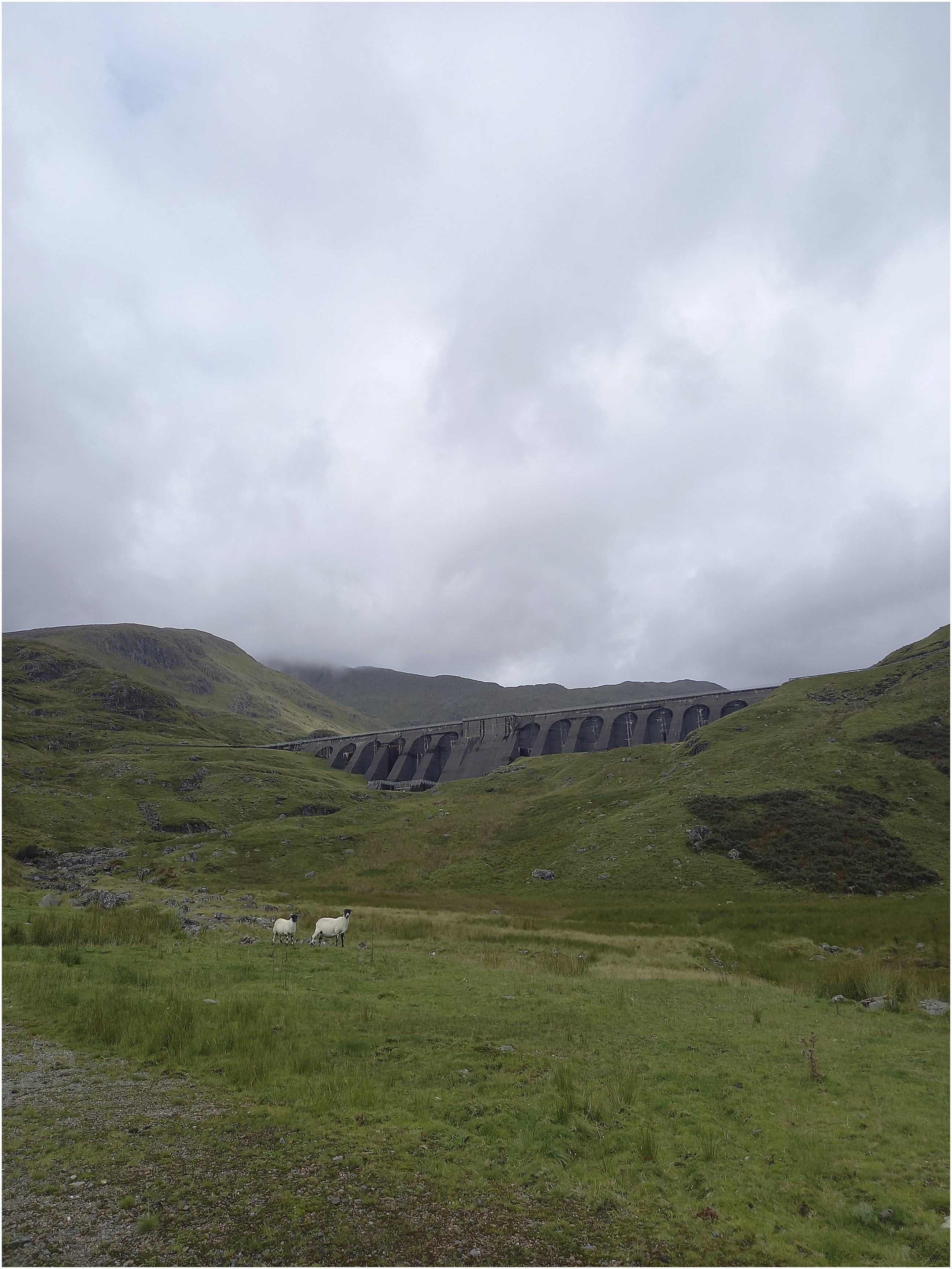
Reflecting further I continued: “It is phenomenal that the dam does just looks like the front of Vader’s mask. It is so apt. A pretty compelling setting. Vader, looking down the valley, watching The Eye.”
The dam itself was interesting not only because of this analogous aesthetic, and its additional evocation of the pill-shaped interior architecture of Imperial starships, but also because of its scale. At distance (the photograph in Figure 1 was taken around 500 m from the dam wall) it seemed a modest artifice, nestling in the landscape. This perspective, however, was deceptive; disclosing not any diminutiveness of the dam, but rather the relative size of the mountains that frame it. Up close, the imposing structure of the dam became truly apparent. This especially struck me as I walked to the foot of the dam wall on the return leg: “I am just walking down a set of old uneven sets to the bottom of the dam wall, and yeah up close I am starting to appreciate the scale if it. It is big. Like, really big. Just walking down a set of old windy uneven steps to the dam wall you maybe hear my echo right next to it.”
Being so close to the structure, and viewing it from below, I was struck by a further familiarity: “It is funny looking at it. Not only does the dam wall evoke Vader’s mouth, from the bottom of it it also looks like the shape of Vader’s helmet, which I had never really appreciated before. But the scale of it is impressive.”
The photograph (Figure 2) below shows clearly how the dam structure elicits this famous silhouette: Viewing the Cruachan Dam from below.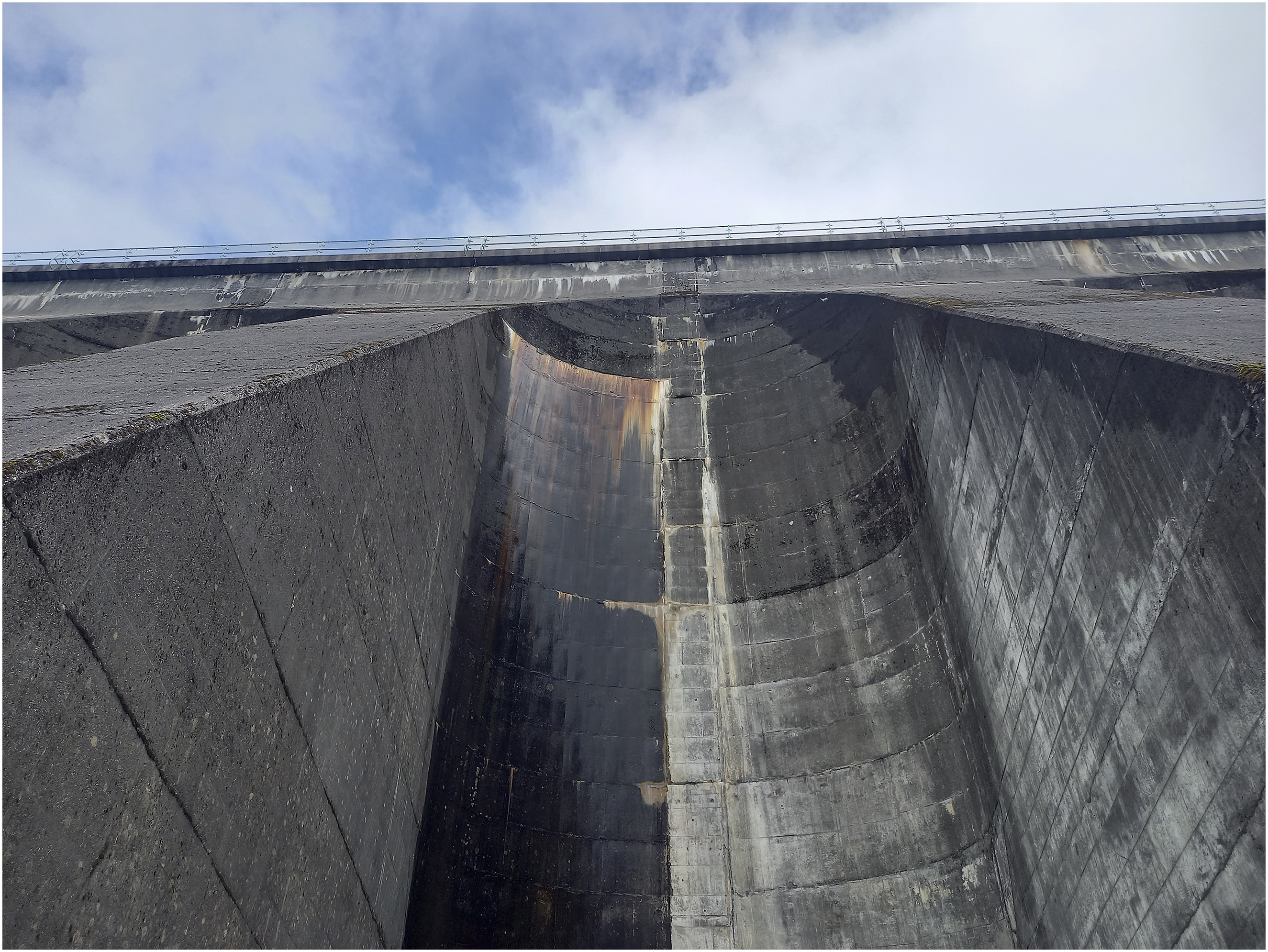
Darth Vader does not feature in Andor. Yet just as Vader has been argued to be integral to the wider storytelling in Star Wars (Van Ypren, 2011), so the same can be said of the Aldhani Garrison setting to Andor. This imposing buttress dam forms an important physical stage upon which a fantastic story is told. The dam, which was furnished further on screen by both practical on-set structures and a modicum of post-production visual effects, brings a brutalist architectural aesthetic through its exposed concrete pillars and cold, uncompromising design. 6 This works well with the narrative of Andor, where the dam serves to symbolise the exploitation of the landscape, the people, and the natural resources of Aldhani by the colonising Empire; broader themes of Imperial abuse and environmental harms that have been readily recognised in the wider scholarship of Star Wars (Atkinson, 2022; Boys-Smith, 2016; Kempshall, 2023).
Andor foregrounds how the pains of Empire radicalise ordinary people to oppose an oppressive regime that is slowly choking the galaxy. These disparate pockets of resistance will eventually coalesce to become the Rebel Alliance, but in many ways the soul of the rebellion at this point in time can be found in a character newly introduced in Andor. Karis Nemik is a young rebel, his politics shaped by the actions of the Empire, who becomes central to Cassian’s journey from everyday criminal to rebel hero. As part of a cell of seven rebels, including Cassian, Nemik is integral to the heist on the Aldhani Garrison. More than this though, Nemik is also an idealist, described by his fellow rebel Skeen as ‘all in’ and ‘a true believer’ for whom there is ‘nothing but the cause.’ At the rebel camp on Aldhani Skeen interrupts a conversation between Nemik and Cassian, who at this point is known in the rebel team by the nom de guerre Clem. The scene begins with Nemik tinkering with a navigational device: CASSIAN/CLEM That’s an old one. NEMIK Old and true. And sturdy. One of the best navigational tools ever built. Can’t be jammed or intercepted. Something breaks, you can fix it yourself. CASSIAN/CLEM Hard to learn. NEMIK Yes, but once you’ve mastered it, you’re free. We’ve grown reliant on Imperial tech and we’ve made ourselves vulnerable. There’s a growing list of things we’ve known and forgotten, things they’ve pushed us to forget. Things like freedom. SKEEN Nemik sees oppression everywhere. NEMIK Skeen pretends not to listen, but I know the message is sinking in. SKEEN [Chuckling] He’s writin’ a manifesto. Did he tell you? Apparently, the only thing keepin’ us from liberty is a few more ideas.
Nemik’s manifesto frames the unnatural state of Imperial control and tyranny as a type of dam: ‘It breaks, it leaks,’ and the battles and defiance of the rebellion will eventually ‘flood the banks of the Empire’s authority.’7 In this way the Cruachan Dam is not just an aesthetic recalling of Vader’s mask, but also serves as a deeper symbol of the Empire as artifice or aberration. The brutalist architecture in the beautiful landscape of Aldhani is a manufactured Imperial harm inflicted on the planet, its people, and its environment. It may hold back the sacred Nasma Klain river, but the brute force of the Empire cannot hold back inevitable Imperial defeat. This is a story already written in the canon of Star Wars, but which here, in Andor, is perfectly rooted in the landscape and history of the Scottish hills and glens.
The setting of the rebel camp from where the heist was planned – in the series a remote area in the Highlands of Aldhani, hidden in plain sight from the attentions of the Empire – was a destination for my second walk. Glen Tilt is unusually narrow and straight for a Scottish glen, with its flat valley floor and steep mountainsides cleaved into the landscape by millennia of glacial erosion. My walk into the glen and onto where the rebel camp was set was long but breathtaking. The reward for this walk was to encounter a landscape that disclosed a deep sense of time. The length of the outward walk to where the rebel camp was filmed, far into the glen for just under 11 miles, disclosed a physical remoteness of the setting. I encountered an array of awesome natural sights: from the roaring waterfalls and rapids of the River Tilt (see Figure 3) to golden eagles soaring on thermal updrafts as the sun warmed the hillsides. Sedimentary and granite rocks and waterfalls in Glen Tilt, en route to the rebel camp.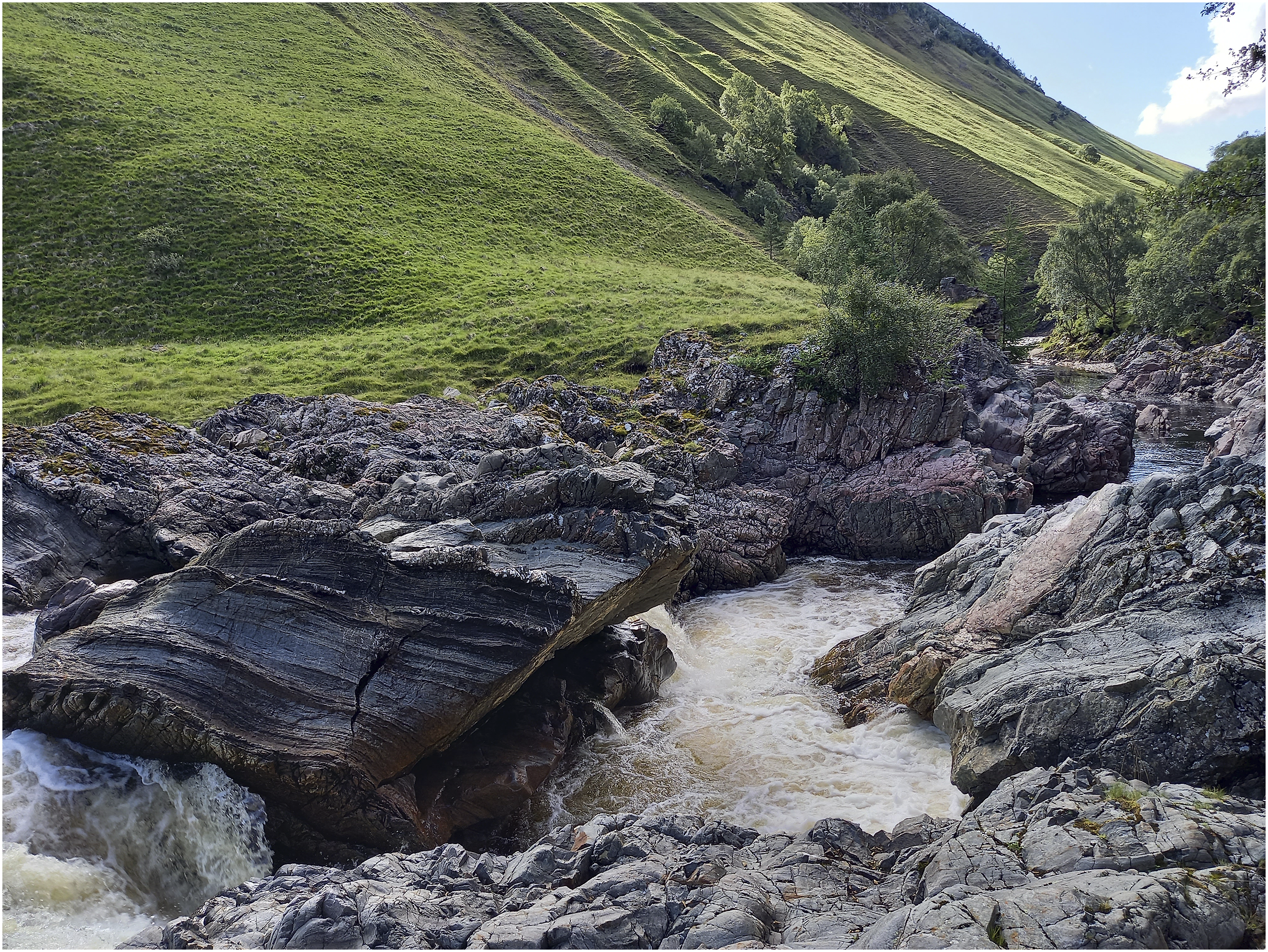
There was also an undoubted romance here in walking in the footsteps of James Hutton, whose groundbreaking geological journeys across Scotland, and particularly through Glen Tilt, used literature and illustration to convey the sense of wonder and excitement of scientific discovery (Furniss, 2014). For me, however, the aim of the walk was not an appreciation of deep geological time, but to encounter and sense the rebel camp in situ (see Figure 4). Watching Andor in situ at the site of the rebel camp, Glen Tilt.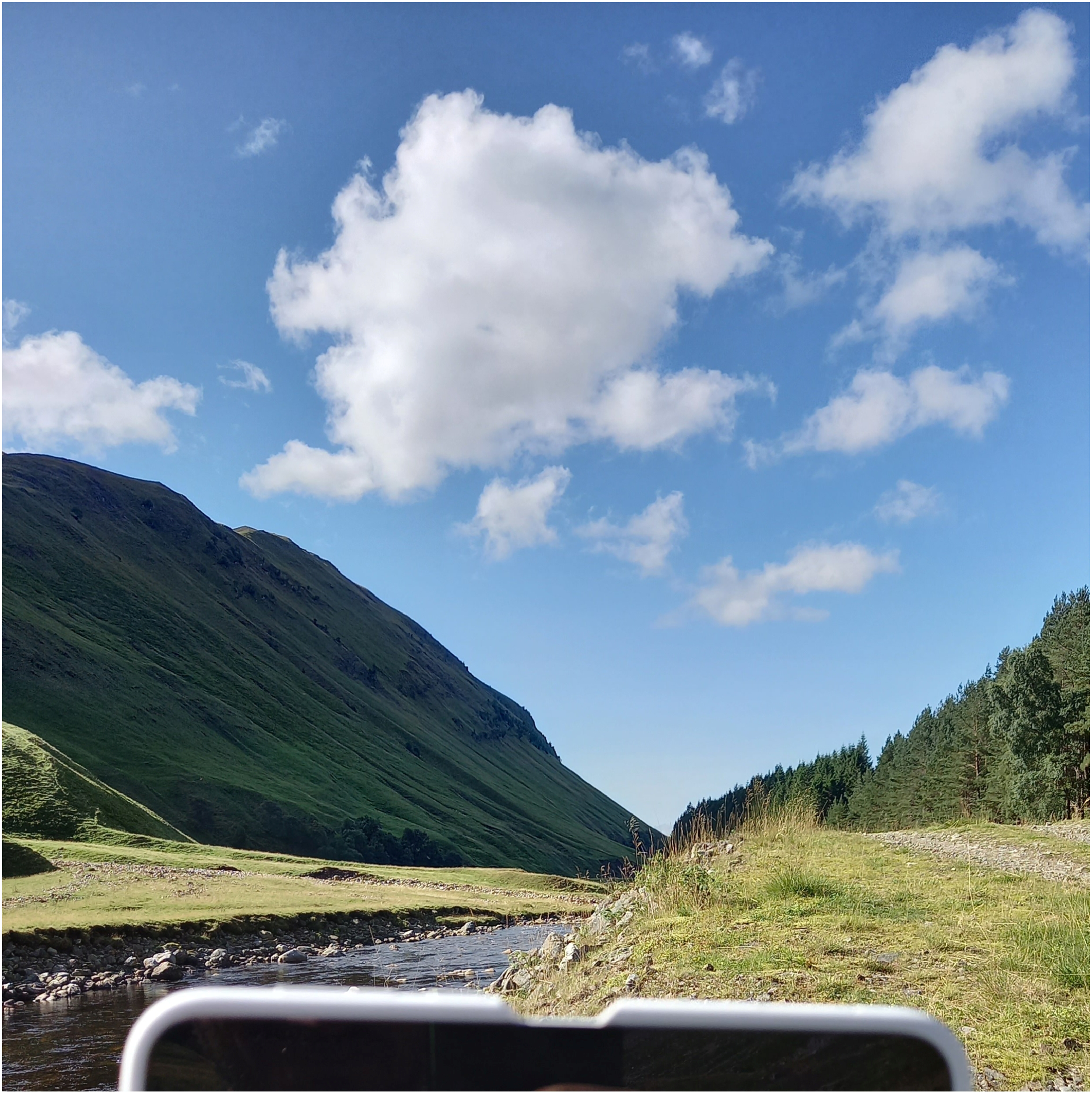
Being sensorially present in this space allowed me to augment Hutton’s spirit of discovery with Nemik’s perspective of ‘seeing oppression everywhere’. This reading of the landscape and its history, I argue, resonates with the storytelling of Andor; an analysis deepened by encountering wildlife through walking.
On my first walk, ascending the Ben Cruachan path, I stopped for a moment to look back down at the River Awe. Noticing a handful of industrial fish farms below allowed me to make my first connection between Scottish wildlife and the narrative of the Aldhani arc: “One thing I hadn’t really thought about until I got here on the way up, looking down to the Pass [of Brander] is wildlife and thinking about the migration of the [Atlantic] salmon coming up the coast and up into the Pass and the [River] Awe and right up through. So the migration of the Aldhani… maybe reflects this landscape.”
I pondered the epic journey of these fish back from their feeding grounds in surrounding seas and oceans to return to the very rivers in which they were born, and how this passage mirrors the trek of the Dhani people. The connection to wildlife was perhaps even more apparent at Glen Tilt. There, I again thought about the Atlantic salmon as they migrated up the River Tilt to their spawning grounds, but also about the golden eagles circling above. The presence of these magnificent birds of prey reminded me of the Empire’s aerial power – screeching TIE fighters and looming Star Destroyers – in the Aldhani mini-arc: “I just spotted a big, massive bird of prey on the hillside. I can still see it. It just dipped below the little crest of a hill there. It’s the equivalent of the TIE fighter zooming down the hillside buzzing the prey below.”
The way in which the narrative of Andor was written into the landscape and wildlife of Scotland was also apparent beyond this example. At the outset of my walk into Glen Tilt I encountered a sight that I, even as a Scottish person, had never seen in my own country: an indigenous red squirrel: “I have just walked past a pretty spectacular set of falls. The water was a deep peaty brown, a bit like whisky, the water of life, and just as I rounded the bend I came across a little red squirrel. That may not seem significant but they are pretty rare, pushed out by the colonising American grey squirrel in much of the rest of Scotland.”
Then just a few steps onwards: “That’s funny, after me saying red squirrels are rare literally a minute later I got a fright next to me as something darts up a tree, a silver birch tree, and there is another little red squirrel, who stopped to have little look at me before scampering back up… Maybe there is a story in the squirrels as well, reflecting Andor in the sense that the invaders, the grey squirrel, haven’t made an impact here, and it does remain a place where indigenous species remain. A remote haven… So again just like I have found an allegory with nature at [Ben] Cruachan, there is similar allegory to be made here at Glen Tilt.”
Here, Scottish landscape and wildlife disclosed a narrative of resistance to colonisation and ecological harm that both grounded and amplified the authenticity that has been integral to the success of Andor. Indeed, the sensobiographic walking method used in this study yielded additional insights on the encountered landscapes, particularly through sound and light, that further account for the convincing and compelling nature of the universe seen on screen in Andor.
Anamnesis, affective atmosphere, and authenticity
Järviluoma and Murray (2023) consider how sensobiographic walking builds upon wider sensory, affective and new materialist turns in research to engage with, amongst other encounters, the study of soundscapes. Given that walking methods have particularly focussed on the dynamic urban experience and ‘walking the city’ (Bates and Rhys-Taylor, 2017; Middleton, 2010; Pierce and Lawhon, 2015) both the ability to be unaccompanied and to experience both the sounds and the silences of these Scottish landscapes further diversified the underpinning method and theory. The soundscapes I encountered whilst walking – from the settings themselves, but also the sounds of Star Wars, particularly as imagined and recalled whilst walking – were powerful prompts to anamnesis as engagement with Andor. Conceptually, anamnesis is routinely considered as synonymous with remembering, but it is deployed here as more than that. Drawing further on the autoethnographic element of this paper, anamnesis is understood as an embodied experience prompted by sensory and emotional memories that, crucially, may recollect exposure to events, moments, or scenes that are known to exist only in the realm of imagination, speculation, fantasy, or myth.
My own anamnesis of Aldhani was immediately apparent on my first walk as I approached the Cruachan Dam: “It is really strange as I walk up I can hear the voices, of Cassian and crew marching up, of Taramyn [saying] “We meet soldiers from the garrison? We’re from Alkenzi. They’re from Alkenzi? We’re from the garrison.” I can also in my head hear the music of the Aldhani [I sing the ceremonial chant from the episode ‘The Eye’]. Feels weird. Crazy [wind blows].”
Prompts from watching Andor whilst stationary in the settings and my memory of the sounds of Andor – voices, music, and sound effects – were interwoven and informed my method and my analysis. This was disclosed in the following reflection from Ben Cruachan: “Just as I am walking back down to the dam wall and having watched bits of those episodes at lunch, I can almost hear the Andor theme music, those sort of discordant notes. I can also imagine now as I am walking down the whoosh of the TIE fighter just above the water as it speeds over the dam and the noise that it makes, a classic cinematic sound. And the noise of my feet, reflecting the march of Imperial boots, more than I think the Dhanis themselves. I more think of the pace of my walk as [it is] reminiscent of the march [of Imperial troops], rather than the [ceremonial] dance of the Dhanis.”
This powerful anamnesis of Aldhani, apparent across both fieldsites, was overlaid with the atmospheres the settings themselves. The following data indicates how this interwoven nature of setting, sound and screen further unfolded at Ben Cruachan: “Just walking along the dam, the dam wall, now and I can picture in my mind’s eye Vel running along the bridge, the dam wall. Wow. Looking at a spectacular view. It is a big ring, the Cruachan, and Stob Daimh. All I can hear now is the birds tweeting, flying away, and the distant roar of the waterfalls coming down all sides of the bowl and into the dam itself.”
This data was recorded at the Cruachan Dam wall (see Figure 5). Experiencing anamnesis walking across the Cruachan Dam wall.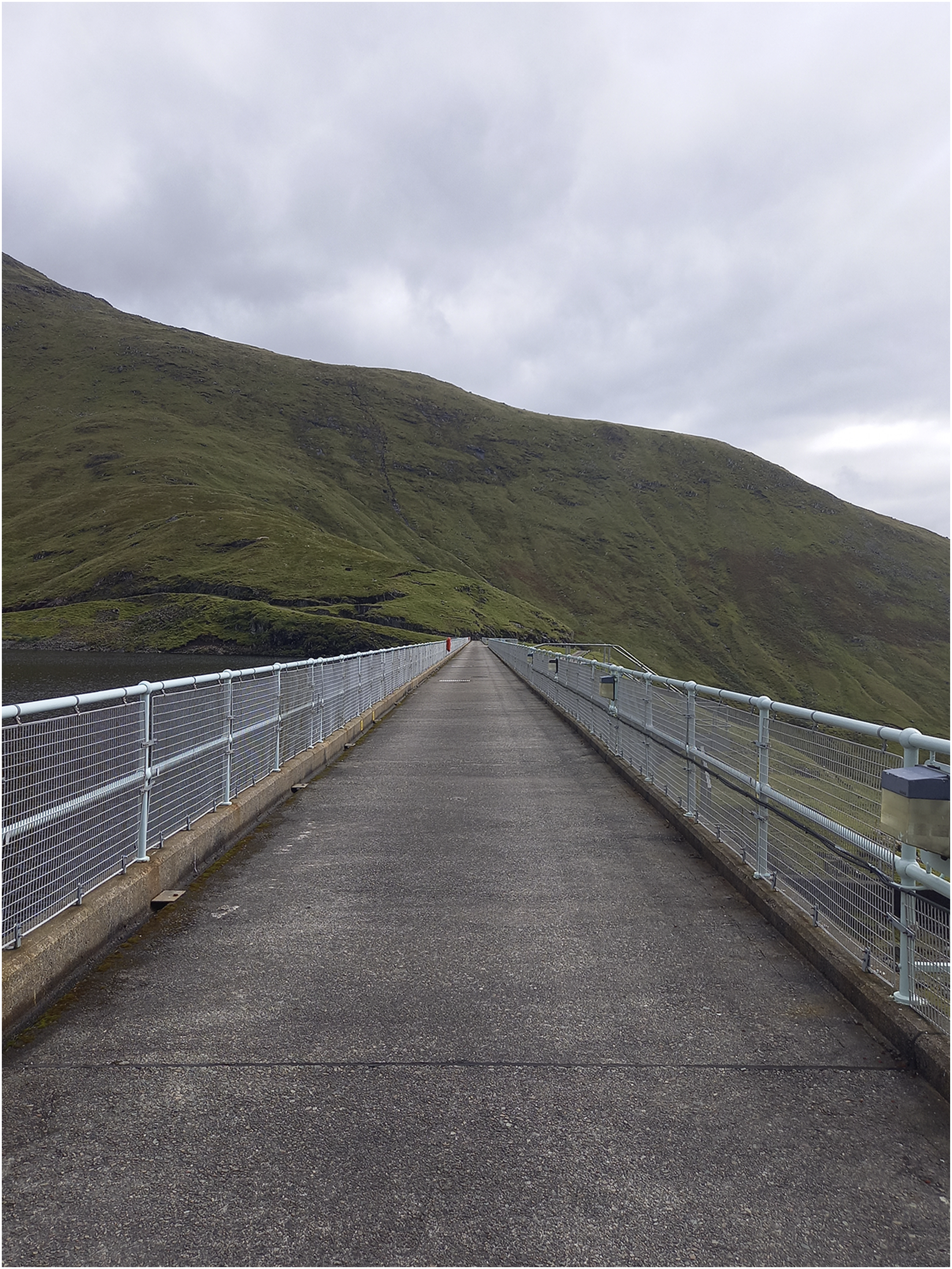
Similar processes – of my recalling of events, through sight and sound, at a place I had never physically been to – were also at play at the rebel camp at Glen Tilt, as the following data from fieldwork discloses: “I am not sure why but as I walk back down the glen and I am looking at the camp area, over my right shoulder I can kinda feel that is where the TIE fighter came from and I can hear it go ‘ZMMMMM’ down the glen, kicking up the water from the river on my left and the rebel crew ducking for cover and the sheep looking slightly bemused. Definitely if I close my eyes I can feel that on my right hand side, that sound.”
This reflection was recorded at the location below (see Figure 6). Anamnesis in Glen Tilt at the area from which the TIE fighter emerged.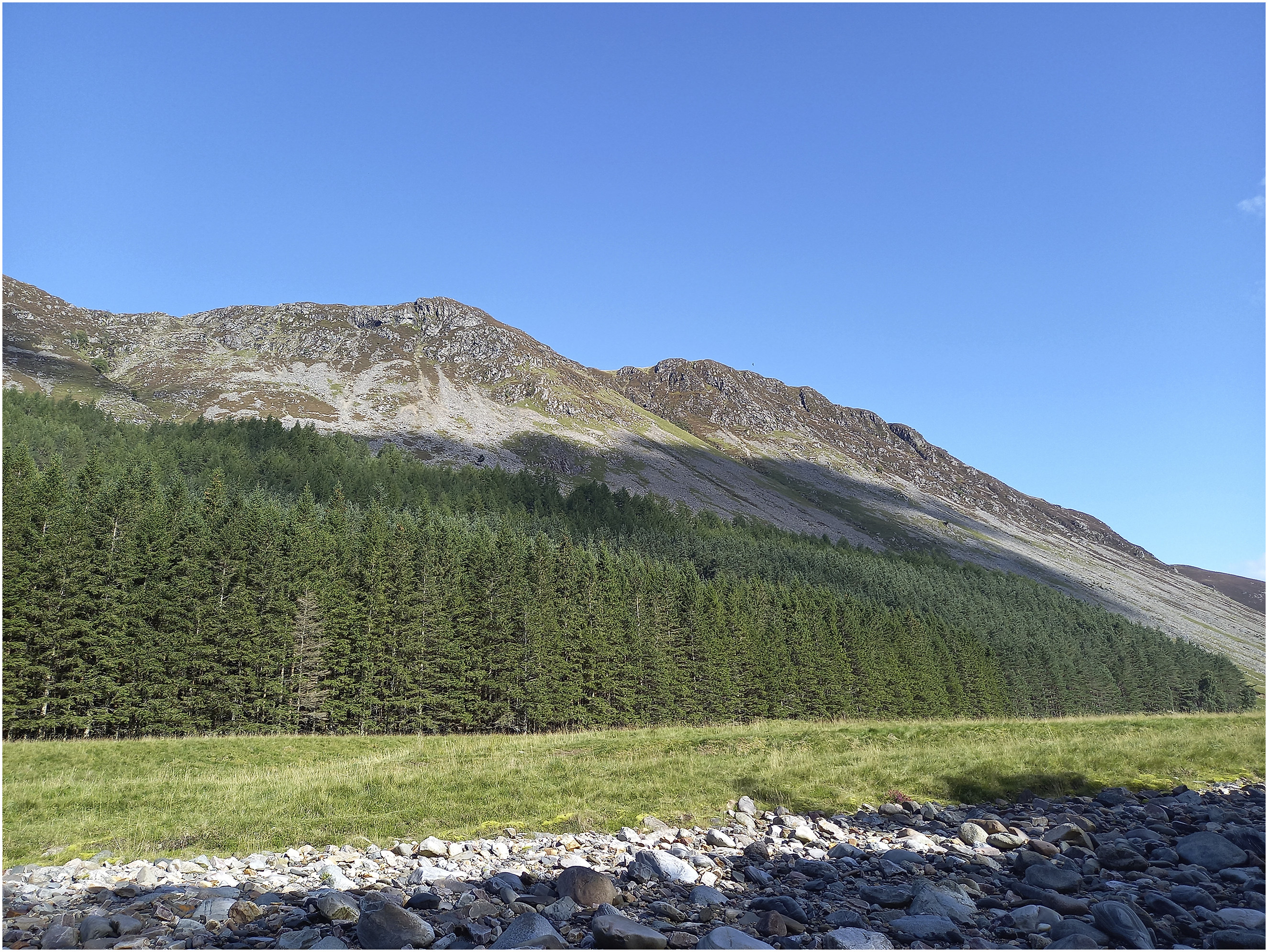
My recollection of sound was a powerful prompt to engagement with landscape and setting. In part, the auditory power of Andor, and of its sound effects in particular, is rooted in its continuity with the classic sounds of Star Wars. A study of the 1977 movie Star Wars (Brooker, 2009) noted how the sound designer Ben Burtt composed a ‘sound fabric’ that captured and composited an array of real-world sounds that contributed to the authenticity and lived-in feel of this far away galaxy. Andor reproduced this familiar sound fabric across the Scottish landscape: from the scream of the TIE fighter to the blare of the Imperial siren. My own memory of sound was a powerful prompt to engagement with landscape and setting, with my anamnesis contributing to what can be considered as an ‘affective atmosphere’ of the fieldsites.
In Encountering Affect Ben Anderson (2014) sought not to offer a definitive conception of affective atmosphere, but to use his exploration as an opportunity to ‘sense’ how spaces and times become imbued with an ‘affective charge.’ The sensory turn towards understanding atmosphere as ‘affective’ – which is to be attuned to how non-material forces can be both sensed by and influence bodies, emotions and experiences in a given space and time – has focussed on a range of settings: from urban streets (Fraser, 2021; Fraser and Matthews, 2021) and cities (Shaw, 2014) to art fairs (Yates and Bērziņa, 2023) and surf spots (Waitt and Frazer, 2012). In her own applied research on gentrification in urban neighbourhoods Olga Łojewska (2023) understood affective atmosphere as a ‘conceptual tool’ that can be applied to portray the dynamic relationality of ‘materialities and non-materialities’ in the assemblage of environment. Perhaps more plainly, and in language familiar to fans of Star Wars, affective atmosphere constitutes an intangible and invisible force in a given space, the energy of which can be sensed by and acts upon those present. My encounters with affective atmospheres at the fieldsites were found at the confluence of my own identity, anamnesis and sensory experiences in these spaces. The ephemerality of these engagements – of my walking into, through and beyond Aldhani – was reflected in Anderson’s view that such atmospheres are dynamic and attuned to, and envelope, those present; they are ‘always forming and deforming, appearing and disappearing’ and ‘never still’ as they are encountered (Anderson, 2014).
Sensobiographic walking of both Ben Cruachan and Glen Tilt disclosed how their affective atmospheres were in constant motion. In particular, my sensory experiences of these landscapes – and the extent to which I felt attuned to Andor in the spaces upon which it was performed and filmed – were influenced by the shifting combination of skies, light, and weather. On the outward leg of the walk at Ben Cruachan the skies, light and weather were similar to that depicted in Andor: damp and overcast, with mist rolling across the hills. Just as lighting has been integral to the stories told by filmmakers across the history of cinema (Brown, 2024), so cinematographic techniques incorporating light, dark, shadow, and colour have been significant in the storytelling of Star Wars. Van Ypren (2011), for example, noted how both light and darkness on screen have been deployed in Star Wars as chiaroscuro, and a form of cultural symbology to convey a binary moral universe of good versus evil. This commitment to light as metaphor has continued in the Disney era, memorably in the use of the reflective glow of blue and red lightsabers on the mask and partially exposed face of Darth Vader in the limited series Obi-Wan Kenobi (2022) to suggest his internal emotional conflict as he fought his former master. Light in Andor, by contrast, was more natural.
As filmed on location in remote Scottish settings Andor was at the behest of the notoriously erratic Scottish weather; a process compounded by the economic realities of shooting schedules. Doing so, however, allowed the production team to harness natural light and conditions on set and on screen in ways that disclosed authenticity in relation to both the Scottish setting and to the spirit of the franchise as a grounded and lived-in galaxy. Andor may have been science fiction set in a galaxy far, far away, but I could see Scotland on screen. My walking fieldwork allowed me, through anamnesis and affective atmosphere, to feel Star Wars in Scotland.
There are differences between affective atmosphere as it has been broadly applied in the existing literature – across a range of settings, but largely in urban spaces and amongst groups of people – and how it was sensed for the purposes of exploring Andor for this paper. Foremost amongst these are that affective atmosphere is used here in the context of solo sensobiographic walking journeys in the spaces that were used as settings for television content, with these affective atmospheres sensed individually, in remote landscapes, with no other people present. Importantly in the context of this method, one must recognise that those who feel the force of affective atmosphere bring their own histories, bodies and sensory experiences to bear upon its composition and concentration, in quiet conversation with the space itself. In her exploration of walking methods in landscape research Hannah Macpherson noted the importance of the individual body and personal biography as they intersect with the ‘authenticity’ and experiences of place, “The body has sometimes been regarded as a way in which to ‘ground’ understandings of landscape. Yet, there are many ways in which the landscape can enter the embodied conscious and unconscious mind and these are historically specific and contingent on an individual’s particular practices… researchers must remain reflective and critical of people’s expressions of connectedness and authentic connection with landscape and avoid assuming that particular embodied experiences are in anyway more ‘authentic’ than others.” (Macpherson, 2016: 429).
The fieldwork undertaken for this paper disclosed a deep and unique connection between my own self as the researcher, the Scottish landscapes, and Star Wars. The claims made upon how these landscapes – imbued with their own histories, myths, memories, aesthetics, and soundscapes – both reflect and create authenticity for the series merits further discussion.
Discussion: Reflections on intersecting authenticities in Andor
This paper has, to this point and in its guiding research question, deployed the term ‘authenticity’ with an ease that betrays the complexities of the concept. This discussion section contends that the authenticities of Andor are exhibited across two vectors: its identity as a Star Wars production and how the series balances this with its commitment to social realism. A straightforward accounting of authenticity on screen – as grounded in and representing ‘real life’ in ways that resonate with viewers and which is recognised as a familiar approximation by those depicted – has been central to understanding the critical success of television show such as The Wire, a celebrated series that cultivated authenticity through an assemblage of casting, characters, dialogue, dialects, settings, scenes, lighting, sound, props, and stories of the city of Baltimore (Penfold-Mounce et al., 2011). The type of authenticity so often praised in The Wire, social realism, has a long tradition that is particularly evident in British television and film, spanning a range of genres (Lay, 2002). In Scotland, for example, social realism has been central to popular television comedy series such as Rab C. Nesbitt and Still Game (Blaine, 2009; Rolinson, 2011). The very notion of authenticity, however, requires a deeper consideration beyond simple synonymity with social realism, particularly as it intersects with fictional narratives on screen as they extend into science fiction.
Whilst there is considerable debate and dialogue on the problem of precisely defining science fiction (see Bould and Vint, 2011; Landon, 2014; Roberts, 2006), an area into which this paper does not seek to delve too deeply, it seems reasonable to suggest that science fiction as a genre, particularly as it is depicted on screen, is multifaceted and elusive, and is kept fluid through its ongoing construction and reconstruction by creators and wider communities of practice (Telotte, 2023). Recognising science fiction as a fluid and contested field allows for resistance to the exclusions that follow from strict definition. Roberts (2016) provides a useful account here in his suspicion of any attempt to make a binary distinction between ‘science fiction’ and ‘real life,’ appreciating that science fiction writers may deploy realist strategies in their work, creating a dialectic interplay between the freedom of imagined speculation and more grounded accounts of our world as it is. Andor, perhaps more so than any other Star Wars production, not only exemplifies this fluidity between science fiction and social realism, but actively contributes to developing the connections between these seemingly contrasting modes of storytelling.
Discontent over the authenticity of Star Wars has been a recurring feature in the fandom; perhaps most apparent in the controversy over the edits and digital additions made by George Lucas to the original trilogy across successive special editions and DVD releases. As Lyons and Morris (2007) remarked, “Lucas’s digital project also reconstructs and reorients the spectator’s auratic experiences, further problematizing notions of authenticity and permanence. Ironically, whilst Lucas envisions his digital project as somehow preserving the “authentic” art experience, he fails to recognize the extent to which digitization opens up and destabilizes the films and tampers with the unique interaction that is the aura.” (Lyons and Morris, 2007: 190).
8
Andor was also a project carrying destabilising risks, particularly given its canonical proximity to Lucas’s much celebrated Star Wars (1977) and the well-received 2016 release Rogue One. In his foreword to The Art of Rogue One: A Star Wars Story (Kushins, 2016) Doug Chiang, the vice-president and executive creative director of Lucasfilm, noted the challenge of envisioning bold new ideas for Rogue One whilst staying true to the aesthetic of Star Wars, remarking upon how Rogue One’s ‘new designs’ had to ‘dovetail seamlessly with A New Hope.’ Andor faced a similar challenge, although this time it also had to do so as a television series that, at the conclusion of its second season, walks the viewer directly into the opening act of Rogue One. The success of Andor in not only looking but also, as Singh (2014) may suggest, feeling authentically ‘Star Wars’ was achieved not just through continuity and the care of its creators, but also in the practical locations that gave its creative talents a dynamic space and stage, and its audiences a grounded sense of place and time.
The themes of Andor resonate with those apparent in the tradition of social realism on screen: injustice, exploitation, abuses of power, status and privilege, inequalities, violence, resistance, and the uneven distribution of harms across society. Furthermore, Andor stylistically foregrounds these themes across its stories, characters, settings, costumes, props, and overall aesthetic and sound in ways that are familiar to the traditions of social realism. To illustrate this, Andor eschews much, albeit not all, of the fantastical elements that characterise much else of the wider Star Wars franchise. The vast majority of the characters in Andor, for example, are humans; with alien species featuring sparingly in secondary roles across the series. Similarly, there are no supernaturally powerful Jedi or Sith participating in beautifully choreographed or CGI-enhanced lightsaber battles. 9 The audience is instead presented with scenes of everyday human struggle beyond the effortless agency of the traditional heroes and villains of the franchise; of the mundanity of life and work at remote military outposts at the periphery of Imperial power, or the quiet deliberation of the disgraced street-level bureaucrat who considers his life choices whilst eating cereal at breakfast with his disapproving mother. Through such scenes Andor is perhaps less likely to appeal to children in the ways that have been apparent in prior instalments of this transmedia franchise (Charles, 2012; Krämer, 2004; Miller and Sprich, 1981). Andor is awash with ordinary people facing everyday challenges and ethical dilemmas that are relatable to a more mature audience, with it oftentimes seeming incidental that these stories are set in a science fictional universe.
As the preceding analysis highlighted, Andor discloses an authenticity in large part because it is staged upon and connected to physical landscapes with their own histories, myths, memories, aesthetics, and soundscapes. As these features intersect they both align with and inform collective understandings of the Star Wars universe, providing the series with a gritty and grounded feel, and an aesthetic perfectly suited to its subgenre as a political spy thriller. This approach can be understood in some contrast to the production of other recent Star Wars content. The Mandalorian (2019 – ), The Book of Boba Fett (2021–22), Obi-Wan Kenobi (2022), Ahsoka (2023–) and Skeleton Crew (2024–25) all made extensive use of ‘Industrial Light & Magic (ILM) StageCraft’, a state-of-the-art special effects technology known colloquially as ‘The Volume’, ILM StageCraft blends traditional studio production stages and sets with enveloping digital screen backdrops that shift perspective in real time and space (Turnock, 2022). In their heavy use of ILM Stagecraft both season one of Ahsoka (2023) and season three of The Mandalorian (2023) present an interesting contrast to the production of Andor. Both Ahsoka and The Mandalorian used aerial cinematography of Scottish settings to create immersive composite virtual environments using ILM StageCraft. Ahsoka filmed the otherworldly ‘cnoc and lochan’ (hill and lake) geography of Assynt and Coigach in the remote northwest Highlands, whilst the rugged Atlantic coastline and jagged peaks of the Isle of Skye were used in The Mandalorian. Arguably, however, in their reliance on recreating these settings digitally in a virtual production studio space they lack the physical connection between landscape and narrative apparent in Andor.
Conclusion
Sensitised by Phiona Stanley’s 2020 autoethnographic account of ‘walking home’ in Scotland this paper used sensobiographic walking methods to explore two locations in the Scottish Highlands that provided a physical stage and backdrop for three episodes of Andor. Walking in these landscapes and reflecting upon my own sensory engagement with nature, culture, climate, myth and memory, disclosed deep narrative connections between the Aldhani mini-arc in this series and its Scottish stage. Beyond its aesthetic similarities with Vader’s mask, the imposing Cruachan Dam symbolised the exploitation of landscape, people and natural resources at the thematic heart of Andor; themes amplified by the sensory experiences of the wider landscapes and wildlife. Walking through and spending time in these spaces became powerful prompts to my own anamnesis of Aldhani, a process of ‘remembering’ and discovery that synthesised the settings with their sounds and sights on screen. Such experiences are, of course, acutely personal, and the ontological status of any place depicted on screen can depend on one’s own knowledge of, and familiarity with, the setting in question. Nonetheless, the paper argued that in its grounding in these landscapes, and in almost totally eschewing ILM StageCraft, Andor disclosed an authenticity and a lived-in, patinated feel that has been lacking in recent Star Wars productions. In important ways, therefore, Andor signalled a return to the filmmaking approach of the original Star Wars trilogy, ultimately working to bring this galaxy far, far away a little closer to home.
Footnotes
Declaration of conflicting interests
The author(s) declared no potential conflicts of interest with respect to the research, authorship, and/or publication of this article.
Funding
The author(s) received no financial support for the research, authorship, and/or publication of this article.
