



Abstract
In 2017, Moscow launched an urban renewal campaign proposing to tear down eight thousand panel-block apartment buildings aiming to relocate over a million and a half residents into newly built high-rises. The campaign provoked diverse reactions ranging from anger to excitement for the chance to improve living conditions. The author began ethnographic research on the eve of the first phase of demolition in 2021, inviting Moscow-, and Berlin-based artists to examine the stories, memories, and feelings of their panel-block homes in a collaborative visual anthropology research project. In 2022, Russia’s full-scale invasion of Ukraine interrupted research, beckoning the author to reevaluate their study from affective and ethical positions. Studying responses to the war using autoethnographic methods allowed the author to acknowledge disaffection and withdrawal as significant emotional responses to the threat of political violence—dispositions that make for ethnographically and ethically important moments of research.
Keywords
I grew up in a prefabricated panel-block home in a working class neighbourhood on the outskirts of Moscow, then the capital of the Soviet Union. My family lived in a large, two-bedroom apartment; my mother and I occupied one room, my grandparents, the other, and a brown poodle roamed the halls, barking at the door at every disturbance. A laminated particle-board bookshelf called a stenka stood alongside one wall of the living room, and a rug hung on the wall opposite. On dark winter mornings, my grandmother would make porridge, or grate me an apple for breakfast. We would then walk to kindergarten through courtyards of five-, and nine-storey grey, panel-block apartments unremarkably similar to my own. My kindergarten teachers taught me that Lenin was kind to children, which I later learned was a bizarre notion of which my mother had to painstakingly disabuse me. In 1991, one of my mom’s scientific colleagues visited us from Europe. He left the only surviving colour photograph of my childhood, which captured my first day of school. Soon after, my mother left Russia to pursue a scientific career first in France, and then Canada, and she would take me with her.
Across several migrations and cultural frames, the narrative about my childhood has gone through many iterations before settling in my adult voice, and now, in print. It is also one in which I hardly recognize myself; Russia’s escalation of war on Ukraine made the sentimenal candour of such reminiscences feel hackneyed and self-aggrandizing. Before Russia’s invasion, I was leading a visual anthropology study prompted by Moscow’s Renovatsiya campaign, an urban redevelopment initiative that sought to demolish several thousand apartment blocks and to relocate a million and a half residents into newly-constructed high-rises (Evans, 2018; Moy Noviy Dom, 2017: 551). Seeking to examine feelings, memories, and experiences associated with the loss of their homes, I invited a dozen Russian-speaking artists in Moscow and Berlin to create original artworks that would develop a contemporary aesthetic of prefabricated panel-block apartments, which we planned to exhibit in a transnational art exhibition. Just as we were finalizing exhibition plans, Russia’s war in Ukraine abruptly ended our collaboration. Its immediacy became an “ethically important moment” (Guillemin and Gillam, 2004), triggering an affective response that shifted research priorities and provoked feelings that refused to settle.
This paper engages with the multiple dimensions of the ensuing crisis by reflecting on personal and political narratives, experiences, and feelings that circulated around panel-block homes shortly before Russia’s full-scale invasion. Anthropological scholarship has traditionally approached the planned uniformity of socialist housing as a deeply ideological space (Boym 2005[1994], 67; Borneman, 1992). Later accounts considered the home as a transgressive, or performative site of the everyday, which allowed people to subvert political and social expectations (Cherkaev, 2023; Yurchak, 2006: 158). Supported by research on panel-block housing as a highly-differentiated living space (Korableva et al., 2023: 95), I approach the socialist home both as a political project that emerges from “a mutual involvement of people and materials in an environment” (Ingold, 2000: 68), and an affective entity.
Raymond Williams first conceptualized collective feelings that shape cultural patterns and reveal social asymmetries as “structure of feeling” (1977: 132). The concept describes social senses that elude “definition, classification, or rationalization before they exert palpable pressures and set effective limits on experience and on action” (1977: 130). Affect scholars have refined the concept, making a distinction between emotions articulated through cultural codes by words such as “anger,” or “sadness,” and affects, which are inchoate senses expressed through verbal hints such as “feeling out of place,” or through psychological dispositions such as melancholy (Slaby and Röttger-Rössler 2018: 5). Jan Slaby considers how various actors engage with wider socio-spatial constellations through an “affective arrangement” (2019: 109), a relational concept that activates “any array of persons, things, artifacts, spaces, discourses, behaviours, expressions or other materials [capable of] affecting and being-affected [within an] affect-intensive site of social life” (2019: 109); a concept that I readily take up in my research.
My initial ethnographic study focused on feelings towards panel-block housing constructed during Nikita Khrushchev’s first industrial mass-housing campaign, 1957-1968, which came under threat of demolition as “dilapidated housing stock” in 2017. Owing to Covid-19 precautions at the time of fieldwork, conversations with interlocutors took place largely online, although occasionally, I would invite participants to walk through their neighbourhoods, and to paint plein-air sketches of apartment buildings slated for demolition. Throughout this paper, I intersperse my watercolour sketches as a visual record of our placemaking (Figures 1, 2, 3, 4, 5, 6). If my experience inhabiting and interpreting panel-block housing shaped me as a “positioned subject” (Rosaldo 2014: 135), it necessarily impacted our conversations. Therefore, autoethnographic reflection became a key method through which I gained ethnographic insight. My research revealed that the way participants and I articulated feelings towards our homes, drawing on memories of state socialism and the ensuing social and political transformations, also framed our dispositions towards contemporary Russian politics.
In the following sections, I provide a brief historical overview of panel-block housing in the Soviet Union and contemporary Russia. I then describe participants’ experiences, which I classify as displacement, dispossession, and disaffection. These categories derive from ethnographic analysis of transcribed and coded interviews, which revealed how participants connected memories of childhood (coded here as displacement), to the growing sense of unease about losing their homes (coded as dispossession), and to the affective realities of the present moment, which I conceptualize as disaffection. In this last section, I turn to reflexive, autoethnographic approaches to deconstruct how my own affective dispositions towards my former home blindsighted me to an unfolding crisis, leaving my analysis deeply unsettled.
A hundred years of socialist housing
The history of housing in the Soviet Union is inextricably linked to Marx and Engels’ dialectical materialist doctrine, which posited that a society’s material conditions would effectuate the ideas it collectively embodied. The Marxist view held that an industrial, capitalist economy pushed people from the countryside to the cities, where they were dually exploited as labourers working for subsistence wages, and as tenants, indebted to landlords and living in squalid conditions (Magubane, 1985: 45-48). Writing about the working class in England, Engels posited, “The brutal indifference, the unfeeling isolation of each in his private interest becomes the more repellent and offensive, the more these individuals are crowded together, within a limited space” (Engels, 1980: 60). Engels believed that eliminating private property would play a key role in erasing division between classes, thereby abolishing the capitalist mode of production. Altering society’s material conditions would, in turn, alter its way of thinking. Khrushchevka in Cheryomushki Administrative District, Moscow. Watercolour on paper, Autumn 2021.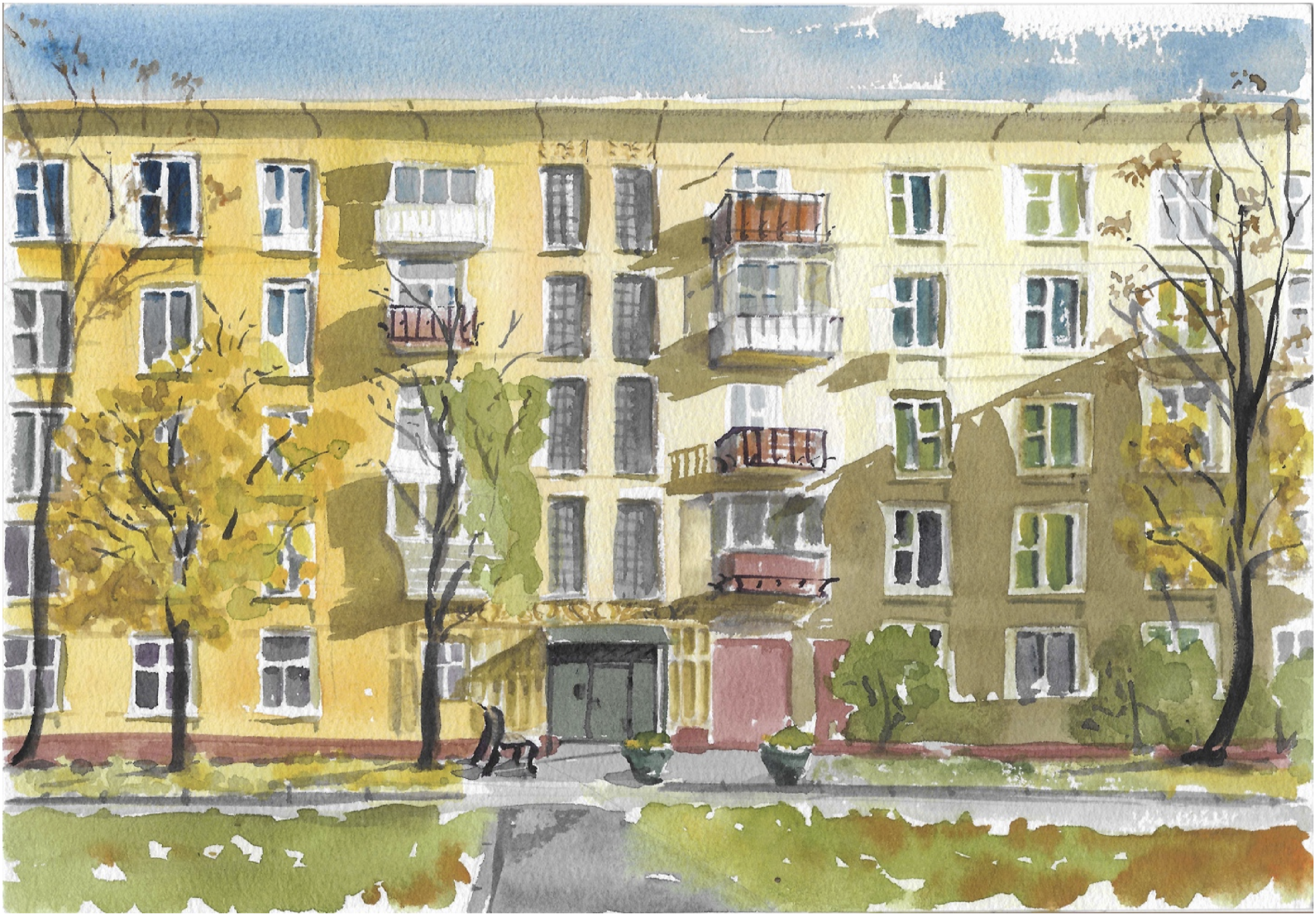
Beginning in 1917 with the Russian Revolutions and the Civil War, Bolshevik revolutionaries heeded Engels’ call: housing was expropriated from landowners, nationalized or “municipalized” by local commissariats, and distributed to newly-minted civil servants (Kholodilin and Meerovich, 2018: 937). Housing became an essential tool for Bolsheviks to consolidate power (Crawford, 2022: 318), “turn[ing] into perhaps the most, if not the only, effective means of managing labor resources” (Kholodilin and Meerovich, 2018: 938). Architects and urban planners would continue to debate its aesthetic, political, and ideological functions until their revolutionary fervor was cut short by Joseph Stalin’s doctrine of socialist realism. Beginning in 1932, avant-garde experimentation made way for a neoclassical, ornate architecture that venerated socialist life by rising to ever-greater heights (Gan, 2015). Paradoxically, industrialization and militarization sidelined housing policy, pushing people into crowded communal apartments, damp basements, and wooden barracks (Meuser and Zadorin, 2015: 55). The housing crisis was only further exacerbated by the destruction and mass displacement of the Second World War.
In December 1954, almost two years after Stalin’s death, Nikita Khrushchev gave a speech at the All-Union Conference of Builders widely considered to have heralded the era of Soviet modernism. Khrushchev derided Stalinist architects for building eclectic structures with spires and porticos, and for giving in to “bourgeois excess” (Khrushchev, 1954: 3). The following year, he decreed that architecture shall be standardized using prefabricated concrete panel blocks, and designed “without excesses” (Gerchuk, 2000: 86). Cheryomushki, a quaint settlement on the outskirts of Moscow, was renamed Mikrorayon Novie Cheryomushki (“micro-district New Cherrytown”), and turned into a test site for industrially-built mass housing. Between 1956 and 1959, it would test neighbourhood designs promoting foot traffic; cost-effective construction materials, and built-in furniture that would accommodate small spaces (Malaia, 2020: 30). The winning design of a five-storey panel-block apartment offered private living quarters and central heating, and could be built in as few as 12 days.
The micro-district was metonymized to other parts of the Soviet Union, allowing entire cities to emerge in hitherto undeveloped regions. In the span of a decade, Khrushchev’s mass-housing campaign would relocate over a hundred million people into single-family panel-block apartments (Reid, 2006: 238). If this type of rational planning sought to solve the post-War housing crisis, it also secured Khrushchev a political foothold that would allow him to dismiss Stalin’s cult of personality (Gorlov and Artemov, 2022: 50). Seizing on the slogan of the time, “Communism by 1980” (Ikonnikov, 1995: 8), the micro-district grew in ideological importance, but this also meant that its architecture was deemed temporary, slated to be replaced within twenty-five years. Antonina Romodanovskaya’s impressionistic, snow-covered watercolours, or Yuri Pimenov’s painting series, “New Residential Quarters” (1968) sought to capture the excitement of rapidly emerging panel-block neighbourhoods, now synonymous with socialist progress. Even Dmitry Shostakovich composed Moskva, Cheryomushki (1959, op. 105), an operetta subsequently adapted to film (Rappaport, 1962), which combined a socialist realist plot with surreal, expressionistic sets. In a key scene of the film, a concrete panel block flown by a construction crane carries a young couple, as if by magic carpet, into their new apartment (Palmorola, 2020: 62).
During Brezhnev’s era of economic stagnation, panel-block architecture broadened its visual vocabulary and greatly increased in building height (Malaia, 2020: 9-10). However, social experiments that sought to involve collective or participatory forms of living were dropped in favour of building the highest number of single family apartments (Bronovitskaya et al., 2021: 104). Panel homes came to symbolise a new Soviet domesticity, and their planned uniformity became a plot point in seminal films, such as Moscow Doesn’t Believe in Tears (Menshov, 1980), and Irony of Fate (Ryazanov, 1976). In the latter film’s opening animation, panel-block apartments grow legs, marching to conquer the entire world. Indeed, 89,2% of the urban population of RSFSR would be housed in buildings constructed between 1950s-1980s, spanning the period beginning with Khrushchev’s housing campaign to the dissolution of the Soviet Union (Kalyukin and Kohl 2020: 1774).
If the vast majority of Soviet apartments were state-, and cooperative-owned, a Russian Federal Law “On the Privatization of the Housing Reserve” (4.07.1991) gave tenants the right to ownership, with an important caveat that the municipality would retain property rights to the building itself. Apartment residents were justifiably apprehensive that privatization would raise taxes and utility bills; nevertheless, by 2015, 87% of Russian residents were homeowners (Korableva et al., 2023: 89). Meanwhile, panel-block apartments built to last twenty-five years were entering their sixth and seventh decades, and urgently needed repairs (Korableva et al., 2023: 89). Trumbull discusses urban regeneration initiatives across different postsocialist countries, framed by new standards of governance, access to global markets, and residents’ own expectations. If in the West, ill-reputed panel-block housing was generally retrofitted through participatory initiatives that sought to involve residents, in Russia, where residents maintained favourable attitudes towards their homes, “renovation” has been a top-down process that involved razing buildings to the ground (2014: 497-498).
Trumbull examines one such initiative, which in 2008 sought to relocate 150,000 St. Petersburg apartment residents into privately-developed infills (2014: 502). A fraction of the scope of Moscow’s campaign that would follow a decade later, it similarly involved the cooperation between local politicians, private companies, and apartment owners. A selection of interviews on the eve of the program reveals remarkable similarities between the two campaigns: residents feared that new housing would not provide them with adequate infrastructure and green space; they were kept in the dark regarding demolition timelines, and were often forced from their homes against their will (2014: 505). If Trumbull extols the early phases of the initiative, Korableva et al. chronicle the campaign’s apparent failure in its twilight, having accomplished only 3,5% of its objectives (2023: 91). The authors attribute this to successful resistance mounted by residents, whose ownership rights presented a legal challenge to private developers and the municipality. Having learned of the need to curb the homeowners’ negotiating power, the State Duma amended the law to allow two thirds of apartment dwellers to decide the fate of their building (Korableva et al., 2023: 96), which came into effect on the heels of Moscow’s renovation campaign of 2017.
Initially, Moscow’s Renovatsiya seemed to echo previous campaigns: Muscovites were promised apartments in newly-built high-rises with updated neighbourhood accessibility, security, and infrastructure. However, the sheer number of homes slated for demolition—originally, 8000 apartment blocks (Smyth, 2018: 2)—and an estimated relocation of a million and a half residents between 2021 and 2032 made this the largest urban redevelopment project since Khrushchev’s mass-housing campaign. Residents formed neighbourhood groups, knocked on doors petitioning neighbours, and organized city-wide protests both in favour, and against the demolition of their homes. As Muscovites awoke to the possibility of losing a key symbol of state socialist welfare, Renovatsiya became an “affective arrangement” (Slaby, 2019: 109-118) in which feelings towards the five-storey panel-block apartment building congealed or splintered communities, and exposed political affinities.
In late 2017, the first legal drafts implementing the campaign encountered resistance, both at the grassroots level, and in local government. Since support for Renovatsiya correlated with support for the state, housing policy became a tool to consolidate power, because those neighbourhoods that voted against it witnessed state divestment (Smyth, 2018: 4). Despite this, and under pressure from local deputies, the municipality was forced to redraft the law, reducing the number of buildings considered for demolition to 4,546, and conceding social welfare guarantees intended to protect property owners (Evans, 2018: 563). Following the final tallies, 5,175 structures were slated to be demolished (Smyth, 2018: 2). Once again, the campaign revealed the ability of people to successfully effectuate political change. If such grassroots initiatives proved effective, it seemed possible that panel-block housing would not only demarcate the “borders of socialism,” as Susan Reid (2006: 228) proposes, but become a wedge for democratic change in contemporary Russia.
Methods and materials
I was slow to recognize the privilege of my Soviet middle-class upbringing, and for most of my life in Canada, I felt embarrassed at having grown-up in a nine-storey panel-block home. However, despite the passage of time and a widening culture gap, stepping back into the Moscow apartment felt familiar, and my trips to Russia coalesced in a “belonging of displacement” (Knowles, 1999: 64). It would remain unnoticed that our décor remained relatively unchanged for several decades until two friends came to visit from New York. Having to explain the apartment’s quirks, like the fact that the bathroom and the shower were two separate rooms, and that their light switches were reversed because of the way my grandfather wired them many years ago, I felt a sudden fondness for my home, which von Poser et al. term an “emotion repertoire,” a way “to display, negotiate, and thus regulate felt experiences in socially and culturally appropriate ways” (2019: 241). Recognizing that my personal and ethnographic realms have blurred (Behar 1991: 374-375), I sought to conceptualize these feelings using anthropological research that would combine ethnographic-, autoethnographic-, and visual anthropology methods. Khrushchevka in Severnoe Tushino Administrative District, Watercolour on paper, Summer 2021.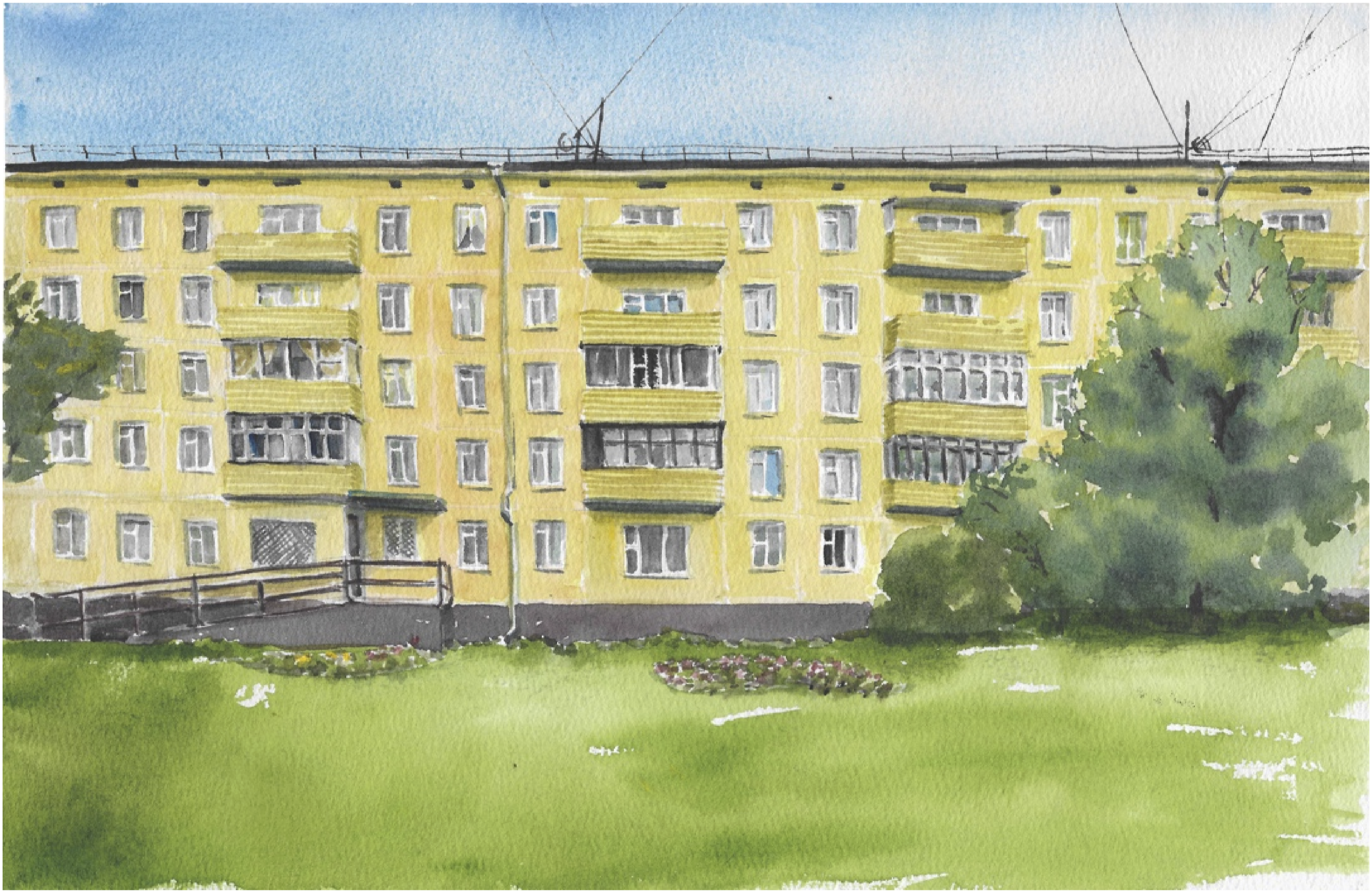
I began fieldwork in Summer 2021, inviting twelve Russian-speaking visual artists split between Moscow, Russia and Berlin, Germany to participate in the research. Participants were recruited from existing social networks, using social media, and, especially in Berlin, through paper flyers posted in panel-block neighbourhoods. One participant contacted me after they stumbled on a social media post bearing a photo of the flyer I posted on the side of a hot-dog stand. Participants were between 19 and 60 years old. Eight participants identified as women; three as men, and one, as non-binary. All participants grew up in Soviet-era panel-block housing, and all were now at various distances from their homes, whether because of migration, or owing to the Renovatsiya campaign. Half pursued art professionally; others worked in jobs in the creative fields, such as architecture and design. Several Moscow artists had previously exhibited together, or took part in collective plein-air painting sessions. Using this as an ice-breaker, and owing to Covid-19 precautions, I invited participants to sketch their neighbourhood together, and if this proved impractical, to walk through it while recording our improvised interviews. Sarah Pink (2008: 179) proposes that fieldwork strategies such as urban walks are a form of placemaking, whereby participants and researcher constitute the places through which they are simultaneously emplaced. Similarly, the routes we chose— meandering, tree-lined pedestrian paths between five-storey panel-block buildings—and the sights, sounds, and interactions we encountered along the way, framed our conversations.
Research participants were all accomplished artists well-attuned to the aesthetics of the urban environment. Therefore, our sensory and embodied experiences were creatively shaped both by our conversations, and through urban sketches, which translated our impressions onto a two-dimensional surface. Alongside my camera and audio recorder, it became a habit to carry a set of watercolours, a portable medium well-suited to plein-air painting. Anthropologists have previously used visual elicitation to gain ethnographic insight, or to find ethical ways to connect with research participants (Degarrod 2013). In a fast-paced media environment, anthropologist and realist painter Zoe Bray went a step further, painting realist portraits of her participants as a “slow media-commentary” (2015: 15). In my research, watercolours came to occupy a space between drawing and painting. John Berger (2013) distinguishes between the two, calling drawing an inward-turning reflection that creates an autobiographical record of an event, and painting, a public depiction of that event. Therefore, watercolour painting served as a research strategy to establish rapport with participants; an observation method, and a way to share a creative practice with a broader audience. My goal was to facilitate the creation of a contemporary aesthetic of panel-block homes, made with awareness of former artistic representations, but shaped by our own complex realities and emotional attachments. I believed that such an engagement would resist both overly-sentimental approaches that capitalised on feelings of socialist nostalgia, and commercial interpretations of panel-block housing that aestheticized architecture at the expense of its living inhabitants.
In early 2024, I was preparing to revisit my research site, when on the morning of February 24, I learned that Russia began a full-scale invasion of Ukraine. I felt numb reading news of unfolding events, unable to enunciate my feelings. The violence of the war came as a shock. However, in Russia, the Criminal Code was hurriedly amended prohibiting the “discreditation of the Armed Forces” (Articles 207.3 and 280.3). Since it was now forbidden to publicly utter the word “war,” people were getting arrested for silent protests while holding up blank pieces of paper. Acknowledging my privileged vantage point in Berlin, I recognized the importance of naming the ineffable, even if this would prevent me from returning to my research site, seeing my family, or visiting my childhood home. I sublimated my disorientation, anger, and grief by spending frenzied nights at the Berlin central train station, translating directions for people fleeing war by train. Later, I would volunteer by giving art lessons to groups of newly-arrived children. As Denzin suggests, the “meanings of these experiences are always given retrospectively, as they are relived and re-experienced in the stories persons tell about what has happened to them” (2014: 52). However, in my case, the emotional force of the moment “jolted [me] out of my intellectual complacency” (Behar, 1991: 367), forcing me to acknowledge just how deeply my personal and ethnographic realms have blurred (Behar 1991: 374-375). It was from this zero-point that I began to scrutinize my attachments, starting with my Russian passport, which signaled my unwitting complicity with the war; my family history, and the privilege of my bicultural identity. As Kien proposes, the emotional urgency of such life-altering moments turns a methodological tool of autoethnography into an imperative, constantly in need of re-examination (2013: 578). Khrushchevka in Koptevo Administrative District. Watercolour on paper, Autumn 2021.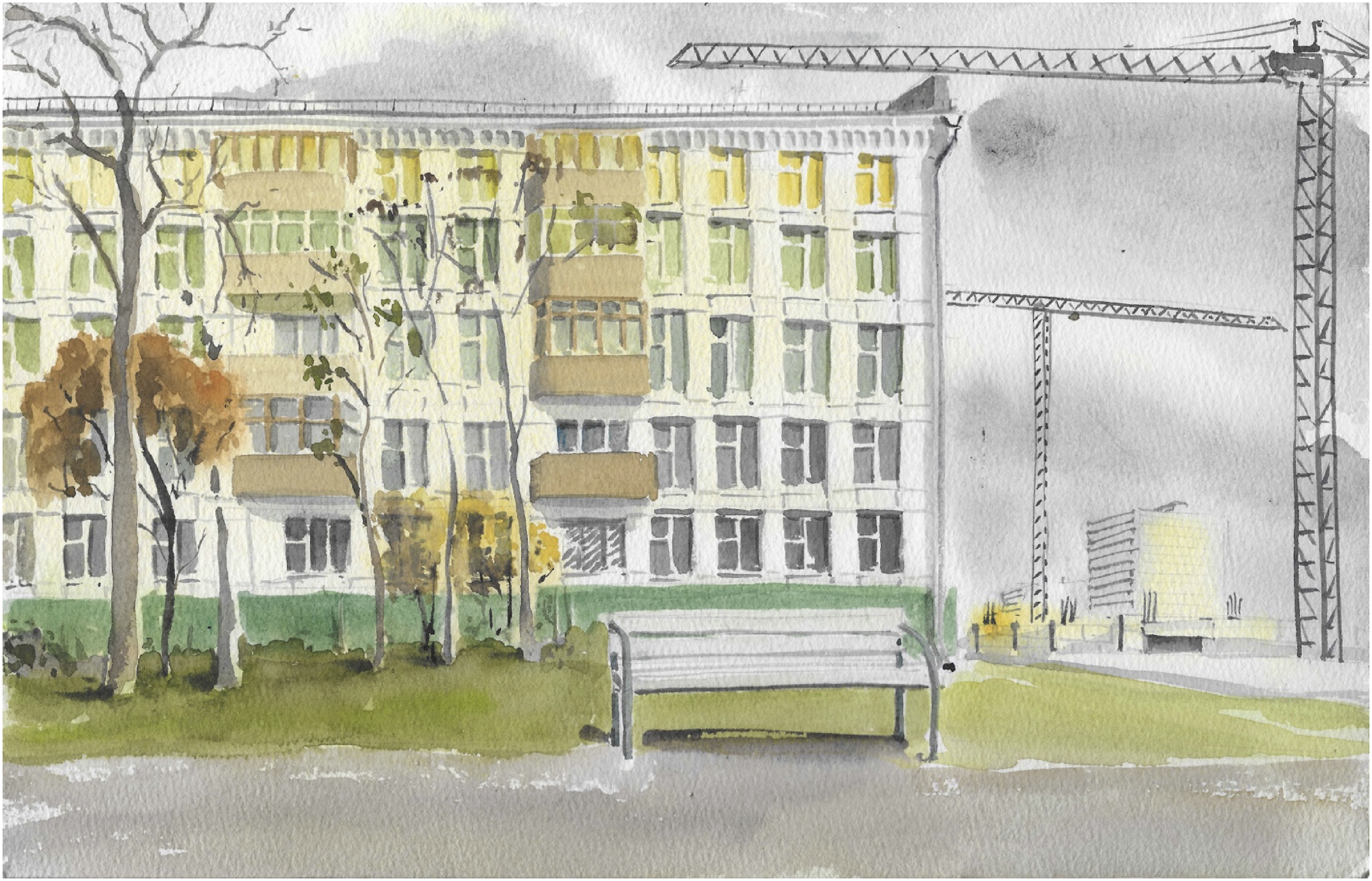
Beattie considers how an ethnographer’s experience, which includes their personal and political vistas, informs ethnographic analysis (2022: 12). If this is openly acknowledged, ethnographic inquiry can proceed symbiotically with autoethnographic approaches, which include evocative storytelling, interpretive analysis, and a political focus, among other techniques (2022: 38). The ethnographer can therefore both “challenge oppressive sociocultural and political practices,” and allow themselves to experience the “transformative effect of autoethnographic writing” (2022: 70-71). This does not mean that autoethnography automatically resolves “biases, beliefs, and personal experiences” (Pitard 2017: 1); quite the contrary, reflexive writing allows the ethnographer to monitor these as ethnographic data. Russia’s full-scale war in Ukraine allowed me to recognize how strongly emotions can shape social and political dispositions, beckoning me to re-evaluate my methodology and research ethics.
Artistic collaboration between Russia and Germany became not only politically volatile, but ethically contentious. It felt particularly insensitive to continue to research the aesthetics of Moscow panel-block housing when similar homes were being shelled by Russian artillery in Ukraine. Participation in the research also exposed artists to the risk of political repercussions, because both in Germany and Russia, they could have been held responsible for cooperating with hostile institutions. I cancelled exhibition plans, closed our online server, and informed participants that our collaboration could no longer take place. This also meant that I could not reproduce artworks contributed to the project, because signatures could be traced back to individual artists. I later reached out to participants with a confidential request to use portions of our interviews for this new research situation, and received ongoing consent from five individuals. Working to honour their participation across scattered geographies and political situations, I anonymized and edited representative passages from our interviews. I present them here as an archive of feelings conveyed to me by former panel-block residents in Moscow and Berlin, and collected on the eve of full-scale war.
Displacement
I met Sveta on a hot summer day on Karl Marx Allee, a central avenue of former East Berlin lined with chestnut trees, Stalinist residential highrises, and panel-block apartments. Sveta is a historian, a pedagogue, and an artist who agreed to meet me for a plein-air painting session. She grew up in the infamous Novie Cheremushki neighbourhood, where her parents were alotted an apartment as scientific workers. She has lived in Germany for close to a decade, teaching at the university, and raising two children here. As we settled to paint, she describes her relationship to her former home: I always considered my home to be a multi-storey panel-block apartment in Moscow. The whole mikrorayon was built in 1975 as standardized housing. In my early childhood, I remember walking in the forest by the apartment building; passing villagers’ homes. There were several farms, and cows roamed the forest.
Ekaterina Mizrokhi regards panel-block housing as occupying multiple temporalities. She attributes this to postsocialist upheavals that resulted in “individuals who do not always relate to a singular temporal framework, but can hold several temporalities simultaneously in variety of fractured, disjointed, hybrid and integrated ways” (2020: 222). If Mizrokhi problematizes temporal aspects of panel-block housing, Krisztina Fehérváry (2013) considers them in spatial terms. Because residents gauged the rapid changes happening in postsocialist Hungary against the relative constancy of socialist panel-block neighbourhoods, Fehérváry regards panel-block apartments as “heterotopic spaces,” which allowed residents to establish a sense of “normalcy” (2013: 18). Both these concepts complicate binary definitions of space as something produced—usually by those in power—and resisted—usually by those without, as articulated by Henri Lefebvre (1968). However, if Lefebvre argued that in a democratic society, people had the right to collectively shape space, to conceptualize panel-block apartments as heterotopic, atemporal spaces risks doing the opposite: mapping political transformation onto people’s realities, rendering inhabitants hapless bystanders of political changes that envelop them.
Now in Moscow, I meet Masha, a full-time artist who paints cityscapes as a stark commentary on urban pollution. She shares memories of her childhood dvor, a panel-block courtyard described as a self-contained microcosm: You enter a kind of environment where neighbours are like relatives. It was typical back then that people made friends by living in the same dvor [courtyard]. The dvor was akin to home. At the time, there were no telephones, so all communication with parents occurred through an open window, “come have lunch!” or, “you didn’t finish your homework!” Everyone in the courtyard thus became a participant in your relationship. You know all your neighbours: one is feeding the stray cats; another’s husband is a drunk; the third, dumpster-dives. Conflicts, celebrations, funerals, weddings – everything happened before your eyes.
If displacement can be measured as the felt difference between past and present, or social and physical distance, it can also correlate with personal attachments, as Sveta’s narrative attests: Ten years have passed since I left, but when I revisited, I felt as if no time had passed at all. All this changed, of course. The perception of the apartment also changed. Earlier this year, my mom suddenly passed away. It was perhaps the most traumatic experience of my life. I suddenly found myself alone in this apartment, and this changed my perception of it. I’m unsure whether it feels like home anymore.
As our watercolour landscapes begin to take shape on paper, Sveta enunciates her artistic interpretation of her former home: Nobody would’ve ever had the idea to go into the courtyard and paint the electrical transformer box, or the neighbour’s apartment building. This had a patina of Soviet propaganda; it was inculcated, and when it’s inculcated, you don’t feel like being awed by it. It’s possible that when I paint these highrises today, I try reproducing everything that I can remember about them, and what I remember stems from childhood, because these are perhaps my happiest, most cloudless recollections. Khrushchevka in Severnoe Tushino Administrative District. Watercolour on paper, Autumn 2021.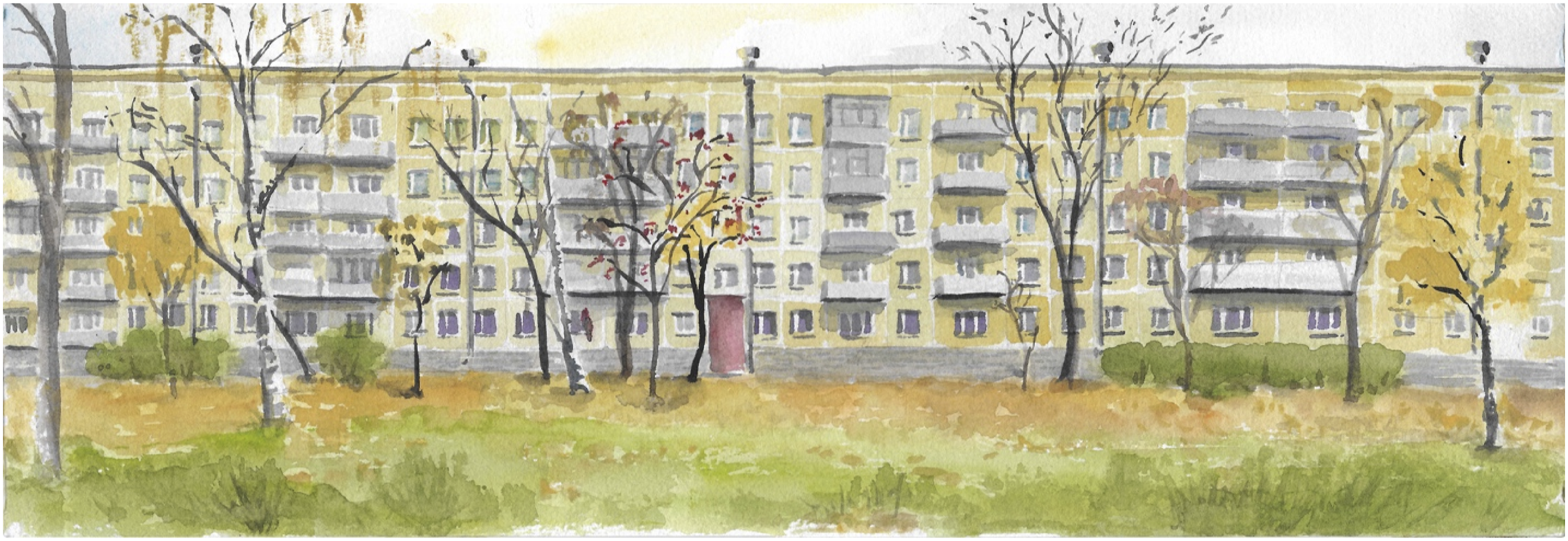
Dispossession
I have heretofore argued that the distance between past and present homes allows us to mediate what aspects of our identities we choose to express, and in what complex affective configurations; in other words, how we see ourselves in relation to other entities. However, what happens to these relations when people’s homes cease to exist? As Edward Casey notes, places are not empty vessels waiting to be filled, but are already replete with cultural knowledge, memories, and language, and constituted by “our own lived body” (1996: 21). In that regard, Moscow’s Renovatsiya signalled that “the most ubiquitous remnant of the late modernist epoch, which so profoundly impacted life, culture and consciousness, would be erased from the urban fabric, and subsequently, eventually erased from collective memories” (Mizrokhi, 2020: 228). Hereby, I consider participants’ affective dispositions when faced with eviction from their panel-block neighbourhoods.
Vera met me at the tram stop, the last of the line. For many years, Vera worked as an applied artist in a factory, but started giving art lessons when her eyesight began to decline. She lives in a two-room apartment with her bedridden mother to whom she is the sole caregiver. Her building was scheduled to be demolished in the first phase of the Renovatsiya program, between 2021 and 2024. On a walk through a maze of five-storey panel-block apartments, Vera shared stories of the neighbourhood she inhabited over the last 30 years. The nature of my creativity is connected to my khrushchevka. I once saw a ladder at the end of the panel home where our address is written. I thought, oh, here’s my chance! I ran home to get some paint, climbed this ladder, and painted a geometric ornament there. Why did I need to do this? There was a period in my life when I constantly had guests over. My doors were always open—I liked hosting people. But because we live in standardized housing, the street name and house number are written on the side of the house that people never approached. I always had to meet people at the bus stop; we have such winding paths here that they could never find our address. When I saw this ladder, I saw it as my chance. I wrote the house number and my street name for my many guests. This ornament was painted there, in terracotta paint, and everything was swell. Then, the house was renovated, and they painted it over. This is how I live, in these conditions, but I play inside them. I moved here intentionally, because I belong to the generation that believed that one day, apple trees will blossom on Mars. I was getting ready for spaceflight. My childhood fell on this period. This creative spurt was connected to a new, cosmic era. We were young, and the time was young for our ambition; this was felt in this architecture. We dreamed that one day, we would fly from our khrushchevkas as cosmonauts to Mars, but ended up living in such a garbage dump that even the government wants to tear it down.
If earlier, panel-block neighbourhoods were coupled with feelings of optimism, their collective devaluation provokes despair. If displacement is recounted by appealing to a sense of continuity with the past, participants describe the threat of demolition as an affective rupture.
Alex is a non-binary, politically-engaged illustrator who, at the time of fieldwork, lived in a panel-block apartment they were gifted by their grandmother, and which was now slated for demolition in the first phase of the Renovatsiya program. Stepping out onto the balcony, they point to an enormous poplar tree – they have a photograph of their grandmother standing on that same balcony looking out onto open fields. Alex shared their opinion about how Renovatsiya will transform Moscow’s social makeup: People are tricked (veshaut lapshu na ushi) that conditions will improve, and that apartments will get bigger. However, from what I have seen, these apartments are not well made, to put it lightly. People are placed in human ant hills (cheloveyniki), in these endless PIK high-rises of incredible density of people to a square metre. It’s also a fact that the surrounding infrastructure does not support the number of people that inhabit these dwellings. In my experience, in a khrushchevka apartment, you can knock on your neighbour’s door and ask for salt, for example. In new housing, you don't know your neighbours, so you won’t be able to mobilise against anything. People are becoming atomized; they stop socialising with one another. However, the theme of neighbourliness is also political. What can grassroots democracy look like, if you do not know your neighbours? It simply cannot exist.
In constrast, Vera, who painted the ornament on the side of her building, expressed hopelessness about her future home: You’re perpetually living under threat that you're going to be demolished. I only just made this space comfortable for myself, and now I must move someplace. The process happened “forced-voluntarily,” (dobrovolno-prinuditelno) as it used to be called. They came and left papers in our mailbox that our house was going to be “renovated.” Seemingly, they were gathering opinions, “write whether you agree or not.” I was the only one who voted against it in our entranceway. I know all the histories of our entranceway; they are all marginal histories. This marginal life that I witness here—this truth of Russian reality, with all its rude neighbours—I am a recipient of this, unfortunately. I don't have a clean well. I have a dirty well.
Scholars have argued that Renovatsiya was a project of neoliberal restructuring (Alonso 2018), effectively signaling the erasure of a bygone symbol of social welfare (Mizrokhi 2020; Reid 2019). In that respect, the program resonates with what Grant has called a “state of innocence” (2001:335), by which the Russian state advances its own goals while disclaiming its social obligations towards a group of citizens. However, my research revealed another, more insidious dynamic at play. Tim Edensor has previously considered the productive qualities of industrial ruins, which “dislocates the normative aesthetic and sensory apprehension of urban space” (2005: 330). Similarly, Nikolai Ssorin-Chaikov talks of material intensities of unfinished construction projects in Siberia, considering how destruction can lead to unexpected associations and new cultural arrangements (2016: 717). I consider Renovatsiya to be an “affective arrangement” (Slaby 2019) that reaffirmed political affinities, normalized dispossession, and kept people in a perpetual state of suspense. The campaign could therefore be considered “cruelly optimistic” (Berlant, 2012), because alongside promises of improved living conditions, it turned familiar neighbourhoods into sites of interminable demolition and construction. As Ann Stoler suggests, ruination is “a political project that lays waste to certain people and places, relations, and things” (2008: 196). Similarly, the campaign destabilised entire districts, especially favouring those, which could have mounted political resistance; an arrangement that proved fundamental to the way Muscovites would react to Russia’s escalation of war against Ukraine. Khrushchevka in Severnoe Tushino Administrative District. Watercolour on paper, Autumn 2021.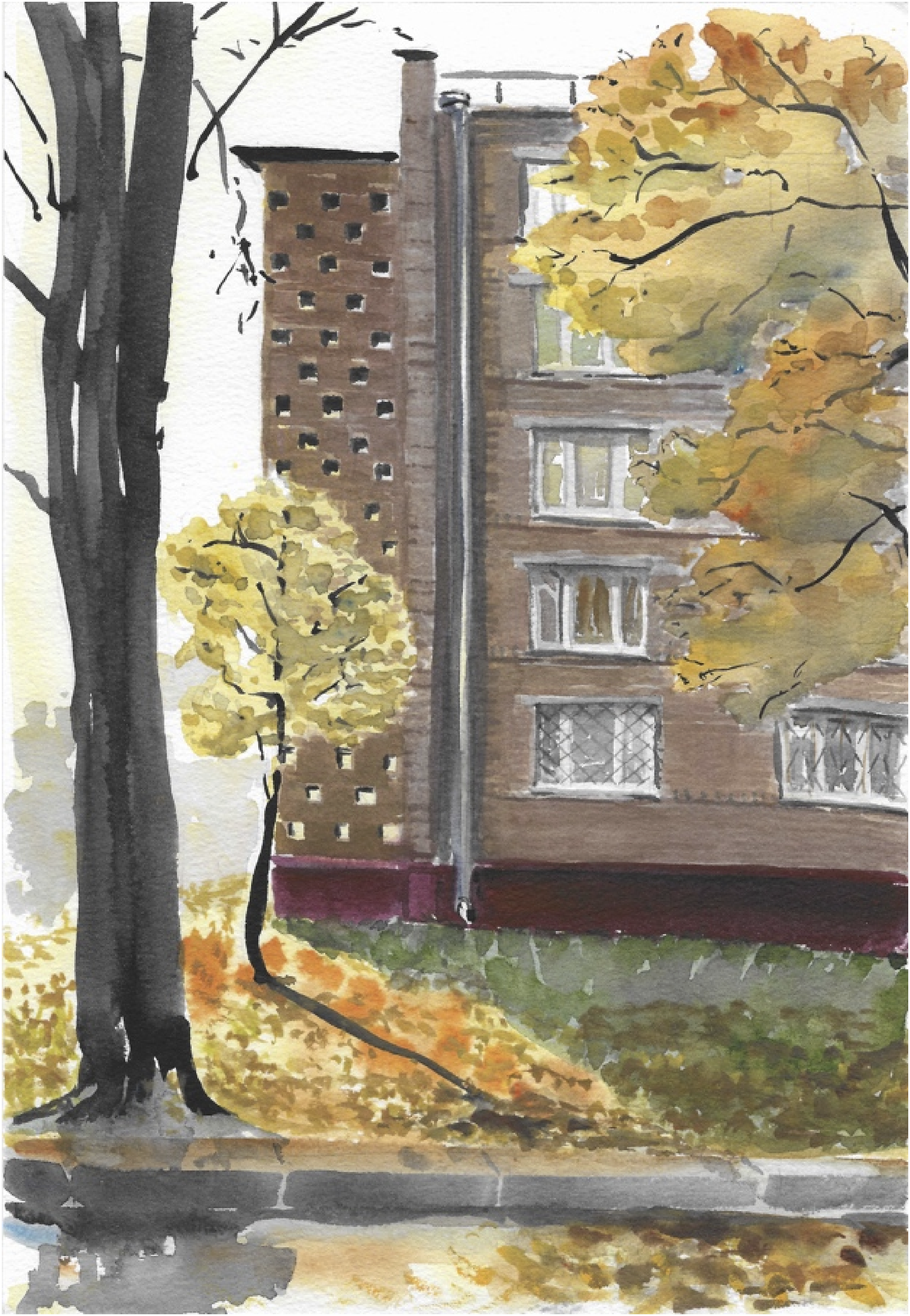
Disaffection
A former research participant who now lives abroad tells me that his family did not keep old photographs out of fear of being persecuted during Soviet repressions. I grew up with the privilege of a family archive that documents several generations of family migrations across now disputed political terrains. Domestic spaces among post-Soviet migrants have been variously interpreted as a “creative project” (Pechurina, 2015: 34), and “a personal memory museum” (Boym, 2001: 328), precisely because biographical objects give migrants the flexibility to express diverse forms of attachment and belonging (Gan, 2019:188). When personal archives are destroyed in an act of war, there remains no room for subtle identity negotiations. On February 24, 2022, Russia’s full-scale invasion of Ukraine made research about Renovatsiya seem hubristic and near-sighted. Ukrainian journalist Oleksandr Mykhed has recently stated, “I’m afraid to look at the photos on my phone. I can’t look at the images any more. Every warm memory is… destroyed” (quoted in Harding, 2024). Since the beginning of war, biographical objects in my possession loom large, but they serve an outsized role because they earmark a history from which I have become emotionally disconnected.
Sara Ahmed discusses how “‘the past,’ becomes associated with a home that is impossible to inhabit, and be inhabited by, in the present” (Ahmed, 1999: 343). The home is an affective entity, “sentimentalised as a space of belonging” (Ahmed, 1999: 340-341). However, Röttger-Rössler proposes that when a person’s “affiliation is no longer a self-evident state of being” (2018: 243), belonging may arise, paradoxically, from feeling “out of place.” Such cognitive dissonance (2018: 257) may be enunciated through emotions and structured according to social codes, or it may be experienced as affect, and characterized by a sense of tension (Röttger-Rössler, 2018: 241-242), melancholia (Navaro-Yashin, 2009), or numbness (Stoler, 2008: 201).
Images of disintegrated homes with shattered façades and exposed furniture became an early symbol of war. At the time of writing, Russia’s shelling in Ukraine resulted in the destruction or damage to an estimated “116,000 homes for 3,5 million people” (Sukhomud and Shnaider, 2023: 635). The logic of attack on civilian infrastructure meant to provoke terror by way of arbitrariness – the message is that it could happen to any of us. This was amplified by accounts of torture; conflict-related sexual violence; abduction of Ukrainian children, and other Russian atrocity crimes as relayed through international agencies (OHCHR, 2022). Meanwhile, Russian construction companies have been issued contracts to build panel-block high-rises in Ukraine’s occupied regions (Melnikov, 2022). New housing is undoubtedly meant to strengthen Russia’s presence in Ukraine, serving once again to consolidate power and manage labor resources (Kholodilin and Meerovich, 2018: 938); except now, revolutionary fervor and socialist positivism have been replaced by an atmosphere of terror.
A state power that systematically dispossesses and displaces millions while claiming to liberate them has since multiplied its own violence manifold, upending lives, livelihoods, and homes, and severing transnational relations of an increasingly tenuous world order. It would be cynical to equivocate Muscovites experiencing dispossession to people surviving war; rather, I consider Revonatsiya as a premonition of an increasingly emboldened state to engineer its own sense of morality and instrumentalize affect in the service of power. As Ann Stoler has argued (2009: 63), even if state actors are tasked to manipulate emotions, they are not themselves immune from them. Rather, affects and emotions create a cultural frame through which political decisions are made (2009: 61). Thomas Stodulka terms such configurations “orders of feeling” (2019: 310), describing feeling and display rules proscribed by social rules and political doctrine. In Russia, such orders make it impossible to express dissent against the mass destruction of Ukrainian infrastructure, or the ruthless killing of civilians. Instead, Russian state actors demand intensified patriotic feeling, or make frivolous claims about Russia’s victimhood from the West. In the absence of publicly avowable forms of protest, feeling disassociated, disaffected, or numb may be just the form of repudiation of such feeling rules. Panel-block homes in Aeroport Administrative District. Watercolour on paper, Summer 2021.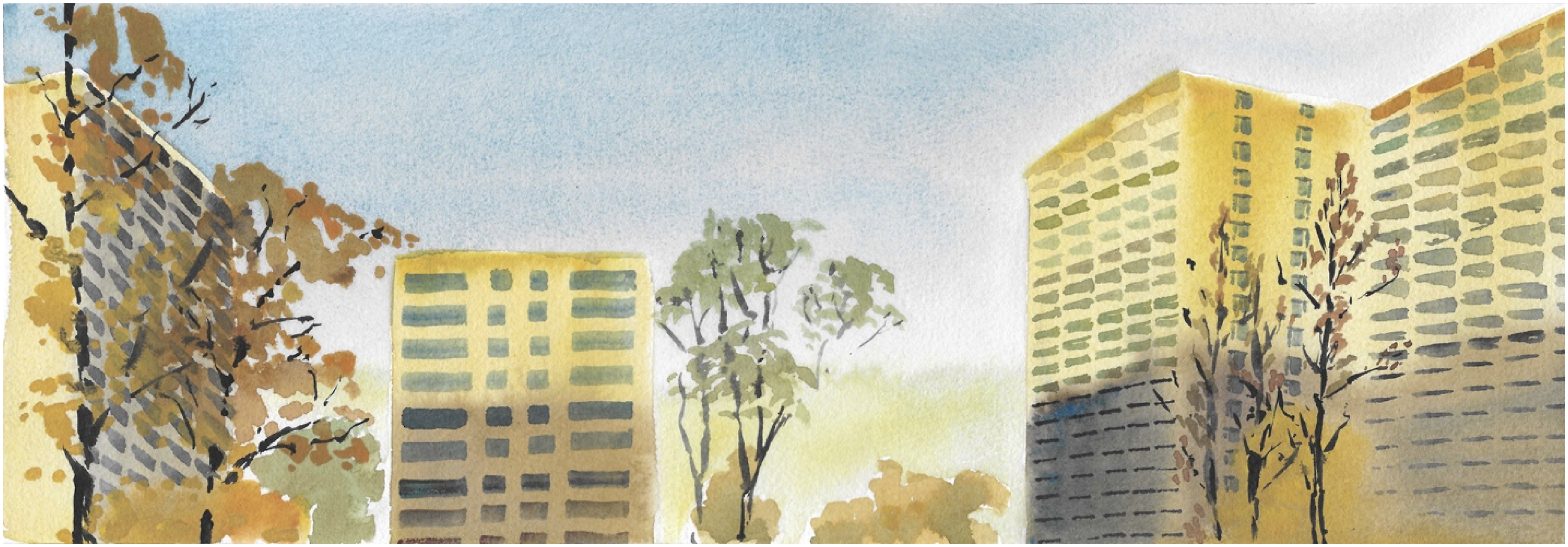
Conclusion
Just as Russia has prescribed certain publicly-avowable “orders of feeling” (Stodulka 2019: 310), so too in Germany, where I am currently living, the war made it impossible to sentimentalize the socialist past. Although I cannot travel to visit my research site, former home, or family in Russia, my grief feels out of place, considering that my peers are losing their lives, livelihoods, and homes. My childhood home remains intact, although I feel ashamed that I must identify it as a place of origin. I acquiesce to this “ethically important moment” (Guillemin and Gillam, 2004), recognizing how an emotion repertoire (Von Poser et al., 2019: 241) correlates with personal affects and ethics. In my case, there is a congruence between such publicly available repertoires in Germany, and my personal feelings; however, in cross-border conversations our emotions rest uneasy. If initial phone conversations with Russia involved tears and anguish, we have now switched to speaking in code, not sure which feelings are appropriate to indulge in a transnational, and transcultural conversation.
If home, according to Svetlana Boym, is “not really a place,” but a “sense of intimacy with the world” (2001: 251), I have lost this intimacy, feeling myself imbricated in the unfolding crisis. While anthropology is generally known as an interpretive-, rather than a predictive field, I feel naïve for having failed to imagine the consequences of Russia’s increasingly aggressive policies at home, and abroad. In that sense, I am still unable to find a voice, or to settle on a narrative that would give my account closure. In the face of new global calamities, and in keeping with the cadence of fieldwork interrupted by war, I feel like I owe it to my participants—and to those who may find it impossible to inhabit their former home, to articulate their disaffection, or to reclaim a sense of normalcy in their lives—to keep this account, as well as my own feelings, deeply unsettled.
Footnotes
Acknowledgements
The author wishes to acknowledge the support of the Social Sciences and Humanities Research Council of Canada, which awarded a two-year Postdoctoral Fellowship that enabled this research project. The author is greatly indebted to Prof. Dr. Birgitt Röttger-Rössler who welcomed him at his host institution, Collaborative Research Center CRC1171: “Affective Societies” at Freie Universität Berlin; to colleagues who supported this research throughout his postdoctoral tenure, and to two anonymous reviewers for their thorough engagement and critical contributions to this paper. The author also wishes to acknowledge the support of twelve participants eager to take part in the research project, as well as the curators, designers, and web developers who participated in the planning of the group exhibition, and sincerely regrets that this collaboration could not take place. Finally, the author thanks his partner, Stephanie L. for unwavering support, strength, and solace during these impossible years.
Declaration of conflicting interest
The author declared no potential conflicts of interest with respect to the research, authorship, and/or publication of this article.
Funding
The author disclosed receipt of the following financial support for the research, authorship, and/or publication of this article: this work was supported by the Social Sciences and Humanities Research Council of Canada Postdoctoral Fellowship, 2021-2023, grant number 756-2021-0349.
Ethical statement

Data Availability Statement
Owing to a sensitive geopolitical situation, and to the researcher’s status as a scholar supported by Western institutions, audio recordings of the research data cannot be made available, as it would compromise the anonymity and confidentiality agreements made between the researcher and his research participants. Limited, redacted interviews have been re-recorded with voice actors, presented at research conferences, and published as an animated ethnographic film titled “Empathy for Concrete Things” (2024, 61 minutes), which has now been released under public license.