



Abstract
Focusing on the “small stories” of everyday embodied encounter with place, this study investigates how sense of place manifests itself amongst residents of a northern English city. The study employs map drawing and “go-along” interviews and the paper presents data from a sample of these. The study draws on the assemblage thinking of Deleuze and Guattari to elaborate a concept of sense of place as assemblage with three dimensions: the affective / sensorial, the temporal / mnemonic, and the political. Sense of place, seen as an opening up of oneself to the potentiality of the encounter with space, is characterised as a disrupting concept. The paper considers the implications of the research for how residents might be engaged more effectively in future debates about the city’s development.
Introduction
Sense of place is widely understood to be central to our immediate experience of the world and our ability to make sense of it (Relph, 1976). Arguably an elusive concept (Ardoin, 2006), it is generally found in the literature as an overarching concept, with a range of terms emerging from within it to describe more specifically people’s interaction with their surroundings (Rogan et al., 2005). This paper seeks to develop a more fully articulated concept of sense of place capable of elucidating the factors that are at work in the immediacy of the individual’s embodied encounter with place. Focusing on a case study of York, a city of around 200,000 residents in the north of England, in which the “small stories” (Georgakopoulou, 2006) of individual residents’ everyday, embodied encounters with the city’s public spaces were collected, it seeks to build a sense of place from what Massey (2005: 130) describes as a ‘simultaneity of stories-so-far’.
The paper considers the implications of the sense of place that emerges from these stories for how city authorities might engage residents more effectively in discussions about the city’s future. Whilst urban planners tend to focus on the built environment (Salesses et al., 2013), it is argued that other factors more salient in the formation of residents’ sense of place, also need to be foregrounded.
Sense of place as assemblage
Understanding place as relational, ‘constructed out of a particular constellation of relations, articulated together at a particular locus’ (Massey, 1993: 67), the paper draws on the assemblage thinking of Deleuze and Guattari to provide a ‘dynamic and open sense of place as a multiplicitous assemblage’ (Dovey, 2020: 21). Where phenomenological approaches to sense of place, after Heidegger (1962), tend to see the material world as pre-given, with place a central, ontological structure of being-in-the world (Casey, 2009), assemblage thinking focusses on becoming, on transformation, looking into ‘the circumstances in which things happen: in what situations, where and when does a particular thing happen, how does it happen, and so on’ (Deleuze, 1995:25). Where social constructivist approaches to the meanings ascribed to places can be accused of a reduction to discourse (Dovey, 2020), saying little about how individuals are impacted by changes to the fabric of places (Devine-Wright, 2014), assemblage thinking encompasses both material and discursive dimensions, exploring how sense of place emerges from the interaction of material and non-material elements.
The deleuzoguattarian assemblage is fundamentally relational; ‘It is a multiplicity which is made up of many heterogeneous terms and which establishes liaisons, relations between them across ages, sexes and reigns– different natures. Thus, the assemblage’s only unity is that of co-functioning: it is a symbiosis, a “sympathy”’ (Deleuze and Parnet, 1977: 52). Entities, human and non-human, are brought into some provisional form of relations, without presupposing that these constitute an organism (Anderson et al., 2012). The elements of the assemblage remain autonomous, never fully assimilated in an assemblage, affected by the other elements to which they are related but not fully determined by those relations. They can be detached from any one assemblage to become parts of another.
In a relational world, understood as assemblage, Deleuze and Guattari (1988) move away from questions concerning “what is a body?” towards thinking about the virtual capacity of a body to affect or be affected, asking ‘What can a body do?’ (p. 299). The emphasis in assemblage thinking is on how ‘all the elements of a nonhomogeneous set converge, making them function together’ (Deleuze and Parnet, 1977: 39), operating as a “machine” to produce new realities. What is of interest is not the make-up or internal properties of the assemblage but how it holds together (territorializes) or breaks apart (deterritorializes), how it transforms and connects to other assemblages, how the same constituent elements might have produced different assemblages in other conditions (Anderson et al., 2012).
Assemblage thinking, then, allows a view of place constructed from diverse entities with differing capacities and where the lines between them, described as “becomings”, are always in process, changing, shifting, having no beginning nor end, only a middle (Stewart, 2007). In entering this middle, this “in-between”, in order to study the multiplicity and relationality of a thing, to extract what is immanent to it, its specificity or singularity (Deleuze and Parnet, 2002), this paper attempts to reveal the nature of the relations at work in the assemblage of the person-place encounter. Through a ‘critical amplification’ (Fannin et al., 2010: 922) of the relations in play, it will seek to build a concept of sense of place that, whilst not providing clear definitions, will force us ‘to stop, and think about things in new ways … to see what was not seen before’ (Olsson, 2009: 26).
Research methods
My choice of research methods for this study reflected my ambition to ‘capture the essences of encounters and engagement in moments of emergent meaning’ (Waterton and Watson, 2015: 97). Recognising that walking offered the greatest potential to get “up close” to the embodied experience of the city (Helmreich, 2013), I adopted an approach involving “talking whilst walking” (Anderson, 2004) using recorded “go-along interviews” (Kusenbach, 2003). I asked participants to choose an everyday sort of place for them in which to meet me, preferably somewhere they would be going anyway as part of their normal routine. In many cases, respondents invited me to accompany them in an activity that they had planned, such as taking a child to the local park. Before setting out to walk, participants were asked to draw a rough map of “what York means for you” and to mark on the map the main features that come to mind when you think of “your York”. Maps are known for their ability to fire up “thinking spaces” (Wood and Fels, 2008) and the map-making acted as a form of elicitation (Prosser and Loxley, 2008), beginning a conversation that continued as the walk began and then continued traversing whatever portion of their map the respondent thought appropriate.
Once we had set out, my aim was not to give the participant instructions or to ask questions but rather to allow them to respond to the space through which we were walking, aiming to employ various “technologies of listening” (Blackman, 2012b: 178) as they talked. In most cases respondents were happy to talk for the whole walk though, occasionally, periods of silence occurred that felt like a natural response to our walk. Immediately following the go-along, I retraced our steps on my own, recalling the conversation and paying attention to those passages that struck me as having particular affective intensity for the respondent. I also attended closely to my own affective response, the things that induced in me a gut feeling or a heightened sensibility. At these points of raised intensity, I took a photograph, recognising the photograph’s potential to jog the memory and to elicit an emotional response (Weber, 2008).
I created field notes as an assemblage of ‘variously formed matters’ (Deleuze and Guattari, 1988: 3), reworking them over time in the light of reflection, and ‘seeking to describe the agencies and interactions of humans, nonhumans, spaces, processes, and atmospheres’ (Bøhling, 2015: 173). My own subjectivity was an important tool in creating the research data (Blackman, 2015: 26), reflecting my understanding that ‘writing emotions into research accounts’ can lead to important insights (Widdowfield, 2000: 205), connecting the reader to the events described through accessing ‘forms of knowing that exceed rational, conscious experience’ (Blackman, 2012a: 24). Using the maps, interview transcriptions, photographs and fieldnotes, I created a montage for each walk, setting in train an iterative process whereby this representation of the walk often evoked a feeling, thought or insight that led me to return to my fieldnotes and rework them, producing new reflections and suggesting new interpretations.
I undertook 20 go-alongs, continuing to recruit participants until I reached the point where I believed I had a picture of what was going on and could generate an appropriate explanation for it (Mason, 1996). To recruit respondents, I visited community centres and similar community settings to chat to people informally about York seeking to interest them in the project. Participants were “ordinary” York residents, in the sense that they held no positions of influence; none had any special qualification other than their willingness to participate. The cohort selected was broadly reflective of the demographic of the city and drawn from a variety of settings: city centre, suburban and surrounding villages.
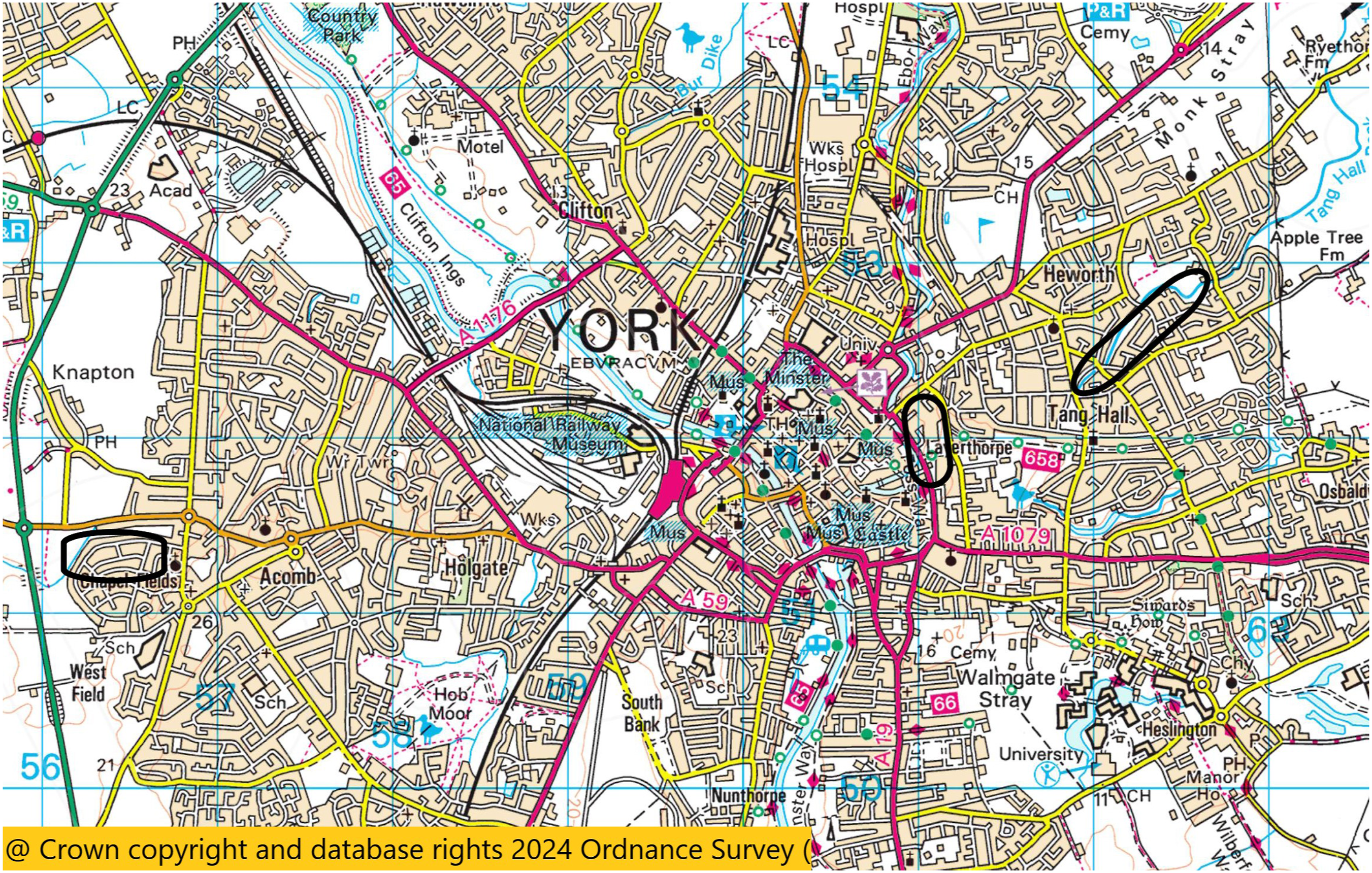
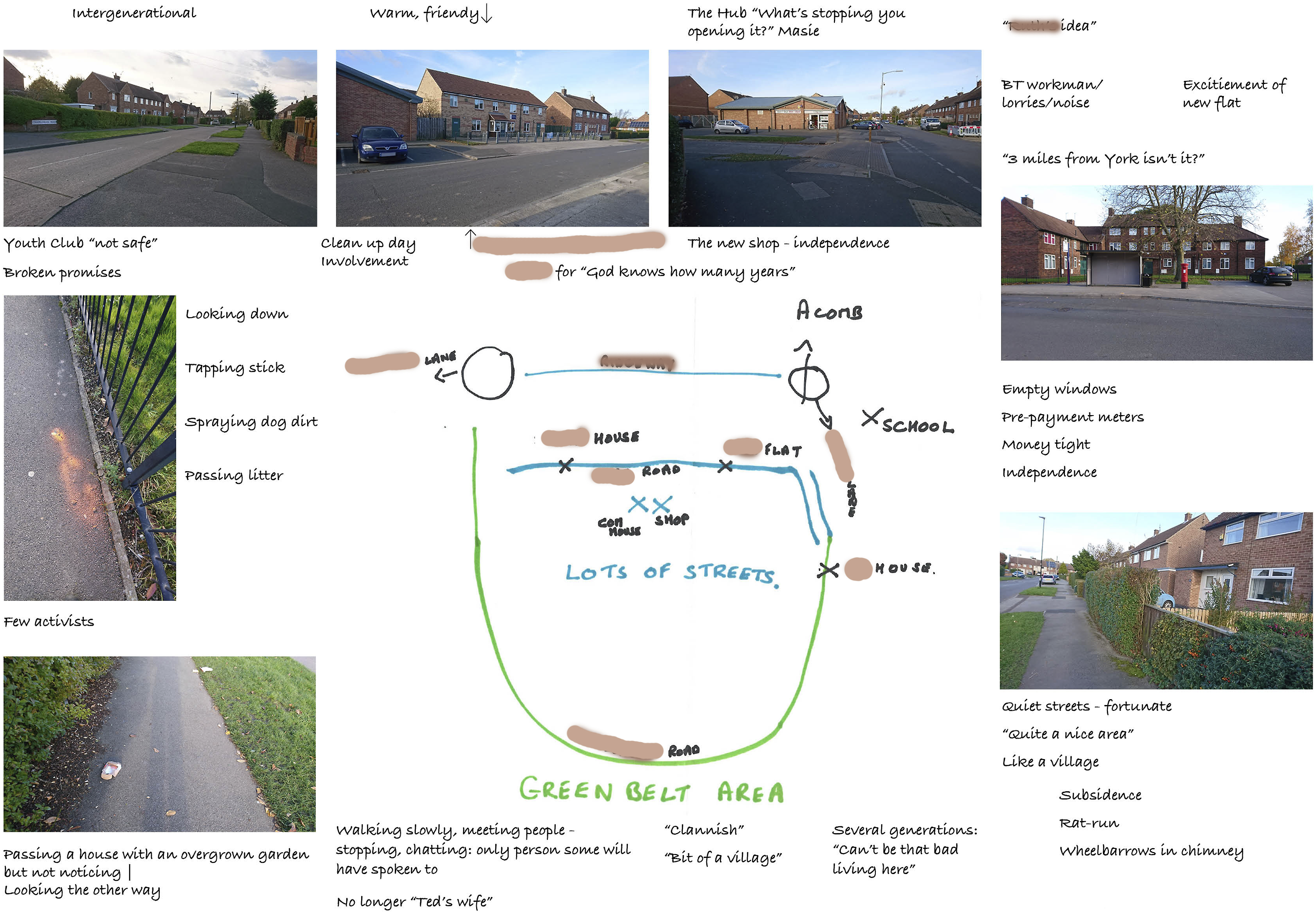
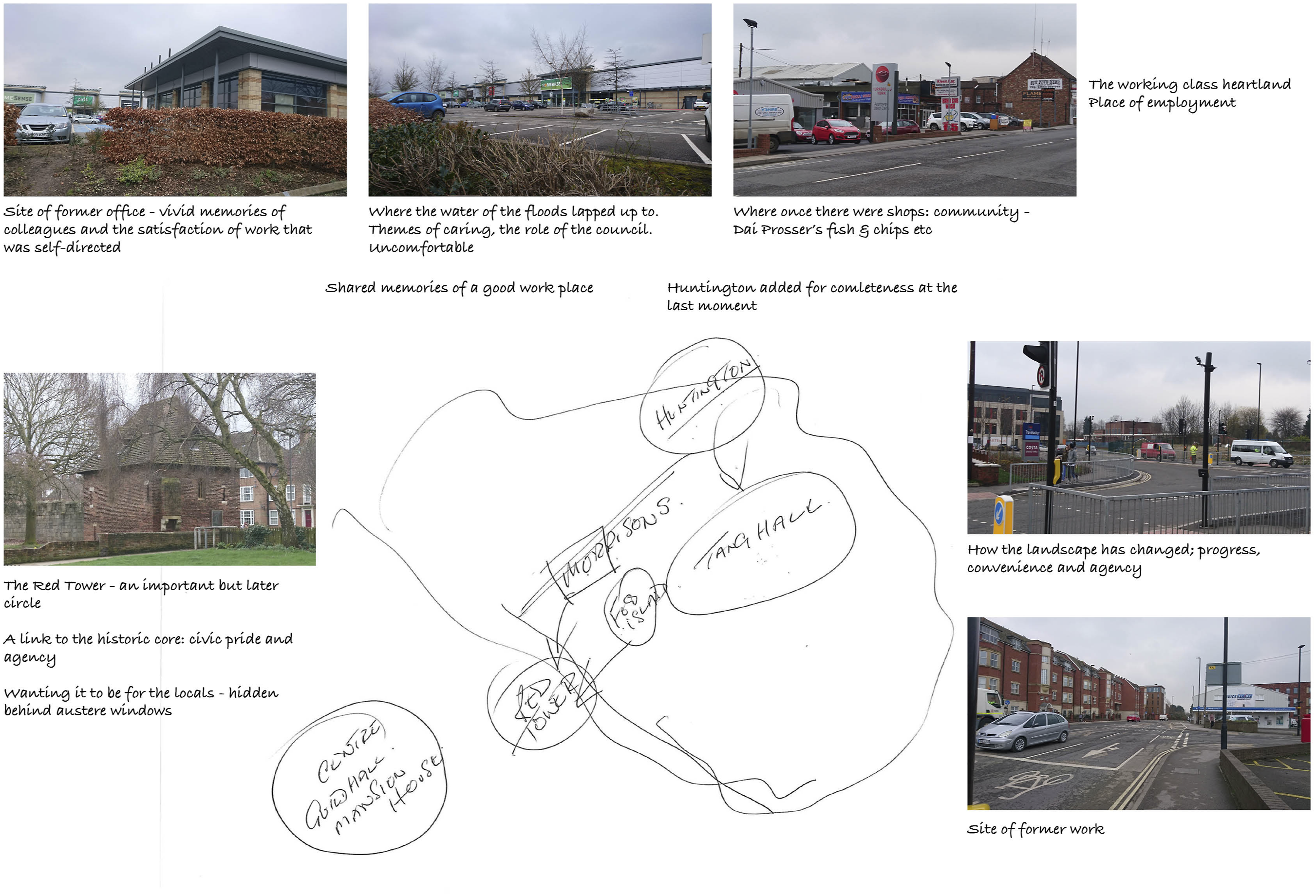
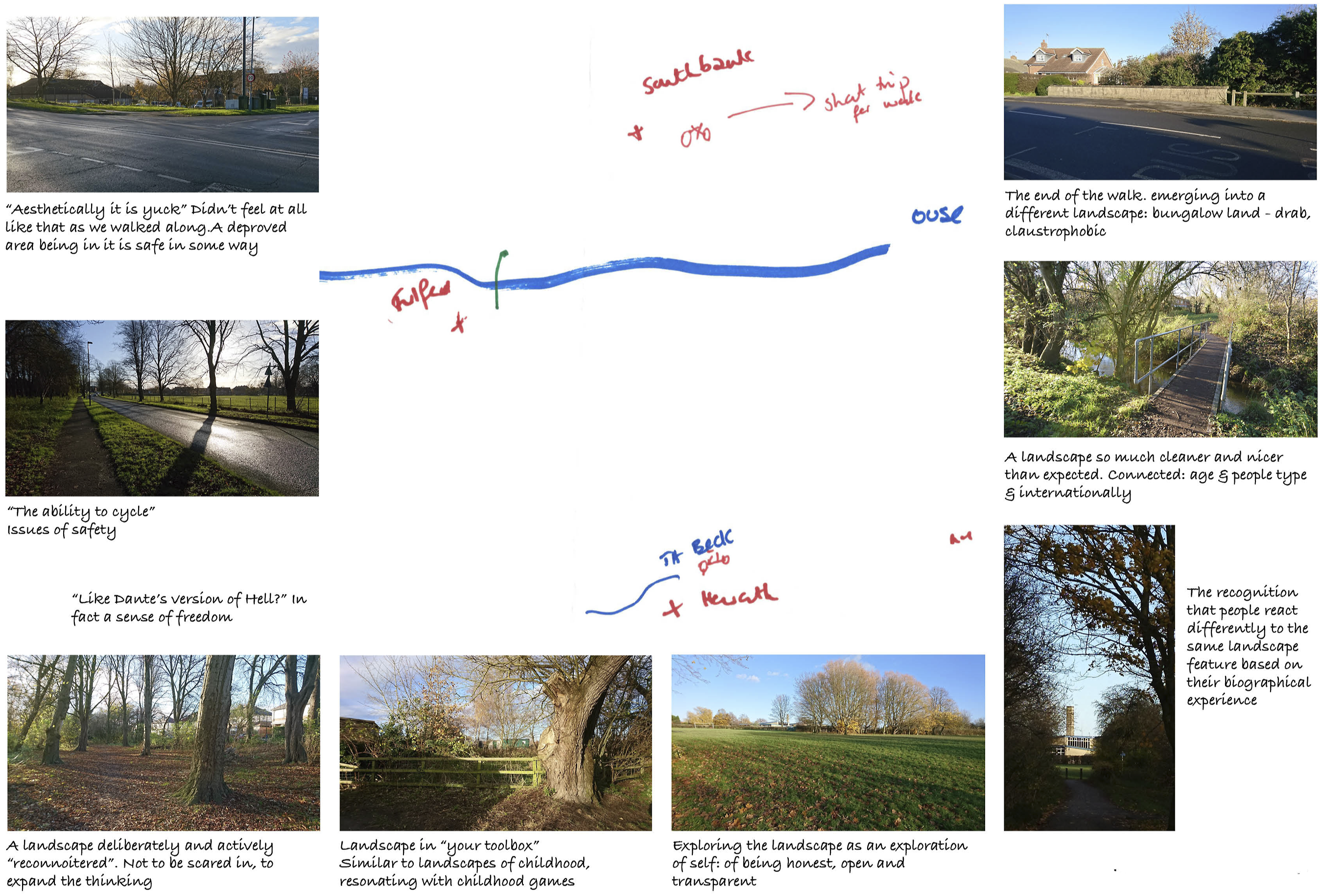
Here I present data from three of the go-alongs, placing them in the context of the others but focusing on these three in order to afford the reader a deeper understanding through engagement with the granularity of the encounters. Two take place in suburban areas, on the east and west sides of the city respectively, with the third commencing within the city walls. Figure 1 shows the location of York. The locations of the three walks are shown in Figure 2. Digital recreations of my montages in respect of these go-alongs are included below at Figures 3–5 with the hand-drawn maps shown in the centre. Names are changed and redactions made to the figures to safeguard anonymity. Location of York. Overview of the three walks. The go-along with Debra. The go-along with Bob. The go-along with Julia.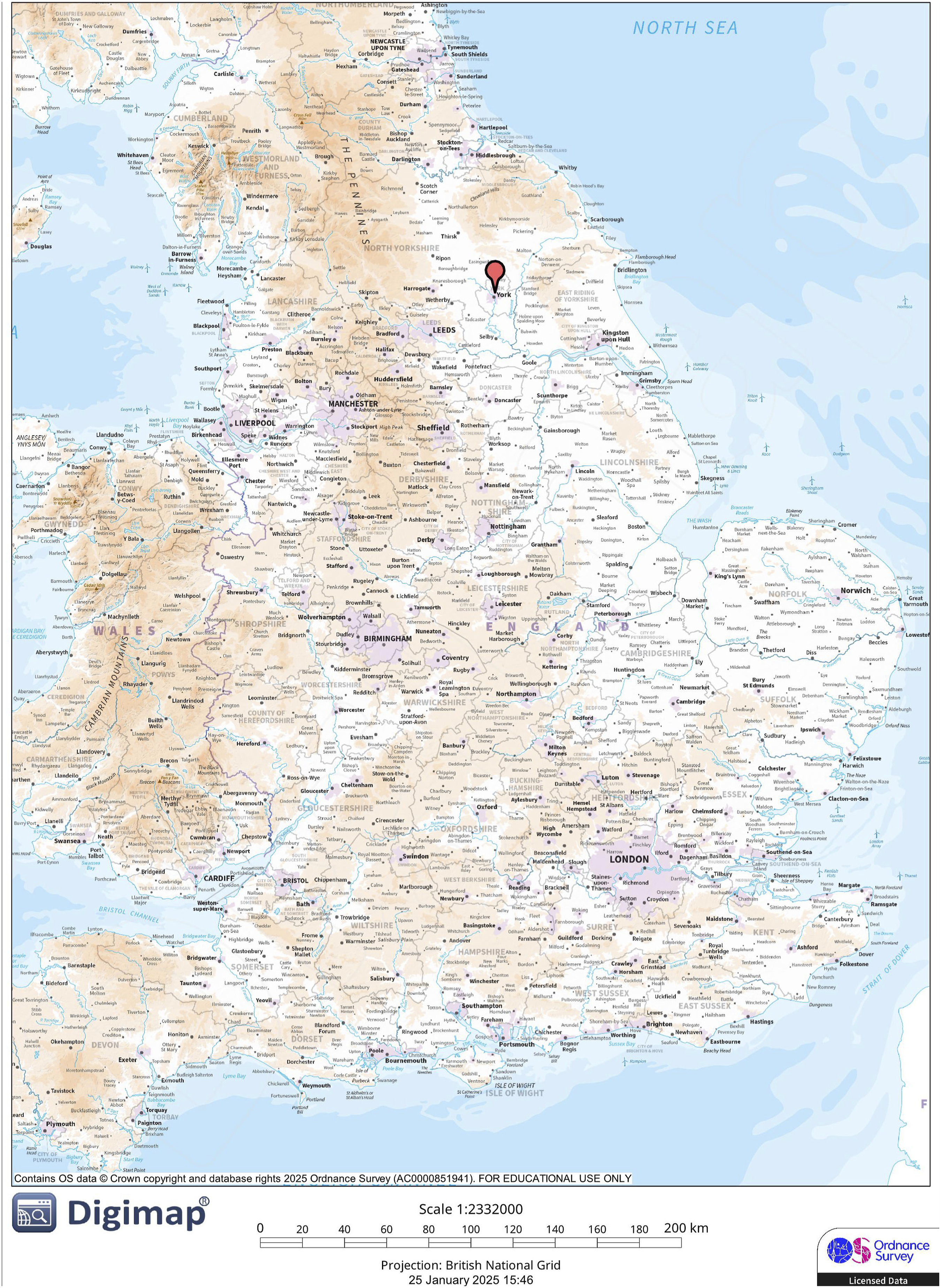
An everyday encounter with public space - the go-along with Debra
I meet Debra at the community hub in a 1950s estate on the edge of the city where Debra is a member of the residents’ association. Debra’s map of what York means for her is simple, marking the sweep of the two roads that enclose the estate, her house and those of her two daughters, which lie close by, together with the community hub and the shops. Only when I comment that the estate looks all alone does Debra mark on the roundabouts and the access road that connect the estate to the wider city. Debra tells me that she does not often leave the estate.
Today, a community clean-up day is in progress. As we set out, the local councillor hands us an aerosol and instructs us to spray any dog-dirt we spot on our walk. We immediately encounter local residents and lively conversation ensues as Debra stops to chat. Donald Trump’s latest foibles provoke incredulous laughter, whilst stories of a shared history on the estate generate evident warmth and enthusiasm: the time, back when the houses were new, when one poor resident’s chimney just would not draw, and the council workmen, breaking into the chimney breast, found a wheelbarrow bricked up inside!
As we finally walk on, Debra comments: Well, people stop me and we have a chat. And you see some people and you’re the only person who some of them have talked to, you know, so sometimes, especially in summer, it takes me a time to get down here, because people stop you.
As I walk along-side Debra, I become aware that the affective experience of the walk is very different for each of us: I am quite apprehensive, feeling that I am in someone else’s territory expecting, perhaps, to be challenged as to what I am doing here. In between our occasional encounters with the locals, the street seems rather grey and uninspiring, brooding even. The regular tapping of the stick with which Debra walks, stands out, melancholic in the quiet. Our gaze is on the pavement, occasionally encountering dog dirt, which Debra sprays. The loud spraying feels jarring, the incongruous act suggesting some meaning, but one that remains just beyond my grasp. We pass a garden that is all overgrown. I feel that its parlous state is significant in some way, but Debra does not comment or even look at it. We pass some litter and I wonder whether to pick it up, but self-consciousness prevents me. Again, Debra does not comment.
Seemingly oblivious to the things on which my eye alights, Debra continues: So, I’ve been up here forty, forty-one years. My husband lived on the estate from when he was three. And his mum lived on here. At first, when it was somebody strange, I used to get, “you’re Ted Smith’s wife aren’t you?” So, I’d say “yes”; so, for a few years I was “Ted’s wife”,
I detect pride in her voice here: the implication is that she is no longer just someone’s wife. There is a prolonged silence, so I ask if she feels, living here, she is in York. She comments: Three miles [away] isn’t it? I don’t go into town much. We would go up to [out-of-town shopping centre] more when Ted was alive. But now I tend to do online shops. And now it’s made it quite good really for people who can’t get out because now we’ve just got these new smart meters ... And you get your cards, and you don't have to go to the shop to get your cards, you can do it online; [spraying] they have like pre-payment meters ... And you don’t have to go to the shop to get your cards, you can do it online, and I think that's good for people who are housebound: they are keeping their independence.
Debra tells me how she became involved in community activism: We was one of the first in York to have a residents association and I went down and was, like, on the committee, but then I had to give it up because Ted worked away a lot of the time so it was like I didn’t have anyone to have the kids and it was like I sort of dwindled away from it. Anyway, then I was asked to help at the pensioners’ party and, erm, and that’s how I got started again. And then they said, would you come on the committee, which was like over 20 years ago, and I've been on the committee ever since.
We meet a woman walking with a frame and Debra introduces her to me. Her tone is more confident whenever we meet people; she’s genuinely pleased to see people and they her. She tells me that there are ‘generations of families that live on the estate … So it can’t be that bad living here’. She shows me where her house is and then returns to the theme of her community activism: 18 years ago, we decided there was a problem with young people and drugs and all that, so we formed a group … and we bartered with the Council, ’cos most of the shops were empty, and they let us have a shop for a peppercorn rent and, er, we wrote to paint places. Anyway, we got the kids to paint it with us, and, erm, they took ownership of the building; they didn’t graffiti on it, because they’d painted it … we had lots of kids in. But all we had in it was an old CD player and a table with a roll of wallpaper on [laughs]. But they used to call it theirs. And it were good … There was even 70-year-olds coming and helping with these kids; but we got respect from them, and, er, yeah, it was fun like.
The conversation returns to the present as Debra comments on current problems with young people who ‘bomb around’ the estate on motor scooters: It's come to a time where they think the kids should have this, that and the other but then, when you say, “Can you help?” and they sort of say, “Well, no”. And I just think it’s a shame really. I lived in a village and my mum was sort of like an active person in the village and that: she helped with old-aged pensioners. She was a member of the church and they did things there. And I suppose I have been brought up with, you know, helping people.
As the walk concludes Debra tells me about the plans for the recently founded community hub: And we’re starting crafts next week; we’ve got funding for that … we’re putting in for some more money for sort of doing, erm, a meal for people, you know?
Some initial observations
What leaps out from this go-along is its inherent jumpiness, heterogeneity, incoherence even. The question that launches the encounter invites Debra to talk about what York means to her. Any expectation that this might elicit a response shaped by a holistic, spatial or conceptual view of the city is quickly confounded by the embodied experience of walking and talking that follows, which is characterized rather by the diversity of interactions with the particular elements or singularities that present themselves in the spaces in which we walk, both material and human. Debra’s expressed thoughts are diffuse, unpredictable, strange even, without obvious theme or direction; they are, to use Stewart’s (2007) term “obtuse”. I am often left wondering why a particular topic has been broached, such as when Debra talks, unprompted, about the benefit of the new smart meters.
Obtuse as these connections may seem, my sense is that they are the product of very real and specific interactions with the singularities present in this space, interactions with both the space’s material surfaces, arising from the “distributive agency” (Bennett, 2010: 21) of things to influence what transpires, as well as with its virtual attributes, the potentialities that it contains to make one’s life easy or difficult. Equally important are the meanings that Debra attributes to this space; for example, her understanding of the estate as being like a village, shapes her expectations of how community should function and the residents behave. This is consistent with Deleuze’s explication of assemblages as comprising both content and expression, ‘states of things, bodies, various combinations of bodies, hodgepodges’ but also ‘utterances, modes of expression, and whole regimes of signs’ (Deleuze, 2007: 177). It seems that the task will be to attend to the whole ‘swarm of vitalities at play’ (Bennett, 2010: 32), to understand this “constellation” (Deleuze and Guattari, 1988) of elements in all its granularity.
This go-along typifies those undertaken in the study in that, shining through the person-place encounter, one sees the particular configurations of materiality, effects or circumstance within those spaces, the interactions, transformations and emergences to which they give rise, and the way that these act to constitute individual subjectivity (Patton, 2000). The encounter with space is consistent with a characterisation of assemblage as emergence rather than formation. It can be apprehended ‘only by a longitude and a latitude’ (Deleuze and Guattari, 1988: 304 emphasis in original), by the ‘lines and dimensions it encompasses in “intention”’ (Deleuze and Guattari, 1988: 286), that is, in this case, by Debra’s relations within the estate, the problems and the people with whom she interacts, and the intensive affects to which they give rise: ‘Nothing but affects and local movements, differential speeds’ (Deleuze and Guattari, 1988: 304).
Debra’s embodied encounter with place can be viewed as consistent with Stewart’s view of everyday life whereby ‘Something throws itself together’ (Stewart, 2007: 1 emphasis in original). But to conceptualise sense of place as assemblage implies the need to focus not on the something but rather on the causal relations that are immanent to it, since ‘a multiplicity is defined not by the elements that compose it in extension, nor by the characteristics that compose it in comprehension, but by the lines and dimensions it encompasses in “intention”’ (Deleuze and Guattari, 1988: 286). The next section of the paper seeks to elucidate the nature of the lines and dimensions that characterize sense of place as assemblage arguing that the data in this study point to three particular traits, traits that are consistent with the three interconnected features of assemblage that Hamilakis (2017) argues hold special importance within assemblage generally, namely, the affective / sensorial, the temporal / mnemonic, and the political.
The affective / sensorial
According to Deleuze and Guattari (1988: 465), ‘Assemblages are passional, they are compositions of desire’, where desire is the vital, productive force, revealed in affects, that a body has to touch and impact upon another body, forging connections and intensive states and leading to new emergences. Bodies are characterised by their affects: ‘We know nothing of a body until we know what it can do, in other words, what its affects are’ Deleuze and Guattari, 1988: 300). The assemblage that is sense of place, can be understood, then, in terms of the affective connections between the materiality of place and the human body. This, I argue, is made possible by the sensorial, understood not so much as the biological processes of sensing but as the facility to make affective connections (Hamilakis, 2017).
The sense of place emerging from the study can be characterized as intensive rather than extensive, in that all the respondents experienced place not as space extending within defined bounds, but rather as intensive spaces, zones of ‘intensive continuity’ (Deleuze, 2007: 179). Like Debra, they paid little attention on their maps to the wider context of the city; rather, it is the processes at work in the intensive spaces in which we walk that are salient for them. It is these intensities that produce place in the form of the various extensive spaces that they experience (DeLanda, 2005).
The go-along with Debra attests to the affective / sensorial connections that she makes, driving her embodied responses to the needs and concerns that she encounters in this landscape. It is a sense of place unique to her peculiar encounter with place, her particular ‘angle of vision’ (Li, 2007: 265). Consequently, although I walk the same streets as Debra, and our walk is designed expressly to be a shared experience, I am, nonetheless, always conscious of experiencing place quite differently to her, of making different affective connections. I cannot share Debra’s place encounter: all I can do is observe it and subsequently compare notes with my own encounter.
The temporal / mnemonic
A second trait of the sense of place assemblage, revealed by the data in this study, is that the disparate elements acquire agency by being connected ‘in this particular space and in this particular moment’ (Gheradi et al., 2018), meaning that it should be understood as temporal as much as spatial, comingling multiple pasts and presents with diverse materialities and affects. An understanding of the part played by time and memory will therefore be required and to pursue this I will continue to look for explanatory power in the work of Deleuze, and in particular his view of time found in Difference and Repetition (2014) and Bergsonism (1988). It will be important here to recognise the complexity of the idea of the “particular moment”, since, according to a Deleuzian understanding, time is multiple, made by a network of processes of synthesis (Williams, 2011) that connect together or contract repeated things. Deleuze distinguishes different types of passive (or unconscious) syntheses of time that must be viewed both in relation to each another as well as to active (or conscious) syntheses (Pisters, 2016), and which serve to contract past, present and future, thus making them dimensions each of the other. Time is fractured with different syntheses interacting in a complex manner ‘allowing for dislocations and changes in perspective’ (Williams, 2011: 51). This accords with the sense of place emerging from this study, which is characterized by a comingling of various pasts and presents as well as an anticipation and enunciation of potential future becomings.
Turning first to what Deleuze (2014) describes, in his first synthesis of time, as the “living present”, it is natural to view the immediacy of the go-alongs’ encounters with everyday spaces as being attributable to the force of habit. Deleuze (2014: 105) describes the ‘passive synthesis of habit’ whereby the mind, at a pre-reflective level, connects together ‘cases, elements, agitations or homogenous instants and grounds these in an internal qualitative impression endowed with a certain weight’ (Deleuze, 2014: 94). So, when Debra steps out on this particular morning, the way she navigates the streets of the estate on which she has lived for 41 years and the easy conversations that she falls into with the people we meet, is shaped by all the habits of which she is composed, ‘these contractions, contemplations, pretentions, presumptions, satisfactions, fatigues; these variable presents’ (Deleuze, 2014: 103). For Deleuze, past and future are contracted into the “living present”, existing as dimensions of it. Thus, Debra’s “living present” connects all her past life in this place, her history as a community leader, her relationships with the other residents, as well as her anticipation of the future. Whilst habit may be the product of a “passive synthesis”, it should not be thought of as inert or ossifying; on the contrary, Deleuze conceptualises it as the essence of being and becoming, a creative form of generative repetition, ‘a dynamic force that opens up the universe … to radical change’ (Grosz, 2013: 233). The go-alongs are characterised by a sense of anticipation of the future potential of place, of the possibilities that it affords the individual or the community of which they feel part. In Debra’s case, this sense of action and becoming shines through her response to the streets of her estate and the habits and modes of living she has adopted here.
Turning now to consider how the past, through memory, operates simultaneously with the living present within the sense of place assemblage, it is necessary to turn to the way in which Deleuze, 1988a understands temporality in the Bergsonian sense of durational time (Bergson, 1988) through his second synthesis of time, another passive synthesis, one where the past appears in the present unannounced and forcefully (Pisters, 2016). Deleuze employs Bergson’s cone of memory to illustrate the relationship between past, present and future, showing them as inter-penetrating and commingling planes (Deleuze, 1988a) and where the apex, which represents the present, condenses all pasts so that every present carries with it all pasts.
I will illustrate the role of memory through a go-along with Bob, who is chair of a community group that has recently taken over management of a heritage building that forms part of the city walls, turning it into a community facility that serves the relatively deprived community that surrounds it. He chooses this as our meeting place.
In drawing his map, Bob tells me that, to him, York means two things: ‘where I was born, brought up and worked most of my working life; and the other part is the historic part of York that I’m immensely proud of’. His map has two main circles, corresponding to these two components. Bob’s approach to the question of what York means to him is, however, essentially biographical, centering on his memories. He begins by telling me about his upbringing on a local authority housing estate on the east side of the city, about his first job at a butcher’s shop that supplied meat to all the local, gas-lit streets of poor housing. His story emerges as one of personal growth and progress as he gained knowledge, skills and qualifications until he was ‘my own boss with my own Portakabin, determined my own work schedules’.
What is most striking about Bob’s encounter with the city is the way that it shifts continuously between different time frames. As we begin the walk Bob is very much in the present, expressing his concern for the local residents who live in the flats around the community facility, ‘an eclectic mix’ of ‘elderly and disabled and vulnerable’ people and his plans to address their needs. As we survey the former industrial landscape ahead of us, however, Bob’s thoughts turn to past events that have shaped his experience of the area as well as his current concerns: So, now we’re looking at Foss Islands Road. Now, flooding and Foss Islands Road has existed ever since I was born in the 1940s - I vaguely remember the big floods of 1947 - everything would flood, and you’d have something like eight to twelve inches of water along here virtually every other year.
He continues by relating some of his history with the area: The work I did for the bread company meant that I kept the wheels rolling so that the bread vans could go out and deliver the food stuffs to the local community; you know what I mean? I’ve not just been … a person who sat at a machine.
As we walk away from the city centre, the cityscape is characterised by light industrial and commercial premises, a jumble of low-quality and poorly maintained buildings. It is, by any standards, an unattractive landscape and the level of traffic noise strikes me as oppressive. Yet here Bob becomes quite animated. It seems that, in his mind’s eye, he is surveying not this landscape but that of an earlier era: This was all housing … you had the little shops along the street [and] side streets that went off … that’s where Jockey Giles lived and he was an old, worn-out jockey … and the corner was Dai Prosser’s fish and chip shop … and then there was a paper shop; … And then, in here was Ozzy’s car spares - the number of hours I have spent in there, rescuing things like mini sub-frames …
He is particularly excited by the way the city has been improved, by the clearance of the slum housing that stood here and the more recent creation of a new traffic intersection with a big hotel on the corner and what it will do for the city’s economy.
As we turn back towards our starting point, Bob’s thoughts turn to more recent events that took place in that landscape and the flooding of Boxing Day 2015. There is anger in his voice on behalf of residents who were affected: When the barrier failed, all the housing around this area got swamped out. And they’ve got to have a plan, the council - They didn’t in 2015. The first responders were ourselves and all the volunteers that arrived: masses of Muslims came from all over the country; absolutely brilliant was that There was loads of them came from Birmingham; they brought a big lorry load of stuff and utensils and food and cash; you know, they didn't know us from Adam but they stepped up to the plate and they provided the aid that we needed.
He goes on to tell me about how his community centre has built on the momentum created by this event with projects to promote the health and wellbeing of local residents.
In this go-along, Bob’s response to the encounter with place elicits and is shaped by a variety of memories as was the case with all the go-alongs. In thinking about what memories come to the fore in the go-alongs I am struck by the way they can be seen as being concerned with the potential of place, to the respondents’ future aspirations for that place and/or for their potential in that place. They are never “idle” memories but are always future oriented, linked to action, prefiguring a future that the individual wants to see come to pass. This is consistent with a Deleuzian understanding that the present is to be viewed not as something that is, but rather as something that acts, a process of synthesis in which memories come to be contracted and thus shape the resulting action. Since not all past memories can be selected to be made conscious, and since ‘the choice is not made at random’ (Bergson, 1988: 102), the question arises as to what “active element” (Al-Saji, 2004) or “virtual image” (Bergson, 1988) links immediate perception and all possible pasts, facilitating concrete perception by contracting into it those memories that resonate (Al-Saji, 2004), that have sufficient ‘sensorial intensity and affective weight’ (Hamilakis, 2017: 174 emphasis in original).
The go-alongs suggest that sense of place is as much about what may happen as it is about what has happened already, where place is seen as a “realm of virtualities” (Dewsbury and Thrift, 2005). Deleuze, building on Bergson, describes time in terms of two jets emanating at the same time from a single source: ‘the “present” that endures divides at each “instant” in two directions, one orientated and dilated towards the past, the other contracted, contracting towards the future’ (Deleuze, 1988a: 46). The person-place encounters in this study seem to fit with the process illustrated by the latter jet, the jet of actualization that is launched toward the future, guided by action and the “attention to life” (Deleuze, 1988a). These are the memories that are strongly associated with new becomings, reflecting the generative potential of the assemblage through its ‘abstract line of creative or specific causality, its line of flight or of deterritorialization’ (Deleuze and Guattari, 1988: 330 emphasis in original).
Just as in the go-along with Debra where the temporal instances that come to the fore in the stories that she tells are those that mark the opening up of new possibilities, both for her and for the estate, so this generative potential is evident in the go-along with Bob. As he interweaves stories of his own personal growth and development with memories of the city, it become evident that the memories he evokes relate to his profound concern for community and how he believes it should function, as well as his personal agency, his salience in the community, and ultimately his ability to deliver his vision of a more positive future for local residents.
The political
This section attends to the third distinctive characteristic of the sense of place assemblage that is found in the study’s data, that is the political. It can be argued that the political is inherent in the very concept of assemblage. Deleuze and Guattari, in the original French, use the term agencement, derived from agencer, which suggests a process of arranging, setting out or fitting together (Phillips, 2006), the “hard work” involved in drawing heterogeneous elements together and creating and sustaining connections between them (Li, 2007). It assumes that the social agent has certain power, prerogative and choice in the work of assemblage and that the exercise of this choice will have particular political effects in terms of that individual’s relationship to the polis, the community, its way of life, and its ordering (Miller, 1980).
In order to draw out these political traits of the sense of place assemblage I will draw upon a go-along with Julia who I meet at the local community centre in an area of relative deprivation on the east side of the city. She tells me that she moved there in 2012 having experienced redundancy.
At the start of the walk, she describes the impact of an unexpected and, on the face of it, undesirable move: So, it was ... erm ... fairly traumatic - but, once you come to terms with it, then it’s just making the most of what you’re dealt and then saying how can I bring my skill sets to this situation... And I thought it was going to be like, you know, Dante's version of Hell but it was actually … [alright] because you can’t pretend here: there’s nothing about house prices or the value of your car, or social climbing or anything like that.
Julia emphasises the importance of the choices that she now sees open to her: ‘you make of it what you will’ and she actively chooses to make the most of her circumstances: People here obsess a lot about the past and the future but they don’t make the most of the present, erm ... so … if I hadn't have been here I wouldn't have got a grant to train to become a mindfulness teacher ... All the stuff that I’d wanted to do about the community leadership, that wouldn't have happened unless I’d made the best of where I was.
As she tells me about losing her house and moving into social housing, Julia speaks of the need to reach an active accommodation with the place: ‘It’s like doing a reconnaissance isn’t it? So, you just go, what’s the lay of the land? What can I do? What do I want?’ This accommodation with place is an important aspect of her sense of herself: I feel more at home here in the sense that it's a reflection of who [I am] … the best part of me that I’d like to explore ... it’s just that I’d imagined that I'd, er … have a high-powered job and a house of my own … but where I am now is still a reflection of who I am and that’s okay.
Julia stresses her conviction that it is important to be open with other people: It’s about being honest and open and transparent, and people then see the truth of who you are, and then, if I’m okay with it, it's up to them if they’re okay with it.
As well as involving being open with other people, for Julia, her sense of self also concerns being open to other people: I can’t help connecting - it’s like my mum: we were brought up in a poor community in [a northern town] and she’s got like nine children and a tough life with my dad … but they were still contributing to the community. So, I only realised that recently: it’s like I’ve been taught how to do this since I was that high …
As we walk through a wooded area along the beck, Julia’s thoughts turn to the importance of the stories that we choose to tell and how they impact our sense of place: I think the way we judge affects our sense of place as well, so if we decide, even before we have explored, that where we live is shit, we won’t give ourselves a chance. And the reality of this is … we’re in the middle of a deprived area, but you just look round here, it’s lovely; but someone might go, “I never go up there it’s bloody awful”… But that’s a thought that’s not necessarily true, so, I think the more we can share our stories … [the better].
In this walk we see just how significant the encounter with place is in the construction of a sense of self. In Deleuze’s thought, the individual is not an essence, a stable entity over time, but rather the product of processes of individuation. These ongoing processes, constantly subject to variation, are defined by their relations to others rather than by any internal property (Tucker, 2012). Subjectification is a process of folding, through which the outside (knowledge, discourse and materiality) becomes folded or doubled with the individual’s inside such that the outside is always part of the inside and the inside is always part of the outside. It is this folding in of the outside that produces a self, in the sense of a way of being in the world, and which simultaneously folds back upon the outside (Malins, 2004). Deleuze asks, ‘What can I be, with what folds can I surround myself … [and] how can I produce myself as a subject?’ (Deleuze, 1988b: 114). For Deleuze, this is not a personal question but a political one since, although each body-space assemblage has its own specific movements and potentialities, it is also connected in diverse ways to other bodies and spaces and thus impacts on how other material singularities move in the socio-spatial world, and the connections that they make with other bodies. It is in this potential to effect movements, connections and transformations that is found each assemblage’s political implications (Malins, 2004). Julia echoes Deleuze’s question throughout our walk, in the way that she asks herself what aspects of life will she fold into herself, what connections will she make to other bodies in that community, and how will these choices help her to realise the person that she wants to be?
The processes of individuation that Julia describes take place in the context of the community; they are worked out in public spaces. Butler (2015), drawing on Hannah Arendt, throws light on the political character of public space, characterising it as the “space of appearance” and suggesting that it is only in the context of public space, of community, that the individual has agency. As bodies come together in a space, through their speech and their action they reconfigure or reproduce the materiality and public character of that space whilst, at the same time, the materiality of the space has agency in the way that it facilitates the action.
Cavarero (2005) explicates Hannah Arendt’s view that, in this materially shared space, the “political” arises in the way that those present share with one another, through words and deeds, their uniqueness and their potential to begin new things. It is not the content of speech that is political; rather the political consists in the expression and communication of oneself, through words and actions, which allow each individual to distinguish him- or herself actively, and therefore politically, from every other. For Julia, this is expressed in her determination to engage openly in the community. It is political because of the very fact that, in so doing, she is talking to others who share this space of reciprocal exposure.
Butler (2015) highlights the political significance of the life of the body suggesting that, since living and acting are so intricately bound together, the conditions that make it possible for the body to live, for example the need for food, for housing, for protection from harm, become a central concern of political reflection and action: ‘The body on the streets … seeks to find the conditions of its own preservation’ (Butler, 2015: 95). It was noteworthy how a concern with these basic essentials cropped up time and again in the go-alongs. Just as Julia focusses on the particular issues of poverty and exclusion that her community faces, the need for practical help, such as the help that ‘saved me … gave me a roof over my head’, so access to food was mentioned frequently by respondents and especially to bread, that most fundamental staple. Housing, energy costs, local shops, making ends meet and the dangers of social isolation were also recurring themes.
Drawing together the strands
In response to the question, “What does York mean to you?” it might have been expected that a sense of place would emerge shaped by a “city imaginary” (Bridge and Watson, 2011) reflective of York’s image as a beautiful heritage city (City of York Council, 2019). Instead, the person-place encounters in this study evoked a very personal sense of place, intensive rather than extensive, one characterised by those junctures (or “events” in Deleuzian terms) that create new relations and allow matters to take off on a new path (Colebrook, 2002). This sense of place concerns not the “meaning” of a particular space but rather what it can do, what ‘new thoughts it makes it possible to think?’ (Massumi, 1988: xiv). As Deleuze conceptualises sense as an opening up of oneself to the world, so the sense of place that emerges from this study, with its affective / sensorial, temporal / mnemonic and political dimensions, can be understood as an opening up of oneself to the potentiality of the encounter with space, the potential to produce new relations within it. As Deleuze and Guattari put it, ‘One opens the circle a crack … One launches forth, hazards an improvisation. But to improvise is to join with the World, or meld with it’ (1988:362-363). The over-riding sense is that, far from being a ‘despotic Great Signifier’ (Deleuze and Guattari, 1983: 310) that serves to stabilize meaning, sense of place is a disrupting concept (Colebrook, 2002), working through the interleaved processes of language and materiality, constantly pointing to new becomings, disruptions, breaks and “monstrous births” (Deleuze and Guattari, 1988). It is suffused with an awareness that place is a realm of “virtualities” (Dewsbury and Thrift, 2005) where virtual relations not actualised are still present in what actualises with a potential force that could yet be brought to bear should circumstances change. This virtual sense of place is no less “real” albeit it is not “actual” (Deleuze, 1988a).
Implications
Over 60 years ago, Kevin Lynch (1960) compiled people’s perceptions of their environment, overlaying them to map the city and identify five basic elements that are salient for urban designers. Perhaps regrettably, the highly personal concept of sense of place emerging from this study may not lend itself to aggregation; it may not lead to the creation of a simple set of tools for urban planners. That does not, however, mean that it is without practical use for those seeking to engage residents in thinking about and planning the future of their city.
The study’s conceptualisation of a sense of place as assemblage points to the need for a holistic way of thinking about the cityscape and the human response to it, one that brings together the material and the immaterial. Where local councils in the UK typically consult primarily about the physical landscape, seeking residents’ views about things that might be constructed, this paper suggests the need to talk to residents more holistically about their experience of the city and about the factors that would determine its future potential to enable them to “join with the world”, to share their uniqueness, to fulfill their potential.
The task of creating public spaces that work well for a broad range of citizens is notoriously uncertain (Koch and Latham, 2013). This paper highlights the potential of more active methods of engaging residents, through encounter with the city’s spaces, to reveal, to city authorities, the factors that are most salient for residents’ sense of place. Such approaches are likely to generate new ideas and new ways forward. Further studies could usefully test other tools for eliciting the “small stories” of everyday encounter, especially tools that could be used at scale with citizens. It is also possible that such tools might add to the affective/sensorial, temporal/mnemonic and political dimensions of sense of place as assemblage revealed in this study.
Footnotes
Declaration of conflicting interests
The author(s) declared no potential conflicts of interest with respect to the research, authorship, and/or publication of this article.
Funding
The author(s) received no financial support for the research, authorship, and/or publication of this article.
