




Abstract
While concepts such as infrastructure and assemblage can make it difficult for scholars to locate responsibility for social injustices, given the diffused nature of action and harm, this article starts from the continuous, competing and negotiated constructions of responsibility that can be explored ethnographically. The argument is based on fieldwork in Cuenca, Ecuador, where the flawed construction of a tram threatened local businesses and led to citizens’ organized attempt to attribute responsibility and be compensated. In the face of an apparently irresponsible state, these citizens thus tried to reconstruct responsibility through what I describe as the weaving of causal chains and the search for alliances of (self)responsibilization. In this analytic, the construction of responsibility proves a key component of how worlds are inhabited and made and, more specifically, how the state, the public good and citizens are configured.
Introduction
If this project wasn’t progressing, it had to be us citizens who had to push for it to be implemented and to see what was going on. I mean, why was it not progressing? What was the reason? (Inés, veedora)
I arrived at 7:30 p.m. at the hotel in the old town of Cuenca. At this time of day, the provincial capital in the Ecuadorian Andes was quickly growing quiet. In the dimly lit hotel ballroom, however, a civic group meeting was about to create a vivid discussion. The group that was about to meet on this evening in December 2017 was a veeduría, a citizen oversight group. It had formed a couple of years earlier, when a tram construction project in the city centre had gotten out of hand (see also Gutiérrez Magaña, 2018). Especially the small businesspeople near the construction sites suffered from the chaotic project. Streets that were vital for their livelihoods had been dug open and then left abandoned. The oversight group had been created by half a dozen of these businesspeople – mostly owners of small shops. Other citizens affected by the construction would regularly participate in its meetings and events.
This was the first of their weekly meetings that I attended. They received me with open arms, as they considered their work as public and my research as relevant – perhaps even useful for their endeavours. I tried to keep their expectations low, though, given that I did not know myself at this point what my research would yield. Yet, I was able to accompany the group at subsequent meetings and to get to know various members more closely over the following years. As the veedores – as veeduría members are called – arrived one by one on that evening, they updated each other on what they had heard and seen in relation to the tram project. Inés, one of the founding members, showed them the new contract that had been signed between the municipality and a new construction consortium. This consortium had been hired to finish the public works that had been abandoned over a year ago by previous constructors. Although the shopkeepers at the meeting were not trained to understand such a contract, they nevertheless made sense of it, together with an engineer and a lawyer who were also voluntary participants. A first conclusion that the group drew was that the new timeline of the contract was unrealistic again. They immediately decided to organize a press conference to inform the public about this. Apart from technical and political discussion, participants also expressed their hardships due to the paralyzed construction. The abandoned streets threatened the survival of their businesses – other people’s shops had already succumbed to the pressure. Despite the glaring injustice, nobody was taking responsibility for the consequences of this flawed construction project.
In their introduction to a special issue in Ethnography on infrastructural violence, Rodgers and O’Neill (2012) discussed issues of responsibility in relation to infrastructure. “[H]ow can one raise the question of responsibility for the systematic wrongs that their research uncovers when the identified culprit is neither a person nor a policy but a faceless set of fleeting social connections?”, they asked (2012: 402). In my research on the tram construction in Cuenca, I faced a similar question. 1 The people I met during fieldwork were clearly struggling, but what exactly their struggle was and who was responsible for it was anything but clear. The tram project enfolded a myriad of people, institutions, materials, documents and ideas, and its flaws seemed to be the product of the messy entanglement of these elements. The problem of locating responsibility in “fleeting social connections” is therefore particularly relevant also with regard to assemblage approaches in social sciences (including actor network theory). The latter have allowed us to understand how agency and power are gathered and made contingent through more-than-human associations (e.g. Latour, 2005a), but the question of responsibility is thereby greatly complicated (see also Eckert and Knöpfel, 2020; Fitz-Henry, 2012).
In this article, I offer an ethnography of how an infrastructure project sparks controversies over responsibility. By doing so, the aim is not only to contribute to the study of infrastructure (Harvey et al., 2017; Rodgers and O’Neill, 2012), but also to the recent anthropological literature on responsibility (Demian et al., 2023; Hage and Eckersley, 2012; Trnka and Trundle, 2017). Instead of taking the theoretical puzzle of responsibility within sociomaterial assemblages as my starting point, I look at the concrete ways in which city actors themselves attribute responsibility and blame in their everyday lives. For such attributions are indispensable for understanding and acting on the world (Laidlaw, 2013). Therefore, in contrast to theoretical difficulties of attributing responsibility, what I encountered among research participants was an abundance of attributions which were constantly renegotiated. What I would like to show is how each allocation of responsibility involves a larger reality configured as a plot and an action space.
I particularly focus on the relationship between the state (especially local government) and citizens, and how both are configured through conflicting allocations of responsibility by means of the tram project in Cuenca. Mary Douglas (1992) forcefully argued for the identification of culturally specific blaming patterns which would help us understand different regimes of responsibility. In the context of citizen-state relations, we might link this approach to Foucauldian considerations of governmentality and the historical changes in governmental logics (Gordon, 1991). The question of who governs what and how that underlies assessments of governmentality is intrinsically linked to questions of responsibility. However, rather than neat patterns of responsibilization or governmentality, what I will describe are constantly contested allocations of responsibility and the corresponding negotiations of what constitutes the state and citizens. In Callon’s (1998) terms, this is a “hot situation” that lacks a stable, overarching frame to give the actors order, identity and meaning. The tram project itself lacked a coherent form as material frame where responsibility (and its abdication) could be enacted (cf. Appel, 2012). But precisely because of its uncertain existence, the tram constituted the stage for and origin of these competing responsibilities (Trnka and Trundle, 2017).
Like other scholars before (Appel, 2012; Law and Mol, 2002), I think responsibility here through Callon’s (1998) notion of (dis)entanglement – that is, how are discrete actors and actions identified (disentangled) and linked together (re-entangled). But while Law and Mol argue for a need to understand responsibility for train accidents in practical and entangled (rather than individualized) ways, my aim is to suggest that individualization and entanglement do not have to be contradictory approaches to responsibility. And whereas Appel adopts the register of (dis)entanglement mostly to describe how responsibility is abdicated through infrastructural detachment in oil enclaves, what I explore is how responsibility is constantly and competitively constructed wherever a vacuum of responsibility is experienced.
By seeing responsibility as constructed, I depart from common ideas of allocation of responsibility (as in Douglas, 1992, or Laidlaw, 2013) in two important ways. First, allocation of responsibility tells us nothing about the difficulty of stabilizing one frame or distribution of responsibility. It could be a simple one-off claim. Instead, the construction of responsibility allows us to imagine a continuous, collective and strenuous process. This comes close to Geschiere’s understanding of responsibilization (2023). Second, while I take allocation of responsibility to refer to a sort of epistemological ordering of an uncertain reality, what I have in mind with the construction of responsibility is that realities are actively, performatively shaped in the process. The construction of the tram and the construction of responsibility, in this sense, are not just metaphorically connected but are co-constitutive. Accordingly, the disruption of the construction project was also a disruption in the organization of responsibility. During the construction years (2013-2020), the tram project grew into a large-scale controversy, with citizens seeking clarity and authorities passing the buck. In the face of authorities’ self-disentanglement from responsibility, the veeduría’s aim was to re-entangle a stable distribution of responsibilities. I present their efforts here as involving two kinds of constructions: the weaving of causal chains ensuing from irresponsible actions and the quest for alliances of (self)responsibilization to remedy the crisis. Before exploring these processes ethnographically, however, I outline the broader governmental project in Ecuador which the tram was part of.
Postneoliberalism’s ambiguous distribution of responsibility
In Ecuador, the decade from 2007 to 2017 was marked by the presidency of Rafael Correa and the process his government called Citizens’ Revolution. The successive Correa governments introduced major changes in the country’s political landscape, including a new constitution and an overhaul of state structures. After what Correa termed the “long and sad night of neoliberalism” (Krupa, 2013: 172) in reference to the preceding decades, his project was presented as postneoliberal (Goodale and Postero, 2013). This project was defined by a return of the state: a renewed programme of state-sponsored welfare, development and modernization. The state was considerably enlarged through new structures, and this enlargement was felt in people’s lives through the state’s increased media presence, new regulations, jobs, benefits and infrastructure.
As Trnka and Trundle (2017) point out, in recent literature responsibility is often discussed in advanced liberal or neoliberal contexts. It is unsurprising that these contexts have led researchers to focus on responsibility, given the way neoliberalism is typically characterised as responsibilizing individuals as autonomous, calculating subjects. In the vein of Foucault’s thinking about governmentality, neoliberalism is understood as government through free, self-disciplining citizens. Society and the economy ought to self-regulate, therefore, while the state’s interference and, hence, responsibilities, are reduced. Trnka and Trundle, however, wish to “examine modes of responsibility that extend, challenge, or coexist with neoliberalism’s emphasis on a particular kind of individual cultivation of the self” (2017: 3) and thereby show how various, competing responsibilities interact. But how did the notion of postneoliberalism in Ecuador relate to neoliberal framings of responsibility? In this first section, I will briefly address this question from a more general standpoint by drawing on relevant literature, before I present my ethnographic case.
There was a deep-seated contradiction at the heart of the governmental programme denominated Citizens’ Revolution in Ecuador – a contradiction that the very name of said “revolution” adumbrated. The “citizen” here did not refer to the neoliberal kind of autonomous, calculating citizen-subject who legitimates and even requires the reduction of the state. On the contrary, the state was vastly expanded after the election of president Correa and became the protagonist of the “revolutionary” process in the country. It was, in many ways, an attempt to return to the early days of the modern state. Accordingly, Correa saw himself as in the footsteps of national hero Eloy Alfaro who, a century earlier, had led the Liberal Revolution and spearheaded the establishment of a modern, secular, centralized state in Ecuador (Ávila Nieto, 2012). After decades of neoliberalism had dismantled the state and made it vulnerable to appropriation by the elites, the reconstruction of the state was presented as necessary to make it an autonomous entity again, freed from the interests of the traditional economic elites and their partidocracia (“partiocracy”) (Ramírez Gallegos, 2010).
By constructing a state for citizens again – offering them welfare, equal rights and development – the latter were, however, barely actively involved in the political process. The much-criticised tendency of the government to exclude other political parties, social movements and civic organisations from decision-making processes (see Conaghan, 2015) was due to the leaders’ understanding that citizens needed to be freed – just like the state itself – from manipulation by entrenched social and political forces (Ospina Peralta, 2011). It is true that this understanding of the citizen bears much resemblance with that of the neoliberal citizen-subject, the autonomous individual. However, this was an understanding that the government largely projected as a future objective. Thus, the emancipation or, indeed, creation of the citizen was part of the governmental project and was concomitant with the reconstruction of an autonomous state. In the meantime, the political leaders – and Correa himself most of all – presented themselves as the intellectual guides to follow and trust. In Foucauldian terms, then, neoliberal governmentality was at least partly suspended in favour of a more pastoral government. Pastoral power, with its emphasis on leaders who guide and care for their community (Martin and Waring, 2018), translated into populist dynamics in Ecuadorian politics. These dynamics were certainly not a new phenomenon (see Burbano and De la Torre, 1989) but they acquired renewed relevance under Correa (De la Torre, 2013).
This pastoral configuration notwithstanding, a “citizens’ revolution” also necessarily involved a discourse of civic participation. In fact, participation became a keyword for Correa’s government and gave shape to new laws and institutions. One mechanism that was strengthened in this new legal framework was the veeduría ciudadana (citizen oversight group) (Gutiérrez Magaña, 2018). Any citizen can form and join a citizen oversight group on a specific public sector activity, as long as they complete the required training to be accredited as veedor (watchdog) and do not present any conflict of interest in relation to the specific activity they wish to oversee. Veedurías then have the right to access relevant documents and information on the monitored activity – be that a public construction project or the work of a public agency – and report any irregularities to the state and the public. We could say that the above pastoral configuration of the government, with its populist and even autocratic leadership, both required such civic counterweight to its power and, at the same time, severely compromised civic participation. 2
But, in the governmental logic, the veedurías provided the means for people to truly exercise their role as citizens. Instead of the supposedly anti-democratic – because minoritarian (Mancero Acosta, 2017) – opposition groups and protest movements, real democratic participation could develop in spaces like the veedurías where citizens participated as individual, rational and disinterested actors (Ospina Peralta, 2011). The image of the autonomous state and citizens thus contoured a quintessentially liberal public sphere, to be purified from “private,” particularistic economic and political interests. The dichotomy between the “public” and the “private” is very deep-rooted in Ecuadorian society, as is the roughly equivalent one between “public” and “political.” Linking back to the much-disdained partidocracia that the Citizens’ Revolution took upon itself to disintegrate, the very word político (political) has become an insult that both citizens and leaders use to discredit people considered to corrupt the public sphere with their private-political interests. As we will see, citizens routinely deny publicness to their leaders in that way, while leaders similarly try to exclude certain uncomfortable citizens from the legitimate public sphere.
Postneoliberalism in Ecuador thus prompts interesting questions regarding governmentality and the distribution of responsibility in citizen-state relations. It did not represent a clear break with neoliberal governmentality and subjectivation, but it aimed to reintroduce a strong state, embodied in pastoral leaders, while civil society was given the role of the obedient yet watchful recipients of state programmes. These programmes – including the expansion of public health and education and the construction of infrastructure – could be seen as the outcomes of this new governmental relationship. However, I suggest considering them rather as the crucial terrains on which this relationship was enacted and contested. That is, both the new, autonomous state and the autonomous citizen were to be constructed with the specific sociomaterial reassemblings of the country. The latter were not only the concrete links between citizens and the state but the sites of their (mutual) shaping. These projects were therefore also where the public sphere could be performed, although in multiple, contradictory ways.
My research focuses on one such project, the tram construction in Cuenca. Proposed by the Citizens’ Revolution candidate Paúl Granda in his campaign for mayor of the city in 2009, the tram presented the spectacular power of the new regime to the locals. The official discourse of the project hinted at how local and wider issues were defined by the new administration – including what the common good, needs and desires of Cuenca inhabitants were and how to fulfil them. Hence, the tram discourse outlined a specific space of responsibility. Two broad threads could be identified as guiding this discourse: on the one hand, an emphasis on modernization, involving ideas of technological and cultural progress and, on the other hand, a focus on sustainability, with the tram being understood as furthering social inclusion and environmental protection. In this way, the tram project specified a problem space that the government assumed responsibility for. By doing so, it also ascribed particular identities and roles to both the state and the citizenry. However, as research on planning (Abram and Weszkalnys, 2013) and infrastructures (Harvey et al., 2017) has shown, such attempts at social engineering usually entail a wide range of unanticipated consequences. This was also the case in Cuenca. In the face of growing public discontent over the project’s negative effects, the already ambiguous distribution of responsibility in citizen-state relations was further destabilized, leading to various strategies to reconstruct responsibility. In the following, I will describe two such strategies.
The irresponsible state I: weaving causal chains
The tram construction started in late 2013, shortly before the 2014 municipal elections, in which incumbent and Correa-ally Granda would be defeated by rival Marcelo Cabrera. In his electoral campaign, Cabrera claimed he would stop the tram construction, after the beginning of the project had fuelled wide-ranging public criticism for its apparent rashness, “political” motivations and possible corruption. When Cabrera won, though, he merely undertook some changes in the project which, rather than calming criticisms, made them worse. The following years were characterized by a sluggish, erratic construction process that disturbed people’s everyday activities in the surrounding areas. Streets were dug up and closed to traffic, leaving once lively commercial areas almost deserted. 3 Instead of culminating within 2 years, as initially claimed, deadline after deadline was breached, making the outcome of the project highly uncertain. In 2017, the construction ground to a halt. Mayor Cabrera argued that he had inherited a poorly planned project and moreover accused the construction company of attempts to trick the local government into overpayment. Ex-mayor Granda, now transport minister, rejected all guilt. According to him, his successor had made poor off-the-cuff decisions by redesigning the project as it developed. Surcharges by the construction company were therefore justified. “Se están botando la pelotita” (they’re passing the ball around) a friend of mine commented with reference to this blame game. Other commentators argued that any mayor would be subjected to the whims of Correa, for although the project was managed by the municipality, large part of the funding came from the national government.
The tram project became a wide-reaching controversy in which everybody – from top officials to engineers, journalists, activists and “common” inhabitants of the city – seemed to have some bit of information and opinion to add that complicated the picture. The result was, simply put, a mess. This was also the sense I got from Emilio, a former foreman of the tram construction, who had been laid off when the construction had been paralyzed. Like many of his colleagues, he was still waiting for his last salaries to be disbursed. When I asked him during our interview at his home about who was responsible for the construction problems, he agreed that “it’s complicated”: “The planning wasn’t based on the reality of Cuenca. [The project leaders] said ‘it worked in other places,’ but this is Cuenca, this is Ecuador, it’s very sui generis. […] So the planning and design constantly changed as the construction progressed.” Construction workers came across all kinds of unexpected configurations of streets, materials and subterranean infrastructures. “So each time, we went to the planning meeting [asking] ‘how do we do this, who gives us the design, how are we going to do that?’ Until they defined everything, some three months would pass [each time].” This process required the interaction between a host of municipal agencies, one responsible for traffic, another for heritage, another for the sewage system, and so on, each with their own bureaucratic procedures. Further, the construction was led by a consortium made of various companies from Spain, France and Ecuador, linked to other consulting and auditing bodies from those countries. Hence, to speak of either the municipality or the construction company as a single, coherent actor concealed this heterogeneity.
Emilio gave me only a small glimpse into this tangle of institutional relations, but he admitted that his own understanding of the issues was limited. At the time of our conversation, the municipality had unilaterally terminated the contract with the construction consortium and was seeking a new one to finish the work. An international court would now have to decide whether the municipality had rightfully sacked the consortium (and was therefore entitled to compensation) or not (and therefore owed the consortium). But for Emilio, “at the end of the day, whoever wins [the court case], the only ones to lose are the cuencanos [inhabitants of Cuenca]. Because the money is ours, let’s be frank. And you can ask anybody, they will be disheartened by that. So whoever wins, believe me, it doesn’t matter at this point.”
Indeed, the court case was going to determine whether the municipality or the consortium deserved compensations, but in the meantime, many cuencanos felt that their claims to compensation were being ignored. Especially small businesspeople had been severely affected by stalled construction sites in their streets, as Emilio recognized. To his knowledge, some 600 businesses had already closed down since the start of the construction.
One of the struggling businesspeople was Maricela, the owner of a once thriving restaurant right on the tram route. I got to know her in 2017 through the tram veeduría and stayed in touch with her over the following years. In that time period, her situation went from bad to worse. The tram construction had not been the first time her business had been disrupted by public works, so she tried to anticipate the losses. As her restaurant had overcome downturns before, she was confident that it would do so this time round, too. The idea of having a tram circulate right in front of her premise – the first of its kind in the country – was thrilling. Authorities assured businesspeople that once the project was completed, they would benefit greatly from it. Maricela was told her segment of the street would be affected by public works for three months. “I said let’s not prepare for three months, but for six. But we never imagined that it would be such a disaster, so many years. […] It was all a scam! […] But, of course, always the demagoguery that characterizes our political leaders that ‘it’s imminent, just wait a month, two months, it’s coming.’ We spend our lives waiting!”
Her despair was graspable as we sat at one of the tables in her abandoned restaurant.
So Maricela had made provisions for double the officially planned time for constructions in her street, knowing that public works were typically protracted. But deadlines were constantly postponed thereafter, increasing the financial strain and uncertainty for her. Maricela’s business, loan agreements and family plans were gradually undermined. Loans for investments that had seemed reasonable before the tram construction now felt like traps that she and her family could no longer escape. With still a glimmer of hope for the construction to be completed soon and economic recovery to ensue, they sacrificed savings and borrowed money from friends. But they fell deeper and deeper into the crisis. From calculating entrepreneur – the model neoliberal subject – Maricela turned into a “major criminal,” as she put it, because she could not pay off her debts to banks, friends and relatives. In the face of the Kafkaesque opacity of the tram project and an unresponsive state involved in a confusing blame game, the responsibility for Maricela’s situation fell back onto her. And she knew there was little chance of legally holding authorities to account. “Sometimes prosecution of the state is impossible, because they will always win. Especially in a country like ours where judges have no independence. [So] judges aren’t free to act, but we are free at least to register and expose the damage done.”
“To register and expose the damage done” was one of the tasks that the veeduría took upon itself, bringing together businesspeople like Maricela. They organized a civic mobilization and issued numerous press releases over the years, creating public awareness of their problems. But their goal was not just to demonstrate that the tram project had caused damage – this seemed evident to most cuencanos. Their effort was to articulate what kinds of damage had occurred and with what consequences. In their weekly meetings, the veedores tried to determine, in the first place, who was affected: the businesspeople right on the tram route – as many of the veedores were themselves – suffered the most, but they had also heard that businesses in intersecting and parallel streets, sometimes even further away, had been impacted by the construction. However, the veeduría lacked the necessary expertise and access to broader datasets to produce a comprehensive statistical analysis of the impact of the construction. Therefore, their assessment remained rather speculative and based on more experiential knowledge.
What they emphasized in meetings were also the different dimensions to the damage. The economic impact would translate into social, familial and psychological impacts. Many examples from their own lives and those of friends were gathered as evidence. In one meeting, Maricela recounted to the group how the financial problems had created tensions between her and her husband, her son and other relatives. She had had to lay off her employees, causing distress to other families, too. Maricela’s son had had to interrupt his studies because they could no longer afford the university fees. They had sold their car and other assets. Other veedores mentioned how acquaintances had lost their jobs as a result of this situation, had fallen into depression, had been divorced, had emigrated and had even attempted suicide. The repercussions of the flawed construction project could be found in these personal dramas. The well-being, reputation and future of a whole segment of local society would have been destroyed.
What the veeduría articulated here, first in internal meetings and later through different media, were causal chains, linking up different events and representing them as consequences of the failing tram project (on causation, see also Fitz-Henry, 2012). This narrative construction made those responsible for the tram also responsible for an ongoing succession of effects spreading through society. Unfortunately, it seemed that the longer these chains of responsibility constructed by the veeduría, the more elusive those responsible. Thus, to connect these chains of responsibility to an original cause – be that a person, entity or decision – was a wholly different issue. And yet another issue was to hold the original causal agent to account in terms of reparation or, at the very least, recognition of the damage done. The injustice felt even more blatant to Maricela and other activist businesspeople in the face of this apparent irresponsibility of the state, this vacuum of responsibility. While the veedores worked persistently to demonstrate what was happening downstream in the responsibility chain – that is, what were the consequences of the flawed construction – upstream, responsibility was elided with similar persistence. In contrast with the image of the strong state presented by the Citizens’ Revolution, authority completely disintegrated over the topic of the tram.
Maricela framed this as a sort of betrayal by the state (see Kolling and Koster, 2019) and articulated it in terms of the public, or common good, and the private good. “As we say here, the common good prevails over the private good. So my personal benefit is secondary to the common benefit. And that’s legit, the philosophy is noble. […] And under that criterion we have worked with the veeduría, and that’s how the tram should work, too.”
Public works are labelled by the municipality as obras de beneficio general, “works for the general benefit,” and are as such among the objects of local tax demand. Maricela emphasized that she, unlike others, had always been a conscientious taxpayer, trusting that despite personal losses from public works, the latter were indeed “for the general benefit.” But the tram, the most expensive construction ever undertaken in the city, had clearly been a “work for the general harm” in her view. So why even pay taxes if they were wasted so irresponsibly and, to make matters worse, led to still greater indirect costs for inhabitants? Maricela argued that the real cost of the tram – its official cost plus the economic, social and psychological consequences for inhabitants – amounted to a disaster. Again, diligent tax payment is part of what makes model (neo)liberal, because responsible, citizens. However, if these taxes are considered to be squandered by the local government and therefore useless, resulting in neither general benefit nor even protection from harm, a sense of a breached social contract is likely to emerge (Trnka, 2017). Hence, other people’s tax evasion can be interpreted not only as illustrating their own irresponsibility, but also as motivated by a conviction that the state is profoundly irresponsible.
Maricela was convinced that the tram project was being handled in a “political” way, designed to serve the interests of the few – especially the political leaders themselves – rather than the public. Therefore, instead of a “general benefit,” what the public received were problems. The causal chains of responsibility constructed by the veeduría were meant to order a confusing reality, to connect scattered elements (such as paralyzed public works and somebody’s attempted suicide) into a clear plot with defined actors, actions and consequences (see Puccio-Den, 2017). The morality of this plot – good and evil – was transposed into the public/private-or-political dichotomy. In that sense, the chaining also worked to bring all the individuals affected by the tram construction together as “the public.” In the face of a stalled construction project, the chains of responsibility described here were what was being constructed in its stead. Thus, from a reality of chaotic entanglements and individual events, the veedores were able to weave linear narratives. But these constructions should not be considered merely narrative or epistemological, making up for the absence of a physical construction. The next section will show that the meaning-making was also intrinsically pragmatic and tied to physical developments. I will focus on how veedores tried to turn the negative responsibility for the past into positive responsibility for the future by appropriating the plot they elaborated.
The irresponsible state II: Alliances of (self)responsibilization
In a three-way interview with Maricela and Inés (one of the founders of the veeduría, mentioned in the introduction), Inés made clear that “authorities are managing public money, money of the city. It’s not their money. With all due respect, the mayor and all of them are employees of the people [el pueblo]. […] Therefore, they have an obligation to respond to the people.” Nevertheless, Inés and her fellow veedores experienced a clear lack of transparency and willingness to collaborate on the part of the authorities. As officially recognized veedores, they had the right to access project documents and information, yet they were constantly denied this access by the municipality. “Generally, mayors and those inspected by veedurías aren’t very happy,” Inés went on. “We’re the enemies, the thugs.” The mutual suspicion between the veeduría and local authorities came into view here. And mutual criticism, again, was commonly framed according to the public/private or public/political dichotomy, involving the exclusion of the other from publicness. Thus, veedores often invoked the “political” nature of the tram project. From that perspective, the state and local government disintegrated into an incoherent ensemble of self-interested actors. Veedores routinely suggested the tram project was either failing because of conflicting party politics within local and national governments, short-sightedness and incompetence, corruption or the mayor’s alleged drinking problem. Hence, the state was understood as deeply pervaded by political/private forces, unresponsive to “the people” and the common interest. The other way round, veedores vividly felt how efforts to delegitimize them were affecting their work. According to Inés and Maricela, authorities were also calling the veeduría “political” – as in self-interested – and were trying to infiltrate the group to adulterate its aims: “There have been intentions to distort the idea that guides us, which is a common goal, [based on] a common problem that we have.” Given that most veedores were businesspeople, to represent them as self-interested was not too difficult anyways.
But the veeduría fought against these intentions and resolutely represented itself as a “public” force against political/private encroachments. A populist logic participated in this dualist demarcation, this time not in order to consider authorities as the pastoral leaders but, on the contrary, to enact el pueblo, the people, as the benign, sovereign and righteous actor in this crisis. “If this project wasn’t progressing,” Inés argued, “it had to be us citizens who had to push for it to be implemented and to see what was going on. I mean, why was it not progressing? What was the reason?” This was the initial motivation of the veeduría according to Inés. It conferred responsibility upon citizens to both make the tram happen and understand “what was going on.” The veeduría worked hard to fulfil this self-imposed responsibility by making its own work as transparent as possible and inform the citizenry on a regular basis about its findings.
The same day of our three-way conversation, I accompanied Inés and Maricela to the town hall. They had a meeting with a city councillor who was sympathetic with the people affected by the tram construction and had promised to defend their interests. The councillor was critical of the mayor and the management of the tram project, and he happened to be preparing his own bid for the mayor’s office. This was what his secretary told us as we were waiting for him in his office. When he arrived, he did not have much time, but Inés and Maricela got the chance to exchange some news with him. The three of them interacted like close acquaintances, displaying trust and affect. The councillor agreed with the activists’ complaints and informed them that in the next council meeting he would advocate tax cuts for people affected by the tram. As we left the town hall again, we bumped into a journalist in the entrance who knew Inés and Maricela, too. With similar closeness, the women chatted for a while with the journalist about the tram and local politics, after which the journalist recorded a short interview with Maricela on tram-related issues.
Such instances demonstrated the kind of activism the veeduría developed, characterized by an effort to bring into play as many actors as possible. Rather than a concerted strategy, this approach seemed to have gradually emerged from the veeduría’s helplessness in the face of the vacuum of responsibility. As nobody was assuming responsibility for the crisis, the veedores tried to gather support wherever they could. In their internal meetings, therefore, what became an increasingly important topic was who to make contact with, how and with what goal. Specific city councillors were discussed, as well as national parliamentarians, the comptroller, the chamber of commerce, lawyers, journalists, architects and engineers. The veedores saw the need to “knock on doors” (golpear puertas), to establish potentially useful connections. 4 Inés had even knocked on the archbishop’s door, as she told her fellow veedores in one meeting. The archbishop would have asked her “what do you expect me to do?” “To represent!” another participant at the meeting exclaimed in response to Inés’s account, “he’s got power.” Other attendees agreed, considering that the archbishop was a moral leader who should care for the community.
By bringing forward their situation to external actors, the veedores effectively expanded the publicness of their issue. The implicit goal was to make it a public issue, an issue that concerned everybody, or that everybody should at least be concerned about. 5 While alleging their own publicness, they thereby simultaneously blurred the boundaries between public and private, state and civil society. Their networking developed largely on an interpersonal level, creating trust and sympathy, and calling on people’s moral duty to care about injustice. This is not to say that the people thus persuaded acted selflessly. Support might be offered with a view to future reciprocation, for instance (e.g. in the form of votes for the councillor and mayoral hopeful). Neither do I argue that the veeduría was unaware of such interests. Work for the “common interest” effectively gathered many “private” interests. In the name of the non-political public, the veedores further disassembled the state and local government into particular political actors to be lobbied, while civic actors could be drawn into political activism for the public interest. 6 The network constructed by the restless activism of the veeduría could, therefore, be understood as one of responsibility alliances transcending state/citizen and public/political boundaries – all while upholding the sanctity of these same boundaries. What was at stake here was no longer to attribute blame for the crisis per se but to share the responsibility for its resolution. Alliances, so the veeduría hoped, were able to create the necessary leverage for the construction to progress. The more (and the more powerful) actors enrolled in the veeduría’s cause, the stronger and more public the network.
Unfortunately, most hopes for reparation were to remain unfulfilled over the next years. But when I talked to the veedores again in 2020, the year when the tram finally went into operation, they nevertheless felt that they had achieved something. They had brokered advantageous credits from the state bank, for instance. And, according to some veedores, the very completion of the tram could be accredited to no small extent to them. Without their persistent lobbying and pressure, the tram might not have come into being, or at least not as quickly. In retrospect, thus, the veedores saw themselves as partly responsible for the completion of the tram, thanks also to the alliances they had built over the previous years. When I accompanied one of the veedores on his inspection of the finished tram route, he asserted at some point “we did that,” pointing to the street. He referred to the asphalting of this segment of the street. When workers had left the street unpaved and unserviceable for inhabitants for a considerable length of time, the veeduría had stepped in to pressure authorities and accelerate the repaving.
Conclusion
During the tram construction, billboards by the municipality started to appear throughout the city depicting a row of people holding a tram in their hands (see Figure 1). The image was accompanied by the slogan “We make it possible” (Lo hacemos posible). The apparent message of these billboards was that ordinary citizens were the driving force behind the tram and were somehow able to bring the tram into being, to sustain it, if they pulled together. This sign could be read as an implicit attribution of responsibility by the municipality. After a large state project had gone awry and exposed the incoherencies of the state, the billboard could be interpreted as yet another attempt by authorities to ward off blame and redistribute the responsibility that the state had previously tried to assume. The message felt like a retraction from pastoral power, by telling city dwellers that the project had hinged on their collaboration all along. And although collaboration was suggested here without any detail as to how citizens were supposed to collaborate, it was nevertheless a kind of collaboration that went beyond the usual ideas of civic discipline, participation or oversight. It implied the idea that citizens created the very conditions of possibility for the urban intervention to succeed. “We make it possible.” Picture taken by the author, 2018.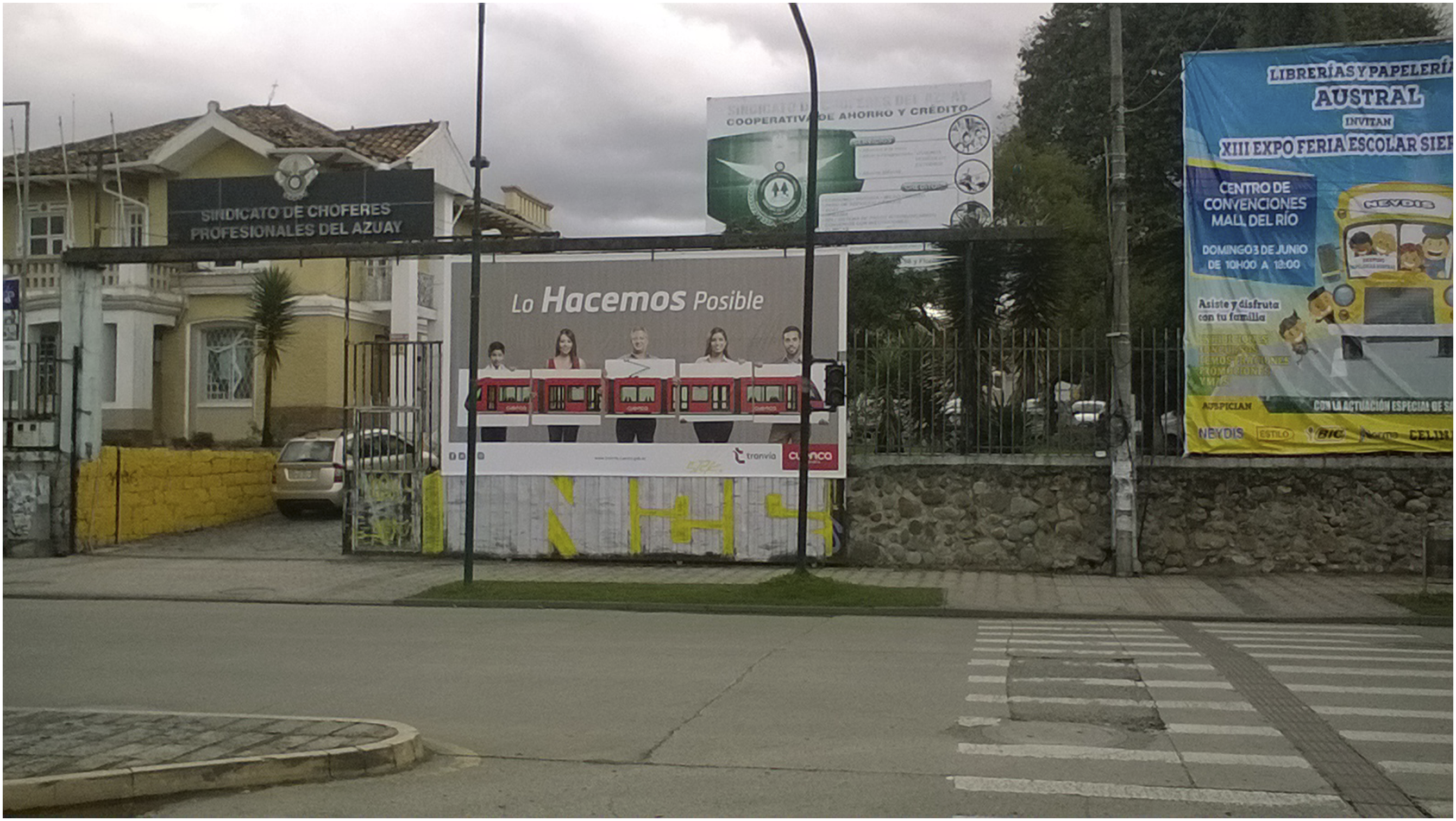
In fact, this kind of responsibilization of civil society seemed to target precisely activist groups such as the veeduría who were critical of the tram management. In authorities’ attempts to delegitimize the veeduría, a common argument was that the veeduría’s actions were actually counterproductive for the completion of the project. Even Emilio, the construction foreman who empathized with the affected businesspeople, argued that civic pressure on the municipality resulted in authorities’ ill-considered decisions and consequently harmed the process. Citizens like the veedores were thus transformed into part of the problem instead of the problem solvers. When the tram started operating, citizen responsibilization became an even more important element of the official discourse. A tweet by a public entity put it most succinctly: “The Cuenca tram has become a reality, and it is in our [i.e. the citizens’] hands to be responsible with this means of transport.” At a public event, the director of the tram department said in her speech: “The tram belongs to the cuencanos, and it is time to appropriate it and engage in its progress.” By this, she referred to the need for people to use the tram correctly, responsibly and – if possible – frequently, given that initial passenger numbers fell far short of expectations. Now more than ever, citizen collaboration was required. In contrast with the official discourse before the start of the construction, in which the tram appeared as a means for the state to care for and shape society, citizens were now called upon to be the carers and agents of change themselves.
But although authorities washed their hands of the tram project and now presented it as their gift that had to be taken care of by the people, those who had been most severely affected by the construction had not forgotten, let alone overcome, their struggle. Quests to hold authorities to account over the project’s shortcomings continued after completion. While both mayors, Granda and Cabrera, later became transport ministers in a twist of most bitter irony for the veedores, investigations into irregularities and possible corruption within the tram project were undertaken by different state actors, including parliamentarians Fernando Villavicencio 7 and Bruno Segovia. In a radio interview in February 2022, Segovia said “the tram is there now. We have to make a minga 8 all together [to make it successful]. The tram is there, we can’t go back, but we can’t forget the irregularities and let them go unpunished.” This position was more akin to that of the veeduría, in that collective responsibility was assumed for the resolution of an issue that was blamed on someone else.
What I have described in this article are the negotiations of responsibility, sparked by an infrastructure project, which configured citizen-state relations in different ways. The pastoral governance of a strong state was superseded by a fierce blame game involving authorities and citizens, competing constructions of the causal chains of authoritative action and fragile alliances of (self)responsibilization. Ultimately, diverging allocations of responsibility were both what allowed actors to navigate the apparent messiness of the situation and what effectively created it. The ethnographic tracing of the constructions of responsibility thus proves a fruitful terrain for understanding how infrastructural violence (Rodgers and O’Neill, 2012) is handled by concerned actors. More broadly, I suggest, it is key to exploring how worlds are inhabited and made. In an influential article, Strathern addressed the difficulty in actor network theory to cut the networks of “endless extension and intermeshing phenomena” that form our existence (1996: 522; see also Eckert and Knöpfel, 2020). If, ultimately, everything is somehow related to something else in more-than-human assemblages, how do we stop relational flows and stabilize a limited network for interpretation and action?
Strathern suggested that the concept of ownership was one way of doing so in modern society, as it allowed a determined thing to be owned by a bounded actor. Responsibility is another such concept, complementary to ownership, linking bounded actors not only to inert things but to events. These events thereby become the effects of actors’ actions (Puccio-Den, 2017). In the case of the veeduría in Cuenca, responsibilization involved disentangling and re-entangling a confusing reality. Individual actors such as local authorities were disentangled from the messy, opaque relations and institutions they were embedded in and re-entangled in coherent, linear narratives that attributed certain interests, levels of power, means, relations, and actions to them. Disparate events in the city could then be clearly located within the causal chains of responsibility thus woven. The construction of such chains of responsibility was a collective, negotiated and laborious process. People needed to be actively convinced to pull on these same chains for the latter to gather traction. This aspect is what I described as alliances of (self)responsibilization. While blaming others for the situation, such an alliance was nevertheless taking the reins – or, rather, the chains of responsibility – to try and change the course of events. For while the causes of the present are always up for debate, causation of the future is more undetermined still. In that sense, the construction of responsibility is a necessary world-making device. It fundamentally shapes one’s reality by creating a logical order, a plot of relevant actors, causes and effects, a distribution of power, an action space and a moral compass. Although this order can be highly unstable, it nevertheless constitutes a necessary ground for understanding and acting on the world.
Footnotes
Acknowledgements
I would like to thank the three anonymous reviewers of this article for their invaluable comments. This article developed out of a paper presentation I gave at the Nordic Ethnology and Folklore Conference in 2022 in Reykjavik, as part of a panel on responsibility and blame. I am indebted to panel conveners, Riccardo De Cristano and Marc Brightman, as well as to all the panel contributors for the enriching discussion. The research that this article is based on benefitted from a PhD Studentship from the University of Manchester.
Declaration of conflicting interests
The author(s) declared no potential conflicts of interest with respect to the research, authorship, and/or publication of this article.
Funding
The author(s) received no financial support for the research, authorship, and/or publication of this article.
