




Abstract
Egyptian shaʿbi music is typically positioned as a somewhat vulgar style produced and consumed by the working-class masses. But in practice, numerous individuals have long been attempting to sanitise it to appeal to audiences deemed more elite. This article, based on 21 months of ethnographic fieldwork with musicians and producers in Cairo, investigates how this mainstream, mass-mediated, commercially successful version of shaʿbi, known as ‘clean shaʿbi’ (shaʿbi nadif) is produced and distributed. I explore how three different cultural brokers try to clean up shaʿbi in distinctive ways. I argue that their success does not reveal a straightforward crossing of class-cultural divides, as it might at first appear; in each instance boundaries are in some ways crossed, and in other ways reinforced. Cleaning up shaʿbi does not necessarily benefit the musicians: the processes through which their music is sanitised and mediated are often exploitative, serving to entrench pre-existing social inequalities.
Introduction
It was the tail-end of a long, hot summer of fieldwork in Cairo. I was doing research into a style of Egyptian music called shaʿbi and had been lucky to find work as a violinist with several bands.1 But I was beginning to feel exhausted from the frequent all-night performances at nightclubs and street weddings around the city’s margins, and the often-arduous journeys on public transport required to reach the venues. When, on a rare night off, a friend from outside the shaʿbi scene invited me to his house party, I was excited for the change of pace. He worked for the U.N. and always managed to gather a fun crowd of Egyptians and foreigners, most of whom worked as journalists or for international NGOs, at his spacious apartment in the upscale neighbourhood of Garden City. His building was free from the watchful gaze of a bawwab (doorman) or prying neighbours, so large mixed-gender gatherings were no problem, unlike elsewhere in the city.
At the party, after a few hours of eating and drinking and chatting, a guest called Radwa announced that she wanted to dance, switched off the smooth jazz music that had been playing from a laptop, and put on a song by the shaʿbi singer Hakim. 2 I had spoken to Radwa earlier in the evening about my interest in shaʿbi music, and how, as part of my research, I had been performing at street weddings. She had expressed disbelief: in Egypt, shaʿbi has a reputation for being a somewhat vulgar music of the lower classes (Grippo, 2010; Puig, 2006), or as she put it, not something ‘people like us’ (educated, cosmopolitan) listen to. But now, as she got up to dance, Radwa turned to me and admitted: ‘There is some good shaʿbi… I like this kind of thing.’ Switching to Arabic, she clarified, ‘shaʿbi nadif, yaʿni’—‘you know, clean shaʿbi,’ but perhaps translated better as ‘decent’ shaʿbi’. 3 This type of exchange had become familiar to me: people of all classes but particularly those from the upper middle classes would express distaste at the idea of shaʿbi music and the lower-class culture with which it is associated, before professing that they do in fact like some shaʿbi, but only ‘decent shaʿbi,’ (shaʿbi nadif) or ‘acceptable shaʿbi’ (shaʿbi ma’bul). ‘Decent’ and ‘acceptable’ shaʿbi are not distinct subgenres, but rather flexible labels assigned to particular singers or songs based on a constellation of markers including image, musical style, and lyrical content.
Based on 21 months of ethnographic fieldwork (2018-20) in the recording studios, nightclubs and street weddings that constitute Cairo’s shaʿbi music scene, this article investigates how this mainstream, mass-mediated, commercially successful shaʿbi music deemed ‘acceptable’ is produced and distributed. I explore how three different private-sector cultural brokers are each trying to clean up shaʿbi in distinctive ways, actively sanitising it for commercial, aesthetic and ideological reasons. The undeniable success of clean shaʿbi across social and class-cultural divides shows that shaʿbi is not, and has never been, straightforwardly a low-brow music of the lower classes. It has always been commercially produced and had a wide listenership; it gathers varied publics that exceed pre-existing social formations. What is considered ‘high’ or ‘low’ (as well as ‘clean’ or the opposite it conjures, ‘dirty’) is constantly in flux, and styles constantly shift on the spectrum of taste, a process that is shaped as much by private-sector cultural brokers as by the state.
It might initially be tempting to read the upper middle class’s embrace of clean shaʿbi as signalling a successful crossing of class-cultural divides. However, as will become clear, it is not quite so straightforward: in each of the contexts I describe below, attempts to clean up shaʿbi result in boundaries sometimes being crossed, and sometimes reinforced. In its simultaneous crossing and enforcement of boundaries, I argue that the cultural brokers I discuss here participate in what Jacques Rancière calls the ‘distribution of the sensible.’ He explains it as follows: ‘I call the distribution of the sensible the self-evident facts of sense perception that simultaneously discloses the existence of something in common and the delimitations that define the respective parts and positions within it’ (Rancière, 2013: 7). By the ‘sensible,’ he means what is visible or invisible, sayable or unsayable within any given social formation; thus redistribution of this ‘sensible’ (a process he calls dissensus), can lead to a new common (sense) (Rancière, 2013: 139). Importantly, both inclusion and exclusion are intrinsic to this process of redistribution: the process presupposes a certain extent of equality such that everyone is in the same ballpark, even if the inequalities are visible within.
In varied and decidedly partial ways, the cultural brokers introduced here ‘redistribute the sensible’ across social divisions. If operating within a distribution of the sensible that determined certain sounds as ‘noise’ and not ‘music’, shaʿbi music would be excluded. But by mediating shaʿbi and facilitating its mass circulation across varied social spaces, they help create new conceptions of what shaʿbi music is and who it is for. In doing so, these cultural brokers are staking a certain claim to a space, shifting boundaries of high/low, ‘the people’ and ‘the elite’, and arguably creating a space where political reality can be perceived differently. However, as will become apparent, this does not necessarily benefit the musicians themselves: the processes through which their music is sanitised and mediated are often exploitative, and in this respect serve to entrench pre-existing social inequalities. Indeed, I follow Georgina Born who suggests that musical mediation is about the negotiation of difference, and as artists engage in different types of mediation they are able to ‘generate new models and new practices of difference and interrelation in music’ (2005: 11), though there is no guaranteeing these new interrelations will be more equitable (2005: 30).
In attending to these issues, I draw on scholarship that has explored the role of cultural brokers in shaping tastes and mediating between artists and an imagined broader consuming public (Bourdieu, 1986; Negus, 2002), often transforming musical styles and social relations in the process. While much of this scholarship relates to racial difference, in terms of what happens when musical styles associated with Black communities are adapted for white audiences (Haynes, 2005; Heap, 2009; Miller, 2010; Steingo, 2016; White, 2000), the Egyptian context requires instead a sharper focus on class dynamics. Also, while recent literature has focused on the mediating role of algorithms and AI within music streaming services (Leyshon, 2014; Prey et al., 2022), this article shows that in Egypt the music scene continues to be shaped largely by individual industry insiders and on-the-ground personal connections. Such observations are made possible by paying close attention to the labour that goes into the production of music, an aspect that scholars have tended to neglect in favour of focusing on discursive or lyrical aspects of particular styles and how they relate to social formations (see e.g. Armbrust, 1996; Gilman, 2014; Simon, 2022).
The article is structured as a series of three case studies, each focusing on the methods and motivations of a particular type of cultural broker. First, I explore how singers and music producers who position themselves as firmly outside of the shaʿbi scene work to clean up shaʿbi for commercial and aesthetic reasons, focusing on musical and lyrical content and particular performance practices. Next I consider how members of the film-producing family known as the Sobkys have successfully pioneered high production value shaʿbi music videos, and in doing so are understood to have elevated shaʿbi music and helped it reach new elite audiences and venues. Finally, I explore how the founders of Shaʿbiyyat, a satellite television channel dedicated to producing and broadcasting shaʿbi music videos, are understood by musicians as key figures in the distribution and elevation of this musical style. Ultimately, I argue that in the process of mediating and facilitating the circulation of shaʿbi, these cultural brokers at once connect people and amplify the divisions between them. Highlighting the role that music plays in mediating difference, I offer a way to think through how popular culture forms get taken up in more elite circles (as eventually happens with much popular music) and the politics of this process in the contemporary period.
Cleaning up shaʿbi in the music industry
The rise of clean shaʿbi singers
Shaʿbi first emerged in late 1960s Cairo, its sound epitomised by singer Ahmad Adawiyya. Although listened to widely, shaʿbi was strongly associated with the city’s working-class neighbourhoods and their inhabitants, and often condemned as vulgar (habit) in the press (Armbrust, 1996; Simon, 2022). Hakim emerged as the first clean shaʿbi singer in the early 1990s. His producer, Hamid El Shaeri, had sought to fill what he saw as a gap in the market by creating a style of shaʿbi that was chic and modern. Together they created a style that was sonically and visually distinct from previous shaʿbi releases: they moved away from al-firqa al-sharqiyya (the Eastern band, which included accordion, violin and kawala [reed flute]) to a formation known as the combo (comprised of synth, drums, guitar and bass guitar); they released music videos which displayed Hakim’s carefully cultivated and preened look; and they sold cassettes at more than the going rate which signalled a conscious attempt to appeal to a more raqi (upmarket, elite) audience, as well as generating more profit. Today, Hakim remains incredibly popular and performs regularly at upscale nightclubs and weddings in hotels, his reputation as a clean shaʿbi singer enabling him to charge clients more than other singers for bookings. He also pays his band (which is made up of regulars from the shaʿbi circuit) very slightly more than the going rate, meaning he gets his pick of musicians while cultivating an air of prestige among industry insiders.
Hakim’s trajectory is a classic ‘rags to riches’ tale: he started out as a lowly street wedding singer but with the help of Hamid El Shaeri, found mainstream commercial success. The success of his signature ‘clean shaʿbi’ style effectively opened up new space for singers not rooted in the shaʿbi music scene to aspire to sing shaʿbi in a way that is still deemed respectable. One such singer is Hamada Magdy, with whom I briefly performed towards the end of my fieldwork. Hamada was unique among the shaʿbi singers I knew, both in his background and his insistence on distinguishing himself as a clean shaʿbi singer. Unlike the rest of the singers I knew who lived in working-class neighbourhoods on the outskirts of the city, he hailed from Nasr City, a well-to-do area in central Cairo. When I asked him to meet for an interview, he invited me to an indoor shisha lounge near his apartment, which was full of young mixed-gender groups; a marked contrast to the male-dominated street cafes that are the typical spaces of socialisation for the majority of shaʿbi singers. His image, with carefully shaped eyebrows and a Hollywood smile, also contrasted the more rough-and-ready looks of other singers on the circuit. Discussing his career, Hamada explained that he started singing as a university student (he studied at the relatively expensive private International Academy for Media Science) and was initially focused on vocal styles he defined as drama and sharqi (eastern). He transitioned to singing shaʿbi because of ‘akl ʿaysh’: in order to make a living. Despite his personal preference for classical and shababi (youth music) singers like Amr Diab, he found that the majority of work available to singers was at events like weddings, and ‘at weddings people want shaʿbi,’ he explained.
He referenced Hakim as a key source of inspiration. In fact, without Hakim as a model, I doubt someone like Hamada would ever have considered shaʿbi wedding performance as a viable or desirable career. He was keen to distinguish what he considered ‘their’ (his and Hakim’s) decent style from ‘vulgar’ (habit) shaʿbi. For him, the difference was rooted not in musical elements, but in lyrics and performance venues. Hamada explained that he rejects rude words (alfaz), and instead seeks purposeful lyrics (kalam hadif). Many of his songs have religious themes, for example “Illi Hamina Rabbina” (It’s God Who Protects Us, 2017), “Thiqa Fi Allah” (Trust in God, 2018), and a duet with Ahmad Sheba called “Allah al-Mustʿan” (God is our Aid, 2019). Hamada does not present himself as especially pious—he did not leave our interview to pray when the call to prayer sounded for example, and he stars alongside scantily-clad belly-dancers in several music videos. His incorporation of religious themes is instead a means through which he sought to sanitise shaʿbi by incorporating widely accepted markers of social respectability.
Hamada also distanced his own style from what he considered vulgar shaʿbi through his decision to perform only at weddings held at indoor venues, never in the street. Rejection of ‘the street’ as a space of noisy sociality has long been central to constructing a middle-class identity in Cairo (Fahmy, 2020), and for Hamada this was a key aspect of keeping his shaʿbi clean. Given that having a wedding in a hotel as opposed to the street is also a marker of class distinction, this decision also implies that the audience he intends to appeal to is distinctly raqi (elite). It might seem contradictory, then, that his music videos (including those accompanying the above religion themed songs) tend to be set at street weddings and include extensive visual markers of life in shaʿbi neighbourhoods. But Hamada also makes sure to incorporate elements that help distance him from the negative associations of the street. For example, instead of the female belly-dancer that would typically feature in such music videos, he is more often accompanied by a troupe of male dancing percussionists. These dancers, who also feature in his live performances, execute carefully choreographed steps that echo the staged folkloric dance style pioneered by Mahmoud Reda’s dance troupe in the 1960s. As dance-ethnographer Christine Sahin has argued, Reda’s style ‘represented a cleaner (less sexually stigmatized), and more middle and upper-class masculine version of Egypt that didn’t have to contend with the working popular class and sex work connotations and connections raqs sharqi [belly-dance] always wrestled with’ (Şahin, 2018: 158).
Belly-dancing is conventionally associated with the streets and lower classes; its moves are erotic and unpredictable. The choreographed male troupe, on the other hand, is wholesome and ordered. This echoes the disciplining discourse of spatial ordering evinced by upper middle classes and the state: the presumed chaos and social disintegration associated with informal areas is contrasted with the spatially and morally ordered formal or elite neighbourhoods (Bayat and Denis, 2000; see also Winegar, 2016 on ‘aesthetic ordering’ in Egypt). By incorporating Reda-style dancing within his performances, Hamada is able to use imagery that situates him firmly in the ‘authentic’ world of shaʿbi music, whilst simultaneously ordering and disciplining these spaces and thus distancing himself from their association with disorder.
Although Hamada has not reached the same level of fame as Hakim, he has found relative success: he has a busy schedule of wedding performances, and his videoclips are frequently broadcast by the satellite television music channel Mazzika, which does not typically screen shaʿbi songs, sticking instead to more classical or conventionally respectable styles. In this sense, Hamada has expanded shaʿbi’s sphere of influence by finding it a home on new platforms from which it was previously excluded. But his embrace of shaʿbi is partial: he feels the need to reject many aspects of conventional performance practice in order to keep it what he deemed to be suitably clean and respectable for someone of his class position.
Cross-over collaborations
In addition to the clean shaʿbi look and sound epitomised by Hakim and Hamada Magdy, decidedly non-shaʿbi singers have increasingly sought to collaborate with shaʿbi singers in crossover duets, resulting in songs that are heard as more acceptable than standard shaʿbi. Given the hierarchies that exist within the music industry whereby shaʿbi is devalued in comparison to genres like pop or shababi—even the most famous shaʿbi singers and musicians command very low fees compared to stars such as Amr Diab and Sherine Abdel-Wahab—one might presume that shaʿbi musicians would be the ones initiating such collaborations. However, having watched several of these collaborations be negotiated and produced, it became clear that it is usually singers from other (more ‘respectable’ but perhaps less commercially successful, or declining) genres who approach shaʿbi artists suggesting collaborations.
For example, in February 2018 a composer friend invited me to a recording session. He explained that he had been commissioned to compose a duet for Ehab Tawfik (of 1990s pop fame), and Ahmad Sheba (shaʿbi star of the day), and wondered if I wanted to come and hear the singers record their vocal lines. It was a little after midnight when I made my way to the studio, and rather fittingly the taxi driver was playing Sheba’s best-known song, “Ah Laww Laʿibt Ya Zahr” (Oh If the Dice Would Roll My Way, 2016). I told the driver I was on my way to hear him record, and he excitedly scrolled through the contents of his flash drive playing a selection of his songs, as well as pointing out billboards we drove past that featured Sheba as the new face of an advertising campaign for international telecommunications company Vodafone.
When I arrived, the singers had not yet begun recording, so I joined them in the lobby. Ehab told me about a recent trip to London, his love of upscale department store Selfridges, and his own PhD in music. He seemed keen to distinguish himself as educated, wealthy, and cosmopolitan, and establish commonalities with me, a British PhD student. I asked about the song they were going to record, called “ʿAshamy Fe Rabena” (My Hope is in Our Lord), commenting on the religious theme. Ehab responded, ‘yes, it has a good message. But alongside that, you know, it’s just the usual shaʿbi stuff: advice, sadness, that kind of thing,’ grimacing slightly and waving his hand dismissively. I asked whose idea the duet was: ‘It was my idea. I wanted to do something shaʿbi with Sheba, but something cleaner (andaf) than what he usually does. Shaʿbi nadif.’ He made it clear that shaʿbi was usually something he saw as below him, and that he was trying to elevate it by cleaning up Sheba’s style.
The studio, Studio Risala in Mohandisin, is known as one of Cairo’s best. Both singers had recorded there before and were friendly with the sound engineer. Sheba was the first to record his vocal line, standing in the large recording booth whilst I, the sound engineer, Ehab and the rest of the team (lyricist, composer, and the singers’ entourages) remained in the adjoining control room, separated by a glass wall. The sound engineer played the previously recorded backing track and Sheba sang his part. Various people in the control room weighed in giving him advice: the sound engineer, the lyricist, the composer, and especially Ehab. Ehab repeatedly stopped him mid-phrase, telling him he was doing it wrong and singing back to him the ‘correct’ version. As well as commenting on his tuning, he suggested particular ornamentation (hiliyat) for Sheba to use during the mawwal (vocal improvisation) and advised Sheba to sing certain passages up or down the octave. At one point he became particularly agitated with Sheba, telling him that this part of the song wasn’t meant to be sung with such ‘violence’: ‘no, no, no… we don’t want this violence (ʿunf) here… not so strong, not like this—’ he said, before demonstrating the sound he didn’t want, in an overexaggerated imitation of Sheba’s voice; an affected unrefined and loud honking. He then exemplified the sound he did want: softer, more legato and less in-your-face. Sheba responded to all suggestions in a good-spirited way, replying ‘certainly, sir’ (hadr ya ustaz). Ehab sighed and said to the sound engineer under his breath, ‘his voice really isn’t suitable for this kind of music…’
Meanwhile, when it was Ehab’s turn to record, any suggestions from the control room were met with annoyance. When I left, a little after seven o’clock in the morning, 4 hours after Ehab began recording, he showed no signs of wrapping up. His insistence at repeating and refining every little phrase might be understood as a combination of perfectionism and a performative stance against Sheba’s more go-with-the-flow attitude to recording, which saw him complete his section in just under 2 hours.
Scholars have long argued that recording studios are spaces in which relationships and power dynamics are mediated. Louise Meintjes, for instance, suggests that ‘recording and mixing is a dramatized struggle over signs embodying values, identities, and aspirations’ (2003: 9), and the same can be said here. Ehab wanted the aura of authenticity and fame Sheba brought, but was keen to establish his dominant position throughout, most probably aware that despite his dismissal of shaʿbi music, Sheba’s YouTube views well outnumbered his own. The finished song was released with an accompanying videoclip (Figure 1) which, like Hamada Magdy’s videos, was screened by the Mazzika satellite television channel. In this regard, Ehab and his production team’s attempt to ‘elevate’ or ‘sanitise’ shaʿbi music for mass-consumption was successful in opening up a new platform for Sheba and shaʿbi. A still from the “ʿAshamy Fe Rabena” music video. Sheba is seated centre-left, and Tawfik is seated centre-right. (https://www.youtube.com/watch?v=Lr8563QKpCk).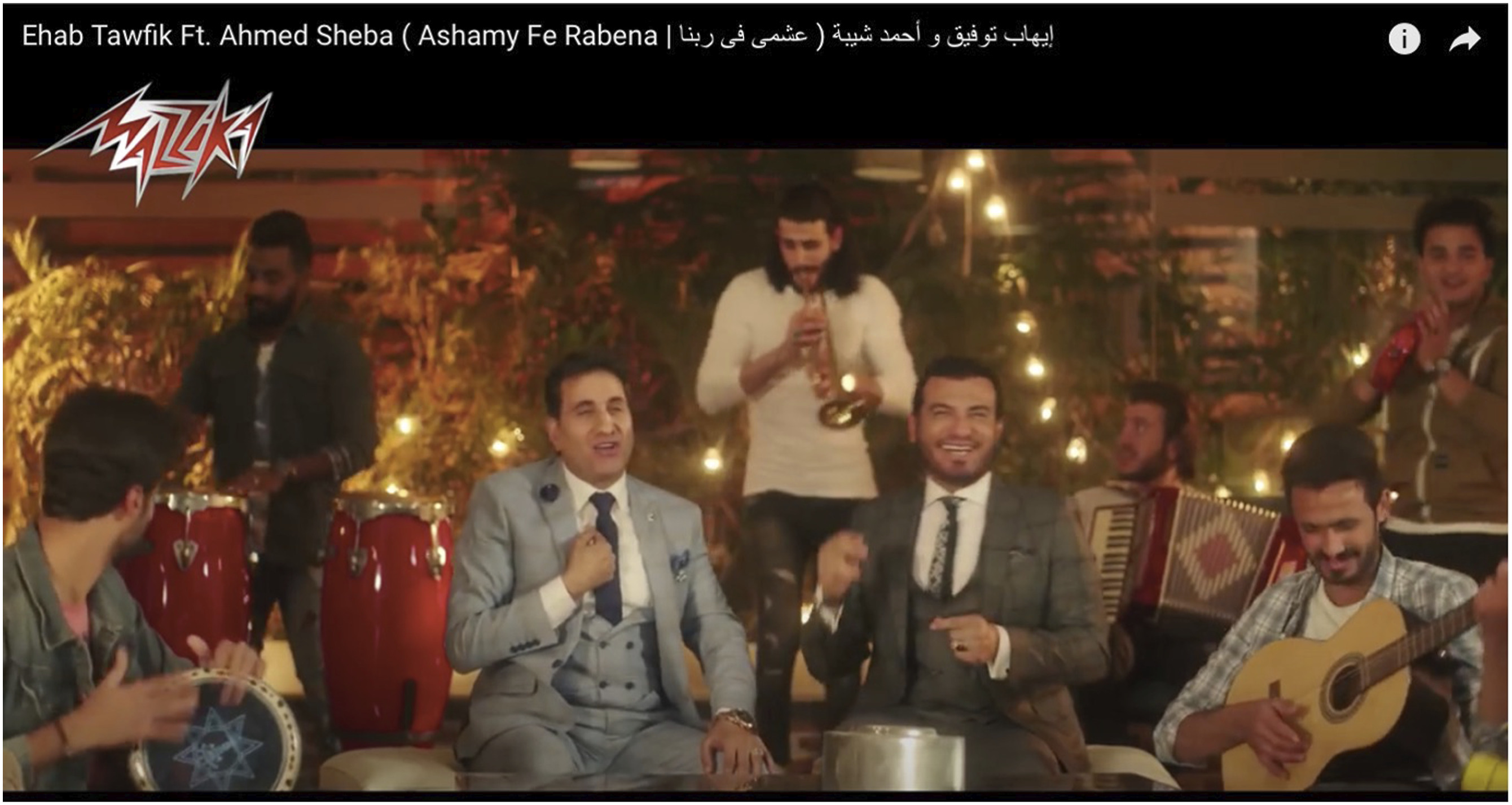
The figures who orchestrated the cleaning up of shaʿbi in the examples above—singers Hamada Magdy and Ehab Tawfik—could be understood as co-opting or appropriating a marginalised musical style for their own commercial gain. Throughout, they were keen to emphasise and maintain boundaries between themselves and other shaʿbi artists in order to highlight their own superior class-cultural positions. Chad Heap notes a similar situation in his book Slumming (2009), with reference to 1920s New York where class was deeply entangled with race. He describes how white musicians would visit Harlem and admiringly listen to Black jazz musicians play, viewing their style through a prism of primitivism—as ‘simple and natural’ (Heap, 2009: 214). This is similar to how Tawfik understood Sheba’s style, and in this regard, instances where shaʿbi is brought into close proximity to those outside the shaʿbi circuit can actually serve to underline and even exacerbate boundaries and divisions.
Heap goes on to note that that it was precisely this racist stereotype of primitivism, sensuality and hypersexuality associated with Black nightspots that appealed to white listeners. White middle-class people got a thrill and felt able to push the boundaries of the sexual norms that governed white spaces of sociality, while simultaneously highlighting their difference and superior moral standing (Heap, 2009: 273). There was certainly an element of this in Radwa’s enjoyment of shaʿbi as described in the introductory vignette: it might be understood as an auditory form of ‘slumming.’ Although she had never been to a street wedding, she did admit they sounded exciting; inhibitions were let loose and the presence of a belly-dancer signalled the relaxation of sexual norms. An element of this fun could be brought to my friend’s house party in a cleaned-up form via singers like Hakim and Hamada Magdy.
However, while white jazz musicians would memorise and appropriate Black musicians’ melodies, performing them in higher-paying segregated nightspots from which Black performers were banned, in the case of shaʿbi, the musicians do benefit in some regards from the new platforms opened up to them. They can charge rates better in line with more respected genres, and have their songs aired on channels that were previously off limits. In this sense, figures like Hamada Magdy and Ehab Tawfik can be understood as mediators who help other shaʿbi musicians and singers connect with industry professionals and media platforms that otherwise exclude them. In doing so, they widen the very canvas of what is deemed acceptable, redistributing the sensible across social divisions.
The Sobkys and shaʿbi music videos
In contrast to the above cultural brokers who have attempted to clean up shaʿbi while self-consciously positioning themselves as ‘outsiders’ to the shaʿbi scene, the remainder of the article discusses cultural brokers who self-consciously position themselves as ‘insiders,’ or rather intermediaries intimately familiar with the shaʿbi scene, thus best able to mediate between shaʿbi stars and a broader listening public. This section introduces the film-producing Sobky brothers (Ahmad and Mohammad), who help well-known shaʿbi singers create high-quality music videos which they then feature in their films. The Sobkys are the most prolific and well-known ‘cleaners-up’ of shaʿbi operating today, utilising a medium—the music video (called a videoclip in Egypt)—that is considered inherently ‘decent’ and high-status by shaʿbi musicians to increase the genre’s status and appeal.
‘Sobky’ was a name that arose often during my fieldwork, in conversations about shaʿbi music as well as more generally. It refers to the notorious Sobky family of film producers, headed by brothers Ahmad and Mohammad. The phrase ‘Sobky films’ (aflam al-Sobky) refers to the films they produce. Now wealthy, the Sobky brothers hail from humble beginnings: their family ran a butcher’s shop in the Cairene neighbourhood of Dokki, and in 1985 they opened a videocassette shop above the butcher’s. It was this experience, friends told me, that allowed them to understand what audiences want from a film; they learned what sold and what didn’t. They used this insider knowledge to establish themselves as producers and founded a production company, ‘el-Sobky for Artistic Production,’ in the early 1990s. Sobky has become ‘a metonym for light entertainment, obscene dialogue, and lewd imagery’ as El Khachab (El Khachab, 2019: 39) puts it. Their films, often set in shaʿbi neighbourhoods, continue to be commercially successful but are now typically slated by critics for their perceived poor production quality and thin plot lines centring around drugs, fights, and belly-dancers. Sobky has become analogous with moral and artistic bankruptcy in return for a quick profit, and the films and their producers are subject to the same class-based accusations of vulgarity historically levelled against shaʿbi music.
It is perhaps not surprising, then, that shaʿbi music today is intimately tied up with Sobky films. The top contemporary shaʿbi singers, especially Mahmoud al-Laythy and Saad al-Soghayyar, are often referred to (sometimes admiringly, sometimes scathingly) as ‘Sobky’s darlings’ (habayib al-Sobky). This is because these singers often feature in song-dance scenes within Sobky films. These scenes are produced separately from the rest of the film and are released as standalone videoclips on YouTube and television channels like Shaʿbiyyat some weeks before the film comes out in order to serve as a promotional trailer. The videoclips tend to continue circulating long after the films themselves have faded into obscurity, and also circulate in decidedly ‘elite’ spaces: the Hakim song played in the introductory vignette, for example, originated as a Sobky videoclip, a promotional trailer for the film Halawit Ruh (2014). Sobky videoclips such as this one were understood by my interlocutors—shaʿbi musicians, fans and detractors alike—as ‘clean’ shaʿbi.
But why are Sobky videoclips understood to be clean shaʿbi when the films are so firmly scorned for being ‘vulgar’? The answer is in part related to the Sobkys’ promotion of the videoclip as a suitable medium for shaʿbi music. Before the Sobky brothers began to produce shaʿbi videoclips, very few existed: Daniel Gilman noted in 2014 there were ‘a limited number of professionally produced shaʿbi videoclips’ (2014: 12), and Peterson, 2008 similarly observed that they were ‘extremely rare’ due to the high costs involved. It was previously a medium associated with more respectable musical genres due to the quite considerable financial investment required to make one, and also because to be screened on television the clip must be approved by a cultural gatekeeper, thus conferring on the musician a kind of external validation. As such, for the shaʿbi musicians I knew, the videoclip as a medium connotes an air of sophistication and has become almost synonymous with quality.
By the time I conducted my fieldwork, professionally produced shaʿbi videoclips had become ubiquitous, primarily thanks to the Sobkys: having seen the success and fame that Sobky videoclips afforded shaʿbi singers like al-Laythy, most of the singers I knew were keen to make their own videoclip. They considered releasing a videoclip to be a desirable marker of professionalism, as well as the best means to promote themselves and solicit more bookings for weddings, because when the videoclip is streamed on television or YouTube, the singer’s contact details typically feature prominently in the credits or on a rolling panel throughout. Several companies, most notably Shaʿbiyyat (introduced below), have been established to offer videoclip production services specifically for shaʿbi singers. However, Sobky videoclips stand out for their high production quality: they are shot using higher-quality audio and recording equipment than shaʿbi singers would otherwise have access to, resulting in a product that is considered visually and sonically superior (andaf) than the majority of shaʿbi releases, as El Khachab, 2019 has similarly noted. My interlocutors felt that by doing so, the Sobkys were helping a select few singers to access new upscale venues and audiences. As one lyricist, Atef, put it: Thanks to Sobky films, these singers have become high level (mustawa ʿali). For my daughter’s wedding I’ll just bring a DJ, because, you know… [he rubbed his fingers and thumb together, implying a live singer would be too expensive]. But the daughter of a minister who is getting married soon said to her dad, ‘I want al-Laythy for my wedding, I want Saad al-Soghayyar.’
Mahmoud al-Laythy’s music video “ʿAmm Ya Sayyad” (Oh Fisherman) from the film Yigaʿalu ʿAmer (May You Prosper, 2017) exemplifies this glossy Sobky videoclip style. The film follows the trials and tribulations of ʿAmer (played by Ahmad Rizk), who repeatedly divorces his wife. Singer Mahmoud Al-Laythy is cast as himself and appears in an acting role at various points in the film. The song “ʿAmm Ya Sayyad” is one of three musical numbers from the film which were released independently as videoclips, and it proved by far the most popular: I heard it constantly throughout fieldwork, both in mediated forms around the city and performed live. In fact, the song proved far more popular than the film itself which was a bit of a flop. Barely anyone I asked could recall the name of the film in which the song originally featured, showing that these videoclips are consumed independently from the films in which they feature.
The videoclip is set in a nightclub and the scene is contextualised for the viewer when ʿAmer suggests to a female companion a fun night out to help her forget her woes. He calls al-Laythy, asks where he is performing, then the shot cuts straight to the nightclub where the standalone videoclip begins. The camera focuses on the belly-dancer, Anastasia, who is in a deep backbend, her hair trailing the floor. She slowly rises, her figure silhouetted on a dark and smoky stage, accompanied by a mournful improvised violin solo and al-Laythy’s weeping mawwal (vocal improvisation) (Figure 2). The camera then pans around the dancer, flitting between closeups and full-body shots, perhaps imitating the imagined male gaze of the audience. Around a minute into the video, we finally see the source of the voice: al-Laythy singing in the background. As the mawwal transitions into the more upbeat part of the song, he comes to stand centre-stage with the dancer. They perform some synchronised dance moves, al-Laythy tucking his mic into the waistband of his trousers, hands behind head, hips thrusting, playing up to his trademark comic style (Figure 3). The camera pans to the nightclub audience (including characters from the film and dozens of extras), who sing and dance along. Mahmoud al-Laythy and Anastasia in stills from the “ʿAmm ya Sayyad” music video. (https://www.youtube.com/watch?v=8S47IghslBo). Mahmoud al-Laythy and Anastasia in stills from the “ʿAmm ya Sayyad” music video. (https://www.youtube.com/watch?v=8S47IghslBo).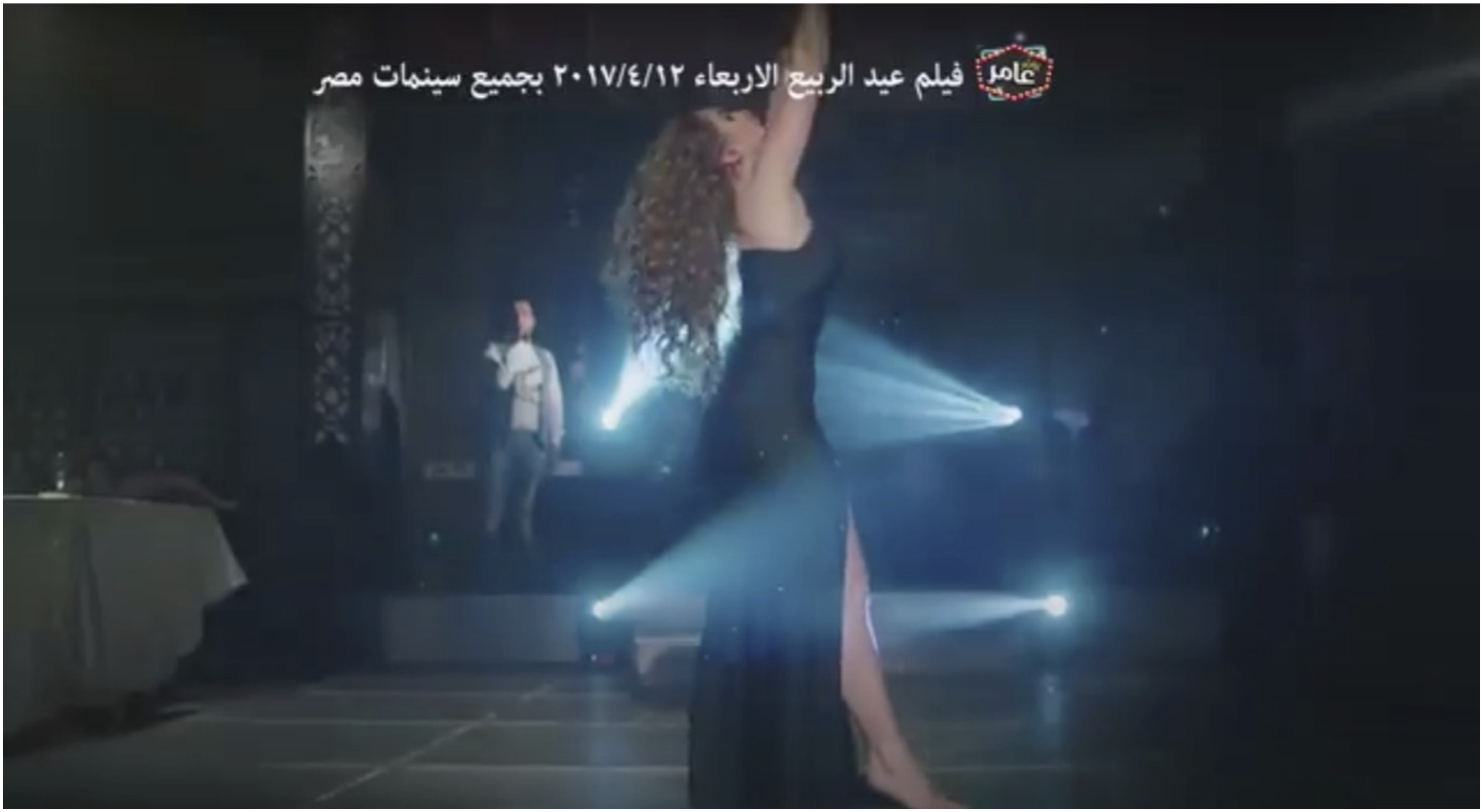
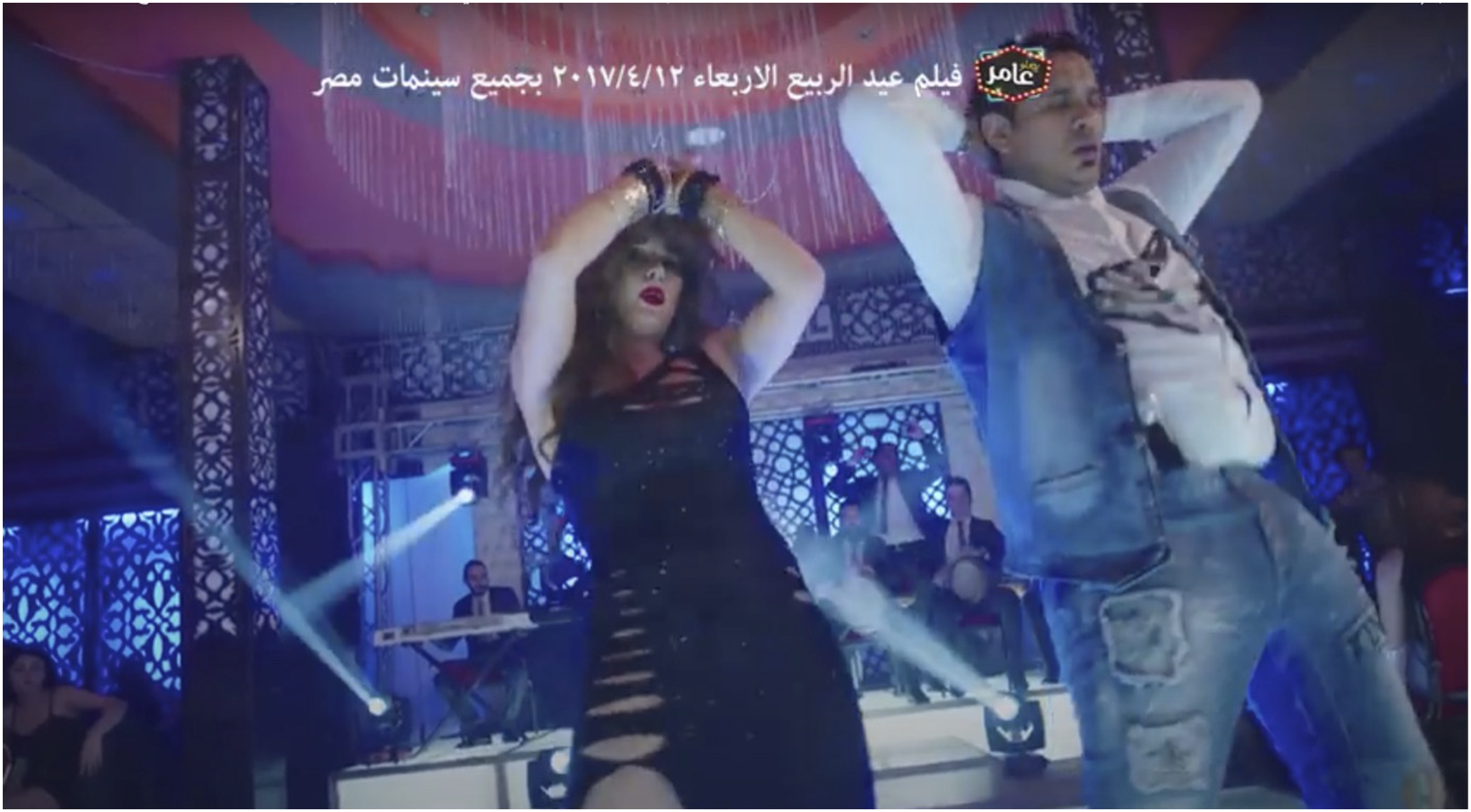
While critics argue that the Sobkys sacrifice production quality in the interest of profit, their videoclips are characterised by a high production value, especially in comparison to most other shaʿbi videoclips which are either self-produced or produced by companies like Shaʿbiyyat. In the above videoclip, multiple cameras have been used, allowing for regular switches of camera angle to keep the energy high, and it features sweeping shots that appear to have been filmed using a crane or jib, which suggests a professional setup and resulting aesthetic. Videoclips made by Shaʿbiyyat, on the other hand, are shot with a single camera, often handheld, resulting in a more home-made aesthetic and low production value clip. The difference in quality of editing equipment is also evident, as Sobky clips have a much more polished finish than others. In addition, the Sobkys have better access to shoot locations due to their higher budgets and their film industry connections: this clip is shot in a hired cabaret, while Shaʿbiyyat videographers tend to shoot in the street in order to save money.
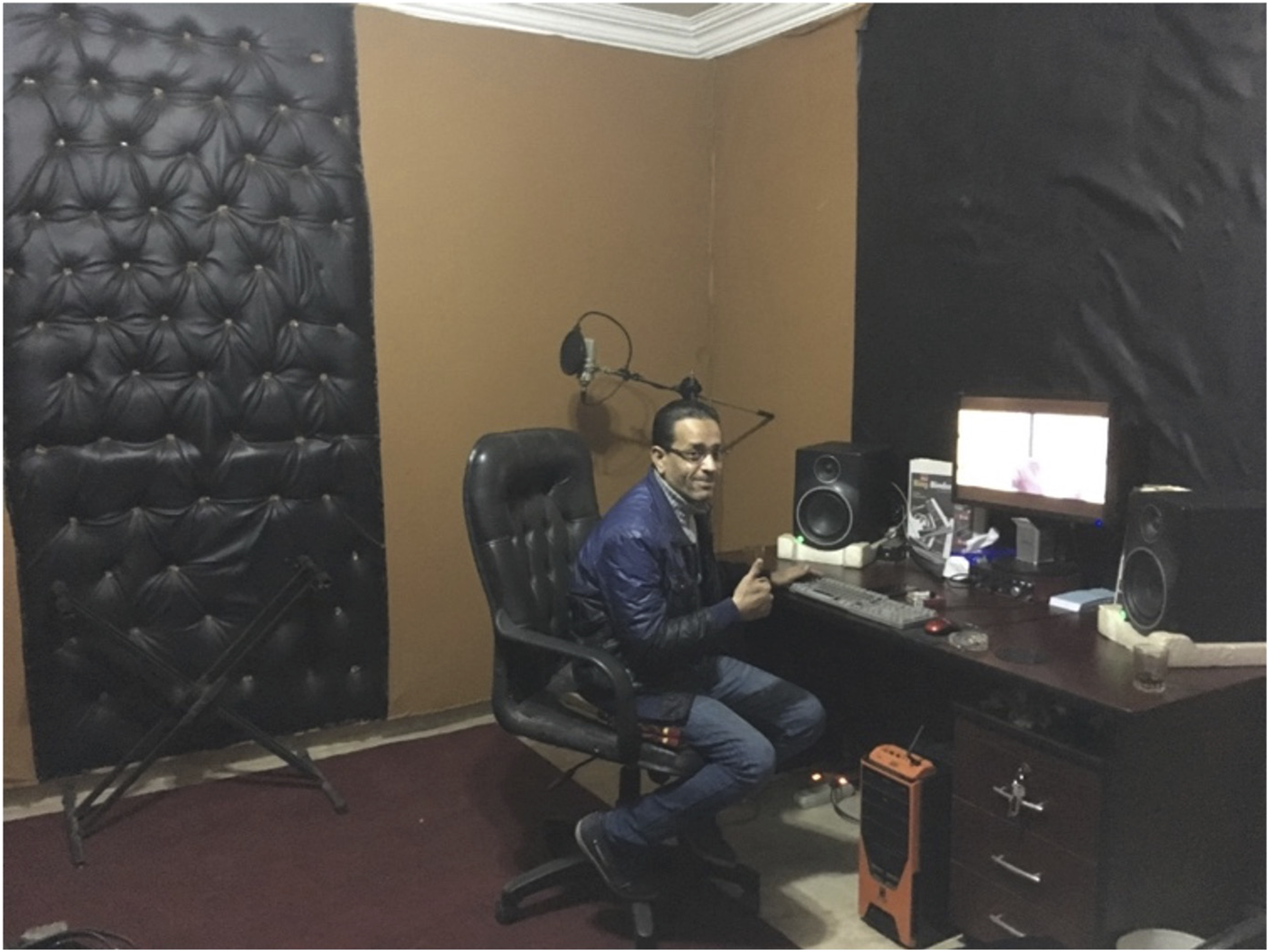
The videoclip also benefits from excellent sound quality. While in some Sobky films background noise from on-location recording sometimes renders the dialogue difficult to hear, the song is crystal clear and carefully EQed (equalised) to ensure a pleasing balance between instruments. This is because songs that feature in Sobky videoclips, including “ʿAmm Ya Sayyad,” are recorded separately from the rest of the film, usually at Studio Risala in Mohandiseen, and mixed by respected sound engineer Mohammad Gawda (the same location and sound engineer used for Sheba and Ehab Tawfik’s recording session discussed earlier). This studio uses high-quality and expensive technology, including Pro Tools music software and Mac computers, which offer a wide range of effects and editing options (Figure 4). The songs for Sobky films tend to feature live instruments, each recorded separately, as opposed to the money-saving computerised versions of violins and kawala that dominate in standard studio setups. This, combined with the fact that most studios in which shaʿbi is recorded tend to be far worse equipped and reliant on old and often failing technology (Figure 5), means that songs recorded for Sobky videoclips are sonically distinct from other shaʿbi releases by virtue of their high audio production quality. Sound Engineer Mohammad Gawda working in the well-equipped control room in Studio Risala. Composer, arranger and sound engineer Mahmod Saad in his studio.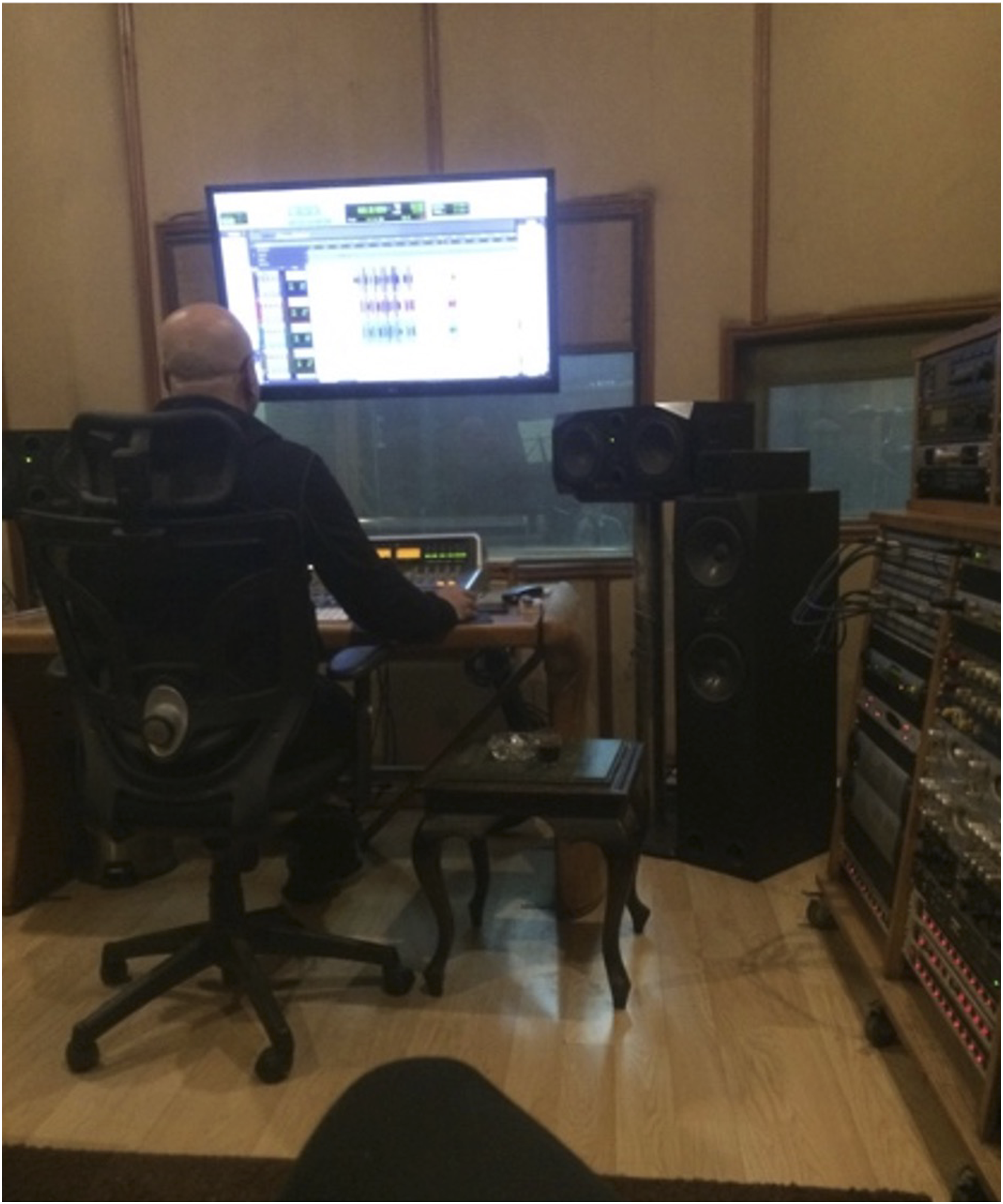
The resulting clips, visually and sonically more polished than other shaʿbi videoclips, led many of my interlocutors to suggest that the Sobkys have elevated shaʿbi music, giving it a gloss of professionalism not usually associated with the genre. Singer Adham told me that it was his dream to feature in a Sobky film because they produce ‘something upmarket’ (haga raqiya) that could lead to performance opportunities a step up from his nightly C-list cabaret slot. The glossy Sobky version of shaʿbi, he suggested, appealed to a different kind of audience—‘upmarket people in upmarket places’ (al-nas al-raqiya fil-amakin al-raqiya). The professional look and sound of the clips, paired with their ubiquity (both made possible by the Sobkys’ status as already-successful producers with capital to invest) has enabled the creation of a new kind of image for shaʿbi music.
As often happens in shaʿbi music, the songs featured in Sobky videoclips also actively play with boundaries of ‘high’ and ‘low’ cultural forms in their content, through musical quotation and sampling. The lyrics and melody of the opening mawwal in “ʿAmm Ya Sayyad” are adapted from Suad Hosni’s 1966 song “Ya Bahr al-Hawa,” a fondly remembered song performed by an actress/singer perceived as respectable. In another example, al-Laythy’s hit song and videoclip “Atawi” (2018) quotes several ‘high-art’ songs. The song opens with lyrics taken from a late verse in Umm Kulthum’s song “Ya Zalemny” (1951): ‘Atawiʿ, fi hawak, albi.’ Al-Laythy ‘shaʿbifies’ the next phrase by changing the words from ‘ansa al-kull ʿashanak’ (‘I forget everyone because of you’) to a more dramatic ‘abiʿ al-kull ʿashanak’ (‘I’d sell it all for your sake’). He also alters the melody, transforming the fresh, light feel of Umm Kulthum’s original in the melodic mode of ʿajam (similar to a western major scale), to a dramatically emotive and stereotypically shaʿbi feel by transposing it into the mode of saba, with its characteristic quarter-tone. This ‘shaʿbification’ (expressed in Arabic ‘takhalliha shaʿbi’) is underlined by a prominent electronic mizmar (double-reed instrument) line played by a synth, which has become contemporary shaʿbi’s signature sound. The incorporation of elements from older, respectable songs like those of Umm Kulthum and Suad Hosni can be understood as disrupting prescribed notions of the difference between ‘high’ and ‘low’ cultural forms.
In these novel pairings and rearrangements of elements considered upmarket (raqi) and vulgar (habit), Sobky videoclips signal a redistribution of what is sayable in any particular aesthetic form (Rancière, 2013). With their glossy packaging and mainstream appeal, they offer singers the promise of reaching new, more elite audiences. This is made possible by the Sobky brothers, who position themselves as ‘insiders’ in the shaʿbi world but at the same time with lots of capital to facilitate this new aesthetic.
Shaʿbiyyat: distributing shaʿbi
While the Sobkys have played a key role in producing clean shaʿbi videoclips, another pair of brothers with a very similar socio-cultural background play a key role in facilitating their distribution. In late 2011, Walid and al-Gindi founded Shaʿbiyyat, the first satellite television music channel dedicated entirely to broadcasting shaʿbi music.
I had the opportunity to meet Walid in the company’s stylishly decorated office in Mohandiseen, not far from Risala Studio where the audio for Sobky videoclips is recorded. The stairwell was adorned with a collage entitled ‘Shaʿbiyyat Museum,’ which featured black and white prints of older singers like Umm Kulthum (shaʿbi singers, on the other hand, were curiously absent). In the office itself, Walid sat behind a large desk, the wall behind him plastered with a bold wallpaper listing international capital cities. The implied international cosmopolitanism struck me as curiously at odds with the decidedly local (national) orientation of their channel, which in itself contrasts the pan-Arab orientation of Saudi-owned music channels like Rotana Clip (Cochrane, 2007: 6), as well as the self-consciously global facing cosmopolitanism of clean shaʿbi singer Hakim.
Walid explained that there are two parts to the Shaʿbiyyat business. First, their television and YouTube channels, which screen shaʿbi videoclips and generate income through advertising revenue. He proudly pointed to a silver plaque they had received from YouTube after gaining a million subscribers; at the time of writing this number has increased to an impressive 4.06 million. In fact, Walid told me that ‘I now do more work on the YouTube channel and social media that I do the television channel itself.’ Some of the videoclips they screen are simply song-dance scenes cut straight from old feature films. But the majority of the videoclips that Shaʿbiyyat broadcasts have been specially produced for release on television and YouTube.
This constitutes the second part of Shaʿbiyyat’s business: their videoclip production service. For between 5,000 and 50,000 Egyptian pounds (£230 - £2,300), any singer can bring them a song and they will shoot and produce an accompanying videoclip. They write a plot that meshes with the lyrics, as well as providing a director and actors to feature alongside the singer in the video. Many singers I met were keen to use this service to clean up their music in the hope of reaching listeners beyond those found in live performance contexts. Singer Ahmed Elprins, for example, who had recently commissioned Shaʿbiyyat to make a videoclip for a new song he was recording, explained it as follows: Anyone can sing at weddings or nightclubs. But if you make a videoclip, it shows that you are professional [he used the English word]; you know, that you are doing something decent (nadifa), upscale (raqia). I want to get more wedding bookings, but also have something high quality, something upscale (mustawa ʿali, haga raqia) to advance my career beyond weddings.
When I asked why he was so keen to turn his song into a videoclip, his Arabic was littered with English words: ‘ʿashan al-prestige; w-ʿashan al-videoclip propaganda kwayyisa’—‘because of the prestige, and because videoclips are good propaganda.’ The word ‘propaganda’ was used frequently among musicians and marketing professionals to mean something akin to promotion, and did not have the negative connotations implied in English usage of the word. The implication was that Ahmed Elprins was entrusting Shaʿbiyyat to mediate between himself and an imagined pool of elite listeners, in the same way the Sobky brothers did. But while the Sobkys only worked with already-successful singers, the Shaʿbiyyat brothers offered unknown shaʿbi singers a shot at the big-time.
In this regard they have been instrumental in establishing a new platform for everyday shaʿbi musicians to create and broadcast music videos, when they had previously been sidelined by state media (Grippo, 2010; Simon, 2019) and other corporate cultural gatekeepers (like those who run music channels Mazzika and Melody Hits). Their vision of cleaning up shaʿbi to make it as commercially appealing as possible is centred on cleaning it up aesthetically. When I joined singer Ahmed Elprins on his Shaʿbiyyat videoclip shoot, for example, the director selected a picturesque shoot location: a waterway and row of luxurious villas in al-Qanatir, a rural area on the outskirts of Cairo (Figure 6). Singer Ahmed Elprins recording his music video.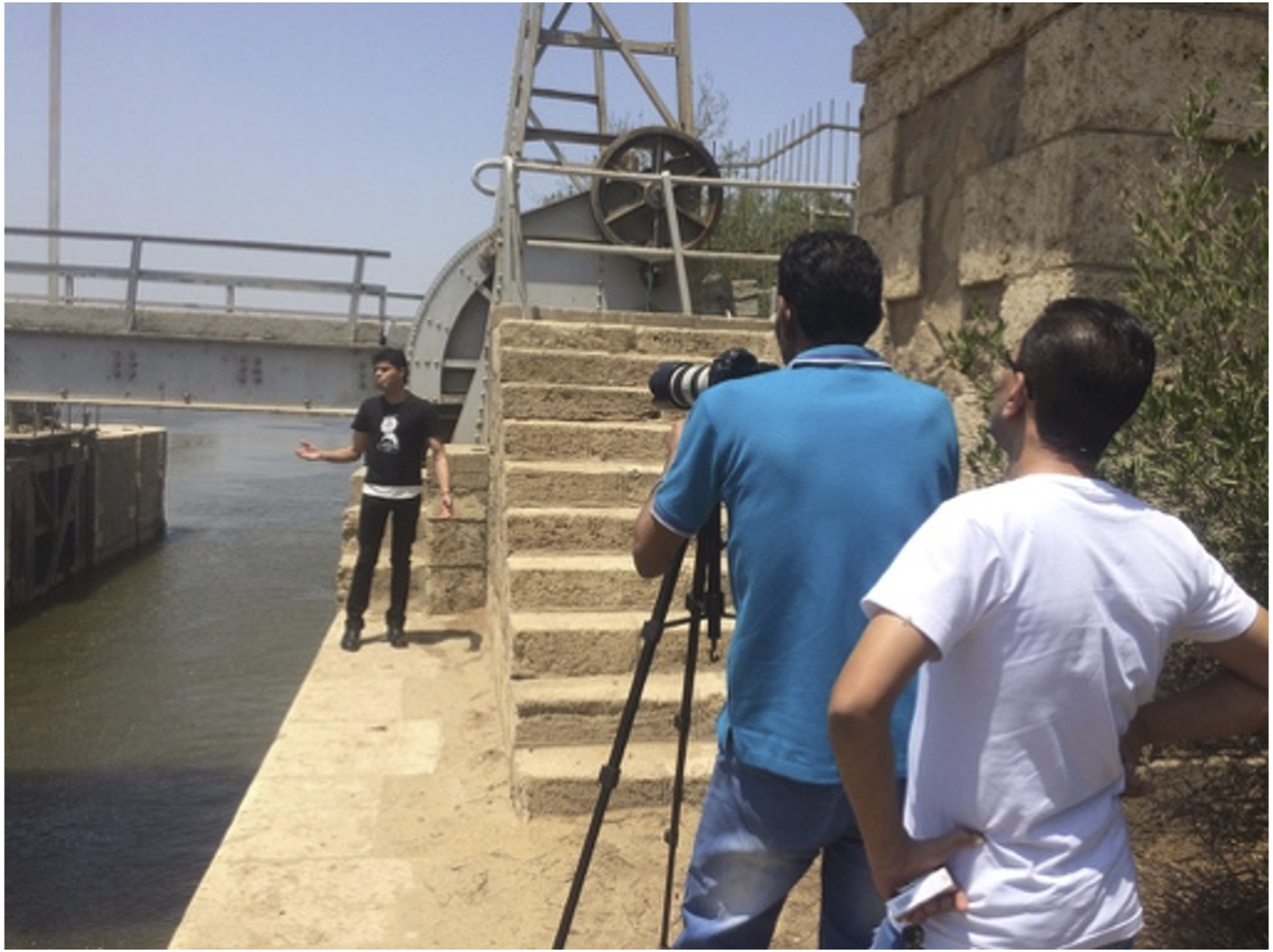
This contrasts with the way that clean shaʿbi singer Hamada Magdy self-consciously incorporated visual markers of ‘street life’ and shaʿbi neighbourhoods in his videos. The presence of hired actors and actresses, as well as plentiful costume changes for the singer and the actors, were understood by Elprins as being markers of quality and representative of being high class. While the cultural brokers in the previous section worked within existing media structures, the founders of Shaʿbiyyat have established new ones. In doing so, they can be understood as redistributing the boundaries between high and low culture, and remapping the kind of content that is deemed suitable for a particular medium.
Singers’ trust in Shaʿbiyyat, and the brothers’ ability to redistribute the sensible as described above, is premised on Walid and el-Gindi’s intermediary and mediating class position. In this sense, they are akin to Bourdieu’s taste-making ‘cultural intermediaries’ (1986: 363; see also Negus, 2002). Bourdieu suggests that these intermediaries mediate between producers and consumers, providing symbolic goods and services, and constructing value through legitimating certain cultural forms. The work these cultural intermediaries do is characterised by their frequent blurring of existing divisions—for example between cultural forms deemed high and low, and between personal taste and professional judgement (Negus, 2002: 503). This is certainly the case with the Shaʿbiyyat brothers. On the one hand, the brothers highlight their roots in a working-class neighbourhood and their knowledge of shaʿbi music’s street culture as having been key to their success; on the other hand, they now have an office in an upscale area of Cairo, and clearly had considerable financial capital in the first place to enable them to establish the business. Singers see the brothers’ perceived upwardly mobile trajectory as evidence of their success in traversing social strata and cultural worlds, and trust in their methods of cleaning up shaʿbi and asserting its legitimacy.
Gavin Steingo observes a comparable situation in his ethnography of South African kwaito music. Kwaito, like shaʿbi, is associated with socially and economically marginalised parts of the city. He argues that members of the black middle class, a social group known as ‘black diamonds’ (2016: 161), create the institutional and organisational networks through which commercial kwaito is produced and able to circulate. They conceive of the marginalised townships as home, but have mostly moved away and are now able to ‘shift effortlessly between township and suburb and between various social strata’ (ibid.). This mobility and connectedness enables these black diamonds to play a key role in producing ‘musical commodities that then circulate between various social strata’ (2016: 184) in a similar way that Walid and al-Gindi do through Shaʿbiyyat. As I have done, Steingo also finds Rancière’s work useful for understanding this process, contending that kwaito participates in Rancière’s ‘distribution of the sensible’: Steingo argues that ‘kwaito traverses—or has a transversal relationship with—social and economic inequality. Because of this, kwaito at once links groups of people and makes explicit the deep division between these groups’ (2016: 162). The same can be said of shaʿbi.
However, while Steingo contends that thanks to the efforts of black diamonds, ‘through sharing an aesthetic experience, kwaito listeners are able to suspend social antagonisms and enter into a virtual community’ (ibid.), the same cannot be said so straightforwardly in the Egyptian context. First, although Shaʿbiyyat has been undeniably successful in helping shaʿbi reach audiences beyond its immediate live performance contexts, we cannot conclude from this that the ‘aesthetic experience’ is shared by all listeners. Although shaʿbi musicians considered Shaʿbiyyat videoclips ‘decent,’ not everyone did. When I showed Radwa from the introductory vignette Ahmed Elprins’s clip, she scoffed, and disagreed that this was decent shaʿbi. She saw it as low quality, with an unoriginal plot and corny graphics: typical of what she might expect of a shaʿbi production company, and nothing like the real clean shaʿbi of singers like Hakim. Also, by only screening shaʿbi videoclips, Shaʿbiyyat arguably ghettoises the style, reinforcing genre boundaries and as she saw it, precluding the featured videoclips from definitively crossing over into legitimate territory.
Finally, just because the Shaʿbiyyat and Sobky brothers emphasise their roots in working-class shaʿbi neighbourhoods—that is, they position themselves as partial ‘insiders’ to the shaʿbi scene, unlike the mediators in the first part of the article—this does not mean that their relations with singers are automatically more equitable. Both sets of brothers are motivated to invest in and clean up shaʿbi videoclips for commercial reasons. The Sobky brothers capitalise on shaʿbi singers’ existing success, repackaging them in order to appeal to as wide an audience as possible and drive ticket sales for their films, while the Shaʿbiyyat brothers are clear that their primary goal is to make the business profitable. The Sobkys famously pay singers very little to appear in films. Several interlocutors told me that Ahmad Sheba was paid just 200 Egyptian pounds (£10) to record his hit song “Ah Laww Laʿibt Ya Zahr,” and the Sobkys require singers to sign away their rights to their songs, meaning that Sheba does not receive any royalties for the millions of YouTube views and television screenings his song has garnered; all profits go to the film company.
When I asked Sheba about this he expressed no misgivings: the boost his Sobky stardom gave him means he is hired at more weddings and nightclubs and can charge a vast amount more than he used to, thus garnering him entry into decidedly more elite spaces. So although my interlocutors tended to understand Sobky films as having improved shaʿbi’s reputation by pushing it towards new more upmarket venues and audiences thanks to its glossy look and sound, it must also be understood as reinforcing inequalities, as the film makers exploit singers in the pursuit of profit. El Khachab (2019: 44–45) has likewise drawn attention to the Sobkys’ exploitative labour practices amongst film workers, such as cheating them out of payments and demanding they work overtime, to make a pertinent point: that struggles over ‘the popular’ play out over multiple terrains and in seemingly contradictory ways.
Similarly, while the Shaʿbiyyat brothers promise singers a shot at fame through their videoclip production and distribution service, this comes at great personal expense. Singers pay to record the clip and must then pay again to have the clip feature on the channel. I knew singers who practically bankrupted themselves to record a clip, but then could never scrape together enough to actually have it screened. Also, as with Sobky videoclips, singers who use this videoclip production service do not keep the rights to their song: Shaʿbiyyat owns the song. This means that if it is successful and garners views on their YouTube channel, the company Shaʿbiyyat profits financially, not the singer. I asked Walid about the issue, and he was nonchalant. ‘Yes, usage rights (haqq al-intifaʿ). That’s the way it is in shaʿbi: we have the rights, but singers benefit in other ways. We make them widespread and well-known, so they can work in 10 places a night instead of one; so they can charge thousands of pounds at weddings instead of hundreds.’ In this sense, divisions based on economic positions are reinforced, not crossed: shaʿbi singers, already marginalised within the industry, find themselves exploited further. But while artists in comparable situations—for example hip-hop artists in the US exploited by major record labels—have been left ‘broke, destitute and bitter’ (Keyes, 2002: 121), shaʿbi artists expressed no unease, instead grateful for the chance to enter the commercial mainstream.
Conclusion
The various attempts to clean up and disseminate shaʿbi music discussed in this chapter complicate common definitions of shaʿbi as simply a low-brow music of the lower classes, existing in implicit opposition to state-sanctioned high-brow culture. These private-sector cultural producers have each been involved in cleaning up shaʿbi in distinctive ways for commercial and aesthetic reasons, and in doing so have reshaped the contours of what is considered ‘high’ or ‘low,’ and what kind of music is deemed acceptable in particular social spaces. This process, whereby a popular cultural form associated with the working classes is ‘cleaned up’ for wider audiences deemed elite, is not unique to Egypt. Acknowledging the multiple levels upon which these struggles are played out in the case of shaʿbi can offer a model for understanding other such situations, highlighting how music mediates difference, and is often centre stage in broader struggles over how categories of and boundaries between ‘the people’ and ‘the elite’ are made and remade.
I have suggested that the flourishing of clean shaʿbi across social divides does not reveal a straightforward crossing of class boundaries. Nor does it reveal a straightforward appropriation of shaʿbi tropes. Focusing on the way that new sounds, or old sounds laden with prior associations are refreshed and heard anew, I have argued that these cultural brokers contribute to establishing a new common sense of what is sayable and what is visible. The process of cleaning up shaʿbi has been a longstanding project, but it is no coincidence that the above examples each began to pick up steam in the years immediately following the 2011 revolution, at a time when the atmosphere was ripe for new configurations of class-cultural positions and high/low divides. Walid, for example, cited the 2011 revolution as the primary impetus for establishing Shaʿbiyyat. He suggested that after the revolution there was a ‘refresh’ of music and society in general, and he heard a renewed and broader desire amongst the public to listen to shaʿbi music.
With this in mind, I want to conclude by briefly returning to Rancière and his discussion of the relationship between aesthetics and politics. He proposes three possibilities for understanding the relationship between art and everyday life, each of which yields a different configuration of the aesthetic: ‘Art can become life. Life can become art. And art and life can exchange their properties’ (Rancière, 2013: 119). It is interesting to consider these possibilities in relation to those involved in cleaning up shaʿbi. The first configuration, art becoming life, can be seen in state-driven efforts to clean up shaʿbi, for example its founding of Shaʿbi FM radio station in 2014, which only features older, more traditional shaʿbi with no uncouth lyrics. Or at least the state hopes that with the high-culture agenda they promote ‘art will become life.’ Meanwhile, aspiring singers like Ahmed Elprins tend to dream that life will become art, as per the second configuration. In reality, though, aside from the lucky few like Hakim, this rarely pans out.
Finally, the third configuration, and the one that I argue is the one most evident throughout this chapter: art and life can exchange their properties. By this, I mean to highlight the productive tension that exists between high-culture aspirations and everyday music production. Or as Rancière puts it: ‘the works of the past can be considered as forms for new contents or raw materials for new formations. They can be re-viewed, re-framed, re-read, re-made’ (Rancière, 2013: 125). Conceptions of high and low are constantly being redefined, and aesthetic experience cuts across and reshapes social divides. This is not just a case of people carving out different spaces by listening to different music, but rather how political reality is perceived differently when people stake a claim to a certain space, proposing new ways of being and relating. The spaces being carved out through these struggles are not as defined as the spaces carved out, for example, when revolutionaries in 2011 took to the streets, and the shift in perceptions of political reality not so clearcut. Nor are the resulting spaces necessarily more equitable: in some respects, pre-existing boundaries are reinforced. But attending to how these processes play out shows how divisions between ‘elite’ and ‘popular’ are constantly being negotiated, and it is through struggles like the ones I describe that new class-cultural positions are instantiated and boundary lines redrawn.
Footnotes
Acknowledgements
Many thanks to my interlocutors in Cairo. Thanks also to Walter Armbrust, Zuzanna Olszewska, Chihab El Khachab, Pablo Infante Amate, and Helena Kaznowska for their comments on earlier drafts, as well as the journal editor and two anonymous reviewers.
Declaration of conflicting interests
The author(s) declared no potential conflicts of interest with respect to the research, authorship, and/or publication of this article.
Funding
The author(s) disclosed receipt of the following financial support for the research, authorship, and/or publication of this article: This research was supported by the ESRC under Grant number ES/J500112/1; a British Forum for Ethnomusicology Fieldwork Grant; and a Postdoctoral Fellowship at the Centre d’Études et de Documentation Économiques, Juridiques et Sociales, Cairo.
