




Abstract
Energy-ethnographies of ‘closed’ workplaces detail practices for achieving robust, authentic research. However, few publications highlight -experientially- benefits of developing connections; learning specifics of environments, peoples and customs prior to beginning ethnography proper. Developing knowledge is (a) necessary for organisational locales, to achieve accurate, thorough and representative accounts of peoples, places, and cultures; and (b) grants the researcher ‘insider status’; enhancing depth, quality, authenticity and knowledge. Observations are deconstructed in the context of my past doctoral studies, where an ‘enhanced’ dual ‘embedded-actualised’ ethnography was used to examine linkages between oilmen, masculinities, and safety and risk practices onboard a remote UK North Sea offshore oil-gas drilling platform, with initial research conducted first in an ‘onshore’ site of labour. This ‘dual’ approach facilitated legitimacy, trust, rapport and acceptance, resulting in unique oilfield access, in-depth and novel findings uncommon of similar-topic research. A pathway for scholars to utilise methodological learnings vis-à-vis ‘embeddedness’ is presented.
Introduction
Study of high-risk ‘closed’ workplaces 1 poses a quandary for ethnographers. Locales are often suggested as sources of rich knowledge for developing understandings about social interactions in unique labour contexts (Austin, 2006; Crewe and Ievins, 2015; Miller, 2002). However, such workplaces are notoriously difficult to gain access to. Researchers sometimes achieve only partial or short-term study of locations. Lack of access can also result in adoption of distanced research methodologies. Neither approach allows for an authentic tapestry of knowledge to be developed. Thus, ‘closed’ workplaces and their associated social and cultural dynamics remain under-researched.
This paper details the challenges of ethnographically studying oilmen as they laboured in UK offshore oilfield drilling operations. I use the term oilmen to describe the all-male drilling crews. As of 2021, nearly 97% of regular UK rotational drilling workers are male (OGUK, 2021). I first describe the offshore research location and social difficulties of study. Then follows a methodological breakdown of my ‘embedded-actualised’ ethnographic approach designed to contend with difficulties. I then take the reader through several reflective vignettes from my time in the oilfield, constructed from photographs, field notes and interview extracts; reflecting on methodological positives and challenges. Benefits of the researcher accessing and conducting ethnography in a first, initial locale other than the primary site of research is discussed, highlighting the importance of this at building connections, legitimacy and acceptance to their presence as a participant-observer in the later site of study proper. Notions of transference between sites are discussed, as is researcher conduct in the worksite operating as a barrier and facilitator to developing ‘inside status’. How the above method may be utilised by ethnographers for future study of similarly high-risk and difficult-to-access energy-production workplaces is presented.
The offshore oilfield
Energy-producing sites of labour are an increasing area of interest (Al-Saleh, 2022; Austin, 2006; Austin et al., 2006; Espig and De Rijke, 2018; Faulkner, 2009). Many of these locations conform to the descriptor of high-risk ‘closed’ workplaces. This is the case for the UK North Sea Oilfields. Few existing studies have developed in-depth ethnography of offshore oilfields. Notable works that do this, include Collinson’s fascinating study of oilmen’s workplace performances in 1990 following the introduction of new surveillance safety mandates (Collinson, 1999), and Ely and Meyerson’s (2010) engaging study of ‘undoing gender’ within two oilfield locales. As with offshore oilfields, a small number of studies focus also on onshore oilfield locations (see Filteau, 2014, 2015; Perry, 2013).
Despite a small pocket of scholarship, a knowledge gap exists for recent ethnographies of oilfield environments. Of the limited number of onshore and offshore oilfield studies – and studies exploring comparably high-risk environments, some efforts see researchers spend little direct ‘embedded’ and sustained time in worksites; often visiting locations for a day or two before returning to land. Additionally, some studies emphasise interviews with managers and supervisors and do not demonstrate researchers venturing into ‘high-risk’ areas of workplaces to interview active drilling-crews, and associated workers conducting heavy labour in the industrial location proper.
Perspectives no doubt influence outcomes, but limitations are also understandable: offshore oilfields are functionally difficult locations to access. Travelling offshore and studying active worksites requires lengthy training, long helicopter flights over large expanses of sea; often in poor weather, and researchers must convince majority owners of a drilling asset to allow their presence; forfeiting accommodation space and allocating resources for duration of stay. If researchers gain access, they then face issues of convincing workers to speak with them. Drilling installations have their own unique cultures, norms and rules. Typically, crews work together conducting difficult labour, in close quarters for lengthy periods of time. Often, crews remain together without change for years. Thus, there exist social barriers to accepting new workers - never mind immediately accepting an unknown researcher asking oilmen to talk about topics relating to personal understandings, beliefs, and sense-making. Gaining trust, developing rapport, and facilitating legitimate and open discussions is a topic somewhat minimised in current oilfield research. However, in beginning my own ethnographic journey, researcher distrust and potential for oilmen to not wish to speak to ‘an outsider’ were salient considerations from the earliest stage of planning. This is a key topic that warrants further examination.
In tandem with the above observations, one of the most notable gaps within existing studies is the absence of discussion surrounding benefits of embedding in a related, linked and easier-to-access workplace prior to attempting ethnography of the ‘closed’ workplace proper. While prework is -at times- present in ethnographic journeys, this differs substantially from the methods outlined in this work and links more to ethnographies in non-industrial and less ‘high-risk’ locales than energy-producing sites of labour (Brown-Grant, 2022; Meyer et al., 2016; Rea-Holloway and Hagelman, 2020). Further, pre-work is described recurrently in ethnographic studies as being a much less ‘hands-on’ pre-stage to ethnographic research; theoretical and research-led, involving reading, reviewing and assessing policy and literatures. This is opposed to methods more akin to the ethnographic phase of research.
Some research introduces studies detailing ‘rapid’ or ‘brief’ ethnographies that extrapolate complex inferences surrounding people and places. However, it could be expected some of the limitations above: researcher distrust, access, sampling, and time in locale, could be mitigated by conducting a prior embedding ethnographic phase locating the researcher in a comparable ‘first-step’ research location other the primary site of study. This ‘enhances’ connections to people and places, awareness of cultural norms, traditions, local values and expectations, customs and behaviours, allowing these to transfer to the primary site of labour. The hypothesis is that this practice deepens and enhances trust, openness, transparency, familiarity and the willingness of participants to speak with the researcher, in ways they would not do in a ‘cold’ ethnographic research approach to the primary site of study.
Alongside above points, a significant corpus of research upholds a binary position of the ethnographic researcher as ‘an outsider’ (Agar, 1986, 1996; Ahmed, 2000; Lofland, 1995; Walsh, 1998). This is the position some studies of oilfields and similar ‘closed’ locales largely adopt. However, many scholars now recognise contemporary, ethnographic approaches rarely see researchers maintain this ‘distanced separation’ at 100%. More realistically, researchers straddle outsider/insider positions (Crewe and Ievins, 2015; Lewis and Russell, 2011). This is true of modern ethnographies in enclosed institutions and tight-knit communities, where researchers and subjects are brought together into proximity (Reiter-Theil, 2004). Relatedly, scholars now suggest gaining acceptance from participants is crucial to representative ethnographies (Lewis and Russell, 2011). Saliently, Reiter-Theil, (2004) discuss how ethnographers may strive to achieve “some kind” of team member status (p. 23) to enhance acceptance from participants and improve the quality of access and data. However, they also acknowledge the vagueness of this position, suggesting the term “some kind” due to structural limitations of participation that vary per workplace.
The remainder of this publication actively factors above considerations, outlining my own methodological approach to conducting an ethnography in the offshore oilfield; dealing with problems arising and how appropriate groundwork and research design overcame these.
Research context: Point Delta
In beginning my ethnographic journey, I decided to make the UKCS (UK Continental Shelf) oilfields my primary site for studying oilmen’s masculinities. While sparse research has explored onshore and offshore energy-production sites, very few studies exist focussing on UKCS locales – only one of which is ethnographic and the data for this is currently over thirty-years-old (Collinson, 1999). Further, UKCS drilling platforms represent distanced, male-dominated, remote workplaces. The specifics of these total institutions provide enclosed and ideal space for examining men and masculinities at work – providing access, proximity to labour and stay at site can be secured. Oilfield platform labour continues twenty-four-seven, 365 days a year. Work is structured into two temporal teams; day shift, and night shift. Shifts last twelve hours followed by change-overs. Thus, opportunities for intense ‘rapid’ ethnographic study are significant. Also, studies position energy-producing labour sites as locations of both hegemonic masculinity
2
and sites of transformational masculinities (Diffee, 2012; Filteau, 2014, 2015; Miller, 2002). Unique observations are owing -partly- to oilfields representing spaces distanced from norms of wider society. Scholarly notions exist alongside a history of stereotyping of UKCS oilfield work (and male oil workers) as ‘masculine’ or ‘hypermasculine’ - linking narrow gender-descriptors with near-exclusively negative media connotations. The prevalence of male workers and the oilfield’s long tradition of requiring labour demanding tough bodies for hard, physically-demanding (and often dangerous) work, marked the oilfield as a rich and relevant setting for ethnography. Danger and risk aspects were validated by oilmen in this study, however it must be made explicit that findings resisted any hegemonic identity descriptors, indicating instead new forms of multiple cultural masculinities (see Adams, 2019, 2022). Such discussions also included references to lengthy helicopter travel over sea to the platform. One worker commented on risk and danger: “You’ve got twenty to thirty metre seas battering the rig and it’s moving around. You’re not allowed outside because the wind is that bad: 100 miles-per-hour, and you’re just a little speck on this tiny oil rig in the middle of the far North Sea. I mean this rig, the helicopter, the weather, it’s risky! There is a risk in doing that. The H175 [the designation for the model of helicopter] is not comfortable. It’s light, noisy, cold and cramped. You know now! It’s not a nice experience. As for feeling uncomfortable about being here!! Anyone who says that they like it out in this place…no way!”
Several oilmen validated the physical labour and locational aspects of drilling being “high risk” and “dangerous”. One oilman commented: “[…] unease is always there, it’s just around the corner all of the time. […] you’re on a platform, you’re on a sitting time bomb…if everything lets loose here it doesn’t matter what job you’re doing, you’re sitting on a pressure cooker. You’ve got gas lines, oil lines, and then we’re drilling holes with fucking thousands of feet of pressure that’s wanting to come back at you, but it’s all managed and all risk-assessed. You’ve got to focus on that, get on with the job”
Another commented: “It’s just so risky here. Well, we’re staying on a bomb…it could blow up…there’s always that. But then you could crash your car, get run down by a bus, so you just get on with it. It is risky, yes, of course it is. It’s a harsh environment…the weather…what we’re sitting on, where we sleep at nights, in amongst all the production equipment, all the combustibles. It is very risky…but…life is risky when you think about it. You just don’t think about it, you put it out of your mind. It’s my second home”
My primary site of study was the Point Delta (PD) oilfield platform (a pseudonym
3
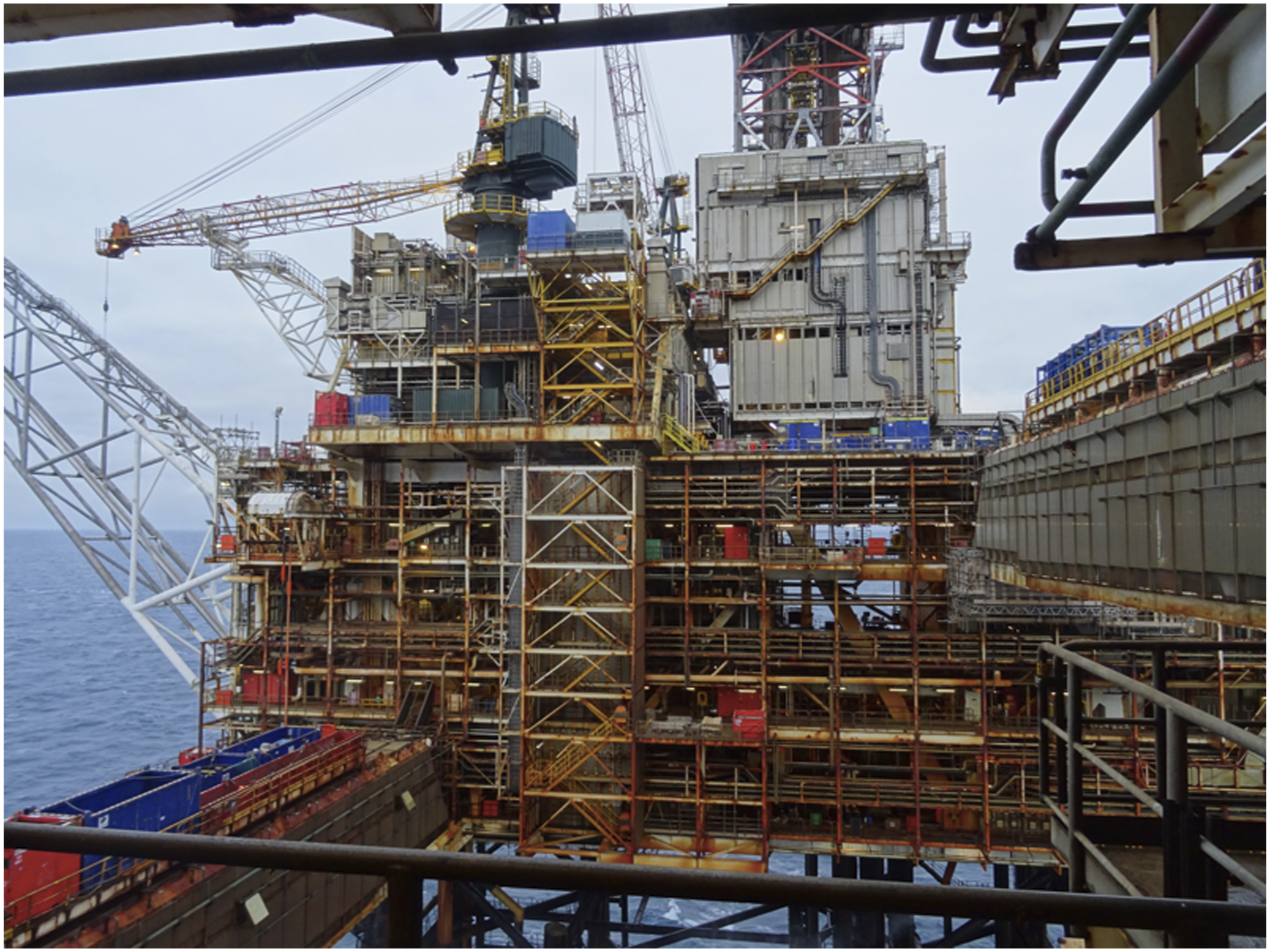
). PD is in the mid-deeper waters of the far UK North Sea. This location is one of the most inhospitable and isolated maritime positions possible. An hour of helicopter travel, often in high winds and low visibility over sea is a requirement of access. PD is a large; aging structure designed and built in the early 1980s. Between fifty-five and 170 workers crew the platform. The primary purpose of the installation is drilling for oil and gas. PD comprises of two ‘jackets’: resembling two platforms (or ‘packages’) joined by bridges. One site contends with drilling, and the other hydrocarbon production and processing. Figures 1 and 2 below depict the two halves of PD. Point Delta, the production package. Note: photograph taken by myself (care has been taken to crop-out any potentially identifying imagery). Point Delta, the drilling package. Note: photograph taken by myself (care has been taken to cropout any potentially identifying imagery).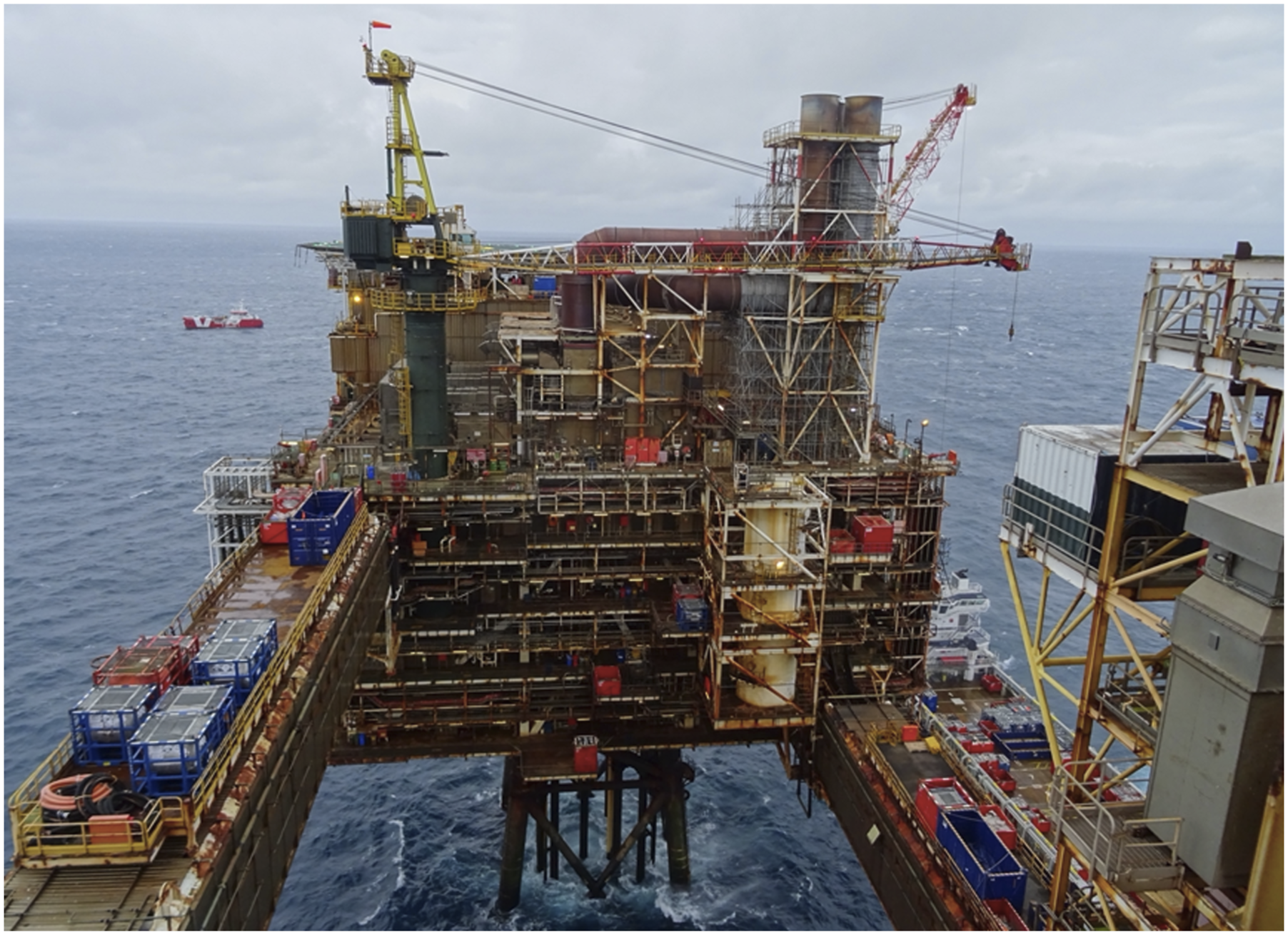
Social difficulties of conducting an ethnography of drilling crews and Point Delta
Despite the theoretical appropriateness of conducting ethnography on PD, several points of difficulty were immediately salient when selecting this location.
The first of these points relates back to earlier mentioned considerations of conducting an appropriate and fitting ethnography that does justice to studying the complex subject of men and their institutional masculinities in the oilfield; the participants and their lived experience. Oilmen work daily twelve-hour shifts offshore: a 2 week ‘trip’ or ‘rotation’ followed by two (or three in some cases) weeks break at home. Some ethnographic studies that see researchers visit oilfields and ‘closed’ workspaces, capture ‘snapshots’ of this time via short oilfield/workplace visits and interactions that largely avoid direct lengthy embedding within crews and worksite. I felt that if this ‘snapshot’ perspective was followed, it would be difficult to build an authentic picture of unfolding oilfield interactions and ‘life’ offshore as this played out over time. For example, oilmen beginning their 2-week shifts may have different attitudes, values, and understandings at one temporal point of work versus another. A ‘snapshot’ approach negates ability to capture changing attitudes and values as shift work and time offshore continues, and limits potential for detection of ‘natural’ displays of workplace behaviours that scale only with time spent offshore.
A second important point considered when designing ethnography was that I wanted to be as close to the ‘action’ offshore as possible. That is: I wanted to be able to embed with offshore oilfield crews as they actively worked in operations: drilling a new well, and interview workers engaged in heavy labour on the drilling floor. I felt that this was the only way to develop an authentic picture of relationships between specific aspects of oilfield labour, and oilmen’s understandings of their masculinities. Specifically: how identities change and shift over time, how masculinities are formed and challenged, and what shifts mean for the future of oilfield work and identity. Few existing studies actively explore the topic of masculinities in conversation when engaging with oilfield workers. For some scholarship, the phrasing ‘masculinity’ or what this means to oilmen is actively avoided, and instead, inferences vis-à-vis identities are latterly constructed by the researcher using the data they have collected offshore. However, I wanted to avoid this distancing, instead, focussing on a research design that actively sought to ask oilmen directly about their associations between energy-production labour, masculinities and behaviours and identity, and linkages to oilfield labour and norms.
The third consideration I had when designing ethnography, was the potential for oil workers not to trust a researcher. Many existing ‘closed’ workplace studies do not discuss this, nor deconstruct researcher positionality in the process of gaining access to site or workers. Studies seem to assume a de facto trust of the researcher by participants. Converse to this position, I did not assume this. Of the numerous preparatory work that I undertook designing the research study, my informal preliminary discussions with active oilfield workers highlighted that acceptance is rarely immediate offshore, and significant work is required to achieve this.
My fourth and final consideration related to the spread of workers I wanted to interview offshore. While some scholarship prioritises management; senior workers (perhaps for the above limiting reasons of trust and access), I wanted instead to study all the drilling crews that rotated through PD, and interview and observe a range of workers from different levels of the organisational hierarchy; operating in different roles, with different seniority and experience offshore.
Method: Embedded-actualised ethnography
I negotiated access to PD by approaching a major UK drilling organisation: DrillMech (a pseudonym). I wrote to this organisation explaining I wished to study men and masculinities, safety and risk in a ‘real’ drilling environment.
During access negotiations, I reiterated my stipulations. Firstly, I wanted to be located physically on the platform, for about the same, two-week equivalent rotation as all oilmen. This was achieved. I completed two trips to the oilfields; one lasting eight days, the other seven days. Secondly, I wanted to have access to direct discussions, observations, and interviews with oilmen as they engaged in high-risk drilling labour, and I wished to speak openly with oilmen about their masculinities. Thirdly, I wanted to get to know oilmen, build trust and rapport and gain the ‘inside’ perspective on life offshore to develop an authentic ethnography of the oilfield. Fourthly and finally, I wanted to experience oilfield life as closely and authentically as possible, to enhance understanding of how identities are formed, change, are challenged, and what transitions mean for different oilmen in different roles. Initially, my intentions were considered “an unprecedented” level of access for someone not actively engaged and employed in oilfield drilling. However, after many meetings, emails, presentations, and time spent at DrillMech’s head office, growing interest at DrillMech soon saw me developing a methodology strategy plan and involving several rig managers, seasoned oilmen, and senior management (in the execution phase), to locate me offshore. Following this stage, I began training for offshore. I was assigned a ‘handler’, who was the Rig Manager for PD.
The methodology I employed to address the above points is best presented as an embedded-actualised ethnography: an ethnography of two inseparable halves. The two halves of ethnography refer -firstly- to a groundwork yet also full-ethnographic phase. For my research, this represented an embedded ethnographic phase where I spent much time over the course of a year at the DrillMech head office learning about, training, and preparing for life offshore, and interviewing and observing oilfield workers in office contexts. This phase was invaluable in allowing me to later conduct a successful study of the offshore PD drilling platform and oilmen labouring at this site. I refer to this later ethnographic time where I was physically located on PD as the actualised component of embedded ethnography; a second -main- component of site-based study, with a depth of research facilitated by the first embedded component.
This method differs from common ethnographic ‘pre-work’ and institutional ethnography methods (Smith, 2009). The researcher first begins ethnography in the more ‘accessible’ locale of an organisation, utilising this position to undertake necessary training, build rapport, knowledge, connections, and becoming ‘known’; developing basis, background and embedded skills for which to negotiate and successfully research the ‘main’ site of study. Indeed, for the PD platform this first embedded portion of ethnography was critical -necessary- to proceed to the ‘next level’ of actualised oilfield research; studying oilmen and masculinities in the ‘real’ locale of offshore labour, the focus of this research. Thus, this process differs from any ‘pre-work’ ethnographers may undertake using established methods, allowing for relationships between onshore and offshore components of study to ne networked and drawn together, travelling between the two sites of research, in tandem with the human-connections made in the onshore environment facilitating ‘enhanced access’ in the oilfield. The interlinking of each component of ethnography allows for a process of data triangulation; facilitating critical understandings for probing deeper questioning and discussions once arrived in the offshore site of study. Overall, this methodology allowed interconnections between history, changing norms and the unique aspects of offshore labour linked to identity to be highlighted, analysed and clearly documented.
The following sections detail the methodology I utilised to address the above points and how this was executed in practice.
Onshore - a prior ‘embedded’ ethnography: ‘DrillMech HQ’ and ‘doing the groundwork’
Step one to realising my proposed ethnographic plan was to approach a solution to travel to PD, and remain on the platform for the same amount of time as the regular drilling crew. To do this, it was quickly decided that I would have to complete the offshore training and certifications to travel offshore. These are the same certifications drill-crew complete. While training was initially a point of concern for DrillMech from the perspectives of insurance and risk-exposure, obstacles were overcome through discussions. Like myself, DrillMech management recognised that to conduct appropriate research, I had to be “at the coal-face” of offshore operations. However, this was not achieved immediately.
When first visiting the DrillMech head office, I set myself a goal of collecting offshore data in the second year of research, allowing me a period of one year to ‘get to know’ the research locations, the peoples and the practices before setting foot in the site of ethnography. For this first year, I regularly spent time at the DrillMech head office. I asked to be allocated a desk within one of the safety teams. Then, I worked on my PhD literature review materials, and conducted a formal Document Analysis of DrillMech offshore safety policies. In doing this, I began -through proximity- to get to know workers who travelled offshore to PD, and began to engage them in discussions regarding my planned research; what I hoped to study and how I was going about doing this. I asked these workers for their advice on getting offshore oilmen to speak openly with me, to share their own experiences, and about their thoughts regarding masculinities in the oilfield. Much of this information I noted down in an onshore field journal.
During this time, I was also introduced to James (a pseudonym): one of the rig managers of PD. James proved to be essential in arranging access and offshore training for me. Training consisted of several sets of classroom exams, coupled with 2 weeks of intense practical drills. The main qualifications are termed MIST and BOISET. MIST refers to Minimum Industry Safety Training. BOISET refer to Basic Offshore Safety Induction and Emergency Training. Training included helicopter escape simulations conducted in a warehouse, where a helicopter passenger section is dropped into a cold, deep-water pool and rotated upside down. Candidates must escape wearing and utilising a variety of equipment, including underwater rebreathers and survival suits. Practical fire-fighting, life-raft assembly, flotation, climbing - and a variety of technical platform escape and water-survival training was also taught. Participating in a manned life-boat launch at an inner-city harbour was another practical requirement. I received a pass for all course components, and was awarded my offshore Vantage passport. A Vantage passport functions like a regular electronic passport, but presents as a series of ID cards with photograph and biometric data. A Vantage passport is specifically designed for and allows offshore oilfield travel to only the Vantage passport holder.
Training was invaluable from the perspective of the formal access to site it allowed, but - it was also essential from an informal perspective. Training ushered me into the ‘oil world’. Upon completing training, I had a strong awareness of PD and offshore in general: tasks, drilling process, safety concerns, and inherent dangers oilmen face when they travel and engage in oilfield work. I had also now spent lengthy ‘close quarters’ time training alongside seasoned oilmen undergoing refresher training (oilfield certifications must be renewed at the five-year mark from initial certification). These workers had inducted me into the practical norms and customs of the oilfield: the conduct, had taught me some key “do’s and don’ts”, and told me to “look them up” if they were on the platform during my visits. I had begun to become known to oilmen.
As my presence at DrillMech became commonplace, I began asking onshore oilmen (and one oilwoman) if I could interview them about topics of my research and proposed plans to visit PD. I conducted seven formal interviews onshore with workers involved in policy-making who actively worked some of their time offshore. Interviews each lasted at least an hour, some vastly exceeding this and taking place over two (or three) parts at different times. Additionally, numerous informal conversations over lunch, coffee, meetings and during office time were conducted. Informal topics of discussion included subjects such as the changing nature of masculinities and labour offshore, where I should locate within the platform to get the ‘real offshore story’, how should I conduct myself on the platform to best set oilmen at ease over my research intentions and encourage them to speak openly with me, and what resistance and ‘banter’ in the work environment I could expect as a researcher; an unseasoned ‘oilman’ travelling to PD. Advice from workers included “just be yourself” and “don’t try and be something you’re not: be honest”. All of which resonated with me. Additionally, I was given tips such as to be mindful of the closed location of the platform and that everyone is working long hours in a rapidly changeable, confined environment: the implication being not to ‘bother’ oilmen to talk if they seemed too busy, but to arrange meetings with workers, days in advance, upon first arriving. This point further highlighted the need for a ‘lengthy’ embedding on PD. Other staff offered different advice, such as how to react to “piss taking” and “banter” of the oilfield, including to remember: “If they take the piss out of you, it means they like you [they are including you in their ‘banter’]”. At other times, I was encouraged to try and experience all aspects of the oilfield, and “get stuck in” to visiting the different workspaces offshore and observing different varieties of platform work (i.e. drilling, production, maintenance, supply). Other advice concerned the importance of ‘getting known’ in the drilling doghouse: the control centre of drilling-floor operations, and the salience offshore of the ‘tea and smoke shacks’ 4 : locations where oilmen congregate for a break during the workday. It was suggested to me that ‘being present’ in these locations as well as maintaining proximity to sites of labour, would allow me to arrange interviews and to come to know workers more informally and in depth when offshore.
Onshore advice I received also focussed on navigating acceptance offshore. Onshore workers ordered me the same regulation drill-crew uniform as workers on the platform: a pair of thermal and fire-proof red coveralls with the drilling crew logos embossed on them. This was required, and represented a formal process of ‘inclusion’; the uniform must always be worn in the labour-areas of the platform, removed only within the accommodation block. However, in a parallel -informal- thread of induction, workers advised me to write my first name in black marker on the left-hand pocket of the coveralls prior to going offshore – as is tradition with the drill-crew. They also supplied me with a branded kit bag and some other required items. Finally, some advice suggested that if I was asked to complete or try small ‘token’ tasks by oilmen, I might engage in these, to show willing and effort whilst offshore. The suggestion was that involvement would enhance my reputation as ‘a passenger’ in the oilfield, but a passenger with a genuine interest, and to make clear that I was present on PD to experience all aspects of ‘what it means to be an oilman’. Among collective advice were numerous tips for safety: the regulations of the platform and how to adjust to the day-to-day routine of being offshore.
As time went on at DrillMech, I began to be invited to attend meetings with oilmen, I continued to eat lunch with workers in the local canteen, and got to know in more detail workers involved in onshore operations. I attended various formal industry meetings and informal events, studied offshore policies and plans of the platform, and associated with onshore and returning offshore workers in professional (and occasionally social) contexts. This approach legitimised my later visits to the oilfield. This ‘pre-oilfield immersion’ fostered closeness and trust with onshore workers who had close connections with offshore oilmen. Embedding was crucial for facilitating access and developing trust, learning about the norms and layout of the site of study, and allowing ‘word to spread offshore’ about my hope to secure visits to PD.
After receiving my Vantage passport, the next step in achieving my journey to the oilfield was to arrange a seat on an outgoing helicopter from the local oilfield heliport. This process was a lengthy one. Numerous flights out to PD were arranged and cancelled. The main reason for this was that I was designated a ‘non-essential’ crew member; having no functional reason to be offshore other than for research. Additionally, PD was ‘bed bust’: oilfield slang for requiring more workers on the platform than there is physical space to sleep. Thus, I spent weeks waiting for a spare seat to be allocated in a transport helicopter. Being on ‘standby’ consisted of being ready to leave at a few days’ notice - with all offshore kit and safety gear, clothing, and interview recording equipment packed into pre-weighed bags and ready to go. I was ready to drop everything when the call came in, and journey to the heliport. Eventually, very early one morning, the call came in advising me I had been added to a flight manifest for a few days’ time. I was ready to begin the next step of my ethnography.
Embedded-actualised ethnography: ‘Point Delta’ and doing ‘enhanced ethnography’
The ‘actualised’ and also embedded -offshore- component of ethnography focussed on immersive ethnographic principles. Namely, I interviewed, conversed with, and observed offshore workers in their natural workplace, whilst being as close to and as directly involved with work as possible. Brewer (2000) argues a high-degree of embeddedness facilitates ethnographers to experience and question subtle nuances that interviews alone may miss. Contextual and unarticulated understandings and sense-making related to specific workplace tasks, locations, and occurrences are lost when researcher-embeddedness within the specific location of labour is replaced with office or meeting room settings (Lewis and Russell, 2011; Smith, 2009). Relatedly, Brewer (2000) and Smith (2009) suggest that workplace ‘immersion’ allows for discrepancies between articulated practices in interviews as compared with witnessed behaviours to be revealed, allowing the researcher to re-question subjects and ‘tease out’ the motivations behind observed and discussed intentions and actions.
Whilst offshore I prioritised an interwoven combination of semi-structured interviews with drilling-crew, and observation of different tasks, in different locations. In total, I conducted interviews with thirty-five offshore oilmen from all five of the rotational crews of PD. In additional to many unstructured conversations and note-taking sessions, four formal focus-groups offshore were also conducted with workers from a variety of roles. This was all achieved over two visits to the platform, one lasting 8 days in December 2017 and one lasting 7 days in early 2018. Visit timings allowed me to study all crews at different stages of their offshore work trip, and to shadow both day and night-shift crews, and various crew-changeovers, and facilitated me to be present for different well-drilling activities (i.e. drilling a new well in the December North Sea). Throughout all interviews and observations, the most important aspect of research was to allow workers to speak about their own lived experience. Most interviews ran longer than an hour, some ran much longer than this.
Semi-structured interviews were chosen over unstructured or structured interviewing. Factoring advice I received onshore, unstructured interviews represented too loose an investigatory mode for discussions with oilmen. Also: I felt, given my ‘embedded’ experiences onshore, having no predetermined questions may encourage oilmen to talk on topics unrelated to my research. At the other extreme, rigidly structured interview plans aligned too closely with survey method principles, which I had been warned oilmen were distasteful of. Also: structured interviewing largely negates reactively exploring responses, which is a key benefit of immersive ethnographic fieldwork. Conversely, semi-structured interviews are openly structured, and allow new investigations to be developed ‘on the fly’ or as led by participant dialogue or ongoing locational events and changes. Some scholars suggest interview guides are important for maintaining the semi-structured model of investigation (Brinkmann, 2014). Based on the information I had learned onshore, I developed an interview guide that contained a list of core, open, and thematically-linked questions. Topics could be grouped to move between different themes and questions, yet allowed flexibility in inquiry and ways topics may be approached. Design preserved interview flow and complemented the offshore oilfield environment and investigatory subjects of masculinity, safety and risk.
Observations were a key, auxiliary component of participant interviews. As I was located within the worksite for lengthy periods of time 5 , all time was spent observing and documenting. Observations are an integral component of the ethnographer’s toolkit (Allan, 2006; Gobo and Marciniak, 2011; Lewis and Russell, 2011). However, some researchers position that researcher reflexivity in observations are often downplayed, or absent when ethnographies are reported (Gilmore and Kenny, 2015). Despite this, as others suggest, recording observations allow the connections and intricacies between social actors, locations and local objects to be revealed and interlinked as influences, connecting greater ethnographic detail (Allan, 2006; Brewer, 2000; Lewis and Russell, 2011). Whilst on PD, I gathered much information due to my ongoing offshore oilfield access. Due to my prior training and onshore immersion, I knew the design of the platform, and had complete reign to move around and speak with workers freely. Institutional restrictions imposed by DrillMech were minimal, provided guarantees of anonymity were given, and consent forms signed, workers were free to speak with me on any topics; DrillMech invested in hearing the ‘real story’ relating to my research, for reasons of wellbeing, safety and process improvement. Also, no stipulations were made of my research should an accident or incident occur on the platform, DrillMech accepting my university-linked study rendered data as strictly confidential; property of the researcher, and not bound by industrial clauses or open for requisition for any later investigations. The main institutional agreement was that I would provide DrillMech a summary of my final doctoral research which -of course- anonymised any and all participant details, areas of the worksite and roles and rotations discussed.
Upon arriving on the platform, some workers realised who I was and were accepting of my presence, highlighting they had been told by others that I was coming out and had “saved up” some stories, observations and thoughts to tell me. Further, after speaking with these oilmen, observing work and interviewing them, workers went on to inform their colleagues and encourage them to speak to me. This was in large part because of the novelty of a researcher completing offshore training, gaining knowledge of the platform and observing the customs, rules and norms of the oilfield. A more detailed exploration of this follows in the next section.
Point Delta: reflective vignettes from “Alcatraz”
I now reflect upon my offshore ethnography and the subsequent enhanced knowledge that was made possible using the methods above, by exampling several oilfield vignettes.
Walking the walk, arrival and immersion: developing empathic researcher-participant understandings via ‘first-hand’ experience
I arrived at the heliport for check-in at 0500 on a snowy, below-zero December morning. After lengthy flight briefing; completing my practiced change into survival suit - inclusive of breathing equipment, GPS locator unit, and other equipment - I watched from inside the cramped confides of an H175 transport helicopter as the coastline vanished into cloud. After an hour flying over darkened and thrashing seas, miniscule twinkling lights of a steel skeletal-structure came into view. As we banked -buffered by the winds- upon approach, I made out an “H” octagon illuminated by spheres of white. After circling, the H175 braced downwards onto the helipad. Doors opened to gusts of wind and spray, and heavily suited deck-crew indicated with torches the pathway to the inside of the structure. I was now on PD.
Conditions on PD are cramped, as they are for most oilfield drilling platforms. Workers share cabins between two; sleeping in small bunk beds. Crews alternate between a week of day shift and a week of night shift. The first thing I noticed upon arrival was the feeling of isolation. On any deck, facing any direction, at any given time, sea was all that was visible; stretching out into the distance. (See Figure 3). The view to the north on Point Delta. Note: The structure in right of the photograph is the scaffold of the platform flare, that points North. No other signs of life are visible. Taken by myself.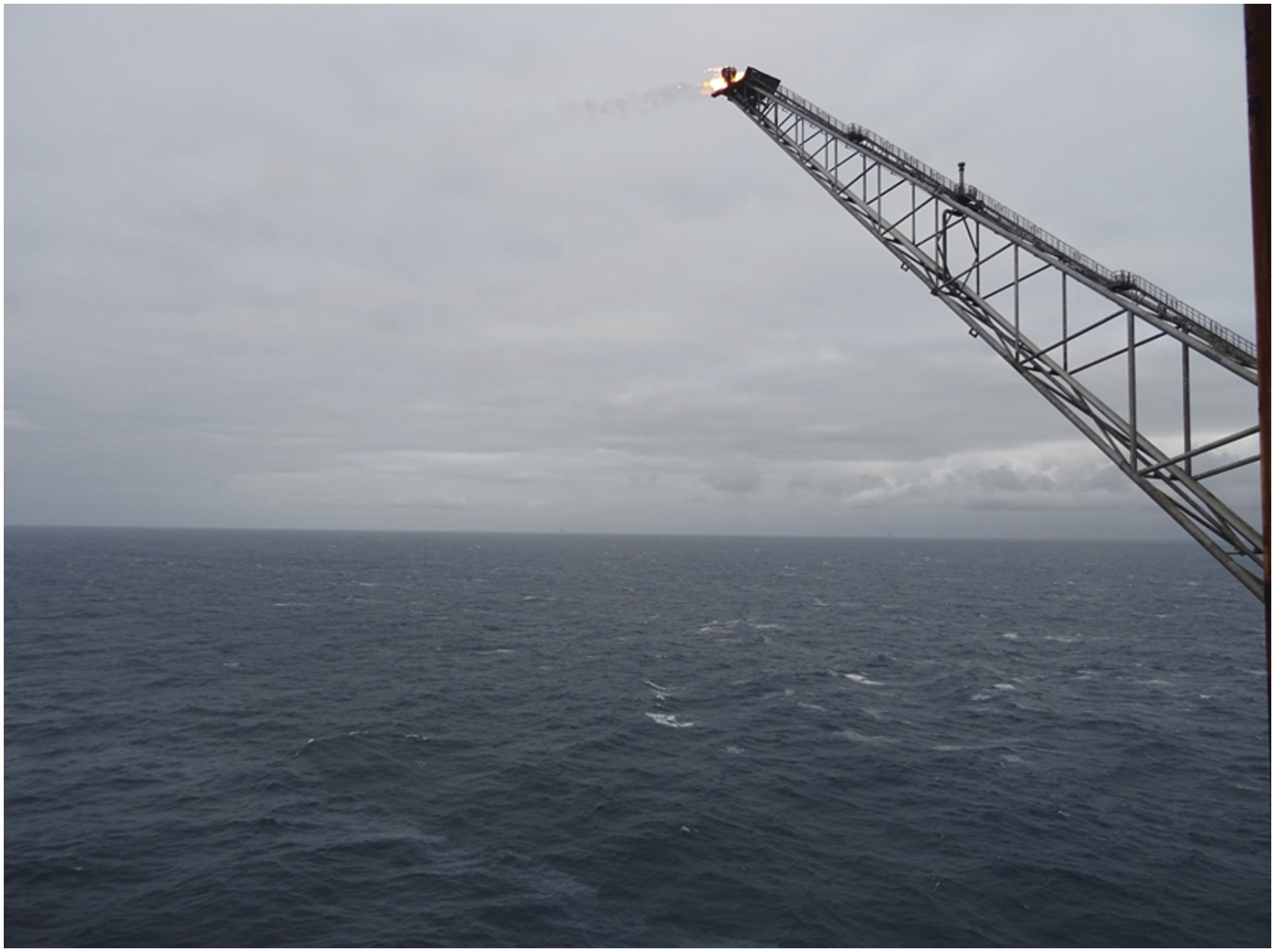
This ‘isolation’ feeling remained with me during my first trip. Referring to a note in my field journal: I recognised and experienced the ‘dread’ oilmen frequently spoke of when arriving offshore; the realisation that they are ‘trapped’ on the ‘prison’ that is PD until their trip comes to an end. Importantly, my ‘lengthy’ location in the environment allowed me to experience this myself and empathise with oilmen when discussing this, promoting deeper conversations on coping with the distancing component of offshore life and how this influenced the performance of (and suppression of) identities in the oilfield. Oilmen often spoke of only living ‘half a life’ - using this term to refer to their dichotomic experience of ‘splitting’ their time between the labour of the PD platform and regular onshore home-life. Workers also discussed the process of decompression upon arriving back home and ‘getting used’ to onshore routine and life again; impacts upon personal relationships, and the returning sensation of ‘dread’ at having to leave their families and come back offshore once their ‘home stay’ was concluded. A driller: Sam (this name and all that follow are pseudonyms) - who I met when he was working in the drilling area of PD, and I spent time with offshore - shared his experience: “Well... my son is six and my daughter is nine...but I’ve only really seen three years of my son’s life...because the other three years I’ve not been there... [Sam sounds emotional here] I’ve missed their first day of school, their first steps...whatever...you can’t get it back. You can’t put money on those things, you can’t put a price on that sort of stuff. I just can’t look at it that way...can’t think about it. For me personally, I need to be out here to earn what I’m earning to pay the mortgage and provide, but there is no money in the world worth missing that stuff” […] “Living two lives... is hard, you know? I’m actually... well... [Sam pauses as if deciding to tell me something] ... I’m actually separated from my wife now...and I’m not blaming offshore, but it does have a part to play in it. It is hard. Fifteen years I have been doing it and the amount of divorced people out here, people who are separated. Like I said it’s a double life. […]”
Deepening connections with research participants: acknowledging and ‘fitting in’ with formal/informal routines and the prison timetable
Within a few days offshore I had become used to what oilmen termed “the prison timetable”: the rigid, routine scheduling of wake, sleep, work, meals, and downtime. Interestingly, many oilmen compared this routine to prison, or metaphors suggesting similar ‘no escape’ associations. One oilman: Jake - who I spoke with while he worked in the drilling package said: “Here…It’s fucking Alcatraz man…it is a prison on water. It’s so uniformed and…I don’t even know where to begin. I start feeling the dread a couple of days before I come offshore. For me, it’s the lack of freedom. I’ve been on nights [nightshift] where you’ve never seen daylight, it’s black when I wake up, and it’s black when I go out. […] Nothing happens here… It’s just a prison”
Alan, an instrument technician in his early thirties shared a similar perspective. He had worked offshore for ten years: “Well…I’ve never been in prison but…it is like that here, you’ve nowhere to escape to. You have no time to yourself, you share a room. Comparisons to a jail are accurate…”
Sam, the driller I spoke with previously, echoed similar sentiments about working offshore: “The worst thing is that once you are here, everything is so out of your control. You’re effectively in prison here. You get flown here and then that’s you here until the helicopter comes back in two weeks. […] You’re stuck out here”
Despite oilmen’s comments, I quickly adjusted to being ‘trapped’ offshore. I rapidly adopted the same work-shift-sleep schedule as regular oilmen, and mimicked their patterns of routine. I woke at 0500, ate breakfast in the galley (in the accommodation/production package) with different rotating day and night-shift teams and got to know these individuals. I then walked over the long bridge with the crew to the drilling package and was present every morning for the 0600 work briefing. Immediately following this, I attached myself to different teams daily, with different tasks. I spent the days speaking to workers, observing work and routines and I took breaks when workers did, often accompanying them into the tea and smoke-shacks to engage in discussions and drink tea and coffee.
Surprisingly, oilmen often addressed me directly regarding the topics of trust, acceptance, and research legitimacy. Workers spoke of frequently completing “tick-box” questionnaires regarding life offshore
6
. Frustrations with these surveys was that they did not capture the “real experience” of oilfield life, had limited -or no- room for qualitative notations, and oilmen felt surveys ‘pigeonholed’ their experience into stereotyped, pre-defined categories and responses. Like onshore workers suggested, oilmen were keen to share their thoughts and experiences of offshore life with me, and lengthy narratives involved many hours of conversation on ranging, diverse topics. This openness developed over time; facilitated largely by the onshore phase and the training I completed. Speaking to this, oilmen commented on how unique it was to have a researcher -a non-crew person- make the trip offshore and be actively invested in recording their stories and experiences, be aware of the customs and norms of the platform and be able to build empathy and connections linking to shared experiences; the training, helicopter and being ‘stuck offshore’ - experiencing the same cramped conditions, weather and food. Some discussed the duration of my stay offshore, noting the fact I would return onshore and come back out after two ‘substantial’ trips as an important factor. They said: “It’s great that you were willing to make the trip out here and spend time with the likes of us” […] “You’ll see it completely differently to how we do. Through completely new eyes” […] “I don’t think anyone has been allowed out here before. It’s great that you’re here and we have a chance to tell our story…about life here, men out here…other people might read it”
Additionally, oilmen acknowledged my keeping to their ‘prison’ routine, suggesting I “didn’t have to” engage so rigidly in their schedules, but recognising that doing so allowed me to see “the real” oilfield. By doing this I found many opportunities for both formal and informal interviews, as well as unplanned observations of non-scripted events (for example, experiencing a full fire-alarm and muster when a heat-sensor detected fire in the drilling package, where I was present to document the experience and left my audio-recorder running throughout). Despite some being aware of my visits, other oilmen initially expressed surprise when I arrived at the drilling floor for the morning briefings, on my first few days, wearing drill-crew uniform, and introducing myself as a researcher interested in experiencing “life offshore” first hand. Oilmen spoke of ‘the most important thing’ (regarding my project) being that I had undergone all the same oilfield training as drilling crew to travel offshore and could experience -first-hand- the same stresses of isolation, loneliness, distancing from home and the discomforts of a prolonged stay in the worksite that they did. This legitimised my presence and oilmen often took me around the site, introduced me around other workers, explained my project (sometimes in surprising detail), and reassured me they would ‘make the most’ of my stays offshore. These factors all enhanced my standing, trust and rapport with oilmen. Embedded time onshore played a significant role in these connections and trust: oilmen spoke of ‘waiting’ for me to arrive offshore and ‘saving up’ stories of events, observations, and anecdotes to share with me. Several oilmen recounted how workers from onshore had stayed on the platform transiently and had spoken of a researcher working towards making the trip to the oilfield to interview and observe oilmen in person. Thus, oilmen were ‘primed’ for my visit and recognised my achieving certifications and travelling offshore had been a lengthy and effortful process. Oilmen were all ready to allocate time to spend with me, have me shadow them, and had ready topics of conversation surrounding energy-production labour, oilfield masculinity, safety and risk. This ‘expectation’ of my first visit was best demonstrated when I first landed on PD and it was pointed out to me that a print out of an email I had sent one of the rig managers many months previously was tacked-up on a notice board in one of the tea-shacks. At this time, I felt both privileged and grateful for my lengthy onshore induction. The training pathway and onshore ethnography attached legitimacy and respect to my offshore ethnography -as suggested by oilmen themselves- but also allowed time for oilmen to build expectations and get used to the idea of a researcher entering their midst. As such, connections built onshore in the pre-offshore ethnography directly transferred to the main research site of PD.
Engaging in tasks and further building ‘legitimacy’ through involvement
Alongside the above important considerations, participation was key in facilitating legitimacy and acceptance from oilmen, further solidifying opportunities for lengthy interviews and observations, and allowing me insights into ‘closed’ worksite aspects. Offshore, I occasionally engaged in small ‘tokenistic’ tasks when asked. This included helping to change-out CCTV camera-PCBs (Printed Circuit Boards – small components requiring replacement within several broken cameras) at the top of the drilling tower, helping an experienced electrical engineer. I was required only to carry some tools during the climb, and hold these and other materials; passing them to the engineer once at the top of the tower. The drilling tower is a high pylon-like structure that contains piping for mid/deep-water-sea well-drilling. I was recruited to help once I had asked to make a voluntary initial high-climb, for photography and fresh-air. Figure 4: (below) shows the top-perspective of the production jacket platform from the very top of the drilling tower scaffolding, I took this photograph on my first climb. The view from the top of the drilling tower scaffold. Note: care has been taken to blank any potentially identifying imagery. Photo taken by myself.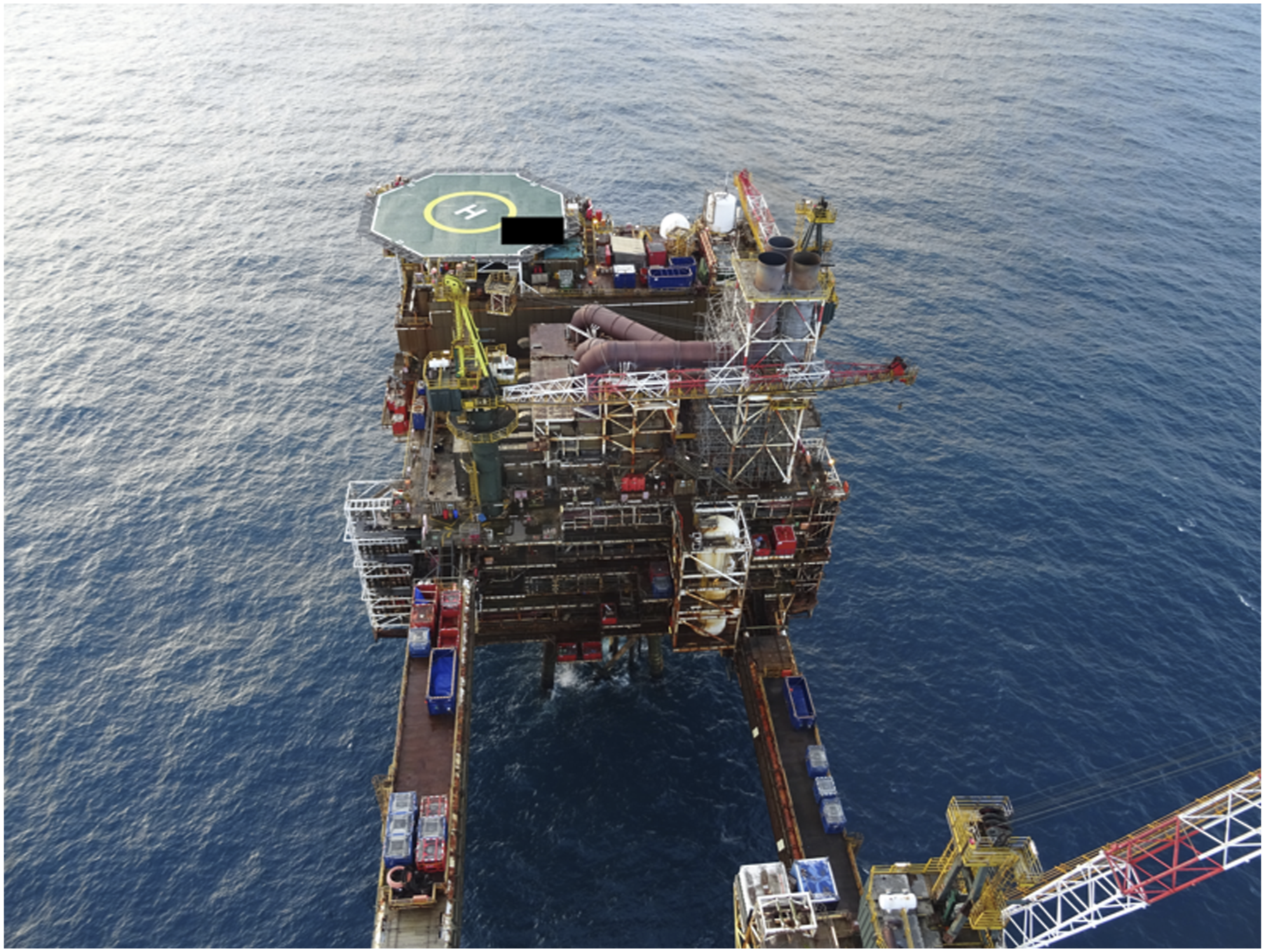
My climb of the drilling tower demonstrated my “head for heights”; a commodity on PD. Oilmen reacted by offering further access and participation. Following this climb, oilmen who I had not already spoken with, who were (largely) engaged in roles focussing on manual handling, mentioned to me that they had heard I had climbed the drilling tower, subsequently finding time for me to shadow and interview them. In interviews, I could relate to many points discussed surrounding drilling tower aspect, maintenance and equipment. In interviews, oilmen made explicit references to me having “seen” and “experienced” some aspects of life offshore, safety and risk they spoke of. At other times, oilmen brought me to specific locations within the platform to show me equipment functioning, potential risks, boats docking with supplies, and how different crews worked on different aspects of drilling. This provided a unique ‘participation’ aspect to the ethnography that went beyond the acceptance and trust generated through presence, length of stay and participation alone. Experiences functionally anchored my understandings surrounding aspects of worksite, materials, tools and locations, and allowed me to contrast and compare my own experience with that of active oilmen. This facilitated further probing and questioning of themes emerging in conversations, interviews and observations throughout my ethnographic stay, as my experiential knowledge deepened. This ‘snowball’ effect of gaining new experience and demonstrating this in conversation and activity, further enhanced oilmen’s perception of my willingness to learn. Workers ‘opened-up’, volunteered more time for interviews and shadowing, and began to accept me into the worksite as a researcher ‘crew-member’ who they readily took around the platform, sharing with me their ‘inside stories’ of energy-production labour and identities.
Discussion
Within social sciences, study of ‘closed’ workplaces such as offshore oilfields are few, despite literatures suggesting these are rich locales for studying behaviours and identities evolving within uniquely insular environments. While studies of ‘closed’ workspaces do exist, ethnographers often arrive at locales with no documented knowledge of customs and norms. This approach is somewhat normalised in ethnography and associated best-practice discussions. However, for insular energy-production locales, where often only limited, transient time is available to researchers, ‘going in blind’ may be detrimental to developing a rich ethnographic picture of the place, peoples and goings on. Researchers may struggle to gain trust, build rapport or develop sufficient time with subjects of study. Without appropriate linking-ethnographic work, the coming to know component, central to the ethnographic method and regarding place and peoples is rendered difficult, impacting legitimacy and ethnographic potential and may even skew subsequent research conclusions drawn.
Studies also see researchers spent little continuous time embedded in worksites and little time in proximity to labour. Some scholarships justify ‘distance’ from connecting with participant’s lived experiences, avoiding deepening ethnography by experiencing aspects of labour, environment, routine or immersion. Reversely, I argue approaching study of ‘closed’ locales from the perspective of utilising an ‘embedded-actualised’ approach to spend initial time in a similar, but-easier-accessible prior locale to the main site of study can circumvent many pressing methodological shortfalls faced by research.
Of the methodology discussed, negotiating appropriate training, developing prior knowledge, and conducting ethnography in a related, yet non-primary study locale (i.e. DrillMech’s onshore office) can develop relationships, trust, and allow peoples to get to know the ethnographer before their immersion into the planned site of ethnographic study (i.e. PD). In the case of my research, this approach led to oilmen travelling to PD and informally communicating their experiences and opinion of this researcher to members of the ‘closed’ worksite group prior to my arrival. This transferred connections, legitimacy, access and openness established onshore to the offshore locale. Such occurrence is rarely discussed in ethnographies as a benefit. However, my time onshore at DrillMech and time spent training was key to developing reputation in the site of study and promoting awareness of my research goals and objectives, as this work has demonstrated. When finally arriving offshore, oilmen were less ‘on guard’ and more ‘open’ to being interviewed, shadowed, and to allow complete access to this researcher, than they would have been otherwise, had this ‘priming’ phase not taken place.
Time spent in environment and time spent immersed in local routines, and both the witnessing and the ‘partaking in labour’ are likewise rarely highlighted as beneficial strings to the bow of ethnography. However, these practices were invaluable to me. Keeping to the local routines and norms of the platform facilitated enhanced access to witnessing unplanned and unscripted events as they unfolded. These practices also demonstrated to oilmen that I was “serious” about getting the “real” oilfield story and experiencing oilfield life as closely as possible for myself. To understanding the hardships, behaviours, customs and norms of a ‘closed’ worksite, I suggest that -where possible and safe- a researcher should experience activities to better tell the story entrusted to them by research participants, promote empathy, openness, transparency and reflexivity in research, and to legitimise ethnographic research as reflective of ‘real lived experience’. As oilmen pointed out in my time offshore, it is impossible to know about many aspects of the isolated and enclosed environment, the mental aspects of offshore life, and the delicate interconnections between labour, culture and identities, unless one has come to experience these themselves to some degree through sustained presence and ‘token’ participations.
The above perspectives were solidified in my time offshore in one memorable discussion of energy masculinities with a senior driller: we had been talking over the prevalence of the singular stereotypical ‘macho’ archetype of oilfield drilling men popularised in some existing research. My own research (now published) refutes this stereotype based upon my own experience on PD, instead suggesting oilfield identity is best represented as a manifold collection of distinct and different masculinities that largely interlink through performances of safety (see Adams, 2019, 2022). After discussing my embedded method, in the context of existing research, the oilman in question stated: “I think if any of these researchers actually came offshore, and spent any amount of time with these guys, they would be in for a shock. There are a lot of individuals here, a lot of different masculinities. None of them that macho tough-guy thing you’ve mentioned”
Possible limitations
Despite outlining the benefits of the ‘embedded-actualised’ ethnographic approach, I am mindful of limitations. A primary limitation relates to Reiter-Theil’s (2004) earlier-discussed research positionality. While researchers strive to become “some kind” of team member for reasons of inclusion, access, legitimacy and trust, some locales and professions prohibit this (p. 23). Reiter-Theil (2004) examples healthcare contexts to (very rightly) suggest researchers completing small tasks is impossible, due to protections of the professional role. This is true; however, I suggest ‘team membership’ can be achieved in capacity beyond direct involvement in labour. Earlier I discussed some of my own -brief- involvements in task completion. I would suggest my willingness to partake in activities, be present in the active worksite, question workers and demonstrate interest surrounding tasks and linkages to other activities - and my adherence to workers’ routines, was far more valuable ‘ethnographic commodities’ than direct task completion itself. I suggest ethnographers framing inability to partake in any worksite activity as the primary reason for not achieving ‘team membership’ move away from this restrictive perspective as a justifier of minimal knowledge of complex task-completion and labour dynamics. Instead, I think it more useful for ethnographers to work towards defining activities they can engage in -safely and functionally- promoting ‘team membership’ for a given workspace culture in some definition fitting for the norms of that worksite. This is to avoid positioning prescriptive ethnographic practices that vary in relevance per time, place, space and peoples.
Some scholarship also suggests issues with blurring lines between participant-observer, namely concerns of ‘over rapport’ (Miller, 1952; O’Reilly, 2009). However, much of these issues are historic and are countered by modern thought recognising evolution of ethnographic methods and the changing, interconnected; global-world social actors -including researchers- now inhabit (e.g. Fayard and Van Maanen, 2015). On PD, I maintained -very clearly- my position as a researcher, informing all who spoke with me about the topic of research and purpose of my visit. In addition, I utilised several ‘anchors’ to re-establish my position as a ‘guest’ whilst conducting ethnography. This included providing all oilmen interviewed consent forms and information sheets regarding my project, which they all signed and returned to me. Also, I formally ‘exited’ the oilfield upon my final departure from PD, closing out my data-collection phase of research at this point. This represented the process of ‘stepping out’ of the ‘ethnography-in-practice’ headspace. Data collection concluded on my departure date and I shifted to a phase of transcription and structured scientific analysis of materials collected. This avoided the issue of confounding primary findings with later additional materials provided ‘outside’ of the ‘ethnographic window’; a concern discussed by others of ‘over rapport’ which I was very careful to avoid.
Reflexive, ‘open’ analysis of my positionality in the onshore and offshore research sites
This discussion would not be complete without a reflexive analysis of my positions in both the onshore and offshore sites of research. Namely, my positions of gender, class and physical privileges must be recognised and addressed. I am a white, Scottish male; athletic and well-travelled. I began my working life in a physical labour position, moving into finance and office-based work, going to university in my very-early 20s. My background is complex. I grew up in a family well-travelled with high cultural capital, middle financial capital, and was instilled with working-class values; recognition and importance for hard work. While my family instilled values opposing any practices commonly networked to hegemonic masculinity (HM), much of my exposure to education, events, social processes, norms and values in the locales I grew up within all served to propagate ideologies that could be typed as representing some internalised (sometimes amplified) select-components linking to common HM-descriptors (physical toughness and resilience - strong, stoic, aloof, independent, self-reliant), although, most motifs have been heavily resisted through my various processes, (un)learnings; accommodation and assimilation of new perspectives during my life-course. Reflecting -with complete honesty- I retain some components of reverence surrounding stoicism, fortitude, independence and self-reliance, and I likely apply these in different -careful- ways through my lived experience while concurrently rejecting HM and HM-linked practices in favour of a complex -intersectional- personal construct of masculinities identity.
Whilst onshore, my position as a male, with the embodied above characteristics did little in the ways of dividend to promote access. Rather, it was my discussions of the importance of studying masculinities and HM that ingratiated me; generating interest in my research and promoted access. This was because most of the men I engaged with had developed their own understandings of masculine identity that rejected previously dominant -tough, hard, strong, stoic- oilfield gender-norms and wished to promote departures from these notions, linking these with poor workplace culture and -likely- poor safety practices.
Offshore, some components of privilege were noted. For example, my position as a male allowed me to immediately integrate with the nearly-all-male drilling crew, linking via overlapping positions of gender - but not always masculine values, ideologies and subscriptions. My embodied physicality was a factor. I mention earlier completing small tasks such a climbing the drilling tower. I also went to the platform gym nightly. I am a swimmer, having swam near-daily since my early years. Therefore, I was sometimes referred to as “a fit lad” or “one of the fit lads” and one senior electrician once called out to me (kindly) “alright muscles?”, when I was leaving the small gym room down in the belly of accommodation block located on the production platform. Therefore, there was an inherent physical respect from many – some asking my about what supplements I took (protein power and vitamins only); this allowing me an ‘in’ to some conversations regarding fitness, which allowed the building of relationships with a minority of workers (only a minority of drill-crew were interested in fitness). Additionally, no task on the platform was physically onerous to me. Climbing the stairs many times daily and nightly to conduct interviews, walking on the bridges between platforms in the weathers and winds, climbing ladders and doing small tasks all further enhanced my physical -able-bodied- privilege as someone who was “willing to get stuck in”. This was noted several times by oilmen.
Complexities of class and capital negotiations, transformations and contradictions offshore require acknowledgement. Workers viewed themselves as ‘working-class’ due to many having a trade; apprenticeships in different aspects of ‘oil work’, and performing physical labour, but this was contrasted with earning wages more commensurate with many ‘middle-class’ onshore occupations. Lifestyle discussions linked to middle-class notions; nice houses in good areas, regular abroad holidays, high financial capital and high disposable income (for it is near-impossible to spend money offshore aside from online-shopping and holiday-booking via online means. All amenities are provided offshore; food, washing, transport, entertainment). This was among other factors. Oilmen recognised contradictions, discussing they would not carry high financial capital and linked ‘lifestyles’ working onshore or in an industry outside of oil and gas extraction. Thus, middle-class lifestyles were linked to labour labelled as ‘working-class’. However, and fascinatingly, the pricing of personal and embodied labour and masculine capital commodities offshore weighed heavily in favour of values of ‘hard work’ and linkages to ‘can do attitudes’ and ‘getting stuck in’ - notions networked with ‘working-class’ identity (Zandy, 2004). Thus, I found myself in a position of privilege as a researcher with a background in ‘working-class’ physical labour, coming from a complex background connecting middle and working-class values and the juxtapositions of this with the conditioning of locales within which I grew-up, and some of my early-life experiences. As such, I felt I was in a unique position compared with some other researchers; being able to easily adapt to the ‘banter’ and ‘vibe’ of dialogues; what was to be said and when, and to volunteer for small tasks and become useful, as opposed to becoming a ‘distanced observer’, which I am sure would have alienated me from the groups I built close connections with. Furthermore, many oilmen asked me about my career journey – going to university, the financial implications of paying for my first postgraduate education (MSc), engaging in PhD study, and other factors linking to my early life and non-traditional journey into academia, some connecting this with their own non-traditional routes into resource-extraction industry. These connections made due to my own positionality and how they fitted with the complexities of labour, class and capital structures in the oilfield should not be downplayed as means of enhancements to access.
The sharing of facilities also promoted integration. While some women work on oil platforms, it was explained to me women typically have a room to themselves or share with another woman; never sharing with someone of different gender. Conversely, I shared a room on both occasions with another male oilman, and on one occasion two different oilmen, at different times, following a crew-change (I also had the room to myself for part of one trip - a rarity offshore for a male). This allowed for bonding with cabin-mates in the ‘down-time’ space; speaking about family, life-experience, work, and hobbies. Upon seeing these individuals ‘in the work zone’, I was -at times- introduced to wider circles and acquaintances as a ‘known’ individual; brought into the ‘inner circle’ if you will. Therefore, my gender played a role in developing the ‘closeness’ and ‘embedded’ perspective, whilst conducting the offshore component of research. While the accommodation process for people of a non-binary gender is unknown to me (this was not discussed as a component during research), it is a reasonable position that -as the platform is predominantly crewed by men- my position as a male carried significant integration and access benefits over women and non-binary identifying persons.
Conclusion
This paper outlines and discusses benefits of utilising an ‘embedded-actualised’ ethnographic method. This methodology focussed on building connections; legitimacy, trust, acceptance, awareness of cultural norms and nuance in a prior ‘first’ onshore site of study to the intended main research site; the offshore locale of PD. Explicitly, the ‘embedded-actualised’ ethnographic method demonstrates this first phase of onshore work was critical for facilitating enhanced access in the ‘closed’ offshore oilfield worksite. This is qualified by several factors: oilmen readily accepting -and expecting- my presence, my position, personality and person receiving prior validation from ‘known oilmen, oilmen willing to rapidly ‘open-up’ to multiple interviews and story-sharing sessions, share with me detailed accounts of their history and personal identity and how this linked to changing institutional and labour processes, and include me in work-based activities and trust me with various small jobs, insights and events, and in-term request me to ‘open up’ to them illustrating reciprocal respect, trust, interest and deepened connections. Most critically, trust, connections and acceptance built in the onshore site transferred to the offshore oilfield locale. The ‘embedded-actualised’ approach allowed longer time in locale and better access to observations and interviews in a traditionally restricted and little-researched site of energy labour, a difficult feat to accomplish. Researchers approaching study of similarly ‘closed’ workplaces should find this descriptive methodological monograph useful, particularly for adopting this methodology for studies exploring similarly ‘closed’ sites of labour which likely have more accessible satellite sites that may represent fitting possible first ethnographic access points. For example, natural resource extraction; mining and recovery operations, nuclear sector work, military and naval operational research, and aviation, among others.
Footnotes
Acknowledgements
I would like to sincerely thank the onshore team at DrillMech and offshore drill-crew working on Point Delta during 2016-2019, without whom this research would not have been possible.
Declaration of conflicting interests
The author(s) declared no potential conflicts of interest with respect to the research, authorship, and/or publication of this article.
Funding
The author(s) disclosed receipt of the following financial support for the research, authorship, and/or publication of this article: This work was supported by the Economic and Social Research Council. ESRC Grant Reference: 1800896.

Data availability statement
Data is not available for sharing; held securely and protected under confidentiality and anonymity guarantee to research participants.