



Abstract
This article explores the concept of time among combat reservists in the Israel Defense Forces. Most ethnographic studies of temporality tend to focus on how time’s passage is measured or ‘reckoned’ within varying cultural contexts. In contrast, this article looks to the more corporeal and embodied aspects of the human experience of time. It argues that within Israeli military contexts time is experienced as a near material-like substance that imposes itself – in a very physical way – upon the bodies of combat soldiers. In this sense, the ‘military timescape’ is experienced as a sort of malleable substance that the physical donning of a military uniform can transcend, alter, and refract. A detailed ethnographic exploration of time’s corporeal dimensions offers anthropologists a temporal, as opposed to a spatial, paradigm for engaging with some of the unique sociocultural phenomena of militarism and of military reserve service more specifically.
Introduction: Time and the things they carried
Opening his now famous semi-autobiographical war novel The Things They Carried Tim O’Brien (2009) marshaled the material aspects of the combat experience as a medium through which one can begin to understand the psychological trauma of America’s war in Vietnam. In part, the book’s descriptions focus squarely on the physical and everyday details of combat service in Vietnam. In this way, the weight of an assault rifle (2009: 4) alongside cigarettes and lighters (2009: 1) all become grist for the narrator’s hard-edged tale of war. As the narrative continues, however, it becomes apparent that soldiers carry other things into and out of combat – more ephemeral, yet just as weighty. Stories of fear, pain, and loss resonate through the physical accoutrements of war.
This article mobilizes a similar narrative overlap between the corporeal and the ephemeral as a way to ethnographically explore the experience of ‘time’ within one reserve combat unit of the Israel Defense Forces (IDF). I argue for a reconsideration of how the concept of time is understood within the extant anthropological canon. Most ethnographic studies of temporality as a social experience tend to focus on how time’s passage is measured or ‘reckoned’ within varying cultural contexts. Following Adam’s notion of a ‘timescape’, or ‘the embodiment of practiced approaches to time’ (1998: 10), this article examines the more corporeal and embodied aspects of the human experience of time. It argues that within Israeli military contexts time is experienced as a near material-like substance that imposes itself – in a very physical way – upon the bodies of combat soldiers. For combat reservists, time becomes corporeal and embodied precisely because it bears its own kind of material ‘weight’. In this ‘military timescape’, just as a soldier carries a weapon, a pack, and water, she or he also carries ‘time’ in ways that are distinctly material in nature and that elicit unique types of physical experiences.
This ethnographic and theoretical argument concerning ‘time’ can also shed light on the nature of military reserve service itself. Social scientific studies of the military have generally approached the experience of reserve service through a ‘spatial’ metaphor focusing on the phenomenon of foreign, temporary labor (Gazit et al., 2021; Lomsky-Feder et al., 2008; Walker, 1992). This literature perceives civilians as entering a military framework for a defined yet relatively brief period of time to perform a series of specific (military) tasks. While this framework differs radically from their civilian home environments, it is only temporary in nature, and soldiers eventually return to their original cultural environments. This article presents a new perspective, observing in the corporeal experience of time a more salient metaphor for anthropologically engaging with military reserve service. In this sense, time is experienced as something that not just passes one by but that is also a malleable substance whose physicality can transcend, alter, and refract everyday military experiences. This physicality manifests itself in the language used to describe time, in the ways in which soldiers experience the temporal flow of their service, and in the physical experience of operational duty, along with the ways in which trauma and memory become intertwined with time. Ultimately, I argue that a unitary focus on time’s reckoned ‘passage’ has led scholars to overlook the corporeal and embodied ways in which temporality can be experienced by social practitioners.
This ethnographic analysis is based on more than a decade of my active reserve service within an IDF combat infantry unit. Following in the tradition of other Israeli anthropologists of the military (Aran, 1974; Ben-Ari, 1989; Feige and Ben-Ari, 1991; Gazit, 2019), I have used this experience as an opportunity to gather ethnographic observations and discursive material. Most of this earlier social scientific literature has been written by officers in the reserves. In contrast, I am a low-ranking infantryman, with no command duties or unique functions within the unit. As part of this research, I participated in the daily routines of military life with 30–40 other reservists (depending on the day). Throughout each call up, I carefully observed the everyday activities of my fellow soldiers and commanders and strategically positioned myself in critical places and at decisive moments if important conversations or debates were being held. I also conducted informal and extended conversations with approximately half (15) of the soldiers in my immediate unit during long patrol shifts or our off hours. We discussed things such as home life, work, and politics; through all of these discussions, issues of temporality naturally emerged.
My observations and analysis represent the everyday experiences of a regular combat reservist and are the ethnographic equivalent of what Brown and Lutz (2007) term ‘Grunt Literature’ (Silliman, 2008: 239). Indeed, one methodological implication of this research into time is that the anthropology of the military ought to be far more attuned to the “imponderabilia of actual [military] life” (Malinowski, 2002: 14). Details that to some might seem trivial – the pain in one’s feet, improperly fitted helmets, or the cramped feel of a crowded jeep – are all inescapable elements of the military experience, offering critical context for understanding the experience of time among military reservists.
Current reserve service in the IDF is governed under the Reserve Service Law of 2008. Following their mandatory period of service, regular combat soldiers are called up into the reserves twice every 3 years, with 1 month devoted to performing what is termed ‘operational activity’ (ta’asuka mivtzait). In my own infantry unit, operational activities were usually conducted somewhere in the occupied West Bank, performing such duties as routine patrols, surprise roadblocks/checkpoints, and guard duty in forward bases and observation posts, along with conducting the occasional arrests of – what we were told were – Palestinian militants and terror suspects.
As other anthropologists have documented in conflict zones around the world (Basham. 2015; Charlton and Hertz, 1989; Mæland and Brunstad, 2009), my fellow soldiers and I considered much of this service to be terribly boring, with our time divided between hiking along the West Bank’s rough agricultural terraces and guarding empty roads and gates. These duties were interspersed with what seemed like inordinate amounts of ‘down time’, simply waiting around for briefings to start, vehicles to be made ready, and one’s shift to begin. This tempo of military life served as the everyday framework through which reserve service was experienced, in very corporeal ways. As an anthropologist, I used this temporal routine in a discursive manner to quickly jot down notes on a small waterproof notepad, which I would later transfer to a larger notebook, and finally onto a laptop.
Reckoning time and the anthropology of temporality
Anthropologists have long been interested in how cultural context can affect the experience of time within differing social settings. Rather than being an embodied phenomenon, this corpus has generally viewed temporality as an ephemeral concept that conditions how humans think about the world around them. Essentially, anthropologists have focused on ways in which time’s ephemeral passage affects social experience, to the exclusion of other more embodied or corporeal encounters with temporality.
Although lacking some theoretical sophistication, functional and symbolic anthropologists in the first part of the 20th century (Hodges, 2008: 400) were keenly aware of how conceptions of time molded social experience. Following Durkheim’s differentiation between ‘personal’ and ‘social’ time, wherein a subjective experience of temporal flow is transformed into distinct, differentiated, and cognizable units of time (Durkheim, 1915 [1912]: 11, 441; Munn, 1992: 95), early anthropologists addressed what they termed ‘time-reckoning’. For example, Malinowski examined how the measurement of time functions to better organize activities between individuals and groups, noting: ‘When the soil is to be tilled, or a long fishing or hunting expedition undertaken, dates have to be fixed by reference to some recurrent natural phenomena which can be foreseen and defined’ (Malinowski, 1927: 203).
Evans-Pritchard complicated this functional view of time by differentiating between what he termed ‘oeceological time’, which reflects individuals’ relationship with the environment, and ‘structural time’, which reflects individuals’ relationships with one another (Evans-Pritchard, 1939: 189). The former views time as an annual, repeatable cycle, while the latter is progressive, enabling diachronic changes in individual and social status. For Evans-Pritchard, the relational nature of structural time – existing between two individuals situated within separate spatial and temporal contexts – affects the experience of other social institutions, notably, the calculation of kinship relations across lineages among the Nuer tribesmen of what is today South Sudan (Evans-Pritchard, 1939: 215–216). Following Evans-Pritchard’s seminal analysis, a range of ethnographic studies comparing ecological with structural time were conducted demonstrating the Durkheimian link between what Eickelman (1977: 39) described as the individual perception of reality on the one hand and the everyday ‘rhythms of social life’ on the other (Beidelman, 1963; Bohannan, 1953; Morey, 1971; Panoff, 1969). Later theoretical and ethnographic works have followed this focus on the social contexts through which temporality is perceived and made meaningful in the lives of informants. Munn, for example, sees time as a “symbolic process continually being produced in everyday practices” (1992: 116). In this way, people weave themselves in and out of different dimensions of what she terms ‘sociocultural time’ (Munn, 1992).
From an ethnographic perspective, anthropologists have also been interested in how conceptions of time have contributed to the cultivation of transcendent aspects of community and ideology (Ramble, 2002). At stake in this process are the broader eschatological, redemptive, and otherworldly promises of religion itself. Anthropologists have shown interest in millenarian and messianic movements that promise both an end-of-time experience as well as a removal of the individual from the boundaries of time itself (Kravel-Tovi and Bilu, 2008; Robbins and Palmer, 2013; Tuminia, 1998).
From Durkheim’s view of social time, to Malinowski’s time-reckoning, and the more current interest in millenarianism, temporality has nearly always been viewed as an ephemeral experience existing solely in social actors’ minds and emotions. This theoretical focus has added depth and ethnographic insight to the study of temporality in social contexts. However, its almost monolithic focus on ephemerality has elided other – more corporeal – dimensions through which individuals and communities may encounter time.
Indeed, some scholars have ethnographically hinted at how notions of embodiment and temporality tend to complement each other in social contexts. Hazan, for example, pointed toward certain extra-ephemeral dimensions of temporality in his 1984 study of an elder care home in northeast London. For Hazan and colleagues, changes in the perception of time among the elderly were ‘linked to changes in external and internal social boundaries’ (Hazan et al., 1984: 574–575). That is to say, time should not merely be understood as a mental construct that reflects a distinct social reality, but also as a phenomenon that is constitutive of reality itself. Although they fall just short of saying it, Hazan and colleagues’ argument intimates a unique physical dimension to temporality. As Balkenhol suggested three decades later, “people’s experience of time…depends to a large extent on the material forms through which time is represented and made palpable” (Balkenhol, 2012: 8).
Samimian-Darash (2013) focused on just this type of palpability in her work on IDF counter-terror training when she highlighted how the conditioning of a soldier’s body transforms the potential for violence into something that is second nature. Reminiscent of Mauss (1973: 73), who found that forms of bodily movement develop over time, Samimian-Darash ethnographically alludes to the temporal dimensions of muscle memory, when she highlights how “the bodily and emotional changes resulting from only a month and a half of military training are still embedded within him [the informant], even after his discharge” (Samimian-Darash, 2013: 47). This current article adds further ethnographic weight to Hazan et al. and Samimian-Darash’s arguments by empirically documenting the variety of dimensions through which temporality can also be intertwined in corporeal experience, in manners that act on the bodies of (military) social actors in distinctive ways.
This focus on corporeal time (as opposed to Durkheimian and more ephemeral social time) also reflects current debates within the anthropology of the military and militarism. Over the past decade, social scientists have considered various paradigms for better understanding the unique cultural contexts of periodic reserve military service. In the 1980s, political scientists such as Horowitz and Lissak used a territorial metaphor of ‘permeable boundaries’ to conceptualize the close and interactive relationships that exist between reserve forces and the civilian structure that mobilizes them (Horowitz and Lissak, 1989: 204). Similarly, Walker (1992: 308) observed this permeable relationship when noting how reserve forces tend to serve as the main point of contact between most American civilians and the broader military apparatus. More recently, Israeli anthropologists have developed this concept of permeable boundaries into a distinctly spatial metaphor. Specifically, Lomsky-Feder et al. (2008; Gazit et al., 2021) have argued that IDF reservists should be viewed through the prism of transmigration. That is, much like foreign migrant workers, reserve soldiers temporarily travel to a different cultural context for a set period, only to return to their original homes and families. In an argument somewhat reminiscent of Malinowski’s Kula ring (Malinowski, 2002: 77), Lomsky-Feder, Gazit, and Ben-Ari suggest that as IDF reservists travel between spaces, they “mediate, and sometimes create critical perspectives between the army and wider civilian society” (Lomsky-Feder et al., 2008: 594).
Without denying the importance of this theoretical position, it is notable that it has little to say regarding the emic experiences of reservists themselves. How is limited and periodic military service understood for these individuals? Interestingly, the anthropological record has noted how notions of time and space interlap and are often influenced by one another specifically within hunter-gatherer societies. Chagnon (2013) observed, for example, how Yanomamo tribes indigenous to the Amazon rain forest in Venezuela and Brazil utilize geography in referencing notable past events. Distance – or the amount of time it would take to travel between two points in the jungle – was measured by this group using the experience of sleep (Chagnon, 2013: 181–182). While these measurements might be subjective, they were very much enmeshed in the embodied nature of jungle life.
Drawing on this overlap between the spatial and the temporal, this article ethnographically highlights how reservists mobilize time’s corporeal characteristics to essentially revert to their mandatory service they experienced during their late teens and early 20s. Thus, I argue that temporality – alongside spatiality – becomes the primary means through which IDF soldiers experience their reserve military service.
Sion and Ben-Ari (2009: 656) have taken careful note of the ‘special character of reserve service’ within Israeli social life. In my unit, young students regularly complained about how month-long service stints forced them to miss important tests and assignments, sometimes even delaying their graduation. Fathers complained about missing their spouses and children. As one friend of mine acknowledged: “the real reserve service is performed by my wife, she’s alone with the kids.” Despite all of this, however, they still joined the ranks in service to a state whose political goals they may or may not identify with. On the other hand, the academic literature has often elided how the actual behavioral patterns of reservists in the military are also deeply intertwined with the military culture that has developed in and around mandatory service. In those years of military service, young men and women learn to endure discomfort, enjoy simple camaraderie, and set aside their individual (and often ethical) desires in service to a state.
This article addresses how these military experiences overlap with one another and begins with an overview of the manner in which soldiers linguistically relate to and imagine the experience of time. It will go on to explore how the Israeli military experience is bounded by distinct corporeal engagements with time. The article will then turn to some of the embodied modes through which individual soldiers experience temporality.
The military language of corporeal time
Israeli soldiers utilize a variety of linguistic terms to express not just the ephemeral passage of time but its corporeal experience as well. Some of these terms refer to specific military activities while others highlight the broader flow of military life. Ben-Ari (1998) has reported how the language of military service can often index certain professional tasks. During the First Intifada, for example, he observed how the use of policing terms in military briefings signified a shift in how the Israeli military contextualized the process of occupation (Ben-Ari, 1998: 375–376). For Ben-Ari, these terms helped to condition how regular reservists experienced the unique type of violence they were expected to engage in. While these policing terms emerged from the formal command level (top-down), terms that military personnel use to express their engagement with temporality have more informal origins (bottom-up). For example, li’tchon (‘to grind’) is a contemporary Hebrew slang phrase that soldiers use to describe extended periods of operational duty. It also denotes being late switching with someone on operational duty. The term is reminiscent of the popular culinary dip, techina (which is produced from ground sesame seeds), and evokes images of an individual being ‘ground down’ by endless hours of (mostly boring) duty while wearing heavy gear in all types of weather.
During an infantry soldier’s mandatory service, guard duty regulations are fairly strict. Soldiers are generally forbidden from eating while on duty and are limited to drinking the water carried in their camelback sacks or canteens. Soldiers in fixed positions are also mandated to stand throughout most of their shift. While these rules are rarely followed strictly – and certainly not in the reserves, where discipline is far more relaxed – they do set the tenor for the level of standards expected from soldiers during operational duty. As one former squad commander related half-jokingly during an interview: My soldiers were told to stand for 8 h in one armored position. I asked the company commander if they could at least put on some music during their shifts. He told me, ‘I’ll allow soldiers to do two things during their shift: guard, and die’.
For soldiers, time spent on operational duties, whether as a sentry or on patrol, possesses a ‘grinding’ materiality that takes on an almost physical quality. As that same commander related to me during an informal conversation while on reserve patrol, “you know if someone is late [switching with you on guard duty], every minute feels like an hour, but if someone is early, wow that feels like heaven.” Gazit and Grassiani (2021) theorized that these long hours of mainly static policing and observational duties by military personnel, who have been trained for kinetic combat operations, may carry its own type of corporeal and violent consequences for Palestinian civilians.
One aspect of this grinding experience involves the messages that soldiers indirectly absorb from the graffiti situated on the built environment around them. Some anthropologists, such as Peteet (1996), Jean-Klein (2001), and Allen (2008), have examined popular graffiti to understand modes of Palestinian resistance to the Israeli military occupation of the West Bank. However, the graffiti of the Israeli–Palestinian conflict manifests on both sides of the political divide. For soldiers in the IDF, and those on combat duties in the West Bank, the graffiti found on nearly every military post references the experience of temporality.
Time’s passage is acknowledged by soldiers when they use the term ad matai, which means ‘until when?’ For soldiers in mandatory service, the term ad matai is usually combined with the month and year of one’s induction date and signifies a desire to be discharged from service. For example, ‘ad matai [until when] August 19’ refers to a soldier who was conscripted in August of 2019 and scheduled to be discharged sometime in 2021. Graffiti with this phrase and a variety of years can be found etched into almost every guard post and position in nearly every military base (Figure 1). As one reservist related in an interview, “it’s like everywhere you go you are surrounded by physical signs that people don’t want to be there, just waiting for their time to be up. That’s also part of the grinding feeling.” Graffiti on guard/observation post. “How much more Nov[ember] ‘18. Until when Aug[ust] ‘18.”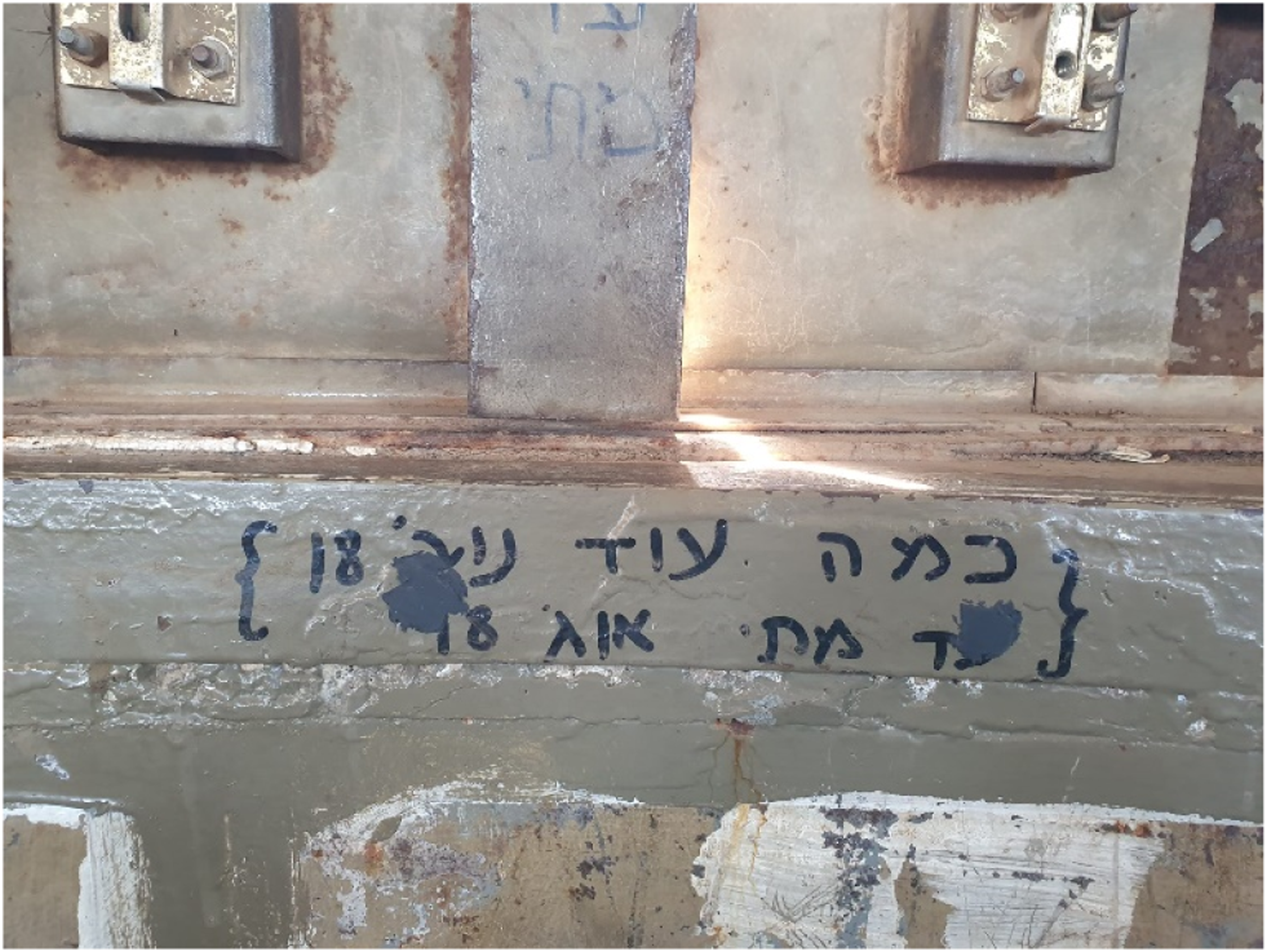
Another term describes an equally visceral experience of temporality. The term shavuz’ is an acronym of the Hebrew phrase ‘shibur zayin’; in English, literally ‘broken penis’. Soldiers often transform the descriptive term into the Hebrew adjective, ‘shvizut’, loosely translated as ‘broken dickness’. While Sion and Ben-Ari (2009) have noted how sexual and sexualizing humor in the reserves (and perhaps, the military more generally) reflects a sense of military masculinity, the literal meaning of the term shavuz seems to lack any overt sexual connotation. It refers instead to overwhelming feelings of fatigue or depression that tend to emerge following long periods of round-the-clock military duties.
While some terms are more frequently used in the regular enlisted army, one can still hear them in the reserves. For example, in an effort to avoid kitchen duty, and wanting a slightly more interesting reserve experience, I had asked Dvir, who was in charge of the duty roster, to schedule me for the morning and evening foot patrols. “Titchan oti [grind me],” I told him and, placing me on daily foot patrols, grind me is exactly what Dvir did. However, as the days stretched on, these treks across the rocky hills of the northern West Bank became far more physically challenging then I had expected. At the time, I was a 39-year-old academic, and hiking across boulder-filled agricultural terraces, with a heavy ammunition vest and three liters of water, was beginning to get a little burdensome. Dvir, noticing how I was becoming somewhat withdrawn and depressed, asked half-jokingly, but with unmistakable concern, “you ask to be put in all these patrols, and you’re walking around here all shavuz.” Here, a language of physical discomfort appeared to seamlessly melt into an experience of temporality.
Such language does not merely reflect a dry accounting or reckoning of the passage of time. Far from pointing to an ephemeral experience of temporal flow, these terms point to the more physical, corporeal, and embodied ways in which soldiers engage with time. As soldiers complain about the long, grinding hours of service or express these frustrations in the graffiti that surrounds their operational positions, they are experiencing not just the ephemeral reckoning of time but rather the very embodied and corporeal experience of the temporal flow itself. While the experiences of shvizut and t’china happen on a micro-level, the reservist engagement with temporality occurs within a much wider framework as well.
The long duration of reserve service: From induction to discharge
Yitzhak,
1
a 32-year-old reservist, entered our caravan one evening in the middle of our month-long tour of duty in the West Bank and saw the empty cot next to his. Until then, the cot had been occupied by Sagi, and both soldiers knew each other well having served together in the same infantry platoon during their years of mandatory service. ‘What happened to Sagi? Yitzhak asked. ‘I think he left, that’s what I was told’, I answered. “Really? That’s it? He didn’t even say goodbye’? Yitzhak answered, sounding upset. Unsure if he was joking, and not wanting to offend my roommate who I would have to live with for two more weeks, I put on a half-jovial tone and quipped, ‘yeah, are you surprised? Offended’? ‘A little’, Yitzhak answered, ‘I thought he would say something’.
With that, he dropped his rifle on the floor, hopped onto the upper bunk above me, and began listening to what sounded like the evening news. Yitzhak had served with Sagi during their mandatory service. Although they were not great friends outside of the military, over the years a kind of easy familiarity had grown between them. Yitzhak was offended that Sagi simply had not bothered to say goodbye. Buried within this somewhat banal encounter are the ways in which a sense of military time impinges upon the experience of comradeship within military units.
Comradeship is one of the central tenets of the IDF (as it is in many military organizations). There is a physical habitus to this type of comradeship that incorporates within it an almost intimate kind of ‘brotherhood’, coupled with a physical willingness to risk one’s own life. However, in combat units this brotherhood exists in some tension with the broad experience of temporality.
In 1975, the military sociologist Charles Moskos observed how the 12-month rotation cycle epitomized the combat experience for most frontline infantry soldiers in Vietnam. ‘Barring his being killed or severely wounded, every soldier knew his exact departure date from Vietnam..It would be hard to overstate the soldier’s constant concern with how much more time – down to the day – he had remaining in Vietnam’ (Moskos, 1975: 30).
In Vietnam, soldiers’ sensitivity to the temporal pace of rotation into and out of the combat theater deeply affected their relationships with their comrades. As Moskos further wrote: Squad members who have returned to the United States seldom write to those remaining behind…The rupture of communication is mutual despite protestations of lifelong friendship during the shared combat experience (Moskos, 1975: 29).
The social implications of military rotation in Vietnam operate in similar ways within Israeli military units. Most IDF servicemen and women are inducted for set periods of time into mandatory service: 32 months for men and 24 months for women. A whole series of informal cultural signs mark the passage of time leading to one’s discharge from mandatory service. For example, a soldier 4-months away from their discharge date is referred to as a mem aleph (an acronym in Hebrew for machzor acharon, or the ‘last cycle’). 2 Soldiers closer to their discharge date are given fewer military responsibilities, such as less guard duty or a blanket release from kitchen duty. They may also be afforded other kinds of ‘respect’ within their individual companies, for example, permission to wear certain military accoutrements such as leather rifle straps or leather rifle magazine covers.
While reserve service lacks a similar type of sensitivity to the forms of social respect given to soldiers in mandatory service, the temporal pace of one’s call-up into the reserves is still acutely felt. One usually first receives word of an impending month-long period of reserve service through a unit’s unofficial WhatsApp group. In my case, the group is moderated by the company commander, who sends out a message about 3 months before the official induction date. Soldiers are given time to prepare their families and places of employment for their impending extended absence.
After receiving the official summons through the IDF’s reserve service Web site, soldiers are ordered to arrive at the initial training base at eight in the morning on the day of induction itself. Few, however, are able (or desire) to arrive that early, with most arriving between ten or eleven in the morning. For the officers and commanders in my reserve unit, this tardiness seemed to be a source of a good deal of consternation. The company commander expressed his displeasure toward the latecomers in his introductory briefing on the first day: Most people came way after they were supposed to show up. That might be fine now, but when we begin operational duties its extremely important that patrols leave on time, that guard shifts are switched on time.
Dvir, the individual designated to organize the duty roster and home-leave schedule, stood up and politely interrupted the company commander with a thinly veiled threat toward the reservists present: Those who aren’t straight with us, who are late to all sorts of things will notice that we also won’t be straight with you. When you ask for leave we may not want to give it, if we can’t trust you to be on time, you might not be able to trust us to give you the time you need.
Although everyone knew from experience that commanders usually ‘pretend’ to be stricter on the first few days of reserve service, the threatened impact to one’s home-leave certainly increased the tension in the room. The home-leave schedule, or the amount of time one spends in the army and at home, is of critical importance and concern for reservists who abandon busy civilian schedules to spend weeks in military service. Any change in the home-leave schedule is thus viscerally felt by most reservists. All reservists are given anywhere between three to five paid leave days. As a result, when soldiers are granted leave in the middle of their month-long service stint, they do not have to go to work and instead can spend time with their families.
For very practical considerations, however, there are extremely good reasons to arrive early for reserve service. On one call-up for a few days of training, I had hitched a ride with some other soldiers. As is customary, we arrived many hours late and immediately began signing out equipment from the quartermaster. Be’eri, a fellow soldier, complained that he could not find a helmet or an ammunition vest that fit him. The platoon commander immediately replied: “Well, what do you expect? You come hours late and the only equipment that’s left are broken down helmets and vests.” When in the field, soldiers practically live in their equipment. As one commander observed, “your vest is your house, it has to fit you, it has to hold the essentials what you might need.” A poorly fitting vest or a helmet with broken straps is not just an annoyance or unprofessional, it is also physically painful. Here, temporality does not just have disciplinary consequences but also very physical ones that are felt in the everyday lives of combat reservists.
Just as temporality is a central factor upon reservists’ arrival, it is equally as important for its completion. Many soldiers carefully track the number of days of reserve service they have remaining. However, this ‘reckoning’ does more than merely mark the passage of time until civilian life resumes. There is a certain anxiety felt surrounding the discharge date. In Hebrew, this anxiety is termed lachatz bayit (‘home pressure’). Soldiers can react quite viscerally to this pressure. For example, toward the end of 1 month of reserve service I once observed a soldier at a checkpoint walk into the middle of the (empty) road, stretch out his arms and scream: “I want to go home!” Here, time is experienced as an almost weighted substance producing its own forms of embodied anxiety.
On the day of a unit’s discharge from service, all rooms and installations must be cleaned, and all equipment counted, checked, and handed over to the incoming reserve unit. Of course, all these procedures take time, and my own unit quartermaster made sure to emphasize that no soldier would be discharged until everything was completed. One could see the pressure in the soldiers’ eyes as they rushed around the base looking for mops, buckets, and other cleaning supplies.
At the time of discharge, soldiers must return all of their military equipment to the quartermaster. This operation, which usually takes place in a large, garage-like hall with open doors, is a scene of controlled chaos. A hundred or so soldiers rush to empty ammunition magazines, pushing themselves into one line to return their equipment and then another line to return their rifles. Once at the front of the line, one is accosted by quartermaster officers shouting at individuals to remove items from their kit bags more quickly. The pressure, however, does not stem from a concern over discipline, nor is the shouting meant to instill any sense of order; rather, it is simply meant to impel individuals to move faster so they can go home.
While the notion of temporality within the long duration of military service is certainly something to be ‘reckoned’, it is also an experience that comes with unique physical qualities. As I heard one soldier exhale with relief upon returning his rifle, “finally, I feel so much lighter now.” The soldier was not simply referring to the negligible weight of his M-16 carbine (weighing approximately a little over 2 kg), but to the ‘weight’ of military service itself. Here, the passage of time toward one’s discharge and the broader context of the military timescape (Adam, 2005) acts as a fundamental component through which military socialization is both actuated and experienced (Hockey, 2017: 83).
Alongside the broader course of reserve military service – from induction to discharge – time’s ‘malleability’ is also an important aspect of a soldier’s experience of reserve service. In this sense, soldiers see their reserve service as a vehicle through which the passage of time can be manipulated, alongside the distinctive behavioral patterns and attitudes that go along with it. For example, during one induction day at the start of a 3-day stint of reserve training, I overheard our platoon commander remark: “look around you, people put on that uniform and it’s like they turn 18 again.” As I looked up from organizing my gear, I noted how groups of teachers, university students, lawyers, and software engineers were joking or cursing as if they were indeed once again teenagers. Likewise, one could not help but note how soldiers in their early-to mid-thirties would exhibit very youthful behavior throughout longer periods of reserve service as well. Individuals who, in their civilian lives, had professional careers and were parents of young children, could be found sitting in the recreation room playing video games for hours on end. Others could spend hours on their smartphones, watching movies or music videos.
This youthful social atmosphere also affected operational abilities. During an informal interview, Major Dan, our company commander, expressed some frustration with the lackadaisical attitude expressed by many reservists toward the condition of their military gear. Giving me a ride home at the end of a month-long stint of reserves, Major Dan explained: “you go into reserves the way you leave mandatory service. If you left mandatory service with a lackadaisical attitude, not caring much about the missions or your gear, that’s exactly what you revert to in the reserves.” Major Dan was not so much criticizing his own soldiers as he was the lax professional standards that one can find among the mandatory service ranks of the IDF’s various infantry brigades. In a wider sense, however, he was also commenting on how that sense of professionalism becomes intertwined with notions of temporality.
Indeed, the professional capabilities expressed during reserve service are conditioned by one’s operational and training experiences during mandatory service. The learned habits of gun handling, for example, that develop during one’s 3 years of mandatory service are hard to break. Shortly before my first period of reserve service, the IDF changed their gun clearing techniques. Until the early 2010s, upon nearing the end of their duty, soldiers were instructed to vigorously open the actions of their rifles, twice, check that the chamber was empty, and then depress the trigger, ensuring that a live bullet was not left within the rifle. The military later changed this procedure to exclude depressing the trigger. During months of reserve service, I, along with many others, regularly depressed the trigger while clearing our rifles, to the consternation of commanders and firearms instructors. Here, the very physical components of muscle memory transcended the temporal flow of decades of subsequent reserve service.
While reservists entering the military for their mandated brief periods of service are certainly shifting the spatial context of their labor, they are also shifting their own temporal experiences. Anthropologists have been adept at documenting different aspects of everyday life among military personnel. Anthropology has generally viewed experiences of military life, such as boredom (Harris and Segal, 1985), the use of bawdy language (Sion and Ben-Ari, 2009), or the fascination with violence both during training (Ben-Ari and Frühstück, 2003) and in combat (Hammami, 2019: S95), as being distinctly influenced by spatial or geographical contexts. That is to say, military behavior is often seen as being prescribed by a particular mission or within a particular spatial environment (the training field or the checkpoint). This perspective, although certainly descriptive, has tended to obscure how these spatial contexts are deeply intertwined with perspectives of temporality. As they return to military service in a spatial sense, soldiers also allow themselves to ‘go back in time’ to express not just the behavioral patterns of late adolescence but also the professional attitudes of mandatory service that they developed during their late teens and early twenties. Temporality in this military context is experienced as a malleable substance that the material conditions of IDF service can shape and transcend.
Time, boredom, and preparedness in military life
The ways in which individuals engage with temporality within the specific contexts of military duty are also critical for understanding the larger frameworks of military life. Following my unit’s discharge, I hitched a ride home with the unit commander, a middle-aged major, who was interested in some of my ethnographic observations. “Daily life is very mission oriented,” he remarked, “You live your days in set blocks of time.” Israeli military units on operational duty ‘work’ around the clock in 4-, 8-, and at times even 12-h shifts. These shifts usually rotate throughout the week, giving individuals an opportunity to experience a variety of military tasks. Between shifts, soldiers are allowed periods of rest that usually equal or (hopefully) exceed the amount of time they spent on duty. If an individual is on guard duty for 8 h, he is expected to be given at least an eight-hour period of rest before the start of his next shift. This schedule is particularly stressful over lengthy periods of time, and refrains of ‘they are grinding me down with these 8-8-shifts’ can be commonly heard in combat units. Most soldiers much prefer a more normative 8–16-h cycle of duty, which provides sufficient time to sleep and which more closely mimics a regular 8-h workday.
The major was referencing not just this general context of shift duty, but also the ways in which soldiers take an interest in and agonize over the shift schedule. In my unit, the shift schedule was posted on the inner wall of the recreation room. It consisted of a sheet of A4 paper with the names of soldiers and their shifts printed on it within rectangular blocks. In many ways, this shift schedule is the heart of the day-to-day course of life of military units. The schedule determines not only the amount of time one sleeps or one’s leave from the military but also matters as diverse as the quality and amount of food one has access to, 3 the friendships one can cultivate, 4 and even one’s identity. In the army, one may be called by a variety of names and monikers. As a friend of mine shared in an informal conversation, “in the army you aren’t really known by your name, you are known by the name that is put on the shift schedule.”
Soldiers look to the shift schedule with both dread and anticipation. One’s shift might include hours of boredom alone in a guard post; conversely it might mean long hours hiking across rocky hilltops while wearing a heavy vest. As I observed on one chilly evening when a soldier walked into the recreation room, turned toward the schedule, and with a finger began to search for his name, saying “another 8 h of road reinforcement, I was just doing that, this never ends,” ‘Road reinforcement’ is a military practice where an infantry unit patrols a specific road in the West Bank, either on foot or in an armored vehicle. At that time, all road reinforcements were conducted on foot; many times, it was necessary to move on foot along the rocky terraces overlooking a highway in an effort to prevent (or catch) rock throwers.
“My feet are killing me,” another friend of mine complained when I remarked on his muddy boots, “We were out there for hours going back and forth.” The blocks of time represented within the shift schedule are harbingers of visceral physical discomfort, and this physicality is something that all must relate to. In this way, the shift schedule serves not only measures time but also represents a certain corporeal confrontation with the rhythms of military life.
The sense of boredom and fatigue is a function of temporality that must also be dealt with on a routine basis. For example, on one month-long stretch of reserve duty in 2012, all guard posts were manned for 12-h stretches. According to the Company Commander’s directives soldiers on guard duty must wear their vests, although they were allowed to place their helmets off to the side. Here, a 12-h period of guard duty was measured as a corporeal experience of discomfort. Standing (or even sitting) while wearing these vests for 12-h stretches is hot, tiring, and generally uncomfortable. For the first few days, soldiers would indeed stand wearing their vests. Invariably, however, the vests came off, and after a week or so, I almost never replaced a guard who was wearing his combat vest.
How to occupy one’s time during long hours of operational duty is also a matter of concern for IDF reservists. All soldiers bring their personal smartphones with them on duty and spend nearly all of their time checking the news, watching videos, or checking their various digital social networks. Many soldiers enjoyed this time off from regular life. As one admitted: “finally I get to sit here, no kids, no diapers, no messages from work, finally I can relax a little.” The long, quiet hours of guard duty also offer reservists who are students the opportunity to complete assignments. As another soldier asked his commander at a West Bank pillbox: “do you mind putting me in the observation tower? I have an important paper I need to finish, and I just don’t have time to do it at home.” Indeed, upon switching with him in the tower, I noticed his laptop and notes resting on the concrete surface, with binoculars and a rifle on the floor.
Others experienced this ‘time off’ with some frustration. Through interviews with combat soldiers, Grassiani (2013, 2015) has discussed how the physical conditions experienced by soldiers on operational duty tend to contribute to the dehumanization of Palestinian civilians during their daily interactions with military personnel. In making this argument, Grassiani (2013: 379) conflates physical conditions, such as heat, cold, and dust, with an ephemeral experience of boredom. My own ethnographic observations indeed resonate in part with the findings from Grassiani’s interviews. On the one hand, the physical conditions of operational duty, including heat, cold, rain, and boredom, were central factors shaping the military experiences of the reservists I observed. On the other hand, there were soldiers (myself included) who much preferred spending long periods at roadside checkpoints in uncomfortable and difficult conditions to standing in empty guard positions within the base. While the latter generated boredom and a sense of uselessness, the former provided more activity and more of an opportunity to possibly experience some form of combat action. For example, one group of reservists that I observed spent their time at the checkpoint trying to learn Arabic by speaking with passing Palestinian motorists. There were also soldiers who engaged in contact with Palestinians at checkpoints or when on patrol, ostensibly to demonstrate the Israeli military presence, but also as a means of ‘staving off boredom’ (Hammami, 2019; Manekin, 2017). Some soldiers were quite critical of this practice. As one soldier I spoke with informally asked, with some derision: “what, they want to stop Palestinians because they are bored?”
Echoing this sentiment, other soldiers also expressed their distaste for service in the checkpoints. During one stint of reserve duty, my unit was called to set up a surprise and temporary checkpoint outside the northern Palestinian village of Azzun. Positioned relatively far away in an observation post along a highway overpass, I could not quite see the activities below and so, an hour later, as we closed the checkpoint and drove back to the base in a military jeep, I took the opportunity to ask Ran, a senior sergeant who was present, about his feelings regarding the mission. ‘I hate it’, he declared, looking at some point past me. ‘A child came with his dad. The little kids are the worst, they look at you, and you just feel it. You feel awful’. ‘You know it used to be much worse’, another reservist broke in. ‘The checkpoints used to be much tougher’. ‘I know’, Ran responded. He then began to recount an incident from almost 15 years ago, when an officer instructed him to shoot a tear gas canister into a Palestinian house. ‘A baby died, he just got caught in the smoke…I killed him, I didn’t know he was there’. Silence overcame our jeep. ‘Do you know what a child who chokes looks like’, Ran continued. ‘No, I don’t want to hear about it’, I replied. But Ran seemed to be stuck in that traumatic moment, 15 years ago, that he tied into this latest incident during that brief checkpoint duty. ‘He’s all blue and black’ he continued. ‘That’s it, I don’t want to hear it’, I said more insistently. Trying to change the subject, I asked Ran if he ever sought therapy following the incident. ‘Never’, he said, and we drove the rest of the way back to base in relative silence.
Looking at Ran sitting in that jeep, he appeared to be physically transfixed by past trauma, and for him, temporality seemed to transform into something quite corporeal as painful memories of past checkpoints took on present significance. As his Vietnam War novel, The Things they Carried, progresses, O’Brien (2009) meditates on the ways in which stories of military trauma work to contract the experience of time for veterans. Forty-three years old, and the war occurred half a lifetime ago, and yet the remembering makes it now. And sometimes remembering will lead to a story, which makes it forever. That’s what stories are for. Stories are for joining the past to the future (O’Brien, 2009: 36).
Crammed together in the jeep, it became clear that for Ran, this contraction of time was not only an ephemeral experience in the deep recesses of his mind; it was also a physical one. Ran (along with all the rest of us reservists) took part in dozens and in some cases hundreds of checkpoint operations throughout his service. For Ran (41 at the time), the hours spent at those checkpoints have left indelible marks on his personality, actions, and how he interprets military experiences. Though certainly not a psychologist, I got the sense that Ran’s insistence on repeatedly returning to reserve duty at such an advanced age was somehow related to an unspoken desire to revisit and perhaps correct the mistakes of the past. As O’Brien suggested, the difficult times spent serving at checkpoints seem to merge and are woven into a wider set of embodied experiences, related to ethics, memory, and the trauma connecting the two.
Hussein Agrama has raised how an experience of temporality serves as one precondition for ethical reflection (Agrama, 2012: 145). Although writing in the context of traditional Islamic jurisprudence, the point that temporality serves as a limiting factor for human ethics is just as relevant to the IDF. Decades of reserve service have given Ran an almost endless amount of time to reflect on the ethics of his experiences. However, temporal distance does more than simply give Ran space for reflection; it also functions as a space for trauma. In a very physical sense, Ran seemed to be ‘stuck’ in time, unable to escape the combined memories of his checkpoint experiences. Whether through boredom or trauma, temporality acts a corporeal entity that physically impinges on the lives and experiences of Israeli reservists.
Conclusion: The military timescape
“Sleep in your uniforms tonight guys, you’re on the readiness team. There is going to be an important operation tonight in the village of Azzun,” Major Dan, our company commander informed us, as my six-man team came off from a few hours of road patrol. “The police special forces are arresting a wanted militant, if they get into trouble and a riot starts, you guys might be asked to come in.” No one really believed him of course: why would the police special forces get into trouble, and if they did, why would they call for middle-aged reservists? I went to sleep that night in my boots, although considering the limited likelihood of an incident, I took my shirt off.
We were awakened 3 h later with the call to gather our gear, along with the less-than-lethal armaments used for riot dispersal (gas grenades, rubber bullets, and more). In a rushed haze, we got up. I struggled to button my shirt, feeling the seconds counting down, but my fingers were sluggish; I saw others having similar difficulties lacing their boots. The pressure of time comes with its own physical ramifications. Oddly enough, at that moment I remembered a lecture that a military psychologist had given to my class of fresh recruits 22 years ago. During Israeli basic training, basic tasks are timed in seconds. The psychologist pointed out how new recruits often have trouble carrying out simple tasks, such as buttoning shirts or zipping up pants. “It’s not that you’ve forgotten how to get dressed,” she concluded; it was just the pressures of time and stress playing havoc with our coordination.
Once our team was in the armored jeep, we had about a 5-min drive to Azzun. Along the way, we had to prepare the riot dispersal armaments. I placed some stun grenades in my vest but noticed that Sagi was having trouble attaching the rubber bullet muzzle extension to the barrel of his rifle. This was an operation Sagi had performed countless times throughout his years of military service, yet with the stress and the time limitation, his fingers simply refused to cooperate. He had great difficulty attaching the extension to his rifle barrel, and we all had trouble helping him locate the correct rounds used to fire rubber bullets.
This anecdote highlights how the experience of temporality operates on a variety of planes. Rather than seeing time as something ‘out there’, to be counted and reckoned in abstract contemplation, an ethnographic look at the military timescape demonstrates how temporality is also ‘within’ us. For (Israeli) soldiers, time itself is a near physical substance dwelling in and around corporeal bodies and imbued with the gritty realities of everyday life.
The military timescape bears its own kind of weightiness and manifests itself through a range of categories. First, the very language soldiers use to describe temporality is intertwined with corporeal imagery – grinding, brokenness – along with the temporally focused graffiti that surrounds the physical spaces of soldiers; these are all reminders of how easily time can be embedded and embodied in corporeal substance. Second, there is the experience of obligation, wherein an individual is physically required to complete lengthy periods of military service and in doing so must set aside other personal desires and obligations. Third, the corporeal experience of temporality also manifests itself in the daily habitus of military service. From video games in the recreation room to weapons clearing, the physical context of military life makes time variable and allows soldiers to re-experience their late teens and early twenties. The weightiness of time is also embodied in the experience of boredom and the discomfort of long hours on operational duty. Here, the weight of one’s cumbersome vest, or the sweat drenching one’s back when hiking up steep terraces, are an ever-present aspect of military temporality. Finally, time’s physicality also manifests itself with regard to the ethics of military service. The stories of past violence and loss that combat soldiers carry with them are as corporeal as the packs on their backs. Stories of ethical dilemmas contract time, and as reservists make the conscious and embodied act of donning their uniforms, beginning their weeks of service, they are not only changing their spatial context – from one profession to another – but are also in a physical sense traveling through time to revisit their younger selves.
Through humor, pain, and panic, but also trauma, Israeli soldiers encounter the very physical manifestations of temporality. In ways both large and small, the human condition seems to be bounded by distinct encounters with time. Specifically, an ethnographic look at IDF reservists underscores how that encounter is not just ephemeral – residing in the recesses of the human mind and imagination – it is also a very physical experience. Anthropologists must therefore also consider the embodied and corporeal ways through which individuals engage with time. Here, time is something that not only passes one by but also materially impinges upon one’s life and experiences.
Footnotes
Declaration of conflicting interests
The author(s) declared no potential conflicts of interest with respect to the research, authorship, and/or publication of this article.
Funding
The author(s) received no financial support for the research, authorship, and/or publication of this article.
