



Abstract
In this article, I draw upon 20 months of participant observation to compare the labor processes of routine, office staff in the popular music and digital content industries in the U.S. In both cases, workers play a game of disappearing, pursuing immersive experiences in their efforts to be more productive. These pleasurably immersive experiences vis-à-vis technology described by informants bear a similarity to aesthetic experiences typically associated with art objects. Comparing how workers describe their aesthetic experiences, I show how the materiality of technology as well as management mediate workers’ immersion. In doing so, this article extends theories of control over work by highlighting the importance of work's affective and aesthetic dimensions while also making an empirical contribution by examining the culture industries’ often overlooked, routine workers in conventional and platformized contexts.
Keywords
Introduction
During 20 months of participant observation in LA’s culture industries, 1 I often found myself working longer than I wanted, even when no one asked me to stay late. My fieldwork included working at a company that managed thousands of YouTube content producers (“creators”). There, my supervisor asked me to analyze the company’s “big” dataset of YouTube channels’ metrics. Hunched over my laptop well beyond the company’s mandatory 10-hour workday, a coworker said, “Dude, just go home.” Lost inside my screen, I barely responded. Writing fieldnotes later, I wondered, where was I in that moment? Why did I do put in so much effort, even when no one asked? As a Marx-ish sociologist, I should know better! Still, there I was, losing track of time, ignoring bodily needs like eating or restroom breaks.
I felt as though I simply was not there, yet in my absence, I put forth more effort. Why? Some social scientists ignore these embodied experiences when answering this question, choosing to instead focus on “symbolic rewards” or “psychic wages” (Frenette, 2013; Menger, 1999; see Siciliano, 2016b, 2021 for critique). Rather than ignore these ineffable absences, I show how local assemblages of technology and managerial ideology exert power or control over labor.
In Contested Terrain (1979), Edwards’s classic examination of 20th century labor processes, control over labor results in workers putting forth more effort beyond that needed to alleviate boredom. Since Edwards’s study, critical labor scholars identified numerous modes of controlling labor, often increasingly exercised upon workers’ subjectivities at the level of culture (Alvesson, 2002; Kunda, 1992), affect or emotions (Mears, 2015; Sallaz, 2015), and aesthetic experiences vis-à-vis workplace objects and technologies (Siciliano, 2016b, 2021; Banks, 2014; Gagliardi, 1996; Ross, 2004).
Here, I extend the last of these theories of labor control by comparing labor processes of two routine jobs in the culture industries: office staff in a music recording and rehearsal studio and office staff in a social media intermediary that manages YouTube content production around the world. Through a comparison of aesthetic experiences vis-à-vis drastically different technologies, I extend theories of control within Post-Fordist labor processes by demonstrating how objects, varying in their material specificity, extend and mediate managerial power over labor. Doing so, I highlight the mutual mediation of technology, embodied experience, and ideology in eliciting effort from labor. Thus, technologies exert control by shaping “the sensory premises of choices and behavior” at work (Gagliardi, 1996: 575) or what I call aesthetic enrollment.
Whether smartphone, computer screen, or stapler, technology affects not just workplace interactions, but also the equally social, aesthetic dimension of work. Though relatively undertheorized in workplace sociology, research in economic sociology, organizational studies, media studies, and cultural sociology suggest that labor scholars need theories of aesthetic engagement within the workplace, especially vis-à-vis technology.
Many studies of workplace materialities focus on a single technology or workplace (e.g., Siciliano, 2016b; Hancock, 2003; Orlikowski, 2007; Orlikowski and Scott, 2015; Rennstam, 2012). In response, I present data from two ethnographic cases of what I call aesthetic enrollment (Siciliano, 2016b) or how chasing aesthetic experiences constitutes a “game” within the labor process, resulting in managerially desired employee behavior and by facilitating workers’ attachment to tasks. After establishing this concept through a briefly discussed first case, I extend this concept to explain a case differing in industry and technology, but similar in terms of managerial ideology.
Throughout, I focus on micro-interactions between workers, managers, and objects to demonstrate how work’s aesthetic dimension forms part of a system of control, exerting power at the level of the labor process (Heydebrand, 1989). Workers’ accounts suggest what sociological, anthropological, and philosophical theorists of art (see, e.g. Adorno, 2004; Dewey, 2005; Gell, 1998; Kant, 1951; Moser and Hennion, 1999) call “aesthetic experiences,” rather than the more narrowly psychological “flow” (Csikszentmihalyi, 1990) which largely ignores social conditions (Banks, 2014) and materiality (Siciliano, 2016b, Siciliano, 2021).
Thus, this study contributes to both labor process theory, cultural sociology’s recent turn to aesthetic engagements in everyday interactions (e.g., Benzecry and Collins, 2014; DeNora, 2000; Moser and Antoine, 1999; Pagis and Summers-Effler, 2021), and “production studies” of routine, “below the line” workers in culture industries (see, e.g., Caldwell, 2008; Mayer, 2011; Mayer et al., 2009). Regarding the latter, few studies examine routine jobs outside film and television. My contribution lies in comparing routine office staff in conventional and platformized culture industries (respectively, music production and YouTube content production).
Games of “disappearing”
Labor process theory in sociology and critical management studies focuses on control mechanisms by which organizations extract workers’ labor (e.g., Braverman, 1974; Burawoy, 1982; Choi et al., 2008; Smith, 1994; Warhurst et al., 2008). Control refers to processes that align workers’ interests with those of management, resulting in managerially desired worker behavior (Edwards, 1979). Aside from direct control seen within small, owner-managed firms, most control mechanisms tend to be indirect, often structuring workplace sociality to increase workers’ effort and elicit consent to managerial power (Sallaz, 2013). Control processes include the technical organization of work (e.g., the assembly-line), managerial support for “games” workers play to make work more interesting (e.g., Burawoy, 1982), service scripts (Hochschild, 2003 [1982]), imposed cultures (Kunda, 1992; Willmott, 1993), and prescribed workplace identities (Alvesson and Willmott, 2002; Cooper, 2000; Lee, 1998).
Workers often resist control through collective mobilization, passive resistance—“preferring not to” a la Melville’s famous scrivener (1856)—or, equally common, subjective escape from tedium. For example, manufacturing ethnographies describe workers who get “lost” in the sensual feel and sound of their routines (Burawoy, 1982; Roy, 1953). Clerical workers escape tedium in much the same way (see Baker, 1991) as do warehouse workers who find embodied enjoyment assembling cardboard boxes that, due to their design, afford the possibility of immersion (Highmore, 2010).
Ethnographies of knowledge workers or “creative” workers such as those found in media, technology, arts, and research industries suggest how subjective absences affectively bind workers to tasks in a variety of national contexts. Being lost in production processes—absent though productive—appears as one of the most desirable features of precarious, creative jobs in UK and US contexts (Siciliano, 2021; Hesmondhalgh and Baker, 2011). Research on cognitive/creative labor within information or knowledge industries shows European investment bankers caught in the flow of information and emotionally attached to computers screens’ “gestural faces” (Cetina, 2009; Cetina and Bruegger, 2000, 2002) while software programmers experience technology as an emotional “trigger” for productivity (Kaiser et al., 2007). Technological objects focus workers’ attention (Rennstam, 2012), especially in contexts wherein technology’s meaning remains ambiguous. For example, Christin (2020) demonstrates how a French newsroom’s adoption of new audience measurement technologies resulted in both contested meanings and workers’ affective attachment.
In each example, micro-interactions between workers and technology result in complex affective-material experiences of subjective absence. Snyder (2016) claims that pursuing these immersive experiences constitutes the game played within cognitive/creative labor processes. Rather than resistance to tedium, absences now appear crucial to production leading management scholars and consultants to study the affective experiences of “creatives” to construct organizations that elicit “flow” (e.g., Adler and Obstfeld, 2007; Amabile et al., 2005; Johnson et al., 2017).
The centrality of absence to capitalist organizations leads Banks (2014) to point out how the term “flow” ignores the socio-political embeddedness of workers’ subjectivities and bodies. Banks, instead, prefers “being in the zone” (BITZ)—still ignoring workers’ material relation to objects. Thus, I use aesthetic experience to highlight the sociomaterial conditioning of absence (see also, Siciliano, 2016b, 2021). Per John Dewey, “[experience] is aesthetic in the degree to which organism and environment cooperate to institute an experience in which the two are so fully integrated that each disappears” (2005: 259). Imagined potentials and indeterminate expressivity afforded by these technologies provides for what I term aesthetic enrollment (Siciliano, 2016b, 2021) or sensual experiences that temporarily align one set of actors with the interests, “desires, motives, and wishes” of another set of actors (Callon and Law, 1982: 622).
Below, I extend research at both macro-social and micro-interactional levels. First, I demonstrate how workers interpret aesthetic experiences as productive under conditions of contemporary capitalism. This contrasts sharply with 20th century industrial workers who interpreted these moments as “escape” from tedium (Baker, 1991; Burawoy, 1982; Highmore, 2010; Roy, 1953). This suggests that power under cognitive capitalism operates upon workers’ embodied sensuality or affects (Gregg and Seigworth, 2010; Massumi, 2002, 2015) rather than simply discourse or ideology. Second, I show how distinctive materialities in conjunction with managerial ideology shape workers’ aesthetic experiences. Many scholars highlight the centrality of aesthetic experiences, “flow” or BITZ to “cognitive” (Boutang, 2011; Lazzarato, 2014; Vercellone, 2005), “informational” (Castells, 2010), or “communicative” (Dean, 2005) varieties of capitalism, yet few studies trace differences in how varying technical materialities shape the “the sensory premises of choices and behavior” (Gagliardi, 1996: 575).
Method and background
Addressing how materialities shape workers’ experiential absences while eliciting managerially desired behavior, I draw from 20 months of participant observation equally split at two sites: a multi-channel YouTube network (MCN) that I call The Future and a music recording studio that I call SoniCo. 2 I use the music case to briefly establish a theory of aesthetic enrollment before presenting the second case in greater detail to extend said theory. While recording studios have existed since the dawn of recorded music industries, an MCN is a relatively new type of “social media intermediary” that generates profit by aggregating, associating with, and managing thousands of social media content producers (“creators”), often by offering services akin to conventional talent management in exchange for a percentage of creators’ earnings (Cunningham and Craig, 2019: 118)—often a 70/30 split in the favor of the creator. From 2011 until 2017, MCNs were purchased by global media corporations for hundreds of millions of dollars 3 with many becoming or being subsumed by conventional talent management corporations. To maintain a constant influx of new content creators, The Future’s full-time employees use proprietary and web-based tools to find (“prospecting”), recruit (“outreach” and “signing”), and format (“optimization”) creators in line with YouTube’s algorithms.
Below, I focus solely on office staff at both companies. The organizations’ full time staff perform routine interactional service work (SoniCo) and data analysis (The Future) alongside freelance contractors (i.e., respectively, audio engineers and creators). SoniCo employs roughly 20 full-time employees and about 20 freelancers. Employees tend to work between 40 and 60 hours per week for annual salaries that range from $20 to 25,000. SoniCo’s management stated a desire for “creative” office workers, a sentiment shared by their counterparts at The Future. The Future employs 120 full-time employees and thousands of freelance content producers. Employees at The Future work a mandatory, 50-hour work week. Median length of employment runs a short 12 months, and most employees earn close to the U.S. median annual salary ($35,000).
Gaining access to media organizations is notoriously difficult (see Grindstaff, 2002; Ortner, 2010). I approached hundreds of organizations before gaining access at SoniCo. I entered as an overt researcher after meeting one of SoniCo’s co-owners. Access to a digital media organization proved even more challenging because digital content production exists at the intersection of media and technology industries, the latter being equally difficult when seeking ethnographic access (Bonini and Gandini, 2020). I entered The Future as an unpaid intern. During the hiring process, I explained clearly to managers that I was a sociologist studying work in media industries and wished to use the company as an ethnographic case. I then slowly “came out” as an overt researcher (Grindstaff, 2002) to other staff members and managers.
In each organization, I spent 2–3 shifts per week and wrote fieldnotes after each 8 hour shift. Among staff, I conducted 37 semi-structured, in-depth interviews with managers and employees at The Future (22) and SoniCo (15). I also interviewed six executives and managers at other social media intermediaries and a software designer. Illustrative of broader entertainment industry employment trends, most interviewees were male, aged 23–35. Interviews ranged in length from 20 to 180 minutes. Following the extended case method (Burawoy, 1998), I analyzed my data in search of anomalous findings vis-à-vis above-described theories of control within the labor process. I coded all fieldnotes and interviews in Atlas.Ti using both theory-derived and inductively generated codes.
Work’s “aesthetic” dimension consists of pre-discursive, non-rational, felt experience separate from cognition (see, e.g., Strati, 1999; Hancock, 2005). Thus, I expected workers’ aesthetic experiences vis-à-vis objects ought not be easily conveyed through words and that they might instead use metaphors or find verbal explanation difficult (Warren, 2008: 561). To capture these experiences, Warren (2008) advocates a “sensual methodology” that documents organizational materialities (e.g., photographs, audio recordings) and uses said documentation to elicit discussions of experiences during interviews. Following this strategy, I closely observed daily life at SoniCo and The Future, capturing behavioral data in my fieldnotes such as worker interactions with technical objects as well as the everyday metaphors used by workers to describe these interactions. At both SoniCo and The Future, I photographed and created audio recordings of the workplace. My observations, photographs, and recordings guided further observation and the development of interview questions intended to elicit grounded discussions of workers’ felt experiences.
SoniCo: Routine work in conventional media services
“Disappearing” in the service of musicians
At SoniCo, office staff perform clerical and interactional service duties for musicians and recording engineers. Like many contemporary workers, their routines were marked by interactions with commonplace information and communication technologies (ICTs). Smartphones buzzed and rang. Computer screens flickered. SoniCo’s staff relied on personal phones and Google’s cloud-based productivity software (i.e., Sheets, Docs, Calendar, Mail, etc.) to schedule clients at the studio. Each week, 100’s of musicians rehearsed or recorded in rooms near the office, saturating the workplace with sound. Musicians arrive intermittently throughout each day and employees assist them by loading equipment into the rehearsal and recording rooms.
Beyond scheduling and manual labor, the staff’s days consist of interactional service tasks. They greet musicians with a smile and a brief “Hello, what can I do for you?” They often offer a playful version of this greeting such as “Whatcha need?” or, as the mostly male staff said with an exaggerated drawl to female musicians, “What can I do you for, darling?” Fulfilling musicians needs, the office staff also inquire about recent events in musicians’ careers, asking “how’s the record coming along,” “how many rehearsals do you have coming up,” or “when’s the next gig?”
SoniCo hires struggling musicians and audio engineers for these jobs. This dispositional hiring ensures a workforce with necessary knowledge of musical equipment and common practices of media production and so, interactions can and often do run smoothly. As a manager explained to me, pleasant interactions were crucial for SoniCo’s business insofar as they aid in “creating a creative space” with a “creative vibe.” Another manager reiterated this sentiment, adding that he hires “affable” people that will not be “bitter about being a musician serving other musicians.”
Work at SoniCo requires specialized knowledge acquired outside the workplace—not unlike several recent studies of creative sectors and service work (see, e.g., Mears, 2015; Sallaz, 2015; Williams and Connell, 2010) in which management demands more and more of workers’ subjectivities (i.e., taste, judgment, bodily comportment, etc.). For instance, the studio often rented equipment out to venues for live performances. One day while I helped load a box truck with equipment, an employee said, “You need people that have loaded stuff like this before. Like on every job we should have a drummer, a guitarist, and then maybe an (audio) engineer. Someone that knows amps, someone that knows drums.” Another employee said, “Yeah I mean I can put together a [drum] kit if all the right stuff is there, but I’m not a drummer and if we’re missing pieces and I need to get creative, I can’t do it.” Musicians and engineers already possess these tacit skills, lessening SoniCo’s need to train new staff.
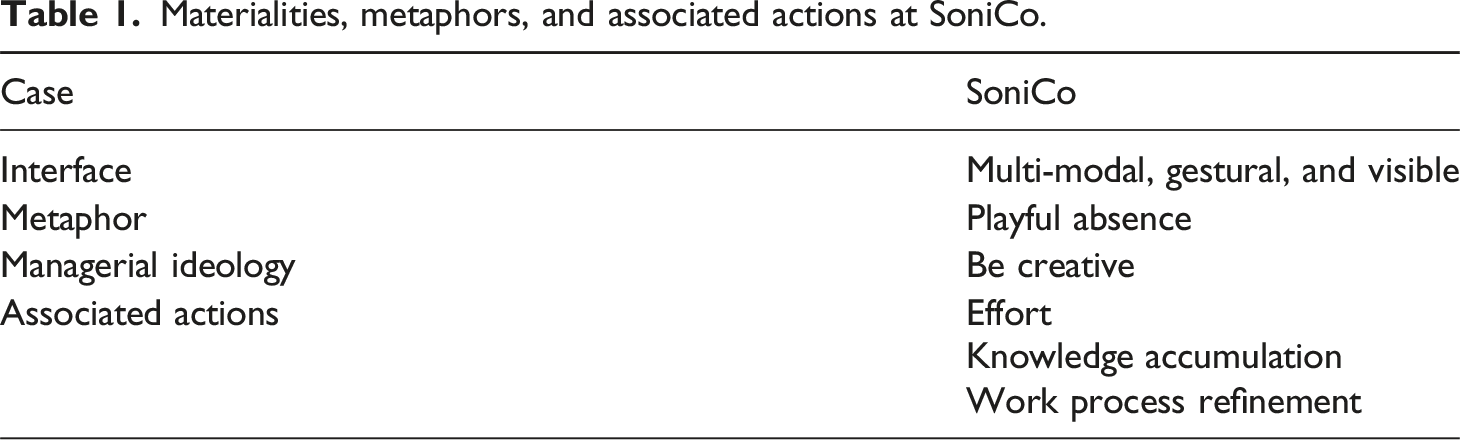
On slow days when SoniCo had only a few rehearsal or recording reservations, employees performed clerical tasks, worked on their own music, or distracted themselves by playing with expensive music equipment in the office. These distracted moments resemble immersive, aesthetic experiences. During moments of interaction with music equipment (“gear”), employees often invoked immersion metaphors. They “disappeared” or “lost themselves.” As one said, One time I was in a session where a band was using that new Moog Voyager that we have, and they took a lunch break for an hour. I just sat there and played the Moog while they were out [mimics the sounds of an analog synthesizer]. When [the musicians] came back I was like ‘Whoa it’s already been an hour!’
Another employee described these moments as “hyper-focus where time is irrelevant and hunger or going to the bathroom are [irrelevant] too” akin to “reading a novel and not wanting to put it down, that kind of immersion.”
The staff’s immersive absences tended to be linked to objects, suggesting close links to theories of aesthetic experience and recent sociological discussions of aesthetic engagement (Pagis and Summers-Effler, 2021). As Dewey said, “[experience] is aesthetic in the degree to which organism and environment cooperate to institute an experience in which the two are so fully integrated that each disappears (2005 [1932], p. 259). Similarly, Adorno said, “through contemplative immersion the immanent processual quality of the [art]work is set free” (Adorno, 2004: 175). The immanent potentials or affordances of the technology––designed, programmed, or hidden––come to life in “disappearing” and the other metaphors I describe later.
Studio staff’s immersive moments involve physical interaction with intensely gestural technological interfaces that afford innumerable possibilities for action. For instance, the Moog mentioned above contains multiple control surfaces that adjust timbre, volume, and pitch. These include a piano-style five octave keyboard, a “ribbon-controller” for “sliding” between notes, a “Touch Surface Controller,” two wheels for slight adjustments to pitch and modulation parameters using one’s left hand, 50 knobs and 10 switches for timbre adjustments, and a patch bay for routing electrical signals to further alter the instrument’s synthesized sounds. As noted by Born (1995), these gestural components of interfaces allows users to feel visceral closeness to technologically produced sounds.
Elsewhere in the studio, audio engineers referred to gear as the “porn side of the job,” echoing Caldwell’s (2008) finding that equipment and masculine identity tend to be strongly linked in culture industries. Interacting with these machines may not allow SoniCo’s workers to enact a desirable identity separate from that of studio attendant (cf., Anteby, 2008), but technologically mediated interactions do alter the “feel” of work. As an employee explained, being in the “zone” vis-à-vis the machine “does not feel like work”––a sentiment echoing Schüll’s (2012) description of gamblers who chase subjective absence or “play to extinction.”
Management encouraged and, at times, explicitly desired these moments of deep, contemplative interaction between staff and “gear” and employees. An owner often paraded the equipment out when it arrived and invited appreciation, stating “Here’s your toys guys!” or rhetorically asking, “Aren’t they beautiful?” As a manager said, “If you’re fucking around with synthesizers or whatever, that’s cool. It’s helpful for us. We need someone that knows how to use those things and you’re doing it.” As such, these moments replenish the company’s stock of knowledge regarding new equipment and make employees “feel creative” at work.
A failed attempt at aesthetic enrollment
Management’s attempts to aesthetically enroll employees do not always work as expected. This control strategy depends upon an assemblage of workers’ subjectivities, technological design, and technologies’ interactional availability within workers’ routines. An example of this comes from early in my fieldwork when I worked on a concert with SoniCo’s “rental” workers. Rental staff include many of the same people who work in the office as well as other aspiring musicians and struggling freelance recording engineers. These workers perform manual and technical work need to set up recording and public address (PA) equipment at small events and concerts around LA. Rarely a full time position, these jobs’ hours frequently changed with little notice. These were SoniCo’s lowest paid positions with the least autonomy. Consequently, rental staff had the highest turnover at SoniCo.
As one rental worker said, “those jobs are the worst, especially the jobs in Hollywood. Those people just treat you like the help. Like you don’t exist.” As he elaborated, this treatment of employees extends to the company’s owners also treat employees poorly in this context: They get pissed off at you for not bringing equipment that the company doesn’t even own. Like, this one time an owner flipped out on me because the client wanted some sort of black cloth covering for a DJ table. Well, we had one that we use for the drum riser. That’s the only one the studio owns and I told him that and he said 'well you should just bring one from your home’ like I’m supposed to know that we’ll need things that we [as a company] don’t possess and, y’know, I don’t own black sheets and if I did and I pulled them from my bed, they’d be dirty.
Harold, the rental supervisor, added, If a client is upset, the reaction from the partners [owners] is a lot more harsh and brash than if a client was upset in rehearsals, retail, or recording. If a client is at all unhappy or even perceived to be unhappy at rentals, it’s a really big deal. It’s not uncommon for me to get yelled at over something. Because of that there’s so much attention to detail and we have to try to read people’s minds because of that.
Beyond emotional resilience, workers were required to possess specialized, often tacit knowledge acquired in the context of work as musicians and studio engineers. Not just any able body was sufficient for loading and unloading trucks containing $10,000–$200,000 worth of instruments, amplifiers, stages, microphones, and other sundry items. My experience as a musician for more than 15 years prior to fieldwork greatly benefitted my access in this regard. As a co-owner said on my first day of fieldwork, “See, he just got here and already he’s right to work after just 10 minutes” as I assembled guitar rigs, wrapped cables properly to avoid damage, and set up microphone stands.
Even on the “worst” jobs described above, owner-managers attempted to mediate the employer/employee relationship by aesthetically enrolling employees. I worked one of the “worst” gigs as part of the crew for a live music event in a Hollywood gallery. We unloaded the equipment and began setting up for that night’s performance. After 12 hours of work, the gallery became an aurally and visually vibrant space. The walls of the room featured intoxicatingly well-composed floor-to-ceiling Afro-Futurist photos of that night’s performers. Stenciled depictions of various instruments such as saxophones, guitars, and a Boss TR-808 drum machine adorned the walls side-by-side with these advertisements. Inexplicably, a cotton-candy machine stood in the middle of an artificial grass field. While perhaps exciting for the audience later in the day, this space was just another workplace for the crew.
Still, an owner-manager attempted to draw attention to SoniCo’s “beautiful” equipment, just as he did above. While the crew and I set up the event, the owner-manager frequently paused to show off equipment manufactured by SoniCo’s “partnered” companies. Staff acknowledged each piece as the co-owner said, “She’s a beaut ain’t she?” The unveiling of a vintage Rhodes electric piano and Vox brand amplifiers aroused only brief, restrained curiosity. This equipment rarely changes from event to event and rental employees are admonished to be mindful of the equipment’s cost if damaged. Consequently, staff were primarily concerned with maintaining the integrity of the equipment, not using it or admiring it.
None of the workers were particularly excited to be there. Geoff, an engineer member of the crew said, I like working at those [other venues] because they’re just beautiful places and I can work with really cool, new equipment. Like, they have these new [mixing] boards there and me and the other engineers are just like 'whoa, do you know how to work that thing? Have you ever seen one of these?’ It’s really great. Here though, man. Something about it. I don’t like this [music], but I guess later I’ll get a glass of wine and some fancy cheese and that’ll be ok.
He said this after his authority as an engineer had been repeatedly questioned and overpowered by clients.
Similar to the studio’s office employees, Geoff places positive value upon work wherein he can use new, interesting gear in “beautiful” spaces. He emphasizes imagined aesthetic agency (DeNora, 2000) vis-à-vis a new mixing board much in the same way that Moog synthesizers enchanted office staff. Employee subjectivity remains similar, but the objects vary in interactional availability. Rental workers’ experience prohibits interaction with equipment aside from preparing the objects for use for clients. Even the engineers who, in this instance, do engage in more creative aspects of this labor process do not particularly enjoy rental jobs. Unlike the studio or offices settings, rental workers possess little autonomy and their work allows little room for creativity. Many rental employees never work for SoniCo again. This employee retention problem may stem primarily from the long hours (typically 11 am–2 am), low pay, and low autonomy, however, rental employees also do not receive fringe benefits such as access to equipment.
Thus, workers’ subjectivity appears as a necessary, but insufficient condition for management’s attempt at aesthetic enrollment. It is not enough to hire workers with desired subjectivities that render the objects legible—springboards for imaginative inferrment of agency. Aesthetic enrollment also requires some semblance of worker autonomy as well as material positioning vis-à-vis objects that allows for interaction (Griswold et al., 2013).
Materialities, metaphors, and associated actions at SoniCo.
The Future: Routine work in digital media services
Dull scrapes and immersive wormholes
Compared to SoniCo, The Future’s staff used drastically different, blackboxed technologies to gather and process information. Software may seem less dazzling compared to synthesizers, but employees, myself included, were deeply drawn to the worlds within our screens. Workers claimed that new processes and new information offered by these technologies constituted work's most enjoyable aspects.
My team’s tasks involved gathering and interpreting data about YouTube videos to render a judgment regarding the financial viability of “creators” and their videos to decide whether to offer a contract to a creator. Staff then develop strategies by which further value may be, as management said, “extracted.” Here, I focus on the former (“prospecting”) in which staff “scraped” data from YouTube in search of potentially valuable content. To “scrape” refers to automated extraction of large corpuses of data from websites––a common data collection technique used in both business intelligence and social research.
At The Future, we “ran a scrape” using custom-built add-ons to Slack, an instant-messaging system. Ostensibly, this allowed seamless, simplified integration of internal communication and organizational search processes. Members of the talent search team such as myself just typed a short line of code, pressed “Enter,” and then, several hours later, Slack notified us of a completed scrape ready for processing.
The team member who ran the scrape would download the resultant CSV file and then upload that file to Google Sheets. This cloud-based spreadsheet enabled multiple workers to simultaneously process scraped data regardless of their physical location inside or outside of the office. Thousands of rows within any given scrape contained YouTube channel names, channels’ URLs, view counts, and subscriber counts. Employees combed these files, vetting potentially valuable YouTube channels row by row. Uploaded and shareable, portions of the scrape were prepared for processing by sorting on key metrics valued by advertisers—typically the number of “subscribers” and the number of total “views” for each channel.
Scrapes were then divided among regular employees and interns for “qualification.” “Qualified” channels were in English, had not been entered into the company database, and contained “some creative element.” These criteria left substantial room for workers’ judgment circumscribed by managerial goals. Employees tended to focus on high-value channels (100,000 or more subscribers) while interns focused on new, less popular channels (10,000–20,000 subscribers). In practice, scrapes containing the latter yielded fewer viable “leads” or prospects and thus unpaid intern labor provided a way for employees to cover less visible portions of YouTube while focusing on potentially high-quality, high-yield channels.
The Future sought already successful channels so the company could, as management said, “extract the maximum amount of value” from channels with minimal investments of capital and labor. According to a venture capital investor at an annual YouTube industry conference, the industry to celebrates digital content’s relatively low production costs—especially American-produced, English language content that “travels well.” 4 Many advertisers on YouTube and intermediaries like The Future prefer English-speaking audiences.
Combing through a scrape, workers typically opened multiple tabs within a web-browser, vetting hundreds of channels everyday alongside meetings and other tasks. We often opened several YouTube channels in rapid succession and so, we heard multiple languages and genres overlap for a few seconds before muting the videos. 5 Men complained about bad dates, computer-generated voices spoke coldly, and young men instructed viewers on how to clean vintage videogame cartridges. Women from around the world explained the best ways to apply make-up. Disembodied voices explained how to navigate the latest videogames and voices spoke Farsi overtop images of Heath Ledger as the Joker in Dark Knight.
Much like these workers’ lives outside work, The Future’s workplace sensations included dense, overlapping sounds and animated screen-environments that workers manipulate through keyboards, mice, and trackpads. Thus, social life’s heightened mediatization (Couldry and Hepp, 2018) prepares workers for tasks requiring fluid human-machine interactions within sensorially dense technological environments—a stark contrast with conventional theorizations of the labor process such as Burawoy’s outright dismissal of media and mediatization as relevant to understanding work subjectivity. 6
Designers of these technologies claim to promote workers’ focus through design by replicating everyday, smoothness of communication in an effort to increase productivity and consultants advocate for the adoption of technologies to improve “flow” (Johnson et al., 2017). As a technology designer said, “The goal is to feel natural, to get out of the way,” and allow workers to “feel immersed in their work.” Likewise, The Future’s workers spend much of each day on the web where content producers and distribution platforms such as YouTube aim to produce what industry strategists call “limbic resonance” 7 or what The Future’s staff called “flow architecture.” Industry consultants claim that by activating portions of the brain’s limbic region, designers can enable smooth, continuous consumption of content—a corporate fantasy, perhaps, but one resonant with workers’ experiences.
Workers used additional cloud-based databases that aggregate social media performance data––most commonly the SocialBlade database—to make judgments about the financial viability of YouTube content. SocialBlade contains monthly and annual growth charts for the majority of YouTube, Instagram, and Twitter accounts. Explaining his relationship to SocialBlade, an employee said, I really like Social Blade a lot. It’s a really interesting piece of software. It’s very simple and it’s very useful. It’s not 100% accurate, but it gives you a ballpark. I don’t need 100% accurate information. I need an idea.
With just “an idea,” he inferred a channel’s growth potential based on past performance illustrated by SocialBlade’s charts.
Often, these systems provided rather unclear information and so, workers creatively inferred or abduced how these systems produce the information—a process that Alfred Gell (1992) theorized as enchantment or how objects captivate viewers or users and that Lucy Suchman (2007) theorizes as a relation between users’ subjectivity and design. As an employee explains below, inferring these processes offers genuinely enjoyable, captivating experiences amid tedium: I like looking at tools and trying to figure out how tools can help [me]. It’s a puzzle. It’s building things. It’s trying to figure out how to use a hammer to build a house. Like, when you create a lever, there’s something exciting about that. I like it. What I [don’t] like is I have no control over the tools and the process. I still don’t have control of the tools, but saying that I no longer want to run scrapes because we’re not finding a way to use the system was something I just did.
Similar to SoniCo, The Future’s workers creatively infer potential processes afforded by technology. This process exerts power over workers insofar as the obscurity of the technology’s internal processes invite repeated interaction. Above, blackboxed technologies appear fascinating and “exciting,” yet never fully knowable due to being upstream (Siciliano, 2016a). Yet, the employee above had no control over tools with which he works. In fact, cloud-based tools may be detrimental to workers’ emotions and task completion due to constant, unpredictable, and blackboxed changes (e.g., Aneesh, 2009; Siciliano, 2016a; Gillespie et al., 2014).
Technology may enchant, but workers still lacked control over and knowledge of how systems work. Insofar as most of these tools exist as networked, cloud-based platforms, they change quite frequently. Technology, here, exists as an object of knowledge—evolving, changing, and in some ways never fully knowable—that engenders a desire to know and to understand (Cetina and Bruegger, 2000). Inability to understand and implement the technology results in frustration and improvisation (Siciliano, 2016a) while workers pursue immersive experiences.
Workers responded to lack of control in two ways. Above, some attempted to know and alter data acquisition processes—not unlike Sallaz’s “permanent pedagogy” (2015). This continued the organization’s larger project of rationalizing search and content acquisition to facilitate growth or “scale.” Often, employees made use of other social media platforms to search for new content. Relatively undirected save for weekly quotas, workers used their pre-existing knowledge and social ties to procure information. As suggested above, workers improvised alternatives when organizationally prescribed processes failed to provide useable information.
Others chased absence—what my co-worker Desmond called a “wormhole.” Every morning, he “checks the most popular YouTube videos or what’s trending to see if there’s any viral [videos] or any videos sparking everyone’s interest.” Beyond YouTube, he often has multiple Reddit and Facebook tabs open in his web-browser. On Facebook, Desmond mines his social network for data. “I like to find other videos of other friends, what other really funny or interesting people are following.”
With multiple browser windows open, Desmond tries to enter into “a wormhole of YouTube.” After working with Desmond for 9 months, I intuitively knew what he meant. Really, the experience should be familiar to anyone who has pursued information on the Internet. Pursuing one piece of information leads to bits of other information and then, without clear intentionality, you end up quite far from your origin. For me, going through a wormhole consisted of combing through large lists of channels and then clicking YouTube’s “suggested channels” links next to any particular video.
As Desmond further explained, Yeah, my co-worker, when I was telling him how to do prospecting, I was telling him that I would just sometimes open up a window, I would say maybe that channel we’ve already reached out to or maybe they’re not interested. I would then look at their channels and open a new window. Before you know it, I’d have 20 windows open and be super deep into some vertical [genre] where the channel might be popular and might be getting views, but you won’t be able to find it.
First, Desmond’s “wormhole” suggests travel or going “super deep” by way of numerous “open windows.” Desmond is, experientially, not in the office and, in a way, not anywhere at all. He traveled by merging with the video streams and at the end of his journey, he gained knowledge. As he explained, “I’ll spend maybe 20 min and find myself at a dead-end and go ‘Wow, I just wasted 20 minutes’ but [now] I know where not to go. So, that 20 min wasn’t wasteful. It was impactful for me.” Again, he travels through windows, finding YouTube’s “dead ends,” while chasing satisfaction. As he said, “There’s nothing more satisfying than finding that untouched channel, just like, you know?” Like disappearing studio staff, Desmond unlocks secrets, or, at least, learns where those secrets cannot be found.
Second, Desmond’s search activity is relatively undirected, but oriented to, on one hand, management’s goal of finding potentially lucrative content and, on the other, the search/retrieval structure of YouTube and other social media platforms. Desmond and his team did not search for any particular type of content beyond the aforementioned guidelines related to popularity, ownership, and language, however Desmond’s traversal of cyberspace hinges upon retrieval rather than the freeform exploration I found at SoniCo.
The Future’s staff described directed absence, suggestive of a more fully circumscribed immersion, one bound up and bound in by both organizational goals and interfaces. The Future’s management placed quotas on staff, requiring them to contact 75 new channels each week. According to workers, worm holing and other immersive moments aided in achieving these goals. As Desmond said, “I find myself in that warp, that wormhole of just children’s channels, I may reach out to 50 of them that week” in addition to other types of channels. According to Desmond, chasing immersion resulted in higher rates of data gathering and outreach. Arbitrating the veracity of Desmond’s causal claim lies both beyond the scope of this article and, more importantly, of limited consequence to my argument insofar as my point here is not instrumentally normative.
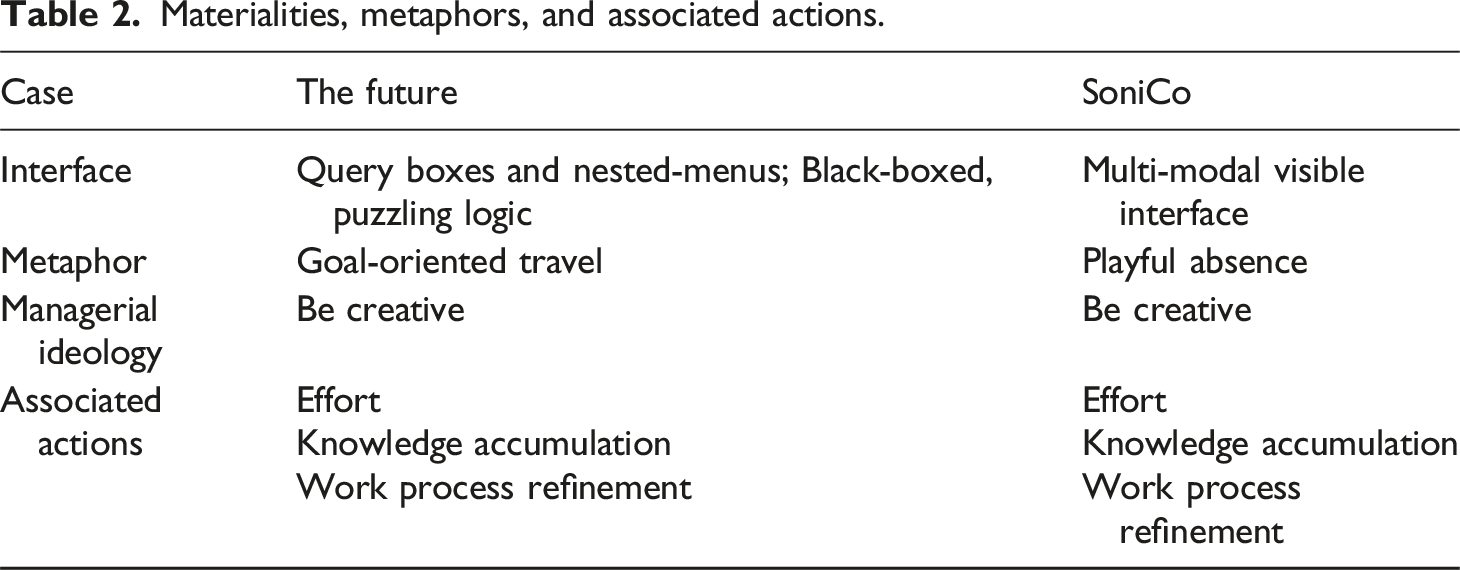
Instead, my point is to highlight how workers’ immersive experiences elicit managerially desired behavior while also demonstrating how both technological materialities and organizational context mediate these immersive experiences. So, SoniCo’s staff fused with “gear,” metaphorically entering into machines by way of numerous, open and visible gestural surfaces. In contrast, Desmond travels through a browser displaying various social media platform—directed just as much by each platform’s query structure as management’s quotas. Each platform’s interface contains spaces in which users may query globally distributed databases. Absence then always contains a narrowly defined goal of retrieval, even if that goal remains obscure to users.
Here, immersion appears not as escape but as productivity, managerially desired behavior rather than escape or resistance to tedium (cf, Baker, 1991; Burawoy, 1982; Roy, 1953). Workers pursue these aesthetic experiences—immersion in an object—and remain free to do so if they log all their activities. As a department head said, We need to have institutional knowledge established. That’s why we’ve implemented things like Salesforce and BCC tracking. That’s the big one, as much as the information that could be set as a logged call or keeping an email thread where I can go back and look at a channel for the last year and a half and see every piece of correspondence that’s happened with it, that’s the only way for that institutional knowledge to be passed on from one member of the team to another.
Free to achieve quotas however they choose, employees must maintain logs to pass information on to other team members or, given the high rate of turnover, new employees.
Desmond’s “wormholing” metaphor points to a common experience among “creative” knowledge workers. For example, Cetina and Bruegger (2000, 2002) describe immersive experiences among financiers, as have Christin (2020) and myself (2016a) in respective studies of journalism and digital publishing. In each, screen-based systems excite workers, providing desirable information and, as suggested above, immersive experiences. Rather than the deadening assembly-line or service work’s prescribed scripts, workers’ interactions with technologies resemble other aspects of social life and, perhaps more strikingly, afford the possibility of immersive, aesthetic experiences. Desmond’s experience suggests an organizationally mandated libido sciendi—the desire to know and understand complex systems that Boutang (2011) claims to be typical of cognitive capitalism. Entering a “wormhole” partially satisfies this desire as workers endeavor to understand the complexities of YouTube’s lesser-known regions.
Deep-diving into data
Another metaphor at The Future further suggests how technological materialities shape workers’ immersion. Among staff, the common phrase to “deep-dive” referred to gathering in-depth knowledge. As a supervisor at The Future explained, “It’s one thing to Google and grab a few things from the front page” but deep-diving consists of “looking through the deeper analytics and extracting meaning that you might not see just at a top-level glance.”
Like wormholing, deep-diving occurs through query-oriented software, accompanied by travel/retrieval metaphor. The deep dive, however, usually involved additional, nested menus as in GoogleAnalytics or YouTube’s similarly structured content management system (CMS) through which staff went “deep.” As another employee stated, diving deep entails going “much further than those surface level things.” Deep-diving into particular organizational concerns involved using data in conjunction with media content and tacit knowledge to render judgments and devise strategies. A version of this process begins by looking at line charts within YouTube’s CMS (skimming the “surface”). Since YouTube touts “viewing time” as its algorithm’s most important metric, workers often graphed “minutes watched” over video length to see when audiences stop watching. Workers then made a judgment or provided “insight” about audience behavior.
Like wormholing, deep-dive implies travel—what Moser and Hennion describe as “movement in which loss of control is accepted” (1999: 227). Below, another employee explained her “deep-dive” experience: [It’s] Zen. I like the focus. It’s easy for me to focus on numbers. Not everybody enjoys looking through numbers. I find it very interesting. To find, to dig meaning out of metrics. When I start digging, I just zone out from everything else. I’m very focused, very interested in it. That’s why I’m moving my career in that direction because I enjoy it. I’m very focused. You could say zoned out.
Being “zoned out,” typically a language of disengaged distraction, appears productive insofar as this employee unlocks data’s meaning. Opening multiple tabs in a browser, clicking through link after link in order to “dive” deep, workers produce meaning or “insights” for use in organizational decision-making. Here immersion appears as a necessary part of the production process––one that results in desired behavior - rather than as resistant escape from boredom (cf. Baker, 1991; Burawoy, 1982; Highmore, 2010; Roy, 1953).
Of course, employees do not always feel immersed. One noted his occasional immersion but more often, he said, It really does feel like I’m on the surface of things. I’m just like wading through, if you imagined it like a desk full of papers. It’s like oh I need this thing and thankfully software lets me recall it much quicker than anything else. It really is with my trackpad, it’s a lot of just swiping through stuff [makes gestural motion against table] and like ‘oh I need this thing and [pause] cool.’
Take note of the tactile referents in his explanation. While other examples indicated travel, movement, and focus—essentially going to another place wherein meaning can be unlocked, he felt “on the surface,” swiping documents back and forth on the top of his desk. He remained on the surface, stuck in place, his hand gesturing across a laptop’s trackpad—quite literally sliding his hand across surfaces as he drags documents into an email. Never diving deep or wormholing, he “skims” and glides as work feels superficial, even tedious, dull, or, as he said, “not particularly creative.”
Concluding discussion
Aesthetic experiences mediate workers’ effort and managerial power. Thus, sociological discussions of power in labor processes require attention to workplace aesthetics, including technology. For macro-sociological theories of Post-Fordist capitalisms, my findings suggest that capitalism produces subjectivities that interpret absences as productive and thus desirable—what Melissa Gregg calls the “productivity obsession” associated with aestheticized technology (2015, 2018). Workers’ felt, embodied experiences vis-à-vis objects (e.g., technology, media, and other organizational artifacts) need be central to any contemporary discussion of power at work. Understanding contemporary, cognitive capitalism requires empirical analysis of work’s aesthetics in addition to conventionally social interactions between people.
At the micro-interactional level, my data suggests that distinctive materialities shape processes of aesthetic enrollment. This point adds sociomaterial nuance to what might otherwise be a matter of individual psychology as in discussions of “flow” or “being in the zone.” Thus, this article contributes to both labor sociology and cultural sociology’s recent turn to aesthetic engagements in everyday interactions (e.g., Benzecry and Collins, 2014; DeNora, 2000; Moser and Hennion, 1999; Pagis and Summers-Effler, 2021).
Across various metaphors, workers make meaning through interactions with objects resulting in subjective absence alongside heightened effort. As aesthetic experiences, workers’ immersion is mediated by technological materialities and goals set by management. Playing the “game,” workers behave in ways desired by and encouraged by management. As part of this assemblage, workers’ aesthetic experiences underwrite managerial power and managerial invitations to “be creative”—common features of creative jobs in the US and UK (Siciliano, 2021; McRobbie, 2016; Mould, 2018).
Materialities, metaphors, and associated actions.
In terms of the “games” associated with capitalist control over labor, aesthetic enrollment is similar to the learning game theorized by Sallaz (2015) in his study of call centers. In both, workers “play” to modulates work’s affects or embodied intensities, however, workers chase absence to secure pleasing experiences rather than remedy discomfort caused by inadequate interactional repertoires as in Sallaz’s study. In both cases, workers associate immersion with increased productivity, not unlike findings from research on workplace affect in which these experiences tend to be associated with feeling creative and positive (Amabile et al., 2005).
Workers’ experiences vis-à-vis technology presented above resemble the sort of affectively engaging and, ultimately, productive absences discussed in a variety of contexts. For example, T. L. Taylor clearly illustrates the connection between technology’s aesthetic pleasures and increased productivity in Watch Me Play (2018), a study of videogame players who use the Twitch platform. Taylor quotes one player as saying that they “download the [latest] app because you think it’s cool, your friends have it or you have seen someone else use it, and you start to play with it, you get comfortable with it, and then you actually start using it regularly and you try to build something from that” (2018: 71, emphasis added). Taylor describes this as “getting hooked on the practice” (2018: 71), a process that begins with aesthetics (i.e., a “cool” and “comfortable” app). In Uncanny Valley (2020: 136), Anna Wiener’s (2020) memoir of tech work, she discusses workers’ relentless pursuit of goal-oriented “flow” (136) or “Deep Work” (173) during which Wiener, immersed within her computer screen, returns to her body only at the end of the day (219).
In sum, both cases in this article illustrate aesthetic enrollment processes in which technology’s distinctive materialities and organizational goals mediate workers’ immersive experiences. Felt intensities upon the body support managerial ideologies and, in this way, capitalist organizations delegate the relational work required to obscure exploitation (Mears, 2015) to technical objects. In response, labor scholars need consider workplace aesthetics including the design of technology. Just as technology may be designed to facilitate empathy and social change (Tettegah and Noble, 2015), technology’s aesthetics may facilitate capital’s domination of labor, eliciting effort, even in absence.
Footnotes
Acknowledgements
Many thanks to Ching Kwan Lee, Patrick Reilly, Steven Tuttle, Neil Gong, Nina Eliasoph and P.O.E.T.S., Kyle Nelson and the UCLA Ethnography Working Group, and Javier Auyero for thoughtful comments in writing this article.
Declaration of conflicting interests
The author(s) declared no potential conflicts of interest with respect to the research, authorship, and/or publication of this article.
Funding
The author(s) disclosed receipt of the following financial support for the research, authorship, and/or publication of this article: This work was supported by the United States National Science Foundation's Division of Social and Economic Sciences (Grant Number 1636662).
