




Abstract
During the Lebanese civil war (1975-1990), Beirut’s built environment was taken over by militias and used for sniping and launching military offensives. These operations took place across demarcation lines that cut through mixed neighbourhoods, eventually dividing the city into an ideologically Christian East and Muslim West. Due to Beirut’s excessive urbanization, navigating the built environment during the war became a necessity of survival. However, on a more imperceptible level, the years of repetitive navigation between, under, and around Beirut’s buildings contributed to learning scripts of othering, where sectarian ‘others’ were assigned to concrete structures that represented danger and foreignness. This article explores Lebanon’s sectarian war by analyzing how survivors interacted with Beirut’s built environment. Using the ethnographic approach of considering built matter, alongside humans, as co-constitutive of social phenomena, the article shows how matter can shed light on the emergence of sectarian thinking and behavior.
Introduction
‘On weekends, I’d go to downtown to just shoot. At the buildings, the other side. Just to remind them that we’re still there’. Halim, an ex-fighter active during the first years of the Lebanese civil war was answering my carefully contextualized question: ‘Have you shot someone in the war?’. Aware that my question was sensitive and warranted evasion, I was struck by how promptly it was answered by substituting humans for the shelled buildings of downtown Beirut. Why buildings? In the grand scheme of war crimes committed in the war, why was shooting at buildings Halim’s potent war memory and answer to my question?
During the Lebanese civil war (1975-1990), the capital Beirut’s built environment was taken over by militias and used for sniping and launching military offensives. These operations took place across demarcation lines that cut through closely stitched mixed residential neighbourhoods, eventually dividing the city into an ideologically Christian East and Muslim West. Such divided space orientated civilians and militiamen to new forms of urban dwelling, forged under the ominous shades of buildings, random checkpoints, barbed wires, and upturned steel containers that demarcated areas of safety and danger. Due to Beirut’s excessive urbanization, navigating the built environment during the civil war became a necessity of survival. However, on a more imperceptible level, the years of repetitive navigation between, under and around these material structures contributed to learning ‘scripts’ of othering, where sectarian ‘others’ were assigned to concrete structures that represented danger and foreignness. Abandoned hotels, overgrown parking lots, and rusting cars became incorporated into daily language of division, where people ceased to exist and were replaced by inanimate yet deeply political and sectarian ‘material things’ that started representing them.
The article explores sectarianism of the Lebanese civil war through the interactions of war survivors – civilians and militants – with their built environment, specifically Beirut’s buildings. The aim is to utilize built matter as an ethnographic and conceptual tool to shed light on acts of violence and survival, which are recounted as spontaneous, immediate, and tangible ‘encounters’ between people and built structures that represented sectarian enemies. This approach, in its methodology, contributes to the scholarly commitment of understanding sectarianism through its operationalization instead of its ontological meaning. The latter is a process that remains compartmentalized into socioeconomic, political, and ideological deconstructions that are difficult to measure and quantify in ethnographic research.
This article shows how the interaction of war survivors with their surrounding built matter beholds a complex process of polarization and drive towards sectarian violence, and is recounted by survivors of war as events or encounters where sectarian understandings of self and other were mobilized. Considering that the archive of the Lebanese civil war remains fragmented (Larkin 2011) and emotional (Haugbolle 2010), the article argues that built matter, put under the general category of ‘matter’, offers a methodological opening through affectual, embodied, visually engraved and often more ‘speakable’ alternatives to recounting the war and to eliciting difficult memories of sectarian violence and the actions that led to committing it. At the same time, the article shows that, in the case of militiamen’s experiences of war, centring stories on matter can intensify feelings of vulnerability and defer blames of criminality. Therefore, in addition to serving as a methodological opportunity, matter can relieve informants from the complex process of releasing self-criminalizing information in favour of more ethically fluid, tactile and communicable understandings of self during war. By presenting ethnographic examples, I show that built matter was not a passive subject on which war was imprinted, but rather facilitated and impeded sectarian violence and is therefore an actor of war deserving of ethnographic scrutiny. Built matter inevitably drew humans into division on a tangible and concrete scale, as will be evidenced by the following examples.
Prelude
The attention to anthropological questions regarding sectarian militarization in the Lebanese civil war is a venture that requires access to civil war testimonies by militants and survivors and is understandably human-centred. The war’s ‘militiaman’ is investigated by a variety of scholars through the prism of gender (Eggert 2018; Peteet 1991), class identity and mobilization (Johnson 2001; Petran 1987), and works that highlight the oscillation between memory and its ongoing implications on survivors’ lives (Hafeda 2016; Hermez 2017; Larkin 2011). Representations of war, through text, photography and film, also bring out textures of war identities that are overlooked in civil war overviews (Cooke 2002; Haugbolle 2012; Hourani 2008; Khatib 2008; Maasri 2009). Perhaps the most potent reflections of the war are found in memoirs that document suffering, political engagement and the gradual descent into aggression (Bazzi 2005; Makdisi 1990; Saadeh et al. 2005). The important work of urban geographer Sara Fregonese, for example, uses testimonies of war to account for the role of the built environment of Beirut in practices of sovereignty and micro state-building in tight spaces (Fregonese 2020). My original aim as an anthropologist was to add an ethnographically rich account of sectarianism in war-torn Beirut to the above scholarship. Through my study of the demarcation line that was forged during the Lebanese civil war, I embarked on unpacking the vast socio-spatial and affective dimensions that make borders living, elastic, negotiable ‘things’ (Ingold 2000, 2004; Jansen 2015; Navaro-Yashin, 2012). Beirut’s turbulent political history shows that it had always been a divided city and the war had simply re-inscribed a border that intersected socioeconomic and class intensities with religious ones (Baroudi 2006; Calame and Charlesworth 2009; Davie 1994; Fregonese 2009; Mermier 2013; Salibi 1976; Traboulsi 2007). This informed the research’s original approach of seeking validation that sectarianism was ‘negotiated’ in a complex web of class, status, nationality and sect at an arbitrary demarcation line where these signifiers were conveniently aligned.
However, as research progressed, I found that sectarian events of war, to my subjects, were not narrated chronologically with a strong use of the pronoun ‘I’, which provokes ownership and clarity of one’s engagement with war. War was rather an acutely engraved memory of sights, conversations, and pauses that happened in and around a handful of well-known buildings that loomed (and most still do) over Beirut’s demarcation line. The understandings of sectarian violence during war were excessively material-based, and powerfully evocative of the viscerality of division, fear and inaccessibility that was experienced through these built matters. As the names and physical features of these built matters became repetitive, it became quickly evident that subjects of my inquiry were not only limited to humans but to the things that surrounded them through which they actualized their sectarian identities. Sectarian violence appeared to be a synthesis of precise descriptions of buildings’ shapes, smells and textures, the size and number of their windows, and more subdued reflections on their current state(s) of disrepair. These buildings – hotels, office spaces and apartments – made matter, as philosopher Karen Bared puts it, inter-agential (Barad 2007) to humans who ‘made war’. In other words, sectarianism was experienced and articulated through actors’ interactions with built matters, without the candid articulation of their sectarian tendencies.
This article therefore views Beirut’s built matter as participants in the process of sectarianization rather than passive subjects – shelled, destroyed and looted – or vessels of war. By engaging the built environment, my intention is two-fold. First, I draw matter into discussions past their physical forms and usages and highlight their value in the extraction of embodied, unvocalized testimonies of war that show how people began thinking in deeply sectarian terms. More specifically, Beirut’s built matters divert respondents’ focus of thinking of themselves or others in sectarian terms but rather offer an alternative form of expressing sectarianism without unnecessary burden of self-identification or fear of being judged as sectarian. In essence, Beirut’s built environment is a lasting space through which the language of sectarianism can be communicated. Second, I aim to highlight the inseparability between actions and emotions that humans imprint on matter and those that matter imprints on humans. In my case study of the Lebanese civil war, both humans and matters are both agential in reinforcing the sectarianism that is described in war memories. By considering matter as an agential subject of research, I show how war takes form in people’s interactions and encounters with their direct surroundings – spontaneously, randomly and pre-sensibly – and often come unencumbered with the calculated conviction of avoiding or attacking sectarian enemies. The result, in my study, is a parcel of knowledge created and qualified as an ‘expression of sectarianism’ by the simultaneous and contingent interactions between humans of war and their material surroundings.
To achieve this, the article briefly engages theoretical conceptions that elevate matter to an analytical level useful for the study of sectarianism during war and then reflects on three ethnographic instances where matter entered as a co-subject to generate sectarianism – broadly defined. I choose these instances in particular to illustrate the tight-knit intimacies between humans and matters that were expressed repetitively and evocatively by my research subjects, but they by no means encapsulate the potential of matter generally in my study of the civil war. The first example looks at how specific built matter tested sectarian separation on a neighbourhood level in downtown Beirut, which later became the apex of the demarcation line. The second, more ethnographically rich account, shows how the demarcation line was formed in people’s minds through personal interactions with specific built matters. The third encounter with matter illustrates how it can be used as a methodological tool to elicit difficult memories that trigger admissions of sectarian violence. The material gathered for this article is a combination of in-depth interviews with pseudonymized survivors and militants of the civil war, an architect and a memory conservation activist during two stays in Beirut between July 2015 and March 2016. The latter is supplemented with war memoirs, visits to specific buildings and finally with multiple walks along what used to be the demarcation line in Beirut that remains dotted with many war-torn buildings today. Being an inhabitant of Beirut and my detailed and intimate knowledge of the city and its war buildings supported my fieldwork and understanding of interlocuters’ descriptions.
Beyond built matter as a witness
I examine the intersection of Beirut’s built matter with war memories using philosopher Karen Barad’s work on inter-agentialism, which falls under the umbrella of the ever-growing field of ‘New Materialism’. New materialists treat matter as an equal agent to humans in determining social meanings, and Barad’s work in particular sheds light on the potential of matter, which becomes ‘activated’ through its interaction with humans to imprint what is experienced as a social ‘reality’ (Barad 2007). According to Barad, it is in this state of interaction and intertwining that matter and humans become mutually agential and create viable products open for analysis and understanding. In this research, Barad’s work offers a tool that renders Beirut’s built matter analytically useful in identifying and recalling experiences of sectarianism, or sectarianization, that come to life when interviewees offer memories of war. This inter-agential ‘moment’ is ethnographically captured when informants begin seeing material objects as having human qualities (such as a sect) that should be protected or destroyed, depending on the side of war one is on. Similarly, built matters, depending on how they were constructed or positioned, imposed their own modes of warfare and engagement and were crucial in sectaranizing areas where sectarian communities were geographically close. The most notorious example of this, for example, was Beit Beirut also known as the Barakat building, now functioning as Beirut’s first war museum, which, due to its geographic location and asymmetrical architecture and floor plan, allowed right-wing Christian fighters to snipe and control their area ferociously. My choice of Barad’s inter-agentialism aims to conceptually invoke the messy and co-constitutive process that allows humans and built matters to be agents that co-create the phenomenon of sectarianism during the civil war, which I unpack through ethnographic detail.
Recognizing the challenges of centring matter as objects of ethnographic pursuits, anthropologists can attune to spaces and things that are rendered ‘sensitive’ to their subjects of research (Frykman and Frykman 2016). Emotional intelligence is key and requires listening to changes in how informants communicate. These cues could be as simple as the slowing down in speech, increase or decrease in speed of breathing, or the avoidance or eagerness to discuss particular objects that emanate particular affects on informants (ibid, p. 15) and change their ways of communicating. If anthropologists are trained to listen, then they can ‘listen’ to how things do work on people. However, understanding how built matters exert agency on interlocuters requires the ethnographer’s deep understanding and observation of the material structures that interlocuters mention. This process is key to understanding how these structures exert their own agency on actors who utilized their physical and spatial features while conducting war. Such materials, if accessible to anthropologists, should also be immersed in, by touching walls, stones, looking out windows and simulating the interactions with materials as narrated by their subjects (ibid, p. 23). Matter also imprints emotions of victimhood, victory, or death without the necessity of verbalizing them directly. Since several such admittances are inexpressible for a variety of reasons,
1
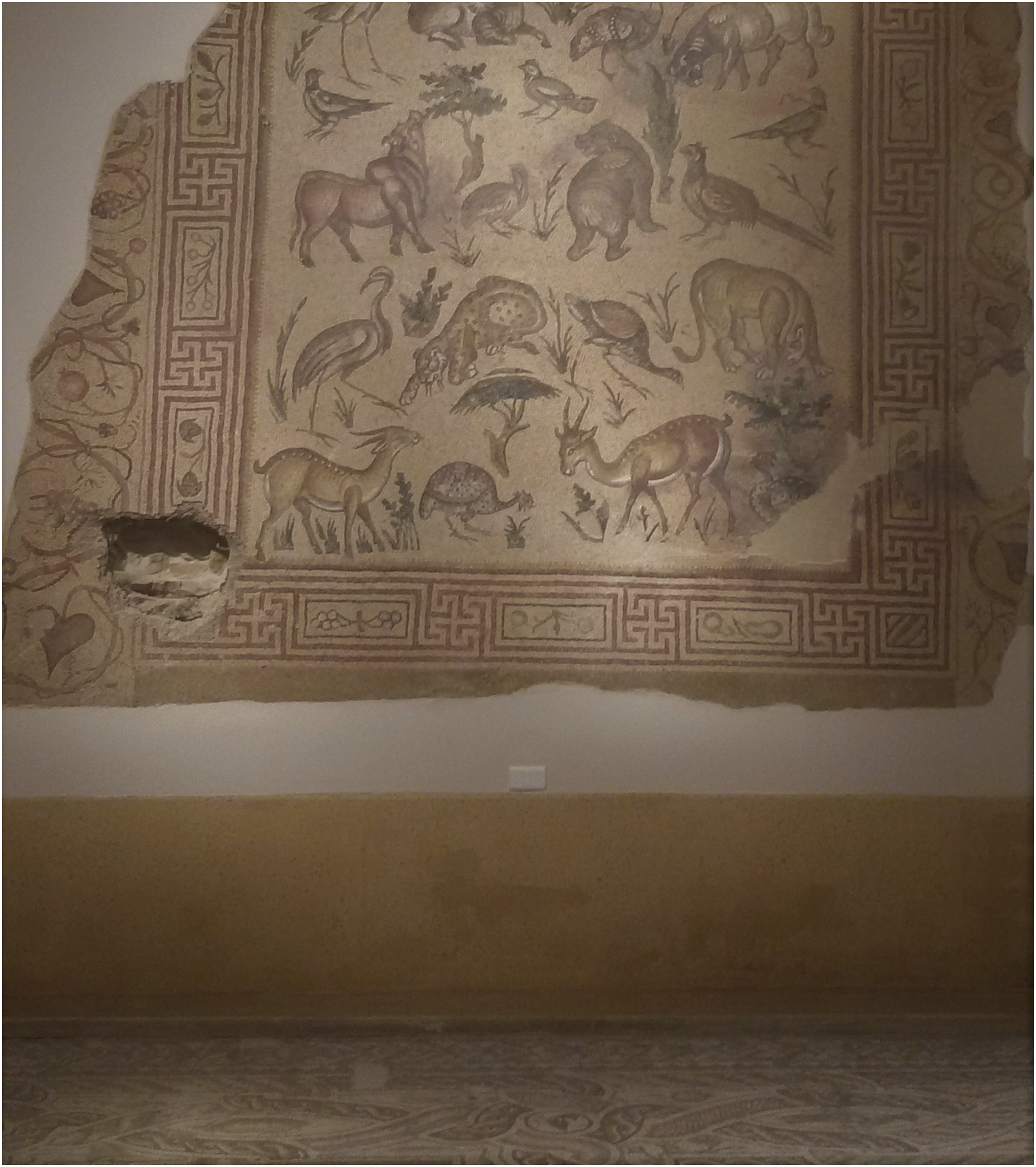
I find it useful to render Beirut’s built matters ‘affective’ – as in capable of eliciting memories and reactions of violence otherwise inaccessible through direct narration. The following sections make use of the above-mentioned conceptualization and methodology by attending to pauses, repetitions, and diversions in conversation on matter to deflect very real and complex human emotions such as criminality, guilt, revenge or hopelessness in the space of war-torn Beirut (Figure 1). A bullet ridden wall in Barakat Building. Beirut, March 2016. Taken by author. A sniper hole in a mosaic at the Beirut National Museum. Beirut, March 2016. Taken by author.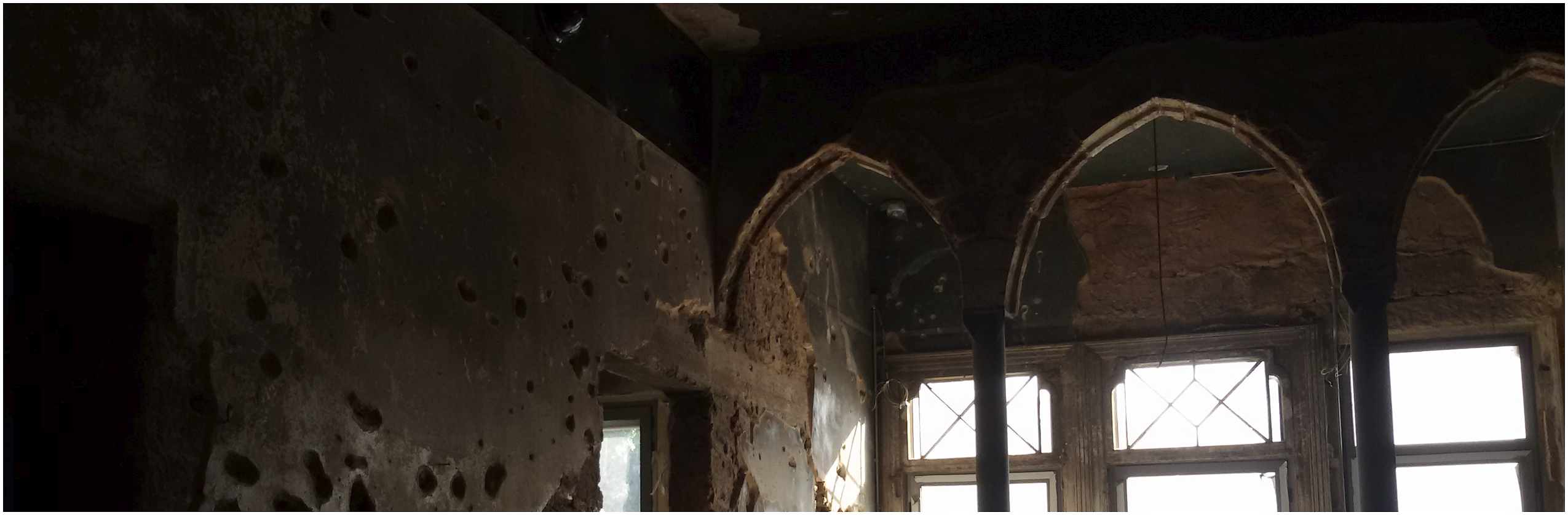
Beginnings
Lebanon’s civil war officially started on 13 April 1975 and ended 15 years later with the political settlement known as the Taif Agreement. The settlement froze the Lebanese civil war at a moment when sectarian divisions were routinized, by seeping into life’s most minute functions such as public service, urbanization, and education (cf. Cammett 2014; Salloukh 2015; Nucho 2016). Having started with a division between right-wing nationalist, Christian-dominated militias, and left-wing, pan-Arab, Muslim majority militias, the later years of war were muddled by international actors, inter-group clashes and newly forged loyalties or betrayals between sectarian groups. However, the first stage of war, also known as the 1975-1976 or ‘two-year’ war, is remembered by Beirut’s survivors as the most brutal and divisive period where East and West Beirut became, respectively, Christian and Muslim fiefdoms. These recollections include mass massacres, checkpoints, assassinations, road-side bombs and sniping which demarcated the city through death and collective fear.
One of the earliest battles of the two-year war, namely, the ‘Battle of the Hotels’, took place in between sea-front hotels and commercial centres of Beirut’s downtown area. Downtown, previously the centre of Lebanon’s leisure and commerce became the apex of the demarcation line that cut the city along its north–south axis. The transformation of downtown from a mixed centre into two autonomous sectarian fields was the beginning of Beirut’s urbicide – or deliberate killing of the city fabric (Fregonese 2020). Within months, downtown was hollowed out by repetitive combat, leaving in its wake a husk of what was once a vibrant cosmopolitan centre, now reterritorialized into East and West Beirut. In comparison to the later years when the demarcation line became deeply engraved, the first years of war showed that the demarcation line was messy and porous and inscribed daily through geopolitical negotiations of territory during which key buildings played a key role.
A war of few buildings
The Battle of the Hotels ended only with the territorial reconfiguration of militias in March 1976 with the fall of the iconic Holiday Inn hotel at the hands of pro-Arab militias. The western side of downtown, also known as Minet al-Hosn, expanded into West Beirut, upon which the luxurious hotels and centres such as the Holiday Inn, the Phoenicia-Intercontinental, Alcazar and St. Georges hotels as well as the Burj al-Murr Tower, the first skyscraper in the Middle East, were built. This area became known as the ‘Fourth Sector’. The fiercest battles began on 8 December 1975, in retaliation to the Black Saturday Massacre that was instigated by Christian militias two days earlier at the port, a stone’s throw away. The massacre claimed hundreds of Muslim lives, and set the precedent to large-scale massacres of Lebanese civilians. Although the Battle of the Hotels was especially exacerbated following the events of Black Saturday, it went on for several months as militias reterritorialized their power between hotels and their surrounding buildings, sometimes even overnight. Propaganda, including graffiti and posters, incorporated images of these iconic buildings and essentialized them into symbols of martyrdom and monumental victory (Maasri 2009; Fregonese 2012).
On a busy December afternoon, at a terrace of a local café, I was meeting with an ex-Christian right-wing nationalist fighter and an ex-Marxist communist fighter who were enemies during war. Now capable of polite interaction, they revealed the following: Christian nationalist: I can’t remember the year, with the Israelis, there were two buildings that we wanted to remove to correct the map. Going back to the hotels. There were two big buildings which we couldn’t attack militarily, from a distance. We needed a weapon that shoots one-ton artilleries. No one had it except the Israelis.
2
It was called the “Wolf” Until today, we aren’t able to get it. Communist: (laughing): You’re still trying? Christian nationalist: We are still trying. Until today. Because it changes the balance of power. Just to confirm what he is saying.
I was asking my interlocuters, both of them having histories of deep involvement, how the downtown battle changed the war for them. A family seated at a table nearby stared blankly at us and I grew uncomfortable about our conversation. In what they jokingly revealed, the Battle of the Hotels in downtown was the crucial moment where boundaries of the war were drawn in their minds. To this day, they symbolize what the Christian nationalists were unable to regain and the victory fell to the pan-Arab left-wing faction.
Emerging victorious, the pro-Arab militia Murabitun along with several other leftist factions, mainly the Lebanese Communist Party, took over the hotel district of Minet al-Hosn and engraved their territorial landmark for the duration of the civil war. A short video published by Murabitun, with the title, ‘This Is How We Cleansed the Fourth Sector’, features the militia taking over the Holiday Inn hotel and, towards the end, driving around the destroyed downtown souk area with the anthem of the militia playing in the background. 3 The territorial demarcation of the line was defined for the course of the war, with the retreat of the Christian forces back to the east of downtown. During this operation, one of the Christian nationalist snipers of the Holiday Inn was dropped from the 23nd floor. His body was then collected from the street, his hands cut off and his legs tied to the back of a car, and then dragged by the victorious militia around West Beirut. This was done to show to the public the face (and the body) of the human who terrorized them behind his sniper scope for months (Itani 1977). To this day, the fall of the sniper from Holiday Inn and the consequential justice served in its most barbaric form are memories evoked by people who stayed in Beirut during the takeover and are also reproduced as common cultural knowledge. For example, a play performed in Beirut 4 in the winter of 2019 flirted with idea of vertigo and punishment of a sniper who was later dragged around the neighbourhood while children playfully cheered the convoy.
Hani, a fighter, who witnessed the takeover of the Fourth Sector as a teenager fighting for the Lebanese Communist Party, recalls, ‘It wasn’t their place. There was a defect in the balance. Now we made the line right’. He was referring to the Christian militia’s presence in West Beirut. This territorial equilibrium was established visually. To Hani, the way of ‘making things right’ was reclaiming a building that came to personalize the unwanted Christians infiltrating an area that should fall under Muslim control. In the language of buildings, Hani abstained from identifying himself as a Muslim fighter at war with Christians and settled for being an observer with an eye for precision. If stationed in the Fourth Sector, the Christian militia would be protruding rather asymmetrically into West of Beirut, disrupting the urban imagery of a demarcation line that is rather straight and unswerving. The feelings of arbitrary yet deeply embodied territorialization on display in the Fourth Sector which, prior to the war, was the consumerist and cosmopolitan heart of Beirut” appears to have been actively created to ascertain a feeling of victory and agency in a very tight, power-concentrated space. The geopolitical reasons behind the desire to control the area were the advantageously high-rise buildings that became machines warranting competition and battle, as the winner controlled the movement along the demarcation line. Territorial gains, in terms of economic spoils of war, were rather marginal in this area in comparison to the accumulation of hidden power on the invisible roofs of the Holiday Inn, the unfinished Burj al-Murr tower and other buildings, such as the shopping complex, the Fattal Building. After the Battle of the Hotels, the defeated Christian militias retreated a few hundred metres to the East, back to their headquarters overlooking the port, and with a tower of their own in East Beirut to rival those lost in the Fourth Sector.
The conversation between my interlocuters illustrates the importance of ‘a few buildings’ in altering the landscapes of militia control and the power of vantage structures in determining gains along the demarcation line. In a city with diverse neighbourhoods that are intricately stitched together, territorial power became extremely localized and scaled down. Even though the total area does not exceed a few hundred squared metres, the hotel district and downtown became emblematic of a civil war that was close and intimate, and where gains and victories were tied to particular buildings that designated sectarian identities. Within the game of reterritorialization that has its own logic such as ‘straightening’ or aligning the demarcation to fall between respective Christian and Muslim communities, buildings played a key role. They brought into focus the sectarian ‘other’ but with an effect of ambiguity that allowed informants to allude to their sectarian tendencies, without outwardly admitting them. The turn to built matter allows first, the visualization of shifting political territories in tight spaces, and second, and more importantly, the immense potential of matter in communicating war-specific phenomena such as spaces of deathly violence and demarcation, and the need to ‘restructure’ and ‘re-align’ the boundaries of a sectarian community (in this case, returning the Holiday Inn to West Beirut).
Things that make a demarcation line
Demarcations are not imprinted on residents as lines. As Jansen (2013) reminds us, borders are border-works. They are repetitively experienced through restrictions, openings, and personal negotiations, which over time, set up new patterns of navigating, narrating and relating to space. Beirut’s demarcation line was never fixed in concrete – such as the now fallen Berlin wall or the Israeli West Bank barrier. Instead, what created Beirut’s demarcation line were nodes where violence accumulated – such as checkpoints, debris from destroyed buildings and even endless greenery. The built structures positioned at these nodes of violence lent their names to an increasing repertoire of keywords that signified ‘danger’, which to my informants, substituted expressions such as: ‘We crossed to the Christian side’, or ‘There, it is Muslim’. The product of repetitive encounters with these built structures was a feeling of a demarcation line that should not be crossed, for fear of being caught or killed by the other side. During my interviews, the demarcation line was not reconstructed as a traceable entity with an origin and end. Rather, subjects of research relied on built materials to relay demarcation ‘moments’ where they felt they were crossing the line, in effect, leaving or entering antagonistic sectarian communities. Using the inter-agential framework, the memory of ‘crossing’, as a reconstruction given by informants years after the end of the civil war, is activated through the mutual interaction between specific built matters and subjects doing the crossing. Therefore, the attention to built matter is key to trace the demarcation line, which is communicated as movement between built structures, but is in reality a movement between Christian and Muslim spaces.
The section below first navigates the demarcation line according to events, things and structures that coalesce into intensities of divisions and products of othering. The ‘repertoire’ of demarcation, as is shown, is replete with material structures – including buildings and walls as well as large open spaces. The section then shares an ethnographic example of a civilian crossing the demarcation line to show how key built matters ‘materialized’ a totalizing, numbing experience of moving between one sectarian community and the other.
The Fourth Sector described above was the first node of the demarcation line that started at the sea and extended south to the city, swerving to suburban residential areas. Another way of ‘making the line’ was the disposal of bodies of militiamen and civilians at abandoned sites that slowly became known as spaces of death. Taht al-Balhat, translated as ‘Under the Palms’ of al-Burj square, the main square located in downtown, became one of the sites where bodies were found on a regular basis, along with the hidden space under the Fouad Chehab Highway (Sinno, 2008: 942). Most of the bodies that were collected from either West or East Beirut were dumped at these spots, which also became sites of executions to avoid the complications of cleaning after and transporting bodies (Borgmann and Lokman 2009).
At these nodes where violence was concentrated, previously accessible roads became passageways under the control of militias. One of the first passageways along the line was the ‘Port – Normandy’, which separated the port from the Hotel Normandy in the Fourth Sector and gained its name during the Battle of the Hotels. As war progressed, the names of passageways between the separated spheres of the city became incorporated into the quotidian language. These passageways were relatively traversable when were not obstructed by checkpoints, and in the early days, the regulation of the latter was random and chaotic. The hardening of the line took time. At the beginning of war, Tayyar checkpoints – most accurately translated as ‘Flying’ checkpoints, were set up randomly in the city to the musings of the militias. Civilians knew whether or not it was safe to cross by listening to the radio newscaster Sharif al-Akhawi, who would remain on air and advise listeners on movements within the city. His reliability and accuracy gained him the nickname ‘al-Daleel’ – ‘The Guide’, and ‘Sawt al-Dameer’ – ‘The Voice of Conscience’. He was particularly well known for his curt expression ‘Salkeh wa-Amneh’ or ‘Crossable and Safe’ to describe passageways (Saadeh et al. 2005; Sinno 2008).
The demarcation line slid south east along the well-known Damascus Road and crossed Beirut’s National Museum. Damascus Road was originally the main road that connected Beirut to Damascus and was a key infrastructure in the development of Beirut. This intersection became a permanent checkpoint, but also a crossing that was opened during ceasefire. Facing the museum, the infamous ‘Olivetti’ was a building taken over the Italian typewriter company Olivetti, under which Christian militias operated the checkpoint. The checkpoint was simply known as Olivetti, or Hajiz al-Tyus, ‘Checkpoint of the Rams’ – suggestive of stubbornness and inflexibility. Some Christians who operated this checkpoint lived in Musaytbeh, in West Beirut, but did not cross further west than the General Security building, located a few hundred metres away from the Olivetti. According to one informant, there would be an armed vehicle waiting for them there to transport them safely to West Beirut. The National Museum, simply known as the Museum, or Mathaf, became another scene for violence. Until today, war is imprinted on a mosaic located in the museum’s eastern wing where Christian militants destroyed the corner to fix scopes and overlook the street (Figure 2).
From the Museum, extending south along Beirut’s horse-racing arena and reaching the Muslim neighbourhood of Barbir, nature was left to fill the gaps of uninhabited spaces. Shrubs grew viciously, transforming the quiet and deserted roads into a thick green stretch which also became the home of wild and abandoned animals. Barbir, a checkpoint operated by pro-Arab militias and led by local leaders, such as ‘Issam al-’Arab at the time, marked the entrance to West Beirut.
What follows is a narrative of the demarcation line told to me by one of my informants, Rami, a Muslim resident from West Beirut. Rami’s narrative draws on matter to construct a memory of crossing. Trapped in East Beirut for a few days following the massacre of Black Saturday, Rami’s family finally got in touch with a distant family relative who worked for the neighbourhood’s pro-Arab militia leader in charge of operating the checkpoint of Barbir, West Beirut. Two Christian militiamen agreed to return a favour to one of Rami’s acquaintances and accompanied him with a military vehicle to the Christian side of the demarcation line, where they dropped him off. They also communicated with the sniper of East Beirut to make sure of ceasefire. On the other side, his relative was supposedly waiting at the crossing right behind the General Security building, armed and ready to receive him. He shares: The Christian militia accompanied me with their cars to a safe distance of 50 meters away from the Olivetti checkpoint and I was alone. I turned the corner heading for West Beirut and suddenly I saw these two Christian fighters signalling for me to stop the car. I knew the next question would be to show them my ID,
5
and then after that who knows. But my sharpness saved me that day. I saw one of them carrying a handbag and I had a flashback to the times when we would go hunting in the Bekaa valley and there would be some soldiers on leave carrying bags, asking for lifts. Without blinking an eye, I opened the window and said, At`een? – Are you crossing? Come, I’ll give you a ride! A brief pause and they accepted my offer. They must have thought that I did this regularly. One sat next to me and one sat in the back. I started driving, and my left foot was shaking violently on the clutch, it was a manual car. I was so worried that the one sitting next to me would notice my fear. I was so focused on staying calm that I arrived to the General Security building but continued driving! I completely forgot that I had to drop them off before that
6
! Now I have crossed into West Beirut. A strange silence grew in the car. The one sitting next to me turned to me and asked, “Where are you going? The General Security Building is behind us.” But his tone was different now. But he couldn’t do anything; it was not his area anymore. He had no power here. I abruptly stopped the car, and without a word, they let themselves out. I had arrived at the crossing where Ibrahim was supposed to be waiting for me, but there was no one in the street. I counted to 10, then I counted to 20...then I just started driving on slowly. It was unbelievable, the silence that day. There wasn’t even a cat! From the Museum to Barbir, there was not a soul. But out of nowhere, a car comes opposite to me, in full speed. I put my flashers on but this car just rushed by me, and the man inside didn’t even look at me. I grew incredibly nervous until I finally saw a Jeep with a doshka
7
in the distance. Those were my men! I got to Ibrahim and he welcomed me warmly. But he was in panic. He explained to me that while they were approaching the General Security building where they were supposed to wait for me, they received information that the Kataib party
8
was setting up a random checkpoint right at that specific location. They were worried I would not make it in time. (Rami)
This checkpoint that was set up by the Christian militia that day was a flying checkpoint. Later, Rami found out from his relative that the man who rushed by him in the opposite direction was a schoolteacher who accidentally got shot in his car by the Christian fighters who were supposed to save him on the other side. He died at the Olivetti.
Instead of reconstructing the demarcation line as a traceable beginning and end, informants like Rami relied on built materials to relay demarcation ‘moments’ that were personal reiterations of a pervasive civil war. As these accounts show, physical demarcations were instances of violence that were routinized, but more importantly, punctuated by built matters. Informants relied on these built matters to relay memories of crossing an unidentifiable, invisible demarcation line. The latter then took on meanings of violence and sectarianization that dotted the landscape and eventually formed antagonistic sectarian spaces that lasted throughout the war. Key buildings such as Olivetti, the General Security building, the Museum, and other infrastructures became synonymous with spaces of death, but also openings for survival and escape to the other side during ceasefire. These buildings were not only references of violence practiced by humans, but also spaces that imposed their own modes of usage, in language, warfare and crossing due to their architectures and locations. The General Security building, for example, was the essentialization of a demarcation ‘line’ at one specific building that served to divide populations and obstruct movements, even though it was not occupied or used as a checkpoint. Accessing information about demarcations through my informants’ reflections illustrated that demarcations were always narrated through traversals across, through or under materials that became markers of division, and where violence was always excessive. Whereas the previous section expanded on the materialization of particular phenomena of the Lebanese civil war, the next section engages built matter to divulge difficult memories of self that might be heavy to extricate and share. In these instances, matter becomes participatory in violence of war and an accessible witness that fills human silences.
Claiming death: Buildings as targets
Halim, a retired schoolteacher and ex-fighter in his fifties, recounted his war to me through exaggerated optimism. ‘We felt alive, not like now. Things were never nihilistic for us’, he would say cautiously, while sharing some information of his participation. Halim’s war was a matter of survival and solidarity with the downtrodden, whom the leftist Amal Party mobilized during the war, and to which he remains connected until today. Once, as we were nearing the end of our conversation, I asked him offhandedly which location he preferred for shooting. He answered, First of all, you take a location that overlooks your enemy facing you. You know this location has movements. You fortify it and you sit down and observe. Whenever you see any movement there, you shoot. But you must never be visible. Because they are specialists to find you and kill you. They can throw a rocket, a tank can fire at you and they would simply kill you. So one is always in a position where he should be protected. We would sometimes build three or four rooms with several walls that cannot be seen, you become skillful, just need to have a good eye. You change the whole place! They would be seeing everything from the front, but you wouldn’t be visible. Who shot? They don’t know (Halim).
Halim’s answer came as a surprise to me. The purpose of my questions was to locate which areas Halim would move around during the war as a mapping exercise, but instead, he admitted to sniping. I had known that he would snipe occasionally because to him, a sniper was merely a ‘harmless militiaman with a scope attached to his rifle’. This time, however, I felt Halim’s answer came with calculated experience.
What I would later learn is that admitting criminality takes on different forms. The most detested criminal of the civil war was the sniper, who was regarded as a separate entity, always working alone, and never fairly. ‘Even though the sniper is the avenger of the tribe, his people do not accept him (..) The sniper is not a hero (Traboulsi 2012, p. 184)’, reflects historian Fawwaz Traboulsi. In few instances when I mustered the courage to ask whether my informants sniped, they would instantly differentiate between those who sniped ‘in battle’ and those who sniped when the atmosphere was calm, or in my informants’ terms, ‘the real criminals’. Often, however, these two categories of violence were blurred, as peace-time and war-time were continuously intertwining experiences. In fact, snipers were the discrete makers and sustainers of the line, operating in Benthamite panopticons in the sense that the exercise of violence was often not even necessary in sustaining their power (Foucault 1977, p. 201). Beirut’s residents simply attuned to their omnipresence on the tops of high buildings.
As our conversations later deepened, I learned that Halim ‘sat’ in downtown for several months, waiting. ‘I waited my entire youth’, he told me one day, to balance out the perceived injustices and grief he saw inflicted by Christian nationalists on Palestinians in the massacres of the Palestinian camp Tall al-Za`tar, 9 and later, Sabra and Shatila. Raised in a politically active Shiite family in a southern suburb of Beirut, Halim grew up aware of the large class differences between him and ‘others’ – a signifier that was interchangeably used for Christians. When the Palestinians started establishing themselves as fierce political opponents in the early 1970s in the form of armed commandos clashing with the Lebanese army, Halim felt an overwhelming sense of excitement and joined a militia. He laments later, ‘When we became aware, we found out everyone was a criminal in the end’.
In downtown, Halim ‘worked the line’ – shtaghal al-khatt and joined whenever there were calls for backup. Sometimes battle was well coordinated with other militias to strike their opponents – mainly the Christian Kataib Party on the other side, but other times, Halim would just go to the downtown area on the weekends to shoot at the abandoned buildings facing him. He would often bring his girlfriend as well and instruct her on how to aim and shoot at invisible targets hiding behind windows. In a gesture of masculine protection, he points out how he would always have to grab her shoulder because she would otherwise injure herself while firing the gun. Downtown, to Halim was a place where opponents were faceless.
However, during the critical moments when I found myself asking Halim about shooting and taking lives, his answer would come enmeshed in descriptions of the buildings that he used for his operations, instead of direct descriptions of his victims. He recalls, We were three people. We were surrounded and one of us was this guy. All the party that was with us had rifles with scopes. And the most dangerous was this guy, he lost his hand but wanted to continue his military life and so he became a sniper. We were in a building. It was an abandoned building but it had a great view. This building didn’t have people in it. There was that building that we used because people lived there, and we took over it. We would sit at the entrance of the building or go up to the roof. We would be forced to break a wall sometimes. One time I went up to the 5th floor, we found that the bathroom overlooks the centre which we had targeted. And we started putting sandbags to fortify it…there was no problem. (…) I waited for thirty minutes, but my arm started to hurt so I rearranged the sandbags. I was careful not to attract attention (Halim).
That day, Halim shot at people. However, he could not admit to that so openly and instead layered his reflections with acute descriptions of what was around him at the time. Physical things found around him, such as walls and sandbags, were re-activated to share blame or guilt, and accommodated the position of a perpetrator, or silent yet consenting observer who allowed violence to happen. Instead of detailed descriptions of victims, Halim instead mechanized and deindividualized his practice of violence to include matter as an arbitrator, or facilitator of his crimes. His material surroundings at the time invoked in Halim’s speech the opportunity to partially reveal his developing criminal subjectivity, without directly admitting it.
The built material directly surrounding fighters was often conflated with humans as targets of killing. An informant Munir described to me the reaction he had to seeing his Armenian friend Mano getting shot in the street, and later dying in his arms. He recalls, The reaction? I got a shelling machine and threw three shells at a building called Abu Jawdeh. It was on the Camille Chamoun Boulevard. [I shot] without a specific aim, but it was a building that snipers used. It didn’t matter, the whole building had to come down. Then the car came. They would take the martyrs to the University
10
(Munir).
Munir, a killer of buildings, rather than a killer of people, found ways of expressing his lethal revenge by shooting at built matter that symbolized his enemy. The number of victims was rarely shared with me. However, the name, location and physical attributes of the Abu Jawdeh building were acutely communicated.
Separately, Ghali, a Christian fighter from East Beirut, also shares a memory: When you see someone shoot someone else, a 60-year-old deaf man coming to his son’s apartment to check on it, what do you feel? I felt great hatred that day. They were sniping this old man, who was deaf, he couldn’t hear a thing and they shot at him several times. That day we were forced to close the street. And truly. That evening, we got a tank and we destroyed the five buildings, I remember them name by name. I told the son that his father’s blood wouldn’t go in vain. All the buildings that were facing us we destroyed with the tank. Dijj Dijj..for two hours until we stopped. What was his fault? Do I want to go kiss the guy who killed him? (Ghali)
Such discussions demonstrate informants’ hesitations in individualizing themselves as killers or their opponents as victims. Instead, built matters become faces of detached ‘others’ who can be claimed as victims. In these examples, Munir ‘humanized’ an entire building, while Ghali humanized an entire neighbourhood which, in their communication with me, was conflated with their targets who they refused to name or number. Although such practices are not specific to the Lebanese war, they are significant because buildings were often inhabited by neighbours who found themselves turning into militia members and mercilessly dragged into opposing sides, especially in spaces where the demarcation cut densely populated neighbourhoods. In such areas, victims could be easily identified by the shooter, which, to some of my interlocuters, warranted even more silence and ambiguity.
Conclusion
As these ethnographic accounts reveal, Lebanon’s sectarian war was shaped, impacted and hatched within material structures through which sectarianism was operationalized. In research that delves into personal and conflicting accounts of civil war, involving human survivors and perpetrators is simply not enough to de-tangle the complexities of conflicts that are ongoing, and in the case of the Lebanese civil war, routinely silenced by the political class to enforce collective amnesia and crush any motion of accountability. As the accounts above show, built materials can also be violent perpetrators, and ‘things’ that formalized demarcation lines and consolidated key battles that defined the sectarian divisions of Beirut and impacted the ways in which war is practiced, remembered and then communicated.
More conceptually, the ethnographic examples show that humans and built matters are entangled in a process of mutual signification, where both exert agency and control over Beirut’s warscape. Sectarianism was enacted and amplified through interactions between people and their material surroundings, that is, not only in the ways humans utilized their built materials and assigned meaning to them, but also the ways buildings directed human behaviour through the former’s physical features and positions within the city. By viewing humans and built matters as inter-agential, my aim is to touch on an elusive sense of sectarianism that was operationalized in a dense urban environment, where antagonistic sectarian communities lived in close proximity.
By employing a mixed methodological technique of listening closely to encounters of war survivors and participants with their direct environments, and by also visiting, touching, looking through and ‘listening’ to built matters, the article argues that matter is a worth engaging as a co-constituent of sectarian behaviour. Matter is a reliable, visible and tangible storyteller, witness and producer of war and war spaces and comes into prominence through interactions with human mobilities and geostrategies that are pursued or avoided. Matter complements the pursuit of embodied knowledge of war activities and movements and is essential to their recollection, activation and realization. By sensing and attuning (to) matter as more than a decorator of landscape or physical container of violence, research on war can expand into new directions. My intention is to illustrate that the immersion into material is worthy and often crucial for the investigation of the Lebanese civil war by social scientists interested in its continuing impact on the humans who experienced it first-hand.
Footnotes
Declaration of conflicting interests
The author(s) declared no potential conflicts of interest with respect to the research, authorship, and/or publication of this article.
Funding
The author(s) received no financial support for the research, authorship, and/or publication of this article.
