




Abstract
In contemporary capoeira groups, newcomers are symbolically ‘baptised’ into the community at a public ceremony called their Batizado (literally baptism) held during a festival. Novices play a game with a guest expert, get their first belt and thereafter they are members of their teacher’s group. Drawing on a long term, two-handed ethnography of diasporic capoeira contemporanea in the UK, including observation of 53 such festivals, their ceremonial features are analysed. At all the stages of the ‘welcome’, before, during and after the batizado, the topic of gender in capoeira contemporanea is explored. In the last 40 years, women have become enthusiastic participants and are core members of the groups we have studied. The article compares the sociological (symbolic interactionist) and anthropological approaches to ceremonies and rituals such as the capoeira batizado, drawing on Glaser, Strauss and Katz compared to van Gennep, Turner and MacAloon.
It is the Saturday of the last weekend in November 2019, in a dark, cold, commercial gym on an industrial estate in Bristol. The high point of Mestre Claudio Campos’s 32nd Capoeira festival is about to take place. Novices are about to get their first belt, to join the capoeira family, and some more advanced students are about to graduate to a higher belt. What follows is incomprehensible and unimpressive to an outsider, but of enormous significance to those involved. A line of chairs is set out, and people with musical instruments seat themselves and start to play. Everyone else present sits on the floor in a semi-circle. A solo singer begins a call and response capoeira song, and everyone else joins in singing the chorus. The solo singer, an African-Brazilian man in his fifties, sings about Bahia, the city in the North East of Brazil, and the seated sing the simple chorus ‘Bahia Axé, Axé Bahia’. Everyone claps a rhythm. Nearest to the musicians on the right hand side of the circle are half a dozen capoeira teachers, men and women, and on the left hand side nine anxious-looking novices. The musicians (the bateria), the teachers, and the novices all wear white trousers and the emerald green T-shirt celebrating this festival. It shows a musician playing the berimbau, capoeira’s iconic instrument, and two capoeira players. On a signal from Mestre Claudio Campos the man in charge, a teacher, steps into the circle and squats at the foot of the lead berimbau. A student joins the teacher and they play a cautious game. When the teacher is satisfied that the novice has demonstrated some basic competence he or she is put onto the floor, helped up, taken to the berimbau again, and then led out of the circle to the side where their beginner’s, blue, belt is placed round their waist. Everyone claps, the music and song resume, and another pair repeat the process.
Of the nine beginners on 30 Nov 2019, only one man plays ‘his’ teacher aggressively, and is ‘taken down’ by the expert. The others are lifted and placed gently on the floor (all three women and two of the men) or lose their footing in the game and fall to the floor. After the novices, four people who have the Blue belt already play two teachers each and get the second Blue and Brown belt. Then one man plays three teachers for the Brown belt, and finally one woman on Brown plays three teachers and gets the Green and Brown fourth belt. That concluded the 32nd batizado and graduation. Every aspect of this ceremony has meaning in capoeira, and those meanings are analysed in this article.
During our fieldwork we have seen the initiation of as many as 45 novices in one ceremony, 12 or 13 people being promoted to Brown, or Green and Brown, and a few people awarded even higher belts each playing up to six teachers. While this was a small ceremony, we feature it here because it was the last one observed as part of our fieldwork before COVID-19 closed live capoeira festivals in the UK, and it contained all the elements we discuss in this article.
The article focuses on these baptism (batizado) festivals, which welcome the novice students (discipulos) into the club, the group, and capoeira contemporanea itself. The batizado is a rarely studied feature of capoeira contemporanea (a term we explain below) in the UK, but deserves attention. The title is a quotation from ethnographic fieldnotes taken in 2016 at the Summer Festival of the group Nucleo de Capoeiragem. During the ceremony the novice students (discipulos) receive their first belt (corda). Before it begins, the belts to be awarded are laid out, usually on a table. In capoeira contemporanea, the festivals are high points for many students, and the ceremony of baptism is a symbolically important part of the whole event, which signals the coherence and continuity of the group.
Our aims in this article are to highlight an important feature of the contemporary capoeira experience in the UK that has received little ethnographic attention, and to analyse the initiation ceremony as a rite of passage in its context of an exploration of the culture of contemporary capoeira. The research aims were to explore these ceremonies as rites of passage, and to contrast them with secret and esoteric rituals commonly described in anthropology. The core research task was to analyse the ways in which the culture of contemporary capoeira in the UK is manifested in the regular festivals run by teachers and their groups. We do this by analysing batizado events through the various phases that occur, as rite of passage.
We start by providing a short description of capoeira and outline its history in Brazil, its ‘home’ country, and in the UK where our fieldwork was done. In these sections, we identify the three main varieties of capoeira, regional, angola and contemporanea, with an emphasis on the latter, the focus of our ethnography. We then contrast the sociological and anthropological approaches to ceremonies such as the capoeira batizado at which novices join subcultures or organisations. Then we describe our research methods. The core of the article analyses the capoeira contemporanea festival, and the batizado and graduations at its heart during which we emphasise how it enculturates students into this martial art.
The two authors Delamont and Stephens appear with their real names, and their real capoeira nicknames (apelidos) given by their capoeira master (mestre) Claudio Campos, as they do in Delamont et al. (2017). All places, students and teachers have pseudonyms. Teachers’ pseudonyms are mythological Greek and Roman figures, such as Hermes and Andromedea. Students have pseudonymous capoeira nicknames which are trees and flowers for women (e.g. Hibiscus) and characters from Kipling’s Jungle Book (e.g. Baloo) for men. This gender differentiation reflects the real nicknaming practices of UK based teachers: women usually get pretty nicknames, such as Mermaid or Hummingbird, and men get funny, or heroic, names such as Corn Cob or Viking, mostly in Portuguese (Owen and de Martini Ugolotti, 2019). Stephens’s real capoeira name is Da Lua (from the moon) and Delamont’s is Doutora (Doctor). Our study has been conducted in two British cities ‘Cloisterham’ and ‘Tolnbridge’. We have been studying capoeira in the UK since 2003, and have attended 53 festivals. Stephens, himself a capoeira student, got his first, baptismal, belt (corda) in 2003, graduated to his second in 2004 and his third in 2005.
Capoeira: its nature and history
Capoeira is simultaneously a dance, a fight and a game. It is the only globalised, widespread martial art always done to music so all students need to sing, clap in a variety of rhythms and learn to play five instruments. In Brazilian Portuguese, the language of capoeira, the verb used to describe what the practitioners do is jogar (to play) rather than lutar or dançar (to fight or to dance). Capoeira attacks are mostly kicks and occasionally strikes with the head. Punches or slaps with the arms and hands are not routinely used, and attacks are not blocked but escaped. The basis of capoeira is a triangular step called the ginga. Elegant and rapid escapes, plus acrobatic ‘flourishes’, such as handstands, headstands, backflips and spins, are central to capoeira, and good players are regularly upside down. Teachers insist that capoeira should always be elegant and moves must be done in time to the music. UK capoeira is generally taught as a non-contact sport, and teachers stress that, in contrast, ‘in Brazil’ capoeira can be violent and dangerous (Delamont et al., 2017: 168).
Capoeira games are played between two people in the centre of a ring (roda). The musicians (the bateria) play five main instruments, the berimbau (a bow strung with wire that is struck with a stick) (Acuna, 2016), drums (atabaques), tambourines (pandeiros), cowbells (agogo) and a hollow cylinder scraped with a stick (reco reco). The musicians sit or stand in the roda and the ring is made up of capoeiristas waiting to play, who clap and sing. The singing is call and response. The solo singer, usually a musician, sings verses, and everyone else ‘replies’ with simple choruses such as ‘Bahia axé, Axé Bahia’ which novices can learn quickly.
Capoeira in Brazil
The history of capoeira is not well documented. We draw on Assuncâo (2005) whose scholarly account is generally accepted by both capoeira practitioners and historians. The origins lie in Africa: the instruments, the call and response singing, and the style of the embodiment are ‘African’. Capoeira as it has been known since the 19th century is generally agreed to have been a syncretic production in Brazil created by enslaved Africans. It existed on the plantations in the slave era, and after the enslaved Africans were freed in 1888, developed among African-Brazilians in the cities (Almeida, 1986; Hofling, 2019). It was a male, black, street ‘sport’, and the white authorities feared it as they feared other manifestations of African-Brazilian culture (Browning, 1998). Capoeira was made illegal after 1888, and not legalised until the 1930s (Holloway, 1989). In the era of President Vargas (1930–1945 and 1951–54) called the Estado Nova (new state), there was a self-conscious policy of post-colonial modernisation. Following ideas propagated by Gilberto Freyre, a leading intellectual (see Burke and Pallares-Burke, 2008) a new government policy integrated aspects of African-Brazilian culture with that of the Portuguese and other European citizens, replacing the savage repression of African origin cultural manifestations by the former regimes.
Capoeira today, in Brazil and globally, has its origins in that era, when two main varieties were crystalized (Assuncâo, 2005; Hofling, 2019). Two African-Brazilian men from Salvador, Mestre Bimba and Mestre Pastinha were the pioneers of the globalised varieties known today which we distinguish below. Everything about these men is disputed but Assuncão is clear that Bimba was an innovator, and what is now known as regional capoeira, and the most widespread form, contemporanea, were developed by Bimba and his discipulos. Today capoeira done exactly as Bimba intended which included aspects of S.E. Asian martial arts are called regional. His successors subsequently developed it, and created what is now called contemporary (contemporanea). Bimba, an ex-dockworker, moved from Salvador de Bahia in the 1930s to Rio de Janeiro, then the capital of Brazil (Machado, 2018). He taught capoeira formally to elite white men indoors who wore uniforms. Previously capoeira had been learnt by African-Brazilian men watching street games.
Formal, codified instruction, uniforms and moving capoeira off the streets into private indoor spaces made it respectable among white Brazilians. Da Matta (1980) Brazil’s leading anthropologist has explored the many oppositions between the street (rua) and the house (casa) that permeate Brazilian society, and Bimba’s shift of capoeira from outdoors to indoors impressed the ruling class enough to get it legalised in 1937. Bimba’s followers developed a ceremony to baptise newcomers into capoeira and a series of belts (cordas) that signified the students’ level of achievement. (Bimba had given his student coloured scarves to mark their upward progress.) The baptism (batizado) and the system of graduations up the hierarchy of cordas are key rites of passage in capoeira contemporanea today. Contemporanea has spread globally since the 1970s and become an activity for men and women (see Cachorro, 2009, 2012; Capoeira, 1995, 2002, 2006; Guizard, 2017; ; Reis, 2005; Vieira, 2004). We follow Assuncao who uses the term diaspora to capture this as it was led by Brazilians in a reversal of the passage of the enslaved Africans to Brazil across the Black Atlantic.
The other tradition of capoeira is called angola. It developed in Salvador in the 1930s under the influence of Mestre Pastinha, who saw himself preserving and transmitting a ‘purer’, more ‘authentic’ form. The academic research has been focused on angola, for example, Downey (2005), Griffith (2016), Lewis (1992), Varela (2017a, 2017b) and Willson (2010). Fieldwork in Salvador predominates in the research on capoeira angola. A gross generalisation is that angola is played closer to the ground, often more slowly, and to an uninitiated observer does not look spectacular. Many practitioners regard angola as more beautiful and admire its technicalities.
Contemporanea has more acrobatic, eye-catching moves, and features in films (e.g. Meet the Fokkers), video games (Tekken 3), TV series (Stargate SG1) and commercials. Angola does not have belts, batizados or graduation up a formal hierarchy. We do not discuss angola here except for occasional contrastive comparisons.
Capoeira in the UK
Capoeira spread outside Brazil in the 1970s, partly because of the military coup in 1964 and the repressive regime that followed (1964–1985). Trade unionists, left wing activists, musicians and creative artists were persecuted. Many Brazilians went into exile. In the USA and Europe, exiled Brazilians met to play capoeira themselves and some began to teach it (Browning, 1995). They discovered that women were keen to learn, and both diasporic and Brazilian capoeira have been mixed since the 1970s (see Joseph, 2008; 2012; Owen and De Martini Ugolotti, 2019). Detailed discussions of gender in 21st century capoeira are beyond the scope of this article, which is about the batizado experiences of women and men but more extensive discussion of gender and capoeira can be found in Owen and De Matini Ugolotti (2019) and Stephens Delamont (2014).
Today capoeira clubs exist in most British cities. Lessons usually last 90 min or 2 hours, including warm up, demonstration to the students of moves (the basic step, the ginga, attacks, escapes, or acrobatic flourishes) or short sequences of moves (such as two kicks and an escape, or an escape, an acrobatic flourish and a kick). The moves or sequences are drilled by the individuals in lines. Then the class forms a circle to observe the teacher and an advanced student demonstrate a paired sequence (e.g. A and B ginga, A attacks, B escapes and counterattacks, A escapes and does an acrobatic flourish). Pairs then practice that sequence. If a class has both novices and advanced students attending, the teacher may divide it, and teach each half in turn so the beginners get simple moves and sequences, while the advanced sub-group get more difficult moves and longer more complex sequences. These phases are repeated until about 20 min before the end of the class when there is a roda.
During the roda the class make one or two circles near the musicians, someone sings the verses, everyone else claps the rhythm and sings the choruses. Two people kneel at the foot of the lead berimbau, and then cartwheel into the centre of the ring and play until the teacher stops them and signals to the next pair. Some teachers require everyone to play in these routine rodas, others allow students to choose whether or not to do so. If the class has beginners and advanced discipulos in it, the teacher will remind advanced students to ‘play gently with the beginners’, so they can learn about games (Stephens and Delamont, 2010).
Capoeira contemporanea groups usually have a uniform. White trousers (abada) with the corda are worn for festivals, public performances, and often in indoor classes. ‘Street’ trousers, worn without the corda, are a darker colour, such as navy blue or black, are preferred for capoeira outdoors. T-shirts are worn which advertise the group (e.g. Abolicão), the local club (e.g. Belfast) and the teacher (e.g. Contra-Mestre Gyges). Uniform is one way capoeira contemporanea instructors build a visible identity for their group, which students are proud to display. Festivals have special T-shirts, which intensify ‘belonging’. Contemporanea teachers vary in their insistence on uniform in ordinary classes, but everyone involved in the graduation and batizado ceremony is required to wear white trousers and the event T-shirt. Teachers stress that, for the festival, the rule is ‘all in white’.
Students enter both the culture of capoeira contemporanea and of their specific teacher’s group at their batizado. Groups have different colour schemes for their belt hierarchies (see Delamont et al., 2017: 72) usually with an underlying symbolic system. In Nucleo de Capoeiragem, the first three belts are blue (for the Atlantic passage of the enslaved Africans), blue and brown (for the landing on the shores of Brazil) and brown (for the earth of Brazil). Novices get the blue belt at their batizado and later ‘graduate’ to the next corda. The gaps between achieving belts get longer and longer as the skills needed are more extensive. Mestre Claudio Campos got the blue belt in 1991 in Brazil, came to the UK in 2003 on the ninth (purple) belt and was promoted to the purple and red (the Contra-Mestre level) in 2009, and to the red of Mestre in 2016.
Analytic framework
Our analytic framework is drawn from an amalgamation of a concept used by the symbolic interactionist sociologists Glaser and Strauss (1965, 1968) to study death and dying, that they labelled status passage, and anthropological work on rites of passage. For the symbolic interactionist concept, we draw on Katz (2001) and for the anthropological on Turner (1982) and Van Gennep (1909). Katz (2001) developed the concept of status passage when he reflected on how ethnographers can, and should, aim to answer ‘how?’ questions and then move on to ‘why?’ questions. That is, after producing rich descriptions of social life (the ‘how’ questions) the scholar should seek for patterns in the data, and account for them (the ‘why’ questions). One of his specific examples is status passage, useful for thinking about our data on the batizado. Katz contrasts anthropology’s ‘long tradition of studying rituals and ceremonies guiding liminal phases of personal metamorphoses’ (458) with sociology’s different focus on status passage in ‘bureaucratic institutions’ where there are explicit criteria for progression such as academic credentials or formal appraisal procedures. Capoeira contemporanea is not a ‘bureaucratic’ institution but the batizado is a status passage in Katz’s terms.
Katz argued that ethnographers should gather rich data on status passages advocating ethnographic research, of the kind that we have conducted, and argues that ‘retrospective interviews’ are ‘not likely’ to produce satisfactory data. Katz continues: Sociological ethnographers have repeatedly stumbled upon subjects’ [sic] experiences of magical transformations by finding emotionally powerful frustrations in their subjects’ efforts to move from performing given lines of action to taking for granted that they have acquired talents, abilities, or competencies (459)
The responses of capoeira students to their initial belt operate in just that way. He illustrates his argument with ethnographies of boxing and medical education and then writes: Data are strategically well shaped to locate sociologically significant phenomena when they track how people move through an anxiously monitored transition from one state to another. Ethnographic data that vividly describe how people make such a transition are likely to find that the workings of a spiritual, magical or sentimental culture is a key contingency (Katz, 2001: 461)
The anthropological study of rites of passage began with the publication of Van Gennep (1909) book, distinguishing the preliminal, liminal and postliminal stages of social processes such as initiation rites, marriages and funerals. Breaking down the batizado using van Gennep’s three stages means exploring the preliminal period, the liminal batizado ceremony and the postliminal phase separately.
The anthropological literature on ritual in general and initiations in particular is extensive, detailed, and richly theorised (e.g. Bull and Mitchell, 2015; Kapferer, 2019). Turner's (1967, 1969, 1974, 1982) work on the Ndembu has been influential for 50 years. As Berthomé and Houseman (2010: 63) summarise, in the anthropology of initiation ceremonies, the scholarly focus has been on experiences of intense pain, fear, surprise, helplessness, and confused humiliation brought about by the violent, disorienting ordeals that occur in many initiation rites….
They continue: These stressful performances provide the novices with little substantive knowledge and needlessly reiterate their already well-established subservience towards their initiators.
Scholars initiated into the African-Cuban, African-Haitian and African-Brazilian religions, such as Santería, Voodoo and Candomblé, have produced first-hand accounts of procedures that fit Berthomé and Houseman’s summary such as Brown (1991), Carr (2015), Hagedorn (2001) and Johnson (2002). In these religions, there is esoteric, secret knowledge only known by initiates about gods and goddesses and supernatural phenomena such as possession and divination. The novice is led, through ‘sensory pageantry’ into a body of ‘revelatory knowledge’. Turner (1967) stressed that such procedures have cognitive and affective characteristics, and analysed the symbolism of the milk tree in Ndembu culture, which symbolised both feelings associated with breast-feeding (a ‘sensory’ meaning) and the structural principle of matriliny (an ‘ideological’ meaning). Johnson's (2002) account of initiation into Candomblé features all these elements.
Turner's (1982) emphasis on rituals as performance and the ritual-theatre continuum helps us locate the capoeira contemporanea batizado, which is not an initiation like those in Candomblé. There are no religious beliefs and nothing secret to be revealed. It is firmly at the performance end of Turner’s continuum. The batizado is like a graduation ceremony at the end of a degree course, when the graduand puts on special clothes (the cap and gown), listens to formulaic announcements, walks across a stage and is ‘admitted’ to the degree by a ceremonial figure such as a university president. The batizado is almost as perfunctory as that. It matters to the initiates, their teacher and their club mates. It is a public recognition of effort expended in the preceding months. MacAloon (2019) analysis of the Olympic medal ceremonies: a ritual that converts an athlete into a medallist: reveals a parallel case to the batizado. Nothing religious or secret happens, it is short and public, but it is a rite of passage.
The Researchers and the methods
Our research is on diasporic capoeira contemporanea in the UK centred on Nucleo de Capoeiragem. Mestre Claudio Campos has taught us since 2003, and co-authored with us (Delamont et al., 2017). Our classic, traditional ethnography (Hammersley and Atkinson, 2019), is discussed in Stephens and Delamont (2006) and Delamont et al. (2017: 178–191). Fieldnotes are taken in situ and later written up and analysed, augmented with some interviews. It is a double-handed ethnography (Stephens and Delamont, 2006) in two phases: one ran from 2003 to 2009, the second from 2009 to the present. In Phase I, Stephens was learning capoeira. He quickly became a leading member of the new capoeira club in Tolnbridge: running the email list, organising venues, learning the five instruments and leading singing. During 2003–2005, he was Delamont’s key informant. In 2006, we agreed that the research relationship was better understood as a two-handed ethnography. When Stephens was training seriously his body changed, he gained musical skills, and acquired many of the tacit skills of capoeira (Stephens and Delamont, 2010) articulated in our dialogues. After 2009, when Stephens gave up training due to recurrent injuries, Phase 2 began. Delamont has been a non-participant observer throughout. By December 2019, she had observed 1125 classes, 672 of which were Mestre Claudio Campos’s. Delamont has observed 53 festivals, 32 of Mestre Claudio Campos’s and 21 of other groups, 17 of which were contemporanea festivals with batizados and graduations. Stephens attended 14 festivals when he was actively training, 13 of which were also observed by Delamont. The two authors worked on Delamont’s fieldnotes and discussed capoeira. Had Stephens been able to persist in training, at the same level of commitment, he would, like his Tolnbridge contemporaries, be on the sixth belt in 2021.
The Batizado analysed
The account and analysis of the batizado is based on Van Gennep’s three stages, preliminal, liminal and postliminal, expressed in two time frames. Batizado ceremonies, and graduations, are the centre piece of intensive 3 day festivals. There is therefore a long preliminal phase and a short intensive one during the first 48 h of the festival itself. The whole festival is the ‘long’ liminal stage, with the actual ceremony the short liminal phase. Once the novice has their belt the rest of the festival is the short postliminal phase and the next year or so is the long postliminal phase. This dual structure is important for the initiation and enculturation of the novice. What the new student learns before that first festival, and after it, is less intensive than what they see, hear and experience during the intensive 72 h of the festival. We call the two structures the extended status passage and the intensive rite of passage (see Figure 1). Two structures of the Batizado as rite of passage.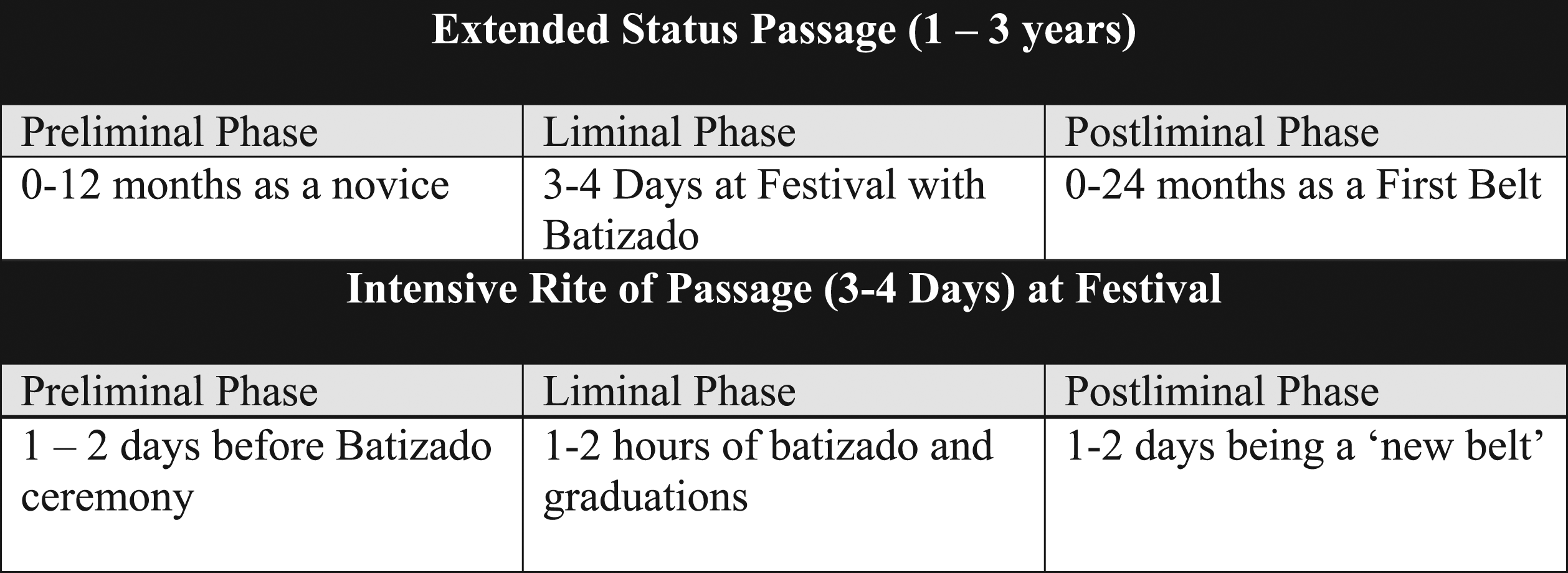
The extended preliminal phase
The novice phase of capoeira (Delamont et al., 2017 Chapter 2) is the period before the batizado, and can last for over a year. Awareness of festivals, batizados, graduations and their relations with overall capoeira culture begins in this extended preliminal phase. Any student who joins a class and begins to enjoy learning the physical, musical and cultural aspects of capoeira will see belts and festivals, T-shirts, hear talk about festivals and learn that there are two per year. As the next event approaches, the novice will hear more explicitly about these things. Mestre Claudio Campos typically announces the date of the next festival (summer or winter) about 10 weeks beforehand and says: ‘Beginners, if you want to get your first belt, come to class, train hard, talk to me’. That specific announcement was made in Tolnbridge in March 2019, ahead of the Summer Festival and was essentially the same as those we had heard 30 times before. Beginners who ask other students what that means will get explanations about the first belt, the award of a nickname, the intensive weekend of classes from visiting teachers and the parties. The novice who asks for more personal details about what will happen to them, and whether Claudio is going to put them forward, is told that they will not be formally tested, they do not have to be very good, and that it is a ‘welcome’ to the capoeira family, to Nucleo de Capoeiragen, ‘our group’. The proceedings are not secret, previous events are widely available on YouTube. If they ask what they have ‘to be able to do?’ fellow students will explain they only need do the basic triangular step (the ginga) and escape simple attacks.
Getting the first belt is highly desirable. If a group wear cordas in regular classes, not having one is a visible sign of being a ‘no-belt’. In the extended preliminal phase, the student is investing money (at £6.00 to £8.00 per class) and time (usually 4 hours a week) plus the cost of kit, and the batizado is their first tangible reward for that investment. Once discipulos know they can have their batizado they can clear their diary, raise the money and train regularly. Festival costs in 2019 were about £60–£80 for the full weekend, plus travel.
Students report mixed feelings in the preliminal phase of the capoeira initiation procedure. Getting a belt is anticipated with excitement and pleasure, but there are also anxieties. Hibiscus, interviewed in 2016, recalled her batizado the previous year: Yeah it was last summer, so about six months after I’d started training. I was very nervous, I felt very unprepared for it but it was really good.
Some students are afraid that they will be hurt, others are apprehensive about playing in front of a crowd. During the extended preliminal phase they will be urged to play in the class rodas if they are not already choosing to do so. Claudio himself starts to take the no-belts into the roda to play with him to help them get used to real games with a mestre.
The festival: the intensive preliminal phase
The batizado and graduation ceremony is set into a three or 4 day festival. Most of the important aspects of diasporic capoeira culture are then visible and audible to novices. The key elements of that culture are explored in Delamont et al. (2017), and include: (1) the sense of membership and collegiality among teachers and students, (2) the ‘global’ nature of capoeira, (3) the importance of Brazilian and of African-Brazilian culture, (4) the level of skill and the ‘Brazilian’ style of embodiment of teachers, (5) the quality of music played by experts, (6) the sheer exuberance of the activity, (7) axé (the mystical force that is created by and drives good capoeira), (8) the humour and (9) trickery (malicia) that characterises games especially between experts, (10) Portuguese as a badge of ‘belonging’ and (11) the strong ties of loyalty to one’s own teacher. Novices experience these during their batizado festival, when aspects they have been unaware of, or had heard spoken about but not seen, are displayed. Most of these are not displayed in the simple game that the novices experience to get their own belt, but suffuse the graduation games, the rodas, and the whole event.
The heart of a festival is classes, taught by teachers visiting from other clubs and groups (See Figures 2 and 3). Teachers come from Brazil, Europe, and elsewhere in the UK at the host teacher’s expense. They award the belts, but equally importantly, they teach classes, play music, and have capoeira games with students and each other in the many rodas that punctuate the whole event. Classes are usually divided by ability, with two, or even three parallel adult classes and separate ones for children. The organiser will announce: ‘Beginners: no belts and first belts: with X over by the door and advanced: blue and brown and above: with Z at the other end’. If the visiting teacher has little or no English, an interpreter is allocated. Training session at a capoeira batizado. Further training at a capoeira batizado.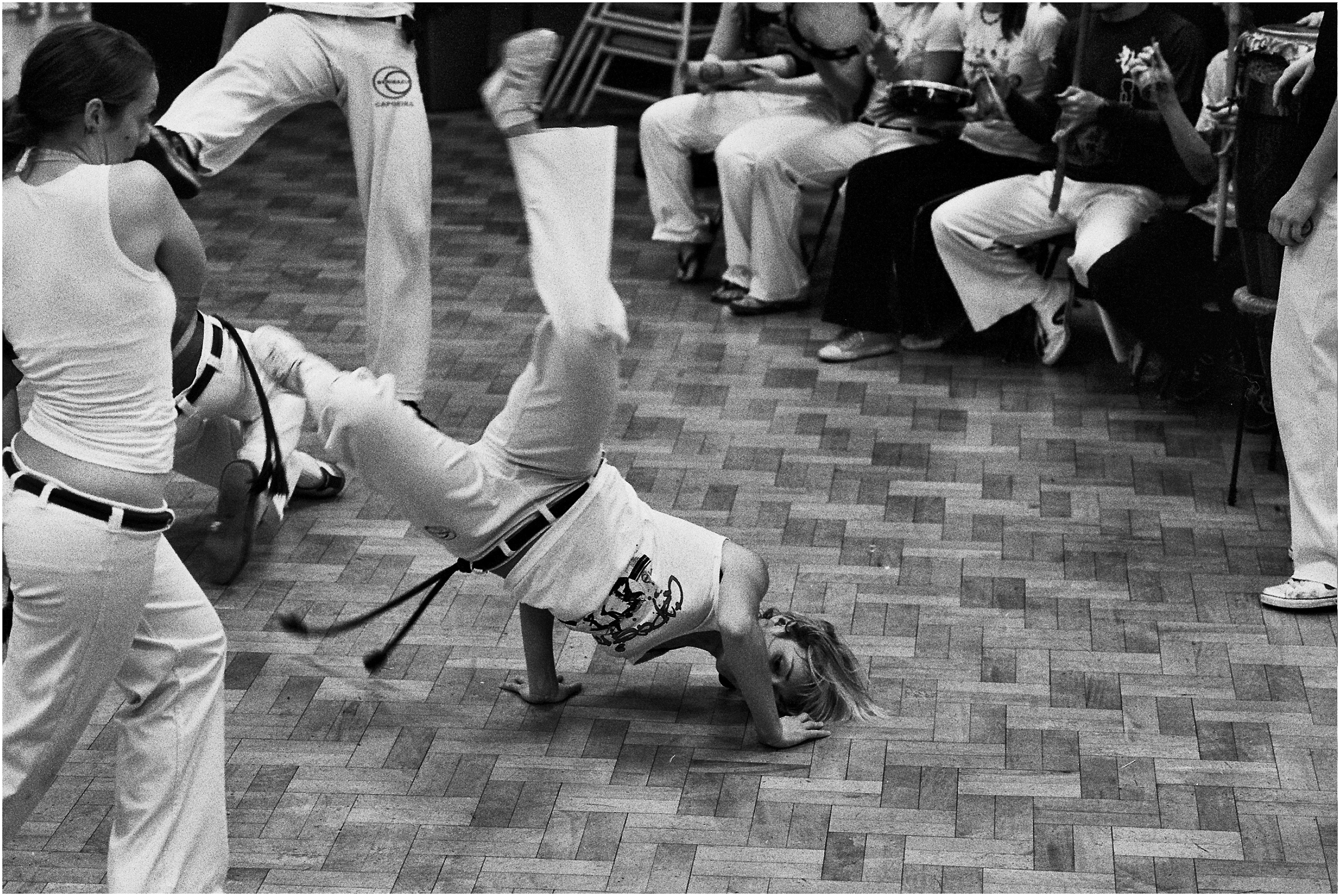
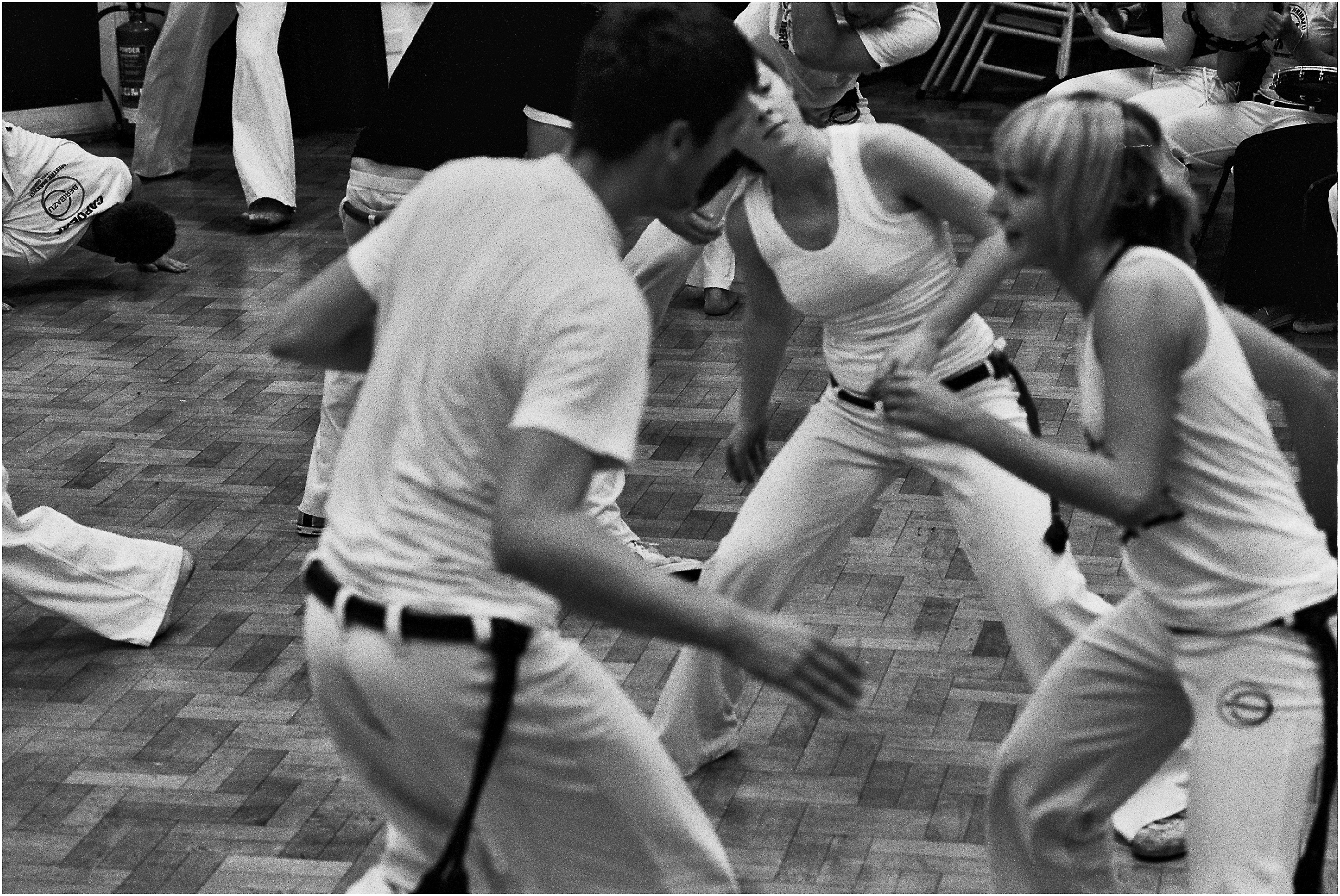
The intensive phase begins with the opening evening of the festival and covers the period up to the batizado ceremony: the moment when the belts are set out.
A typical event has parallel classes of an hour each on the first evening (Thursday) from 7.30 to 8.30, followed by another pair from 8.40 to 9.40 with different teachers, and then a roda until 10.30 or so. On Friday, the start might be 6.30, with three classes before everyone adjourns to a party after the roda. Evenings are only for adults. Saturday’s proceedings usually start around 10.30 a.m. More teachers attend for the weekend, and children have separate parallel classes. The batizado is usually on Saturday, from 4.00 to 7.00, followed by a bigger party from 9.00 until late. Sunday is again adult classes and more rodas, from about noon until the festival closes at about 6.00. It is common to have an African dance class for everyone to start both Saturday and Sunday mornings, to act as a social and physical warm up (Delamont et al., 2021).
The whole event has high quality live music, instrumental and vocal, provided by visiting teachers and advanced students. Teachers sell things: capoeira clothing, Brazilian clothes and shoes, jewellery, musical instruments, capoeira books, CDs and DVDs. The host teacher tries to get some of the same teachers to each festival, and some new ones. Experienced students will greet the ‘regulars’ with enthusiasm as friends. Most teachers are Brazilians, but many have lived outside Brazil for many years. Teachers based in the UK and mainland Europe may bring some of their students with them. A specific area of the hall will be used only by the teachers, and that space will be Portuguese speaking, and symbolically separate from the rest of the room. All these features provide a concentrated exposure to capoeira culture for the novice.
The intensive liminal phase
The central action of the batizado is the novice going into a roda, set up specifically for the purpose of initiating new students, and playing a game with a visiting teacher to demonstrate their basic skills. The liminal phase for the individual novice is embedded in a festival, but for each student their game with the visiting mestre chosen by their regular teacher, in front of up to 100 people is the core of it. At his 2018 Summer Festival, Claudio said, in a short explanatory speech, that ‘this is the first belt - blue for the slaves’ Atlantic passage – it is the symbol of “landing” in capoeira, joining our group’. Sometimes a novice gets a capoeira nickname at their batizado, and so Rhian Llewellyn and Wyn Rees-Davies go into their game in the roda and Pinta (Painter) and Berinjela (Aubergine) come out with their first belt and a new name. Mestre Claudio Campos’s batizado ceremonies are quite simple. The novice plays a guest teacher and then has their belt tied round their waist, everyone claps and the next pair play. Unlike gradings in many other martial arts from Karate to Savate, there is no formal test. The teacher decides in advance if a discipulo is ready, sometimes by asking them to perform some sequences or play instruments, but more commonly by close observation of their performance in regular classes.
The main difference between the batizado game and any other encounter is that it can include the teacher taking, or putting, the student down so they land on the floor. Capoeira groups vary in their ‘everyday’ use of takedowns, which are usually achieved by sweeping away the victim’s weight-bearing leg, a bodycheck or a combination of the two. They can be achieved by a head butt to the torso when the player is off balance, or by crowding and harrying them so they lose their balance and fall over. Some groups practice takedowns and use them regularly in roda games and in class. Other teachers demonstrate them but place greater emphasis on ways to escape. In the batizado ceremony, the takedown is not usually fierce or dangerous, unless the novice has played the teacher very aggressively. Novices will occasionally ask ‘will it hurt?’ and the advice given is typically ‘not if you play gently and calmly, and when you get the attack drop to the floor’. In 2006, Stephens explained to Delamont that the mestre who plays with a beginner determines how long the game will last and when the belt will be given. If the beginner has not already been thrown or taken down in the ring, they might be tricked into taking a fall at the end. The mestres play and then I don’t know how they decide to stop but they just decide to shake your hand and take you over to the foot of the berimbau. And they actually tie the corda around you. And if the Mestre hadn’t managed to trip you up, they put the corda over your head, as if they’re gonna put it round your neck, and then they drop the corda to below your knees and pull your legs away from underneath. So they get you in the end.
We have ethnographic data on 49 festivals that included batizados and graduations and seen at least 450 adults get their first belt. Some were tiny (six first belts at a festival of M. Leontis in 2006) others had 45–55 adults getting the first belt. In ceremony after ceremony, we have recorded two related gender differences. We have very rarely seen a woman who tried to fight the teacher she was playing for her first belt, so women are not routinely taken down, although they may trip or fall over. Some men do try attacks, despite the advice of their teacher and fellow students. If a man plays aggressively he is more likely to be taken down by the teacher than one who plays calmly and non-aggressively. Most first belt games are gentle, and focused on basic, simple moves. At the end of the game, the teacher may pick up a woman and place her ceremonially on the floor. At the 2009 September festival of the London School of Capoeira held in a north London theatre, there were 15 children given belts, and then 16 adults, 11 having their batizado. Five were women and six men. None of the women tried to ‘fight’, and only one of the men was aggressive. Two women and one man were ‘outwitted’ and their testers jumped over them so everyone laughed, two men were taken down and no women. No one was lifted and put onto the floor at this ceremony.
Trickery is employed to the amusement of the audience as in the quote from Stephens recalling his own batizado. Such deceit, or malicia, is foundational in capoeira (Stephens and Delamont, 2009). During a game a teacher might stop and point to something behind the student, who naively turns away and the teacher does the takedown. Delamont has seen a teacher set up an audience member to get her mobile phone to ring, taken it from their confederate, and passed it to the student saying ‘It’s for you’, and when the student reached for the phone, doing the takedown. This humorous performance shows malicia, the no-belt’s naivety, and the teacher’s confidence. During the vital game in the roda the no-belt wants to play respectably so they demonstrate to the visiting instructors and everyone watching that their teacher has taught them properly and they are worthy of their first corda. A poor performance from an adult (children can freeze or run away) is not only shaming for them, but reduces their instructor’s reputation.
Students we have interviewed varied in their responses to their batizado. Asrattha, on his third belt in 2018, recalled that: I cried when I experienced my batizado roda. I was full of tears throughout, and a confused mix of sadness and joy.
Yadu, speaking 3 months after his batizado told us: I got my first belt at the winter festival 2017. The winter festival with the visiting Brazilian Mestres left a deep impression on me.
The intensive postliminal phase
Once all the candidates have got their first, or next belt, there is a roda, before the hall has to be cleared. The new belts can relax and enjoy these events as their ‘ordeal’ is over, and they have publically joined the group.
Many students from the host group attend the whole event, but some cannot get to all 4 days, or cannot afford to pay for them. Saturday has the biggest attendance: at Mestre Claudio Campos’s Summer Festival in 2019, there were 37 adults present on the Thursday, 54 on the Friday, 94 on Saturday plus the children and their parents, and 69 on Sunday. Not everyone takes every class, it is acceptable to rest, go out for food, drink or to a cash machine, play music, or sit and talk to friends. If a student is injured, tired, or, on Saturday, saving their energy because they are getting a belt they will play music, help with the organisation, or just ‘hang out’. For novices, the festival as a whole is their first exposure to the local history of their club (as former students return to train with their mestre) to other members of their own group from other parts of the country and to capoeira’s global nature. They also hear explicitly about aspects of capoeira culture, such as its joy and its etiquette, experience its social reality and its key tacit elements. Their own teacher is revealed as one of a variety of capoeira experts.
There are several common explicit transmission mechanisms, and a great deal can be learnt by listening to teachers and students and by watching: what Lave and Wenger (1991) called legitimate peripheral participation. Festivals are primarily celebratory, but they are also pedagogic. During a festival a student might well take 12 capoeira classes with 12 teachers and a dance class. Each begins with an introduction, some stretching, includes explicit teaching, some mini-lectures on that teacher’s philosophy of capoeira, singing, and a short roda. There will also be three or four longer rodas in which the teachers play each other and students (usually the most advanced). A novice sees capoeira humour, trickery, fierce games, acrobatics, and his or her teacher playing his or her contemporaries as an equal. The energy that fuels good capoeira, axé, can be felt and seen. If it drops, as it can when everyone is tiring, teachers will set out to raise it by stating that axé is vital, and urging everyone to clap louder, sing more lustily, and concentrate on the game (Scott and Stephens, 2018). Teachers will behave in ways that make all the experienced people watching laugh, will trick their playing partner, and occasionally get so angry that more senior teachers intervene.
The collegiality is apparent as the first students and teachers arrive, not only on the opening night, but each day. A novice will see people come into the hall, and be greeted with hugs and whoops of joy by those already present. Teachers, carrying instruments and their luggage will be embraced by the host mestre, other teachers, and more advanced students who know them. As soon as each day’s event is about to begin, the host will make announcements. At Mestre Claudio Campos’s 2019 Summer Festival, each day began in the same way. Claudio whistles and calls everyone to sit on the floor in front of the bateria. As soon as they have assembled he welcomes everyone, says that classes will start in ten minutes, it is his 31st festival, the 34th of ‘our group’ in Cloisterham; and it is going to be great. People who have not paid must go and see Aconite and Vyassa “Stand up Aconite and Vyassa”: he points out where they will be sitting taking money and tying ribbons onto the wrists of those who have paid. If you need a floor to sleep on tonight, see Hibiscus – “Stand up Hibiscus”. He goes on: “Now I am going to introduce our teachers – we have 17 teachers coming to this festival – today we have Professora Axiothea”. She jumps up from the bateria and comes to hug Claudio. He says “she is from our group, we grew up together in Brasilia, she is like my little sister. She is teaching now in Warsaw with Mestre Socrates. She has a great game, and you’re gonna love her style. Claps for Professora Axiothea”. Everyone claps and whoops.
This is repeated for each visiting teacher, at the opening of each day of the festival, and at the beginning of the belt ceremony. The most senior Mestre is usually introduced last and if they are famous, the novice can see other students being impressed that Mestre X has come to their festival.
The different types of embodiment are clearly visible in the teachers, who are a range of sizes, shapes and ages, but generally the majority are male African-Brazilians, embodying the African-Brazilian heritage of capoeira. As the lessons begin, the novice sees capoeira in styles that are not identical to that of their regular teacher, learns more Portuguese instructions, and hears music of a professional standard. Novices will be training with a mixture of regular classmates, and some strangers. The other explicit socialisation is central to the start of the ceremony, when the host teacher ‘explains’ to the audience of family and friends, as well as the students, that the batizado is ‘how we welcome people to our capoeira family, to our group’.
The extended postliminal phase
In those regular classes where students train in white uniform trousers with their corda, the postliminal phase is very visible. After their batizado the people with a new corda can walk into the class as a member of the ‘family’. The T-shirt of that festival is ‘special’. Our informants speak of hanging their corda where they could see it last thing at night for several weeks after their batizado. They now have a story to tell – how hard Mestre Ixion was to play, how friendly Mestra Andromeda was, how idiotic they felt when tricked by Contre-Mestre Belisarius who distracted them so they were a soft target and so on. Those with their first belt are now publically members of a specific capoeira family, and most report that they were then motivated to train harder, learn to play the instruments, and in some cases to find out more about the history and philosophy of capoeira. Students interviewed in 2018 reflecting on their enthusiasm for capoeira routinely used the metaphor of a family they had joined. Zepherine, on her first belt, enthused: I love the variety it brings, the different ways how to express yourself and just the positive and loving attitude towards everyone and capoeira by my capoeira friends and Claudio that have become my second family.
Dianthus, on her fifth belt expressed her sense of belonging: I really do love capoeira and feel very committed to the art itself as well as our own group.
Prakviti, on his third belt said: I feel deeply connected to Capoeira: the group is like a family to me. I have come to understand my being-capoeria, sou eu, as an entry point into a way of being – with my fellow capoeiristas as brothers and sisters, uncles and aunts, mothers and fathers. Just as a specific group is bound together as a family-like structure across the differences – age, education, sex, occupation, personality etc. – of its individual members it seems that on a macro level the main groups that are all over the globe are somehow like a family network.
The batizado in capoeira contemporanea is indubitably a rite of passage and status passage, from ‘no-belt’ to ‘insider’. Five aspects of the novice identity are symbolically transformed by the ceremony. These are, in reverse order, their sense of responsibility, their sense of international membership, their loyalty, their embodiment and their self-confidence. These are key mental changes according to both students and teachers. Once a learner has had their batizado they train harder, attend class more regularly, and begin to think of themselves as capoeiristas (Delamont & Stephens, 2019). They feel ‘more capoeira’ as Mestre Claudio Campos puts it. There is also a change in the student’s embodiment: they have displayed basic skills in front of a large crowd, and survived three or 4 days of intensive training. They have seen a wide range of capoeira bodies of many sizes and shapes, including expert bodies that they can desire to emulate. Their self-conscious embodiment is heightened.
The simple ceremony is the reward for loyalty during the no-belt phase, and that loyalty is reinforced by the baptism. From then on, the novice is Mestre X’s student: they ‘belong’. So, for example, a man back from Brazil said ‘I went to Rio to see the city, then to Brasilia to catch up with all our mob’. There was only one couple in Brasilia he had ever met before, but he could walk into the classes as a member because of his batizado in Cloisterham. The first belt holder is now a member of a group, and through their local group of an international network. Visiting teachers from other groups have offered a glimpse into the wider world of the dance-fight-game. Teachers from their group who appear at ‘their’ festival from other cities in the UK, Europe, Brazil and perhaps the USA or Canada embody the ‘spread’ of that group.
For novices, the extended postliminal phase is also characterised by a greater awareness of the tacit culture of capoeira, that allows newly belted trainees to recognise and partake in these less explicit practices. There are three aspects of this which are fundamental to capoeira’s attraction for experienced students; the axé (Stephens and Delamont, 2014), the malicia (Stephens and Delamont, 2010) and the humour.
Axé is the energy that drives capoeira and is created by it. The roda at a festival with everyone clapping the rhythm, everyone singing the choruses, good music and a lead singer who can be heard over the other noise, generates energy that lifts the two players so they perform better than they normally do. At Claudio Campos’s 2018 winter festival, Ikki was scheduled to go up to his fifth belt. As he arrived on the Saturday morning, he told Delamont: I’m not sure I’m going to be able to play, I’ve got a cold, my back is in a bad way, and last night in Andromeda’s class I tried to do that Queda de Rins based attack she was teaching – did you see that class? – it was awesome wasn’t it? – and I’ve wrenched my elbow. I don’t think I can play. I’m not going to do any classes just play music.
At 5.30 that evening, Ikki and two Cloisterham students played six teachers in rotation for their fifth belts. Delamont wrote: Ikki played some of the best games I’ve ever seen him produce. He flew, he spun, he escaped terrifying attacks from Contra-Mestre Romulus who was being really tough on them. No sign of any injuries at all.
Speaking to Ikki after that ceremony he said: Oh the axé carried me through – I’ll be in agony tomorrow – I probably won’t even come tomorrow.
The humour and malicia are most apparent in the rodas when teachers and the most advanced students play. For example, at Claudio’s 2018 Summer Festival, Delamont wrote during the closing roda on the Friday night: Claudio went in with Contra-Mestre Remus, who is taller and has longer legs. Remus played fiercely, and I could see Claudio enjoying it.
A teacher like Mestre Claudio Campos, who is the only capoeira teacher in a city, only gets stretched by other experts at festivals, and the pleasure hosts take in tough games with their visitors is manifest: Claudio did lots of acrobatic escapes, and then, when Remus nearly kicked him, Claudio pretended to be terrified, vaulted into the ‘audience’, and pretended to hide behind Dahlia, the tiny Tolnbridge novice. He pretended to send her into the roda to play Remus as his substitute. She looked baffled, but bravely stepped forward and began to ginga. Remus jumped over her, so he was again facing Claudio, who pretended to run away out of the three - deep roda circle, and then did a back flip back into the roda and began to play Dahlia as if he was a 90 year old man with bad arthritis who could barely move.
Everyone laughed at this ‘performance’, both men hugged Dahlia, and Claudio led her to the foot of the berimbau, pulled out his wife, Sycamore, to play her, and set a new game (gentle and careful) going. That was an example of humour. Malicia, trickery or deception, is also apparent in rodas: a teacher will pretend to see something important behind a student and when they turn to look, do a takedown, or act as if they have been injured, start to limp or hobble, and then as soon as their opponent shows any compassion, launch a rapid and hard to escape attack. The audience reaction to malicia is laughter, and admiration for the skill of the joker.
The festival is where the on-going work of the host teacher to build a strong capoeira family is visible to the discipulos themselves, past and present, to other teachers and students from the wider groups who can see their fellow members, and to teachers from other groups who can see that capoeira is strong in Cloisterham and therefore in the UK. We have not explored here the important function that the festival and its batizado perform for the host teacher, but as well as incorporating new students a festival is a Tournament of Value (Appadurai 1986a, 1986b) for the organising teacher (Delamont et al., 2017). His or her reputation is enhanced by a successful festival, or diminished by a poor event. Each adult no-belt who is baptised after an acceptable game adds to the reputation of the group and its teacher, and strengthens his or her status among capoeira teachers.
Conclusions
For the novice, the batizado is an initiation but not a secret or unpleasant experience. It furnishes the novice with a greater understanding of the culture that further supports their engagement within going forward. We have analysed the enculturation of the novice into capoeira as both a status passage, drawing on symbolic interactionist authors, which lasts up to 3 years, and a rite of passage lasting three to 4 days, at the festival that includes their batizado. We have shown that the capoeira batizado and festival while not an initiation into secret or esoteric knowledge provides myriad opportunities for students to acquire the culture of capoeira as it is set out for them.
In our research on the contemporanea capoeira batizado, we have found that students are, in the intensity of the 4 day festival and their own liminal game, introduced to the mystical aspect of capoeira (axé), the deception and trickery (malicia) and sentimental culture of loyalty and belonging. We have written about these aspects of capoeira elsewhere (Delamont et al., 2017; Stephens and Delamont 2010, 2013). In this article, we have demonstrated that the teachers organising festivals for capoeira contemporanea groups in the UK have successfully created a rite of passage that incorporates novices into their martial art.
The capoeira student is changed by their batizado, and incorporated into the culture of the martial art. Precisely because the batizado is the ceremony which demonstrates publicly that the novice has officially joined the group, the wider festival – with the graduation ceremonies for more advanced students – is also important. The novice can see their friends progressing in the system, and the joyfulness and public recognition of achievement is shared.
Footnotes
Acknowledgments
We are grateful to Mrs R.B. Jones who word processed this article, to our teacher Mestre Claudio Campos, to all the other teachers we have studied and learnt from and to all the students we have observed, interviewed, played and danced with since 2003.
Author Note
Mestre Claudio Campos has organised two festivals per year since Autumn 2003.
Declaration of conflicting interests
The author(s) declared no potential conflicts of interest with respect to the research, authorship, and/or publication of this article.
Funding
The author(s) received no financial support for the research, authorship, and/or publication of this article.

Author Biographies
Sara Delamont is an ethnographer and anthropologist who has studied the sociology of education and the professions, and conducted detailed studies of martial arts Capoeira and Savate. She is founding editor (with P. Atkinson) of the journal Qualitative Research.
Neil Stephens is a sociologist and Science and Technology Studies scholar who has studied innovation in biomedicine and laboratory ethnography. With Sara Delamont, he has also been working on an ethnographic study of the dance-fight-game Capoeira for over a decade.