




Abstract
Based on ethnographic fieldwork conducted during recess and lunch in a primary school sited in a deprived Palermitan neighbourhood, this paper sheds light on the (dis)functioning of food pedagogies in a school on the fringes of society. During recess, teachers use food rules to highlight transgressions, but not to improve food literacy. Likewise, their efforts during lunchtime are devoted solely to keeping children under control, while trying to get to the end of lunch as soon as possible. Ultimately, both eating occasions are seldom opportunities for food education, as teachers’ primary focus is on preventing or halting children’s restlessness and skirmishes. I conclude by outlining some limitations and strengths of the ethnography while reflecting on the findings vis-à-vis previous fieldwork I conducted in less challenging contexts.
Introduction
In recent decades, attention towards school meals has soared all over Europe. Given that family sustenance, and particularly children’s nourishment, has always been a responsibility discharged mostly by women, the challenges engendered by the ‘adult worker model’ are visible in school meals. Among other things, the political framework built through the Lisbon Process aims to foster women’s individual autonomy and a two-earner household model by outsourcing families’ duties to other providers (Daly 2011; Lewis, 2001). Yet next to what could seem an almost neutral transfer of feeding from home to school, a constellation of political interventions has been brought into play to enhance children’s health choices and fight the obesity epidemic. The increasing preoccupation with children’s nutrition probably reached its peak during the last Universal Exposition (EXPO), where the high-sounding Milan Charter, a document containing social justice principles regarding environmental sustainability and nutrition, emerged from a grouping of Italian ministries, international agencies and research institutes. As the Milan Charter (2015) states: In signing this Milan Charter, we women and men, citizens of this planet, strongly urge governments, institutions and international organizations … to commit to introducing or strengthening dietary, physical and environmental education programmes in schools and in school meal services as instruments of health and prevention.
Despite these optimistic premises, scholars have highlighted contradictions, resistances and perverse effects that flow from framing school meals as a sort of panacea for children’s health. In Italy, for instance, despite being thought of as an almost universal service, access to school meals is socially stratified (Oncini and Guetto, 2017). Costs and economic benefits of particular services (e.g. discounted meals) may be evaluated differently: some parents may decide to opt out of those perceived as too expensive. And regardless of cost, some may not want to outsource their children’s feeding to a public institution, as the lunchbox is a powerful means to express love and care (Metcalfe et al., 2008).
Using Foucauldian concepts of governmentality and biopower, several authors have highlighted the controversial nature of food education and, through participant observation, focus groups and interviews, analysed how food pedagogies come to life and are resisted in the school setting (e.g. Leahy and Wright, 2016). Far from being just a model of nutritional outsourcing, food education in schools is rather a contested and contradictory assemblage of technical discourses and moral precepts (Leahy, 2009), where ‘a constellation of governmental ambitions are played out, in which individual actors play particular roles in supporting, resisting and transforming these agendas, and in which particular types of knowledges and understandings of food, health, childhood and youth become accepted and function as “truths”’ (Pike and Kelly, 2014: 6).
Drawing on this scholarship and building on ethnographic fieldwork I conducted in a primary school sited in a deprived Palermitan neighbourhood, this paper aims to expand current knowledge on food education in schools by shedding light on unexpected consequences of implementing food pedagogies in a school on the fringes of society. Making use of fieldnotes gathered during recess and lunch with a second-graders’ class labelled ‘difficult’, the article aims to answer three questions: What happens to food pedagogies when they are implemented during two eating occasions in a classroom mostly containing deprived children? How does the role of teachers as food pedagogues influence the snack break and the school lunch? How do children react to teachers’ food rules and suggestions?
As other authors that outline the controversial and problematic aspects of food pedagogies have found (e.g. Leahy, 2009; 2014), this article unveils the frailty and inconsistency of food education when applied in extremely challenging contexts. In fact, recess and lunch, far from being didactic experiences or convivial breaks, are mainly periods of tension between teachers and troubled children. After introducing in the next section of this article the conceptual devices used in the system of food education in Italy, I briefly outline the methodology and the context of this study. I concentrate on the recess and lunch break of a second-grade class to show how food ‘dos and don’ts’ are seldom envisaged by the teachers as means to achieve a food literacy objective. During recess, arbitrary rules on food and table manners are used to highlight transgressions, but not to teach healthy eating principles. Likewise, teachers’ efforts during lunchtime are mainly devoted to keeping children fed and seated, while trying to get to the end of lunch as soon as possible. Ultimately, both eating occasions are seldom opportunities for teaching about food, as teachers’ primary focus is on preventing or halting children’s restlessness and skirmishes. Most often, food itself is a matter of little concern for anyone, since violent episodes between children monopolize the attention of all the adults present. In the conclusion I outline some limitations and strengths of the ethnography and reflect on the findings vis-à-vis previous fieldwork I conducted in less challenging schools.
Placing food pedagogies in context
Although educational institutions have long been interested in children’s nutritional intake and provided dietary recommendations (Helstosky, 2004; Levine, 2008), the evidence on the impact of food choices on health, coupled with the increasing rates of obesity among children, have resulted in a proliferation of school programmes dedicated to food. In this light, the term ‘food pedagogy’ refers to formal, informal and incidental forms of education that focus variously on growing, shopping for, cooking, eating and disposing of food in an attempt to improve individuals’ health and wellbeing (Flowers and Swan, 2015).
Building on the work of Foucault (1991; 1998) and Coveney (2006), scholars interested in the analysis of food pedagogies in the school context use the concepts ‘governmentality’ and ‘biopedagogy’ – after Foucault’s biopower – to make sense of the intense pedagogical intervention carried out in schools to shape and cultivate particular food practices. Governmentality describes the procedures, techniques and forms of rational knowledge used by the agencies and authorities that aim to control and shape the conduct of individuals and groups (Foucault, 1991). Biopedagogies can be considered as ‘governmental technologies’ and, more specifically, refer to initiatives that operate in schools, on the media, through campaigns, websites and TV programmes that attempt to govern food choices either by controlling the food environment or by encouraging children (and mothers) to take it upon themselves to learn about risks associated with food choices and improve health chances (Foucault, 1998; Leahy and Wright, 2016). Since food pedagogies can be extremely heterogeneous and contradictory, some authors (Leahy, 2009; Pike and Leahy, 2012) use the term ‘biopedagogical assemblage’ to capture the multifaceted complex of education sites, practices and discourses that contribute to shape and regulate children’s understanding of their body. In this sense, school biopedagogies can be seen within a continuum that ranges from extreme passivity (providing school meals that balance their nutrients), via deliberate obstruction (prohibiting some or all food during recess), to encouragement and guidance (cultivating food literacies in the classroom or while eating in the canteen).
Fieldwork conducted in several schools has challenged the ostensible neutrality of food pedagogies which, besides being of little effect, are ‘saturated with moral meanings and judgments about acceptable citizens, bodies, foods and ways of eating’ (Leahy and Wright 2016: 11). As such, food pedagogies emphasize individuals’ responsibilities and oversimplify complexities of food culture, paying no attention to the structure of opportunity that constrains access to or choices of food, and taste responses (Hayes-Conroy, 2009; Poppendieck, 2011). Not surprisingly, scholars have highlighted how instances of stigmatization and resistances to school meals and food pedagogies occur in the gardens, corridors, classrooms and lunchrooms of many different countries, especially when new ‘healthy’ standards are introduced and teachers are asked to manage, evaluate and discipline children’s snacks and meals (Allison, 1991; Fletcher et al., 2014; Harman and Cappellini, 2015; Iacovetta, 2000; Salazar, 2007).
In Italy, building on World Health Organization (WHO) and Food and Agriculture Organization (FAO) indications, and guided by five articles of the constitution (Ruffolo, 2001), food pedagogies are part of the curriculum of activities that should be carried out in schools. Both the ministry of education and the ministry of health provide general guidelines for food education, initiatives for healthy practices and a management protocol which valorises organic foods and local cuisines (Oncini, 2018a). As Morgan and Sonnino (2007: 3) argue, ‘the Italian model integrates the nutritional dimension of the food served in schools into a wider cultural framework that emphasizes the educational purposes of school meals and assigns to them the specific function of protecting the “local”’. In addition, schools must appoint a canteen committee made up of a group of volunteer parents who can participate in school lunches to assess quality, hygiene and portion size. Especially during recess and lunch, where children can learn about food hands-on, teachers are supposed to pursue some specified objectives for ‘the health and wellbeing of the school population’, which should include promotion of awareness of the links between food and health, the adoption of healthy eating behaviours and the encouragement of a ‘concept of overall sociality of food, that starting from safety would incorporate values related to sustainability, ethics, legality, interculturality and territorialism’ (MIUR, 2015: 19). But as we will see, launching a model that is supposed to ‘create knowledgeable consumers willing and able to choose “quality” food’ (Morgan and Sonnino, 2007: 5) does not necessarily imply it will be implemented effectively.
The fieldwork
This ethnography is based on fieldwork conducted for eight months in the Valmarina primary school and its neighbourhood between March–May 2016 and October–February 2017. The fieldwork mainly took place during recess and lunch, two periods in which food education is supposed to occur experientially. In total, I spent around 70 (non-consecutive) days in the school and observed roughly 140 eating occasions.
The Valmarina school, sited in the centre of Palermo, is old and ill-equipped. The area surrounding the school is mostly inhabited by low-income families, some of them living in buildings that squatters have purchased by acquisitive prescription or public housing. Although the area, like the whole centre of Palermo, is slowly gentrifying (see Bonafede and Napoli, 2015; Picone and Schilleci, 2013), and attracts eager tourists to its monumental churches and Baroque oratories, many schoolchildren still come from ‘multi-problematic households’, as the school website states. Extreme conditions of poverty, parental unemployment, drug dealing, familial violence, and overcrowded and decrepit housing conditions constitute for many of them the social and material environment of their infancy.
After formally applying to the school board and being approved, I presented my projects to the teachers during their weekly meeting. 1 Parents were then informed by the teachers during the days before my arrival, and I had occasion to meet some of them while spending the afternoons in the school neighbourhood and by participating in an informal after-school programme as a volunteer. The canteen assistants were informed about my research by the nutritionist in charge of the menu in Palermo, who authorised me to access the canteen and share the meal with the teachers and the children. Finally, I met the children during my first recess in each classroom and I explained the reason why I would be spending time in their school, introducing myself as an older student interested in what foods children like the most and the least.
In the first part of the fieldwork I visited each classroom of the school for one week, during recess and lunch. This allowed me to meet all the teachers, the pupils, the janitors, the assistants and to explore the similarities and differences between classrooms. During my second period at the school, I decided to focus on one of the two second-grade classes because of the relationship of trust I had developed with Rosanna, teacher at the Valmarina school since the 1990s and now its deputy head. During recess, I took notes about the snacks eaten by the pupils and the interactions amongst them and with the teacher. At lunchtimes, I ended up sitting with children only during the initial minutes; the rest of the time I helped the teachers and the canteen assistant to supervise the children and to plate the food and peel the fruit. In any case, the extreme turmoil of lunch did not allow any prolonged dialogue with children. As I will argue in the conclusion, what initially appeared as a hindrance to the research was probably one of its most compelling findings. During the fieldwork, I also conducted formal interviews and held informal conversations with teachers, with the nutritionist in charge of the menu, and with 12 second-graders’ mothers. Formal interviews were recorded, then transcribed verbatim and used to enrich the fieldnotes.
Collection and analysis of data proceeded simultaneously with the literature review, in an attempt to balance the experiences other scholars recorded and existing theoretical views on the topic with the assumptions about (food) pedagogy and childhood that I brought to the project (Willis and Trondman, 2000), often based on my previous fieldwork in less problematic schools in northern and central Italy (see Oncini 2018a; 2019; 2020). Compared to my earlier observations, this ethnography could be considered an extreme case study: Gerring (2007: 101) uses this term to describe ‘a case that is considered to be prototypical or paradigmatic of some phenomena of interest’ (in our case the side-effects of institutionalising food pedagogies) because of its ‘extreme value on an independent or dependent variable of interest’ (children’s social origin or level of deprivation). The evidence quoted in what follows aims to have a ‘synecdochic’ function – to convey some sense of the empirical regularity of the whole through some salient parts of it. Consequently, the reason why I concentrate mostly on the disruptions, clashes and frictions during recesses and lunchtimes is precisely because they consistently set the tempo of the school’s food life – few eating occasions occurred without them.
Recess and lunch with the second graders
The Valmarina school provides full-time education from 8:00 to 16:00 and a school lunch programme. Although the latter is not compulsory, the low price paid by families in the lowest income group means that only a few of them opt to pack a lunch at home. While recess is always spent in the classroom, five disused classrooms on the ground floor are dedicated to the school lunch, with four long tables and chairs and the windows half covered with a dusty protective grid (Figure 1). The previous year’s (out-of-date) menu hangs in the corridor, and no decorations are used to embellish the rooms or suggest dietary recommendations.
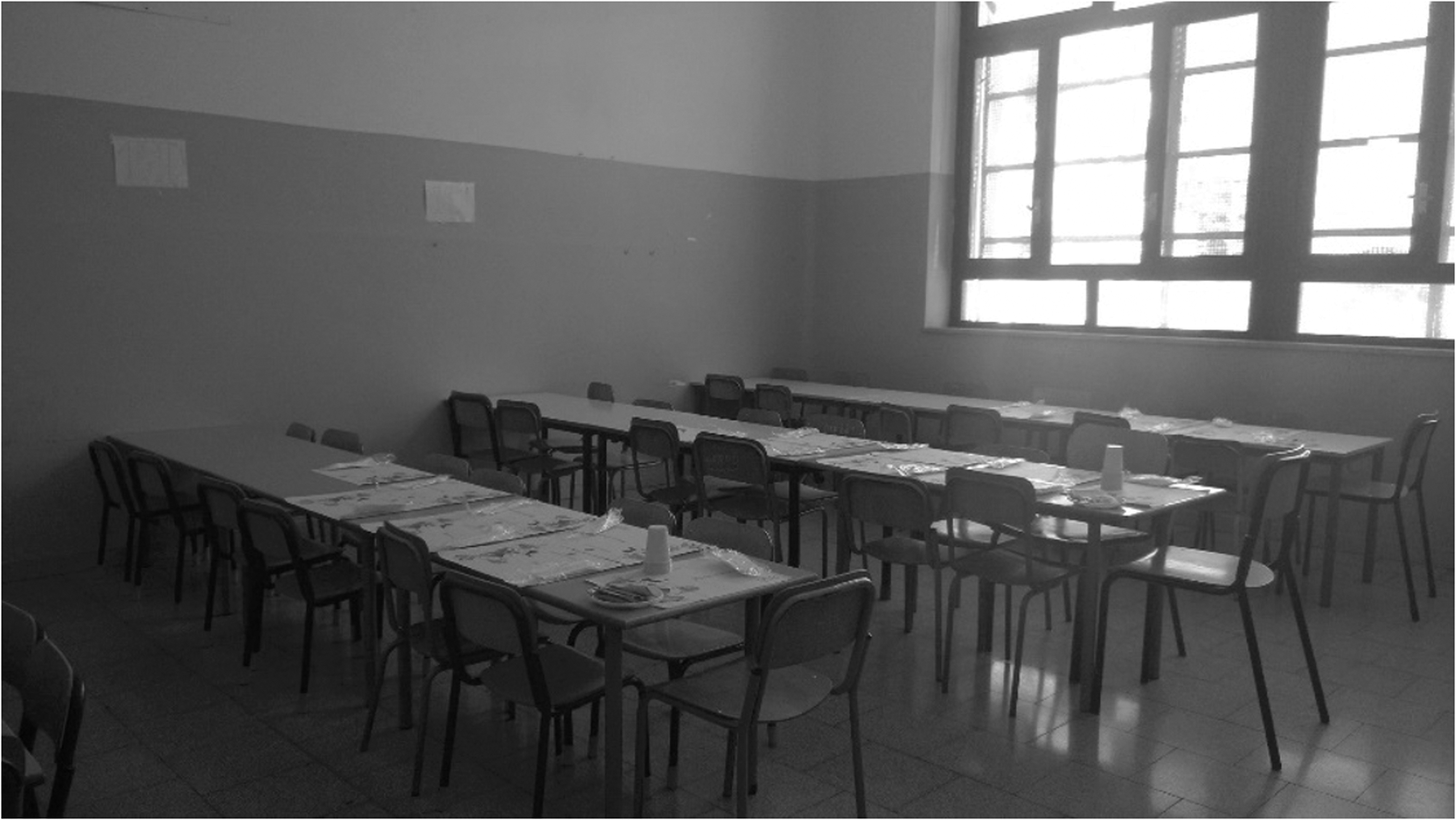
One of the lunchrooms in the Valmarina school.
Rosanna and Clara teach the 21 second-grade pupils at the Valmarina school. In 2016 and 2017 their classroom was considered one of the most troublesome in the institute, since two children with challenging behaviour were repeating the second grade, thus joining an already lively classroom. All pupils come from low-income families: parents generally have little education, and most working fathers, when still part of the family, hold unskilled jobs. An additional line dividing the socio-economic composition of the classroom can be drawn between the ‘magnificent five’ and the rest that ‘come from nice families’. At the beginning of my fieldwork Rosanna described the classroom as containing a few children from difficult families, ‘but also some from “famiglie graziose”’, those that in her eyes provide ‘proper care’ to their children. 2 The ‘magnificent’, sometimes ‘fantastic’, five owe their ironic nickname to Clara. Giovanni, Piero, Giacomo, Matteo and Fabio all come from families with highly problematic dynamics: illegal activities, violence, alcoholism and parental imprisonment are, to different degrees, the constitutive environments of their childhood. The magnificent five are the most troublesome children in the classroom, and according to both teachers they present some levels of cognitive and/or linguistic deficit. Yet only Piero has a part-time, special needs, assistant teacher, as the other parents have not lodged an official request for one, probably because of the stigma attached to children with special educational needs, and consequently to their families.
The ‘roar’ of the snacks
In the whole school, only a few teachers have implemented explicit food rules during the recess, and Rosanna was among the first to do so. Clara, who is in her first year at the Valmarina, agrees with this approach. Rosanna is aware of the food education guidelines issued by the Ministry of Education, and when we first met, a few months before I began the fieldwork, she expressed her preoccupation with the unhealthy food brought by her pupils for the school break: You have to see what they eat every day; the situation is out of control. Children come in the morning with arancine, sometimes they bring a sausage roll [rollò] for the break, and drink Coke, tea or juice. In my classroom I have established some rules, but sometimes parents come in the morning and ask if I can make an exception…and how can you forbid that? They are not precise rules.
Since the school does not have a suitable space for recess, all children must remain in the classroom during the 20–30 minutes of the break. When Rosanna or Clara decide that the lesson can be interrupted, pupils are generally divided by gender into small groups and sent to the bathroom with a piece of paper stuffed in the collar of their smock. Usually, the janitor checks that kids do not drench their clothes while washing their hands, and then returns them to the classroom. Arguably, this is the only time they can let off steam and run down the corridors. 4 Once everyone is back in the classroom, snacks are set up on the placemat, and the ritual prayer can start: ‘God bless the meal we are about to eat, and please make sure that food is given to all the children in the world. Enjoy your meal, kids.’ In the few rare moments when silence prevails, the noise produced by the simultaneous unwrapping and popping of packaged snacks can be clearly heard, while the air is filled with creamy and chocolatey smells: ‘teacher, it’s the noise of the snacks!’ a girl once, amusingly, observed; ‘yes Maria, it’s the roar [scroscio] of the snacks,’ Clara replied.
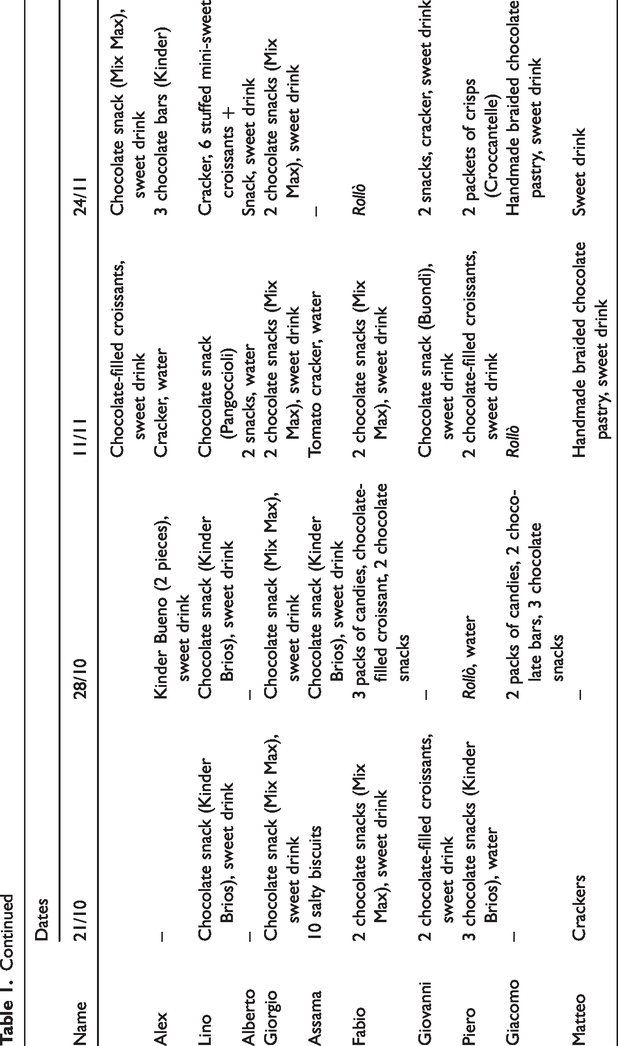
As this may seem hyperbolic, Table 1 lists the snacks that were typically brought by the pupils on four days that I have selected from my fieldnotes. Three observations are in order: first, although Rosanna’s rules are respected by most pupils, they are highly arbitrary: stuffed pizza, handmade croissants or fried doughnuts are not very different from the prohibited foods in terms of nutritional value and healthiness, yet are classified as acceptable edibles. Second, although the rules were drafted to improve children’s dietary compliance – that is to say, to create a barrier against unhealthy feeding choices – they cannot be deemed successful. Most children bring more than one energy-dense sugar-based snack, along with tea or fruit juice in cartons, but neither Rosanna nor Clara can stop them from eating or drinking as much as they like (Figure 2). Indeed, the list ignores the additional provisions which are often hidden inside the school bags and not routinely searched by the teachers. Third and most importantly, rule breaches are frequently committed by one or another of the fantastic five, usually once or twice per week.
Typical children’s snacks at the Valmarina school.
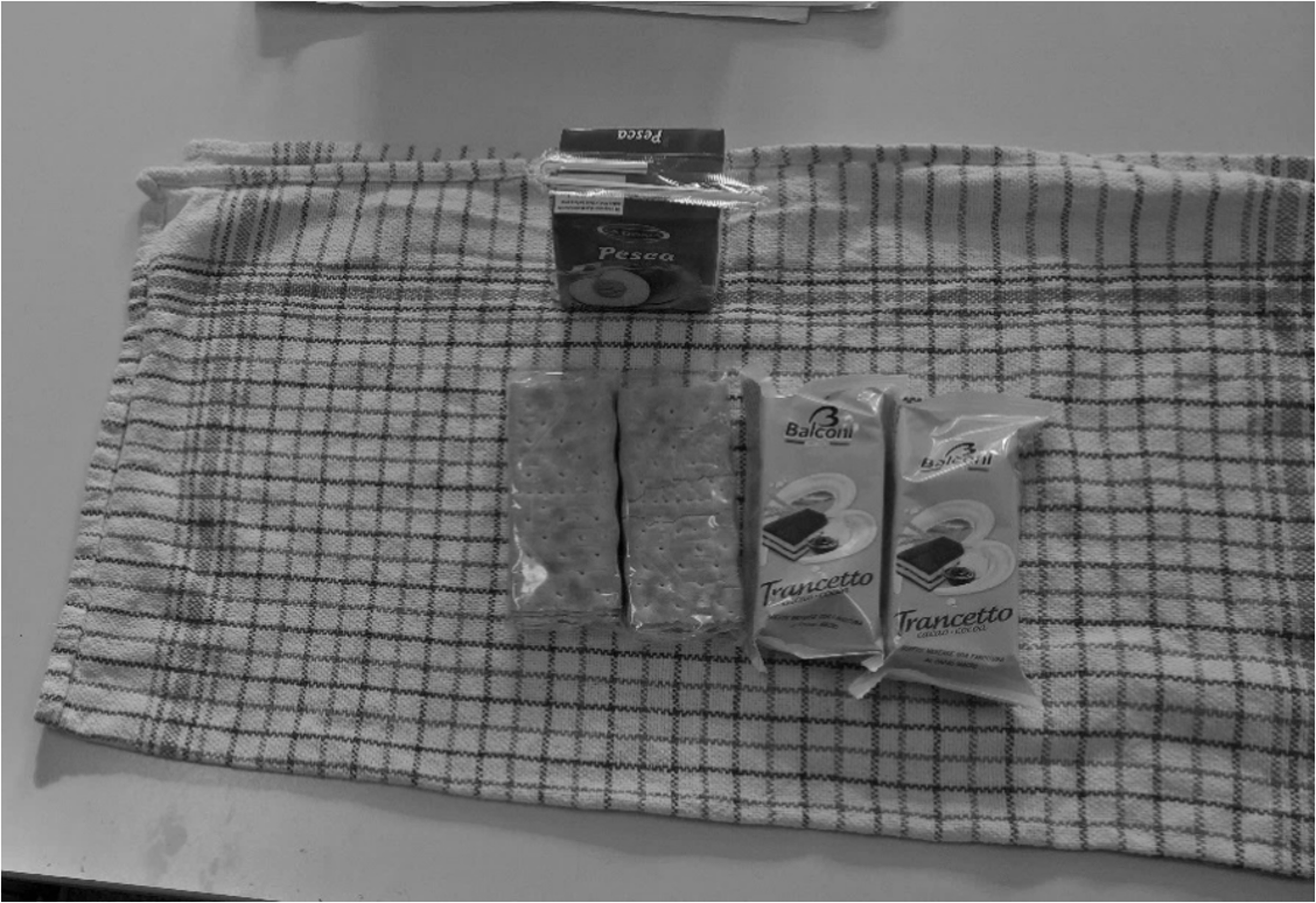
Fabio’s break snacks.
There is probably no more compelling evidence of the hiatus between the ‘project of nutrition’ (Kimura et al., 2014) and eating or feeding practices. Even in this classroom, a small food pyramid hangs on the door. Children as young as seven can distinguish between healthy and unhealthy foods, since teachers have taught them to do so. Nonetheless, when it comes to eating, rules of thumb give way to rules of taste. And some pupils, as past studies have widely documented (e.g. Karrebæk, 2012), become responsible for familial choices. Thus, even though Rosanna’s prohibitions might seem reasonable at first glance, they perversely end up targeting the five children who most often flout the rules. Forgetting one’s placemat or bringing prohibited items are violations that are then punished with a reprimand that creates an arbitrary distinction between one of the fantastic five and the others. Having a rollò or a pack of pralines leads to the same children becoming negative examples in the eyes of the classroom. Giacomo, Piero and Fabio are shoved into the classroom, followed by Rosanna’s angry voice: “YOU SHOULDN’T HIT OR PUSH EACH OTHER! DO YOU THINK THAT’S RIGHT?” At this point, all the children sit down and prepare their placemat. Fabio has two mini-muffins, two pre-packaged sweet puff pockets and two pralines. Rosanna removes the pralines from his desk as a punishment and firmly reproaches him: “You know you can’t have these”. In response, Fabio starts dragging and lifting the desk, to create a tedious and continuous noise. Piero turns his desk towards Fabio and lays out a paper napkin instead of the usual placemat. At this point, Rosanna intervenes again: “Where’s your placemat? You know you have to come to school with a placemat!” … After the prayer, Fabio goes back to Rosanna and asks for his pralines, without success. At this point, Fabio hurls on to the floor his four snacks, one kid’s bottle and then the tablemat. “Now I’ll call your mother, so she’ll come to pick you up,” threatens Rosanna. “Better!” “Better? Perfect, then you’ll stay here the whole afternoon; I’ll send you to a riformatorio
5
and you’ll stay there for a very long time!” Fabio gathers the snacks from the floor and throws them away a second time. Rosanna picks up her smartphone, and pretends she is recording a video: “So now I’ll send this to your mother, on WhatsApp”. Fabio covers his face with his hands, and then with the placemat. “Even if you cover your face, your mum can recognise you!” In the scared quietness, one kid remarks, in an impertinent voice: “Yes, you are the only one who’s wearing blue, and your mother knows that”. Giacomo unwraps a rollò from a paper sack, but Clara immediately notices: “Giacomo? What are the rules? Can you bring that snack [to school]?” Giacomo defends himself: “My sister bought it for me!” “And what do you have to tell your sister? These things cannot be brought to school, because they are very unhealthy, so you won’t bring this any longer.” “But what’s the harm [e che fa mae’]?” he rebuts. “It’s unhealthy, Giacomo, you know we don’t allow that.” Fabio has unwrapped a rollò over his placemat, and he is waiting for the prayer to start. Clara looks at the rotisserie snack and starts talking louder so that all children can listen. “Rosanna, have you seen what Fabio has brought?” “Yes, I have, and I’ve already scolded him. How many times do I need to tell you children: rollò hurts your stomach, eating sausage in the morning is unhealthy!” Giacomo, who two weeks ago was treated similarly and today has hand-made braided chocolate pastry, intervenes: “I don’t bring it to school any more; later, when I go out I buy it, because I ask my father for the rollò and he buys it for me.”
‘You know where you can put that rice!’
The Valmarina school menu offers many organic fruit and vegetables, local products (e.g. swordfish or vastedda della valle del Belice) and traditional dishes (e.g. anellini al forno), and it is consistent with the guidelines dispensed by the ministries. The school canteen, as all Italian school canteens do, has the specific aim to improve food literacy among children. Yet when school meal policies are implemented in a problematic context, the premises underlying them can be drastically overturned by the social forces at play. Among those running the canteen, I could not find anyone who truly considered the school meal to be a didactic intervention. Although most children eat meals provided by the school, no parents volunteer to join the canteen committee. Of course, children eating the school lunch are more likely to eat a nutritionally balanced meal, as that is the menu purpose. Some mothers I interviewed admitted this: some healthy foods, such as spinach or legumes, are only prepared and tasted by their children at school. However, many of them stressed that the true added value of the service lies in its cost: since most families whose children attend the Valmarina school fall in the lowest income groups, they pay €7 for twenty meals. The relief to the family budget thus outweighs any consideration regarding the wholesomeness of the meal, which some may consider less important than simply filling their children up. Even so, some children are often given adults’ meals, since their parents did not pay the monthly fee and they did not bring a home-packed lunch to school.
For the teachers, lunch is a mission to be accomplished as soon as possible. Especially for Rosanna and Clara, who on alternate days must supervise the second graders, the shorter lunch lasts, the lower the likelihood of losing control over the magnificent five. On average, within 20 min all the children are queuing to go back to the classroom. Moreover, the presence of the other second-grade class increases the turmoil, as well as the probability of loud arguments, fighting and throwing food.
The pedagogic purpose of the school meal fails as soon as the children enter the lunchroom: while leading the prayer, teachers often scold pupils that laugh and talk, by reciting the words in an angry and loud voice, or roughly switching their seats: God bless the meal we are about to eat, and [in an outburst of rage, the teacher of the other class grabs Alberto’s collar, lifting him up and forcing him to move to another seat] PLEASE MAKE SURE THAT ALL THE CHILDREN IN THE WORLD HAVE SOME! IT’S NOT POSSIBLE! ALWAYS YOU! SHAME ON YOU!
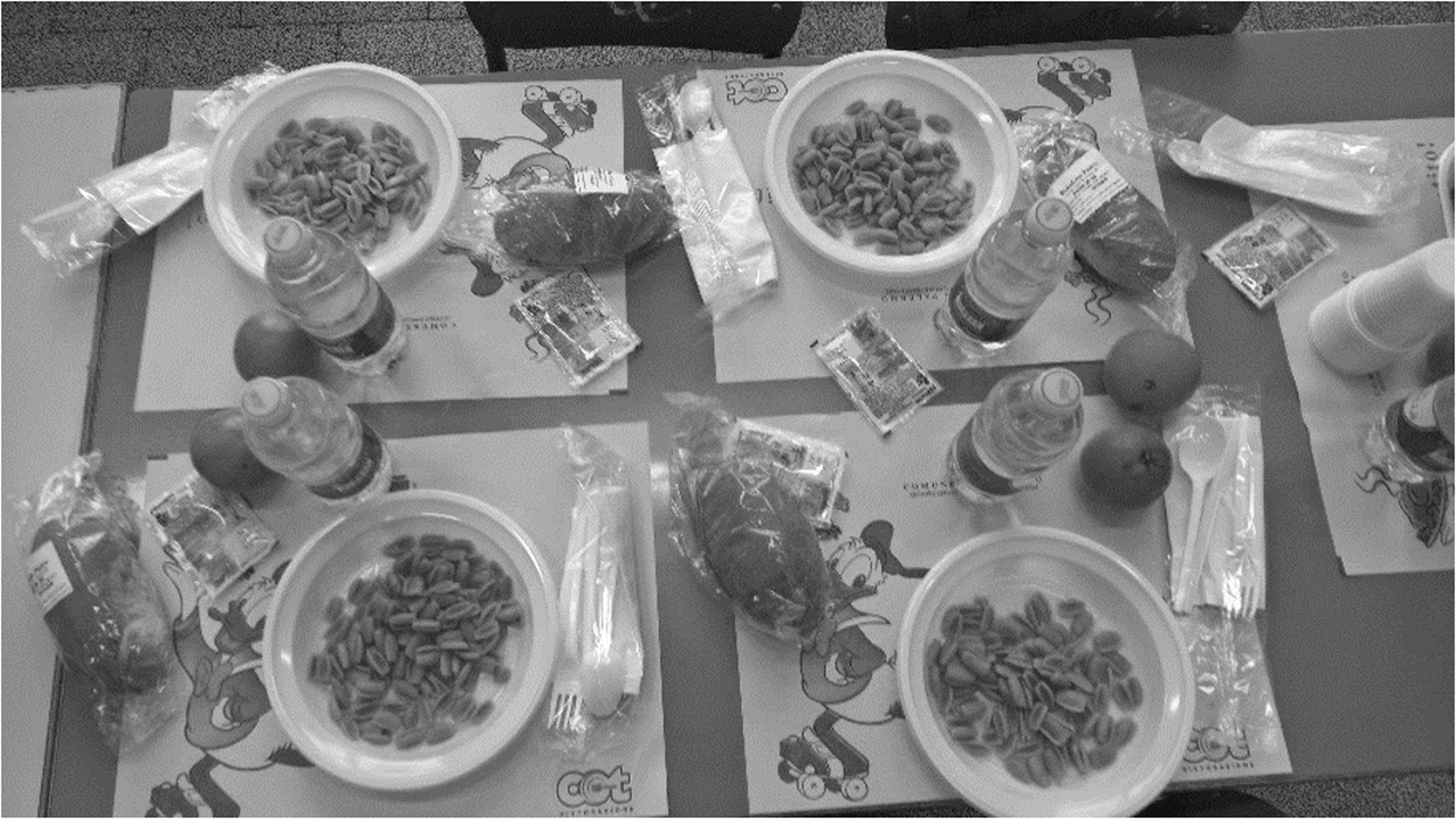
Pasta in bianco. Children can decide whether to add sauce or not.
Unlike in recess, the few children with home-packed lunches are never encouraged to modify their meal following nutritional principles; the teachers have not laid down any rules in this matter, as enforcing food rules during recess is hard enough. Packed lunches tend to consist of rotisserie (often rollò and arancine), pizza, sandwiches with sausage, ketchup, and mayo, fried chicken and French fries; tea or Coke usually accompany the meal.
Lunch, far from being a convivial or a didactic event, tests the ability of the teachers to restrain children’s exuberance. While, in other schools, teachers mainly aim at reducing the level of noise, in the Valmarina their primary objective is to prevent children’s behaviour from spinning out of control while trying to satisfy their incessant requests. Unremittingly throughout lunch, teachers respond and issue reprimands in a loud voice while helping the canteen personnel to distribute food: “Eat! Have you finished? Come on! Quick! Turn your back! Sit down immediately! Sit properly! Don’t even try!” and such like are exclamations that mark the rhythms of the canteen. At times, Rosanna even makes rude retorts to pupils: While I am eating the kiwi fruit, Matteo asks me for some. I ask Rosanna if he can have a kiwi fruit. Unexpectedly, she gives a very rude answer: “Matteo, if you don’t eat that kiwi I’ll use it as a suppository! Do you understand? As a suppository!” There are portions of rice left over, so Lara asks for another helping with tomato sauce. After receiving the portion from Rosanna, she realises she’s not hungry anymore, and leaves it on the table. Rosanna is walking along the tables, and when she notices Lara hasn’t eaten the second serving, she shouts at her “Lara, YOU asked me for another portion of rice, and now YOU’re not eating it?” “But I don’t want it!” “You know where you can put that rice!” It is hard to convey today’s lunch climax in words. Giovanni starts throwing small pieces of bread from the other side of the table, thus prompting his peers to react. In the meantime, a group of pupils start getting up despite teachers’ reprimands. They walk around, ask for peeled kiwi fruit, water or plastic cutlery; some of them try to escape from the lunchroom but are stopped by Ada, one of two teachers who are eating with the second graders. Towards the end, I sit near Giovanni to give him his peeled kiwi fruit: he eats half and throws the other half at Gianni. At the same time, Alessio starts kicking Andrea – they have some unfinished business from recess; Ada asks me to hold Alessio while she explains to Andrea why it is always better not to fight back, as Andrea tends to be a quitter, and easier to handle. After a couple of minutes, the situation is totally out of control. The floor is covered with bread, pieces of tomato, plastic cutlery and pasta. Every now and then a loud crash resounds, as plastic dishes are turned over and cracked with a punch. Giacomo runs all over the canteen and laughs at Maria [the other teacher], who cannot control the situation any longer: she just looks at me with disconsolate eyes. Small pieces of bread and kiwi fruit fly from one side of the canteen to the other, and I am still holding Andrea and Alessio back from kicking and slapping each other. Suddenly, Maria stands up, shouts at the children “SILENCE!”, then faints, falling to the ground. Two hours before, during recess, she had sourly confessed to me she is counting the days to the end of term: next year, she will no longer be here. Luckily, Ada holds her up and gently lays her down on the floor. I help other teachers to move Maria out of the canteen, while she dramatically repeats that she “can’t stand it anymore”. Most children are scared, some of them make the sign of the cross, yet I can clearly see a few laughing at her. A few minutes later, Alessio exploits the absence of authority to kick Andrea, who reacts and tries to fight back, while I am holding him. Alessio takes a plastic knife and threatens Andrea: I seize the knife, while still holding Andrea, who is furiously moving his legs to harm his classmate. Alessio moves close to the table, where a real table knife and a pair of scissors have been accidentally left within reach by the canteen assistant. He seems set on taking the knife, putting his hand on the handle, but Ada pre-empts him, grabs his shirt and starts shaking him with vehemence, telling him to stop. Alessio looks frustrated, and throws a plate full of sauce on the floor. Ada is furious at this point, and starts yelling “NEVER AGAIN! NEVER AGAIN! NEVER AGAIN!” right in Alessio’s ear, and then pretends to slap to his right cheek.
Discussion and conclusions
Soon after my first visits to the Valmarina school, I started wondering whether the fieldwork was putting to the test my capacity to focus on the research object. Previous ethnographic fieldwork conducted in less challenging contexts (see Oncini, 2018b) had allowed me to abide by a more formal, downright disciplined, research protocol. I attempted to control as far as possible my influence over children’s responses, while trying to identify the different positions of the many actors gravitating around the school meal. This allowed me to formulate and respond to precise research questions: How are school meal guidelines planned and received by families? How do different actors position themselves in the nutritional field? What are the most common frictions? How do children’s social origins influence their knowledge of cuisine, food and health? The very same lines of inquiry, when attempted in the Valmarina school, became nebulous to say the least. A common difficulty that the ethnographic approach entails when adult researchers face children – how to deal ethically and methodologically with the most stark form of power relationship – became insurmountable. In other school canteens I had to be careful not to influence children’s responses; in the Valmarina canteen, I simply could not obtain most of those responses. In this sense, my fieldwork might be optimistically seen as revealing the serendipity that characterises the ethnographic craft. Yet it actually unveils the hindrances produced by my misplaced research questions, by-products of the scholastic point of view, a ‘collection of unspoken presuppositions that accompany the intellectual’s privilege to withdraw from the world so as to think it’ Desmond (2014: 564). My unspoken presuppositions, largely overlapping with optimistic views on the beneficial role of state-school meals, common-sense ideas on children’s developmental trajectories and traditional takes on the pedagogic relationship between teachers and children, were like an unadjusted pair of glasses through which I could see only blurred figures.
The words of the nutritionist in charge of the Palermitan schools’ menu, who once told me that he wished to ‘dismantle children’s nutrition and reconstruct families’ food culture’ through school food programmes, could not sound more removed and distant from the dynamics entangling the Valmarina neighbourhood with the school. If previous case studies shed light on the ambivalences, the frictions, and the struggles brought about by food pedagogies, the Valmarina school presented me with their inconsistency and actual side-effects. The concept of school food intervention, despite the endeavours and claims of Rosanna and Clara, clashes with the real goal of daily life in those classrooms: containing the effervescence of the most troublesome pupils and getting by with the standard didactic curriculum – a challenge in itself. Sure enough, both teachers know by heart that school meals should provide a vector of intervention; but in the end, they repeatedly acknowledged that there were bigger issues at stake than food education, and by extension than my pre-packaged questions. Thus, the commonly accepted narratives on the significance of promoting healthy diets usually leave on the plate what they do not like: what pupils actually eat.
The fieldnotes illustrate the complicated reality of recess and lunch in challenging schools, and question whether we should insist on considering schools as able to fix the environmental and health problems stemming from the current food system and its negative externalities, especially in contexts characterised by severe and diffuse poverty. Some excerpts I have quoted describe what happens during food times: they are often interrupted by other incidents, which usually involve a certain degree of physical violence and subsequent adult intervention – at times mighty and repressive. I frequently stepped in to stop children’s altercations myself, thus becoming a ‘participant’, not an ‘observer’. I was often diverted by more salient issues, as teachers came to count on me as an additional supervisor, especially during lunch. Ethically, I could not help but burst into the field when fearing that children might harm themselves during their recurring fights, although this often compromised the ethnographic ecology of the study: what would have happened if I had not been present? Did my presence as an adult man among (female) teachers as well as children trigger and foster actions and reactions? But also, how could I take accurate notes on food during the turmoil? And, just as positionality was unstable, so the gaze was myopic. When reading back my notes I realised that the attention often shifted ‘from eating to beating’, and that the material collected could probably have been more fruitfully employed to examine boys’ construction of masculinity and their rapid growth to adulthood than in offering another account of school food education.
Yet these hurdles, conceptually distant from the school meal ethnography I was intending to study, ultimately reveal the discrepancies between the high-sounding claims of advocates of preventive health intervention among children and the actual life of a school on the fringes of society. In line with previous ethnographic literature showing how pedagogies of shame and disgust are deliberately employed by teachers to try to cultivate healthy subjects (Leahy, 2014), the biopedagogies put in place in the Valmarina school, especially during recess, are often based on melodrama and affective intensities in a poorly focused attempt to improve children’s food literacy through arbitrary rules and reproaches. But, as Leahy and Wright (2016: 243–244) state, “a feature of food pedagogies, and their intended effects, is that they are never as straightforward as curriculum writers, resource developers and teachers can imagine”, and they can “inadvertently encourage other problematic practices”. In fact, the study reveals how food pedagogies that rely on teachers’ disciplinary measures, aim to foster self-control in children and expect (poor) families to align with middle-class health precepts and food values can unwittingly but unsurprisingly intensify the stigma attached to more disadvantaged pupils. Moreover, adding an ambiguous didactic burden to teachers’ shoulders may actually generate unexpected side-effects, as many teachers working on the fringes find that supervising recess and lunch – which should be break times for teachers as well as children – is enough of a challenge. Clearly, a healthy school lunch can improve pupils’ diets in the hic et nunc, but it will not magically shape their food preferences and families’ access to healthy meals. Many mothers may be relieved from the chore (or cost) of providing lunch, but food literacy, healthy snacks and wholesome meals will remain peripheral preoccupations for them. And persevering in trying to impart food literacy without seriously considering the persistence of social inequalities and the profundity of urban poverty will continue to sound hollow.
Footnotes
Acknowledgements
The author is much obliged to Prof. Marco Picone, Arch. Giancarlo Gallitano and Teacher Rosanna for their help throughout the fieldwork, and wishes to thank Prof. Alan Warde and the anonymous reviewers for their valuable comments on earlier versions of the manuscript.
Declaration of conflicting interests
The author(s) declared no potential conflicts of interest with respect to the research, authorship, and/or publication of this article.
Funding
The author(s) received no financial support for the research, authorship, and/or publication of this article.
