



Abstract
This paper examines the enactment of relational welfare in Milan through a focus on how new welfare professionals operating in deprived neighborhoods in Milan work to stimulate participation and relational energies among migrant and low-income parents. The paper introduces the notion of the “intimate public,” a spatial and relational milieu for activating an increasingly diverse public in the absence of traditional welfare resources. Through the lens of the intimate public, a number of effects come into view: First, the incitement to participate recasts the private as simultaneously a source of new forms of solidarity and a potential obstacle to social cohesion and integration. Second, assumptions about the organic and sustainable nature of citizen-based solidarity effectively erase the affective labor required to produce and sustain it, especially in marginalized neighborhoods. Finally, the intense relationality that characterizes the intimate public produces uncertainty and entanglements that bind professionals and participants in compelling ways.
Keywords
Introduction
On Thursday afternoons, a pedestrian-only street at the outskirts of Milan comes alive with children racing on wooden balance bikes, trying their luck on stilts, and playing with board games made by a nearby woodworking cooperative. Their mothers sit nearby on cement benches, talking with each other and with the professionals running the program. The scene is part of the “Inside Out” 1 project that offers homework support and other educational opportunities to families with young children in an increasingly diverse but underserved neighborhood. The project also has broader aspirations: to bring together young and old, Italian and migrant-origin, and poor and middle-class residents. Inside Out is run by two associations: Giocon (Play With), which uses play in public spaces as a medium for creating aggregation and relationality, and Insieme (Together), which runs projects aimed at children and families. Other associations offering services for minors and their families also operate in the neighborhood, a number of them located on the same street as the Inside Out program. Every year, they come together to organize an “Open Neighborhood” annual party, with a potluck lunch eaten on long tables arranged in the street, activities for children, and music.
On the days leading up to the party in the spring of 2017, leaflets were handed out to parents, encouraging them to participate. Marco, a seasoned professional in his 40s who was responsible for Giocon, took time to chat with each mother (and with the rare fathers in attendance), insisting that they must show up to the party. As Marco handed a leaflet to Sabina, one of the participants in the program and the mother of three young children, he asked her: “You’re coming this Saturday, right?.” Faced with Sabina’s evasive reply, Marco added: “We know where you live! If you’re not there on Saturday, we’ll come by and burn down your apartment!.”
Programs like Inside Out have emerged from reforms of welfare and social citizenship in Italy. An extensive, Foucauldian-inspired literature has examined the transfer of social responsibilities from the state to individual citizens and communities in “advanced liberal,” post-Fordist or neoliberal regimes, most commonly in the US or UK context (Foucault, 1991; Jessop, 1994; Juhila et al., 2016; Rose, 1993, 1996; Rose and Miller, 2010). These analyses have brought into focus mutations in the spatialization of government, particularly its reterritorialization from the national scale to the community, and identified a new mode of government “at a distance,” through free, responsible, self-governing subjects (Dean, 1999; Juhila et al., 2016: 14; Rose and Miller, 2010). A more recent literature has attended to the heterogeneity of post-Fordist economic, political, social, and ethical formations (Collier, 2011; Muehlebach, 2011; Muehlebach and Shoshan, 2012). An important contribution of this literature has been to show that citizenship has been recast in affective terms, producing forms of “governing through affect” (Fortier, 2010; see also Caldwell, 2007; De Wilde, 2016; Muehlebach, 2011, 2012; Muehlebach and Shoshan, 2012; Thelen, 2015; Ticktin, 2006). In these analyses, the self-enterprising, rational, and economically calculating subject of neoliberal governmentality (Brown, 2015; Rose, 1996) has been complemented by other subjects, such as the relational, affective citizen of a welfare community, who can be generative of integration and social cohesion (De Wilde and Duyvendak, 2016; Fortier, 2010; Johnson, 2010; Muehlebach, 2012). This work has captured some of the complex subjectivities post-Fordist governance engenders, and the publics it seeks (but does not necessarily succeed) in producing (Clarke, 2013: 216).
Rather than describing the “retreat” of the state that was posited by some neoliberal analyses, this literature shows new strategies of government that bring the state closer to citizens. One of the defining contributions of this critique, Andrea Muehlebach’s (2012) research with elderly volunteers in Milan, traces the emergence of “forms of state-citizen relations that are not distant, but in fact incredibly intimate, leading directly from state law to the human heart” (115). This intimate state–citizen relation is enabled by a “collapse of private and public” that leads to the “flooding of the public with a proliferation of private emotion” (Muehlebach, 2012: 133). As Rose (1996) had foreseen, generating social cohesion and solidarity remain critical aspirations of these new forms of governing the social; it is their locus that has shifted.
This shift in the ideal locus of solidarity from the universalist, state-centered, bureaucratic welfare state to an affective, relational welfare located in the third sector and among citizens (see Donati, 1994) reconfigures the boundaries and significance of “public” and “private.” This reworking of public and private also characterizes reforms in post-socialist contexts (see Gal and Kligman, 2000; Read and Thelen, 2007). In Italy, the domain of the private has always been crucial to a welfare model that relied upon the family, and women’s carework, to supplement limited services (Saraceno, 1994). The privatization of the public that accompanies post-Fordist reforms extends the welfare function of private relationalities and affects into the public. These new understandings of citizenship accompany a “radically recast” notion of society as the product of an accumulation of individual relational acts (Muehlebach, 2012: 43). The region of Milan is particularly invested by these ethical and affective forms of citizenship, which seek to marry a care for others with “a new sense of self and good citizenship, of interiority and action, of sensitivity and agency” (Muehlebach, 2012: 9).
As Marco’s quip to Sabina about burning down her apartment if she did not show up at the neighborhood party suggests, however, new relational forms of welfare that seek to harness private sentiments and relational capacities to generate solidarity beyond the state reconfigure more than the boundaries of public and private; they also reconfigure their value. While the potential of private sentiments to produce more organic and non-state-based forms of solidarity is embraced and idealized by policymakers and experts, it is also the case that when this affective and relational potential fails to be extended into the public, the private can come under scrutiny. Marco’s joke about Sabina's apartment exemplifies this dynamic: The impetus of drawing citizens, their energies, and their potential problems out of the home and into the public sphere reframes the private space and relationality of the home as detracting from the potential of a more solidary public.
Feminist scholarship has long probed the boundary work that sustains the imagination of distinct public and private spheres (Gal and Kligman, 2000; Muehlebach, 2012; Prokhovnik, 1998; Read and Thelen, 2007; Thelen, 2015). This literature re-theorizes the public/private binary of separate spheres into co-constitutive ideological distinctions. Drawing on linguistic theory, Susan Gal (2002: 80) argues for understanding the “public” and “private” as discursive and cultural categories rather than “particular places, domains, spheres of activity.” 2 In this reading, the public/private dichotomy becomes an indexical and “fractal distinction” that obtains its meaning only by reference to its context (Gal, 2002: 81). Such retheorizing of public and private is crucial for understanding how new relational welfare paradigms are enacted at the intersections of new modes of governance, financial regimes, and diversifying publics.
Drawing on ethnography in the expanding third sector in Milan, this paper builds on these debates. It examines how non-profit welfare professionals work to draw out participants from the home and engage them in their programs. It does so by introducing the notion of an intimate public: a set of practices, relationalities, and spaces that draws upon and reworks affects and functions assumed to inhere to distinct public and private spheres. In The Female Complaint, Lauren Berlant (2008: 5) uses the notion of “intimate publics” to describe how US mass-mediated and marketed virtual affective spaces produce identification and belonging. While Berlant’s notion locates an intimate public in mass culture, making for a gendered “imagined community,” I deploy the term to make sense of affective spaces, practices, and relationalities that are understood to facilitate the creation of local communities. The engendering and maintenance of such an intimate public is an important element of relational welfare, a way to draw out and bind citizens to each other in the absence of work- or state-centered forms of solidarity.
What makes the relational welfare interventions that are the subject of this paper—parenting support groups, educational opportunities for low-income children, neighborhood social events—“intimate” is the affective and personal nature of relational practices and the home-like arrangement of space. In understanding these same spaces and practices as public, I reference the multiple meanings of term: The intimate public depends upon institutional support, and enacts, in close partnership with local institutions, governmental aims to “innovate” welfare (Selloni, 2017). Moreover, the spaces and programs of the intimate public are open to everyone. In contrast, in these projects, the home is implicitly, and at times explicitly, framed as an isolating, closed, and even potentially pathological space. These aspirations of new welfare programs to produce a more solidary and integrated public are focused on the urban periphery, where many migrant and low-income and elderly residents live. In these areas, the potential for generating solidarity, cohesion, and integration comes to be linked to opportunities for sociality and the fostering of new ties and networks.
In addition to depending upon citizens’ willingness to leave their homes and participate, relational and community models of welfare require new welfare actors who understand, know, and live the neighborhood. Non-profit welfare professionals differ from institutionally based social workers in key ways. The latter are increasingly seen by experts and policymakers as being too wedded to old welfarist logics and practices, and too distant from citizens’ daily lives. Actors employed by, or volunteering for, non-profit associations, on the other hand, are tasked to work closer to citizens, “in the street,” in a preventative and activating key. In the absence of the (albeit limited) material resources available to institutional social workers, these new professionals, such as those working at Insieme, enact an intimate, relational stance to generate and sustain participation. Ethnographic inquiry into the work of new welfare actors and new welfare policies shows how they labor to generate an intimate public through gendered activities usually associated with the private domain, such as cooking and nursing, and by providing a warm relational and physical space for discussing parenting and marital challenges (see also De Wilde and Duyvendak, 2016). Through this intimate public, professionals aim to generate among participants new ties that cut across ethnic, cultural, and linguistic barriers, extending affect and responsibilities of solidarity from the family to the neighborhood.
A critique runs through the affective citizenship literature: that a politics of affect, with its contingency and particularism, detracts from a universal politics of rights (Muehlebach, 2012; Ticktin, 2006; but see Graham, 2002; Penz et al., 2017). While this is certainly the case, what is produced by such projects is more than a privatization of the public, understood in the two related meanings of: (1) the devolving of state responsibilities to non-state actors that allows the social state to retrench and (2) the affectivization of “a public rendered private through citizens’ feelings turned inside out” (Muehlebach, 2012: 46). In the intimate public of relational welfare, we also see the converse: The private is persistently and intensively invited to become more public. The notion of an intimate public, then, builds on this rethinking of public and private spheres to consider the productivity and indeterminacy of new ways of governing through intimacy (see Vollebergh et al., 2021). Professionals’ practices of generating and negotiating an intimate public, and the effects that this produces, shed light on how we understand ongoing transformations of the social state. Rather than assume a neat “narrative” of privatization and of the decline of the public (see Newman and Clarke, 2009: 1), this paper examines how public and private are reconfigured on the ground as welfare responsibilities are devolved to the third sector.
The paper is organized into three sections. First, it traces the logics of relational welfare that have emerged in Italy and the related expansion of the role of the third sector in social services. Second, the paper focuses on how relational welfare actors create an intimate public by fostering intimate relationships and organizing homey spaces and activities usually associated with the domestic domain. This section also shows how these welcoming spaces and relationalities are also coupled with a suspicion of the private domain of the home. The third section examines how the engendering of an intimate public also generates uncertainty, about roles and the nature of relationships, and compelling entanglements.
The paper draws on nine months of research in Milan in 2016 and 2017 with professionals and volunteers operating in non-profit associations serving poor families, mostly of migrant-origin. 3 The argument focuses mostly on the work of new welfare professionals at Insieme and Giocon, two non-profit associations funded by a combination of public and foundation money, an international NGO focused on child poverty and wellbeing, and private sponsors. The analysis also draws on concurrent research conducted in volunteer-based associations providing language classes to migrant mothers. All of these programs are located in, and explicitly target, neighborhoods characterized by a prevalence of public housing, high rates of migrant residents, and inadequate social services. One such neighborhood was known until recently as a dangerous “ghetto” controlled by organized crime and rife with drug dealing. Another, while considered more livable, was understood to suffer from a lack of services for its residents, which increasingly include migrant-origin families. These neighborhoods, one of which I called home during the year in which I was conducting fieldwork, are situated in the city’s periferia (outskirt). Despite a significant presence of third sector actors and even of the military, 4 in media coverage, political debates, and in the complaints voiced by many residents, these neighborhoods are described as sites of “abandonment” by the state (Grassi, 2018).
Research was conducted while participating in programs such as Inside Out and in a support group for mothers and their young children. My role in these programs was at times ambiguous—part observer, part participant, part volunteer. I played with children, helped mothers with job searches, and made crafts. I attended association meetings, social events, and special outings, as well as numerous government-sponsored conferences on welfare and the third sector. In addition to participant observation and informal conversations, I conducted interviews with 24 professionals from a number of associations and with policymakers responsible for welfare reorganization in Milan.
Relational welfare
Following a postwar expansion, the welfare state in Italy underwent significant reforms. In the early 2000s, the architecture of the welfare state was broadly reshaped by institutional and constitutional reforms that decentralized the social state vertically—by delegating responsibilities and funding to regional and municipal levels—and horizontally—by devolving services to non-profit and private entities, according to the Catholic-derived principle of subsidiarity (Maino and Neri, 2011; Naldini and Saraceno, 2008). This process intensified fragmentation and territorial inequalities, further undermining existing weaknesses in the Italian social state (Naldini and Saraceno, 2008), which, even at its height, had always leaned on the family and its heavily gendered division of labor (Esping-Andersen, 1999; Ferrera, 1996; Saraceno, 1994). The fiscal demands of European monetary unification and the financial crisis of 2008 doubled down on these significant retrenchments in social services and healthcare.
Reforms in healthcare and social welfare in Italy followed divergent patterns: while healthcare has been reshaped by logics of privatization, social welfare has been substantially devolved to the third sector. This devolution of social services fits within the broader reconfiguration of the sociopolitical landscape associated with post-Fordist governance, which also includes its rescaling from the national to the local levels (Rose, 1996). The “thirdness” of this sector is in relation to the first and second domains of market and state. The non-profit third sector should not be understood to operate in a separate, “nongovernmental” sphere, but, rather, to be exercising “statelike function[s]” (Ferguson and Gupta, 2002: 994) as part of a shared governmental assemblage.
The third sector in Italy is an ambiguous domain infused with affective energies and ethical commitments, producing a fantasy of its distance from both state and market logics, even while being entangled and dependent on both (see Muehlebach, 2012: 66). Understood to be positioned closer to citizens than either the state, even in its most local incarnation, or the market, and more knowledgeable about local problems, the third sector has also acquired a “sacralized” moral quality as an arena supposedly governed by reciprocity and animated by love (Muehlebach, 2012). This rhetoric tends to erase its entanglements with both private and public monies and logics, including fierce competition and adoption of corporate management practices (Weiss, 2011: 596). 5 One of the ways in which the third sector is sacralized is through its conflation with volunteerism, notwithstanding the sector’s employment of a growing labor force (Morningfuture, 2019; Muehlebach, 2012: 66).
Despite, or perhaps, because, of these ambiguities, the third sector has emerged from Italy’s prolonged economic crisis as uniquely positioned to heal what policymakers and various welfare actors commonly refer to as a torn social fabric. The annual National Festival of Volunteering, a multi-day event that brings together institutional and third sector actors, and practitioners, for example, consistently uses the tropes of “reweaving” and “reconstructing” in its titles. 6 In 2017, when I attended the festival, the theme of “reconstruction” linked the urgency of rebuilding areas in central Italy devastated by earthquakes in 2016 to a broader, but no less urgent, social crisis that requires the “reconstruction of ties and relationships.” Both types of reconstruction, the physical one and the relational one, were deemed to hinge on the relational labor that third sector actors are assumed to be uniquely positioned to provide.
For funders, policymakers, and experts, third sector actors, like those working at Insieme, are “relational entrepreneurs” at the heart of the new welfare. At the conference on volunteerism, Edoardo Patriarca, president of the National Centre for Volunteering and a member of Parliament, described third sector actors as “artisans of relationships” who can mobilize citizens and heal a society in ruin and tatters. He suggested that reweaving Italy’s torn social fabric requires the extension of sentiments often assumed to belong to the private affective sphere of family and friends into the public. With its homey environment and warm, welcoming relationality, Insieme’s group for mothers is an enactment of Patriarca’s call for such an extension of private relationality. In comments that echo Patriarca, the president of Insieme described the association’s aim to “help to reweave social ties and remake the social fabric” of the neighborhoods in which it operates. Creating a physical and relational environment conducive to sharing problems and struggles is supposed to further new welfare ambitions of generating new ties, activating citizens, and enabling the emergence and transformation of individual problems into social ones where, it is hoped, they can find resolution (Colozzi, 2012: 114).
Over the past two decades, and across administrations at opposite ends of the political spectrum, community welfare paradigms that rely on third sector actors have gained ground in Milan (Ferrera and Maino, 2011). Milan’s center-left administration, which has been in power since 2011, invested in welfare policy as it confronted a series of “crises,” including the arrival of tens of thousands of refugees to the Milan central station beginning in 2014 and the ongoing effects of economic recession. Led by Pierfranco Majorino, the charismatic and politically savvy Alderman of Social Policies, Health and Rights, Milan’s municipal government initiated a series of welfare reforms inspired by a relational paradigm. The municipality’s policy plan (Piano di zona) defines social policy as “first of all, a matter of rights” (Comune di Milano, 2012: 3), but describes welfare as a system that promotes relations among persons, the growth of social capital, reciprocal trust and inclusion as constitutive elements of citizenship and as necessary to generate the conditions for the production or the support of efficient and effective care services.
7
Influential Italian scholarly re-elaborations of social citizenship call for a move away from individual rights toward a social and relational citizenship (Donati, 1991, 1994, 2008; see also Belardinelli, 2005; Giuffrè, 2005). These shifts from rights to responsibilities, and from the individual to the social, are understood to enable a more sustainable welfare that regenerates the resources it consumes. Through the alchemy of relational welfare and its “engagement and activation of multiple latent energies in the social fabric,” “costs” can be transmuted into “revenues” (Fondazione Zancan, 2013). These theories about how the social works influence policymakers, and are echoed in their arguments. In an interview, the policy architect of Milan’s most recent welfare reform explained to me that welfare innovation requires a “cultural shift” from a welfarist citizenship focused on “my rights” to one focused on responsibilities. A new welfare, he continued, also calls for new kinds of professional figures who are located closer to citizens and operate in their neighborhoods rather than sitting in an office with a list of services at the ready. The role of these professionals should not be that of traditional social workers—to redistribute resources to the needy—but to empower citizens into new, active forms of welfare that ultimately regenerate resources. The “soft skills” necessary for this kind of social work center on “relational capacities” (Morningfuture, 2019).
Insieme
Like many similar entities, the non-profit association Insieme emerged in the context of social policy reforms and economic recession by successfully navigating the opportunities provided by the devolution of public funding. Insieme was successful not just in its partnerships with the municipal administration, but also through its links with an international NGO, with Milan’s biggest foundation supporting welfare innovation (the Cariplo Foundation), and with private donors. In its promotional material and on its website, Insieme describes itself as developing, and experimenting with, “innovative forms of welfare.” Its mission states that the association “believes in relationships,” making it an ideal partner for the municipality’s welfare reform efforts. In fact, the municipality chose Insieme to pilot the implementation of welfare reforms in Milan.
Insieme’s projects, like those of many other third sector associations operating in the domain of welfare, fit the model of neoliberal immaterial welfare as, materially speaking, they “give very little” (Rozakou, 2016: 190; see also Muehlebach, 2012). Unlike traditional, institutional social work, Insieme’s professionals are not in the business of redistributing resources. Ideally, they are tasked with co-producing it with their participants. Like many association professionals in Italy, actors at Insieme combined the egalitarian aspirations of relational social work with the policy ambitions of relational welfare. In relational social work, operators work through “relational dynamism” by activating various networks (Folgheraiter, 2006). Understanding welfare as a relation among multiple actors positions the helping professional in the role of accompaniment and empowerment of the client, now understood as agent (Barnes and Bowl, 2001; Bortoli and Folgheraiter, 2002; Folgheraiter, 2006: 38). This approach lends itself well to the relational welfare paradigm in which professionals “empower” active citizens to access available resources, including by sharing them with neighbors or fellow parents, and to regenerate them through participation. As in similar projects elsewhere, however, such logics also create challenges for practitioners (De Wilde and Duyvendak, 2016; Van Bochove et al., 2018).
I came to know three of Insieme’s professionals well, Lea, Marta, and Emma along with other professionals, like Marco, at Giocon. All worked at the Inside Out program described in the introductory vignette. Lea, Marta, and Emma ran a daily morning group for mothers that I also attended. Like almost all of the other association professionals I encountered in my research, none of them had a traditional social work degree. Instead, they had come to this work through various educational and employment paths, including degrees in philosophy, anthropology, and even engineering, and through volunteering experiences. Marta and Emma had left significantly higher paying and secure positions in industry and the public sector, a very risky move in Italy’s precarious employment environment, in order to work nel sociale (“in the social”), as the domain of the third sector is often called. For Lea and Marta, the drowning of 368 migrants off the coast of Lampedusa in 2013 and the refugee crisis that began in 2015, respectively, were crucial moments in feeling called upon to “do good” through their work. Marta, who spoke Arabic, had been particularly affected by volunteering in reception centers at the height of the refugee crisis, which for a time she did on weekends while holding on to a full-time job during the week. Emma, who had a background in both the corporate world and in volunteering work with the disabled, found her way to her position after the birth of her two children.
The professional status of social workers, their scope of action, and the processes of de- and re-professionalization that accompany changes in the welfare state have been the focus of a broad social science literature (Duyvendak et al., 2006; Evetts, 2003; Larner and Craig, 2005; Newman and Tonkens, 2011; Van Bochove et al., 2018). The rise of the third sector as an employer has seen a multiplication of “semi-professional” roles (Etzioni, 1969; Noordegraaf, 2007). Italy’s reformed welfare landscape is populated by a “galaxy” of “helpers” in a multiplying of “helping profession” figures (Colozzi, 2012: 113). Often, as in the case of the new welfare professionals I came to know, these figures identify with the general term “operatori sociali” (social operators). 8 In this article, I use the term “professionals” to differentiate between figures like Marco, Lea, Emma, and Marta, and the volunteers who are often associated with discussions of the third sector in Italy (see Muehlebach, 2012).
The intimate public
On a gray spring morning in Milan, a group of women sit around a large table covered in colorful crêpe paper, busily folding it into decorative flowers. The walls of the space are painted a warm yellow, an armchair in the corner welcomes nursing mothers, bookshelves are lined with books and toys, and soft curtains hang on the floor-to-ceiling windows. Behind a wall adorned with mirrors is a homey kitchen. Large windows framed by soft curtains look onto a piazza over which tower public housing buildings in various states of disrepair. The piazza’s porticos are tagged with colorful graffiti. Only a few years ago, this piazza was known for its organized-crime fueled drug dealing. Today, 10 women sit in the bright, warm space, chatting as they learn techniques of paper flower-making.
One of the professionals, Lea, a hip woman in her mid-20s, is working out the menu for a Women’s Day celebration. She asks Sharmin and Farah, two women from Bangladesh, if they want to participate. While they are enthusiastic about contributing a biryani dish, to Lea’s disappointment, they insist on cooking it at home. “Usually we cook it here, together,” Lea tries to remind them, to no avail. A little later, Fatma, a woman originally from Morocco, arrives pushing a stroller. She immediately seeks out Lea’s help to call the hospital appointment line for her son’s chronic ear infections. Having secured an appointment, Fatma joins the rest of the group at the big table. The conversation turns to a pastry training course, in which Fatma, along with other women participating in the program, is enrolled. Although the course will meet three mornings a week, Lea tries to encourage everyone to keep attending the Moms’ group. Looking at Fatma, she says: “You’re going to keep coming on the other two days, right?.” Seeing Fatma’s uncommitted response, Lea insists, “Come on, what are you going to do at home by yourself the rest of the time?.”
The group for mothers met in a space furnished to evoke the home and often engaged in activities reminiscent of it, such as cooking and eating together around a large kitchen table. The coziness of the physical space and the warmth of the relationality with which professionals addressed participants reflect the ambitions of these projects, which from the perspective of the municipality and the foundation supporting them is to activate participants and to empower them to identify common solutions to their problem. Drawing people, particularly women, and even more specifically migrant mothers, out of the domain of the home is understood to be facilitated by the warm and home-like atmosphere. In this more public but still intimate milieu, previously isolated citizens can be helped to understand the shared nature of their problems, thus countering isolation and alienation, and to find ways to address them through a broadened social network, ideally reducing their dependency on the state. Professionals worked hard, and not always successfully, as we saw in the case of Sharmin and Farah, to convince participants to transpose their private activities into an intimate but more public setting.
In the intimate public of the group for moms, we also see the gendered and racialized dynamics of new welfare paradigms. While the ambition of the relational welfare paradigm is to draw in all citizens, the public that its programs invite and generate are mostly constituted by (migrant) women and their children. Italian-origin women make up the bulk of professionals and volunteers (De Nardis, 2012). Programs like the group for mothers are aimed at facilitating women’s exit from the home in favor of building broader networks of social relations. At a staff meeting, a professional from a partner association reacted to the description of a new entrepreneurial initiative centered on sewing by asking: “When are we going to think of something for the men?.” In fact, in many of the projects, men were assumed to be unavailable and in less need of “activation” because they were working. Women, by contrast, were assumed to be at home alone or with their children and the intimate public served to provide an alternative to their isolation.
The intimate public—cozy meeting rooms reminiscent of home, welcoming practices, friendliness and informality, cooing over babies, cooking and eating together (see Figure 1), mutual sharing of personal stories, humor—implicitly contrasts with the bureaucratic detachment bordering on indifference that has come to be associated with the “traditional” welfare state. This contrast sometimes was drawn out explicitly, as in the case of another Insieme professional, Lucia, who ran a support group for expectant and new mothers through a Milanese hospital. In describing the success of the group, Lucia used examples from the feedback the program received from participants which noted that the group felt like hanging out at a friend’s house while the equivalent one at the local public family clinic felt impersonal. For Lucia, the program’s importance was due to profound changes in Italian society that increased mothers’ isolation. The atomizing effects of economic crisis and migration, such that grandparents might need to work longer and be less available and that migrant mothers may lack a family network to rely upon for support, made personal alternatives to impersonal bureaucratic services all the more crucial.
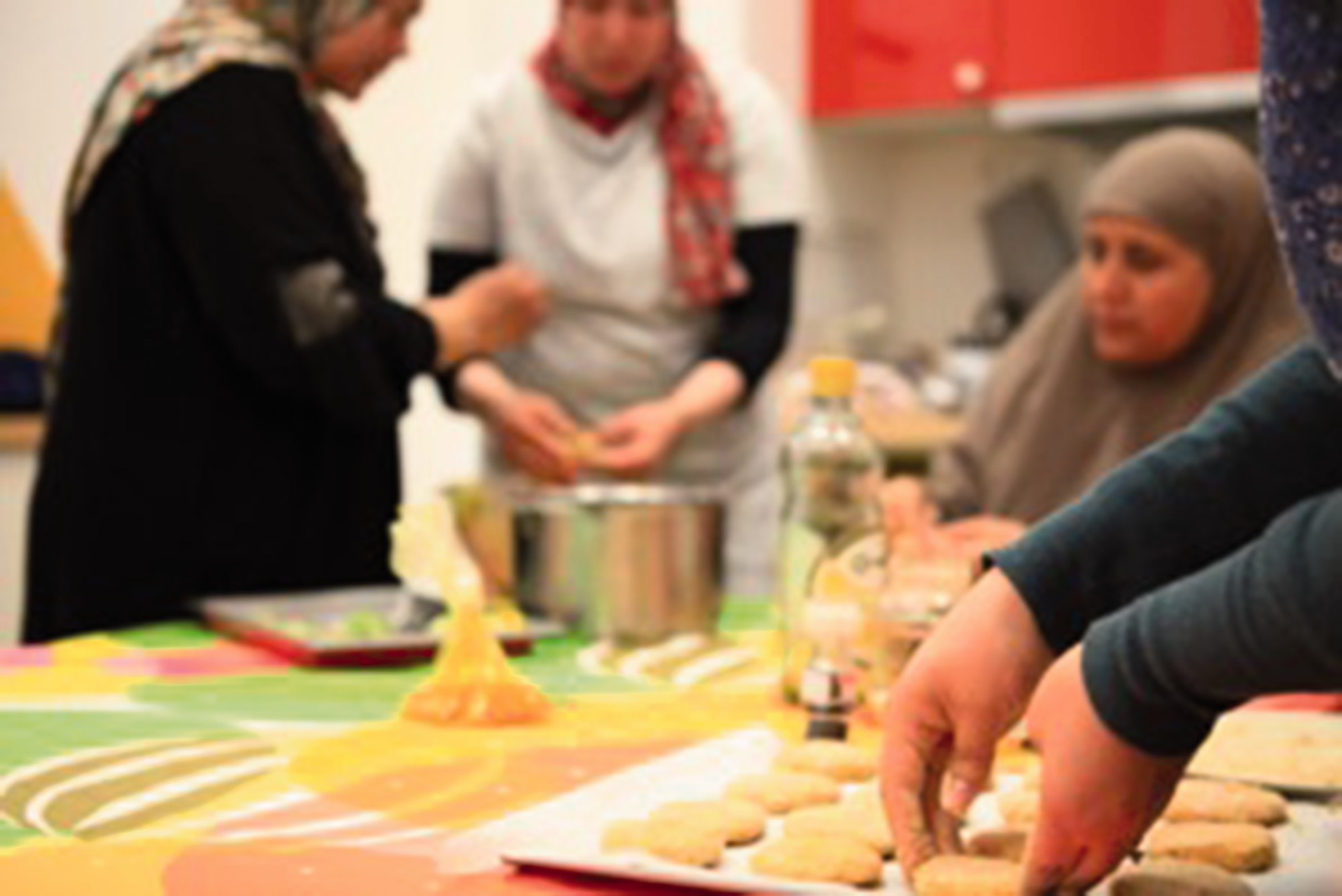
A cooking activity at Insieme. Photo credit: Andrea Balossi Restelli.
Lea’s insistence on cooking together and having Fatma continue to attend the group highlights professionals’ efforts to draw out participants. Although Lea and Marta had identified the pastry course as a way to address the desire of many of their participants to find employment, investing significant time and effort in the enrollment process, they also readily admitted that employment was an unlikely outcome. 9 Professionals saw the reskilling course as a means to bring participants outside of the home and even beyond the intimate public of the group for mothers. I heard similar logics in team meetings and other discussions in which children, particularly those of migrant-origin, were the target of the “out of the home” impetus. In a staff meeting, a young professional responsible for an afterschool program pushed back against suggestions that her approach of accepting every child into the program, regardless of capacity, was leading to mayhem. She argued that in the absence of other services in the neighborhood, the afterschool program was the only alternative to the home. Providing a positive alternative to the home, for this professional, meant that she could not turn anyone away. In a project run by a different association offering language courses to migrant mothers, the women’s experiences of home and of the neighborhood were solicited. The Italian facilitators lingered on the negative aspects of home for migrant residents, particularly the lack of space, contrasting them with the potential of a neighborhood-based sociality. The facilitators’ efforts to invite migrant women and their children into a such a neighborhood sociality were met with skepticism. Participants expressed a preference for watching movies in their first language with family at home rather than at a proposed outdoor movie theater. The women dismissed calls for more green areas, including playgrounds, in the neighborhood arguing that their children would continue to come straight home from school to avoid bad influences. They also described, to the facilitators’ chagrin, a desire for commercial spaces, like malls, that they could visit on the weekend with their families.
Burning down the house
Marco’s joke about burning down Sabina’s apartment is thus not as idiosyncratic as it may have appeared initially. Rather, it reflects relational welfare’s focus on mobilizing residents into a more solidary public. With its emphasis on public participation and aggregation, relational welfare for Marco was a needed correction to what he described as decades of citizens turning inward. He noted, for example, how many long-term Italian residents of the large public housing complex surrounding the Inside Out project had purchased their apartments. In becoming homeowners, he argued, they had also become ensconced in their private lives and too focused on protecting their turf. This turn to the private for Marco was part of a broader abandoning of the public by citizens who could afford to retreat to their homes. Marco’s assessment of the state of public space resonates with the ambitions of ethical citizenship as well as with analyses of the loss of public and political spaces in the transition from Fordism to a flexible accumulation regime (Mudu, 2004).
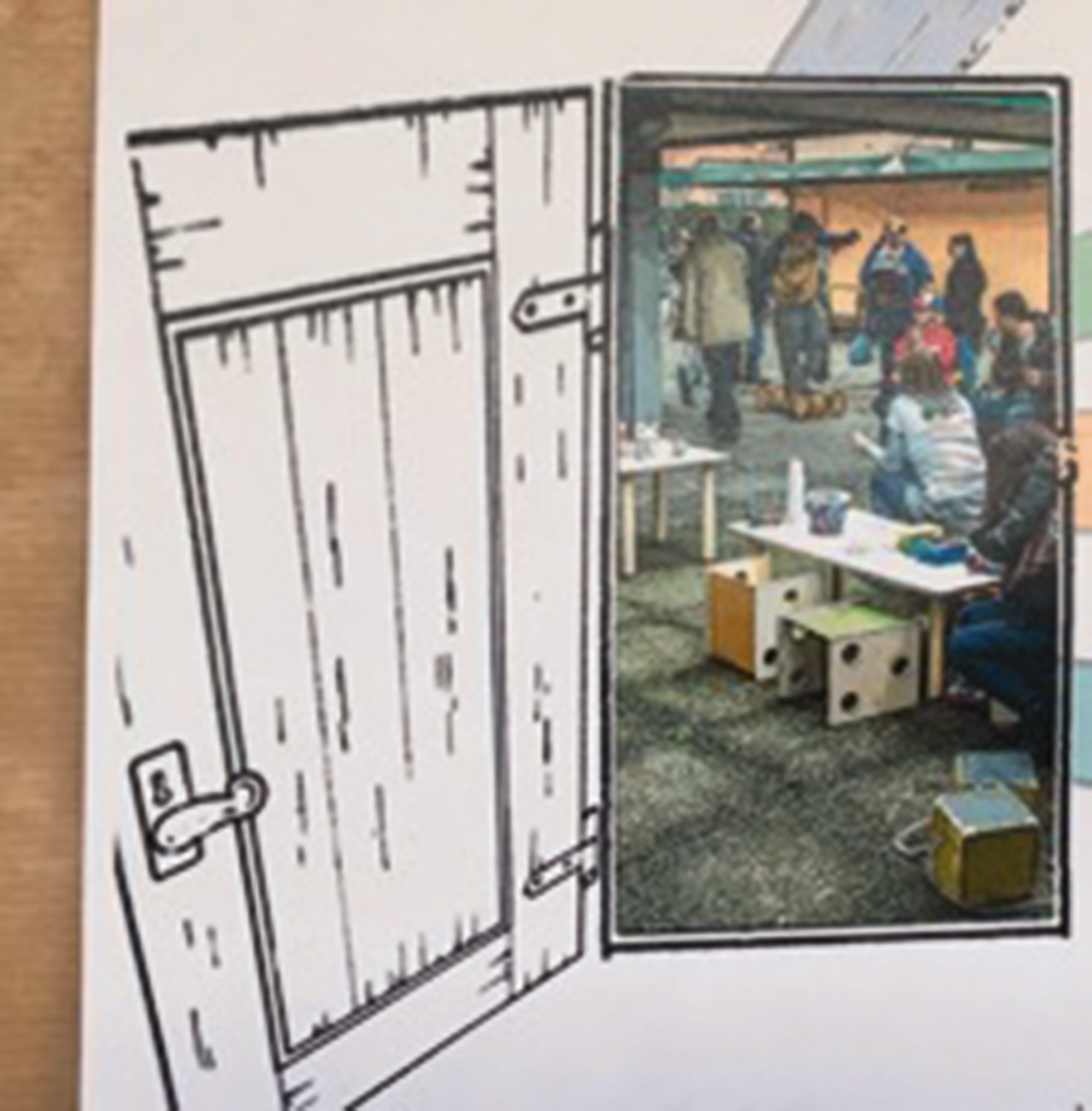
Illustration on a flyer advertising the “Inside Out” project, which highlights the threshold of inside/outside and invites participants to cross into the public sociality of the street. Photo credit: Author.
In Marco’s view, Italian society could no longer afford citizens preoccupied with an inwardly focused, private life. The economic crisis and the rise in anti-immigrant and refugee sentiments made such a retreat on the part of Italians and migrants dangerous. One afternoon, in the aftermath of a violent fight that had broken out among some of participants of the Inside Out project, Marco joked about the supposed effectiveness of “relational welfare.” “What’s the alternative?” I asked. Without missing a beat, Marco replied: “the military in the streets.” Marco’s contrast between new practices of welfare that aim to bring disparate people together in a reclaimed public space with the alternative of militarization hints at the stakes of this new welfare paradigm: for many practitioners and policymakers, it stands between the promise of a better society and the threat of its dissolution. Similarly, the alderman of a town outside of Milan argued at a conference on the third sector that without “citizens choosing to guarantee the common good by being solidary … we’ll all go down together.”
This suspicion of the private coupled with the embrace of publicness sticks to differently positioned subjects in different ways. Marco’s joke about burning down Sabina’s apartment not only reveals the intensity with which new welfare professionals work to draw participants out of their homes and into the neighborhood, but also the kinds of citizens that these projects are most likely to reach: poor and migrant mothers. Professionals described being regularly reminded by their supervisors of the need to encourage a more heterogenous mix in the mom’s group to avoid having it turn into a program for “just migrant mothers.” However, as Marco acknowledged, “normal families,” whose energies and resources would make relational welfare work, were precisely the kinds of residents who did not need these programs and thus were harder to draw in. “Normal,” middle-class Italians are called upon to contribute to the public good as citizens who have time, resources, and connections to offer. Whether as volunteers or as potential hosts of refugees, these are citizens whose private domain has material as well as relational resources that would benefit the public good, if put into circulation. For Lea, whose responsibilities included developing programs with broad appeal and producing flyers and advertising events, drawing in a culturally, socially, and economically diverse public was the most challenging part of the job.
The role of the intimate public as a domain of intervention is inextricable from the politics of migration and integration (see De Wilde, 2016; Hoekstra and Pinkster, 2019). In a welfare context in which private sentiments are understood to form the binds of new social ties, migrant women occupy a potentially fraught position. As newcomers with little access to the job market, intermediaries for their children, and non-speakers of Italian, many migrant women are users of social services. Thus, although, migrant women are employed in substantial numbers as caretakers in the private welfare market and as cultural and linguistic mediators in social services, they come to be primarily identified with the “consumer” end of welfare. 10 The challenges of migration with young children, structural barriers to employment for migrants in Italy, and family patterns also contribute to Italian institutional and NGO actors identifying (especially Muslim) women as isolated and in need of opportunities to escape the domestic domain. The significance of the intimate public in Milan thus needs to be understood as occurring at the intersections of transformations in social citizenship and the diversification of its public. In this dimension of activation, new welfare logics converge with the gendered and sexual politics of a multicultural Europe (Akkerman and Hagelund, 2007; Ghorashi, 2010; Mepschen et al., 2010; Petzen, 2012; Van den Berg and Duyvendak, 2012). Tracing the work of relational professionals shows that even when they themselves embrace a culturally sensitive approach and their task is to weave ties across a broader public, their affective labor is most effective at harnessing migrant mothers. While migrant women and families are most heavily and successfully interpellated by these programs, it would be an oversimplification to conclude that the private domain is considered a virtuous source of relationality for middle- and upper-class Italian-origin citizens but a potentially pathological space for migrant-origin and poor citizens. The effort to produce a more relational public implicates all citizens, though in different ways and with different stakes.
In the intimate public, private sentiments become the thread for reweaving a torn social fabric. For those sentiments to be productive, they must be harnessed from private concerns and spaces into more public ones. The intimate public can be understood as such a mediating space between the private and the public, the home and the street, the family and society (see Figure 2). Drawing participants into the intimacy of the space, however, is not the end point. Rather it is a stepping stone onto a trajectory into a more public public, such as the neighborhood or the city. We can see this impetus in efforts to enroll participants in the reskilling pastry course described above, but also in the organization of “field trips” (“gite”) bringing participants from periphery neighborhoods to the city center. This dynamic is also at play in the Inside Out program. With its use of an indoor space, decorated with a couch and bookshelves and brightly painted, and a contiguous outdoor space on a pedestrian street set up with children’s tables and chairs and toys (see Figure 3), the project encouraged participants to repeatedly cross the threshold of private and public. Public space, in turn, is itself domesticated and reclaimed through interventions that bring domestic practices, like parenting, doing homework, and commensality to the street.
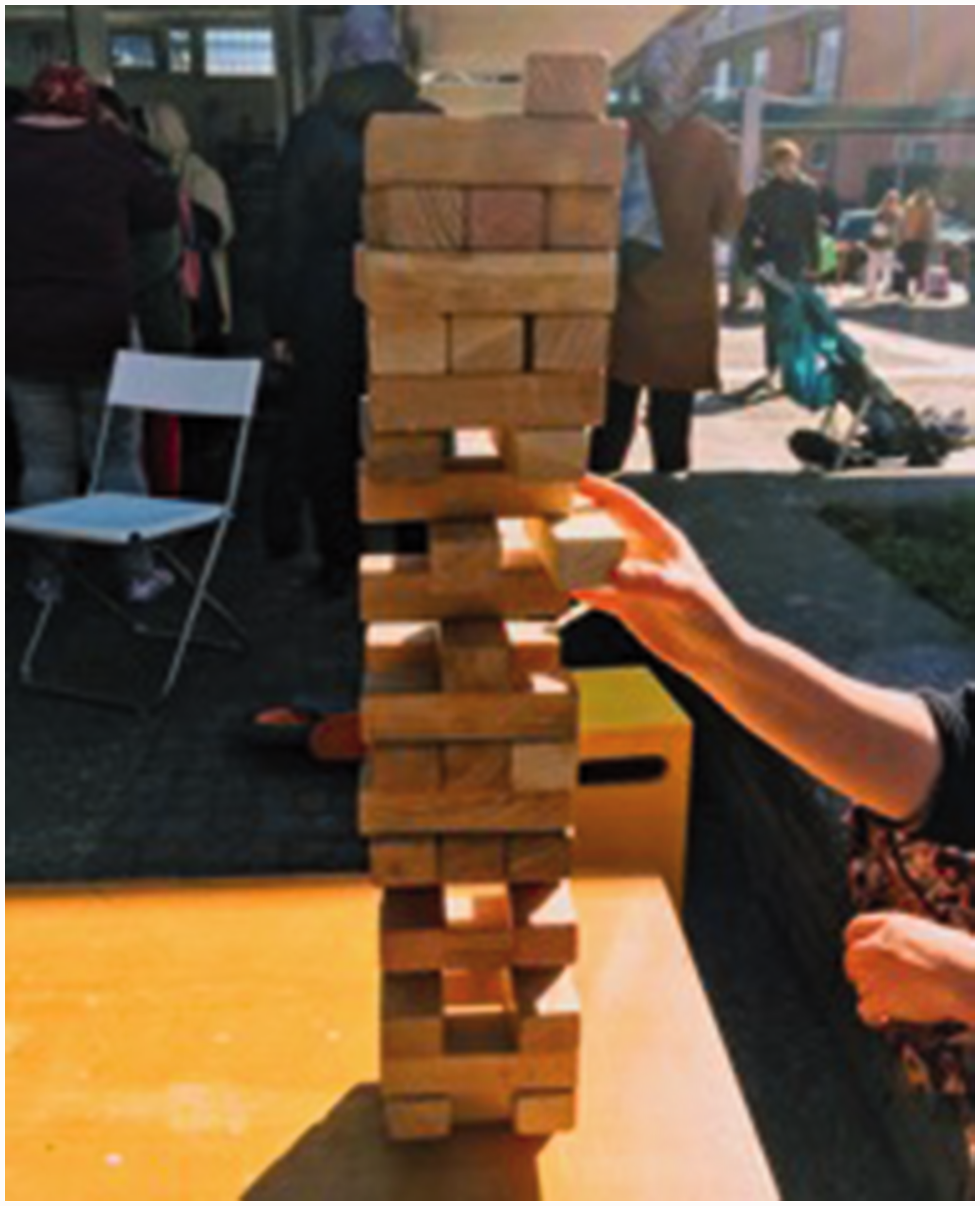
Inside Out activities draw participants out into the street where they can interact with passersby. Photo credit: Author.
Invisible labor and entangled relations
The welcoming stance and informality, warmth and friendliness, that constitute the intimate public are an expression of the values of hospitality and egalitarian relations to which Insieme and its professionals were committed, as well as the means through which they created and sustained participation in their programs. Generating an intimate public requires intensive, sustained, and delicate emotional labor on the part of professionals. Moreover, in order to make their programs enticing and accessible, professionals performed an informal style of social work. This very approachability and friendliness, however, could also produce confusion and entanglements that professionals needed to address. Intensely compelling moments, such as discussions of personal issues, could bind participants together and increase trust in professionals by dissolving boundaries and hierarchies. Yet, such intimacy also required careful negotiation, as the following vignette illustrates.
On a late afternoon in early June, the Inside Out program was winding down for the day. I was still sitting into a child-sized chair, where I had been playing with some children. Most participants had headed home, leaving only professionals and one of the regulars, Elena, an Italian woman in her late 20s. Elena had three children with her Egyptian husband. As the sun got lower and the light softer, Elena, the welfare professionals, and I took turns sharing stories about food, family, migration, and home. Elena’s youngest child, Lilly, a plump three-year-old, walked over to join our group, climbing into her mother’s lap. Lea, who had been busy in the office, walked out and took in the unusually peaceful and radiant moment. Looking at Lilly all snuggled on her mom’s laps, Lea asked warmly: “Aww, Lilly, just how much do you love your mom?.” Elena immediately replied, saying: “Oh, but Lilly got it good this morning. She made me so nervous with her demands: ‘Mamma this!’, ‘Mamma that!’ that I ended up spilling a glass of milk. So, she got it good after that.” Lea’s face dropped in response, and she was silent for a few moments, eventually managing an unconvincing: “Oh, Lilly, no.” Lea finally settled on this ambiguous reply, avoiding criticism of Elena and thus the risk of alienating her. The intimate connection that had drawn our group together, however, had collapsed as suddenly as if someone had pulled out the last wooden block supporting the Jenga game we had been absentmindedly playing. The group dispersed, focusing on picking up toys and packing up for the evening.
The intimate chat in the warm glow of the lowering sun had been intensely compelling, including for the anthropologist. It had temporarily erased the boundaries between professional and participant. Yet, the moment had also brought into relief the challenges of generating and managing an intimate public: professionals often outnumbered participants and easygoing and informal relationships conversation between professionals and participants, so crucial to the making of an intimate public, can easily be misinterpreted as something akin to a friendship. Lea acknowledged that the balancing act of relationality often failed: “sometimes they don’t understand that it’s a job.” Moreover, the relational nature of the hold that professionals have over participants can act to limit professionals’ actions because of fear of undermining the personal connection. The informal methods that professionals used to draw and keep participants engaged in their programs, the public intimacy that they cultivated, also created challenges and relational binds. In this case, the uncertainty about roles and the personal nature of the relationship led Elena to say too much while leaving Lea unable to say much at all.
Like a duck
The informality, accessibility, and friendliness of demeanor, a casual, laid-back attitude and playfulness that were necessary elements of the intimate public of relational welfare, made professionals’ work look like something other than it was. In trying to adapt to and mirror participants’ practices—smoking a cigarette with “some” mothers but never considering that with others—professionals engaged in the kind of mimicry described by scholars working with other social work or human rights figures (Babül, 2017; Shoshan, 2016). An outsider would be hard-pressed to distinguish professionals from participants. On more than one occasion, professionals joked self-consciously that from the outside it looked a whole lot like they were “just hanging out” rather than hard at work. I realized in retrospect how much overlap there was between the anthropologist’s “deep hanging out” mode of participant observation and professionals’ own informal relational work. While their relational and observational attention was directed at participants, mine was directed at professionals. This combination brought the delicate balance of the interestedness of both anthropological and new welfare professionals’ relational practices into uncomfortable relief.
This seeming “just hanging out” mode belied the actual intensiveness of professionals’ work schedules. Running programs like the group for mothers was a visible aspect of association work. However, professionals were also responsible for numerous other tasks, including participation in grant writing, public relations and event advertising, and program development. Professionals at Insieme also handled intake appointments and engaged in an intensive form of casework. Lea and Emma called these activities their “backstage” work.
I came to fully appreciate how busy many of these seemingly “laid-back” professionals were while trying to schedule interviews. Their calendars were packed with work-related commitments that extended into evenings and weekends, prime time for aggregation and sociality. Emma explained to me that they had learned that if they wanted mothers to attend special events, professionals would also need to be present. In fact, professionals often met participants in the neighborhood and traveled with them to more distant events. At the end of an Inside Out afternoon, a professional for Giocon who worked closely with Marco sat tiredly on the couch, head in his hands. He commented that maybe this kind of work was not such an improvement over the assembly line. On a different occasion, I made a passing remark to Marco about the discontinuity between professionals’ playful and relaxed demeanor, their “hanging out,” and the intensity of their schedules and responsibilities. I noted that it reminded me of a duck seemingly gliding on the water’s surface while busily paddling underneath it. Marco’s face lit up and he enthusiastically grabbed what seemed to me a rather pedestrian analogy: “You get it! That’s exactly what it’s like!.” Marco was so taken with the analogy that he joked about changing the logo of the association to a duck. Every time I ran into him thereafter, including upon a return visit, he mentioned the duck.
The duck analogy rang so true for Marco because of a crucial paradox at the heart of relational welfare: Experts and policymakers are vague about the practices and energies required to generate an intimate public that can activate relational resources among the most marginalized citizens. These innovative forms of welfare are predicated on a notion of relationality as organically and essentially located among citizens, of relationality as a renewable resource that has gone untapped, even suppressed by the welfarist state, but which can be activated by the right kind of (third sector) actors and programs. Given these assumptions, the intense affective and relational labor that is required of professionals in order to produce participation in their projects, in other words, the work to create and sustain an intimate public, remains unaccounted for. This invisibility of relational and affective labor to policymakers and experts contributes to the illusion that the new welfare is not only possible, but uniquely sustainable.
Conclusion
This paper has sought to examine new forms of social citizenship through the notion of an “intimate public.” It has shown how the aims and immateriality of relational welfare and the need to mobilize an increasingly diverse public have produced spaces and forms of relationality between professionals and participants that stand as an alternative to the home. Relational welfare is predicated upon the forging of new relationalities outside of the home and the family that are generated and managed by third sector actors tasked with producing new forms of solidarity. Working to activate residents to produce solidarity “from below,” these welfare professionals seek to remake the private in public and the public in private. They do so in home-like spaces, through warm and personalized interaction, and by reclaiming urban public spaces for activities meant to bring the neighborhood together.
Experts, funders, and policymakers argue that new ties can help suture a social fabric torn by economic crisis, a diversifying public, and the alienating effects of modern life. The alchemy of relational welfare rests upon a configuration of public and private that goes beyond the notion that the public has become infused by the private (see Muehlebach, 2012). More precisely, the value of the public and private to the forging of the common good is being reconfigured and re-signified. The private and gendered domain of care and relationality has long served to complement the limits of the Italian welfare state. New welfare logics have recast the private as a visible and celebrated potential source of relationality and solidarity, one that is no longer limited to the family. Despite the rhetoric, however, the home can also be imagined and addressed as a potentially pathologized space of anti-sociality, a retreat from the obligations and opportunities of social citizenship.
Concerns over integration, and particularly over the assumed isolation and home-boundedness of Muslim women, add to the impetus for extending private relationality outward. The private represents at once a resource to harness, and a potential “problem” to be addressed. The “intimate public” aims to do both, by providing an alternative to the isolation of the home that can also be generative of new ties beyond the family and the ethnic community. While the home becomes suspect as a site of alienation, isolation, and potentially of pathology and ethnic ghettoization, the neighborhood street is recast as a virtuous space of managed sociality. Marco’s quip to Sabina about burning down her apartment if she didn’t participate in the neighborhood festa exemplifies this dynamic.
The supportive, warm welcome of professionals is aimed at drawing (and keeping) participants. Yet, such intimacy also complicates the relationship. Warmth and a casual demeanor blur the line between a professional relationship and friendship and, if not managed carefully, lead participants to overshare and risk exposure. In this sense, the public intimacy that “artisans of relationships” cultivate and try to sustain also produces unruly entanglements, relational binds, and confusion about roles and relationships. Because relational welfare is, by definition, supposed to be arising from the community and to be regenerative of its energies and resources, the intensive labor of professionals to engender and manage intimate publics, which includes renegotiations of the boundaries of hard-won relationships with participants, remains invisible. This affective labor is not supposed to be accounted for, as citizens themselves are meant to be the relational agents.
The new welfare is to be a “Welfare for/of All” (Welfare di tutti), as in the name of a broad reform of social services in Milan of which Insieme was a partner. However, programs like those run by Insieme are particularly successful at capturing economically, socially, and culturally marginalized residents, particularly mothers. Ultimately, then, the intimate public is not productive of what experts and politicians assume (and hope) to be a just-waiting-to-be-awoken citizen solidarity (Rose, 1996). The intimate public is more accurately understood as a mode of governing the social that depends upon ongoing and sustained affective labor. Rather than enabling the state to smoothly “retreat,” by way of the intimate public it creates and requires, relational welfare generates uncertainty, contradictions, and ties that bind citizens and professionals to each other, often in compelling ways.
Footnotes
Acknowledgements
I am deeply grateful for the generosity and availability of professionals, participants, volunteers, and policymakers in Milan that have made this research possible. I am also thankful for the anonymous reviewers and the feedback of numerous colleagues, particularly Anouk de Koning, Anick Vollebergh, Nitzan Shoshan, Mette-Louise Johansen, and Hilde Danielsen.
Declaration of Conflicting Interests
The author declared no potential conflicts of interest with respect to the research, authorship, and/or publication of this article.
Funding
The author disclosed receipt of the following financial support for the research, authorship, and/or publication of this article: This project has received funding from the European Research Council (ERC) under the European Union’s Horizon 2020 research and innovation programme (grant agreement no. 640074: ERC Starting Grant for “Reproducing Europe: Migrant Parenting and Contested Citizenship”).
