



Abstract
Entrepreneurial intentions in later life are an understudied phenomenon; studies of intentions among retirees are even rarer. This paper examines the external validity of Vallerand's Hierarchical Model of Motivation among 272 retirees in the USA. The results of path analyses reveal that the need for autonomy and work engagement pre-retirement play crucial roles in the potential decision to create a new venture, serving as the initial steps towards the formation of positive attitudes and perceived behavioural control; these in turn lead to post-retirement entrepreneurial intentionality. There is also a direct path linking the need for relatedness with the formation of post-retirement entrepreneurial intentions. The findings offer new insights based on social psychology that suggest why a proportion of retirees might choose self-employment or new venture creation after retirement from their main salaried employment in an attempt to meet their post-retirement needs. This can underpin schemes and policy interventions to encourage entrepreneurship post-retirement.
Keywords
Introduction
This study is based on a novel approach to better understand the processes that lead to post-retirement entrepreneurial intentions by considering key psychological aspects both before and after retirement. We are driven by the argument that entrepreneurial decisions are ‘affected by different factors at different stages in the life course and that the dominant models explaining transitions into self-employment in the general working-age population may not apply to self-employment transitions at older ages’ (Singh and De Noble, 2003). In recognition that retirement is a particular phase in the life course, this research responds to calls for more entrepreneurship studies to incorporate retirees as their subject participants (Ratten, 2019) including in entrepreneurial intentions research (Pérez-Macías et al., 2022). Such calls are extremely valid given that the vast majority of research on entrepreneurial intentions has used student samples (Hueso et al., 2021).
Not only have retirees been an understudied group in entrepreneurship studies, but the issue of what individuals do after retiring from their main career is particularly significant at present. The expected duration of retirement in OECD and G20 countries in 2050 is projected to be 25 years for women and 20 years for men, 50% longer than projected in 1960 (OECD, 2011). This presents challenges for individuals, who need to decide what choices to make in retirement to meet their needs. It also presents significant dilemmas for policymakers trying to design welfare states for ageing societies where pension provision is becoming ever more expensive (Henkens et al., 2018).
We specifically set out to explore entrepreneurial intentions amongst those who have already retired from paid employment. This may currently be a small niche given that, in a study of individuals aged 50–75 in the United Kingdom, Curran and Blackburn (2001) found that only 4% of those who had already retired expressed an interest in becoming self-employed. However, Singh and De Noble (2003) report a study that found 32% of early retirees who returned to work did so by becoming self-employed. Therefore, we are interested in why a proportion of retirees might choose self-employment or new venture creation as a form of work after retirement. Americans aged over 65 are more inclined to return to some form of work after retirement (Moulton and Scott, 2016); our sample, therefore consisted of individuals in the US who had reached the minimum retirement age of 62 (SSA, 2024).
From a theoretical perspective, we believe that this is one of the first attempts to investigate the external validity of Vallerand's (1997, 2000) Hierarchical Model of Motivation. Therefore, we are responding to suggestions (Sahut et al., 2015) for a more holistic perspective on the psychological constructs determining intentionality, going beyond the over-researched cognitive approach (Maheshwari et al., 2022; Pérez-Macías et al., 2022; Ruiz-Alba et al., 2021) of the Theory of Planned Behaviour (TPB; Ajzen, 1991). We accomplish this by integrating the main tenets of Self Determination Theory regarding Basic Psychological Needs (SDT-BPN; Deci and Ryan, 2000; Ryan and Deci, 2019), and the Work Engagement Framework (WEF; Bakker and Demerouti, 2008; Schaufeli and Bakker, 2010), into TPB (Ajzen, 1991).
By doing so, our study complements recent work looking at work engagement and basic needs as outcomes of entrepreneurial activity (Obschonka et al., 2023; Shir et al., 2019) by examining these factors as antecedents of entrepreneurial intentions. Our study also responds to criticisms from Hatak et al. (2014) that the job-related context in which individuals are embedded has not been explored sufficiently when studying entrepreneurial intentions. Kautonen et al. (2010) find that work history influences entrepreneurial intentions amongst those aged 50–64 with blue-collar careers. Their results suggest that perceived behavioural control (PBC) fully mediates the impact of a career in blue-collar industrial work on entrepreneurial intentions; we are responding to their call for more empirical work with a finer-grained operationalization of work history.
Our study, then, contributes to the literature on entrepreneurial intentions amongst retirees. It particularly provides an alternative psychological root of antecedents that can be explored in post-retirement entrepreneurship studies (Stephens and Hegarty, 2022; van Solinge, 2014). Most importantly, our study is, to the best of our knowledge, one of the first empirical attempts to explore, from a psychological perspective, entrepreneurship as a form of work after retirement (for alternative psychological antecedents please see Razzak and Al Riyami, 2024). We suggest clear direct and indirect connections between work engagement beliefs in pre-retirement, psychological needs after retirement, and post-retirement entrepreneurial intentions.
Practically, our work provides a clear perspective on how specific psychological factors in pre- and post-retirement shape entrepreneurial intentions and boost retired individuals’ inclinations to continue to contribute to society and the economy. This indicates that well-established psychologically focused mechanisms (e.g., educational programmes and community support schemes for retired individuals) could be effective in encouraging social inclusion, better health outcomes, and economic participation through self-employment or new venture creation.
This article is structured as follows. In the literature review, we identify a growing interest in studying retirement in relation to entrepreneurship and set the context for our study by examining changing notions of retirement and how it has been conceptualized (Wang and Shultz, 2010). We look at the broad factors influencing work engagement post-retirement and categorize potential antecedents of entrepreneurship post-retirement into micro, meso, and macro variables, thereby demonstrating the complexity of the influencing factors. We also examine the experience of the retirement transition, drawing attention to the significance of needs satisfaction for psychological well-being. After this, we move on to our theoretical framework and hypotheses. Next, we detail our methodological design and justify our focus on work engagement and psychological needs; we then present our empirical findings. Finally, we discuss the results and their implications and present the limitations of this study and potential future research directions.
Literature review
There is a growing interest in studying entrepreneurship and retirement. Recent studies have explored the retirement decisions and transitions to retirement, of former entrepreneurs (e.g., Crawford and Naar, 2016; Mallett and Wapshott, 2015; Morris et al., 2020; Rönkkö et al., 2024; Stephens, 2024). However, this study looks at how individuals who were not involved in such activities before retiring may be inclined towards entrepreneurship post-retirement.
Wang and Shultz (2010) note that the context for retirement has changed significantly since the 1990s. They cite many factors, including the need to work longer to gain maximum benefits in retirement, changes in the nature of pension provision, and lower levels of private savings. Longer life expectancy has also increased the length of time individuals may spend in retirement. These factors may lead individuals to delay retiring, with the previously traditional lock-step retirement becoming less prevalent and people increasingly moving in and out of paid work (Kojola and Moen, 2016). Cahill et al. (2011: 34) therefore conclude that ‘one-time permanent retirements are the exception rather than the rule’, while Beehr and Bennett (2015) note that the majority of US retirees work for pay after retiring from their main or ‘career job’. A significant body of work has focused on the option of re-entering the labour market by taking paid employment after retirement from a main career (for a review see Sullivan and Al Ariss, 2019). However, there is much less research on self-employment post-retirement.
Wang and Shultz (2010) identify four conceptualizations of retirement: as decision making, as an adjustment process, as a career development stage, and as a part of human resource management. Our study conceptualizes retirement as an adjustment process, which incorporates both the individual's transition from employment to retirement, and their choices in post-retirement life. This is a dynamic process shaped by individual factors within a turbulent environment; research should therefore move away from a static view of retirees’ work transitions to consider how the experience of retirement may evolve over time (Sullivan and Al Ariss, 2019).
Sullivan and Al Ariss's (2019) review of employment after retirement, which can include self-employment, uses five dimensions under an overarching theme of employability to categorize factors related to pre-retirement experiences that go on to influence uptake of work afterwards: Career motivation (encompassing needs – the drive for money and developmental growth – and self-perception), human capital (the stock of it and willingness to gain new competences), social capital (the informational and emotional support gained from interaction with others), identity (work and non-work identities), and personality (openness and proactivity are constructs closely liked to employability).
Similarly, the antecedents of entrepreneurship later in life can be categorized into micro-variables related to the individual, such as health (Kerr and Armstrong-Stassen, 2011; Zissimopoulos and Karoly, 2007); financial capital, liquidity, and wealth (van Solinge, 2014; Zissimopoulos and Karoly, 2007); and education (i.e., Tervo, 2014; Zissimopoulos and Karoly, 2009). Also influential are macro-variables such as the economic outlook (Beehr and Bennett, 2015; Biehl, Gurley-Calvez and Hill, 2014), and policy factors including benefit regimes (Kautonen et al., 2008; Kenny and Rossiter, 2018), mandatory retirement ages (Tervo, 2014), and business support policies (Maritz, 2015). Sociocultural influences such as societal attitudes to entrepreneurship and self-employment in later life (Kautonen et al., 2008, 2011, 2012; Mallett and Wapshott, 2017; Martin and Welsch, 2019) can also be significant.
Meso-variables originating from an individual's prior work or workplace are seen to be important in the retirement literature in terms of both retirement transition and adjustment outcomes, including the decision to generate income from one's labour, and in the entrepreneurship literature in terms of uptake of later-life entrepreneurship. In both cases, pre-retirement job-related variables can be positively or negatively related to the take up of work post-retirement. Work-related variables pre-retirement which influence take up of work post-retirement can be observed in the human capital dimension of work prior to retirement (skills acquired during employment), the social capital dimension (informational support from professional connections made whilst working), and the identity dimension (the extent to which individuals had had a strong connection to their work pre-retirement) (Sullivan and Al Ariss, 2019).
In terms of meso-variables relating to prior career employment in the entrepreneurship literature, Fuchs (1982) was one of the first to identify that a switch to self-employment at an older age (post 58 years) is related to previous experience of self-employment or a salaried position with characteristics of self-employment. Whilst many studies find a positive effect from prior exposure to entrepreneurial activity and role models (Tervo, 2014), Miralles et al. (2017), in an older sample, find that direct experience of entrepreneurial activity prior to retirement serves as a ‘reality check’ on entrepreneurial intentions. Skills and resources acquired in previous employment have also been seen to be significant. Lewis and Walker (2013) find that most of their interviewees who were not previously self-employed had taken up self-employment in the same industry they had been in during their working lives. Avnimelech and Feldman (2010) argue that employees acquire three kinds of resources during employment that can support subsequent entrepreneurial activity: networks, general technological and managerial knowledge, and industry-specific knowledge and skills. However, Lewis and Walker (2011) point out that these skills do not necessarily support individuals in starting and running a new venture successfully. A period of unemployment later in life can also dent confidence in those skills (Kenny and Rossiter, 2018); however, Stirzaker and Galloway (2017) find that redundancy at a later stage of life is perceived to have positive outcomes in triggering entrepreneurship.
In terms of experiences in the retirement transition, Ugwu et al. (2024) use the phrase ‘retirement anxiety’ to refer to a range of fears and worries associated with the transition from work to retirement that can influence post-retirement needs and choices. Such anxiety may relate to contextual factors brought about by changes in pensions and macroeconomic forces. The move from defined-benefit pensions, which last for the retiree's life, to defined-contribution schemes, where the investment risk falls on the individual, leads to uncertainty regarding the sufficiency of income during retirement, especially at times of stock market turbulence and inflation. However, post-retirement experiences are far from exclusively related to financial instability or otherwise, and surprisingly, Maestas (2010) finds that unfulfilled work expectations are more common than unfulfilled leisure expectations, in cases where individuals find retirement less satisfying than expected. Vigezzi's et al. (2025) review of the impact of the retirement transition on health, well-being, and health behaviours highlights mixed impacts on mental and physical health, often related to pre-retirement socioeconomic status. Other challenges for the newly retired include loss of identity and the need to adapt to new non-work routines and maintain social connections (Ugwu et al., 2024).
Fulfilment of the three main psychological needs (autonomy, competence, relatedness) has been seen to facilitate enhanced psychological well-being in various life transitions (Deci and Ryan, 2000; Ryan and Deci, 2019). Stenling et al. (2021) find that fulfilling the above needs during the transition reduces retirees’ level of depressive symptoms. Specifically in terms of autonomy, they argue that the need for autonomy (NA) increases throughout retirement. Failing to fulfil this need by losing financial independence and disengaging from meaningful activities can become detrimental to retirees’ psychological well-being. Particularly if the need for competence (NC) was previously fulfilled by performance within work, the opportunity to gain competence through activities not related to the workplace may drive retirees to seek challenging new activities (Henning et al., 2019b). While these can be considered as unexplored waters, they allow retirees to fulfil their NC and consequently maintain or improve their psychological well-being. For relatedness, it is crucial to build and maintain healthy and valuable relationships and foster a sense of purpose in life. In the retirement transition, individuals may lose their work-related social networks, although they may have the opportunity to spend more time with friends and family (Henning et al., 2019b), which might reduce the risk of isolation or exclusion. However, if social contacts decline over retirement, this does not necessarily mean that feelings of relatedness will decline (Stenling et al., 2021). Retirees may search more intensively for connections and belonging through social activities (Henning et al., 2021) or other activities. Therefore, given that Shir, Nikolaev and Wincent (2019) have highlighted the interrelated roles of active engagement with entrepreneurship, enhanced psychological well-being, and fulfilment of the three psychological needs, retirees’ involvement in entrepreneurial activities can act as a pathway to financial, social, and emotional benefits.
We focus on entrepreneurial intentions post-retirement because there are few studies (Baucus and Human, 1994; van Solinge, 2014) that empirically explore the transition to self-employment or new venture creation post-retirement. Recent research (Justo et al., 2021) finds that retirees moving from inactivity to either self-employment or a paid job experience a similar boost in satisfaction. However, when controlling for satisfaction with earnings, those switching to self-employment are more satisfied. Other researchers have provided evidence that entrepreneurship post-retirement has a positive impact on individuals’ quality of life (Gimmon et al., 2018). This potential impact is important given that life expectancies in the Western world are at historically high levels, with more time therefore being spent in retirement. Although the retirement process and entrepreneurial intentions are both complex, we believe it is of interest to study them in parallel. Therefore, to make a modest start to this endeavour, we introduce concepts from the psychological literature in the form of work engagement pre-retirement and need satisfaction post-retirement to test an entrepreneurial intention model.
Theoretical framework and hypotheses
Starting a new venture is an intentional act that involves repeated attempts to exercise control over the process in order to achieve the desired outcome (Shaver et al., 2001), therefore intentions (i.e., the state of mind directing a person's attention toward a specific goal or a path in order to achieve something) may explain why individuals decide to create a new venture (Bird, 1988: 442).
Since the early nineties, entrepreneurial intention has been a growing and evolving area of interest within entrepreneurship research. Intentions have been established as the immediate and best predictor of any voluntary behaviour (Beck and Ajzen, 1991), and a large body of work on entrepreneurial intention models has confirmed their applicability to a wide range of entrepreneurial settings (Hueso et al., 2021; Pérez-Macías et al., 2022). Recent work has clearly established the link between entrepreneurial intention and behaviour (Harima et al., 2021; Lihua, 2022; Martínez-Gregorio et al., 2021; Meoli et al., 2020; Shirokova et al., 2016; Weiss et al., 2019). Still, the intention-behaviour link has been disputed on the grounds that intentions do not always lead to action and that third variables moderate the relationship (Conner et al., 2000, Tsou et al., 2023). Previous meta-analyses in the context of social psychology (Webb and Sheeran, 2006) suggest that intentions have strong-to-medium associations with actual behaviour. A recent review finds that entrepreneurial intentions account for only 17% of the variance in entrepreneurial behaviours compared to the commonly expected and cited 37% (Tsou et al., 2023). However, a positive relationship between intention and behaviour is likely to exist (even if it is not strong) irrespective of any moderating variables (i.e., PBC); this underlines the importance of testing for intentions (Palamida et al., 2015).
Intention-based research looks at peoples’ cognition, perception, motivation, and intention (Turker and Sonmez Selcuk, 2009). Researchers highlight the importance of understanding entrepreneurial cognition and the formation of intentions to understand the essence of entrepreneurship (Boyd and Vozikis, 1994) as ‘the construct of intentions appears to be deeply fundamental to human decision making’ (Krueger, 2017: 5).
Retirees may form entrepreneurial intentions because they want to satisfy specific needs or elaborate on previous working experiences. To better understand whether and how post-retirement entrepreneurial intentions are formed as a function of post-retirement requirements (psychological needs) and earlier work-related experience (work engagement), we focus on three motivational theories: Self Determination Theory/Basic Psychological Needs Theory (SDT-BPN; Deci and Ryan, 2000; Ryan and Deci, 2019), the WEF (Bakker and Demerouti, 2008; Schaufeli and Bakker, 2010), and the main tenets of the TPB (Ajzen, 1991).
Researchers from contexts other than entrepreneurship (Barkoukis et al., 2010; Sicilia et al., 2015) have extensively examined the integration of SDT-BPN, and we believe this integration enriches our understanding of the psychological aspects that lead to individuals’ engagement in specific activities and behaviours.
Additionally, scholars have directly and/or indirectly linked diverse needs, such as those for autonomy/independence (Al-Jubari et al., 2017; Bickenbach et al., 2017; Dehghanpour Farashah, 2015), achievement/self-fulfilment (Karimi et al., 2017; Yukongdi and Lopa, 2017), and learning and support (Kenny and Rossiter, 2018) to entrepreneurial activity. More recently, Al-Jubari (2019), looking at the student population, clearly provides the links between the three basic needs as described in self-determination theory (SDT) (autonomy, relatedness, competence) and the antecedents of entrepreneurial intentions in TPB. However, these studies have not explored in depth the needs-intentions link and do not take into account the specificities of retirees. We therefore seek to fill this gap by shedding further light on the incorporation of the SDT-BPN (Deci and Ryan, 2000; Ryan and Deci, 2019) in TPB (Ajzen, 1991) to explain post-retirement entrepreneurial intentionality.
Previous research has explored the diverse individual, job-related, and social factors affecting entrepreneurs’ work engagement, as indicated in Mäkiniemi et al.'s (2021) systematic review. Scholars contend (Bakker and Demerouti, 2008; Bakker et al., 2008) that engaged employees are not addicted to their work. They work hard because they enjoy working, but they also enjoy other activities (sports and hobbies, spending time with friends and family, etc.). More recent studies determine the role of effective commitment (Sotiropoulou et al., 2024), autonomy, and psychological capital (Obschonka et al., 2023) in relation to work engagement. We accordingly combine these into a single intentions-based model according to Vallerand's Hierarchy (Vallerand, 1997, 2000; Vallerand and Ratelle, 2002), in which the effects of motivational constructs flow from higher to lower levels of generality: Global-level motivation influences contextual-level motivation, which in turn influences situational-level motivation (Lavigne and Vallerand, 2010). Based on previous work (Hagger and Chatzisarantis, 2007; Vallerand and Ratelle, 2002) we expect this model to illustrate the extent to which psychological need satisfaction and work engagement (global-level motivation) predict entrepreneurial intentions (situational-level motivation) directly and/or indirectly through personal attitudes (PAs) or PBC (contextual-level motivation). Figure 1 depicts our Conceptual Model. Its theoretical basis and the hypothesized effects are extensively discussed in the following sections.
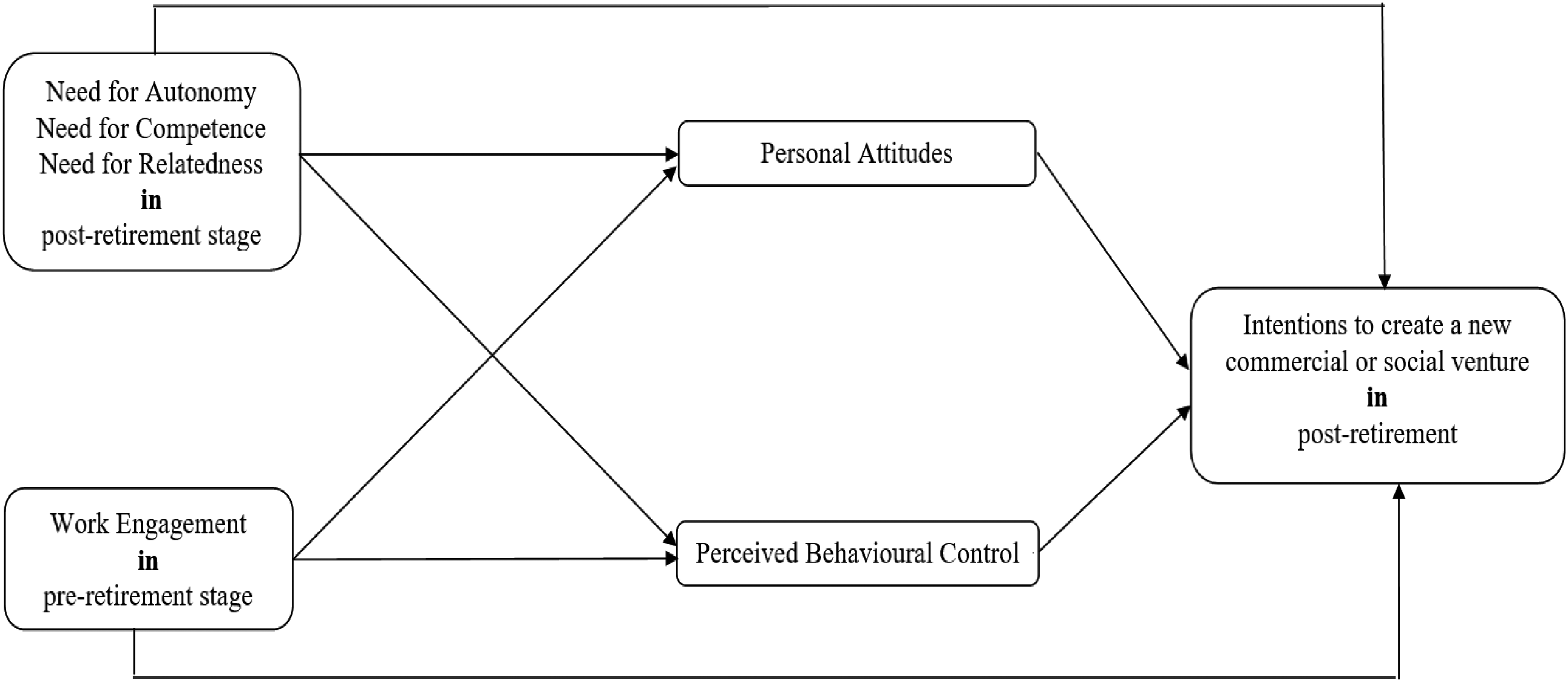
Antecedents of post-retirement entrepreneurial intentions based on the SDT-BPN (Deci and Ryan, 2000; Ryan and Deci, 2019), WEF (Bakker and Demerouti, 2008; Schaufeli and Bakker, 2010), and TPB (Ajzen, 1991). SDT-BPN: self-determination theory and basic need satisfaction; WEF: work engagement framework; TPB: theory of planned behaviour; SDT: self-determination theory.
Linking psychological needs and entrepreneurial intentions post-retirement
SDT (Deci and Ryan, 2000; Ryan and Deci, 2019) is a broad framework for understanding human motivation and personality. It is comprised of six mini-theories, each of which was developed to explain a set of motivationally based phenomena (Deci and Ryan, 2002). At the core of SDT is the notion that individuals strive to satisfy global psychological needs (autonomy, competence, relatedness); the research focus now therefore turns to the applicability of the fourth mini-theory, that of Basic Psychological Needs (BPN; Ryan and Deci, 2019). According to BPN, these needs must be satisfied for individuals to experience optimal psychological development, performance, and well-being within any domain and across cultural contexts (Ryan and Deci, 2008).
The NA reflects individuals’ desire to be and/or become independent; it is satisfied when they believe that they are the initiators of their decisions and obtain feelings of free will and ownership of their engagement in specific behaviours (Deci and Ryan, 2011; van den Broeck et al., 2008, 2010). The NC reflects individuals’ desire to possess the required skills that can effectively/efficiently lead to successful outcomes; it is satisfied when they can actively control essential outcomes/actions/behaviours (van den Broeck et al., 2008, 2010; Vansteenkiste et al., 2007). The Need for Relatedness (NR) reflects individuals’ desire to receive support from others and also provide support to others when engaging in specific behaviours/actions; it is satisfied when mutual respect and trust is developed via frequent interactions among the members of the group/community to which they belong (Baard et al., 2004; van den Broeck et al., 2008, 2010). Evidence for the critical role of supports for autonomy, competence, and relatedness in human development and thriving is summarized in Ryan and Deci's (2019) recent work.
Individuals are naturally driven to seek personal growth and fulfilment that will lead to optimal functioning (Deci and Ryan, 2008a, 2008b); the satisfaction of the BPN can predict this optimal functioning, such as the extent to which a person will identify, pursue, and persist in goal-directed behaviour (Ryan and Deci, 2017). Therefore, it can be argued that individuals will be more inclined to engage in any kinds of activities if they consider that their BPN will be fulfilled. Since the best predictor of behaviour is intentions (Ajzen, 1985, 1991), it can be further argued that individuals’ expectations that a specific behaviour will satisfy their basic needs will increase their intention to act in this way. In the entrepreneurial context, one would expect that potential entrepreneurs in the post-retirement stage will be motivated to (a) make their own decisions that will lead to specific actions and behaviours (autonomy) (b) engage in challenging activities by using their financial-human-social skills (competence) and (c) socially connect with but also be valued by diverse social groups (relatedness) (Al-Jubari, 2019).
The mediating role of personal attitude
According to TPB (Ajzen, 1991), PA is the degree to which a person has a favourable or unfavourable evaluation of a behaviour; it is expected that the more favourable the attitude, the higher the level of their intentions. Regarding entrepreneurship among older individuals, scholars provide evidence that older individuals are more inclined towards entrepreneurial activities if they experience positive attitudes (Kautonen and Luoto, 2008; Sahut et al., 2015; Tornikoski and Kautonen, 2009). Therefore, it is argued that post-retirement entrepreneurial intentions are shaped by retirees’ perceptions that engaging in entrepreneurship would be a wise and beneficial decision. This indicates a possible mediating effect: in their search to fulfil their BPN, retirees will be more inclined to perform entrepreneurial activities if they consider that doing so will meet those needs (Ryan and Deci, 2017). One can further argue that retirees’ positive expectations of the fulfilment of BPN through their involvement in post-retirement entrepreneurial activities will produce positive beliefs regarding the outcomes (freedom, choice, effectiveness, belongingness, social acceptance) of such involvement. They will therefore consider this as a more attractive option (positive attitude), in turn leading to higher entrepreneurial intentions (Al-Jubari, 2019). The following hypothesis is therefore formulated:
The mediating role of perceived behavioural control
According to TPB (Ajzen, 1991), PBC is the perceived ease or difficulty of performing a behaviour; it is expected that the greater the PBC that individuals have, the higher the level of their intentions (Ajzen, 2002). Individuals’ intentions to enter entrepreneurship are driven by their assessments of whether they possess the requisite knowledge, skills, and abilities to perform such activities (Segal et al., 2005). High-self-efficacy individuals feel confident about their skills, knowledge, and ability to start and run a business (Koellinger et al., 2007). They tend to see more opportunities than risks in certain situations, and feel capable of overcoming difficulties and handling situations by expecting positive outcomes (Kobia and Sikalieh, 2010). Many individuals avoid entrepreneurial activities not because they lack skills, but because they believe they do (Chen et al., 1998). However, entrepreneurs are likely to possess high levels of self-efficacy (i.e., they believe that they have what it takes to meet environmental demands and control their environment) (Camerer and Lovallo, 1999; Chen et al., 2001). Retirees who lack belief in their own ability to start and run a business will therefore experience a significant negative impact on their entrepreneurial intentions (Kautonen et al., 2013). Conversely, retirees with high levels of self-efficacy will have greater intentions to create a venture as they will be more likely to believe they can control the situation (Caines et al., 2019; Kautonen et al., 2015a). This indicates a possible mediating effect, where the fulfilment of BPN offered by post-retirement entrepreneurial activities creates beliefs of greater control/self-efficacy over the specific behaviour, thereby forming stronger entrepreneurial intentions (Al-Jubari, 2019; Al-Jubari et al., 2019; Sicilia et al., 2015).
Linking work engagement pre-retirement and entrepreneurial intentions post-retirement
Based on WEF (Schaufeli and Bakker, 2010), it is argued that pre-retirement work-related experiences may play a role in forming retirees’ intentions to engage in entrepreneurial activities. We suggest that the degree to which retirees will be motivated to engage in such activities is determined by the degree to which they were engaged in their pre-retirement employment. According to Schaufeli and Bakker (2010), work engagement is a positive, fulfilling, work-related state of motivation characterized by high levels of vigour, dedication, and absorption. Vigour involves high levels of energy; dedication refers to feeling pride, significance and enthusiasm; and absorption is being fully concentrated and happily engrossed in the job. It may therefore be suggested that employees who were highly engaged in their pre-retirement employment have experienced work as something positive that they will likely miss after they retire. This positive experience may function as a drive to engage in entrepreneurial activities post-retirement.
The mediating role of personal attitude and perceived behavioural control
Pre-retirement engagement will enhance positive attitudes and PBC regarding post-retirement entrepreneurial intentions. Individuals who had positive work-related experiences pre-retirement may be more positively inclined towards work-related activities post-retirement, because those positive feelings may spill over (Demerouti et al., 2010). Engaged employees also build personal resources such as self-efficacy (Xanthopoulou et al., 2009). Since they feel more self-efficacious, they may be more likely to perceive high levels of control in extending their work-related activities after retirement. As discussed above, TPB (Ajzen, 1991) postulates that intentions toward a specific behaviour may be partly explained by PAs towards the given behaviour and PBC (Caines et al., 2019; Kautonen et al., 2015b; Tornikoski and Kautonen, 2009). This indicates a possible mediating effect, where post-retirement intentions are determined from pre-retirement work engagement via the formation of positive attitudes and high levels of self-efficacy.
Methodology
Participants
We targeted 800 participants in the USA who had reached the minimum retirement age of 62 (SSA, 2024). The purpose of this research was to capture psychological antecedents of entrepreneurial intentions that are generated in a specific life stage (1–3 years in retirement). Those antecedents refer to beliefs related to events taking place in pre-retirement and post-retirement. We took into consideration the retrospective data collection timeframe and recall biases when measuring our work engagement in pre-retirement construct. Therefore, to assure that our participants can accurately recall past employment before retirement we have incorporated only paid employment retirees who have retired 1–3 years before the study was conducted. This is in line with our conceptualization of retirement as a longitudinal adjustment process; this, as Wang and Shultz (2010: 177) state, ‘provides a more realistic depiction of retirement and guides the selection and investigation of retirement outcomes’. It also corresponds with the approach of Topa and Alcover (2015), who examine the retirement adjustment process using retrospective measurement of psychosocial factors related to paid employment. They argue, as do we, that whilst work-related factors will become less salient over time, they are relevant in the years immediately after retirement. Additionally, since perceptions on work engagement in the pre-retirement and post-retirement phase of life might differ, it is crucial to map how retirees feel at a very certain point in their retirement life about past events, because these perceptions and feelings will drive them towards acting in post-retirement. That said, Grünwald et al. (2022) find that the psychosocial aspects of career employment that individuals have valued generally remain important post-retirement, suggesting that the commonly held notion that retirees may reevaluate what they value in life may be less pronounced than previously thought.
Our final sample consisted of 272 retired individuals. They all resided in the US; 60% were of ‘Anglo’ American ethnicity. Their mean age was 66 (SD = 9.14); 57% were men, while 43% were women. The majority (168) were engaged or married; 79 were divorced, widowed, or separated, and 25 were single or had never married. The participants come from diverse educational backgrounds: 52% held undergraduate degrees, 35% had high/technical school experience, 12% had postgraduate education, and only 2% were PhD or Professional Degree holders. On average, the participants had an annual post-retirement household income of between $40,000 and $49,999, with only 22% indicating that their income was between $20,000 and $29,999.
Measures
Core variables
Expectations of basic need satisfaction by engaging in post-retirement entrepreneurial activities. To measure participants expectation about whether engagement in post-retirement entrepreneurial activities (create a new commercial/social venture) is likely to facilitate the satisfaction of the NA, competence and relatedness, we adapted the work-related basic need satisfaction scale developed by van den Broeck et al. (2008, 2010). Expectations for need for autonomy satisfaction were measured with five adaptive items, including ‘Being an entrepreneur by creating a new commercial/social venture in post-retirement will help me be myself’ (Cronbach's α = 0.95). Expectations for need for competence were assessed with three adaptive items (e.g., ‘Being an entrepreneur by creating a new commercial/social venture in post-retirement will make me feel that I could really master my tasks’; Cronbach's α = 0.95). Expectations for need for relatedness were measured with five items, including ‘Being an entrepreneur by creating a new commercial/social venture will not give me the feeling of being connected with other people (Reverse Item)’ (Cronbach's α = 0.95). All items were rated on a five-point scale ranging from (1) = strongly disagree to (5) = strongly agree.
Work engagement in pre-retirement was measured by the nine-item Utrecht Work Engagement Scale (Schaufeli et al., 2006), adapted to capture pre-retirement employment. The scale consists of three subscales measuring vigour (‘In my pre-retirement work, I was feeling bursting with energy’; Cronbach's α = 0.91), dedication (‘I was enthusiastic about my pre-retirement work’; Cronbach's α = 0.92), and absorption (‘I was feeling happy when I was working intensively in my pre-retirement work’; Cronbach's α = 0.83) with three items each. To create a total score for engagement that combined vigour, dedication, and absorption, we calculated the average of these three subscales. This score was used in the analyses.
PAs were measured with the three-item scale developed by Van Hooft and De Jong (2009). Items were adapted to refer to attitudes towards venture creation (e.g., ‘It is wise for me to create a new commercial/social venture in post-retirement’). Participants were asked to rate their level of agreement on a five-point scale from (1) = strongly disagree to (5) = strongly agree. The reliability of the scale was excellent (Cronbach's α = 0.92).
PBC was measured with a five-item scale adapted from Van Hooft and De Jong (2009). Items were adapted to refer to control with regard to venture creation (e.g., ‘Overall, I feel confident in being able to create a new commercial/social venture in post-retirement’). Participants rated their level of agreement with each item on a five-point scale from (1) = strongly disagree to (5) = strongly agree. The scale showed excellent reliability (Cronbach's α = 0.92).
ICV were measured with the three items developed by Van Hooft and De Jong (2009). These items were adapted to refer to participants’ ICV. They included ‘I intend to engage in entrepreneurial activities (create a new commercial/social venture) within the next six months’ and ‘I expect that I will engage in entrepreneurial activities (create a new commercial/social venture) in the next six months’. Response options ranged from (1) = strongly disagree to (5) = strongly agree. Participants were also asked to indicate the time that they intended to spend on entrepreneurial activities: ‘How much time do you intend to spend on entrepreneurial activities (create a new commercial/social venture) during the next six months?’ Response options ranged from (1) = no time at all to (5) = very much time. Following Van Hooft and De Jong (2009), we used the total score of these three items to measure intentions. The reliability coefficient for this scale was excellent (Cronbach's α = 0.91).
Control variables
Year of Birth was measured by asking participants to report their age. A dichotomous variable ((1) = Male, (2) = Female)) was used to measure Gender.
Strategy of analysis
Path analyses using AMOS 20.0 were performed to test the study hypotheses. The fit of the model to the data was examined by means of the chi-square (χ2) and the related degrees of freedom (df) and their ratio (χ2/df), which should be up to 3.00. Also, we evaluated the fit of the models to the data using the Non-Normed Fit Index (NFT, where values > 0.90 indicate a good fit), the Incremental Fit Index (IFI, where values > 0.90 indicate a good fit), the Comparative Fit Index (CFI, where values > 0.90 are indicative of an acceptable fit and values > 0.95 indicate a perfect fit), the Root Mean Square Error of Approximation (RMSEA, where values ≤ 0.10 are acceptable, ≤0.08 are reasonable, and ≤ 0.05 indicate a perfect fit), and the Standardized Root Mean Square Residual (SRMR, where values ≤ 0.10 are acceptable, values ≤ 0.08 are reasonable, and values ≤ 0.05 are indicative of a perfect fit) (Byrne, 2001).
The Conceptual Model was compared to an alternative model (Alternative Model) with all the direct effects excluded to determine which model had a superior fit to the data. The statistically significant difference was assessed by a chi-square difference test. The hypothesized indirect effects were examined by means of bootstrap analyses with 2000 resamples. Indirect effects are significant when 95% confidence intervals (CIs) do not contain zero.
Results
Table 1 presents descriptive statistics in the form of means, standard deviations, and correlations between the study variables. As the correlations among (a) PAs, PBC, and intentions (ICV), and (b) NA, NC, and NR were relatively high, two Confirmatory Factor Analyses (CFA) were performed to rule out concerns over potential overlap across the study variables. The results showed that the proposed three-factor model (PA-PBC-ICV) had an acceptable fit to the data ( χ2 = 238.05, df = 41, χ2/df = 5.81, NFI = 0.92, IFI = 0.94, CFI = 0.93, RMSEA = 0.13, SRMR = 0.06) and a superior fit to all three alternative two-factor models and the alternative one-factor model. This was also the case for the second three-factor model (NA-NC-NR) (χ2 = 284.88, df = 62, χ2/df = 4.59, NFI = 0.94, IFI = 0.95, CFI = 0.94, RMSEA = 0.11, SRMR = 0.03).
Means, standard deviations, and correlations between the study variables (N = 272).
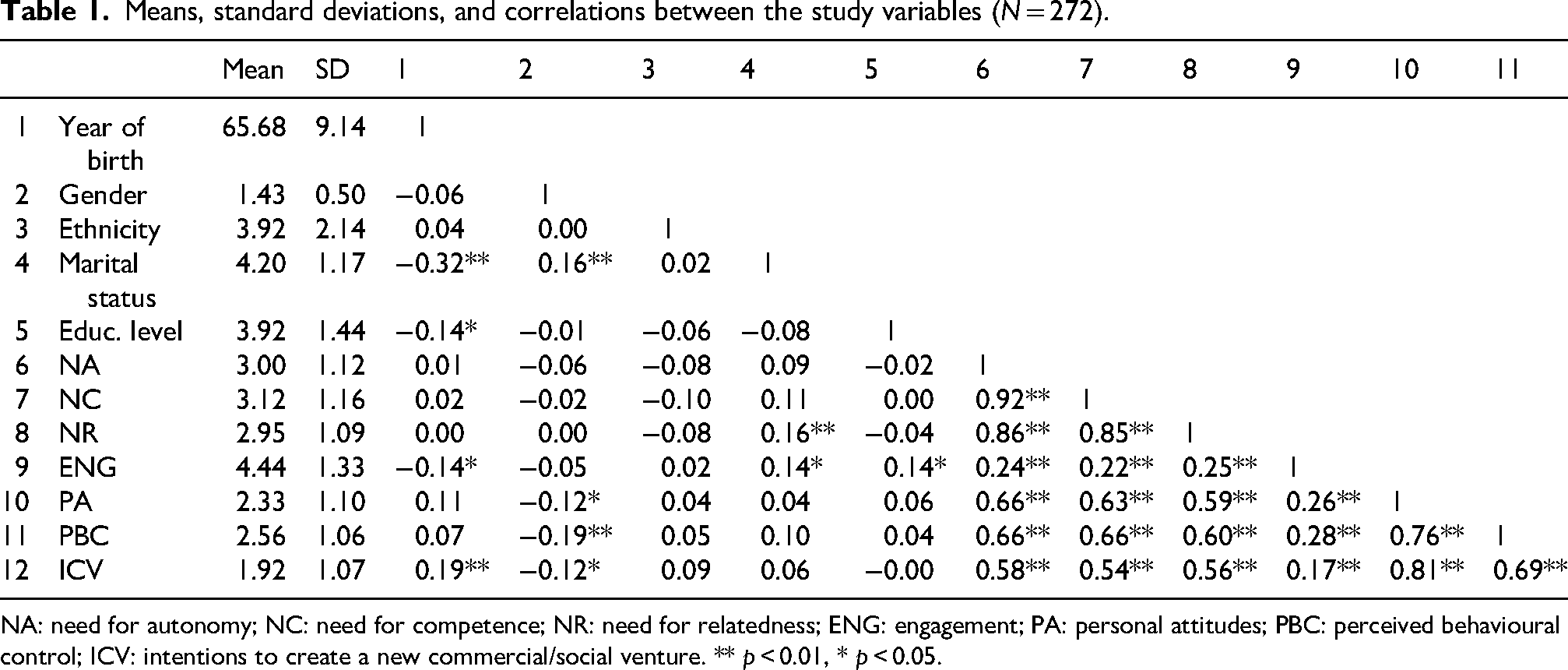
NA: need for autonomy; NC: need for competence; NR: need for relatedness; ENG: engagement; PA: personal attitudes; PBC: perceived behavioural control; ICV: intentions to create a new commercial/social venture. ** p < 0.01, * p < 0.05.
Correlation analysis results also revealed that demographic variables such as Ethnicity, Marital Status, and Educational Level were not significantly related to intra-family succession intentions and not systematically related to any other variables in the hypothesized model. Therefore, these were omitted from our path analyses. However, Year of Birth (r = 0.19, p < 0.01) and Gender (dummy variable; 1 = Male, 2 = Female; r = −0.12, p < 0.05) were significantly related to post-retirement entrepreneurial intentions. Thus, we added both as control variables in our model with a path linking these variables to the post-retirement entrepreneurial intentions manifest variable.
Since we collected our data via self-report questionnaires, this may raise concerns regarding common method variance. However, we are confident that this is not the case in our study as the CFA results showed that the highly correlated factors were distinct. Future research could replicate our findings by combining self-reports with objective indicators or other ratings of the study variables.
The path analyses (Table 2) showed that the Conceptual Model fitted adequately to the data and was superior to the Alternative Model 1 [Δχ2(4) = 13.93, p < 0.05]. Thus, indirect effects were estimated based on the hypothesized conceptual model.
Path analyses: standardized maximum likelihood estimates (N = 272).

IFI: incremental fit index; CFI: comparative fit index; RMSEA: root mean square error of approximation; SRMR: standardized root mean square residual.
Figure 2 presents the standardized estimates for significant and non-significant relationships among the study variables in Model 1.
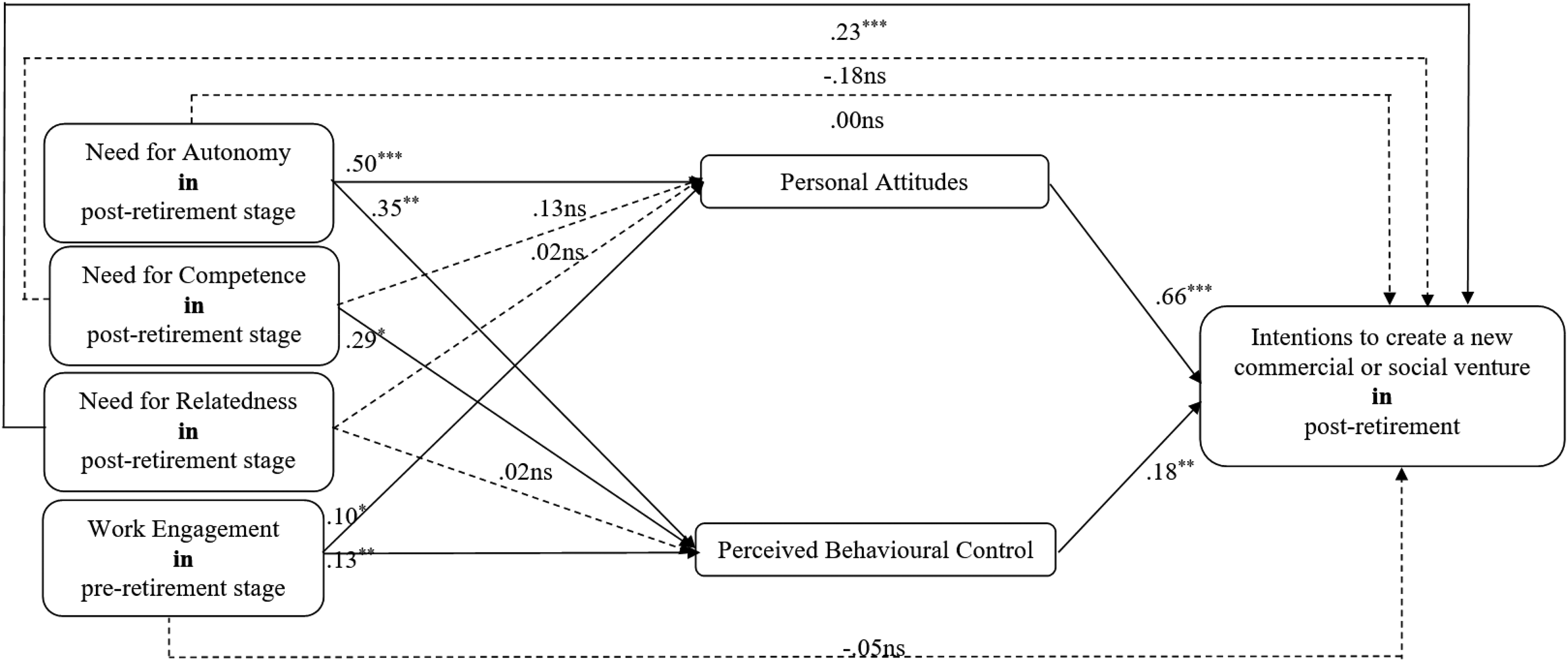
Standardized estimates for significant and nonsignificant relationships in model 1 (N = 272). *** p < 0.001, ** p < 0.01, * p < 0.05.
Figure 2 indicates that PA (γ = 0.66, p = 0.00) and PBC (γ = 0.18, p = 0.00) are directly related to ICV. NR is positively related to post-retirement entrepreneurial intentions (γ = 0.23, p = 0.00). However, the direct effects of NA (γ = 0.00, p = 0.97), NC (γ = −0.18, p = 0.07), and ENG (γ = −0.05, p = 0.12) on IVC are non-significant.
Hypothesis 1 posits that PAs will mediate the positive relationship between retirees’ expectations that engagement in entrepreneurial activities will satisfy their needs for (a) autonomy, (b) competence, and (c) relatedness, and their ICV in post-retirement. The results (Figure 2) indicated that only NA was significantly related to PA (γ = 0.50, p = 0.00). Thus, we proceeded with testing a possible indirect effect from NA to PA and IVC. Bootstrap analyses showed that the indirect effect from NA to ICV (LB = 0.209, UB = 0.576, p = 0.001) was significant; H1a was therefore accepted. The NC-PA (γ = 0.13, p = 0.29) and NR-PA (γ = 0.02, p = 0.79) links were not significant; this led to the absence of the main mediation conditions, and therefore H1b and c were rejected.
Hypothesis 2 indicates that PBC will mediate the positive relationship between retirees’ expectations that engagement in entrepreneurial activities after retirement will satisfy their needs for (a) autonomy, (b) competence, and (c) relatedness, and their ICV in post-retirement. However, only NA was significantly related to PBC (γ = 0.35, p = 0.00). Thus, we could proceed with testing a possible indirect effect from NA to PBC and consequently to IVC. Bootstrap analyses showed that the indirect effect from NA to ICV (LB = 0.209, UB = 0.576, p = 0.001) was significant; H2a was therefore accepted.
The NC-PBC (γ = 0.29, p = 0.01) relationship was significant; we therefore examined the indirect effect from NC to PBC and consequently to IVC. However, the bootstrap analysis did not support an indirect link between NC and ICV (LB = −0.052, UB = 0.336, p = 0.163). Based on these findings, H2b was rejected. The NR-PBC link was also not significant (γ = 0.02, p = 0.86); this led to the absence of the main mediation conditions, and therefore H2c was rejected.
Finally, Hypothesis 3 indicates that PAs (a) and PBC (b) will mediate the positive relationship between retirees’ work engagement before retirement and their ICV after retirement. According to Figure 2, ENG is positively related to PA (γ = 0.10, p = 0.03) and PBC (γ = 0.13, p = 0.00); this indicates two possible mediating effects from ENG to PA/PBC and consequently to IVC. Bootstrap analyses showed that the indirect effects from ENG to ICV (LB = 0.028 UB = 0.168; p = 0.007) via PA and PBC were significant; H3 (a and b) was therefore accepted.
Table 3 summarizes the hypothesized effects and the significant and non-significant paths. In summary, retirees’ needs for autonomy and relatedness post-retirement, and their engagement with paid employment pre-retirement, increase their intentions to create a commercial/social venture and continue to contribute holistically to society and the economy.
Hypothesized effects and significant/non-significant direct/indirect paths.
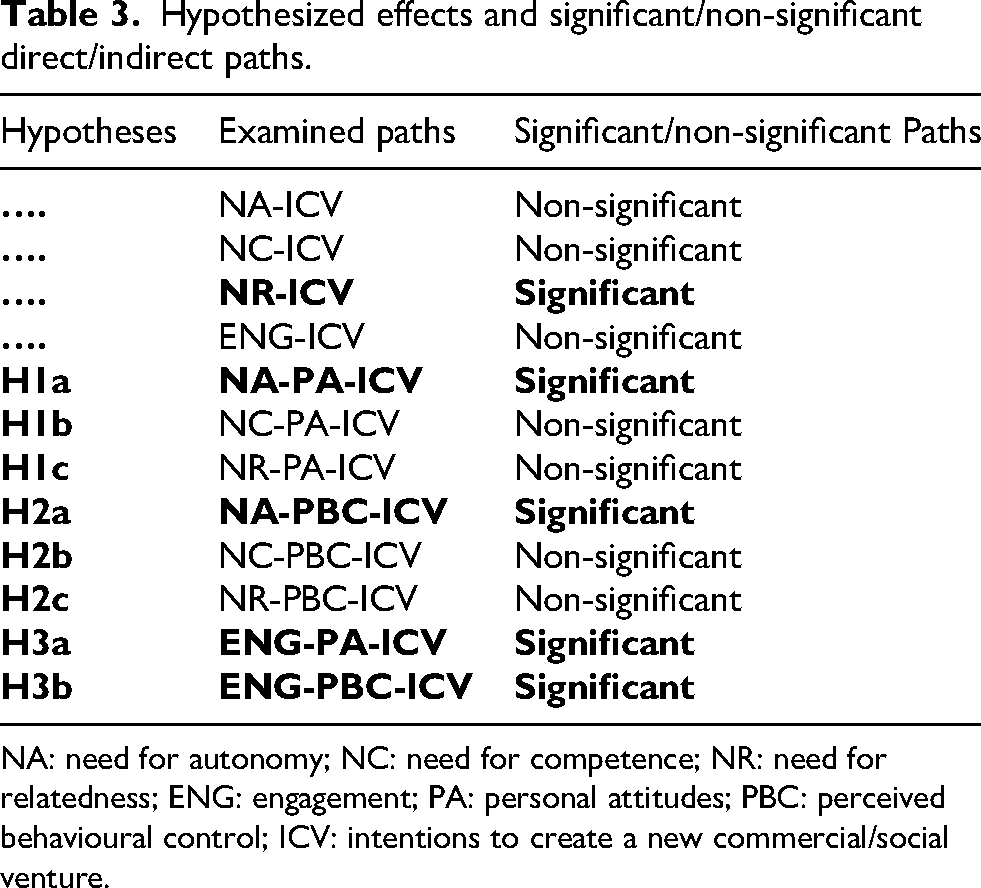
NA: need for autonomy; NC: need for competence; NR: need for relatedness; ENG: engagement; PA: personal attitudes; PBC: perceived behavioural control; ICV: intentions to create a new commercial/social venture.
Discussion
In this study, we tested entrepreneurial intentions in the retired population by simultaneously considering pre-retirement experiences and post-retirement needs, coupled with PAs and PBC. Our findings indicate that pre-retirement engagement at work and post-retirement expectations of fulfilling the NA and relatedness play a crucial role in the formation of entrepreneurial intentions after retirement while encountering the positive role of PAs and PBC.
In line with TPB (Ajzen, 1991), which indicates that intentions are formed by PAs and PBC, this study provides evidence that post-retirement entrepreneurial intentions are formed when retirees consider that their involvement in venture creation at this stage is beneficial for them and when they feel confident that they have the required skills for venture creation. We provide evidence regarding the proposition that early retirees with greater entrepreneurial tendencies (defined in terms of entrepreneurial attitudes and perceived entrepreneurial self-efficacy) are more likely to engage in entrepreneurial activities (Singh and DeNoble, 2003). This is in line with previous research indicating a positive link between attitude and entrepreneurial intentions at later stages of life (Kautonen et al., 2010; Sahut et al., 2015; Tornikoski and Kautonen, 2009), and also between entrepreneurial self-efficacy/control and entrepreneurial intentions in later life (Caines et al., 2019; Kautonen et al., 2010, 2015b). One may conclude that retirees’ entrepreneurial intentions are dominated by their PAs and PBC when forming entrepreneurial intentions as is the case also with younger individuals (students; i.e., Ahmed et al., 2017; Al-Jubari et al., 2019; Duong, 2021; Fragoso et al., 2020, Karimi et al., 2017; Lihua, 2022; Palamida et al., 2017; Paray and Kumar, 2020).
Significantly, based on the main assumptions of the SDT-BPN (Deci and Ryan, 2000; Ryan and Deci, 2019), we provide evidence that NA and relatedness play a role towards the formation of entrepreneurial intentions, while this is not the case regarding the NC. Only relatedness, we find, is directly linked to the formation of post-retirement entrepreneurial intentions. Retirees who expect that their involvement in post-retirement entrepreneurial activities will satisfy their NR, are more inclined towards engaging in new venture creation post-retirement. This contradicts previous research among younger individuals (Al-Jubari, 2019), indicating that the relatedness-intention direct link is absent, and that the constructs relate only indirectly via PAs and PBC. The autonomy-intention direct link is absent; the mediation roles of PAs and PBC, therefore explain this non-significant direct relationship among retirees. Particularly, in the senior entrepreneurship context, we provide evidence that retirees’ expectations that the satisfaction of their basic NA relates positively to entrepreneurial intentions via PAs and PBC. This contrasts with previous research finding a direct path from autonomy/independence to entrepreneurial intentions (Bickenbach et al., 2017; Dehghanpour Farashah, 2015; Şeşen and Pruett, 2014), but it is in line with research among younger people (Al-Jubari et al., 2017) explaining the absence of the effect due to the mediating role of PAs and PBC.
Surprisingly, we find that the NC is not linked to the formation of post-retirement entrepreneurial intentions, directly or indirectly. One would expect that when work-related experience of competence is no longer available due to retirement, people will be more inclined to identify new sources of competence (Henning et al., 2019b). That said, individuals might view competence as more important pre-retirement than in the retirement transition (Henning et al., 2019a). Even though retirement may increase opportunities for new challenges that can be seen as a source of competence (Stenling et al., 2021), retirees in our sample were not willing to explore entrepreneurship as one such challenge. This partially contradicts previous work (Al-Jubari, 2019) on entrepreneurial intentions among students, which postulates that a direct link with the NC is absent, but PAs and PBC do act as mediators.
This study also provides evidence regarding WEF (Bakker and Demerouti, 2008; Schaufeli and Bakker, 2010) in the post-retirement context. Our findings complement existing research on the role of previous work/career history (Kautonen and Luoto, 2008; Kautonen et al., 2010; Singh and DeNoble, 2003; Tervo, 2014; Tornikoski and Kautonen, 2009) in the formation of post-retirement/late-career entrepreneurial intentions. Given that past experiences are crucial determinants of future actions (Bandura, 1986), and since an employee's engagement (i.e., being energetic, dedicated and absorbed in one's work) (Schaufeli et al., 2002) has been found to be an important antecedent of optimal functioning at work (Bakker and Demerouti, 2008), we provide evidence that the level of engagement employees experienced in their pre-retirement work influences their intentions to engage in work-related activities after retiring. Being engaged in work is a positive experience that retirees may seek to retain in their post-retirement life. In this regard, retirees who have been engaged in their previous work are likely to be more inclined towards post-retirement entrepreneurial activities. That said, engagement does not directly lead to entrepreneurial intentions; it does so indirectly via PAs and PBC.
From a practical perspective, the benefits of entrepreneurial engagement after retirement include increased social inclusion of older individuals (Kautonen et al., 2008), improved general well-being (Herzog et al., 1991), and support for individuals with no or insufficient savings and pensions by contributing to living costs or adding to their financial portfolios (Weber and Schaper, 2004). Post-retirement entrepreneurship benefits not only the entrepreneurs themselves but also indirectly contributes to society, government, and the economy (Al Hosni et al., 2024). Therefore, echoing Al Hosni et al. (2024: 14), governmental bodies can establish a more ‘supportive ecosystem’ by implementing ‘advantageous finance, taxation and administrative procedure policies’; this should foster an entrepreneurial climate marked by positive attitudes towards such activity among older individuals (Viljamaa et al., 2022).
In addition to fostering a favourable climate, business support and training programmes based on entrepreneurial education provide valuable help and recommendations for those approaching retirement and recent retirees in forming entrepreneurial intentions and behaviours (Al Hosni et al., 2024; Kenny and Rossiter, 2018; Römer-Paakkanen and Suonpää, 2023). However, the findings of this study place psychological components central to the formation of post-retirement entrepreneurial intentions; they thus need to be incorporated into the overall strategy of policy initiatives and interventions. It is crucial to create mechanisms that will provide space for those approaching retirement and recent retirees to think, decide, and flourish in entrepreneurially related activities by accounting for and capturing the components of psychological capital.
Conclusions and future research
This is one of the first attempts to investigate the external validity of Vallerand's (1997, 2000) Hierarchical Model of Motivation by integrating the main tenets of SDT-BPN (Deci and Ryan, 2000; Ryan and Deci, 2019) and WEF (Bakker and Demerouti, 2008; Schaufeli and Bakker, 2010) into TPB (Ajzen, 1991). This study empirically explores why a proportion of retirees might choose self-employment or new venture creation post-retirement. Therefore, this study responds to previous calls for exploration of the factors that determine entrepreneurial intentions beyond student samples (Hueso et al., 2021) by focusing on the retired population (Pérez-Macías et al., 2022).
The USA was chosen as the country in which to conduct this initial study, as retirees there are more inclined to return to a form of work (Moulton and Scott, 2016). However, further research with a cross-cultural design could identify any possible variance in the psychological map that depicts the role of pre-retirement engagement and post-retirement need satisfaction expectations in the formation of entrepreneurial intentions post-retirement. Moriano et al. (2012) find that, in their student sample, the effects of PA and PBC on entrepreneurial intentions do not vary across geographical contexts, and Minola et al. (2016) find that while culture moderates the relationship between age and self-employment motivation, the effect is more marginal at older ages. However, we might expect variance in the psychological map given that previous studies of entrepreneurial propensity amongst older individuals have found significant between-country variance, indicating that the effect of age on entrepreneurial behaviour is socioculturally embedded (Kautonen et al., 2014). This is not surprising given that institutional (pension options and welfare benefits) and legal (compulsory retirement ages) arrangements vary across countries, and these have been found to influence individual choices in retirement (Fuchs, 1982; Zissimopoulos and Karoly, 2007). The economic situation at any one time also influences entrepreneurial activity in older individuals in complex ways (Biehl et al., 2014); Velilla et al. (2018) also find that motivations differ between developed and developing countries.
Our study considered chronological age in determining the eligibility of the participants without evaluating the role of subjective age. Future research could explore the role of work engagement and need satisfaction on retirees’ entrepreneurial intentions by simultaneously incorporating the moderating effect of subjective age and other ageing-related individual variables such as generativity, death anxiety, and perceived health, as suggested by Maalaoui et al. (2022).
Whilst we considered that the retrospective measurement of work engagement in paid employment might better shape the decision towards engaging in entrepreneurial activities as it reflects beliefs and intentions that exist in the same time spectrum, future research could test the same model by incorporating a longitudinal research design. T1 measurements would capture work engagement beliefs regarding paid employment pre-retirement; T2 measurements would capture the same beliefs post-retirement. This would allow for a more detailed investigation of any potential changes in those beliefs during the retirement adjustment process and determine whether such changes might lead to decisions to engage in entrepreneurial activity while in retirement.
Furthermore, our study focused on the psychological factors determining entrepreneurial intentions and we have not accounted for other antecedents that, when encountered, can provide a more holistic view of how entrepreneurial intentions are shaped in retirement. For example, the Theory of Performance (Campbell et al., 1993) posits that performance needs to be considered as a multidimensional concept determined by diverse factors such as knowledge, skills, and motivation. In this regard, individuals at later stages in life, especially in retirement, are privileged to have gained tacit and explicit knowledge, along with skills and resources. Therefore, retirees might consider entrepreneurship as a more feasible option. Equally, SDT (Ryan and Deci, 2000) indicates that there are two distinctive forms of motivation leading towards certain behaviours: Autonomous-intrinsic motivation, which is inherently interesting or enjoyable, and extrinsic motivation, where the decision to behave in a certain way is made because it leads to a desirable outcome. Therefore, we call for future research to expand our model by simultaneously considering how the availability of human, social, or financial capital, and autonomous/controlling motivation (Palamida et al., 2018, 2015), might jointly shape entrepreneurial intentions.
Finally, much of the debate on entrepreneurial intention has focused on its predictive ability to determine behavioural action. Even though previous meta-analyses (Sheeran, 2002; Webb and Sheeran, 2006) in the social psychology context suggest a strong-to-medium association between intention and behaviour, in the entrepreneurial context the relationship between intentions and behaviour has received less support. Only a few studies support this link in non-retiree samples (e.g., Harima et al., 2021; Martínez-Gregorio et al., 2021; Meoli et al., 2020). Therefore, a longitudinal study on self-employment/new venture creation amongst retirees is required to examine the link between intentions (T1) and behaviours (T2) among retirees. Most importantly, it is necessary to explore the link by incorporating any mediating or moderating variables, as indicated in a recent meta-analytic study (Tsou et al., 2023). Since previous research has provided evidence regarding the link between subjective norms and intentions in non-retiree settings (Alferaih, 2017; Kolvereid, 2016), future studies on retirees could explore the mediating role of subjective norms towards intentions as indicated in Palamida et al. (2017). This might be done by exploring the sequential paths leading from work engagement/basic needs to subjective norms, then to attitude/control, and eventually influencing entrepreneurial intentions in the post-retirement setting. Alternatively, research could explore the moderating role of social expectations among the public concerning the economic contributions of older people via entrepreneurial activity (Kautonen, 2012), or the moderating role of propensity on the link between attitude/control and entrepreneurial intentions, as suggested in Maalaoui et al. (2020).
Footnotes

Funding
The authors received no financial support for the research, authorship, and/or publication of this article.
Declaration of conflicting interests
The authors declared no potential conflicts of interest with respect to the research, authorship, and/or publication of this article.