




Abstract
This study investigates the relationship between entrepreneurial orientation (EO) and farmers’ satisfaction with business performance, considering the moderating effects of diversification strategies and environmental hostility. We regard farmers’ satisfaction as a multidimensional concept encompassing economic and non-economic aspects, measured by financial performance, income, leisure time, and employment provision. Using survey data from 248 farm businesses in Sweden, the empirical analysis suggests that EO positively relates to farmers’ satisfaction in terms of income, while a negative relationship is observed with leisure time. Neither diversification nor environmental hostility separately moderates the relationship, but their combination has a significant influence. Specifically, under low environmental hostility and participation in diversification, EO strengthens satisfaction with financial performance, income, and employment. Policymakers can use these findings to allocate public spending toward fostering entrepreneurship in agriculture through targeted educational and training programs for farmers and successors.
Keywords
Introduction
Entrepreneurial orientation (EO) attracts considerable theoretical and empirical attention in the literature (Engelen et al., 2015; Nybom et al., 2021; Rauch et al., 2009; Strobl et al., 2022; Thanos et al., 2017; Vaznyte and Andries, 2019). EO refers to the entrepreneurial strategy-making processes that key decision-makers use to drive businesses to sustain their vision, create competitive advantage, and seize new market opportunities (Engelen et al., 2015; Rauch et al., 2009). Grounded in this conceptualization, EO is frequently viewed as an appealing concept for firms aiming to achieve superior performance (Shirokova et al., 2016).
Previous literature examines the relationship between EO and firm performance, with a consensus that this relationship is positive but contingent on various factors (Rauch et al., 2009; Shirokova et al., 2016; Strobl et al., 2022; Wiklund and Shepherd, 2005). While studies focus on small and medium businesses, family enterprises, and those with international orientation (Casillas et al., 2010; Mahmoud et al., 2023; Mason et al., 2015; Thanos et al., 2017; Wiklund and Shepherd., 2005), empirical insights into farm businesses remain limited and varied (Grande et al., 2011; Nybom et al., 2021; Smith et al., 2021; Veidal and Flaten, 2014; Verhees et al., 2011). Exploring the EO-performance relationship in agricultural sector is particularly intriguing due to the industry's unique characteristics, which may provide novel insights into how EO and firm performance relate within this context.
The agricultural sector frequently faces environmental regulations aimed at preserving natural resources and ecosystems, crucial for sustaining the food system. However, these regulations can constrain farming practices, limiting farmers’ entrepreneurial pursuits due to low returns. Governments also provide subsidies to support farmers, comprising a significant portion of their income—about one-fifth of total revenues in Sweden (fi-compass, 2020). This reliance on economic support may dampen farmers’ motivation to engage in entrepreneurial initiatives (Li, 2018), leading to distinct EO-performance dynamics compared to other sectors. Operating within the sector's regulatory and economic framework further curtails entrepreneurial activities. Additionally, climate change and geopolitical tensions heavily affect agriculture, intensifying farmers’ need to adapt. Limited research on farm businesses obscures the EO-performance relationship, hindering policymakers and advisors from maximizing EO benefits. Internal and external business factors may also moderate this relationship, a dimension largely overlooked in prior research. While Veidal and Flaten (2014) explored on-farm diversification and location as potential moderators, further research is needed to fully understand how these and other factors shape the EO-performance link.
This study explores the moderating effects of farm diversification and environmental hostility on the relationship between EO and farm performance. Farm diversification, widely recognized as a valuable strategy among farmers (Barnes et al., 2015), is a strategic choice made internally by farm business owners. Also, environmental hostility, emphasized in the literature (Shirokova et al., 2016), highlights that firms operate in a context beyond their control (Thanos et al., 2017). Typically, businesses operating in a hostile environment may face resource constraints essential for their performance.
In this study, we address four interconnected research questions: First, we examine the relationship between EO and farm business performance. Second, we investigate how environmental hostility influences this relationship. Third, we analyze the effects of diversification on the EO-performance relationship and finally, we explore how the interaction between farm diversification and environmental hostility affects the link between EO and performance. Using survey data from 248 Swedish farm businesses, we employ a multivariate ordered probit model to test our hypotheses. The statistical analyses progress from examining the EO-performance relationship to incorporating two-way and three-way interactions.
This study contributes to the existing literature in three ways. First, it offers additional empirical insights into the relationship between EO and farm business performance, which has yielded inconclusive findings in the agricultural context and examines this relationship across diverse internal and external contexts, providing the much-needed clarity. Second, using data from Sweden offers valuable theoretical insights into the Swedish agricultural sector and how farm business owners perceive EO–performance relationship. Third, building on Lumpkin and Dess (1996) argument that for small and private businesses, the owner's satisfaction with business performance needs to be regarded as more important than other conventional measures of performance, we prioritize the owner's self-reported satisfaction with farm business performance over conventional measures. By focusing on the owner's self-reported satisfaction with farm business performance across several domains, we acknowledge also the heterogeneous nature of satisfaction with business performance (Carree and Verheul, 2012). Additionally, this study holds significant practical implications for policymakers and farm advisors in Sweden, providing them with evidence-based guidance on how EO influences farm performance. By understanding this relationship, policymakers and farm advisors can develop targeted strategies, guidelines and interventions to support farmers in enhancing their business outcomes.
The rest of the paper is organized in the following way: The first section “Literature review and conceptual framework” introduces the conceptual framework, followed by the materials and methods section, and then the results are presented. Discussion is provided in the next section, and finally, the paper ends with conclusions.
Literature review and conceptual framework
Figure 1 outlines our conceptual framework. We posit that EO positively influences farmers’ satisfaction with business performance, moderated by (i) farm diversification strategy and (ii) business environment hostility. We elaborate on these components and relationships in the subsequent sections.
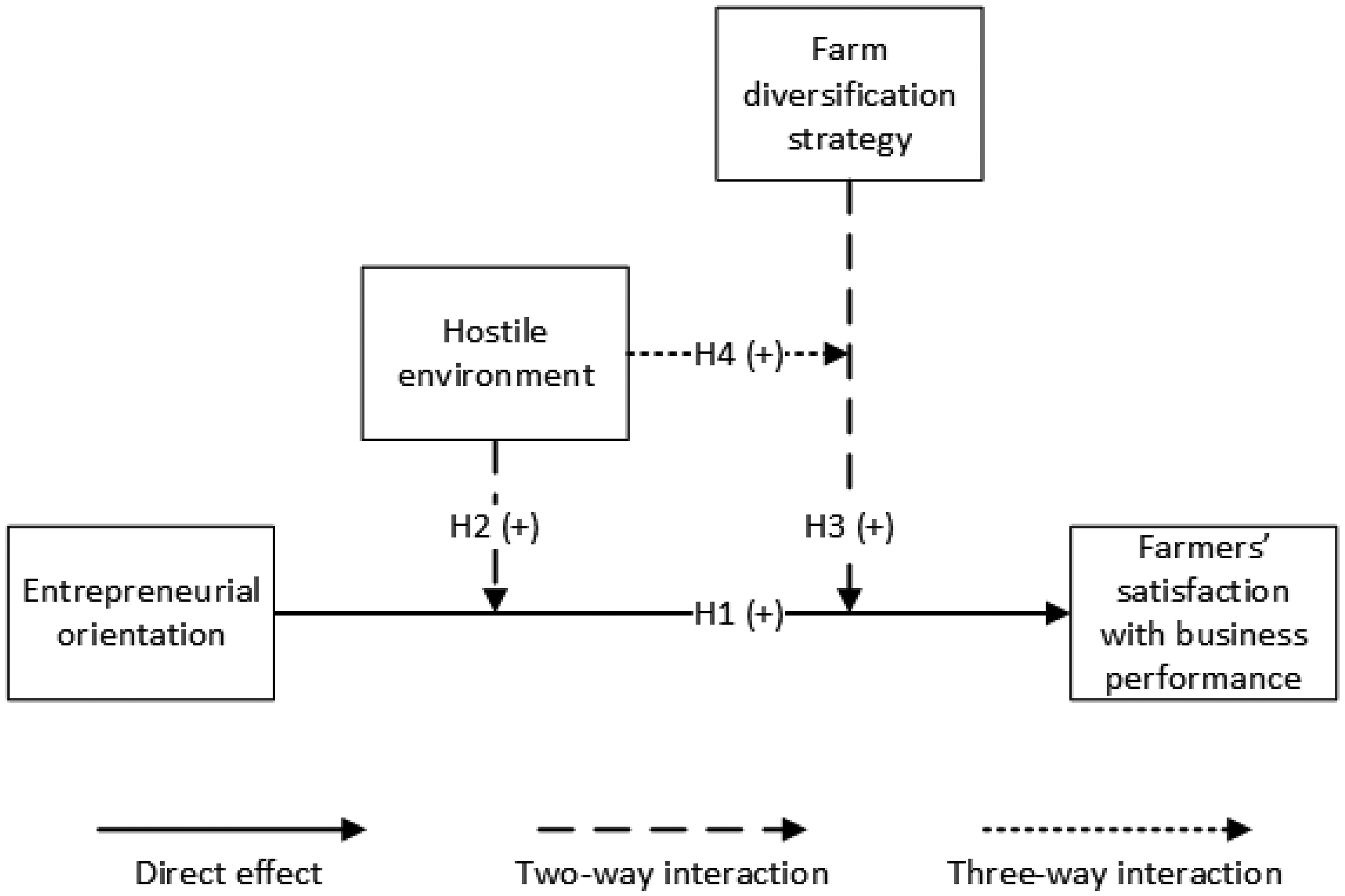
Conceptual framework and overview of hypotheses.
EO: a key to success across sectors
The concept of EO attracts significant attention from researchers (Covin and Wales, 2019). EO refers to a firm's strategic posture, capturing specific entrepreneurial aspects of decision-making styles and processes (Wiklund and Shepherd, 2005). EO enables key decision-makers to enact the firm's organizational purpose, sustain its vision, and gain a competitive advantage (Rauch et al., 2009). Many studies adopt Miller's (1983) approach to EO, which describes EO as the combination of three interrelated dimensions: innovativeness, proactiveness, and risk-taking. Rauch et al. (2009) reveal a moderately large relationship between EO and business performance, suggesting that firms actively pursuing EO can achieve significant benefits, making it a valuable predictor of success. Specifically, firms with an exporting orientation benefit from EO (Jantunen et al., 2005; Mahmoud et al., 2023; Thanos et al., 2017). Moreover, family firms with higher EO tend to perform better (Casillas et al., 2010; Hernández-Perlines et al., 2021; Strobl et al., 2022), and similar findings are observed for small and medium enterprises (Engelen et al., 2015; Semrau et al., 2016).
Moreover, while traditionally associated with for-profit ventures, EO has increasingly been explored in the context of nonprofit organizations (NPOs) and various organizational outcomes. This research posits that NPOs often employ entrepreneurial strategies to fulfill their missions (Stock and Erpf, 2022). Previous studies emphasize the significance of EO in creating social ventures and its impact on social innovation (Dwivedi and Weerawardena, 2018; Lurtz and Kreutzer, 2017). These insights highlight the relevance of EO and justify continued interest in its application across diverse organizations and outcomes.
EO and farmers’ satisfaction with business performance
Owner satisfaction with business performance can be perceived as a decisive measure of entrepreneurial success (Carree and Verheul, 2012), with researchers exploring its determinants over time (Carree and Verheul, 2012; Cooper and Artz, 1995; Murphy and Callaway, 2004). Overall, the literature tends to consent to the relationship between EO and owners’ satisfaction with performance. For instance, Dimitratos et al. (2004), Jantunen et al. (2005) and Koe (2013) found EO to be positively related to satisfaction with performance. These findings are rooted in the core idea that business owners with a strong entrepreneurial mindset can effectively navigate in the changing market conditions by taking proactive measures, staying ahead of competitors through innovative approaches, and seizing emerging opportunities.
In the agricultural sector, an entrepreneurial posture can equip farmers to adapt effectively to the challenges posed by for instance of climate change and economic outcomes
1
(Kangogo et al., 2021). Entrepreneurially oriented farmers can be better positioned to adapt to new circumstances, foster resilience and therefore enhance their sense of success and satisfaction with their farm business performance.
2
Thus, the following hypothesis summarizes our assertion: H1: EO is positively associated with farmers’ satisfaction with business performance.
Moreover, in line with prior studies (Engelen et al., 2015; Shirokova et al., 2016; Strobl et al., 2022; Wiklund and Shepherd, 2005), we extend our analysis as outlined in the following sections. We use both contingency (two-way interactions) and configurational (three-way interactions) approaches to investigate how internal and external factors influence the relationship between EO and farmers’ satisfaction with business performance. Specifically, we examine environmental hostility and diversification strategy as key external and internal factors for farm businesses, respectively.
The moderating role of environmental hostility
A hostile business environment is characterized by limited exploitable opportunities, high competition, and resource scarcity (Covin and Slevin, 1989). Shirokova et al. (2016) emphasize that firms in hostile environments often face unfavorable demographic trends, severe regulatory restrictions, and technological and distributional competition.
While a hostile environment may hinder farmers’ satisfaction with business performance, an entrepreneurial posture helps mitigate these challenges and foster competitiveness. Entrepreneurially-oriented firms are better equipped to navigate hostile conditions (Dimitratos et al., 2004), often gaining an advantage over less entrepreneurial counterparts (Casillas et al., 2010). This advantage arises from proactive strategies, innovation, and risk-taking. Covin and Slevin (1989) find that small firm owners with a more entrepreneurial posture in hostile environments tend to perform better. Similarly, several studies suggest that in hostile environments, more entrepreneurial-oriented businesses often outperform their peers (Casillas et al., 2010; Shirokova et al., 2016; Thanos et al., 2017).
In the agricultural sector, challenges like COVID-19 and geopolitical disruptions have significantly increased the price of mineral nitrogen fertilizers and created a hostile business environment to operate (Gonzalez-Martinez and Miaris, 2024, in press). Farmers with an entrepreneurial mindset, using for instance organic or fossil-free production methods or precision agriculture technologies (Deka and Goswami, 2020; Secinaro et al., 2022) are less dependent on mineral fertilizers and therefore can be affected differently by such conditions. Another example of a hostile environment in the agricultural sector is the drought experienced in Sweden in 2018 (Teutschbein et al., 2022). Droughts create a hostile business environment by depleting water sources needed for irrigation, directly threatening farm business outputs.
Despite obstacles, farmers with a strong EO are likely to be better equipped to navigate under demanding conditions and outperform competitors. Such success can lead to a sense of accomplishment for farmers in achieving their business objectives. Thus, we posit that more entrepreneurial farmers operating in a hostile environment will be more satisfied with their farm business performance. To support our contention, we propose the following hypothesis: H2: The environmental hostility positively moderates the relationship between EO and farmers’ satisfaction with business performance.
The moderating role of farm diversification strategies
Farm diversification strategies have been studied by many scholars (Barbieri et al., 2008; Barbieri and Mahoney, 2009; Barnes et al., 2015; Hansson et al., 2010; Meraner et al., 2015). In this study, diversification refers to utilizing agricultural resources—such as land, buildings, machinery, and labor—to generate income from nonmainstream farming activities (Barnes et al., 2015). Also, diversified farm businesses can process their raw material on-farm, and are likely to pursue a marketing strategy based on value-added products (Barnes et al., 2015). Similar conceptualizations of farm diversification have been employed by other researchers (Barbieri et al., 2008; Barbieri and Mahoney, 2009; Barnes et al., 2015; Hansson et al., 2012).
Farm diversification has been considered an important strategy to improve farm income, assist farmers to remain in agriculture, attract new farmers, and promote rural growth (Barbieri et al., 2008; Barnes et al., 2015; Harkness et al., 2021; Veidal and Flaten, 2014). On the one hand, diversification provides opportunities for new products or services, and on the other hand, EO encourages farmers to innovate and adapt to changing market conditions. Thus, diversification allows farmers to leverage their entrepreneurial mindset and to identify and capitalize on emerging trends or niche markets. This flexibility likely enhances satisfaction with business performance by enabling farmers to stay ahead of competitors, meet evolving consumer demands and achieve their goals. Considering this narrative, we propose the following hypothesis: H3: Farm diversification positively moderates the relationship between EO and farmers’ satisfaction with business performance.
Alignment of EO, farm diversification, and environmental hostility
Hypothesis 1 proposes the positive relationship between EO and farmers’ satisfaction with farm business performance. Hypotheses 2 and 3 suggest the moderating role of environmental hostility and farm diversification strategy, respectively. However, configurational research proposes that businesses aligning many constructs (e.g., EO with internal and external factors) can perform better than firms that align two constructs (Wiklund and Shepherd, 2005).
As discussed earlier, environmental hostility refers to the degree of external challenges and uncertainties faced by farmers. Farm diversification can be a strategy to mitigate the impact of environmental hostility by for instance spreading risk across multiple enterprises and revenue streams. The relationship between EO and farm business performance can vary depending on how diversification interacts with environmental hostility. Thus, configurations of variables are likely to provide more comprehensive information than two-way interactions (Dimitratos et al., 2004). In essence, farmers operating in a hostile environment, and diversify their activities can leverage their entrepreneurial mindset to capitalize market opportunities to stay in agriculture, develop their businesses, achieve their objectives, and have a sense of success. Therefore, we assert that operating in a hostile environment and engaging in farm diversification strategies will enhance the relationship between EO and farmers’ satisfaction with business performance. Hence, to test the proposition of the configurational approach, we developed the following hypothesis: H4: The relationship between EO and farmers’ satisfaction with business performance is stronger when farmers are engaged in farm diversification activities and act in a hostile environment.
Data and methods
Data collection
Data are gathered through a cross-sectional survey conducted in spring 2018 among Swedish farmers. The survey design leverages the project group's expertise in farmer-focused surveys and builds on previous literature (details below). Farmers’ official registered addresses are obtained with assistance from Statistics Sweden. The sample is stratified based on three criteria: geographic location, farm type, and farm size.
We randomly select 2397 farmers to participate by sending letters via regular mail, explaining the study's purpose and providing a link to the online survey along with an access code. With internet access widespread in Sweden (98% of households; Internetstiftelsen, 2020), participation is not hindered. After one reminder, 432 farmers respond, yielding an 18% response rate, consistent with similar studies in Sweden and the Netherlands (Höglind et al., 2021; Sok and Fischer, 2020). Of these, 404 agree to participate, but due to incomplete responses, the final sample comprises 248 farmers. The completion rate, measured as the ratio of fully completed surveys to total responses, is 57%.
Measures
Dependent variables. Business performance is a complex concept, challenging to measure due to its multidimensional nature (Dimitratos et al., 2004), and scholars often employ multiple measures for a comprehensive understanding (Wiklund and Shepherd, 2005). Various performance metrics exist, including sales growth, market share, profitability, and stakeholder satisfaction (Lumpkin and Dess, 1996). Previous research uses both objective and subjective metrics, each with advantages and disadvantages. This study focuses on subjective measures, as they capture both economic and non-economic aspects of farm businesses. In agriculture, both economic (e.g., income) and non-economic aspects (e.g., work–life balance) are particularly important for farmers (Gasson, 1973; Grubbström and Eriksson, 2018; Howley, 2015) and thus, obtaining information on both better suits studying farm businesses.
In this research, we use a five-item Likert scale, asking farm business owners to assess their satisfaction with financial performance (articulated as return on equity in the questionnaire), farm income, leisure time, and the prospects of providing employment for themselves and others. For a value of 1 on the Likert scale, we provide the text “not at all,” for 3, “neutral,” and for 5, “very much.” This wording allows participants to express their sentiments more accurately (see Supplementary Table S1 for details). Additionally, some aspects of business performance are drawn from previous studies (Carree and Verheul, 2012; Jantunen et al., 2005; Murphy and Callaway, 2004), while others are adapted to suit Swedish agriculture better. It is also important to mention that although farm financial performance and farm income might be related, they are distinct concepts. Farm financial performance refers explicitly to farmers’ satisfaction with return on equity, the economic return received from the equity invested in the farm business. Farm income is the remuneration that farmers receive directly from the farm business. In addition, previous studies have shown that Swedish farmers have high financial literacy, enabling them to differentiate these concepts (Gottlieb, 2021). Moreover, the rationale for including farmers’ satisfaction with leisure time and employment opportunities stems from the need to examine farm businesses beyond a pecuniary perspective, as evidenced by previous studies (Gasson, 1973; Gustafsson, 2021a, 2021b; Hansson et al., 2013; Howley, 2015; Howley et al., 2017; see the supplementary material for more details).
Control variables. The control variables in this study relate to farmers’ personal background, farm, and household characteristics. Age controls for farmers’ life cycle stages, with three groups: younger than 35, older than 65, and 35–65 (reference group). Education accounts for different levels, distinguishing whether third-level education has been attained, including paths like agricultural college (lantmästare in Sweden), agronomy programs, or other university education. The regional variable “location south” controls for geographical heterogeneity, reflecting farms in Sweden's most arable area with similar climate characteristics. Additionally, farm area is included, as larger farms are often associated with better business performance. (Grande et al., 2011). In addition, different types of farms may exhibit distinct characteristics (Veidal and Flaten, 2014). Therefore, we distinguish farms involved in dairy production from those that are not. We also control for family size and the presence of a successor, recognizing that farm businesses are primarily family-run (Bertoni et al., 2021), where labor mainly comes from the family. Omitting the family's contribution could create confounding issues, so we classify farm households as single or non-single households. Lastly, we include the presence of a successor, as farmers may strive to improve business performance to attract successors. Research shows farms that are more successful are more likely to be transferred (Cavicchioli et al., 2015).
Environmental hostility. Firms operating in a hostile environment can face threats to their survival and development (Covin and Slevin, 1989; Shirokova et al., 2016; Thanos et al., 2017). In this study, we operationalize environmental hostility as farmers’ perceptions of aspects that harm their efforts to develop their farms. These aspects include financial constraints, competition, lack of business partners, limited profitability, knowledge gaps, institutional and geographical constraints, and farm layout issues. Respondents rate these aspects on a scale from 1 to 9, indicating how much they hinder business development. A rating of 1 means no hindrance, while 9 means significant hindrance. This assessment measures how these factors influence farmers’ ability to advance their businesses. We measure environmental hostility through perceived hindrances to farm development, following the approach of Hansson and Sok (2021). We estimate the latent construct using multiple indicators, multiple causes model (MIMIC), with two reflective and eight formative indicators (see Supplementary Table S2 for details). After estimation, we obtain the predicted scores and use them as environmental hostility values. For more on MIMIC models, see Diamantopoulos et al. (2008), Joreskog and Goldberger (1975), and Winklhofer and Diamantopoulos (2002).
Farm diversification. We use the definition of farm diversification from Barnes et al., (2015). Specifically, we distinguish between farm business owners engaged in diversification activities and those who are not. The most common forms of diversification include contract work, renting out farm buildings and apartments/houses, tourism, on-farm shops, processing farm products, horse businesses, and energy production.
EO. We follow Grande et al. (2011) to capture the three dimensions of EO. Their scale comprises six items, which we slightly modify to fit the Swedish agricultural context, resulting in a five-item scale. The items are assessed on a point scale from one to five (refer to Supplementary Table S3). The question that is not included in our questionnaire relates to “the aim at being first with technological development within our line of business.” Another question did not replace this one, as we have already covered the three dimensions of EO.
We apply factor analysis on the five-item scale to assess if they load on a unidimensional construct representing EO. The results suggest one factor with an eigenvalue of 2.62, greater than one. We also apply three tests to assess its validity. The Kaiser–Meyer–Olkin measure of sampling adequacy equals 0.83. Second, Bartlett's test of sphericity rejects the null hypothesis that the correlation matrix is an identity matrix. Third, Cronbach's alpha coefficient is 0.85, indicating high internal consistency of EO among the items. Further evidence for the theoretical validity of the EO construct is provided in the supplementary material.
Sample characteristics
Table 1 presents descriptive statistics for the explanatory and dependent variables. A quarter of the farmers are over 65 years old, while few are under 35. Around 41% have attained third-level education, and 8% operate dairy farms. Farm sizes range from 25% operating less than 50 hectares to 25% more than 315 hectares. Half of the farms are located in southern Sweden. One-fourth have succession plans, 9% are single households, and 49% engage in farm diversification. The average perceived environmental hostility is 0 on a scale from −4.57 to 3.86, and the average EO is 0 on a scale from −1.65 to 2.13. Moreover, farmers express the highest satisfaction with their ability to provide employment (3.52) but are least satisfied with their business's income (2.58) and financial performance (2.87). For correlation coefficients of all variables, refer to Supplementary Table S4.
Descriptive statistics (n = 248).
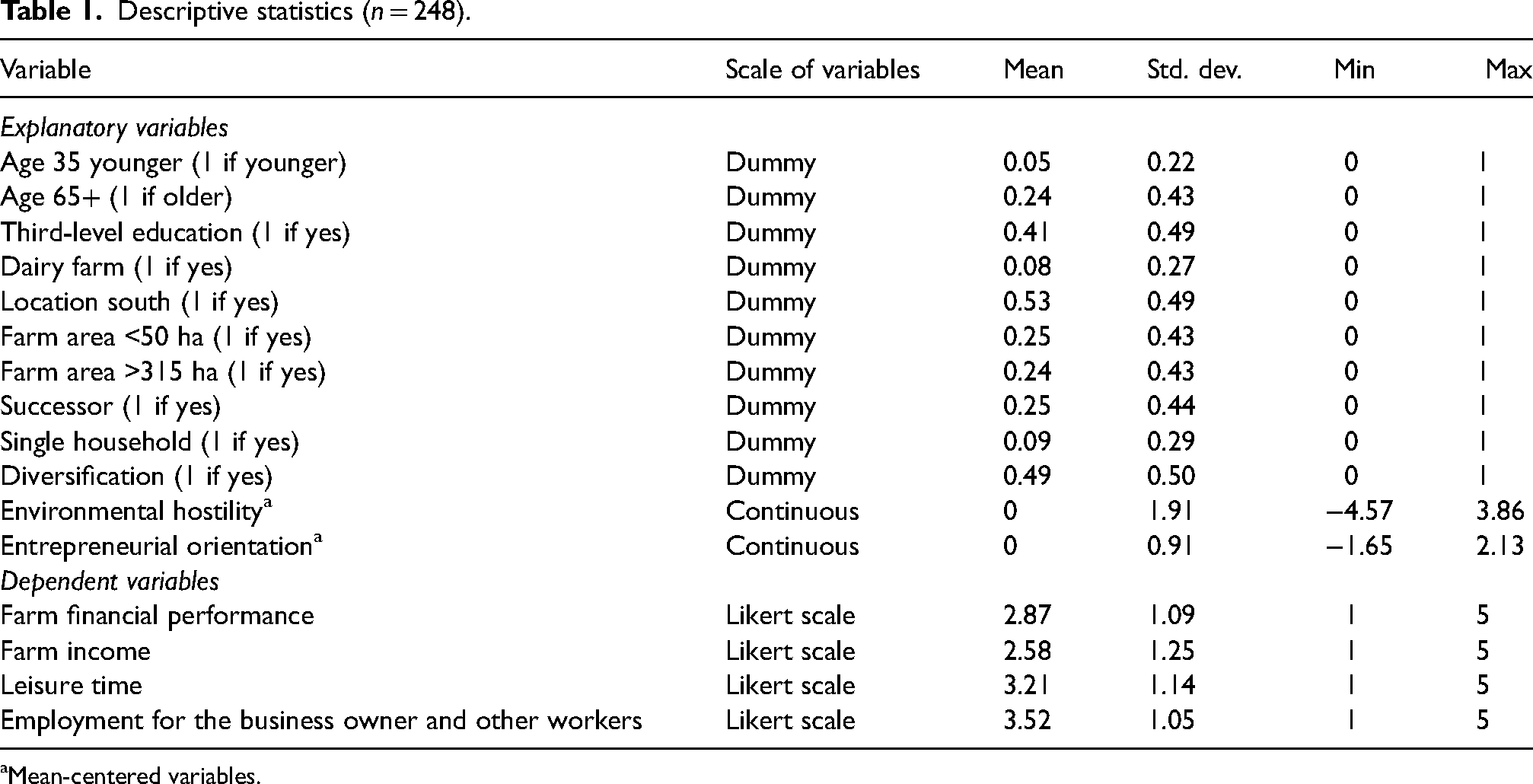
Mean-centered variables.
Estimation methods
We use the ordered probit model, since the dependent variables are ordered. The underlying continuous latent variables 


Results
Estimation results
Table 2 presents the estimation results. Nine control variables, including EO as the variable of interest, are used. Correlation among error terms justifies the use of a multivariate probit model (refer to Supplementary Table S6). EO exhibits a positive and significant association with income, significant negative with leisure time and no significant relationship with financial performance and employment for the business owner and other workers. Thus, hypothesis 1 is partially supported.
Estimates of multivariate ordered probit testing hypothesis 1; number of observations 248.
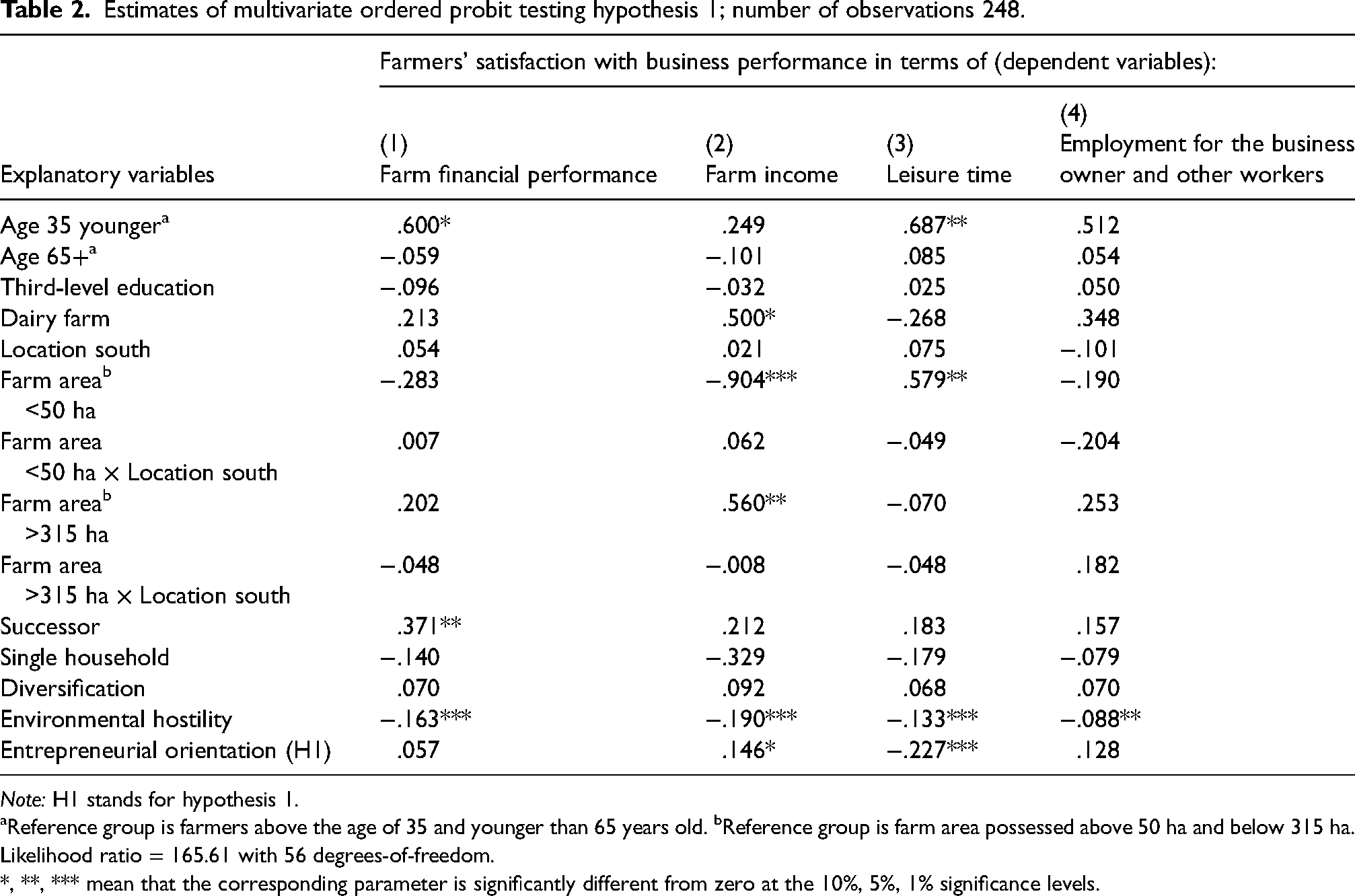
Note: H1 stands for hypothesis 1.
Reference group is farmers above the age of 35 and younger than 65 years old. bReference group is farm area possessed above 50 ha and below 315 ha. Likelihood ratio = 165.61 with 56 degrees-of-freedom.
*, **, *** mean that the corresponding parameter is significantly different from zero at the 10%, 5%, 1% significance levels.
Turning to the control variables, the results suggest that farmers younger than 35 are more satisfied in terms of financial performance and leisure time compared with the reference group. Dairy farmers are more satisfied with their business performance in terms of income than other farm types. Farm areas of less than 50 ha have significantly negative coefficients with the indicator of income, whereas they have a significant and positive relationship with leisure time. In contrast, farm areas greater than 315 ha have positive and significant coefficients with income. Additionally, farm business owners with a successor tend to be more satisfied with the financial performance of their business. Furthermore, environmental hostility negatively affects farm owners’ satisfaction with business performance (all indicators), whereas diversification positively, though without statistically significant results. Finally, the variables farmers older than 65, third-level education, single household, location in the south, and its interaction with farms smaller than 50 ha and farms larger than 315 ha are not significantly related to any performance indicator.
Two-way interaction terms test the second and third hypotheses (Table 3). However, results do not support hypotheses 2 and 3. The interaction effect of EO with environmental hostility is statistically insignificant for each performance indicator, although consistently positive as hypothesized. Similarly, the interaction effect of EO with diversification is not statistically significant in either model. Thus, Table 3 shows no empirical support for the moderation of the relationship between EO and farmers’ satisfaction with business performance by diversification and environmental hostility. The results remain similar to those in Table 2 regarding the control variables.
Estimates of multivariate ordered probit testing hypotheses 2 and 3; number of observations 248.
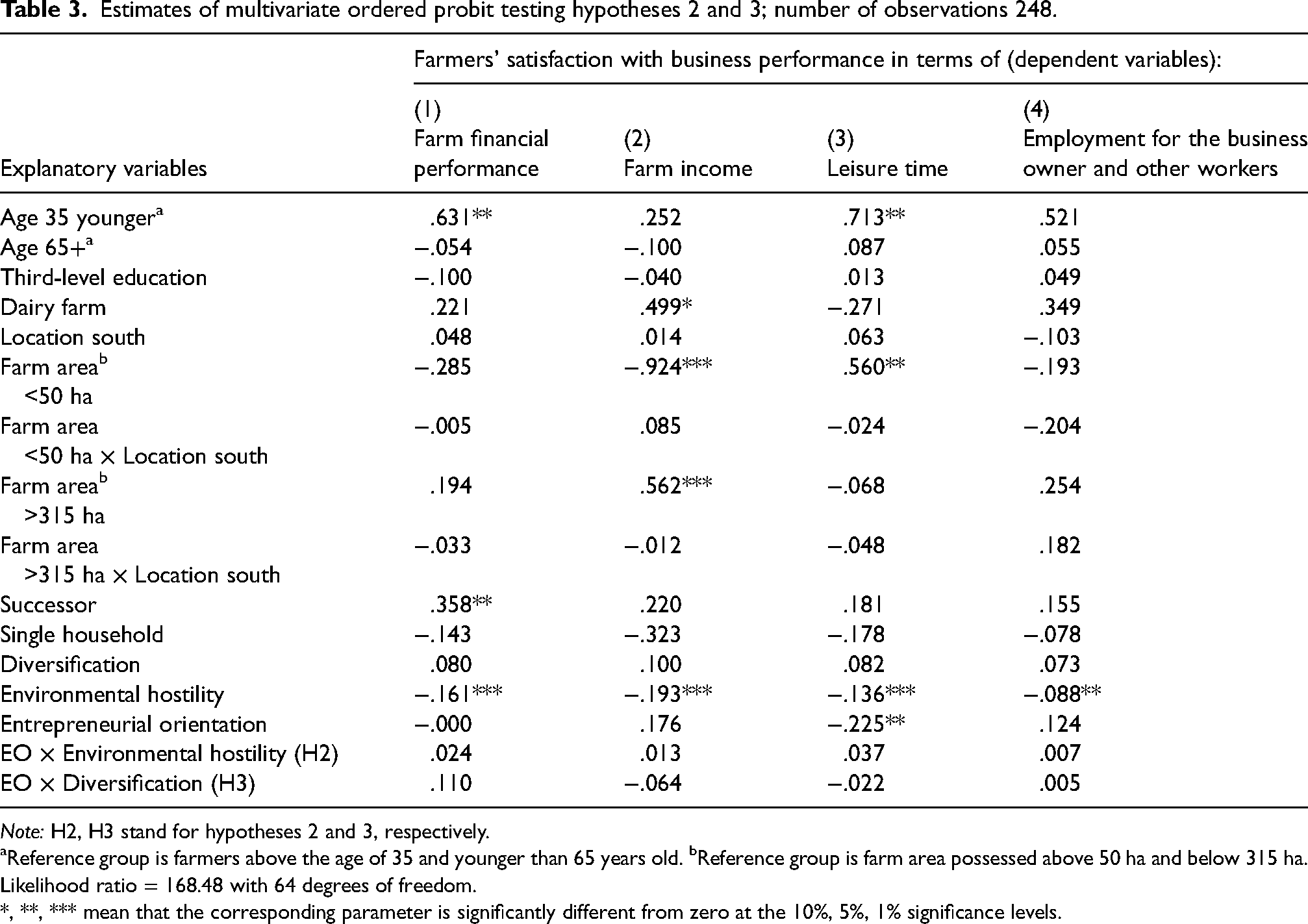
Note: H2, H3 stand for hypotheses 2 and 3, respectively.
Reference group is farmers above the age of 35 and younger than 65 years old. bReference group is farm area possessed above 50 ha and below 315 ha. Likelihood ratio = 168.48 with 64 degrees of freedom.
*, **, *** mean that the corresponding parameter is significantly different from zero at the 10%, 5%, 1% significance levels.
The three-way interaction term tests hypothesis 4 (Table 4), showing a negative and significant relationship for farm financial performance, income, and employment, but not for leisure time. These findings suggest that the relationship between EO and business performance satisfaction depends on the combination of farm diversification and environmental hostility for some indicators but not others. Additionally, we assess model fit across three specifications using a likelihood ratio test, which indicates that including two-way and three-way interaction terms does not improve model fit compared to the model without these terms (refer to Supplementary Table S7 for detailed model fit metrics, including AIC and BIC results).
Estimates of multivariate ordered probit testing hypothesis 4; number of observations 248.
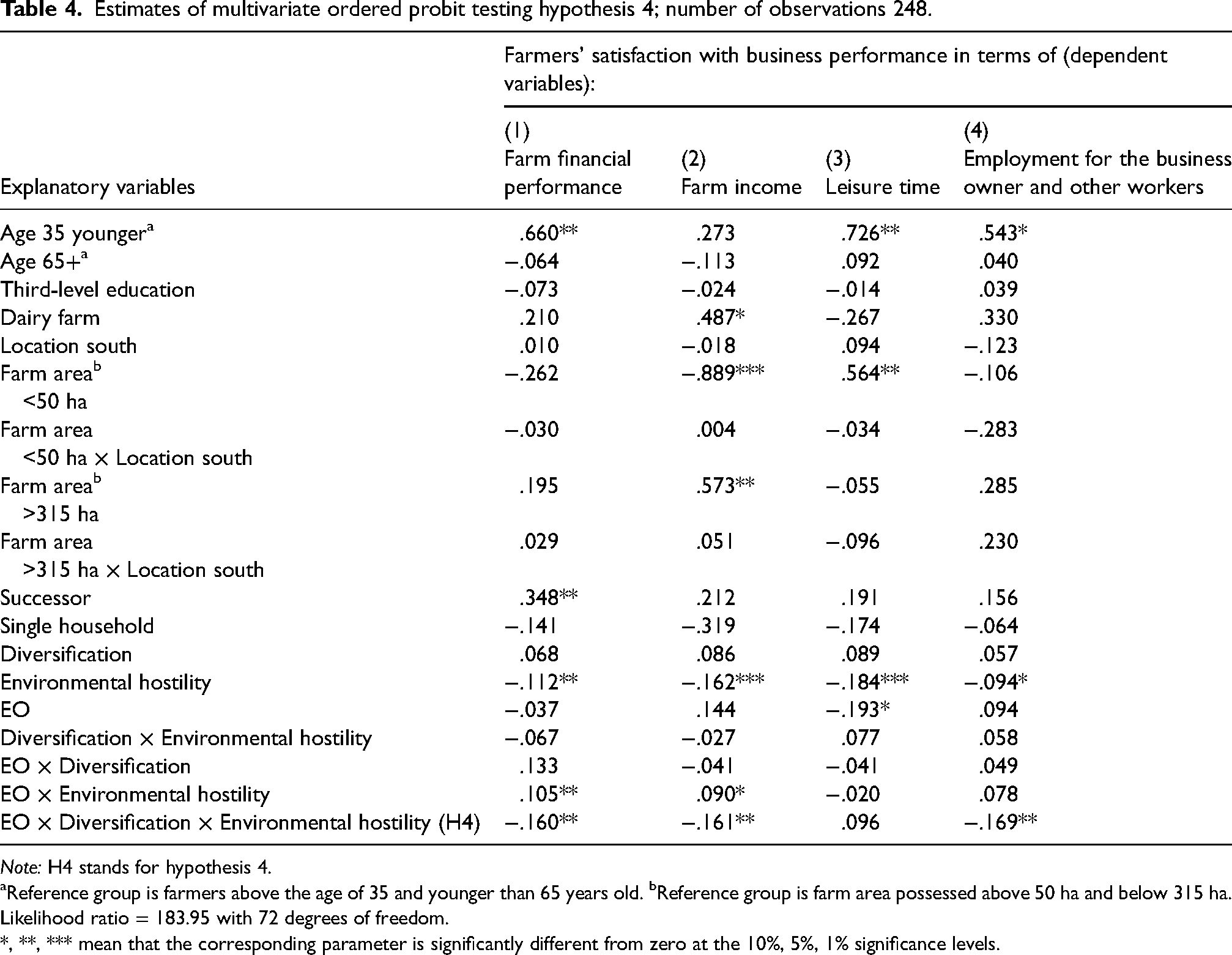
Note: H4 stands for hypothesis 4.
Reference group is farmers above the age of 35 and younger than 65 years old. bReference group is farm area possessed above 50 ha and below 315 ha. Likelihood ratio = 183.95 with 72 degrees of freedom.
*, **, *** mean that the corresponding parameter is significantly different from zero at the 10%, 5%, 1% significance levels.
Plots of significant interactions
To gain deeper insights into the nature of the three-way interaction terms, we generate plots exclusively for the significant interactions. Figure 2 displays all possible combinations of farm diversification engagement and varying levels of environmental hostility for farm owners with very high satisfaction in terms of farm income (for other significant relationships, refer to Supplementary Figures S1–S11). Specifically, we plot the relationship between EO and farm owners’ satisfaction with business performance in terms of farm income, conditioned on four scenarios:
no engagement in farm diversification and low environmental hostility engagement in farm diversification and low environmental hostility no engagement in farm diversification and high environmental hostility engagement in farm diversification and high environmental hostility.
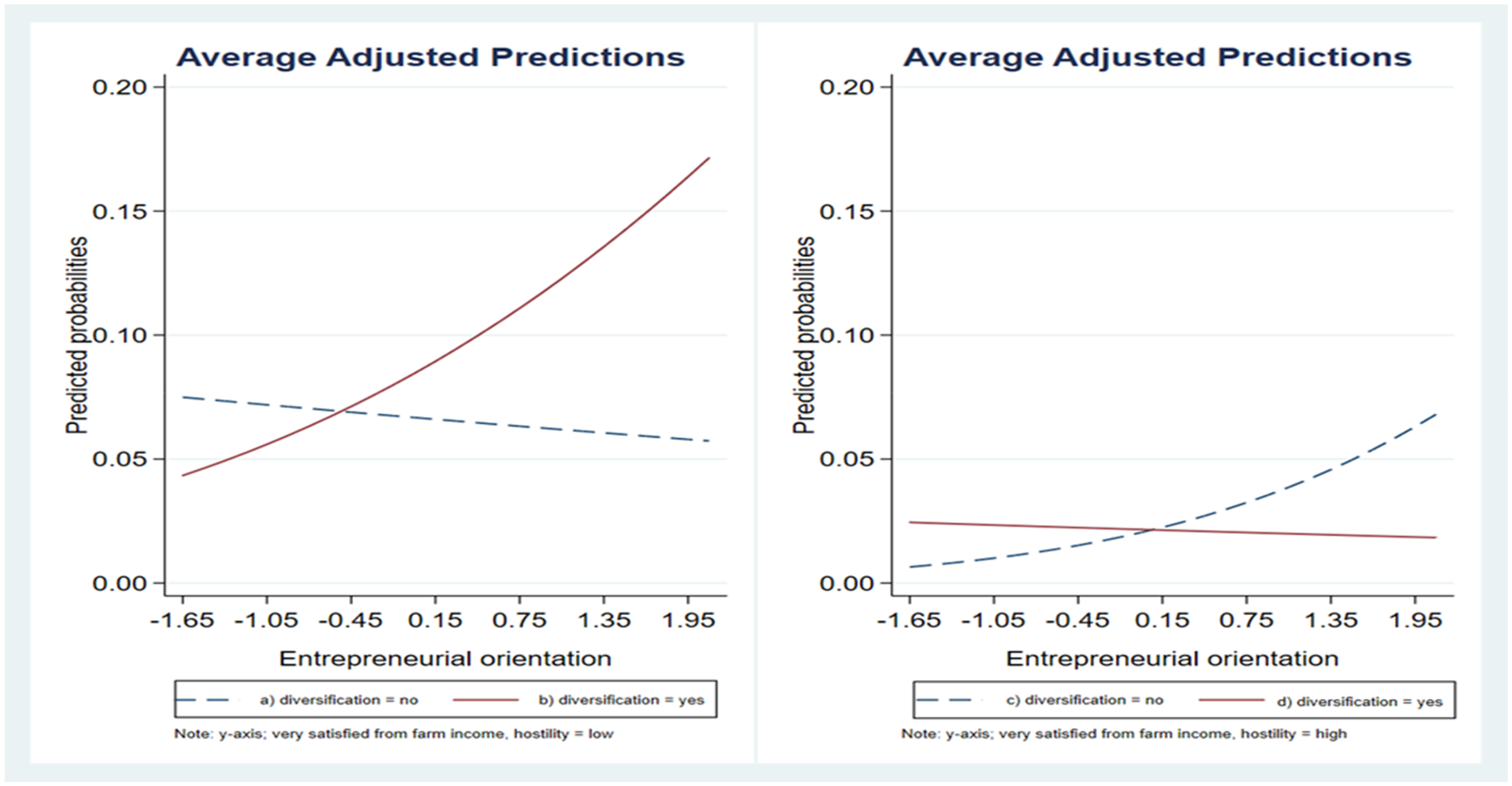
Plot of relationships between EO, farm diversification, environmental hostility, and farm business owners’ high levels of satisfaction with farm income (three-way interaction), conditioned by four cases: (a) no engagement in farm diversification and low environmental hostility, (b) engagement in farm diversification and low environmental hostility, (c) no engagement in farm diversification and high environmental hostility, (d) engagement in farm diversification and high environmental hostility.
Following previous literature, environmental hostility, which is set at one standard deviation above the average, is taken to imply high levels of hostility and vice versa (Shirokova et al., 2016). Farm diversification is set equal to one for involvement in farm diversification activities and zero otherwise.
In two cases (b and c), the relationship between EO and farm income shows an upward slope in Figure 2, while in two others (a and d), it slopes downward. This suggests that diversification activities and environmental conditions shape the relationship between EO and farmers’ satisfaction with business performance regarding farm income. However, the analysis does not support hypothesis 4, which posits that the relationship between EO and satisfaction would strengthen when farmers engage in diversification and operate in a hostile environment (case d). As a robustness check, we estimate additional models using a seemingly unrelated regression and include average adjusted probabilities for significant relationships. Results appear in the supplementary material.
Discussion
Contributions and implications
This study explored the relationship between EO and farm business performance, focusing on farmers’ satisfaction across various domains, while examining moderation effects of farm diversification and environmental hostility. Using data from the Swedish agricultural sector, we applied two-way and three-way interactions. Our contribution lies in offering empirical insights into the inconclusive relationship between EO and farm performance, testing it across internal and external factors. In addition, a key novelty was considering farmers’ satisfaction with business performance as a heterogeneous concept. Finally, we provided the first insights into the nuanced dynamics influencing EO and its outcomes in the Swedish agricultural context.
The results revealed the complex nature of the relationship between EO and performance, showing varying signs and significance levels across different indicators. This complexity suggests that measuring multiple indicators could offer more insightful information. Overall, the findings supported a significant association between EO and farmers’ satisfaction with business performance, consistent with previous studies (Dimitratos et al., 2004; Jantunen et al., 2005; Koe, 2013; Mason et al., 2015). Specifically, farmers with a more entrepreneurial posture tended to be more satisfied with income, reflecting their inclination towards seeking opportunities, innovation, and risk-taking, leading to enhanced income.
The results also indicated that farmers with a higher EO tended to be less satisfied with business performance in terms of leisure time. Previous research has highlighted the benefits of entrepreneurship, such as increased independence and decision-making flexibility (Benz and Frey, 2008; Millán et al., 2013). In the context of agriculture, being a business owner has traditionally been associated with greater autonomy, flexibility and lifestyle aspects (Gasson, 1973), leading to the expectation that combining entrepreneurial responsibilities with flexible working hours would result in contented leisure time for farmers. However, this study found that more entrepreneurial farmers are less satisfied with leisure time. A potential explanation is that the pursuit of entrepreneurial endeavors can be characterized by risk and ambiguity, which may contribute to stress and reduced satisfaction in leisure.
To address our second and third research questions, we examined whether environmental hostility and farm diversification strategies moderated the relationship between EO and performance. The results indicated an insignificant moderating role of farm diversification, which partially differs from Veidal and Flaten, (2014). This difference in results could be due to differences in sample, methods, or variable measurements. Regarding environmental hostility, coefficients showed positive signs across all performance indicators, aligning with the second hypothesis. However, these coefficients were not statistically significant at conventional levels. Overall, the findings did not suggest any moderating effect of environmental hostility on the relationship between EO and performance, consistent with prior studies (Shirokova et al., 2016; Thanos et al., 2017; Wiklund and Shepherd, 2005).
Turning to the last research question, the three-way approach provided deeper insights into the EO-performance relationship compared to the main effects and two-way approach, consistent with previous research (Shirokova et al., 2016; Thanos et al., 2017; Wiklund and Shepherd, 2005). Specifically, results indicated that farm businesses engaged in diversification and facing low environmental hostility (case b) benefitted most from high EO levels. These farm owners tended to be more satisfied with their businesses regarding financial performance, farm income, and employment for the business owner and other workers. Additionally, the relationships between EO and leisure time, remained consistent and stable, unaffected by internal or external factors. This suggests that entrepreneurially oriented farmers maintain a steady relationship with these performance indicators, independent of other influences.
Some important implications can be derived from our study for policymakers and farm advisors in Sweden. Our results have shown that farmers with an entrepreneurial posture could obtain considerable benefits in terms of income, but these may be accompanied by less satisfaction in leisure. In addition, benefits for entrepreneurial farmers seemed to appear in terms of financial performance, farm income, and employment for the business owner and other workers when the business environment was characterized by low levels of environmental hostility and a diversification strategy had been adopted. The important role of income benefits may well warrant policymakers’ action in steering public expenditure towards entrepreneurial training and initiatives fostering entrepreneurship within the agricultural sector, which can boost farmers’ income and narrow the prevailing income disparities between economic sectors in Sweden (Nordin et al., 2019).
Furthermore, research on entrepreneurship has highlighted the influential role of community and social contacts on entrepreneurial behavior (Guiso et al., 2021; Vladasel et al., 2021). Recognizing the pivotal role of these networks, we propose that farm organizations can foster entrepreneurship among their members and potentially amplify income benefits through an “entrepreneurial multiplier” effect, diffusing entrepreneurial behaviors across the community. Also, acknowledging the intergenerational nature of Swedish farm business sector and its need for intergenerational renewal (Nordin and Lovén, 2020), it is crucial to highlight that participation in educational and training programs can foster entrepreneurial behavior among participants (Elert et al., 2015; Vladasel et al., 2021). In this way, such programs targeting young and prospective successors will allow them to capitalize on income opportunities and continue the operation of the farm business. In addition, the entrepreneurial mindset can assist farmers in Sweden to adjust better their production activities by for instance adopting new crop varieties resistant in climate change and thereby, be able to continue their operations. However, policymakers and farm advisors aiming to promote their recommendations among farmers should acknowledge that embracing entrepreneurship may involve trade-offs, involving reduced satisfaction in leisure time, which may hinder their implementation.
Limitations and future research orientations
Some limitations of our study should be acknowledged. First, the data used in this study are cross-sectional. A factor, which restricted the examination of causal relationships between EO and business performance. A study using panel data could potentially identify the causal relationships. Second, broader validation of these results through multinational research is warranted. In addition, future research could examine the implications of adopting a more entrepreneurially-oriented posture and assess its consequences in terms of life satisfaction, because working is just one domain in a farmer's life.
Conclusions
The empirical results of this study show that EO positively relates to farm income but negatively to leisure. Additionally, the relationship between EO and farm performance remains unaffected by farm diversification or environmental hostility. The three-way interaction terms provide further insights, revealing three points: First, the relationship between EO and financial performance, income, and employment is complex. Second, EO benefits farmers engaged in diversification and operating in environments with low hostility. Finally, the relationship between EO and leisure time remains stable across various model specifications, unaffected by external or internal factors.
Supplemental Material
sj-docx-1-iei-10.1177_14657503251327353 - Supplemental material for The relationship between entrepreneurial orientation and farmers’ satisfaction with business performance: Insights from Swedish agriculture
Supplemental material, sj-docx-1-iei-10.1177_14657503251327353 for The relationship between entrepreneurial orientation and farmers’ satisfaction with business performance: Insights from Swedish agriculture by Georgios Miaris, Helena Hansson and Jaap Sok in The International Journal of Entrepreneurship and Innovation
Footnotes
Data availability
Data will be made available on request.
Declaration of conflicting interests
The authors declared no potential conflicts of interest with respect to the research, authorship, and/or publication of this article.
Funding
The authors disclosed receipt of the following financial support for the research, authorship, and/or publication of this article: This work was supported by a research grant from the Swedish Farmers’ Foundation for Agricultural Research [Grant No. O-17-21-948].

Supplemental material
Supplemental material for this article is available online.
Notes
References
Supplementary Material
Please find the following supplemental material available below.
For Open Access articles published under a Creative Commons License, all supplemental material carries the same license as the article it is associated with.
For non-Open Access articles published, all supplemental material carries a non-exclusive license, and permission requests for re-use of supplemental material or any part of supplemental material shall be sent directly to the copyright owner as specified in the copyright notice associated with the article.
