




Abstract
This paper examines issues associated with the commercialisation of genomic research of taonga species through Indigenous enterprise in Aotearoa New Zealand. A contribution to Indigenous entrepreneurship knowledge is offered by answering the question, how do Māori enterprises reconcile tensions between cultural, commercial and science imperatives in commercialisation processes? Taonga means anything that is highly prized—tangible or intangible, while taonga species refers to native flora and fauna and traditional knowledge of these biological resources and their uses. Genomic research of taonga species and the commercialisation of this knowledge is advancing, but with limited Māori involvement. International and domestic frameworks recognise risks to Indigenous peoples from commercialisation of their biological resources, with benefit-sharing an alleviating mechanism. While few Indigenous benefit-sharing agreements in genomic research are known, we highlight new frameworks that encourage rights protection, responsible engagement and beneficial arrangements with Indigenous groups in the commercialisation of genomic research among science, business and state actors. We posit ‘Te pūtahitanga’ (the confluence of rivers) as a conceptualisation of how Māori can mediate cultural, commercial and science imperatives using tauutuutu and manahau as Māori principles of reciprocity which has implications for commercialisation processes within Indigenous and non-Indigenous enterprise.
Introduction
This paper examines issues associated with the commercialisation of genomic research of taonga species through Indigenous enterprise in Aotearoa New Zealand. A contribution to Indigenous entrepreneurship knowledge is offered by answering the question, how do Māori enterprises reconcile tensions between cultural, commercial and science imperatives in commercialisation processes? We contend that reconciliation can be achieved when viewed through an Indigenous moral philosophy conceptualised as ‘
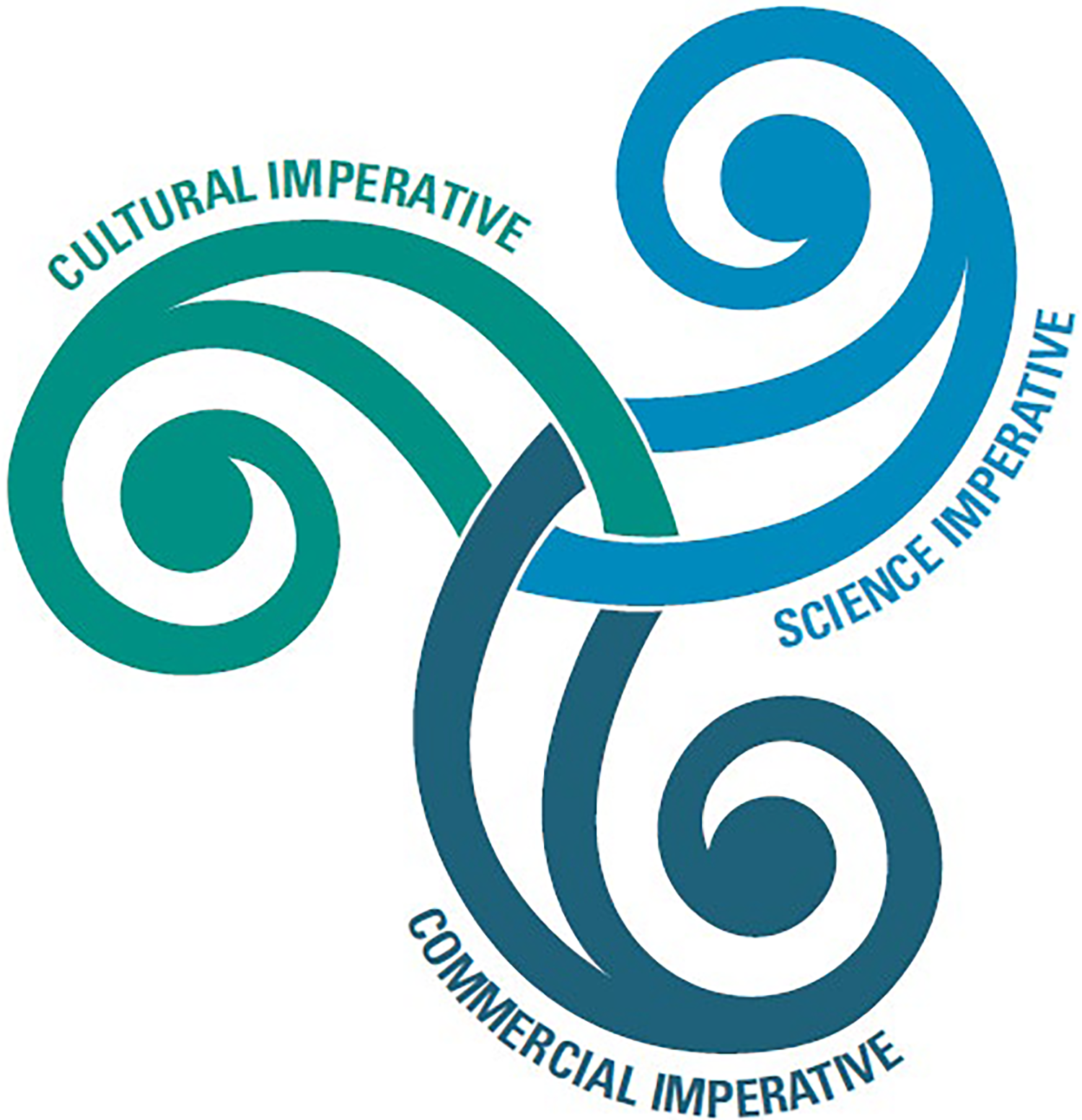
Te Pūtahitanga—a conceptual model of commercialisation.
In the commercialisation of genomic research, there are many obstacles, and possible entry and exit points for Māori innovation explaining why so few Māori enterprises may be participating in this emerging biotechnology (Hudson et al., 2021b). Yet, the future of the Māori economy rests significantly on the biological resources of Papatūānuku or Earth Mother, the source of life, human wellbeing and potential (Mika, 2021a). When Māori engage with the natural world, they attempt to do so in ways that are mutually beneficial for people and nature, which reframes genomic research toward a reciprocal balance in human and nonhuman relationships and a distributive and intertemporal beneficence (Hudson et al., 2021b; Rout et al., 2021; Trosper, 2022). This paper sets out to provide insights on how Māori, and potentially other Indigenous peoples, might successfully overcome systemic challenges in commercialising genomic research of taonga species. We examine the financial and nonfinancial benefits that Indigenous groups might seek to obtain from genomic research whilst upholding their rangatiratanga (self-determination) (Durie, 1998) and kaitiakitanga (guardianship) responsibilities, rights and interests (Kawharu, 2000) through this research.
In this paper, we first discuss the commercialisation of Indigenous knowledge within Indigenous entrepreneurship theory. Second, we discuss the importance of genomic research and its commercialisation. Third, we identify Māori enterprise development as the context within which the commercialisation of genomic research might occur. Fourth, we propose a conceptual model for Māori approaching commercialisation of genomic research of taonga species. We conclude with implications for research, policy, and practice.
Biotechnology and commercialisation
Defining biotechnology and bioeconomy
The science of the genome and subsequent applications form biotechnology which supports diverse technological innovations with wide-ranging social, economic and environmental benefits (Friedrichs and van Beuzekom, 2018). Biotechnology is predicted to be an industry exceeding US$729 billion in economic value by 2025 (Ugalmugle and Swain, 2019). According to the IACGB (2020), the bioeconomy is defined as ‘the production, utilization and conservation of biological resources, including related knowledge, science, technology and innovation, to provide sustainable solutions (information, products, processes and services) within and across all economic sectors and enable a transformation to a sustainable economy’ (9). The bioeconomy in Aotearoa New Zealand comprises biotechnology companies, Crown research institutes (CRIs), universities, independent research organisations, business accelerators, investors and support services, with a focus on medical, water and environmental bioscience (Biotech New Zealand, 2020). The local biotechnology industry is relatively small, comprising 211 companies, generating revenues of NZ$2.7 billion, but with potential to grow the country's NZ$49.4 billion bioeconomy through investments in human health, food production and environmental sustainability (Biotech New Zealand, 2020). Growth in this bioeconomy is, however, constrained by access to capital, regulation, access to skills and public concern over the ethics and efficacy of biotechnology (Biotech New Zealand, 2020).
Commercialising Indigenous knowledge
Commercialisation is a step in the process of generating value from biotechnology, whose meaning variously falls under innovation encompassing elements of newness (Davidsson, 2004; Keeley et al., 2013) and entrepreneurship, which focuses more on value creation processes (Deakins and Scott, 2021). Schumpeter’s (2000) original conception of entrepreneurship as recombinations of resources to form new products, processes, markets, raw materials and organisational forms, corresponds with modern approaches to entrepreneurship and innovation (OECD, 2016). For instance, the Oslo manual that establishes standards for innovation statistics uses precepts from Schumpeter's definition (OECD, 2000). First, a technological product innovation can involve either a new or improved product. Second, a technological process innovation is the adoption of ‘new or significantly improved production methods, including methods of product delivery’ (OECD, 2000: 32). In both criteria, the words ‘new’ and ‘improved’ are used, implying that innovation and, by extension, commercialisation should involve the creation of new knowledge as well as its dissemination. Similarly, the United Nations (2011) defines commercialisation as ‘the process of turning an invention or creation into a commercially viable product, service or process’ (17), consistent with Keeley et al. (2013) who consider innovation a viable new offering.
Indigenous entrepreneurship and commercialisation
Indigenous entrepreneurship theory provides fertile ground for exploring the commercialisation of genomic research through Indigenous enterprise (Colbourne, 2021; Mika, 2024). Hindle and Moroz (2010) equate Indigenous entrepreneurial success with culturally viable and community-accepted wealth creation within new Indigenous enterprise. Commercial enterprise thus offers a means of overcoming Indigenous disadvantage and attaining self-reliance (Peredo et al., 2004). In contrast, Jorgensen and Taylor (2000) correlate tribal enterprise with reduced success because tribal polities are ill-suited to simultaneously governing for commercial and community purposes. Yet, Indigenous entrepreneurship tends to emphasise wide-ranging success measures (Mika, 2024), such as quality of life, ongoing relationships and guardianship of Indigenous knowledge and the environment (Mika, 2021a).
The commercialisation of Indigenous knowledge is an emerging field, but studies on its history and approaches are sparse (Dell et al., 2017; Frederick and Henry, 2004; Walters and Takamura, 2015). Most Indigenous peoples have a mistrust of science organisations because of the risk of appropriating their knowledge, which rarely benefits Indigenous peoples (Smith, 1999). Recent pressure for Indigenous knowledge to be recognised and compensation tendered can be problematic as Valderrama and Arico (2010) find that discriminating between Indigenous and non-Indigenous knowledge in bioactive discoveries can be difficult. Nonetheless, Indigenous knowledge should be considered integral to innovation systems, given scientific discoveries have relied on Indigenous knowledge (Leary et al., 2009).
Genomics presents a significant development challenge for Indigenous peoples because of the technical expertise and funding required for genomic discoveries and their commercialisation (Hudson et al., 2016; Leary et al., 2009; Royal Society of New Zealand, 2016). Given that an estimated 90% of startup enterprises fail within their first 3 years (Marmer et al., 2011), Indigenous ventures must be well prepared, as failure in Indigenous communities tends to be harshly judged (Verbos et al., 2017). When combined with a distrust of science (Smith, 1999), historical biopiracy (Stirrup, 2016) and ongoing treaty grievances (Mutu, 2019), clearly hurdles exist for Māori commercialisation of Indigenous knowledge.
The importance of context cannot be understated as Indigenous entrepreneurs navigate non-Indigenous and Indigenous business communities for cross-cultural legitimacy and enterprise efficacy (Manganda et al., 2023). For example, Tretiakov et al. (2020) show how Wayuu and Māori entrepreneurs behave like Pekerti and Thoma’s (2016) identity of n-Culturals, who are people that have cognitively mastered the ability to deploy relevant knowledge in response to culturally constructed business contexts. Interestingly, Wayuu and Māori products and services with overt Indigenous content were directed to international consumers, implying indifference among local non-Indigenous markets possibly because of prejudicial postcolonial perceptions (Shirodkar and Hunter, 2021); hence the tendency for Indigenous enterprise to favour international over local markets.
Commercialisation of genomic research of taonga species will necessarily have an international dimension because of the technology involved and the need for access to global producer and consumer markets for biotechnologies. This brings the commercialisation process into the realm of Indigenous trade. Indigenous trade refers to international business, trade and investment by Indigenous owned enterprises, which is increasingly being recognised as a meritorious economic phenomenon as the global trading system attempts to become more inclusive, equitable and sustainable (Burrows and Schwartz, 2020; Mika and Maniapoto, 2023). Understanding why and how Indigenous firms are engaging in international trade and what makes this activity culturally and economically distinct is also generating scholarly interest (Jurado and Mika, 2022; Mika and Ross, 2019). Jurado and Mika (2022), for instance, find that Māori export practices are driven by ‘identity, long-term inter-generational strategies, and an ability to balance tensions between cultural values and business demands’ (1). Despite governmental action to protect Māori rights and interests by way of treaty exception clauses in free trade agreements (Kawharu, 2020) and closer involvement of Māori in trade negotiations (Mika, 2023), these protections are routinely contested because Māori and Crown relations are constitutionally unsupported and subject to political whim (Kelsey, 2023; Mika et al., 2022b; Ngā Toki Whakarururanga, 2022). Nonetheless, Māori enterprises are using tikanga Māori (Māori culture) to establish overseas trading relationships and to ensure these are beneficial for their families, communities and environments (Mika, 2021b). For example, Te Rūnanga o Ngāti Whatua, in 2023, signed an agreement with the world's largest biotechnology company, Roche, to address Māori health inequities through the combination of biomedical capabilities and Indigenous knowledge (Roche, 2023).
Sophisticated business models are needed for commercialisation, which may be enabled by context and entrepreneurial capabilities. For instance, Macpherson et al. (2021) find that Māori entrepreneurs exhibit varied business model use compared with Mapuche entrepreneurs, which they attribute to the relative stability of New Zealand's business environment. While remoteness and infrastructure deficiencies inhibit access to mainstream business environments, other factors, including cultural fit, Indigenous suzerainty, family history and Indigenous culture appear to influence the relevance of global markets, strategy sophistication and independent development (Macpherson et al., 2021).
The presence and efficacy of Indigenous entrepreneurial ecosystems may also affect commercialisation processes offering culturally appropriate support (Dell et al., 2017; Warren et al., 2017). An Indigenous entrepreneurial ecosystem is, according to Mika et al. (2022c), ‘a self-organised, adaptive, and geographically bounded community that contributes to regional development and local economic activity of Indigenous agents whose interactions result in Indigenous enterprises forming and dissolving over time’ (43). Indigenous entrepreneurial ecosystems exist within mainstream political and economic systems and are driven by an imperative of cultural continuity. Advanced Indigenous entrepreneurial ecosystems enable viable enterprise formation beyond family, cultural and geographical boundaries with ecosystem success indicated by the capacity to ‘advance aspirations for Indigenous self-determination and sustainable development’ (Mika et al., 2022c: 51).
While development status, business model sophistication and economic prosperity accruing to Indigenous individuals and groups may be enabled by relatively more stable and supportive mainstream political economies, an adequate assessment of Indigenous disadvantage in such contexts is missing from studies by Tretiakov et al. (2020), Macpherson et al. (2021) and Mika et al. (2022c). In Aotearoa New Zealand, developed country status has arguably come at the expense of the environment and the capacity for Indigenous self-development due to the precarious nature of Indigenous rights (Mika et al., 2022b). Further, the extent to which Māori entrepreneurs livelihoods are generated from traditional lifestyles on Māori land is not easily determined (Barr et al., 2018; Ellis, 2021; Nana et al., 2021), but is likely to be less than is the case with Wayuu (Tretiakov et al., 2020) and Mapuche (Macpherson et al., 2021) entrepreneurs. Another limitation is the lack of longitudinal quantitative studies of Indigenous entrepreneurship among Wayuu, Mapuche and Māori, which negates assessment of aggregate social and economic effects over time (Haar et al., 2021).
A roadmap for genomic commercialisation will help Indigenous entrepreneurs develop enterprises whose success is measured in Indigenous terms, encouraging formation of Indigenous entrepreneurial ecosystems (Mika et al., 2022c) as sites for culturally-attuned enterprise development (Awatere et al., 2017). Maclean et al. (2024), for example, demonstrate how critical evaluation of alternative economic models, combined with Indigenous leadership and partnerships with non-Indigenous enterprise can both protect and utilise Indigenous knowledge for sustainable livelihoods. Such a step-change is supported by Peredo et al. (2004) whose use of contingency theory explains how flexible and adaptive Indigenous microeconomies can evolve even in disadvantaged contexts.
Indigenous innovation and commercialisation
Indigenous innovation in commercialisation processes does exist, but they tend to be beset by power imbalances and capacity challenges. Subramanian and Pisupati (2010) find that during the commercialisation of Indigenous biological resources, neither is the source of this knowledge acknowledged nor are the commercial benefits shared with Indigenous knowledge-holders. Such practices have been termed ‘biopiracy’ of biological resources (Svarstad, 2005: 245). The San people of Southern Africa, for example, traditionally used the Hoodia gordonii plant as an appetite suppressant (Bavikatte et al., 2010). This knowledge was used without their consent to develop a commercially successful appetite suppressant. Only through intense media coverage and subsequent public objection was a benefit-sharing arrangement implemented (WIPO, 2015). In another example, the Malagasy of Madagascar have traditionally used the Catharanthes roseus plant for its medicinal properties. Eli Lilly Pharmaceuticals developed this intellectual property to create two alkaloids, Vincristine and Vinblastine (Bavikatte et al., 2010), which are used to successfully treat cancers as well as malaria (Reid, 2009). There are, unfortunately, no benefit-sharing agreements with any Indigenous or Madagascan organisations. A local example is a trademark application the Mānuka Honey Appellation Society (MHAS) for the protection of mānuka honey. Māori regard mānuka (Leptospermum scoparium) as a taonga that is native to both Aotearoa and Australia. The Australian Manuka Honey Association (AMHA) opposed the application arguing that mānuka honey is not sufficiently distinctive. Despite well-documented mātauranga Māori (Māori knowledge) of mānuka, the Intellectual Property Office of New Zealand (IPONZ) (2023) rejected the trademark application as ‘manuka honey’ was at the time also used in Australia to describe Leptospermum scoparium honey.
Conversely, other examples hint at the potential for appropriate commercialisation. An example is the Sámi people of Finland, who harvest reindeer bone to produce reindeer bone morphogenetic proteins (BMPs). Initial research by Gao (1996), Gao et al. (1996) and Gao et al. (1997) and subsequent studies (Pekkarinen et al., 2006; Tölli et al., 2010), have shown that BMPs assist in healing bone defects in rabbits and rats. A company, Bioactive Bone Substitutes (BBS), has been established to commercialise these findings, with some therapies proceeding to human trials (Bioactive Bone Substitutes, 2021). The Samoan people of Falealupo traditionally used tea made from the bark of the mamala tree (Homalanthus nutans) as a treatment for intestinal problems and infections. United States National Cancer Institute screening found that a molecule derived from the bark of the mamala, prostratin, had potential as an antiretroviral pharmaceutical to treat Human Immunodeficiency Virus (HIV) (Cox, 2001). Prior to pharmaceutical development of prostratin, benefit-sharing agreements were entered into between the people of Falealupo, the Samoan government and scientists.
Māori enterprise and biotechnology
Māori enterprise development refers to the process of enterprises developing as Māori and their capacity to advance Māori development aspirations (Davies et al., 2005; Durie, 2003; Harmsworth, 2009; Mika, 2013). Māori enterprise development is contingent on growing Māori human and cultural capability through education and employment, maintaining mātauranga Māori, and developing community-based enterprise from which Māori entrepreneurship and innovation emerge (Kawharu and Tapsell, 2019; Mika, 2018). The Māori economy—the assets and incomes of Māori commercial enterprises, while growing (estimated at NZ$68.7 billion in 2018), is mainly primary sector-based (Nana et al., 2021). Around two-thirds of Māori economic assets are held by small and medium Māori enterprises, whose propensity for innovation is above the norm (MacGibbon, 2017; Stats, 2019), consistent with earlier findings (Frederick and Henry, 2004; Reihana et al., 2006). This Indigenous innovation potential is, however, constrained by capability deficiencies (Grimes et al., 2016) and mismatches between support systems and business needs (Warren et al., 2017). An expectation is that the Māori economy contributes to Māori wellbeing (Mika, 2021a; Reid, 2021) due to socioeconomic disparities and the aspirations of iwi (tribes) who have settled treaty claims for an improved quality of life (Durie, 2011; Mika et al., 2019; Wiremu et al., 2021).
In a study of the New Zealand biotech sector, no Māori biotech firms could be identified (Biotech New Zealand, 2020). Yet, cursory reference to Māori business networks reveals at least four such firms: Hikurangi Enterprises of the Tairāwhiti region (Barrett, 2019), which is commercialising medicinal cannabis under an offshoot firm, Rua Bioscience (Whitehead, 2021); Ora Innovation New Zealand Limited, which has developed a skincare cosmetic derived from mamaku (black tree fern) (Anderson, 2024); Kāti Huirapa Rūnaka ki Puketeraki, which has commercialised taramea (sub-alpine speargrass) as a perfume (Ruckstuhl et al., 2023); and NZ Bio Forestry Limited, a Māori enterprise with international partners that converts forestry biomass into biofuels among other things (Mill and Millin, 2021). These are examples of Māori enterprises seeking to be among New Zealand's frontier firms whose indigeneity adds a valued dimension despite the challenges (New Zealand Productivity Commission, 2021). While Biotech New Zealand (2020) argues for counting Māori biotechnology firms and supporting mātauranga Māori-infused biotechnologies, the New Zealand Productivity Commission (2021) recommends support for Māori export growth and a unique Māori business ecosystem.
While the United Nations Declaration on the Rights of Indigenous Peoples (UNDRIP), the Convention on Biological Diversity (CBD) and Nagoya Protocol provide frameworks conducive to Indigenous participation in the commercialisation of Indigenous knowledge, few instances of a tradeable market presence exist (Bavikatte et al., 2010). Uncertainty about Indigenous rights and interests combined with economic, financial and technical risks confound Māori enterprise development in biotechnologies (Hudson et al., 2021b). There is potential, however, for Māori to be at the forefront of an evolving biotech sector. This is predicated on three main factors. First, treaty settlements are providing iwi with the institutional means (settlement legislation, tribal institutions and tribal capability) by which to exercise their kaitiaki (stewardship) responsibilities over Māori resources (Kawharu, 2000; Mika and Scheyvens, 2021; Rout et al., 2019; Wheen and Hayward, 2012) and uphold their mana (power, authority, dignity) in land, water and knowledge (Dell et al., 2018). Second, Māori are building capability in science-intensive industries through research which they initiate or in which they are partners (Gillies and Chapman, 2020; Martin and Hazel, 2020; Stott, 2014). Third, the science system is committed to unlocking the innovation potential of mātauranga Māori with emerging guidance on how this can responsibly occur (Hudson et al., 2021b; Martin and Hazel, 2020).
Māori enterprise is a pragmatic expression of Māori aspirations, values and capabilities for a good life (Awatere et al., 2017; Hēnare, 2011). Māori enterprise seek not only to generate wealth or overcome disadvantage (Reihana et al., 2006; Ruckstuhl et al., 2019), but to give effect to tino rangatiratanga—Māori self-determination (Durie, 1998) as an essential element in sustainable Māori development (Hawksley and Howson, 2011; Smith et al., 2015; Yap and Watene, 2019). What works for Māori enterprise development in conventional industries and sectors like farming, fishing, forestry is well established (Phillips et al., 2016; Ransfield and Reichenberger, 2021; Reid et al., 2019; Rout et al., 2020), but the premise for Māori business success in new industries like biotechnology is more opaque. Additionally, homogeneity in Māori perspectives is not to be expected as Māori identity varies across a spectrum from traditionalists to the disconnected (Greaves et al., 2015; Houkamau et al., 2019). Yet, research indicates Māori value their identity as Māori and seek to give material expression to this in business (Dell et al., 2021; Durie, 2017; Loreto and Mika, 2023). As a consequence of Māori aspirations, potential and capability for innovation (Hudson et al., 2016), researchers proposed guidelines for responsibly engaging with Māori on genomic research of taonga species, including its commercialisation (Hudson et al., 2021a, 2021b).
Commercialisation of genomic research of taonga species
Table 1 outlines key issues for the commercialisation of genomic research of taonga species through Māori enterprise. A major issue confronting Māori is moving up the value chain. By this, we mean transforming mātauranga Māori from an Indigenous knowledge into a commercial proposition. This implies a commerciality and scientific enquiry underpinned by cultural imperatives (Hudson et al., 2021b). There is no one-size-fits-all model of commercialisation. Instead, a variety of pathways will allow Māori to capitalise on options that advance Māori aspirations, which may include Māori-led and partnership-based approaches.
Key issues for Māori enterprise development.
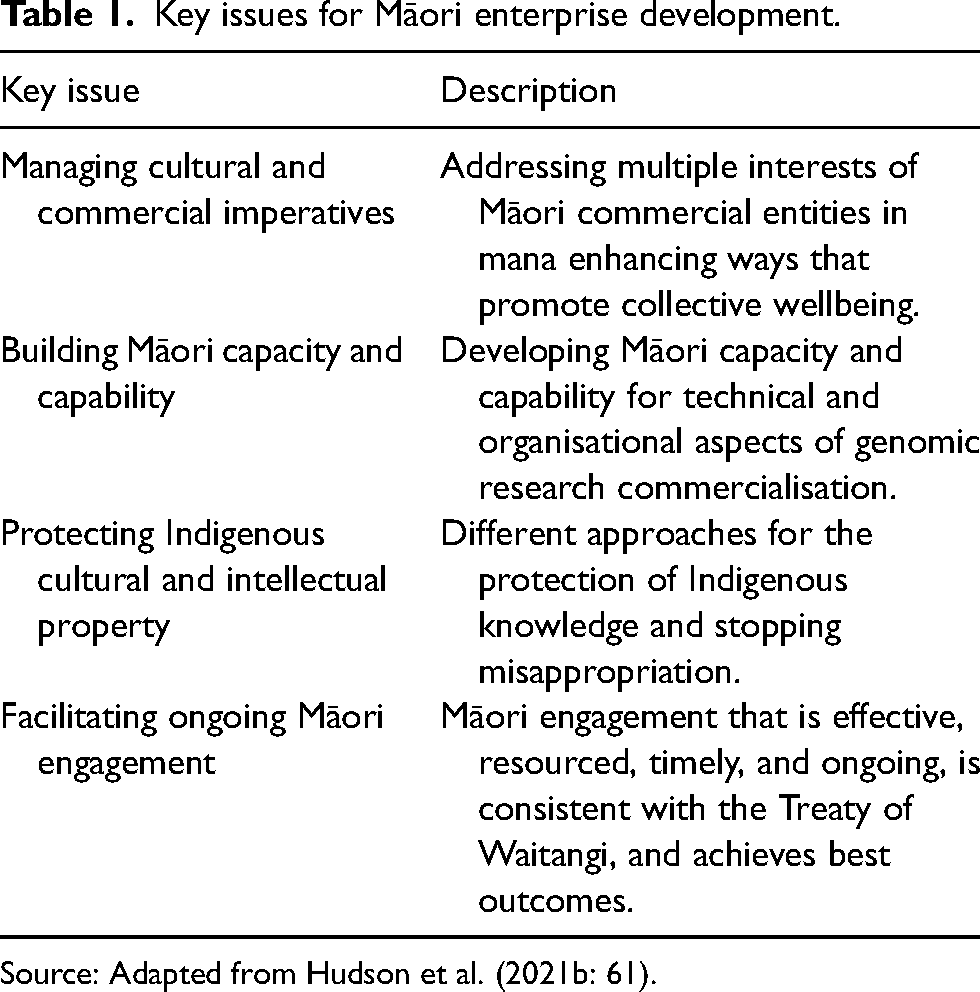
Source: Adapted from Hudson et al. (2021b: 61).
Managing commercial and cultural imperatives
The commercialisation of genomic research of taonga species is grounded in Māori identities, world views, values, aspirations, circumstance and institutions. Commercialisation should, therefore, not proceed without providing for Māori cultural imperatives. Three practices are suggested that might help: first, engaging mana whenua (tribes who hold customary authority over ancestral lands) and Māori entrepreneurs (Mika et al., 2022b); second, accounting for Māori values, aspirations and capabilities in business (Haar et al., 2021; Mika and Scheyvens, 2021); and third, using culturally responsive approaches to science and innovation (Hudson et al., 2021b; Martin and Hazel, 2020). Commercialisation can thus be constructed in ways that advance Māori aspirations (Durie, 2016, 2017), provide for Māori enterprise collaboration (Mika et al., 2021), and access and benefit-sharing agreements that protect Māori knowledge of taonga species and develop it for the benefit of Māori and others (Whare and Skinner, 2021).
Building Māori capacity and capability
In terms of the commercialisation of genomic research, capacity and capability refer to the technical and entrepreneurial resources needed for discovering, researching and developing an idea, good or service into a viable new offering. Capacity and capability building are priorities for Māori because self-determined development depends on such capabilities (Mika, 2003) and few Māori are engaged in genomic science (Martin and Hazel, 2020; McAllister et al., 2019). Most approaches to building Māori capacity and capability have till now been designed, controlled and funded by non-Māori, but treaty settlements (Mika et al., 2019), international Indigenous rights (Katene and Taonui, 2018) and the growth of Māori private enterprise (Nana et al., 2021) mean Māori-led approaches and providers of enterprise assistance are emerging to support this activity (Dell et al., 2017; Mika et al., 2022c). In the science sector, publicly funded research must demonstrate their engagement with and benefits to Māori including capability development, but the diffusion of this innovation capability among Māori firms is somewhat limited (Haar, 2020; Martin and Hazel, 2020; Vunibola et al., 2021). Commercialisation of genomic research of taonga species must entail commitment to building Māori technical and entrepreneurial capabilities by, for example, providing for Māori to be involved in the governance, management, operations, science, investment and marketing of enterprise developments founded on Indigenous knowledge.
Protecting Indigenous cultural and intellectual property
International organisations are imploring nation-states to better protect Indigenous cultural and intellectual property, but few mainstream legal regimes meet such expectations (WIPO, 2019). This is because their focus is on protecting discoveries and inventions rather than the recombination of existing knowledge and resources, ownership of which is generally privately held by individuals and corporations rather than kinship groups (Bavikatte et al., 2010). However, in May 2024, a WIPO Diplomatic Conference ratified the new WIPO Treaty on Intellectual Property, Genetic Resources and Associated Traditional Knowledge (aTK). This treaty affirms the need for a disclosure requirement of country of origin for the use of genetic resources, and where there is aTK, disclosure of the relevant Indigenous Peoples or Local Communities (IPLC) who provided the aTK is also necessary (WIPO, 2024). Moreover, Indigenous cultural and intellectual property encompasses human and nonhuman genetic material and traditional knowledge associated with this (Pihama and Smith, 1997; Taiuru, 2022). While the Waitangi Tribunal's report on the Wai 262 claim offers a definitive analysis of Māori rights to flora and fauna (Williams et al., 2011), the government is still working on its response (Te Puni Kōkiri, 2020). Meanwhile, the Intellectual Property Office of New Zealand (IPONZ) has taken steps to protect mātauranga Māori by establishing Māori advisory committees to advise ‘on whether proposed intellectual property would be offensive to Māori, or contrary to Māori values, if approved’ (IPONZ, 2016: 1). This means that researchers and enterprises must consider the significance of Māori cultural elements in the intellectual property of genomic research of taonga species and its commercialisation. As a minimum, this means engaging with mana whenua to ascertain Māori rights and interests in protective measures and enabling commercialisation (Hudson et al., 2021b). Any agreements with Māori should recognise and protect Māori cultural and intellectual property rights, including ownership and control of their subsequent manipulation and commodification. Māori initiatives are underway to address these issues including Tiaki Taonga (2024) which aims to develop a tikanga-led protection framework for taonga.
Ongoing engagement
The need for ongoing engagement with Māori is the final issue in Table 1. Poor engagement with Māori has been a common feature of government consultation, which minimises and excludes Māori voices, rights and interests, particularly in relation to land and water (Mika et al., 2022b). As a consequence, Māori capacity to protect their mātauranga and achieve self-determined development is weakened (Smith et al., 2015). Effective engagement with Māori occurs early and often, should continue beyond the lifetime of the venture (Harmsworth, 2005; Simmonds et al., 2016), and include Māori individuals and groups (Roberts, 2009). Ongoing engagement maintains relationships for future developments. Such engagement should seek to mirror the treaty partnership between Māori and the Crown, which is founded upon principles of good faith, reasonable cooperation, active protection, support for development and respect for kāwanatanga (governance) and rangatiratanga (self-determination) (Coxhead et al., 2014; Durie, 1998). Additionally, this model of engagement benefits Māori through knowledge transfer (Hudson et al., 2021b).
Achieving Māori enterprise success
Given the complexities of conceptualising and enacting the commercialisation of genomic research of taonga species through Māori enterprise, success seems contingent upon four antecedents: first, recognising and providing for Māori aspirations for self-determined development; second, building Māori capacity and capability for genomic research and development; third, recognising and protecting mātauranga Māori; and fourth, implementing benefit-sharing arrangements (Robinson, 2014; Riddle et al., 2024). Commercialising knowledge of taonga species through Māori enterprise also requires funding that spans the engagement, research and commercialisation phases. This development process entails collaborating with individuals and organisations that have the desired technical, operational and financial capacity to generate end-to-end success (Mika et al., 2021). Māori enterprise collaboration must start early, which is assisted by trusted enterprise facilitators who have a high degree of cultural and commercial capability (Mika and Scheyvens, 2021). Intellectual property is an integral element of Māori enterprise success. This involves recognition of mātauranga Māori and applying genomic data expertise to previously undeveloped intellectual property. The expected outcome is a mutually beneficial exchange where mātauranga is transformed as a core capability and benefits are shared with traditional knowledge-holders. While New Zealand has not ratified the Nagoya Protocol, its emphasis on ‘the need for free, prior, informed consent, and fair benefit sharing’ intimates minimum standards (Riddle et al., 2024: 8). Benefit-sharing can extend beyond financial measures to include capacity building, but must be based on community engagement and Indigenous self-determination (Riddle et al., 2024).
Conceptualising commercialisation as te pūtahitanga
We conceptualise the commercialisation of genomic research of taonga species through Māori enterprise using te pūtahitanga, a Māori expression that refers to the confluence of two or more rivers (see Figure 1). In this instance, te pūtahitanga uses three interlocking koru to metaphorically depict the dynamic interaction of cultural, commercial and science imperatives, underpinned by an Indigenous moral philosophy, which orients human behaviour toward the collective wellbeing of human and nonhuman communities (Hēnare, 2014; Mika, 2021a; Reid, 2021; Rout et al., 2021). Koru are, in general terms, a ‘curvilinear element punctuated with a circular stoppage’ denoting the fern but connoting culturally significant meanings (Shand, 2002: 48) frequently appearing in Māori traditional motifs and in symbols of national identity, which themselves, as Shand points out, have interesting and questionable cultural and intellectual property rights histories. In this vein, te pūtahitanga denotes four key insights. First, as an Indigenous people who aspire to entrepreneurship (Kawharu and Tapsell, 2019; Nana et al., 2021), a commercial imperative is not inconsistent with Māori indigeneity because it provides a means by which to fulfil an obligation for collective wellbeing (Rout et al., 2022). This is expressed through multiple measures of wellbeing among whānau (families), hapū (subtribes), iwi, the wider community and the environment (McMeeking et al., 2019; Mika, 2021a).
Second, cultural imperatives refer to shared values and beliefs as an ethical code for right and proper practice, processes and outcomes that originate from te ao Māori (the Māori world view) (Bargh, 2012; Hēnare, 2011; Manganda et al., 2022; Mead, 2019; Mika, 2021a). These cultural imperatives are indicated by Māori values, which have found application in management scholarship and practice (Amoamo et al., 2018; Best, 2013; Mika and O'Sullivan, 2014; Tinirau, 2017). They include whanaungatanga (relationships), manaakitanga (generosity), kaitiakitanga (stewardship), kotahitanga (unity), rangatiratanga (leadership) and wairuatanga (spirituality) (Haar et al., 2020; Spiller et al., 2019, 2020; Wolfgramm et al., 2019).
Third, the science imperative refers to the inexorable pursuit of knowledge using the scientific method (Aityan, 2022), subject to intellectual property rights that cohere in technology-based exploitation of such knowledge (Barseghyan et al., 2018; Sterling et al., 2021). The cultural imperative is challenging the science imperative to accommodate, integrate and otherwise accept other knowledge systems, including Indigenous knowledge, as legitimate epistemologies (Awatere and Harcourt, 2021; Hikuroa, 2017). As a result, the science imperative is being modified by the inequities of underrepresentation of Indigenous peoples in genomic research (Claw et al., 2018), the ethicality of biotechnology (Te Momo, 2007) and gene-editing (Clark et al., 2024; Hudson et al., 2019), and accountability to community (Hudson et al., 2016). Critically, both national (for example, treaty policy and intellectual property laws) and international frameworks (for example, UNDRIP, CBD, and the Nagoya Protocol) must be in place to ensure that Indigenous knowledge is protected and benefit-sharing occurs (Mika, 2018; Mika et al., 2022b; Teran, 2016).
Fourth, the preceding points allude to a place where all three imperatives converge, a confluence in streams of thought and action known as te pūtahitanga, which is consistent with Indigenous conceptualisations of innovation as multiple, intersecting dimensions—social, cultural, economic, environmental, and spiritual (Kawharu et al., 2017; Walters and Takamura, 2015; Winiata and Luke, 2021). In this meeting place, Māori must reconcile the commercial and cultural imperatives of genomic research with their being Māori (Greaves et al., 2015; Rangihau, 1992). According to Manganda et al. (2022), for instance, culturally responsive Māori entrepreneurs will be acutely aware of the economic risks and benefits (Callaghan, 2009; Mulligan et al., 2005), while culturally engaged Māori entrepreneurs will focus on the noneconomic risks and benefits (Hudson et al., 2016).
In te ao Māori, the confluence of te pūtahitanga is commonly expressed in three key concepts—reciprocity, balance and wellbeing. An example of these concepts in action is Palmer and Mercier (2020) who show how Mead’s (2003) take-utu-ea framework can be used to negotiate tensions inherent within te pūtahitanga. In their study into methods of wasp control, Māori perspectives on the use of biotechnologies were ascertained, including gene-editing, to address a socially significant issue—exotic pest control—underpinned by government policy. According to Mead (2003), take (issue) represents a breach of tikanga, which is established when the parties involved agree a take exists, warranting an acceptable form of utu (recompense), to achieve a sense of ea (satisfaction). In this instance, negative environmental effects of an excessive wasp population represents the take, with the use of biotechnologies, including gene-editing, possible forms of utu, and ea reflected in part in the achievement of a predator-free future state. The take-utu-ea framework must enhance mauri (lifeforce) and mana (power and authority) of those involved, which may be achieved when rangatiratanga and kaitiakitanga are recognised. While consensus on the take (need for pest control) was apparent, participants were unequivocal about the utu (biotechnologies), particularly where rangatiratanga was insufficiently recognised.
In the case of te pūtahitanga, enhancing mauri and mana are cultural imperatives which may be diminished (constituting a take); genomic research coheres in a science imperative with mātauranga elements (constituting a form of utu); and commercialisation is a form of ea (constituting a state of balance). Variations on this approach are evident in the concepts of tauutuutu (Reid et al., 2021a) and manahau (Mika et al., 2022a) as a functional ethic of reciprocity in Māori land-based (Reid et al., 2021a) and Māori marine-based enterprise (Rout et al., 2024), post-settlement governance entities (Cribb and Mika, 2023; Mika et al., 2019), and Māori entrepreneurship (Dell et al., 2021; Manganda et al., 2022).
For example, Reid et al. (2021a) use the Māori term tauutuutu (ongoing reciprocal exchange) to describe the reciprocity that occurs between the extractive processes of agricultural activity and the reinvestment of Māori farming enterprises in the land and water resources available to them. The object is to achieve balance in the wellbeing of the people and the land intimated through preserving the mauri (life force) of human and nonhuman entities through an ongoing reciprocal exchange. Reid and colleagues offer examples of tauutuutu including transitioning to more sustainable land uses, using waste from one process (mussel shells) in another (fertilizer), tribal support for whānau (family)-based enterprise and employing multiple measures of performance (human and nonhuman wellbeing) (Reid et al., 2021a).
Mika et al. (2022a) develop a similar concept they call manahau as a Māori theory of value. Manahau is defined as ‘an axiological agent Māori entrepreneurs employ to synergistically negotiate cultural and commercial imperatives to achieve multidimensional wellbeing, human potential, and relational balance in multiple sites, sectors, and scales’ [emphasis in original] (Mika et al., 2022a: 452). Manahau derives from a combination of mana—meaning power, authority and prestige (Dell et al., 2018) and hau—denoting the vitality of an object, people or place (Nicholson, 2019). Manahau is exemplified in Hēnare’s (2014) concept of an economy of mana, where the object of enterprise is to enhance the mana of other entities, establishing a bond between firms and an obligation to reciprocate. Examples of manahau are evident in expressions of manaakitanga (generosity) and kaitiakitanga (guardianship) of people and land, where the spirit of the gift is reciprocated at some future point (Barnett, 2001; Rout et al., 2021). Balance in manahau is characterised as synergistic rather than as trade-offs (Mika, 2021a), which few scholars have attempted to express in algorithmic terms save one (Robson, 2021).
The implications of te pūtahitanga for the commercialisation of genomic research of taonga species through Māori enterprise are threefold. First, cultural imperatives are rooted in indigeneity, expressed in values and actions consistent with Māori entrepreneurial identities (Manganda et al., 2022). Second, commercial imperatives are values and practices grounded in cultural imperatives, orienting behaviour toward methods and outcomes of enterprise that achieve balance and wellbeing—manahau and tauutuutu, for example (Dell et al., 2022; Reid et al., 2021b). Third, the science imperative integrates Indigenous and non-Indigenous knowledges, where ethicality and practicality are defined by the degree to which such research advances Māori aspirations for the wellbeing of human and nonhuman communities (Rout et al., 2021). Thus, commercialisation of genomic research of taonga species is not only protective of Māori rights, interests and values, but is also developmental, encompassing purposes, processes and outcomes beneficial to Māori and others (Mika et al., 2022b).
Conclusion
This paper contributes to knowledge of Indigenous entrepreneurship by identifying principles, practices and frameworks that support Indigenous engagement in the commercialisation of genomic research of taonga species using Indigenous knowledge, capabilities and potential. While favourable innovation ecosystems rapidly advance biotechnologies as means and ends, this progression has mostly proceeded without material and beneficial Indigenous involvement except as sources of genetic material obtained with or without consent. While Indigenous peoples vary greatly in their propensity and capability to pursue biotechnologies, they are not particularly well supported to do so by instruments that offer largely unenforceable Indigenous rights to own, develop and benefit from their biological resources and knowledge of those resources. Access and benefit-sharing agreements, for example, that culminate in an equitable distribution of scientific and economic gains from genomic research of taonga species are rare. Yet, Indigenous people are actively engaging in entrepreneurship as a means toward self-determined development, sustainable livelihoods, poverty alleviation and preserving culture and the natural environment. While reconciling the ethicality and efficacy of biotechnologies with Indigenous ethical codes is a necessary precursor to their engagement, an implied presumption of inconsistency with indigeneity should not negate Indigenous assessments of the cultural and commercial merit of genomic research in partnership with the biotech sector. This is because such assessments embrace a multidimensional view innovation, with social, cultural, economic, environmental and spiritual favourability considered because of their synergism in realising Indigenous aspirations.
In the absence of an institutional environment of enforceable Indigenous rights, Indigenous engagement in the commercialisation of genomic research of taonga species must rely on two non-exclusive pathways to innovation and enterprise development in this emerging sector. First, responsible corporate and state actors who are increasingly recognising the inequity of excluding Indigenous people from developing and benefitting from their own resources as well as the value of Indigenous knowledge for sustainable development. While the ethic of responsible management may be induced by a socially conscious consumer base, investigative journalism, social movements and Indigenous activism, the desired effect is the inclusion of Indigenous peoples in commercialisation processes. Second, self-determining Indigenous entrepreneurs who actively seek innovative ways to utilise their resources for the benefit of Indigenous peoples and others, others having a broad ambit, inclusive of nonhuman communities. Neither pathway is devoid of challenges nor assured of success. In Aotearoa New Zealand, given current capacity, Indigenous engagement is most likely to occur through Māori enterprise collaborations with science, corporate and state actors. With few Māori enterprises involved in biotechnology, Māori entrepreneurs are deprived of examples to follow. The local biotech sector's suggestion for a register of Māori enterprises in biotechnology and better data would assist in decisions about how best to direct support to, and interest in, Māori involved in genomic research and its commercialisation. Financing Māori enterprise development would also facilitate the end-to-end investment that is required for commercialisation.
We posit a conceptual model that metaphorically conceives the confluence of several approaches for successful Māori enterprise development. These include fulfilling an obligation for collective wellbeing and an ethical code for right and proper practice based upon Māori cultural imperatives found in the principles of whanaungatanga, manaakitanga, kaitiakitanga, kotahitanga, rangatiratanga and wairuatanga. The model encompasses the science imperative for genomic research and its principles of empiricism, scepticism, experimentation and deductive reasoning. The cultural imperative is modifying this science imperative to accommodate, integrate and accept Indigenous knowledge systems as legitimate epistemologies. These three imperatives coalesce to form ‘te pūtahitanga,’ which is consistent with Indigenous conceptualisations of innovation as having multiple, intersecting dimensions. Māori are on the cusp of capitalising on mātauranga Māori—Māori knowledge spurred on by treaty settlements, revitalisation of the Māori language and culture, a growing Māori economy, and higher educational attainment. We surmise that if Māori are able to find methods grounded in their culture such as manahau and tauutuutu to balance cultural, commercial and science imperatives, advancing the commercialisation of genomic research of taonga species through Māori enterprise will become more distinctly possible and worthwhile.
Footnotes
Glossary
Abbreviations
Acknowledgements
We thank Genomics Aotearoa for funding Te Nohonga Kaitiaki, a project administered by Te Kotahi Research Institute at the University of Waikato, on which this paper is based.
Declaration of conflicting interests
The authors declared no potential conflicts of interest with respect to the research, authorship and/or publication of this article.
Funding
The authors disclosed receipt of the following financial support for the research, authorship, and/or publication of this article: This work was supported by the Genomics Aotearoa (grant number 1802 Te Nohonga Kaitiaki).
