




Abstract
Industry crises regularly threaten the existence of small- and medium-sized enterprises (SMEs) and place demands on their resilience while simultaneously providing opportunities for cross-industry innovation (CII). The current literature on CII has not examined how SMEs engaged in CII during a crisis. Using in-depth interviews conducted prior to the oil crisis in 2014 and at the end of the crisis in 2018, we evaluate how the disposition of nine SMEs towards CII contributes to their resilience. We show that CII capabilities strategy and mindset promote absorptive and adaptive resilience. Further, the longitudinal aspect highlights the mismatch between CII opportunities identified during prosperity and SMEs’ ability to realise these opportunities during a crisis. This is often rooted in the challenges of understanding the industry structure of the new CII segment. Successful CII is positive for SMEs’ resilience, and policy initiatives should strive to bridge industries, providing transparency for SMEs pursuing CII.
Introduction
Multiple crises have struck industries, with each necessitating a form of response from the affected parties. Small- and medium-sized enterprises (SMEs) comprise over 99% of firms (Knop, 2007), and SMEs are often at the forefront when a crisis strikes. Despite their size and resource constraints, SMEs’ responses to crises are vital, as they are considered drivers of innovation and regional development (Isoherranen and Ratnayake, 2018). Faced with change, SMEs’ often flat-and-flexible structures position them favourably for responsive action (Petruzzelli et al., 2018; Tunzelmann and Acha, 2005), which affects their resilience (Burnard and Bhamra, 2011; Smallbone et al., 2012).
Crises create opportunities for cross-industry innovation (CII), and the ability to identify and realise CII is positive for SME growth (Faeroevik and Maehle, 2022). CII encompasses instances of knowledge, technology, and cooperation between parties of cognitive distance, wherein complementary knowledge from different fields can be combined (Enkel and Gassmann, 2010). CII can also be applied beyond the borders of one's own industry (Hauge et al., 2017). The current literature on CII (for a review, see Carmona-Lavado et al., 2023) has not examined how SMEs engaged in CII during a crisis, and our study seeks to fill this gap by exploring whether inherent capabilities for CII can help SMEs navigate through a crisis.
Dynamic capabilities and the ability to be open to new knowledge make firms better positioned to endure downturns (Ahn et al., 2018). As a subset of dynamic capabilities, CII capabilities (CIIC; Hauge et al., 2017) target a more specific crisis response and may affect CII success and resilience (Dovbischuk, 2022), although the CIIC have not previously been coupled with resilience. As SMEs’ pre-crisis positioning matters for how they respond and develop (Iborra et al., 2020; Koronis and Ponis, 2018; Smallbone et al., 2012), this narrows our scope, and we view SMEs’ responses as embedded in the composition of their CIIC and resources pre-crisis. SMEs’ approach to risk and innovation, whether proactive or reactive, may provide a base launch point for exploiting CII opportunities during a crisis (Eggers, 2020), which may enhance capabilities (Ferreira et al., 2020).
Resilience indicates a firm's ability to maintain itself through crises (Burnard and Bhamra, 2011). We bridge resilience with CII. However, CII initiatives, whether in niche markets within one industry or other industries, take time. Thus, coupled with the importance of pre-crisis positioning, we include the temporal dimension when examining resilience, which Conz and Magnani (2020) called for, and we add to the literature by examining and comparing SMEs with different outcomes of such ventures (Wales et al., 2020).
We find that the oil crisis from 2014 to 2018 provides an opportunity to examine SMEs’ crisis responses through CII and resilience implications. Thus, using two data points—prior to the oil crisis in 2014 and at the end of the crisis in 2018—interviews with nine SMEs (primarily dependent on the oil and gas [O&G] market) shed light on the CIIC and the resulting CII and SME resilience. These cases provide a unique perspective on SMEs’ perceptions of their own CII abilities and the realisation of that potential during a crisis. This allows us to argue that specific CIIC, such as strategy and mindset, determine SMEs’ position to engage in CII in times of crisis and, by extension, impact their resilience. We further contribute to the literature on SMEs’ CII orientation and resilience by confirming that the perception of CII opportunities does not always match reality when SMEs are forced to alter their strategic positions. However, we find that a successful CII, supported by strong CIIC, brings SMEs away from survival, providing a more resilient and diversified foundation—CII resilience.
The remainder of the paper is structured as follows. Section 2 offers context and the theoretical framework. Section 3 describes the research design. Section 4 presents the findings. Section 5 discusses the findings, and Section 6 concludes the paper with contributions, limitations, and avenues for further research.
Theoretical framework
We discuss different types of resilience to discern how SMEs fare during crises. We then examine SMEs’ toolbox of capabilities for CII and argue that these organisational aspects contribute to SMEs’ resilience.
The O&G industry in Norway
Our study seeks to contribute to the outlined research gaps using SMEs in Norway's O&G industry. This is the single largest industry in Norway, with income from the petroleum sector comprising roughly 12% of GDP in 2000–2014, which, owing to the severe drop in crude oil prices, dropped to 4% by 2016 (Hansen et al., 2017). This resulted in a reduction in the number of people employed in the O&G industry in Norway by 20.8% from 2013 to 2016 (Ministry of Energy, and Norwegian Offshore Directorate, 2023; Hungnes, 2017). The 2008 financial crisis created worldwide disruptions, but the oil crisis of 2014 was more targeted in its impact area in terms of affected industries and regions, causing major disruptions for the firms involved and representing an industry crisis. Crises tend to prompt reactive attempts at innovation and restructuring (Chapman et al., 2004), motivating and making firms prone to attempt CII to build resilience. Further, competence in O&G is valuable for growth within the renewable energy, marine, and maritime industries (Basso et al., 2020; Mäkitie et al., 2020), indicating the relevance of studying CII in the O&G industry. Additionally, the Norwegian economy's dependence on O&G is under pressure to respond to sustainability concerns (Joyce and Paquin, 2016).
Our case firms are in the Vestland region on Norway's southwestern coast; 56.3% of the onshore O&G personnel are employed in Western Norway (Vatne, 2008), spanning the counties of Rogaland and Vestland, making the O&G industry a primary employer there. However, despite its heavy reliance on O&G, the region is characterised by a thick and diversified innovation system (Hauge et al., 2017). Combined with an industry crisis and pressure on the oil dependency of the Norwegian economy to respond to sustainability concerns (Joyce and Paquin, 2016), regional structures provide us with an environment well-suited for studying CII and its capabilities, along with implications for SME resilience. However, not unlike other incumbent industries, O&G is often viewed as lacking the willingness to change (Sletten et al., 2023), and we consider studying how firms operating in entrenched industry regimes may undergo restructuring in a resilient manner to be highly relevant for actors both within and outside O&G. Owing to different crises, along with a society-wide sustainability shift, our study is relevant to firms in other countries and industries facing similar challenges.
SME resilience
SMEs’ size impairs their growth compared to the growth of larger firms during a crisis (Peric and Vitezic, 2016). Thus, for small firms, there are two likely responses: seeking short-term survival by cutting costs or investing in the hope of long-term payoffs (Smallbone et al., 2012). Both options come with risks, as the former might damage the firm's recovery at the end of a downturn, whereas the latter might be too costly for short-term survival. However, SMEs that score well on resilience during turbulence tend to adapt and focus on generating more revenue, as opposed to merely cost-cutting (Dejardin et al., 2023; Smallbone et al., 2012). Similarly, Kottika et al. (2020) found a strategy targeting improved product and service quality dominant for SMEs surviving the Greek recession and considered the bare minimum of resilience to pertain to survival, with employee reduction, outwards orientation, management of finances, and marketing as the major factors for survival. We consider survival, or the ability to “bounce back” to their pre-crisis normal (Martin and Sunley, 2015; Miklian and Hoelscher, 2022) as the lowest form of resilience.
In their review of the resilience literature, Conz and Magnani (2020) conceptualise two dynamic types of organisational resilience that go beyond the ability to recover post-crisis. First, absorptive resilience is the ability to withstand shocks, adaptive resilience is the proactive ability to (anticipate and/or) adapt to the conditions brought about by a shock. Allocating resources to CII can be one way to contribute to resilience. While previous literature has not explored CII related to resilience (for a review, see Carmona-Lavado et al., 2023), it proposes that an orientation towards CII may be important in this regard (Hauge et al., 2017). We address this gap by exploring the implications of SMEs’ CII on resilience.
The nature of a crisis will likely also affect SMEs’ resilience, and its conceptualisation serves to determine how it is viewed and researched (Doern et al., 2019). Our study describes a market crisis, and such crises tend to increase the perceived importance of innovation (Bodlaj and Čater, 2019). Additionally, if a crisis is perceived as a permanent industry change, SMEs may be more likely to explore other options, such as CII, than if their perception of the crisis is temporary. Thus, SMEs may attempt to weather the crisis (Laskovaia et al., 2019; Marino et al., 2008). Crisis duration, as perceived initially and the actual duration, can also influence how SMEs respond (Cowling et al., 2020). These changes can be sudden, and response strategies depend on resilience, belief in own capabilities, but also action to gain from the situation (Klyver et al., 2023). Further, in the case of foreign market entry, SMEs that are proactive, willing to assume risk, and innovative gain a competitive advantage in the face of cultural distance and unforeseen events (Baker et al., 2020). We expect a similar effect when moving between different industries (domestic or foreign) because the industries may be governed by different norms and cultures. All these aspects can influence SMEs’ strategy and application of the CIIC during a crisis, as well as the positioning of the SME at the end of the shock. Hence, we consider the temporal dimension of resilience (Conz and Magnani, 2020) by including both the pre- and post-crisis states of SMEs, thus expanding this aspect of resilience.
CII capability
Resilience to crises is garnering recognition as a property of complex adaptive systems (Barasa et al., 2018), with previous studies (Kurtz and Varvakis, 2016; Sabahi and Parast, 2020) linking SMEs’ dynamic capabilities to resilience and the ability to adapt and recover during crises (Dovbischuk, 2022). Research on dynamic capabilities explores how firms may best apply their resources to meet and counter the circumstances of their environment (Ferreira et al., 2020), providing a way to understand organisational performance in different situations (Augier and Teece, 2009).
Dynamic capabilities can be broken down into various categories related to how firms apply their resources, make decisions, manage knowledge, and innovate (Cao, 2011), and are viewed as a precursor to innovation capability (Alves et al., 2017), defined by Lawson and Samson (2001: 384) as “the ability to continuously transform knowledge and ideas into products, processes and systems for the benefit of the firm and its stakeholders”. Hauge et al. (2017) extend this subfield of dynamic capabilities by adding CII, thereby making an orientation towards CII a central part, resulting in a set of eight CIIC. We focus on four of these, which Hauge et al. (2017) find more prominent in firms exhibiting either moderate or strong CIIC:
Vision and strategy: CII as part of strategy (CIIC1). Harnessing the competence base: ability to combine and utilise different competencies (CIIC2). Organisational intelligence: ability to learn from different industries (CIIC3). Open and tolerant culture and climate: organisational mindset towards CII (CIIC4).
These CIIC indicators place CII at the base level of the organisation and propose an organisation that is suffused by a mindset and targeted towards performing CII. This is done by incorporating the goals and strategic decisions; learning, combining, and seeking knowledge both internally and externally; and fostering a culture that encourages inclusion and differences in the pursuit of innovation (Hauge et al., 2017). Dovbischuk (2022) found a similar set of dynamic capabilities that did not consider CII positive for firms’ resilience, leaving a gap for us to examine CIIC during crises.
The ability to absorb or adapt to change requires firms to learn from events and develop their capabilities to become resilient (Duchek, 2020), making resilience a dynamic dimension over time (Conz and Magnani 2020). The possession and appropriate application of these CIIC elements can provide SMEs with a strong foundation for CII, further resting upon the firms’ interaction with their environment and willingness to take risks. During the 2009 financial crisis, SMEs were able to reshape and adjust their capabilities to be more effective and objective in their response (Dias et al., 2021). Thus, capabilities matter for how a firm may alter its own foundation (Helfat and Winter, 2011), and are important for SMEs’ resilience in terms of efficiency, adaptiveness, collaboration, change mastery, and learning (Zighan et al., 2022). The success of SMEs in balancing long-term strategies with immediate resilience is anchored in how they formalise activities (Herbane, 2019). In the context of CIIC, we view this formalisation as dependent on the level of CII saturation within the SME. Further, based on the dynamic nature of capabilities and how they may evolve during crises with their pre-crisis-state shaping development (Dejardin et al., 2023), we propose that the strength of the CIIC can change with time and circumstances. Thus, CIIC can be strengthened if the latent potential for CII is activated (in line with adaptive resilience) or weakened as the possibility of CII decreases (in line with the focus on survival).
Opportunity recognition
Given baseline capabilities, how SMEs approach the application of these capabilities becomes central. Strategically exploiting capabilities in volatile markets (O&G is considered as such (Vatsa and Basnet, 2020)) contributes to SMEs’ competitive ability (Nedzinskas et al., 2013), whereas organisational inertia may hinder their application in a crisis. To this end, the literature often employs an entrepreneurial orientation, comprising innovativeness, risk assessment, and proactiveness, as tools to facilitate the application of capabilities in connection with resilience (Zighan et al., 2022), representing firms’ willingness to renew themselves and seek new market opportunities (Hult and Ketchen, 2001). A crisis may push firms to act regardless of how risk-averse they are, and dynamic capabilities are tied to both risk management during crises (Corrales-Estrada et al., 2021) and opportunity identification (Teece, 2007). We believe that responsive action through a CII orientation incorporates elements of entrepreneurial orientation because innovativeness offers insight into SMEs’ willingness to go beyond their day-to-day operations (Freixanet et al., 2021). Thus, the possession of CIIC informs us about this orientation. However, the disposition to take advantage of opportunities depends on the alignment between capabilities (Altinay et al., 2016); for example, a strategy for CII relies on CII organisational learning.
Risk-taking can be detrimental to performance during a crisis, but it is often negated by improving SMEs’ survivability through innovativeness and proactiveness (Soininen et al., 2012), and is of value for SMEs’ ability to bounce back and survive a crisis. How capabilities are applied during a crisis may contribute to improving SMEs’ proactiveness (Dias et al., 2021). Further, aligned capabilities are connected to lasting competitive advantages, as opposed to temporary strengthening (Altinay et al., 2016), which we deem relevant to SMEs’ adaptive resilience.
In attempting to apply CII in changing market conditions, the actual outcomes do not always match SMEs’ pre-perceptions regarding opportunities and the transferability of their technology through CII processes. Technology may be less transferable than assumed because of context dependencies and tacit dimensions inherent in both firm and market structures (Yin and Zuscovitch, 1998). In this line, there may also be little direct correlation between business and technological performances (Tunzelmann and Acha, 2005). Thus, the recognition of opportunities has both objective and subjective dimensions, as how managers perceive their options does not always match the actual opportunity, and though perception can instigate action, it is the latter that determines success (Renko et al., 2012). Hence, there needs to be a match between perceived and actual opportunities, and in the case of a crisis, the availability of both may be bountiful. A lack of a match can have severe implications for SMEs when applying their capabilities and taking risks. However, SMEs’ positioning—relying on, for example, inherent CIIC—at the start of a crisis determines how the SMEs’ strategy develops during a downturn (Smallbone et al., 2012), and we show how that connects to SMEs’ resilience.
Based on our literature review, we create a model to illustrate SMEs’ resilience and their likely reliance on certain organisational traits in the context of an extended crisis. At the crisis onset, Model 1 (see Figure 1) assumes variable strengths for the CIIC owing to secure market positioning. Implicit here is the inherent potential for resilience pre-crisis and the realisation of resilience post-crisis (Duchek, 2020). Further, Model 1 incorporates the temporal dimension of resilience (Conz and Magnani, 2020), the dynamic aspect of resilience through how a firm can improve its capabilities (Section 2.2), and how resilience can be classified (Section 2.1).
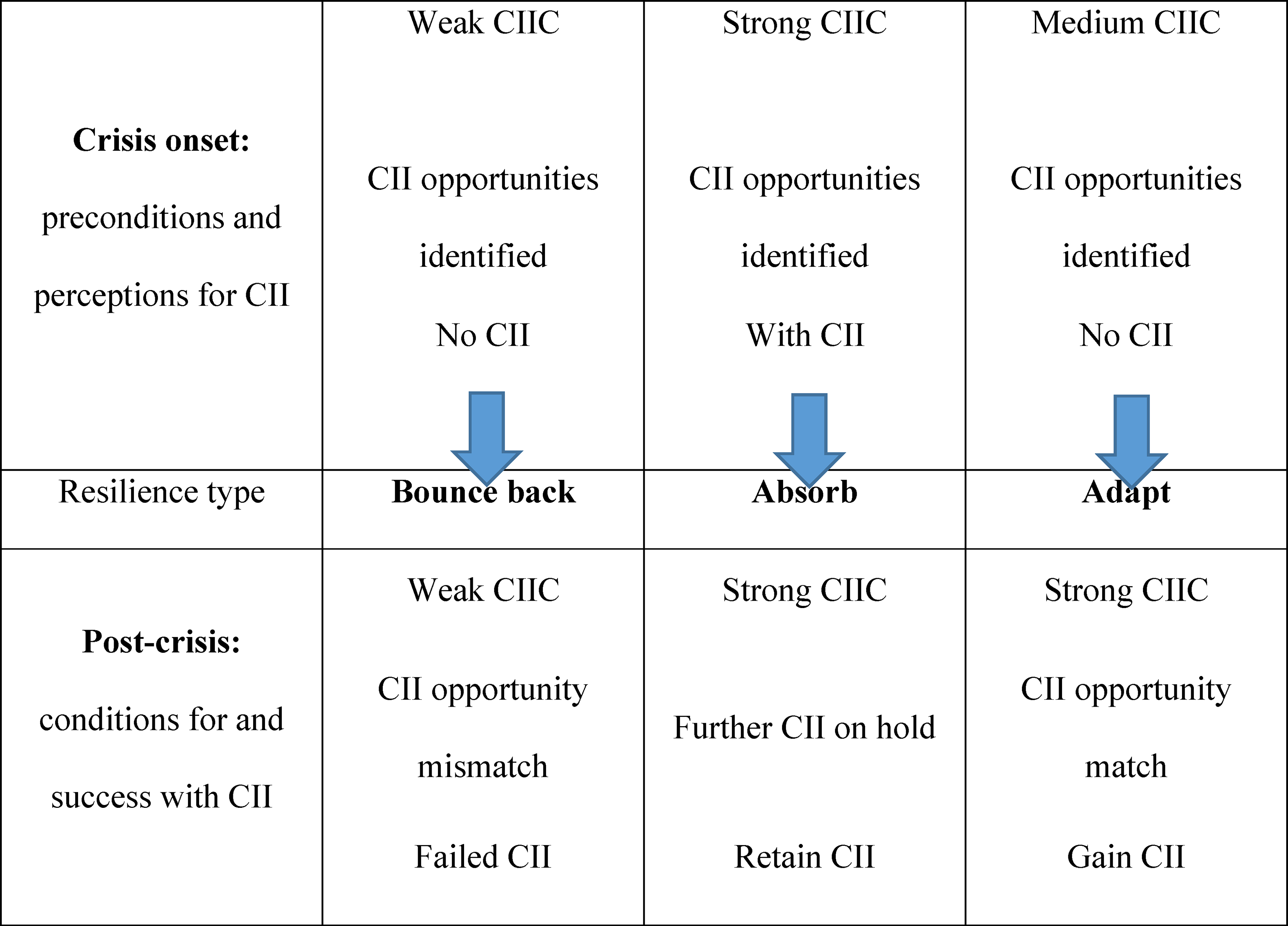
Model 1: expected set-up.
Method
Data collection
This study was designed to be exploratory, in that it sought to understand how SMEs’ orientation towards CII affected their development and resilience during a downturn. It did so by following up on SMEs’ different choices and applications of capabilities to determine their resilience and success with CII. Therefore, a longitudinal qualitative research design was used.
The selection of case firms for the analysis was conducted based on the following criteria: firms were geographically located in the Vestland region in Western Norway, had O&G as their primary market affiliation in 2014, were small- to medium-sized, and had apparent transferable technology (products/services that can theoretically be applied in another industry without major technical adjustments). Consequently, nine firms were chosen based on these selection criteria and the availability of suitable data from 2014. Availability of suitable data from 2014 presented the main constraint in our selection of SMEs to include for this study. Table 1 provides an overview of the SMEs’ O&G market exposure and the industries in which they conducted CII.
SMEs’ O&G market exposure.
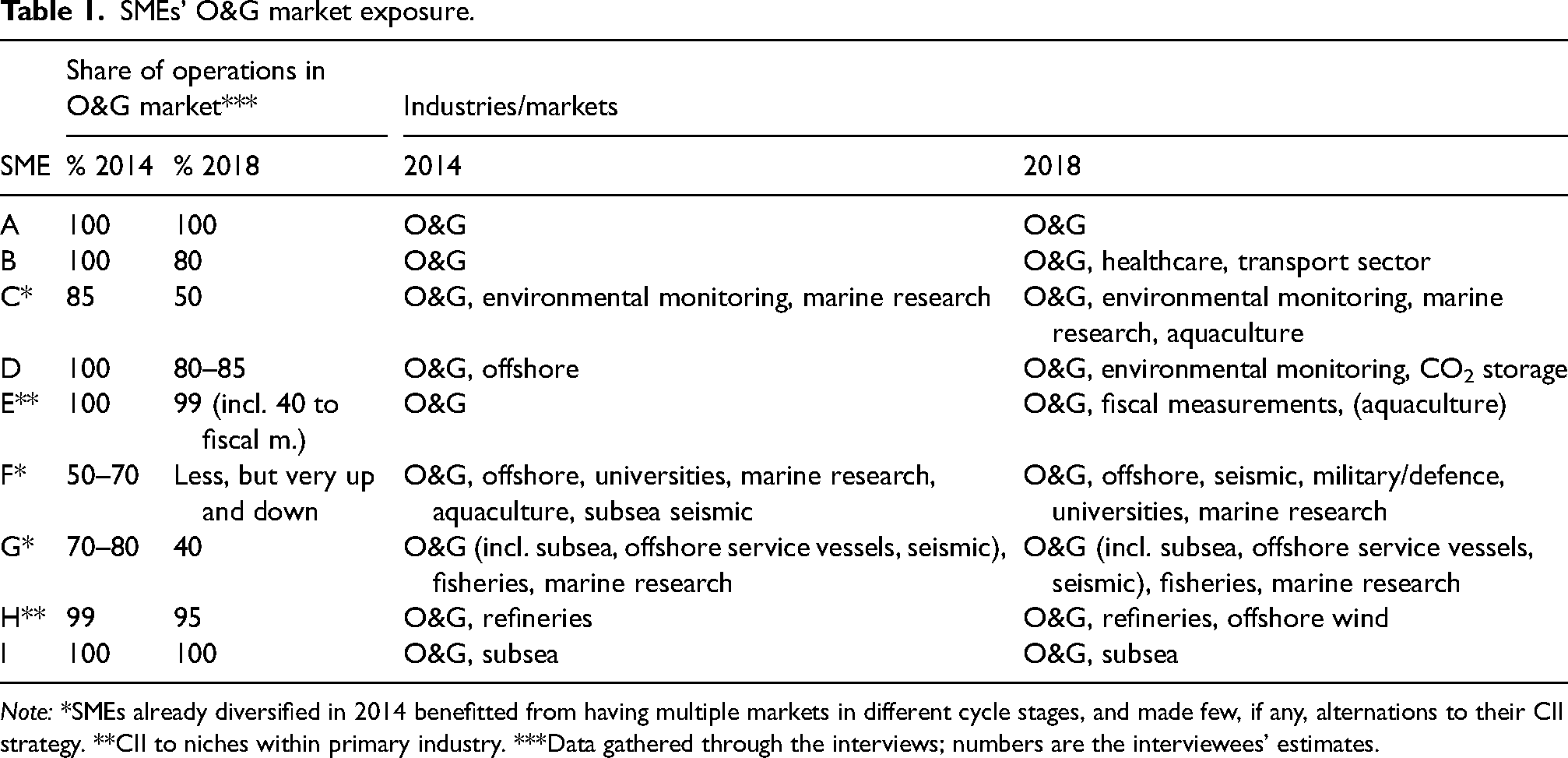
Note: *SMEs already diversified in 2014 benefitted from having multiple markets in different cycle stages, and made few, if any, alternations to their CII strategy. **CII to niches within primary industry. ***Data gathered through the interviews; numbers are the interviewees’ estimates.
The primary data source consisted of semi-structured in-depth interviews with one or two representatives (founder, CEO, or employee in other management positions) of each SME. Informed consent was obtained from all participants. Each firm underwent two rounds of interviews: pre-oil crisis (spring 2014) and post-crisis (spring 2018). Except for Firm H, the respondents retained their positions throughout the period and were available for both interview rounds. It provided a longitudinal dataset around a major event, offering unique insights into SMEs’ expectations, actions, and resilience. Nineteen interviews (Firm G had two interviews in 2014), lasting 50–90 min, were recorded and transcribed. They were conducted in Norwegian, and the quotes were translated into English. Additionally, one firm chose to withdraw in 2018, and another firm was deemed unsuitable for the 2018 interview round based on the 2014 interview.
In 2014, two different versions of an interview guide were used, covering major themes, such as potential CII, R&D, customers and networks, strategy, competence base, personnel recruitment, geography, market outlook, and positioning. This provided a high degree of overlap between the discussed topics and responses, making both applicable to this study.
In 2018, interviews were conducted using the same guide, updated to capture crisis responses. We sought to detect changes in organisational structure, innovation processes, networks, learning, knowledge and competence composition, market structure, crisis response, unforeseen challenges, CII initiatives, and experiences.
We used SMEs’ webpages as secondary sources and a webpage called proff.no., which provides in-depth information about Norwegian companies related to liquidity, revenue, results, and so on.
Analysis
The analysis employed an inductive research strategy (Blaikie, 2000) to explore the data and evaluate and assess the impacts of the processes in accordance with the theoretical foundation. This was done to explain what happens and why it happens, and reproductive elements were used to understand how it happens. The theory of firms’ CIIC (Hauge et al., 2017) was used to estimate the strengths and deficiencies of SMEs. The data material also included the SMEs’ own perception of the downturn, and to what degree they considered themselves affected. The parameters were considered in the study context, capturing the SMEs’ responses to the shock and resilience implications.
Interview transcripts were coded using NVivo R1.6 software. The interviews were first divided into 2014 and 2018 codes and then organically coded into themes in the data material as they appeared. Initial coding was performed descriptively before including evaluation, themes, and codes based on theoretical concepts. Value coding was also used to capture the perceptive responses to the downturn in the 2018 interviews. The coding process underwent repeated readthroughs to gradually refine coding according to the data. Based on the NVivo code tree, a visualisation of the codes and their grouping can be seen in Figure 2, indicating that most of our data refer to the SMEs’ composition and how they were structured depending on external market factors. Appendix B shows a broad spectrum of quotes from the interviews.
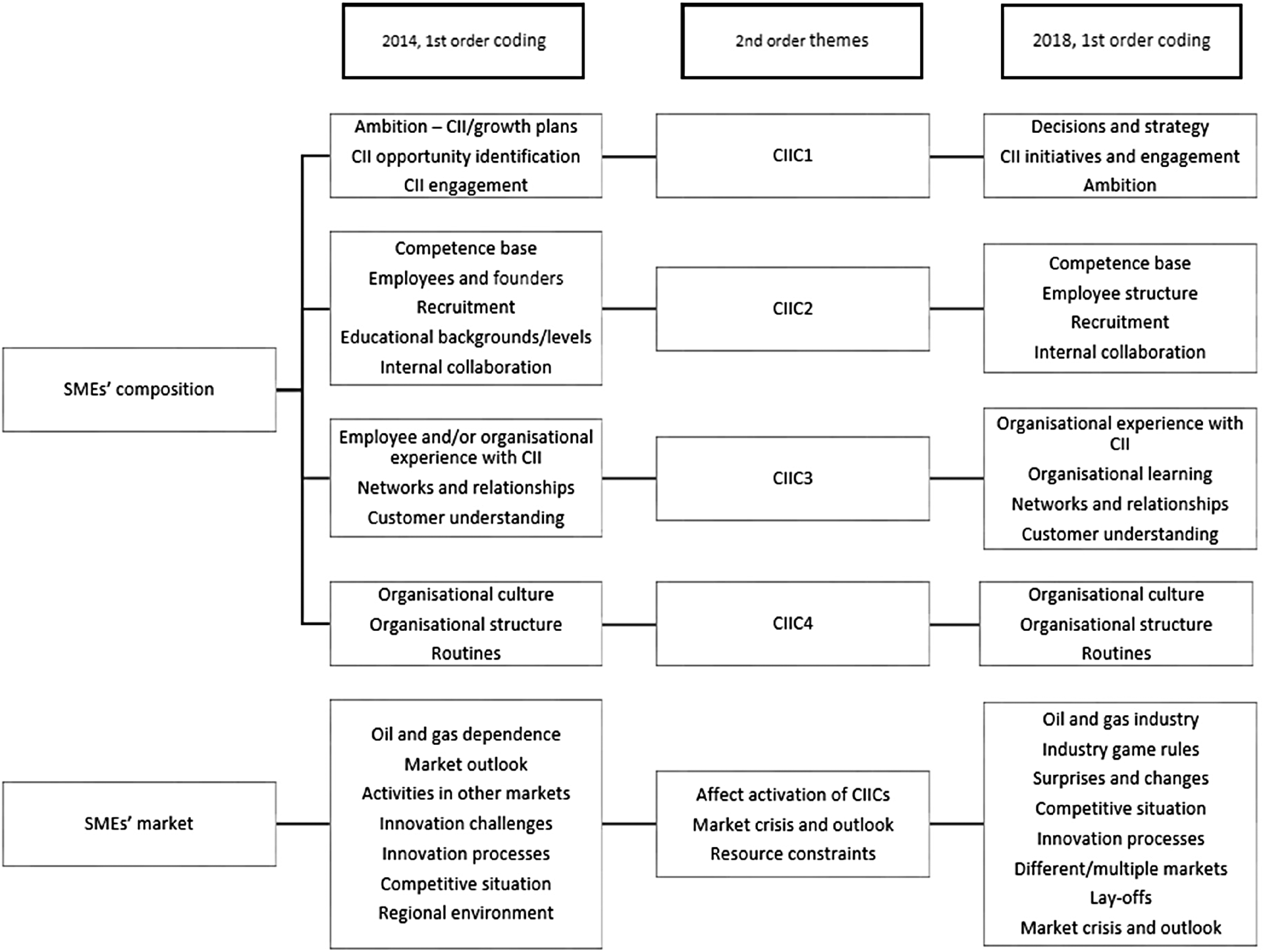
Coding structure. Average number of theme codes per interview were 20.0 in 2014 and 28.9 in 2018, with average amount of base references per interview at 64.9 in 2014 and 69.5 in 2018.
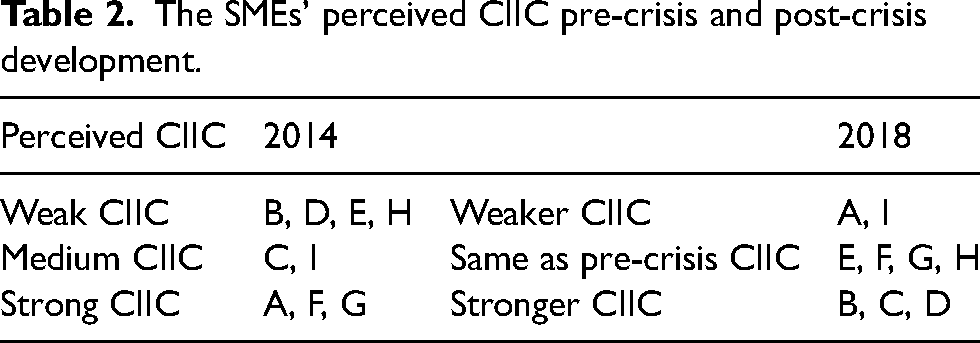
Based on Model 1 and insights from the interviews, we classified each CIIC for each SME, depending on whether that CIIC was weakly or strongly present. Next, we counted weak/strong CIIC indicators for each SME (Table 2 contains a summary; see Appendix A for full details). This enabled us to classify their CIIC based on the SMEs’ perceptions: three or more weak CIIC indicators equalled overall weak CIIC, whereas the opposite signalled overall strong CIIC. Those with two weak and two strong indicators were deemed to have medium CIIC pre-crisis. We did a similar analysis for the SMEs’ CIICs post-crisis, but in relation to their pre-crisis CIIC strengths, i.e. if their CIIC had weakened, remained the same, or improved. Further, we applied a holistic approach to the data material to determine the SMEs’ resilience, mainly relying on findings from the interviews but also by comparing their statements to income and operating results. We derived resilience categories for the SMEs based on their perception of own abilities, CII opportunity match and success, and their ability to activate and improve CIIC throughout the crisis.
The SMEs’ perceived CIIC pre-crisis and post-crisis development.
Findings
While coding and examining extensive interview transcripts, we organised the data using concepts from our theoretical model. In Model 1, how well SMEs fare in terms of resilience is strongly tied to existing CII presence in their organisation, as well as the ability to improve upon their CII. With this outset we strived to classify the SMEs from crisis-onset to post-crisis through repeated readthroughs.
Pre-crisis
CII opportunity identification and CII engagement
The SMEs focused on innovation and R&D in close cooperation with customers and R&D institutions, and they all identified CII opportunities and deemed the risk of attempting CII ventures as acceptable or low, remaining confident in their own abilities and perceived available CII options. Eight SMEs (excluding D) were either diversified (C, F, and G) or had CII intentions (A, B, E, H, and I) in 2014, with a prosperous primary market reducing the SMEs’ need to assume risks (CII) at this point. CII opportunity identification and presence of CII provided a preliminary classification according to Model 1 of the SMEs pre-crisis.
Strength of CIIC
Perceived CII opportunities were important elements in future (if not immediate) strategies, leading to weak CIIC1. Firm B expressed it as “Our goal is to establish ourselves even better in the market. Deeper established within the oil and gas vertical, and with time, more broadly to other verticals”. Despite the lack of concrete CII plans in 2014, the SMEs exhibited open communication structures rooted in their culture, and quite a few of them possessed different competencies (CIIC2) and CII experiences, along with a flexible cross-competence learning environment (CIIC3). Firm I referred to their environment as “The ceiling is high, the doors are open, and we encourage everyone to come up with suggestions, think and be innovative in relation to how we do things. The process is very important. It does not have to be about the big things either. It can be small steps each time, until you suddenly arrive at something new”. However, the SMEs’ attention was primarily directed towards the O&G industry, keeping CII from permeating their mindset (CIIC4), with some notable exceptions as expressed by Firm G, “As we continue to grow, we cannot stay dependent upon individuals; it is vital to become dependent on a system”.
Once the crisis hit, the immediate response of the majority (in particular, firms A, B, C, E, and I) was to alter their short-term strategy to survival mode. Whereas the oil price dropped in mid-2014, 2015 and 2016 were the toughest according to SMEs, as it took time for the consequences to manifest. SMEs were then forced to explore CII options while balancing their lower risk tolerance owing to pressing finances.
Post-crisis
CII opportunity match and CII engagement
All SMEs (except Firm I) attempted CII during the downturn and, except Firm A, those that attempted CII experienced success. Despite their initial CIIC strength 2014, Firms A and I were unable to obtain similar pricing or justifiable sales volumes in other industries for the CII to be economically feasible. Firm I illustrated it as, “An important thing we’ve learned, is that it's not good to be 100% dependent on one market. We probably knew it from before, but few thought the crisis would strike so hard and long”. The other SMEs also highlighted the need to delineate their new operations, focusing on one to three markets.
Strength of CIIC
The SMEs generally strengthened CIIC1, as CII became a prominent feature in their short- and long-term strategy. As for CIIC2, whereas the O&G workforce in Norway reduced by 17% from 2014 to 2018 (Brasch et al., 2019), the nine SMEs reduced their personnel by 26.2% on average during the same period. Hence, a significant amount of specialised personnel was available for hiring but the SMEs—strained for resources—struggled to capitalise on this aspect, thus largely refraining from hiring personnel for CII, which correlates with little alteration in CIIC2. Consequently, SMEs cross-trained employees, making them more versatile and able to switch between several roles as needed. This was done to reduce costs, rather than as an active step to develop CIIC3 in pursuit of CII. “There is something about other industries; we may have the same technology and the same message, but we have had to work a lot with how to translate it—the experience and knowledge we possess” (Firm B, 2018). This quote alludes to the difficulty of understanding a different industry, and the required internal processes to build necessary CII competence. Further, the SMEs reported a high degree of trust and cooperation from employees and having employees on board during a crisis was a major strength. This helped to gear their mindset and orientation towards CII, thus further developing CIIC4. Except for firms A, H, and I, the SMEs retained a mindset of openness and CII in 2018, with plans to rebuild the organisational structure more strategically. In addition, the SMEs actively worked to reshape their organisational structure to fit current demands, becoming less top-heavy and assuming a leaner and more focused organisation during the crisis, carrying positive implications for CIIC1 and CIIC4.
Expecting to explore CII with a prosperous market as their backbone in 2014, the SMEs were confident in their CII prospects, with the crisis clarifying what were actually viable opportunities. This implied that some of the SMEs with perceived strong CIIC pre-crisis, unknowingly oversell their capabilities. The SMEs thus struggled to navigate what was viable, which Firm D described in 2018 as “The most important thing we’ve learned as a company, I’m almost embarrassed to say it because it's so elementary, is to really understand the problem you’re trying to solve”. The SMEs in our study experienced this reality check, which, combined with their application and development of CIIC, led to a spread in their resilience ability.
Discussion
Initially, SMEs followed a well-documented path by sliding into a less advisable strategy in terms of resilience (Smallbone et al., 2012) by stripping their organisations to the essentials (Kottika et al., 2020), representing the firms’ adjustment period (Laskovaia et al., 2019; Marino et al., 2008). Here, the perception of the crisis changed from a quick downturn to a lasting event, with SMEs’ perceptions of the crisis and their capabilities influencing their responses (Cowling et al., 2020; Klyver et al., 2023).
In line with the dynamic interplay between capabilities (Helfat and Winter, 2011), and SMEs’ CII efforts throughout the crisis, we link the CIIC subfield (Hauge et al., 2017) of dynamic capabilities to SMEs’ resilience. SMEs exhibit flat and open organisational cultures, which is a positive trait for adaptation during crises (Duchek, 2020). Thus, from their passive intentions in 2014, SMEs tested the identified opportunities, making them more aware of their own capabilities. In line with existing theory (Nedzinskas et al., 2013), SMEs that manage to trigger and/or develop their CIIC overcome organisational inertia and manage to adapt, primarily by improving and aligning CIIC1 and CIIC4. However, as derived from previous research (Altinay et al., 2016), we advise SMEs to include CIIC2 and CIIC3 in their alignment, maintain CII segments post-crisis, and address future challenges. However, this divided CIIC strengthening may stem from the initial survival mode, suggesting that SMEs’ CII rely more on exploitative efforts in other markets or niches, rather than explorative ventures requiring larger investments. Thus, the contribution drills into individual CIIC and indicates which CIIC are of major importance for CII and resilience during crises.
Based on our dataset, we argue that CIIC activation depends on the ability to recognise and pursue viable opportunities. Tied with opportunity perception (Renko et al., 2012) and overconfidence in their CIIC pre-crisis, the “bounce back” SMEs (Firms A and I) did not manage to utilise their CIIC to overcome obstacles, thus weakening their CIIC. However, we cannot exclude the possibility that even weak CIIC assisted SMEs in surviving and realise that CII was not the right path for them. This supports previous work stating that dynamic capabilities foster the ability to recover and adapt (Dovbischuk, 2022) while extending it to include CIIC. We surmise that it enabled the SMEs to better balance short- and long-term concerns (Herbane, 2019). Those who absorbed the crisis (Firms D–G) improved their CIIC, further strengthening their secondary segments, with their CIIC and CII offering a protective safety net. Those in adaptive resilience (Firms B, C, and H) saw the most changes in their CIIC (adapting being a more extensive process than surviving or absorbing). This led us to tentatively conclude that actual CII intentions and a CII mindset are more important for successful CII and immediate resilience than CIIC2 and CIIC3. Though we see clear patterns connecting preconditions for CII with resilience level, and SMEs’ pre-positioning also matters (Iborra et al., 2020; Koronis and Ponis, 2018; Smallbone et al., 2012), we contribute to this research by highlighting that it is how they develop CIIC during a crisis that carries equal or greater importance for SMEs’ resilience. This goes into the temporal aspect of crises (Conz and Magnani, 2020) and provides clear indications that the CIIC can and should be developed even after crisis onset, thus improving crisis response (Dias et al., 2021).
Rooted in this analysis, we develop Model 2 (see Figure 3) to show the flow of the empirical findings. The main changes from Model 1 pertain to pre-crisis CIIC. The SMEs’ measure of strength during prosperity failed in some cases to be actionable during a crisis, considering the match between prospective opportunities and realisable CII. Hence, we view the crisis as a sort of stress test and driver of SMEs’ CIIC foundation, serving to make SMEs aware of actual opportunities (Renko et al., 2012), the nature of the crisis (Cowling et al., 2020), and their CIIC (Hauge et al., 2017). With their existing CIIC tested, the SMEs may then proceed to evolve their CIIC (Dejardin et al., 2023), and as we proposed in section two, we see that a crisis can then strengthen or weaken CIIC. Additionally, this allows us to draw a parallel between CIIC and other types of capabilities (Dias et al., 2021; Zighan et al., 2022), emphasizing their dynamic nature (Conz and Magnani, 2020). After accounting for self-bias and overconfidence, Model 1 remains representative once a crisis occurs. Additionally, managing to absorb or adapt to a crisis is correlated with CII, which we refer to as CII resilience in Model 2. We encourage the use of this term, as it emphasises the positive effect of CII on SMEs’ resilience. Further, the SMEs success in adapting to (and absorbing) the crisis through CII resilience strengthens our expectation that moving between different industries may bring some of the same competitive advantages as foreign market entry (Baker et al., 2020).
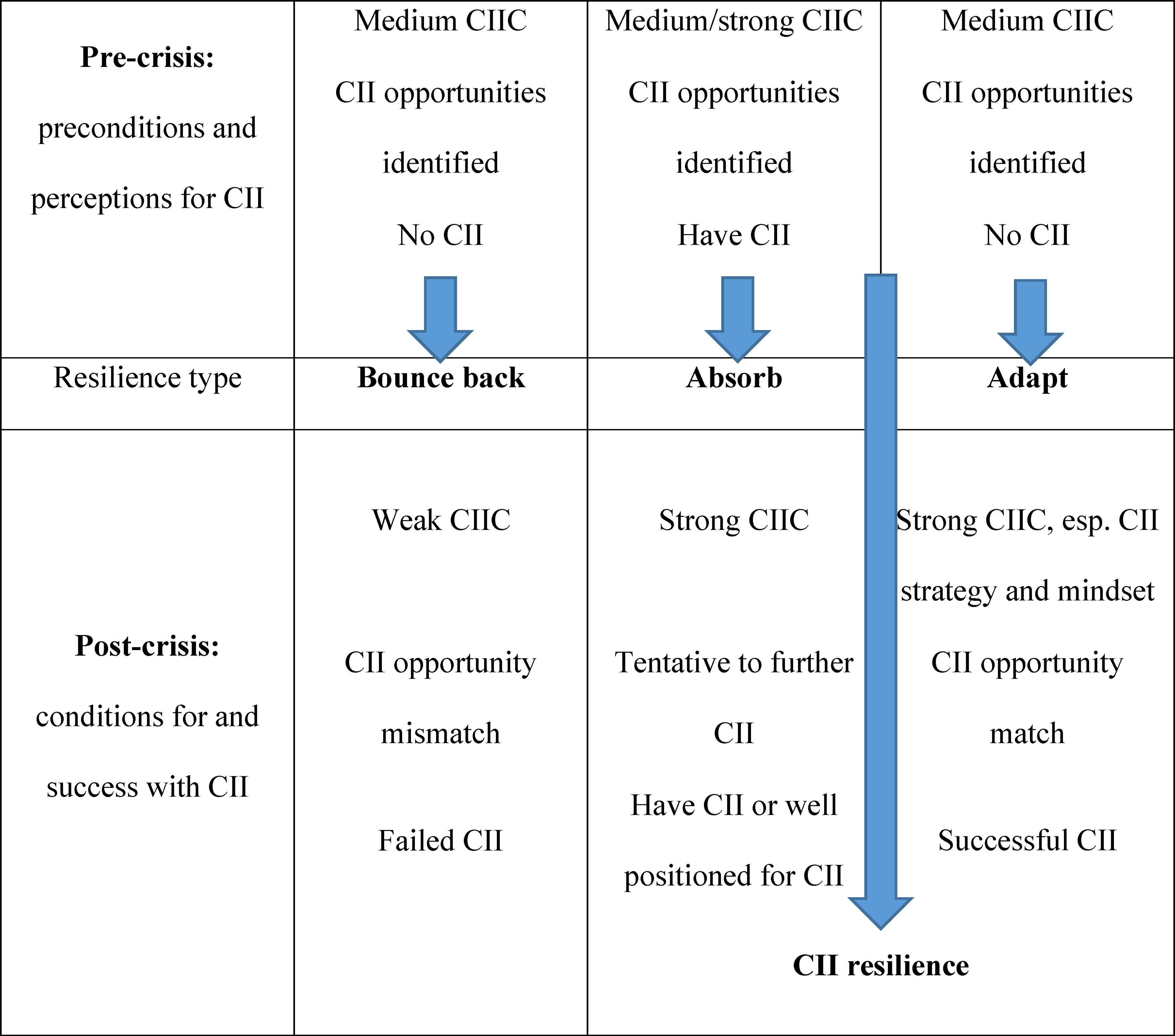
Model 2: Empirical set-up.
In conclusion, internal conditions such as CIIC alone cannot explain CII success and resilience levels. This implies that the external context, rather than technology or internal capabilities, poses a hindrance. Similarly, SMEs report challenges in overcoming the tacit dimensions inherent in market structures (Yin and Zuscovitch, 1998), and consistent with previous research (Tunzelmann and Acha, 2005), this places technological performance in the background, separating it from business performance. Another way to describe this may be by referring to the different “game rules” in different industries. These rules reflect different cultures, norms, industry structures, and costs. To some extent, the knowledge and understanding of these game rules fall under CIIC3 but are slightly broader in scope. Hence, what is seemingly an approachable and realisable opportunity to take technology into a new industry becomes something else entirely when attempted. It contributes to the mismatch in opportunity perception, and for the SMEs in our study, it represented a major obstacle to performing CII and particularly impacted the resilience of those in the bounce-back category. We view this as a side-along contribution to CII resilience as it explains some of the difficulties in succeeding with CII.
Conclusion
Our study presents a unique perspective on SMEs’ perception of and approach to CII, with rich data providing an in-depth pre-/post-crisis comparison. The findings contribute to the emerging literature on CII, specifically by examining the match/mismatch between how CII opportunities are context-dependent and firmly anchored in SMEs’ trust and belief in their own abilities. Business practitioners may find a lack of cohesion between CII expectations and their realisation interesting as it impacts SMEs’ resilience. This CII gap is often owing to inherent game rules in industries; therefore, business practitioners should work to improve their understanding of how industries differ (e.g. norms, culture, and cost levels), as industry structures, rather than technological performance, hinder CII. We advise SMEs to counter this by focusing on organisational learning (CIIC3). Conversely, policymakers may establish industry-bridging initiatives to make industry structures more transparent to SMEs. A combination of these factors may reduce the mismatch between opportunity identification and success.
Successful CII brings SMEs away from survival mode, enabling them to absorb or adapt to crises, which provides a more resilient and diversified foundation. CII resilience is supported by capabilities fostering CII strategy and mindset, leading us to recommend that the entrepreneurial community initially focus on these two capabilities and align additional CIIC (competence and learning) when suitable at a later stage regarding future resilience. Thus, as the CIIC represents complex dynamics, we add to the growing literature on capabilities and resilience by connecting it with specific CIIC and CII over time, and by showing which CIIC is crucial during a crisis. We also clarify a gap in the resilience literature (Zighan et al., 2022) by addressing the longitudinal aspect of capabilities and CII on resilience.
Further, a crisis changes SMEs’ attitudes towards risk, and policy initiatives should aspire to lower the threshold for assuming CII risk during crises. This extends previous research (Faeroevik and Maehle, 2022), which indicates that the CII is positive for SMEs’ growth. We use the O&G industry as a case study and view our contributions as representative of other SMEs within the industry and transferable for SMEs in other industries. However, we recognise that cognitive distance (Enkel and Gassmann, 2010) along with industry game rules may affect CII and transferability.
Recent years have witnessed frequent crises, such as the financial crisis of 2008, the O&G downturn, and the COVID-19 pandemic. This places crises in a different perspective, perhaps even negating the term “crisis”, making it a more generic, almost normal context to study. However, each crisis represents a different type of upheaval, bringing old and new elements to study. From this standpoint, crises might be a new normal, as we enter the largest and longest crisis–the need for a transition to green technology (McHugh et al., 2021). While we did not discuss the green shift in our study, we consider SMEs’ CII resilience as an important steppingstone for the transition from fossil fuel-based to green industries. SMEs’ motives may not be driven by environmental concerns, but the outcomes may still have positive implications. Therefore, future research should examine how CII resilience contributes to the green shift when attempting to restructure existing fossil-based industries.
Our study is limited in scope and context, and future research may test our findings with larger datasets and against different types of crises to elucidate the components necessary for CII resilience. We include four CIIC items, but as external factors may impact SMEs’ CII resilience, we call for future research to examine additional dimensions. We would also like to see how policy initiatives may facilitate the improvement of CIIC, CII, and resilience. Further, we have not discussed regional aspects, partly because SMEs consider them to be of low importance (owing to the global nature of the oil industry). However, firms’ immediate environment likely affects their attempts at CII and, to some extent, provides opportunities. Finally, as crises are temporary, future researchers should examine if CII resilience from one crisis carries over to the next one. We view this as vital because the need and desire to perform CII are likely cyclical in nature.
Supplemental Material
sj-docx-1-iei-10.1177_14657503241248285 - Supplemental material for SMEs’ resilience and cross-industry innovation before and after a crisis
Supplemental material, sj-docx-1-iei-10.1177_14657503241248285 for SMEs’ resilience and cross-industry innovation before and after a crisis by Kaya Haugland Faeroevik in The International Journal of Entrepreneurship and Innovation
Footnotes
Acknowledgements
I would like to thank Professor Natalia Maehle and Professor Jarle Aarstad, HVL Business School, Western Norway University of Applied Sciences, for thoughtful comments and discussions when developing the paper.
Declaration of conflicting interests
The author declared no potential conflicts of interest with respect to the research, authorship, and/or publication of this article.
Funding
The author received no financial support for the research, authorship, and/or publication of this article.

Supplemental material
Supplemental material for this article is available online.
References
Supplementary Material
Please find the following supplemental material available below.
For Open Access articles published under a Creative Commons License, all supplemental material carries the same license as the article it is associated with.
For non-Open Access articles published, all supplemental material carries a non-exclusive license, and permission requests for re-use of supplemental material or any part of supplemental material shall be sent directly to the copyright owner as specified in the copyright notice associated with the article.
