




Abstract
This study identifies i) factors that encourage small rural enterprises to innovate and ii) obstacles to introducing innovation. Using a case study of a rural business in the Czech Republic, the paper reveals that although rural businesses may experience innovation barriers, such as inadequate human resources and volatile market conditions, they can innovate, respond quickly and effectively to emerging market circumstances and turn threats into opportunities for growth. Importantly, many of the challenges and opportunities for innovation interplay with each other, with some obstacles becoming a foundation of creative and innovative solutions that help to develop a sustainable, modern and efficient enterprise. We highlight that the innovation of rural enterprises can be an outcome of pull and push factors that influence both product innovation and business innovation processes. Pull factors represent incentives and opportunities to stimulate rural innovation. Push factors, on the other hand, necessitate change and create pressures that must be addressed to ensure business longevity. The paper also shows that successful innovation is not free from agency, with the strategic vision and innovation outlook of business owners being a significant driver of innovation practices. Finally, our study shows that the innovation of rural enterprises depends on local, regional, national and international connections, and goes beyond rural areas, with a ‘think local and act global’ approach helping to harness opportunities in wider markets.
Keywords
Introduction
Rural areas account for over three-quarters of the European Union's total land area (European Commission, 2021). They play a crucial role in all European economies, providing food, energy and raw materials for societies (Olmedo et al., 2023). The importance of rural areas in contemporary economies is not only restricted to their traditional, resource-based economic activities (Labrianidis, 2006), but they also play an important role in mitigating the effects of climate change and supporting the transition to a green and sustainable Europe (European Commission, 2021).
Although rural areas share common features, there are also many differences between them. This diversity manifests in topography, climate, resources, population, socio-economic development, productivity and employment rates (Abeysinghe and Malik, 2021; Burnett and Danson, 2022) – indeed, these and other features point to the importance and uniqueness of a specific context (Steiner et al., 2023). Compared to urban areas, rural areas have smaller populations and a lower infrastructure density, and they vary in social and economic relations, functions and meanings (Farmer et al., 2008; Olmedo et al., 2023). These differences between rural and urban areas have several implications for rural enterprises (Abraham et al., 2015; Siemens, 2012), with many rural businesses having lower access to resources, customers and markets, and more limited access to skilled workers than urban enterprises (Steiner et al., 2019). Therefore, innovation opportunities for rural enterprises are often limited, and many rural businesses fall behind their urban counterparts in terms of innovation practices and growth. Importantly, however, the expansion of digital technologies and the development of the knowledge economy help to mitigate some ‘traditional’ challenges associated with the geographic isolation of rural businesses (Tiwasing et al., 2022). For example, digital technologies allow rural businesses to overcome distance barriers and facilitate access to wider markets as well as skilled workers beyond the local context (Schmerber et al., 2020).
In the Czech Republic, rural areas cover around 80% of the country, they are home to 33% of the Czech population and nearly 700,000 businesses out of which 99% can be classified as micro and small businesses (Steinerowska-Streb and Steiner, 2014; The Czech Statistical Office, 2023). Pártlová et al. (2020a) suggest that rural areas remain sluggish because many businesses move from rural areas to large conurbations. While research shows that Czech rural enterprises would benefit from support from scientific institutions and in introducing innovation, knowledge about determinants of rural enterprise innovation remains scattered (Abrhám et al., 2015), particularly in the Czech Republic context. Using empirical data from the Czech Republic, our study aims to address this knowledge gap, identify factors influencing innovation among small rural enterprises and inform future research, policy and practice. In particular, the paper helps to answer the following questions: Q1: What encourages small rural enterprises to innovate? Q2: What are the obstacles to introducing innovation for small rural enterprises?
Based on a case study of a small rural enterprise operating in the Czech Republic, our exploratory study reveals some determinants that can affect small rural enterprise innovation. Our findings also demonstrate obstacles to introducing innovation, and how such enterprises can engage local resources to induce innovation and overcome potential innovation barriers. Importantly, understanding innovation practices can be particularly important for business sustainability in times of crisis caused by turbulent and fast-changing socio-economic and political circumstances. Indeed, the latter applies to the recent context and a mixture of unprecedented consecutive events including the Covid-19 pandemic, international conflicts, soaring energy prices, growing inflation, raised borrowing costs, labour shortages, disruptions in supply chains and poor economic outlook disturbing global and local contexts as well as entrepreneurial practices.
By illuminating factors affecting the introduction of innovation by rural enterprises, this paper extends knowledge in the field (Steinerowska-Streb et al., 2022) offering a fertile ground for future larger studies about innovation in small rural enterprises in the Czech Republic. By highlighting challenges and opportunities that can influence the innovation practices of rural enterprises, this study (i) offers relevant insights to business support organizations and policymakers interested in facilitating the development of rural businesses and rural economies, and (ii) shows the importance of conducting more studies in this field encompassing a larger sample of small rural enterprises. Indeed, our paper presents a first step that can inform designing more effective strategies to unlock the potential of rural enterprises for economic growth and sustainable development.
The paper begins by describing the determinants of small rural enterprise innovation, highlighting a specific context and its potential impact on innovation practices in the Czech Republic. It continues with a description of the research methods and the background of our rural enterprise case study. The findings are then described, presenting key opportunities and challenges influencing rural business innovation. The discussion summarizes and comments on our findings, and the concluding section outlines the contribution of this study to generating new knowledge in the field. The final section also identifies study limitations and future research avenues.
Determinants of small rural enterprise innovation
Innovation plays a crucial role in driving the growth and survival of contemporary companies (Röd, 2016; Steinerowska-Streb et al., 2022). Interestingly, however, while some companies treat innovation as a critical element of long-term strategies (Serrano-Bedia et al., 2012), others postpone their innovation projects or do not plan innovation at all (Duarte et al., 2017). The reasons for this are manifold. For instance, considering that the success of innovation depends on many complex internal and external factors (Madanaguli et al., 2023), some companies are hesitant to take risks and face uncertainties associated with the innovation process (Arabshahi and Fazlollahtabar, 2019). Other organizations do not see the need to innovate or do not have the resources necessary to create and implement innovations.
Research evidence suggests that due to insufficient resources and lower spending available to support Research & Development, small enterprises have a lower capacity to innovate than larger companies (Govindarajan et al., 2019). Among small firms, those in rural areas face the most challenging circumstances because they are subject to the resource barriers that are typical for all small firms and geographical disadvantages associated with rurality including limited infrastructure, a sparsely populated customer base, constrained access to markets concentrated in urban centres (Abeysinghe and Malik, 2021; Steiner and Atterton, 2014, 2015), and challenges finding adequate human resources to deliver specific innovative tasks (Lee and Cowling, 2014). Indeed, these factors harm the development of innovation in rural enterprises (del Olmo-García et al., 2023; Lee and Cowling, 2014).
The environment in which small rural enterprises operate has many attributes which can also create opportunities to develop innovation. First, the rural business context may support innovation linked to unexploited local resources as well as limited competition and product/service supply (Müller and Korsgaard, 2018). Second, rural enterprises can capitalize on informal cooperation (del Olmo-García et al., 2023; Farmer et al., 2008), social networks and social capital, which are frequently described in rural literature (Steiner et al., 2021; Steinerowski and Steinerowska-Streb, 2012). In addition, in many countries, businesses in rural areas can benefit from specific support programs established to develop rural areas. In this regards, rural enterprises in the European Union are particularly privileged as they can access internal national government grants as well as European Union support (Kmecová and Vokoun, 2020). These programs make it easier for rural businesses to invest, innovate and develop.
Small rural enterprise innovation in the Czech Republic
Considering the Czech context, innovation among small rural enterprises is influenced by many specific factors. For instance, rural geography points to the population decline and a lack of development in peripheral regions, fuelled by the outflow of young, professionally qualified and university-educated people. Shrinking population size and declining economic power lead to a decrease in public transport services and a decline in social and cultural activities in rural areas. The innovativeness of Czech small rural enterprises is also affected by poor institutional infrastructure, limited availability of public services and the withdrawal of services that can facilitate the work of businesses, such as post offices (Pártlová et al., 2020b). Moreover, in addition to geographical rural disadvantages, business size also influences the intensity of innovation activities. Indeed, using a harmonized Eurostat model questionnaire to collect data on companies’ innovation activities, a study conducted by the Czech Statistical Office (2022) 1 indicated that, between 2018 and 2020, large enterprises with more than 250 staff innovated most intensively (83.3%), followed by medium-sized enterprises (50–249 employees; with innovation rate of 66.6%) and small enterprises (10–49 employees; of which 52.4% introduced innovation). The study, however, did not include the most common form of enterprises that exist in rural places, i.e., microenterprises which operate with fewer than 10 staff, and available data does not consider rural specification but only top-level national statistics. The same study also indicated that foreign-controlled enterprises – which are more common in urban locations – innovate more (68.6%) than domestic enterprises (54.3%). While showing the growing engagement of Czech enterprises in innovation practices (Czech Statistical Office, 2022) as well as one of the top acceleration innovation levels in Europe (European Innovation Scoreboard, 2022), data exploring innovation among small rural enterprises does not exist.
Considering innovation practices among businesses, a reference should the made to ‘the Fourth Industrial Revolution’, often referred to as Industry 4.0 – a term used to describe the current era of technological advancement in manufacturing and industry. Industry 4.0 represents a fusion of technologies, including digital technological advancements and the use of, for example, the Internet, Big Data and Analytics, Artificial Intelligence and Machine Learning, Advanced Robotics and Additive Manufacturing/3D Printing. Using different forms of digitalisation, Industry 4.0 aims to create businesses that are more efficient, flexible and responsive to customer needs offering innovation that helps to improve productivity, reduce costs and enable new business models and opportunities. Indeed, the latter became one of the EU's priorities with new policies being targeted at innovation enhanced through digitalisation, with SMEs becoming one of the main beneficiaries of the EU's digitalisation support (Brodny and Tutak, 2022). However, there are significant regional differences across nations when it comes to the ability to embrace the underpinnings of Industry 4.0 and nurture innovation practices. For example, exploring the level of SMEs’ digital maturity in the EU-27, Brodny and Tutak (2022) identified four groups of countries, with large discrepancies between individual EU members and between the old (EU-14) and the new (EU-13) EU countries. The expert level, in terms of SME digital maturity, was achieved by Denmark, Finland, Malta, the Netherlands and Belgium, and the advanced level by Sweden, Portugal, Germany, Slovenia, Austria, Luxembourg, Italy, Croatia, France, Spain and Ireland. Countries with an intermediate level included the Czech Republic, Estonia, Cyprus, Latvia, Lithuania, Poland and Slovakia, while countries with the lowest, beginner level of SME digital maturity included Bulgaria, Hungary, Romania and Greece. As such, while digitalisation and its impact on innovative solutions become increasingly important to successfully run SMEs and to remain competitive, at the national level, the Czech Republic lags behind many EU countries in the implementation of digital solutions for SMEs.
Available support and existing challenges facing Czech small rural enterprises
Various programs and initiatives aimed at supporting small enterprises in rural areas exist in the Czech Republic. In particular, responsible for rural development, the Ministry of Regional Development introducedthe Rural Development Concept 2021–2027 to facilitate dynamic and balanced development of Czech Republic regions, with the countryside representing a desirable area to live in. The latter should be achieved through investments in: (i) people – to create a stable population in rural areas characterised by high human and social capital ensuring dynamic endogenous rural development, and (ii) settlements – to develop adequate infrastructure and amenities in rural settlements ensuring the good quality of life of the inhabitants and creating opportunities for rural economic development. These ambitions of ‘the Concept’ are executed through separate implementation documents, specifically the Action Plans of the Regional Development Strategy of the Czech Republic. Municipalities contribute to the promotion of regional development through conceptual tools (e.g., strategic development documents, spatial plans), institutional instruments (e.g., support for municipal cooperation) and financial instruments (e.g., subsidies and grants). This support, however, varies across different municipalities and is not focused on business innovation per se.
Considering support from the European Union, one of the most important roles in rural development is played by Community-Led Local Development, which is led by Local Action Groups (LAGs) using the LEADER approach implemented through integrated and multi-sectoral local development strategies (Steiner, 2016). Community-Led Local Development aims to coordinate support from different sources to strengthen their joint effect, and LAGs are responsible for the implementation of rural development interventions based on detailed knowledge of local conditions and broad cooperation with local actors. Indeed, LAGs create partnerships between citizens, non-profit organizations, private businesses and public administration (municipalities, associations of municipalities, entities) to improve development and the quality of life in rural areas. Again, while useful in enhancing rural development, this form of support does not focus on the innovation of small rural enterprises but on wider socio-economic matters of rural life.
Another form of support for Czech small rural enterprises provided by the EU is finance for Research & Development. Indeed, the latter plays a crucial role in innovation as it allows businesses to carry out research, adopt new technologies essential for inventions and commercialisation as well as begin and sustain innovation activities (Odei and Novak, 2020). Importantly, while funding for innovation can come from different types of financial institutions, governments, private sources and investors, access to external finance for small businesses is usually challenging. Consequently, the EU structural funds supporting Research & Development and innovation practices are highly important as without these funding opportunities many firms may abandon new product, process or service development (Odei and Hamplová, 2022). Moreover, EU funding promotes collaborations between higher educational institutions, other public research organisations and consultants in order to mobilise knowledge exchange facilitating innovation across all sectors of the economy (for a related discussion on innovation in small businesses, see Odei and Hamplová, 2022).
Despite described national government investment and European Union programs supporting development in the Czech Republic, the availability of business support services and funding is less common in rural than in urban locations, making it particularly challenging for small rural enterprises to take the potential risks associated with implementing innovation (Abrhám et al., 2015). Importantly, the severity of these trends and their impact on the innovativeness of rural enterprises can vary across different regions of the Czech Republic, with specific rural locations experiencing localized challenges. In general, however, existing business support targets the development of Czech technology companies, promotes ‘smart’ investments which motivate foreign investors to make national investments, assists Czech companies in entering foreign markets and encourages exploiting trends in progressive sectors of the global economy (CzechInvest, 2023). While important, this form of support might be less relevant to small rural businesses.
In this paper, we explore factors which encourage small rural enterprises to innovate as well as obstacles to introducing innovation. This study is a response to limited knowledge about factors that determine the innovativeness of small rural businesses in the Czech Republic. Indeed, Abrhám et al. (2015) provide a notable exception, exploring aspects of competitiveness among Czech small and medium-sized rural enterprises and suggesting that innovation is negatively influenced by external competition, insufficient demand and infrequent collaboration between small rural enterprises and scientific institutions. Since Abrhám et al.'s (2015) study, however, businesses across the globe, including those in the Czech Republic, have been affected by many unprecedented socio-economic, environmental and political changes such as the Covid-19 pandemic, increased attention to climate change and international conflicts. Indeed, soaring energy prices, growing inflation, increased borrowing costs, labour shortages, disruptions in supply chains and the poor economic outlook of recent years have created ‘a perfect storm’ that influences all businesses (Rossiter and Smith, 2018; Smith et al., 2021; Steiner et al., 2022). As such, our paper provides an up-to-date picture that considers this turbulent business environment and its impact on the innovativeness of small rural enterprises.
Methodology
To address our research questions, we adopted a case study approach – a research method frequently used when the investigated subject explores an under-researched field of knowledge, facilitating better understanding and clarifying new research problems (Kulawiak et al., 2022) through an empirical exploration of particular processes (Olmedo et al., 2023). Indeed, case studies, including single-case designs, have been increasingly used in recent years to inform the development of interventions and to extend meta-analytic and other statistical data analyses to inform practice and policy decisions (Moeyaert et al., 2016). While the validity and generalization can be challenging, case studies are important in defining the ‘complexity’ of an observed intervention, offering ‘an in-depth inquiry into a specific and complex phenomenon (the ‘case’), set within its real-world context’ (Yin, 2013: 321). Importantly, it is acknowledged that case studies can describe detailed conditions in which the practice is being implemented (Moeyaert et al., 2016), and that to arrive at a sound understanding of the case, the importance of the number of case studies might be outstripped by a better understanding of the context, i.e., a case study should be considered within the context in which it is embedded (Yin, 2013). While case studies are frequently used by rural entrepreneurship researchers who explore issues that have been studied only to a limited extent (Munoz et al., 2015; Steiner and Cleary, 2014), the ability of this research method to address the complexity and contextual conditions has been particularly important in this study, i.e., innovation is a phenomenon of a complex nature. There is no one pattern for creating innovation and there is no one pathway to introducing it. Instead, innovation relies on the creativity of entrepreneurs, context and, frequently, it is based on a unique opportunity that exists in a specific place and at a specific time. This complexity and uniqueness make it i) challenging to research innovation as well as ii) impossible to introduce a uniform step guide for practitioners to introduce innovation. Indeed, in many cases, top-level statistics do not reveal the granularity and novelty of the innovation factors in a comprehensive manner. As such, in this paper, we use a rich qualitative approach to unpack this complexity that quantitative data does not capture. Our case study shows an example of how rural small enterprise innovation could happen, rather than making generalizable claims about business innovation in the rural context.
Empirical data informing our rural enterprise case study derived from observations, interviews and secondary data. The observations began in 2010 and continued until April 2023 and were used to understand the key challenges and activities of the enterprise. An in-depth interview with the owner-manager of the company was conducted in March 2023. An interview guide consisted of 25 questions about innovations at the company, factors that positively and negatively affect these innovations and plans for the firm's development. The interview lasted around 60 min and was audio-recorded, with consent, and transcribed verbatim. This information was supplemented with secondary data provided by the enterprise (e.g., grant applications, financial statements and development plans) as well as information from the company's website. All data were analyzed together, with data triangulation (i.e., observations, an interview and secondary data analysis) enhancing the validity and reliability of our results. Indeed, this form of triangulation helps to build greater confidence in the overall study findings (Yin, 2013). Before presenting the study findings, the paper provides information about and background of our small rural enterprise case study.
A case study of a small rural enterprise – Background
Moravec Quality Socks Ltd (Moravec Kvalitní Ponožky s.r.o.) is a small Czech rural family company that produces socks. It was established in 1996 in a small village located in the north of the Czech Republic in a region called Brumovice. The company is currently headed by Vladislav, who represents the second generation of family owners. The founder of the company was his mother, Anna, who came up with the idea of producing socks. At that time, she owned a second-hand shop in her house. She purchased a knitting machine, a sewing machine and a special fixing iron for socks and started producing her first socks. At the time, her son Vladislav, the present successor of the company, was responsible for the conservation and repair of the machines. As demand for socks quickly increased, additional knitting machines were purchased. After hiring their first employee, Anna and Vladislav founded a company, AMO s.r.o., which in 2006 transformed into Moravec Quality Socks Ltd when the enterprise was established, three workers (i.e., family members) produced 40 pairs of socks daily using two knitting machines. Now the company has 16 employees and 30 knitting machines, and it produces 8400 pairs of socks daily and 2,000,000 pairs annually. The company targets end buyers (including children, men, women, active athletes, users of medical socks and users of work socks) and sales intermediaries (COOP, Hruška, TESCO, KAUFLND as well as companies interested in socks with specific logos). The socks and related products are sold in more than 10,000 sales points in the Czech Republic, and over the last four years, the company has started using its e-shop to expand sales. The vast majority of production is made for the domestic market. Exports represent 30% of sales, with Germany, Slovakia, Norway and Austria being the most significant foreign partners.
The long-term development strategy of Moravec Quality Socks Ltd aims to ensure sustainable development, enter new markets and build a high-quality brand. Therefore, the company emphasizes the quality of its products, which are regularly tested by an independent test centre (SOTEX). The socks have the QZ Czech Quality certificate, and in 2013 they received the Czech Product Award. In 2021, the Moravec Quality Socks Ltd trademark was registered due to the unfair conduct of competitors who started using the company's name on their products. Vladislav's goal is: ‘to be a quality European manufacturer of socks’.
The company cooperates with a variety of stakeholders. It has a long-term relationship with two universities from the Moravian-Silesian and Olomouc regions. This cooperation is focused on presenting university students with tasks and challenges specific to the enterprise. These include proposals to increase the growth potential, expansion of a product range or into new markets, and marketing proposals that utilize social networks. Such cooperation offers the company inspiration through students’ solutions and, at the same time, helps students to apply their knowledge in practical case scenarios. In addition, the company supports local communities by promoting a healthy lifestyle and sponsoring a local football club.
Findings
Our study helps to explore the innovation processes of rural enterprises and, in particular, factors that encourage small rural enterprises to innovate as well as obstacles to introducing innovation. As evidenced in the following findings sections, in many cases, factors enabling innovation and obstacles constraining innovation interplay with one another. More precisely, while some innovations are introduced due to existing incentives and opportunities that exist in the business environment, others are born out of business challenges. Indeed, we observe some pull and push factors enabling rural enterprise innovation.
Product innovation
Innovation has always been essential for Moravec Quality Socks Ltd, with the company perceiving it as the primary means of achieving sustainable development. Indeed, since the company was established, it has implemented many product and business process innovations. However, the company does not have a separate research and development department. A team of family members and selected employees are responsible for introducing innovation. That team meets regularly twice a year, evaluates new ideas and decides on their implementation. The main drivers of product innovation for Moravec Quality Socks Ltd are customers. Their suggestions are gathered by sales representatives and from online comments. The company owner said: ‘Positive information from a customer pleases us, and negative information drives us forward’. Indeed, 20% of current sales relate to customized production.
Additional inspiration for innovation is taken from several different sources. These include international exhibitions (e.g., ITMA Barcelona, PLA Amsterdam, regional exhibition KABO Brno), the owner's practical experience, technology suppliers, competitors and staff. If the innovation is based on an employee's idea, they are given a financial reward. This approach encourages staff to be creative and proactive in identifying new trends and solutions that can contribute to innovation and business development.
In order to meet customers’ requirements, the company focuses its product innovation on the enhanced quality of its socks. For example, all yarn must have an Oeko-Tex Standard 1000 certificate, which requires the fulfilment of criteria related to the exclusion or limitation of hazardous substances in production. Moreover, using adequate woolen yarn prevents shrinkage and protects the shape of socks during frequent washing. The company also offers a wide range of sock colours to appeal to the preferences of different customers. Materials used for manufacturing are mainly cotton, wool, recycled cotton, elastane, lycra, polyamide and Coolmax. There are almost no domestic yarn suppliers in the Czech Republic and, as such, these types of yarn are mainly procured from abroad, namely from Austria, Spain, Poland, Malaysia and India.
Business process innovation
The company also introduces business process innovation, particularly organizational and marketing innovation. Moravec Quality Socks Ltd's process innovation has recently been focused on reducing energy intensity during production and applying new technologies to these processes. Therefore, the company built a solar power plant and started using its own electricity to power production. Moreover, it implemented a heating system that redistributes the heat created by the knitting machines during production to the rest of the production hall and warehouse via air ducts. Thanks to this efficient heating system, the company was able to reduce production and running costs, as well as negative impacts on the environment. In addition, to promote environmentally friendly production, the company started using recycled paper for its labels and covers.
The company also invests in upgrading its software and IT solutions. It implemented a new information system that has improved the flow of information between different company departments. Moreover, the system is used for communication with the company's stakeholders, especially its customers and suppliers. The new system makes it possible to streamline personnel and HR management, evaluate the effectiveness of production processes and assess trade trends and the company's performance.
In 2018, the company opened its e-shop and started to develop social network connections with its customers, mainly using Facebook and Instagram. Since then, internet channels have been developed and used for marketing communication. One employee, who also takes care of the company's marketing, is responsible for all online activities.
Financing innovation
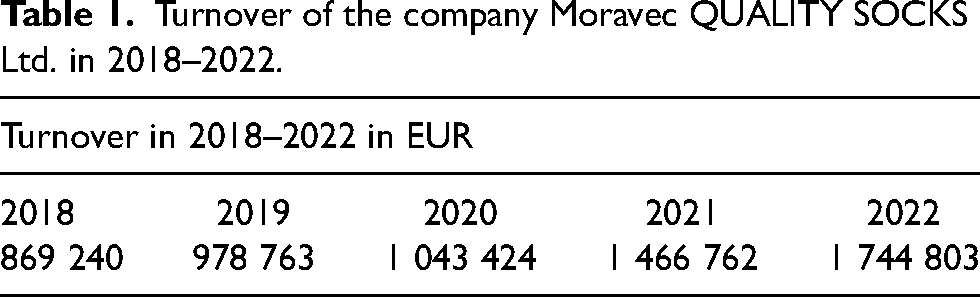
The company's financial performance is strong, as evidenced by its turnover and sales growth since 2018. Interestingly, turnover growth was not affected by the Covid-19 pandemic as a reduction in in-store sales was replaced by e-shop sales. 2018–2022 turnover is shown in Table 1.
Turnover of the company Moravec QUALITY SOCKS Ltd. in 2018–2022.
The owner of the company positively evaluates the position of the company in relation to its competitors: ‘Our company is one of the bigger ones in the Czech market, and I am pleased that our competitors are comparing themselves to us! This means they perceive us as the best’. He also stated: ‘At the beginning of our existence, the main goal was to gain and maintain our position on the market. We are currently an established company with a strong position in the Czech market, and we beat the competition. We have economic and social goals that are appreciated by our customers and stakeholders’.
Despite healthy financial accounts, innovations implemented by Moravec Quality Socks Ltd were financed from different sources, showing that grant opportunities can be harnessed to facilitate the company's development. As such, the enterprise used a combination of its own resources, investment loans and EU funds. The energy-saving installation was financed by an EU fund, called Operational Program Enterprise and Innovation for Competitiveness 2014–2020. The grant covered 50% of the associated costs and was intended to reduce energy demand. Moreover, the company received financial support for its innovation from the European Regional Development Fund, the Moravian-Silesian Region and the Ministry of Industry and Trade. This funding was invested in the new machinery and equipment.
The company was aware of EU funds that could finance these innovations thanks to the support of institutions that operate in the business surroundings. These include the LAG Opavsko and the Regional Development Agency. Nevertheless, the driving force behind all grant applications supporting the firm's innovation was the owner of Moravec Quality Socks Ltd. While acknowledging that developing grant applications can be time-consuming, e.g., ‘it is associated with a large administrative burden’, he had been monitoring relevant European Union funds, perceiving them as an attractive development opportunity that can help to ensure long-term business sustainability.
The financial support received to support innovation at Moravec Quality Socks Ltd suggests that the company is not experiencing innovation barriers related to a lack of capital. The company's owner confirmed that access to innovation finance had not been an obstacle to introducing innovations. Instead, rising production costs associated with inflation and growing costs of energy were perceived as factors that constrain the company's innovation. Indeed, the latter can lead to increased product prices and the loss of some customers, resulting in lower profits and fewer opportunities to implement self-financed innovation. Moreover, incorrect production cost estimation may contribute to the mispricing of products which, in turn, can similarly affect a company's profits and ability to finance innovation.
Staff and innovation
When describing factors that constrain the introduction of innovations, the owner also referred to a lack of qualified personnel and staff fluctuation. For example, the implementation of product innovation can be jeopardized by a lack of professional designers, while shortages of well-qualified production workers able to operate new machinery and equipment can negatively impact innovation. To overcome this obstacle, Moravec Quality Socks Ltd employs staff living further afield, even those living abroad in Poland. Another way to reduce labour shortages is the automatization and digitization of processes. So far, the company has purchased automatic ironing and packaging lines, and machines that automatically close the toes of socks. The business owner indicated: ‘If the company were located in an urban area, access to human resources would be easier, and distribution costs would be lower’.
According to the business owner, innovations introduced in recent years enabled the company ‘to stay in the market’. Through the innovation process, the company has reduced costs associated with production and increased its overall efficiency as well as product quality.
Discussion
In our case study, we observed two types of innovation including product and business process innovations, with financial and staff matters being highlighted as critical in promoting (or constraining) rural enterprise innovations. The implementation of innovations has been mainly motivated by market pressure and competitive pressure (i.e., push factors), as well as existing opportunities and the owner's desire to develop innovations (i.e., pull factors). Our study evidenced the importance of a number of factors for promoting innovation, including utilizing customer feedback, the company's response to customers’ needs and expectations, staff engagement and capturing their creative ideas, and the company's activities to ensure product quality and sustainable, environmentally friendly and cost-efficient production, which in turn helps to maintain competitive product prices (Table 2).
Types, drivers and constraints of rural enterprise innovation.
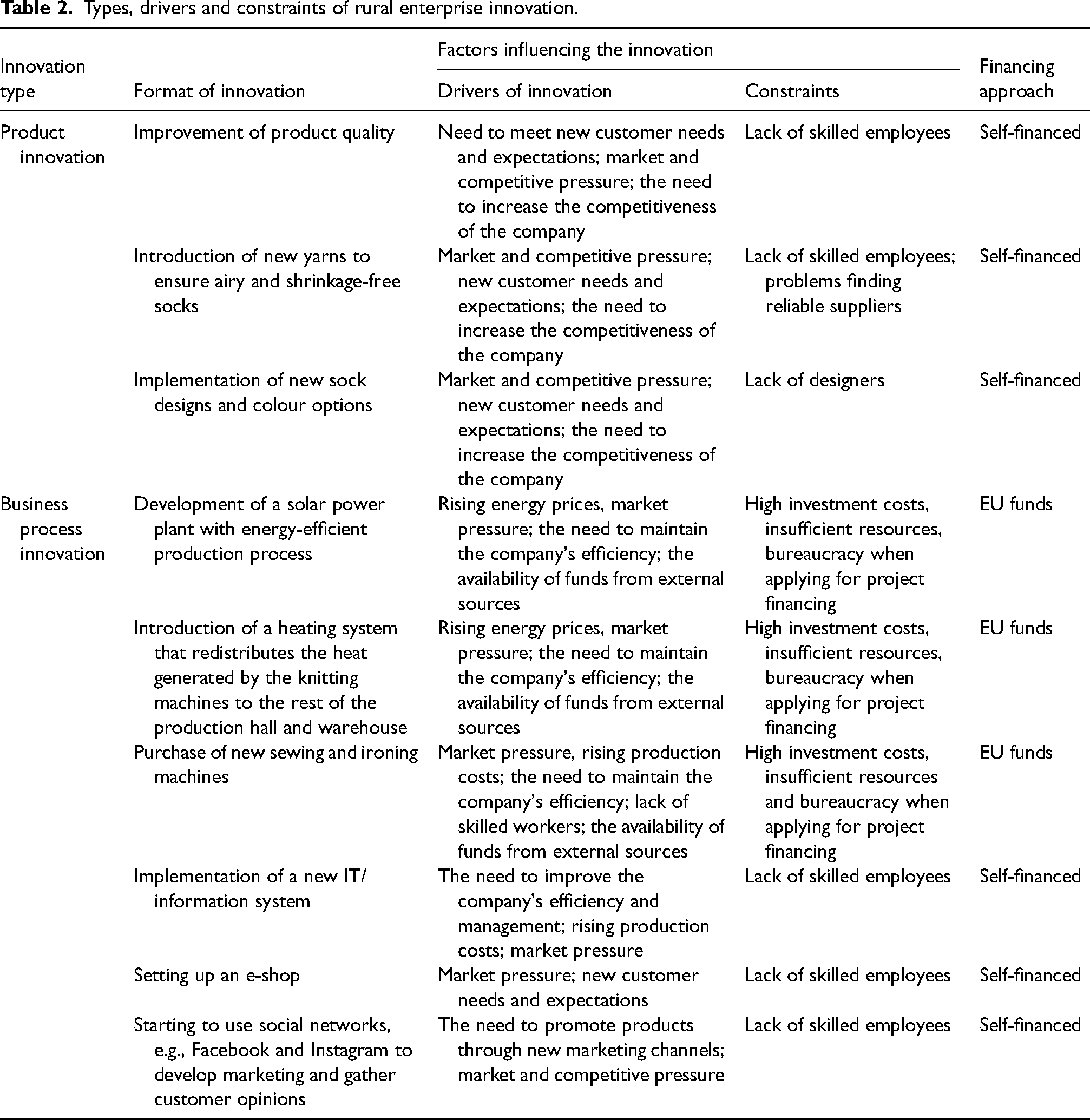
As presented, the product and process of innovation can be induced by the evolving needs of customers and a company's response to those needs. In the case of our rural enterprise, to better understand what customers and sales agents want and need, one employee was tasked with monitoring the company's website, online blogs and wider social media. Gathered information is carefully analyzed to develop new ideas that inform product and service improvements. Market pressure for innovation is also evident in the fact that the company responds to current trends in the sector and introduces modern and high-quality production materials. Indeed, as presented in our study, quality can become one of the most important ingredients of success.
Our data indicates that an important factor negatively affecting innovation is a shortage of employees and/or a lack of skilled workers able to introduce innovative practices. Interestingly, limited access to human resources can lead to the automatization of production processes helping to reduce dependency on staff. Indeed, replacing human resources with robotization and automation becomes a commonly observed practice (Kryńska, 2017) that affects not only international and national economies but also regional, local and rural markets. The latter represents an example of a challenge that leads to innovation and enhanced sustainability of a business. Similarly, a lack of local suppliers led to sourcing specific materials internationally, outside the local market, bringing benefits of scale and quality.
Our study shows that innovation can be influenced by rising production costs associated with inflation and rising energy prices. For example, in our case, rapidly growing energy costs acted as an incentive to implement energy-efficient solutions and reduce energy consumption. An additional incentive to innovate was the possibility of receiving subsidies and a growing legislative pressure to implement ecological innovations. As such, innovation can derive from both push (e.g., growing energy costs or other negative market factors that act as an innovation stimulant) and pull factors (e.g., grants encouraging business owners to innovate).
Importantly, in addition to external push and pull factors influencing processes of innovation, a crucial role is played by the organizational strategy and strategic vision of company owners – in our study, we evidenced the perceived importance of introducing innovation. Our rural enterprise owner searched for innovations, found funding sources to implement them and monitored the results of the innovation process. Day-to-day, he views innovation as a way to keep the company competitive and to survive in the long term. This approach created fertile ground for embracing innovation, encouraged employees to search for creative solutions and developed knowledge about customer needs and trends in the industry and beyond. All of these were utilized as inspiration to find new ideas and further develop technologies and production methods. Indeed, this aligns with other findings suggesting that the innovativeness of a company is influenced by the innovative DNA of owners and the creativity of their collaborators (Dyer et al., 2011). Moreover, our study supports previous research revealing that innovation output is a function of a firm's innovation strategy and its internal routines and resources (Karlsson and Tavassoli, 2016), and that company innovation is strongly influenced by internal factors, such as strategy, corporate leadership, corporate culture, resources and technologies, procedures and management, task requirements, systems, internal policies and procedures and individual styles (Tidd and Bessant, 2013). In our study, we see that all these factors also apply to rural enterprises and that rural innovation goes beyond rural locations per se, with rural businesses being influenced and using opportunities offered by external national and international markets. As presented, the latter can relate to gaining knowledge and learning from others, sourcing materials that are unavailable on the local market, accessing capable staff from other locations and expanding the customer base beyond the rural area.
Conclusions
Rural enterprises face a range of challenges and opportunities that can influence their innovation processes. Our study reveals that although rural businesses may experience many innovation barriers, such as inadequate human resources and volatile market conditions, they can (i) innovate, (ii) respond quickly and effectively to emerging market circumstances and (iii) turn threats into opportunities for growth. Importantly, many of the challenges and opportunities for innovation interplay with each other, with some obstacles becoming the foundation of creative and innovative solutions that help to develop a sustainable, modern and efficient enterprise. We highlight that innovation among rural enterprises can be an outcome of pull and push factors that influence both product innovation and business innovation processes. The pull factors represent incentives and opportunities to stimulate rural innovation and include, for example, available/easy-to-access funding or opportunities offered by online technology, such as e-shops and online sales. The push factors, on the other hand, are those aspects that necessitate change or create pressures that must be addressed to ensure business longevity. The latter includes, for example, changing customer needs and expectations, growing energy costs and a movement towards green energy. Both – pull and push factors – play a significant role in the innovation process of rural enterprises.
We see that successful innovation is not free from agency. Indeed, as demonstrated, it is also determined by the ongoing efforts of business owners who monitor the market and customer needs, ensure production efficiency, have a strategic vision and work hard to innovate. Innovation activities undertaken and introduced by owners (or management) help companies to maintain their competitive position and revenues, and successfully grow despite their rural location. Finally, our study shows that innovation among rural enterprises depends on local, regional, national and international connections and goes beyond rural areas. Indeed, for rural innovation to happen, rural businesses need to ‘think local and act global’, harnessing opportunities found in wider markets. For instance, one source of opportunities to further develop business innovation can come from the EU structural funding which supports research and development among small businesses as well as the digitalisation of enterprises. As evidenced in previous studies (Brodny and Tutak, 2022), innovation of businesses from the Czech Republic lags behind many EU member states and the potential to enhance the impact of innovation investments exists (Odei and Hamplová, 2022). To make it possible, the latter should (i) be facilitated by a group of stakeholders, including the national government, and (ii) recognise a specific size of, as well as the context, in which businesses operate.
Our study contributes to the existing body of evidence and shows the importance of rural enterprise innovation. Presented results can be used to inform future studies exploring determinants of innovation in rural areas internationally as well as innovation strategies and rural development national and regional policies in the Czech Republic. The latter might be of particular importance considering the lack of business support programmes for, as well as data on, innovation practices of small rural enterprises.
While highlighting many interesting matters relating to the innovation of rural enterprises, we acknowledge some limitations of our study. Firstly, our research was limited to only one case study of a rural business in the Czech Republic. To verify, extend and increase the generalizability of our findings, we encourage the use of a wider sample of rural businesses in wider national and international contexts. Secondly, a better understanding of why certain rural firms innovate while others don’t is also important. The latter can support the creation of relevant policies that promote innovation across rural enterprises. Finally, understanding a wider spectrum of drivers and obstacles to rural enterprise innovation can also assist business support organizations in designing more effective strategies and developing support mechanisms which unlock the potential of rural enterprises and enhance their economic growth and sustainable development.
Footnotes
Declaration of conflicting interests
The author(s) declared no potential conflicts of interest with respect to the research, authorship, and/or publication of this article.
Funding
The author(s) received no financial support for the research, authorship, and/or publication of this article.
