



Abstract
A vibrant literature studying antecedents of entrepreneurial intentions is largely motivated by an often implicit assumption that they will be followed by subsequent entrepreneurial behaviors or actions. A much smaller number of studies actually test this assumption. Their results suggest that while the entrepreneurial intention–behavior relationship is usually present, its strength turns out highly contextual. This meta-analysis intends to integrate and summarize the available research base on the entrepreneurial intention–behavior relationship, assessing the moderating impacts of environmental, demographic and methodological factors. Data from 75 studies (150,703 individuals) were included in the analysis. Our results indicate that the focal relationship is robust across environmental contexts, populations, and methodologies except for the measures used for entrepreneurial behavior, the use of a database compared to collecting new data, and the duration of time between intention and behavior. Additionally, entrepreneurial intentions were found to account for only 17% of the variance in entrepreneurial behaviors as opposed to the commonly expected and cited 37%. Our findings suggest theoretical and methodological considerations for future work aimed at exploring and overcoming the non-trivial intention–behavior gap and we encourage the discovery of cognitive and behavioral factors reinforcing the intention–action translation at different levels of analysis and over time.
Introduction
Intention leads to behavior. This concept is intuitive and observable: To follow through a task, humans first must intend it. Intention is considered one of the strongest predictors of behavior (Ajzen, 1991; Rhodes and de Bruijn, 2013), accounting for 28% of the variability in behavior on average across fields as diverse as health, driving, and academic activities (Sheeran, 2002). In the entrepreneurship domain, most prior studies focus on the factors that affect entrepreneurial intention (Shabsough et al., 2021; Taghizadeh et al., 2022), having faith that the downstream effect will be a corresponding change in entrepreneurial behavior and business development (Linan and Fayolle, 2015). However, it is well-established that a discrepancy (or “gap”) exists between intention and behavior (Sheeran and Webb, 2016).
There have been increasing calls to investigate why entrepreneurial intentions might not translate into behavior (e.g. Kautonen et al., 2013; Schlaegel and Koenig, 2014). Although the baseline relationship generally gets validated (Kautonen et al., 2013), reported correlations between entrepreneurial intention and behavior are highly inconsistent across available studies. Results range from negligible (Gielnik et al., 2014; Vandor, 2021) to substantial, above 0.50 (Duong and Vu, 2023; Rauch and Hulsink, 2015), suggesting that the entrepreneurial intention–behavior relationship is highly context-dependent. As such, there is a need for meta-analytic integration and summarizing of the available research base on this crucial baseline association and the moderators that might shape it.
Sheeran and Webb's (2016) review of the intention–behavior literature emphasizes self-regulation as a critical factor, with both external and internal influences potentially undermining the intention–behavior link. This focus on psychological and cognitive aspects is less evident in the entrepreneurial intention–behavior literature, which tends to favor a resource-based approach (Tornikoski and Maalaoui, 2019). While certain studies have explored self-control and motivation in entrepreneurial contexts (Adam and Fayolle, 2016; Gielnik et al., 2014; Hashmi and Khan, 2018; van Gelderen et al., 2018), the field predominantly concentrates on resources at various scales, ranging from individual skills (Gieure et al., 2020) to regional social capital (Weiss et al., 2019).
Recent studies on the entrepreneurial intention–behavior gap have proposed various models with moderating and mediating elements (Aloulou, 2017). These factors can be sorted into two categories. The first includes “environmental,” such as regional socio-cultural, economic, and legal factors (Bogatyreva et al., 2019; Braunerhjelm et al., 2021; Calza et al., 2020; Kibler et al., 2014; Meoli et al., 2020; Shirokova et al., 2016). The second category comprises “individual differences,” such as age (Gielnik et al., 2018; Kautonen et al., 2015; Yasir et al., 2018), gender (Saiz-Alvarez and Rodriguez-Aceves, 2019; Shinnar et al., 2018), and psychological factors (e.g. self-control, van Gelderen et al., 2018). This meta-analysis seeks to integrate existing empirical research on entrepreneurial intention–behavior moderators. Guided by these two categories, our approach is twofold: we investigate (a) environmental factors theorized to hinder or facilitate aspiring entrepreneurs and (b) individual differences thought to impact the entrepreneurial intention–behavior link.
We intend to make three unique contributions to the literature stream on entrepreneurial intentions. First, our study establishes a baseline strength for the entrepreneurial intention–behavior relationship based on the current literature. Second, we provide an assessment of theoretical moderators, offering a nuanced understanding of the contexts when the intention–behavior gap is likely to be more or less pronounced. Third, our study illuminates methodological moderators, detailing how study design decisions might amplify or attenuate the observed association.
Theoretical development
Entrepreneurial intention and behavior
Becoming an entrepreneur (i.e. starting a company) is a volitional and planned behavior, suitable for investigation under intention theories and models (Schlaegel and Koenig, 2014). Entrepreneurial intention represents an individual's commitment to startup and is considered a cognitive state preceding entrepreneurial behavior (Alferaih, 2017; Maleki et al., 2023; Shabsough et al., 2021). Three major theories place intention proximally to behavior: (a) Shapero and Sokhol's (1982) Entrepreneurial Event Model posits that socio-cultural influences on perceived desirability, propensity to act, and perceived feasibility lead to intention and subsequent behavior; (b) Bird's (1988) model outlines that environmental and individual difference factors impact rational and intuitive thinking that leads to intention and behavior; and (c) Ajzen's (1991) Theory of Planned Behavior (TPB) argues that behavioral, normative, and control beliefs inform attitudes toward behavior, subjective norms, and perceived behavioral control, respectively, which then determine the intention that leads to behavior. All three of these models demonstrate the role of intention as a cognitive state through which environmental and individual difference factors (e.g. extraversion; Alferaih, 2017) influence entrepreneurial behavior, emphasizing the utility of intention as a predictor of behavior.
The entrepreneurial intention–behavior link has been empirically validated (e.g. Kautonen et al., 2013), but the strength of the relationship varies across studies and with proposed moderators (e.g. Bogatyreva et al., 2019; Shinnar et al., 2018). Therefore, we pose the following hypothesis to establish a baseline against which potential moderating impacts will be assessed:
Moderators
Moderators of the entrepreneurial intention–behavior link can be broadly categorized into two groups: environmental factors and individual differences. Studies linking environmental conditions to national entrepreneurial activity levels have outlined the importance of cultural, legal and socioeconomic factors (e.g. Wennekers et al., 2002). Similar national-level moderators present in the entrepreneurial intention–behavior literature are socio-cultural (Bogatyreva et al., 2019; Calza et al., 2020; Kibler et al., 2014), economic (Meoli et al., 2020; Shirokova et al., 2016), and legal (Braunerhjelm et al., 2021). The TPB relays that intention predicts behavior when individuals have high levels of volitional control over behaviors (Ajzen, 1991). However, total control over entrepreneurial behavior is not possible given that environmental factors, such as regulations and financing (Kautonen et al., 2013), influence resource availability and thus level of volitional control, subsequently influencing the intention–behavior link. Triandis’ (1980) Theory of Behavior posits that “facilitating conditions” (i.e. resource availability) are objective factors that make it easy or difficult to perform a behavior, and that low facilitating conditions can inhibit the intention–behavior translation even in cases of high perceived behavioral control. In short, with a boundedly rational perspective, the greater the degree an aspiring entrepreneur has access to resources, the more likely the entrepreneurial intention to behavior translation.
However, psychological factors, such as self-image and identity (Kautonen et al., 2015) and self-control (Hashmi and Khan, 2018), especially when combined with competing priorities (Harima et al., 2021), are also potential explanations for the entrepreneurial intention–behavior gap. These factors demonstrate the potential explanatory power of theories such as Higgin's (1987) Self-Discrepancy Theory, in which a misalignment between the actual self and ideal self (e.g. an entrepreneurial identity) cause negative emotions that lead to inaction, and Procrastination Theory, in which intended courses of action are unreasonably delayed due to reasons including low self-efficacy and high impulsiveness (Steel, 2007). Notably, these theories have the potential to explain the impacts of “irrational” factors (as opposed to boundedly rational factors such as resource availability) on the entrepreneurial intention–behavior relationship. We outline and hypothesize the moderating effects of environmental and individual differences in the following paragraphs.
Bogatyreva et al. (2019) found that certain aspects of national culture, for example, uncertainty avoidance, influence the intention–behavior translation, whereas other aspects, such as individualism, do not. Socio-cultural factors influence the legitimacy of entrepreneurship, where the more legitimized the activities involved in being an entrepreneur are in a society, the more likely these activities will be performed by those within that society (Kibler et al., 2014). Thus, we hypothesize:
In an exploration of the legal environment, Fogel et al. (2006) propose that entrepreneurs cannot act without transactional trust (degree of trust between parties in a business transaction), which depends on the legal environment. Weak legal protections can result in an inability to cooperate with others, making venture creation and growth harder, while stronger legal protections encourage transactional trust, facilitating cooperation and thus venture creation (Fogel et al., 2006). Thus, we hypothesize:
Tax policies in the legal environment can influence venture founding through risk (Gentry and Hubbard, 2000). A progressive taxation situation wherein higher profits are met with higher tax rates in new ventures (an unsupportive tax policy) results in greater risks being associated with entrepreneurship compared to employment, thus suppressing firm creation (Gentry and Hubbard, 2000). The more supportive tax policies are towards new ventures, the more likely entrepreneurial intentions are translated into behaviors. Therefore, we hypothesize:
Among the moderators that comprise individual differences, established demographic factors include age (Kautonen et al., 2015; Levesque and Minniti, 2006) and gender (Duong and Vu, 2023; Saiz-Alvarez and Rodriguez-Aceves, 2019; Shinnar et al., 2018). Age is often used as a control variable (Shirokova et al., 2016; van Gelderen et al., 2018) since entrepreneurs tend to be between 35 to 44 years old (Kautonen et al., 2015; Levesque and Minniti, 2006). Following the reasoning of Campbell et al.'s (1993) Theory of Performance, individuals gain experience and resources with age, making entrepreneurship appear increasingly feasible and leading to an increase in translation of entrepreneurial intention into behavior with age (Gielnik et al., 2018; Kautonen et al., 2015; Levesque and Minniti, 2006). Therefore, we hypothesize:
Gender inequalities and inequities exist in entrepreneurship (Shinnar et al., 2018), so like age, gender tends to be included in empirical studies as a control variable (e.g. Shirokova et al., 2016). However, there are studies investigating gender as a key influence (e.g. Shinnar et al., 2018). Saiz-Alvarez and Rodriguez-Aceves (2019) explain that, in contrast to men, women with strong entrepreneurial intentions do not follow through because they see a lack of financial and social capital. Gender can moderate the entrepreneurial intention–behavior relationship through the real and perceived differences in resource access and facilitating conditions. Therefore, we hypothesize:
Individual-level psychological factors can exacerbate time's impact on the entrepreneurial intention–behavior link. Randall and Wolff (1994) posited that tasks where some degree of control is ceded to others, where tasks are difficult, or where lack of willpower can play a role (e.g. self-control in entrepreneurship; Hashmi and Khan, 2018) are strongly moderated by time. Some prior studies suggest that entrepreneurial intention–behavior analyses should be conducted with longitudinal designs (Joensuu-Salo et al., 2020; Kautonen et al., 2013) since entrepreneurship occurs over a period of time where commitment and self-regulation are inconsistent (Donaldson, 2019). Notably, procrastination theories encapsulate multiple reasons why aspiring entrepreneurs may delay and ultimately never follow through on their intentions to start a business (Steel, 2007). For example, the link between motivation and time is demonstrated in Steel and Konig's (2006) Temporal Motivation Theory, wherein motivation for a task is a function of value and expectancy over impulsiveness and delay: The longer delay between action and reward, the lower an individual's motivation to tackle the task, despite stability in intentions. Harima et al. (2021) report that prioritization of startup-unrelated tasks leads to procrastination as a behavioral response and discontinuation of startup activities.
Furthermore, it is well established that time can have significant impacts on theory development (Ancona et al., 2001; George and Jones, 2000; Mitchell and James, 2001) and on study design (Dormann and Griffin, 2015). Specifically, studies need to ensure alignment between the duration of time required for entrepreneurial intentions to be translated into entrepreneurial behavior, the time during which the researcher measures intention and behavior, and the time interval within which the theory holds: an alignment between the existence interval, the observation-recording-aggregation interval and the validity interval (Zaheer et al., 1999). For example, it is possible for intentions to decrease in strength over time, rendering the initial measurement of entrepreneurial intention invalid
1
, and making the observed intention–behavior translation inaccurate. Consequently, Dormann and Griffin (2015) suggest using short time lags between measures to identify optimal time intervals that are aligned with theory. On the other hand, a study by Joensuu-Salo et al. (2020) found that entrepreneurial intentions are stable over both short (1–3 years) and long time periods (6–8 years), with both able to predict entrepreneurial behavior. Procrastination theories suggest that an increasing duration of time contributes to the intention–behavior gap (due to individual difference factors such as self-control, motivation, and low self-efficacy) (Steel, 2007). Thus, with the caveat that measurements of entrepreneurial intention and behavior remain valid, we hypothesize:
We identify various additional methodological aspects present in existing empirical studies to assess whether they influence the strength of the entrepreneurial intention–behavior relationship, including: the studies’ publication status, type of participant (student or not), data collection method (use of an existing database or independently collected), theory framework (the TPB or not), and behavior measure (binary “yes or no” for venture creation or a scale of entrepreneurial activities). The data collection method variable encapsulates impacts from multiple studies sharing the use of the same database as opposed to collecting data independently. The theory framework variable allows for an assessment of consistency between the most utilized intention model, TPB, and other models. The type of participant variable will inform whether the use of student versus non-student samples matters for the intention–behavior translation. No formal hypotheses are proposed for these moderators as, ideally, methodological differences between studies do not impact the entrepreneurial intention and behavior relationship (i.e. robustness tests).
Methods 2
Search, screening and coding
Our literature search of prior literature reviews and five electronic databases returned results up to the latest search date 22 July 2023. All obtained works were uploaded to HubMeta software for deduplication, screening, and coding (Steel et al., 2021). The Cohen's kappa for title screening and full-text screening were .69 and .83, respectively (or substantial agreement and almost perfect agreement; Cohen, 1960). The final 75 studies were coded for Pearson's correlations between entrepreneurial intention and entrepreneurial behavior and for potential moderators in the meta-analysis.
Analytical methodology
All analyses were performed in the R software version 4.0.4 using the metafor package (Viechtbauer, 2010). We found no outliers according to criteria by Viechtbauer and Cheung (2010). Our bivariate meta-analysis was performed for the entrepreneurial intention–behavior relationship using a random-effects model. Moderators were assessed using meta-regression analysis (Steel et al., 2021), each in its own model.
Results
Descriptive data
The 75 studies in the meta-analysis were published between 2007 and 2023, cover over fifty countries 3 , totaling 150,703 individuals, and utilize data samples between 1998 and 2022. Most studies used a student-only sample (65.3%), utilized the TPB as a theoretical framework (60.0%), had independently collected data (82.7%), were published in a peer-reviewed journal (88.0%), and used a scale measure for entrepreneurial behavior (81.3%). The duration between intention and behavior ranged from 0 to 13 years (averaging approximately 10 months), the sample average age ranged from 19.44 to 48.34 years old, and the sample gender percentage ranged from 0% to 100% male.
Bivariate meta-analysis
The results demonstrate that entrepreneurial intention is positively and significantly related to entrepreneurial behavior (β = .41, p < .0001, 95% CI [.37, .45], τ2 = .03), supporting hypothesis 1. The significance of the Q statistic (Q(74) = 5315.62, p < .0001) and high I2 statistic (I2 = 98.43%) indicated significant heterogeneity, strongly suggesting moderator presence.
Moderator analysis
The theoretical moderators—Cultural and Social Norms (β = .02, p = .42, 95% CI [-.03, .06])]), Commercial and Legal Infrastructure (β = .03, p = .42, 95% CI [-.04, .09]), Government Tax and Bureaucracy (β = .04, p = .08, 95% CI [-.01, .08]), age (β = -.00, p = .65, 95% CI [-.01, .01]), and gender (β = -.00, p = .64, 95% CI [-.00, .00])—are not significant, failing to support hypotheses 2a-e, except for time duration (β = -.03, p < .01, 95% CI [-.05, -.01]), supporting hypothesis 3. See results in Table 1.
Results of mixed-effects meta-regression moderator analysis.
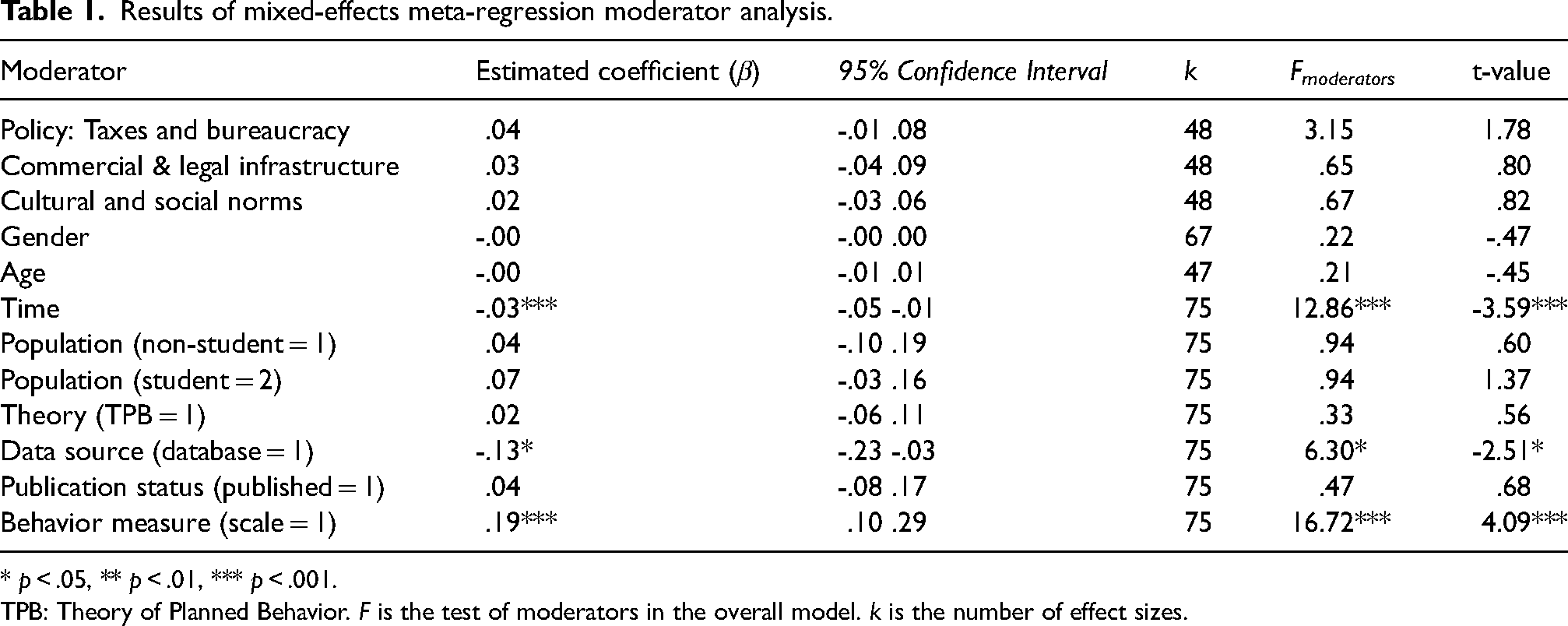
* p < .05, ** p < .01, *** p < .001.
TPB: Theory of Planned Behavior. F is the test of moderators in the overall model. k is the number of effect sizes.
Most methodological moderators are not significant: non-student sample (β = .04, p = .55, 95% CI [-.10, .19]), student sample (β = .07, p = .18, 95% CI [-.03, .16]), TPB intention framework (β = .02, p = .56, 95% CI [-.06, .11]), and published work (β = .04, p = .50, 95% CI [-.08, .17]). However, the variables “scale behavior measure” (β = .19, p < .01, 95% CI [.10, .29]) and “use of database” (β = -.13, p = .01, 95% CI [-.23, -.03]) are significant. All 75 studies are present in these regression models. Results can be found in Table 1.
Post-hoc analysis
We conducted a post-hoc analysis to assess the potential impact of regional affluence on the entrepreneurial intention–behavior relationship due to the complexity with which regional affluence is theorized to impact said relationship. Regional affluence can boost entrepreneurship by increasing access to resources for venture creation but can also render the opportunity costs of entrepreneurship too great compared to employment, discouraging entrepreneurial behavior despite entrepreneurial intention (Meoli et al., 2020). Studies linking Economic Development Theory to entrepreneurial activity find several factors that complicate our development of hypotheses with regional affluence as a moderator, such as the stage of economic development of a country and its interaction with the prevalent type of entrepreneurship, and even the presence of export-oriented multinationals versus small firms (see Acs et al., 2008). Furthermore, the “Resource Curse” Theory (Sachs and Warner, 1995) posits that high resource availability can hinder economic development (Brunnschweiler and Bulte, 2008), potentially impacting the entrepreneurial intention–behavior translation where both low facilitating conditions (Triandis, 1980) and extremely high regional affluence could reduce the strength of the link in an upside-down U-shaped curve.
To address as many complicating factors as we could, we dissected regional affluence into several components: the impact of national economy being in a growth stage (i.e. efficiency-driven stage) is represented by the national gross domestic product per capita (GDP per capita) growth rate. National wealth is represented by GDP per capita. Both these variables were developed from World Bank data. The World Bank is a standardized database often drawn on in entrepreneurship studies (e.g. Damaraju et al., 2020; Williams et al., 2017). Our variables GDP per capita and annual GDP per capita growth rate were based on the year of data collection and obtained from the GDP per capita (current US$) dataset provided by the World Bank based on the 2023 United States dollar value 4 . Specific resource availability is represented by access to financial resources such as equity or debt (the Entrepreneurial Finance indicator from the GEM), and by access to physical resources such as utilities or buildings (the Physical Infrastructure indicator from the GEM). However, our results were non-significant—GDP per capita rate (β = .38, p = .15, 95% CI [-.14, .90]), Entrepreneurial Finance (β = .01, p = .69, 95% CI [-.06, .09]), Physical Infrastructure (β = .04, p = .18, 95% CI [-.02, .09]), GDP per capita squared (β = .00, p = .68, 95% CI [-.00, .00]), GDP per capita rate squared (β = -2.51, p = .26, 95% CI [-6.90, 1.87]), Entrepreneurial Finance squared (β = .05, p = .08, 95% CI [-.01, .11]), and Physical Infrastructure Squared (β = .04, p = .14, 95% CI [-.01, .08])—except for GDP per capita (β = -.00, p = .04, 95% CI [-.01, -.00]).
Additionally, we assessed a potential complicating factor in the age variable. According to the Life Span Perspective, the costs associated with switching from employee to entrepreneur at 45 years old (e.g. peak wage earnings) can reduce the motivation of individuals to pursue entrepreneurship and thus decrease the likelihood of individuals becoming entrepreneurs at older ages (Gielnik et al., 2018; Kautonen et al., 2015; Levesque and Minniti, 2006). Our results on age having a potential upside-down U-shape were not significant (β = .00, p = .35, 95% CI [-.00, .00]).
Discussion
Starting a company is a lengthy and challenging process (Kautonen et al., 2013). This statement is reflected in our results wherein entrepreneurial intentions account for only approximately 17% of the variation in entrepreneurial behavior, which is surprisingly low compared to the 37% based on four articles (Schlaegel and Koenig, 2014) that has been commonly cited in the literature. Given the significance of the time and entrepreneurial behavior measure moderators, we take the stance that the entrepreneurial intention-action gap depends more strongly on the interaction of psychological factors with environmental-resource conditions than on environmental-resource conditions alone.
Our finding that national-level, environmental factors are non-significant for the entrepreneurial intention–behavior relationship is initially surprising, given that our results contradict some prior work. Studies had found moderators such as legal protections (Shirokova et al., 2020) and some dimensions of cultural norms (Bogatyreva et al., 2019; Cannavale and Nadali, 2020). We suggest that the contradictions may result from the concept that substitutions can be made for lacking resources. For example, the negative impact of a national culture unsupportive of entrepreneurship might be mitigated by the encouragement of “relevant others” (the individual's immediate social circle) (Meoli et al., 2020). Limited financing from professional sources can be filled-in by funds from close contacts, self-financing, and bootstrapping, phenomena that often happens in early stages of entrepreneurship (Shirokova et al., 2020). Poor legal protections that lead to low institutional trust (Welter, 2012)—preventing cooperative activities for new venture founding (Fogel et al., 2006)—could be replaced by personal trust between individuals and those with strong ties to them, which is common in post-socialist and developing countries (Welter, 2012). Indeed, Butler and Hansen's (1991) model of network evolution indicates that early stages of new venture creation are characterized by personal trust, which has been used for building legitimacy and obtaining resources.
In these examples, the influences of macro-level factors can be mitigated by lower level factors, suggesting that it is possible to substitute a lacking resource with another that provides a similar function (Welter, 2012), but whether action is taken depends on the aspiring entrepreneurs’ motivation and self-control (Steel and Weinhardt, 2018). This concept is reinforced by our significant time moderator, which can be partially explained by time-perspective theories such as the entrepreneurial goal-striving process model, in which entrepreneurs’ self-set goals and corresponding actions change over time through feedback loops influenced by self-control and motivation (Schjoedt and Shaver, 2020; Steel and Konig, 2006). Similarly, the goal-striving phase of the Goal Phase System framework is strongly impacted by impulsivity (to pursue more immediate temptations) such that self-regulatory failure contributes to intention–behavior gaps (Steel and Weinhardt, 2018). Aspiring entrepreneurs may procrastinate startup tasks in favor of competing goals and temptations. Strong self-control positively impacts the entrepreneurial intention–behavior translation (van Gelderen et al., 2015) and motivation can help people overcome setbacks (Hueso et al., 2020).
Given that motivation plays a role in the intention–behavior translation, it is also possible for environmental-resource conditions to indirectly impact the intention–behavior link through motivation. For example, our results on gender non-significance contradict findings by Saiz-Alvarez and Rodriguez-Aceves (2019) and Shinnar et al. (2018). This discrepancy is likely not a result of variance in cross-national gender equality, since various indexes reinforce the concept that women have less access to resources than men (European Institute for Gender Equality, 2020; World Economic Forum, 2021). Instead, we suspect that the inclusion of activities such as “discussed product or business idea with potential customers” or “attempted to obtain external funding” (e.g. Shirokova et al., 2020, p. 14–15) in entrepreneurial behavior measures do not capture the behavior-discouraging impacts of negative feedback when performing these activities. Gender inequalities present in rate of negative experiences (Marlow and Patton, 2005) can lead to different startup discontinuation rates through motivation loss (Grant and Dweck, 2003).
Beyond motivation and self-control, we propose that self-image and identity can interact with environmental conditions to influence the entrepreneurial intention–behavior gap. For example, aspiring entrepreneurs cannot legally dodge taxation policies that are burdensome without moving to a different geographical region. However, we attribute our finding of taxation policy non-significance to the concept that entrepreneurial individuals are often motivated by preferences for independence (while also being risk-tolerant; Douglas and Shepherd, 2002) as opposed to money, such that comparatively lower earnings due to tax policies do not discourage aspiring entrepreneurs from acting on strong intentions. 5 Similarly, Kautonen et al. (2015) determined that individuals who considered their age as suitable for entrepreneurship (a positive age-based self-image) translated their entrepreneurial intentions into behaviors independently of chronological age. In line with this finding and our results, we believe it is possible that the pattern of resource accumulation with age holds true within one individual, but that in a population, resource accumulation (e.g. experience) occurs at different rates for different individuals such that both older and younger individuals feel ready to translate their entrepreneurial intentions into behavior.
Methodological implications
Our results indicate that the entrepreneurial intention–behavior relationship is consistent across student and non-student populations. Nevertheless, we encourage careful sample-factor matching, such as using student samples for university environment (Bogatyreva and Shirokova, 2017). Additionally, our significant data source variable and non-significant population type variable suggest that the selection of samples within the student population should be carefully done to allow generalizability to student types (e.g. in an entrepreneurship course or not).
Furthermore, explanations for the activities included in scale variable measures (i.e. entrepreneurial behavior) should be made clear, given the significance of the scale-versus-binary entrepreneurial behavior measure variable and the potential for activities included in the measure to have impacts on theory (e.g. the earlier section on gender). Meta-analyses in other intention–behavior contexts have noted that type of behavior and self-report measures can impact the intention–behavior link (Armitage and Conner, 2001; Randall and Wolff, 1994). Finally, given the importance of time in the entrepreneurial intention–behavior link, strong reasoning should be given for the time interval between measures of entrepreneurial intention and behavior to ensure that the time lag utilized in the study is aligned with theory (Dormann and Griffin, 2015).
Limitations and future directions
Given data limitations, we are unable to assess the intention measure as a moderator. While we found in post-hoc analysis that national wealth has an impact on the entrepreneurial intention–behavior gap, its influence—especially accounting for other regional affluence factors—remains complex. Furthermore, there are meso- and micro-level factors explored or used as controls in the literature that we could not include in this meta-analysis because too few studies assessed them, including level of education (Saiz-Alvarez and Rodriguez-Aceves, 2019), field of study (Shirokova et al., 2020), exposure to entrepreneurial education (Rauch and Hulsink, 2015), family influence (Baluku et al., 2020), work experience (Bernardus et al., 2020), creativity (Hashmi and Khan, 2018), university entrepreneurial environment (Bogatyreva and Shirokova, 2017), personal wealth (Kong et al., 2020), fear of failure (Calza et al., 2020), age-based self-image (Kautonen et al., 2015; Yasir et al., 2018), and positive fantasies (Gielnik et al., 2014). Recent studies investigated moderators at multiple levels (Meoli et al., 2020) and suggested analysis at group-levels (Shirokova et al., 2016) as high-level factors may interact with lower level factors to moderate the intention–behavior gap (Norton et al., 2017).
The significant temporal component indicates opportunities for investigating factors such as self-control and motivation (Blank and Gabay-Mariani, 2021). For example, studies linking ADHD and entrepreneurship propose that impulsivity can help individuals overcome fear-induced inactivity but also reduce the performance and survival of entrepreneurial firms (Wiklund et al., 2017). This paradox suggests a complexity that is best untangled by studies over time: van Gelderen, Kautonen and Fink (2015) utilized a year-long study to illuminate that self-control counters the negative effects of action-related aversion, doubt, and fear to positively influence the entrepreneurial intention–behavior link. Longitudinal studies could illuminate when and why aspiring entrepreneurs fail to translate intention into behavior, and how self-regulatory strategies can help bridge the gap. The interaction of time-associated factors with environmental conditions and demographic characteristics could also reveal new insights, such as the impact of repeated confrontation with resource barriers on motivation. There is also a need to revisit the activities included in scale measures of entrepreneurial behavior.
In this meta-analysis, 60.0% of studies utilized the TPB as the primary intention model, however, studies utilizing motivation focused models may derive insights conflicting with assumptions in the TPB. For example, using the Action Phase Theory—a four-step model comprising of deliberation, action planning, action, and evaluation (Gollwitzer, 1990)—van Gelderen et al. (2018) determined a mediating role for implementation intention between entrepreneurial intention and behavior whereas the TPB depicts entrepreneurial intention as the most proximal predictor of entrepreneurial behavior. Indeed, studies have suggested that closing the intention–behavior gap requires conceptual models to include mediators and variables for action control (Rhodes and de Bruijn, 2013), such as emotional responses and negative contextual influences (Gollwitzer and Sheeran, 2006), which has been lacking in the entrepreneurial intention–behavior literature (Gielnik et al., 2014).
Conclusion
One of the underlying assumptions in entrepreneurial intention research is that behavior follows intention, and while our meta-analysis validates this relationship, we also find that it is weaker than expected. We propose that aspiring entrepreneurs can overcome resource barriers at the national-level via interpersonal sources and subsequently that the interaction of psychological factors such as motivation and self-regulation with environmental-resource barriers contribute more strongly to the entrepreneurial intention–behavior gap than resource access alone. Both future studies and public policy development would benefit from studies with multi-level analysis, longitudinal designs, and exploration of psychological moderators and mediators in entrepreneurial intention–behavior models.
Footnotes
Declaration of conflicting interests
The authors declared no potential conflicts of interest with respect to the research, authorship, and/or publication of this article.
Funding
The authors received no financial support for the research, authorship, and/or publication of this article.
