



Abstract
Despite that the commercialization of academic research at universities in the form of spin-offs is increasingly acknowledged as a source of innovation across the globe, few universities in Africa have created spin-offs. Consequently, we examine the extent to which different organizational factors impact the development of academic spin-offs in the South African context. Primary data is collected from public universities via a structured questionnaire and hypotheses are evaluated using structural equation modelling. The findings reveal that organizational factors in terms of research mobilisation, external collaboration, unconventionality, and the perception of bureaucratic university policies all positively and significantly influence academic spin-offs. A complex picture of predictors influencing academic spin-offs emerges in terms of the different model pathways. Conducting research and empirically evaluating a model in an African emerging market context, offers new and valuable insights, which can enlarge theory and enhance understanding of academic entrepreneurship in general.
Keywords
Introduction
The commercialization of academic and scientific research through entrepreneurship and university start-ups or spin-offs is increasingly acknowledged as a source of innovation across the globe (Fini et al., 2021; Kusio and Fiore, 2020). Indeed, the ‘transformative effect’ of academic entrepreneurship in developed economies such as the US, reveals that policy and legislation have been instrumental in driving university entrepreneurship activity (Etzkowitz and Leydesdorff, 2000; Rothaermel et al., 2007), thereby creating academic spin-offs (ASOs). ASOs are new ventures that originate from individuals conducting scientific research within universities (Perkmann et al., 2013; Tagliazucchi and Marchi, 2022) and drive local development and national competitiveness – thereby transforming universities from traditional teaching into entrepreneurial universities (Compagnucci and Spigarelli, 2020).
Developing a National System of Innovation (NSI), which originated in Europe, shows that the success of ASOs is often attributed to the Triple Helix (TH) (university–industry–government interlinkages) approach to ‘innovation systems. Despite that the TH approach has been widely accepted, especially in the public sector (McAdam and Debackere, 2018), most of the existing research on innovation ecosystems is focused on firms, with only a few studies in the context of universities, and even fewer so in African merging markets (Kruss and Visser, 2017; Urban, 2019). Consequently, we view this as an important research gap in the literature and to further emphasize this deficit, we consider some of the challenges faced by South African ASOs, highlighting the consequences of these challenges on innovation and economic growth.
The African Union ranks science, technology, and innovation (STI) as a catalyst for Africa's development in the next 50 years, thereby placing STI at the centre of its advancement agenda (STI, 2022). More specifically, in South Africa (SA), the ‘Intellectual Property Rights (IPR) on Publicly Financed Research and Development Act No 51’ was promulgated in 2010 as part of efforts to regulate the use of IPR emanating from government funded institutions to establish Technology Transfer Offices (TTO) to be responsible for identification, protection, and commercialization of innovations. Over the last decade, the Department of Science and Technology (DST) has advanced an NSI through several policy interventions, while some South African universities themselves have also established TTO to take advantage of research and commercialization (Alessandrini et al., 2013; Kruss and Visser, 2017).
Notwithstanding the mounting significance of commercialization of research and developing ASOs at universities, research reveals that SA is falling behind other middle-income countries with respect to key outputs such as patents. Overall, the “number of inventions coming from SA are exceptionally low. In 2020 the country had 25 patent applications per million population, whereas the average for upper middle-income countries in the same year was 641. Moreover, receipts from the sale of South African intellectual property declined by 16%” (STI, 2022, p.15). Furthermore, research reveals that SA universities have been slow to transform their traditional research and teaching activities to enable the commercialization of research and technologies (Alessandrini et al., 2013; Urban and Chantson, 2019). In this respect, scholars note that it is extremely difficult and complex to sustain a competitive knowledge-intensive university spin-off in SA (Kruss and Visser, 2017). Many ASOs fail because of poor business models, a lack of funding to grow the business, management failures or competitive realities (STI, 2022).
Moreover, many universities in SA have inadequate or mixed institutional and organizational support for ASO, such as the organizational preferences for licensing to established companies instead of establishing small enterprises, in the form of ASOs (Urban, 2019). In this regard, in several emerging economies, it has been proposed that institutional and organizational factors may not have the same influence on academic entrepreneurial start-ups as may be the case in developed countries (Saad and Zawdie, 2011). For instance, prior studies show that in SA the support provided by TTO to academics is normally focused on the protection of new intellectual property (IP), with much less consideration and finance available for academic start-ups (Urban and Chantson, 2019). This is remarkable considering that ASOs are seen as an attractive option when compared with the often rigorous and arduous process of securing IP and patent licensing (Guerrero and Urbano, 2012).
Acknowledging such challenges to the development of academic entrepreneurship in the South African university context presents us with an opportunity to explain ASOs by testing an empirical model which stakeholders can utilize to better understand specific antecedents leading to the development of ASOs. To address our study objective, we rely on the entrepreneurial university model (ENTRE-U) (Todorovic et al., 2011) in terms of examining each of its constituent organizational dimensions with the objective to determine the impact of organisational factors on the development of ASOs. The ENTRE-U model mirrors the entrepreneurial orientation (EO) construct, but in an academic entrepreneurial environment (Felgueira and Rodrigues, 2020; Tatarski et al., 2020). In the traditional entrepreneurship literature, a steady stream of research underscores that an EO is essential as a foundation for an organizational strategy focused on implementing entrepreneurial behaviours throughout the organization (Verbano et al., 2020; Wales et al., 2021). Consequently, the main research questions which drive our study are formulated as:
To what extent do the organizational antecedents of research mobilisation, collaboration, unconventionality, and the perception of university policies influence ASOs within the South African university context. Furthermore, to what degree is this relationship influenced by the aspirations of the individual academic entrepreneur.
Our study contributes to the innovation literature by examining ASOs through an entrepreneurial lens in terms of expanding on the ENTRE-U model which will allow for the investigation of separate factors that may be idiosyncratic to development of ASOs to emerge. While there is no shortage of studies examining various determinants of ASOs, there is no consensus on what is the specific set of factors that drive ASOs (Clarysse et al., 2011). Accordingly, we test a model which will allow for patterns that are specific to the influence of different antecedents on spin-offs to be explained. Rather than merely assess the dimensions of the ENTRE-U model a nuanced approach will highlight which distinct factors operate through different pathways or vary in the strength of the paths when they operate through the same pathways. Furthermore, we expand on the current ENTRE-U model by including the aspirations of academic entrepreneurs which is posited to have a positive outcome on the development of ASOs. The rationale for this addition is based on a critical assessment of the literature which reveals that while many existing studies on academic entrepreneurship are occupied with institutional and contextual issues, the role of the academic, as an agent in the academic entrepreneurial process is often ignored (Urban and Chantson, 2019; Verbano et al., 2020). This oversight is a bit alarming given the importance of the individual and entrepreneurial aspirations in the entrepreneurship process, since the role of academic entrepreneurs (Albats et al., 2018; Hayter et al., 2021; Mäkinen and Esko, 2022) and the way they think, act and take decision is pivotal within such a process (Bosma et al., 2020; George et al., 2016).
As the study takes place in an African emerging market context, SA, explaining the extent to which organisational and individual factors may play in shaping ASOs at universities could prove valuable. Many studies on academic entrepreneurship are Western in nature, with very few if any reflecting on Africa (Njinyah et al., 2023). By locating our study in SA, several potential socio-economic impacts could emerge, as universities and research organisations in emerging economies are well-positioned to enhance overall regional economic progress and increase science-society commitment (Urban, 2019).
The article is organized to first emphasize the theoretical basis which inform the study hypotheses. This is followed by research methods where sampling and measurement instruments are discussed. The study findings are then presented and analysed. Finally, study implications are considered in the context of educators and policymakers.
Literature overview on academic entrepreneurship and ASOs
The emergence of the concept of the academic entrepreneurship has spurred numerous studies (e.g., Albats et al., 2018; Fini et al., 2021; Rothaermel et al., 2007). Some authors perceive academic entrepreneurship as the product of the commercialization of intellectual property that has originated from university sources (Etzkowitz et al., 2000), while others conceptualise it as “new enterprises started within a university setting and based on technology derived from university research” (Link et al., 2007, p. 641). This latter conceptualisation with a focus on spin-offs is key to university entrepreneurship and represents the development of business opportunities based on modern technology stemming from the academic arrangement (Lockett and Wright, 2005). Prokop (2021) reviews several key theories of the firm and studies their relevance to ASO's, which he conceptualises as firms “that commercialise university faculty's research by establishing a firm to lead the development of the underlying knowledge into a product or service that can be sold in markets”.
Previous studies analysed the determinants of academic entrepreneurial activity into three major groups, namely: (1) environmental factors, relating to the macro-environment, (2) organizational and institutional factors, and (3) personal factors (Albats et al., 2018; Compagnucci and Spigarelli, 2020). Within this space of analysing which determinants drive academic entrepreneurial activity, an emerging stream of research has examined under what conditions ASOs occur within an academic entrepreneurial environment (Felgueira and Rodrigues, 2020; Tatarski et al., 2020), using the ENTRE-U model. The theoretical foundations of our article are rooted in the ENTRE-U model which mirrors the entrepreneurial orientation (EO) construct, but in an academic entrepreneurial environment (Felgueira and Rodrigues, 2020; Tatarski et al., 2020; Verbano et al., 2020). In the conventional entrepreneurship literature, a sizable collection of research underlines that an EO is essential as a foundation for an organizational strategy focused on implementing entrepreneurial behaviours throughout the organization (Wales et al., 2021). EO identifies the behaviours of entrepreneurs who can identify and exploit opportunities, and is composed of three dimensions, which are well documented in the literature in terms of innovativeness, risk-taking and proactiveness (Wales et al., 2021). In the context of an academic entrepreneurial environment the ENTRE-U builds on the scaffolding of the EO to determine the overall strategic posture of the university or university department that results in the commercialization of innovation (Tatarski et al., 2020). The ENTRE-U was developed to facilitate empirical research on EO within public universities and can successfully predict the number of patents, licenses, and spin-off companies (Todorovic et al., 2011). In previous studies, the ENTRE-U scale (Todorovic et al., 2011) is operationalized through four dimensions, namely: (1) Research mobilisation activities, (2) collaboration, (3) unconventionality and the (4) perception of university policies (Felgueira and Rodrigues, 2020). Notwithstanding these dimensions, based on the assortment of theoretical and empirical studies focused on the determinants of academic entrepreneurship, there is no consensus on what is the specific set of factors that drive ASOs. Consequently, the selection of these factors is by no means all-inclusive since the actual process of how ASOs are formed is far more complex and depends on the entire ‘university-based ecosystem’ (Fransman, 2018).
Research mobilisation
Research mobilisation, when conceptualised broadly, goes beyond pure knowledge mobilisation, and includes the ability of the academic entrepreneur to apply knowledge and garner support to influence how innovative ideas get initiated and developed (Carayannis and Campbell, 2012; Clarysse et al., 2011). Previous findings suggest that many innovative ideas evolve in educational environments, where opportunities need to be recognised and nurtured (Tagliazucchi and Marchi, 2022). Alessandrini et al. (2013) explain that while the establishment of an ASO in an emerging market context is conducted in a similar way to the developed market, the process may be interrupted at the mobilisation phase when limited funding and budgetary constraints are observed or when there is a lack of support in the environment in terms of collaborative diverse communities and networks. Extant research supports that access to an established funding base will serve as the foundation for the mobilisation of academic innovation with the goal of the funder being value creation for themselves, for the university and society (Albats et al., 2018; Caputo et al., 2022). Moreover, supportive national and regional environments will encourage the development of ASOs, where this support can be achieved through policy mechanisms or regional strategies that can be instituted to encourage ASO development (Etzkowitz and Leydesdorff, 2000). Contrastingly, in the absence of a supportive environment, a poor perception of the market environment may demotivate academics, resulting in lower creativity and idea generation (Hayter et al., 2021). Building on in this research direction where prior empirical studies have associated research mobilisation to the development of innovative ideas a supportive market environment, access to funding, and connection to the global community, we predict the relationship between research mobilisation and ASOs in the South African university context to be as follows:
Collaboration
Collaboration is formed by the pattern of relationships that are created from the direct and indirect connections between participants, with researchers suggesting that understanding collaboration within a network should be conducted by exploring the different parties within the network (Cao and Zhou, 2018; Carayannis and Campbell, 2012). In the broader entrepreneurship literature, research suggests that social networks are a strong and reliable predictor in successful venture creation (e.g., George et al., 2016). Similarly, in the academic entrepreneurship literature, the engagement of government, industry and academia has been linked to improve the potential of spin-off success (Etzkowitz and Leydesdorff, 2000; Fransman, 2018). Studies also suggest that the relationship between organisations and individuals, which comprise of government, industry, and academia, will be influenced in several different and distinct ways depending on the type of information sharing taking place (Etzkowitz and Leydesdorff, 2000). This position is echoed in prior research where it is suggested that it is the interactions among innovators, and financiers accelerate the richness and scope of innovation and discovery when it comes to ASOs (Thursby and Thursby, 2007). Pre-existing relationships and university support structures empower the academic to approach the market environment and gain access to markets. These relationships are deemed to be most successful when personal and external collaborations are combined (Clarysse et al., 2011). However, it is recognised in emerging markets that these interactions are not always present, and external entities such as industry and government may be called upon to support academic research focused on innovation development (Saad and Zawdie, 2011). Consequently, by acknowledging empirical studies which advise that ASO development would be supported when there are strong collaborations and recognising the clear distinction between interpersonal collaboration and the external collaboration the following hypothesis is articulated.
Unconventional risk-taking activities
When deciding on a career in academia, academics are faced with observable and known risks, such as insecurity in research funding, the pressure to publish regularly, rising workloads and time constraints (Lockett and Wright, 2005; Perkmann et al., 2013). However academic entrepreneurship introduces otherwise unconventional risks that the academic did not foresee when beginning their academic career (Kusio and Fiore, 2020). This ‘unconventionality’ is the recognition and application of risks associated with the idea or innovation when undertaking an ASO. In this sense risk-taking refers to the propensity of the entrepreneur to take courageous steps towards projects that have uncertain outcomes (Hayter et al., 2021). Todorovic et al. (2011) argues that the better the ability of the academic to engage with these unconventional risks, the better the chances of spin-off success. Comparable to the traditional entrepreneurship literature, for new process and products to emerge, academic entrepreneurs must discover opportunities and engage in behaviours that will enhance opportunities and mitigate several types of risk (George et al., 2016). Studies also highlight the interconnectedness of several types of risks related to ASOs, which financial risk, institutional risk, reputational risk, and business risk (Kusio and Fiore, 2020). In this respect research highlights that academics’ may be reluctant to focus on a commercial aspect of their research, as the ASO may be subject to risks and exogenous shocks which they cannot control (Link et al., 2007; Urban and Chantson, 2019). Accordingly, successful application of institutional trust to mitigate several types of risks will provide the foundation for positive perceptions of support offered to the academic by their institution, which plays a key role in fostering ASOs (Broström et al., 2021). Consequently, in recognising the diverse types of risk which the academic may face when engaging in an ASO, it is hypothesised.
Perception of university policies and support
University policies are expected to encourage the engagement of the academic towards academic entrepreneurship (Todorovic et al., 2011; Walter et al., 2016). Several studies suggest that university governance policies and mechanisms should be designed to support ASOs (Cao and Zhou, 2018), where stable, and effective bureaucratic university governance structures can reduce the cost of accessing resources and improve the development of ASOs (Meoli et al., 2019). For instance, efficient TTO structures can boost commercialisation activity and reduce the cost to the faculty in terms of time spent on IP administration (Cao and Zhou, 2018). University mechanisms which explicitly assign rewards for entrepreneurial endeavours reveal that academics possess higher levels of ASOs, patenting or licensing intentions (Marzocchiet et al., 2019). Others recognise that top management must support the need to change the organisational culture to accommodate academic entrepreneurship, and hence it needs to modify incentives and allocates resources to create a conducive environment for ASO development (Walter et al., 2016). Research reveals differing patenting practices of academic entrepreneurs in weak versus strong organizational regimes (Walter et al., 2016). Under these circumstances, bureaucratic intervention involves the regulating of commercial academic output through the protection of IP but also recognising that networks and resources need to be available for ASOs (Compagnucci and Spigarelli, 2020). Thus, it is hypothesised that supportive university policies will have a positive impact on ASOs.
Entrepreneurial aspirations
Prior research has concentrated on examining academic entrepreneurial intentions, identities, aspirations, creativity, self-esteem, and self-efficacy to explain ASOs (Albats et al., 2018; George et al., 2016; Mäkinen and Esko, 2022). Other research on ASOs has analysed competencies required by several actors while engaging in the entrepreneurial processes, which include opportunity refinement, leveraging, and championing (Rasmussen et al., 2011), while some authors report that the researchers’ entrepreneurial intentions and career choices positively affect the creation of ASOs (Meoli et al., 2019). In the South African context, Urban and Chantson (2019) extend the theory of planned behaviour (TPB) by incorporating institutional and organizational factors to evaluate how these shape beliefs and attitudes towards academic entrepreneurship. In the series of global entrepreneurship monitor (GEM) reports, Bosma et al. (2020) measure aspirations and provide valuable insights into the entrepreneurial process from intentions through to venture conception, venture birth, and subsequent growth and development. Scholarly work on academic entrepreneurship notes that even though academics may improve their reputation and earn more income their aspirations and attitudes vary significantly when deciding to engage in academic entrepreneurship (Perkmann et al., 2013). Previous research findings reveal that informal factors (e.g., attitudes, role models) have a greater impact on university entrepreneurial outcomes than formal factors (e.g., support measures, education, and training) (Guerrero and Urbano, 2012). Understanding that the academics’ aspirations may provide a deeper understanding of why ASOs develop, it is hypothesised.
Methodology
Sampling
In SA, there are 26 Public Universities spread across nine provinces which constitutes the population for our study (DHET, 2019). While the broader Post-School Education and Training system has 503 institutions, some of these institutions produce vocational and technical skills, while others develop first degree graduates only and focus on professional development (DHET, 2019; USAF, 2019). Consequently, the focus of our study, in line with the study objectives, was Public Universities (n = 26), as their central purpose is to conduct directed research and development, which include research-intensive institutions which produce PhDs, research outputs and technological innovations (DHET, 2019; USAF, 2019). Guided by the literature review, which highlights the extant theoretical models that foster ASOs, the study respondent was the individual academic entrepreneur currently situated across different Faculties such as Commerce, Science, Technology, Engineering and Medicine. Since there was no available sampling framework for ASOs at Public Universities in SA, the registrar at each of the universities was contacted and permission was requested to engage with their academic entrepreneurs. Each of the universities required their own ethics clearance certificate to engage an academic in their employ.
Ethical considerations were taken into consideration by submitting a written request to conduct the survey at each university. Approval letters were obtained from the relevant deputy Vice-chancellor office at the universities, where the ethics approval process required an offer of anonymity to respondents. Full and open information (informed consent) was made available to respondents to ensure that no form of deception and misrepresentation was used to extract information from the respondents where their privacy and confidentiality was respected at all times. Despite several requests, over a 12-week period only 14 universities granted ethics clearance and allowed for the distribution of the survey. Moreover, given that academic entrepreneurs are a relatively small subset of all academics at Public Universities in SA, it was necessary to use total population sampling (n = 620) which is a purposive sampling technique that involves engaging with the entire population that has a defined set of characteristics (Schindler, 2019). The first mailing request was followed by a second and third email request for filling out the on-line questionnaire, two and four weeks later respectively. These efforts resulted in a final sample size of 207 complete questionnaires, (response rate = 33 percent) and represented prominent universities across three of the largest provinces in SA, ensuring that sufficient variability and a degree of regional representativeness was obtained (Schindler, 2019). Previous similar studies have reported similar response rates (Urban, 2019). We conducted tests to look for potential sources of bias in our sample. First, we analysed whether there were differences between respondents and non-respondents, using a Wilcoxon-Mann–Whitney test, according to Faculty type but no significant differences were detected. Second, we conducted t-tests and found no significant differences between early and late respondents in terms of age or gender.
Measures
This study used a self-administered and predetermined on-line questionnaire with closed ended questions reflecting the constructs under investigation. Questions were measured on a 5-point scale in which ‘1 represented strongly disagree and 5 represented strongly agree’, with the commonly used method of retaining means of all items to operationalize multi-item constructs. In terms of the independent variables (IVs) the following constructs were operationalized to reflect each construct as per the hypotheses:
Research mobilisation (Felgueira and Rodrigues, 2020; Tatarski et al., 2020; Todorovic et al., 2011) was measured with six items, e.g., ‘I typically create new commercial ideas by combining existing research with my own innovative spin’, and ‘I typically create new ideas to commercialize by combining existing research with my own innovative spin’.
Unconventional risk-taking was measured in terms of four aspects (Felgueira and Rodrigues, 2020; Tatarski et al., 2020; Todorovic et al., 2011): (a) Financial risk (3 items), e.g., ‘Some activities involve ‘financial risk’; (b) Business risk (3 items), e.g., ‘My spin-off firm is very seldom the initial business in the industry to introduce new products/services, techniques and operating technologies’; (c) Institutional risk (5 items), e.g., ‘The focus of the university conflicts with my innovative ideas’; (d) Reputational risk (5 items), e.g., ‘When facing a decision that carries some risk, I/we tend to adopt a ‘wait and see’ approach to avoid risking my/our university's reputation’.
Collaboration was measured through two dimensions (Felgueira and Rodrigues, 2020; Tatarski et al., 2020; Todorovic et al., 2011): (a) External collaboration (4 items), e.g., ‘Creative ideas hardly ever come to me alone. I rely on industry to identify potential opportunities.’; (b) Personal collaboration (6 items), e.g., ‘My partner/s and I have a great relationship, both when deciding on matters related to the spin-off and during our time out of the office’.
Perception of university policies was measured through two dimensions (Felgueira and Rodrigues, 2020; Tatarski et al., 2020; Todorovic et al., 2011): (a) University support (7 items), e.g., ‘My university has no policies and processes in place to support the commercialization of innovation’.; (b) Bureaucratic policies (4 items), e.g., ‘It is not possible for me to bypass standard university operating procedures in the development of the spin-off’.
Aspirations was measured with four items regarding the aspirations of the academic entrepreneur insofar the individual's own aspirations may be an influence on ASO choices that he/she makes within the university setting (Bosma et al., 2020; Urban, 2019). A sample item is ‘I believe that my university has intellectual imperatives that guide academics towards developing innovative and commercial ideas that can be used by business and society.’
ASOs, as the study dependent variable (DV) (Felgueira and Rodrigues, 2020; Tatarski et al., 2020; Todorovic et al., 2011), was measured with five questions such e.g., ‘My spin-off firm has produced more than five new lines of products and/or services in the past five years or since its establishment.’
Similar to prior studies, in terms of control variables, where researchers report a positive relationship between various demographic factors and the likelihood of an invention being commercialized through start-up companies, we investigated the influence of age, gender, career experience and educational background in determining development of ASOs (Hayter et al., 2021; Link et al., 2007).
Analytical techniques
We used structural equation modelling (SEM) since the study constructs are operationalized as multi-item scales and we first had to establish acceptable canonical correlations for each formative subset whereupon these canonical constructs were used as reflective inputs into the overall SEM. Before estimating the structural model, we assessed the dimensionality, reliability, and validity of the measurement scales by means of confirmatory factor analysis (CFA) (Steiger, 1990; Treiblmaier et al., 2011).
Results
Validity and reliability tests
Both reflective and formative canonical sets were assessed together using CFA, where the following model fit indices were obtained which measure discrepancies between observed and model-implied correlation/covariance matrices. Bentler Comparative Fit Index (CFI) = 0.910, where CFI is a normed fit index in the sense that it ranges between 0 and 1, with higher values indicating a better fit. The most commonly used criterion for a good fit is CFI ≥ . 95. Chi-Square χ2/df = 1.66 which as a measure of model fit is in line with the conventional accepted value, with values of 5 or less being a common benchmark; the Root Mean Square Error of Approximation (RMSEA) is an index of the difference between the observed covariance matrix per degree of freedom and the hypothesized covariance matrix which denotes the model. The RMSEA value of 0.072 obtained in this sample indicates an acceptable fit as it is suggested that RMSEA values between 0.05 and 0.08 are acceptable; the Standardized Root Mean Squared Residual (SRMR) assessing the average magnitude of the discrepancies between observed and expected correlations as an absolute measure of (model) fit criterion was 063 and considered as a good fit when the normalized square root of average squared differences is < .05. ; and the Non-Normed Fit Index (NNFI) also called the Tucker Lewis index is preferable for smaller samples and was acceptable as it should be > .90 (Treiblmaier et al., 2011).
Reliabilities were confirmed, using the commonly employed Cronbach Alpha prescriptions of ≥0.70 (Nunnally, 1978), indicating acceptable internal reliability across all factors (apart from a borderline case of 0.69): (1) Research mobilisation (α = 0.80); (2) personal collaboration (α = 0.82); (3) external collaboration (α = 0.76); (4) business risk (α = 0.81); (5) financial risk (α = 0.74); (6) institutional (α = 0.78); (7) reputational risk (α = 0.75); (8) bureaucratic policies (α = 0.85); (9) university support (α = 0.80); (10) aspirations (α = 0.69); (11) ASOs (α = 0.85).
Descriptives and correlations
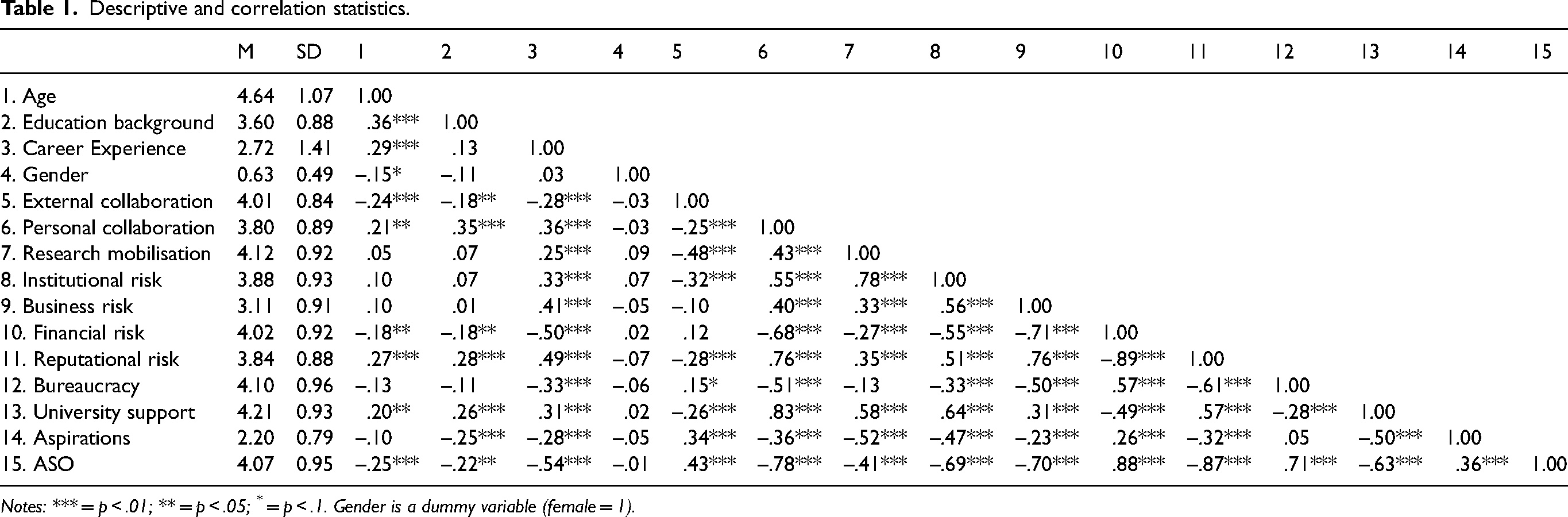
In terms of descriptives most mean scores are above the 1–5 scale midpoint average, see Table 1. The Pearson's correlation coefficient (expressed as r) shows the direction and strength of a relationship between two variables (Schindler, 2019), where ASO has several high positive correlations, namely with financial risk (r = .88, p < .01) and bureaucracy (r = .71, p < .01), while external collaboration shows a low positive correlation (r = .43, p < .01). This means that these variables move in the same direction and are important in explaining ASO, particular as bureaucracy includes the regulating of commercial academic output and also relates to networks and resources that need to be in place for ASOs (Compagnucci and Spigarelli, 2020).
Descriptive and correlation statistics.
Notes: *** = p < .01; ** = p < .05; * = p < .1. Gender is a dummy variable (female = 1).
In the converse, ASO also has several high negative correlations with reputational risk (r = -.87, p < .01), personal collaboration (r = -.78, p < .01), and moderate negative correlations in terms of institutional risk (r = -.69, p < .01), university support (r = -.63, p < .01), career experience (r = -.54, p < .01). This means that as the IV variable increases, the DV decreases, suggesting that ASO may be subject to risks which academics cannot control (Urban and Chantson, 2019).
Hypotheses testing
To test the hypotheses hierarchical regression models were formulated with two testing issues or statistics that are worth mentioning, namely, in the first instance the form of the hierarchical regression used was hierarchical set regression, and secondly when assessed, particular terms were added to assess the moderation hypotheses involved. The model was formulated as:
DV = α + B1Predictor + B2Moderator + B3Predictor x Moderator (where α is the intercept and Bs are slopes). At each stage in the hierarchical regression, the change in fit was assessed for significance via adjusted R² (higher being better) and information criteria (AIC, BIC, and SBC) for which lower scores indicate better models.
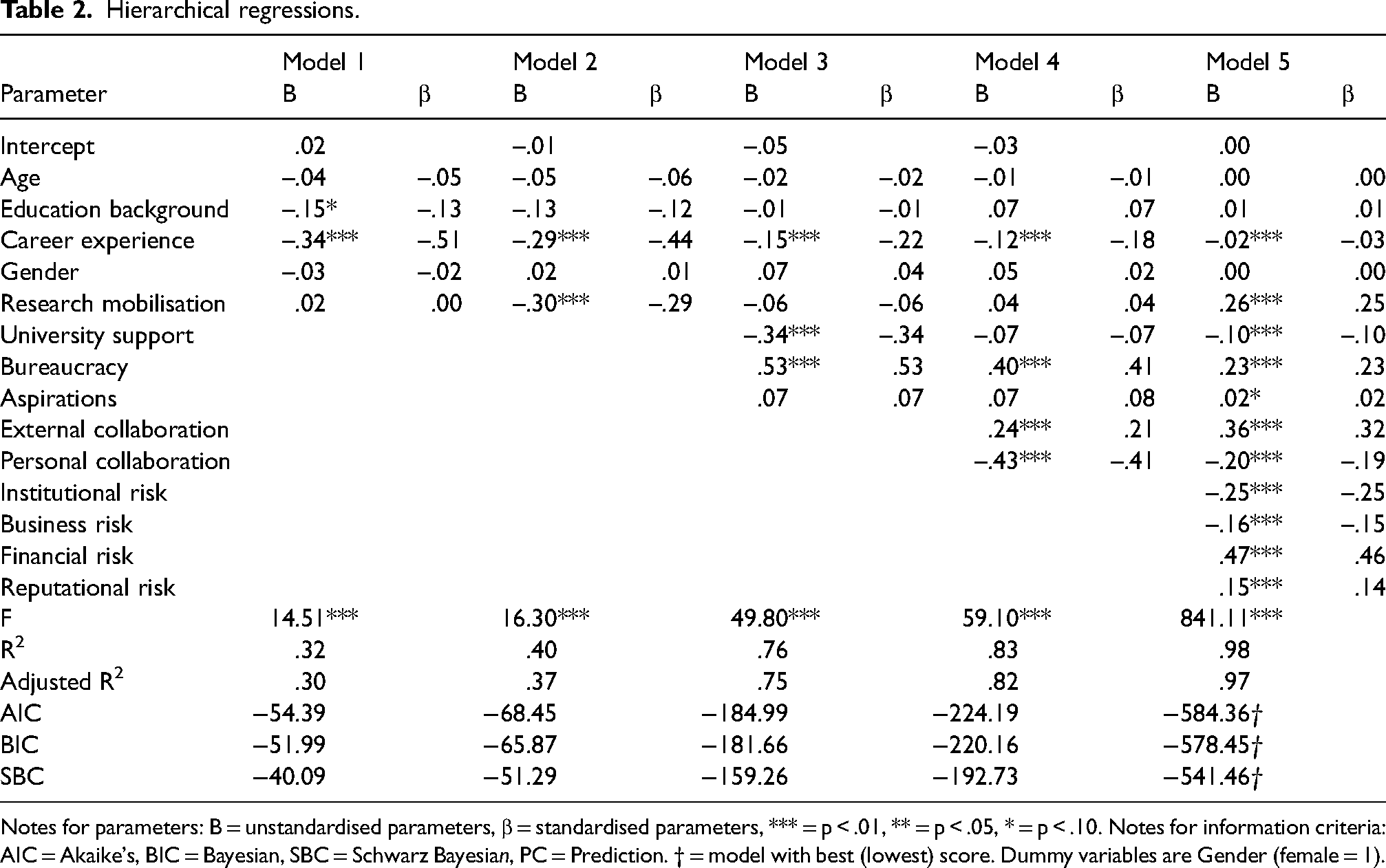
The regression models are presented in Table 2, where each model in terms of model 1 to model 5 individually demonstrated good fit (Treiblmaier et al., 2011). For Model 1, demographics were entered first; Model 2, research mobilisation was added; Model 3, university support, bureaucracy and finally aspirations were added; Model 4, external and personal collaboration were added; and Model 5, the risk variables were added. Table 2 results show how each subsequent variable set adds significantly to a model, increasing the adjusted R² substantially and decreasing information criteria (AIC, BIC, and SBC). This suggests potentially important roles for each variable set in each of the subsequent models, although the specific variables adding to each set differ.
Hierarchical regressions.
Notes for parameters: B = unstandardised parameters, β = standardised parameters, *** = p < .01, ** = p < .05, * = p < .10. Notes for information criteria: AIC = Akaike's, BIC = Bayesian, SBC = Schwarz Bayesian, PC = Prediction. † = model with best (lowest) score. Dummy variables are Gender (female = 1).
It is notable that the final model provides some highly significant effects, while other are negative and non-significant effects which are similar to the correlation results in many respects: Research mobilisation (H1) (β = .25, p < .01); personal collaboration (H2a) (β = –.19, p < .01), external collaboration (H2b) (β = .32, p < .01); business risk (H3a) (β = –.15, p < .01), financial risk (H3b) (β = .46, p < .01), institutional risk (H3c) (β = –.25, p < .01), reputational risk (H3d) (β = .14, p < .01); bureaucracy (H4a) (β = .23, p < .01), university support (H4b) (β = –.10, p < .01); aspirations (H5) (β = –0.02, p < 0.05).
It is interesting to note that in Model 1 through subsequent models the control variable career experience begins as a significant factor, but the addition of more variables steadily decreases career experience to a trivial factor. It is plausible that the typical academic career path clearly lacks several key elements that characterize an entrepreneurial career in terms of developing ASOs (Etzkowitz et al., 2000).
However, the more complex SEM model provides more detail in terms of which variables are potent predictors of ASOs, leading to the acceptance or rejection of the study hypotheses. Path analysis in SEM allows all coefficients linked in the multiple regression models to be estimated simultaneously (Steiger, 1990). Figure 1 presents a complex picture of predictors influencing ASOs, which will be discussed in terms of their implications for the research hypotheses. In terms of direct paths, unconventionality/risk factors are the strongest, with large positive paths existing between institutional risk and research mobilisation (β = .71, p < .01) and between financial risk and ASO (β = .62, p < .01). These path analyses results suggest positive and significant support for the hypotheses which predict ASO determinants as bureaucracy (H4a), external collaboration (H2b), research mobilisation (H1), and financial risk (H3b). All other paths are modest to moderate in size. Crucially, as it acts as a key mediator, research mobilisation has a modest positive relationship with ASO (β = .15, p < .05), therefore, mediation effects are relatively small. External collaboration has the next most powerful association with ASO (β = .32, p < .01). With regard to direct effects on ASO, there are several results that do and some that do not fully support the hypotheses: Personal collaboration shows a negative association with ASO (β = –.25, p < .01), which is contradictory to H2; Bureaucracy has a modest positive association with ASO (β = .22, p < .01), which is supportive of H4; Institutional risk is negatively albeit modestly directly associated with ASO (β = –.18, p < .01), which does not support H3; Business risk is slightly negatively associated with ASO (β = –.13, p < .10), which does not support H3 (However, this is a very weak result and can probably be discounted); University support has effectively no direct effect on ASO and reputational risk taking is positively associated with ASO (β = –.03), although this is a non-significant result and, therefore, cannot be interpreted as support for the hypotheses. It is noteworthy that Lagrange multipliers do not suggest the addition of other paths in this model (Steiger, 1990). The standardized and unstandardized path coefficients for models, along with goodness of fit indices, indicate an acceptable fit (Bentler, 1990), however, several paths linking some of the constructs proved to be negative and non-significant, indicating that the direct effect and the indirect effect on the DV were in some cases negative, small, and non-significant. The relevance of these findings will be discussed in the discussion section as they relate to the study objectives.
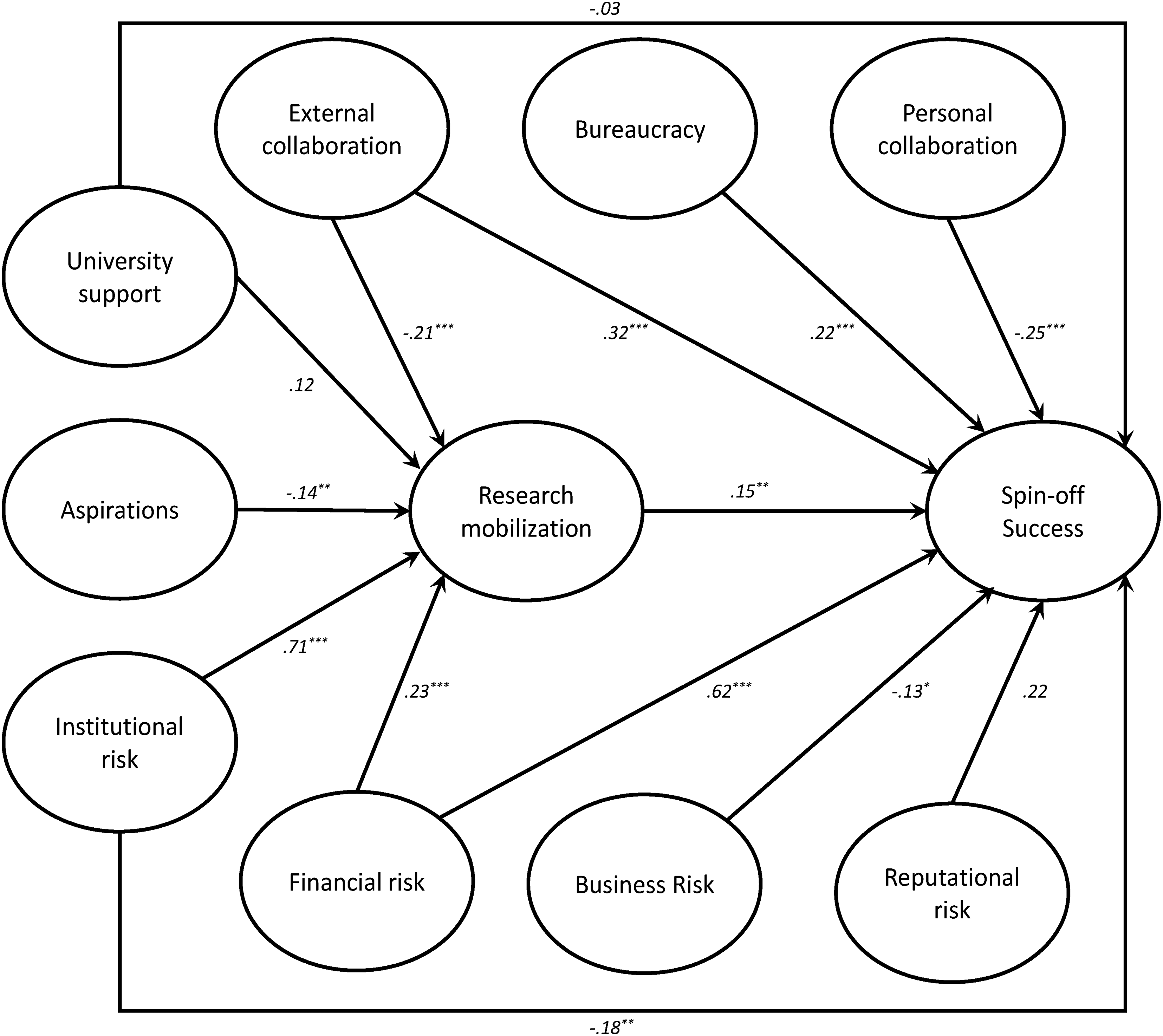
SEM model.
Discussion
The findings are analysed in relation to each of the study hypothesis and elaborated upon in terms of their alignment with or divergence from the literature.
H1 predicted that research mobilisation will positively influence the development of ASOs. The results support H1 insofar research mobilisation has a significant and positive influence on ASOs. This positive finding compares favourably with prior studies which emphasise the interplay between the development of innovative ideas, access to support and funding, as well as connection to the global community as crucial drivers for effective research mobilisation to take place (Alessandrini et al., 2013). Furthermore, considering our study context the findings highlight that the ability of the academic to apply knowledge and ensure innovative ideas get implemented (Carayannis and Campbell, 2012) is crucial for ASOs in an emerging market context as well. In emerging markets, institutions including universities often operate in highly dynamic environments, reflecting the vagaries in their fast-changing economic climate and levels of government interference (Urban, 2019). Such a situation of flux and transformation requires academics to constantly be alert for scanning of opportunities and be open to multiple possibilities to develop innovations through ASOs, which aligns with positive findings for H1.
H2 anticipated that collaboration in the form of (a) personal collaboration and (b) external collaboration by the academic will positively influence the development of ASOs. Findings support the external collaboration-ASO link providing support for H2b. This finding is aligned with the literature insofar the common thread in research on collaboration is that in developed markets, the TH innovation system relies on all parties in the helix for success, with collaboration being an implied requirement (Etzkowitz et al., 2000). Moreover, the relevance of this finding in the context of emerging markets is pivotal when considering that it is often argued that governments are poorly placed to direct innovation and industry is better equipped to assist academic entrepreneurs (Urban, 2019). So, it is highly likely that external collaboration was in the form of industry linkages rather than collaboration with governmental agencies. Indeed, weak public–private partnerships characterise the South African landscape precisely as the country scores the lowest among the BRICS countries in incentivising and growing long-term investment in research, innovation and invention that can produce the “markets of tomorrow,” (STI, 2022). While H2 is partially supported the results need to be interpreted with some caution insofar external collaboration with only governmental agencies may be unsuccessful, but rather, academics would need to be able to work with government, industry, and private sector organisations to ensure successful constructive collaboration to drive ASOs.
H3 forecast that constructive engagement by the academic with unconventionality in terms of (a) business risk, (b) financial risk, (c) institutional risk and (d) reputational risk will positively influence the development of ASOs. In this regard, the findings indicate that unconventionality and more specifically financial risk (H3b) has the most significant and positive impact on the ASOs. This finding resonates with existing research and theory where the ability to mitigate financial risk above all other forms of uncertainty will result in the commercialisation of an academic innovation in the form of ASO (Kusio and Fiore, 2020). This positive finding converges with prior studies which show that factors that support financial risk, such as the efficiency of the financial system, availability of funding and access to the financial system, will promote the development of ASOs (Todorovic et al., 2011). In the converse, and of some significance in the context of emerging markets obstacles such as the lack of cash flow or investment capital would inhibit the development of the ASOs (Link et al., 2007). Such a scenario echoes with recent conditions of increased ‘fiscal pressure’ at public universities, where it has become essential for management not only to increase efficiencies in providing quality teaching and related services, but also to be innovative and focus on being entrepreneurial), to achieve ‘more with less’ (Urban and Chantson, 2019). Based on such prevailing conditions and our study findings it seems reasonable to imply that an academic entrepreneur needs to engage with unconventional risks that have uncertain outcomes to increase the likelihood of developing ASOs (Hayter et al., 2021).
H4 anticipated that the perception by the academic in terms of (a) bureaucratic policies leading to commercialization and (b) university support will positively influence the development of ASOs. Our findings reveal positive and significant effects that bureaucratic policies influence ASOs and subsequently H4a can be supported. This finding corroborates prior research that academic entrepreneurs are more likely to develop ASOs with the existence of a bureaucratic institutional environment in which stable governance mechanisms and policies support spin-off activity (Albats et al., 2018). These findings add to the body of knowledge that given the complexity of relationships in the TH model, a well-functioning bureaucratic system will facilitate the academic to become more efficient and effective with respect to ASOs. More specifically, research findings show that weak and strong bureaucratic organizational rules influence different patent practices, while other studies show bureaucratic factors moderate the effect of technology based ASOs (Walter et al., 2016). It would appear that the academic finds benefit in having the advantages of the bureaucratic system to guide entrepreneurial outcomes and shield themselves from potential unintended negative outcomes (Urban and Chantson, 2019).
H5 anticipated that aspirations of the academic will positively influence the development of ASOs. The negative and non-significant results obtained, which do not support H5, were somewhat surprising. Prior studies shed some light on this finding insofar Wu's (2010) research suggests that when universities are the product of historical legacies and aim to become a top-ranked university through academic publications, the motivation of the academic is driven primarily by theoretical research rather than focusing on ASOs. As the demands on the academic to deliver on academic publications continues, their aspirations to engage with ASOs will only gain traction once the university supports and incentivises academic entrepreneurs to have a commercial focus aligned with their research activities. Universities must modify promotion and tenure and remuneration systems for academic staff so that aspirations and behaviours supporting ASOs are realized.
Additionally, our results have contextual relevance as little is known about ASOs in African emerging market contexts (Njinyah et al., 2023). Scholars have observed that since the TH framework was developed in post-industrial knowledge economies it is deemed to be inadequate in its normative form for understanding dynamic innovation systems in emerging economies (Rothaermel et al., 2007). Moreover, there has been a move away from the literature from concentrating on the hegemony of the TH model and towards the development of theory that allows for heterogeneity in contexts to emerge (McAdam and Debackere, 2018). While in developed countries, there appear to be no major differences in the determinants of academic engagement and ASO development (Perkmann et al., 2013), our findings highlight the unique nature and relevance of several factors, such as research mobilisation and external collaborations, to the ASO development process. For instance, in terms of public collaborations, the South African government often creates burdens for academic entrepreneurs due to administrative inefficiencies, inertia, and because of uncoordinated and conflicting policies (Urban, 2019).
Another contextual feature which deserves mentioning in the SA context is the indiscriminating continuation of institutional support for technology transfer and IP generation, rather than ASO development (Alessandrini et al., 2013). In this regard, several universities have recognized that unfavourable ownership provisions of the IP Act and the university's IP policy are obstacles to the development of ASOs. In SA, the ‘Copyright Amendment Bill is currently open for public hearings across provinces. Many have supported the adoption of the Bill as it was essential to eliminate apartheid legislation and aligns with South African law with other progressive copyright regimes and international treaties by addressing the limitations that many developing countries had been experiencing for years’ (Parliamentary Monitoring Group, 2023). In this regard, it must be mentioned that South African public universities continue to be shaped by a historical social legacy of apartheid, and a culture of academic entrepreneurship still needs to be cultivated to increase levels of ASOs (Urban, 2019).
Conclusion
Recognising that there is no consensus in the literature on what is the specific set of factors that drive ASOs, we investigated to what extent various organizational antecedents influence ASOs within the South African university context. Our study findings indicate that factors relating to research mobilisation, external collaboration, unconventionality in terms of financial risk, and the perception of bureaucratic university policies, positively and significantly influence ASOs. Our study makes a contributes to the entrepreneurship literature by examining ASOs through the ENTRE-U perspective in an African emerging market context. A unique contribution of the study revolves around the issue that although the original scales had primarily been used in developed economies, validating their psychometric properties in an African market context now allows for the replication studies to take place in other similar emerging market contexts.
In terms of managerial implications, the findings demonstrate that there is a need for academics and institutions to appreciate how various antecedents can lead to the development of ASOs. University management must design and implement simple and efficient support mechanisms allowing for ASOs to flourish and take root at South African public universities. Targeted interventions through short courses and workshops, empowering academics with implementable entrepreneurial tools and techniques, could stimulate potential ASO development. Furthermore, academic entrepreneurs should be granted easier access to co-ordinated networks of individuals and technologies from diverse stakeholders to stimulate collaborations for ASOs. Strategic alliance-building is important for ASOs, so that reciprocal advantageous arrangements can take place which are characterised by resource and knowledge sharing which may include licensing arrangements or joint ventures.
University management needs to consider the quadruple helix and quintuple helix models (QH) (Carayannis and Campbell, 2012) to examine how knowledge, innovation and the environment relate to each other. The QH model is relevant to ASOs insofar innovation is the outcome of interactions which involve societal, economic, cultural, and political issues, which drive local and regional development. By appreciating that innovation translates knowledge into economic growth that contributes to the well-being of society (STI, 2022), there is an ever-increasing need to develop social entrepreneurship as a centrepiece of academic entrepreneurship and ASOs at universities. Social entrepreneurship holds much promise as a process that catalyses social change by addressing social problems caused by shortcomings in existing markets and social welfare systems. Through innovations ASOs in the form of social enterprises can create systemic changes and bring about sustainable improvements to local and global communities (Cosa and Urban, 2023).
Study limitations surface from the cross-sectional design which was adopted and prevents any causation to be credited, which requires a longitudinal study using the same sample at several points in time. The results should be interpreted with some caution in terms of appreciating that not all contingencies effecting ASOs were incorporated in our study, particularly as they relate to limited sampling database availability. Future research could place greater emphasis on the long-term sustainability of ASOs rather than just on the act of formation. Investigations using a multilevel analysis could highlight the interactions between various national and institutional level factors which may affect ASOs. In this way universities can ascertain the level of impact that ASOs have on the broader country ecosystem, so the benefits of ASOs are more widespread for other entrepreneurial and social enterprises in the wider African market region.
Footnotes
Declaration of conflicting interests
The author declared no potential conflicts of interest with respect to the research, authorship, and/or publication of this article.
Funding
The author received no financial support for the research, authorship, and/or publication of this article.
