



Abstract
This study analyses the potential influences of entrepreneurial framework conditions on the economic growth of OECD countries. We correspondingly divided these countries into groups according to their income level (high- and upper-middle-income economies) with the data, structured into an unbalanced dynamic longitudinal panel (2000–2020), obtained from the National Expert Survey, Global Monitor Entrepreneurship and the World Bank. After applying the generalised method of moments, we may report that commercial, professional, physical and service infrastructures, government support and policies, R&D transfers, cultural and social norms and financing entrepreneurs positively affect economic growth independently of the national income level. Basic entrepreneurial education does not attain significance in explaining the economic growth of high-income economies and post-education is not significant in explaining the economic growth of upper-middle-income economies. Furthermore, government programmes generate negative effects on the economic growth of OECD countries when considered jointly and individually in high-income economies but with a positive effect on upper-middle-income economies that display an inverse behaviour in the case of the effects of taxes and bureaucracy. The upper-middle-income economies also registered a negative effect in terms of internal market dynamics and openness even while this factor returned positive effects in high-income economies.
Keywords
Introduction
Entrepreneurial ecosystems have received broad recognition as an important source of wealth creation at the regional and national levels (Spigel, 2017; Zacharakis et al., 2003), triggering rising interest among both political decision-makers and academics (Roundy and Bayer, 2019). According to the GEM (2021a), entrepreneurial ecosystems derive from the set of entrepreneurial structural conditions facilitating (or hindering) the launching of new businesses ventures. Hence, entrepreneurial ecosystems constitute complex and significant sets of interconnections involving the different actors that make up entrepreneurial societies (companies, entrepreneurs, educators, media, policy-makers, governments) and thus the importance of the perceived incentives for advancing with entrepreneurial activities (Hechavarría and Ingram, 2019). Therefore, entrepreneurial ecosystems provide the framework for exploring entrepreneurial opportunities that may, in turn, result in entrepreneurial business activities that serve to boost the economic growth of a particular geography (Lopes and Franco, 2019; Sitaridis and Kitsios, 2020).
In recent years, the literature on entrepreneurial ecosystems has experienced a high rate of growth while still displaying some shortcomings and gaps (Yan and Guan, 2019) with the further expansion of its knowledge therefore important. Despite frequent identification of entrepreneurial ecosystems as stimulators and the means for exploring and discovering business opportunities (Cavallo et al., 2019; Farinha et al., 2020; Lopes and Franco, 2019), the literature also contains evidence of how they may act as obstacles (Alaassar et al., 2022; Lux et al., 2020; Xie et al., 2021).
Hence, comparing entrepreneurial ecosystems in different types of economies may identify important differences arising among their respectively different entrepreneurial ecosystems. There is equal importance in ascertaining whether the practices implemented in different types of economy assist in their developing of entrepreneurial activities (Ahmad and Hoffmann, 2008). Furthermore, there remains a lack of empirical studies setting out comparisons of different economy types and identifying the core areas of intervention within a framework of accelerating economic growth (Maroufkhani et al., 2018). Such comparisons will return explanations of the potential influences of the entrepreneurial framework conditions (EFCs) on economic growth and enable political decision-makers to develop efficient measures for nurturing economic growth. Consequently, identifying divergent criteria and the measures appropriate to strengthening the level of dynamic entrepreneurship and foster economic growth is crucial to improving the effectiveness of entrepreneurial ecosystems (Maroufkhani et al., 2018; Yan and Guan, 2019). Furthermore, comparing different types of economies can assist entrepreneurs and other business decision makers in designing better strategies and making more efficient investment choices (Yan and Guan, 2019).
In this context and in keeping with the aforementioned gaps, the current study seeks to analyse the potential influence of EFCs on the economic growth of OECD (national entrepreneurial ecosystems) member states in accordance with entrepreneurial ecosystems theory. Within this scope, we furthermore formulate the following research question d: How might the endowment of EFCs influence the economic growth of upper-middle and high-income economies? To this end, we deployed the latest economic classifications of economies from the World Bank based on Gross National Income (GNI) per capita, classifying countries into low income, lower-middle income, upper-middle income and high-income.
GNI per capita represents a methodology applied by the World Bank to measure operational credit policy. In this way, GNI per capita does not fully reflect the degree of development or well-being of a country but enables the meaningful and harmonious incorporation of non-monetary measures, such as quality of life, average life expectancy at birth, infant mortality rate and the education system participation rate (World Bank, 2021). Despite this, GNI per capita may underestimate lower-income economies due to the exclusion of informal economies from consideration and not reflecting asymmetries in income distribution.
Our study results make various contributions. Firstly, we add to the understanding of the connection between entrepreneurial ecosystems and different types of economy to identify potential differences (Ahmad and Hoffmann, 2008; Maroufkhani et al., 2018; Yan and Guan, 2019). Thus, we add important knowledge to the scant literature on the areas to prioritise interventions designed to accelerate economic growth (Maroufkhani et al., 2018). Indeed, the comparisons of diverse types of economy may assist strategic managers and entrepreneurs in carrying out more efficient investments (Yan and Guan, 2019).
Secondly, we add to the stock of still limited knowledge on panel data studies that analyse the potential effect of EFCs on economic growth. To the best of our knowledge, this is one of the few studies incorporating the most recent classifications of economies according to the new World Bank methodology based on GNI per capita in current USD, deploying the Atlas Method Exchange (e.g., Sethi et al. (2022) and Halkos and Argyropoulou (2022)) first released in 2020.
Our arguments stem from entrepreneurial ecosystems theory, which therefore deepen this field of study and contribute to its justification in demonstrating how EFCs, as factors in this system, can change national patterns of entrepreneurship and, as such, produce impacts on economic growth. In turn, the potential effects of entrepreneurial activity on economic growth depend on the country's income level.
Thirdly, we highlight how EFCs positively affect the economic growth of OECD member states irrespective of their income level. However, we encountered different effects of these same EFCs on the growth of economies in accordance with their income level (upper or middle). The findings also underpin recommendations for political decision-makers seeking to accelerate economic growth in upper-middle-income and high-income economies, with our study representing a significant effort in this direction.
Theoretical background
Entrepreneurial ecosystems theory
Entrepreneurial ecosystems theory arises from the combination of diverse cultural, economic, political and social factors prevailing within a particular region that support, or otherwise, the launching of innovative companies (Walsh and Winsor, 2019). Entrepreneurial ecosystems initially emerged in large urban centres in developed countries with more significant levels of ongoing entrepreneurial activities (Roundy, 2017). According to Cooper and Folta (2017), location is relevant in creating entrepreneurial ecosystems and ventures. Thus, geographic location can influence entrepreneurship levels (Roundy, 2017; Song and Winkler, 2014).
The foundations of entrepreneurial ecosystem theory say that technology and resources, knowledge processing and cultural influences shape and drive entrepreneurial activities (Madzikanda et al., 2021). According to entrepreneurial ecosystems theory, socio-cultural factors determine the intentions and collective attitudes of the individuals inhabiting a particular region, displaying an enormous influence on their capacities to launch companies as well as on their entrepreneurship related perceptions (Hofstede, 2001; Spigel, 2017). However, it still remains unclear just how entrepreneurial ecosystems wield their influence over entrepreneurs identifying business opportunities, organisational structures and performance, and the attainment (or otherwise) of competitive advantages (Roundy and Lyons, 2022; Yan and Guan, 2019). Furthermore, just how EFCs exert their influence on the dynamics of entrepreneurial ecosystems and economic growth is also still unclear.
Link between entrepreneurship and economic growth
There are countless studies interconnecting entrepreneurship with economic growth (Ács et al., 2012; Audretsch, 2007; Audretsch and Keilbach, 2004; Bosma et al., 2018 Boudreaux, 2019; Carree and Thurik, 2008). Some authors propose that entrepreneurship impacts on economic growth differently depending on the income levels prevailing (Carree et al., 2002; Meyer and de Jongh, 2018; Sergi et al., 2019; Stoica et al., 2020; Wennekers et al., 2005). This facet let to an intensification of studies designed to grasp the different forms of entrepreneurship and how their determinants might influence the economic growth of countries and regions (Ács et al., 2012; Galindo and Méndez, 2014; Hessels and van Stel, 2011; Stoica et al., 2020). The findings of these studies demonstrate how the impact of entrepreneurial activities on the economic growth of countries may differ in accordance with both their stage of economic growth and their levels of income. Stel et al. (2005) report a negative impact on entrepreneurial activities in poorer countries, interrelated with the low levels of human capital of the entrepreneurs in these countries, while generating a positive impact in richer countries. Valliere and Peterson (2009) and Lepojevic et al. (2016) also report a positive relationship between entrepreneurship and economic growth in developed countries but not in emerging or low-income countries. In turn, Boudreaux (2019) concludes that in countries with higher levels of earnings, the motivations for entrepreneurship arise from opportunity and thus return a positive impact on economic growth inversely to countries with lower incomes where need acts as the driver of entrepreneurship and, as such, entrepreneurship returns a negative impact for economic growth. Furthermore, Dvouletý et al. (2018) point to a negative effect of entrepreneurship in developed countries due to shortcomings in governmental institutions.
Contextualisation of upper-middle and high-income economies
High-income economies are mature, industrialised economies. As the wealth of these economies increases, the supply of services expands and industry diversifies to satisfy the needs of a population endowed with rising levels of income. This context provides the conditions necessary to raising R&D investments and, with a greater intensity of capital investment, fostering the conditions for developing entrepreneurial activities. This type of entrepreneurship arises from opportunities and not need, with entrepreneurs acting as actors of ‘creative destruction’, creators of wealth and promoters of economic growth (Ahmad and Xavier, 2012; Xavier et al., 2011). Entrepreneurs from high-income countries benefit from favourable entrepreneurship conditions, such as post-school entrepreneurial education, professional and commercial support in terms of physical and service infrastructures, lower levels of bureaucracy; appropriate government support and policies and greater R&D transfers coupled with culture and social norms that focus on entrepreneurial activities, greater support funding for launching new companies and a dynamic and open internal market environment (Ahmad and Xavier, 2012; Doran et al., 2018; Guerrero et al., 2021; Rotefoss and Kolvereid, 2005).
In turn, in upper-middle economies, industrial sectors are still expanding, and institutions are only starting to support industrialisation, scaled production processes and increased productivity (Ahmad and Xavier, 2012). Higher economic productivity enables financial capital and opens the need for the optimisation of industrial processes. In this context, entrepreneurial activities arise out of necessity or subsistence, often for lack of other employment options (Ács et al., 2008). Hence, entrepreneurial activities still fall short of the capacity to promote economic growth (Doran et al., 2018). In this type of economy, there is no effective entrepreneurial culture and, as such, no significant supports for entrepreneurs, a lack of entrepreneurship education alongside government failure to provide subsidies and policies capable of promoting or encouraging entrepreneurship alongside an absence of institutions able to financially support entrepreneurs, and overall discouraging entrepreneurial intentions (Guerrero et al., 2021). Even when meeting these entrepreneurial environment conditions, the launching of new companies in this type of economy is limited by the lack of orientation towards innovation, an engine of entrepreneurship in high-income economies (Guerrero et al., 2021).
Hypothesis development
GEM business ecosystem model
The GEM model assumes that entrepreneurial activities respond to interrelating environmental and business factors. Based on the GEM model proposed by Reynolds et al. (2005), our study focuses on the EFCs in the GEM business ecosystem model that measure the respective business ecosystems prevailing in countries and the ways in which they may differently frame and shape entrepreneurial activities and economic growth. This model incorporates the twelve variables that GEM designates as EFCs: (1) Entrepreneurial education at school; (2) Entrepreneurial education post-school; (3) Commercial and professional infrastructures; (4) Physical and service infrastructures; (5) Government support and policies; (6) Taxes and bureaucracy; (7) Government entrepreneurship programmes; (8) Research and development transfers; (9) Social and cultural norms; (10) Access to entrepreneurial finance; (11) Internal market dynamics; (12) Internal market openness (GEM, 2021a).
Entrepreneurial education
Over time, education has emerged as a determining attribute to the well-being of economies and, as such, to their economic growth. This assumption incorporates three mechanisms: 1) education raises the level of human capital and the effectiveness of labour (Mankiw et al., 1992); 2) education boosts the innovative capacities prevailing in economies (Aghion and Howitt, 1998); 3) education facilitates the dissemination and transmission of knowledge (Benhabib and Spiegel, 1994). Entrepreneurship education has expanded in recent years, characterised by interactive learning processes based on experiences interrelated with business initiatives (Boon et al., 2013; Chawinga, 2017). The objective of this type of education involves changing the thinking of students towards innovation and assuming the risks inherent to business activities (Jones et al., 2014). Higher levels of entrepreneurship education drive the launching of new businesses, growth in small and medium-sized companies, job creation and reductions in poverty levels and consequently contributing to economic growth (Bakar et al., 2015; Isaacs et al., 2007) with this effect amplified in poor countries (Ediagbonya, 2013). Entrepreneurial education at the basic level increases intrinsic motivation and energises business creation behaviours, especially in developing countries (Bongomin et al., 2018). In higher income countries, basic education in entrepreneurship does not foster entrepreneurial activities as creating and developing a company, given the multiplicity of opportunities in this type of country, requires education adopt a closer relationship with entrepreneurial activities and the environmental and institutional factors that often impede entrepreneurship (Walter and Block, 2016). We may thus formulate the following hypotheses:
High levels of basic entrepreneurial education and training positively influence the economic growth of countries irrespective of their income levels, although the magnitude of their effect is more intense in upper-middle economies.
High levels of post-school entrepreneurial education and training positively influence the economic growth of countries irrespective of their income levels, although the magnitude of their effect is more intense in high-income economies.
Commercial and professional infrastructures
The commercial and professional infrastructures consist of the professional support services essential to establishing a new business, such as contracts with suppliers, subcontractors, consultants, accountancy, financial and marketing services (Hechavarría and Ingram, 2019; Levie and Autio, 2008). When these services are available and function effectively, entrepreneurs may concentrate their competences and abilities on their businesses without worrying about legal obstacles and facilitating the launching of new businesses (Lee et al., 2011).
Similarly, the physical and service infrastructures, including the road, rail and air transport networks, alongside communications services, are all essential to entrepreneurial activities. These infrastructures provide connectivity between internal and external markets (Ács et al., 2014). While these infrastructures are guaranteed in richer economies and drive entrepreneurship and, correspondingly, economic growth, in poorer economies, the lack of infrastructures of this type and/or their lack of efficiency may be an obstacle to launching new companies (Ghani et al., 2014; Urbano et al., 2020). In accordance with Audretsch et al. (2015), entrepreneurship positively relates to service infrastructures such as broadband but not to physical structures (roads, railways and airports). We thus arrive at the following hypothesis:
H2: Appropriate entrepreneurship support infrastructures at the commercial, professional, physical and service levels positively influence the economic growth of the countries, with their effect most intense in upper-middle economies.
Physical and service infrastructures, government support and policies, taxes and bureaucracy
Government support, provided through innovation-focused policies, may serve as a driver of entrepreneurial activities. The economies better oriented towards innovation enact specific policies that foster the creation of new businesses (Stevenson and Lundstrom, 2007; Stojčić et al., 2020; Storey, 2003).
According to Levie and Autio (2008), GEM does not specifically capture the government policies that foster entrepreneurship but rather the priority attributed by the government to entrepreneurial activities. Thus, they portray the context that may motivate the launching of new businesses and, as such, foster economic growth. The relationship between government support and entrepreneurship is not consensual, given that different social contexts may lead to different policy results (Hechavarría and Ingram, 2019). Furthermore, government programmes may guide and enable professional assistance that stimulates entrepreneurship in economies (Clarysse and Bruneel, 2007; Saberi and Hamdan, 2019). Business training programmes, government subsidies for the procurement of materials, consultancy and guidance on setting up new companies may receive government support through the provision of financing granted to company incubation platforms, science parks, chambers of commerce, research centres and others (Keuschnigg and Nielsen, 2004).
Naturally, in poorer countries, such government entrepreneurship support measures are only ever either incipient or even non-existing. This type of programme minimises the costs of establishing a new business, boosting human capital and competences and correcting market failures (Chowdhury et al., 2019; Delmar and Shane, 2006). However, according to Ács et al. (2008), when government intervention mostly incorporates taxation, bureaucracy and other regulations, these become a barrier to entrepreneurial activities and, as such, also to economic growth.
An excess of bureaucracy may impact negatively on the economy (Stenholm et al., 2013) as these processes may frequently lead to entrepreneurs becoming demotivated over setting up new businesses, missing out on entrepreneurial opportunities as well as incurring higher initial start-up costs (Audretsch et al., 2019; Mullins and Forlani, 2005). Taxes mostly arise as direct financial costs for businesses removing incentives for entrepreneurial activities even when establishing progressive taxation levels (Levie and Autio, 2008). Therefore, we may formulate the following hypotheses:
Government programmes, policies and support for entrepreneurship positively influence the economic growth of countries, with their effect most intense in upper-middle economies.
High levels of taxes and bureaucracies imposed on entrepreneurial activities negatively influence the economic growth of countries, with their effect most intense in upper-middle economies.
Research and development (R&D) transfer
According to GEM, R&D transfers reflect the extent to which national research and development outputs lead to new opportunities in commercial terms and the ways they become available to small and medium-sized companies (Amorós and Bosma, 2014). According to the knowledge spillover theory of entrepreneurship (Ács et al. (2005), entrepreneurship leverages the spillovers of knowledge in keeping with how new entrepreneurial knowledge is associated with higher levels of uncertainty and the information asymmetries that are important to detecting entrepreneurial opportunities (Amorós et al., 2019). Thus, richer economies with faster and cheaper knowledge transfers tend to display higher levels of entrepreneurship and, as such, generate greater economic growth (Audretsch and Lehmann, 2005). Furthermore, there is evidence that small, emerging and growing companies act as channels for the transfer of knowledge as well as its transformation into economic value that thereby contributes to economic growth (Audretsch, 2009; Braunerhjelm et al., 2010; Levie and Autio, 2008). We may thus determine the following hypothesis:
The ease of transferring R&D to entrepreneurial activities positively influences the economic growth of countries, with the effect most intense in upper-middle economies.
Social and cultural norms
According to Hofstede (2001), culture is ‘the collective programming of the mind that distinguishes the members of one group or category of people from another’ (p.9). In keeping with Hofstede's framework, national culture may positively influence entrepreneurship activities across four dimensions: proximity to power, high individualism, high masculinity and aversion to uncertainty (Kreiser et al., 2010; Shneor et al., 2013). The specific values, attitudes and social norms regarding entrepreneurship may change over time, but the entrepreneurship culture proves longer lasting (Levie and Autio, 2008).
A society that respects entrepreneurship culture through valuing the attitudes of those who engage in entrepreneurship, positive media portrayals of entrepreneurial activities and an institutional environment that is not at all hostile to entrepreneurial activities positively influence the desire and will of individuals to become entrepreneurs (Guerrero et al., 2021). Hence, the culture and norms of social acceptance of entrepreneurial activities positively influence entrepreneurship and enhance economic growth in developed countries (Hechavarría and Ingram, 2019). We may therefore formulate the following hypothesis:
Access to entrepreneurial finance
Access to financing may condition and restrict entrepreneurship (Wennekers and Thurik, 1999). Firstly, entrepreneurs apply their own financial resources to launch new businesses before then seeking out the closer sources of external financing, such as friends and family, and only then other external sources such as financing from banks, business angels, venture capital or other such external investors (Berger and Udell, 2003; Block et al., 2018). According to Brown and Earle (2017), constraints on financing entrepreneurial activities represent a barrier to the launching of new businesses as well as to the growth and survival of those already in operation. In developed countries, the greater the ease of access to sources of financing, the greater the level of entrepreneurial activities and, as such, the greater the level of economic growth (Howell, 2019; Leitch et al., 2018). We, therefore, arrive at the following hypothesis:
Internal market dynamics and internal market openness
Internal market openness conveys the speed of change prevailing in markets – their market clockspeeds (Carter and Jackson, 2020; Nadkarni and Narayanan, 2007). Highly dynamic markets interlink with high levels of unpredictability, uncertainty and risk, thus generating opportunities for entrepreneurs to maximise the value of their businesses in return for the risks they assume and striving to ensure the best combination of resources to achieve the highest levels of efficiency and competitiveness (Magnani and Zucchella, 2018). Therefore, more dynamic markets display higher rates of entrepreneurship. In addition, according to Klepper and Sleeper (2005) and Urbano et al. (2019), this dynamic also impacts on long term economic growth.
Another approach to entry regulations taken into consideration by GEM is internal market openness that, according to Amorós and Bosma (2014), measures the freedom of new companies to enter existing markets. Excessive and complex bureaucracy and regulations, high initial costs and taxation constitute obstacles to launching new companies and sources of demotivation for entrepreneurs (Misra et al., 2014). In developed countries, the greater scope for the entrance of new companies may positively influence opportunity entrepreneurship (Fuentelsaz et al., 2015), influencing economic growth (Aparicio et al., 2016). Hence, we may propose the following hypothesis:
Figure 1 sets out the research model and the hypotheses formulated.
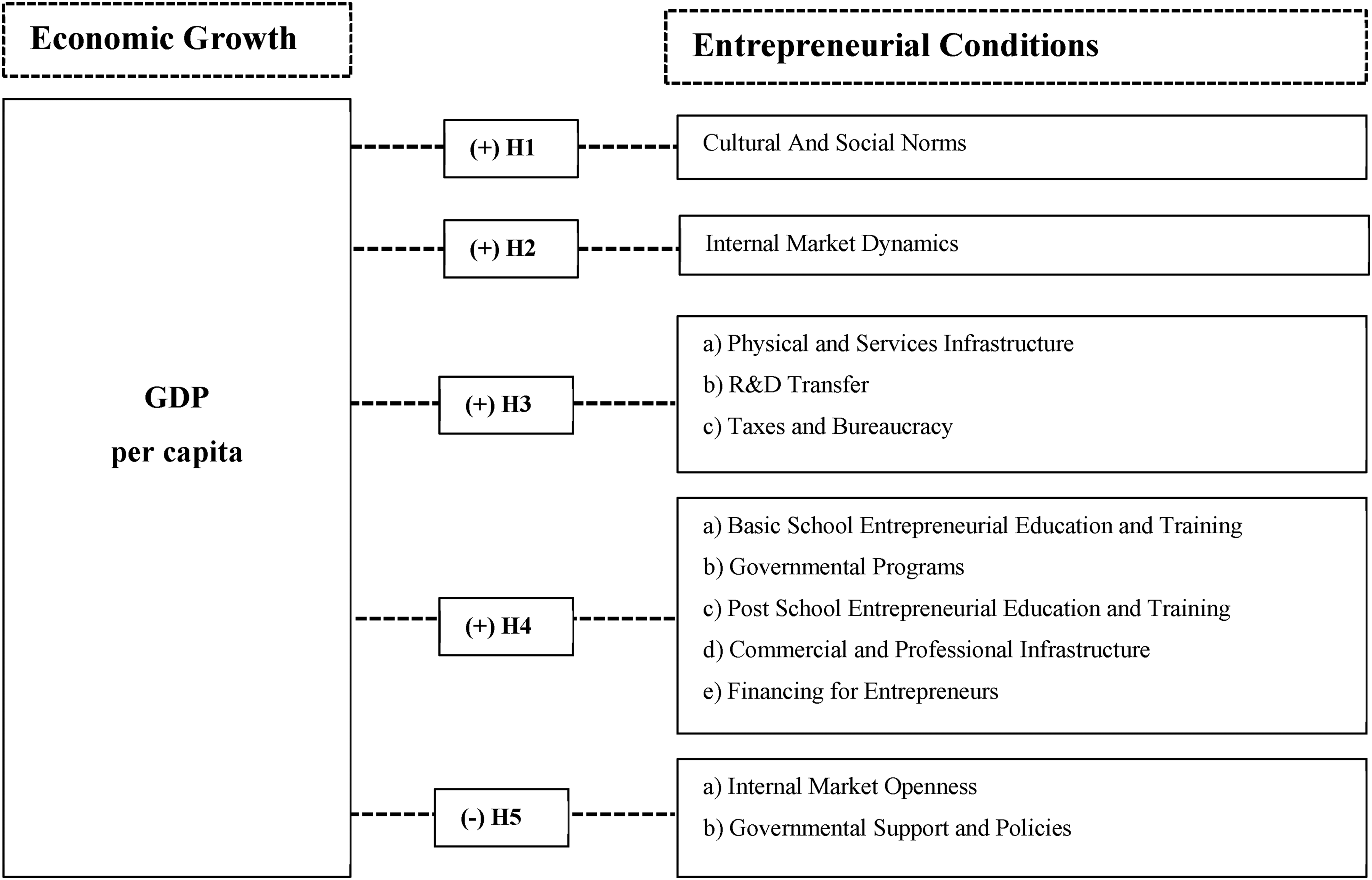
Research model.
Methodology
Sample and data
The study sample includes a total of 37 OECD countries. The choice of OECD member states stems from the availability of data on each country for each of the research model variables (Leković and Marić (2015). To classify countries by their level of income, we applied the new classification from the World Bank based on Gross National Income (GNI) per capita in current USD, using the Atlas Method Exchange rate, subject to review on 1 July 2021 based on 2020 GNI per capita (Hamadeh et al., 2021). This criterion divides the economies according to their GNI per capita into four groups: Low income (< $1046); Lower-middle income (between $1046 and $4095); Upper-middle income (between $4096 and $12,695) and High income (> $12,695).
Consequently, the OECD member state classification divided two groups (Table 1): Upper-middle income (Turkey, Mexico and Colombia) and High income (the remainder). The presentation of this classification first took place in 2020 based on GNI per capita from 2019. We may report that no country changed its position in the groups between 2019 and 2020 (Hamadeh et al., 2021).
Classification of OECD members by income level.
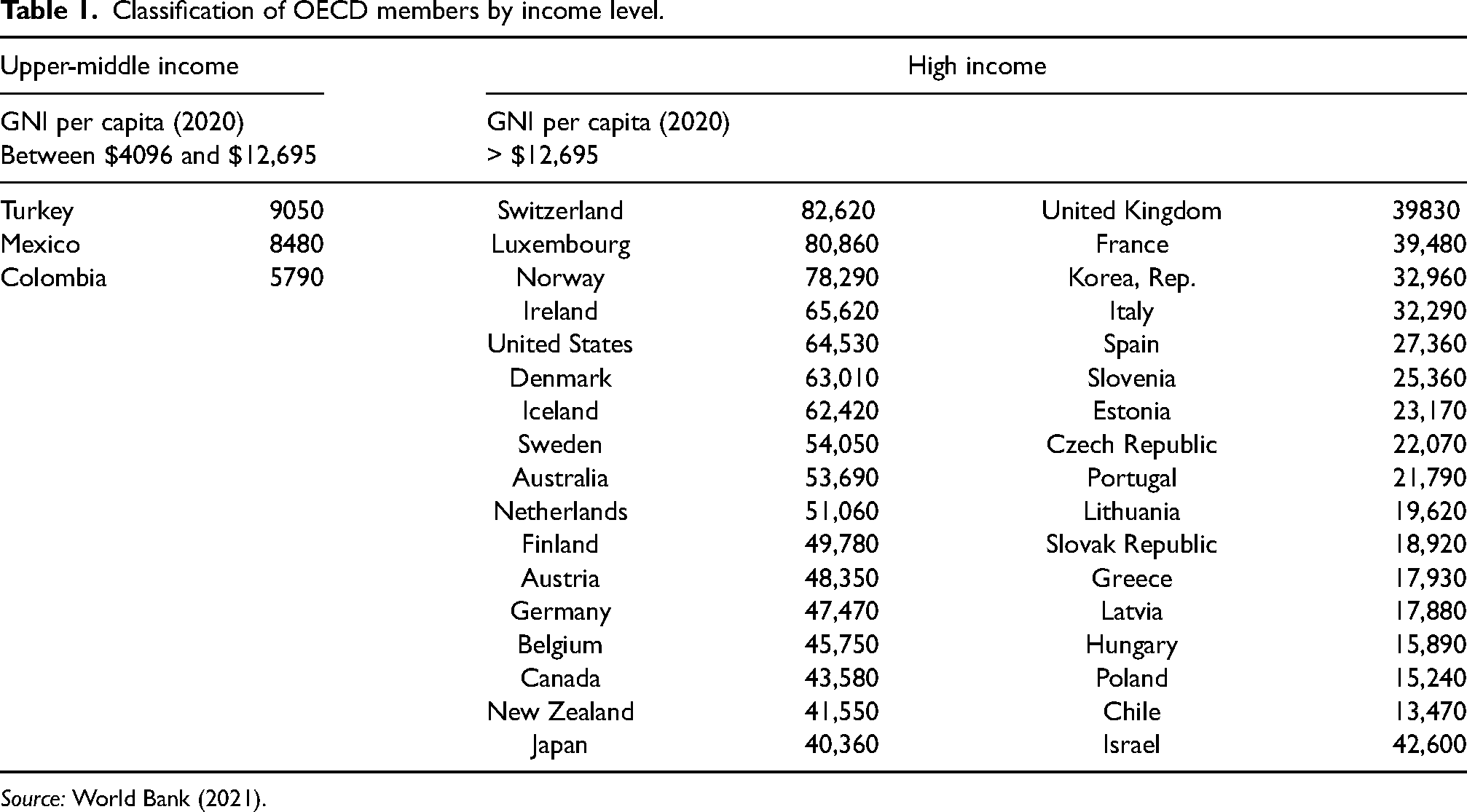
Source: World Bank (2021).
Measurement
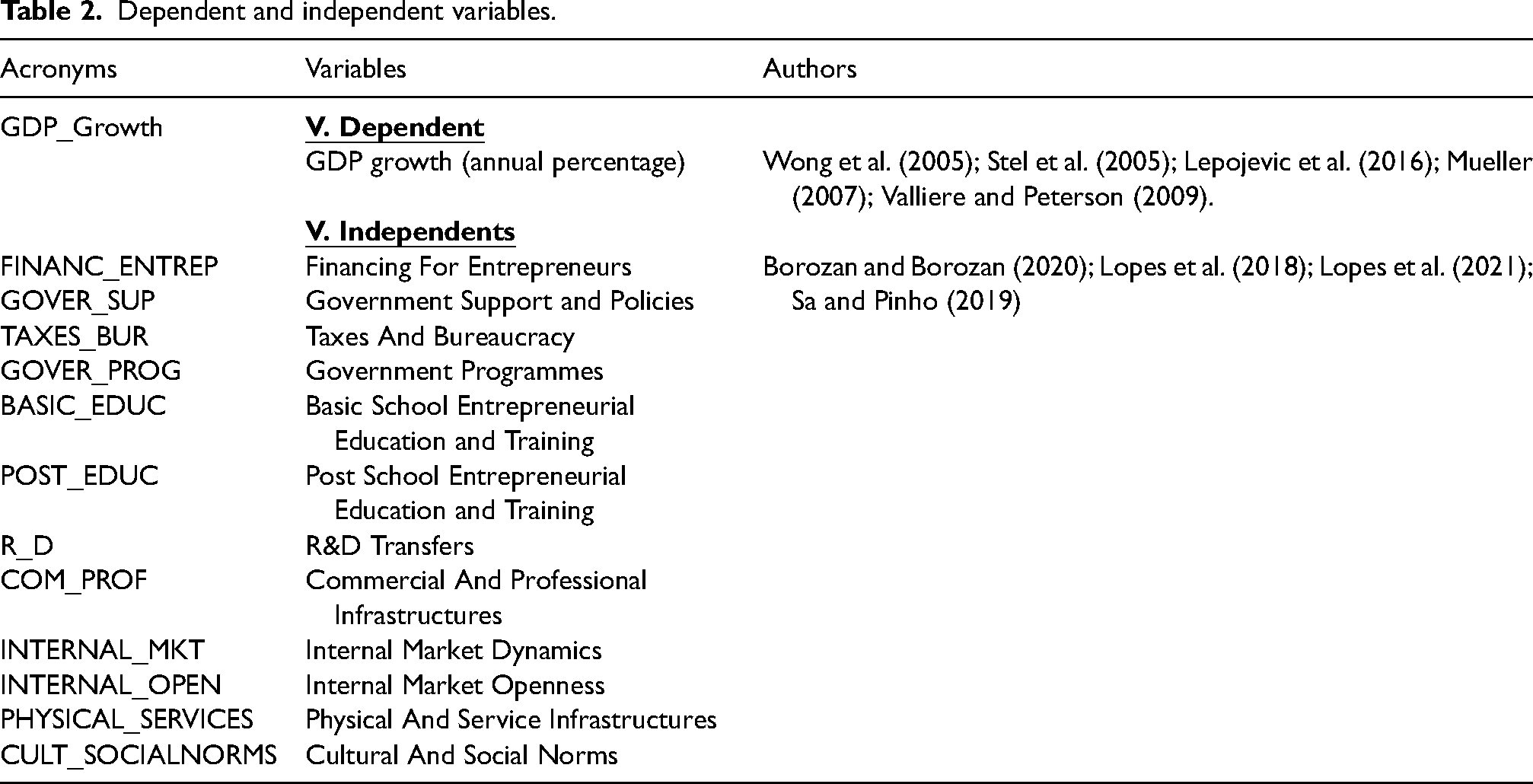
Given the main objective is assessing the influence of EFCs on economic growth in OECD countries according to the two income levels – Upper-middle income and High income, we measured economic growth by GDP growth (annual percentage) as reported by the World Bank (2021)[1] in accordance with that proposed by Wong et al. (2005), Stel et al. (2005), Lepojevic et al. (2016), Mueller (2007) and Valliere and Peterson (2009).
Thus, GDP growth (annual percentage) constitutes the dependent variable. The EFCs (independent variables) came from the National Expert Survey of the Global Entrepreneurship Monitor (GEM, 2021b) 1 . We applied the 12 indicators provided (Table 2) in accordance with Lopes et al., 2018; Lopes et al., 2021; Borozan and Borozan, 2020; Sa and Pinho, 2019.
Dependent and independent variables.
GEM provides data covering many consecutive years, updated annually and standardised to enable comparisons among the different countries (Reynolds et al., 2005; Sitaridis and Kitsios, 2020). Furthermore, GEM also contains a diversified set of indicators, as is the case with the EFCs applied in this study to the detriment of a single ranking, which enables empirical studies and allowing stakeholders to reach various conclusions (Sitaridis and Kitsios, 2020).
The EFCs foster the emergence of complex interconnections among the actors participating in entrepreneurial ecosystems, which, in turn, drives increasingly entrepreneurial societies (Hechavarría and Ingram, 2019).
Method
We constructed a panel data set with these variables covering the period 2000–2020 with the sample consisting of a total of 459 observations. The number of observations depends on the data available in the database sources. The subsample defined for upper-middle income economies contains 39 observations for its countries, as detailed in Table 1, and with the high-income economies subsample including 420 observations.
First, we carried out statistical analysis of the variables deployed, undertaking a statistical description of the variables in terms of their mean, maximum and minimum values and standard deviation for all OECD countries before presenting and comparing the means of these variables for the upper-middle and high-income OECD economies. Next, we deployed correlation analysis to study the dependent and independent variables and assess the multicollinearity between variables (Greene, 2020) in addition to performing panel data stationary analysis.
Finally, our data constitute an unbalanced dynamic longitudinal panel and to control for possible endogeneity and unobserved heterogeneity, we applied the Generalised Method of Moments (GMM) estimation method with fixed cross-section and cross-section weighting instruments (Greene, 2020; Hall, 2005; Wooldridge, 2001). Then, in accordance with the GMM method, we estimated three econometric models for the different groups of countries (model 1 – all OECD economies, model 2 – Upper middle-income OECD economies and model 3 – high-income OECD economies).
Equation 1 defines the influence of the EFCs on economic growth:

Results
Table 3 displays the descriptive statistical analysis of the dependent and independent variables applied in this study.
Statistical description of the variables for OECD economies.
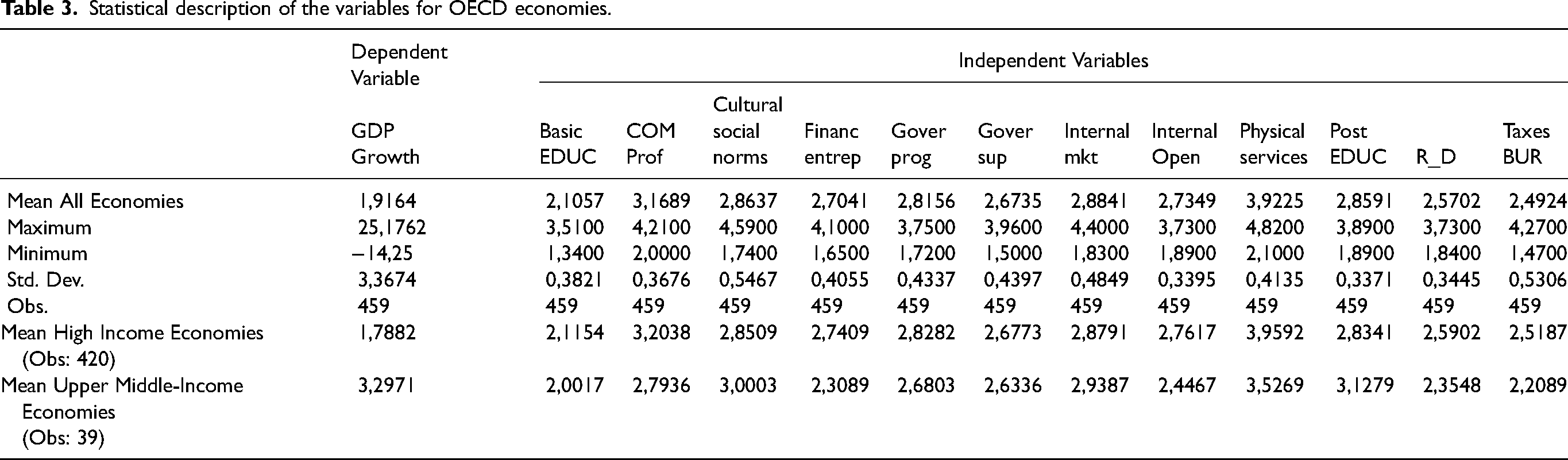
Comparing the means returned by the (dependent and independent) variables for the upper middle-income and high-income OECD economies (Table 3), we may observe that, on average, the variables return higher values in more developed countries (high income), with the exception of GDP growth (1.79 vs 3.30), cultural and social norms (2.85 vs 3.00), internal market openness (2.88 vs 2.93) and post school entrepreneurial education and training (2.83 vs 3.13).
Table 4 displays the matrix of correlations among the variables demonstrating how there is no high correction levels among the variables (< 0.50); thus, the estimated models do not incur multicollinearity problems.
Correlation matrix.
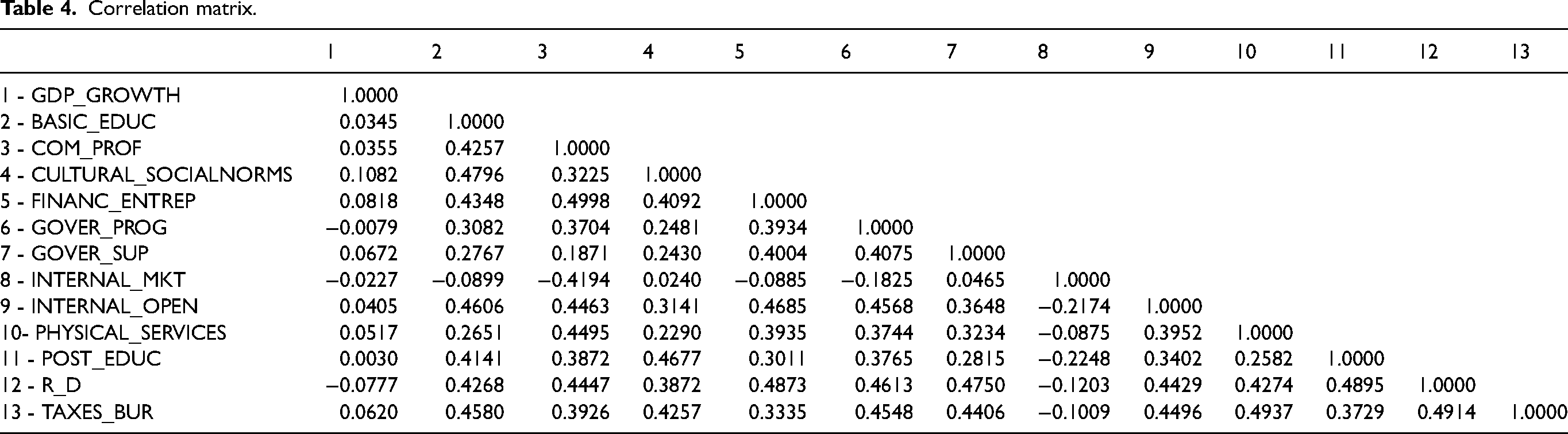
Table 5 details the panel data stationary analysis, and we may conclude that the data in our sample are stationary for mean stationarity at 1%, 5% and 10%.
Panel unit root tests.
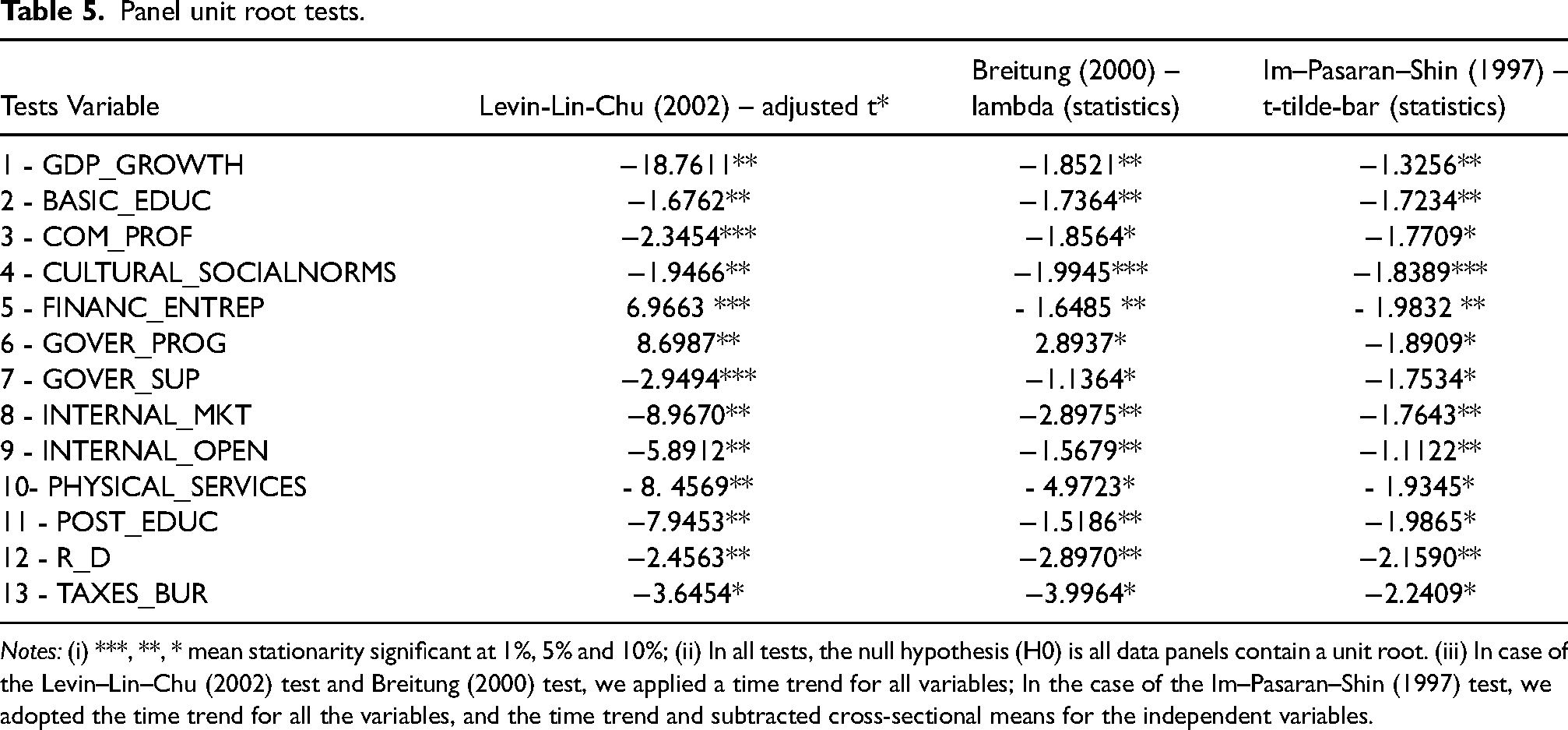
Notes: (i) ***, **, * mean stationarity significant at 1%, 5% and 10%; (ii) In all tests, the null hypothesis (H0) is all data panels contain a unit root. (iii) In case of the Levin–Lin–Chu (2002) test and Breitung (2000) test, we applied a time trend for all variables; In the case of the Im–Pasaran–Shin (1997) test, we adopted the time trend for all the variables, and the time trend and subtracted cross-sectional means for the independent variables.
Table 6 details the estimation results for the three models (model 1 – all OECD economies, model 2 – High-income OECD economies and model 3 – Upper Middle-income OECD economies).
Results of GMM estimation. Dependent variable: GDP growth.
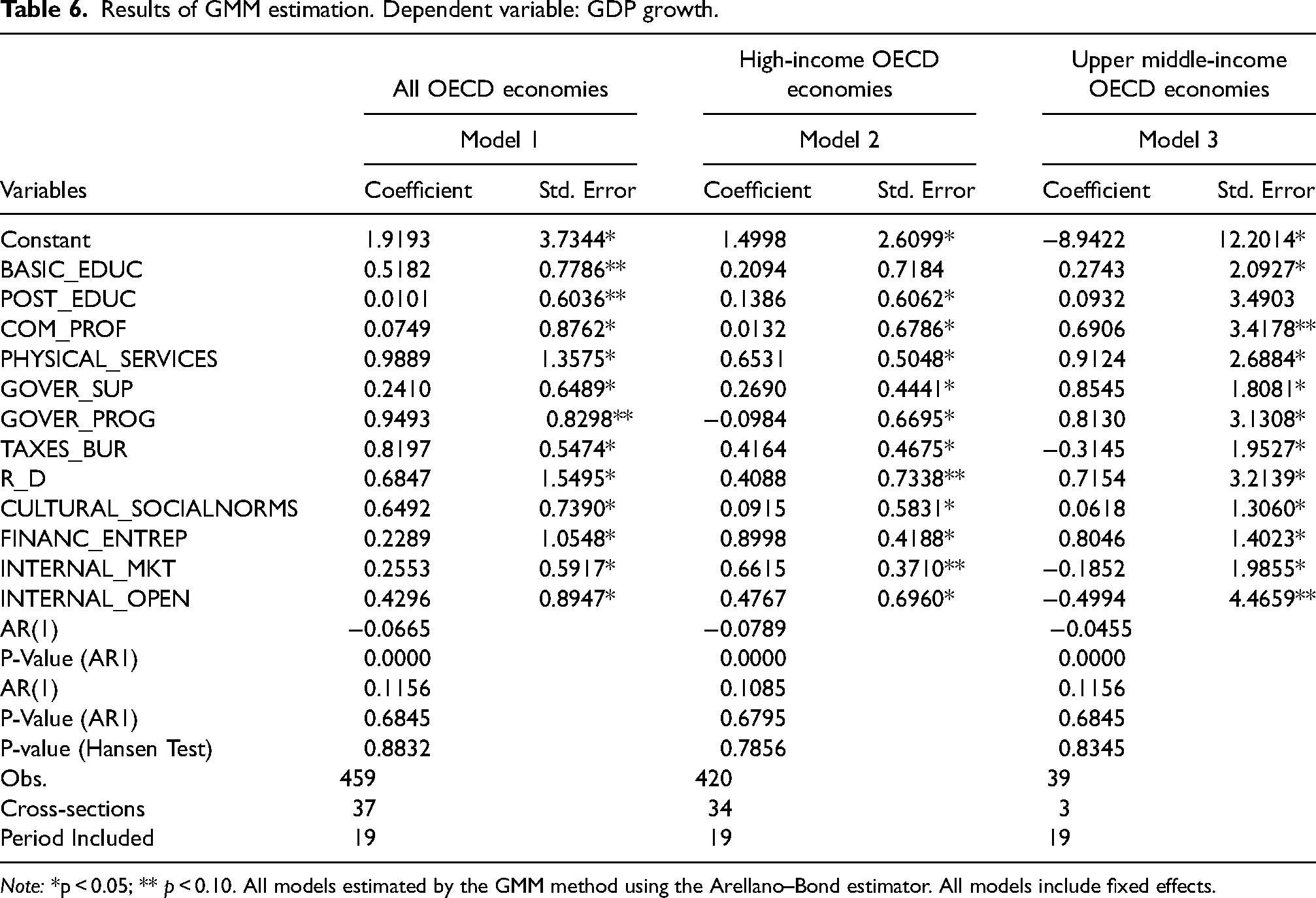
Note: *p < 0.05; ** p < 0.10. All models estimated by the GMM method using the Arellano–Bond estimator. All models include fixed effects.
In model 1 for all OECD countries, all variables are statistically significant for p < 0.05 and p < 0.1. In model 2 for High-income economies, the basic school entrepreneurial education and training variable is not statistically significant to explaining economic growth in these economies. Finally, in model 3 of upper-middle-income economies, the variable post-school entrepreneurial education and training education does not attain statistical significance for explaining economic growth. Table 6 presents the p-values AR(1) and AR(2). As the p-values of AR(1) are less than 0.10, we reject the null hypothesis that there is no autocorrelation of the error terms for a significance level of 0.10. The AR(2) test allows for detecting levels of autocorrelation and validating the quality of the GMM estimator (Mileva, 2007).
Thus, as the p-value AR(2) is greater than 0.10 (Lahouel et al., 2019), we conclude that there is no second-order autocorrelation in the three models. The Hasen test also served to assess the quality of the instrumental variables (Hayashi, 2011). As the p-values are greater than 0.10, the models are well specified, and there is no evidence for rejecting the validity of the instrumental variables applied in the regressions.
Basic and post school entrepreneurial education and training positively affect the economic growth of OECD countries irrespective of their income levels (basic school: β = 0.5182; post school: β = 0.0101). Basic entrepreneurship education is positive and significant in explaining the economic growth of upper-middle-income economies (β = 0.2743) but fails to attain significance for the economic growth of high-income economies. Thus, the statistical results reject hypothesis H1a: High levels of basic entrepreneurial education and training positively influence the economic growth of countries irrespective of their income levels, although the magnitude of their effect is more intense in upper-middle economies.
In contrast, post-entrepreneurial education is not significant in explaining the economic growth of upper-middle-income economies while positively influencing the economic growth of high-income economies (β = 0.1386). This therefore runs counter to hypothesis H1b: High levels of post-school entrepreneurial education and training positively influence the economic growth of countries irrespective of their income levels, although the magnitude of their effect is more intense in high-income economies.
The commercial, professional, physical and service infrastructures positively boost the economic growth of OECD countries irrespective of their levels of income (commercial and professional infrastructures: β = 0.6906; physical and service infrastructures: β = 0.9889) even though their effect is greater in upper-middle-income economies (commercial and professional infrastructures: β = 0.6906; physical and service infrastructures: β = 0.9124). This confirms H2: Appropriate entrepreneurship support infrastructures at the commercial, professional, physical and service levels positively influence the economic growth of the countries, with their effect most intense in upper-middle economies.
Regarding government involvement, government support and policies provide a positive boost to the economic growth of OECD countries, irrespective of their income levels (government programmes and policies: β = 0.9493; government support: β = 0.2410). However, government programmes return a negative effect on the economic growth of OECD countries when approached in terms of high-income economies (β = -0.0984) and a positive effect in upper-middle-income economies (β = 0.8130). On the contrary, taxes and bureaucracy provide a positive boost to the economic growth of OECD countries when jointly considered (β = 0.8197) and in high-income economies (β = 0.4164) and a negative effect in upper-middle-income economies (β = -0.3145). Therefore, hypotheses H3a: Government programmes, policies, and support for entrepreneurship positively influence the economic growth of the countries, with their effect most intense in upper-middle economies and H3b: High levels of taxes and bureaucracies imposed on entrepreneurial activities negatively influence the economic growth of the countries, with their effect most intense in upper-middle economies do not receive any statistical confirmation.
The R&D variables of knowledge transfers, cultural and social norms and financing entrepreneurs produce positive effects on the economic growth of OECD countries irrespective of their income levels (β = 0.6847). The influence of R&D transfers on economic growth is more intense in upper-middle-income economies (β = 0.7154), while the influence of cultural and social norms is more intense in high-income economies (β = 0.0915). Regarding the influence of financing entrepreneurs on economic growth, its effect is greater in high-income economies (β = 0.8998) than in upper-middle-income economies (β = 0.8046). Thus, the following hypotheses are confirmed - H4: The ease of transferring R&D to entrepreneurial activities positively influences the economic growth of countries, with their effect most intense in upper-middle economies; H5: Culture and social norms that support entrepreneurship positively influence the economic growth of the countries, with their effect most intense in high-income economies; H6: Financial environments that support entrepreneurship positively influence the economic growth of the countries, with their effect most intense in high-income economies.
As internal market dynamics and openness generate positive effects on the economic growth of OECD countries when considered collectively and for high-income economies (β = 0.6615 and β = 0.4767, respectively), while returning a negative effect in upper-middle-income economies (β = -0.1852 and β = -0.4994, respectively), these results do not fully support hypothesis H7: A dynamic and open internal market environment positively influences the economic growth of the countries, with their effect most intense in high-income economies.
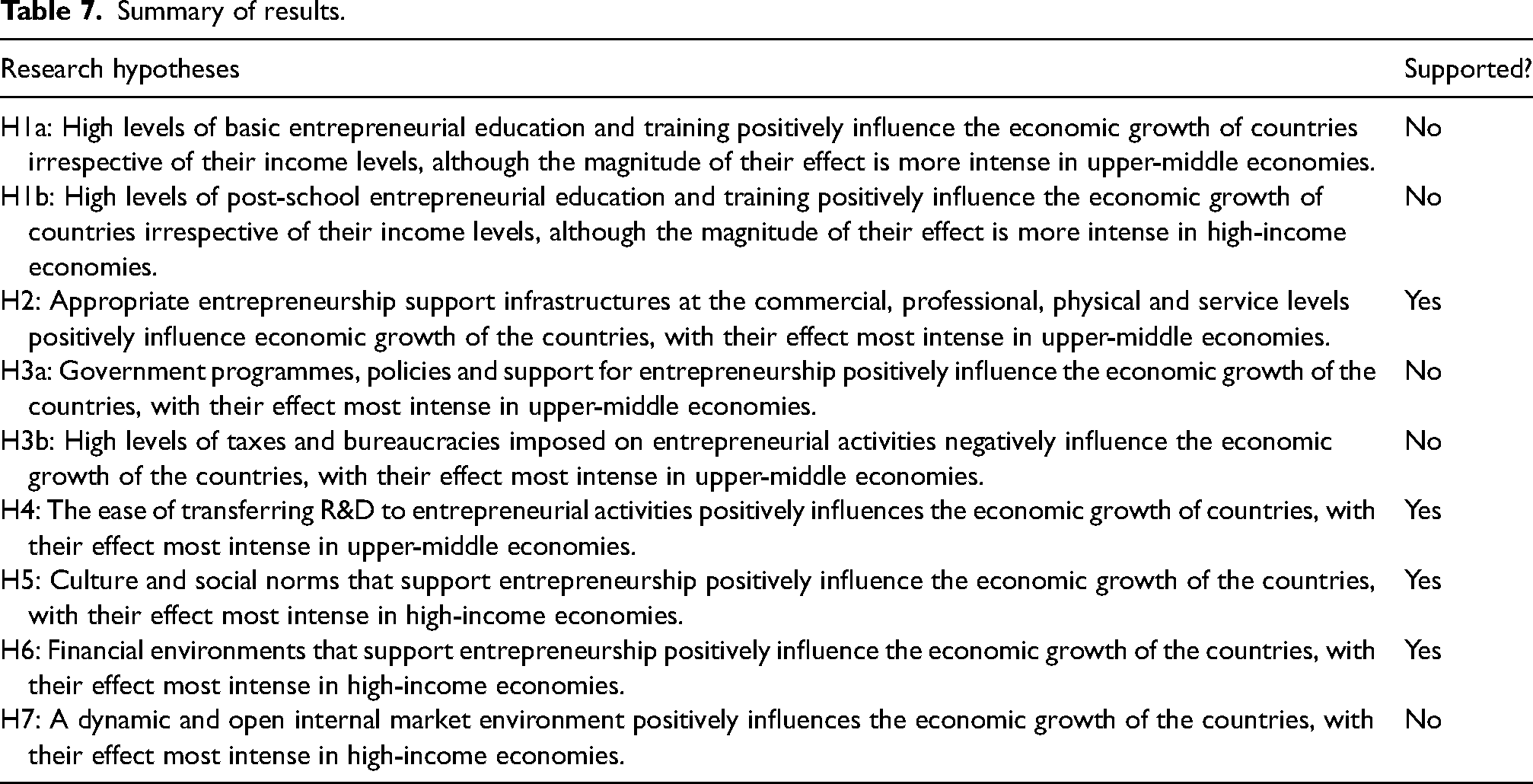
Table 7 sets out a summary of the results of the present study.
Summary of results.
Discussion
Academics and political decision-makers have recognised the importance of entrepreneurial ecosystems to economic growth (Spigel, 2017; Zacharakis et al., 2003). This paper demonstrates how important EFCs are to the economic performance of OECD member states with economies classed as either upper-middle or high-income. However, not all the EFCs significantly influence the performance of the economies studied. In addition, the stage in which the economies find themselves influences the impacts of entrepreneurial activity on economic growth, given the EFC endowment inherent to each economy (Doran et al., 2018). In high-income economies characterised by mature industrialisation and high per capita incomes, entrepreneurship arises from opportunities and is innovation based (Ahmad and Xavier, 2012). The existing EFCs in this type of economy naturally favour entrepreneurial activities. However, in upper-middle economies, industrialised but without a mature industrial structure, entrepreneurial activity still arises out of necessity. In these types of economies, EFCs still remain weak, and as such, improvements to EFCs feed through more quickly into the promotion of entrepreneurial activities and long-term economic growth (Guerrero et al., 2021). According to Bosma et al. (2018), institutional variables positively shape the production of entrepreneurship and thereby enhance economic growth.
We report here that both commercial and professional infrastructures and physical and service infrastructures return positive effects on the economic growth of both types of economy. According to Lee et al. (2011), when commercial and professional infrastructures are available and functioning effectively, this facilitates the emergence of new businesses. In turn, the physical and service infrastructures play a fundamental role in entrepreneurial activities (Ács et al., 2014). Indeed, according to Ghani et al. (2014) and Urbano et al. (2020), the absence of such infrastructures may create a barrier to launching new companies in poorer economies contrary to the situation generally prevailing in richer countries. However, when poorer economies have adequate commercial and professional and physical and service infrastructures, their impacts on entrepreneurial activities are more intense than in high-income economies.
Government support holds a positive effect for economic growth in both types of economy. The relationship between government support and entrepreneurship does not achieve any consensus in the literature as different social and political contexts (Hechavarría and Ingram, 2019) may drive different levels of economic growth. Furthermore, while government programmes provide positive effects in upper-middle-income economies, there is a negative effect on high-income economies. Our results portray a new scenario, given that some of the literature proposes that government programmes and support targeting entrepreneurship fall short when we compare poorer countries with their richer counterparts, which may hinder economic growth (Chowdhury et al., 2019; Delmar and Shane, 2006). On the contrary to government programmes, taxes and bureaucracy create a negative effect in upper-middle-income countries but this turns positive in the case of high-income economies. In the study by Hechavarría and Ingram (2019), which spans 75 countries (e.g., Colombia, Mexico, Switzerland, Norway), the authors conclude that government programmes impact negatively on entrepreneurship, with one of the reasons identified being the bureaucracy associated with government support programmes (Hechavarría and Ingram, 2019). Ács and Amorós (2008) carried out a study on Latin America, thereby including Colombia and Mexico (upper-middle-income economies), asserting that government interventions cannot only focus on taxation as bureaucracy and other regulations impose barriers to entrepreneurial activities and economic growth.
We may also report that R&D transfers positively boost both types of economy. Hence, we can affirm that entrepreneurial opportunities are created by organisations investing in knowledge, which leads to growth in both industries and economies (Baumol and Strom, 2007). In turn, Braunerhjelm et al. (2010), in a study covering 17 OECD member states, which only included countries classed as high-income economies (e.g., Italy, Australia, Canada, Belgium), state that growth is dependent on the agglomeration of knowledge as well as its dissemination through means of entrepreneurial actors and activities. In addition, these authors indicate entrepreneurs as the means for converting knowledge into economically relevant knowledge (Braunerhjelm et al., 2010). In poorer economies, the transfer of R&D tends to be more reduced because, for example, they do not have structures that accelerate this transfer, such as incubators. However, in this type of economy, transfers of R&D fall short as only when there are a high levels of entrepreneurial absorption will their effects on entrepreneurial activities and economic growth be positive and more intense (Kirschning and MrozewskinAff, 2022).
As regards the cultural and social norms and financing of entrepreneurs variables, we encounter positive effects in both types of economy, although the effect is more intense in high-income economies. Hechavarría and Ingram (2019) and Guerrero et al. (2021) maintain that the culture and norms of social acceptance of entrepreneurial activities positively influence both entrepreneurship and economic growth. In high-income economies, a favourable culture prevails for entrepreneurship, namely innovative and opportunity, while in poorer economies, entrepreneurship arises out of necessity, often due to the lack of alternative employment, without a true pro-entrepreneurial culture (Guerrero et al., 2021). Furthermore, Brown and Earle (2017), in a study undertaken in the United States, state that restrictions on financing entrepreneurial activities constitute a barrier to the launching, development and survival of new companies. Hence, the greater the ease of access to sources of financing for entrepreneurs, the greater the level of economic activities expected to lead to economic growth (Howell, 2019; Leitch et al., 2018).
Finally, the internal market dynamics and internal market openness generate negative effects on economic growth in upper-middle-income economies while generating a positive boost in high-income economies. These results are new given that studies approaching these two variables by economic type are scant and unable to identify patterns according to the type of economy (upper middle and high-income economies). Generically, the greater the level of market dynamism, the higher the rate of entrepreneurship that normally occurs in economies with higher incomes (Carter and Jackson, 2020; Lopes et al., 2018). Thus, dynamic markets are associated with higher rates of entrepreneurship (Klepper and Sleeper, 2005; Urbano et al., 2019). In addition, a study by Delmar and Shane (2006) in Sweden (a high-income economy) references how the market experience of teams raises the likelihood of survival of new ventures and their sales. Wyrwa (2020), following a study in Poland, states that the internal market is absorbent and fosters dynamic economic growth. Still furthermore, Fuentelsaz et al. (2015) maintain that the greater the freedom there is for new companies to enter markets, the greater the probability of positively influencing opportunity entrepreneurship and, consequently, economic growth.
Theoretical and practical implications
This study incorporates entrepreneurial ecosystems theory, which is relatively recent, with scarce studies taking into consideration the new World Bank classification of economies. Hence, this paper contributes by applying this theory to upper-middle and high-income economies. The objective was not to identify the key strengths and weaknesses of national entrepreneurial ecosystems but rather to put forward recommendations to political decision-makers regarding the means of stimulating entrepreneurial activities and economic growth. The GEM theoretical model, by norm, assumes that the better the state of the EFCs, the greater the likelihood of entrepreneurs holding the capacity to successfully develop their initiatives and positively contribute towards economic growth (Herrington and Coduras, 2019), in a position demonstrated by this present study in the case of upper-middle- and high-income economies.
In general, in both types of economy (high-income and upper-middle-income), the strategies and policies concerning commercial and professional infrastructures, physical and service infrastructures, R&D transfers, cultural and social norms, and financing entrepreneurs should be maintained, as they are making a positive contribution to the development of entrepreneurial ecosystems and economic growth. Therefore, to build and develop entrepreneurial ecosystems, government collaboration is essential. In general, governments should regulate and prevent corruption in public services to foster the conditions for universal financing, nurturing fair and appropriate regulatory environments and deploying the appropriate physical infrastructures and means of education (Madzikanda et al., 2021). According to Fatma et al. (2021), the psychological mentality can influence both economic performance and economic development. Nevertheless, the present study clearly finds that EFCs are relevant to upper middle and high-income economies. Thus, we may state that the institutional environment significantly influences entrepreneurship. We may affirm that entrepreneurial ecosystems are responsible for the success or failure of entrepreneurial ventures with repercussions for economic performance levels.
However, we also identified differences between high-income and upper-middle-income economies and the effects of some EFCs, such as basic school entrepreneurial education and training, post-school entrepreneurial education and training, government programmes, support and policies, taxes and bureaucracy, internal market dynamics and internal market openness. Therefore, we would recommend policy makers review their policies regarding these EFCs. Furthermore, we may tailor particular recommendations to policy makers in high-income and upper-middle-income economies.
As regards the policy implications for the upper-middle-income economies, political decision-makers need to focus on improving the policies in relation to post-school entrepreneurial education and training, taxes and bureaucracy, and the dynamics and openness of the internal market in order to accelerate economic growth. Post-school entrepreneurial education and training require accessible programmes on how to identify and leverage business opportunities and to launch firms for all potential entrepreneurs, regardless of their age or income (Borges et al., 2021). Therefore, these programmes need to be free for potential entrepreneurs to access and correspondingly requiring government support. The organisation of these programmes might involve local higher education institutions. Taxes and bureaucracy require enacting less burdensome employment legislation for small and medium-sized companies and stripping away unnecessary bureaucratic procedures. Therefore, simplifying and reducing the number of regulatory requirements for small and medium-sized companies need analysis and consideration (Herrington and Coduras, 2019).
Regarding the dynamics and openness of the respective internal markets, the political decision-makers need to boost their dynamism by raising the speed of change. This may result in a high rate of unpredictability in the prevailing environment that generates new and highly profitable opportunities for entrepreneurs. The political decision-makers may provide incentives and support for exploiting new endogenous resources (e.g., access to new endogenous resources for exploitation at low cost). Hence, changes in the market will enable entrepreneurs to allocate their resources through new and more productive combinations, which may result in relevant sources of entrepreneurial opportunities (Hechavarría and Ingram, 2019). In turn, the internal market dynamics and openness influence long-term economic growth (Klepper and Sleeper, 2005). Correspondingly, in upper-middle-income economies, the internal market dynamics have to change more swiftly to generate higher rates of entrepreneurial activities able to subsequently boost economic growth.
In the case of high-income economies, the political decision-makers need to focus on developing policies that improve basic school entrepreneurial education and training and government programmes designed to foster economic growth. Policymakers can implement basic school entrepreneurial education and training at the primary and secondary levels of their education systems through introducing either new subjects or new content in existing subjects capable of fostering entrepreneurship, creativity and innovation (e.g., information technologies, computer programming, artificial intelligence technologies). The higher the qualifications of workers and managers, the higher the productivity companies are able to achieve (Grossman et al., 2017). Therefore, investing in managerial capital may also increase company productivity rates (Dinopoulos and Unel, 2017), which then develops entrepreneurial ecosystems and economic growth. Regarding government programmes, companies, governments and citizens need to intensify their collaboration to create and develop entrepreneurial ecosystems that provide appropriate and enabling resources for entrepreneurial innovations (Madzikanda et al., 2021; Sitaridis and Kitsios, 2020). These government programmes require adapting to provide the conditions that ensure entrepreneurs feel better protected in relation to their innovations. Hence, restructuring national policies may reduce the risks of launching new companies. The quality of the government programmes made available needs to be deepened to respond to the effective concerns of potential entrepreneurs, which may result in the launching of more companies and, as such, greater economic growth.
Conclusions, limitations and future research
The primary objective of this study involved analysing the potential effects of EFCs on the economic growth of OECD member states, that is, on their national entrepreneurial ecosystems as measured by GDP growth. In general, the results demonstrate the importance of EFCs to economic performance even though their impacts may differ in accordance with the national income level. Thus, not all EFCs return similar influences on the economic growth of upper-middle and high-income OECD economies.
Studying the national entrepreneurial ecosystems according to the EFCs set out by GEM may return important insights into economic growth at the national level. The EFCs may serve as indicators for ascertaining the vitality of any national economy (Ács, 2006; Sitaridis and Kitsios, 2020), given how this framework combines the diverse cultural, economic, political and social facets of countries that serve to support the launching of innovative companies and thereby falling within the scope of entrepreneurial ecosystems theory (Walsh and Winsor, 2019). Hence, EFCs shape entrepreneurial activities, which, in turn, impact economic growth.
Limitations and future lines of research
This paper analyses business ecosystems at the national level, given that the data on the ecosystem factors were unavailable at the sub-regional level for every country in the sample. We here applied secondary data gathered from the World Bank and GEM. Furthermore, the study only includes upper middle-income and upper middle-income economies as OECD member states fall into these two economy classifications. However, future analysis might study the potential effects of EFCs on the economic growth of low-income and lower-middle income, thereby expanding the sample to another group of countries.
The number of countries constituting the sample of upper-middle-income economies and that these economies emerge as heterogeneous stem from the sample selection having to reflect the availability of data for each country across all of the selected variables. However, other studies might also consider other sources of data collection (e.g., the regional innovation scoreboard), which would enable the inclusion of other variables and thereby generate complementary results to this study.
As future lines of research, in the upper-middle-income economies, the results for the post entrepreneurial education variable were inconclusive. The same was the case for the variable for basic entrepreneurial education in high-income economies. New studies are necessary to analyse the potential effects of these two variables on economic growth.
In the case of upper-middle-income economies, other studies should adopt more specific measurements for the taxes and bureaucracy levied on launching new companies within the framework of business ecosystems (Hechavarría and Ingram, 2019). High-income economies require complementary studies on the specific types of government programme that nurture the launching of businesses and their real impacts on economic growth (Hechavarría and Ingram, 2019).
The results on internal market dynamics and internal market openness returned by the present study are new, with only scant literature existing. Hence, this requires further study in order to deepen the understanding of internal market dynamics and the facets of internal market openness generating negative economic effects in upper-middle-income economies but returning positive effects in high-income economies.
Footnotes
Acknowledgements
NECE-UBI, Research Centre for Business Sciences, Research Centre and this work are funded by FCT – Fundação para a Ciência e a Tecnologia, IP, project UIDB/04630/2020.
Declaration of conflicting interests
The author(s) declared no potential conflicts of interest with respect to the research, authorship, and/or publication of this article.
Funding
The author(s) received no financial support for the research, authorship, and/or publication of this article.
