



Abstract
The role of entrepreneurship in alleviating poverty has been extensively researched by entrepreneurship researchers and policy makers. The focus of this research has mostly been in the context of business, for example, the links between value creation leading and economic poverty amelioration. We believe that poverty is multidimensional and requires attention to detail. Similarly, we argue that entrepreneurship is more than an engine for economic outcomes; rather it is a process for socioeconomic value creation and change. Therefore, we approach entrepreneurship as a verb – ‘entrepreneuring’, an unfolding value process which points at the inherent processual character of entrepreneurship. We argue that entrepreneuring enables the context of poverty by creating different values. To understand its nuances, we explore the concept of ‘value’ in entrepreneuring that offers a means of escaping poverty. To do so, we conducted a qualitative narrative study of entrepreneurs in Khyber Pakhtunkhwa, in an impoverished part of northern Pakistan. This article initially reviews literature about entrepreneurship and poverty. Next, we propose a conceptual framework to understand how and why entrepreneuring happens in the context of poverty, and who is involved. Finally, we provide a theoretical framework as to how entrepreneuring creates values that allow individuals to enable the context of poverty.
Introduction
In today's world, about 655 million individuals live in extreme poverty (World Bank, 2018). Entrepreneurship has been suggested as part of the solution to alleviating poverty (Hussain et al., 2014). In its most abstract form, poverty is understood as living on less than 1.90USD a day, and entrepreneurship is a known engine for generating money, which translates to economic prosperity (Bruton et al., 2008; Hussain et al., 2014; Bruton et al., 2015b; Ribeiro-Soriano, 2017; Sutter et al., 2019). However, poverty is more than just a lack of money (Sen, 1999). Poverty is a multidimensional phenomenon and with this view, entrepreneurship as a solution may also provide different values. Therefore, in this study, we will explore different aspects of poverty and entrepreneurship. Our purpose is to explore how entrepreneurship results in alleviating multidimensional poverty.
Poverty has been defined and discussed on different levels of abstraction; sometimes the economic perspective is the most useful, while at others a broader understanding which views poverty as multidimensional is the most utilitarian (Sen, 1999). The argument that poverty is multidimensional is not new and is well recognized in the literature (Waglé, 2008). Studies focusing on the unidimensional economic understanding of poverty have investigated the possibilities of microfinance (Khavul et al., 2013; Chen et al., 2017); crowdfunding (Bruton et al., 2015a; Manara et al., 2018); entrepreneurship education (Hussain et al., 2014); access to bank loans and gender problems related to such access (Hussain et al., 2019); new venture creation and innovation (Si et al., 2020). Poverty is one of the main challenges of todaýs world (Roser and Ortiz-Ospina, 2017), and the first of UNs Sustainability development goals (UNDP, 2015); therefore, understanding the dynamics of poverty at greater depth requires investigation on a contextual level.
World Bank (2018) define multidimensional poverty as a measure of poverty that captures deprivation in as defined by education, well-being, and access to basic infrastructure in addition to the 1.90USD definition. Maasoumi and Lugo (2008) understand employment/unemployment as a dimension of poverty, while Alkire (2007) argues that dimensions of poverty include empowerment and agency, the ability to advance goals, physical safety and gender. Kabeer (2008) sees poverty as a phenomenon reinforced by gender inequality and unequal distribution of power and resources in specific cultural contexts. Some argue for a remediation perspective, where poverty is seen as something driven by scarce resources (Alvarez and Barney, 2014; Wu and Si, 2018); a reform perspective that views poverty through institutional voids (Sutter et al., 2019); or a social and plight perspective that takes into account economic, social and personal reasons, where change is impeded by difficulties in access and agency (Easterly, 2014; Si et al., 2015). There are many dimensions or perspective from which we can discuss poverty, but the definition of poverty used in this paper is that of a disabling condition; not a description of a condition, but rather a process. The dimensions we include are income (Belfield et al., 2017), lack of access to resources and opportunities (Philip and Rayhan, 2004), lack of education (Philip and Rayhan, 2004), gender inequality (Lustig and Stern, 2000), social exclusion (Kabeer, 2000; Blackburn and Ram, 2006, Mair et al., 2012; Smith et al., 2019a) and a person's right to engage in decision making (Kabeer, 2000), because these dimensions capture the essence of poverty in our empirical material.
Similarly, entrepreneurship is often discussed in economic terms. Seen in this light, entrepreneurship as a solution to poverty only works when the income of the poor is increased and businesses flourish. However, we know poverty is not only the lack of money and entrepreneurship is not only about making money. It has also been described as a change process that creates not only monetary value but different values (Anderson, 1998; Korsgaard and Anderson, 2011; Tobias et al., 2013; Refai et al., 2018). In 2007, Steyaert developed his ideas about ‘entrepreneuring’ emphasising the processual and the relational aspects, or in Anderson et al. (2012) words the ‘connecting’, of entrepreneurship. A process approach to entrepreneurship is relevant here as it focuses on how change happens over time and on its different outcomes (Van de Ven and Engleman, 2004). Therefore, in this study, we approach entrepreneurship as a verb; ‘entrepreneuring’ (Steyeart, 2007), and as an unfolding value process, highlighting the inherently processual character (Verduyn, 2015) of entrepreneurship. In addition, we connect with the contextual turn in entrepreneurship research (Welter, 2011; McKeever et al., 2015; Welter et al., 2019). Anderson et al. (2009) argued for the importance of social context, and as of late the intricacies of spatial context are often included (Müller and Korsgaard, 2018). Related to poverty, Rindova et al. (2009: 477) argue that entrepreneurship is about bringing change to social, institutional, and cultural contexts. Based on our inductive research work, we will, in particular, discuss entrepreneuring in three contexts: the social, the cultural, and the economic.
In our narratives, we saw how entrepreneuring in the context of poverty created different kinds of values (Anderson, 1998; Tobias et al., 2013; Refai et al., 2018; Colovic and Schruoffeneger, 2021). First, we saw how entrepreneuring enabled individuals to change their circumstances by creating different values, for example by equipping individuals to fight poverty directly, by educating children and providing them with skills. Interestingly, the impetus behind these ventures was often embedded in questions of personal fulfilment for these individuals, and they often emphasised internal values (Bylund and Packard, 2022; Gallowayt et al., 2019) that worked as a motivator (Bylund and Packard, 2022). For example, ‘I do this because I want to help people’ (Diochon and Anderson 2011), ‘I do this because I am obligated to help make society better’, or ‘because I am guided by my religion or by my moral compass’. Thus, these internal values mattered to entrepreneurs and helped explain their motivations.
Our enquiry stemmed from the study of entrepreneurs working on a very small scale in Khyber Pakhtunkhwa (KP), in impoverished northern Pakistan. According to Pakistańs multidimensional poverty index (MPI, 2015/16) (that includes education, health, and standards of living), poverty in KP falls at 49.5%. On the global gender gap rank score, Pakistan ranks 153 out of the 156 countries that were included (World Economic Forum, 2021). This makes KP an interesting place to study for this project. In addition, KP's local culture is characterized as both conservative and patriarchal (Lindvert et al., 2017; Roomi et al., 2018). The region is known for its conservative views about gender. Women are encouraged to stay at home while men are thought to be the breadwinners of the family. The key challenge for individuals is to be able to do what they want to do.
In order to understand entrepreneuring in the context of poverty, we talked to 17 local entrepreneurs, both men and women. They were all operating in poverty, but their own individual poverty was not visible in the same way as it was for other individuals in their community. Their economic, cultural and societal context constantly challenged them but did not stop them. Thus, we were intrigued by local individual's ingenuity in this particular context of poverty. These locals’ entrepreneurs did not focus only on economic value; they were often addressing specific local social issues. The very smallness and the simplicity of their actions allowed us to observe how and why entrepreneuring happens with more clarity and helped uncover important elements along the way, such as the concept of value in entrepreneuring (Colovic and Schruoffeneger, 2021).
Thus, in this article, we discuss poverty as an intricate mix of six elements that together make up the complex web of what poverty entails. We are interested in how change comes about in poverty and turn to theory about entrepreneuring as a value creating process to describe and offer ways out of poverty. Our research questions are:
How do individuals engage in entrepreneuring to create value? What motivates individuals in the context of poverty to do entrepreneuring?
The idea of engagement captures the idea of ‘process’. As Gaddefors and Anderson (2017: 270) puts it ‘It is not so much what entrepreneurs do, but the doing itself’. Therefore, in this study, we first review the poverty and entrepreneurship literature and the connections between them, and argue for a combined understanding of both concepts. We then examine what we know about entrepreneuring in the context of poverty and argue for a more elaborated understanding of the different kinds of values in entrepreneuring. Next, we describe our context and our approach, and finally, we propose a conceptual framework for understanding how entrepreneuring offers a means of escaping the disabling context of poverty.
Understanding entrepreneurship in poverty
It is argued that entrepreneurship presents a viable solution to global poverty (Bruton et al., 2013; Santos et al., 2022). Previous research has argued for subsistence entrepreneurship as a solution to reducing extreme poverty (Fischer, 2013; Viswanathan et al., 2014). Subsistence entrepreneurs, while living and operating in poverty, have focused mainly on economic value creation for the poor (Viswanathan et al., 2014). However, this unidimensional economic view limits understanding of the different kinds of output produced by entrepreneurship the context of poverty. Thus, our understanding of poverty is inspired by Seńs (1999) view that focuses on challenges beyond just the economic in the context of poverty. According to Sen (1999), poverty is the deprivation of capabilities; or, in other words, a constraint what individuals are able to do. Seen in this light, poverty is not merely what people do or do not possess, but rather what enables or prevents them from doing what they want or need to do. Our empirical material shows individuals immersed in poverty have a challenging time doing what they are able to do.
Multiple dimensions of poverty
Following the research by Sen on the ‘capabilities’ approach, Alkire and Foster (2011) and Grimm et al. (2016) argue that the lives of the poor are affected in many ways and all the issues around poverty are interconnected (see Figure 1)). Klasen and Waibel (2015) and Grimm et al. (2016: 22) see poverty as vulnerability. Philip and Rayhan (2004) studied this vulnerability and its relationship to poverty, and saw poverty as lack of access to education, resources, and opportunities. Others have argued that poor people define poverty in terms of a lack of opportunity, empowerment, and security (Lustig and Stern, 2000). Thus, these views increase the challenge of coming up with a comprehensive definition of poverty as both a term and a concept. Based on our review of poverty dimensions, we decided to include income (Jackman et al., 2021); a lack of access to resources and opportunities (Philip and Rayhan, 2004); a lack of education (Philip and Rayhan, 2004); gender inequality (Lustig and Stern, 2000); social exclusion (Blackburn and Ram, 2006, Mair et al., 2012; Smith et al., 2019a); and a person's right to engage in decision making (Kabeer, 2000). Our inclusion of these dimensions of poverty was empirically grounded; the six dimensions above were encountered in our review of the empirical material.
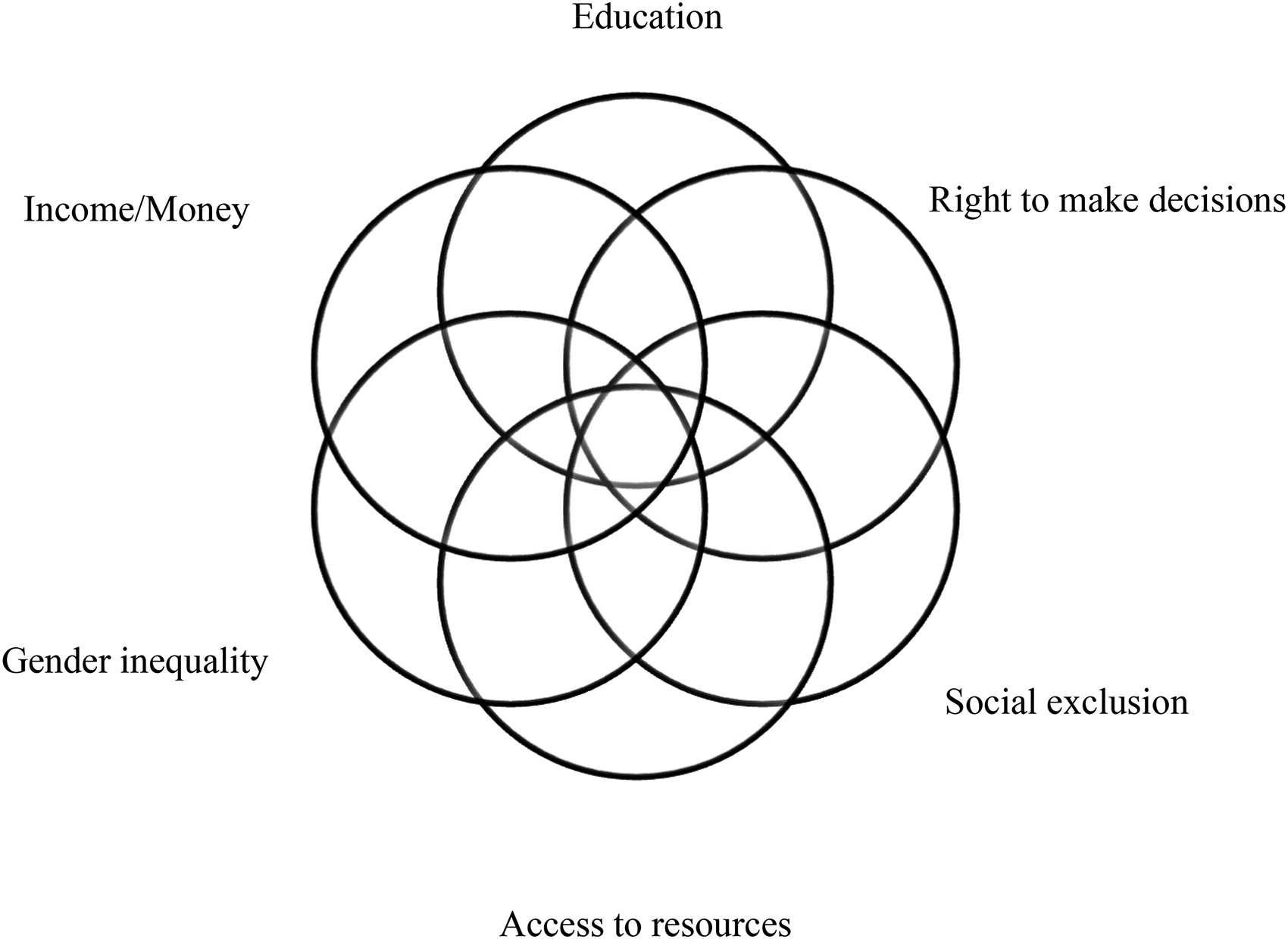
Multiple Dimensions of Poverty.
In our view poverty, in its essence, is many things. In Figure 1, we show how poverty has multiple dimensions and highlights its complexity. For example, the lack of money can decrease of likelihood of accessing education, and not having an education can result, in turn, in a lack of money. Thus, a person with a high income level may still be deprived in the sense of being illiterate, which cuts them off from the privileges that come with learning. A person with a high income level may still be deprived if they cannot make decisions in their own life, cutting them off from privileges of using money the way they want. In Figure 1, we highlight the ways in which an individual can be affected by more than one dimension simultaneously. Therefore, although unidimensional poverty measures are common and thus have the advantage of simplicity they may also deter us from considering all its aspects. Such an approach can work in some contexts, but cańt be applied to all situations, as lives can be impoverished in quite different ways.
Similarly, we argue that entrepreneuring contributes to understanding the lived actuality of mundane entrepreneurial endeavours (Steyaert, 2007). It is a complex, non-linear and open phenomenon (Nayak and Chia, 2011). We argue that the solution to poverty is not adding entrepreneurship, it happens when entrepreneuring engages (Verduyn, 2015) with poverty, disrupting the status quo and consequently creating value for change. Thus, entrepreneuring in poverty becomes more like wayfinding, in which individuals are trying to find ways to escape the disabling context of poverty, and draw from their social context using local resources (Baker and Nelson, 2005) that result in different values for the poor (Colovic and Schruoffeneger, 2021). In essence, we can see entrepreneuring as the creation and extraction of value from a situation (Anderson, 1998), with a focus on creation (Steyaert, 2007). Yet again, value is a much richer concept and can be social, economic (Smith et al., 2019b), or social, with economic outcomes, like in a social enterprise (Chell et al., 2010). Indeed, we can understand these different values as addressing different dimensions of poverty. We believe it may be conceptually possible to understand entrepreneuring as tackling several dimensions of poverty. Income improvement is the obvious immediate solution, but we also need to understand other processes involved in this. Thus, entrepreneuring may address several issues or aspects that constitute how poverty operates.
Our processual stance and the logic of value helps clarify the reasoning behind entrepreneuring in poverty. The context, especially that surrounding poverty, offers us an extreme case to highlight processes. Our narratives show how entrepreneuring is, or can be better understood, as change-making and is not determined by conventional resource availability, or ‘entrepreneurial entrepreneurship’. While our study is contextually-bound, the conceptual contribution of understanding entrepreneuring is generalizable to other circumstances. Essentially, we propose that a conceptual value framework allows a fuller understanding of the entrepreneurial process in its myriad formulations and its multiple contexts.
Contextual turn
Dana (1995) has emphasized on the importance of understanding entrepreneurship in its context. The concept was further highlighted by Zahra (2007), Welter (2011), Zahra et al. (2014), Welter and Gartner (2016) and Welter et al. (2019) where it is argued that the context in which entrepreneurship occurs in important. Understanding context helps lead to answer the where, when and how of entrepreneurship (Welter, 2011; Welter et al., 2019). Context is complex and multidimensional. The notion of context encompasses spatial, temporal, business, social and institutional dimensions (Welter, 2011). Again, we revisited our empirical material and the contexts that were most relevant to our aim were the cultural, the societal and the economic. Based on our understanding of entrepreneurship as contextually dependent, and poverty as multidimensional, we combined the two theoretical concepts. We categorised the six poverty dimensions into three contexts (see Figure 2).
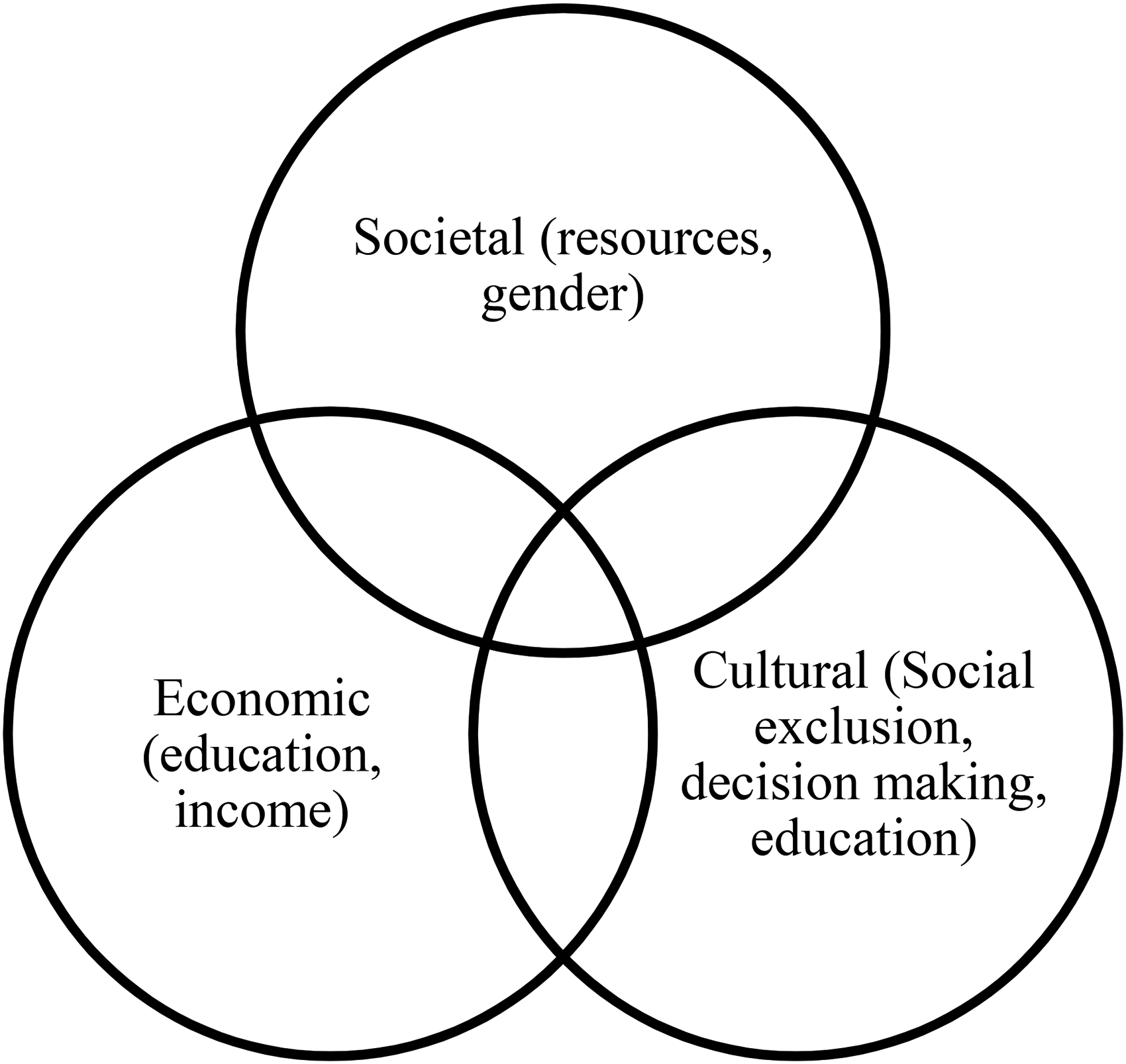
Three contexts related to six dimensions of poverty.
Depending on the empirical situation these dimensions can be further combined into alternative patterns. Here, we want to illustrate how individuals are part of this process and influenced by the interplay of its social, cultural and economic contexts. In this context, individuals can be societally, culturally and economically deprived. Some can be deprived in one context, in two contexts, or in the centre of the figure, and thus extremely marginalised. Thus, this presents a high degree of complexity for entrepreneuring in poverty; local poverty combinations with a different balance over time between the six dimensions will require different combinations of values produced from entrepreneuring.
Context of the study
The choice of poverty dimensions is sensitive to context, in particular to the characteristics of the country under study. Clarifying the unit of analysis – the individual, the process or the place – helps to sharpen the descriptions. Yet they may also limit our understanding of that context. Put differently, being poor in Pakistan may be different from being poor in Nigeria. Pakistan is the fifth most populated country in the world (UN World Populations, 2019). It has faced multiple sources of internal and external conflicts. The region recently won their battle (which lasted more than a decade) against terrorism at the cost of 50,000 deaths and two million displaced people. While the incidence of terrorism has been reduced, poverty has grown (Muhammad et al., 2017). Pakistan is one country in Asia that has experienced less poverty reduction, compared to others over the last 35 years (Bruton et al., 2013). Pakistan is facing extreme poverty; at least as defined by the socioeconomic aspects of poverty (Saleem et al., 2021).
Pakistańs traditional roots, culture and social beliefs collectively dictate the role gender plays in the country (Roomi et al., 2018; Anderson et al., 2019). For example, the social system of Pakistan allows men to control women's lives because gender forms one of the fundamental aspects of its society (Roomi et al., 2018). The social importance of gender is decided by a patriarchy that is ingrained in the traditional and cultural foundations of the area; thus, women are restricted in private domains and relegated to the role of reproduction, whereas men are held to be bread earners in the public domain (Muhammad et al., 2017; Roomi et al., 2018). It is important to note that society is diverse and holds contradictory views with no consensus as to a definition of women's rights.
Pakistańs official report on multi-dimensional poverty (which includes education, wage, health and living conditions) shows that 39% of Pakistanis live below the poverty line (MDPI, 2015/16), while poverty in Khyber Pakhtunkhwa (KP), one of the four administrative provinces of Pakistan, stands at 49%, or almost half of the population. Pakistan ranks 146th out of 180 in the multidimensional poverty index (the index included health, education and economic indicators) (Shirazi and Obaidullah, 2014). Early-stage entrepreneurial activity is lowest in the region at 1.2% for women and 21.27% for men (GEM, 2012) indicating a clear gender gap. A survey by the Government of Pakistan (2013–2014) showed that women'ś entrepreneurial activity in KP is only 0.1%. The region is known for its conservative principles regarding women which were further influenced by the Taliban (terrorist groups). These terrorist groups limited women's participation outside of the home and instilled corruption at every level of government (Owais et al., 2015). We can thus identify how several dimensions of poverty and its consequences prevail in KP. Therefore, KP offers us a rich site for examining poor entrepreneuring as a socially-situated process that may arise from different kinds of motivation and different kinds of generated values.
Method
We adopted a qualitative methodology, as there is a shortage of conceptual work on entrepreneuring, especially when we consider the specific context of poverty. In such situations, qualitative methodologies are useful as they allow for the emergence of new insights from the empirical material. This helps explain the subtleties and nuances of this context; our contextual approach is indeed inherent to our studies (Welter, 2011; McKeever et al., 2015). We considered the stories that the entrepreneur tells about themselves and their ventures. Such stories are often used to legitimize what they are doing (Johansson, 2004), so accessing them enabled us to interpret how these narratives informed the entrepreneurial process.
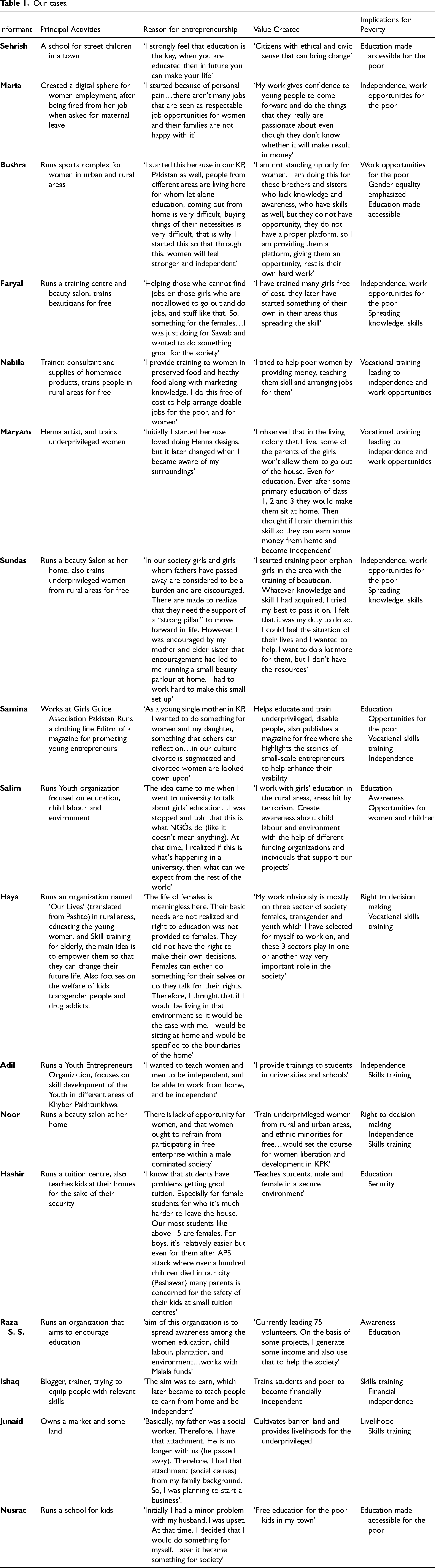
We collected in-depth life stories from 17 self-declared entrepreneurs (Table 1, see Appendix), both male and female, working in the region of Khyber Pakhtunkhwa, Pakistan. We used a snowball sampling technique (Patton, 2014) to locate our interviewees. Most of them, especially the women, started out as home-based endeavours, and many still are. Eight of the participants have now moved on to commercial arenas with government-registered setups, while the rest remain unregistered with the government and thus have an informal establishment. The first author collected in-depth life stories (McAdams Dan, 1995) from our self-declared entrepreneurs through face-to-face interviews. The interviews were conducted in their native languages; Pashto and Urdu. The researcher who is native to the area, transcribed the interviews into English. To express what the interviewees experienced they needed to be able use their native language, as they were not well versed in English. So having the interviews take place in their native language was a methodological necessity. The empirical material was gathered during 2017–2019, at different points in time. The researcher interviewed the informants three times and followed them on media platforms. Table 1 provides a brief description of the informants. To maintain the anonymity and confidentiality of the respondents, we have used pseudonyms (Guenther, 2009).
We analysed the narratives from the field and looked at the narratives through a constructionist lens, thus allowing us to interpret the interactions between the self-declared entrepreneurs and their social contexts (Czarniawska, 2004). The data is analysed through the constant comparative technique, which involves continuous iteration between data and theory (Jack et al., 2015). We first reviewed the empirical material in situations presented by the material, thus comparing interviews from the same person at different times and comparing different informants within and between different situations. Codes were assigned to the empirical material, which were also compared with other codes, thus leading to the development of conceptual categories. We defined themes within the context, or patterns of similarity and differences that can be conceptually linked to form explanations and concepts (Jack et al., 2015; Ukanwa et al., 2018). Once we were convinced by the analysis, we could use the categories to explain the processes. Thus, our empirical material served as revelatory cases (Yin, 2017). We purposefully sampled (Neergaard, 2007: Suri, 2011) two contrasting elaborating cases as exemplars (Suri, 2011) to be presented in this study. It was important to establish elaborated case representations for two main reasons: first, an elaborated case yields insights and in-depth understanding of the study's context (Patton, 2002); second, they are easy for the reader to follow. Space prevented us from doing this for all 17 of our cases. Therefore, we selected two cases for illustrative purposes (Patton, 2002); however, this does not mean that our analysis is constrained by these two cases; our analysis is based on all 17 cases (see Table 1).
Case representations
We continue by describing two of our cases and offer our discussion of the findings. Our cases have led us to three prominent narratives; first, we saw poverty as disabling. Second, we saw value in entrepreneuring as enabling. Thirdly, we saw the value in entrepreneuring as key to explaining the process of enabling disabling context.
Case of ‘street children’
“My aim isn’t to just create doctors or engineers like other institutions but to create good citizens for society; citizens with ethical and civic sense that can bring change” “I think I am obliged…I feel that if a person has everything, then he is supposed to do things. One reason is our religion, it expects that if we have faith that we have to meet Allah, then we have to, um, do something over here and if we have everything and we are privileged then we are supposed to give back to our society.” “I would say my strong support mechanism (my family, especially my husband) plays a strong role in getting me to this point…I strongly feel that education is the key, when you are educated then in the future you can make your own life”.
Sehrish mentions family support and understanding many times in her story. She believes their support is a powerful force that allows her to work toward change. Therefore, she decided to set up a school, free of cost. Now she had to think about the practicalities of such an initiative. All she had was her education and her supportive family and friends. What she needed now were resources, a location for a school building, and the necessary material resources for starting a school. Sehrish could not afford it on her own. Her earnings were limited, only enough for herself and her family, so she decided to start teaching in the town's nearby park. Her school had no building or furniture – just open education in the park. The fact that a woman was in the park teaching street children was not an everyday image for the people of Khyber Pakhtunkhwa and thus raised concerns about her image as a Pashtun woman. There are some ‘dós’ and ‘dońts’ about women's mobility and how they ought to behave in public. Sehrish realized that she cannot operate in the park like this: “I asked my aunt to join me as she is an elderly person and I thought with her I won’t feel uncomfortable working in a park. Alone I might have faced some societal issues.” “First day we went there, and no kids came. Although I already had been telling those kids in my area for the last two weeks that I am starting a free education school and you kids should come”.
Thus, after a few days she went out and practically started grabbing kids off the street. They started to come, and she thought now her school should work. One day a local politician in town saw her and was impressed with her struggle. He offered her an unused room in his office building for the school, and thus the school moved from the park to a spare room. After about a month, she noticed that the kids were having a hard time concentrating on their studies. They were hungry, and did not have access to proper food, which made it difficult for them to study. Therefore, Sehrish thought of adding a meal to the daily curriculum. She arranged funds in order to this. Food led to more kids coming to study. Months passed, and the number of pupils increased. At this point, the parents of the kids realized that they are not earning what they used to and heard about the school. The parents did not appreciate the fact that their kids were not begging and bringing money home. “So, their parents don’t care about them. They just care about what they earn. And if the kids don’t earn well, they get a beating from their parents”.
Therefore, Sehrish arranged to begin paying the kids to attend school. She looked for sponsors among friends and relatives. The parents appreciated this gesture and more kids started to come to the school. Today, there are hundreds of kids learning to read and write. Sehrish is particularly focusing on teaching them civics: “When we do it like this, then what I am thinking is that we have 50–60 children right now, then in next 10 years these 50–60 children will be responsible for 50–60 households and obviously when you focus on individuals then they will end up having better lives no matter whether they are males or females. We have a male-dominant society, so if more males are coming than females, then these males will be the head of their families and will create an environment that will be better, it will be clean, it will be educated, and it will be healthy for the rest of the family members”
“I have never needed funds. We just started with one piece of rug and one board. We are getting funds from places we would never have expected…I don’t know from where I am getting all these funds” [smiling]
Sehrish believes in education and believes that it is a basic human right. She believes that in order to create good independent citizens, they must be educated. She has no formal strategy for how to do it; rather her actions are knowledge-based, and reactive. Everyone around her is trying to do what he or she can do best, together. Sehrish explains her actions with the help of a narrative: “Once a boy came to me from a science background, and he said that he wants to start an organization and how shall I register so I asked him okay what have you done? Then he said to me that he has not done any work yet, but he wants to make an organization. So, I told him that you start working and slowly similar people will come together and eventually you will form an organization very soon in less than a year, but you need to start doing something before you actually think. Our people think more about formalities and don’t do actual work”.
This group of individuals have made it their business to help develop their society. It's not charity work, rather it is value creation. Instead of addressing the poverty in monetary terms and creating monetary values, these individuals are treating the manifestations of poverty. It is a long-term progression, but works in this context. “One does not need to do something that has a bigger impact, like serving the society on a bigger level—rather a person should just aim for serving the society, the best way one can, for its betterment”
Case of “our lives”
“Our Lives” is run by Haya and her friends. This venture is dedicated to enabling women, transgender individuals, and children and adolescents by creating awareness about education and basic human rights. They also arrange vocational skill training for marginalised individuals in the society.
Haya belongs to North Waziristan, a rural area in KP. North Waziristan has been one of the places most affected by Pakistan's war on terrorism. It is also known for its conservative views and norms. Haya explains that she was raised in an understanding family because her parents were educated, and she wanted others – especially women, transgender individuals and youths – around her to also have that kind of advantage. It is a purely male-driven society. Females are not allowed to have education over here; they are totally dependent on their husband, father, or their brothers, who are considered the elders of the family….. The life of females is meaningless there. Their basic needs are not realized and right to education was not provided to females. They were not free for taking or making decisions. So, I witnessed that environment. I look at my mother who is a motivation for me…She grew up in that environment and tackled it…society did not support her, but she educated my siblings and me. She taught us about our rights so that was when I decided that if my mother can fight society to transform our lives then I can do it for people too. I want to become an inspiration for the girls in my village…if I can go out and make a life for myself then they can do it too. I want the poor girls, the children, and the transgender people in my village to not be deprived of their rights—why should they be? —and that is why I want to help this community”.
Hayás mother is self-educated, after getting married her mother wanted to get an education and in doing so, she had to fight the cultural and societal structures around her. She believed in educating her children and sent them to universities in KP regardless of their gender. Haya and her friends see the value in that and want to do the same for the people in her village. Thus, taking her mother's vision to the next level. With the help of family and friends, she started her organization under the name ‘Our Lives’. In this venture, Haya, together with her friends, take on different social projects. Like Sehrish, their venture is also based on no formal strategy, rather their actions are knowledge-based. Haya focuses on three sectors: “My work is mostly on three sectors of society: women, transgender, and youths, which I have selected for myself, and these three sectors play—in one or another way—a very important role in society.” “I want females to not be deprived of their rights and that is why I want to do something for them…I want all my sisters (women in her community) when tomorrow they become mothers the person born in their in house is at least a person who is beneficial to society rather than a burden on society” “the transgender community is biologically different than others whereas some change their gender due to poverty or other reasons they would either beg people for money or dance to earn some money because they were not allowed to do anything else, they were being harassed, sexually assaulted…So I thought of arranging vocational skill trainings for them to help them eliminate the poverty factor and live their lives as comfortable as they can” “if we work on these 3 sectors these problems will be solved and society would be a better place to live in and that's how I think my work helps society and is fruitful” “I reached out to my teacher for investment purposes, who advised me that nobody invests in anybody's work like that so you have to start working and slowly you will get the funds to support your venture. I realized that without referrals nobody would try to help you financially, so my friends and I started saving some portion of our pocket money to support this organization”
Keeping the advice in her mind, Haya graduated. After graduation, she started working for an organization. With her income and new connections at work, she managed to obtain funding for multiple projects in her area. She started with arranging training sessions, although this was not easy. In every sector, she faced problems. First, transgender individuals especially were scared when approached for training; as such kind gestures are not offered to them in their daily lives. “They were scared and wanted us to take them somewhere secure for the training so that the people cannot find out about it, and they also wanted us to take them in secure cars with guards around because of the security concerns. Most of them would not show up even after [all this] and that, for me felt like it was unsuccessful” “we arranged a training session for those females who are not allowed to go out of their house and earn for living so I rented a place in their village where I provided them with 2 months of training on beautician and stitching work so they could work on their own from home” “We gave trainings to 9th and 10th grade students. They went home and discussed what they had learned with their parents and the next day those parents showed up complaining about the training saying that these organizations are being funded by western society and they are trying to ruin the mind-sets of our children by telling them to empower themselves, be independent, and go out” “if I am doing something for society it doesn’t mean I am getting something (monetary value) in return for that…My main objective is working for society and there is no benefit for me in it, it's only working for the people's happiness and satisfaction and that is what matters to me.”
Analysis and discussion
Based on our aim and research question, we developed three themes. First, we discuss poverty as a disabling multidimensional context. Second, we identify and describe different contexts of entrepreneuring and link them poverty. Third, we show how outcome values and internal values as key concepts help us to understand the role of entrepreneuring in poverty.
Poverty as disabling
In our cases, we saw poverty as something that was in continuous flux. The entrepreneurs had evolving ideas that disruptively changed in accordance with what dimension of poverty was dominant in that moment. Sehrish initially believed that if she started a free school that would solve the problems of street children; but that did not work. The immediate disabilities caused by poverty – such as hunger – limited the ability of those children to study, and so Sehrish started providing kids with food every day. She thought this would work, but then the parents of the children started beating their kids and stopped them from coming to the school because the kids were no longer earning an income from begging. Again, Sehrish had to manage another dimension of poverty, and provided counselling for parents, and paid a modest amount to kids to come to school. In Sehrish's case we see how she works around the societal and economic contexts of poverty. In Hayás case, Haya and her team thought providing free vocational training to the people in her village would enable them, but social exclusion (Blackburn and Ram, 2006; Mair et al., 2012; Smith et al., 2019a) and gender inequality (Lustig and Stern, 2000) stopped them from attending the training sessions, and the patriarchs of the society started to label them agents of the west. Considering this, our study agrees that poverty is multidimensional (Sen, 1999), and can be understood from different dimensions. We also agree that change is a long and hard process and is impeded by difficulties (Easterly, 2014; Si et al., 2015). With this study we emphasize the importance of contextualization (Dana, 1995; Zahra, 2007; Zahra et al., 2014; Welter, 2011; Welter and Gartner, 2016; Welter et al., 2019); especially when it comes to understanding poverty.
Thus, we add to the discussion on poverty by illustrating how poverty is dynamic; what dimension is dominant differs over time and by situation, and the interplay between dimensions often works in insidious ways. Thus, the ‘disabling’ we observed was constantly changing; a process which was often difficult to capture and describe, both by the entrepreneurs and by ourselves, as researchers. This observation was important because it helped us to explain some of the actions performed by Sehrish and Haya; actions that we had problems making sense of. For example, we did not understand why Sehrish had to pay her students to come to class; but when we considered the different dimensions of poverty and how they varied over time, we were able to understand what was happening.
Entrepreneuring as enabling
The case stories are illustrations of how entrepreneuring and poverty interact and creates change (Sutter et al., 2019). We saw entrepreneuring in our cases as not merely only an economic engine but also as an engine for social and cultural change. This was why we decided to focus our entrepreneurship lens on three contexts: the economic, social and cultural.
Haya and Sehrish were both living somewhat privileged lives, at least compared with others in their community. Sehrish was working as a teacher, and Haya studied in a management institute. According to the economic dimension of poverty they are not poor, but in their life stories they described themselves as poor and disabled in other dimensions. For example they were facing gender issues (Lustig and Stern, 2000), where Sehrish describes that being a woman in a park was not a normal image, and Haya describes that women being educated was not seen as appropriate in her community, which limited access to resources to only the support offered by family and friends; and fear of social exclusion, because of their improper behaviour when refusing to remain house as was the case with other women in the community (Kabeer, 2000). But, as in the case of Sehrish, she went from being a teacher to becoming an owner of a school that empowers people with education and raises awareness about social problems. As such, her organization inspires social change and increases people's opportunities to earn money. Similarly, Haya went from being a student to the owner of an organization that trains poor individuals in skill learning and raises awareness about counteracting poverty. In this way we saw how their entrepreneuring allowed them to first confront different poverty dimensions, and second, to do so through engagement with their context (Colovic and Schruoffeneger, 2021).
Through their entrepreneuring Haya and Sehrish have overcome parts of some of the poverty dimensions for themselves. They have also provided others with tools like education and skills training that will offer them better ability to handle poverty. We can explain the process of these changes by focusing on the economic, social, and cultural contexts of entrepreneuring in poverty. We add to the entrepreneuring discussion by illustrating how entrepreneuring is flexible and has the ability to adapt to the disabling context of poverty like moss in cracks between paving stones, finding ways to grow. Thus, our processual stance (Seyeart, 2007; Colovic and Schruoffeneger, 2021) makes it easier to understand the change process.
Value creation
This above discussion leads us to examine what kinds of change are happening, and what led to these changes. The concept of ‘value’ in entrepreneuring (Anderson, 1998; Tobias et al., 2013; Refai et al., 2018) seems to make it clear for us.
In our cases we saw values created for different contexts of poverty (see Figures 3 and 4). These different values are more of a value for life for poorer individuals. These values stay with these impoverished individuals and can be passed on to the future generations. In the poverty context, we see value in entrepreneuring as a more inclusive concept, not solely economic in nature (Colovic and Schruoffeneger, 2021; Galloway et al., 2019; Kasabov, 2021). We argue that recognizing the concept of value as much more than money or income generation is the key to alleviating poverty. Our cases illustrate that for us.
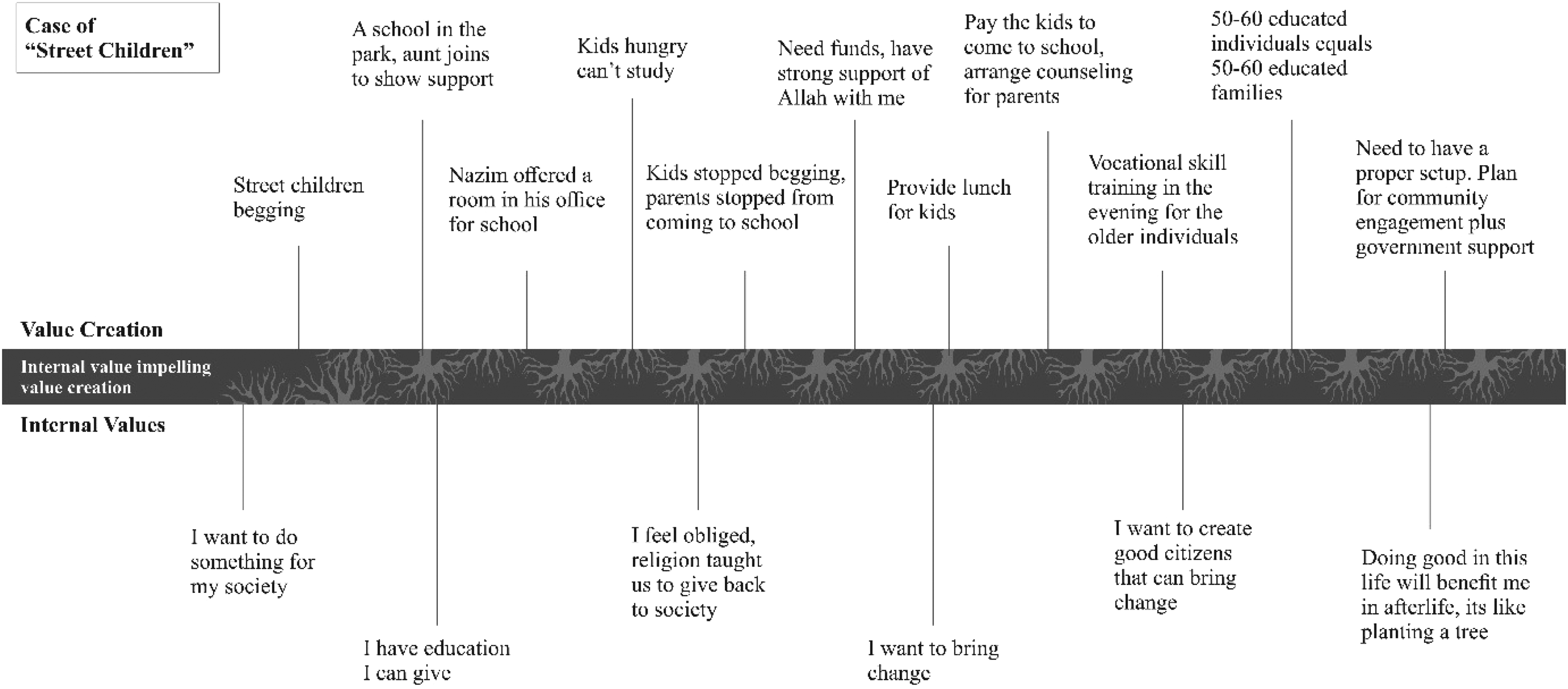
Value Creation ‘Street Children’.
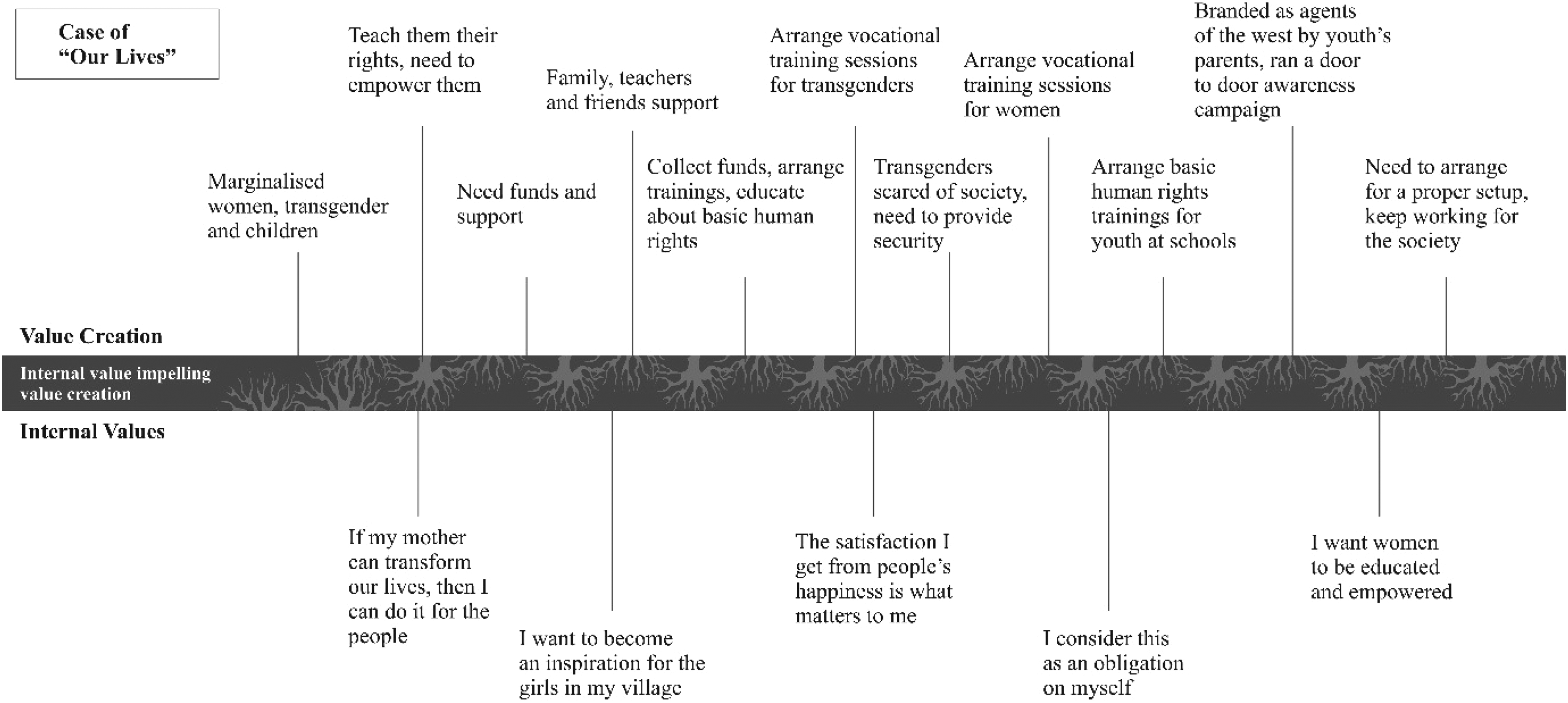
Value Creation ‘Our Lives’.
Our respondents saw value in entrepreneuring (Bylund and Packard, 2022; Galloway et al., 2019) as process of change making (Tobias et al., 2013; Colovic and Schruoffeneger, 2021), which we can comprehend in terms of value changes. Our cases show that monetary value is important, but economic value creation alone is not the solution. The solution lies in long-term values created for societal and cultural contexts. That´s when change happens. We also notice internal values (Bylund and Packard, 2022; Galloway et al., 2019) come in strongly in these narratives from time to time and seem to drive the motivation for change in these individuals. We have tried to capture this process in the figures above. In Sehrish´s case (see Figure 3), we see value created for cultural and economic contexts, such as the creation of more independent citizens in the sense of education and increased civic values, opportunities for free education, and opportunities for skill learning. In Hayás case (see Figure 4) we see value for societal and economic contexts, such as opportunities being created for the poor in their communities, opportunities for empowerment, and opportunities for income generation.
Our study aimed to understand how entrepreneurship results in alleviating multidimensional poverty. We found that poverty is a disabling process and entrepreneuring can enable this process by creating different values. To arrive at this conclusion, we explored the concept of value in entrepreneuring and contextualized poverty. We found that poverty has different contextual dimensions, which are dependent on the geographical context of the study, and what dimension is in action differs over time. That makes it hard to find solutions to poverty. It also makes it clear that a unidimentional solution, such as money/income generation is not the answer. Therefore, in search of the solution, we found that entrepreneuring results in value creation, in terms of value that is socialized that could interact with disabling poverty and ultimately better enable the amelioration of poverty in context. We also identified a set of internal values as motivating factors for entrepreneuring to take place. These motivating factors are also contextual in nature, and resulted in driving the individuals to work toward changes in their community.
Overall, our study points to the importance of entrepreneuring as a value creation process in the context of poverty, suggesting that poverty is not determined and alleviated by numbers but is rather a complex dynamic process which requires big actions. Beside these theoretical discoveries, at least two policy implications can be derived from this. First, the recognition that poverty is multidimensional, and solutions need to be linked to what dimension of poverty is dominating the scene at any one time. Understanding this is very much linked to understanding the context. Secondly, policy makers need to recognize that entrepreneuring in poverty is an asset. One way to accomplish this is for policy makers to recognize that entrepreneuring is much more than an engine for economic value creation.
Like other studies, this research also has its limitations. First, it focuses on individual participant's experiences and reports on the stories they tell about themselves at different points in time. Secondly, it is focused on one geographical context, which might deliver specific results that apply only to that context. Despite these limitations, there were consistencies in the stories the entrepreneurs talked about themselves that allowed us to produce an in-depth account of our research problem. Finally, future studies can focus on social and societal entrepreneurship as theoretical lenses, other geographical areas and regions and investigate how poverty dimensions are disabling in that context, and what kind of values are created in order to alleviate poverty in line with Sustainability agenda 2030.
Footnotes
Acknowledgement
We would like to thank Professor. Alistair R. Anderson for providing ideas, guidance and feedback on earlier versions of this paper. The meetings and conversations we had were exceptionally fun and inspiring. His knowledge and enthusiasm for the topic helped us frame what is now in print.
Declaration of conflicting interests
The author(s) declared no potential conflicts of interest with respect to the research, authorship, and/or publication of this article.
Funding
The author(s) received no financial support for the research, authorship, and/or publication of this article.

APPENDIX
Our cases.
| Informant | Principal Activities | Reason for entrepreneurship | Value Created | Implications for Poverty |
|---|---|---|---|---|
|
|
A school for street children in a town | ‘I strongly feel that education is the key, when you are educated then in future you can make your life’ | ‘Citizens with ethical and civic sense that can bring change’ | Education made accessible for the poor |
|
|
Created a digital sphere for women employment, after being fired from her job when asked for maternal leave | ‘I started because of personal pain…there aren’t many jobs that are seen as respectable job opportunities for women and their families are not happy with it’ | ‘My work gives confidence to young people to come forward and do the things that they really are passionate about even though they don’t know whether it will make result in money’ | Independence, work opportunities for the poor |
|
|
Runs sports complex for women in urban and rural areas | ‘I started this because in our KP, Pakistan as well, people from different areas are living here for whom let alone education, coming out from home is very difficult, buying things of their necessities is very difficult, that is why I started this so that through this, women will feel stronger and independent’ | ‘I am not standing up only for women, I am doing this for those brothers and sisters who lack knowledge and awareness, who have skills as well, but they do not have opportunity, they do not have a proper platform, so I am providing them a platform, giving them an opportunity, rest is their own hard work’ | Work opportunities for the poor Gender equality emphasized Education made accessible |
|
|
Runs a training centre and beauty salon, trains beauticians for free | ‘Helping those who cannot find jobs or those girls who are not allowed to go out and do jobs, and stuff like that. So, something for the females…I was just doing for Sawab and wanted to do something good for the society’ | ‘I have trained many girls free of cost, they later have started something of their own in their areas thus spreading the skill’ | Independence, work opportunities for the poor Spreading knowledge, skills |
|
|
Trainer, consultant and supplies of homemade products, trains people in rural areas for free | ‘I provide training to women in preserved food and heathy food along with marketing knowledge. I do this free of cost to help arrange doable jobs for the poor, and for women’ | ‘I tried to help poor women by providing money, teaching them skill and arranging jobs for them’ | Vocational training leading to independence and work opportunities |
|
|
Henna artist, and trains underprivileged women | ‘Initially I started because I loved doing Henna designs, but it later changed when I became aware of my surroundings’ | ‘I observed that in the living colony that I live, some of the parents of the girls won’t allow them to go out of the house. Even for education. Even after some primary education of class 1, 2 and 3 they would make them sit at home. Then I thought if I train them in this skill so they can earn some money from home and become independent’ | Vocational training leading to independence and work opportunities |
|
|
Runs a beauty Salon at her home, also trains underprivileged women from rural areas for free | ‘In our society girls and girls whom fathers have passed away are considered to be a burden and are discouraged. There are made to realize that they need the support of a “strong pillar” to move forward in life. However, I was encouraged by my mother and elder sister that encouragement had led to me running a small beauty parlour at home. I had to work hard to make this small set up’ | ‘I started training poor orphan girls in the area with the training of beautician. Whatever knowledge and skill I had acquired, I tried my best to pass it on. I felt that it was my duty to do so. I could feel the situation of their lives and I wanted to help. I want to do a lot more for them, but I don’t have the resources’ | Independence, work opportunities for the poor Spreading knowledge, skills |
|
|
Works at Girls Guide Association Pakistan Runs a clothing line Editor of a magazine for promoting young entrepreneurs | ‘As a young single mother in KP, I wanted to do something for women and my daughter, something that others can reflect on…in our culture divorce is stigmatized and divorced women are looked down upon’ | Helps educate and train underprivileged, disable people, also publishes a magazine for free where she highlights the stories of small-scale entrepreneurs to help enhance their visibility | Education Opportunities for the poor Vocational skills training Independence |
|
|
Runs Youth organization focused on education, child labour and environment | ‘The idea came to me when I went to university to talk about girls’ education…I was stopped and told that this is what NGÓs do (like it doesn’t mean anything). At that time, I realized if this is what's happening in a university, then what can we expect from the rest of the world’ | ‘I work with girls’ education in the rural areas, areas hit by terrorism. Create awareness about child labour and environment with the help of different funding organizations and individuals that support our projects’ | Education Awareness Opportunities for women and children |
|
|
Runs an organization named ‘Our Lives’ (translated from Pashto) in rural areas, educating the young women, and Skill training for elderly, the main idea is to empower them so that they can change their future life. Also focuses on the welfare of kids, transgender people and drug addicts. | ‘The life of females is meaningless here. Their basic needs are not realized and right to education was not provided to females. They did not have the right to make their own decisions. Females can either do something for their selves or do they talk for their rights. Therefore, I thought that if I would be living in that environment so it would be the case with me. I would be sitting at home and would be specified to the boundaries of the home’ | ‘My work obviously is mostly on three sector of society females, transgender and youth which I have selected for myself to work on, and these 3 sectors play in one or another way very important role in the society’ | Right to decision making Vocational skills training |
|
|
Runs a Youth Entrepreneurs Organization, focuses on skill development of the Youth in different areas of Khyber Pakhtunkhwa | ‘I wanted to teach women and men to be independent, and be able to work from home, and be independent’ | ‘I provide trainings to students in universities and schools’ | Independence Skills training |
|
|
Runs a beauty salon at her home | ‘There is lack of opportunity for women, and that women ought to refrain from participating in free enterprise within a male dominated society’ | ‘Train underprivileged women from rural and urban areas, and ethnic minorities for free…would set the course for women liberation and development in KPK’ | Right to decision making Independence Skills training |
|
|
Runs a tuition centre, also teaches kids at their homes for the sake of their security | ‘I know that students have problems getting good tuition. Especially for female students for who it's much harder to leave the house. Our most students like above 15 are females. For boys, it's relatively easier but even for them after APS attack where over a hundred children died in our city (Peshawar) many parents is concerned for the safety of their kids at small tuition centres’ | ‘Teaches students, male and female in a secure environment’ | Education Security |
|
|
Runs an organization that aims to encourage education | ‘aim of this organization is to spread awareness among the women education, child labour, plantation, and environment…works with Malala funds’ | ‘Currently leading 75 volunteers. On the basis of some projects, I generate some income and also use that to help the society’ | Awareness Education |
|
|
Blogger, trainer, trying to equip people with relevant skills | ‘The aim was to earn, which later became to teach people to earn from home and be independent’ | Trains students and poor to become financially independent | Skills training Financial independence |
|
|
Owns a market and some land | ‘Basically, my father was a social worker. Therefore, I have that attachment. He is no longer with us (he passed away). Therefore, I had that attachment (social causes) from my family background. So, I was planning to start a business’. | Cultivates barren land and provides livelihoods for the underprivileged | Livelihood Skills training |
|
|
Runs a school for kids | ‘Initially I had a minor problem with my husband. I was upset. At that time, I decided that I would do something for myself. Later it became something for society’ | ‘Free education for the poor kids in my town’ | Education made accessible for the poor |