



Abstract
Entrepreneurial leadership is an emerging paradigm of enquiry that has gained increased attention in research and practice in recent times. However, due to lack of conceptual clarity and theoretical foundations, various dimensions of entrepreneurial leadership competencies and their development specifically in group contexts lack theoretical and conceptual underpinning. This research seeks to narrow this gap by outlining a conceptual framework for team-based entrepreneurial leadership learning and development. According to the proposed model, developing entrepreneurial leadership skills is a dynamic and complex social process. Entrepreneurial leaders can gain knowledge and skills by participating in a variety of team-based learning activities, including peer observations, group-based experiential learning, self-regulated learning and team learning.
Keywords
Introduction
Entrepreneurial leadership as an emerging paradigm of enquiry has been the focus of leadership and entrepreneurship research and practice in recent times (Ahmed and Harrison, 2021; Bagheri and Pihie, 2011; Harrison et al., 2020; Harrison et al., 2018; Omeihe et al., 2020). This is due to the criticality of developing the capabilities of entrepreneurial leaders to cope with the challenges associated with new venture creation, growth and success, and effectively deal with competitive business environment (Cogliser and Brigham, 2004; Fernald et al., 2005). Despite this importance, our knowledge is limited about entrepreneurial leadership learning in individual and dynamic team contexts (Ahmed and Harrison, 2021; Bagheri and Pihie, 2011). In particular, little prominence has been given towards developing entrepreneurial leadership in teams in ventures at different stages of creation, growth and success (Mattare, 2008; Surie and Ashley, 2008).
This research attempts to fill this gap in the literature by proposing a conceptual model of entrepreneurial leadership learning and development with a focus on the team context. To fully comprehend the development of entrepreneurial leadership, it is necessary to combine the conceptual discussion with the numerous empirical findings on entrepreneurial leadership learning and growth. The objectives of this paper are to examine the empirical and theoretical debate on the development of entrepreneurial leadership and to present an integrated conceptual model supported by various team-based learning techniques that take contextual factors into account.
The proposed model, which is supported by experiential learning, self-regulation learning, team learning and observational learning, makes numerous contributions to the literature (Biberhofer et al., 2019). The paper first provides a critical overview of the existing literature on the learning and development of entrepreneurial leadership and makes recommendations for future research areas. Second, the conceptual model could serve as a foundation for future research on the learning and development of entrepreneurial leadership in a dynamic team environment. Third, by identifying the antecedents – namely, social and contextual variables – as well as the outcomes of entrepreneurial leadership learning, this research contributes to the body of knowledge on entrepreneurial leadership learning and development. Fourth, the suggested framework acts as a starting point and improves our comprehension of entrepreneurial leadership from a competency perspective.
The paper is set out as follows. The first section drawing on theoretical debate and extant conceptualisation of entrepreneurial leadership defines the concept. The role of entrepreneurial leadership abilities and competences as well as their development are covered in the next section. The third section presents a conceptual model and discusses several team-based entrepreneurial leadership learning and development strategies. The discussion, limitations and future research directions are presented in the final part.
Entrepreneurial leadership
The new discipline of entrepreneurial leadership lacks conceptual coherence and is atheoretical (Bagheri et al., 2013; Bagheri and Harrison, 2020; Clark et al., 2019; Harrison et al., 2018) additionally, the idea itself lacks definitional precision and is elusive (Harrison et al., 2018). The concept is viewed by some experts as a separate type of leadership behaviour that is extremely effective in a demanding and changing business environment (Bagheri and Pihie, 2011; Gupta et al., 2004; Harrison et al., 2018). According to some researchers, such as Vecchio (2003), entrepreneurial leadership is a style of leadership that takes place in emerging and established organisations in an entrepreneurial atmosphere. Entrepreneurial leadership is viewed by some studies as a style of leadership that is characterised by risk-taking, proactivity and innovation and is very effective in addressing business difficulties in a dynamic business environment (Bagheri et al., 2013; Chen, 2007; Harrison et al., 2018; Surie and Ashley, 2008; Swiercz and Lydon, 2002)
Different meanings of the idea have arisen as a result of the varied points of view. Entrepreneurial leadership according to Gupta et al. (2004) is described as ‘leadership that produces visionary scenarios that are used to gather and mobilise a “supporting cast” of participants who get dedicated by the vision to the discovery and exploitation of strategic value creation’ (p. 242). According to Gupta et al., the two key roles of the entrepreneurial leader are to have and express a vision in terms of growth outcomes and to involve followers and other stakeholders in acting to attain this vision also (Galloway et al., 2015). According to Hejazi et al. (2012), entrepreneurial leadership entails identifying and seizing business opportunities through entrepreneurial activities and influence. In contrast, Surie and Ashley (2008) propose that entrepreneurial leadership is the best type of leadership for resolving organisational issues in a volatile context. Despite the passionate debate, there isn't a universal definition of the concept. Table 1 displays a selection of papers that defined entrepreneurial leadership.
Sample of studies that defined entrepreneurial leadership.
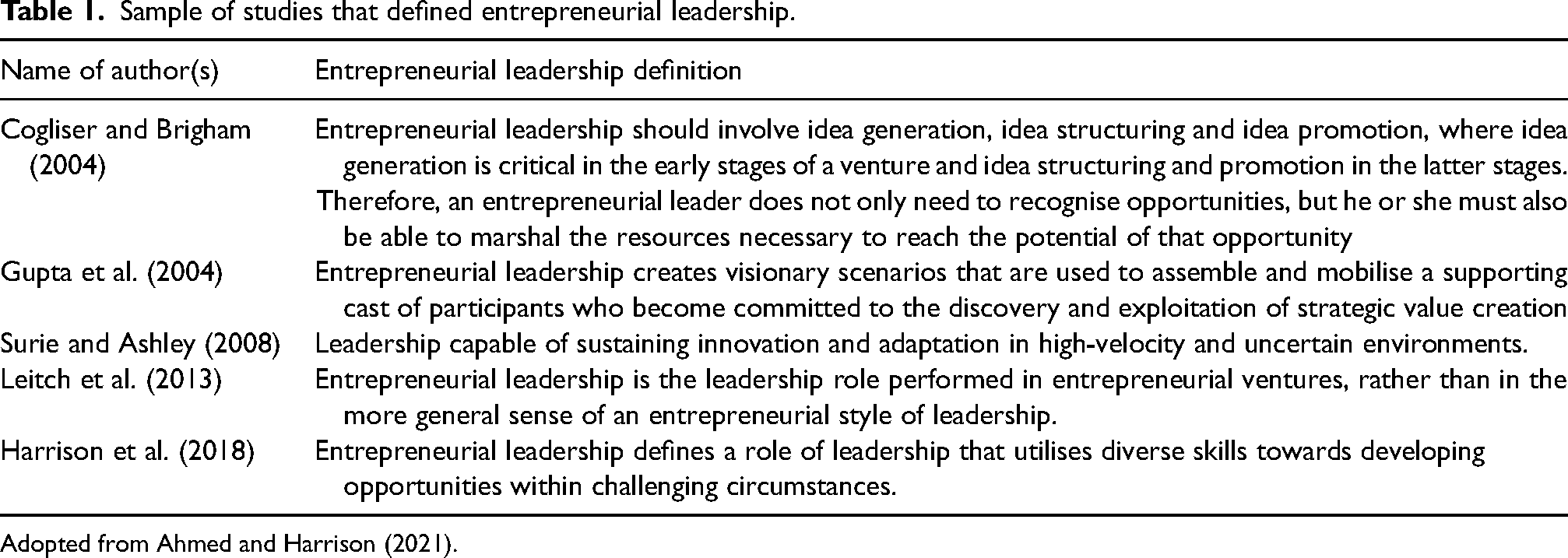
Adopted from Ahmed and Harrison (2021).
The current conceptualisation of entrepreneurial leadership demonstrates that this type of leadership is capable of recognising and seizing economic opportunities in both new and ongoing ventures (Chen, 2007; Gupta et al., 2004; Surie and Ashley, 2008; Swiercz and Lydon, 2002). According to several academics, the ability and skills of entrepreneurial leaders can be learned and developed as a result of a social process, and they are essential for identifying and seizing economic opportunities (Bagheri and Pihie, 2011; Baron and Ensley, 2006; Kempster and Cope, 2010). Although the research on entrepreneurial leadership skills and competencies have received some attention recently, questions remain about the development of EL-specific abilities and competences in various circumstances.
Competencies are the mixture of knowledge, abilities, and attitudes necessary to successfully start and run both new and old businesses (Aouni and Surlemont, 2009; Politis, 2005). Given the prominence of entrepreneurial leadership skills and competencies, some literature has recently made attempts to explore the role of entrepreneurial leadership abilities and competences in starting new businesses and maintaining existing ones (Freeman, 2014; Harrison et al., 2016a; Koryak et al., 2015; Tian and Smith, 2014; Wahab and Tyasari, 2020). Notably, communication, interpersonal, conceptual, entrepreneurial, and human skills are some of the most frequently mentioned skills of entrepreneurial leaders. Table 2 lists the specifics of entrepreneurial leadership skills and competencies that have emerged throughout the literature.
Details of studies on entrepreneurial leadership skills and competencies.
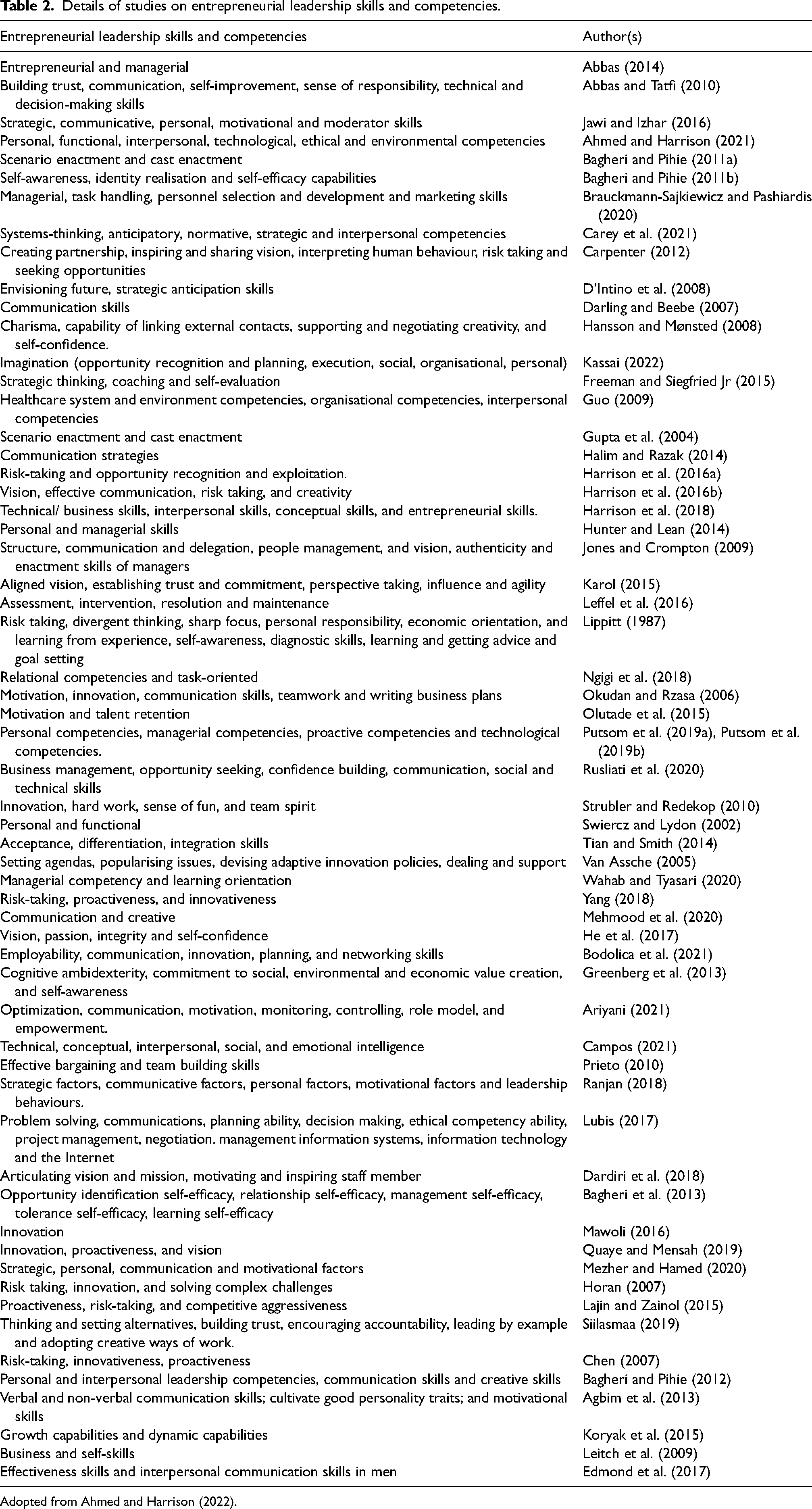
Adopted from Ahmed and Harrison (2022).
Despite gaining some attention, there is scarcity of empirical evidence about specific entrepreneurial leadership competencies and their development (Ahmed and Harrison, 2021; Bagheri et al., 2013). Most prominently, how entrepreneurial leadership learning occurs through social interactions and how their experiences transform EL learning and development in teams remain under studied. Only few studies focus on this (Freeman, 2014; Hentschke and Caldwell, 2005; Koryak et al., 2015; Roomi and Harrison, 2011; Tian and Smith, 2014; Wahab and Tyasari, 2020) but the literature that is currently available places a large emphasis on entrepreneurship programmes and extracurricular activities for the development of entrepreneurial leaders’ skills and competencies (Bagheri and Pihie, 2011; Bagheri et al., 2013; Cogliser and Brigham, 2004; Freeman, 2014; Galloway et al., 2005; Harrison et al., 2016a; Koryak et al., 2015).
A few researchers consider the learning and growth of entrepreneurial leadership to be a social and contextual phenomenon that happens through naturalistic learning among team members and individuals through social contact, observation, critical reflection, coaching and training (Bagheri and Pihie, 2010, 2011; Bagheri et al., 2013; Churchill et al., 2013; Leitch et al., 2013). In contrast, some academics suggest an action-based learning approach for fostering entrepreneurial leadership abilities and skills (Freeman and Siegfried, 2015; Kempster and Cope, 2010; Leitch et al., 2009). This point of view contends that the development of entrepreneurial leadership should not be restricted to classroom instruction, but rather should be taught through a more thorough and rigorous methodology supported by ‘learning by doing’ mechanisms in real-world situations (Anderson and Air, 2022; Freeman and Siegfried, 2015; Kempster and Cope, 2010; Leitch et al., 2009, 2013).
Although the role of entrepreneurship courses and programmes in developing entrepreneurial leadership skills and competencies cannot be denied (Bagheri and Pihie, 2011), nonetheless, there is not enough empirical data in the literature currently available to support recommendations for the best teaching practices (Roomi and Harrison, 2011). Some academics contend that the structures and subject matter of entrepreneurial leadership courses need improvement, therefore they might not be successful in fostering certain entrepreneurial leadership abilities and competences (Bagheri et al., 2013; Kempster and Cope, 2010; Okudan and Rzasa, 2006).
The next section covers the discussion of entrepreneurial leadership learning along with a model for developing entrepreneurial leadership that combines observational learning, team-based experiential learning, self-regulated learning and team learning.
Entrepreneurial leadership learning and development: A group perspective
Despite studies’ claims that entrepreneurial leadership learning is vital for enhancing entrepreneurial leaders’ competencies through training, education and experience (Bagheri and Pihie, 2011; Galloway et al., 2014; Kempster and Cope, 2010). We know relatively little about team-based leadership learning and development in an entrepreneurial environment. Because most new enterprises are established by entrepreneurial teams rather than individuals, investigating entrepreneurial leadership learning from a team context is critical (Schjoedt et al., 2013). Team performance and learning have an impact on individual performance within the team (Harms, 2015).
The evidence suggests that 40% of new businesses fail in the first year after they are founded, and more than half of these failures are attributable to underlying issues in entrepreneurial teams (Kaplan and Strömberg, 2004). The challenges of starting a new business as a group are distinct from those of starting one alone. The ability of each individual to adapt to changing circumstances is essential to the success of the independently managed firm. The team members, on the other hand, depend on the team's skills, a single objective, and coordinated efforts (Santos et al., 2019). Teamwork includes coordinating efforts, exchanging information knowledge, and resources, mutually developing skills and forging a sense of group identity (Santos et al., 2019). As a result, there are considerable differences in the learning needs of individuals and teams. Entrepreneurial learning happens at many stages of entrepreneurial activity and the process of creating new businesses – and each stage is distinguished by a distinct set of difficulties, necessitating a different set of skill sets to overcome the difficulties of new enterprises on an individual basis as well as at the team level (Bagheri and Pihie, 2011).
Entrepreneurial leadership and observational learning
The importance of observational learning and its role in the advancement of leadership development is understudied, even though the relevance of entrepreneurial learning in improving entrepreneurship knowledge and development is well recognised (Kempster and Parry, 2014). The discussion on entrepreneurial learning in recent years has centred on how people and teams acquire entrepreneurial expertise (Cope, 2005; Pittaway and Thorpe, 2012) and specifically, how social context affects individual's entrepreneurial development (Hoffmann et al., 2015). As a result, many academics emphasise how crucial social and contextual factors are for developing entrepreneurial leadership skills (Pittaway and Thorpe, 2012; Taylor and Thorpe, 2004). Arguably, the value of knowledge that transforms into strategic resources is defined by individual skills and experiences. The ability to build social networks as a result of entrepreneurial leadership learning through observation and social interaction gives entrepreneurial leaders a competitive edge since they are better able to recognise, evaluate and seize opportunities.
The literature on entrepreneurial leadership learning, however, lacks theoretical models that explain how social learning theories allow entrepreneurial leaders to share knowledge in a complicated social environment (Zozimo et al., 2017). Despite the lack of theoretical frameworks, numerous researchers investigated the social learning theory's aspect of peer-based learning in educational settings, workplaces and other contexts (Hamilton, 2011; Nanda and Sørensen, 2010). The use of observational learning, which enables entrepreneurs to learn from their peers and co-workers through social contact, is frequently recommended as a method for effective entrepreneurial learning (Pittaway et al., 2011) and developing entrepreneurial leadership skills. Peers’ participation in entrepreneurial leadership learning is a critical element that motivates and shapes entrepreneurs’ actions and strengthens their ambition to become entrepreneurs in the future (Falck et al., 2012). Peer observation that results from social interaction is highly influential in entrepreneurial leadership learning and development (Pittaway et al., 2015). Social interaction and observational learning are enabling factors for entrepreneurial intention, creativity and motivation of entrepreneurial leaders (Zozimo et al., 2017).
Entrepreneurial leadership development through group-based experiential learning
Gaining entrepreneurial knowledge and skills through real-world experiences in an entrepreneurial setting is the focus of an experiential entrepreneurial learning method. These learning techniques are mostly group-based (Pittaway and Cope, 2007). It is generally accepted that learning about entrepreneurship through experiential and action-oriented methods helps people develop real-world experience in all aspects of entrepreneurship, including starting and running a business. For entrepreneurial leaders to improve their comprehension of new businesses and build their leadership skills in a naturalistic situation, an experiential learning approach is crucial (Bagheri and Pihie, 2011; Kempster and Cope, 2010). According to Minniti and Bygrave (2001) and Politis (2005), experiential entrepreneurial learning is an evolutionary process that improves creativity, business skills, networks and brand reputation. It also has long-lasting effects on the knowledge, experience and confidence of entrepreneurial leaders. The development of entrepreneurial leadership should not be restricted to pedagogy or formal education but instead can be achieved by utilising a body of knowledge and experiences that have been gathered over time and via experience (Anderson and Air, 2022).
Direct experiential learning and vicarious experiential learning are two different mechanisms that make up experiential entrepreneurial learning, according to Holcomb et al. (2009). The goal of direct experiential learning is to get first-hand knowledge of various facets of business management through active engagement. The acquisition of entrepreneurial knowledge from seeing the actions and behaviours of other businesspeople is known as vicarious entrepreneurial learning. However, this entrepreneurial learning paradigm is not applicable in a dynamic group situation and is more appropriate in an individual scenario. The researchers advise group-based experience learning as a result.
Lean start-up (LS) learning approach, which enables business owners to employ a variety of tools and strategies to create their new business in a timely and cost-effective manner, is an example of a group-based experiential learning (Panther et al., 2019). Entrepreneurial leaders use an LS learning approach and engage in a build-measure-learn loop process to evaluate the viability of their business ideas and performance in the target markets. Entrepreneurial leadership learning through LS improves the knowledge and abilities of entrepreneurs (Harms, 2015). For entrepreneurial leaders to grow their knowledge and abilities by actually participating in business endeavours, this style of learning is extremely important. The socio-cognitive dynamics of entrepreneurial ideation are incorporated into the LS learning technique (Gemmell et al., 2012), allowing entrepreneurial leaders to make early customer contacts that will determine the success or failure of their enterprise.
Three sets of activities make up the bulk of the lean start-up methodology. The business model canvas, which includes a graphical representation and a testable assumption of the business model, is used in the first phase to visually illustrate the business model. The second stage focuses on testing these hypotheses in order to develop the business model. The ‘minimum viable product’ (MVP), which is ‘the version of the product developed by using the least amount of time and resources and provides entrepreneurs with the information to confirm or invalidate assumptions’, is an example of testing an assumption (Mansoori, 2017: 818). This process will continue until the final prototype is developed. The remaining hypotheses are evaluated and validated in the last stage to achieve ‘product-market fit’ – which denotes that the product is ready for customers and provides value to customers (Mansoori, 2017).
Entrepreneurial leadership development and self-regulated learning (SRL)
The traditional approaches to entrepreneurial learning are criticised for not taking into account the personal and sociocultural aspects of learners. Therefore, academics advocate for a comprehensive strategy that not only boosts learning but also improves the experience and intrinsic motivation of learners (Cheng, 2011). The ability of learners to organise their own learning through self-regulation, activity monitoring, content assessment, learning needs assessment, outcome prediction, and effective time and information management is closely related to the use of a self-regulated learning strategy to guide learners’ learning process (Cheng, 2011). Self-regulated learning is a multifaceted process that determines how people adopt self-regulatory abilities based on self-evaluation, self-direction, controlling and adjustment to gain new skills and competences (Zimmerman, 1989).
Metacognition, deliberate action, and motivation are the foundations of the self-regulated learning approach (O'Shea and Buckley, 2010). Effective learning can be accomplished using a four-phase cyclical model of self-regulated learning, according to Zimmerman (1989), in which entrepreneurs develop their abilities through self-evaluation and monitoring, developing goals and strategies, putting them into practise, and evaluating the results. The core of a self-regulated learning process is the capacity of learners to think, feel, and act in accordance with their learning initiatives to achieve learning goals. Such learning has a significant impact on teams when the success of the group depends on the success of each member. A self-regulated learning strategy is especially important for early-stage entrepreneurs who collaborate in teams to fulfil entrepreneurial activities (O'Shea and Buckley, 2010). Self-regulated learning, however, has not been given much attention in the field of entrepreneurship research in general and entrepreneurial leadership development in particular (O'Shea and Buckley, 2010). Building the knowledge, abilities, and competences of aspiring entrepreneurial leaders can be accomplished with the help of an SRL.
Entrepreneurial leadership development through team learning
Team learning is a central element of the entrepreneurial development process (Rae and Carswell, 2001). Entrepreneurship is viewed as a contextual process of “becoming” that entails ongoing entrepreneurial learning and development (Rae, 2000). Team learning refers to an ‘ongoing process of reflection and action characterised by asking questions, seeking feedbacks, experimenting, reflecting on results and discussing errors or unexpected outcomes of actions’ (Edmondson, 1999: 353). In today's rapidly changing environment, organisations emphasise team learning in order to develop entrepreneurial competencies within teams (Peltonen, 2008). Various researchers call for team learning specifically in an entrepreneurial context. For instance, Yazici (2005) argue that peer interaction is an integral part of team learning. Similarly, Vanhlakka Ruoho (cited in Peltonen, 2008) describing collaborative learning coined the term ‘learning partnership’ which emphasises reciprocal learning, dialogue and reflectivity for team learning. Due to the knowledge and information that come from social interaction, business leaders can build social networks and have an advantage in identifying, evaluating and taking advantage of opportunities to better compete (Hunter and Lean, 2014; Miller and Besser, 2003).
Recently, there has been much emphasis on entrepreneurial learning within entrepreneurship education research (Peltonen, 2008). Extant literature argues that entrepreneurial learning is focused on entrepreneurship, entrepreneurial activities and the attributes of entrepreneurial individuals (Kyro, 2008). Therefore, an entrepreneurial learning process forms entrepreneurial behaviour and the ability to take risk, recognise and exploit business opportunities. However, the extant literature largely disregards the role of entrepreneurial learning process and specifically its association with “powerful others” in entrepreneurial learning (Cope, 2005). In line with this assertion, it is pertinent to know how entrepreneurial leadership learning takes place among entrepreneurial leaders working as team.
The evidence suggests that team learning has a positive impact on individual learning, new product development, new venture teams and organisational learning (Harms, 2015). Moreover, team learning can be more productive than individual learning as it potentially integrates a diverse set of knowledge, experience and perspectives from various individuals in the team (Hill and Korhonen, 2014). In essence, team learning in turn stimulates individual learning and promotes entrepreneurial leadership learning behaviour (Hirst et al., 2009).
A proposed model of entrepreneurial leadership learning and development
Since there is scarcity of empirical and theoretical underpinning on entrepreneurial leadership from a team context, any model that attempts to portray a team conceptualisation of entrepreneurial leadership development is subject to legitimate criticism. Utilising the theoretical and conceptual underpinnings of entrepreneurial leadership as well as a dynamic and integrated method of entrepreneurial learning (Lans and Mulder, 2009), the study at hand proposes a team-based model of entrepreneurial leadership learning and development. The model is based on an all-encompassing approach to entrepreneurial leadership competencies, showing that the competences can be acquired, developed as a result of team-based learning strategies, and are related to one another (Baron and Ensley, 2006; Lans and Mulder, 2009).
Despite the fact that few academics have sought to investigate entrepreneurial leadership learning and development (Bagheri et al., 2013; Okudan and Rzasa, 2006; Roomi and Harrison, 2011), these studies expose several limitations. For instance, the aspect of entrepreneurial leadership learning from a group context was not examined in any of the research. Further, these studies’ paradigm of entrepreneurial learning and development ignores contextual factors. Despite its prominence in the literature, there is still little research on how contextual factors affect entrepreneurship in general (Jones et al., 2019) and entrepreneurial leadership development in particular. There is broad acceptance that context is a significant predictor of entrepreneurial identity – which develops as a result of social interactions (Hall and Du Gay, 1996) and a strong predictor of entrepreneurial success and failure (Wynn and Jones, 2019). It can be argued that self-reflection and experience in a dynamic setting also has an impact on the entrepreneurial behaviour and learning of entrepreneurial leaders (Markowska, 2020). It is worthwhile to investigate how contextual elements, such as institutions, society, and entrepreneurs’ self-motivation and knowledge-sharing mechanisms, affect the entrepreneurial process (Jones et al., 2019). One may claim that the potential risk-taking, innovativeness, opportunity spotting and exploitation abilities of entrepreneurial leaders are influenced by contextual circumstances. Therefore, recognising the impact of contextual factors on the learning and development of entrepreneurial leadership is crucial.
Contextual factors, entrepreneurial leadership learning and entrepreneurial leadership outcomes serve as the foundation of the model in Figure 1. Different contextual factors or intervening variables, including but not limited to organisational culture, learner attitudes, communication channels, pre-existing values, family dynamics, resources and experience, influence how entrepreneurial leaders learn (Harrison et al., 2018; Russell and Stone, 2002) that may have moderating effects on entrepreneurial leadership development and its outcomes (i.e., opportunity identification and exploitation). This research views entrepreneurial leadership learning as a social process that occurs among individuals and teams and recognises the prominence of contextual variables in learning and developing entrepreneurial leadership. As argued by Harrison et al. (2018), entrepreneurial leadership abilities may be influenced by intervening variables such traits, family dynamics, culture, followers, resources and experience. Entrepreneurial leadership learning strategies are antecedents of entrepreneurial leadership development and thus are referred to as independent variables. Since learning strategies determine the effectiveness of entrepreneurial leaders in terms of opportunity identification and exploitation, they are dependent variables.
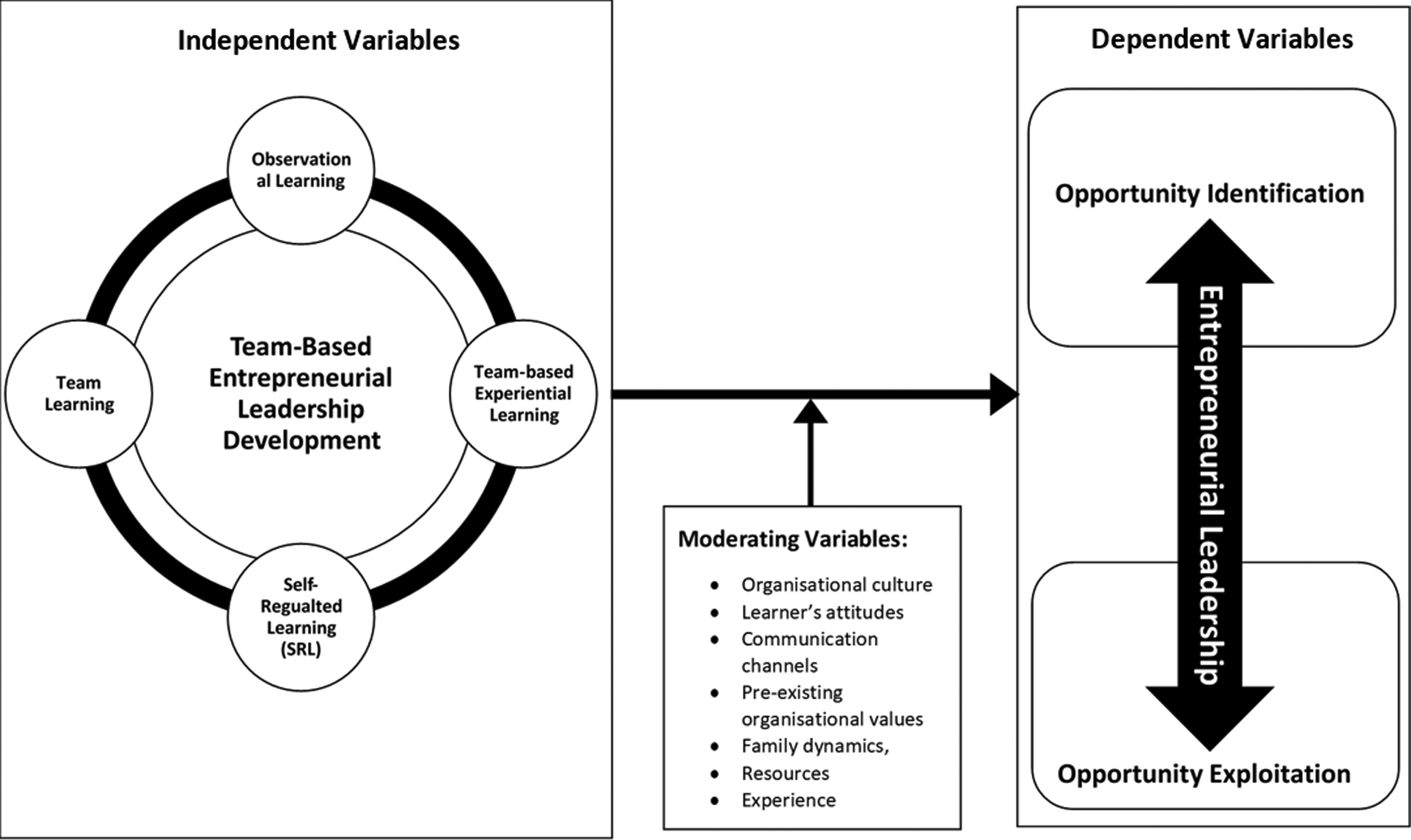
A team-based model of entrepreneurial leadership learning and entrepreneurial leadership development.
The proposed model of entrepreneurial leadership learning and development posits that it is a simultaneous learning process underpinned by observational learning, team-based experiential learning, self-regulated learning and team learning (see Figure 1).
According to the model, team-based entrepreneurial leadership learning helps entrepreneurial leaders build their competences for seeing and seizing business opportunities as well as overcoming the difficulties of starting a new endeavour in a fast-paced business environment. According to Bagheri and Pihie (2011), entrepreneurial leadership learning helps entrepreneurial leaders develop their abilities to accomplish the goals of scenario enactment (proactiveness, risk taking and innovation), as well as cast enactment (building commitment, identifying limitations). The proposed model posits that entrepreneurial leadership skills can be acquired and developed through a variety of concurrent learning processes. By expanding its dimension from an individualistic learning perspective to an integrated group learning perspective, the model contributes fresh insights to the literature on entrepreneurial leadership in general and entrepreneurial leadership development in particular.
The model seeks to address the intricate and numerous problems of developing entrepreneurial leadership (Cogliser and Brigham, 2004; Kempster and Cope, 2010). The approach offers a framework for developing entrepreneurial leadership skills in a group environment by recognising contextual variables. The aspects of entrepreneurial leadership learning that have a substantial impact on the development of entrepreneurial leadership competencies are also strengthened and reinforced by this methodology (Pittaway and Cope, 2007). Through gaining real-world experience while starting new businesses, it will allow entrepreneurial leaders to master a variety of skills and abilities (Gupta et al., 2004; Kempster and Cope, 2010). Entrepreneurial leaders can enhance their abilities and competences by participating in experiential, team-based, observational, self-regulated modes of learning.
Discussion, research and practical implications
The suggested model in Figure 1 is found on a number of team learning methodologies, such as observational learning, team-based experiential learning, self-regulated learning and team learning. Entrepreneurial leaders working on entrepreneurial initiatives as a team can identify and manage their obstacles by strengthening their competencies through peer observation, team-based experiential learning, self-regulated learning and team learning. A team-based learning method helps team members identify and take advantage of new commercial opportunities in addition to improving effective learning within the team. The approach broadens our understanding of the intricate, multidimensional processes involved in developing entrepreneurial leadership learning and leadership (Kempster and Cope, 2010). According to the integrated team learning model, it can be claimed that entrepreneurial leadership learning is a social phenomenon and that entrepreneurs can learn and advance their skills by engaging in a cyclical process of observational, experiencing and social interactional learning. They gain the ability to recognise business possibilities and successfully handle the difficulties of running new businesses as a result of this education (Bagheri and Pihie, 2011). For emerging entrepreneurial leaders, an integrated team learning method is crucial because it affects their intentions and encourages more entrepreneurial behaviour, which aids in the development of their leadership skills (Bagheri and Pihie, 2011; Cogliser and Brigham, 2004; Kempster and Cope, 2010).
The proposed model makes a variety of contributions to the developing field of entrepreneurial leadership and learning. First, the model lays the groundwork for a group-based conceptualisation of entrepreneurial leadership by establishing a link between entrepreneurial leadership and entrepreneurial leadership learning from a team context. Second, the model extends entrepreneurial leadership development from an individualistic perspective to a shared process by incorporating group perspectives on the development of entrepreneurial leadership competencies that have been disregarded in current entrepreneurial leadership literature. Third, by shifting from focus on classroom-centred learning strategy to a practical and action-oriented learning approach, the model broadens the dimension of entrepreneurial leadership learning. Fourth, by suggesting that developing entrepreneurial leadership is a collaborative activity, the approach offers fresh perspectives towards entrepreneurial leadership as a team process.
The model in Figure 1 also offers useful practical implications. First, emerging entrepreneurial leaders can utilise the model to comprehend the nature of cooperation and the learning challenges connected to it in a dynamic group setting. Second, business incubators and other entrepreneurial platforms can use the concept to develop learning and support for starting new ventures that encourage working together to find and take advantage of business opportunities. Third, this model can be applied by decision-makers across various entrepreneurial leadership development platforms to support efficient team development and the growth of entrepreneurial leadership. Fourth, entrepreneurship educators can use the integrated approach to design a course of team-based entrepreneurial leadership learning and entrepreneurial leadership development by adopting a hybrid model of entrepreneurial leadership teaching and learning in business schools underpinned by observational learning, experiential learning, and team learning. Finally, autonomous organisations like SMEs, labs, and research centres can use the suggested approach to promote team learning and the growth of entrepreneurial leadership to take advantage of business prospects.
Limitations and future research directions
Although the present conceptual framework adds new insights about entrepreneurial leadership learning, practice and research, empirical studies are required to assess its reliability and applicability in different organisational settings. Further research is required to assess the model's validity in cross cultural settings to determine how contextual factors affect entrepreneurial leadership learning and development at a team level across various organisations. Besides, future researchers may identify and integrate alternative learning process into the model to expand its applicability in diverse areas. By applying the approach to pinpoint certain entrepreneurial leadership qualities at a team level, the need for more research is implied.
Conclusion
The development of entrepreneurial leadership's theories and concepts remains in its infancy. Less focus has been placed on the development of entrepreneurial leadership competencies at the group level, despite the fact that numerous scholars have examined the dimensions of entrepreneurial leadership skills and competencies (Harrison et al., 2018). This research suggests an integrated model of entrepreneurial leadership learning and development from a group perspective by examining and synthesising the existing literature on entrepreneurial leadership learning and entrepreneurial leadership development. According to the model, entrepreneurial leaders can learn and hone their skills through a variety of team-based learning techniques, including peer observational learning, experiential learning in groups, self-regulated learning and team learning. Entrepreneurial leaders can build their leadership skills and competences as well as recognise and take advantage of business possibilities while overcoming the difficulties of starting a new venture in a volatile business environment by using team-based learning strategies.
Footnotes
Declaration of conflicting interests
The author(s) declared no potential conflicts of interest with respect to the research, authorship and/or publication of this article.
Funding
The author(s) received no financial support for the research, authorship and/or publication of this article.
