




Abstract
This study explores the antecedents of alliance failure between incumbents and startups by shedding light on the ex ante conditions that initiated the alliances, the in situ conditions that caused the alliance failures, and the ex post conditions of the outcomes. We conducted a qualitative, multiple case-study analysis of four failed alliances in a northern European context based on interviews with executives from the incumbents, startups, and incubators involved. Our findings indicate that the promise of resource complementarity between incumbents and startups does not warrant the success of strategic alliances. Finally, we explore the implications of our findings and propose how incumbents and startups can collaborate better in future alliances.
Introduction
Faced with uncertainty from emergent markets and disruptive technologies, firms in vulnerable strategic positions often resort to alliances to safeguard against or take advantage of market dynamics (Eisenhardt and Schoonhoven, 1996; Osiyevskyy et al., 2017). Scholars in strategic management have explored the reasons for entering into alliances as well as the factors that lead to successful alliance formation (Kale and Singh, 2007). For entrepreneurship research, however, alliances between incumbents and startups represent an important avenue of research, as incumbents increasingly look to startups both as a source of uncertainty—as startups may disrupt existing core businesses of the incumbents (Ansari et al., 2016)—and as potential alliance partners to overcome the disruption (Katila et al., 2008). In the entrepreneurship research field, some research exists that documents the factors leading to successful alliance formation. There is also some research on the challenges of entering into alliances for startups, and some limited empirical evidence of alliance failures (Das, 2015).
Successful implementation of alliances is a complicated affair. As research on alliances has shown, many alliances fail. Reasons abound for this, such as the way alliances are organized and managed (Kaplan et al., 2010). In the context of incumbent–startup alliances, the matter may be further complicated by strong power asymmetries between the parties involved (Das and He, 2006). Understanding the specifics of failures in incumbent–startup alliances represents an important element of entrepreneurship research, with limited empirical evidence available in the existing research. In this paper, we seek to answer the following research question: What are the antecedents of strategic alliance failure between incumbents and startups? The study is conceptually motivated by the above-mentioned research gap in understanding empirically and theoretically the antecedents of incumbent–startup alliance failure. Empirically, we were motivated by the occurrence of a series of high-profile alliance failures in the Nordic countries, indicating to us the empirical, practical, and theoretical relevance of this topic.
Inspired by existing research into alliance failures, we adopted an approach that emphasizes the need to explore the trajectory of alliance failures, including the lead-up to alliance formation, the activities of negotiating the alliance, as well as the dynamics of the actual failure (Schreiner et al., 2009). This allows for an understanding of how conditions and characteristics of the alliance partners influence the alliance formation and failure, as well as the consequences for the involved parties. Specifically, we used Park and Ungson’s (2001) general model of alliances to explore the ex ante, in situ, and ex post conditions of alliance failures. Ex ante conditions are defined as the “prevailing conditions at the time of the formation of an alliance” (Park and Ungson, 2001: 48). Ex ante conditions thus incorporate the characteristics and objectives of the incumbents and startups that make them pursue the alliance, as well as those pre-existing routines, structures, strategies, etc., that may be carried over to the alliance formation and which may hold some of the seeds of the ultimate alliance failure. Accordingly, in situ conditions “relate to the dynamics […] within the course of an alliance” (Park and Ungson, 2001: 48). Looking at in situ conditions thus allows for the exploration of the alliance formation and maintenance. As our research question and cases revolve around alliance failures, the in situ conditions represent the dynamics of alliance formation efforts as well as the events that lead to and constitute alliance failure. Finally, ex post conditions refer to the conditions that occur at the end of what Park and Ungson (2001) refer to as the collaborative cycle where each partner reevaluates the alliance and decides whether to move forward or terminate.
Literature review
Most firms operate in dynamic and uncertain markets, where existing and profitable core business areas face the challenge of competition and disruption as new technologies, business models, and entrants enter the market (Ansari et al., 2016; Bouncken and Fredrich, 2016; Christensen, 2013). On the one hand, managing this uncertainty and maintaining a competitive advantage are essential for incumbents, and indeed, the possibility of disruptive innovations brought about by startups, which may cause incumbents to fail after rendering their capabilities and assets obsolete, is seen as a risk (Christensen, 2006). On the other, new entrants in the form of, e.g., startups, depend on undermining the competitive advantage of incumbents, yet must do so despite the liabilities of newness and smallness (Stinchcombe, 1965). Facing different challenges in uncertain and competitive markets, incumbents and startups are increasingly seeking alliances with each other for mutual benefit (Cherbib et al., 2021; Gulati, 1998; Spender et al., 2017).
In this context, a strategic alliance is defined as a purposive, voluntary relationship between two or more independent firms that involves the exchange or sharing of resources to achieve mutually relevant benefits and strategic objectives (Gulati, 1995; He et al., 2020). Alliances help firms strengthen their competitive position by developing new products (Haeussler et al., 2012; Peltokorpi, 2017), increasing innovation performance (Hagedoorn et al., 2018), accessing new or critical resources or capabilities (Rothaermel and Boeker, 2008), and entering new markets (García-Canal et al., 2002). Several empirical studies have demonstrated that each partner in an alliance has certain areas of strengths that may compensate for the weaknesses of their potential alliance partner (Chiambaretto et al., 2020; Burgers et al., 1993; Lorange et al., 1992).
Following a resource complementarity perspective (Harrison et al., 2001; Yahiaoui et al., 2016), alliances between incumbents and startups represent a move that has the potential to mutually benefit and help startups survive and grow (Ahuja et al., 2009; Knoben and Bakker, 2019). The literature of liabilities of newness (Stinchcombe, 1965) suggests that even if startups possess the necessary ideas, technologies, and capabilities, the lack of a track record may prevent them from building the relationships and markets they need (Yang and Aldrich, 2017). Thus, partnering with incumbents may help them build legitimacy as the incumbents can lend them credibility and status (Svensson et al., 2019). For the incumbents, partnering with startups can be seen as a way to compensate for the challenges of innovation. Startups are often considered to excel in product innovation or new product development compared to incumbents (Rothaermel and Boeker, 2008). Building partnerships with startups can thus provide insights into new and emerging technologies, products and services, and capabilities, some of which the incumbents may want to integrate into their organization and pursue (Rothaermel and Deeds, 2006).
Yet, as pointed out in more recent research, strategic alliance processes involving startups and incumbents are not without their challenges (Minshall et al., 2008) and risks (Fernandez et al., 2014). The apparent inequality in bargaining power, resource position, and legitimacy between startups and incumbents often jeopardizes such alliances (Hallen et al., 2014), leading to potentially harmful outcomes for the startups (Velu, 2015). For startups, losing a core resource to a partner in an alliance can be fatal (Li, 2013). Despite some differences of opinion on the relative weakness of the startups (Diestre and Rajagopalan, 2012; Katila et al., 2008), some advances have been made in understanding and managing the tensions between startups and incumbents (Fernandez et al., 2014).
Method
To build theoretical insight into the antecedents of alliance failures, this study uses an inductive and multiple case-study design. This particular research design fits in well with the research objectives and setting for several reasons. First, alliance failures represent a sensitive topic where information is not necessarily willingly and publicly made available—at least impartially and by both parties. Negotiating access to data thus constitutes a particular challenge requiring in-depth commitment to a limited number of cases. Second, as the purpose of the study is to build theoretical insight into the specific empirical domain of incumbent–startup alliances, the multiple case-study design allows for a combination of in-depth and inductive exploration of a large number of antecedent and outcome variables while at the same time offering analytical generality through replication (Eisenhardt, 1989; Eisenhardt and Graebner, 2007).
Case selection
The research setting is the technology startup scene in a Nordic entrepreneurial ecosystem. Around 2017, a number of prolific incumbent–startup alliances failed and received wide media coverage. We identified the startups and incumbents in these failed alliances and negotiated access to them. We managed to negotiate access to a total of four alliances so that data was available to us from both the partners in the alliances and the incubators involved.
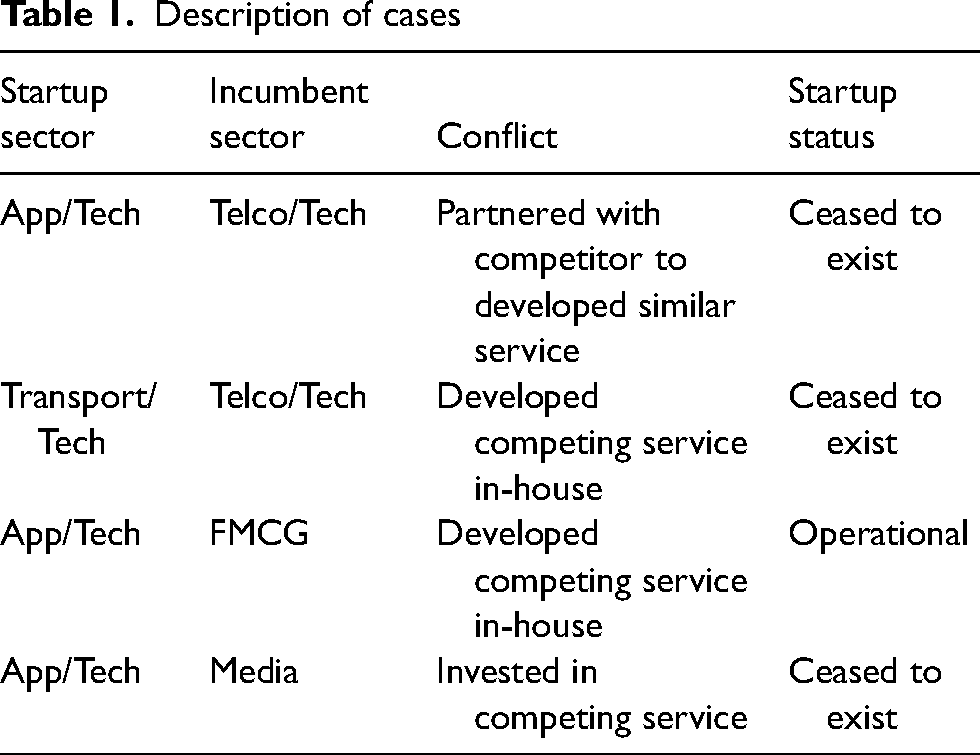
All the startups were defined with the criteria set out in, e.g., Luger and Koo (2005), as being independent and new at the time of alliance formation. New is defined here to mean no more than five years old and still in the process of developing products and a business model. The ages of the startups were well within the criteria of less than eight years commonly used in entrepreneurship research (Steffens et al., 2009). An overview of the alliances is provided in Table 1.
Description of cases
Data sources
The sources of data consist of 19 semi-structured, open-ended interviews conducted in the period of 2017–2019, with incumbents (n = 8), startups (n = 7), and incubators (n = 4) as the matchmakers/referee in the alliances. Incubators (X and Y) provide third-person views and a neutral perspective of the failed alliances.
The informants at the startups are the founders (two are first-time founders and two are serial entrepreneurs); informants at the incumbents are current or former executives in innovation and partnership divisions of the incumbents that focus on alliances with startups; informants at the incubators are partners with responsibilities to facilitate collaboration between incumbents and startups.
Semi-structured interviews were employed and—following recommendations on conducting qualitative research—data collection and analysis were performed concurrently (Miles et al., 2018; Silverman, 2013; Yin, 2017). The interviews pursued the specifics and contexts of the individual cases, thus enabling a comprehensive, in-depth understanding of each case. This semi-structured format helped set thematic foci for the interviews, thus enabling proper cross-case analysis, with patterns of difference resulting not from data-collection variation but from actual differences in the cases (Yin, 2017). The interviews revolved around a set of themes, including background and motivations of the alliance and the process of alliance formation, execution, and termination. For the interviews with founders, the focus was on their strategy for growth, the rationales for alliance formation and their explanations of the alliance failure. For incumbents, the focus was on the rationales for alliance formation, the general approach of alliance formation and incumbents’ explanations of the alliance failure. For the interviews with the incubators, we focused on getting a neutral third-party account of the failures and the rationales of both startups and incumbents for entering into an alliance.
The interviews lasted 45–75 min; apart from three (phone and Skype interview), all the interviews were conducted face to face. The interviews were recorded and transcribed before being analyzed. Secondary data was collected from business press, industry reports, and a complete database including documents and newspaper clips was established in NVivo software. The combination of interview data and document data allowed for data triangulation in all four cases (Yin, 2017). Furthermore, a case study log with details of the organizations and informants was created and maintained. Idea development and observations that emerged during the data-collection process were recorded in memos.
Case descriptions
Case A: failed alliance between incumbent A and startup A
Startup A was established in 2014 to develop a family organizing app. Incumbent A gained access to Startup A's app to test the service during the incumbent's mobile innovation program. At their second meeting, there were discussions of equity that Incumbent A would like to have in Startup A and board seats on Startup A's board. Incumbent A denied Startup A's request to enter into a non-disclosure agreement (NDA). Incumbent A subsequently decided to enter into an alliance with a competing app.
Case B: failed alliance between incumbent B and startup B
Startup B (est. 2013) developed an app that collects vehicle mobility data and received an invitation to talk to Incumbent B about operational cooperation and investment, which they entered into in good faith and presented their ideas in detail to Incumbent B in 2016. The founder claimed that Incumbent B withheld the development of Startup B's app for 6 months from June 2016. The founder was under the assumption that Incumbent B was evaluating the system. Despite having an NDA in place, Incumbent B launched a similar service. This alliance failure ended up in court.
Case C: failed alliance between incumbent C and startup C
Startup C, a digital cleaning company, was founded in 2015 by a serial entrepreneur who had a successful exit from a previous venture. Both parties started engaging in close dialog in early 2016; there were presentations to Incumbent C with great mutual interest and there were talks of possible investment in Startup C. The founder was also asked to sit on the board of another subsidiary of Incumbent C. The alliance fell apart when Incumbent C started an in-house service that resembled Startup C's.
Case D: failed alliance between incumbent D and startup D
Startup D enabled its users to trade in the marketplace with the help of an image recognition solution. Incumbent D invested in Startup D in 2014 and 2017. The relationship started to deteriorate when Incumbent D invested in a competing startup with a service resembling Startup D's and subsequently brought the competing service to the Norwegian market without informing Startup D. Unable to turn around his startup, the founder gave up his startup dream.
Data analysis
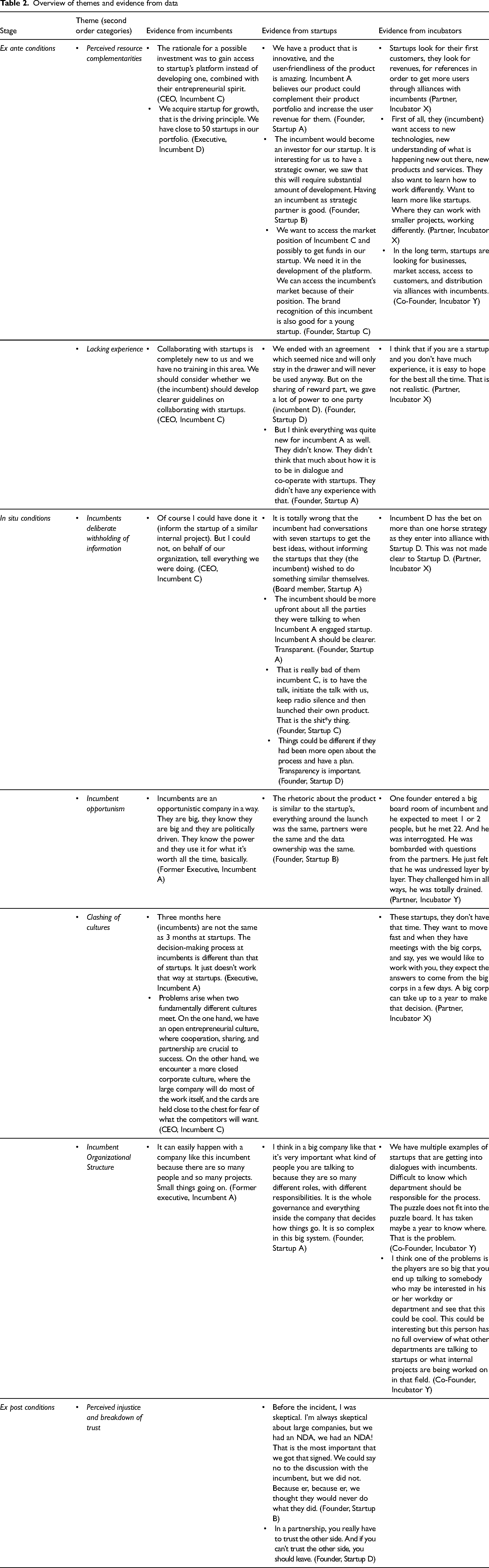
The data analysis followed the standard multiple case-study template with few variations (Eisenhardt, 1989; Gehman et al., 2018). Using the full data sources of the cases and drawing on the initial ideas and observations, elaborate case descriptions were developed for all four cases. Having built this overview of the cases, we applied a multi-cycle coding process (Gioia et al., 2013; Miles et al., 2018). In the first cycle, inductive first order codes were developed from statements and observations in the data, selecting issues that were relevant for our research interest and that summarized the relevant experiences of the interviewees. Examples of data coded in this cycle are presented in Table 2 below as evidence from the different types of interviewees. From these inductive first order codes, a second cycle was conducted to identify thematic patterns across the cases. This coding cycle resulted in seven second-order categories documented in the second column of Table 2 below. In the third cycle, deviating slightly from Gioia's template, we used Langley’s (1999) strategy of temporal bracketing as a way of developing processual accounts, distinguishing between the ex ante, in situ, and ex post conditions of the alliance failures. Despite variations in the specifics of the various conditions, a strong pattern was clear in the case summaries, indicating a common trajectory of the cases toward alliance failure. Moreover, by outlining the conditions temporally, the resulting pattern outlines potential underlying dynamics of alliance formation and failure.
Overview of themes and evidence from data
Findings
Ex ante conditions
Following the process outline of alliance failures Park and Ungson (2001), our analysis distinguished between the ex ante, in situ, and ex post conditions that shape and emerge from the interactions of the incumbents and startups as they move toward alliance erosion and failure.
Perceived resource complementarities
Across all cases, we found that perceived resource complementarity was a primary motivation for entering into the alliances. Each party had something the other party desired. In this study, the startups were primarily hoping to gain legitimacy, market access, and access to new or critical resources or capabilities and financial investments by entering into an alliance with the incumbents.
One illustration of resource complementarity is between Startup A and Incumbent A. This founder worked in Incumbent A for 12 years and rose through the ranks to become a director before starting Startup A. Incumbent A found Startup A's product compelling and innovative; in particular, Incumbent A liked the user-friendliness of the product and believed it could complement their product portfolio and increase their revenue. For Startup A, the motivation for the alliance was as a distribution channel. Partnering with incumbents for market access had always been a growth strategy for Startup A.
In Startup C, the founder was looking to access the market position of Incumbent C and possibly obtain financing to further develop their platform. In addition, Startup C was also attracted to the brand recognition of Incumbent C, as this would help Startup C gain legitimacy. Incumbent C was trying to get closer to its users’ homes via Startup C's platform instead of having to develop it from scratch. Startup B and Incumbent B had similar use cases for entering into an alliance.
Incumbent D saw Startup D as a way to acquire new users and market their products via Startup D. Startup D could also act as a talent and technology platform. The motivation for Startup D to enter into a partnership with Incumbent D was to learn and try out new ideas fast, much faster than the existing established marketplace.
Lack of experience
A further important ex ante condition relates to experience, or rather the lack thereof. In the Nordic context of this study, incumbents do not have a long history of forming alliances with startups or vice versa. The startup scene in the ecosystem studied was still new when all these failed alliances occurred; hence, the procedures and guidelines were not in place for the alliances to lean on. This founder of Startup A put it succinctly: “But I think everything was quite new for the incumbents as well. The incumbent didn't know. They didn't think that much about what it's like to engage in dialogue and cooperate with small startups. They didn't have any experience of that. Because all this is new, they don't have the procedures in place to engage with startups.”
The CEO in Incumbent C admitted as much: “Collaborating with startups is completely new to us and we have no training in this area. We find it very sad. We should consider whether we should also develop clearer guidelines on collaborating with startups.”
This is also observed by a partner in Incubator X, commenting on the failed alliance for case D, the partner was convinced that the lack of experience in handling an alliance with an incumbent caused this alliance to fail: “I think that if you’re a startup and you don't have much experience, it's easy to hope for the best all the time. That's unrealistic.”
This was further confirmed by the founder of Startup D when he explained why he was not forceful enough to protect his interests when he entered into alliance with Incumbent D. The founder admitted that some clauses in the agreement they entered into seemed to be “standard” and would never be used. Incumbent D indeed executed these clauses and gave Incumbent D a lot of power to dictate the flow of capital into Startup D. This effectively meant that Startup D surrendered a lot of control to Incumbent D, which spelled the demise of Startup D.
An executive in Incumbent A, with venture-capital experience prior to working in Incumbent A, admitted that part of his job was to educate his colleagues on how to collaborate with startups and provide guidelines on incumbent–startup partnership.
In situ conditions
In situ conditions relate to various conditions embedded within startups and incumbents that only became apparent once both parties entered into alliances, and contributed to the subsequent alliance failures. In this study, we identified four in situ conditions that worked against the alliances.
Incumbent deliberate withholding of information
While the startups were transparent, incumbents were the opposite. Little was communicated to the startups about the corporate strategies underlying the decisions to enter into the alliances. Despite being in alliances, the incumbents behaved as if the startups were competitors. For example, after initial meetings about an alliance, Incumbent C developed a similar service in-house without informing Startup C. Startup C felt unjustly treated and furious: “That's really bad of them (the incumbent), having the talk, initiating the talk with us, keeping radio silence and then launching their own product. That's the shit*y thing.”
The CEO of Incumbent C, when asked why they hadn't been forthcoming about developing a competing product similar to Startup C in-house while engaged in an alliance with Startup C, responded: “I, on behalf of the incumbent, tell the startup everything that we are doing.”
For case A in this study, the founder thinks that Incumbent A was withholding information while they were talking about entering into an alliance, when Incumbent A was actually engaged in talks with others: “The incumbent should have been more upfront about all the parties they were talking to when the incumbent engaged us. The incumbent should have been clearer. More transparent.”
A serial entrepreneur who sat on the board of Startup A lashed out at Incumbent A in the media. He thinks that Incumbent A in reality only interviewed startups to take their ideas and that this should be criticized. Incumbent A had had conversations with several startups to get the best ideas, without informing the startups that they (Incumbent A) wanted to do something similar themselves. A partner from a known incubator in Oslo, commenting on alliance failures between startups and incumbents, said that incumbents tend to have a “betting on more than one horse” strategy: incumbents usually have various alliances with similar startups for strategic reasons without disclosing this to the startups they enter into an alliance with.
The founder at Startup D shared the same sentiments with other founders in the study when Incumbent D put a service on the market that competed with Startup D's. Startup D thinks that things could have been different had they (Incumbent D) been more open about the process and had a plan. The founder of Startup D thinks that Incumbent D did not communicate its plan clearly. If Incumbent D had had a clear communication plan on how to move forward, their alliance might have had a different outcome.
The data shows that the startups felt a strong need for more transparency on the part of the incumbents when entering into alliances. Previous research has found that information asymmetry may create power imbalances and that this is one of the causes of alliance failure. This is even more pronounced if the two firms, whether incumbent or startup, are competing in the same business area. In such situations, the alliances face the risk of succumbing into learning races in which a firm attempts to extract as much knowledge as possible from its partner while divulging as little as possible.
Incumbent opportunism
When asked about the behavior of Incumbent A, following some high-profile failed alliances between incumbents and startups, a former innovation director at Incumbent A stated: “They (incumbents) are an opportunistic company in a way. They’re big, they know they’re big and they’re politically driven, so they’re power-aware in a way. They know their power and they use it for what it's worth all the time, basically.”
In case B of this study, a lawsuit was filed against Incumbent B when a similar service to Startup B was launched after the communication between them had gone quiet for six months. Startup B thinks that Incumbent B deliberately stalled the product development of Startup B after a few rounds of meetings and workshops. Incumbent B was gleaning information from them and using it to develop a competing product similar to Startup B, despite having signed an NDA.
According to the founder, there were conspicuous similarities between the product developed by his startup and the product launched by the incumbent: “The rhetoric about the product is similar to the startup's, everything around the launch was the same, the partners were the same and the data ownership was the same.”
This founder later found out that other startups had had a similar experience after the news of his failed alliance with the incumbent came out in the media. He thinks that Incumbent B was systematically and opportunistically scouting for ideas from startups that could be used for internal product development.
A number of factors, including the inherent conflict resulting from goal divergence, corporate opportunism and cultural differences, substantially contribute to alliance failure. With immense power and clout, incumbents can push their way through when it comes to dealing with their counterparts, especially a startup. Alliances present opportunities for firms to share lessons learned, yet the different absorptive capacities between them means that one partner in the alliance may learn the desired capabilities more quickly and dissolve the alliance, even if the other partner has yet to acquire the desired know-how. It is also common for firms to enter into alliances with the intention of becoming a competitor, which is exhibited in this study. As the learning process between partners evolves during the course of the alliance, the dynamics and relationship may be reconfigured. If a partner meets its learning objective in an alliance, this will affect the motivation of the partner in the alliance and may lead to reduced cooperation and even the dissolution of the alliance.
Clashing of cultures
It is well established that alliances between organizations whose cultures are different present far more risks than those between organizations that are similar. This observation was confirmed in the analysis as we observed cultures clashing in the alliances. One example of this relates to the differences in the perception of openness and a culture of sharing. This is confirmed by Incumbent C: “Problems arise when two fundamentally different cultures meet. A bit schematic perhaps, but it looks something like this: on the one hand, we have the open entrepreneurial culture, where cooperation, sharing and partnership are crucial to success. On the other, we encounter a more closed corporate culture, where the large company will do most of the work itself and holds its cards close to the chest for fear of what the competitors will want.”
In addition, the different way of working and perception of time at incumbents and startups further exacerbates their cultural difference. This is further emphasized by a partner at Incubator X: “At big corporations, it takes a year to hire a person. And when you hire a person, the person will stay in the organization even if it doesn't work out. If you’re at a startup, you hire a student, who comes in on short notice and leaves quickly if it doesn't work out. So, it's a totally different way of working.”
Incumbent organisational structure
The sheer size of the incumbents with abundant resources and the complexity of running them could also mean that the people working in such organizations often lose sight of the various projects in various parts of the incumbents. When asked about structural problems within incumbents where one division had a limited overview of what other divisions were doing, the founder of Startup A, who had previously worked for Incumbent A, answered: “It can easily happen with a company like this incumbent because there are so many people and so many projects. Small things going on. It's the whole governance and everything inside the company that decide how things go. I understand them a little bit as well (chuckles). I worked there myself. I understand how it works; it's so complex in this big system.”
This sentiment is also shared by a partner at Incubator Y: “We have multiple examples of startups engaging in dialogue with incumbents. It's difficult to know which department should be responsible in the process. The piece doesn't fit into the puzzle. This means that they sometime need to have cross-department input to see if it's relevant to bring it forward. It's taken maybe a year to find out. That's the problem.”
Ex post conditions
Perceived injustice and breakdown of trust
The ex post conditions for this study are based on the actual outcomes of the alliances. As all alliances in this study suffered a premature demise and failed to realize their objectives, we gauged from the parties involved on their assessments of what actually happened during the course of the alliance. In this study, we identify the breakdown of trust and the perceived injustice endured by the startups as ex post conditions.
Startup B went so far as to sue Incumbent B in what became a prolonged court case. Incumbent B won the case but was given a stern warning by the ruling judge for “borderline malpractice” in their business conduct. Startup B believes that Incumbent B was not honest about their intentions at the first meeting. Incumbent B did not give Startup B the right reasons about why the collaboration would not continue when the dialog ended, and Incumbent B went on to pursue its own project. In Startup B's view, this is the worst part. In addition, the founder was unable to prove whether Incumbent B had misused the information. The founder added: “Before the incident, I was skeptical. I’m always skeptical about large companies, but we had an NDA, we had an NDA! That's the most important thing that we got that signed. To me, you have to take some chances, also in business, and we did. We could have declined to enter into discussions with the incumbent, but we didn't. Because we never dreamed that they would do what they did.”
As a serial entrepreneur, the founder at Startup B was well aware of the risks of entering into an alliance with incumbent. Despite his effort to protect his startup from the worst-case scenario in the alliance, his attempts were futile. He added: “What I did to protect myself is that I never attended meetings with Incumbent B alone: eight of us were involved. At the first meeting I attended, there were about seven high level directors of Incumbent A and I had brought six people. So, I didn't go alone. All of us, similarly, were shocked by what they did later. We were completely shocked!”
The founder of Startup C had an experience that resembled Startup B's: Startup C thought that Incumbent C was a firm he could trust The trust collapsed completely when Incumbent C launched a similar service internally. Startup C also thinks that if another incumbent had been in a similar situation with Incumbent C, this would not have happened.
As to the perception of trust between Startup D and Incumbent D, they were on a firm footing and shared everything until Incumbent D brought a competitor into the local market without informing Startup D. Then, everything just fell off the cliff. The founder stated: “They (the incumbent) kind of throw you under the bus if things don't go well. In our case, they (the incumbent) didn't do what they said they were doing. In a partnership, you really have to trust the other side. And if you can't, you should leave.”
Discussion and implications
Theoretical contribution and conceptual framework
In the empirical findings, the perceived resource complementarity is a central antecedent to alliance formation. The possibilities of generating synergy between the resource configurations of the incumbents served as the main reason for entering into the alliances, in which startups were primarily seeking legitimacy (Haley et al., 2016), access to markets and networks (Allmendinger and Berger, 2020; Hogenhuis et al., 2016), and financing (Spender et al., 2017). On their part, the incumbents were looking for technologies and access to the startup ecosystem (Chesbrough, 2019).
A series of ex ante and in situ conditions were antecedents to the ultimate failures of the alliances, however. The antecedents include an incumbent who deliberately withheld information, opportunism (Chiambaretto et al., 2020), cultural clashes (Cherbib et al., 2021), and an incumbent's organizational structure (Kale et al., 2002). While these antecedents were all distinct in the empirical analysis, conceptually they are associated with overall differences in how incumbents and startups approach alliances. Drawing on strategic management research, we conceptualize the approaches as resulting from strategic orientations that are fundamentally different. Strategic orientation covers the “strategic directions implemented by a firm to create the proper behavior for the continuous superior performance of the business” (Gatignon and Xuereb, 1997; Menguc and Auh, 2005; Narver and Slater, 1990). The principles of strategic orientation can also be adopted to guide the activities of the organization (Adams et al., 2019; Hakala, 2011). Thus, strategic orientation represents principles affecting the behavior of incumbents and startups.
For startups, strategic orientation revolves around a sense of focused urgency. Thus, startups were keenly focused on getting their specific and singular product into the market as quickly as possible via the market access, credibility, and financing provided by the incumbents, and these are the most frequently cited reasons for entering into an alliance with an incumbent (Allmendinger and Berger, 2020; Haley et al., 2016; Rehme and Svensson, 2011; Spender et al., 2017). This focused urgency may be due in part to a shortage of funds, making time critical.
The incumbents, on the other hand, have a different strategic orientation when entering into alliances with startups, invoking portfolio thinking and exploration. This revolves around the need to explore new technologies and market areas to supplement their current businesses (Chesbrough, 2019). Having a wide and established customer base means that incumbents can push new products via the alliances with startups to expand their market reach. Yet exploring new technologies calls for an uncommitted approach to alliances with startups. This strategic orientation is associated with all the antecedents identified in the empirical analysis. The incumbents, following their strategic orientation, would have incentives to act opportunistically, withhold information, and be unconcerned with the organizational structure that allows for similar projects to be developed in different departments. In this light, the cultural clash between the incumbents and startups is unsurprising.
Importantly, for the theoretical understanding of alliance failures, perceived resource complementarity is a key driver of alliance formation. Yet, the difference in strategic orientation serves as a key antecedent to alliance failure. Notably, the differences in strategic orientations and resource complementarities are associated, as the characteristics of incumbents and startups from which the resource complementarities originate are also at the heart of the difference in strategic orientation.
A final ex ante condition, a lack of experience in the conceptualization, functions as a form of moderator between the in situ conditions and the alliance failure. The lack of experience seemed to function as a negative moderator in contributing to alliance failure. Had the incumbents and startups been more experienced, some of the negative effects of the ex ante and in situ conditions would have been less severe. This is confirmed by respondents from startups, incumbents, and incubators in the data, and conceptually, we would argue that knowing the differences in, e.g., strategic orientations and transparency of the incumbents would have alleviated much of the tension. A similar point has been made using the notion of a so-called alliance management capability, defined as the skill to manage alliances throughout the lifecycle of the alliance (Schreiner et al., 2009). This is pivotal to the success of alliances.
An overall summary of the empirical findings is outlined in the conceptual model of alliance failure and is provided below in Figure 1.
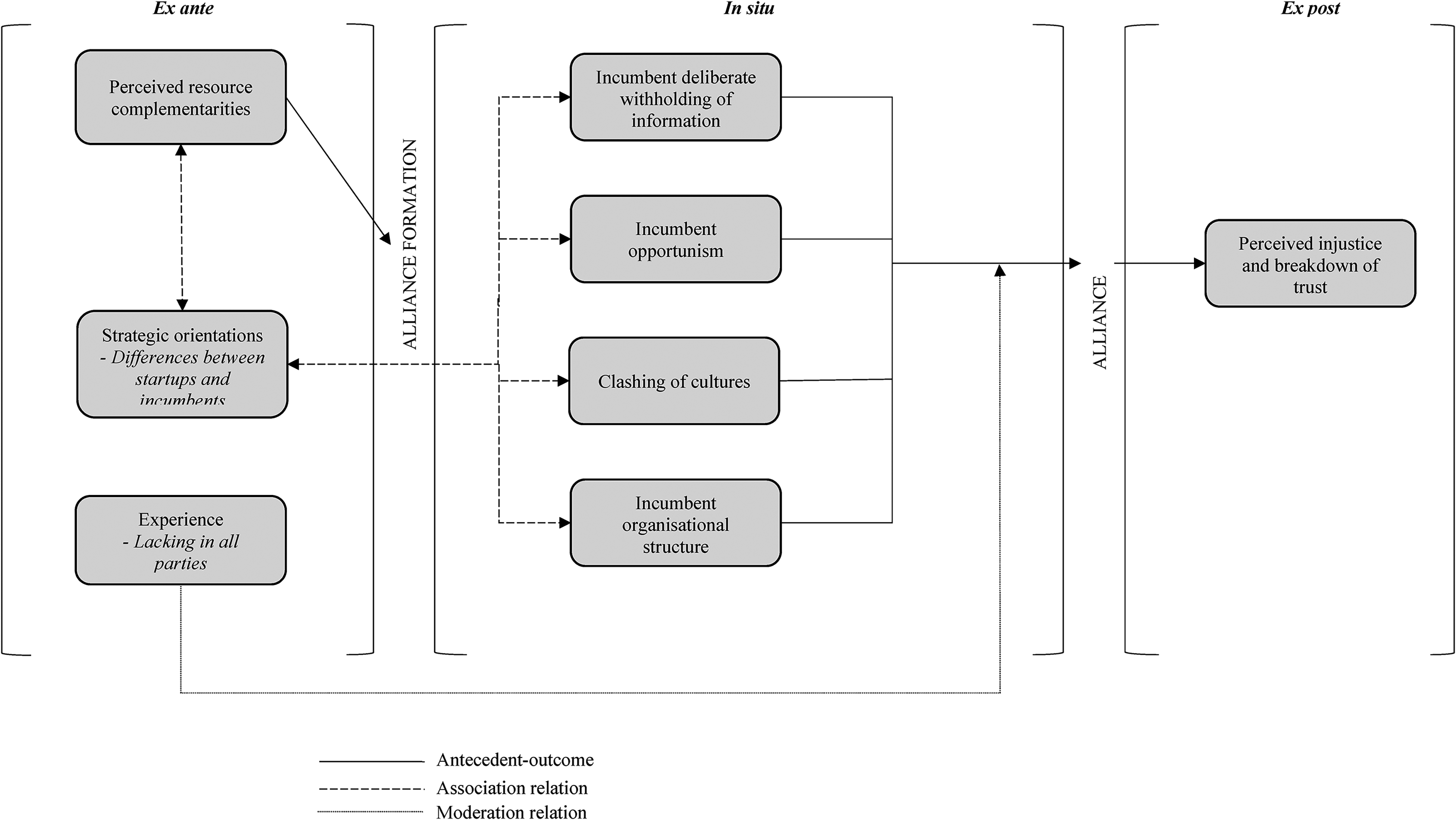
Conceptual model.
Practical implications
Our findings suggest that startups and incumbents need to be cautious when considering whether to enter into asymmetric alliances. The resource complementarities of many incumbents and startups provide incentives to enter into such alliances, yet the complementarity holds the seeds of future challenges within an alliance.
For startups this implies that they should not be naïve about what it means to enter into an alliance with an incumbent. Most likely, the startups will be part of a portfolio of activities undertaken by the incumbent to explore a new market or technology. Taking the product or service of the startup to market is therefore much less important to the incumbent than it is to the startup. There is little in our findings to suggest that signing an NDA or taking other formal precautions against incumbent opportunism will help alleviate this problem for the startups. It is also imperative for startups to do due diligence and to check the “street cred” of incumbents among their peers before entering into alliances.
For incumbents our findings suggest that insofar as incumbents seek successful alliances, they need to examine their procedures and clarify their interests in pursuing an alliance. As indicated in our findings, several incumbents have reacted to the alliance failures by initiating development and training in the company to ensure better alliance performance in the future. We see this as an important, indispensable step towards better overall alliance performance in the ecosystem we studied. While such measures will not eliminate the differences in strategic orientations of incumbents and startups, they will hopefully ensure that future alliances will avoid many of the pitfalls we found in our four failed alliances.
Finally, the important role played by incubators in alliances between incumbents and startups needs to be highlighted. Incubators understand the inner workings and culture of both incumbents and startups, which gives them unique potential to help startups and incumbents prepare for an alliance. By heightening an awareness of the challenges inherent in asymmetric alliances, incubators can help startups in particular to carefully consider the dangers of alliances, thereby averting future problematic alliances.
Limitations and future studies
This study is not without its limitations. First, getting access to managers from incumbents proved difficult. Managers at incumbents were not willing to comment on specific cases, whereas former managers were more open. This might be interpreted as a partial admission of guilt. Access to startups was easier, as they were willing to sound the alarm and share their experiences. Future studies may get better access to incumbents and provide a more complete view of failed alliances. Second, this study follows a post hoc approach to alliance failure. The parties in the failed alliances were only identified after the fact. Future studies could follow the entire lifecycle of an alliance, from formation, during the cooperative process and up until an alliance ends.
Conclusion
This study contributes to entrepreneurship and strategic management research that explores alliance formation and alliance failure by exploring failures in asymmetric alliances—an area that has received less attention than failures of alliances between equal-size partners. The study outlines key conditions that lead to alliance failure, most importantly underlying differing strategic orientations of incumbents and startups. For practitioners, this study provides insight into potential fault lines between startups and incumbents, allowing them to better understand each other, especially as these are broadly communicated and understood in the ecosystems. Finally, the study's limitations, primarily associated with data from incumbents, have been presented.
Footnotes
Declaration of conflicting interests
The author(s) declared no potential conflicts of interest with respect to the research, authorship, and/or publication of this article.
Funding
The author(s) received no financial support for the research, authorship, and/or publication of this article
