




Abstract
We examine how musicians become entrepreneurs, illustrating how this dramatic shift from the aesthetic to the commercial offered a useful platform for understanding entrepreneurship. Analysing our data of 20 life story narratives, we found chronological patterns of socialised learning through and by experience and began to recognise how experience was acquired and deployed. Employing an entrepreneurship as practice theoretical framework, we saw an unexpected dimension, that our respondents not only used experience for “knowing” but that they performed that knowledge. Remarkably, performing was not simply enacting, but was a learning experience. This led us to propose a constructive circuit of learning by doing. The concept of performing provides an explanation that bridges conceptual gaps between experience and learning, strengthening our knowledge of entrepreneurship as socially situated by demonstrating that it is also socially learned. Although novel, it builds on and connects to much of what we already know.
Keywords
Introduction
We offer what we believe to be a constructive concept that helps explain learning entrepreneurship in, and as, informed practice. ‘Performing’ reflects and contextualises learning and knowing in actions. Providing a process view of enacting entrepreneurship with knowledge, it recognises knowing as sedimented experience(s). Informed by theories of entrepreneurship-as-practice (Higgins et al., 2019), performing offers insights about the entrepreneurial application of socially situated learning as the enactment of experience. Based in what entrepreneurs do, performing demonstrates how entrepreneurial learning is everyday, and how experience forms useful knowledge. Moreover, this practice turn to learning, theoretically connects learning into the entrepreneurial process.
We believe the concept extends what we know about learning by doing, experiential learning (Cope and Watts, 2000; Jack and Anderson, 2002). It helps to explain why experience is useful and how it is used. Minniti and Bygrave (2001: 7) had argued ‘entrepreneurship is a process of learning, and a theory of entrepreneurship requires a theory of learning’. The concept of performing is a theoretical bridge that links learning by doing to enacting learning. It proposes entrepreneurial knowledge develops over time, extending the periodisation of learning process from a short series of events to a long view that takes greater account of all experiences (Berglund, 2015). Moreover, it recontextualises and embeds learning in social practice. As Orlikowski (2002: 252) puts it, “knowing is an ongoing social accomplishment, constituted and reconstituted in everyday practice”. Performing shows us how knowledge is reconstituted.
We demonstrate how performing involves learning as both input and output. By performing, entrepreneurs learn what is needed, they experience social feedback and in doing so, begin to understand how things actually work. Performing involves stage and audience, the context and stakeholders with whom entrepreneur enacts what they have learned. Thus, performing is learning from context and then enacted in context. However, our analysis demonstrates that entrepreneurial knowing is an accumulation of experiences transferable across different spheres. We conclude that performing is the creative, productive engagement with circumstances as socialised learning. Performing is a virtuous circuit of acquiring knowledge and applying knowing and explains why and how experience matters.
Our discovery and development of performing was serendipitous and attributable to good luck rather than planning or foresight. One author had preceded her academic career as a rock guitarist and had noticed that some of her contemporaries were now entrepreneurs. This intriguing question became her PhD topic asking, “how did this remarkable change come about?” (Air, 2020). Music and entrepreneurship appear to occupy different, even opposing domains. The aesthetic and the commercial are so very different in terms of practice and ethos. Indeed, we had previously encountered (Anderson and Jack, 2015) resistance by creatives towards even being seen as business-like. Moreover, Haynes and Marshall (2018) found musicians defended their musical identity, shunning the commercial and tended not to frame their business activities as enterprise (Dumbreck, 2016; Green, 2002). This was evident despite the disruptive effect of technology on the music industry (Kot, 2009) resulting in musicians becoming their own marketeers, writers, sound engineers, music producers, logistics experts and performers (Breen, 2004; Watson, 2013). Aesthetic labour has become reliant upon an array of additional skills and competencies that can be considered in entrepreneurial terms.
Our study originally asked how and why this intriguing aesthetic to enterprise change occurred. We collected and analysed the data looking for reasons and explanation. It quickly became clear that we had asked the wrong question, we should have asked what is common across these spheres. Our eureka moment was realising that both musicians and entrepreneurs perform; both enact socially acquired experience. We recognised entrepreneurship was a creative process which is enacted in context and may be understood as a performance interaction (Goffman, 1959; McKeever et al., 2015; Searle, 1995). Moreover, we saw how entrepreneurs learn in performing and how experience is an outcome that prepares them for further performing. Performing creates a virtuous circuit: learning in doing and then enacting that experience, by doing as entrepreneurial knowing.
Review of literature
A good literature review identifies and explains what is known about a topic. Typically, the critical element of the review will justify the research question by showing its significance. We became aware of the enormous volume of work on why people become entrepreneurs. However, this proved to be largely a theoretical cul-de-sac for understanding how. We decided to focus on entrepreneurial learning as a theoretical lever for establishing one dimension of process. Our reasoning was that experiential learning is consistently deemed critical for both practitioners and pedagogies (Jack and Anderson, 1999; Krueger, 2007; Rae, 2005). Moreover, Galloway et al. (2015) argue that entrepreneuring is performative. Accordingly, our review critically explores what we know about experiential learning.
A widely endorsed view within the entrepreneurial learning literature is that much of their learning is experiential. However, Karataş-Özkan (2011) notes little attention is devoted to how entrepreneurs, through experience, develop entrepreneurial knowledge. Moreover, studies on entrepreneurial learning often adopt a rather static perspective on the process of entrepreneurial learning, often only within the narrow frame of entrepreneurship. Arguing for a narrative approach, Rae and Carswell (2000) propose that to understand life worlds, we need an approach that explores choices through their own accounts. Moreover, Cope (2005) explains entrepreneurial learning is inextricably linked to the idea of ‘learning history’ because preparing for entrepreneurship has personal and interactive dimensions that occur throughout an individual’s life rather than being concentrated in the immediate pre-start-up phase.
A critical synthesis of the literature demonstrates that our concept of performing sits conceptually comfortably with theories, and what we know, about socially situated learning. For example, dramaturgical and narrative work has developed a sharp conceptual framework (Anderson and Miller, 2003; Downing, 2005; Hjorth and Steyaert, 2004; Rae, 2004), especially about sensegiving and sensemaking (Clarke, 2011). However, these accounts tend to explain events at moments in time; they are usually micro level and typically do not theorise beyond this level. We delve a little deeper and stay longer in these processes and make comparisons across our literature. We continue by considering related literatures.
Knowledge transfer across domains
The practice of entrepreneuring has been argued to involve connecting. Anderson et al. (2012) offer a robust Schumpeterian informed perspective proposing that entrepreneurship is boundary spanning and connecting and is in essence a phenomenon of relatedness. They argue entrepreneurship connects; sometimes technologies, sometimes ideas, sometimes places and products. Chell (2007) similarly describes how interaction shapes meanings, so the concept of entrepreneurship deploys the idea of relatedness, a recursive dynamic of relationships. Dodd et al. (2020) insist that entrepreneurial ontology is connectedness. One key dimension of connectedness is that entrepreneuring is socially embedded and socially enacted (Galloway et al., 2015a). From this perspective, it becomes easier to follow how social experiences, social learning and social performance contributes to performing entrepreneurship. Conceptually, Higgins et al. (2019) suggest we position entrepreneurial practice as a process of human engagement which is emergent and enacted and that social practice theory is a means of decoding the nature of entrepreneurial practice. For our purposes, we propose that social interaction is a learning platform for actors to connect their experience with that of others, thus leading to ‘knowing’. In turn, knowing is not restricted to a given field, but may be applied across domains. Indeed, knowing may bridge different fields.
Experiential learning
Experiential learning is “the process whereby knowledge is created through the transformation of experience. Knowledge results from the combination of grasping and transforming experience” (Kolb, 1984: 41). There is a paradox in that the concept of experiential learning gained purchase in academia for teaching, rather than from the more obvious acquisition of skills and knowledge in experiencing everyday practice. Moreover, Seaman et al. (2017) exploring the origins of experiential learning, remind us it was first conceived as social learning with the purpose of addressing social problems. Indeed, coupling experience with learning was largely pedagogic because Kolb’s theory enabled a new teaching practice focusing on “an independent learner, cognitively reflecting on concrete experience to construct new understandings, (Fenwick, 2001: 7). Thus, the extensive literature is largely about experiential learning as an intervention. Our arguments about performing as learning return experience to its social learning and socially situated roots.
Learning within small business has not been entirely neglected. For example, Cope and Watts (2000) relate it to Argyris and Schon’s (1978) “double–loop learning”. This is similar to Nonaka’s (1994) dual elements of tacit knowledge, technical and cognitive, alteration of beliefs: the viewpoints that shape the individual’s perception of the world. They proposed that ‘learning by doing’ involved a gradual change in a person’s orientation as a consequence of a continual flow of information gained via experience. Pittaway and Thorpe (2012) describe Cope’s approach to experiential learning as trying to understand ‘lived experience’ which should capture the everyday situated social constructing of knowledge in their here-and-now. We can thus infer that learning by doing occurs when experience provides knowledge. It may manifest as a change in an entrepreneur’s background consciousness that occurs gradually over time. It also recentres ‘lived experience’ as a learning mode.
Competences and the art of entrepreneuring
We note similarities in our argument to the expanding literature on entrepreneurial competencies (Bird, 2019). Here specific competencies are singled out as the functions of entrepreneurship. However, Ronstadt (1990) points that entrepreneurship is not the sum of functional subdivisions and competencies themselves are culturally situated (Tehseen and Anderson, 2020). Indeed, authors such as McElwee who are concerned about skills as competencies consistently find that competencies are poor predictors of entrepreneurship (McElwee and Bosworth, 2010; McElwee et al., 2006a, 2006b). Stinchcombe (1965) had argued long ago that technical expertise is not sufficient for entrepreneurs. Entrepreneurship calls for an array of attitudes, skills and knowledge, experiences and ways of behaving (Anderson and Jack, 2008) that combines functions associated with the professions, the artist and the artisan. Johannisson (2005) calls it a practice of creative organizing. Entrepreneuring is both an art and science, perhaps even an economic art form (Anderson and Jack, 1999). As Baumol (1983: 30) puts it “How can one analyse and teach acts whose nature is not yet known and whose effectiveness relies to a considerable degree on the difficulty others have in foreseeing them?” Jack and Anderson (1999) found entrepreneurship practice involves perceptual leaps which may transcend conventional rationality or competence. This art is the very nub of entrepreneurship. We can list possible ingredients of entrepreneurship, but the art lies in cooking diverse components. For us, this ‘cooking’ -action - is performing entrepreneurship.
Learning by ear
We also considered the importance of informal learning in music (Green, 2002), not to debate musicians as entrepreneurs, or indeed entrepreneurs as creative but to explore learning methods in relati n to performing. In learning to play music, auditory learning is known to be the most common way of building a necessary musical vocabulary (Lilliestam, 1996). It involves learning through listening and trying to replicate what is heard, often relying on trial-and-error approaches. Davis (2005) reminds us that “learning by ear” is not the poor relation of formal learning and is often goal orientated and self-directed, suggesting musicianship also calls for an array of attitudes, skills and knowledge, experiences and ways of behaving (Anderson and Jack, 2008). In social situations music is performed, with flawless expertise a somewhat obvious aim in the live music arena (Miller, 2008). Achieving such expertise takes practice and often relies on determination and discipline that need not take place in front of peers. Much musical learning happens in solitary (Bamberger, 2006; Green, 2002), as well as in social situations. We understand performing music as more than doing, as Frith (1996) describes, it is experience of the intangible and we would add that such experience is performed beyond the sonic.
Performing experience
Performance is frequently discussed as an output measure, we explore a different meaning of performing, enacting entrepreneurship. The concepts are linked in that some authors identify performing specific activities, such as innovating, with performance (Hosseini et al., 2012). We observe how often we refer to the entrepreneurial actor, this serves well to centre our attention on entrepreneurship as action. However, the focus is usually on role, rather than performing.
It is interesting to note that even when scholars are intent on identifying dependent variables for explaining entrepreneurship they allude to performing in their definition. Shepherd et al. (2019, p. 163), ‘Entrepreneurship involves the initiation, engagement, and performance of entrepreneurial endeavours embedded in environmental conditions’. Performing in the more sociological literature is presented as ‘doing entrepreneurship’ (Bruni et al., 2004). ‘Doing’ combines material and discursive practices (Bruni and Gherardi, 2001). These enactments can be deliberate and motivated, or unplanned, but should be seen as socially situated practices.
Morris et al. (2012) talk of lived experience and experiential processing. They describe how performing experience is ‘in the moment’. However, our processual perspective extends and develops experience as garnered over time accounting for how it is acquired and applied as performing as practice. We add to the growing school of thought that we can better understand entrepreneurship as actions, as ‘entrepreneuring’. Performing emphasises interactions and reflects the variety and flexibility of entrepreneuring (De Clercq and Voronov, 2009) as it adapts in encounters with changing circumstances. Moreover, it conceptually relocates entrepreneurship and entrepreneurial learning from an exceptional occurrence to demonstrate entrepreneuring as performing a flow of practices.
The conceptual appeal in performing is how it involves more than delivering competencies or articulations of entrepreneurial knowledge. Performing is not merely enacting a rehearsed entrepreneurial script, but interpretations of experiential knowledge. It expresses individual interpretations, understanding and experience. As Mangham (1990) proposes, performing is not a matter of metaphor, but a matter of form.
Theoretical framework, methods and practical analysis
Our respondents’ narratives produced a large volume of data, so our first task was organising. We first followed the natural chronological order of our narratives. We noted how our respondents had described the influence of different types of interactions at different times in their lives and careers. Probing these data, we saw that these different interactions occurred at different life periods producing different kinds of knowledge. Moreover, we also recognised how interactions were contextual social learning experiences and this provided an organisational framework for our analysis. The data are obviously skewed towards learning about becoming a musician, as per our original research objectives. Nonetheless, this allowed our second order of theoretical analysis where we found a fascinating, but explanatory pattern of learning, experience and performing cycles and process. We identified how learning, especially social learning, formed experience as situated knowledge and how this knowledge was enacted in performing. Moreover, we identified performing itself to be action learning. The explanatory utility of this performing was not confined to musicians. We were able to demonstrate how performing knowledge helps to explain entrepreneurial processes.
Reflecting the natural chronology of life narratives, we present our data as learning periods. The first is childhood experiences and the second as they extend their interactions into the wider world. Haneberg (2019) explains how the learning process is continuously impacted by its surroundings; the process is also adaptive to the context (Cantino et al., 2017). An objective is to show the extent to which learning is interactive and to develop the constructive circuit of learning by doing. Doing > experiencing > performing that learned experience > learning from performing
Methods
Our research approach was phenomenological to capture changes in the lived experiences of our respondents. Our twenty participants had started their careers as musicians but became entrepreneurs later in their lives. Our data were their narratives, which we analysed using the constant comparison method (Anderson and Jack, 2015). Again, we were fortunate in having used this approach because of its openness to inductive analysis (Cope, 2011). Our original objective was to chart transition from the sphere of music to the world of entrepreneurship. The life narratives explained what happened, but they also led us to explaining how, which led to identifying the concept of performing.
Phenomenology privileges people’s life-worlds and lived experiences. Van Manen (1990: 227) explains how experience is understood in retrospect and why we should “gather and reflect upon stories, anecdotes and recollections of live experience”, prioritising people’s life-worlds or lived experiences. Moreover, Berglund (2015: 479) explains in the entrepreneurial life-world “there is no a priori limit to what information is relevant [to the entrepreneur]”. This implies that all situational contingencies – as well as the entrepreneur’s entire life-history of experiences and relationships – is of potential relevance. Indeed, it can be argued that the nature of the entrepreneurial role turns on the enactment of such open-ended situations (Gartner et al., 1992). Dodd et al. (2013) describe how Heidegger’s notion of ‘being in the world’ (Daesin) makes the past present in the now, but also projects into our futures. “Being in the world” is an interactive experiential process that takes full account of being embodied and embedded in experience and situations (Berglund, 2015).
Our 20 respondents, a purposeful sample (Table 1) were recruited through a Facebook “shout out to friends” (Wilson et al., 2012). Our selection criteria were simply framed as seeking entrepreneurs who had started out their working lives as working musicians. All hail from the same city and were musicians before they started their respective businesses offering temporal distance between two careers. They generously narrated their life stories, encompassing musical beginnings through to being entrepreneurs. Again, we were fortunate, the author’s career opened doors and empathetic understanding, creating rapport that encouraged frank and full accounts.
Participants.
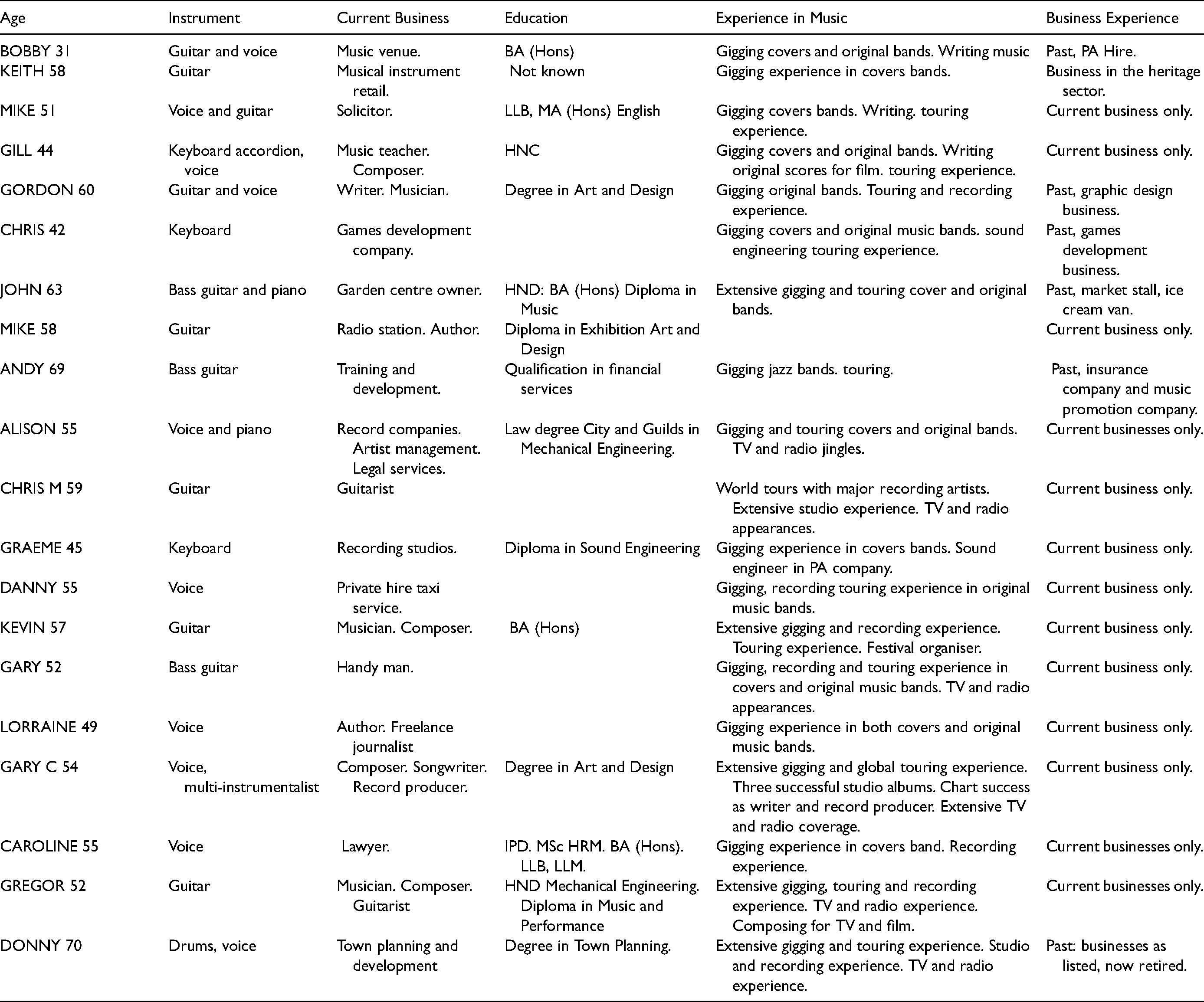
We collected the data with interviews, allowing us to probe interesting points. Our data were richly descriptive (Geertz, 1975) narratives of their experiences. Smith and Anderson (2004) describe how narratives offer both sense making and a sense giving (Gioia and Chittipeddi, 1995) and thus enable the possibility of interpreting an informed understanding of practices. Narratives re-present social and entrepreneurial experiences, allowing subjective and the individualised knowledge to be transformed into generalised and objective knowledge (Diochon and Anderson, 2011). Moreover, Fletcher (2007) explains how narrative analysis moves beyond the ‘what’ and the ‘how’ of entrepreneurship to answer theoretically ‘why’ such processes migrate and stretch across different cultures and contexts. Narrative draws attention to the ways in which people connect at a local level to practices associated with entrepreneurship, and what it is about that connection that engages with entrepreneurial ideas. This dimension of narratives directed us to the explanatory power of performing.
We used Dragon Naturally Speaking to help with the laborious task of transcribing the volume of data. This reduced the tedium because transcription by others risks losing nuances. Data were managed with NVivo. Analysis was by the constant comparison method (Anderson and Jack, 2015) which instilled rigour into our two stages of analysis. The first stage coding asks the data, ‘what is going on here’; whereas the second asks how can we explain it? Our inductive data analysis started by sifting and sorting through all data and discarding irrelevant information and bringing together what seemed important (Galloway et al., 2015). The next step was to search for patterns and explanation. The constant comparative technique involves a recursive sense-making of the data (Jack et al., 2010). It is informed by theory, but not determined by theoretical preconceptions. These Iterations between data and data, data and theory and the literature, are essentially trial and error, a craft rather than science (James et al., 2021). We persevered until we were satisfied that we had captured the nuances of our respondents’ experiences and practices. In this constant comparison the formative role of experience and experiencing became apparent. Analysing this process led us to see how they performed these experiences. Immediately recognisable for musicians, we observed how entrepreneuring similarly developed. This enabled us to demonstrate how experience informs performing and how performing enhances experience; a complementary and virtuous cycle of learning by doing and learning from doing.
Findings
Learning rules, roles and enacting experience
Enculturation was the earliest stage of learning and is largely about experiencing. This highly socialised learning takes place mainly in the shelter of the family. Most participants described their musical family and how that influenced them then, and later in life. A typical statement was that “there was always music in the house.” There were homes where radio or records were played constantly, mothers singing lullabies alongside examples of parents producing original music. It was clear that the participants considered their young lives to be steeped in music and music making as part of their family and cultural life.
We saw two elements, one directed towards musical participation: the other to learning the implicit rules of life. For participation, Chris V told us how “…my granny was quite keen that I played an instrument, so she paid for me to have piano lessons”. But Kevin offered a contrasting account about the influence of a musical culture and how it directed him towards learning by experiencing. “When my grandfather nipped out to get milk, that’s when I would be at the piano. And I started, I didn’t know how to play it. I didn’t have any idea, I’d just seen people doing this (places hands out front as if playing piano), like real writing, a skill you know and I thought, I’ll try a bit of that”. (Kevin)
Moreover, both Gill and Kevin talked about mimicking adults, presumably another way of learning by doing and vicariously experience what other had done. Family influence was powerful, but not deterministic. Consider how Alison had learned about herself through, or in spite of, family. Alison told us how her mother wanted her to play clarinet and sent her for lessons. But Alison preferred piano and taught herself to play. In this kind of response, we see experiences building knowledge. But Alison’s decision to play piano was based on informed knowing, an application of what she had previously learned.
The second more general experiences were about life more broadly and learning the rules of the game. For example, Garry G told us his dad, ‘thought that I had to learn the rules". Gregor explained, "My dad specifically was always like you’re going to have to work at this”.
These influences are as expected. We know how in family businesses children become encultured into business as a way of life. Accordingly, it is not surprising to find music playing a similar role. Hamilton (2011) explains how such entrepreneurial learning is socially situated, embedded in everyday practice in the context of family business. The family itself is a learning environment and influential because of the closeness of ties and the strength of familial bonds. Moreover, Konopaski et al. (2015) suggest that these situated-learning settings may help develop understanding of the past, present, future, and how it all fits together. Lave and Wenger (1991) propose families are communities of practice providing opportunities for learning through participation.
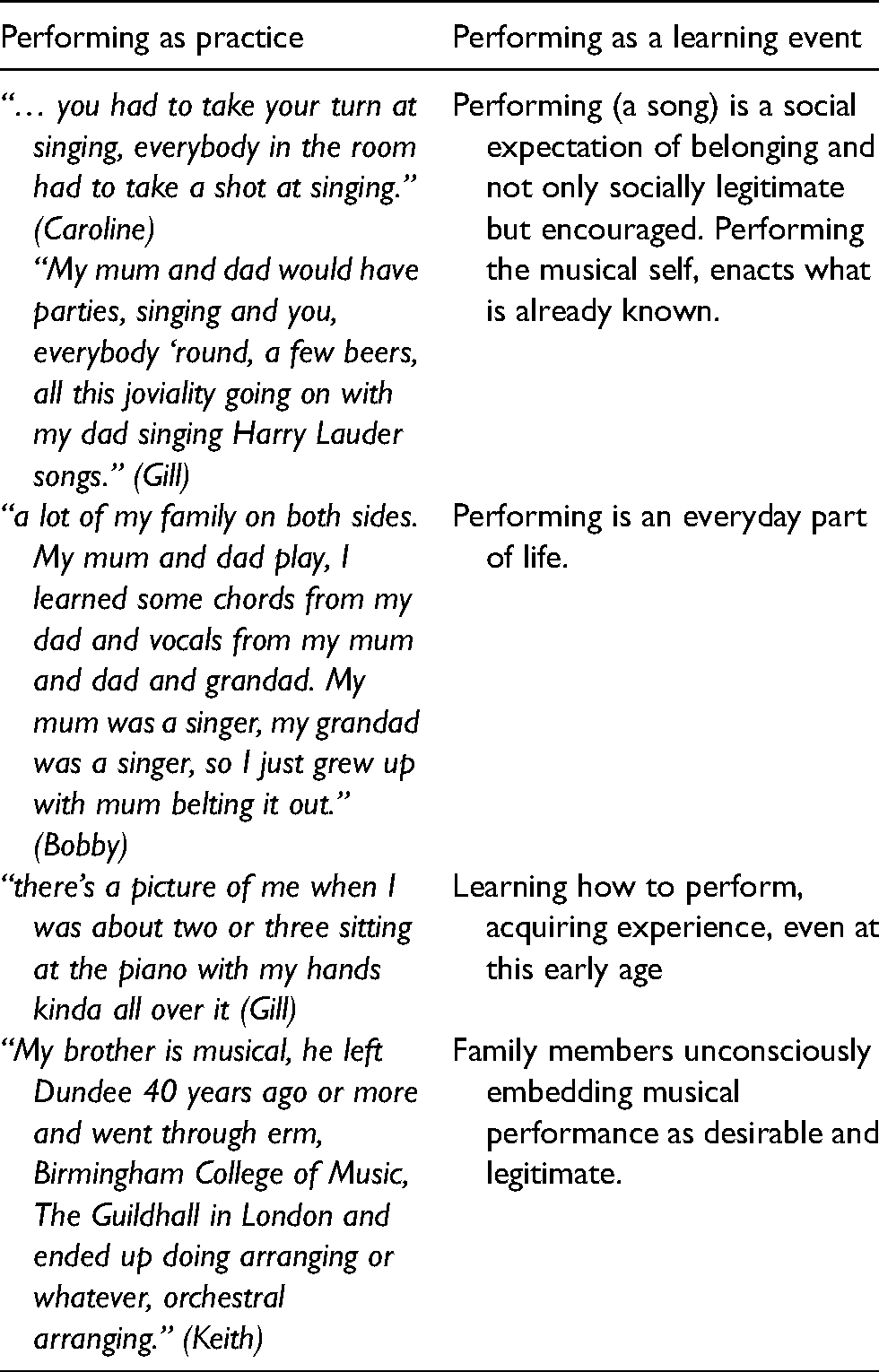
Table 2 helps demonstrate how cultural embedding connects to performing as a social expectation. Performing in a family context was manifest in rituals and games, with a strong fun element attached. We also found examples of performance as transactional, where singing at parties was “exchanged” for staying up late. We had not anticipated the extent of participation as learning by doing- performing - even at this early stage. These data show us very clearly a process of learning through experiences that includes learning what others, especially family, deem appropriate. Note how this learning is enacted.
From practice to learning.
This next section is contextualised beyond childhood and is about broader interactions. Central to the respondents’ comments in Table 3, is their emphasis on learning by doing. We note how even solitary learning (practicing) is about experimenting with what they already know. The universal language of music, or indeed lack of formal participation was no barrier for our musicians. There is a vibrancy and real sense of intrinsic joy in playing music in these examples, and we see the self-directed, iterative nature of learning as bridging performing previous experience and learning from performing as per our constructive circuit of learning by doing.
Experiment, performing and learning. .
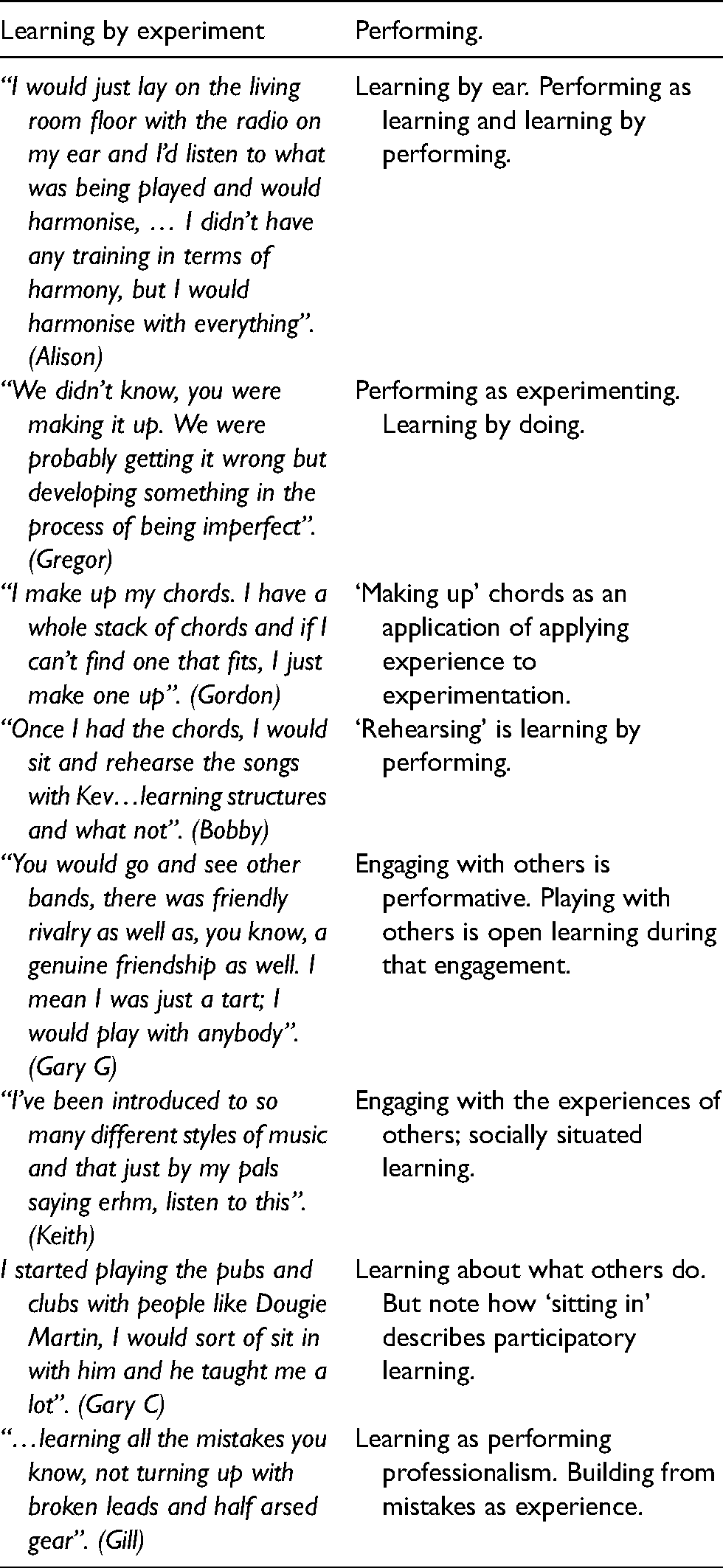
Gill’s point about learning from mistakes suggests a shift towards professionalism, learning a professional approach. Performing music in live and social situations meant consistently producing a convincing performance. This is a high point of ‘knowing’ where experience is enacted. For example, Alison describes how she has learned to perform without a script dominating the performance. “[I] never step on stage with my lyrics in front of me, you know and that to me, that’s a big no, no. I’ve seen so many singers doing it and I think, d’you know what, you’re great…please just get rid of the words, just learn them and let it all immerse you.”
Danny also told us about the importance of preparing to perform. I like to be well rehearsed and go up there and do my thing, which is just the way I am. You’ve got other people that are great at just going up and doing that sort of thing, it’s just not my scene at all.
Chris M describes his learned rules about social interaction, explaining how he presents his musical self. “You know if there’s a pile of people in a room for a couple of days, you have to get on with people. Even people you don’t like, you get on with them, you have to be fun, you’ve got to be creative and straight as well, sober.”
We thought that Gregor summed up the significance of a professional performing attitude rather well. “The psychology is the same on a big stage as it is in a pub. You’ve got to be as good as you can be anyway. So, give it the respect whatever, give everything the respect. Do everything equally, as well as you can. That stands you in good stead for bigger stages.”
In social situations, experience is enacted to produce a convincing musical performance. Resulting in congruence between the performance and social expectations of what a musician is, all despite risks associated with situations where knowledge and skills are on show.
Discussion
The constructive circuit of learning, experiencing and performing is very evident in our data. We saw how experiencing was employed to first learn the general rules of the game. Later we saw how experimenting levered this experience into honed and appropriate technical and social knowing, all moving towards ‘professionalism’. Chris M presented this, “there’s things you have to learn to do, you have to be able to physically do.’ But then explained how this was performed, “you don’t notice that you are doing them, once you learn how to do it”. He adds, you “always try to improve what you are doing.” This striving appears to us to drive and energise the constructive circuit. The interesting and novel part of this process is the key role played by performing. It incorporates experience, experiencing and experimenting. Yet it turns out to be action learning, thus completing the circuit.
Performing as a portable practice
Thus far we have focused on learning and performing in the musical world. Yet our respondents also informed us about how some of this knowing and enacting extended into the different world of entrepreneuring. We were not told explicitly, but it seems evident that this is an application of experience. Chris V demonstrated this knowing when he told us, “…you know how a band is sold to the world, the real hard core business brains are always hidden, they may be the guy at the front of the stage or the guy on the lead guitar or whoever it is but that won’t be presented to the adoring public coz that’s’ not a character trait that people want to buy into.”
Table 4 provides more examples.
Performing and practice of entrepreneurial knowing.
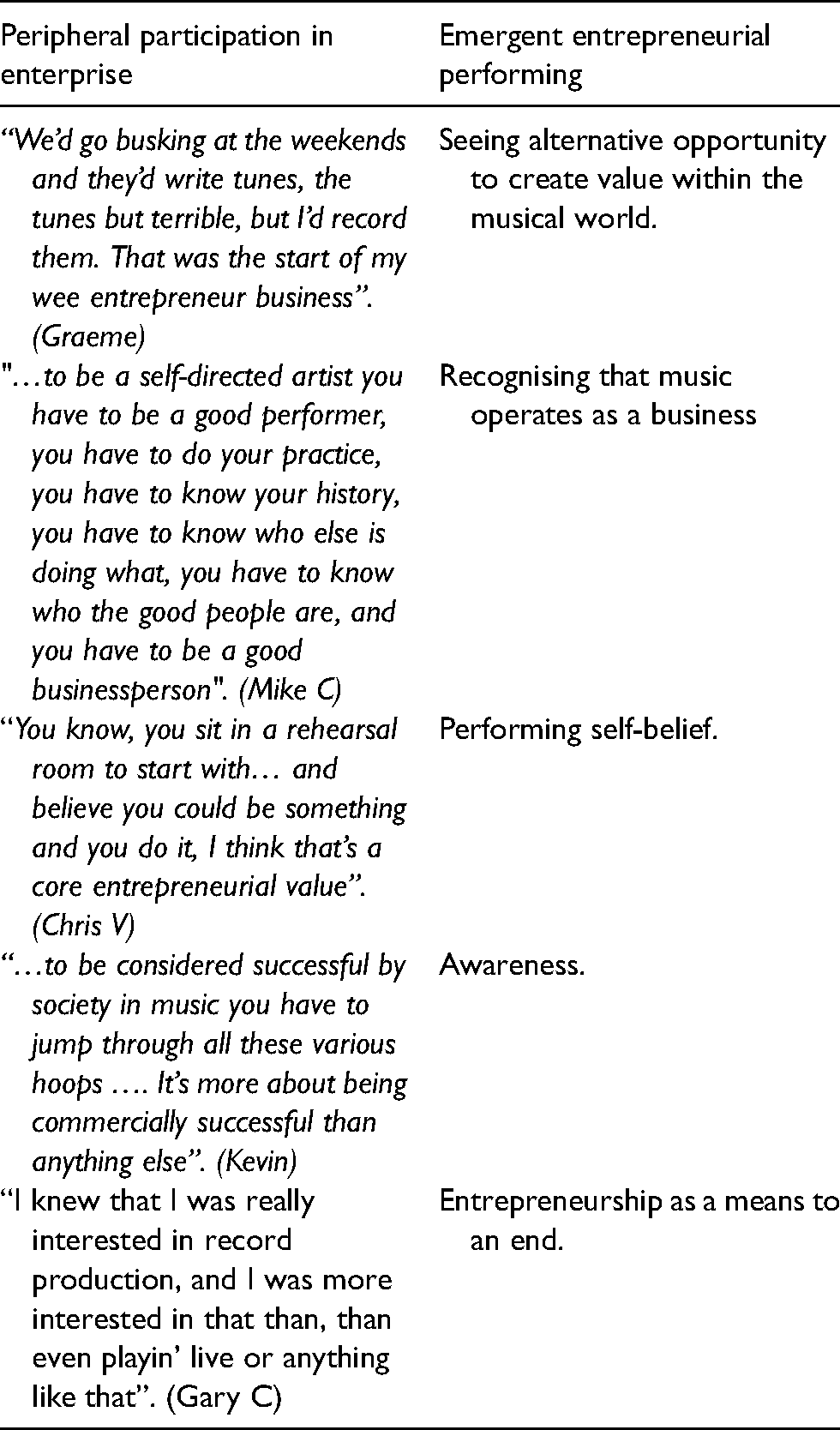
It seems learning the art of performing in music opens doors to entrepreneuring. Yet the key point for us is that performing is transferable across very different spheres. Conceptually, performing configures learning where experience is an outcome that iteratively builds entrepreneuring capabilities over time. Early performance was about learning the rules of the game through enculturation and enacting experience. For our young musicians, performing was fun but was also used as “exchange”, perhaps we might even say to extract value from performance. As our musicians became more proficient, learning through experimentation was identified as performance. Here we saw performance as self-directed musical experience configured to determine what does and does not work in both, solitary and wider social contexts. We also found supporting examples where performing professionalism was experience learned in a professional music context. Performing configures learning and performers’ learning reflects the wider environment in which the performances take place, and in which entrepreneuring is learned. We also identified emergent entrepreneurial performances learned through peripheral participation that led to our uncovering the main elements in our model. Doing > experiencing > performing that learned experience > learning from performing
We now show how these elements fit together in our constructive circuit of learning by doing. In our model, doing and experiencing are positioned separately but overlapping, clearly joined and directed towards the performing experience element of the model. An embodied experiential perspective is key to our processual approach (Matthews, 2006), and our arrangement of parts circumvents a danger of inadvertently introducing a mind, body duality problem by connecting doing and experiencing. We also show that doing is experiencing, but also that performing experience is doing All elements are encapsulated in a sphere of learning, reflecting our point that performing configures learning and this was evident in all stages of our participant’s music to enterprise transitions. Figure 1.
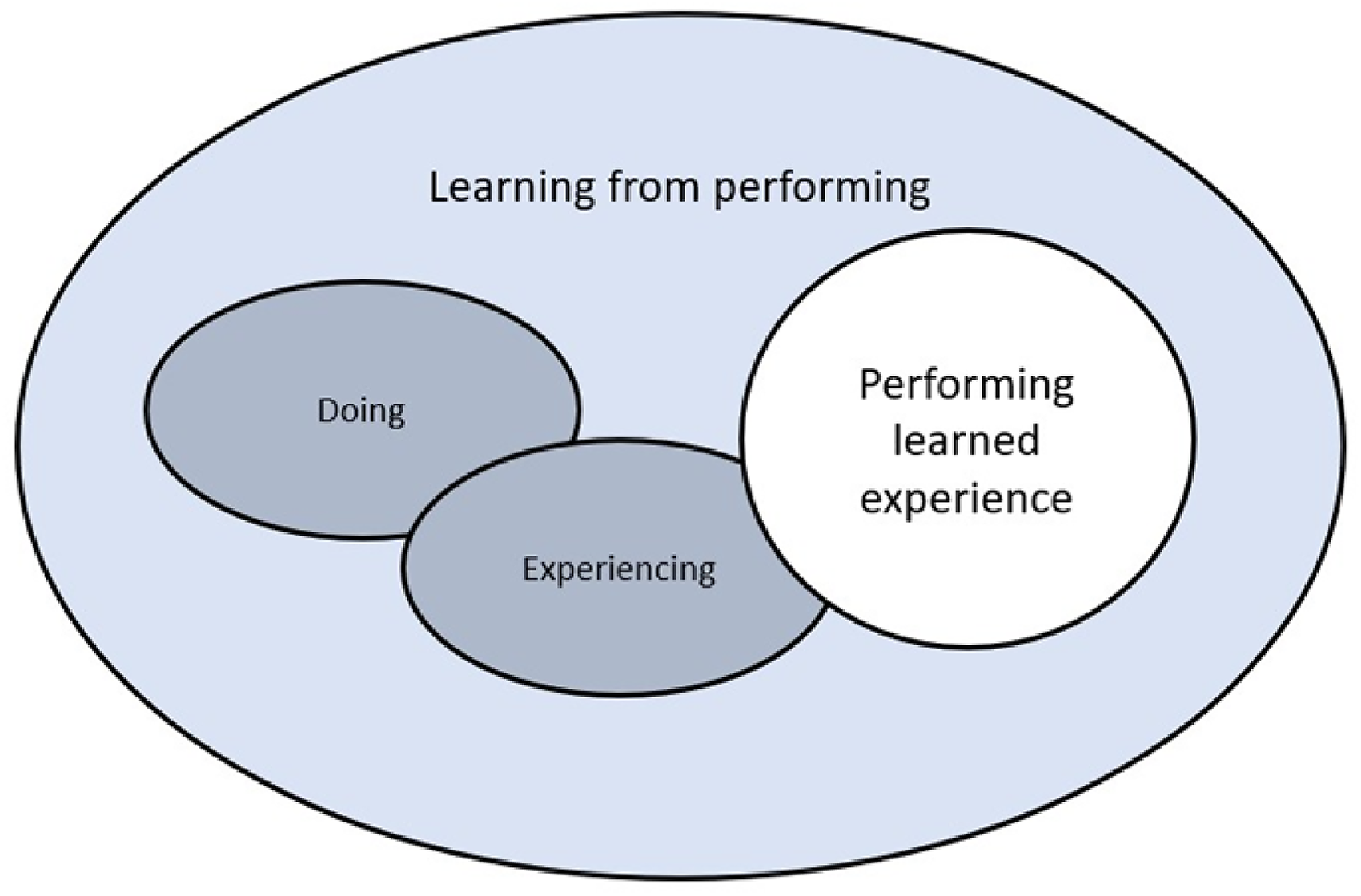
Constructive circuit of learning by doing.
Conclusions
It is interesting that in asking about one thing, we discovered something quite unexpected. Understanding the socially situated learning practices introduced us to the constructive circuits of learning by doing. Hence performing provides an explanation that bridges conceptual gaps between experience and learning. This appreciation of performing is novel and understanding that performing itself is a useful extension to our knowledge. Although novel, it builds from, and connects to, much of what we already know.
Our conceptualisation emphasises experiential learning is a lifelong process. We believe this important because Blenker et al. (2013: 55) states, ‘Performing entrepreneurship requires a large proportion of fundamental business knowledge and skills’. Yet it is also noted (2013: 56) ‘This involves uniqueness, sensitivity and an ability to cope with the unknowable in the sense that no formal correct procedure exists for decisions. Instead, an entrepreneurial action seems to involve an anti-positivistic and subjective as well as judgemental approach to problems, based on personal knowledge’. These entrepreneurial demands demonstrate the significance of social learning, where experience, experiment and performing provides the big picture. To reiterate Berglund’s (2015, p.479) point, “This implies that all situational contingencies – as well as the entrepreneur’s entire life-history of experiences and relationships – is of potential relevance.” Yitshaki and Kropp (2016: 227) argue that “entrepreneurial identities are shaped by a process rooted in an entrepreneur’s past personal and occupational experiences.” Processes of entrepreneurial becoming start before working age and may begin in childhood according to Jayawarna et al. (2015). They posit that human capital accumulated early in life impacts upon an adult’s propensity to become an entrepreneur.
This idea is also embedded in enculturation and socioeconomic arguments about learning, about access to educational and social opportunities (Anderson and Miller, 2003) as well as opportunity recognition. Moreover, we propose that a theory of entrepreneurial learning should not be restricted to pedagogy or formal learning. Entrepreneuring is thus about putting this accumulation of experience, knowing, to work. Indeed, we suggest that learning is the long-term assimilation of knowledge from experiences. Such knowledge may not be directly ‘entrepreneurial’ but general understanding about how things work. Garud and Gehman (2018) argue that performativity is not a destination but an ongoing journey.
We identify implications for teaching entrepreneurship. Too often students propose business ideas that fail to take any account of their own experience or broader learning (Kirkwood et al., 2014; Rae, 2010). The ‘idea’ is thus isolated and not informed by what they may know or have experienced and much harder to operationalise or perform convincingly. Including a self-reflective element into our pedagogies – do I know how to do this?, have I seen it done? – could help develop the entrepreneurial self with reasoned and realistic self-efficacy (Mueller and Anderson, 2014). This may produce more viable, sounder and practical ideas. However, for practitioners we see a downside. The circuit of leaning, experiencing and performing is not closed, but is directional. This suggests that practitioners may have a tunnel of experience that cognitively limits what they consider. It would be interesting to examine if this is true with serial and portfolio entrepreneurs.
Our process perspective argues that is what people do rather than possession of pre-defined entrepreneurial attributes that explain practice (Gartner, 1988; Shaver and Carsrud, 2018). “We are what we do,” (Foley, 2013: 82). For us this doing can be conceptually packaged as performing. Our novel contribution here is to point out that performing is not only enactment but a mode of experiential learning.
“I hear and I forget. I see and I remember. I do and I understand” Confucius (551 BC-479 BC). To which we would add, that in doing I learn.
Footnotes
Declaration of conflicting interests
The author(s) declared no potential conflicts of interest with respect to the research, authorship, and/or publication of this article.
Funding
The author(s) received no financial support for the research, authorship, and/or publication of this article.
