



Abstract
This paper develops a taxonomy of rural micro-enterprises based on their level of embeddedness in the rural. Drawing upon 19 in-depth narrative interviews we identify the classifications of ‘bedrock’, ‘anchored’, ‘disembedded’ and ‘perfunctory’ enterprises. This offers a new categorisation of rural micro-enterprises and challenges the notion that all rural micro-enterprises add value to the rural economy. Indeed, ‘disembedded’ rural micro-enterprises may have parasitical tendencies and be negative contributors to rural economic sustainability due to the actions and choices made by their owner-manager(s). Through the creation of an empirically and conceptually grounded taxonomy we reveal a number of important attributes which develop understanding of the nature of rural micro-enterprises and highlight the varied activities of such businesses. The implications of the taxonomy are discussed, and important policy implications are identified.
Introduction
Rural micro-enterprises (herein referred to as RMEs) are strategically important to the sustainability of the rural economy (Tehrani and White, 2003), representing c91% of all registered businesses and employing c31% of workers within rural England (DEFRA, 2021). Micro-enterprises are defined as businesses with fewer than ten employees and less than €2 m annual turnover (European Commission, 2020).
This paper increases understanding about RMEs by establishing a taxonomy based upon their degree of embeddedness (Sofer and Schnell, 2017) within their rural community. It is during the development of this taxonomy that the myth of RME being a positive influence upon the rural economy (McElwee et al., 2018; Moyes et al., 2014; Shrivastava and Dwivedi, 2020) is challenged. This paper contributes to the ongoing discourse about rural entrepreneurship by finding that RMEs are motivated by lifestyle (Finke and Bosworth, 2016; Lyee and Cowling, 2015) ahead of wealth generation and not all RMEs make a positive contribution to their community. Moreover, some may make a negative contribution and we label these ‘disembedded’ RMEs with parasitical tendencies, marking a move away from a tendency to romanticise the rural (Gaddefors and Anderson, 2018).
Our empirical taxonomy contributes to theory by providing a clear nomenclature of RMEs for use in further academic research. The focus of this taxonomy is the RMEs degree of embeddedness within their community, responding to Müller and Korsgaard's (2018) call for further research investigating the embeddedness of enterprise within the rural. Our taxonomy contributes to academic discussions regarding embeddedness and place (Jack and Anderson, 2002; Kalantaridis and Bika, 2006; Korsgaard et al., 2015a) by understanding the degree to which the RME is embedded within their community and combining this with the degree to which they are alert to new opportunities in order to identify ‘types’ of RMEs.
The paper continues with a review of the theoretical background underpinning this research. The research methodology is then outlined and the pertinent findings informing the taxonomy discussed. We conclude by summarising the contribution of this taxonomy to knowledge, policy, and practice.
Context
Rural
‘Rural’ is challenging to define (Pato and Teixeira, 2016), its meaning being personal to individuals and their circumstances (Moyes et al., 2014; Shrivastava and Dwivedi, 2020). Furthermore, Gaddefors and Anderson (2018) contend that rural is a socially constructed spatial concept. There is no universally agreed definition of rural (Isserman, 2005; Pateman, 2011), with definitions being subject to multiple influences including population density, population size, economic activity, cultural and social aspects, and remoteness (Bibby and Shepherd, 2004; DEFRA, 2021; Halseth et al., 2009; Isserman, 2005; Pateman, 2011; Pato and Teixeira, 2016). For some people rural is simply the space where they live (Müller and Korsgaard, 2018), others typify rural as a romantic, bucolic idyll (Gaddefors and Anderson, 2018) yet it can conceal a darker underbelly of illegal activity (Somerville et al., 2015). To fully understand ‘rural’, Miyoshi (2013) advocates scrutinising the experiences of those living within rural communities, conceptualising rural as a community of people living within a defined geography. Existing definitions of rural are imprecise and depend upon what aspect of ‘rural’ is being studied (Halseth et al., 2009). Isserman (2005) warns vague definitions such as a “settlement smaller than a town” (Bosworth, 2012: 499) may be problematic, leading to practical advice and policy direction being founded upon incorrectly sited research. The contextual ambiguity in defining rural underpins its intangibility. Such intangibility leads us to consider rural a spatial phenomenon. Aligning to this spatial conception of rural, this paper engages with RMEs situated within ‘predominantly rural’ 1 (ONS, 2015) and ‘remote rural’ 2 (Scottish Government, 2021) locations; both constructs being population led.
The rural economy, a diverse mix of enterprises, is in a state of flux (Faherty and Stephens, 2016; Halseth et al., 2009). Extant discourse recognises the rural is no longer a homogeneous, harmonious space across the UK. Its schisms span political, economic, and social facets (Neal et al., 2021). The last 5 years have presented unique challenges, including Brexit and Covid-19, draining the emotional and financial reserves of rural communities (Neal et al., 2021; Phillipson et al., 2020). Survival prerequisites in the contemporary rural economic landscape remain resilience and an enterprising spirit.
Rural embeddedness
Embeddedness theory has migrated across disciplines and contexts. Within a business context embeddedness theory suggests that social relationships between heterogeneous elements drive economic activity such as supplier relationships and communications networks with information shared between trusted parties (Granovetter, 1985; Greenberg et al., 2018; Johannisson, 1987). During the 1990s a new meaning emerged, linking embeddedness and spatial aspects. Bonding, bridging, and linking ties, although different, enhance understanding of contextual influences (Leonard, 2004; McKeever et al., 2015). A complex relationship exists between bonding social capital, typified by strong ties within homogenous communities, and bridging social capital, typified by weak ties across heterogeneous groups, although both bonding and bridging social capital can enhance community stability (Leonard, 2004).
Embeddedness is defined by Hess (2004: 177) as “the extent to which an actor is anchored in particular territories or places” where shared behavioural patterns evolve from a specific locational tie or embeddedness (Kalantaridis and Bika, 2006). Yet, Donner et al. (2017) maintain that embeddedness has no definitive definition. Baù et al. (2019) consider local embeddedness as the relationship between a business’ economic activity and its location, suggesting it is “the involvement of local actors in a geographically delimited network” (Baù et al., 2019: 362).
Korsgaard et al. (2015a) define embeddedness from a space perspective as a dynamic process encompassing the location’s traditions, culture, and terrain. This encourages and enables, yet also constrains, entrepreneurial activity. If rural enterprises are considered a spatial construct (Gaddefors and Anderson, 2018), spatial characteristics are important and understanding their spatial embeddedness is needed (Korsgaard et al., 2015b). The trend to narrow the concept of embeddedness to a localised, territorial proposition persists. However, Tregear and Cooper (2016) contend that a broader perspective is needed to better understand the symbiotic relationship between the actor and their environment. Indeed, embeddedness may influence collective actions, such actions being shaped by the social fabric and norms of the context they are embedded within (Atterton, 2007; Tregear and Cooper, 2016).
Scholars, such as Jack and Anderson (2002), suggest that in a rural context social embeddedness can provide opportunities for rural entrepreneurs. However, there are diminishing returns from over-developing personal networks. Saturation is reached once the optimum number of ties are formed. These excess ties potentially constrain business performance leading to over-embeddedness (Uzzi, 1996). Over-embeddedness may restrict growth opportunities (Klyver et al., 2011; Schnell and Sofer, 2002) due to increased conformity through yielding to established social norms. Uzzi (1997) intimates that over-embeddedness is particularly problematic in rural contexts because of social obligations and over-supporting strong historical ties (Atterton, 2007). Excessive strong ties in a personal network are undesirable because as well as being costly to maintain, information received may conflict, overlap and be irrelevant to the business; personal obligations may constrain the ability to build external ties thus limiting access to knowledge (Arregle et al., 2015; Kreiser et al., 2013; Uzzi, 1996).
Network embeddedness refers to relationships within a personal network and structural embeddedness as the number of ties within the network (Mozumdar et al., 2019). Within rural areas network embeddedness enables knowledge sharing and strengthens local network ties (Kalantardis and Bika, 2006; Tregear and Cooper, 2016). Typically, smaller businesses focus upon community and family embeddedness at the expense of building wider contacts (Bowler et al., 1996; Hinrichs, 2000; Schnell et al., 2015). Korsgaard et al. (2015b) contend that if rural businesses are platialy embedded it is their numbers which drive growth and community resilience rather than their dynamism. Korsgaard et al. (2015a) maintain that if owner-managers are embedded in the rural they should possess knowledge about local resources and how to access them. Embeddedness influences a firm’s behaviour because of the impact of social ties (Blomback and Wigren-Kristoferson, 2014). Firms’ decisions are based upon ‘situational factors’ which consider the impact of social relationships upon economic activity.
Rural micro-enterprises
Much debate persists around the definition of RMEs. To be considered a RME, Korsgaard et al. (2015b) maintain the business should be embedded within and create value for the rural community as well as the owner-manager. Conceptualising the owner-manager, we align with de Oliveira et al. (2015) portraying the owner-manager as the individual responsible for owning and actively managing all aspects of their business, including procurement, logistics and marketing. Traditionally RMEs are considered to be neo-endogenous, bound to their location, optimising local resources, and improving the resilience of the local community (Bosworth et al., 2016; Deakins et al., 2016; Pato and Teixeira, 2018). The notion of rural enterprise contrasts with the enterprise in the rural concept. In the latter, the rural aspect can be considered as referring to the space where the enterprise is based. The entrepreneur, or in this research the owner-manager, does not necessarily provide a link to or consider the rural location an important aspect pertaining to the activity of the enterprise (Korsgaard et al., 2015b). The entrepreneur may establish a business in the countryside to utilise the benefits associated with a rural area, such as lower land costs, lower labour costs and a better lifestyle (Korsgaard et al., 2015b).
Rural enterprise taxonomies
Taxonomies have become a useful classification tool within the social sciences (Neilsen, 2016). Classification tools do have some limitations, such as focussing upon certain characteristics of a phenomenon at the expense of others and reducing complexity of that observed phenomenon (Halkier, 2011). Such limitations do, however, engender benefits because they enable the examination of heterogeneity within a complex group (Neubaum et al., 2019) and create order by assigning labels to categories (Jaouen and Lasch, 2015) within that group. Taxonomies are likely to change over time (Neubaum et al., 2019) because the economic landscape is dynamic, rendering existing static taxonomies out of date and requiring regular reviews.
Historically taxonomies in rural literature have focussed upon classifying farmer’s behaviour, such as McElwee’s (2008) taxonomy of entrepreneurial farmers, Vik and McElwee’s (2011) categorisation of Norwegian farm diversifications, and McElwee and Annibal’s (2010) classification of farms in the ‘Farm Cornwall’ initiative. More recently taxonomies by Müller and Korsgaard (2018) consider the resource embeddedness and proximity bridging of rural entrepreneurs and McElwee et al. (2018) propose a typology of rural animators. The taxonomies by Müller and Korsgaard (2018) and McElwee et al. (2018) move rural taxonomies beyond the farm, but they do not consider the importance of RMEs within the rural landscape. Our taxonomy contributes to rural scholarship by increasing understanding of the nuances and unique characteristics inherent in RMEs.
Micro-enterprise taxonomies within entrepreneurial literature are scarce (Jaouen and Lasch, 2015), typically focussing upon entrepreneurial performance and behaviour, for example entrepreneurial failure (Khelil, 2016), entrepreneurial risk (Miles, 2014) and entrepreneurial decision making (Nouri and Ahmady, 2018), or being industry specific. Such taxonomies, whilst valuable, fail to consider the micro-enterprise as an entity. Our empirical taxonomy contributes to both rural enterprise and micro-enterprise literature by providing a set of standardised descriptions helpful to support future research and theorising. These descriptions are based upon local embeddedness (Müller and Korsgaard, 2018; Shrivastava and Dwivedi, 2020) and how alert the RME is to new opportunities (Kirzner, 1979; Tang et al., 2012). By looking at these elements we can understand more clearly how RMEs interact with their environment and opportunities within that environment. This enables us to learn more about how RMEs impact, and develop, the rural economy. This is important due to the prevalence of micro-enterprises within the rural economy (DEFRA, 2021).
Methodology
Methodological approach
Our data collection and analysis spanned an 18-month period comprising 38 h of interviews and over 300 pages of interview transcripts. Narrative interviews took place, face to face, with 19 rural-micro enterprise owner-managers throughout the UK.
Jovchelovitch and Bauer (2000: 2) maintain that narrative interviews in the form of life-stories can be a powerful tool for social science researchers to employ due to the importance of storytelling “in shaping social phenomena”. In fact, Riessman (2008) contends that a narrative, rather than traditional question and answer, approach may be more effective in soliciting rich data to craft regional identity (Markowska and Lopez-Vega, 2018). This enables the complexity of life in RMEs to be captured. We adopted a receptive, non-directive, style of narrative interviewing as advocated by Wengraf (2009). This suited the exploratory nature of our research and enabled the participants to have a voice and therefore tell the story of their business from their perspective. By encouraging a research relationship that allows for the roles of narrator and listener to be established, we were able to go some way towards protecting and encouraging the life story (Chase, 2005).
We do acknowledge that there are limitations of capturing a narrative at one point in time (Beuthin, 2014) and that we can never truly access complete life stories through interviews, particularly when researching with busy owner-managers who often have limited time to devote to such interviews (Kevill et al., 2015). Nevertheless, we endeavoured to “get as close as possible” (Beuthin, 2014: 126) to the full narrative and, to help us achieve this, we focused on eliciting the life-story of the micro-enterprise, rather than the owner-manager's complete life story. Focusing interviews on the life-story of organisational phenomena has precedent (Kevill et al., 2015) and meant we could zoom in on factors that were central to our research objectives. This enabled us to generate in-depth insights within the space of one interview. Whilst we focused on the life story of the business, we also elicited information about the owner-manager's personal story during the life of their business. This is because the owner-manager and the business are heavily intertwined in micro-enterprises, meaning that their stories overlap (Kevill et al., 2015).
Our sample size (business cases are summarised in Table 1), is consistent with those employed in the taxonomies by McElwee et al. (2018) and by Nouri and Ahmady (2018). When we reached this number of interviews, we considered the theoretical saturation point had been reached.
Summary of business cases.
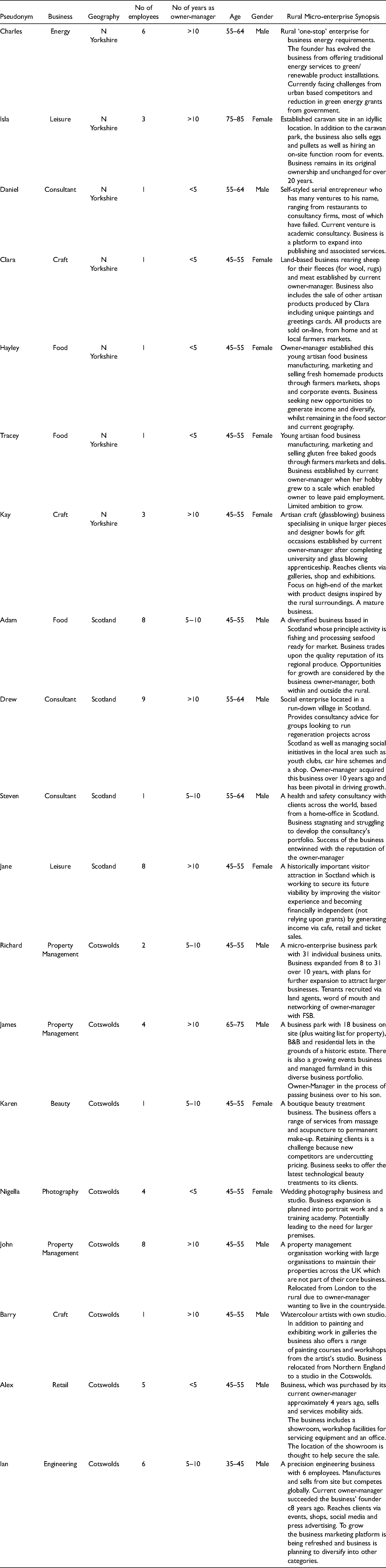
The owner-managers had rich, working, lived experience within the RME. Contact with the owner-managers was made through a variety of different sources including colleague introductions, small business networks and participant recommendations. The sample was based on a snowball approach. All interviews took place in person and lasted between one and two hours. Each interview consisted of three parts. In the first part we focused on the business and its history in terms of how and why the business was first started. The second part then focused upon changes which had happened within the industry they operate within before exploring a specific change within the business which had taken place over the past two years. The final part of the interviews then explored the owner-manager’s perception of how they anticipate the future of their business.
After the interviews, reflective notes were made about the participant, location, and business. The reflective notes enabled contextual information such as perceived business success, locational information, and observable characteristics of the owner-manager to be recorded. This information was available for incorporation into the data analysis.
Data analysis
The owner-managers’ stories were transcribed and analysed using Clarke and Braun’s (2017) six stages of thematic analysis. The transcripts were read to increase familiarisation, then multiple analytical phases were undertaken. Taking an inductive approach, the themes first emerged from the data. We then revisited RME and embeddedness literature and reviewed the data a second time with a RME and embeddedness lens to ensure we considered the data from this perspective. A final review of the data was then conducted with platial embeddedness front of mind. McElwee and Smith's (2012) segmentation framework also influenced the analysis by enabling classifications to be extrapolated from the data. This iterative approach to data coding helped identify which businesses share common attributes (Mair et al., 2012).
The 140 identified codes were subsequently sorted into 16 themes. These themes ranged from owner-manager character attributes to locational factors and business challenges. The themes were defined and the transcripts reviewed again whilst considering the identified themes to ensure nuances within the data were captured and relevant quotations identified.
Segmenting the rural micro-enterprises
We conceptualise segmentation as a process of dividing the RME's into smaller groups based upon their business characteristics, their business activities, and their owner-managers’ character attributes. Segmenting the RME facilitates identifying similarities within the businesses based upon factors such as barriers to success (Álvarez Jaramillo et al., 2019; McElwee and Smith, 2012). It is how the businesses are clustered around certain segments which helps increase understanding about the characteristics of RMEs and their owner-managers.
Our data is segmented using an augmented version of McElwee and Smith’s (2012) segmentation framework. Three additional categories; ‘tied-to-location’ under business characteristics umbrella, ‘rural orientation’ under owner-manager characteristics and ‘dynamic capability potential’ under business activities and processes were added to the framework to enable a broader spectrum of attributes to be considered. These additional fields increase the segmentation framework's flexibility to take account of RME’s differences and nuances. Figure 1 depicts the segmentation framework applied to this research.
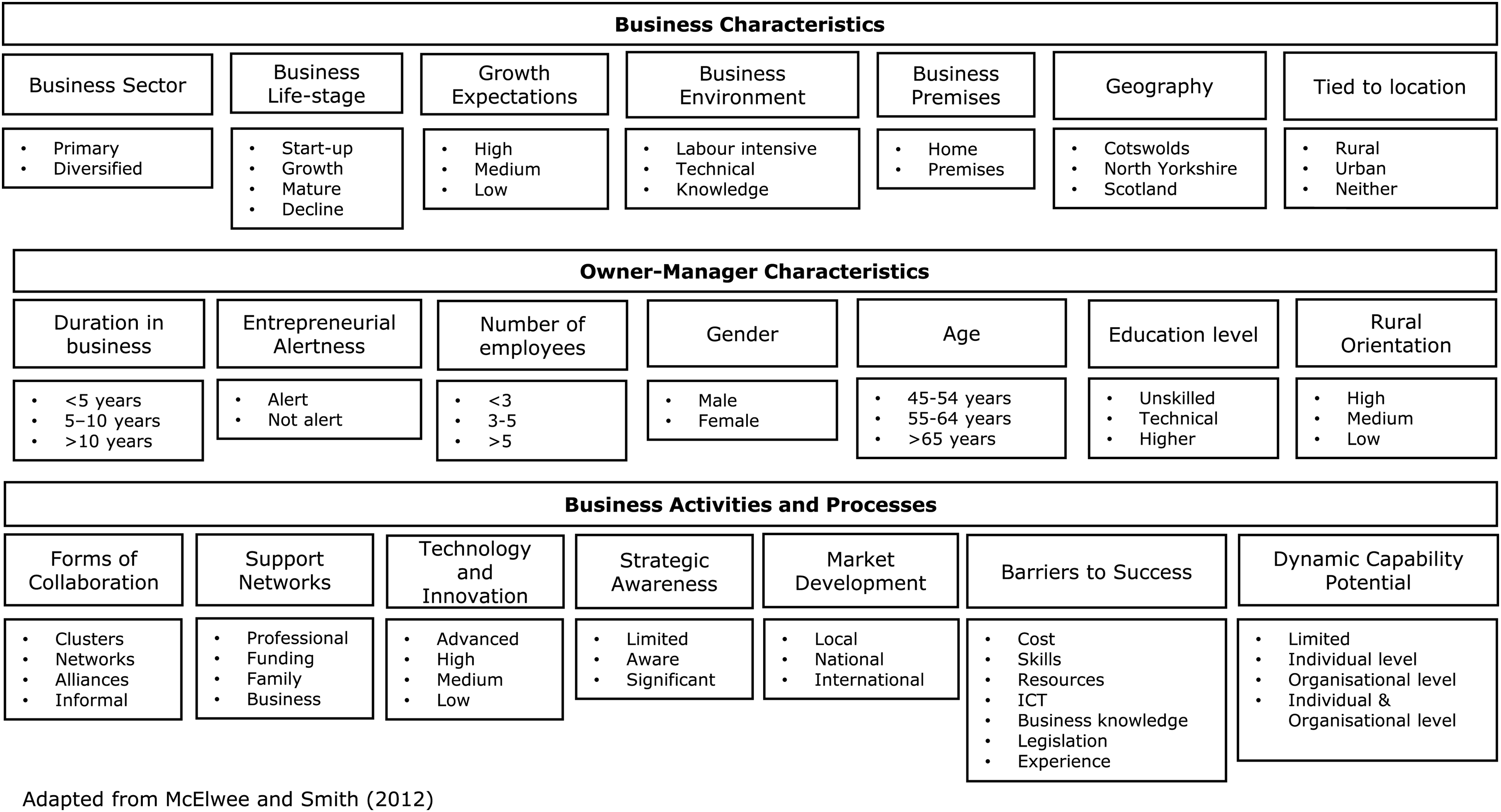
Segmentation framework.
RMEs were discretely clustered around the ‘rural orientation’ segment. This segment converged with the rural embeddedness theme (an aggregation of codes relating to embeddedness including rural orientation, tied-to-land, local shopping, local socialising, local networking, and owner-manager aspirations) emerging from the thematic analysis and led to the conception of rural embeddedness as a focus for our taxonomy.
The architecture of the construct ‘degree of embeddedness’ is illustrated in Figure 2

Architecture of ‘degree of embeddedness’.
Within ‘degree of embeddedness’, a disembedded RME is considered to ‘take’ more than they contribute (Mosar, 2021) from the rural. An under-embedded RME is conceptualised as being located within the rural yet their contribution to their local community is negligible, there is a tendency for their owner-managers to prefer using proximity resources and assets (Müller and Korsgaard, 2018) for both business development and personal recreation. Conversely over-embedded (Klyver et al., 2011; Schnell and Sofer, 2002) is conceptualised as a business deeply rooted within their local community to the extent that they miss opportunities, leading to business inertia and stagnation.
To complement the segmentation analysis and ensure the realisation of a thorough and rounded taxonomy, the influences from endogenous and exogenous factors (Bosworth et al., 2016; Lowe et al., 1995) upon the RMEs were considered
Findings and discussion
Classifications of rural micro-enterprise
Rigorous data analysis underpins our empirical RME taxonomy (Figure 3). By focussing upon the RME’s degree of embeddedness and their level of alertness to new opportunities, i.e., the RME’s responsiveness and desire to embrace new opportunities (Faherty and Stephens, 2016; Tang et al., 2012), four distinct segments emerge. The degree of embeddedness of the RME within their local rural community is likely to impact upon the resilience and sustainability of the rural economy (Korsgaard et al., 2015a, Müller and Korsgaard, 2018).
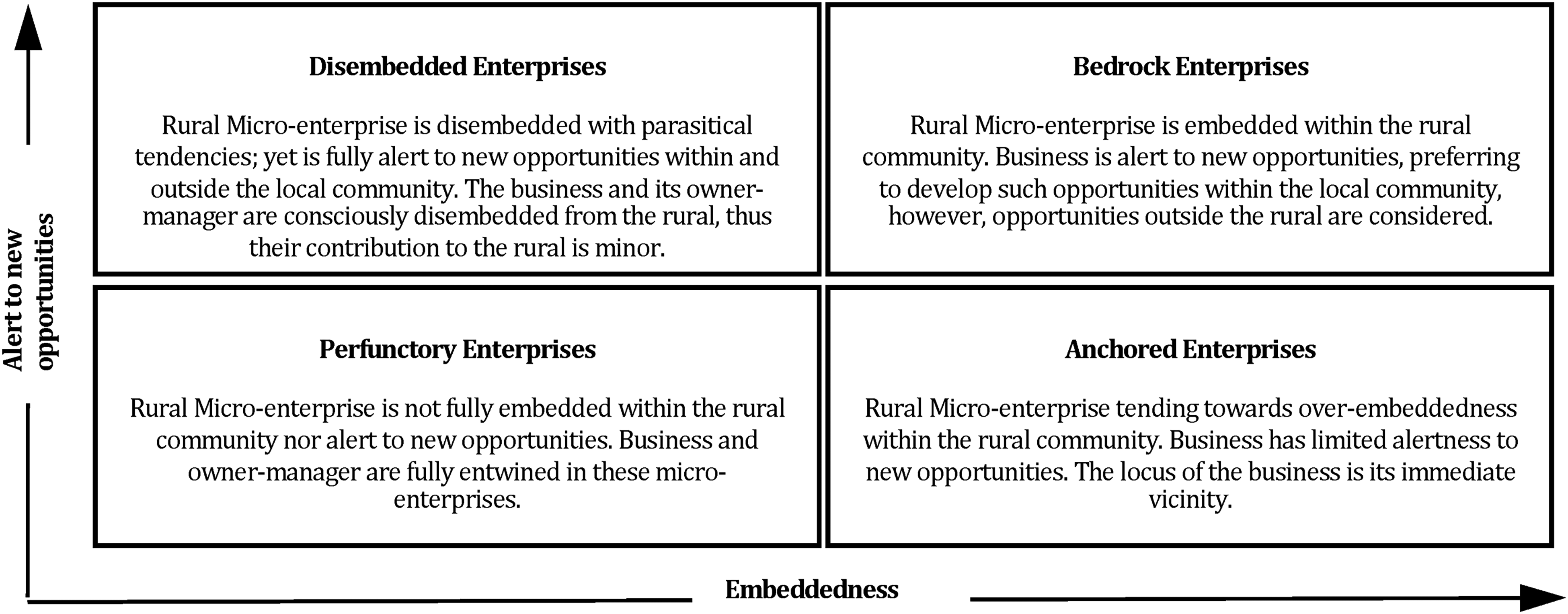
Taxonomy of rural micro-enterprises.
An explanation of the four segments within the taxonomy follows.
Bedrock enterprise
These RMEs are embedded within the rural community and are alert to new opportunities. Typified by the businesses of Charles, Adam, James, Drew, Richard, and Jane, they are tied-to-the-land and due to their uniqueness, they would not exist in the same form should the business relocate out of the rural or to a different rural location. Indeed, Jane’s enterprise relies upon tourists visiting an ancient rural religious site, and therefore, without the location there would be no business. Adam’s food business could have its commercial base elsewhere, however the food’s provenance is an important marketing platform and would be diluted alongside the product’s quality if it had to travel further for processing. Although embedded within the rural, these micro-enterprises remain open to new business opportunities both within and outside their local community. Indeed, the business model of Adam’s enterprise was reshaped to embrace the opportunity to control more of its product’s route to market. “We were always feeling that we weren’t getting decent end value for our product. You‘re putting your week’s catch onto a lorry and you’re getting whatever they pay you for it. So, we decided to have a go at doing it ourselves. That’s when we created [brand], touch wood, and we’ve never looked back on it.” (Adam)
“We are in it to promote other people, it’s not a greedy business. It’s a business that says arts businesses here are important. They need encouragement. We will commission things for the shop.” (Jane)
Richard’s mature RME is receptive to complementary opportunities to develop alongside the existing business. Networking paves the way for uncovering such opportunities.
“I also think about doing something completely different to what I do at the moment, that’s why I do the Federation of Small Businesses” (Richard)
These owner-managers and their businesses embrace rural life, enriching the rural community through participation in rural events, supporting local shops and pubs, and serving the local community. For example, Drew’s business creates local employment which helps retain amenities in the remote village where his RME is located. Such amenities are important to sustain the village and encourage establishment of more businesses, thus perpetuating a virtuous circle of growth.
Disembedded enterprise
This group of RMEs, such as those run by Nigella, Karen, Ian, Hayley, and Daniel, are considered disembedded from the rural community. These businesses are not tied-to-the-land and could exist in the same form elsewhere. Owner-manager personal choice has led to the establishment of these businesses in the countryside. However, the owner-managers have made the conscious decision for their businesses not to become embedded within the rural community. Furthermore, they predominantly ‘take’ the locational benefits from the rural. Nigella’s business ‘takes’ the perceived client benefits of working in a more tranquil, cleaner and peaceful location rather than a city centre; this is illustrated in the following quotation from Nigella explaining why her business was located in the rural when larger premises were needed. “It’s easier here because I don't have any parking issues, the parking spot I had in [town] was always covered in human faeces and beer cans, the centre of [town] is disgusting, absolutely disgusting. My clients are a lot calmer when they get here because they zoom off the motorway into a parking spot right outside - happy days.” (Nigella)
These RMEs and their owner-managers are typified by a lack of engagement within the local community. For example, Hayley’s business does not support local businesses as part of its supply-chain. Instead, ingredients are procured from the nearest town, due to the owner-manager's perception that they are better value and fresher than purchasing locally. This group of businesses are disembedded. They maximise the lifestyle benefits (Pato and Teixeira, 2018; Pret and Cogan, 2019) associated with living in the countryside for their owner-managers, whilst re-investing little wealth and resources back into their community.
The wider economic impact of these businesses to the rural economy is limited. Moreover, owner-managers are taking the perceived work-life balance benefits of living and working in a tranquil, safer, and bucolic location (Pato and Teixeira, 2016; Steiner and Atterton, 2014) but are investing little socially or economically back into the rural community to balance the equation. It could therefore be argued that these RMEs fail to fulfil their “obligations to place” (Bensemann et al., 2021) being a negative contributor to their community. They could, therefore, be styled as having parasitical tendencies.
At the same time, there are instances where such enterprises do provide some minor contributions to the rural, such as the employment provided by Nigella’s and Ian’s enterprises, which likely provides some contribution to the rural economy through the financial activities of those employees. Furthermore, these businesses provide some small contributions to the rural community. For example, paying council tax contributes to the provision of services and amenities for the local community. Nevertheless, our research indicated that RMEs in the disembedded category each take more from the rural than they contribute.
Anchored enterprise
This group of RMEs, including the RMEs owned by Isla, John, Kay, Tracey, and Clara, are embedded, potentially over-embedded (Tregear and Cooper, 2016), within the rural community. These businesses have invested in and are tied-to-the-land but have limited exposure to opportunities which could facilitate business growth. These RMEs would not exist in the same format if they relocated out of the countryside. Clara’s business illustrates a business ‘anchored’ in the rural. Clara established an artisan business which includes rearing and managing a flock of sheep. Local village contacts are used to butcher, market and sell the business’ products, with the business having minimal exposure to the market beyond its locality.
Isla’s caravan park is a base from which tourists can explore the surrounding countryside. Without the rural space this business would not exist In the following quotation Isla articulates her commitment to maintain her business without the drive to develop it beyond the status quo. “I enjoy working, I think I’ve done quite well really. I’ve had my ups and downs, enjoyed myself here.” “Keep running the business, to keep my brain working.” (Isla)
“We just want to stay here and carry-on plodding on really. I mean we have a nice way of life… I don't have big holidays, but I do something I love doing every day. I walk to work and can afford to help the kids which is what all the money is going on at the minute.” (Kay)
“I took the view of thinking I’m just going to keep this one unit here; I don’t want 60 staff and a large company here because we would have to more than likely relocate” (John)
John’s RME provides him with his desired lifestyle, provides local employment, and supports and sponsors village events which help sustain the local economy.
Perfunctory enterprise
This group of RMEs such as those run by Barry, Alex, and Steven are not consciously trying to embed within the rural nor are they alert to new opportunities. Traditional land-based businesses (Henry and McElwee, 2014) they are not. These businesses could exist in the same form anywhere due to the intrinsic entwining of the owner-manager and the business as a single entity. Barry’s business has recently been relocated from the Lake District to the Cotswolds, and networking through family and friends has helped the business grow. “It’s word of mouth. And how you build up in a new area. I’ve only been here now since last September, but you build, people start to talk to you.” (Barry)
“Painting is what I am….I paint and that’s it…..just plodding away” (Barry)
Steven’s business has been established over 30 years, yet it remains in essence the same business, offering a single consultancy product in a dynamic market. The business (and Steven) is not alert to new opportunities, leading to business stagnation and decline. The location of Alex’s RME is an important product selling tool. The location was chosen to provide a competitive advantage (Barney, 1991).
“I know we’ve got lots of competitors who sell scooters, and they don’t have space for the people to try them. Or they just go onto a busy pavement, while here, you can seat someone on a scooter in spring or summer or autumn and you’ve nearly sold it before you start, because it’s just that feel good factor from them all, and plus, they get to use it over terrain that they think they might be going on when they go for a walk, this location works really well for us.” (Alex)
Alex’s and Barry’s RMEs epitomise ‘perfunctory’ enterprises. Being very small, typically less than 3 employees, they provide few local employment opportunities. The owner-managers live and work in the rural yet gravitate to urban centres for cultural fulfilment.
Conclusion
This paper has presented a new taxonomy focussed upon RME’s degree of embeddedness within the rural and their alertness to opportunities. Whilst developing the taxonomy, McElwee and Smith’s (2012) segmentation framework is advanced by including the segments ‘tied-to-location’, ‘rural orientation’ and ‘dynamic capability potential’. This advancement enhances the granularity of the original framework, increases its flexibility and enables the consideration of additional factors when analysing business sectors, industries or enterprises. The enhanced segmentation framework has been applied beyond its original application of classifying farm diversification opportunities, into the RME context thus demonstrating the utility and practical adaptability of the framework.
Positioning the RME’s degree of embeddedness and alertness to opportunities within a taxonomy enables identification of four classifications of RMEs: bedrock, disembedded, anchored, and perfunctory. This contributes to scholarship within rural enterprise and micro-enterprise literature in several ways. It adds to conversations across rural literature about the behaviour of RMEs, supporting the notion that not all businesses have a growth mentality (Jaouen and Lasch, 2015; Kearney et al., 2019) and considering the possibility that not all enterprises are good for the rural economy. We introduce the idea that some RMEs are disembedded and a parasitical drain, resulting in a negative contribution to the rural community overall.
The taxonomy considers the characteristics of RMEs and, once within the domain of policy makers, can act as a guide when they are considering how to best support RMEs within the UK. It can facilitate the focusing of available resources to encourage RME establishment and drive economic activity within the countryside. Making policy decisions based upon relevant, rural sited research may encourage owner-managers who have established a business in the rural through choice to remain within the rural. Furthermore, encouraging this group of owner-managers to remain within the rural may induce them to contribute both socially and economically, thus integrating themselves more fully into the rural economy. The heterogeneity within the RME population due to the multiple industry sector span, geographically remote locations they operate within (Pato and Teixeira 2018) and idiosyncratic owner-managers (Del Giudice et al., 2017) can, to scholars unfamiliar with rural enterprise, appear chaotic. Therefore, creating a taxonomy to classify RMEs by common attributes can help bring order to the sector; something previous taxonomies, by focussing upon the entrepreneur rather than the micro-enterprise, do not do. This formal classification makes it easier to understand sector dynamics and formulate policies to support sector development. The categories identified in the taxonomy can be used to tailor resources to support RMEs. For example, support for developing business strategies could be directed towards ‘anchored’ enterprises and encouragement to become more integrated and support the local community could be directed to ‘disembedded’ enterprises.
Limitations and further research
The taxonomy developed is valuable in illuminating the heterogeneity of RMEs. Nevertheless, there are limits to its generalisability due to our sample size. Therefore, repeating the study in different rural areas or using a different set of RMEs to validate the anchored, bedrock, perfunctory and disembedded classifications used in the taxonomy has merit. Likewise, a larger quantitative study could be beneficial to ascertain if the taxonomy classifications are applicable to a wider range of RMEs. Furthermore, in our study the owner-managers were mostly above 45 years of age. It would be interesting if future research examined the role of age in the embeddedness of RMEs and conducted research with younger owner-managers to see if similar findings are observed. There is also an opportunity to repeat this research with the same RMEs to get a longitudinal perspective. This repetition will ascertain how RMEs’ embeddedness changes over time and will allow us to establish the ‘life cycle’ of the disembedded enterprise. This longitudinal approach would further allow us to understand if the parasitical tendencies of disembedded RME’s remain or change over time. Further, it would be interesting to understand different perspectives and as such, capture the role and perspective of the employee within the micro-enterprise to further understand the dimensions of micro-enterprise and the role it plays within the rural economy. Finally, looking ahead further; an area for future research would be to enhance our understanding of how embeddedness and disembeddedness works within different geographies. It is feasible that some urban enterprises may similarly be disembedded, prioritising service to rural markets. Investigating such enterprises would help to further develop our understanding of disembedded enterprises and the authors would encourage contributions in this area.
Footnotes
Declaration of conflicting interests
The author(s) declared no potential conflicts of interest with respect to the research, authorship, and/or publication of this article.
Funding
The author(s) received no financial support for the research, authorship, and/or publication of this article.
