



Abstract
While scaling of social impact is a key element in social entrepreneurship (SE), many social enterprises fail to scale-up their impact meaningfully. This is an opportunity to investigate earnings generation (EG) and strategic alliance-building (SAB) as potential predictors of scalability of social enterprises. The study context is South Africa where SE has much relevance due to the many social ills, which plague the country. Initially, the study instrument is tested for validity and reliability, whereupon hypotheses are tested using multiple regression analyses. Results show that EG is a significant and positive predictor of social enterprise scaling. This finding is important considering that many social enterprises in South Africa are challenged by financial resource constraints. This study, conducted in an African emerging market context, allows social entrepreneurs to more deeply understand the relevance of EG and SAB in their scaling efforts. Indeed, developing a strong body of evidence that validates the effectiveness of policy in supporting social enterprise scaling is pivotal for both theory and practice.
Keywords
Introduction
Scholarly and practitioner interest is proliferating on social entrepreneurship (SE) which over the years emerged as a distinct field of study (Brieger and De Clercq, 2019; Dacin et al., 2010; Scheuerle and Schmitz, 2016). SE contributes to the common good and serves as a means to integrate entrepreneurial actions into solving societal wicked problems (Campos et al., 2020; Pattison, 2020; Urban, 2020). While there is widespread agreement that the domain of SE is situated within the wider entrepreneurship discipline (Lortie and Cox, 2018), certain distinct characteristics of SE invite a more nuanced understanding of this phenomena (Hechavarŕia and Welter, 2015; Mair et al., 2012). These SE distinctions include the focus on social missions, certain motivations and traits driving SE such as empathy, the resource mobilisation of social enterprises and their methods to assess performance (Austin et al., 2006; Zahra et al., 2009). SE performance goes beyond profit and includes ‘people (the community being served) and planet (the wider impact of the good work), the so-called triple bottom line encompassing the social, environmental, and economic components of sustainable’ practices (Akter et al., 2020; Elkington et al., 2010; Wilson and Post, 2013).
In the context of SE, performance is often determined in terms of scaling of social impact as it relates to the ‘ability to scale the enterprise's reach so as to address social needs’ (Dees et al., 2004; Urban and Kujinga, 2017). Accordingly, scaling is deemed one of the crucial dependent variables (DV) in the SE domain (Bacq et al., 2015; Walske and Tyson, 2015). However, prior studies indicate that the right option for scaling-up is potentially problematic for social enterprises, particularly due to their limited funding and earnings generation (EG) capacity (Desa and Koch, 2014; Halberstadt and Hölzner, 2020).
When appreciating that many social enterprises fail to extend or meaningfully scale-up their impact (Zhao and Han, 2020), it is important to investigate their means of achieving scalability. The need for EG becomes crucial as funders, impact investors, and philanthropists choose their financings and donations founded on a social enterprise's capability to scale (Phillips, 2006). Similarly, strategic alliance-building (SAB) is important for scaling and includes ‘familiar, reciprocally advantageous arrangements between one or more parties where there is shared knowledge, capabilities, and resources, which may include licencing arrangements, franchises or joint ventures’ (Cannatelli, 2017: 2710). Furthermore, prior studies indicate that the pressures of scaling can cause social enterprises to experience mission drift, which requires the need to manage the tensions in strategic-alliances that arise from trying to achieve both commercial and social goals (Cornforth, 2014; Urban and Kujinga, 2017).
Yet despite these challenges, existing research on SE scaling has so far been largely conceptual and anecdotal (Corner and Kearins, 2021). There are limited theoretical and empirical studies dedicated to the scaling of social enterprises (SSE) (Walske and Tyson, 2015). Additionally the majority of the definitions of scaling are more about scaling organisations in terms of increases in programmes, income, beneficiaries, and geographic regions, instead of scaling the impact (Han and Shah, 2020). Much of the conceptual research concentrates on speculating about the challenges that make scaling-up difficult, while anecdotal research offers practitioners funding advice to improve scaling-up, making it challenging to move beyond descriptive studies (Kraus et al., 2017). Recognising these gaps and unresolved issues in the literature (Lortie and Cox, 2018), the research question that guides this study is as follows: To what extent do (1) EG and (2) SAB influence the scalability of social enterprise?
By addressing this research question, specific contributions to the empirical and theoretical development on SE are provided. In this regard, EG as one of the factors under scrutiny is highly relevant for SE scalability as a result of the many resource constraints social enterprises face. Consequently, it is pivotal that social entrepreneurs develop their EG capability and capacity to ensure the sustainability of their social enterprises (Mair and Marti, 2006). Additionally, the organisational capability of SAB enables social entrepreneurs to scale with the help of other associations (Bloom and Smith, 2010) and therefore further exploration of the notion that social entrepreneurs actively participate in SAB to obtain relevant information, proficiencies, and funds to advance and scale their impact is important (Cacciolatti et al., 2020).
This article further contributes to the entrepreneurship literature by empirically testing drivers of scalability in social enterprises within an African emerging market context. The study setting is South Africa, and directly responds to research calls made for ‘empirically rigorous understandings into a variety of under-reported and emerging topics in an African context’ (Jones et al., 2018; Urban and Kujinga, 2017). SE is highly relevant to South Africa, which has one of the highest inequality rates in the world driven by pertinent and chronic poverty and unemployment (Urban, 2020). Accordingly, examining the drivers of scalability through the lens of EG and SAB, by means of African data is valuable (Rivera-Santos et al., 2015) as it opens up opportunities for important social deliberations and enriches a broader comprehension of entrepreneurship in different contexts (Chliova and Ringov, 2017).
The article is organised to provide first a brief theoretical discussion that underpin the study hypotheses. The methodology is discussed in terms of sampling and instruments used to carry out the study survey. Statistical results are then tabulated, explained, and followed by a discussion of the findings, with reference to prior research and contextual considerations. Finally, conclusions, study limitations, and future research avenues are identified.
Literature on social entrepreneurship and scalability
SE, although grounded in entrepreneurship theory, does have overlaps with other sub-fields, containing but not restricted to corporate social responsibility (CSR) (Lortie and Cox, 2018; Urban, 2021). What distinguishes SE from corporate forms of doing good such as CSR or corporate philanthropy is its transformative social ambition (Austin et al., 2006; Mair et al., 2012). Some authors suggest that SE transcends domains like social movements and non-profit management, which belong to entrepreneurial studies (Dacin et al., 2010). Indeed, what differentiates SE from pure social movements is its focus on economic activity (Mair et al., 2012; Saebi et al., 2019). Social entrepreneurs, similar to commercial entrepreneurs, need to navigate the opportunity identification and exploitation process, engage in resource mobilisation, and ensure their activities are characterised by innovation and value creation (Dwivedi and Weerawardena, 2018; Estrin et al., 2016; Gras and Lumpkin, 2012).
While it is not the purpose of this paper to interrogate definitional debates surrounding SE, conceptual disparities are visible in terms of SE (focus on process or behaviour), social entrepreneurs (focus on founder of initiative), and social enterprise (focus on tangible outcome of the enterprise) (Mair and Marti, 2006; Neck et al., 2009; Venter and Urban, 2015). For the purpose of this study, the focus is on the social enterprise, where a social enterprise must embrace ‘social goals rather than profit, and use revenue to support social goals instead of shareholder returns’ (Neck et al., 2009; Urban, 2020).
Some authors argue that the conceptualisation of scaling is largely dependent on the source discipline (Desa and Koch, 2014; Halberstadt and Hölzner, 2020). For instance, the entrepreneurship literature refers to scaling as organisational or revenue growth, while the non-profit literature refers to scaling as sector growth, and in the marketing management literature, scaling refers to social franchising or replication (Dwivedi and Weerawardena, 2018; Lyon and Fernandez, 2012; Rangan and Gregg, 2019). While there is still an absence of a universally recognised definition for the scaling of social impact, there appears to be a common theme insofar as the social enterprise pursues scaling because their investors, donors or supporters require them to deliver a high social return on their investment (Gibbon and Dey, 2011).
Desa and Koch (2014: 154) conceptualise scaling social impact as the ‘process of expanding or adapting an organisation's output to better match the magnitude of the social need or problem being tackled’. Others suggest that SE scaling is not about becoming large or increasing capacity, but more about increasing impact through constant innovation, change and learning as ways of creating and sustaining social value (Blundel and Lyon, 2015; Gibbon and Dey, 2011). More recently, appreciating that the lack of conceptual uniformity detracts from its usefulness, Islam (2020: 3) formulates an integrative definition of scaling social impact as an ‘ongoing process of increasing the magnitude of both quantitative and qualitative positive changes in society by addressing pressing social problems at individual and/or systemic levels through one or more scaling paths’.
Appreciating the effects of geographic context, Corner and Kearins (2021) refer to scaling as having started-up in one geographical location where ‘a good idea or product is turned into a product that can benefit local people and when successful, it can create this benefit for a larger number of people’. From this perspective, the SSE involves solving a problem that has been solved elsewhere to some degree, but can now scale up such that the impact on society is broader and leads to the expansion of social value to a larger quantity of beneficiaries. In an attempt to encompass the diverse interpretations of scaling, Desa and Koch (2014) advance a distinction of scaling in terms of the breadth of scaling impact versus scaling of the depth. Similarly, others refer to scalability as the system's ability to cope with larger volumes and still maintain high quality (Bacq et al., 2015). This means that scalability incorporates ‘change capacity, determining a customer value proposition, market analysis and business attribute analysis as key components, all of which are related to the social enterprise's scalability’ (Moore et al., 2015). Additionally, Rangan and Gregg’s (2019) framework illustrates how social entrepreneurs alternate between charting activities to increasing the scale of their work and producing social impact in a zig-zagging process.
An analytical appraisal of the literature reveals several constraints related to SSE. These include, among others, the challenge of limited funding and capacity (Halberstadt and Hölzner, 2020); ensuring quality while expanding the product/service offering; the sourcing of added capital (both human and financial); and developing and implementing an earned revenue strategy (Walske and Tyson, 2015; Zhao and Han, 2020). In general, ‘challenges of cost are widespread in scaling as social business models are trying to address societal problems by offering reasonable prices to poor people by keeping the quality the same’ (Akter et al., 2020). Furthermore, Han and Shah (2020) suggest that without systemic level support, such as institutional infrastructure and government policy, the efforts of scaling social impact might result in scaled organisations without creating any meaningful social change.
In order to explain how social enterprises might overcome such constraints and select an option for scaling-up, various organisational level factors, including funding, organisational capacities, and strategies of scaling are commonly recognised in the literature on scaling (Bauwens et al., 2020; Moore et al., 2015). Han and Shah (2020) categorise the literature into five groups of theoretical models, namely the supply-demand model, three-strategy model, spiral model, multi-factor model, and pathway model. By integrating existing factors and strategies of scaling these authors then propose an ecosystem model of scaling. The literature provides multiple models to understand drivers, stages, strategies, and pathways of scaling. Bauwens et al. (2020) illuminate aspects of the hybrid nature of social enterprises by describing their diverse scaling strategies and showing how they might collaborate to achieve multiple missions. Recent work by Pattison (2020) explains how business model thinking can be used to create sustainable social enterprises. Others, such as Jha et al. (2021), suggest that to scale effectively, social enterprises need to ‘deploy a deliberate and dynamic mix of product diversification strategies in order to maintain a balance between their social and financial goals’. Walske and Tyson (2015), using inductive, qualitative research methods, find three main factors that best aid social start-ups to obtain speedy growth, namely financial funding, supply chain (manufacturing and distribution), and having a high profile in the media.
Several seminal works on scaling are prevalent in the literature and include, among others, research by Mulgan et al. (2007) who contend that scaling impact depends on two clusters of factors. First, an environment characterised by public agencies prepared to provide contracts, charitable funders disposed to provide subsidies and the public willing to pay for services. Second, the capacities of organisations in terms of managerial, financial and workforce skills, communication, leadership, and the ability to bridge different sectors. Dees et al. (2004) provide a three-strategy model consisting of three strategies of scaling social impact in terms of dissemination, affiliation and branching, which relate to an assortment of options necessitating central co-ordination and resource requirements. Similarly, Lyon and Fernandez (2012) describe three strategies of scaling used by social enterprises in terms of growth within the organisation (new activities and more locations); formalised relationships with other providers (social franchise, training, and networks); and open access sharing and spreading good practice (surrendering control and permitting others to take ideas and adapt them). The SCALERS model identifies seven social impact scaling drivers, namely, staffing, communications, alliance building, lobbying, EG, replication, and stimulating market forces (Bloom and Chatterji, 2009). These authors argue that the extent to which each SCALERS factor will influence scaling depends on situational contingencies such as public support and probable partners, among others).
Following this stream of research findings on scalability, the intention of this study concentrates on two main factors where there has been a convergence of research highlighting their critical importance to social enterprise scaling, namely EG and SAB. It is acknowledged that the selection of these specific factors is by no means exhaustive of the ways in which social enterprises may scale, as no distinct factor can reveal how the complex process of scaling takes place in social enterprises (Brieger and De Clercq, 2019; Urban, 2021).
Strategic alliance-building
SAB represents the partnerships forged by the organisation, which include coalitions, joint ventures, branching, franchising and other associations to bring about anticipated social changes (Sherman, 2005). SAB is aligned with the theory of social change which supports the notion that forming relationships with other organisations assists with access to additional resources that will affect the development and implementation of the social innovation and scaling (Cacciolatti et al., 2020; Urban, 2020). Therefore, the organisational capability of SAB enables the social enterprise to scale with the help of other organisations (Cannatelli, 2017; Kraus et al., 2017). Important stakeholders in the formulation of SAB for social enterprises are externally focussed, and include commercial and social alliance partners, government agencies, and local communities (Gras and Lumpkin, 2012). These stakeholders are often involved in the control of the social enterprise and their objective is to be accountable to the constituencies that they serve (Cacciolatti et al., 2020; Cannatelli, 2017). Strategic networks with multiple stakeholders are important to the social entrepreneur as they contribute to the creation of value through mobilisation of their network ties and diversity (Scheuerle and Schmitz, 2016; Sherman, 2005; Urban, 2021). Although some contingencies may be at play, prior studies indicate that SAB can influence SE scaling, which guides the construction of the subsequent hypotheses.
Earnings generation
Social entrepreneurs need access to finance in order to scale their ventures (Cannatelli, 2017; Dwivedi and Weerawardena, 2018; Estrin et al., 2016; Scheuerle and Schmitz, 2016). However, many social enterprises face challenges in acquiring financial resources as the environment they operate in is characterised by uncertainties and information asymmetries making it difficult to seize opportunities (Scheuerle and Schmitz, 2016). This scenario is further exacerbated by the fact that if they operate as non-profits, they cannot distribute residual financial returns and are not able to raise equity financing, which often translates into choosing between for-profit or hybrid structures (Sherman, 2005). To overcome these challenges, studies highlight that social entrepreneurs need to generate earned revenue, which entails moving beyond a historical reliance on merely charitable donations (Hechavarŕia and Welter, 2015; Seelos and Mair, 2007). EG is often derived from earned income efforts, donations, grants, sponsorships, membership fees, investments, or other sources, which provides financial capital to scale the social enterprise (Blundel and Lyon, 2015). Studies highlight that EG as a mechanism for scalability in the SE context includes a broad spectrum of resource provision, depending on the match of activities and resource providers (Han and Shah, 2020). This implies that the more successful the social enterprise is in generating earnings through its activities the more probable it is that it will be able to acquire additional financial resources or development capital that is required to scale the social enterprise. Recognising that the social enterprises operate in very limited capital markets and therefore the capability for EG becomes critical for the social enterprise to scale (Blundel and Lyon, 2015; Seelos and Mair, 2007), the following hypothesis is submitted:
Research design
Background and data collection
South Africa does not have a single consolidated legal structure for social enterprises and there is no comprehensive database available on social enterprises registered in South Africa. However as a result of past practices one of the most common forms of social enterprises in South Africa are non-profit organisations (NPOs) operating as a legal structure in terms of voluntary associations, trusts, and Section 21 companies (RSA, 2012). Furthermore, the Department of Trade, Industry, and Competition in South Africa is currently developing a Social Economy Policy with the aim of strengthening the social economy as a whole (Economic Development Department, 2019).
The study design was cross-sectional and primary data was collected from respondents who met the following sampling selection criteria: (a) The unit of analysis was the individual running the social enterprise either as a founder or manager, ensuring that the respondent had an intimate understanding of the activities in which the social enterprise is involved (Urban and Kujinga, 2017). (b) The respondent had to be ‘starting or currently leading any kind of activity, organisation, or initiative that has a particular social, environmental, or community objective’ (Bosma et al., 2016). This broad measure reflects the Global Entrepreneurship Monitor (GEM) conceptualisation of SE (Bosma et al., 2016) and is largely in harmony with other definitions used in SE research as discussed in the literature review section.
Primary data was collected through an on-line self-administered survey. Initially 400 questionnaires were distributed via emails, LinkedIn, and WhatsApp social platforms. Weekly follow-ups were done to try to improve the response rate. To ensure that respondents met the sampling selection criteria a screening question was asked upfront to eliminate those individuals who were not engaged in a social enterprise. The responses were screened to remove all the incomplete questionnaires and a total of 158 fully comprehensive responses provided the final study sample, yielding a 39.5 percent response rate. This was considered a reasonable response rate in surveys of this nature (Cooper and Schindler, 2014).
The following sample characteristics were recorded: Gender = males (51%) and females (48%); age groups (in years) of the respondents = 45 to 54 (25%), 35 to 44 (23%), 25 to 34 (22%), 18 to 24 (21%); education = professional degree (56%), post-graduate degree/diploma (23%), undergraduate degree or diploma (22%); venture size = 0 to 10 employees (43%), 11 to 50 employees (31%); age of venture = less than 10 years (79%), more than 15 years (8%); geographic location = Gauteng province (63%), KwaZulu-Natal (KZN) province (11%). These characteristics were compared with reports that indicate social enterprises in South Africa are highly inclusive, employing higher numbers of women (Lovasic and Cooper, 2020). This resonates with broader small and medium enterprises (SMEs) trends where the series of GEM reports indicate that female entrepreneurship is on the rise in South Africa (Bowmaker-Falconer and Herrington, 2020). In terms of age distributions, the skewness towards older age groups (45–54 and 35–44) suggests that individuals in early- to mid-career trajectories ‘have had time to develop their knowledge and skills through education as well as through work experience’ (Urban, 2021).
Measures
Applicable measures identified from prior studies were used as the study instrument for the survey. The measuring instrument used multi-item scales and a seven-point Likert scale which ranged from one being strongly disagree to seven being strongly agree. Demographic data collected included variables recognised as pertinent to SE in prior studies (Bosma et al., 2016).
SAB as an independent variable (IV) was operationalised in terms of five items measuring various aspects of partnerships with other organisations including joint actions, franchising, and joint ventures (Bloom and Smith, 2010; Sherman, 2005). Questions such as the following were posed to respondents: ‘(1) We rarely try to “go it alone” when pursuing new initiatives; (2) we have accomplished more through joint action with other organisations than we could by flying solo’.
EG as an IV was operationalised in terms of five items measuring various aspects related to revenue streams from products and services; donors and funders as sources of revenue; sustainable finance; investors; and programme related investors (Bloom and Smith, 2010; Venter and Urban, 2015). Questions such as the following were asked: ‘(1) We have generated a strong stream of revenues from products and services that we sell for a price; (2) we have cultivated donors and funders who have been major sources of revenue for us’.
Scaling social enterprises as the DV was operationalised in terms of six items measuring various aspects related to scaling which included: ‘(1) any progress made in problem alleviation; (2) capabilities acquired in scaling up to address social mission; (3) expansion of number of individuals served; (4) expansion of geographic area served; (5) transferability to other locations; (6) ability to serve potentially large groups of people’ (Bloom and Smith, 2010; Venter and Urban, 2015).
Ethical considerations were taken into account where the participant's rights (including the right to privacy and refuse to participate) were explained and consent was obtained from the participants. The questionnaire administered was explicit in terms of consent and voluntary participation, and that the information gathered would be treated with care and anonymity. In this regard, all of the respondents were informed that the data gathered was confidential and that there were no risks or benefits to them directly as a result of participation.
Results
Instrument validity and reliability testing
Sample adequacy was performed on SPSS by analysing the Kaiser-Meyer-Olkin Measure of Sampling Adequacy (KMO) for the overall total data set and Bartlett's Test of Sphericity for each variable. A KMO of >0.885 indicated sample adequacy and the significance of the Bartlett's test of <0.5 indicated that factors are suitable for data reduction (Hair et al., 2010). Exploratory factor analysis (EFA) was performed using principal component analysis (PCA) and Promax Kaiser Normalisation rotation. After several iterations, a three-factor structure emerged with a cumulative variance of 65.9 percent, explained by these constructs. A rotated pattern matrix was formulated, which involved the removal of factor loadings of <0.4 and those that were cross-loading. Factor 1 variables related to EG, Factor 2 Converged on SAB, and Factor 3 Converged on the SSE. In addition, the Average Variance Extracted (AVE), which is the square root of the standardised indicator loading, was greater than 0.5 and demonstrated convergent validity. After establishing the validity of the measures, each construct was checked for reliability with Cronbach's alpha where EG = 0.871, SAB = 0.811, and SSE = 0.785.
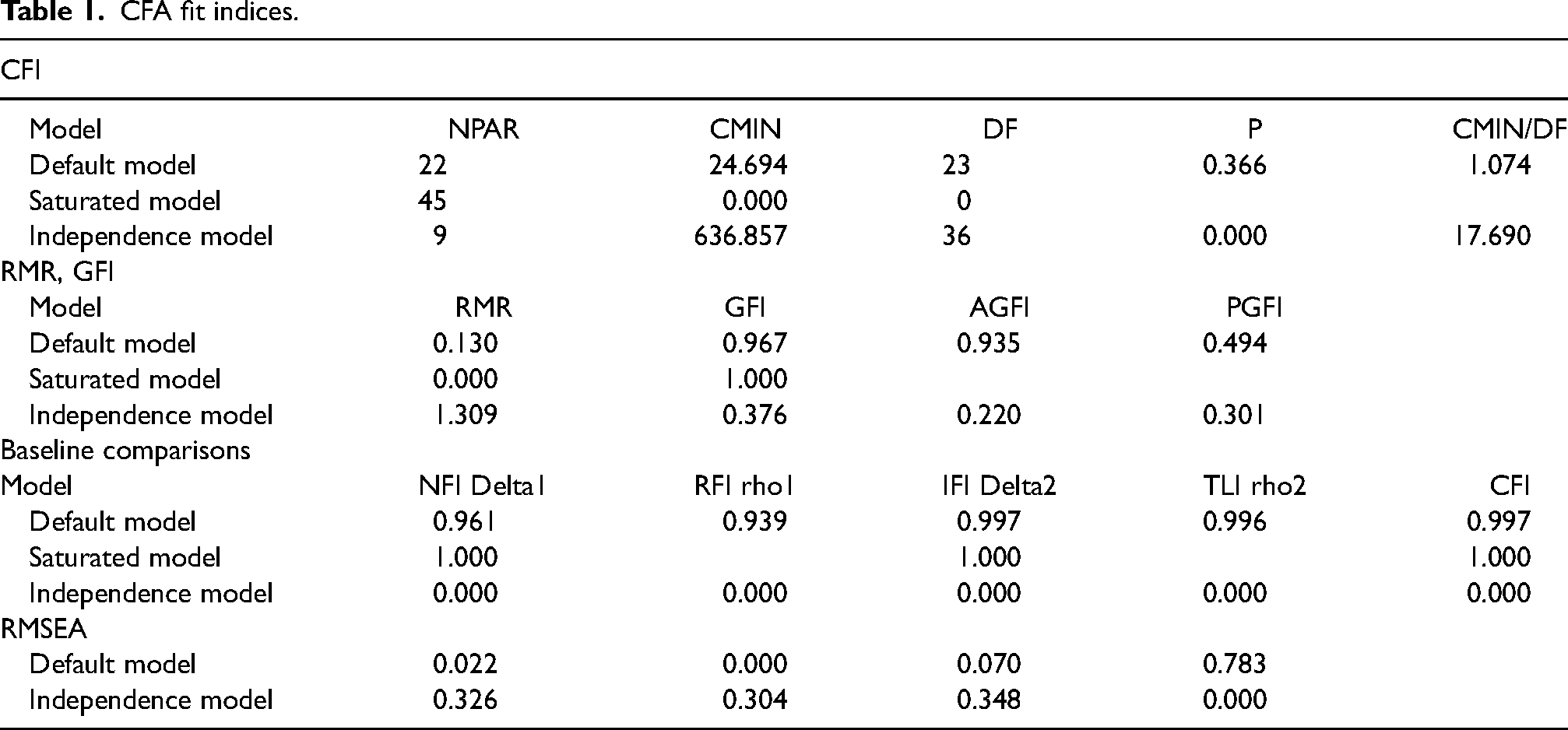
Confirmatory factor analysis (CFA) was conducted using AMOS V26 to test the measurement model where variances with low standardised regression weights were excluded (Hair et al., 2010). Table 1 displays the different fit indices that were evaluated to test the model fit. The Comparative Fit Index (CFI) value was 1.074 which indicated a good fit. A Chi-square value (CMIN) of 24.694, df = 22, and p = 0.366 was obtained for the default model which indicated a good fit as the p value was >0.05, which meant that there were significant differences between the covariances. A goodness of fit index (GFI) of 0.967 also indicated a good fit as the CFI needed to be ≥0.9. An Incremental Fit Index (IFI) of 0.997 also showed a good fit since the cut-off point was >0.9 for a good fit. Regression weights were calculated and results indicated all of the items in the scales were >0.05, which signalled that all the items were significant. The Root Mean Square Error Approximation (RMSEA) was 0.022, which also indicated a good fit as it was <0.08 (Hair et al., 2010).
CFA fit indices.
The model in Figure 1 illustrates the CFA model, which depicts the relationships between the constructs and the variables supporting them.
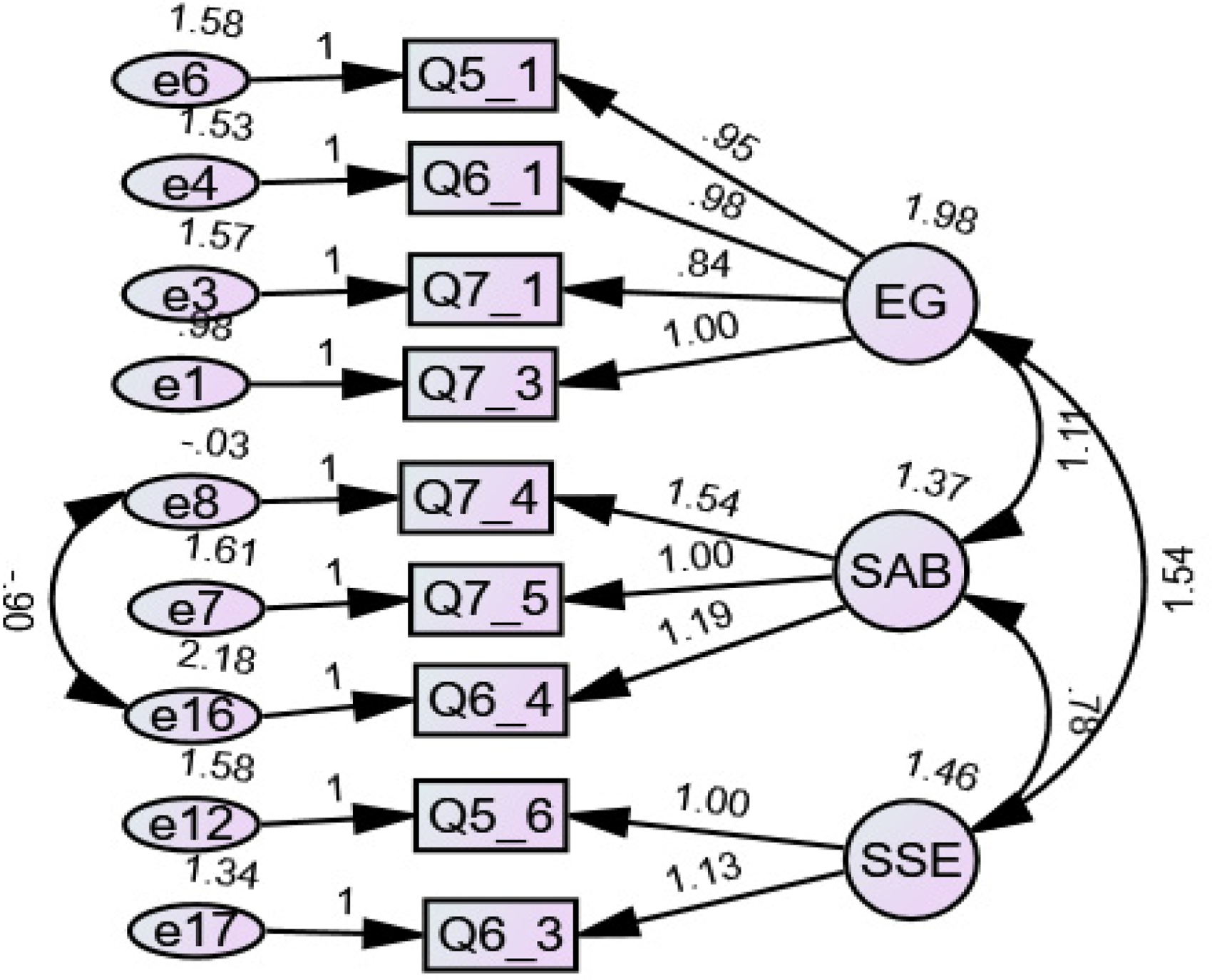
CFA results showing study factors: scaling of social enterprises, strategic alliance-building and earnings generation.
Table 2 shows the significant path variances (p < 0.001), which further proves the fit of the model. Collectively, these statistics showed that the data was a good fit for the hypothesised constructs (Hair et al., 2010).
Covariances between study factors.
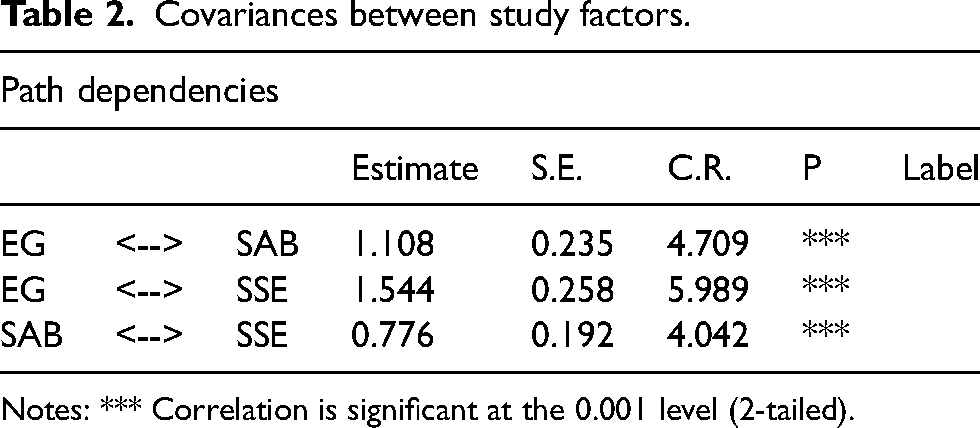
Notes: *** Correlation is significant at the 0.001 level (2-tailed).
Descriptives and correlations
The mean scores, standard deviations, and Pearson coefficients are displayed in Table 3, where the mean scores were all above the scale midpoint average and are ranked as follows: EG (mean = 5.903; SD = 1.205) was the highest rated, followed by SAB (mean = 4.761; SD = 0.976) and SSE (mean = 4.615, SD = 0. 917). The correlation output illustrated positive and non-significant inter-correlations between the constructs. Significant correlations were detected between all of the study variables (p-value > 0.05).
Descriptives and correlation matrix .
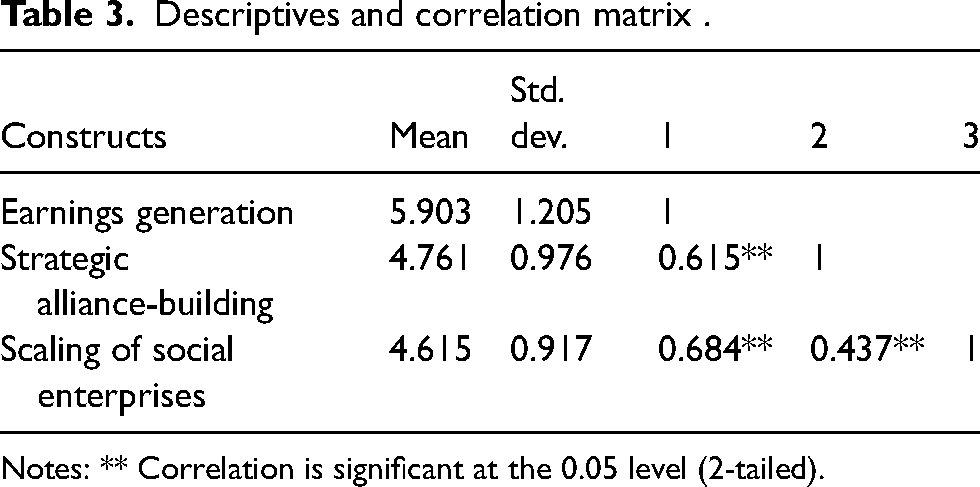
Notes: ** Correlation is significant at the 0.05 level (2-tailed).
To ascertain the influence of some of the control variables, venture size and age were employed to determine their effect on the DV (Cooper and Schindler, 2014). The results of these t-tests showed no significant relationship with each of the control variables, and additionally an individual one-way ANOVA test showed to be non-significant in the influence of controls and were not included in any further statistical testing.
Hypotheses testing
Initially the assumptions for regression were determined in terms of ‘linearity, homoscedasticity, independence of error terms, multicollinearity, and normality of error terms’ (Cooper and Schindler, 2014). Table 4 shows an R square of 0.468, which translates to the predictor variables accounting for 46.8% in the DV. The coefficients in Table 4 for SAB (B = 0.19, β = 0.026, t = 0.356 and p-value = 0.723) indicate a positive but non-significant relationship between SAB and SSE. However a positive and significant relationship is detected between EG and the SSE (B = 0.330, β = 0.668, t-value = 8.997, p-value = 0.000). Therefore, while H1 cannot be supported, based on the regression analyses H2 is supported.
Regression model summary.
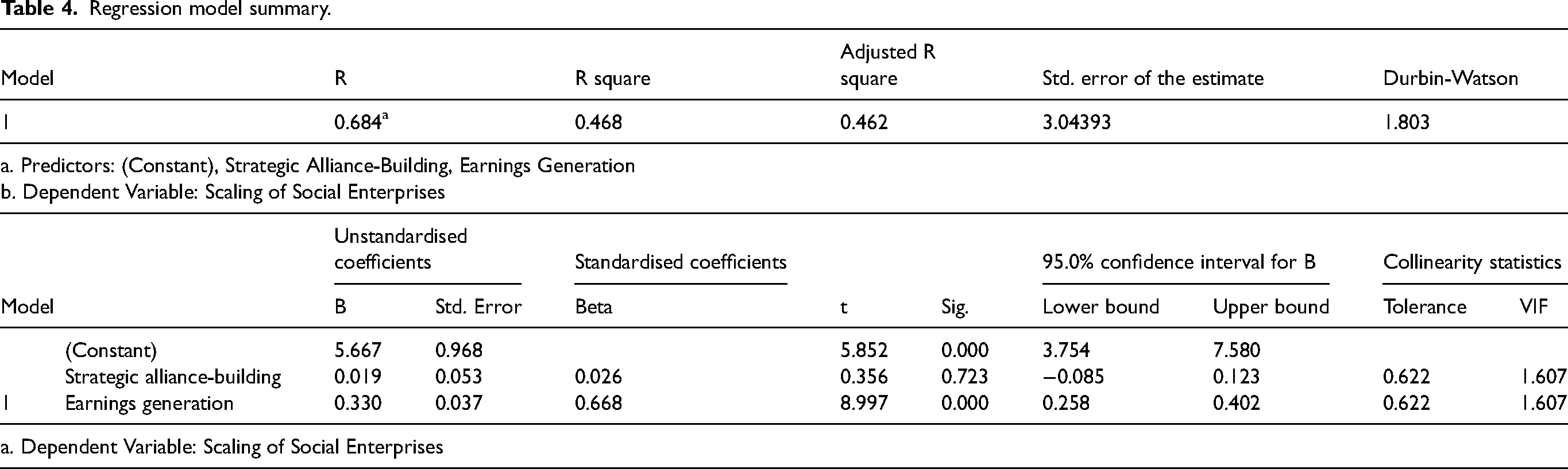
The variance inflation factor (VIF) was used to measure multicollinearity, where the VIF values for this study were within the acceptable level, that is >1, meaning that there was no clear evidence of multicollinearity. Statistical independence of error terms was evaluated using the Durbin-Watson test. The test looks for the presence of autocorrelation in residuals and for this study the Durbin-Watson value was 1.803, indicating that there was no serial correlation, since this value was within the acceptable range of 1.4 to 2.6 (Cooper and Schindler, 2014).
Discussion
Realising that SSE remains a highly perplexing concern in both research and practice; this study provided an opportunity to investigate the means and ways of achieving scalability by focussing on EG and SAB. In this regard, the hypotheses were discussed in light of the findings and plausible explanations offered by referring to prior research and theory.
In terms of H1, where a positive relationship between SAB and the SSE was predicted, the non-significant finding obtained was unexpected. Prior research highlights that the resource-constrained environment of emerging economies, compels social enterprises to build relationships with allies that could assist them with financial and marketing-related resources (Gupta and Srivastava, 2021). A plausible explanation for this non-significant finding was that the development of strategic alliances in social enterprises is often affected by contingencies such as the environment in which they operate (Corner and Kearins, 2021), which does not always allow for suitable allies with which to collaborate in order to scale. For instance, Bloom and Smith (2010) note that strategic allies that are purported to support controversial causes, for example legalisation of drugs, might make SAB a less significant ingredient of scaling for social enterprises. Another explanation for H1 results might have been that despite social entrepreneurs’ appreciation of the need for alliance-building to scale their enterprises, as they scale and provide an extension of benefits to more and more beneficiaries, this might not be socially desirable to their allies. Such a shift in mission and approach might well alienate a social enterprise from its original allies and constituency (Venter and Urban, 2015).
In terms of H2, positive and significant results were obtained for the relationship between EG and SSE. This positive finding resonates with the literature as the greater the capability of the social enterprise to generate earnings, the more financial resources it will have available to achieve scale. EG, such as income, trading activities, and investments, contribute significantly to scaling and growth, thus making the social enterprise self-sustaining (Blundel and Lyon, 2015). This is particularly essential for social enterprises in South Africa as they often face limited access to capital and funds in traditional capital markets (Urban, 2020). While some social enterprises receive corporate social investment (CSI) funding from corporates and from government agencies, most social enterprises in South Africa operate with very little funding, instead buying and selling goods and services to generate income and to cover operating costs or increase support for existing beneficiaries (IDC, 2021).
Support for H2 allowed for theory expansion in the stream of scaling as strategy, where theorists suggest that proper resource management and organisational capabilities, such as EG, are strongly associated with access to and accumulation of financial capital (Gras and Lumpkin, 2012). Generation of earnings capacitates the social enterprise to replicate (scale) the venture. EG not only provides more financial resources to the social enterprise, but also affords greater opportunities to transform financial resources into social and human capital resources, such as expanded networks, and to attract talented personnel. Whether the enterprise is scaling wide or deep, it needs to pursue profitability and simultaneously address its social mission to scale successfully (Han and Shah, 2020). Furthermore there is some evidence of how creative resource mobilisation, which could be in the form of EG, fosters greater social impact (Bacq et al., 2015), especially in times of uncertainty and resource shortages that have been experienced during the Covid-19 pandemic (Ratten, 2020). The Covid-19 pandemic highlights the urgency for social enterprises to collaborate and implement innovative and unconventional methods to relieve suffering and achieve a positive social impact (Bacq et al., 2020; Ratten, 2020).
An important contribution of this study was that the validity and reliability of the constructs under investigation was established in an African emerging market setting. Although the original scales had primarily been used in developed economies, verifying their psychometric properties in an African market context would allow for replication studies to take place in other similar emerging market contexts. Conducting research on SE in African countries affords the acquisition of different insights, the enlargement of theory, and comprehension of entrepreneurship in general (Jones et al., 2018). The findings provided important empirical evidence in the social sector for both policymakers and practitioners to address the complex developmental challenges they face. Developing a strong body of evidence that validates the effectiveness of policy that supports SE is pivotal, particularly given the scarce resources of many social enterprises in emerging economies, such as South Africa.
It is recommended that social entrepreneurs prioritise EG as a mechanism to scale their social enterprises. Government and policymakers need to develop an evidence-based policy framework, based on sound empirical research, to foster an effective ecosystem that provides opportunities for social enterprises to increase their EG capacity more readily in South Africa. In this regard, several interventions are recommended. For instance, current legislation on taxation does not encourage ‘profit’ in social enterprises as normal tax applies to any profits made. Such a myopic taxation perspective needs to change to allow a varying taxation structure to incentivise EG in social enterprises. Furthermore, social enterprises should explore varying business models focussed on EG, which must be evaluated in terms of profits generated versus high administration costs, where the latter has been a point of criticism in the SE literature (Peredo and McLean, 2006). Finally it is important that social enterprises in their efforts to scale devote their efforts towards measuring double bottom line results (financial and social performance) and triple bottom line results (financial, social, and environmental) (Elkington et al., 2010).
Study limitations related to the typical disadvantages of cross-sectional studies, where longitudinal studies would be needed to see if EG and SAB translated into increased scaling for social enterprise, and indeed sustainability. Furthermore, survey-based biases, acquiescence, and social desirability might have affected the responses, and caution was required in interpreting the findings.
Since the study was conducted in a single country, future researchers could extend this study to another country to determine the extent to which the phenomenon discussed are universal. In addition, future research could investigate the likelihood of reverse causality, since an increase in social enterprise scaling could result in an increase in EG and SAB. Finally, researchers are also encouraged to account for digitalisation as a potential mediating variable in the SSE. Understanding how new technologies and digitisation provide opportunities for increased EG and strategic-alliance building for scaling social enterprises could prove highly valuable.
Footnotes
Declaration of conflicting interests
The author(s) declared no potential conflicts of interest with respect to the research, authorship, and/or publication of this article.
Funding
The author(s) received no financial support for the research, authorship, and/or publication of this article.
