




Abstract
This article adds to entrepreneurship research by detailing the mediating role of work-related emotional exhaustion in the connection between the extent to which women entrepreneurs experience work interference with family—defined as the degree to which the quality of their personal lives is compromised by work demands—and the performance of their businesses. It also predicts a buffering role of the entrepreneurial strategic posture of their businesses in this process. Survey data collected among women entrepreneurs in Chile indicate that the depletion of entrepreneurs’ work-related energy resource reservoirs is an important reason that increasing levels of work interference with family diminish business performance. This mediating role of emotional exhaustion is less prominent when they run their businesses entrepreneurially, which might help them find innovative solutions for the negative spillovers of work stress into the family domain. This research therefore reveals a critical challenge for women entrepreneurs who suffer in their personal lives due to pressing work demands: the associated emotional drainage compromises the success of their business endeavors, which eventually can generate even more hardships. This study also shows how women entrepreneurs can address this challenge, that is, by drawing from the novel insights that arise from an entrepreneurial strategic posture.
Keywords
Introduction
Launching a new venture entails both benefits and challenges for people's abilities to avoid conflict between their work and family roles. The autonomy that arises with running a business can make it easier to fulfill their professional and private life demands simultaneously, because they gain more versatility than is generally available to employees (Eddleston and Powell, 2012; Longstreth et al., 1987). Yet the responsibilities of being in charge of one's own venture, instead of working for someone else, also may significantly undermine the quality of family lives (Ezzedeen and Zikic, 2017); entrepreneurs accordingly tend to suffer more from work-to-family conflict, compared with their employed counterparts (Parasuraman and Simmers, 2001). Both men and women experience this challenge, but women entrepreneurs often do so to a greater extent (Pathak and Varshney, 2017; Shabsough et al., 2021; Shastri et al., 2019)—though not because women are any less able than their male counterparts to balance work and family. On the contrary, various studies illustrate that women entrepreneurs juggle professional and private roles quite successfully (De Clercq et al., 2021; Sappleton and Lourenço, 2016; Shelton, 2006). Yet as a particularly pertinent challenge for women, prevailing societal norms often assign them primary responsibility, rather than men, to take care of their families, even potentially at the expense of their business endeavors (Hack-Polay et al., 2020; Kevill et al., 2020; Wyndow et al., 2013).
The focus of this research thus is specifically on establishing why and when the level of work interference with family that women entrepreneurs experience could decrease their business performance, defined as the extent to which their company's growth is relatively weaker than competitors’ (Hatak et al., 2016). 1 First, a critical channel through which such interference may escalate into underperformance involves work-related emotional exhaustion, or the depletion of the positive emotional resources that entrepreneurs possess and devote to their work (Trzebiatowski and Triana, 2020). According to conservation of resources (COR) theory, people's exposure to adverse circumstances tends to escalate into negative work outcomes because of their associated propensity to conserve their energy resources for themselves, rather than to “waste” them on work (Wayne et al., 2017). In our study context, we posit that the extent to which women entrepreneurs experience work interference with family causes them to feel emotionally drained in the course of running their business, so they strive to preserve any remaining resources, which then may culminate in lower business performance.
Second, COR theory prescribes that people's negative responses to the experience of resource-depleting work interference with family may be mitigated by the extent of their access to valuable resources that diminish the gravity of the experienced hardships (Beutell, 2010; Hobfoll, 2001). We propose that the adoption of an entrepreneurial strategic posture for their business (Miller, 1983) may help women entrepreneurs address the challenges of negative spillovers from work to family. Prior research uses the terms “entrepreneurial strategic posture” and “entrepreneurial orientation” interchangeably, to reflect the extent to which firms exhibit high levels of innovation, risk taking, and proactiveness (De Clercq and Zhou, 2014; Jogaratnam and Tse, 2006). For consistency, we use the former term and argue specifically that the novel insights generated from an entrepreneurial strategic posture (Kattenbach and Fietze, 2018) may help women entrepreneurs retain positive work energy, even when they experience elevated levels of work interference with family, which then boosts their business performance.
Contributions
With this foundation, we aim to contribute to extant research in several ways. First, we theorize and empirically show that the extent to which women entrepreneurs experience work interference with family can translate into diminished business performance, due to the depletion of their work-related energy resource bases (Wayne et al., 2017). Our focus on work-related emotional exhaustion and subsequent business underperformance as pertinent outcomes aligns with the matching principle, which suggests that the outcomes of a conflict between work and family manifest in the sending domain, or the source of the conflict (Nohe and Sonntag, 2014; Shockley and Singla, 2011). This principle predicts that, to the extent that women entrepreneurs believe their work is incompatible with family commitments, it can harm their experiences and success at work specifically (Shelton, 2006; Welsh et al., 2018a). With this approach, we also anticipate a potential risk of a downward spiral for women entrepreneurs: The level of work interference with family that they experience may drain their positive emotions so much that they lack the energy to support the performance of their business endeavors, which then might create a risk of failure and further hardships (Jennings and McDougald, 2007; Welsh et al., 2017).
Second, following calls for research into the contingent nature of the negative outcomes of work interference with family (Nguyen and Sawang, 2016; Welsh et al., 2018a), we predict a buffering role of an entrepreneurial strategic posture (Fuentes-Fuentes et al., 2015). According to organizational behavior research, the extent to which employees experience work-to-family conflict as threatening diminishes if they can draw from pertinent resources, such as social support at work (Karatepe, 2010), decision latitude (Billing et al., 2014), or a prevention focus (Brenninkmeijer et al., 2010). To complement this research stream, we investigate how the entrepreneurial posture that women entrepreneurs strategically adopt for their business might buffer the mediating role of their work-related emotional exhaustion in connecting their experience of work–family interference with a failure to run the company well. In so doing, we reject the notion that women entrepreneurs are passive victims of conflicting work and family demands and rather detail how they can leverage proactive strategic approaches to disrupt this downward spiral. That is, we specify how they can cope with the hardships resulting from work interference with family (Fernet et al., 2016) and attain more favorable business performance outcomes.
Relevance of the empirical context
We investigate these topics in the national setting of Chile. Extant research reveals that the hardships that stem from work interference with family are especially deeply felt by women who operate in cultural contexts marked by traditional gender roles (De Clercq and Brieger, 2021), such as in Latin America (Bardasi et al., 2011; Lepeley et al., 2015). The conservative family norms that characterize Chilean culture—and associated expectations that women should prioritize family demands, even if their work makes it difficult—imply that work-to-family conflict is a critical concern for women who run their own businesses in this country (Carlier et al., 2012; Cristόbal, 2017; Kuschel et al., 2020; Lepeley et al., 2015). According to Lepeley et al. (2015, p. 261), a “cultural issue that Chilean women entrepreneurs face is the common challenge to conciliate family and work responsibilities [and] this constraint limits business expansion.” In challenging, gender-discriminatory environments, it is critical to understand the extent to which women entrepreneurs suffer from work interference with family and how it may compromise the performance of their companies.
The Chilean context also is informative because of its high scores on two specific cultural values: uncertainty avoidance and collectivism (Hofstede et al., 2010; Nicholson et al., 1993). In an uncertainty avoidant country, entrepreneurs likely experience work interference with family as particularly intrusive, due to uncertainties that arise about how to perform work effectively without compromising family obligations (Agarwal and Lenka, 2015), which could have more intense negative consequences for their ability to maintain a positive mindset toward their work. Chile's culture also assigns substantial importance to in-group memberships, such as family, which may reinforce negative responses to work challenges that limit people's ability to meet family responsibilities (Hofstede et al., 2010). 2 In turn, an entrepreneurial strategic posture might be a particularly effective protection against such conflict. The national context of Chile therefore is highly relevant for studying the focal research issues.
The rest of the article is structured as follows: First, we highlight the theoretical underpinnings of this investigation, including the relevance of COR theory; explain the proposed conceptual model; and provide detailed explanations of its constitutive hypotheses. Second, we discuss the methodological approach, sample and data collection, construct measures, and statistical results. Third, we conclude with a discussion of theoretical implications, limitations and research avenues, and implications for practice.
Theoretical background and hypotheses
Extant research on the challenges that employees in paid employment experience at the work–family interface juxtaposes the negative interference of work obligations with family (or work-to-family conflict) with an alternative scenario in which family obligations interfere with work (or family-to-work conflict) (Kim et al., 2015; Lapierre and Allen, 2012). Our theoretical focus in this study is on the first type of interference, which aligns with the well-established matching principle (Nohe and Sonntag, 2014). In the process of seeking a balance between obligations that reside in different domains, including work and family, people associate, or match, the difficulties that they encounter with the domain that is the source of their experienced hardships (Amstad et al., 2011; Peeters et al., 2013). As applied to our study context, the matching principle implies that the extent to which women entrepreneurs experience work interference with family may generate more negative feelings in the course of running their business, which serves as the originating domain of their suffering (Jennings and McDougald, 2007; Poggesi et al., 2019). To the extent that they feel upset that they cannot meet their family responsibilities due to pressing work demands, it becomes more likely that they experience their business as the culprit and become emotionally drained when they think about work (Liu et al., 2015), which then may compromise the success of their business endeavors.
Our investigation of women entrepreneurs instead of entrepreneurs in general—and especially how the success of their companies may be thwarted by work inference with family—does not suggest that women should be any more or less able than men to deal with negative spillovers of work-related strain into the family domain. Women entrepreneurs can be very effective in avoiding such spillovers (Agarwal and Lenka, 2015; Sappleton and Lourenço, 2016), and prior studies on work–family enrichment acknowledge beneficial impacts of their responsibilities in one domain on performance in others (Welsh et al., 2018a). But women entrepreneurs tend to have limited control over macro-level, normative expectations that women, more so than men, should assign more priority to family than to work (De Clercq and Brieger, 2021; Jayawarna et al., 2020). Such expectations are prominent in Latin America (Molina, 2020; Ruiz-Gutierrez et al., 2012). Both men and women entrepreneurs may find that their family lives are compromised by their work responsibilities, but this difficulty tends to be relatively more prominently felt by women entrepreneurs who are embedded in broader contexts that encourage women to give precedence to family demands (Welzel, 2013; Wood and Eagly, 2010).
In this study, we propose specifically that the hardships that women entrepreneurs experience at home due to pressing work demands could translate into diminished business performance, as informed by the extent to which they suffer from work-related emotional exhaustion (Jensen, 2014). Moreover, we predict that this translation may be subdued by the entrepreneurial strategies that they adopt for their business and that offer possibilities to find novel solutions for the experienced hardships (Fernet et al., 2016). In our empirical context of Chile, traditional gender roles are widespread (Kuschel et al., 2020; Lepeley et al., 2015). Yet the theoretical arguments for the predicted relationships should apply broadly, as reflected in their conceptual grounding in the well-established COR framework.
COR theory
According to COR theory, people's work-related actions are largely informed by their desire to conserve or protect their existing resource reservoirs, particularly in resource-draining situations (Hobfoll and Shirom, 2000). The extent to which they suffer from resource-depleting interference of work with family may diminish entrepreneurs’ business performance, as a result of the level of emotional exhaustion that they experience in the course of running their businesses (Hobfoll and Shirom, 2000; Liao et al., 2019). Such work-related emotional exhaustion is a key dimension of job burnout, along with inadequate personal accomplishment and depersonalization (Maslach and Leiter, 2008). We focus on emotional exhaustion specifically, because it is the most direct manifestation of energy depletion resulting from adverse conditions at the work–family interface (Jawahar et al., 2012; Jensen, 2014). According to the aforementioned matching principle (Nohe and Sonntag, 2014), the likelihood that women entrepreneurs feel emotionally overextended by their work may increase to the extent that they find it difficult to meet their family commitments due to work responsibilities (Ezzedeen and Zikic, 2017), which then could lead them to try to conserve valuable energy resources and stay away from performance enhancing, but also demanding, business activities (Prottas and Thompson, 2006; Shelton, 2006). 3
Also in line with COR theory, the degree to which entrepreneurs suffer from unfavorable, resource-depleting circumstances should depend on their access to valuable resources that counteract the experienced hardships (Hobfoll and Shirom, 2000; Yu et al., 2018). The entrepreneurial strategic posture of their firms may serve as a critical protective factor that provides such sources, limiting the extent to which their energy reservoirs are drained due to work interference with family (Galloway and Mochrie, 2006; Runyan et al., 2006), with beneficial consequences for their business performance. Prior entrepreneurship research establishes how a firm-level entrepreneurial strategic posture can protect owner-managers of small- and medium-sized enterprises against stress and burnout (Fernet et al., 2016). Similarly, we propose that the entrepreneurial nature of their business activities may diminish the chances that resource-draining work interference with family makes women entrepreneurs default on their performance goals, by enhancing the possibilities that they find innovative solutions to the situation.
Conceptual model
In the following section, we detail the arguments for the hypotheses that underpin the proposed conceptual model (Figure 1). We anticipate that the nature of the theorized links applies to most country settings, even if their strength might differ according to the country's normative expectations with respect to gender (De Clercq and Brieger, 2021; Hack-Polay et al., 2020). In a similar vein, the proposed arguments should apply to both women and men entrepreneurs, but the forcefulness with which the former group suffers from and responds to experienced work interference with family likely is higher in cultural settings marked by gender-discriminatory forces, such as Chile (Lepeley et al., 2015). The hypotheses development accordingly refers to women entrepreneurs in particular.
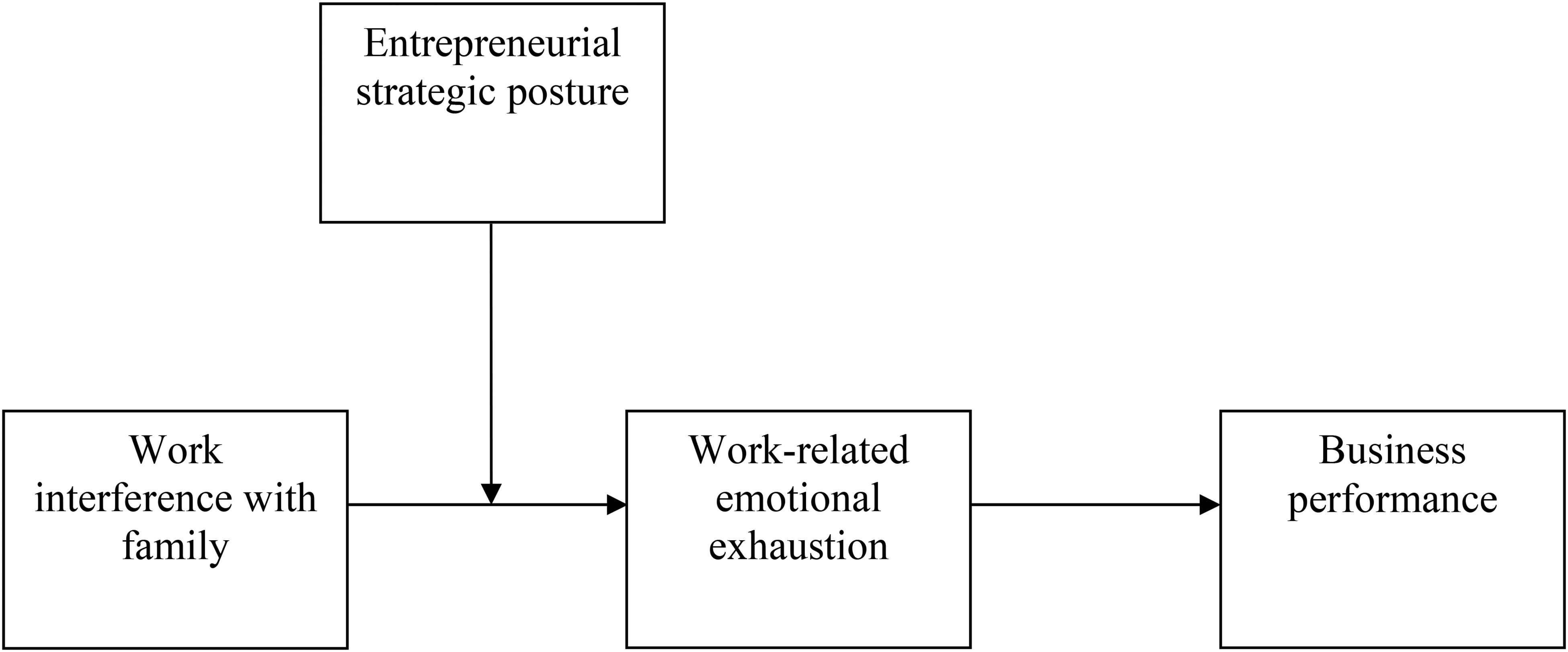
Conceptual model.
Mediating role of work-related emotional exhaustion
Previous research indicates a positive relationship between employees’ intra-work role conflict and emotional exhaustion (e.g. Cordes et al., 1997; Omrane et al., 2018), as well as between work–family conflict and emotional exhaustion (e.g. Halbesleben et al., 2012; McDowell et al., 2019). Along similar lines, we expect a positive relationship between women entrepreneurs’ experience of work interference with family and their work-related emotional exhaustion. In line with COR theory, to the extent that the quality of their family lives seems undermined by pressing work issues, the positive emotional resources from which entrepreneurs can draw to support their business efforts may be more drained (Turner et al., 2014). The negative consequences of increasing levels of work–family interference thus arise in the source domain (Nohe and Sonntag, 2014), and entrepreneurs are more likely to assign blame to the cause of their experienced hardships, evoking emotional exhaustion related to work (Liu et al., 2015; Wayne et al., 2017). To the extent that their work activities take up significant time that they would rather spend with family or friends, women entrepreneurs also may find it difficult to derive joy from their daily work efforts, which they instead associate with challenges for their private lives (Jennings and McDougald, 2007; Ufuk and Özgen, 2001). Through these links, they come to feel distressed by their work and suffer from emotional exhaustion. We hypothesize:
This work-related emotional exhaustion also likely diminishes business performance. To the extent that women entrepreneurs feel emotionally overwhelmed by their work, the associated ruminations may drain the energy resources they need to meet their business performance goals (Huettermann and Bruch, 2019). As predicted by COR theory, these ruminations may be so distracting that entrepreneurs are less able to focus on performance-related issues (Hobfoll and Shirom, 2000; Ye et al., 2021). From a general perspective, COR theory predicts that people's work-related emotional exhaustion tends to steer their energy toward unproductive activities, such as withdrawal from colleagues (Lanaj et al., 2018) or absenteeism (Neveu, 2007). The energy-depleting function of higher levels of emotional exhaustion similarly may make women entrepreneurs less assertive and diligent in their business activities, such that the performance of their company ultimately suffers (Quinn et al., 2012). In addition to this ability-based argument, the negative mindset that comes with being more emotionally overextended by work also might diminish the motivation of women entrepreneurs to go out of their way to boost the performance of their businesses. That is, increasing levels of emotional exhaustion may evoke energy-conserving propensities, so the entrepreneurs become less excited about devoting effort to ensuring the success of their business activities (Hobfoll and Shirom, 2000; Hutchins et al., 2018). On the basis of these arguments, we hypothesize:
The combination of the preceding arguments predicts a critical mediating role of work-related emotional exhaustion: The level of work interference with family that they experience diminishes the performance of women entrepreneurs’ businesses, because they lack positive emotional resources to devote to running their companies (Trzebiatowski and Triana, 2020; Wayne et al., 2017). To the extent they perceive that they are not able to fulfill their family commitments due to work, they may be less likely to run a well-performing business, reflecting their emotionally based work fatigue (Ufuk and Özgen, 2001). Previous organizational behavior research similarly indicates an intermediate role of employees’ emotional exhaustion in linking other adverse situations—such as coworker incivility (Rhee et al., 2017), perceived facades of conformity (Chou et al., 2019), or abusive supervision (Aryee et al., 2008)—with work outcomes. The mediating influence of emotional exhaustion on the link between work–family conflict specifically and employees’ well-being and performance also has been established (Bakker et al., 2004; Jensen and Knudsen, 2017). We extend these findings to an entrepreneurial context by hypothesizing:
Moderating role of entrepreneurial strategic posture
According to COR theory, the detrimental effects of increasing levels of resource-draining work interference with family should be subdued to the extent that women entrepreneurs’ resource access helps them counter the associated challenges (Hobfoll et al., 2018). The entrepreneurial strategic posture they choose for their company may be one such critical resource (Fuentes-Fuentes et al., 2015). It facilitates the generation of novel solutions to adverse situations confronted at work (Kearney et al., 2020). For example, prior research finds that an entrepreneurial strategic posture mitigates the work-related challenges of entrepreneurs who suffer from a sense of occupational loneliness (Fernet et al., 2016). We similarly propose that it may enable women entrepreneurs to avoid work-related emotional exhaustion in response to experienced work interference with family, because this strategic posture helps them develop innovative approaches to managing their time and coping with conflicting work and family demands (Kattenbach and Fietze, 2018). Two critical premises herein are that women entrepreneurs have a significant influence on their company's strategic decision-making and that the associated responsibilities lead them to benefit directly from their strategic choices in terms of feeling less emotionally drained in response to the conflict (Fuentes-Fuentes et al., 2015; Gutiérrez et al., 2014). 4
Previous research also indicates a strong positive connection between a firm's entrepreneurial strategic posture and the extent to which its leaders are motivated to expand their existing knowledge bases and learn new things (De Clercq and Zhou, 2014; Jiménez et al., 2014). Women entrepreneurs who establish an entrepreneurial strategic posture for their business similarly may regard the experience of work interference with family as an opportunity to identify novel ways to address and resolve the situation. They also might derive a sense of personal accomplishment or joy if they are able to find innovative solutions (Ryan and Deci, 2000). The adoption of an entrepreneurial strategic posture accordingly should diminish the potency with which the level of work interference with family that they experience escalates into work-related emotional exhaustion, because it helps them react with agility to the difficult situation (Gölgeci et al., 2019). In this scenario, women entrepreneurs still may experience the challenge of balancing work with family needs, but they likely maintain more positive views of their professional functioning, with beneficial consequences for their sense of work-related emotional exhaustion. These arguments suggest the following moderation hypothesis:
The combination of Hypotheses 3 and 4 suggests the presence of a moderated mediation dynamic (Preacher et al., 2007). In general terms, this dynamic implies that the strength of an indirect relationship between two constructs, through a third construct, depends on the level of some fourth contingency construct (Hayes, 2018). In our study context, the entrepreneurial strategy that women entrepreneurs adopt for their businesses is an important contingency factor of the indirect relationship between the extent to which they suffer from work interference with family and their business performance, through their enhanced work-related emotional exhaustion. When women entrepreneurs establish a strategic entrepreneurial posture for their business (Kickul et al., 2010), a sense of being emotionally drained by work should build a relatively weaker connection between their experienced work interference with family and the diminished performance of their business activities. Conversely, being emotionally overextended may be a more powerful mechanism for this escalation when women entrepreneurs select a more conservative strategic approach, which offers fewer opportunities to find novel solutions to the interference of work with family (Hobfoll and Shirom, 2000). We hypothesize:
Research method
Research approach, data, and sample selection
We employ a deductive, quantitative approach to test our hypotheses, which are grounded in the well-established COR theory (Hobfoll et al., 2018). These empirical tests of the research hypotheses, which we theoretically derived in the preceding section, rely on a survey instrument administered in fall 2019 among women entrepreneurs operating in Chile. The proposed research project underwent a detailed review process and received clearance from the research ethics board of the author team's university. In addition, for the data collection, we hired a well-established firm (IFF International, ISO 9001:2015) with a strong reputation for undertaking large-scale survey projects. It employs 750 native language interviewers and hosts 240 computer-assisted telephone interview stations. It also imposes strict quality control measures, such that 10% of all interviews are partially monitored for quality, 5% are monitored up to three-quarters of the way through, and 5% are monitored in full. Each hired interviewer must successfully complete at least two mock interviews before going live in the field. 5 This reliance on a third-party intermediary for the online data collection is consistent with similar approaches in extant research (e.g. Arend, 2014; De Clercq, 2020; Ellram et al., 2013).
The sampling frame came from IFF International's database of companies operating in Chile. In addition to the theoretical relevance of the Chilean country context, as explained in the Introduction, this focus on one specific country avoids the risk of unobserved institutional or cultural factors, which might influence the challenges associated with combining work and family obligations (De Clercq et al., 2021; Haar et al., 2014). From a more general perspective, this empirical setting addresses the need for more in-depth studies of the difficulties that women entrepreneurs experience in various cultural settings, including Latin America (Gutiérrez et al., 2014; Kuschel et al., 2017; Welsh et al., 2018b), and Chile specifically (Felzensztein et al., 2015; Kuschel, 2020; Lepeley et al., 2015).
Furthermore, the sampling effort targeted firms that met three criteria: They (a) were owned by a woman who held more than 50% of the shares, (b) had been established in 2010 or after (i.e. younger than 10 years), and (c) employed fewer than 250 people. We sought to survey women entrepreneurs with a majority stake, who thus have significant influence over their firm's strategic decision-making, including the extent to which it adopts an entrepreneurial posture (Batjargal et al., 2013; Mari et al., 2016). Furthermore, we targeted relatively young firms (no more than 10 years in existence; Kang et al., 2016), because tensions at the work–family interface likely continue to shape these firms, as a critical issue for their development. Finally, firms with fewer than 250 employees, also known as small and medium-sized enterprises (Powell and Eddleston, 2013), represent the majority of firms in countries across the globe (see https://www.oecd-ilibrary.org) and thus the national economic fabric. Even if the entrepreneurs who answered our survey may share some decision-making power with other managers or a formal board, their majority ownership stake, combined with the age and size limits (and the fact that 90% of the participating firms had fewer than 20 employees; Table 1), implies that this power sharing likely is less prominent than would be the case if we had included older or larger companies with less influential ownership structures in the sample.
Comparison of sample with population estimates.
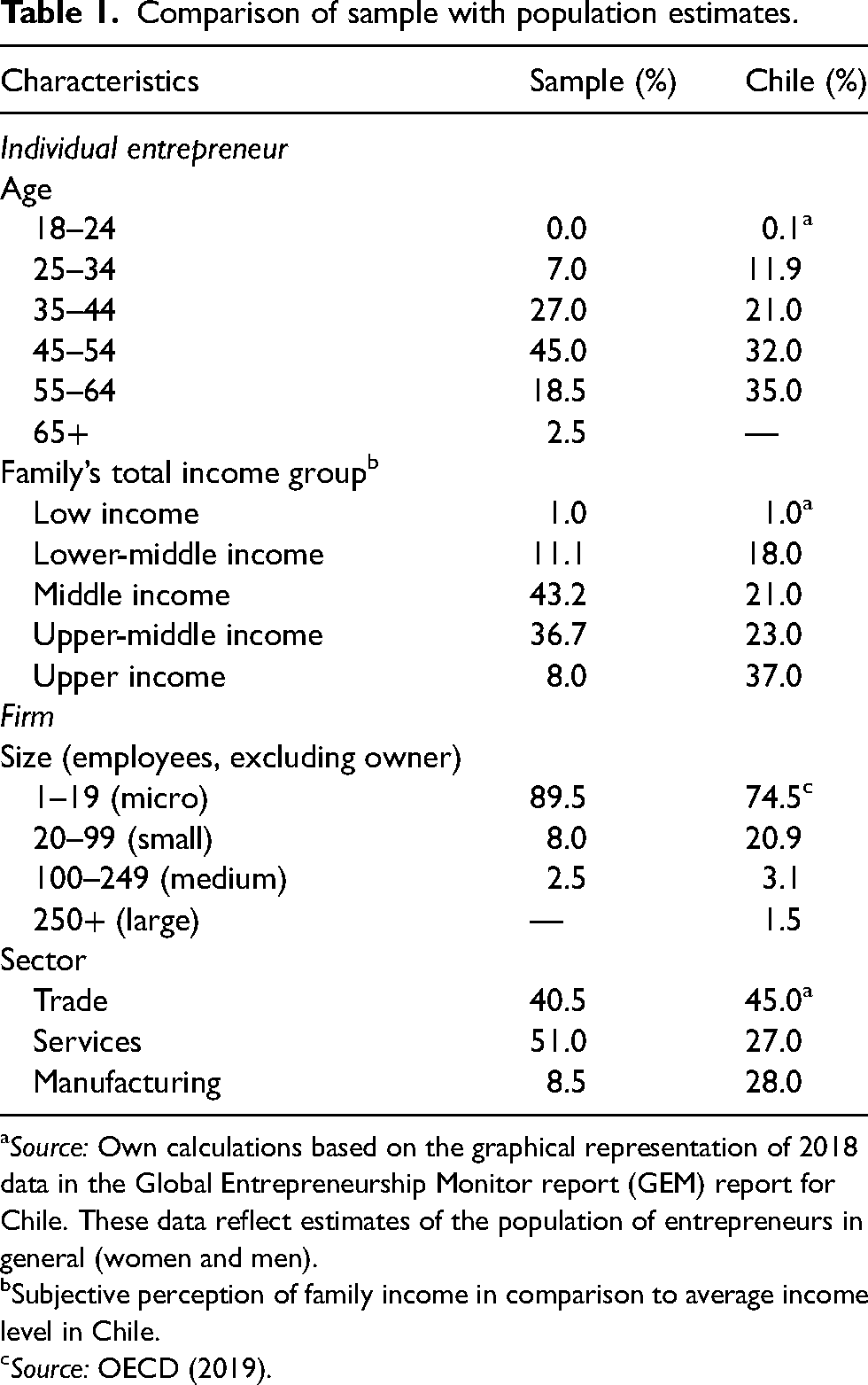
Source: Own calculations based on the graphical representation of 2018 data in the Global Entrepreneurship Monitor report (GEM) report for Chile. These data reflect estimates of the population of entrepreneurs in general (women and men).
Subjective perception of family income in comparison to average income level in Chile.
Source: OECD (2019).
A pilot version of the survey was pretested among a sample of 10 women entrepreneurs who were not part of the focal data collection. Their input helped us ensure the clarity of the instructions and the readability of the survey questions. The original survey questions were formulated in English and translated into Spanish by a bilingual translator. To guarantee the quality of the translation process and detect any discrepancies, this Spanish version was back-translated into English by a second bilingual translator (Brislin, 1986). The resulting adjustments generated the final version, which was administered in Spanish. To protect the rights and privacy of the participants and avoid bias with respect to social desirability and expectancy, we took several pertinent precautions. The interviewers explained the general purpose of the study, without mentioning the specific hypotheses, and emphasized that complete confidentiality was guaranteed. Moreover, they clarified that participation was voluntary and that the research output would only feature anonymous, aggregate data patterns. They also explicitly mentioned that there were no true or false answers and that it was very important for participants to provide honest, truthful opinions. Finally, respondents were told that they had the right to withdraw from the study at any point. Even if these well-established procedures do not completely eliminate social desirability or expectancy biases, they substantially diminish their likelihood (Spector, 2006).
From the defined sampling frame, 776 randomly selected firms were successfully contacted by the survey company, but 451 declined to participate. Of the remaining 325, 125 firms did not meet one or more of the three target criteria, based on a screening at the start of the interview, so they were excluded from the survey. The final sample thus consisted of 200 firms, reflecting a response rate of 26%. The women entrepreneurs in this sample had an average age of 48 years, 70% had earned college degrees, they had been active as a businesswoman for an average of 10 years, and their businesses operated mainly in services (51%) and trade (40%), as well as manufacturing (9%), sectors. A comparison of pertinent sample characteristics (individual age and income category, firm size and sector) with estimates of the general population of firms in Chile—a well-established approach to assess representativeness (Adkins et al., 2013; Khelil, 2016)—indicated that the characteristics generally match Chilean companies overall (Table 1). 6
Measures
The study constructs were measured with established scales, using seven-point Likert anchors that ranged between “very strongly disagree” and “very strongly agree” (first three constructs) or between “much worse” and “much better” (business performance).
Work interference with family. We assessed the extent to which women entrepreneurs believe that the quality of their family lives is compromised by work with a four-item scale of work interference with family (Gutek et al., 1991). For example, the respondents indicated their agreements with statements such as “My business takes up time that I’d like to spend with family/friends” and “My family/friends dislike how often I am preoccupied with my business while I am at home” (Cronbach's α = 0.68).
Entrepreneurial strategic posture. To measure the extent to which a firm adopts an entrepreneurial strategic posture, we applied a seven-item scale drawn from prior research (De Clercq et al., 2014; Miller, 1983). Two example items were “My firm is usually among the first in the industry to introduce new products” and “My firm takes bold, wide-ranging strategic actions rather than minor changes in tactics” (Cronbach's α = 0.73).
Work-related emotional exhaustion. We assessed the degree to which women entrepreneurs feel emotionally drained by their work with a three-item scale of emotional exhaustion (Haar, 2013). In light of our research focus on entrepreneurs, instead of employees, the adapted wording reflects respondents’ opinions about their business, instead of their work. They indicated their agreement with items such as, “I feel emotionally drained by my business” and “I feel burned out by my business” (Cronbach's α = 0.78).
Business performance. To assess the success of women entrepreneurs’ business undertakings, we relied on a three-item scale of firm performance, according to the entrepreneurs (Hatak et al., 2016). The participants rated their firm's growth compared with their competitors’ in three areas: sales, market share, and number of employees (Cronbach's α = 0.79).
Control variables. The statistical analyses included three control variables: the respondents’ age (in years), education level (1 = primary, 2 = secondary, 3 = college or higher), and professional experience (in years).
Construct validity. A confirmatory factor analysis performed on a four-factor measurement model generated an adequate fit: χ2(113) = 248.75, confirmatory fit index = 0.86, incremental fit index = 0.86, Tucker–Lewis index = 0.80, and root mean squared error of approximation = 0.08. As additional evidence of the presence of convergent validity, each measurement item loaded significantly on its respective construct. We also confirmed the presence of discriminant validity, because the fit of the constrained construct pair models, in which the correlations between constructs equal 1, was significantly worse than the fit of their unconstrained counterparts, in which the correlations could vary freely (Lattin et al., 2003).
Common method bias. We performed two tests to check for common method bias. First, we compared the fit of the four-factor model with that of a one-factor model, in which all items loaded on one factor. The former model exhibited significantly better fit (χ2(6) = 466.24, p < 0.001), which indicates that common method bias is not a significant concern (Lattin et al., 2003). Second, we applied a confirmatory factor analysis marker technique (Williams et al., 2010), by running three distinct models: a baseline model; the Method-C model, in which the loadings of a method factor were forced to have the same values; and the Method-U model, in which the loadings of a method factor could vary freely (De Clercq et al., 2013). The theoretically unrelated marker variable (i.e. method factor) was a four-item measure that captured personal beliefs with respect to what constitutes acceptable behavior by men and women (Sharma, 2010), such as “It is ok for men to be emotional sometimes” and “Men can be as caring as women.” The fit of the two method models was not statistically better than that of the baseline model, as indicated by the absence of significant fit differences in the comparisons of the baseline model (χ2(190) = 269.99) with the Method-C model (χ2(189) = 268.98; Δχ2(1) = 1.01, ns) and Method-U model (χ2(173) = 250.97; Δχ2(17) = 19.02, ns). In other words, we find no evidence of the presence of common method bias when accounting for either equal or unequal method effects.
Results
Main analysis
Table 2 features the zero-order correlations and descriptive statistics, and Table 3 contains the hierarchical regression results. Models 1–3 predict work-related emotional exhaustion, and Models 4–6 predict business performance. The values for the variance inflation factors are lower than the conservative cut-off benchmark of 5.0 (Studenmund, 1992), so there is no concern with respect to multicollinearity (Aiken and West, 1991).
Correlations and descriptive statistics.
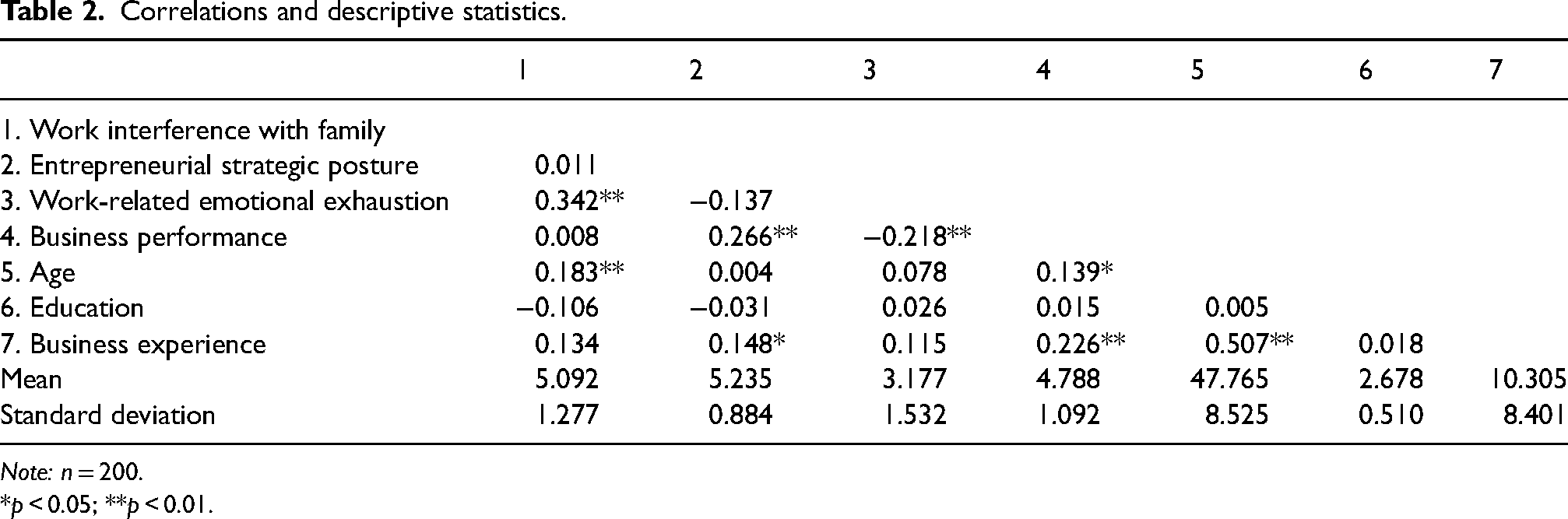
Note: n = 200.
*p < 0.05; **p < 0.01.
Regression results.
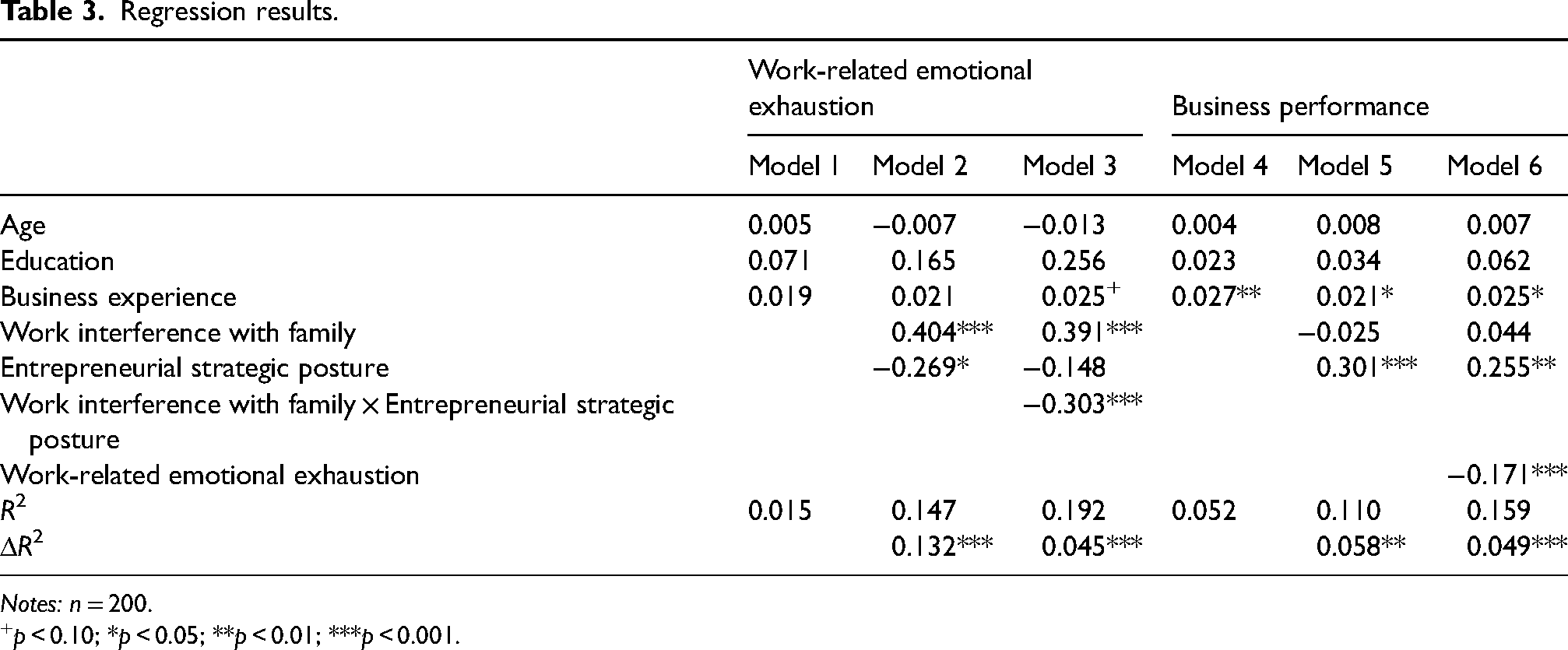
Notes: n = 200.
p < 0.10; *p < 0.05; **p < 0.01; ***p < 0.001.
Hypothesis 1 predicts that women entrepreneurs who perceive they are unable to fulfill their family commitments due to work feel emotionally drained by their work. Model 2 affirms a positive relationship between work interference with family and work-related emotional exhaustion (β = 0.404, p < 0.001). Consistent with Hypothesis 2, this drainage in positive work-related energy also diminishes the success of women entrepreneurs’ business undertakings, as is evident in the negative relationship between their work-related emotional exhaustion and business performance in Model 6 (β = −0.171, p < 0.001). To test for the presence of mediation (Hypothesis 3), we use a bootstrapping approach (Preacher et al., 2007), with Model 4 from the Process macro (Hayes, 2013). 7 Instead of calculating point estimates, this approach applies random sampling with replacement (i.e. re-sampling) to generate confidence intervals (CIs) and estimate indirect effects. Its primary advantage, compared with a traditional Sobel test, is that it mitigates the risk of statistical power problems in the presence of non-normal sampling distributions (MacKinnon et al., 2004). The CI for the indirect relationship between work–family interference and business performance through work-related emotional exhaustion does not include 0 [−0.135, −0.035], in support of the presence of mediation.
To test the moderating role of entrepreneurial strategic posture, Model 3 uses the interaction term, work interference with family × entrepreneurial strategic posture, to predict work-related emotional exhaustion. The negative significant interaction (β = −0.303, p < 0.001) offers support for the buffering role of entrepreneurial strategic posture. Figure 2 depicts the relationship between work interference with family and work-related emotional exhaustion at high and low levels of entrepreneurial strategic posture (i.e. one standard deviation above and below its mean). The associated simple slope analysis indicates that the relationship between work interference with family and work-related emotional exhaustion is positive and significant at low levels of entrepreneurial strategic posture (β = 0.694, p < 0.001) but not significant at high levels (β = 0.088, ns), consistent with Hypothesis 4.
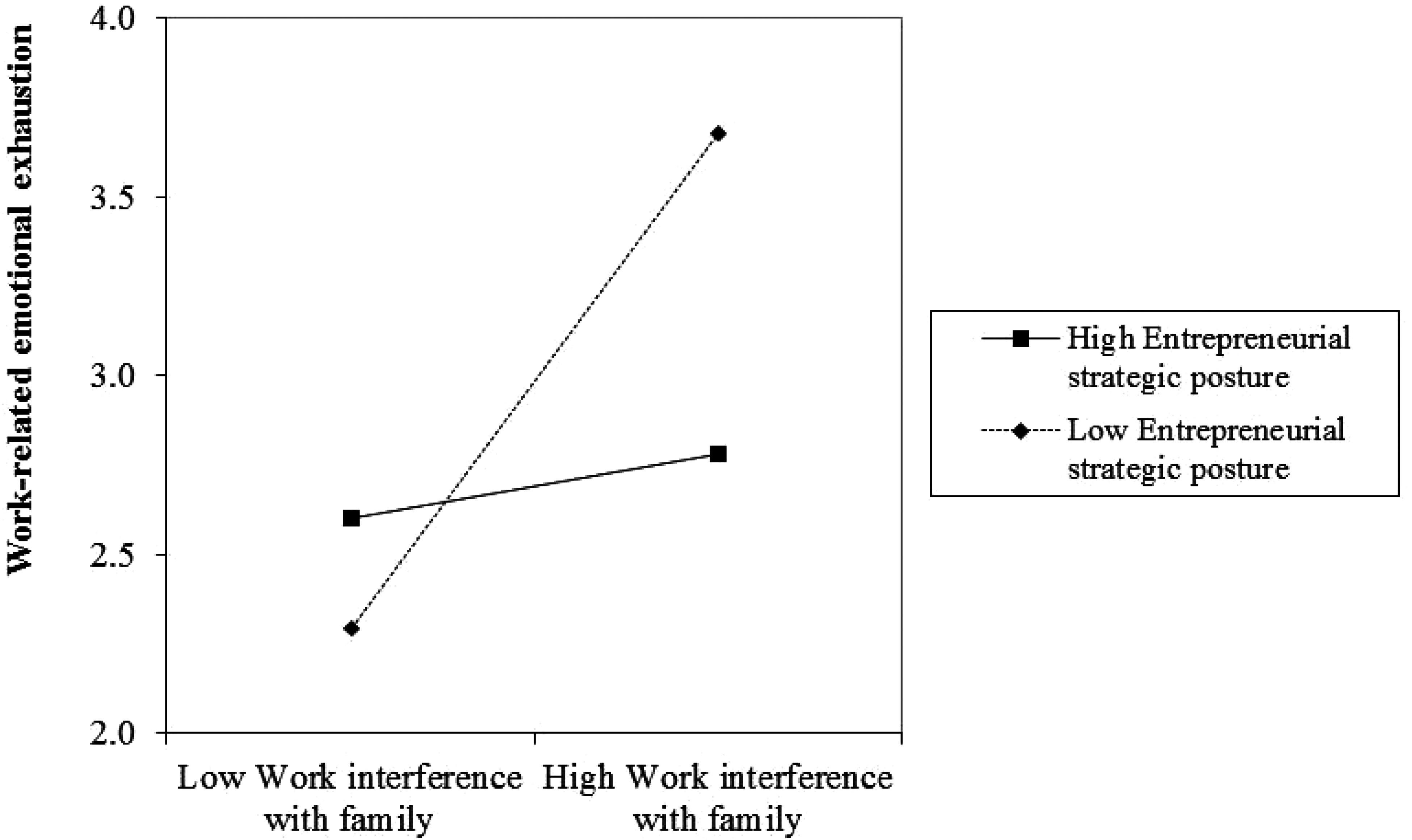
Moderating effect of entrepreneurial strategic posture on the relationship between work interference with family and work-related emotional exhaustion.
To assess the moderated mediation effect that we predict with Hypothesis 5, we again rely on Hayes’s (2013) Process macro. Similar to the bootstrapping procedure to test for mediation, this approach calculates CIs for conditional indirect effects at different levels of the moderator (i.e. one standard deviation below, at its mean, and one standard deviation above). Consistent with the proposed conceptual framework, the estimated model includes a moderating effect of entrepreneurial strategic posture on the relationship between work interference with family and work-related emotional exhaustion but not the relationship between work-related emotional exhaustion and business performance (Model 7 in the Process macro). In a post hoc analysis, we confirm that entrepreneurial strategic posture does not significantly influence this second relationship. The results in Table 4 reveal diminishing effect sizes at increasing levels of entrepreneurial strategic posture: −0.125 at one standard deviation below its mean, −0.066 at its mean, and −0.032 at one standard deviation above its mean. Nor do the CIs include 0 at the two lower levels of the moderator ([−0.189; −0.060] and [−0.119; −0.026], respectively), whereas the CI includes 0 at its high level ([−0.091; 0.010]). Finally, the index of moderated mediation (Hayes, 2015) equals 0.059, and the CI of this index does not include 0 [0.018; 099], which corroborates Hypothesis 5 and our overall conceptual framework.
Conditional indirect effects and index of moderated mediation.

Note: n = 200; SE: standard error; LLCI: lower limit confidence interval; ULCI: upper limit confidence interval.
Post hoc analysis
The positive energy that women entrepreneurs derive from running a successful business might diminish the chances that they feel emotionally exhausted, which then might generate more favorable beliefs about their conflicting work and family demands (Tang et al., 2016). To rule out such reverse causality, that is, the potential conflation of cause and effect, we perform a post hoc analysis in which we use different instrumental variables. Finding good instruments is “one of the biggest challenges that researchers face” (Antonakis et al., 2010, p. 1103), so we devoted significant time and effort to preselecting good instrumental variables in the early survey design stages. The logic for selecting instrumental variables that establish cause–effect relationships is that they should be conceptually related to the cause but not the effect (Antonakis et al., 2010; Bascle, 2008).
For the first path of the proposed mediation link (from work interference with family to work-related emotional exhaustion), we include three instrumental variables: (a) “How much time do you need to get to your place of business (in minutes)?” (b) “Do you have a housemaid?” (1 = yes; 0 = no), and (c) an eight-item measure of problem-focused coping with family responsibilities (e.g. “I manage my family duties by delegating some to others”; Someh and Drach-Zahavy, 2007). These variables arguably influence tensions at the work–family interface but have no direct bearing on the experience of work-related emotional exhaustion. For the second path (from work-related emotional exhaustion to business performance), the selected instruments are: (a) “Do you have any children?” (1 = yes; 0 = no), (b) “Do you belong to a religious group?” (1 = yes; 0 = no), and (c) “How important are your religious beliefs to you?” (1 = very unimportant; 7 = very important). These variables may inform the extent to which women entrepreneurs feel exhausted by work, but they are not necessarily related to their business performance. The results of the two-stage least squares estimations that include these instrumental variables, using the STATA ivreg2 command, are consistent with those reported in Table 3, which mitigates endogeneity concerns (Antonakis et al., 2010). 8
Discussion
This paper extends previous entrepreneurship research by investigating hitherto overlooked factors that might underpin or influence the translation of the level of work interference with family experienced by women entrepreneurs into diminished performance by their businesses. It is well-established that entrepreneurs’ exposure to unfavorable conditions at the interface of work and family can escalate into negative work outcomes (Shastri et al., 2019; Shelton, 2006; Ufuk and Özgen, 2001), but this study takes a more nuanced approach to establish both (a) why such escalation might take place and (b) how entrepreneurs can proactively diminish its likelihood.
We cannot underscore strongly enough that this study's focus on women entrepreneurs—and particularly how they respond to the spillover of work-related strain into the family sphere—is not deterministic. That is, our logic explicitly does not rely on any assertion that women entrepreneurs would be any more or less capable of coping with work–family incompatibilities than their male counterparts. Yet women entrepreneurs generally have little influence over gender-unfriendly expectations that it is their responsibility to take care of family matters, irrespective of their work obligations (Alexander and Welzel, 2010; De Clercq and Brieger, 2021), so they may suffer significant emotional hardships to the extent that their work activities prevent them from meeting these macro-level expectations. The silver lining, as proposed in this study, is that their entrepreneurial strategic approaches can have an especially beneficial effect on their capability to deal with the experienced hardships (Fernet et al., 2016), with positive consequences for their work-related emotional exhaustion and business performance.
A first theoretical implication of the study then is that the diminished availability of positive work-related energy constitutes a key factor that explains why higher levels of work-to-family conflict may have detrimental consequences for companies overall (Huettermann and Bruch, 2019). For entrepreneurs, women and men alike, remaining competitive and meeting performance-related business goals requires substantial energy (Quinn et al., 2012). To the extent that they feel emotionally drained due to stronger interferences of work with family, they lack this energy. In societal contexts in which traditional gender roles exacerbate the challenge of successfully combining work and family demands, such as Chile (Carlier et al., 2012; Lepeley et al., 2015), the mediating role of emotional exhaustion likely is particularly prominent, indicating that women entrepreneurs who experience elevated levels of work interference with family may suffer twofold: They feel disheartened by their inability to participate in a satisfactory private life while also running their own company, and this emotional exhaustion diminishes the success of their business endeavors, which might exacerbate their personal challenges further.
As a second, more uplifting, theoretical insight, we reveal a way that this negative cycle can be broken, based on how the entrepreneurs run their companies (Fuentes-Fuentes et al., 2015). Consistent with COR theory (Beutell, 2010; Hobfoll, 2001), the resource-depleting effect of increasing levels of work interference with family is subdued to the extent that women entrepreneurs can draw from strategic approaches that allow them to experience the interference as less intrusive, so they retain more positive energy with regard to their work functioning (Fernet et al., 2016). An entrepreneurial strategic posture also implies a broad embrace of the need to learn how to deal with challenges, so women entrepreneurs who have adopted such a posture for their company might feel a sense of personal accomplishment when they succeed in problem-solving endeavors (Jiménez et al., 2014; Ryan and Deci, 2000). The buffering role of an entrepreneurial strategic posture in tandem with the intermediate impact of work-related emotional exhaustion pinpoints the critically beneficial role of their strategic choices, which might be particularly salient in country settings where gender-discriminatory forces prevail (De Clercq and Brieger, 2021). That is, increasing challenges at the work–family interface are less likely to escalate into lower performance outcomes at the organizational level to the extent that women entrepreneurs exhibit flexibility in running their companies.
Taken together, the findings thus offer entrepreneurship scholars a more complete picture of the routes to successful outcomes for women entrepreneurs’ companies, even when their family lives are compromised by their work. Their emotional exhaustion connects the experience of work–family interference with underperformance, but the entrepreneurial strategic posture that they adopt at the organizational level can contain this process. This evidence complements previous findings regarding the direct beneficial effects of an entrepreneurial strategic posture on the success of women entrepreneurs’ business undertakings (Fuentes-Fuentes et al., 2015; Gutiérrez et al., 2014; Lavlu et al., 2019) by explicating an indirect but no less important positive role. Strategic approaches that encourage and facilitate the discovery of innovative solutions to experienced challenges at the work–family interface ultimately can diminish the risk that they suffer doubly, that is, from both a negative spillover of work stress into their family domain and a weaker competitive firm positioning.
Limitations and future research
This study has some limitations that set the stage for additional research. First, despite our post hoc effort to assess endogeneity, we cannot totally exclude the possibility of reverse causality. The empirical results are robust to simultaneity threats, and the theoretical arguments are anchored in the COR framework—according to which resource-draining experiences at the interface of work and family should culminate in diminished work productivity (Hobfoll, 2001; Wayne et al., 2017). Still, it would be useful to assess the focal constructs at distinct points in time and test formally for causality, as well as estimate cross-lagged effects. In a related vein, we offer both ability- and motivation-based arguments for the mediating role of work-related emotional exhaustion; additional studies might measure these mechanisms to establish when and where they exert distinct influences too.
Second, we focus on emotional exhaustion as a focal mediator, to acknowledge the energy-draining effect of women entrepreneurs’ experienced incompatibilities of work with family demands (Karatepe, 2010; Liu et al., 2015), but other intermediate mechanisms could explain this escalation too, such as cynical beliefs about their career path (Wang et al., 2012) or psychological withdrawal (Shaffer et al., 2001). The translation of work interference with family into business outcomes also might be explained by diminished positive attitudes, such as lower work engagement (Peeters et al., 2009) or organizational commitment (Tabor et al., 2020).
Third, we investigate the mitigating role of an entrepreneurial strategic posture, reflecting our argument that women entrepreneurs’ perceptions of their professional and personal activities cannot be seen in isolation of the strategic posture they adopt for their firms (Kickul et al., 2010). It would be interesting to consider other organizational-level factors in this process too, such as the extent to which the entrepreneurs embrace a strong market or learning orientation (Gutiérrez et al., 2014). Pertinent personal factors also might serve as buffers, such as women entrepreneurs’ persistence and passion for business (Langevang et al., 2018) or their optimism (Hundera et al., 2019). Which of these alternative factors might be most effective in shielding women entrepreneurs from the hardships that come with a family life being compromised by work? Does an entrepreneurial strategic posture still exert effects, after accounting for the effects of these factors? We leave these questions for further research.
Fourth, the conceptual arguments of this study are not country specific, and we generally expect that these hypothesized relationships apply to a broad set of countries. Yet it is possible that certain cultural features might interfere with the conceptual framework and influence the strength of its constitutive relationships. As indicated in the Introduction, the high levels of uncertainty avoidance and collectivism that mark Chile (Hofstede et al., 2010) mean that women entrepreneurs in this country might feel particularly upset when they confront uncertainty-inducing interferences of work with family, as well as when they are not able to care for the people in their immediate circle in the ways they believe they should. From this perspective, their responses to the situation likely are strongly negative. Pertinent insights thus could come from more cross-country studies that explicitly investigate the roles of these cultural values. Another, similar extension might examine the roles of corresponding individual characteristics, such as women entrepreneurs’ own personal risk aversion (Ackah et al., 2019) or collectivistic orientation (Anlesinya et al., 2019).
Fifth, we reiterate that the conceptual arguments that underpin the theorized relationships are gender-neutral, so the signs of these relationships should not differ across women and men, but their strength may vary. Our focus was informed by the critical premise that women entrepreneurs tend to experience work interference with family as more intrusive, due to persistent normative guidelines that it is up to women, and not men, to carry the bulk of family-related responsibilities (Gherardi, 2015; Lepeley et al., 2015). Women entrepreneurs accordingly may suffer to a greater extent when their work obligations compromise their family lives, such that they also can benefit relatively more from adopting an entrepreneurial strategic posture for their business. Further research could formally test this premise, account for women's perceptions of adverse normative expectations with respect to gender, and compare the strength of the hypothesized relationships between women and men entrepreneurs.
Practical implications
This research has significant implications for entrepreneurial practice. To the extent that entrepreneurs feel upset about a diminished ability to fulfill their family duties due to pressing work demands, it becomes more likely that they end up with a deficiency of work-related energy resources that they otherwise could dedicate to the successful running of their companies. Yet, we predict that some entrepreneurs might be hesitant to admit the challenge of balancing work with family demands, whether to justify their choice to run their own business or to avoid looking weak, needy, or incompetent (Agarwal and Lenka, 2015; Jennings and McDougald, 2007). In response, we recommend that entrepreneurs proactively establish networks of trusted stakeholders, who can share in excessive workloads, offer emotional support, or issue pertinent feedback about how to balance private lives with the demands of running their own business (Bogren et al., 2013; Lerner et al., 1997). Support and guidance from others can diminish the risk that entrepreneurs’ frustrations undermine their companies’ competitive standing. Entrepreneurs also might benefit from training sessions with role models, who have been able to deal with similar, difficult situations (Nixdorff and Rosen, 2010). The mental support and insights provided by these peers can have significant value, both for entrepreneurs’ personal well-being and for their abilities to organize their time effectively across different domains. The listed recommendations are purposefully formulated as applying to entrepreneurs in general, that is, to both genders. As subsumed by our conceptual arguments, they might be particularly instrumental for women entrepreneurs though, to the extent that these entrepreneurs suffer from gender-discriminatory norms that make it more difficult to successfully combine work with family responsibilities (De Clercq and Brieger, 2021).
In addition to these broad recommendations for diminishing the negative consequences of work interference with family through professional or social support, this study reveals a specific, organizational-level path that can help entrepreneurs, women and men alike, achieve such beneficial outcomes: adopt a strategic posture for their companies that increases the opportunities for finding effective ways to deal with the personal hardships caused by work (Kearney et al., 2020). When their companies feature an entrepreneurial strategic posture, it becomes more likely that entrepreneurs, possibly with the help of their employees and other stakeholders, can identify novel solutions. Overall, when they instill an entrepreneurial spirit in their companies, entrepreneurs can reap great benefits and diminish the threats that come with negative spillovers of work stress into the family sphere—which ultimately may boost their work experience and their ability to run a successful company. Again, both women and men entrepreneurs can reap the fruits of an entrepreneurial strategic posture, but the former group may do so to a greater extent when their strategic actions help counter women-unfriendly normative expectations with respect to the simultaneous combination of work and family duties.
Conclusion
This study contributes to entrepreneurship research by investigating the roles of women entrepreneurs’ work-related emotional exhaustion and entrepreneurial strategic posture in the possible escalation of the level of work interference with family that they experience into diminished business performance. The propensity to feel emotionally overwhelmed by work represents a critical factor by which higher levels of work-to-family conflict undermine the success of women entrepreneurs’ business activities. Notably, this study paints a positive picture of how the entrepreneurs can address this counterproductive process: Their emotional exhaustion, as an intermediate mechanism, can be countered by pertinent opportunities to resolve this situation, as informed by the entrepreneurial strategic choices that they establish for their company. We hope these insights provide an impetus for additional studies of how entrepreneurs, women and men, can personally thrive and professionally maintain the competitive strength of their businesses, despite the difficulties they may experience in their private lives as a result of the persistent work pressures they face.
Footnotes
Declaration of conflicting interests
The authors declared no potential conflicts of interest with respect to the research, authorship, and/or publication of this article.
Funding
The authors disclosed receipt of the following financial support for the research, authorship, and/or publication of this article: This work was supported by research grant no. 2017/27/B/HS4/02075 for Eugene Kaciak, National Science Centre, Poland.
