




Abstract
Contemporary representations of entrepreneurship only reflect the past and present, not the utopian or dystopian futures that entrepreneurial behaviours may create. Given calls for alternative narratives of entrepreneurship that challenge the orthodoxy, there is a need to critique the multiple simultaneous representations of entrepreneurship and their potential impact on our future. Using Baudrillard’s concept of simulacra, this paper proposes a new epistemological way to interrogate future entrepreneurial reality through a radical hyper-real frame and an empirical deviation from the norm. The paper introduces and critiques representations that contribute an entrepreneurial imaginary based on contemporary discourse. Through viewing and coding for entrepreneurial behaviours observed in the top-30 Zombie movies, a deviant simulacrum that is far from our field is constructed. This is used to generate a new empirically derived taxonomy that challenges existing entrepreneurial representations and suggests the impossibility of a single entrepreneurial reality. Through this deconstruction, we highlight how entrepreneurial behaviours take on alternative meaning when explored through other realities. By comparing the Zombie genre as simulacra with extant entrepreneurial simulacra, we critically challenge our entrepreneurial system of meaning, providing a perspective where entrepreneurial behaviour may lead to different outcomes depending on the reality pursued.
Introduction
This paper contributes to our entrepreneurial system of meaning by offering a new epistemological way to consider current and future entrepreneurial realities. In doing so we offer an alternative view that goes some way towards answering the thought experiment ‘what would a society that is totally permeated by entrepreneurship look like?’ (Rehn and Taalas, 2004: 235). Through the presentation of a radical ‘hyper-reality’ this paper offers readers with an opportunity to reflect as to whether the entrepreneurial behaviours they seek to emulate align with the future they wish to create (Jones and Spicer, 2005).
The contribution of this paper to theory is in exploring the process and power of signification on our entrepreneurial system of meaning. To do this we draw on post-modern theory to explore what Baudrillard (1994 [1981]) might refer to as the ‘entrepreneurial imaginary’, where we accept ‘multiple simultaneous forms of knowledge’ (Valliere and Gegenhuber, 2014: 7) in a composite system of meaning.
Following a critical tradition in entrepreneurship, where creative and playful approaches draw on stories of the entrepreneur (Down and Revelry, 2004; Hjorth, 2007), we reconceptualise entrepreneurial reality using Baudrillard’s simulacra theory. Here, representations of entrepreneurial reality are deconstructed and their verisimilitude questioned. As the focus of this deconstruction we substitute a neoliberal with a post-human cultural framing that reflects challenging times and in doing so presents a hyper-reality for the entrepreneur that deliberately unmoors entrepreneurial behaviours (the signs) from perceived reality (the signified).
For this alternative, we draw on the Zombie genre, where a Zombie is defined as a reanimated corpse that retains few human behaviours and is driven by a need to consume human flesh. In entertainment terms, the popularity of the Zombie genre waxes and wanes with the economic cycle (Edwards, 2010). Times of austerity lead to a consideration of the fragility of civilisation and of the ultimate worst case scenario. The Zombie becomes a representation of the anxiety and fear we feel about society, with our concerns about health, the economy, environmental degradation, conflict and death congealed within a visceral, bloody and ruthless consumer of resources. Such concerns are relevant during times when we are questioning the impact of entrepreneurship on our health, society, environment and political system (Tedmanson et al., 2012).
We follow the thought experiment of Rehn and Taalas (2004) and add to extant representations of entrepreneurial reality that challenge the collective entrepreneurial imaginary with a post-human future that appears far from our field. This aims to create an epistemological displacement (to repurpose a term from Gadderfors et al., 2020) that contributes to our understanding and, as a consequence, highlights the lack of humanity and society in the contemporary entrepreneurial system of meaning.
In the next sections we foreground the critical entrepreneurship tradition this paper contributes to before introducing order-of-simulacra theory and then, using contemporary narratives of entrepreneurship, build a number of different simulacra that constitute an entrepreneurial system of meaning. Having constructed this imaginary, we then deconstruct it through a deviant and radical representation. We do this through a process of viewing and coding entrepreneurial behaviours in the top-30 Zombie genre films. The results are presented, with a proposed empirical taxonomy used to highlight similarities and differences with existing simulacra. This highlights the process and power that signification has on the entrepreneurial imaginary.
A critical entrepreneurship tradition
The observation has been made that ‘a general theory of entrepreneurship is as far-fetched as a general theory of holes’ (McElwee and Holmes, 2000: 4), supporting a tradition of critical entrepreneurship research, where scholars challenge and deconstruct the dominant discourse through reference to other fields. Here deviations from the norm are used to emphasise the limitations of monolithic stories of entrepreneurship (Steyaert and Landström, 2011). The use of language itself as an instrument for understanding entrepreneurship has been explored (Steyaert and Landström, 2011) and a similarity between stories of successful entrepreneurs as simulacra noted (Steyaert, 2007) where narratives may be embellished fictional representations of an idealised reality. These linguistic approaches build upon an interpretive ontology that accepts and absorbs multiple paradigms (Steyaert, 2007), while calling for alternatives and identifying different narratives of entrepreneurship (Down and Reveley, 2004). For instance, through understanding entrepreneurship as a social practice that is located, situated and contextualised (Hjorth and Holt, 2016), the mundanity and everydayness of entrepreneurial behaviour has been highlighted – a narrative that is sharply at odds with a heroic metanarrative e.g. day-to-day stories of survival rather than dramatic performances of failure leading to eventual success.
These critical scholars have identified a distinctive creative voice in entrepreneurship, where the minority calls the majority voice to account (Hjorth, 2007). Pioneering approaches from outside the field have confronted mainstream approaches (Steyaert and Landström, 2011) to generate new concepts in entrepreneurship that enable educators and students to think differently (Hjorth, 2007). For instance, a Journal of Business Venturing special issue used a single entrepreneurial narrative as the focus for multiple critical interpretations, such as: enacted performance (Stayaert, 2007); feminist critique (Ahl, 2007); and resources as bricolage (Baker, 2007). Particularly relevant is a Hjorth (2007) paper that used a passage from Shakespeare’s Othello to illustrate how scholars may use narratives to learn and go beyond conventions, highlighting the importance of language and representation to entrepreneurship research.
Simulacra and the entrepreneurial imaginary
Representations of entrepreneurship in academia and the media have been criticised as presenting an illusion that hides the experienced reality of entrepreneurship (Shane, 2008). Among various representations, entrepreneurship has been regarded as a heroic myth (Knott and Posen, 2005; Shane, 2008), as a mundane and socially embedded routine (Deller, 2010; Steyaert and Katz, 2004), and as a deviant experience (Bureau, 2014; de Vries, 1985). 1 These multiple representations of entrepreneurship can be regarded as constituting a contemporary entrepreneurial imaginary with each representation having different degrees of verisimilitude to an assumed underlying reality.
The post-modern theorist Baudrillard (1994 [1981]) termed these different representations of reality as simulacra. Baudrillard was a cultural theorist who combined cultural and social criticism to challenge modes of thought (Kellner, 2019). According to Baudrillard, in thinking about representations of reality, we explore how these systems of representation produce meaning (Baudrillard, 1994 [1981]). Here representation is the principle that the sign and the signified are equivalent. Baudrillard problematised reality and argued that some systems of representation produce meaning independently from reality where the sign and the signified are not equivalent. He argued that there has been a historic shift where culture has moved from representation to simulation as the dominant mode of organisation for cultural objects (1994 [1981]). Here there has been a transition from signs that signify something to, in the extreme case, signs that signify nothing.
Within the transition between signs and signified, he identified four different orders-of-simulacra. These are where a representation: (1) Reflects a basic reality; (2) Masks and perverts a basic reality; (3) Masks the absence of a basic reality, or; (4) Bears no relation to any reality – being a pure simulacrum or hyper-reality (Baudrillard, 1994 [1981]). Within a system of meaning, different simulacra may co-exist and intermingle their discourse, creating an imaginary of the system that may have many complex meanings. Baudrillard argued that there is a ‘precession’ of simulacra, where in contemporary society, the hyper-real may take precedence over the real. Here he infamously used the example of Disneyland, where the American Dream exists in a concentrated and gamified form that has become ‘more real than real’ in the American imaginary, to the extent that the Disney representation of high street USA has more meaning than experienced reality in American neoliberal thought (Baudrillard, 1994 [1981]).
Within a broader business and management field, order-of-simulacra theory has been used to deconstruct – that is understand the relationship between text and meaning through alternative readings (Derrida, 1974 [2004]) – phenomenon such as accounting models, markets and trade fairs. These phenomena are presented as hyper-realities which challenge our understanding of reality (Bougen and Young, 2012; Macintosh et al., 2000; Nordin, 2012). In an entrepreneurial imaginary, we highlight that there are a number of different representations of entrepreneurship that constitute a system of meaning – with some more reflective of reality than others. Figure 1 illustrates this, showing how common representations of entrepreneurship may be considered as simulacra that are distant/different from reality.
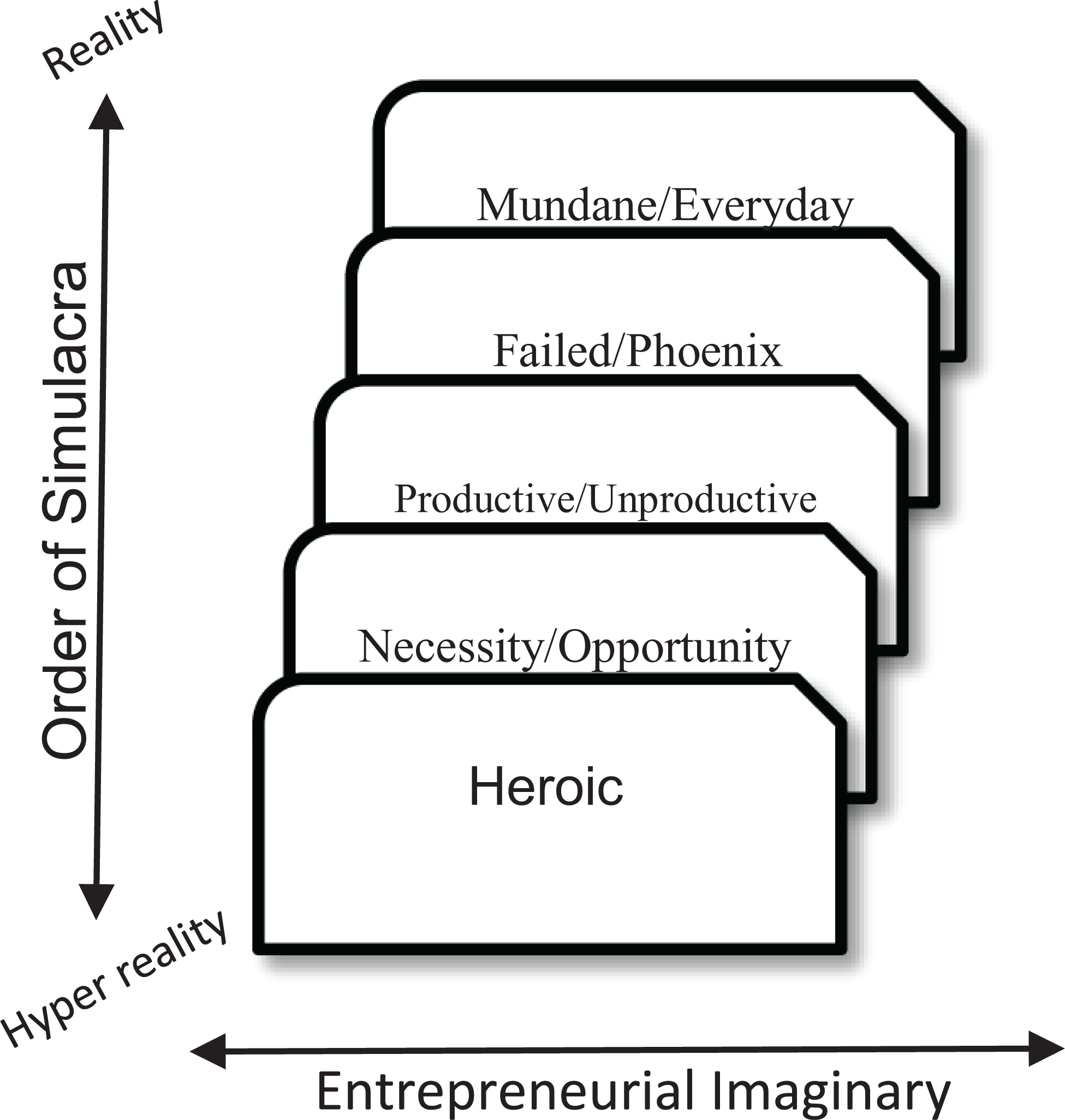
The precession of entrepreneurial simulacra.
The mundane reality of entrepreneurship
Drawing on a narrative based tradition of critical inquiry to explore entrepreneurial representations through order-of-simulacra theory, we may recognise a first order referential of entrepreneurship as a basic reality that is experienced by individuals. This follows narratives where entrepreneurship has been described as mundane, every-day and routine (Hjorth and Holt, 2016; Welter et al., 2017).
Here, entrepreneurship represents a ubiquitous phenomenon where it is ‘a matter of everyday activities rather than the actions of elitist groups of entrepreneurs’ (Steyaert and Katz, 2004: 180). Individuals that are alert for an opportunity (Kirzner, 1999) or are adding value through the creation of personal wealth (Acs and Dana, 2001) are everywhere. This is pragmatically realised at the fieldwork stage of most entrepreneurship research, where the dependant variable is the (mundane) new business rather than (heroic) paradigm shifting individual (Shane and Venkataraman, 2000). When the majority of small businesses involve the modest entrepreneurial behaviour of grocers, shop keepers and the like (Deller, 2010), an everyday discourse of entrepreneurship is arguably a representation of the phenomenon that is closest to reality.
The heroic entrepreneur simulacrum
As we move further away from the equivalence of the sign and the signified, according to Baudrillard, myths of origin are generated that substitute for the truth (1994 [1981]). In line with the second order of simulacra, a heroic entrepreneurial simulacrum may contain elements that reflect the basic reality, but in other ways pervert the representation.
This entrepreneurial discourse regards entrepreneurial behaviours as the solution to many of society’s problems. Alert for an opportunity, the entrepreneur will recognise where resources are underexploited and reconfigure them to optimise value creation (Sirmon et al., 2007). They have been described as the principal actor in the entrepreneurship eco-system, driving the economy and society (Isenberg, 2010), enhancing productivity (Wennekers and Thurik, 1999), exploiting innovation (Koellinger, 2008), and empowering individuals to take responsibility for their own actions (Timmons, 1999). Schumpeter defines the entrepreneur as a modern day ‘feudal lord’ looking to establish their own kingdom (1947). Despite a profusion of alternative definitions for the entrepreneur (Gartner, 1989), it is the heroic individual that maintains a position of primacy in popular culture, remaining a convenient myth (Drakpoulou Dodd and Anderson, 2007).
The position of this discourse is clear through the way the entrepreneur is represented in the media. Competitive ‘Entre-tainment’ shows such as ‘The Apprentice’, ‘Dragon’s Den’ or ‘Shark Tank’, place them centre-stage as expert judges determining the fate of wannabe entrepreneurs (Down, 2010; Swail et al., 2013). Research has found that nascent entrepreneurs regard ‘entre-tainment’ (Down, 2010) as providing positive skills they may use (Boyle and Kelly, 2012). Developing this theme, Swail et al. (2013) found a positive relationship between the belief by students that they were gaining ‘pedagogic value’ (2013: 11) through watching entre-tainment and their intention to subsequently start a business. They go on to suggest that the transmission of narrow messages that model a very specific type of entrepreneurial behaviour may produce ‘enterprising neophytes’ (2013: 13) that are ill prepared for the ‘mundane realities of everyday business owner-ship’ (2013: 13). Here, the heroic entrepreneur represented by the media becomes a normative discourse, with guideline behaviours to conform to.
The failed entrepreneur simulacrum
The heroic simulacrum draws on the classic ‘hero’s journey’ characterised by trial and success against the odds. This was defined by Joseph Campbell as the Monomyth; a universal pattern where the narrative is constructed from common events and stages (1949) and whose appeal has been associated with adventure, excitement and wish fulfilment (Downing, 2005). Central to this journey is a back-story of triumph in the face of failure, challenge and adversity. For example, the classic entrepreneurial tale told by Allen (2007) which follows a narrative where opportunity is realised and pursued, the spectre of disaster is narrowly averted through adaptation, before final triumph. Failures along the way become key points in an entrepreneur’s preparation for the future that has been conceptualised as a learning journey (Cope, 2011). In these phoenix (from the ashes of the fire) narratives, failure is regarded as a necessary step and badge of honour in achieving heroic entrepreneurial success (interestingly Baudrillard referred to the idea of deja-mort (1994 [1981]), being a feeling of having died before).
There is a critical growing discourse on failure, where regarding it as a default marker for subsequent success (Timmons, 1999) has been criticised as trivialising business failure (Coad, 2014). Failed entrepreneurs can be viewed as heroic (Knott and Posen, 2005) ‘leav[ing] us in a rather absurd and “asymmetric” situation in which scholars are allowed to talk about the birth and survival of new businesses, but not about their deaths’ (Coad, 2014: 725). Failure has consequences that may not include positive outcomes such as learning (Cope, 2011). From this perspective failure has been conceptualised as akin to bereavement and is a traumatic emotional event (Shepherd, 2003) that may lead to further negative consequences such as disrupted relationships, a damaged credit record and lasting psychological damage. The failed representation of the entrepreneur hence becomes a perversion of everyday narratives of failure that may be regarded as a second order simulacra that perverts’ basic reality.
The deviant entrepreneur simulacrum
Moving to darker representation of entrepreneurship: We should expect entrepreneurial firms to be associated with conflict and uncertainty as much as progress and harmony. In other words, engagement in downfalls, contests, and scams should be as familiar as engagement in quest plots. (Downing, 2005: 197)
Entrepreneurship is not always regarded as a ‘good’ and in the seminal work on institutional entrepreneurship, Baumol described entrepreneurial talent as socially useful only within productive institutional contexts (1996). Rather than the individual, the institutional ‘rules of the game’ dictate whether entrepreneurial talent is used to promote the good of society, a concept illustrated by exploring how historic institutional norms have led to socially destructive entrepreneurship (1996).
In the work of Kets de Vries the entrepreneur is presented as a social deviant that has been pushed into commercial ventures by their failure to manage relationships and responsibility in ‘real life’ (1985). Outside the artificial boundaries of ‘legitimate commercial activity’ entrepreneurial activities flourish. Thus drug dealers (Frith and McElwee, 2007), prostitutes (Heyl, 1979), gangsters (Smith, 2009) and pirates (Bureau, 2014) exhibit characteristics perceived as common to entrepreneurs (such as a tolerance of risk, ruthlessness and willingness to exploit an opportunity). They are regarded as entrepreneurs, although they are socially destructive (Baumol, 1996).
Other simulacra
While these represent common simulacra, there are others and they interact to form our entrepreneurial system of meaning/imaginary. In some situations, an entrepreneurial simulacrum may precede an entrepreneurial reality. An example of this is in emerging economies where resource scarcity and conditions of poverty may have constrained the development of entrepreneurial behaviours (Kimmitt et al., 2019). Here the heroic simulacrum may be used to promote and stimulate a potential reality that does not currently exist, while a deviant simulacrum may undermine such promotion. Within Baudrillard’s theory, the real is ‘dissimulated’ and a form of nostalgia (for something that does not actually exist) is promoted (1994 [1981]).
A deviant hyper-reality
Having identified different existing representations of entrepreneurship as simulacra, we now develop a representation that, on the surface, bears no relation to entrepreneurial reality. In this ‘hyper-reality’ the relationship with reality is reversed, with the sign preceding the reality (Baudrillard, 1994 [1981]). We use this in order to take a critical perspective and deconstruct the existing system of meaning. In doing so, the aim is to allow different meanings to emerge as part of an expanded entrepreneurial imaginary.
While the narrative turn that much critical inquiry comes from, draws from a post-modern ontology, we take this further and base our hyper-reality on a post-human theorising where we focus our gaze on a future where humanity is absent. We intentionally consider entrepreneurship as a deeply non-social approach that disembodies the human and dis-embeds the social. This approach challenges existing simulacra and speculates on what happens when human and social aspects in entrepreneurship are ignored. In doing so, we respond to calls for creative, curious, radical, confrontational and playful approaches to entrepreneurship (Steyaert and Landström, 2011) that aim to subvert and surprise (Hjorth, 2007).
We take inspiration from the ‘Zombie’ phase of neo-liberalism. This is a concept coined by Dale (2012) to highlight the dangers of re-enacting habitual commercial practices, regardless of their current appropriateness. Within this view, the neo-classical institution is regarded as dead but remains dominant and so continues (Peck, 2010). The living dead of the free-market revolution continue to walk the earth, though with each resurrection their decidedly uncoordinated gait becomes ever more erratic. (Peck, 2010: 109)
Why is this important?
In this post-modern framing, the way we ascribe entrepreneurial behaviours as signs is dependent on the representation signified. There are many discourses we draw on as a society to form an individual system of meaning, be they mundane, heroic, dark, etc. Which representation(s) an individual ascribes to matters, as individuals associate with a representation of entrepreneurial reality and then construct their identity and perform the associated behaviours accordingly (Jones and Spicer, 2005). Without a future oriented framing, the entrepreneurial imaginary that is drawn upon can only offer behaviours from the past and present.
Given calls for alternative narratives of entrepreneurship that challenge the orthodoxy (Down and Revelry, 2004; Hjorth, 2007), there is a need to interrogate, critique and expand this collective entrepreneurial imaginary.
This paper aims to contribute to both theory and practice. The contribution of the paper to theory is in bringing a post-modern approach to entrepreneurship and exploring the process and power of signification to our entrepreneurial system of meaning. From a practice perspective, this allows for a re-examination of a spectrum of entrepreneurial behaviours and provides a method to assess whether the contemporary entrepreneurial toolbox is fit for the developing needs of society.
To explore the entrepreneurial imaginary, this paper creates a new hyper-reality based on a post-human representation of the entrepreneur drawn from the Zombie genre. Within this representation, an entrepreneurship lens is used to identify and deconstruct entrepreneurial behaviours.
Methodology
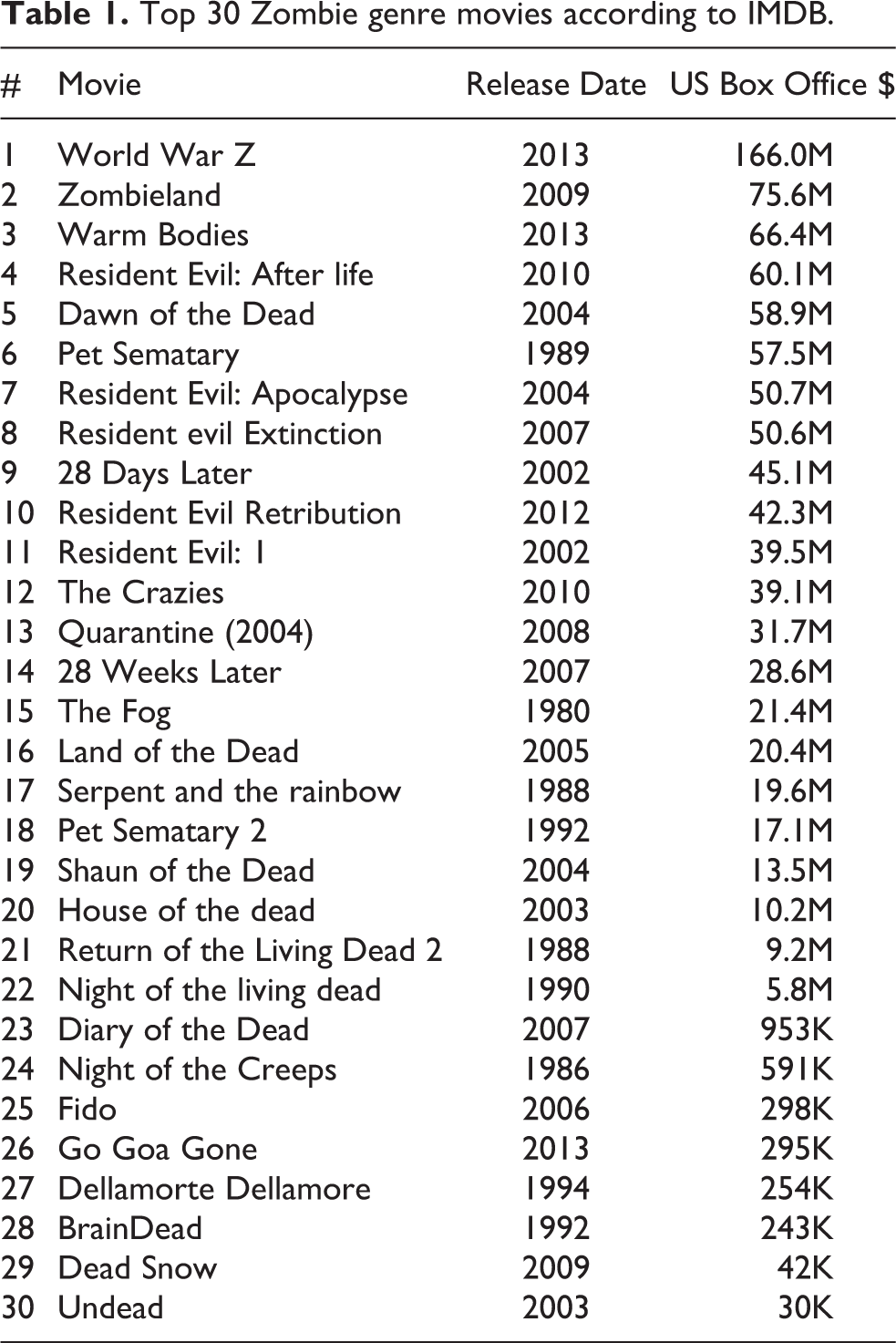
The top 30 Zombie genre movies according to IMDB 2 on the 1st July 2014 were selected according to box-office takings, see Table 1. The keyword ‘Zombies’ was used to narrow the search and obvious non-genre movies were removed from the list (e.g. An American Werewolf in Paris). Researchers were selected based on willingness to watch a large number of films containing scenes of horror and gore. They had a mixed level of expertise within the field of entrepreneurship, including: an entrepreneurship academic; a digital media academic; and two undergraduate students taking an entrepreneurship course.
Top 30 Zombie genre movies according to IMDB.
The first step in coding was for the researchers to watch five movies each and to ‘look for and recognise entrepreneurial behaviour in Zombies’. Following this, the researchers met and agreed an interpretation of observed entrepreneurial behaviours. This interpretation was underpinned by the broad representation of capitalist society that the Zombie genre affords – these are works of fiction that have been observed to reflect contemporary society (Edwards, 2010; Hällgren and Buchanan, 2020). The observed behaviours are taken as signs that signify entrepreneurship drawn from existing representations. In the next step, the researchers returned to the movies and observed further occurrences of these behaviours.
The entrepreneurial behaviours were coded and re-coded in an iterative process described by Glaser and Strauss (1968). Observed behaviours were regularly shared between the group members, and films consequently re-viewed, until saturation in the observation of Zombies engaging in entrepreneurial behaviour was reached. Some of these behaviours were common, while others were not. During the process of observing, coding and re-coding, a number of entrepreneurial behaviours were observed, see Figure 2. Once recognised, some of these were frequently recorded, such as: proactively seeking opportunity; sensing the presence of opportunity; failure to grasp the opportunity; reacting to a signal sent by others; and following others to gain resources. Other behaviours were less frequent, such as: defensiveness; leadership of others; and showing of emotion. The range of behavioural frequency indicated that many of the entrepreneurial behaviours were common-place, while others were possessed only by the few.
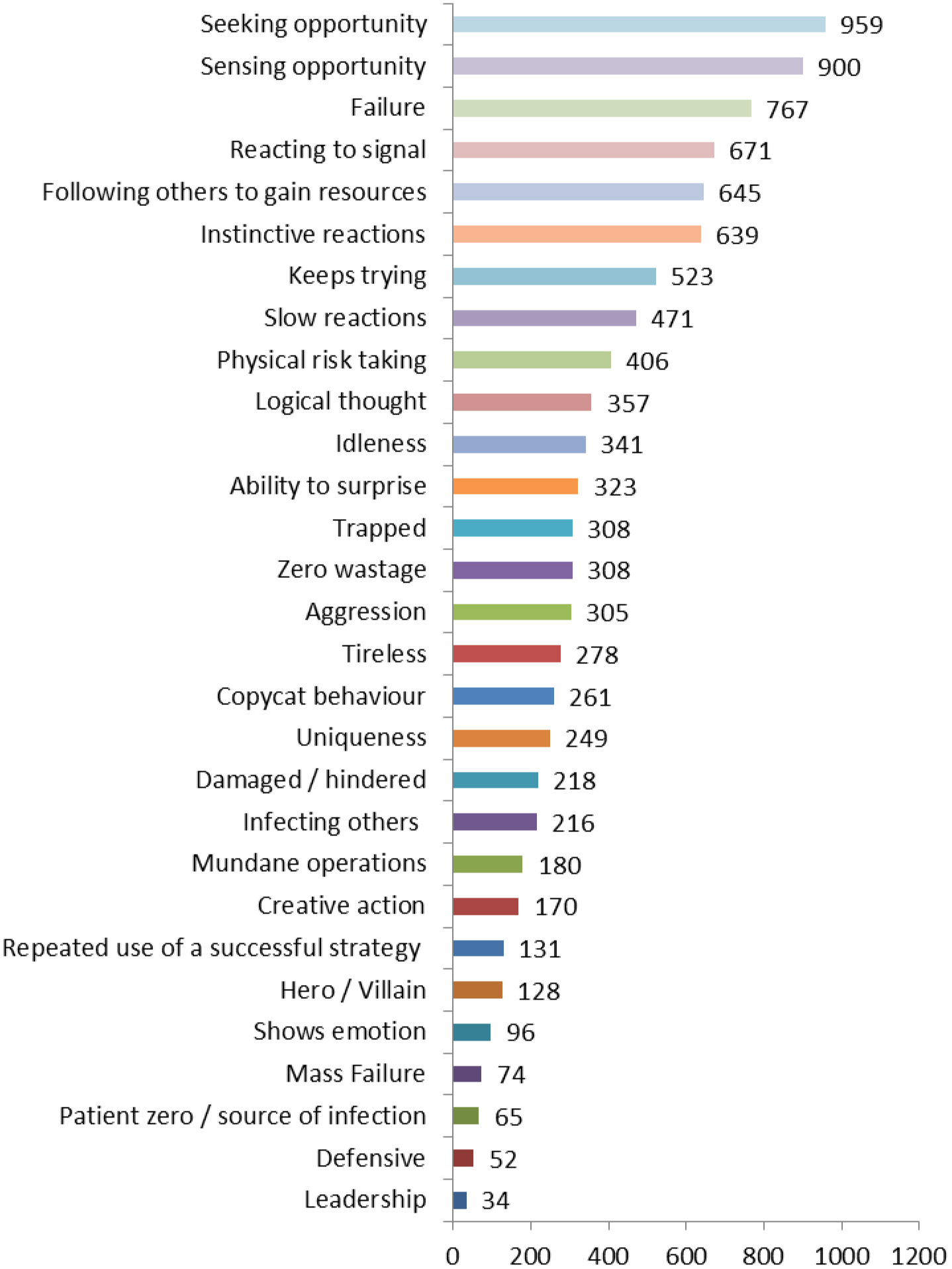
Observed frequency of entrepreneurial behaviours.
Having observed various behaviours, the next step was to interpret them. While entrepreneurship is an existing and well documented phenomenon, the process of deconstruction leads to a new outlook requiring interpretation. A grounded theory approach suggests that only after the capture of data on a phenomenon, should existing research be consulted in an attempt to provide theoretical explanation (Glasser and Strauss, 1968). The intention being to privilege the data over an existing interpretation which may introduce bias, and as such the meaning ascribed from the observed entrepreneurial behaviours in this context was deliberately left open to interpretation until post the coding phase.
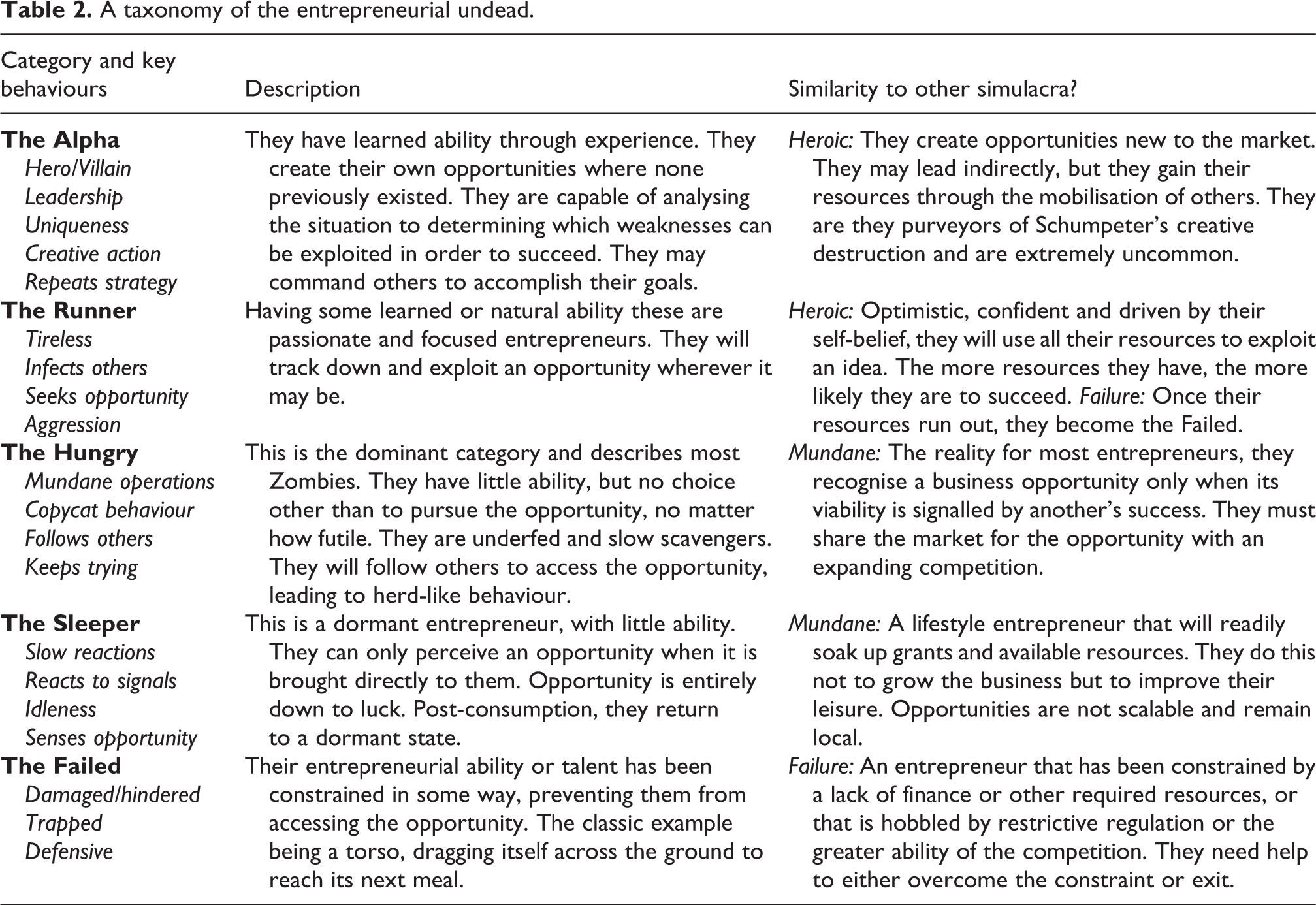
To establish this meaning within the hyper-reality a taxonomy was derived. Empirical taxonomy have been used in entrepreneurship research to classify types of entrepreneurial failure (Khelil, 2016), social enterprises (Young and Lecy, 2014), entrepreneurial farmers (McElwee, 2008) and University entrepreneurship (Rothaermel et al., 2007). Entrepreneurial behaviours clustered around particular types of Zombies were qualitatively identified (as per McElwee, 2008; Rothaermel et al., 2007; Young and Ley, 2014) and are presented in Table 2.
Results
The paper set out to deconstruct the entrepreneurial imaginary by introducing a radically alternative simulacrum. Selecting the Zombie genre as a hyper-real representation to deconstruct other representations, entrepreneurial behaviours were observed, catalogued and recorded.
Zombie hyper-reality and entrepreneurship
It is apparent that definitions of entrepreneurship that relate to commercial business creation are not directly relevant. The Zombie did not literally set up shop. 3 They did however exhibit commonly identified behaviours that tend to be ascribed to entrepreneurs: they took risks; they were autonomous; they were alert for opportunities; they continued regardless of failure; and some appeared to learn. Paradoxically, while they often belonged to a herd, Zombies also appeared as idiosyncratic individuals. The herd was a collection of individuals that pursued resources independently. They followed the opportunity, but they did not communicate directly and they did not socialise.
Despite their horrific image and motivation, for the most part Zombies were characterised by their simplistic and routine behaviour, with examples such as operating a shop counter repeatedly or manning a gas pump. Even with the focus on the deviant, the everydayness of their activity was apparent.
The Zombie approach to resource discovery and exploitation was a game of volume where the sheer number of Zombies meant that success was inevitable for a minority, based on probability, with the corollary that failure was the outcome for the majority. The ultimate result of such an entrepreneurial horde was that all available resources were consumed unless they were protected in some way.
Taxonomy of the entrepreneurial undead
The next step in the deconstruction process is to explore new ‘marks’ or concepts that could not have existed within the previous representations (Derrida, 1974 [2004]). The Zombies appeared to exhibit different levels of entrepreneurial talent. They also had differential levels of opportunity to extract value, although the currency here is flesh rather than cash. Certain individual archetypes were recognisable in the movies and we propose a Taxonomy of the Entrepreneurial Undead. Taking the observed behaviours, we matched these with common, and not so common, Zombie types from the films and then identified the archetypes with different collections of behaviours. The theorisation and exploration of existing entrepreneurial simulacra sets expectations as to the entrepreneurial profiles from the empirical analysis of Zombie movies. However, the resulting taxonomy showed a diverse range of entrepreneurial archetypes: the Alpha, the Runner, the Hungry, the Sleeper and the Failed. These are described in Table 2 and in describing them we highlight where they hold similarities to archtypes within other entrepreneurial simulacra. Thus, the Alpha and Runner could appear in the heroic simulacrum, the Hungry and Sleeper in a mundane simulacrum, and the Failed in a failed simulacrum.
A taxonomy of the entrepreneurial undead.
Discussion
Having identified a number of simulacra existing within an entrepreneurial imaginary, or system of meaning, we proposed and presented a post-human hyper-reality: the Zombiepreneur. In doing so, we followed Baudrillard’s approach (1994 [1981]), where the various orders of simulacra reflect different truths that may obscure or entirely occlude the underlying reality. This follows a critical interpretevist tradition that draws on theories from outside the field to explore the limitations of a monolithic approach to entrepreneurship (Steyaert and Landström, 2011).
The identified hyper-reality of the Zombiepreneur reveals its own truth about the entrepreneur and in doing so, a hidden reality. These truths become intermingled with other representations to form a complex entrepreneurial imaginary. The Zombiepreneurs observed in the taxonomy are inhuman individuals whose repeated and similar behaviours when observed en-mass appear as herd-like behaviour. However, their goal-oriented and focused behaviour to find and consume only appear herd-like. In this post-human simulacrum, they demonstrate how an individual is ‘silently reduced to an economic asset…represented as a bundle of resources’ (Hjorth, 2007: 718) that is starkly similar to the homo-economus (Henrich et al., 2001). This highlights another underlying hyper-reality, one that has been interpreted and enacted literally, the familiar and parsimonious economic model. Similar to the Zombie simulacrum, this economic representation of the entrepreneur uncomfortably fits a post-human representation.
In this hyper-reality, it is clear that the Zombie herd will consume all of the available resources if left unchecked. Similar to the evolutionary model of entrepreneurship (Aldrich and Martinez, 2001), there will be success for individuals that are first to the opportunity, which then signals presence to others which are inevitably drawn to the feast. The Zombie simulacrum highlights how, following the feast, there will be famine in which even the previously successful Zombie must eventually fail as all the resources are consumed.
The intermingling/implosion of simulacra creates an entrepreneurial imaginary where many meanings co-exist (Baudrillard, 1994 [1981]). While the taxonomy of entrepreneurial undead is deliberatively creative and playful, when scrutinised it collapses into types that are simultaneously recognisable yet reimagined within existing simulacra. While this hyper-real simulacrum was purposely constructed as a post-human representation where human values and social norms are not present, a number of the archetypes can be clearly identified in the existing orders shown in Table 2.
In the minority there are the Alpha and Runner – an interesting infrequency given their similarity to characters in the heroic simulacrum. While the media suggests that heroic entrepreneurs are the prevalent form, in the Zombiepreneur they are rare. The Hungry are instead the dominant form of Zombiepreneur. They are not heroic and their behaviours are repeated and mundane (Deller, 2010; Steyaert and Katz, 2004). They see the same opportunities as the rest of the herd and, while individuals with no social obligations, their commonplace behaviours result in what can be viewed as herd-like behaviour. The Sleeper illustrates behaviours observed in lifestyle entrepreneurs (Harrison, 1994), where the availability of grants and incentives does not prime them for the next stage of development, but instead allows them to take more time for leisure. They are not interested in chasing opportunities, but will willingly consume them if they appear. These are the local entrepreneurs that Sautet (2013) regards as having little benefit for society compared to the systemic entrepreneurs that will pursue the opportunity. Finally, the Failed may not realise that they are in-fact ‘dead’ (Coad, 2014). As in the failed simulacrum, they may be encouraged to continue in pursuit of an opportunity regardless of the fact that they are suffering (Shepherd, 2003, 2009) and may never succeed. They may be incapable of learning from the failure and despite a lack of talent, continue trying (Cope, 2005; Storey, 2011). They may be the literal ‘zombie businesses’ that are being artificially kept alive by banks that do not wish to write-off their loans or Governments that have put them into hibernation.
Despite purposively constructing a post-human hyper reality of entrepreneurship where human values and social norms should not exist, we find that the archetypes in the taxonomy are familiar (as illustrated in Figure 3). As demonstrated by Baudrillard, this deconstruction of simulacra can highlight how what we believe to be reality is itself a simulacrum and that other simulacra have more distance between sign and signified reality than previously thought.
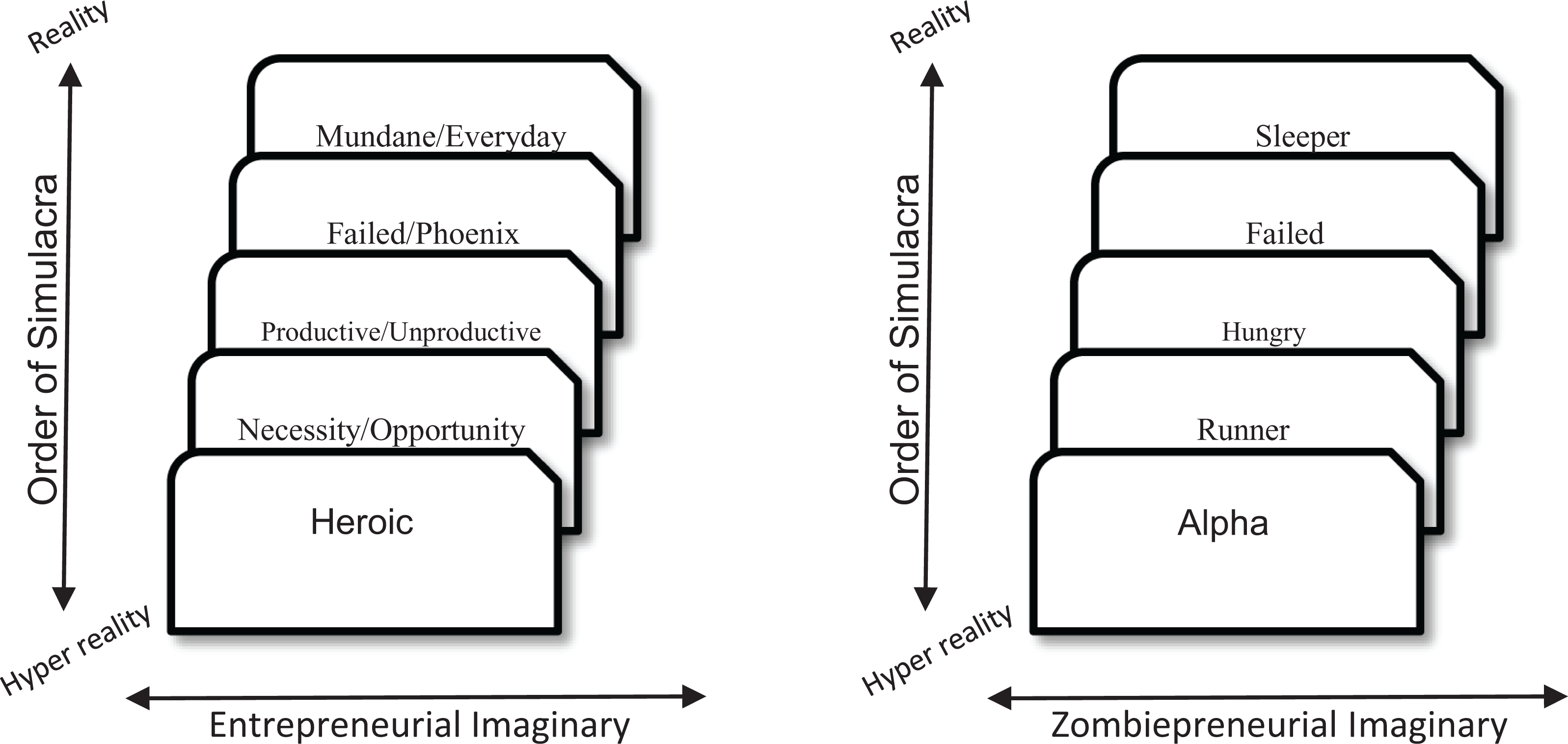
An updated precession of entrepreneurial simulacra.
Conclusion
According to Gartner (2007) the ‘narrative of entrepreneurship is the generation of hypothesis about how the world might be: how the future might look and act’ (2007: 614). This paper contributes to an entrepreneurial imaginary by offering a new epistemological way to consider current and future entrepreneurial realities. If too much entrepreneurship is not a good thing for society (Shane and Venkataraman, 2000), then the Zombiepreneur offers a dystopian vision of the future where the invasion of a horde of entrepreneurial homo-economus is taken to its natural conclusion. Following a critical tradition in entrepreneurship, this paper uses order-of-simulacra theory to problematise representations of entrepreneurship. It presents a new reality based on a post-modern and post-human reimagining, which when scrutinised deconstructs the contemporary reality of entrepreneurship.
The paper invites individuals to recognise themselves in this hyper-reality and ask whether they should accept or reject ‘construct[ing] themselves in relation to [this] discourse?’ (Jones and Spicer, 2005: 224). They may then choose to perform to a representation or actively resist it. This new way of looking at how we conceptualise entrepreneurship and associated behaviours may help individuals consider whether their internalised meaning of entrepreneurship can coexist with their values and a sustainable vision of the future.
In this paper the post-human Zombie genre is used as a methodological device to deconstruct an existing entrepreneurial system of meaning and reflect on future outcomes. Further research could explore the entrepreneurial imaginary using hyper-real representations from different genres and media that have relevance to different groups.
Footnotes
Declaration of conflicting interests
The author(s) declared no potential conflicts of interest with respect to the research, authorship, and/or publication of this article.
Funding
The author(s) received no financial support for the research, authorship, and/or publication of this article.
