




Abstract
Despite the recent proliferation of articles on entrepreneurial identity in the last decade, little consideration has been given to the semiotics and aesthetics of how such identity formation is operationalised via the adoption of artefacts of success and sartorial signifiers of such success to construct, fashion and influence such identities. Using semiotic analysis techniques this article explores the deliberate fashioning of gendered elite entrepreneurial identities in the blogs of an American entrepreneur and influencer Jana Arnold. Visual data was collected and analysed to illustrate the processes involved. The findings indicate that the possession of branded clothing and artefacts, combined with their physical appearance can lead to the formation of a distinctive ‘aesthetic capital’ which confers a visual legitimacy which can be commodified as a commercialised identity. The findings also suggest that the juxtaposition of selective dress, props and settings combine to create a form of branded, elitist expressiveness conveyed via the presentation of designer fashion, branded artefacts and high value marques and products. Collectively these can coalesce to form an authenticated entrepreneurial identity for those entrepreneurs who can afford to buy and maintain the monetised identity.
Introduction
Entrepreneurial identity [EI] is a topical research stream in contemporary entrepreneurship research circles, particularly in relation to the performance of identity (see Jones et al., 2019; Kašperová et al., 2018; Lewis, 2004; Manning et al., 2019; Pitt, 2004; Warren, 2004 , 2005). This study relates to a specific sub-set of EI, namely that associated by the super-rich, ‘Entrepreneurial Elite’ (see also Heizmann and Liu, 2020; Kantola and Kuusela, 2018; Nadin et al., 2020) in a UK/US context. Nevertheless, entrepreneurial identities are diverse and specific identity constructs are only relevant to their entrepreneurial sub-set. Also, at one level, EI is a type of social identity (Kašperová et al., 2008) and at another, it is a moral identity as argued by Kantola and Kuusela (2018). Yet, despite a burgeoning literature on the topic, there are still many unchartered research avenues in relation to EI worthy of further research (Jones et al., 2019). Indeed, aesthetic, artefactual and sartorial elements of EI (Clarke, 2011; Smith, 2005, 2015; Smith and Anderson, 2003) is one such area worthy of further elaboration. Indeed, the aesthetic element of EI is under-appreciated (Elias et al., 2018). Aesthetics relate to a set of principles concerned with the nature and appreciation of beauty and is a branch of philosophy dealing with questions of ‘beauty’ and ‘artistic taste’. An ‘aesthetic’ relates to a particular subject/genre and is a socially constructed visual quality and Elias et al., refer to artefacts possessing an ‘aesthetic value’. For Berglund and Glaser (2021), artefacts of entrepreneurial practice can be sub-categorised as being abstract, material and narrative bases. In entrepreneurship research an overarching concern relates to the dominant discourse of malestream entrepreneurship (Ahl, 2006) and its portrayal as a performed hegemonic masculinity (Connell and Messerschmidt, 2005) evident in academic and media representations of the entrepreneur (Hamilton, 2013), consistent with Berglund and Glaser’s narrative artefacts. These include semiotic representations (Smith and Anderson, 2007) thereof, including fashion, artefacts and the sartorial – which are consistent with Berglund and Glaser’s material artefacts. Artefacts (and clothing) are aesthetic objects ‘…made by a human being, typically one of cultural or historical interest’ and the word ‘sartorial’ is that ‘relating to tailoring, clothes, or style of dress’. However, the concepts of the ‘sartorial’ and ‘artefactual’ span the ‘social’ and ‘personal’ categories of EI as suggested by Kašperová et al. (2008). Clothing and artefacts permit a shared aesthetic to be broadcast and read as outward ‘signifiers of success’.
It is also of note that the related subjects of corporate and entrepreneur dress-codes/imagery and modes of dress are under researched (see Guthey and Jackson, 2007; Popp and French, 2010). Guthey and Jackson posited the notion of ‘authentic’ CEO identity as constructed sartorially in the photographic portraits of celebrity Danish CEOs and Popp and French, examined the sartorial construction of the travelling salesmen as a genre. The possession of certain cultural artefacts displayed in proximity to accepted corporate and/or entrepreneur(ial) dress-code can be used to present nuanced and very different and masculinised, corporeal entrepreneurial identities (see Collier, 1998; Rubinstein, 2018). Artefacts associated with EI include expensive watches; gold jewellery; sovereign rings; cigars; possessions such as the (admittedly dated) filo-fax; and the latest mobile phone or communicational technology; and of course, cars – particularly marquees act as signifiers of a particular EI. At the extreme end of the EI spectrum the possession of a ‘boy-toys’ such as speed boats, yachts, helicopter, or personal airplane complete the socially constructed entrepreneurial persona (Smith, 2006).
This study is based upon a semiotic analysis of the website http://www.entrepreneurdex.com and in particular blog posts authored by American serial-entrepreneur Jana Arnold in which she explored and presented a particularly hegemonic and masculine, elitist EI. In her blogs, Arnold, posited several discursively constructed categories – ‘Entrepreneur-fashion’, the ‘Haute-preneur’, the ‘Man-preneur’ and the ‘Diva-preneur’ based on their consumption of expensive artefacts and fashion brands. This study also builds upon the work of Clarke (2011) who reopened the debate into EI and the role of cultural artefacts in fashioning it, arguing that entrepreneurs use symbolic means, as in language and semiotics, to signal to resource providers that their venture is feasible and legitimate. This can arguably be extended to include other audiences and visual symbols of fashion such as clothing and artefacts. For Clarke, entrepreneurs use visual symbols to: (1) present an appropriate scene to stakeholders; (2) create professional identity and to emphasise control; and (3) regulate emotions. Clarke listed types of visual symbols used by the entrepreneurs as being – setting, props, dress, and expressiveness. This is of vital importance for this study because it deals with exactly the semiotic elements examined in this study and also because fashion, clothing and gendered dress-codes are an integral part of entrepreneurial identities and personas built up layer-by-layer using a mixture of socially constructed individual and collective elements. 1 Such elements are constructed using physiological aspects such as personal grooming styles – from hairstyles to tattoos. In addition, EI can be crafted sartorially (Ugolini, 2007), using selected branded items of clothing and fashion accessories such as suits (Kuchta, 2002; Petrov, 2018) and other items of branded clothing. Culturally specific entrepreneur dress-codes are very much driven by fashion trends and can be related to particular era, or industry. There is an obvious research gap in the literature in relation to the aesthetic, embodied dimensions of EI (Kelan, 2013; Warhurst and Nickson, 2020). It is this gap which this research seeks to address. The purpose of this study is therefore to explore artefactual and sartorial elements of one particular set of gendered entrepreneurial identities and determine how these elements contribute, figuratively and literally to ‘the fashioning’ of an ‘elite EI’ and to illustrate how such identities are discursively and semiotically authored. The key elements studied in this article are those of ‘artefacts’, ‘clothing’ and ‘fashion’ associated with capitalist success. The study therefore seeks to challenge androcentric notions of entrepreneurship through an analysis of the aesthetic lens of the viewpoint of a leading female entrepreneur. This positions the study theoretically between the theories of entrepreneurship, and gender, and in particular Raewyn Connell’s theory of ‘hegemonic masculinity’ (Connell, 1995) and ‘structuralized ritualization theory’ (Knottnerus, 2006) in that the symbolic performance of ‘fashion’ as a ‘ritualisation play’ serves to form, reproduce and transform social structures of groups embedded within an elite strata of enterprise culture.
The following sections present salient literature on EI and its visual aspects; introduce the semiotic methodology and present and discuss the material in the blogs in relation to the discursively constructed categories of ‘Entrepreneur Fashion’, the ‘Haute-preneur’, the ‘Man-preneur’ and the term ‘Diva-preneurs’. This is followed by short discussion and conclusion sections articulating the importance of the study. The research question to be answered is – how does fashion and its sartorial and artefactual elements influence perceptions of an
A literature review of entrepreneurial identity and its visual aspects
The topic of entrepreneurial identity [EI] has been a perennial area of interest in this journal (see Jones et al., 2019; Kašperová et al., 2018; Lewis, 2004; Manning et al., 2019; Pitt, 2004; Warren, 2004 , 2005). To date, the main thrust of the research on EI has been on the theoretical, ideological and gendered elements of the phenomenon. In this review, gender elements are not the main focus albeit they do feature. As a sociological concept, and from a theoretical standpoint, identity studies per-se have reached a state of maturity but the concept of EI, despite a burgeoning literature on the topic is still in its relative infancy. As indicated, in the introduction there is a gap in the literature relating to its semiotic and aesthetic elements.
Two elements are of importance in relation to this study, namely (1) The academic literature on EI, aesthetics and the growing literature on fashion and sartorialism which has expanded rapidly in the last decade; and (2) media representations of the entrepreneur as portrayed in popular culture and broadcast in film and television. The academic literatures on EI, fashion and sartorialism are easily accessed and cited but citing media images is more problematic because of copyright issues. For the purpose of this study the definition of EI is used to refer to ‘…a person’s set of meanings, including attitudes and beliefs, attributes, and subjective evaluations of behavior, that define him or herself in an entrepreneurial role’ (Hoang and Gimeno, 2005). However, we expand the subjective evaluations to include artefacts and clothing, image and imagery associated with such identity which entails consideration of semiotics and symbolism. We seek to contribute to the literature base on EI and begin with an analysis of the literature around the aesthetics and gendered performance of the entrepreneur.
Part 1 – The academic literature on entrepreneurial identity, aesthetics and media representations: At present studies into the gendered media representations of entrepreneurs which impact on the reality of entrepreneurship have been restricted to female entrepreneurs (Eikhof et al., 2013; Lyer, 2009; Nadin et al., 2020; Smith, 2014; Smith et al., 2019). Such studies are predicated upon in-depth qualitative analysis of media platforms reporting on how they present and portray female entrepreneurs. The concensus is still that such platforms that focus on traditionally female activities and pursuits and as domestically centred thus disadvantaging women. Indeed, Bacq et al. (2016) talk of an idealistic and biased, moral portrayal of the entrepreneur in the extant literature and in the media.
Conversely, there are less studies of media representations of male entrepreneurs or of semiotic aspects of EI although exceptions include Smith (2003); Smith and Anderson (2003); Down (2006); Smith (2009); Bill et al. (2010); Clarke (2011); Kendall (2011), Eikhof et al. (2013); Smith (2015); and Bartlett (2016). This growing interest in the visual and semiotic aspects of EI and media representations of such identity has gained pace over the past two decades. Of particular interest here are the studies of Smith, relating to the portrayal of ‘bad-boy iconology’ and the entrepreneur as a ‘non-conformist’ (Smith, 2003; Smith and Anderson, 2003) which identified a predominance of masculine orientated images but infused with working class and criminal identifiers. Accordingly, EI as presented then in the media was predominantly masculine and entrepreneurs were warned that displaying such an identity was to be avoided as a fashion gaffe if one had professional and social ambition (Smith, 2006). There was a sartorial element to such identity construction and the study of Smith and Anderson (2003) synthesised the early literature on the social construction of masculine entrepreneurial stereotypes as a paradoxical form of ‘non-conforming conformity’. Similarly, Kendall (2011) in discussing suitable ‘frames’ for gendered stereotypes of the rich and wealthy used the metaphors of ‘fragile’ and ‘gilded’ to highlight the visible polarities between the classes.
According to Bill et al. (2010) the heroic entrepreneur emphasises the spectacular and the spectacle and flamboyance of entrepreneurship. They discuss the case of Danish entrepreneur Stein Bagger and describe how he was invariably portrayed and depicted sartorially as heroic with his gold Rolex watch, crisp white shirt, tie and cufflinks driving a Porsche or Audi marque. Bagger is depicted on the public stage after winning awards for his entrepreneurial prowess as a manifestation of the entrepreneurial tale replete with the big cheque, the women and an audience of journalists and men in suits. This is relevant in relation to the promotion of hero imagery in entrepreneurship discourse (Smith, 2006). Similarly, Smith (2015) investigated fashion related phenomenon in representations of female entrepreneurship in the media which had a thread of semiotics and fashion running through it.
Also, of note is the burgeoning literature on fashion and sartorialism which documents the cultural importance of dress (Barry and Weiner, 2019; Bartlett, 2016; Edwards, 1997, 2011; Kaiser, 2012; Kuchta, 2002; Petrov, 2018). For Edwards (2011) ‘the suit is…the very essence of men’s fashion and, indeed, of masculinity’ (2011: 53). Edwards opines that researchers on gender and masculinity have so far ignored clothing in their work, albeit dress is one of the most immediate ways in which people read and express gendered identity (Kaiser, 2012, in Edwards, 2011). Moreover, for example, Barry and Weiner (2019) makes reference to the ‘sartorial biographies’ of men as a form of embodied identity and in particular highlights the ubiqitous suit as a powerful fashion icon and indicative of representations of hegemonic masculinity (Connell and Messerschmidt, 2005). Petrov (2018) talks of the semiotics of the suit and of suits as sartorial statements. For Barry and Weiner, the suit embodies hegemonic masculine configurations of practice-power, status, and rationality – most of these men were simultaneously marginalised by the gender hierarchy. Moreover, Barry and Weiner appreciated that fashion is shaped by not only the clothes but by men’s intersectional identities on their relationship with their suits, influenced by their varied subject positions, body shape, ethnicity, age, and the gender identity they identify with. Also, of relevance here is the notions of ‘conspicuous consumption’ (ala Veblen, 2009) and the possession of ‘authentic entrepreneurial identity’ (Guthey and Jackson, 2007). In relation to the notion of conspicuous consumption, artefacts and clothing allow one to broadcast economic success and to engage in ‘bragging rights’ and ‘hierarchical positioning’ as articulated by Rehn and Sköld (2003).
It can therefore be argued that EI is constructed as a performed male dominated paradigm (Down and Warren, 2008; Giazitzoglu and Down, 2015) via artefacts, objects and possessions which are associated with masculine imagery and enactments relating to success (Smith et al., 2019). Kelan (2013) argues that ontologically, female leaders learn to ‘become’ through copying and repeating (mimesis) what they see in media images which are dominated by men and masculine imagery and the appropriateness of professional dress-codes. Also relevant for this study is the work of Warhurst and Nickson (2020) who refer to ‘Aesthetic labour’ by which they mean the embodied qualities (including attractiveness, physiognomy and fashion) people project to gain advantage in the workplace. Thus, ‘looking the part’ is a very important element in the projection of success. Media images of organising are also of interest to scholars of organisation – See Dourish and Mazmanian (2011) who were interested in ‘matter’, ‘objects’, ‘artifacts’, and ‘materiality’. In particular, there has been an increasing focus on fashion (Edwards, 2011) as well as ethics and the embodiment of images of corporate power and politics and in particular the misuse of power (Gatens, 1996; Gilleard and Higgs, 2014; Knottnernus et al., 2006). Knottnernus et al. (2006) were concerned with the rituals that are an important part of corporate culture, but in particular those rituals involving deviance. Employing multiple media sources, and structural ritualisation theory they highlighted symbolic themes expressed through daily work rituals at Enron’s corporate headquarters. The themes they identified involve risk, gratification, pride, and fantasy imagery and these themes extensively influenced Enron employees to behave unethically by shaping their cognitions, patterns of behaviour, and social interaction leading to the normalisation and reproduction of deviance. Heine (2010) suggests that increasingly, consumers engage in a form of ‘symbolic consumption’ and choose a product for its congruity between their personality and the symbolic personality of the product or brand. Designer brands conspicuously display qualities associated with eccentricity, elitism, opulence, ostentation and strength.
Thus, imagery associated with EI has traditionally been dominated by masculine imagery with the stereotypical entrepreneur being male, middle aged, suited but casually dressed in an ‘open necked shirt’ (see Smith and Anderson, 2003). From a theoretical perspective, a theme of gendered non-conformism is self-evident. Few images of female entrepreneurs were encountered which marginalises female EI. Nuanced categories of masculine EI were discernable, namely – the working-class entrepreneur; the gangster entrepreneur; the middle-class and professional entrepreneur; and playboy/tycoon types. Each of these categories constructed an entrepreneurial persona differently using socially constructed dress-codes and artefacts available to them in their personal circumstances. Conversely, Duff (2011) in a study of gendered photographic images in the annual reports of the big four Accountancy firms in the UK established that in relation to women they were under-represented and where they were, they were subjected to stereotypical representations such as images of ‘high heeled shoes’. This demonstrates an obvious disparity.
Part 2 – The entrepreneur as portrayed in the media and popular culture: This section conducts an analysis of the literature around the aesthetics and gendered performance of the entrepreneur, drawing on a number of fictional representations of entrepreneurship and businessmen. Boyle and Kelly (2012) refer to a range of discourses and representations produced by television and suggests that these are ideologically mediated ‘entretainment’. Representations of the entrepreneur in popular culture, novels and in the movies are of interest here because they are socially constructed representations, we become familiar with. Three excellent exemplars are Ben Whittaker, Gordon Gekko and Don Draper. For example, Bartlett (2016) examined the construction of an elite EI through the examination of artefacts associated with the (retro) masculine EI as portrayed in Nancy Meyers’s 2015 film The Intern. 2 The focus of Bartlett’s study was upon a particular kind of masculinity celebrated through the material accoutrements of Ben Whittaker (played by Robert De Niro). Indeed, Bartlett was fascinated with how masculinity is ‘materialised’ and ‘embodied’ as a set of values and objects. She focused on three particular emblematic objects or artefacts – namely the business suit, the briefcase, and the handkerchief as being indicative of masculine business values. Bartlett notes that we fetishise and commodify certain items of clothing and present these as a ‘sartorial style’ (See also Nadin et al., 2020 for a discussion on the fetishisation of an EI). Ben, a senior citizen, habitually wears his suit to work – described as being of solid outline, tailored and dark-coloured. This signifies a professional body that is separate, autonomous and impervious to the outside world. The suit creates an illusion of rational controlled masculinity (Longhurst, 2001). Ben habitually carried his briefcase, a 1973 Executive Ashburn Attaché signifying executive status and a ‘macho mystique’ of concealed technology (Atkinson, 2005: 192). His briefcase was an important part of executive masculinity and contained his newspaper, glasses case, set of pens, calculator, fliptop phone, and travel clock. Conversely, Ben’s contemporaries have ‘…canvas messenger bags complete with smartphone, charger, USB drive, multi-cable connector’. His briefcase resonates with the pre-digital age. Ben also carried a handkerchief concealed inside his suit rather than flamboyantly worn on the outside pocket, in a neatly ironed square functioning as a material marker of the ‘chivalrous gent’. In building up the visual materiality, Bartlett makes constant reference to the clothing and artefacts worn by Ben and this is the basis of how Arnold builds up her word picture of her elite entrepreneurial identities. See Figure 1 for a representation of the iconic Ben Whittaker.

The iconic Ben Whittaker (image – from Alamy Stock Photo).
This cinematic sartorial portrayal of entrepreneurs is not unusual. For example, the actor Michael Douglas who portrayed the fictional entrepreneur Gordon Gekko in the 1987 movie Wall Street, with its capitalist mantra of ‘Greed is Good’ became a fashion icon overnight. His elegant, sartorial style was copied by wannabe entrepreneurs and gangsters alike. In particular, his iconic braces became a sartorial meme representing entrepreneurial excess and success. Gekko’s iconic performance as a corporate psychopath and his screen presence became known as the ‘Gordon Gekko effect’ (Lo, 2015). Indeed, Gekko is a mythic representation of a recurrent and rapacious, American entrepreneurial archetype (McGoun, 2010). See Figure 2 for a representation of Gekko and his sartorial style depicting his braces, tie, cigar and other sartorial accessories.
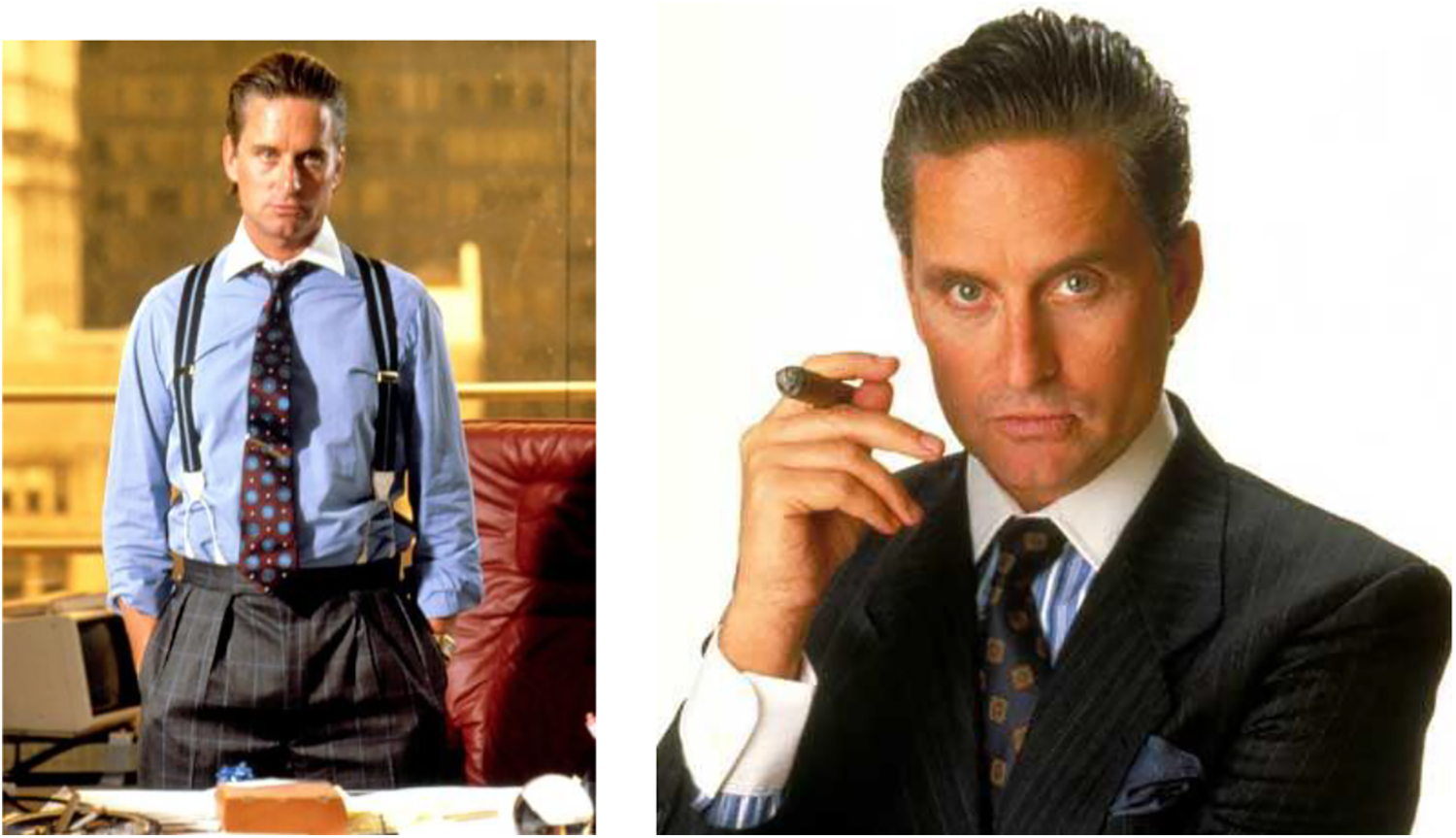
The iconic Gordon Gekko (images – from Alamy Stock Photo).
The television series ‘Madmen’ and the iconic Don Draper is of interest here. Indeed, Şerbănescu (2016) makes reference to the mimetic nature of the culturally mimetic imagery associated with the tv series ‘Mad Men’ and its transmediality and recyclability. In the series the characters are depicted sartorially via stereotypically gendered clothing and artefacts which characterised the era. See Figure 3 for a representation of the Draper.

The iconic Don Draper (image – from Alamy Stock Photo).
Entrepreneurial identity constructed as a performed male dominated paradigm (Down and Warren, 2008; Giazitzoglu and Down, 2015) via artefacts, objects and possessions which are associated with masculine imagery and enactments relating to success (Smith et al., 2019) is obviously mirrored in popular culture in novels of capitalist, corporate culture where masculine EI is commodified and fetishised and female identity and values are constructed in relation to masculine norms and desires. For example, in the novels ‘American Psycho’ (Ellis, 1991), ‘Easy Money’ (Reed, 2006) and ‘City Boy’ (Anderson, 2008) masculine EI is discursively portrayed by the authors via possession of designer clothing; bad-boy-values, behaviours and imagery (Smith et al., 2019), reminiscent of entrepreneurship as a form of hyper-masculinity, or hegemonic masculinity (Connell and Messerschmidt, 2005). In this respect, fashion becomes a fetishised commodity (Billig, 1999). In American Psycho, Easy Money, and City Boy a large part of the text is given over to rich descriptions of the clothing and artefacts associated with the EI of the main and supporting characters. Again, this is how Arnold builds her social construct of the elite entrepreneur. It is worth noting that while examples such as Don Draper, Gordon Gekko and Ben Whittaker may not be entrepreneur’s they possess the character of a businessman, albeit there are distinct differences in the representations of business leaders and entrepreneurs. Nevertheless, despite the existence of the academic and popular literature presented and discussed above the topic remains under researched and under theorised.
Methodological framework and presentation of fashioned imagery
For the purpose of this research an external desk-based approach was adopted (see Kozinets, 2009 and Desk Research – Methodology and Techniques (managementstudyguide.com)) because it was considered to be the most expedient method and as an entity the fashion/aesthetic element of entrepreneurship is best visualised in the media and online. 3 Desk research is a form of documentary research methodology (Scott, 2014) which entails collecting data from existing resources via the internet. This case was chosen by the author because he was already aware of it and had downloaded data on it. The material was then subjected to an intuitive semiotic analysis and submitted to a ‘Close Reading’ (Amernic and Craig, 2006) to identify aesthetic and semiotic elements in the text. Material was selected based on its relevance to portraying an elite EI. It is necessary to consider the research context in part 1 before considering the research design in part 2 below.
Part 1 – The research context
The company Entrepreneurdex is a ‘tech’ company founded by serial entrepreneurs Damir Perge and Jana Arnold. In these posts, positing images of masculine EI Arnold coined and mooted the notions of ‘Entrepreneur Fashion’, the ‘Haute-preneur’, the ‘Man-preneur’ and for female entrepreneurs the term ‘Diva-preneurs’. The website is still in existence. 4 The target audience of the website and in particular the blogs are the wealthy, super-rich, elite entrepreneurs and corporate CEOs who are either customers or associates of the company and are drawn from the tech industry. Within this elite circle it is relatively influential in that in fraternising with and participating in the blog and being on the email list obviously grants one access to the company founders including Arnold. As an influencer and blogger, it can be assumed that the perceived purpose of the fashion blogging conducted by Arnold was to create a community of interest around the concept of entrepreneur fashion and generate interest and participation in her blogsite, attract likes and to establish a personal brand (Cameron-Kitchen, 2017; Duffy and Hund, 2015). According to Duffy and Hund (2015) such a personal brand augments the bloggers ‘entrepreneurial femininity’ and draws upon post-feminist sensibilities and the contemporary logic of self-branding. It is an ideal case to study for the purposes of this research because the blog specifically related to what Arnold referred to as entrepreneur fashion. Arnold’s use of the term ‘man-preneur’ was coined as a fashion statement and she is also a fashion consultant, blogger and social influencer and that her name is a recognisable brand in its own right.
In 2011, when this author first encountered the Entrepreneur fashion blogs curated by Arnold it was apparent that she was flouting the existing advisory corporate dress-code by capitalising upon the triadic concepts of fashion conscious ‘Haute-entrepreneurs’, and the gendered concepts of the ‘Man-preneur’ and the ‘Diva-preneur’. Arnold used this gender specific terminology of the to refer to successful, high-net worth female entrepreneurs. Effectively, Arnold coined the term ‘Diva-preneur’ as a fashion statement. 5 The purpose of the blog page was to highlight what she referred to as ‘Entrepreneur Fashion’. According to Arnold this new concept in fashion spanned the old entrepreneurial divide by the marketing of luxury clothes and fashion accessories to high-net worth male and female entrepreneurs. The material analysed presents an insight into contemporary entrepreneur dress-codes to inform future research into the gendered nature of entrepreneurial identity.
Part 2 – The research design
The author downloaded the text and images from the blogs on Entrepreneurdex.com website, printed them and conducted a visual, ‘blog analysis’ using netnographic techniques (Kozinets, 2009) to conduct a semiotic analysis (Chandler, 2017). Kozinets discusses 12 stages to netnography – (1) Introspection, (2) investigation, (3) informational, (4) ethical, (5) inspection, (6) interaction, (7) immersion, (8) indexing, (9) instantiation, (10) interpretation, (11) iteration and (12) integration. Netnography emphasises the cultural contextualising of online data based on the observation of textual discourse and because it is amenable to treating behaviour or the social act as the unit of analysis, rather than the individual person, it is perfect for unearthing symbolic value. Already being aware of the Arnold material this author was able to start at the inspection, interaction and immersion stages, constantly reading, making notes and immersing himself in the data. The netnographic element of analysing comments fitted well with the close reading techniques of Amernic and Craig (2006) allowing the material to be indexed, compared and analytically interpreted. The author colour coded the aesthetic and semiotic elements contained in the text and images using coloured highlighters and then subjected them to codes borrowed from the framework of Clarke (2011) – dress, props, settings and expressiveness with gender being the additional variable. To retain the power of original narrative selected phrases are represented in the analysis. The visual images were analysed intuitively by the author as suggested by Chandler, based on his theoretical understanding of what constituted a gendered EI. The key coding criteria were (1) By gender – whether male or female; (2) By clothing type; (3) and by artefact. In this manner particular themes emerged from the data which underwent several iterations until saturation point was reached and the material integrated into its present(ed) form. Clarke’s framework helped make sense of the text, imagery and visual symbolism and in particular how the latter present an appropriate scene to stakeholders and audiences; how they individually and collectively create a professional, elite-identity which emphasises control; and regulates emotions. To avoid reproducing the images emphasis was placed on the textual material accompanying the images. 6
Findings
Presenting and visualising the data
The blogs authored by Arnold were written in the richly descriptive style associated with fashion journalism and the glossy images were in colour as is expected of advertising campaigns from luxury brands. Therefore, in the blogs the text was written ‘creatively’ to market the products featured and as such contained a trove of rich-thickly descriptive, values laden rhetorical descriptions and associated tropes. From an analysis of the images and text downloaded it was apparent that the images presented and performed in the blogs were gendered by male and female subjects and were discursively and semiotically constructed using value laden words and imagery. It is also important to stress that because of the fact that the richly descriptive text penned by Arnold is in itself a form of analytic prose and that this is reproduced in the authors textual analysis that it may give the false impression that readers are being left to conduct their own analysis. This is not the case because if one strips the prosaic description from the text one is left with individual words and expressions which do not collectively build up the power of the imagery. We first consider the masculine imagery before turning to the feminine.
It is of interest that the masculine terminology/nomenclature ‘Man-preneur’ posited by Arnold is used in conjunction with the similar but agendered term ‘the haute-preneur’ which is used to refer to both masculine and feminine entrepreneurs and assumes a knowledge and use of high-fashion. The two terms are used in conjunction with one another. In her blogs Arnold provided a running commentary linking the text to the imagery via bold captions which in one sense was narrated as a typical fashion commentary and in another as a sales-pitch.
Dress-codes and props associated with the Man-preneur.
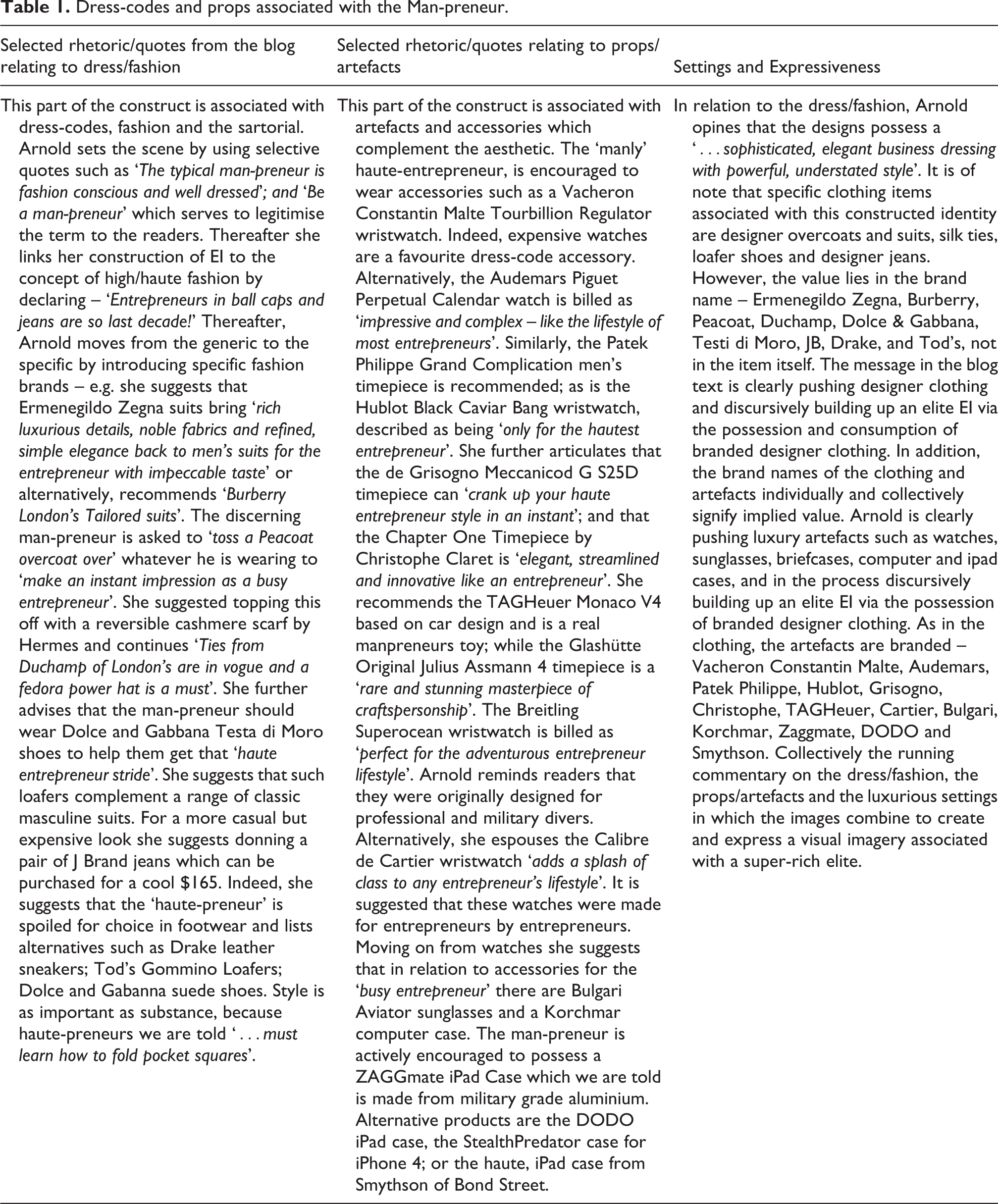
Together the dress-code (clothing) and props (artefacts) taken in conjunction with the settings combine to express an elite, masculine identity. In the case of the ‘Man-preneur’, they relate to the aesthetics of ‘Masculinity’ and ‘Machismo’ (Mulholland, 2003). It is however, of note that the sartorial and artefactual elements discussed in Table 1 above are examples of Kendall’s (2011) gendered stereotypical framework and are adopted by the rich and powerful to highlight their ability to consume conspicuously while conforming to masculine sartorial convention (Barry and Weiner, 2019); and to the accepted tenets of heroic entrepreneurial masculinity both of which act to accentuate their hegemonic ‘macho’ identity.
Dress-codes and props associated with the Diva-preneur.
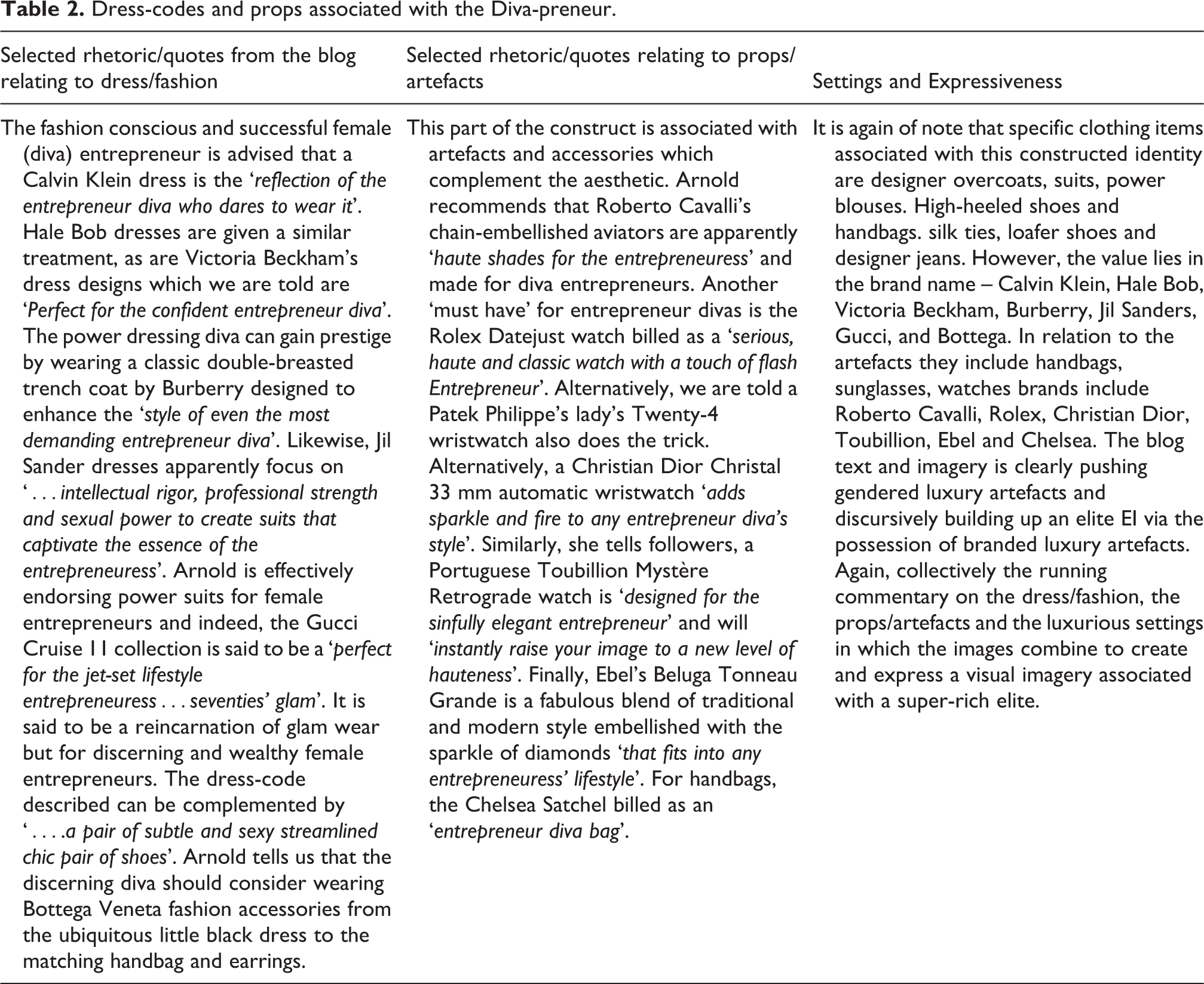
The expensive clothing and artefacts when listed textually read descriptively, but when encountered visually in their layered-gendered combinations depict a seamless picture of elite wealth and power. In this case, it is not the hegemony of heroic masculinity, which is emphasised, but images associated with accentuated and ‘perfected’ femininity, albeit from a masculine perspective – see discussion below to appreciate how the same artefacts portray a different form of gendered hegemonic power.
An analysis and discussion of the blog posts
Semiotically, aesthetically and communicationally, the pitch made by Arnold in the fashion blogs is very powerful because it is made from the position of her being a very successful joint founder, entrepreneur and CEO of an established company. She has established several other successful businesses; is a video/film producer and also because she is a respected journalist and social media influencer. She has pan industry connections as a successful marketer. Her pedigree adds credibility and legitimacy to her posts. 7 Collectively, the combination of the designer clothing and the branded artefacts presented for consumption creates a visually powerful masculinised identity albeit the emphasis on the ‘evocative’ use of the terms ‘man-preneur’ and ‘haute-preneur’ are obviously Arnold’s, not the manufacturers of the designer clothing and luxury branded artefacts. The analysis revealed that the constructs articulated by Arnold are typical embodiments of both masculine and feminine aesthetics. However, in using her voice of influence, she discursively constructs masculinity and femininity differently. For men she emphasises craftsmanship, masculinity, strength and impression management, but for the feminine it is invoked by the use of words such as chic, elegant, fabulous, flashy, sparkly, sexy subtle and sinful. For men the focus is inevitably on ‘boy’s toys’ and ‘military imagery’, but for the women the emphasis is stereotypically items of clothing such as on power suits, the ubiqitous little black dress and on shoes. It is self-evident that the gendered entrepreneurial identities are discursively produced using a mixture of visual cues and emotive language.
Using Clarke’s (2011) typology the clothing is identifiable as dress-code, while the artefacts are identifiable as identity props. As discussed above, the narrative accompanying the images, irrespective of gender is a value laden one ascribing entrepreneurial success via an allusion to risk-taking and entrepreneurial values as in ‘…dare to wear’ or ‘sexy’. The text also links the images to entrepreneurial traits and behaviours while also alluding to settings – for example Bond Street, and reference to the jet-set and 70’s glam rock. See Table 3 below for details of the value laden language used to describe the entrepreneur fashion items featured:
Gendered identity signifiers.
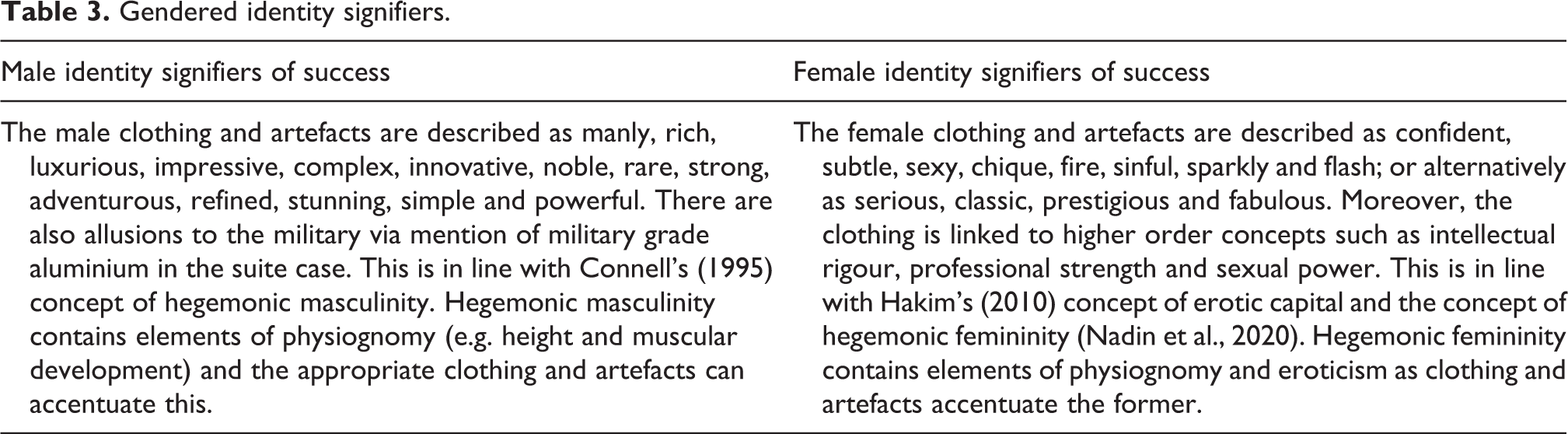
However, negative underlying recurring themes emerged, included those of vanity and exclusivity. The models who wore and presented the imagery were invariably lithe, handsome young men and visibly beautiful women in their 20s and early 30s at the prime of their life and health. They were often presented in leisure settings juxtaposed against images of marque cars, yachts, jets or in rooms adorned by luxury furnishings thereby consolidating and perpetuating the elitist entrepreneurial dream. Although the women were apparently treated equally the images contained shots where they were presented as accompanying the men and thus potentially objectified. In other blogs where top of the range marque cars were/are advertised, the shots contained eroticised images of bikini clad, nubile women draped over, or near to the cars. The adoption of such elitist brands straight from advertising images acts as a mirror of masculinity (Schroeder and Zwick, 2004). 8 It is also evident that in her blog Arnold presents or argues for a social construction of an elite entrepreneur as envisaged by her. However, there is such thing as a unified, homogenous entrepreneurial construct, let alone an EI. For example, Alan Sugar’s aesthetic is rather different to Steve Jobs’ or Karen Bready, albeit there are commonalities across their aesthetics.
Three main findings emerge from the analysis relating to (1) the formation of a distinctive aesthetic capital; its role in conferring visual legitimacy; and the commodification of entrepreneurial identity:
To return to Clarke’s framework (Clarke, 2011) the advertised clothing and artefacts are legitimate visual symbols of financial success and therefore would present an appropriate scene to stakeholders while also manufacturing a professional identity which would place the entrepreneurs in control of their environment. Moreover, the luxurious settings in which the clothing and artefacts are depicted act as legitimating settings and props of entrepreneurial success by consuming clothing associated with such success. Collectively the categories expressing authenticity. It is worthy of mention that none of the images were of real entrepreneurs, of either sex and the clothing and artefacts represented were from ‘in trade’ advertising material. Nevertheless, it created a crafted, visual and memorable elite EI as an embodied, fashioned social identity (Entwhistle, 2014) albeit arguably a fetishised, idealised EI (Smith et al., 2019) suggesting that entrepreneurial success could be fashioned via consuming and adorning the advertised products. Moreover, the findings suggest that the selective juxtaposition of appropriate dress, props and settings can be creatively combined to affect a form of branded, elitist expressiveness conveyed via the presentation of designer fashion, branded artefacts and high value marques and products. Collectively these can coalesce to form an authenticated EI for those high-net-worth entrepreneurs who can afford to buy and maintain a monetised identity. It is a classic example of Veblen’s conspicuous consumption and the place of economic bragging in hierarchical positioning as articulated by Rehn and Sköld (2003).
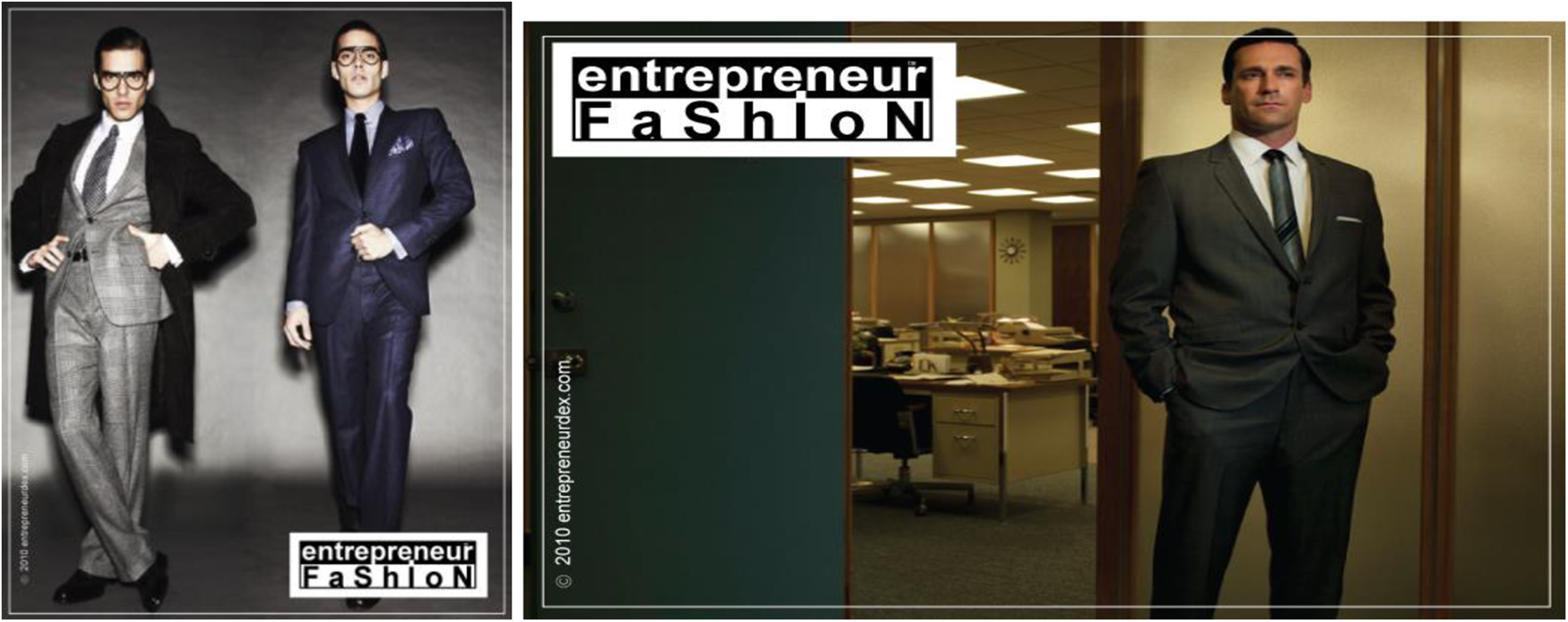
Entrepreneur fashion – How to dress as a man-preneur (image no longer available on the web but downloaded in 2015 by author).
The photographs also visually depict the concept of ‘haute-preneurship’ and an elite EI. Note the use of the fictional Don Draper and the use of male fashion models. Again, the advice is consistent with that of Arnold and branded clothing and jewelry take centre stage. The phenomenon has expanded and as well as the luxury brand ‘Fashion Entrepreneur’ there are rivals such as ‘ENTRPRNR’ which sells its own branded clothing for young male and female entrepreneurs. 11 In such websites EI is also discursively produced as an elitist identity with youthful men and women posing beside luxury marques and in exotic locations. This emerging phenomenon of the ‘commodification’ of EI is worthy of further study.
It must be emphasised that this analysis is but one of many alternative readings of an elite masculinised, entrepreneurial genre and that it is somewhat trapped in time and place. Moreover, representations of the same images now may have changed due to cultural changes in what we understand by entrepreneurship and because of changing attitudes towards wealth and conspicuous consumption. For example, among CEOs a new appreciation of the power of social media; an appreciation of climate change, sustainability and all things ‘green’; not to mention an increase in philanthropic giving may lead to a less conspicuous display of wealth in the future (see Harvey et al., 2020). In this way, according to Harvey et al., super-wealthy entrepreneurs can extend their ‘suzerainty’ from the domain of the economic to the domains of the social and political by downplaying the artefacts of success. However, the elitist stereotype will no doubt remain relevant for years to come.
Concluding thoughts and potential directions for future research
This study has advanced Clarke’s framework for the use of symbolic signalling in EI formation by extending it to include the sartorial and the artefactual as embodied visual symbols. The over-riding message to take away is that the consumption and strategic presentation of branded fashion and artefacts with their inherent elements signifying hedonism and flamboyance helps one fashion an elite and patently gendered EI. The identification of a distinctive entrepreneurial aesthetic capital and the visual legitimacy this confers are both important advances because the former maps another important form of capital in the fashioning of entrepreneurial identities and legitimacies. It illustrates how such an aesthetic capital can combine with an individual’s social capital, their human capital, their financial and entrepreneurial capitals, and their reputational capital to compliment and accentuate each other and create a sound impression. To return to the research question – how does fashion and its sartorial and artefactual elements influence perceptions of entrepreneurial identity? It is obvious from the literature review and the empirical analysis of the blog posts that the adoption of fashion, one’s sartorial style and in particular one’s choice of suit and accessories can be used to literally fashion an elite EI by building up complimentary layers of legitimising imagery. Although possession of an Armani suit worn in conjunction with a Rolex watch and expensive loafers does not signify entrepreneuriality per-se, it does signify ‘materiality’ as suggested by Dourish and Mazmanian and a socially constructed identity associated with wealth and by association an elite EI. This study has highlighted the gendered nature of EI; the importance of visual identity; and how cultural attitudes to what constitutes such identity are changing via the fetishisation and commoditisation of embodied and consumed entrepreneurial identities. The study and embedded analysis make a contribution in terms of the call by Jones et al. (2019) for research that fills the unchartered research avenues in relation to EI. Symbolic brands and designer fashions such as those presented and discussed above, confer a form of authentic identity performance on those who consume them as suggested by Elliot and Davies and Heine. The elitist quality of a brand is measured by its status level and exclusivity and possession of them confers a form of bodily capital on the wearer.
Moreover, what is termed as ‘entrepreneur-fashion’ and accessories play an important part in crafting an elitist and particularly masculine EI. 12 Arnolds blogs targeted a niche, networked market consisting of wealthy, high-value American entrepreneurs who had the ability to afford to endorse the monetised EI fashioned by her and the Entrepreneurdex community. In this respect and context, the gendered terms ‘Man-preneur’ and ‘Diva-preneur’ appear to possess a visual legitimacy as a form of transferable currency as an ideal and dress-code to aspire to. The idea that the possession and consumption of expensive clothing and artefacts is a socially constructed one and not merely Arnolds analysis because we are socialised from an early age to appreciate that certain consumer brands are signifiers of wealth and elite status. It is evident that Arnold is presenting them as a normative ideal. It has also to be remembered that Arnolds readers are high-value entrepreneurs imbued with deeply masculine ideals. Also, the terms ‘Haute-preneur’ and ‘Entrepreneur fashion’ have a legitimate useage and meaning in time and space and the terms make sense within the discussions undertaken in the blogs.
A major limitation of this work is that it is limited to examining the semiotics and aesthetics of an elite ‘masculinised' EI and milieu in a western context and that as such its findings may be not transferable to other milieus and cultural contexts. For example, it will have resonance for criminal-entrepreneurs it will not resonate with social entrepreneurs, or those from ascetic religious settings where the possession and display of wealth is frowned upon. This study is important because it will be of particular interest to corporate consultants and those teaching and training entrepreneurs in that it will help them to advise and counsel their entrepreneurial and corporate consultants on what aesthetics and entrepreneurial identities are acceptable for their particular milieus and cultures. It will also be of interest to entrepreneurs themselves in that an understanding of the semiotics and aesthetics of their chosen field will allow them to ‘mimic’ the accepted aesthetic. 13 This raises questions such as for example, why does it matter that there is apparently quite a rigid (gendered, raced and classed) presentation of the entrepreneur? And also, what are the implications of this? These will be the focus of future research. Furthermore, this study highlights the need for further research into the gendered nature of entrepreneurial identities, gendered entrepreneur dress-codes and visual metaphors including fashion and artefacts associated with entrepreneurs and other rich elites. For example, an analysis of the burgeoning number of female entrepreneurial networks is long overdue as is a similar analysis of other masculine entrepreneurial elites. 14 This stream could be extended to cover other entrepreneurial elites associated with particular industries to shed new light on visual aspects of what constitutes entrepreneurial identities and aesthetics in different contexts.
Footnotes
Declaration of conflicting interests
The author(s) declared no potential conflicts of interest with respect to the research, authorship, and/or publication of this article.
Funding
The author(s) received no financial support for the research, authorship, and/or publication of this article.
