




Abstract
This case focuses on ideas generation in GasTec, a science-based small business specializing in the design and manufacture of gas sensors and analyzers. The case examines how employees’ interaction with a shared boundary object (The “Imagineering Wall”) contributed to the generation of innovative new ideas. The case shows how the Wall generated discussion and participation among employees, leading to enhanced absorption of internal and external knowledge. Interacting with the Wall exemplifies how both bottom-up processes through which employees shared knowledge internally, and top-down processes that supported formalized, managerial-led, external collaborations contribute to ideas generation and innovation. The case also highlights the current dilemma of GasTec’s Managing Director in deciding whether to continue to support the development of the Wall as part of its innovation strategy.
Learning outcomes
The case provides a starting point for students to engage with the management of innovation and ideas generation in science-based small businesses. The case enables students to consider how a shared boundary object (the Imagineering Wall) contributed to the innovation processes and the development of innovative new ideas. The case tasks students with considering both “top-down” and “bottom-up” processes supporting the generation of innovative new ideas. Students should consider how employees share knowledge internally and externally, through formalized collaborations that generate innovative new ideas. The case also encourages students to engage in a broader discussion about the link between innovation and ideas generation in a science-based small business.
Introduction
The purpose of this case is to explore how a shared boundary object (the “Imagineering Wall”) was used by a science-based small business (Pisano, 2006) as part of its ideas generation processes (Baker et al., 2005). In their seminal article, Star and Griesemer (1989) demonstrated how boundary objects—“directories, classifications, materialized representations (maps, designs), standardized methods in organizations” (Trompette and Vinck, 2009: 3)—enable and constrain knowledge sharing processes across organizational (Bechky, 2003), industrial and disciplinary boundaries. Boundary objects are either designated, or emerge from, exchanges between participants as they attempt to share meaning across localized practices (Spee and Jarzabkowski, 2009). They, therefore, acquire meaning when they are incorporated into the practices and processes of groups of individuals working in diverse fields (Star and Griesemer, 1989). Fox (2011: 71) defines boundary objects as: “entities that enhance the capacity of an idea, theory or practice to translate across culturally defined boundaries, for instance between communities of knowledge or practice”; and which can either be facilitative or inhibitive.
This case explores how employees at GasTec, an entrepreneurial science-based small business, interacted with the “Imagineering Wall,” and how this interaction contributed to ideas generation. The case demonstrates how the “Imagineering Wall” generated discussion and supported participation of employees over time, leading to the generation of innovative new ideas. This facilitative boundary object (Fox, 2011) is an excellent example of how both bottom-up processes (Mom et al., 2007) through which employees shared knowledge internally, thus improving absorptive capacity (i.e. the capacity to absorb knowledge (Cohen and Levinthal, 1990), and top-down processes (Mom et al., 2007) that supported formalized external collaborations, can be integrated in innovation processes.
Technological and scientific entrepreneurship
Although “mainstream” entrepreneurship research is based on the notion of the individuals discovering and exploiting opportunities (Grégoire and Shepherd, 2012; Shane and Venkataraman, 2000), technological and scientific entrepreneurship focuses on new opportunities generated through innovation in science and technology (Colovic and Lamotte, 2015). In science-based business, for example, the role of the “star scientist” was initially viewed as the primary source of commercial success with the role of the “inventor” and “entrepreneur” being inseparable (Pisano, 2010; Zingales, 2000). However, in parallel with the concept of open innovation (Chesbrough, 2003), scientific and technological innovation relies on the collective entrepreneurial efforts of employees and managers (internally) and other collaborators (externally) to generate new ideas (Laviolette et al., 2016).
Ideas generation
Ideas generation has long been considered the first step of the entrepreneurial process and has strong connections to entrepreneurial intentions (Link, 2017; Mathews et al., 2020). For example, ideas generation has been studied within entrepreneurial teams in new ventures, exploring the cognitive processes, i.e. related to thinking, of generating, validation and refining ideas (Gemmell et al., 2012). Yet, accounts of how ideas are managed in small science-based businesses remain scarce. Ideas generation kick-starts innovation and innovative strategies, while also responding to the requirements of the market (Foss et al., 2011). Iterative and interactive, the process of ideas generation is also conceptualized as part (rather than only as the first step) of the entrepreneurial process (Pattinson, 2016). In this sense, several authors (Holcomb et al., 2009; Masango and Lassalle, 2020; Rae, 2012) have pointed out the continuous process of ideas generation in the pursuit of entrepreneurial opportunities. Taking the examples of creative or technology-based ventures, they explore ideas generation in relation to market needs and customer demands rather than being driven by new technology per se.
Top-down versus bottom-up processes
In the top-down perspective, the role of managers is crucial in understanding innovation performance (Bäckström and Bengtsson, 2019). Senior managers have greater opportunity than their more junior counterparts to promote innovation and ideas generation by setting clear objectives (Laviolette et al., 2016). Research has emphasized that the bottom-up approaches to build innovation in organizations (Park et al., 2014). Employees are being encouraged to engage in innovation outside of their daily work activities by tapping into internal and external knowledge sources (Laviolette et al., 2016). Where small business employees have the autonomy to generate and pursue new ideas, this approach can be an excellent source of innovative new ideas (Lumpkin et al., 2009). These individual employees (i.e. scientists, engineers etc.) are responsible for developing technologies and are embedded in formal institutions (e.g. small businesses) and informal institutions (e.g. communities of practice, norms, etc.). Thus, innovation is the product of managerial, employee and wider community practices rather than, say, just or primarily top-down, managerial-led processes. These collective entrepreneurial efforts generate new innovative ideas. Individual employees actively use upward influence (Farmer and Maslyn, 1999; Olufowote et al., 2005) in order to promote their ideas. When the ideas meet within this conversational space (Baker et al., 2005), individuals construct new meanings and transform the collective experience into knowledge and, finally, may find opportunities for learning and knowledge exchange (Evangelista and Mac, 2016), which is an essential component of innovation processes and ideas generation, thus also enabling the small firm to respond to changes in its environment.
Internal and external processes
The innovation literature emphasizes the role of internal (individual and organizational) and external processes that rely on extensive communication and knowledge exchange (Mattes, 2012). External knowledge is required to support effective ideas generation and innovation processes, especially within small firms where the internal boundaries are less distinct than in larger businesses due to lower specialization and higher flexibility of employees between different tasks and operations (McAdam et al., 2014). Thus, businesses’ internal linkages are crucial in understanding innovation. Hence, different degrees of top-down and bottom-up influences (Lumpkin et al., 2009) generate varying synergies between senior managers and employees, which may then be converted into strategies and processes. The innovation literature has, to date, focused upon the importance of external knowledge exchanges.
Nevertheless, internal knowledge generation and dissemination within the business is recognized to be vital too (see also Easterby-Smith, 2008). Building on the concept originally defined as the capacity to absorb external knowledge (introduced by Cohen and Levinthal, 1990), Lewin and Massini (2004) first proposed and Lewin et al. (2011: 83) then distinguished internal absorptive capacity (“managing the processes of internal variation, selection, and replication”) from external absorptive capacity (“the management of exploration for new knowledge in the external environment and its assimilation”). Absorptive capacity has, indeed, been shown to be positively associated with networking (Giuliani and Bell, 2005), as well as knowledge management and innovation in small businesses (Gray, 2006), and such processes are influenced by skill levels within the alliance partners (Xia and Roper, 2008). The sourcing of knowledge is important in achieving successful innovations and not just in terms of external sources, but also in terms of skills within businesses (Roper et al., 2008).
GasTec
GasTec is a high-technology, science-based small business based in northern England, with global connections through its linkages (as external processes), specializing in the design and manufacture of gas sensors and analyzers. GasTec provides product solutions to gas monitoring in a variety of environments. Established in 1981, the business currently employs around 40 staff. The business has an annual turnover of around £5 million. The business offers a diverse range of products including breathing apparatus for sport and commercial diving, and industrial and laboratory gas detection and analysis safety equipment. It operates in complex networks of relationships with partner businesses. The Managing Director of GasTec, Pete Johnston, was keen to drive the business forward and recognized that increasing the company’s range of innovative new products was essential to its success in a competitive industrial environment. In an attempt to encourage employees to become more engaged in the ideas generation process, he had recently introduced the “Imagineering Wall.” However, some board members were yet to be convinced about the value of the Wall as part of the company’s overall innovation strategy. Their main concern was that that Wall would distract employees from GasTec’s core activities.
The “Imagineering Wall” and ideas generation in GasTec
The Wall was a large wall-mounted whiteboard where employees could post their ideas (Figure 1). Participation was voluntary, offering employees a space where they could share ideas.
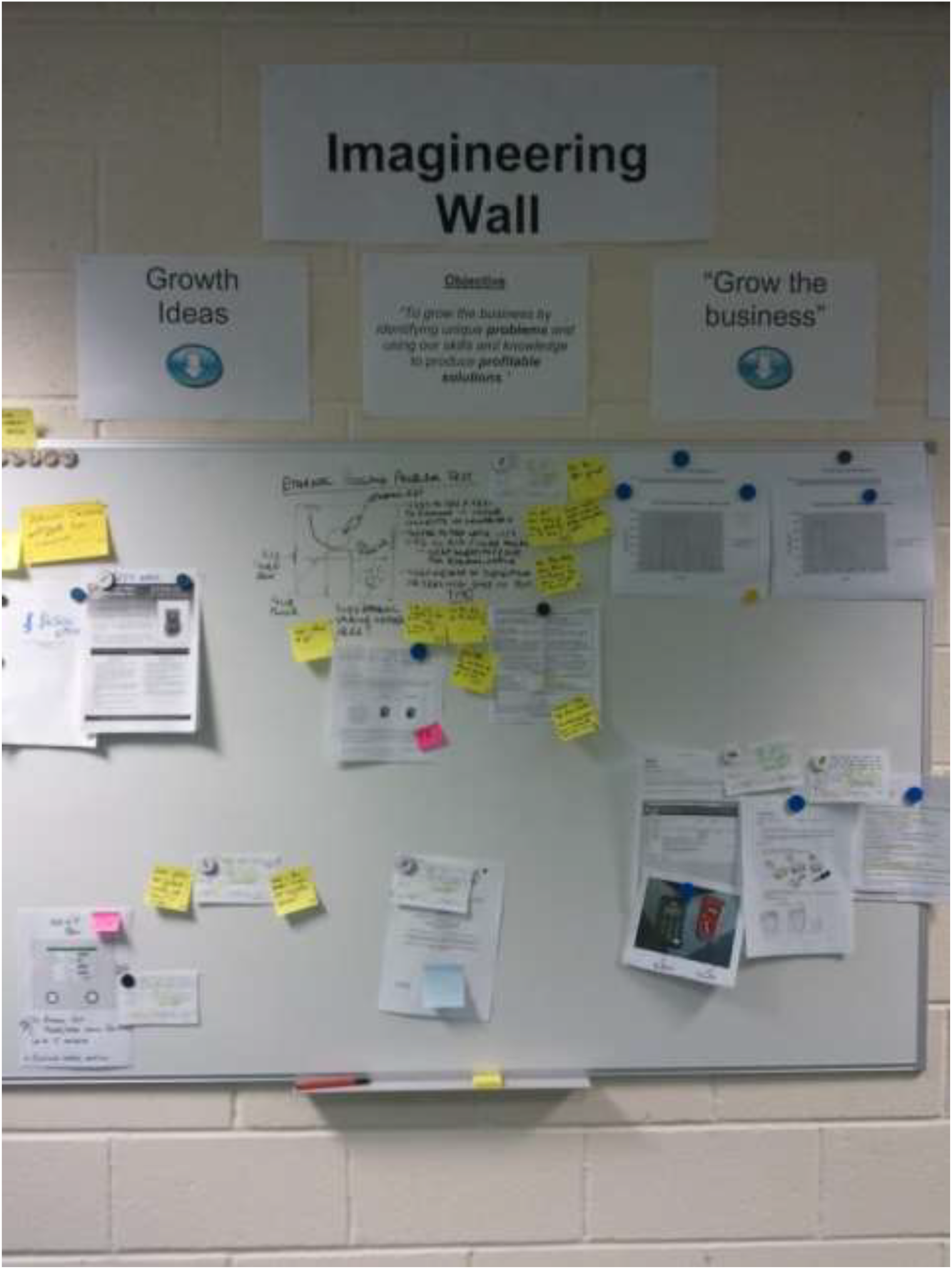
The Imagineering Wall.
The Wall was divided into three sections that represented stages of developing of an idea (Figure 2).
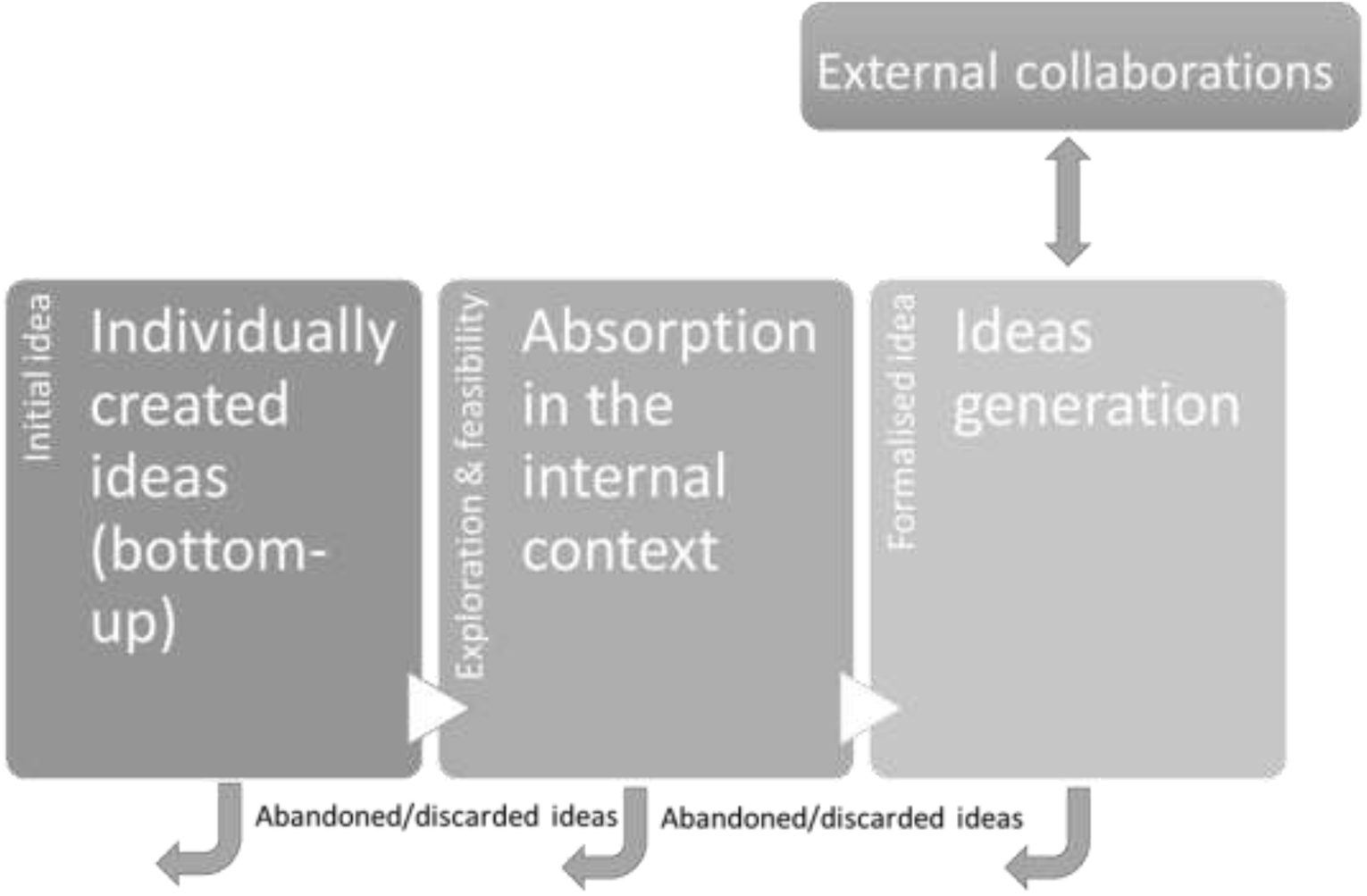
The three sections of the “Imagineering Wall” at GasTec.
The Wall was a key catalyst for ideas generation within and across the small firm. The “Imagineering Wall” represented a conversational and physical space (Baker et al., 2005) used as a shared facilitative boundary object within and beyond small business processes to encourage employees to generate new and innovative ideas. The first stage of the Wall allowed employees to post their ideas, as well as comment on others’ ideas. Employees could add their initials to an idea as an endorsement or expression of interest. The process was self-selecting; if an idea reached a “critical mass,” in terms of employee interest, the ideas were moved to the second stage of the Wall and endorsees were encouraged to collaborate informally on the project. Employees working on these ideas received a half-day each week to collaborate. If an idea reached the third stage of the Wall, it was formalized as a project and a business case formulated by the team in terms of its development cost versus its potential benefit to the business.
An interviewee commented on the process: “[it] allows…anybody and everybody in the business to contribute and comment in a very free and open way” (Service Manager). The introduction of the Wall, therefore, highlights the prime importance of internal knowledge inflows (De Zubielqui et al., 2016), revealing how GasTec first adopted a top-down (Mom et al., 2007) process before it was used by the individuals to generate ideas. The caption above the Wall explained its purpose: “To grow the business by identifying unique problems and using our skills and knowledge to produce profitable solutions.” As the Service Manager explained: […] it is an informal way for us to gather and radiate information about ideas that come up in our day to day work from anybody…so…if somebody from the sales department gets a call from a customer, [and] they ask for something we don’t necessarily have a product offering for, that can be identified as a problem that we, at least, don’t have a solution to. So, we put that up [on the ideas wall] and develop that and try and see if there is a product or service, we could develop to offer that customer. (Service Manager)
The Wall acted as a boundary object, highlighting how internal processes can help encourage the construction of an informal community of practice among employees across the small business. As one manager noted: […] at that stage we have much more idea, you know…there is a market, there is a technology…there is a potential there for us to make something of this…it’s something we’re capable of doing, things like that…. (Service Manager) […] ultimately, we can then hang number and fact on to that idea and eventually get to the point where we do have a very formal form, a business case…which is still very loose…in terms of how much is it going to cost and how much we can potentially make as a return…. (Service Manager)
The Imagineering Wall has succeeded in generating several innovative new ideas. The Wall was a focal point for the collective entrepreneurial efforts of employees and managers (internally) and other collaborators (externally) in order to generate new ideas. Employees engaging with the Wall had together produced: (1) six “new and improved” versions of products that were on the market; and (2) a further four projects in the early stages of development. These products included inert gas monitoring systems for use in commercial and military submarines, oxygen monitoring applications for hypobaric chambers (used for training air flight crew), and a range of oxygen depletion and enrichment devices used in sport and commercial diving. The Wall provided a forum for employees’ elaboration and discussion about their ideas, as well as a creative conversational space that encouraged participation and collaboration. The main drawback of the Wall was the cost to the small firm, in terms of employees’ time away from their main jobs, as well as managers’ time in monitoring the Wall to decide which activities to discard and which to support as formal projects. Another challenge involved how to maintain employees’ interest in the Wall once they had posted their initial ideas.
Not all interviewees expressed positive views of the Imagineering Wall. Some employees, for example, were skeptical about employing the Wall to generate new ideas: I’m not convinced it works…in the guise it’s in at the moment. I think how it’s supposed to work has been constantly shifting since it’s been set up…it’s tried to be many things, but the general gist of it is that people in here will pop an idea, put it on the Wall and they’ll all come and contribute to it…. and drive forward…pick it up and see if it is commercially viable, or not. (R&D Engineer)
Once an idea became a formal business case, GasTec switched to more formal, top-down processes and occasionally sourced partners from its external network to help develop the idea further. This approach involved, inter alia, outsourcing elements where GasTec lacked expertise. In one example, GasTec outsourced much electronic design work to another business (small business X), specializing in industrial design and new product development. The relationship began as a straightforward contractual arrangement: One area where we have outsourced in order to bring in skills that we don’t have is…working recently with [X], who do various industrial design really…and we’re sort of…an area where we don’t really have the skills is in terms of how we package and present our products…in terms of producing ascetically appropriate products we’re lacking…. (Design Engineer)
Extending organizational boundaries
The case explains innovation processes and ideas generation in a science-based small business. The Wall emphasizes the role of critical discussions within the conversational space (Baker et al., 2005) and the pivotal role of the Wall where employees relate to each other and where internal collaborations and internal absorptive capacity (Lewin and Massini, 2004; Lewin et al., 2011) lead to the creation of new knowledge that supports ideas generation. In other words, the Wall supported Lewin et al.’s (2011: 85) view that: […] facilitating variation and enabling the emergence of new ideas within organizations, for selecting ideas for further development (design of selection regime), for sharing and combining knowledge and superior practices across the organization, and routines for reflecting on, updating, and replacing old practices.
The “Imagineering Wall” helps bridge organizational boundaries, drawing upon both internal and external knowledge to stimulate employee ideas generation in both directions, i.e. top-down and bottom-up (Bresnahan et al., 2002) in the conversational space (Baker et al., 2005). The dynamic nature of such processes, drawing upon various internal and external knowledge resources acquired (Pattinson and Preece, 2014) are leveraged by actors from within or beyond the boundaries of the small business. Further, knowledge sharing processes enable small businesses to leverage external absorptive capacity.
The Wall has a key purpose as a shared facilitative boundary object, and both internal and external knowledge and expertise are integrated into the Wall to generate new ideas that (hopefully) lead to new innovative products. The “Imagineering Wall” is thus an implicit facilitator of the absorption of knowledge from external and internal processes. Specifically, the “Imagineering Wall” depended upon external stimuli, external expertise, and outsourcing where internal expertise was missing (sometimes developing into formal collaborative relationships including joint projects). Specifically, the ideas emerging from the Wall were effectively implemented because of the collective entrepreneurial efforts of employees and managers (internally) and other external collaborators.
The future
For GasTec, the challenge going forward is whether it continues to invest time and money in supporting use of the Imagineering Wall as part of its internal innovation strategy. If it decides to continue, it needs to find a way to sustain “bottom-up” participation once the initial spurt of creativity is over—which might mean creating a clearer connection to external participants.
Summary
The case highlights how a facilitative boundary object (Fox, 2011) supports both bottom-up processes through which employees shared knowledge internally, and top-down processes (Mom et al., 2007), that supported formalized, managerial-led, external collaborations. The combination of these processes provides a conducive environment for enhancing absorptive capacity within science-based small businesses. The Wall was a “rhetorical” device, a platform, or space, where employees relate to each other and where collective knowledge is created. The long-term success of the Wall depends on (a) how it is used, (b) the continuous conversations taking place, and (c) the small business’s ability to engage external partners (such as customers, suppliers, universities, research laboratories and even other science-based businesses). The decision that Pete Johnston, the Managing Director, and his fellow directors face is whether to continue using the Wall as part of GasTec’s innovation strategy, to generate new ideas, or whether they should focus on existing products. The long-term success of the Wall might hinge on Pete’s ability to persuade his fellow directors to support his vision for ideas generation.
Questions
What are the risks and opportunities that you perceive if GasTec continues to support the use of the Wall as part of its innovation strategy?
How can GasTec convince employees to continue engaging with the Wall once the initial spurt of creativity is over?
What problems might GasTec encounter by encouraging the participation of external people in the Wall?
How can GasTec encourage continuous and constructive conversations to take place—both top-down and bottom-up, as well and internally and externally?
How do employees share knowledge internally and externally, improving absorptive capacity, and how does this process support ideas generation?
Teaching note
1. Summary of the case
GasTec is a high-technology, science-based small business specializing in the design and manufacture of gas sensors and analyzers. GasTec provides a range of solutions to gas monitoring in a variety of environments. Established in 1981, it currently employs around 40 employees with an annual turnover of around £5 million. The business offers a diverse range of products including breathing apparatus for sport and commercial diving, and industrial and laboratory gas detection and analysis safety equipment. This case study focuses on GasTec’s use of a facilitative boundary object (the Imagineering Wall) to stimulate ideas generation, thus leading to successful innovation.
2. Teaching objectives and target audience
The key issue in this case study is whether GasTec should continue to provide support for the Wall as part of its innovation strategy. The long-term success of the Wall depends on various factors. First, how it is used by internal employees and how it engages with external participants. Second, the quality of the continuous conversations taking place—both top-down and bottom-up, as well as internally and externally. Third, GasTec’s ability (and willingness) to engage external partners—such as customers, suppliers, universities, research laboratories and even other science-based businesses—in its innovation processes. The case study, therefore, enables students to understand different approaches to ideas generation in a science-based small business. Its overall aim is to provide a starting point for students to discuss the challenge of managing innovation and ideas generation in a small business. The case study is aimed at postgraduate students studying entrepreneurship and innovation, and has four learning outcomes: The case enables students to consider how a shared boundary object (the Imagineering Wall) contributed to innovation processes that supported innovative new ideas. The case tasks students with considering how “top-down” and “bottom-up” processes support the generation of innovative new ideas. Students should consider how employees share knowledge internally, improving absorptive capacity, and externally through formalized collaborations that generate new ideas. The case also allows students to engage in a broader discussion about the link between innovation and ideas generation in a science-based small businesses.
3. Teaching approach and strategy
This case study can be used as the starting point for students to discuss ideas generation and innovation (strategy) in the context of a science-based small business. It allows the application of classroom-based theory to be applied to a real-life situation and encourages students to take an active role in the learning process. The main theoretical points to highlight when using the case study are: (1) internal and external knowledge, and (2) top-down and bottom-up processes that contribute to the formation and adoption of new innovative ideas, in interaction with a (3) how the shared boundary object supports ideas generation. The case study places these concepts in the context of ideas generation in a science-based small business, providing an opportunity for students to gain new insights into how new innovations are created. The case allows students to engage in a broader discussion about innovation and ideas generation in a small business context.
Wherever possible, the classroom should be arranged with desks in a semicircle, or a similar layout (subject to any mandatory social distancing requirements), that allows students to face each other and work together in small groups. This layout will help to facilitate a direct exchange of views between students. Teaching this case begins by asking students to read and think about the case—either at the start of, or prior to class—depending on the length of the seminar/tutorial. A 5–10 minute introduction to the case by the lecturer or tutor (henceforth: educator) might then be useful before beginning any discussion. The introduction should explain the purpose of the Wall; how it supports the ideas generation process in GasTec and the dilemma—whether it should continue to support the Wall as part of its internal ideas generation strategy. At this point, the educator might wish to present potential alternatives to the Wall. The goal of the case is not to select the correct choice for GasTec, but rather to understand the challenges inherent in generating new ideas that lead to innovative new products.
Once the introduction is complete, the educator might wish to break the class up into teams of three to five students, depending on student numbers. Each team should discuss and summarize its answers to each of the questions presented in the case study. A representative from each group might then wish to present a summary of the team’s answers to the class. The educator should work to move the discussion past a listing of challenges to an identification of the potential outcomes of the available choices for GasTec. To conclude the session, the educator might consider asking students to report back—either in their groups or individually—to summarize what they consider to be the main learning outcomes of the session. Alternatively, the educator could ask them to take a few minutes to summarize their own thoughts about the main points raised in the case. It is also important to ask students to evaluate the usefulness of the case in their studies in order to help students evaluate their own learning as well as to help the educator to evaluate the usefulness of the case and make amendments where necessary.
4. Analysis
Students should be reassured that there are no right or wrong answers, but rather the case study provides a springboard for discussion about the main issues raised in the case. However, students are challenged to think about a real-life scenario in which the use of the Wall as a catalyst for ideas generation can be analyzed in detail. More specifically, students should consider the following point in their answers to the questions posed:
What are the risks and opportunities that you perceive if GasTec continues to support the use of the Wall as part of its innovation strategy?
Students will recognize that the Wall has already been successful in generating new innovative ideas. From the case material, students might also identify that the Wall presents both an opportunity and a risk for GasTec. The opportunity come from the use of the Wall in supporting the generation of innovative ideas that result in new products. The main risk is the financial cost of allowing employees to work on their own projects, which might slow down the completion of existing projects. Students might also explain that the Wall requires monitoring and support from the company’s senior management team, adding to the managerial burden for a small business.
How can GasTec convince employees to continue engaging with the Wall once the initial spurt of creativity is over?
Students should be able to explain that the main challenge for GasTec is whether it continues to invest time and money in supporting use of the Wall as part of its internal innovation strategy, or focuses its efforts on existing projects. Additionally, students might recognize that, if GasTec continues to support the Wall, it will need to find a way to sustain “bottom-up” participation from employees once the initial spurt of creativity is over. Student discussions and analysis here might focus on how GasTec might develop a stronger connection with external participants.
What problems might GasTec encounter by encouraging the participation of external people in the Wall?
Students should be able to explain how external participation in the Wall can be encouraged. Here students should draw on their wider experience and knowledge of business and recognize that, because GasTec is a small business, its ability to engage external partners (such as customers, suppliers, universities, research laboratories and even other science-based businesses) might be limited. Students should explain that not all of GasTec’s employees expressed positive views of the Wall and some were skeptical about using it to generate new ideas. The educator might encourage a wider discussion here, to consider any other factors in students’ analysis. For example, fear of having its innovations copied (imitative innovation).
How can GasTec encourage continuous and constructive conversations to take place—both top-down and bottom-up, as well and internally and externally?
Students should be able to recognize the importance of top-down as well as bottom-up processes to the success of the Wall that encourage employee participation. Discussions might focus on the role of employees and how they can bring in individuals from their external networks to help develop the idea further. Students might also explain how top-down processes help give GasTec access to external expertise they lack, thus supporting internal processes. Students might engage in a general discussion about the need for continuous discussions between employees and managers and how this process might support internal and external participation in the Wall.
How do employees share knowledge internally and externally, improving absorptive capacity, and how does this process support ideas generation?
Students should explain how the Wall can bring together employees and enable them to leverage internal absorptive capacity to generate ideas that lead to new innovative new products. Students will analyze how the Wall helps create an environment that encourages internal processes of collaborative knowledge sharing (within the boundaries of the business). They should also recognize that the Wall is a facilitative boundary object that supports ideas generation between employees working on projects.
5. Feedback
Please take time to reflect and consider how the case worked in different situations (for example, with different student groups, or on different courses, papers or modules). The case has been tested and has been an effective part of teaching entrepreneurship, innovation and strategy to a range of postgraduate courses, including Business Management, International Business Management, and Business and Entrepreneurship. More specifically, it has been used to support the teaching of small seminar groups on modules such as “Leading Innovative Organizations” and “Global Strategy and Innovation.” This case could also be used on other courses, such as Master’s degrees in innovation, entrepreneurship and/or innovation, Executive Master of Business Administration (MBA) courses, or with doctoral students. The case has been particularly useful for teaching cohorts of Executive MBA students with science and engineering backgrounds. Potentially, the case is suitable for use as a written assessment or for an examination, role-playing, or for other purposes. Finally, the case should trigger some opportunities for students to reflect on their own experiences and managerial practices when it comes to generating and supporting innovative ideas.
Footnotes
Declaration of conflicting interests
The author(s) declared no potential conflicts of interest with respect to the research, authorship, and/or publication of this article.
Funding
The author(s) received no financial support for the research, authorship, and/or publication of this article.
