




Abstract
Our understanding of craft brewing is beginning to grow and a key theme to emerge from this artistic and intrinsically creative sector is the dependence on collaboration between entrepreneurial agents. In the North East of Scotland, the growth in craft beer is also recognised to come from a deep rooted collaboration, as a reaction to and in resistance of large mainstream competition. However, one such enterprise, BrewDog, has grown to achieve global reach to rival that of the large-scale brewers the craft scene sought to challenge. We consider what this unprecedented success means for the remaining collaborators in the local craft beer sector. Our findings point to a shared optimism and possibility of achievement among the craft brewers, aided by BrewDog’s success. However, the nature of collaboration is anchored more in community embeddedness and shared responsibility for market development, rather than in business growth and success replication. While the craft scene acknowledges the inspirational success of ‘one of their own’, strategic drive comes from more localised relations and a desire for independence. This has implications not only for craft beer but also on how collaboration among entrepreneurs sustains in respond to success from within the group.
Introduction
Interest in craft brewing has steadily increased in recent years, echoing the industry’s emerging economic impact and an acknowledgement of the diversity of business operating within the sector (Danson et al., 2015). No official definition of craft brewing exists, however, over the past decade, growth in independent beer brewing has increased and is now considered the home of genuine craft beer brewing by consumers, in contrast to craft ranges of large-scale mainstream producers where sales have decreased (SIBA, 2019), thus the dynamics of the industry are changing. In Scotland, it is believed the brewing industry contributes around £500 million turnover to the economy annually, supporting over 8000 jobs, with ambition to double this by 2030, particularly looking to create jobs and opportunity in rural areas (Scotland Food and Drink, 2018). One hundred and twenty brewers currently make up the market in Scotland, increasing 343% since 2010, with the most dominant areas being in the City of Edinburgh (15 enterprises), and spread across the Highlands (also 15 enterprises) – while the North East of Scotland (taken here as Aberdeen City/Shire and Moray) has 15 enterprises manufacturing beer (Office for National Statistics, 2019). This market growth has been driven by small entrepreneurial outfits, with 100 of the 120 beer manufacturers employing less than 10 people. For many, the industry remains characterised by its opposition to, and independence from, the mass-market of large-scale brewers (Carroll and Swaminathan, 2000).
As part of the growth in craft beer activity, a small number of firms have become talisman of the scene. Cabras and Bamforth (2016) point to BrewDog, in the North East of Scotland, and Sierra Nevada, in the United States, as example brewers which have expanded to a point comparable with larger, more mainstream, beer outfits. While both companies attempt to maintain their artisan credentials, with Sierra Nevada retaining full family control, and BrewDog’s growth based on their unique crowdfunding ability, these examples do blur the lines of what can be considered ‘craft’ and what becomes mainstream. Although such growth stories are interesting and often inspiring (Smith et al., 2010), the attention of this article is not specifically on those who break into the mainstream, but rather on the continued nature of an often collaborative and localised environment from which these exceptions have grown. Essentially, we ask: how do entrepreneurial craft beer enterprises continue to collaborate with such different approaches to growth and variations of success?
To investigate this scenario, we use the North East of Scotland locale as a case study of place to examine enterprise collaboration and localisation, with specific reference to the impact of BrewDog’s growth on such a tightly interconnected entrepreneurial scene. The North East of Scotland is widely regarded as ‘leading’ the UK’s ‘craft beer revolution’ of the past decade, with a plethora of breweries and specialist shops/pubs, stretching from the concentrated pubs of Aberdeen city centre (The Ale Trail Company, 2020) to the popular beer festivals taking place in neighbouring towns and villages (Visit Scotland, 2020). This paints the picture of a geographically spread, but crucially interlinked beer scene across the region. To fully appreciate both the social and relational dynamics at play, we seek the perspectives of both small craft brewing enterprises and those of BrewDog, the key protagonist of the area’s craft beer narrative. Thus, the contributions of this article are twofold. First, we further our understanding of entrepreneurial embeddedness in a field characterised by localised collaboration and not competition (Kraus et al., 2019). Second, we consider how emerging markets such as craft brewing evolve in collaborative ways with changing market dynamics and relative successes (Zhang et al., 2015).
Craft beer as artisan resistance
In contrast to the commoditised offerings of large-scale brewers, craft beer has become highly differentiated, thus engendering a passionate and purposeful customer following (Clemons et al., 2006). Small specialised brewers typically achieve this differentiation by demonstrating an artisan nature, a craft notion overlooked by the generalised production of larger operations (Argent, 2018). Cabras and Higgins (2016) see this as originating in hobbyist home brewing converting into commercialised production (Kesmodel, 2009). While tax levies alone may have had limited impact, in combination with cheaper, smaller and more accessible brewing technology, this created a friendly context for the resurgence of willing independent operators in a yearning market (Wyld et al., 2010). As such there is a characterisation of independent brewing as a lifestyle side-activity, diversified around the niche of a founder’s individual taste (Alonso, 2011; Markantoni et al., 2013). Danson et al. (2015) suggest this leads to an ease of entry, as individual brewers rely on intrinsic artisanal nature, however they also support Wyld et al. (2010), by warning that this does not always translate to sustainable growth.
Despite the increased attention given to the growth of craft beer entrepreneurship, there is acknowledgement that we still suffer from a dearth of knowledge on how this entrepreneurial event functions (Alonso et al., 2016). However, important parallels can be made with findings from other areas of artisan entrepreneurship, primarily in the food and drink sectors (Pret and Cogan, 2018). For instance, where deep levels of cooperation and network connections (Kuhn and Galloway, 2015) are found to be fostered by a mutual sympathy and solidarity around development of ‘the craft’ (Blundel, 2002). As such, artisan entrepreneurs in the food and drink sectors often look to use the cultural aspects associated with their craft traditions to their advantage, either in marketing or on location-based operations (Lounsbury and Glen, 2001). It follows then that the spatial context of artisan entrepreneurship becomes informative to the nature of entrepreneurial activity (Bouette and Magee, 2015), where surrounding social values colour strategic intentions (Cater et al., 2017; García-Rosell and Mäkiner, 2013). This can result in artisan entrepreneurs becoming more selective in the opportunities they pursue, with more organically embedded growth and sustainability commonplace (Mathias and Smith, 2015).
The uniqueness sought in the artisan product tends to come from its links to the locality of the brewer as a strategic strength (Alonso et al., 2016). Although Tremblay et al. (2005) suggest this demonstrates craft brewers catering for local and regional tastes, Danson et al. (2015) look more broadly to uncover a tendency for brewers to serve a spatially defined areas as a method of overcoming resource limitations against the larger brewers. Broader still, this echoes a sociological trend to consider ‘neo-localisation’ in food and hospitality (Everett and Aitchison, 2008), where the importance of place has become informative in a normally globalised business environment (Flack, 1997). Drakopoulou Dodd et al. (2018: 642) suggest that the importance of the local for these entrepreneurs is so strong that our view must be ‘filtered through a more idiosyncratic lens’.
Although focusing on ideals of local craft over profitability may provide craft brewers with a romantic artisanal draw, the declining nature of the beer drinking market and continued domination of those firms gaining economies of scale present a hostile future for craft beer producers. It is not enough for craft brewers to accept that they operate at the competitive fringes of business system norms (Baker and Welter, 2017). If this were the case, the more successful craft brewers become susceptible to take over from the very large organisations they are formed to rail against (Danson et al., 2015). Blundel (2002) warns that artisan enterprises in the food and drink sectors must find a way to sustain their operations as network relationships evolve and markets grow.
Collaboration of the craft brewers
Research in the craft brewing sector is in its early stages; however, one key theme has emerged as a dominant way of understanding entrepreneurial behaviour in this field, the importance of collaboration. Lamertz et al. (2005) suggest that the camaraderie enjoyed in the field of home brewing can translate and develop into a collaboration and kinship enjoyed in the realm of commercial craft beer production. McGrath and O’Toole (2013) link this drive for collective engagement to the fragility associated with resource constraints, where entrepreneurial networks provide access to opportunity, information and the weight of collective reputation, which would otherwise be difficult for solitary actors to gain – thus enabling them to counteract the liabilities of smallness (Hanna and Walsh, 2008). Entrepreneurial firms in this manner look for awareness of opportunity and access to resources to be brought to the firms through collaborating with others (Lechner et al., 2006). This again echoes what is found with other forms of artisan entrepreneurship, where symbolic capital is sought though connections with high-status peers, allowing for the mimicking of ideas and innovations (Pret et al., 2016; Wilson et al., 2017). Thus, Lechner and Dowling (2003) suggest entrepreneurial firms become dependent on external capabilities of others to grow and develop. Zaheer et al. (2010) posit entrepreneurial activity in such a scenario is not driven by autonomous figures but instead be viewed and studied as an interdependent system.
Some approaches to collaboration may be as technical as sharing the expense on large purchase equipment or as complex as ‘swapping’ distributors and relationships with pub outlets (Danson et al., 2015). The interplay of social networks both across and between the individual enterprises thus drives entrepreneurial behaviour (De Carolis et al., 2009), with an embeddedness in local areas a means of drawing from meaningful social capital, perhaps further explaining the neolocal characteristics of many craft brewers (Henchion and McIntyre, 2005). Shepherd and Patzelt (2011) consider this to be a form of ‘community entrepreneurship’, where an increasingly complex spatial web of relations form around accepted norms and values of behaviour (Audretsch et al., 2017). Enterprises secure their positions by fitting-in and adopting common business models so as to further the community embeddedness mindset (Fritsch and Storey, 2014). A cooperation between ‘rival’ brewers, even at the customer face, may appear counterintuitive, but is seen as necessary in the newer industry sectors, particularly when a group of smaller firms are facing a dominant oligopoly structure (Flanagan et al., 2018). A climate of shared problems and combined solutions underpins a form of siege mentality, a team effort rooted in the localised socio-economic structures (McEvily and Marcus, 2005).
Hoyte (2019) calls for greater understanding of value preservation and how the collaborative community mindset maintains. As with any networked community, there can be a jostling for position through the hidden, informal interactions within the network (McGrath and O’Toole, 2013). This positioning tends to be emergent in nature (Mariani, 2007), suggesting that these relationships will change over time in terms of trust and influence (Dahl, 2014). Such collective strategies to gain knowledge and learn from each other have been noted elsewhere is the entrepreneurship literature (Jack and Anderson, 2002), but for various reasons of resource paucity and a lack of formalised education, this form of normative entrepreneurial behaviour seems particularly prevalent in the artisan sectors.
The collaborative spirit of craft brewing challenges the dominant entrepreneurial ideology of individual opportunity seeking and exploitation. However, in this sector, we see a competitive landscape, with independence important, but a horizontal cooperation needed for the sector to learn and grow into a sustainable offering (Flanagan et al., 2018). In such a sense, competition becomes a complex and multilayered dynamic. Relationships can evolve from partner to rival and vice versa, often unplanned and as individual agents develop (Mariani, 2007). The nature of the sector and its collaborations will therefore change with time, as trust between the agents change and develop in an often reactionary process (Dahl, 2014). However, with suggestions that the Scottish beer brewing market has become saturated, and the dominant success and stated growth agenda of one particular player – BrewDog (Zhang et al. 2015), we cannot assume that collaboration to build resource will remain the same as it was, and we question how collaboration copes with these changes.
Methodology
The study adopted a two-stage approach, where each element complemented the other. Stage one provides a comprehensive understanding of BrewDog, as the emerged success of the craft beer sector in the North East, achieving global reach and sales beyond any other craft brewer in the sector. We sought to understand the intended role of BrewDog in the localised collaboration of craft brewers, from their own perspective. We achieve this through a constructed organisational case study (Yin, 2014). Multiple data streams are used in this case construction to paint the picture of a stand out firm (Tharenou et al., 2007). We purposefully identified strategic decision makers within the organisation to interview, providing primary data directly related to our research question. These individuals were informally contacted through the personal connections of the authors to establish will, and thereafter formally invited to take part in face-to-face interviews on BrewDog’s Ellon premises. This was supplemented with multiple secondary sources, which are plentiful as the company has typically produced regular public output. Included in the secondary data building this case are academic and business analyses, data from BrewDog’s online publications and other media commentaries. As the founders of BrewDog are known for their lack of engagement with academic and journalistic research, excerpts from James Watt’s autobiographical business guide are used to portray entrepreneurial intentions. Importantly, a complete draft of this article was passed to BrewDog prior to submission to allow for any concerns to be raised, no concerns were noted. This collation of materials sought to achieve the most holistic appreciation of the organisation possible (Ridder, 2017).
An understanding of BrewDog as a craft brewer of exception allows for contrast comparison to the broader craft brewing sector in the North East region – taken by this work to be the mainland regional surroundings of BrewDog’s operations in both Moray and Aberdeen City and Shire. From this, the second, and more dominant analytical stage of the study, is developed. Narrative interviews were gathered from small craft brewers in the region to investigate their collaborative practices and the impact which the success of BrewDog has had on these. While a total of 15 beer manufacturers are found in national statistics (Office for National Statistics, 2019), through desktop and snowball sampling we were able to firmly identify 10, including BrewDog. From this, a further five self-defined craft beer producers agreed to take part in the research. The remainder were either unavailable or did not respond to our requests.
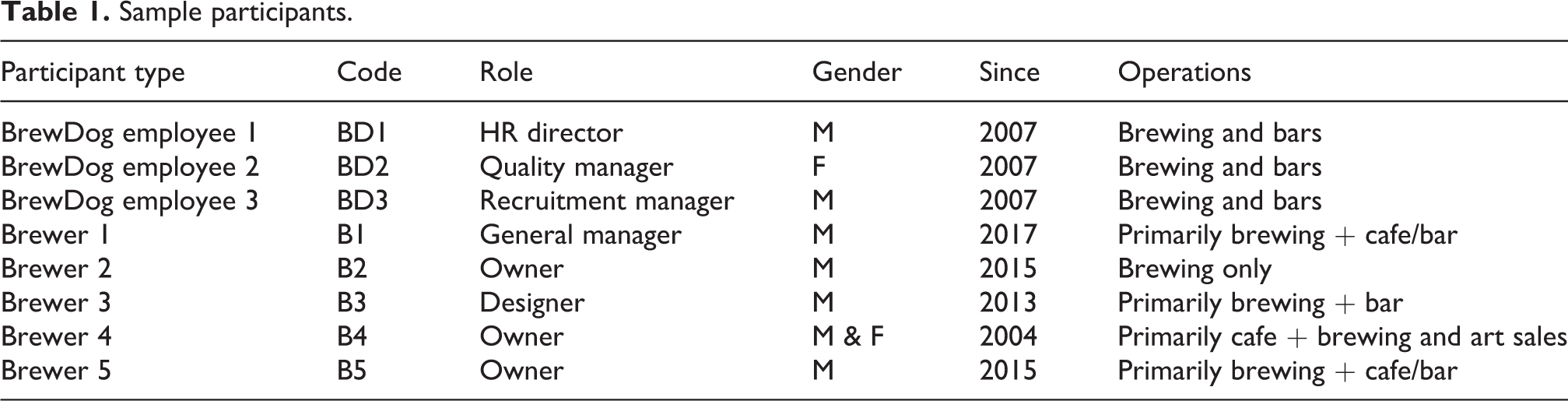
While BrewDog has been a named organisation for the purposes of the study, the participants of second stage have been kept anonymous, details provided in Table 1. Interviews with stage two participants lasted, on average, 35–40 min. Thematic analysis, following the principles of Braun and Clarke (2006), is used to uncover common understandings on how collaboration is constructed and interpretation on the role and impact of BrewDog’s success on this collaboration.
Sample participants.
Stage one findings: BrewDog running ahead of the pack
BrewDog state the organisation began in 2007 with ‘two men and one dog’, dissatisfied with mass-produced beers from the dominant large-scaled brewers of the UK market (BrewDog, 2018a). The founders, James Watt and Martin Dickie, were recent graduates who combined their limited expertise and love for craft beer to start up their own brewery (Smith et al., 2010). BrewDog started in an industrial unit in Fraserburgh in North East Scotland, where the pair undertook small-scale brewing operations (Cabras and Bamforth, 2016). The business was founded on the principle of making people as fervent about craft beer as them, which is still what it aims to do today (BrewDog, 2018a). I also don’t see what we do primarily as a business, I see it as a crusade: a mission to introduce as many people to out passion for greater beer as we can. (Watt, 2015: 43) I think being a trail blazer for an emerging industry has been really important and the willingness to do something that nobody else is doing has been absolutely crucial. (BD1) [Brewing is] massively monopolised and we have to really get in there and establish ourselves in the market as quickly as possible. (BD2) Every year we do Collabfest in each of our bars with a local brewery, it gives people such exposure. But also, it allows them to get access to some amazing quality equipment that they probably won’t have enough money to get just yet. (BD1) I think looking at what we’ve done and what we’ve achieved, I think there’s a lot of people that have taken a big aspiration from it. So, [Brewery X] definitely from a North-East perspective, there’s a lot of similarities because they’ve come on a journey with us. We’ve done a lot with them, they’re always at our AGMs, they’re always at our parties and they’re an extension of our team, so we feel like they’re kind of like our brothers and sisters. So, it’s the same with a lot of smaller craft breweries as well, we encourage them to come up and brew with us. (BD3) I think there’s room for another fifty Brewdogs. So, if you think that we are 1% of the UK beer market at the moment, I think there is space for much, much more. I would love nothing more than a world where there’s forty-nine other companies who are this successful doing what we do. The small players have still got quite a distance to go to catch up with what we’ve done so far. I hope they do though, I hope they beat us! (BD1) Look to create a whole new market. Start a category, not a business…To be credible, your reason to exist needs to extend beyond your own brand, and a focus on growing a brand-new emerging category you are passionate about instantly gives you wider credibility and relevance…[this] can lead to spectacular long-term growth and engagement potential. And ultimately the opportunity to be the market leader…We made our own rules and set about creating and establishing a craft-beer market in the UK. (Watt, 2015: 26–28).
Stage two findings: Other craft brewers in the sector
Three dominant themes emerge from the data here, diagrammatically represented in Figure 1. The three themes are as follows: BrewDog showing the possibility of achievement, community embeddedness and the collective development of the market. Each of these will be taken in turn with use of multiple coding excerpts to demonstrate the theme.
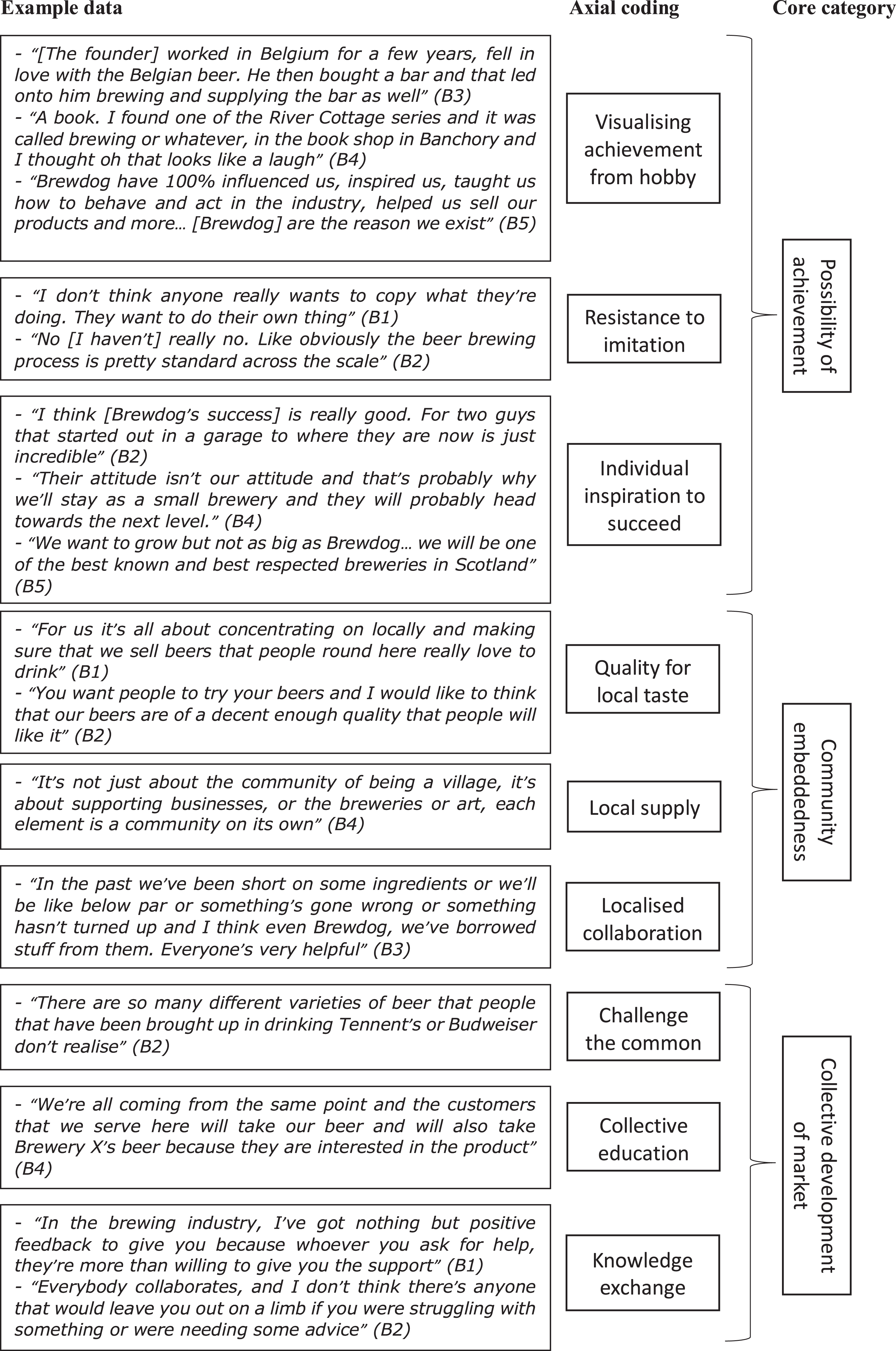
Data structure.
BrewDog as showing possibility of achievement
While some participants viewed BrewDog as the inspiration for starting up their own microbreweries, others did not. The main reason for starting a microbrewery was brewing being an existing hobby, which turned into a viable business idea. For instance: We were into our craft beer and were interested in what was happening and how [microbrewing] has become quite a popular thing and how it is developing. We had done some homebrews ourselves and that’s how the idea came about. (B1) I invested in Brewdog at the first stage and that evolved into being interested in craft beer in general. I started going out and buying unusual beers, trying to find beers that I had never drank before, just trying to taste different types and see what I liked, which basically evolved into thinking well, can I do this myself? (B2) We work with Brewdog every month in some way, be it a tap takeover in one of their bars, to Collabfest, to collaboration brews at HQ. We see our relationship with Brewdog as critical. (B5) We’ve definitely learned from how they operate. Especially in terms of the bars, if they don’t have a bar in a specific area, then we might not. (B3)
However, there were mixed approaches to BrewDog’s influence on growth strategies, where their success was identified as an exception rather than an example to follow. Some noting that imitation may challenge their own need for independence. For instance: Who wouldn’t [want to grow to the same level as Brewdog] at the end of the day. But I think they’re an exception to the rule. Obviously, they’ve been around a little while longer than the rest of us and they’ve done everything quite differently. They were almost very much like the trail blazers in the UK and now, I don’t know if it would be possible to replicate that success. (B3) I think it’s amazing what [Brewdog] have done, it’s brilliant and what else can I say really? But, we personally don’t want to replicate them, we want to be our own business. (B1)
Community embeddedness
For many, the influence of BrewDog was clear, but not considered the dominant power over their collaborative practices. More apparent in the data was embeddedness in the local community. All participants expressed that the local community was of central importance to their operations. This seemed to be particularly important when reflecting on demand. For instance: [The local community are] really important because obviously that’s the majority of our customers and employees. A lot of releases are catered around their preferences and tastes. (B3) [The importance of the local community] from a client relations perspective is massive. We have a strong family of followers locally. (B5) Loads of folk were asking ‘can we bring our dogs in?’, to start with. But more and more people were asking and it got to the stage where we thought it would be daft to turn it away. (B1) It’s tough with craft beer because you don’t get hops and that growing locally, so you’ve got to go afar for that kind of stuff but wherever we can use local ingredients we will. [The local community] have been good to us, supporting us and we want to do the same for them as well. (B1) They give us their bottles, which really helps because they don’t reuse them. So, it saves me a heap of money in bottles. I also get advice [from participant 1]. I went in a few weeks ago with four of my beers that I’d made and sat down with their brewer and went through them. (B2) We’re obviously in touch with Brewery X and Brewery Y and some of us are saying ‘if you’re needing bottles we’re ordering in bigger bulk than you and we can add to the order’. So, there is support and cooperation. (B4) The town’s always going to be really important to us. I mean we’ve got the town in our name, it shows you how much it means to us. (B1)
Collective market development
Accompanying the embeddedness of our craft brewers with the local community, we recognise in the data a need for breweries to collectively educate consumers on their products to stimulate growth. Despite growing interest in craft beer, participants acknowledged that there is still a high percentage of consumers who are indifferent towards craft beer and are unaware of what is available on the market. For instance: [Mass-produced breweries] are competitors in the way that you have to wean customers off of them and they are so dominant. You’ll get people coming in who say ‘well I only drink Corona’. I never take no for an answer, and I tell them ‘you need to try that’. We’re really happy to give people just a wee sup to try. (B4) You still get people coming in and they’re wanting a pint of Tennent’s (large-scale commoditised brewer) [and we’re like] ‘we don’t really do that’. So, that’s really where we’re finding that we’re really trying to open people’s eyes to trying different beers. (B1) Maybe [some consumers’ minds have] not been opened, they’ll come in and ask for Tennent’s or Guinness but we don’t sell it in here. But we’ve drawn up our beers where we can put them onto like a pilsner which would be like your Tennent’s or like a stout, so there’s a definite education there. (B3) I don’t really feel that it’s competitive between local breweries who make craft beer, everyone seems to be working together. But it is competitive when you look at the likes of Tennent’s, we’re like competing against that kind of beers and it’s trying to change people’s opinions. (B1) [I think there is a] massive level of collaboration between firms operating within the microbrewing sector and that is super important. To help each other, learn from each other is critical. (B5) I guess with the collaborations, you learn from them as you learn about ingredients and process, it is an exchange by beers and practices. So, we’ll often come away with more knowledge then we had before. (B3)
Discussion and conclusions
This study sought to investigate the impact of singular success on an ostensibly collaborative entrepreneurial sector. While theory suggests that individual organisational success within an industry may lead to the development of horizontal role model behaviour (Baden-Fuller and Morgan, 2010), there were mixed views on whether the presence of such a role model dominated the entrepreneurial practices of others. BrewDog present an aspirational element, demonstrating to the rest of the collaborative scene that success from a hobbyist venture is possible. This seems to allow the brewers a freedom to pursue their own agenda, striving to grow to sustainable levels, but without the sacrifice of their passion for an often private and home-start origin (Cabras and Higgins, 2016). While our participants did not seek to follow the scale of BrewDog, they are enthused by the vision of a successful enterprise which has been able to maintain its independence (Markantoni et al., 2013). Thus, is it the defence of the unique and the continuation of resistance against the commoditised mainstream which our brewers look to (Elzinga et al., 2015). Support for BrewDog is present, but there is a greater focus on their individuality.
One way in which the success of BrewDog continues to influence our brewers is in their ability to ‘test’ markets and ideas. The economies of scale they have achieved mean that less risk is taken by BrewDog in new market ventures than by the other, normally microscale, outfits. The brewers watch BrewDog and learn from their movements. The move into bars appears to have been led by BrewDog, the ability to scope a geographical location provides a confidence that other craft brewers can do the same in a similar area. While less explicit, this mirrors findings on resource sharing at the more local level. However here, the resource is knowledge of the market and the capability to generate further knowledge. Therefore, we can claim that BrewDog are still an active contributor to the collaboration of brewers. They offer a knowledge resource which others would find difficult to generate and share this openly (Lechner et al., 2006). It is unclear whether our brewers have become dependent on this, as Lechner and Dowling (2003) suggest, but they certainly look to it as a key advantage of having an enterprise of that scale in their collaborative network. This supports Zaheer et al. (2010) notion that collaborations such as this are interdependent, with little focus on competition or envy of success, but instead working together to support and strengthen. Relational learning seems to dominate here, with localised support and clusters of learning thriving (Valdaliso et al., 2011).
Community embeddedness features much more potently as a driving factor to our craft brewers than a desire for growth or imitation of success. Our findings echo that of Lamertz et al. (2005) when they suggest a camaraderie and kinship in the sector; however, this does not necessarily mean a dampening of growth agenda, but more a mutual support for each brewer to be able to achieve what they individually desire. There may be a fragility of resource constraints, as advised by McGrath and O’Toole (2013), but this is overcome by a shared understanding that localised relationships will allow the enterprise to sustain. For this reason, our brewers take on neo-localised characteristics, even when they export to other areas of the country and indeed the world (Bosworth, 2009). Generosity and reciprocal relationships have become a sectoral norm (McEvily and Marcus, 2005), but our findings suggest that this is not only sector specific, but extends to other businesses in the locale, whether direct suppliers or affiliated offerings. It appears that is it the connection to place which drives much of what our brewers hope to achieve.
To explain this collaborative and community-based approach, our findings suggest a collective need to educate the consumer. At first glance, this supports the idea of craft brewing as a resistance to the dominance of mainstream beer production (Woolverton and Parcell, 2008). However, on closer inspection of our findings, we see that our brewers acknowledge that individual resistance will not push the market to evolve on its own. Even a success to the scale of BrewDog cannot develop the mindset of the broad consumer base. Learning from one another and developing the market en masse appears as the best way to turn the environment in the craft brewers’ favour. As such, competition is not directly considered, but instead a feeling of teamwork to curate the consumer comes across.
To conclude, our explorative findings here suggest that BrewDog’s success produces neither an explicit role model for local craft brewers nor a jealous point of reference. While there is an aspirational element in the minds of brewers as to what BrewDog have been able to achieve from common hobbyist beginnings, this presents as a motivation for the individual enterprises to continue of their own path and develop their own unique entrepreneurial identity. The embeddedness of the brewers in the locale is a far more informative element in their development, as this is directly related to a collective drive to shift the market in their favour. Our brewing collaborative seek a deeply rooted and place-based offering, which allows brewers of all sorts and size to pursue their own agenda. The dynamics of collaboration, not competition, are therefore greater understood through our findings (Kraus et al., 2019). Also, we are able to see how a collaborative develops and reacts to individual successes such as BrewDog (Mariani, 2007). The nature of the craft beer sector will change with time, as Dahl (2014) suggests. From this work, we have been able to see how brewers have become more rooted to place as a mechanism to collaborate and how certain positions open up as individual enterprises become more, or less, successful in relative terms.
Our findings support calls for future research to directly investigate the character of embeddedness and the various ways in which this is enacted in entrepreneurial behaviours (Greenberg et al., 2018). For this, it is the context of individual enterprises which becomes increasingly informative and worthy of attention (Gaddefors and Anderson, 2017). Our findings have found that individual desire for growth is not always the driving force behind entrepreneurialism in the sector. Both scholars of entrepreneurship and business support functions would do well to acknowledge this to better appreciate the role of collaboration within a specific context in sustaining an enterprise. These findings have implications not just for the craft beer sector of the North East of Scotland but also for entrepreneurial collaborations more broadly, as they change and develop with time.
Footnotes
Declaration of conflicting interests
The author(s) declared no potential conflicts of interest with respect to the research, authorship, and/or publication of this article.
Funding
The author(s) received no financial support for the research, authorship, and/or publication of this article.
