



Abstract
Populist and Eurosceptic parties’ growing popular support has created a new transnational sociopolitical cleavage that challenges European integration. We hypothesize that disagreements over European integration drive cross-national conflict between party elites, and that party populism—which we show is less strongly related to Euroscepticism than is commonly believed—is an especially important contributor to cross-national elite conflict, independently of Euroscepticism or of the cultural issues debates that animate radical right parties’ domestic agendas. We substantiate our arguments by analyzing machine codings of tens of thousands of news reports of cross-national, elite-level, inter-party cooperation, and conflict between parties in 13 European Union member states between 2001 and 2019.
Keywords
Introduction
Although scholars have explored the predictors of inter-party conflict and cooperation within Europe's democracies (e.g. Gidron et al., 2023; Schäfer et al., 2021; Strom, 1989), we know little about the predictors of cross-national, inter-party conflict and cooperation between parties from different European Union (EU) member countries. Given ever deepening integration among EU member states, this is an important oversight. Since the Maastricht Treaty's signing in 1992, the scope and impact of EU domestic and international policy has increased dramatically, implying that cross-national interactions among EU members’ party elites have become more frequent and impactful. A series of recent crises with EU-wide impact, including the 2009 Eurozone crisis, Brexit, the 2015 migrant crisis, and Russia's 2022 invasion of Ukraine, have required coordination among member states well beyond the bounds of diplomacy (Hooghe et al., 2024). As in any federation, the constituent entities confront these challenges jointly. Leaders of member country parties debate in EU institutions such as the European Council and Parliament as well as through public statements directed at party elites of other member states. Such cross-national interactions affect the member countries’ relationships along with the future of European integration.
Cross-national party elite conflict within the EU concerns the scope of European integration. Controversial decisions by European Union level institutions regarding reforms to the Eurozone, and asylum policies for refugees fleeing wars in the Middle East, have fueled rising popular support for Eurosceptic (De Vries, 2018) and populist parties (Vachudova, 2019) critical of the EU and opposed to non-European immigration (Kriesi, 2016; Noury and Roland, 2020). These parties’ growing representation in member country parliaments and governments, and in EU institutions has intensified conflict between member states, creating a new “transnational” sociopolitical cleavage that “has at its core a political reaction against European integration” (Hooghe and Marks, 2018, 109).
Most scholarship on the implications of increased public support for Eurosceptic and/or populist parties focuses on EU member countries’ domestic politics (Hooghe and Marks, 2019; Kriesi et al., 2006; Sus and Hadeed, 2021). Few have considered the implications of Eurosceptic and populist parties for cross-national interparty interactions. Although examples of EU level conflict driven by populist governments’ leaders are well-known, such as that between Greece's Syriza-led government and Germany's Christian Democratic Union during the Eurozone crisis, we do not know if Eurosceptic and/or populist parties systematically engender cross-national conflict. There are reasons to suspect they do. Eurosceptic and populist parties’ views on integration directly confront those of mainstream parties that are the EU's architects and its strongest proponents (Hodson and Puetter, 2019). Furthermore, as Eurosceptic and populist parties increase their presence in the European Parliament and on the European Council, their distrust of the European Union and its institutions become part of a cross-national, EU-wide conversation.
We argue that European integration debates championed by Eurosceptic and populist parties significantly intensify cross-national conflict. Although many populist parties strongly oppose European integration, and may also be considered Eurosceptical, parties may be Eurosceptic but not populist, and vice versa. For example, Norway's Progress Party is populist but not Eurosceptic, and Britain's Conservative Party is Eurosceptic but not populist (Szczerbiak and Taggart, 2024; Tables 1 and 2). Furthermore, because populism and Euroscepticism are ideologically distinct, parties’ populist versus Eurosceptical stances may influence the tone of their interactions with other party elites in different ways, which we explore in our analyses. Populism is a political frame that glorifies the people, demonizes the elite, and describes politics as a Manichean struggle between the two (Hawkins and Rovira Kaltwasser, 2018; Mudde, 2004). Scholars have shown that parties can be considered more or less populist on a continuous spectrum depending on how strongly they embrace populist discourse (Meijers and Zaslove, 2021). Euroscepticism, by contrast, is a specific set of policy positions that is often espoused by populist parties but can also be supported by nonpopulist parties such as the Communist Party of Greece or the Conservative Party in the United Kingdom (Szczerbiak and Taggart, 2024). Moreover, populism and its emphasis on the pure people's primacy over a corrupt and distant elite may intensify conflict independently of European integration disputes and of broad cultural debates over multiculturalism and LGBTQ rights. This argument is important because, as we document, parties’ European integration stances are not as closely aligned with their populist orientations as is generally believed. The correlation between our measures of parties’ degrees of populism and euroscepticism is 0.18 when using the Manifesto Project Data index and 0.47 when using the Chapel Hill Expert Survey (CHES) index (see Figure 2 in this article). We argue, moreover, that populist orientations structure not only cross-national interactions between mainstream parties versus those of the populist radical left and right, but even between pairs of mainstream parties with only modestly different orientations toward populism.
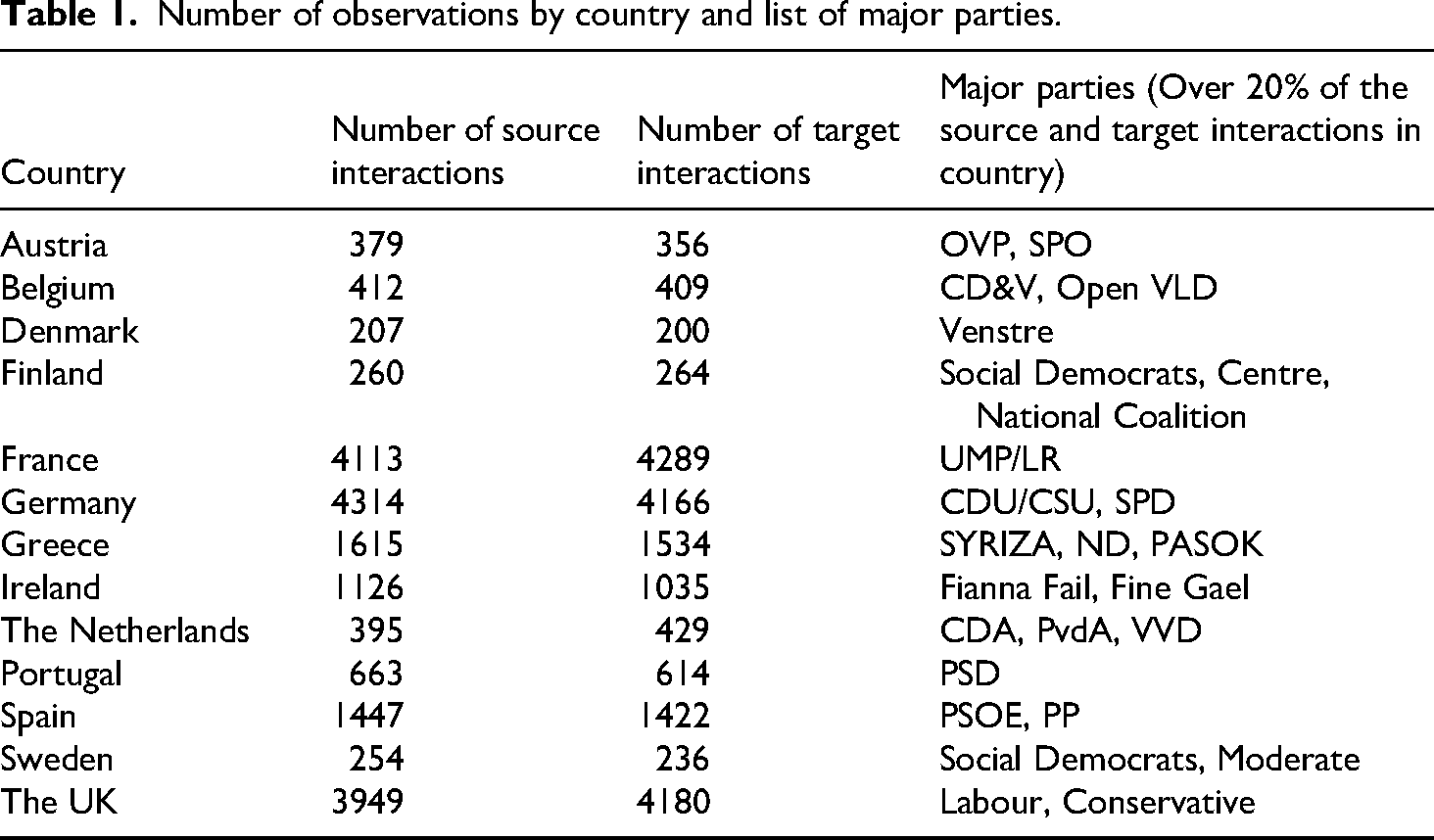
Number of observations by country and list of major parties.
Incidence of cross-national party conflict as a function of differences over Euroscepticism, populism, and governing status (N = 19,134).
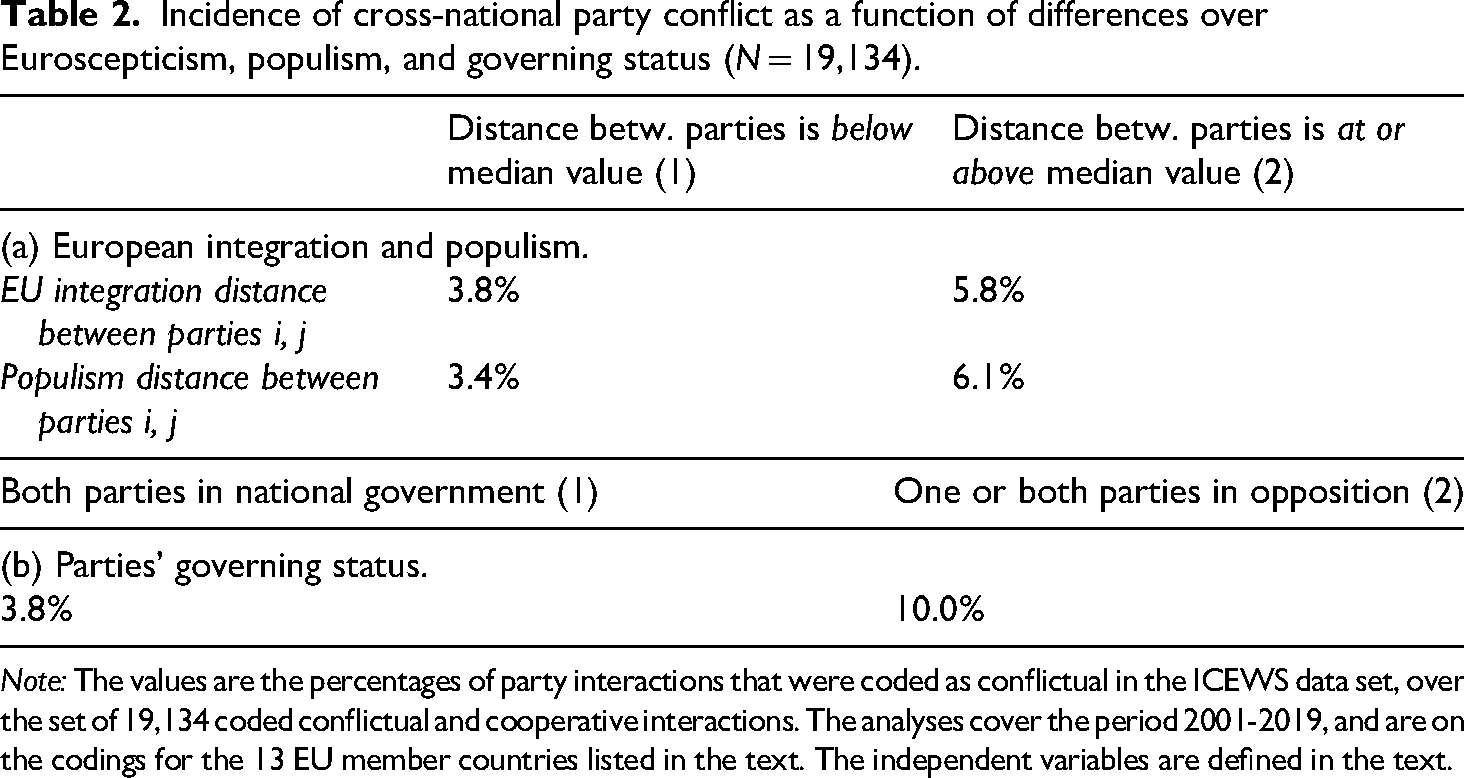
Note: The values are the percentages of party interactions that were coded as conflictual in the ICEWS data set, over the set of 19,134 coded conflictual and cooperative interactions. The analyses cover the period 2001-2019, and are on the codings for the 13 EU member countries listed in the text. The independent variables are defined in the text.
We empirically evaluate our arguments by analyzing event data from the Integrated Crisis Early Warning System (ICEWS) database. These data provide codings of media reports of parties’ cross-national interactions among 13 West European EU member countries, which overwhelmingly concern EU policy, actions of EU member governments, or events with EU-wide significance. We analyze whether parties’ tendencies to interact in a cooperative or conflictual manner with foreign parties are related to their differing degrees of populism and to their positions on European integration. We also control for parties’ differences with respect to domestic cultural and economic policies, and their national governing status. Analyzing almost 20,000 coded media reports of cross-national party interactions between 2001 and 2019, we report the following conclusions.
First, we find evidence that pairs of parties that disagree more sharply over European integration engage in higher proportions of conflictual cross-national interactions, when controlling for differences in their populist orientations and their domestic cultural and economic issue positions. This observational relationship is consistent with our argument that the tone of parties’ cross-national interactions are driven in part by debates over European integration.
Second, we find evidence that when controlling for differences over EU integration, domestic issue debates, and national governing status, parties’ cross-national interactions are far more conflictual the more they differ in populist orientation. To the extent this relationship is causal, it suggests that populism fuels cross-national conflict even more strongly than do EU integration debates. Moreover, this relationship persists when we omit radical right and left populist parties from our analyses: even the populism differences between pairs of mainstream parties—some of which are strongly identified with the political establishment, others of which (such as the British Conservative Party) project an ambivalent orientation toward populism—predict more conflict.
Third, controlling for populism, Euroscepticism, and governing status, we estimate no significant relationship between cross-national conflict and parties’ domestic economic and cultural issue differences. This nonfinding likely reflects a distinction between the dynamics of parties’ domestic and cross-national interactions. For while it is well-documented that parties with similar ideologies within the same system tend to cooperate to form and maintain governing coalitions (or, in opposition, to cooperate in opposing the government), these domestic dynamics appear irrelevant to parties’ cross-national interactions.
Although many scholars emphasize the new transnational cleavage's impact on member countries’ domestic politics (e.g. Hooghe and Marks, 2018), we explore its relevance to cross-national, elite-level interactions. Since EU laws and policies are decided by qualified majority or unanimity, party elites’ cross-national conflict affects the European Union's functioning.
Cross-national party conflict and cooperation within EU member states: Hypotheses
We study interactions among party elites within the European Union, which we classify as either cooperative or conflictual. In our data, based on media reports of cross-national inter-party communications, cooperation typically involves declarations of agreement, acknowledgement of shared goals, or pledges to cooperate. Conflictual interactions typically express demands, accusations, threats, or refusals to cooperate. We consider how parties’ populist orientations and positions on European integration may drive cross-national conflict and cooperation between parties from different EU member states.
Cross-national party conflict and disagreements over European integration
Since passage of the Maastricht Treaty in 1992, the political relevance of “Euroscepticism”—a political stance involving some level of opposition to European integration—has increased significantly (Hooghe and Marks, 2008; Taggart, 1998; Usherwood and Startin, 2013), to the consternation of Europe's mainstream parties who long sought its depoliticization (Hutter and Kriesi, 2019). While “hard” Eurosceptic parties, such as the now defunct United Kingdom Independence Party or Greece's Communist Party, support exiting the EU, most current Eurosceptic parties advocate scaling back the EU's domestic political influence. For example, Hungary's FIDESZ wants to renegotiate the terms of EU membership, to “decouple E.U. membership from the values and the processes of liberal democracy” (Vachudova, 2019, 702). Both the French National Rally and the Alternative for Germany advocate rolling back the requirement that EU member states’ national legislation must conform with the entirety of EU law, which constrains national governments’ leeway to implement their preferred domestic policies (Reungoat, 2015). Furthermore, Russia's invasion of Ukraine has re-ignited debates over deepening integration, while exposing disputes over EU responses relating to sanctions and energy pricing (Genschel et al., 2023).
Disputes over European integration play out formally within the institutions of the European Union, especially the European Council and European Parliament. Disputes over European integration also play out informally through direct interactions in which party elites publicly praise or oppose other member governments’ and parties’ stances.
European integration is one of the most contentious ongoing debates within the European Union, and we expect this to be reflected in cross-party interactions. Thus, the considerations outlined above motivate our first hypothesis:
Populism and cross-national party conflict
We expect populism to provoke cross-party conflict, independently of parties’ stances toward European integration or other policy debates. While strictly programmatic parties compete over policy positions and priorities, populist parties explicitly bifurcate society into the (good) people and the (corrupt) elite (Hawkins and Rovira Kaltwasser, 2018; Mudde, 2004), while portraying mainstream parties as agents of a corrupt establishment working against ordinary peoples’ interests (Bonikowski and Gidron, 2016). Populists claim to speak on behalf of their people whose sovereignty and national identity are threatened. In the cross-national context the “corrupt” elites who populists attack include the representatives of European institutions along with mainstream party elites in other countries. For example, in October 2012, Alexis Tsipras, the leader of the opposition Greek Syriza Party, criticized German Chancellor Angela Merkel and her government's policies on debt relief for Greece, claiming that “She does not come to support Greece, which her policies have brought to the brink. She comes to save the corrupt, disgraced and servile political system.” In response, “Chancellor Angela Merkel's allies and the leaders of her center-left coalition partners condemned Greece's leftist government, reflecting pent-up public frustration.”1 We expect populist parties’ portrayals of mainstream party elites as corrupt insiders to provoke mutual anger, in ways that Euroscepticism by itself does not.
Research on Western politics identifies a populist-versus-technocratic cleavage that is distinct from the left-right dimension (Moffit, 2018; Stavrakakis et al., 2018), while studies on cross-party anger and hostility in mass publics support this expectation. Gidron et al. (2023) analyze 20 western publics, showing that mainstream parties’ supporters dislike radical right populist parties much more intensely than can be explained by policy disagreements alone, and that radical right partisans in turn disproportionately dislike mainstream parties. And Davis et al. (2024) find that increased populist party support intensifies distrust and hostility among both populist parties’ supporters and their opponents. These considerations prompt the following hypothesis, which we expect to apply in analyses that control for parties’ differing stances toward European integration:
Additional controls
Parties’ governing status
Domestic political interactions between co-governing parties are generally cooperative, even given disagreements over policy (Weschle, 2018). Although there is no EU-level analog to a domestic governing coalition, member countries’ governing parties interact frequently in EU policymaking institutions, forming working relationships with like-minded colleagues (Heisenberg, 2005; Warntjen, 2010). Just as members of the governing coalition in parliamentary systems share responsibility for policymaking and therefore seek to avoid public conflict, EU member countries’ ministers and chief executives share collective responsibility for decisions that affect the pace and scope of European integration. Furthermore, government representatives face pressure to behave diplomatically on the international stage, which should promote cooperative cross-national interactions involving governing parties. Moreover, members of the European Council and Council of the European Union come from member countries’ sitting governments and are responsive to their domestic audiences, signaling their national parliaments as they negotiate European Union level decisions (Hagemann et al., 2019). These considerations suggest that parties’ governing status may affect their interactions with governing parties from other EU members; therefore, we control for parties’ governing status in all our models.
Parties’ positions on domestic issues
While leaders of member-country governing parties conduct highly visible cross-national debates and negotiations over the scope of European integration, it is less clear how issues that fall within the jurisdiction of domestic policymaking, such as taxation, government spending priorities, healthcare provision, or educational standards, affect parties’ cross-national interactions. This question is interesting because theoretical considerations point in conflicting directions. On the one hand, previous research documents that in domestic politics, parties interact more cooperatively when they share more similar positions on issues (Gidron et al., 2023; Weschle, 2018), and ideologically similar parties are more likely to co-govern (Golder et al., 2012). Furthermore, within the EU, ideologically similar parties organize into party groups within the European Parliament, and a leader of the largest such group is typically elected President of the Commission.
On the other hand, the Commission itself is not selected by the European Parliament; thus, the dynamic of government formation is absent at the EU level. Hence the coalition incentives which foster warmer cross-party relations between domestic parties with similar ideologies are irrelevant to parties’ cross-national interactions. Moreover, when cross-national parties’ divergent left-right positions prompt them to adopt different stances toward EU mandates pertaining to economic convergence, social convergence, immigration, and minority rights, any resulting conflict should manifest itself primarily in disagreements over the scope of these EU mandates—which are facets of the broader EU integration debate—not in direct conflict about domestic policy debates.
The above considerations suggest that the motivations that prompt cooperation between like-minded parties in domestic politics may be absent with respect to cross-national interactions. Given these conflicting considerations, we control for parties’ cultural and economic domestic policy positions in our subsequent empirical analyses.
Data and measurement
To evaluate our hypotheses we analyze cross-national, elite-level, inter-party cooperation, and conflict as reported in news accounts, utilizing large-scale machine-coded event data that capture public cooperation and conflict between party elites from different countries. We analyze elites’ interactions across 13 EU member states between 2001 and 2019: Austria, Belgium, Denmark, Finland, France, Germany, Greece, Ireland, the Netherlands, Portugal, Spain, Sweden, and the United Kingdom.2 Here we briefly describe these data and our variable construction.
Machine-coded news reports
The raw material for our cross-national, inter-party interactions measure comes from the ICEWS dataset, which contains machine-coded event data about interactions between political and other societal groups beginning in 2001. The US government collected these data as a tool to forecast international crises (O’Brien, 2013) and they are publicly available (see Boschee et al., 2015). The ICEWS source material are the news reports from Factiva and the Open-Source Center, the two largest existing media repositories, which collect all reports published in hundreds of newspapers, magazines, and newswires. A natural language analysis system (Ramshaw et al., 2011) extracts and identifies event classifications providing the event source, the target, and the event type, for example, as “criticize and denounce,” “praise,” etc. The data includes codings of news reports of interactions between actors within the same country, which we do not analyze here, and codings of parties’ reported cross-national interactions which are the topic of our study. We analyze direct interactions between parties, that is, those in which the elites from a given party i in country A are the “sender” and the elites from a party j in country B are the “target.”
We further process the event information in two ways. First, all politicians from the same party are aggregated into a unified actor. Second, we simplify the event type coding into either cooperative or conflictual. For example, consider the following statement by British Prime Minister Tony Blair regarding French President Nicolas Sarkozy: “Nicolas is someone with whom I have worked on several occasions, who I admire and who I consider a freiend” (Agence France-Presse, 2007). This public event enters the data as follows: the event source is the Labour in the UK (Blair's party), the target is President Sarkozy's Union for a Popular Movement in France, and the event type is coded as cooperative. By contrast the news report from 2012 referenced earlier, in which SYRIZA's leader, Alexis Tsipras, denounced Chancellor Angela Merkel, is coded as a conflictual interaction initiated by SYRIZA which targets the German CDU/CSU (Merkel's party). The Supplemental appendix discusses machine coding accuracy and data limitations, information on media sources, a list of event types coded as cooperative and conflictual, and it includes descriptive statistics.
Over time, many news reports appear that chronicle cooperative and conflictual party interactions. Some pairs of parties i, j in countries A, B may usually cooperate, whereby the elites from these parties publicly consult with each other, praise each other's competence, forge foreign policy agreements, and so on. Other party pairs may display more conflictual interactions in which they publicly disagree or disparage each other's leadership. Note that the tones of party elites’ interactions need not be reciprocal, that is, the elites from party i in country A may at times publicly attack party j in country B, while party j's leadership ignores the attack.
Thus, our data consist of interactions between pairs of party elites as reported in the media, which are coded as cooperative or conflictual based on the tone of the interactions. Figure 1 displays the number of interactions recorded in our data in each year (gray bars) as well as the proportion of these yearly interactions that were coded as conflictual (blue loess smoother line). Figure 1 shows that although the raw number of interactions between political parties recorded by ICEWS varies sharply over time, the yearly proportion of conflictual interactions has remained consistently low. This makes sense in the context of the generally constructive interactions between European Union member states. However we posit that where conflict does exist, it is most likely to appear between parties who differ on European integration and populism. Table 1 gives a breakdown of interactions by country, including a list of parties appearing in the lion's share of interactions for each country.
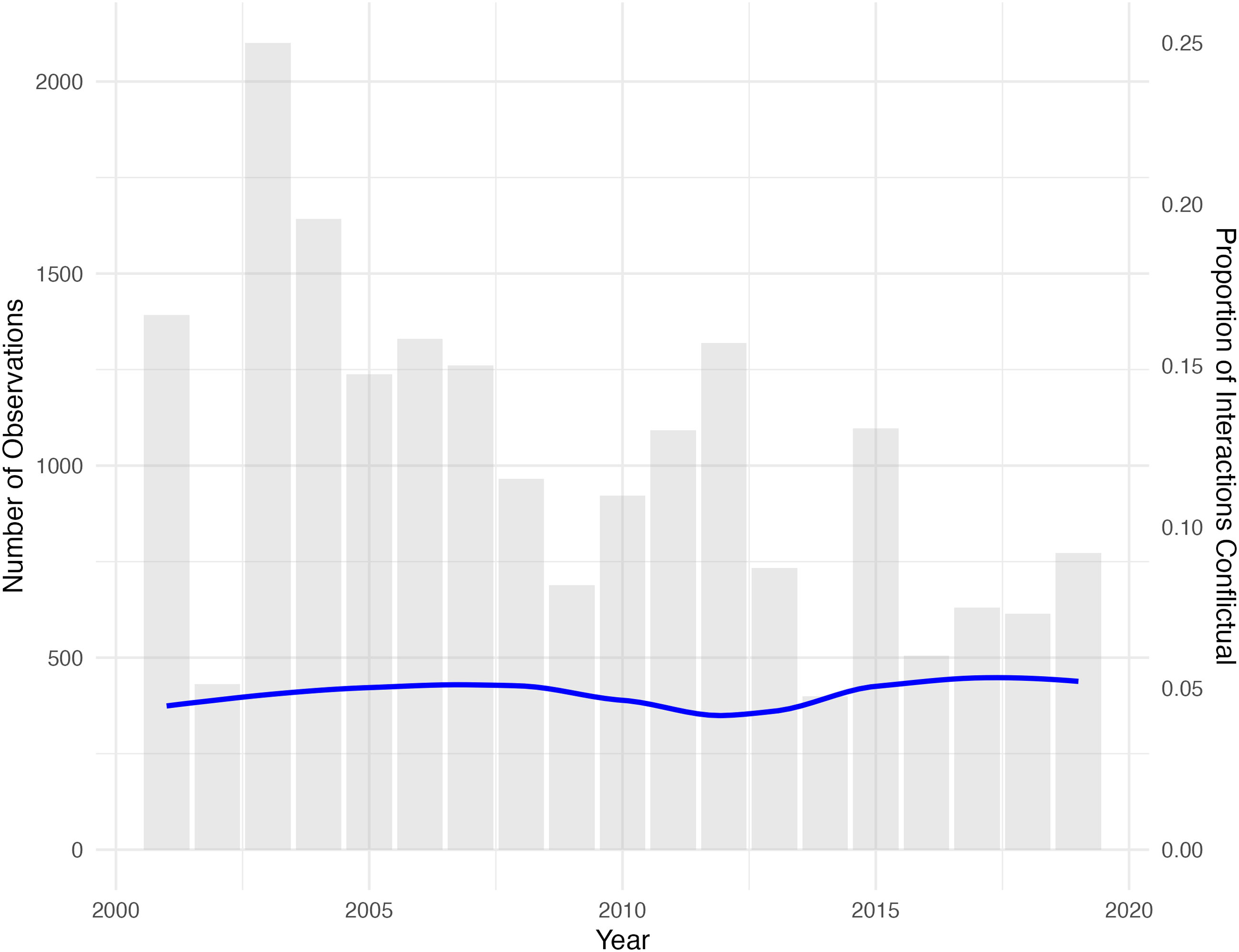
Average conflict and number of interactions over time.
Comparing coded media reports of elites’ cross-national interactions
While we believe our measure represents the most comprehensive media-based estimate of cross-national, inter-party cooperation, and conflict devised to date, it cannot perfectly capture the true tenor of all cross-national party interactions, let alone these elites’ sincere feelings toward each other. Weschle (2018) notes that the ICEWS codings of national media reports may disproportionately cover national party leaders’ behavior, with more limited coverage of local politicians and backbench MPs. The counterpoint to this caveat is that interactions involving party leaders (and other high-ranking elites) are typically more consequential than those involving backbenchers or local politicians, especially at the international level. Furthermore, many important EU-level policy decisions are made by members of domestic governments, who by definition are party elites serving in EU level institutions. Deliberations about such decisions are among the most consequential cross-national inter-party interactions within the EU and are examples of the types of interactions included in the ICEWS data. Finally, studies from multiple European countries report strong issue and frame convergence between parties’ actual messaging and media coverage of these messages (e.g. Merz, 2017; Wirth et al., 2010).
A second concern is that different countries’ media systems may vary in ways that generate different balances of reported cooperative versus conflictual party interactions. Elites also at times strategically engage in “performative” cross-national interactions that do not necessarily reflect their underlying attitudes. As discussed above we expect that diplomatic considerations sometimes prompt governing parties to performatively initiate cooperative cross-national interactions. However we see this as a feature of our study, not a bug: performative actions have consequences—which is why elites perform them!—and we seek to explain and predict how elites actually behave, regardless of their sincerity.
The above considerations suggest that we should not naively interpret the ratio of the ICEWS coded media reports of cooperative versus conflictual cross-national interactions as a reliable measure of the actual tones of all relevant elite interactions. Therefore, we include country fixed-effects for both the “sending” and “target” parties in our analyses, which should capture cross-national differences in media systems, including different systems’ biases toward reporting political conflict as opposed to cooperation. Furthermore, by recognizing that we analyze the tenor of elite interactions, whether sincere or performative, we can address the question: When analyzing interactions between the party elites from countries A and B, what are the characteristics of those party pairs which display higher versus lower proportions of reported cooperative interactions, relative to conflictual interactions? We proceed by examining this question empirically.3
Measuring the independent variables
It is common to refer to parties as “Eurosceptic” or “populist,” as we do when referring to Hungary's Fidesz or France's National Rally. However, parties not commonly identified as populist or Eurosceptic may employ populist rhetoric or advocate policies identified with populism or Euroscepticism. For these reasons, best practices suggest measuring the degree of Euroscepticism and populism for all parties along a continuum, which is what we do in our analyses.
To evaluate the European integration hypothesis (H1), that parties’ cross-national interactions are more likely conflictual as their European integration positions diverge, we measure parties’ European integration positions in two ways. In model 1 we use the Manifesto Project Dataset's (MPD) party manifesto codings for European Parliament elections which are generated using the MPD's manifesto coding method (Lehmann et al. 2023). Higher values denote a more pro-European integration position. Our MPD Euroscepticism distance variable is the absolute value of the difference between party i and j's coded orientations toward European integration, labeled [EU integration difference between parties i, j in countries A, B]. In model 2 we use the CHES index party placements on European integration (Jolly et al., 2022).4 We construct our party Euroscepticism difference variables using parties’ most recently measured positions, so that for instance our Euromanifesto-based party difference measure in the 2010 calendar year is based on their manifesto codings from the 2009 European Parliament elections.5
To evaluate the populism differences hypothesis (H2), that the greater the difference between cross-national parties’ degrees of populism the more likely their interactions are conflictual, we measure populism using the Varieties of Democracy's V-Party database (Lührmann et al., 2020) which provides party populism scores stretching back decades, based on expert codings of parties’ pro-people and anti-elite rhetoric. Higher values denote more populist parties. For each cross-national interaction in our dataset, we take the absolute value of the difference between party i's and party j's populism score to create our Populism Distance variable, [Populism difference between parties i, j in countries A, B].
While Eurosceptic parties are often populist and vice versa, these are distinct phenomena in that some populist parties are not Eurosceptic (such as SYRIZA in Greece) and some Eurosceptic parties are not populist (such as the Left Bloc in Portugal in its early days). Indeed, our party populism and Euroscepticism measures correlate only modestly (at about 0.3–0.4), across parties from the 13 countries in our dataset. Figure 2 displays this relationship, using the MPD codings to measure party Euroscepticism (Figure 2(a)), then using the CHES codings (Figure 2(b)). While these figures suggest there are two clusters of parties—a large group of lower-Euroscepticism and lower-populism parties and a much smaller cluster of high-Euroscepticism, high-populism parties—the figures reveal a great deal of variation, Furthermore the correlation between Euroscepticism and populism is only 0.18 when using the Manifesto Project Data and 0.47 when using the CHES index, reinforcing the idea that these are separate phenomena.
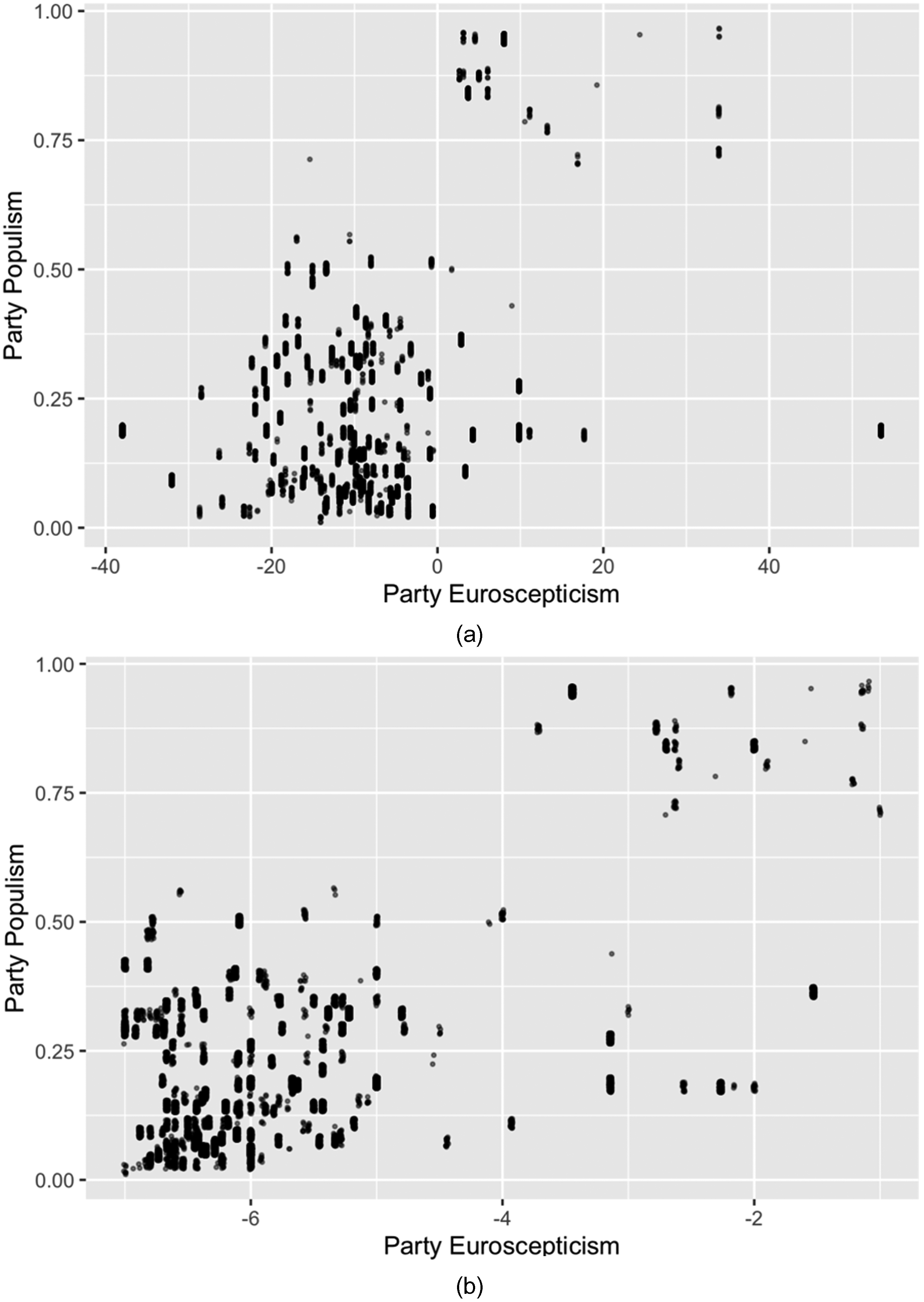
Parties’ degrees of populism versus their Euroscepticism. (a) Party Euroscepticism measured using the Manifesto Project Database codings. (b) Party Euroscepticism measured using the CHES experts’ party placements.
Our models also include dummy variables to control for whether the party that was coded as initiating the cross-national interaction was currently in the national government, [Sending party i is currently in government], and for whether the target party was in the national government, [Target party j is currently in government]. This data is taken from the PARLGOV database (Döring et al., 2022).
We include control variables to capture inter-party differences along two, cross-cutting, dimensions of domestic policy debate, namely economic policy and cultural issue debates pertaining to minority rights, immigration, and national identity. A description of how we measure party differences along each dimension, using both the MPD national election manifesto codings of parties’ and the CHES experts’ party placements, is included in the Supplemental appendix. We control separately for the economic and cultural dimensions for two reasons, first because Gidron et al. (2020, 2023) find that citizens’ hostility toward political opponents is more strongly related to cultural than to economic policy disputes, so that we separate these two dimensions when analyzing elite interactions. Second, parties with more conservative cultural positions also tend to be more populist, so that failure to control for cultural positions introduces omitted variable bias (the correlation between parties’ cultural positions and their degree of populism is −0.275 when measuring cultural positions using the MPD codings and is −0.51 when using the CHES codings).
Finally, we control for country and year fixed effects to capture omitted variables including differences in each country's national media system along with temporal influences such as the global financial crisis that began in 2009 and the migration crisis that began in 2015.
Results
Table 2 presents simple cross-tabulations that bear on our hypotheses, on the 19,134 coded media reports of cross-national party cooperation and conflict in the ICEWS dataset from the 13 countries in our study between 2001 and 2019, for which we have measures of party populism levels and their positions with respect to Euroscepticism, cultural, and economic issues. The top row in Table 2a reports the share of party interactions that were coded as conflictual as a proportion of all conflictual or cooperative interactions, first for interactions between pairs of parties whose MPD-based Euroscepticism distance was below the median value in the dataset (column 1), and then for all party pairs with distances at or above the median (column 2).6 The proportion of conflictual interactions is below 10% for both sets of parties, that is, parties’ interactions are mostly cooperative. However, the patterns support the European integration hypothesis (H1): the proportion of conflictual interactions for parties with larger measured Euroscepticism distances, 5.8%, is significantly greater (p < .01) than for pairs of parties with smaller differences, 3.8%.7
Row 2 in Table 2a reports the proportion of conflictual cross-national interactions for pairs of parties whose measured populism difference was at or above the median value in the dataset, 6.1%, and then for party pairs below the median populism distance, 3.4%. This difference is significant (p < .01) and supports the populism difference hypothesis (H2), that the greater the difference between parties’ degrees of populism the more conflictual their interactions.
Table 2b reports proportions of conflictual interactions between pairs of parties who were both in government (column 1), and when one or both parties were in opposition (column 2). As expected, the proportion of conflictual interactions is higher when one or both parties was in opposition (10.0% vs. 3.8%, p < .01).
Multivariate analyses
We next estimated multivariate logit models that accounted for all party characteristics simultaneously along with country and year fixed effects, where the outcome variable was a dummy variable that equaled 1 if the cross-national party interaction was coded as conflictual, and zero if it was coded as cooperative. We ran our analyses on the 19,134 coded cooperative and conflictual ICEWS cross-national party interactions, once using the Manifesto Project Dataset to measure Euroscepticism distance and the economic and cultural policy distance controls, and a second time using the CHES data. To account for likely heteroskedasticity we cluster standard errors at the party-dyad level. We also ran models using two-way clustered standard errors, clustering for both source and target countries. The results are substantively identical to the results we report in the main text (see the Supplemental appendix).
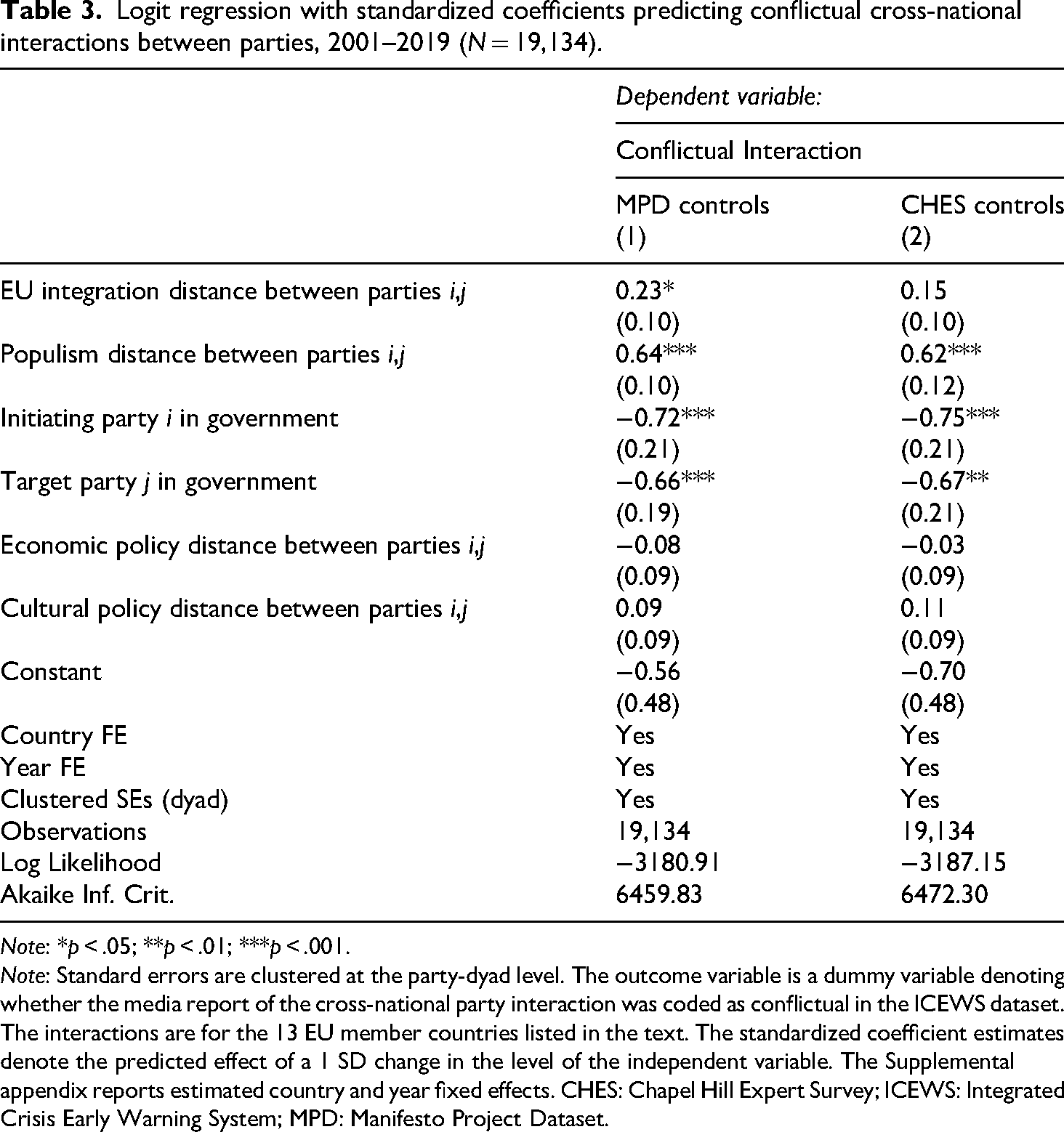
Table 3 displays our results when using the the Manifesto Project Data measures of party positions (column 1) and the CHES measures (column 2). Note that all results are displayed as standardized coefficients. The results strongly support our hypothesis that cross-national, elite-level conflict is linked to party differences with respect to populism but provide mixed support for our hypothesized link to differences on European integration. With respect to populism, the estimates on the [Populism distance between parties i, j] variable, which are roughly +0.64 (p < .001) for both datasets, support our populism differences hypothesis (H2), implying that a 1 SD increase in parties’ populism differences increases their probability of conflict by a factor of roughly 1.9, all else equal, that is, it nearly doubles the predicted conflict probability.8 Thus a party pair whose predicted conflict probability is 5% given their observed level of populism distance would see this predicted probability rise to roughly ((0.05/1 − 0.05) × 1.9) = 10% if their populism distance increased by one standard deviation, all else equal.
Logit regression with standardized coefficients predicting conflictual cross-national interactions between parties, 2001–2019 (N = 19,134).
Note: *p < .05; **p < .01; ***p < .001.
Note: Standard errors are clustered at the party-dyad level. The outcome variable is a dummy variable denoting whether the media report of the cross-national party interaction was coded as conflictual in the ICEWS dataset. The interactions are for the 13 EU member countries listed in the text. The standardized coefficient estimates denote the predicted effect of a 1 SD change in the level of the independent variable. The Supplemental appendix reports estimated country and year fixed effects. CHES: Chapel Hill Expert Survey; ICEWS: Integrated Crisis Early Warning System; MPD: Manifesto Project Dataset.
With respect to EU integration, the results using MPD data reported in column 1 support our European integration hypothesis (H1). The estimates on the [EU integration distance between parties i, j] variable are about +0.23 (p < .01), implying that a one standard deviation increase in parties’ European integration distance increases their odds of conflict by a factor of roughly 1.2, when controlling for party populism differences, economic and cultural issue distances, governing status, and country-year fixed effects.9 This implies that a party pair whose predicted likelihood of conflict is 5% given their observed level of Euroscepticism distance would see this predicted probability rise to roughly ((0.05/1–0.05)) × 1.26) = 6.6.% if this distance increased by 1 SD, all else equal. However, these results are not fully replicated using the CHES data as reported in column 2. The coefficient for [EU integration distance between parties i, j], is positive, drops to roughly 0.15, falling out of statistical significance. While differences over European integration contribute to conflict in cross-national party interactions, parties’ differences over populism contribute much more strongly. Indeed, our results suggest that populism is the primary driver of cross-national elite conflict within the European Union.
Our estimates on the populism distance and (somewhat weaker) European integration variables are important, first, because they imply that populism differences intensify cross-national party conflict independently of parties’ European integration differences (and of their differences with respect to domestic economic and cultural policy debates). Second, our estimates imply that populism differences provoke more cross-national party conflict then do differences over European integration. Our standardized coefficient estimates imply that a 1 SD increase in the populism distance between parties nearly doubles the predicted probability of a conflictual interaction, while a 1 SD European integration distance increase raises this probability by a factor of only about 1.2 (and then only when using the MPD data). Moreover, recall that parties’ measured degrees of populism correlate only moderately with their measured positions on European integration (see Figure 2 above). Simply put, parties’ European integration positions are more weakly connected to their populist orientations than is commonly supposed, and it is party populism differences that are more strongly linked to the tenor of cross-national interactions. And as we discuss below, this strong populism effect is not primarily driven by interactions involving radical populist parties of the right and left: the effect persists when we omit these parties from our analyses, that is, populism differences can drive conflict even between pairs of mainstream parties with moderately different populist orientations.
Figure 3 illustrates how varying party differences with respect to European integration and populism affect the predicted probability that a cross-national interaction is conflictual.10 In both panels, the vertical axis displays the predicted probability of a conflictual cross-national interaction, while the horizontal axis displays party differences with respect to European integration (Figure 2(a)) and populism (Figure 2(b)), with the levels varying from roughly 1 SDs below to 2 SDs above the median value in the dataset. We see that as parties’ European integration differences increase across this range, the predicted conflict probability rises from about 20% to 30% (with all other variables held constant), while when parties’ populism differences increase across this range the predicted conflict probability increases much more sharply, from about 15% to 50%.
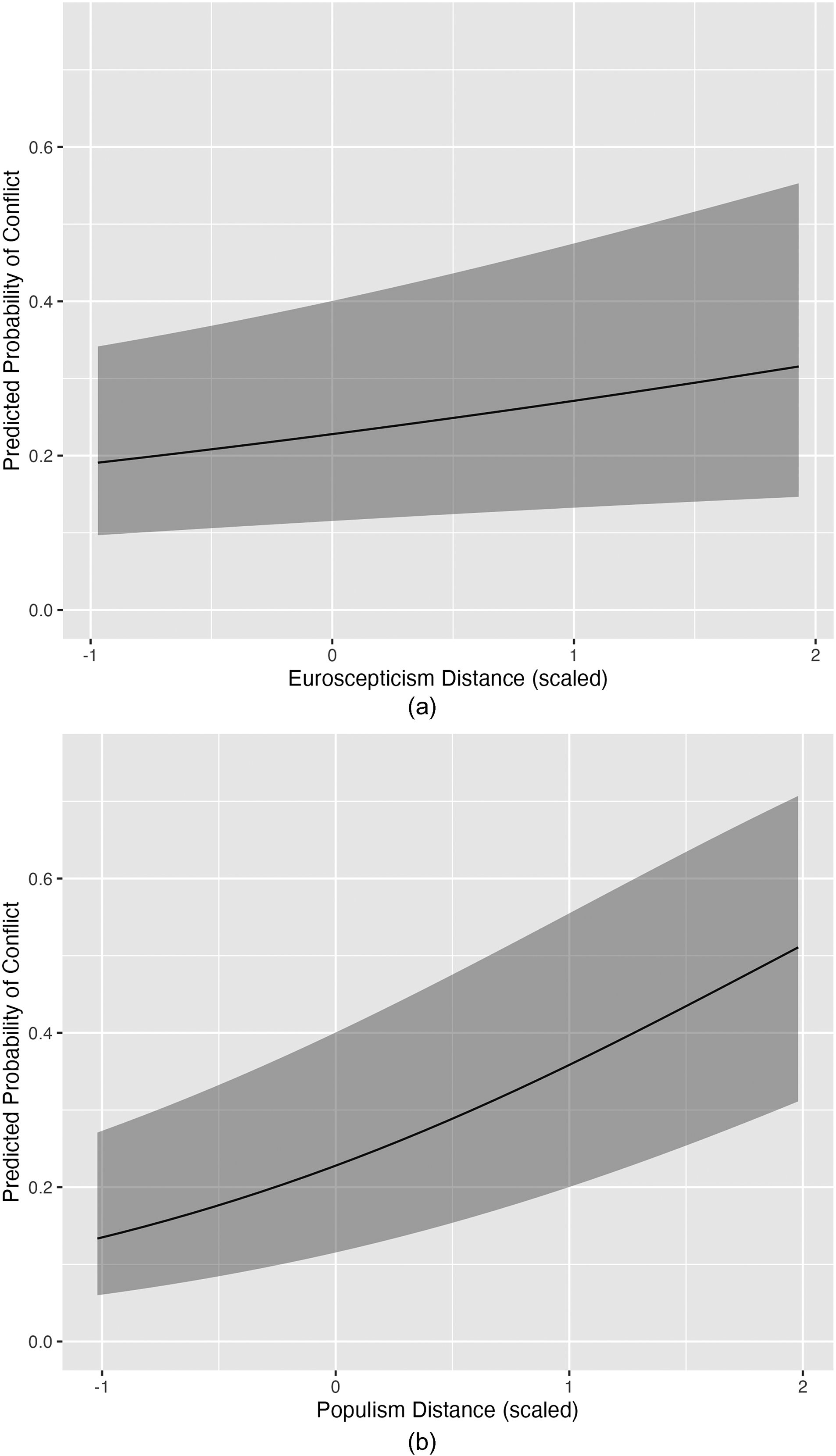
Predicted probabilities of a conflictual cross-national interaction as a function of party differences over European integration and populism. (a) European integration differences. (b) Populism differences.
With respect to governing status, a key control in our analysis, the estimates on the variables [Initiating party i is currently in government] and [Target party j is currently in government], which are in the range of −0.66 to −0.75 (p < .01) for both variables in both datasets, implying that a party switching from opposition to governing status decreases their odds of conflict by a factor of roughly 0.49, all else equal.
Finally, we detect no evidence that party differences with respect to domestic policy debates over economic issues are associated with higher incidence of conflict: the estimates on the [Economic policy distance between parties i, j] and [Cultural policy distance between parties i, j] variables are near zero and insignificant for both the MPD-based and the CHES-based data analyses.
Robustness checks
First, to assess whether our conclusions were driven by a single outlier country among the 13 countries in our study, we re-estimated our models while omitting one country at a time, first omitting all cases where a party from the focal country initiated the interaction, then omitting cases where a party from that country was the interaction target. These analyses, reported in the Supplemental appendix, continue to support our hypotheses although the estimate on the [Euroscepticism distance between parties i, j] variable falls out of significance in one of the MPD models and at times becomes significant in the CHES models.
Next, we analyzed whether the party populism effects we estimate are primarily driven by interactions involving the most populist parties in our dataset. To explore this issue, we re-estimated our models while omitting interactions involving any party that scored above 0.8 on the V-Dem populism index, thereby omitting all radical right and left parties in our dataset. These analyses, reported in the Supplemental appendix, continue to support the populism differences hypothesis (H2). These estimates suggest that even modest differences in the degrees of populism between two mainstream parties can drive cross-national conflict.
Next, to test whether a simpler, unidimensional measure of parties’ positions on domestic issues yielded different results, we repeated the analysis using both MPD and CHES's measures of a parties’ position on the left-right spectrum, or [Left-right distance between parties i,j].11 In the Supplemental appendix we show that these results are substantively identical to the main results. The support for our two hypotheses is unchanged and domestic policy differences still have no measurable relationship with the level of conflict parties direct cross-nationally.
Finally, because the V-Dem party populism measures are based on experts’ retrospective estimates of party populism rather than contemporaneous estimates, we re-estimated our models on the data from recent time periods (first from 2010 onwards, then from 2011 onwards), thereby omitting the earlier in our dataset for which the party populism estimates may be less reliable. These analyses, reported in the Supplemental appendix, continue to support all our substantive conclusions.
Discussion
Populist and Eurosceptic parties’ growing popular support has created a new transnational cleavage challenging European integration. Analyzing nearly 20,000 coded news reports of cross-national party interactions in 13 EU member states between 2001 and 2019, we analyze how elite-level, cross-national party conflict and cooperation is related to parties’ differing orientation toward European integration and, especially, populism. We argue and empirically show that parties’ European integration disagreements are related to cross-national conflict, and also that parties’ differing populist orientations—which are less strongly related to Euroscepticism than is commonly believed—are associated with elite conflict independently of Euroscepticism, and indeed to a greater degree. These relationships obtain even in analyses that exclude radical right and left populist parties. To the extent these are causal relationships they imply that it is differences over populism, and its Manichean premise that mainstream parties are agents of a corrupt establishment working against ordinary peoples’ interests, which are key drivers of cross-national party conflict, over and above specific debates over European integration. We also estimate that governing parties display diminished incidences of cross-national conflict, possibly because of the exigencies of international diplomacy, and we detect no evidence that conflict is related to party differences over domestic policy debates on economic or cultural issues.
Our arguments and empirics extend previous research on elite-level, interparty conflict from domestic politics (see, e.g. Weschle, 2018; Lucas and Sheffer, 2025) to the cross-national level. Our findings on the relationship between party populism differences and elite conflict also extend previous research on mass-level affective polarization, that links parties’ differing populist orientations to their supporters’ mutual dislike (e.g. Davis et al., 2024; Fuller et al., 2022).
We see several promising directions for future research. First, we could extend our analyses of the tones of parties’ cross-national interactions to analyze the volume of such interactions, that is, what are the characteristics of pairs of parties that interact more or less frequently on the international stage? Second, we could explore the impact of additional structural factors that plausibly inflame the tones of parties’ cross-national interactions. For instance, do parties initiate higher (lower) proportions of conflictual cross-national interactions around the times of national elections or elections to the European Parliament, or during domestic economic recessions? Are governing parties that are unpopular domestically inclined to provoke cross-national conflict, as scholars have speculated (Pickering and Kisangani, 2005; Haynes, 2017). And do parties’ patterns of cross-national cooperation and conflict tend to change when they change their leaders?
Second, one could parse out the causal mechanisms driving the observational patterns we detect. While it seems problematic to experimentally manipulate party elites’ incentives, we could qualitatively analyze their cross-national interactions, in an effort to unpack the substance of elites’ cooperation and conflict. For instance, are cross-national conflicts between parties with differing populist orientations typically related to the core substance of populism, that is, the alleged corruption and unresponsiveness of political institutions, or are these sometimes “proxy” conflicts where parties with differing populist orientations pick fights with each other over whatever issue comes to hand? Related, we could extend our analyses outside of the European Union member states, to determine how populism conditions cross-national interactions between party elites from other sets of countries.
Supplemental Material
sj-zip-1-eup-10.1177_14651165261450532 - Supplemental material for Who attacks whom? How populism and Euroscepticism drive cross-national conflict between European party elites
Supplemental material, sj-zip-1-eup-10.1177_14651165261450532 for Who attacks whom? How populism and Euroscepticism drive cross-national conflict between European party elites by James Adams, Josephine Andrews, Braeden Davis and Alexa Federice in European Union Politics
Supplemental Material
sj-zip-2-eup-10.1177_14651165261450532 - Supplemental material for Who attacks whom? How populism and Euroscepticism drive cross-national conflict between European party elites
Supplemental material, sj-zip-2-eup-10.1177_14651165261450532 for Who attacks whom? How populism and Euroscepticism drive cross-national conflict between European party elites by James Adams, Josephine Andrews, Braeden Davis and Alexa Federice in European Union Politics
Supplemental Material
sj-docx-3-eup-10.1177_14651165261450532 - Supplemental material for Who attacks whom? How populism and Euroscepticism drive cross-national conflict between European party elites
Supplemental material, sj-docx-3-eup-10.1177_14651165261450532 for Who attacks whom? How populism and Euroscepticism drive cross-national conflict between European party elites by James Adams, Josephine Andrews, Braeden Davis and Alexa Federice in European Union Politics
Footnotes

Funding
The authors disclosed receipt of the following financial support for the research, authorship, and/or publication of this article: This work was supported by the University of California Davis.
Data availability statement
Data sharing not applicable to this article as no datasets were generated or analyzed during the current study.
Supplemental material
Supplemental material for this article is available online.
Notes
References
Supplementary Material
Please find the following supplemental material available below.
For Open Access articles published under a Creative Commons License, all supplemental material carries the same license as the article it is associated with.
For non-Open Access articles published, all supplemental material carries a non-exclusive license, and permission requests for re-use of supplemental material or any part of supplemental material shall be sent directly to the copyright owner as specified in the copyright notice associated with the article.
