




Abstract
Contemporary international organizations face pressure to be more effective and accountable. But reforming them is challenging given stringent supermajority voting requirements and increasingly critical publics. Some argue that institutional preferences are endogenous to policy, or policy-elastic. Are there policy-inelastic institutional preferences? And are there viable European Union (EU) reform packages? We tackle these questions through a conjoint experiment in 16 EU countries. The evidence shows that majoritarian institutional reforms and stronger legal enforcement powers are supported independently of policy. Finally, results from a Bayesian finite mixture model identify combinations of institutional and policy reforms that could command broad public support. The study is significant for the understanding of institutional preferences, as well as for EU reform processes.
Introduction
Current international and supranational organizations are facing pressure for reform in order to address ongoing policy-delivery and accountability challenges (Börzel and Zürn, 2021; De Vries et al., 2021; Dellmuth et al., 2022; Kelemen and McNamara, 2022). For example, following Brexit, the Conference on the Future of Europe and the war in Ukraine, European Union (EU) institutional reform is once again high on the political agenda (Hahm et al., 2020; Hix and Høyland, 2022; Kelemen and McNamara, 2022). Institution-building in supranational organizations, such as the EU, is particularly urgent, since their incomplete and/or uneven policy frameworks are the key cause of policy failure (Kelemen and McNamara, 2022). Some scholars argue that uploading more majoritarianism to the supranational level is a solution, as this would ensure that policy outcomes are preferred by a majority of citizens, and as majoritarian rules enjoy higher input legitimacy and likelihood of losers’ consent (Bellamy, 2013; Held, 2006; Hix, 2013).
In the face of rising critical attitudes of citizens towards supranational organizations, such reforms are, however, difficult: national governments feel increasingly constrained in their actions beyond the nation-state (Bearce and Jolliff Scott, 2019; Broz et al., 2021; Walter, 2021), for example, on trade (Guisinger, 2017; Mutz, 2021), law (Chaudoin, 2016; Madsen et al., 2022), or economic cooperation (Colantone and Stanig, 2019; Walter et al., 2018). In addition, the path to supranational institutional change is constrained by national vetoes and stringent supermajority – and even unanimity – requirements. It is thus essential to identify which institutional feature commands the broadest public support, if not consensus, across the member states (Dellmuth et al., 2022; Dellmuth and Tallberg, 2015; Tallberg and Zürn, 2019).
Many contend that citizens’ institutional preferences – and particularly in the case of supranational institutions – are chiefly outcome-driven (Majone, 1996, 1998; Scharpf, 1999). Citizens, for instance, might anticipate that majoritarian decision-making procedures would increase the likelihood that their preferred policies are adopted. Related to this, major reforms of supranational organizations have in practice often connected institutional changes to specific policy goals. For example, in the case of the EU, the move to more majoritarian decision-making in the 1980s was combined with the ambitious program to create a “single market” and new social and environmental policies (Moravcsik, 1991). Are moves towards more majoritarian decision-making in the EU likely to garner broad public opinion consent, or would such reforms be conditional on specific package deals? To assess whether a new institutions-plus-policy package could be feasible, we need to understand how far public preferences about institutional designs are conditional on particular policy objectives.
We designed an original conjoint experiment in 16 European countries that examines whether institutional attributes are important for supporting specific EU reforms relative to policy attributes, and/or whether institutional attributes’ effects are conditional on getting one’s way policy-wise. In the design, we pit specific tweaks to the EU executive, legislative and judicial institutions against potential changes in three salient policy areas: climate policy, taxation, and immigration. In a final analysis, we apply a Bayesian finite mixture model (Goplerud et al., 2022) to identify which blend of both institutional and policy reforms could command the widest public support across key voting blocks that would increase the likelihood of Treaty reform being approved.
Our results indicate that some institutional preferences are outcome-inelastic: majority voting and stronger legal enforcement are preferred by the public even relative to a diverse set of salient policies on immigration, climate and taxation, and irrespective of policy (in)congruence. Unanimity voting and the direct election of the EU Commission President, instead, are dependent on getting one’s way policy-wise.
The study makes significant academic and policy contributions. First, it presents original evidence that citizens do hold outcome-inelastic institutional preferences, even in the more obscure context of supranational regimes. Some institutional features, in fact, are favoured regardless of policy outcomes, even in the context of supranational polities. Second, we advance the field of international institutional design by emphasizing the role of public opinion analysis for supranational Treaty reform and by showcasing how conjoint analysis and Bayesian finite mixture models can help to uncover reforms that can command broad consensus among member states’ publics. Third, our analyses are of important significance for Treaty change in the EU, as they set out clear expectations about which design features would yield the strongest public support. In our final analysis we are able to identify the EU reform package deal that could side-step the gridlock hindering the much needed progress on EU treaty change, by leveraging the Bayesian finite mixture model developed by Goplerud et al. (2022). The reform package deal we identify as most likely to garner consensus includes several key features: the direct election of an EU Commission president and lower corporate taxes – to appeal to nationalist-conservative respondents (and where cosmopolitan-progressive groups are indifferent) – and more majoritarian decision-making and stronger EU enforcement – preferred by cosmopolitan-progressives, while nationalist-conservatives are indifferent. In a nutshell: some institutional features have broad public appeal without the promise of specific policy outcomes, but policy-package deals are still useful when Treaty reform is hindered by significant vetoes and supermajority requirements.
Supranational institutional preferences relative to policy outputs
The research focus on public opinion in the field of international institutional design is recent (Kelemen and McNamara, 2022; Tallberg and Zürn, 2019), and only a few studies examine citizens’ attitudes over specific supranational institutional features (Anderson et al., 2019; Hahm et al., 2020). Existing research on public support for supranational organizations has emphasized the importance of institutional accountability (Schneider, 2019; Tallberg and Zürn, 2019), as well as citizens’ attachments to domestic democratic institutions (De Vries, 2018; Ghassim et al., 2022). Anderson et al. (2019) vary the levels of the international institutions’ authority on climate policy to test whether citizens are inherently opposed to policy competence expansion, rendering any attempt at reforms futile. They do not find any authority-accountability link, which paves the way for further research on what citizens want from reforms to international institutions.
Looking specifically at the EU, Hahm et al. (2020) find significant support for the institutional status quo. They also find, though, that respondents particularly dislike unanimous decision-making, while they strongly prefer increasing majoritarianism in the adoption of legislation. There is evidence, though, that citizens are able to consider policy trade-offs when deciding whether to support EU level action. For example, looking at citizens’ attitudes towards EU fiscal integration, Beetsma et al. (2023) and Beetsma et al. (2022) find support for common fiscal capacity and more redistribution to poorer states if combined with strong Commission oversight, no fines for non-compliance, progressive tax financing, and support being conditional on debt reduction during good economic times (cf. Bremer et al., 2024). Similar policy packages that can command majority support amongst EU publics have been identified on common procurement and distribution of medicines (Beetsma et al., 2021), an energy union (Nicoli et al., 2023), and a defence union (Burgoon et al., 2000). Nevertheless, these studies do not directly investigate trade-offs between institutional designs and policy outcomes. Or, put another way, are actor’s institutional preferences in the EU dependent on policy preferences (Majone, 1996, 1998; Scharpf, 1999)?
A classic hypothesis in political science is that institutional reform preferences are endogenous to expected policy outcomes from such reforms: this is the ‘institutional endogeneity hypothesis’ (Boix, 1999; Tsebelis, 1990). An example of this is early 20th century Europe, when liberal and conservative parties feared that universal male suffrage would lead to socialist parliamentary majorities under the existing majoritarian electoral systems, and so replaced these systems with proportional representation (Boix, 1999; Rokkan, 1970). Similarly, in the US context, Riker (1987) predicted that liberals, who favour redistribution, should support US federal institutions, while free market conservatives should oppose them. These ideas also apply to international institutions (Gaikwad et al., 2022): for example, international climate agreements that reflect reciprocity norms and that include features that increase the agreement’s effectiveness receive higher support (Bechtel and Scheve, 2013). Do citizens express support for specific supranational institutions even when presented with policy information? And how do citizens’ institutional preferences vary in relation to ideologically incongruent policy outcomes?
To the best of our knowledge, no study has investigated public support for supranational institutions by directly presenting specific institutional features in combination with salient policy outcomes. It is crucial to establish, for example, whether majority voting in the EU legislature is preferred because respondents anticipate getting their own way policy-wise, or whether majoritarian rules intrinsically have more appeal for citizens, even in the supranational context. This does not simply answer a conceptual question about the existence of institutional preferences, but it also has practical implications as, for example, EU treaty reforms have often been ‘package deals’: negotiated agreements where some policy objectives are adopted in return for institutional change.
To answer these questions, we conducted an original conjoint experiment in 16 European countries – which to our knowledge is the highest number of countries included in a conjoint experiment in political science. We designed the experiment to specifically test citizens’ EU reform preferences when seeing both institutional and policy outputs together. We put various institutional options side by side with policy outcomes to capture ‘inherent’, policy-outcome independent, institutional preferences (Tallberg and Zürn, 2019), and to study the trade-offs between specific institutional proposals and potential policy outcomes. While we do not suggest to respondents that policies are the direct result of specific institutional features, our experiment presents EU reform options priming institutions together with specific policies – thus pre-empting differential predictions on the part of respondents regarding policies that might result from the specific institutional features.
We focus on three policy areas: climate, taxation, and immigration. We chose these areas for several reasons. First, these three policy areas capture the main dimensions of politics in contemporary Europe: an economic dimension (tax policy), a social dimension (immigration policy), and an environmental dimension (climate change policy) (Kenny and Langsaether, 2023; Kriesi et al., 2021). Second, each of these policy areas are significantly shaped by EU policy actions (De Vries et al., 2021). On climate policy, the EU has set out an ambitious ‘European Green Deal’ package of legislation which includes, among other things, at least a 55% reduction in net greenhouse gas emissions by 2030 compared to 1990. On taxation, the EU does not have a direct role in collecting taxes, but does set minimum levels of corporate and sales taxes, and there has been an ongoing debate about whether the minimum corporate tax rate should be increased, to prevent tax competition and to enable member states to increase public spending (e.g. HJI Panayi, 2023). And, on immigration, while the EU does not directly set national immigration policies, the EU sets common rules on the acceptance and processing of refugees and asylum seekers, and there is an ongoing debate about whether the EU should expand the current ‘EU Blue Card’ framework, which allows high skilled workers to apply to work anywhere in the EU. 1 In other words, these are ideal policy issues for our design, as citizens’ preferences on these policies are likely to influence how they evaluate the institutional reform proposals that are presented alongside the policy outcomes. We do not include potential individual or collective costs of policies as our focus is on the direct comparison between institutional and policy preferences. Adding costs could be a possible extension of our design in future research.
To start with, following standard practice with the analysis of conjoint experiment results, we examine the marginal means of the different conjoint attributes. If we see statistically significant marginal means on the institutional attributes, this suggests that the relevant institutional feature has an independent effect on EU reform preferences, above and beyond the other institutional and policy features fielded.
In a second analysis, we further probe the strength of institutional preferences by leveraging the ‘policy congruence’ construct (Mayne and Hakhverdian, 2017). We measure policy incongruence as the difference between an individual’s ideological leanings and the projected policy outcomes. In our case study, each respondent is policy congruent or incongruent with each EU reform bundle in the conjoint task, depending on whether their general ideological (left-right) position (stated at the beginning of the survey) matches or mismatches the specific policy outcomes present in each profile. We then ‘stress-test’ the institutional levels of the conjoint via split-sample testing. This tells us whether policy incongruent individuals differ from policy congruent individuals in their levels of support for specific institutional reforms.
In the third and final analysis, we turn to the package deal concept, and leverage a Bayesian finite mixture model (Goplerud et al., 2022) to identify which institution-policy package deal could command the widest public support across key voting blocks, thereby increasing the likelihood of Treaty reform success. As some institutional features might be outcome-driven, and as strong national vetoes are part and parcel of EU Treaty reform processes, policy outputs can help to see a reform through, so studying institutional preferences in combination with policy output is always recommended. In this analysis we identify ‘clusters’ of respondents and the specific institutional-policy package that is likely to appeal to the different types of respondents. This analysis can provide additional evidence over whether certain institutional provisions are universally well-liked and/or whether a package deal needs to be built that combines institutional features with specific policy outputs. This analysis has also immediate policy implications since it shows what package deals could break the current gridlock over EU Treaty reform.
Data and experimental design
The pre-registered 2 conjoint survey experiment on EU institutional and policy reforms preferences was in the field at the end of April 2022 and ran in 16 countries: Bulgaria, Croatia, Denmark, Finland, France, Germany, Greece, Hungary, Italy, Lithuania, Netherlands, Poland, Romania, Slovakia, Spain, and Sweden. All 27 EU member states could not be included due to budget constraints. We, therefore, picked 16 countries out of the 27 that would be representative of the various EU regions, accession waves, and that also capture different population sizes and institutional traditions. 3 The surveys were carried out by YouGov – see the Online appendix for details of the panel recruitment and sampling method, as well as for information about sample quality and statistical power tests.
Conjoint survey experiments are a useful method to assess the relative importance of multi-dimensional outcomes, as they highlight the relative influence of specific features on individuals’ preferences (Bansak et al., 2021; Bechtel et al., 2017; Hainmueller and Hopkins, 2015; Hainmueller et al., 2014; Jeannet et al., 2021) – in our case whether specific institutional features have independent effects over EU reform choice controlling for other institutional features and policy outcomes. Our design, for example, gives respondents clear information on both institutions and policy outcomes, pre-empting assumptions about the policy effects of specific institutions. It does not field all possible policies and institutional changes, but focuses on the most salient and realistic ones (being currently discussed in EU debates), to avoid complexity and respondent fatigue.
Table 1 illustrates the design of the experiment. We asked respondents to complete four choice tasks. For each task respondents chose between two EU reform ‘packages’, where each package contained a fully randomized combination of three levels across six attributes. In each package, three attributes related to institutions (how the EU Commission is elected, how EU legislative is passed, and the EU’s powers of legal enforcement), and three related to policy (climate change policy, immigration policy, and tax policy).
Conjoint experiment design – attributes and levels.
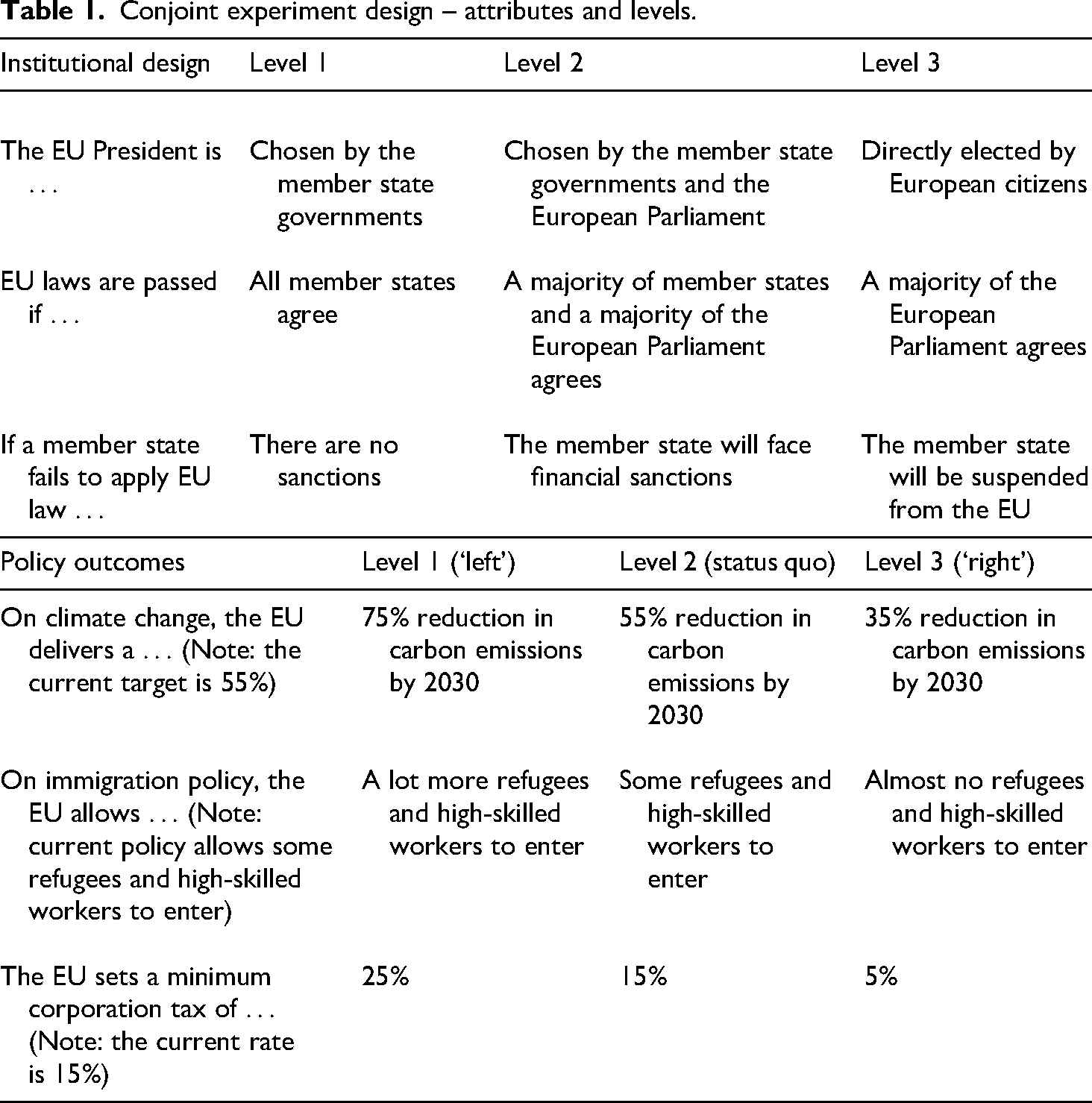
The dependent variable is a forced choice option capturing whether a particular reform package was chosen or not (survey item: which one of these two models do you prefer?). 4 The diagnostics relevant to randomization, order and spillover effects are reported in the diagnostics section in the Online appendix and confirm that the conjoint survey experiment was appropriately designed.
Results
Analysis 1: Pooled marginal means
Figure 1 reports the pooled conjoint analysis marginal means for each level of the attributes. The marginal means capture the effect of a specific attribute level on the probability of picking an EU reform package, controlling for all other attribute levels. A marginal mean of 0.5 means that the particular attribute level does not make a difference in whether one bundle is chosen over the other: the probability of selecting one or the other is equal to chance (50%).
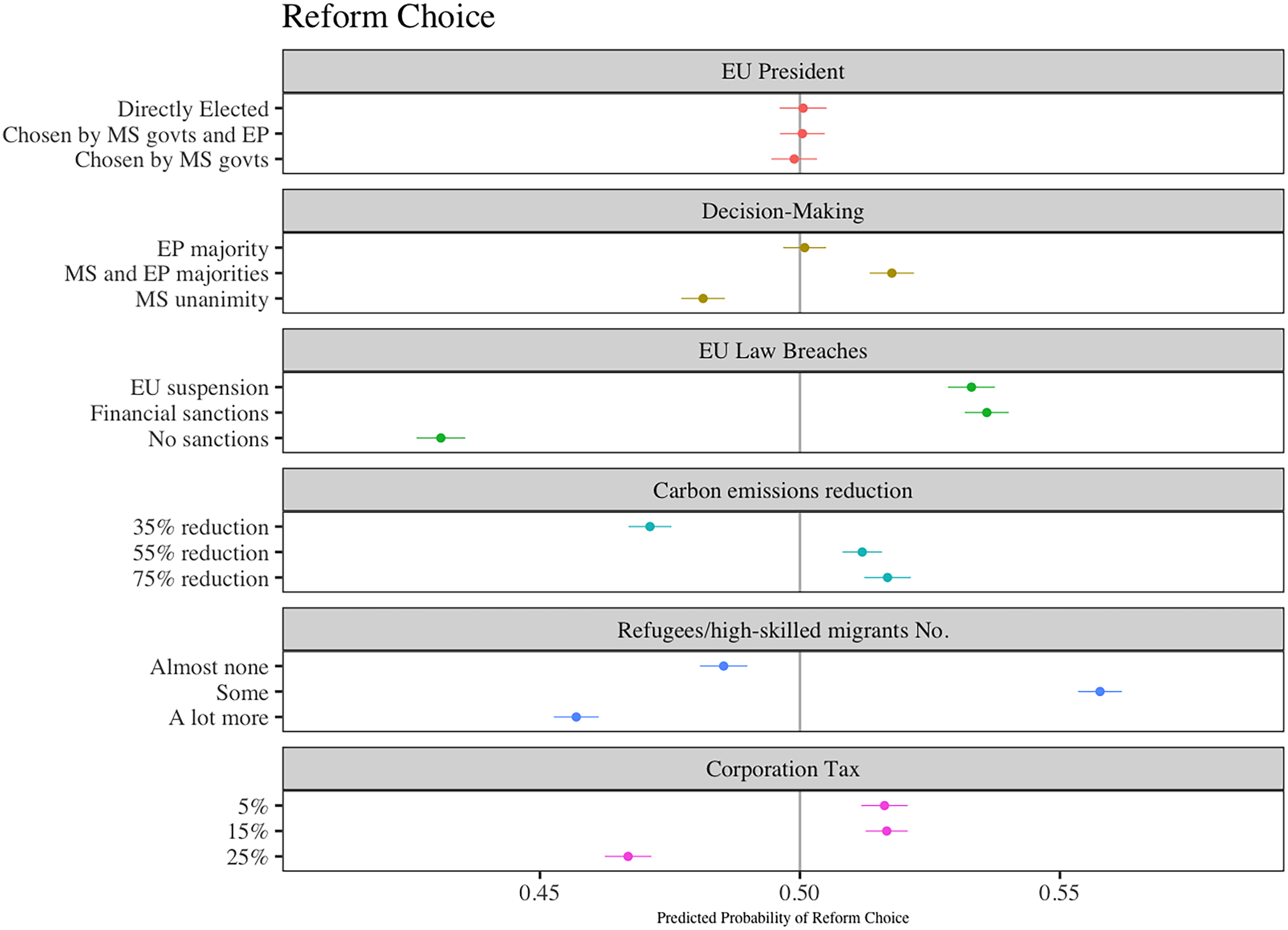
Marginal means – Pooled analysis.
Note: YouGov survey weights applied. Software:
These results reveal evidence of strongly held preferences about supranational institutions which are independent from policy outcomes. In other words, some institutional features are inherently favoured, as they significantly impact preferences over EU reform alternatives irrespective of policy outcomes. Unanimity voting (for the adoption of EU legislation) makes a package less appealing, and having no penalties for EU law breaches has an even stronger negative effect. Institutional packages containing majority voting in both the European Parliament and the Council were more likely to be picked even when controlling for policy outputs, and so were those containing financial sanctions and even suspension of a member state for EU law breaches. These findings are consistent with Hahm et al.’s (2020) key findings about citizens preferences about institutional reforms: there are higher levels of support for more majoritarianism in the EU (relative to intergovernmentalism) when controlling for different policy outputs on climate, immigration and taxation. 5
Turning to the policy attributes, each policy issue consistently and strongly impacts support for EU reform packages. Reform packages proposing more ambitious carbon emission reductions were more likely to be picked, while less ambitious climate proposals significantly reduced the probability that a reform package was chosen. The strongest policy effects were in the immigration domain: the centrist option (allowing some refugees and highly skilled workers) had a statistically significant and strong positive effect on the probability of a package being preferred, whilst both completely stopping immigration or allowing a lot more migrants significantly reduced the probability that a package was chosen. Corporation tax levels also swayed reform choice: more modest tax rates increased the likelihood that a package was picked, whilst the highest corporate tax rate (25%) reduced it.
All inferences are robust to several model specifications, such as the inclusion of standard demographic controls (age, gender, education, and left-right self-placement) and country fixed effects, and the inclusion/exclusion of survey weights (see Online appendix). Furthermore, the heterogeneous effects analyses (see Online Appendix) reveal that the results reported above are broadly unchanged in the country specific models too. Key inferences from the study are thus generally consistent across all member states in the sample.
Analysis 2: Interaction with policy congruence
Some institutional preferences significantly impact EU reform package choice when controlling for salient policy options. But what happens when the policy outcomes appearing in the specific EU reform package are at odds with the respondents’ own ideological stance? In this second analysis, we further test the output-elasticity of institutional preferences by examining whether a respondent’s attitudes towards specific institutional changes depend on the level of policy (in)congruence elicited by the specific EU package seen. We test these heterogeneous effects via standard split sample analyses of the marginal means.
To measure respondents’ policy incongruence we combine the policy outcomes seen in the specific conjoint profile with information about each respondent’s left-right position. The respondent’s left-right position is measured from the pre-treatment survey question asking respondents to place themselves on a 1-7 left-right scale. To measure policy incongruence we first re-code the respondents’ left-right position into three categories: left (scores 1-3), centre (4) and right (scores 5-7). We then mapped these position to each policy level (left, centre, and right) in each choice task. Respondents were assigned a score of 0 if their left-right position was congruent with all the policy attribute levels seen in the specific package; (1) if their position was incongruent for only one policy attribute; (2) if they saw an incongruent level in two out of the three policy attributes; and (3) if they were incongruent in all three policy attributes in the specific EU reform package.
Figure 2 shows that the effect of some institutional characteristics on reform choice does indeed depend on the level of policy incongruence. The effects of nearly every institutional feature were slightly lower/more negative the more it was combined with policies that were incongruent respondent’s self-reported left-right position. The incongruence pattern, however, is noticeably flatter for some institutional attributes: the Commission President chosen by national governments, or by national governments and the European Parliament, member states’ and European Parliament majority-based decision-making, and the absence of sanctions for EU law breaches. These features, therefore, are outcome-inelastic when stress-tested against the (in)congruence construct.
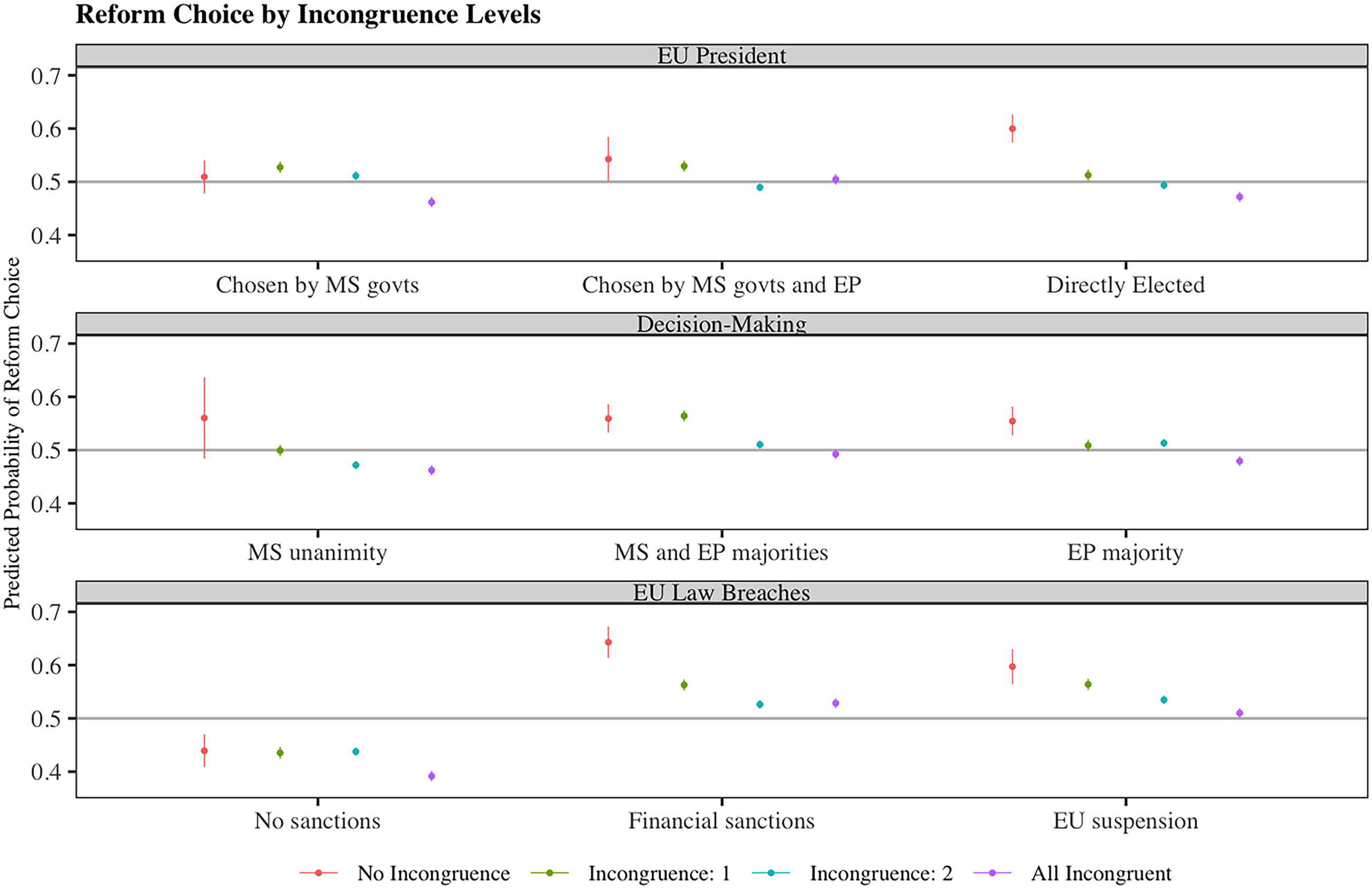
Marginal means – Split sample model by degree of respondent’s policy incongruence. Note: YouGov survey weights applied. Software:
Majority voting, and weak law enforcement (no sanctions) were also features that were statistically significant in the pooled marginal means analysis. Majority voting and the desire for stronger EU enforcement capacity, therefore, are key policy-inelastic institutional features. Their effect on EU reform package choice is significant when controlling for policy outputs and it is consistent across policy (in)congruence states. In other words, these might be considered credible institutional design choices for the EU that are completely independent from policy outputs.
Unanimity voting was significant in the marginal means analysis above, but here it appears that the effect of this institutional feature depends on policy (in)congruence levels. Respondents that get their favoured policy outcomes in the specific EU reform profile are warmer towards unanimity, while policy-incongruent respondents were particularly negative towards unanimity. Similarly, EU suspension and financial sanctions were significant in the pooled analysis but their positive effect on EU reform package support is stronger for policy congruent individuals (especially when it comes to the EU suspension option, where the downward trend by incongruence is more marked). It is important to note, however, that differently from the unanimity voting feature, for financial and suspension sanctions, even incongruent respondents support it, just less strongly. Public support for stronger EU enforcement powers is policy-inelastic, but the two specific enforcement options given (e.g. financial or outright suspension), are somewhat policy-dependent, and particularly when it comes to outright suspension, which is therefore more contentious.
In short, the findings suggest that European citizens support some institutional features (majoritarian decision-making and stronger EU law enforcement, particularly) independently from policy outcomes, even when policy (in)congruence is tested. These can be assumed to have higher intrinsic support. Preferences for some other institutional features, even if significant in the marginal means analysis (e.g. unanimity voting and EU suspension), appear to however depend on the respondent’s level of policy incongruence with the specific EU reform package.
Analysis 3: Package deals and pathways to supranational institutional reform
The analyses above highlight that some institutional preferences depend on policy outcomes. In addition, policy attributes are strongly predictive of reform bundle choice. Moreover, national vetoes are part and parcel of EU Treaty reform processes. Given all this, package deals are likely to still be fundamental when it comes to supranational institutional reform: designing reforms as a blend of both institutional changes and policy side-payments is more likely to get different clusters of voters on board and thus secure broad public and cross-country support. EU Treaty reforms have often been negotiated agreements where some policy reforms have to be offered in return for institutional change. The Single European Act (1986) was a trade-off between more majority voting and Commission and European Parliament powers in return for the single market programme (for parties mainly on the Right), new social and environmental policies (for parties on the Left), and a doubling of regional spending (for poorer member states). Is such a package deal possible at this moment in time? And what would it look like?
We outline here how our conjoint analysis design can be used to reveal viable package deals. This final analysis originally applies a Bayesian finite mixture model (Goplerud et al., 2022) to solve the supranational institutional design problem. The model helps to identify which institution-policy package deal could command the widest public support across key voting blocks, thereby increasing the likelihood of EU Treaty reform success. The Bayesian finite mixture model we use was developed by Goplerud et al. (2022) chiefly as a multiple testing robustness check for heterogeneous effects in conjoints (see Online appendix – FactorHet Results). The method leverages a Bayesian finite mixture of regularized regressions via Expectation Maximization, which first identifies how many ‘clusters’ of individual units are present in/fit the data. It therefore allows to split individuals into ideological camps or coalitions, and can extract what type of EU reform packages each camp, or cluster, prefers most (as well as what features of EU reform packages each camp is indifferent to, or dislikes). We leverage the model’s intermediate step (the clustering step) to draw inferences about what reform bundle could garner the broadest possible support, across various voter groups.
The model recovers two key clusters in the data.
6
Cluster 1 is mainly composed of Eurosceptic, nationalist, right-wing, lower educated, male and North-West European respondents (see Online appendix – FactorHet Results) – we call this the nationalist-conservative cluster. Cluster 2 is mainly composed of Europhiles, European identifiers, left-wingers, university-educated, female, and Southern European respondents – we term this the cosmopolitan-progressive cluster. In the full sample, the nationalist-conservative sample is more prominent than the cosmopolitan-progressive one. Relative proportions do vary by country, with Spain and Italy having only
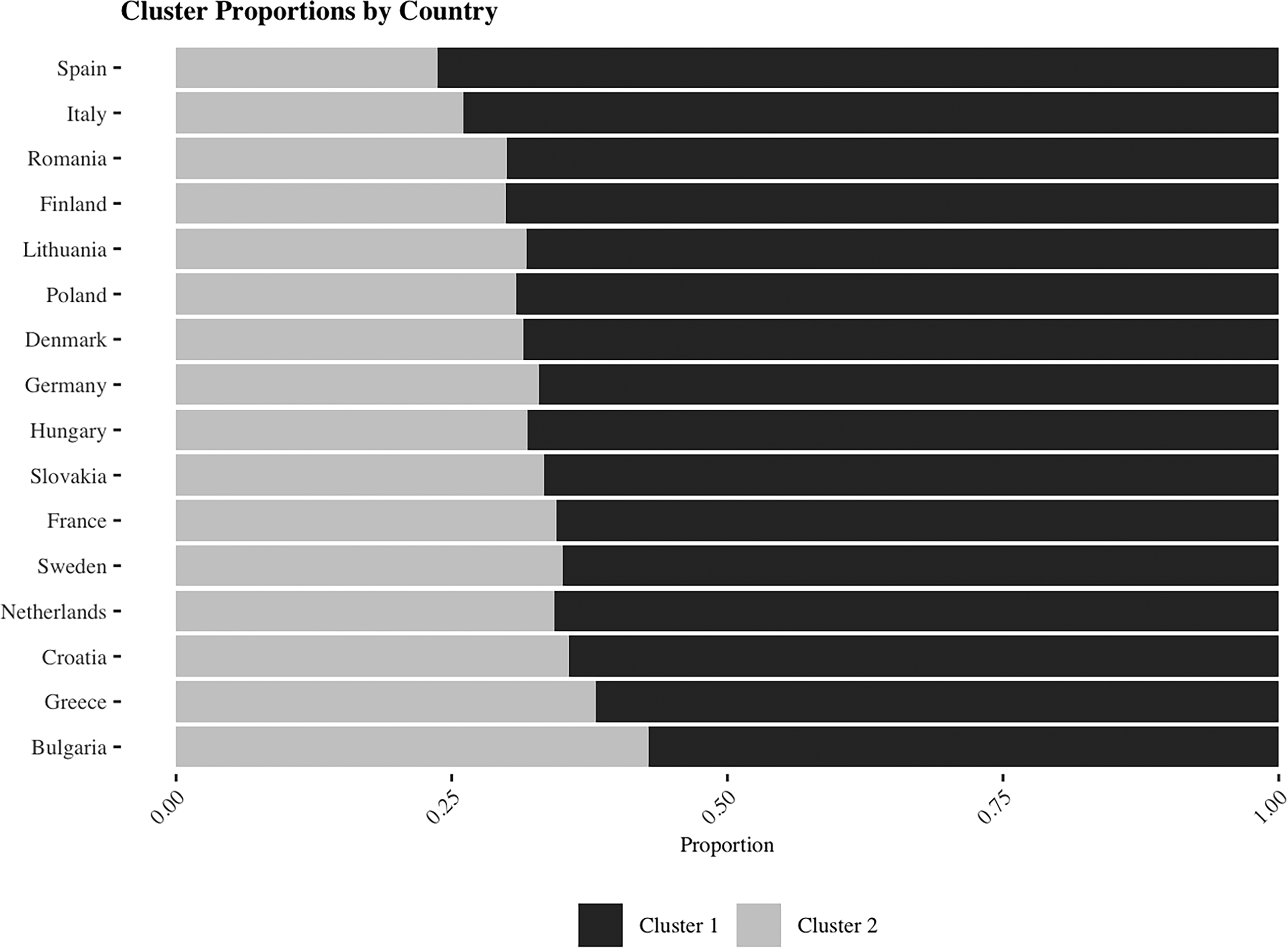
Clusters relative proportions in April 2022 samples.
Figure 4 reports the preferences for the various (institutional and policy) dimensions of the EU reform bundles via marginal means (with Bayesian credible intervals) for each of the two cluster recovered by the FactorHet algorithm.
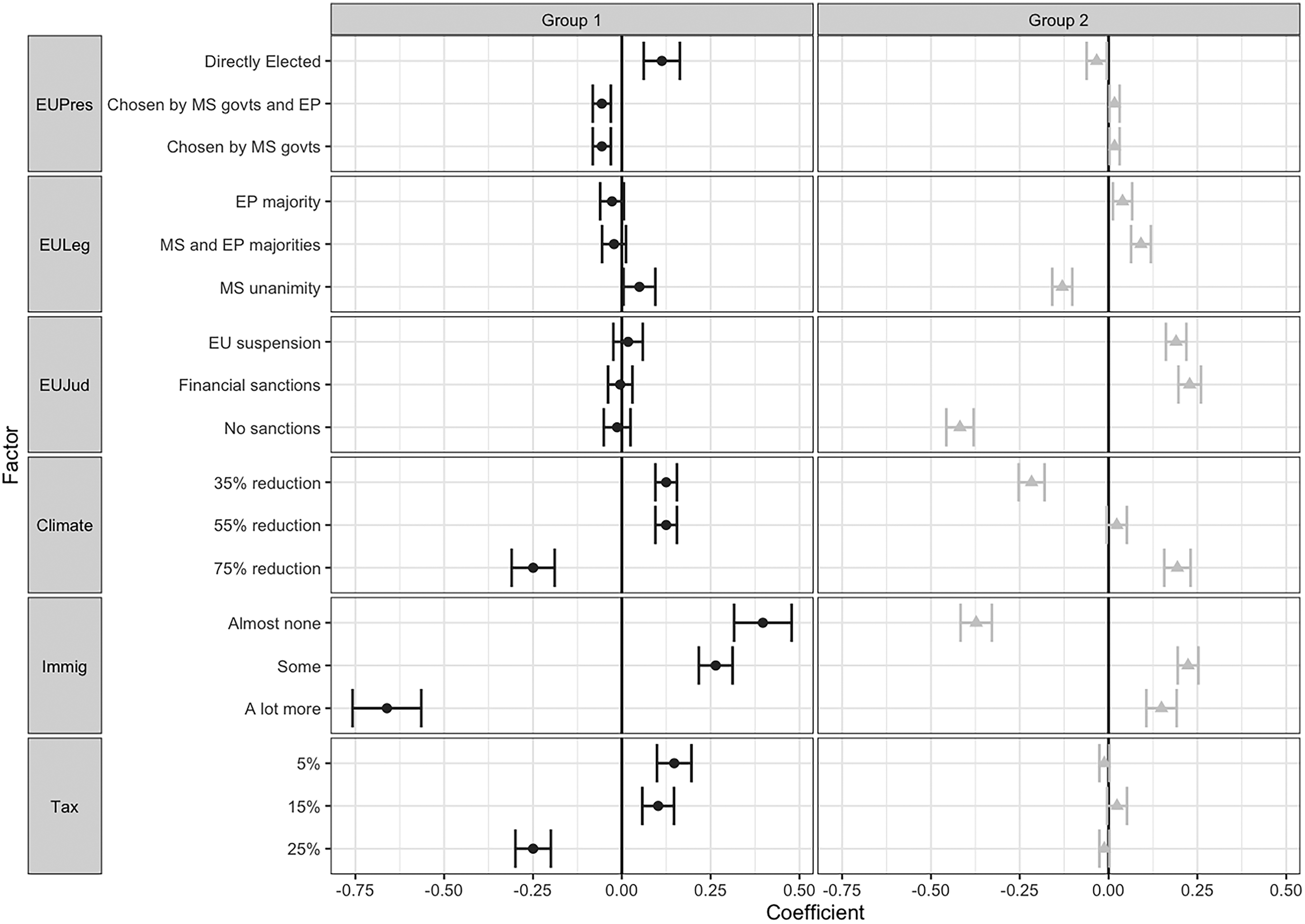
Conjoint cluster analysis – Reform choice by cluster (logistic coefficients:
Respondents in the nationalist-conservative cluster favour direct election of the EU President, are indifferent to various legislative and enforcement procedures (although they appear to marginally prefer Council unanimity), and only support more timid climate reduction targets. The respondents in this cluster are also strongly anti-immigration, and favour lower corporate tax rates. In contrast, respondents in the cosmopolitan-progressive cluster are indifferent about the election/selection of the EU president, but strongly dislike unanimity and prefer majoritarian decision-making, and strongly oppose the absence of sanctions. On policy, respondents in this cluster support more ambitious climate reduction targets, are more pro-immigration (although mostly favouring the status quo), and are indifferent on tax policy. In other words, climate policy and immigration are contentious among these two citizen blocks and are best left off any EU Treaty reform package deal. In terms of viable trade-offs, cosmopolitan-progressives could trade-off the direct election of the EU Commission President and lower taxation rates in exchange for more majoritarian decision-making and stronger legal enforcement.
Our results here, hence, suggest a clear pathway for reform. The reform package deal we identify as most likely to garner consensus includes several key features: the direct election of an EU Commission president and lower corporate taxes – to appeal to nationalist – conservative respondents (and where cosmopolitan-progressive groups are indifferent) – and more majoritarian decision-making and stronger EU enforcement – preferred by cosmopolitan-progressives, while nationalist-conservatives are indifferent.
Discussion and conclusion
We ran an original conjoint survey experiment in 16 European countries to understand whether (supranational) institutional preferences exist and to what extent they are held independently from policy preferences. Using an innovative conjoint experiment, we presented respondents with alternative EU reform packages which randomly varied both institutional and policy features. We then ran a policy incongruence analysis and developed a novel policy design toolkit by originally applying Goplerud et al. (2022) Bayesian finite mixture model to uncover specific institution-policy package deals that could command broad support among the various member state’s publics.
We find that EU citizens do hold some policy-independent institutional preferences – even when provided with clear information about salient policy outcomes. Our evidence suggests that majority voting in the legislative branches and stronger EU enforcement command policy-inelastic public support. These results are broadly consistent across our country cases and across the different regions of Europe. The second analysis finds that both of these institutional changes are also independent from policy (in)congruence levels. Other institutional reforms, however, are not policy-inelastic to the same extent. Unanimity voting, financial sanctions, outright EU suspension, European Parliament-only majority decision-making, and the direct election of the EU Commission President – are either not significant when controlling for policy outcomes and/or are conditional on an individual getting their favoured policy outcomes in a reform package. These reforms are either unlikely to command broad public support, or they would need to be packaged with popular policies to succeed.
Finding a workable institutional and policy ‘package deal’, with side-payments to different groups in society, is still likely to be important if the current EU treaty reform bottleneck is to be overcome. Via our novel application of Goplerud et al. (2022) model, we identify a set of pragmatic institutional-policy linkages that might command broad support across a large number of countries. This package deal would contain a more directly accountable EU Commission president, strengthened majoritarian decision-making, and stronger sanctions for EU law breaches, combined with more free market economic policy goals (which we operationalized concretely with lower EU-wide minimum corporate taxation rates). We also find that including changes to existing EU policy frameworks on environmental policy or immigration would be unlikely to command broad public support.
The study demonstrates that there are institutional preferences that are held independently from policy outcomes, even in the more challenging context of supranational polities. This is an important contribution for the political behaviour field and the debate over the nature and endogeneity of institutional preferences. Furthermore, the study contributes to the institutional design field and to the study of international organization reform, chiefly by showcasing how conjoint analysis and Bayesian finite mixture models can be applied to institutional/policy design problems. For this, we propose two key phases: (1) unpacking institutional/policy multi-dimensionality via conjoint analysis, and (2) identifying preference blocks – or ‘clusters’ – in order to design institutions/policies that can command consensus. Last but not least, the study is of immediate applied significance for the EU: the findings, in fact, demonstrate that there is the potential to break the political gridlock over EU treaty reform, and notably by proposing the direct election of the EU Commission President, majority voting in the legislative chambers and stronger legal enforcement together with free market economic policy goals (e.g. lower EU-wide minimum corporate taxation rates).
Supplemental Material
sj-zip-1-eup-10.1177_14651165251365561 - Supplemental material for Reforming supranational institutions: Insights from a conjoint experiment in 16 countries
Supplemental material, sj-zip-1-eup-10.1177_14651165251365561 for Reforming supranational institutions: Insights from a conjoint experiment in 16 countries by Catherine E De Vries, Simon Hix and Miriam Sorace in European Union Politics
Supplemental Material
sj-zip-2-eup-10.1177_14651165251365561 - Supplemental material for Reforming supranational institutions: Insights from a conjoint experiment in 16 countries
Supplemental material, sj-zip-2-eup-10.1177_14651165251365561 for Reforming supranational institutions: Insights from a conjoint experiment in 16 countries by Catherine E De Vries, Simon Hix and Miriam Sorace in European Union Politics
Supplemental Material
sj-pdf-3-eup-10.1177_14651165251365561 - Supplemental material for Reforming supranational institutions: Insights from a conjoint experiment in 16 countries
Supplemental material, sj-pdf-3-eup-10.1177_14651165251365561 for Reforming supranational institutions: Insights from a conjoint experiment in 16 countries by Catherine E De Vries, Simon Hix and Miriam Sorace in European Union Politics
Footnotes
Acknowledgements
We are grateful to the editor and anonymous reviewers, and to Thomas König, Dietlind Stolle and the participants at the 2022 EUI-YouGov annual conference and at EPSA 2023 for comments on an earlier version of the paper.

Authors’ contributions
The authors contributed equally to the article.
Funding
Declaration of conflicting interest
The author(s) declared no potential conflicts of interest with respect to the research, authorship, and/or publication of this article.
Data availability statement
Data and replication files are available at the DOI of this article.
Supplemental material
Supplemental material for this article is available online.
Notes
References
Supplementary Material
Please find the following supplemental material available below.
For Open Access articles published under a Creative Commons License, all supplemental material carries the same license as the article it is associated with.
For non-Open Access articles published, all supplemental material carries a non-exclusive license, and permission requests for re-use of supplemental material or any part of supplemental material shall be sent directly to the copyright owner as specified in the copyright notice associated with the article.
