



Abstract
This article argues that citizens structure their fiscal solidarity with other European Union countries along a ‘centre–periphery’ divide. This claim is empirically investigated using a Heckman probit selection model on two surveys in 2020 and 2021 among citizens of 13 European countries, which allows to account for differences in the familiarity of the issue and other countries. The results show that individuals in centre countries are more likely to express solidarity with other centre countries than with periphery countries, and vice versa. More broadly, the findings show that citizens perceive a power hierarchy among European Union member states, and that there is a spatial relational dimension to European fiscal solidarity. These results underscore the challenges facing the European Union in achieving greater fiscal solidarity. They also highlight the need to address the structural inequalities between member states.
Introduction
If a European Union (EU) country was to experience a crisis that required financial resources beyond its means, would citizens of other EU countries be willing to express solidarity? Based on existing research, well-informed experts would answer that the country in need could hope for the support of, for instance, those citizens who identify with Europe (Verhaegen, 2018) or those who have a cosmopolitan outlook on the world (Kuhn et al., 2018). They may also argue that the willingness to express solidarity depends on the policy design of the support for the country in need (Burgoon et al., 2022), and what kind of crisis the country was in Katsanidou et al. (2022).
Research on European solidarity is only beginning to explore the role of the spatial dimension to European solidarity. We know that people have greater trust in other countries that are culturally, linguistically or geographically close (Klingemann and Weldon, 2013), and we know that individuals apply deservingness heuristics not just to other individuals but to other countries (Haverland et al., 2022; Heermann et al., 2023). This article contributes to the latter literature on the role of country attributes and argues that the characteristics of the country in need, as well as the relationship between a citizen's country and the recipient country, both play a crucial role in determining a citizen's willingness to demonstrate fiscal solidarity. Specifically, it is hypothesised that the existence of a centre–periphery divide within the EU separates countries and affects citizens’ attitudes towards aiding other nations.
The empirical analysis is based on a pooled dataset of two surveys of 13 EU countries by the European University Institute and YouGov (Hemerijck et al., 2020, 2021). Respondents are asked to express their willingness to financially help a specified country in crisis. This information then provides the opportunity to estimate the specific recipient country's variance in European solidarity. By using a Heckman-style probit selection model (Heckman, 1979), the analysis considers the concern that European solidarity is an issue with limited real-life relevance for most ordinary citizens. This is the first time that the salience of European solidarity has been explicitly modelled. The use of a selection model suggests that an exclusive national identity affects the substance of opinions about solidarity less than previously thought. It also suggests that gender does not directly affect the substance of solidarity opinion at all, although men are much more likely than women to respond to the survey item.
My findings show that citizens, when asked to express fiscal solidarity, indeed distinguish between countries of the centre and countries of the periphery. Citizens of the centre countries are more likely to express solidarity with other countries of the centre than of the periphery, and vice versa. While this divide works in both directions, it is notably the peripheral countries that are subject to a handicap among citizens in centre countries. This effect remains, even when controlling for geographic and cultural proximity, economic performance, and whether countries are in the eurozone. Further, an individual's sociotropic political efficacy – that is, the belief that one's country has a say in the EU – explains some variance in the attitudes towards European fiscal solidarity. The centre–periphery divide mediates this belief as well.
The sociotropic nature of European fiscal solidarity
Extant research has so far mostly focused on individual-level attitudes to explain the variations in European fiscal solidarity: not without reason. Ample evidence suggests that an important proportion of this variance can be attributed to individual-level factors, including (sociotropic) notions of self-interest (Bobzien and Kalleitner, 2021; Mariotto and Pellegata, 2023), identity (Kuhn et al., 2018; Nicoli et al., 2020) and political beliefs (Medrano et al., 2019).
An important assumption of this article is that attitudes towards European fiscal solidarity are based strongly on sociotropic orientation. Citizens perceive European solidarity as the solidarity of one country – or a community of countries, such as the EU – with another country in need. Much of the information needed to assess the individual costs of European fiscal solidarity is not available or costly (i.e. citizens need to engage to be informed), and benefits are rarely framed in individual terms. Public discourse often frames European solidarity in macro terms, that is, about countries’ EU budget net balance. In citizens’ mental representations, the subjects and objects of European fiscal solidarity are not individual humans, but nation-states.
We already know that part of the variance of European solidarity is not explained by attributes of the individual but by the relational dimension of redistribution across Europe. Studies show that the macro context – that is, factors attributed to one's country – explain a non-trivial part of the variance. For instance, countries in which citizens expect to be contributing to European fiscal solidarity are less willing to show solidarity (Vasilopoulou and Talving, 2020). Furthermore, research indicates that national welfare institutions and other contextual factors, including a country's level of national debt, can shape individuals’ attitudes towards expressing European solidarity (Baute et al., 2019; Daniele and Geys, 2015).
This article contributes to a better understanding of the relevance of the attributes of recipient countries for European fiscal solidarity and highlights the relational nature of solidarity attitudes. Notably based on deservingness criteria developed in the welfare state literature (Van Oorschot, 2000), this branch of literature shows how citizens assess the deservingness of other EU countries based on similar criteria as if they were asked to help other individuals. For instance, research has shown that citizens are more willing to express solidarity with countries that have shown reciprocal behaviour (Afonso and Negash, 2024; Reinl and Katsanidou, 2023), with countries that are in more dire need (Afonso and Negash, 2024; Haverland et al., 2022), that are closer in terms of identity (Afonso and Negash, 2024) and that share norms of a political community (Heermann et al., 2023).
European fiscal solidarity is understood here as the ‘preparedness to share financial resources’ (Stjernø, 2005: 2) with people in other European countries who are worse off, or who are in need, through actions and funds mobilised by state institutions, including the EU. As such, European fiscal solidarity is not supranational, but transnational. It does not refer to an abstract EU-wide scheme. European Union policies like NextGenerationEU (NGEU), the 750 billion Euro investment programme adopted by the EU in response to the Covid-19 pandemic, benefit all EU countries in principle but have uneven redistributive effects. It is assumed that citizens are aware that some countries benefit more than others and that their evaluation of such EU-wide policies is influenced by their willingness to help those countries that benefit most. The argument is not to deny the existence of a European solidarity space – the idea that Europeans are more willing to show solidarity with each other than with ‘outsiders’ (Gerhards et al., 2019) – but to underscore that, within Europe, the attributes of the recipient country play a role. While there is international solidarity beyond the EU, this article exclusively focuses on solidarity within the EU.
A dual centre–periphery divide
My central claim here is that a centre–periphery divide clusters geographically and politically close countries, and it structures the relationship of citizens’ solidarity with other countries accordingly. The basic terminology of the centre–periphery divide is borrowed from cleavage theory, in which Lipset and Rokkan (1967) seek to explain how political interests merge into societal groups and create stable party systems. The centre–periphery cleavage emerges in the context of nation-building. As nations grow in territory, their power is distributed in an increasingly asymmetric way, both spatially and in the sense of group membership. Throughout the process of nation-building, power remains at the centre – again, both as a geographical idea as with regard to a culturally or otherwise dominant social or ethnic group – that exerts control over the periphery, which is geographically or culturally distant from the centre (see also Treib, 2021).
Based on this idea, the argument of this article is that citizens make sense of EU politics as if the EU is a nation-state in the making. As some have pointed out, European integration can be understood as a process of state-building (Genschel and Jachtenfuchs, 2016; Ignácz, 2021). What started in the 1950s as an international organisation of tightly defined thematic competences developed over the years into a governance system sui generis. The EU has taken over competences or is involved in policies associated with core state competences, such as customs and borders, currency and judicial oversight. At the same time, the organisation has grown from a community of six countries to a union of 27 countries. It should be stressed that the terminology of centre and periphery also appears in the literature about differentiated integration (see, for instance, Schimmelfennig et al., 2015), but this constitutes a different concept. In this article, the understanding of the centre-periphery divide is about influence of countries in EU politics, that is, centre countries are countries that have a more favourable position in EU decision-making than peripheral countries. In the context of differentiated integration, centre countries are those countries who are deeper integrated (e.g. being part of the Economic and Monetary Union). These two different understandings do not necessarily intersect, and some centre countries in the sense used here may be considered as peripheral countries in the sense of differentiated integration. For instance, Denmark is deemed a centre country in this article, but may be considered a peripheral country given its opt-outs in several EU policies (for a discussion on different EU polity visions, see Fabbrini, 2015).
The understanding of the divide here is ‘thin’ in comparison to the macro-sociological understanding of the cleavage proposed by Lipset and Rokkan (1967). The centre–periphery divide proposed here is best understood as a heuristic. The argument is that citizens recognise the division among countries of the EU and use it to inform their attitude towards fiscal solidarity with other countries. They rely on such cues because they often lack the knowledge and interest necessary to have an informed opinion on EU politics. Cues provided by national politics (Brosius et al., 2020) or by domestic political actors (Pannico, 2020; Sanders and Toka, 2013) have been shown to be influential when evaluating EU policies (see also below). As EU politics remains a low-information environment, and citizens’ involvement is still limited, citizens rely on these cues from influential actors to form an opinion (Rapeli, 2014), saving themselves time and mental energy.
Studies of the coalition-making in the Council of the EU highlight that negotiations among countries in the EU are complex and coalitions change frequently. However, there are studies that do identify a structure along the fault lines of centre and periphery (Kaeding and Laatsit, 2011; Naurin and Lindahl, 2008; Plechanovová, 2011), among other factors. This is particularly the case when it comes to redistributive policies (Zimmer et al., 2005). The negotiations for NGEU, which saw a coalition of frugal countries on the one side and a coalition of the peripheral ‘Friends of Cohesion’ on the other side, are a case in point (De La Porte and Jensen, 2021).
The centre–periphery divide essentially combines two divides – an East–West divide and a North–South divide. These divides differ in their origins, but both contribute to a power dynamic between member states of the EU, that is, between an economically and politically powerful ‘centre’ in the north-western part of Europe and an economically and politically less powerful ‘periphery’ in the south and the east of Europe. It should be stressed that this geographical constellation of the divide is not a theoretical concept, but of a descriptive nature. The two divides are outlined in the following paragraphs. Because the interest of this article is in the effect of being ‘in the periphery’ rather than the exact composition of the different peripheries, in the empirical part, the two peripheral groups will be merged.
The East–West divide stems from the late arrival of Eastern and Central European countries, including Cyprus and Malta, to the EU. With the ‘big bang enlargement’ of 2004 and 2007, the EU integrated 12 additional member states; its most ambitious enlargement to date (Epstein and Jacoby, 2014). The then-15 members of the European Community laid down, specifically for these candidate countries, ‘the Copenhagen criteria’, a set of political, economic and legal conditions which the acceding countries needed to fulfil prior to joining the EU (Dudley, 2020). Rather than a compromise between legal traditions of two parties, this procedure of accession was one-sided: either the candidate countries fulfilled these conditions or they could not join. This power asymmetry at the time of accession suggests that benefits are distributed unevenly between those countries who are already members and who can define terms of accession on the one side, and the joining country on the other side. The big bang enlargement differs from previous enlargement waves, as the EU itself was much more deeply integrated at the time of accession (notably in fiscal terms, through the adoption of the common currency), the much greater income division between existing and acceding member states, and the general geopolitical context. Divisions between East and West are still seen today at a political level, as well as at the level of individual attitudes (Anghel, 2020).
The North–South divide became apparent during the European debt crisis in the 2010s. Interpretations differ as to the origins of such a divide. Whereas some argue that the divide came from differences in political institutions that affected the vulnerability of national economies, others argue that the monetary union had an uneven effect on countries in the centre and at the periphery (see Pérez, 2019: 990). The European debt crisis deepened the divide in two ways. First, by increasing the material divide, since the economies of crisis countries contracted much more than those of creditor countries, and still lag behind, even today. Second, the crisis management of EU institutions – driven primarily by creditor countries’ interests (Beramendi and Stegmueller, 2020), as well as by the prominent use of stereotypes in the media (Chalániová, 2013) depicting other nationalities at the peak of the crisis – further exacerbated this divide (see also Hooghe and Marks, 2018).
While these two divides differ in their origins, they affect individual attitudes in similar ways. Regardless of the underlying reasons for the divide, the division is identified by ordinary citizens through the reception of cues, as outlined above. Citizens perceive whether their country is politically aligned with other countries and adjust their solidarity accordingly. Consequently, they form solidarity attitudes that are more affirmative towards states that are perceived to be on the same side of the divide as their own country.
H1a: Citizens in centre countries are more likely to express solidarity with other centre countries than with peripheral countries. H1b: Citizens in peripheral countries are more likely to express solidarity with other peripheral countries than with centre countries.
The effect of the centre–periphery divide should be seen in a larger context of identification patterns of individuals. While a European identity is found to have a positive effect on European solidarity (Nicoli et al., 2020), research begins to acknowledge the complexities of European identification. As Reese and Lauenstein (2014) discuss, citizens of European countries evaluate each other based on the degree to which they represent the ‘ideal European’. Mummendey and Wenzel (1999) suggest that members of a group tend to project characteristics of their group on the superordinate group category. In other words, Europeans assess the ‘Europeanness’ of other nationalities based on how similar the nationality is with their own nationality. Consequently, ideas of the ideal European differ between countries: Danes may consider that Swedes resemble the ideal European more than the Portuguese do. Conversely, the Portuguese may consider that the Spanish resemble the ideal European more than the Danes do (see also Bianchi et al., 2010).
Hence, citizens of geographically and culturally close countries can be expected to be more likely to show solidarity with each other than with countries that are geographically or culturally more distant, even in the absence of a centre–periphery divide (Deutschmann et al., 2018). However, these are two different mechanisms. Solidarity – as generated by the centre–periphery divide – comes from an uneven distribution of power within the EU. This uneven distribution of power results in a set of shared political expectations and interests within the country groups on either side of the divide, as well as in a polarisation of the groups. This contributes to citizens’ understanding as belonging to a political group.
Because the divide is based on economic and political power, countries of the centre are richer than peripheral countries (Börzel and Langbein, 2019). The socio-economic divide between EU countries and the centre-periphery divide overlap, and, arguably, mutually reinforce each other. Being in the centre allows countries to push more successfully for EU policies that ensure their interests, and economic success increases a country's influence in the EU (see Tallberg, 2008). Since there is strong evidence that utilitarian considerations are also relevant for the formation of EU public opinion (Foster and Frieden, 2017, 2021), it is important to distinguish the centre-periphery divide from such considerations. While the centre-periphery divide is based on identification and group alignment, explanations based on macro-economic conditions relate to mechanisms of self-interest and deservingness of others. As outlined, the centre-periphery divide expects that citizens in rich centre countries show more solidarity among themselves than with outsiders in the periphery (and vice versa, that citizens in poorer peripheral countries show more solidarity among themselves). On the contrary, models based on macro-economic conditions would expect that poorer countries receive more solidarity because they are more deserving (Heermann et al., 2023) and that people in richer countries give less solidarity because it is less in their self-interest (Vasilopoulou and Talving, 2020). The centre-periphery divide provides thus a distinct and supplementary explanation that considers the relationship between two countries, which alternative models cannot account for.
An important assumption of the centre-periphery divide is that citizens perceive the influence their country has in the EU. The belief that one's country can shape EU decisions is labelled here as ‘sociotropic political efficacy’. Craig et al. (1990) refer to internal political efficacy as the belief that one is competent to participate in politics, and external political efficacy as the belief that institutions are responsive to one's demands. Political efficacy has been shown to be associated with a more positive attitude towards the EU (McEvoy, 2016). As Hechter (1987) would argue, group solidarity – such as the solidarity within the EU – requires some level of formal control. When citizens believe that their countries can exert some control, they are more likely to be willing to express solidarity. Citizens who think that their country does not have influence over policy outcomes are less likely to express solidarity with other countries as a result of their general disenchantment with EU integration. The centre–periphery divide suggests that this applies notably to citizens of peripheral countries, which are, by the nature of their disadvantaged position in EU politics, less influential in EU politics.
H2a: Individuals who consider their country not to be influential are less likely to express solidarity with other EU countries than individuals who consider their country to be influential. H2b: The marginal effect of sociotropic political efficacy on citizens’ willingness to express solidarity with other EU countries is greater in centre countries than in periphery countries.
Citizens’ interest in EU politics and familiarity with other countries
Many citizens do not hold strong attitudes on European solidarity, and the attitude strength concerning some countries may be weaker than for others. For instance, in the survey used here among French respondents for the empirical analysis, only 63% were able to indicate whether they thought that their country should help the country of Latvia in the case of a major crisis. As outlined, due to the multi-layered design of European fiscal solidarity policies, as well as a framing which rarely revolves around individual costs and benefits, most citizens do not relate to such policies at the personal level (Armingeon, 2020). Some citizens do not hold an opinion about solidarity, and they lack the motivation to form an opinion. As already highlighted, EU politics is of low salience, and consequently, citizens’ knowledge of it is limited (Rapeli, 2014). It is overly optimistic to assume that all EU citizens are capable of, and interested in, making assessments about their willingness to express solidarity with any other given European country.
Furthermore, citizens are not equally familiar with other EU countries, and many citizens do not know whether another country is a member of the EU. For instance, Eurobarometer surveys regularly ask respondents whether they think Switzerland is a member of the EU, and a significant proportion of the respondents respond affirmatively (European Commission, 2020). In a specific crisis, the salience of a recipient country and its relevant attributes may be high due to increased media coverage (e.g. Greece during the European debt crisis of 2009/2010). However, it is unlikely that respondents have readily stored assessments of all countries. It is also for this reason that the theoretical model does not suggest that eurozone membership has any effect on citizens’ attitudes, because it cannot be assumed that citizens know with enough certainty which countries form part of the eurozone, nor the exact implications of interdependence of a shared currency.
The centre–periphery divide does not only give structure to the content of citizens’ opinions but it also identifies which countries are more likely to be present in citizens’ minds. Since the centre countries are the dominant actors within the EU, and as such receive more attention, they should be more present in citizens’ minds:
H3: Citizens, both at the centre and at the periphery, are more likely to have a crystallised solidarity attitude towards countries at the centre than countries at the periphery.
Few studies assess the relationship of ordinary citizens with other countries (for an exception, see Klingemann and Weldon, 2013), and there is no systematic research on which attributes of a country increase the probability that a citizen is familiar enough to express whether they would be willing to help this country financially. Those surveys that have been carried out focus on public opinion in the US. One survey conducted by YouGov found that US citizens have more favourable views on countries that are culturally, linguistically and geographically close, whereas many respondents have never heard of smaller countries that are geographically distant (Smith, 2020). Since it is uncertain how these findings might translate to EU citizens, and how a general view of another country is related to a familiarity with it and to the willingness to help it, no hypotheses will be formulated in this regard.
We know more about the individual attributes that define the salience of EU politics. Existing research suggests that motivation drives knowledge about the EU. Those with an intrinsic interest in European politics know more about it (Karp et al., 2003; Rapeli, 2014). Identifying as a European can be expected to have a positive effect on an individual's interest in EU politics, as can their political efficacy. Furthermore, satisfaction with national-level democracy has also been found to be positively associated with interest in EU politics (Karp et al., 2003; Rapeli, 2014). The empirical analysis will consider these factors.
Methodology and data
The empirical analysis relies on the pooled data from two surveys conducted by the research project Solidarity in Europe by the European University Institute and YouGov. Random samples were drawn from the more than 800,000 international members of the YouGov panel in April 2020 and April 2021, in 13 member states of the EU 1 as well as the United Kingdom (UK) with a respective sample size of about either 1000 or 2000 per country. For the purposes of this article, respondents from the UK are excluded from the analysis. The country sample includes member states that reflect the theoretical diversity relevant to the topic. The pooled dataset contains 39,203 individual respondents.
The theoretical model makes assumptions both about the salience of solidarity and the substantive opinions about solidarity with other countries. Importantly, the set of variables explaining the salience of solidarity differs from the set of variables that explain the substance of the opinions. Satisfaction with national democracy, for instance, can be expected to increase the probability of expressing an opinion about solidarity, although there are no theoretical reasons to assume that this affects the direction of the opinion. Ignoring this in the empirical analysis would lead to what Certo et al. (2016: 2640) label ‘sample-induced endogeneity’.
To correct for the sample selection bias, the analysis is based on a Heckman probit model with sample selection (Heckman, 1979; Van De Ven and Van Praag, 1981). This kind of model first estimates the propensity of an individual to have an opinion and then uses these outputs to create a selection parameter to be included in the outcome model. Unlike a multinominal model – which could include ‘Don’t know’ as one of the response options – a Heckman selection model allows for a different set of predictor variables to be chosen for the selection equation than for the outcome equation. From a theoretical point of view, a Heckman model better represents the assumption that citizens go through a two-step thought process when confronted with a survey question: First, respondents reflect whether they have an answer to the question. Second, if that reflection brings an affirmative response, the respondent answers the question.
As each respondent indicated their willingness to show solidarity for up to nine countries, and as individual respondents’ attributes are expected to play an important role, a multi-level model is used that accounts for the clustered nature of the data. The basic unit is the country rating, clustered within individuals. Exploratory data analysis reveals that the variance explained at the level of the individual is very high. In an empty model, the ICCindividual is 0.804. In contrast, the variance explained at the level of the respondent's country is trivial (ICCcountry = 0.02). The results of a simple two-level hierarchical model are presented here. As a robustness check, a three-level model has also been performed, with no substantial differences in the findings.
Operationalisation of variables
Dependent variable
The dependent variable is the individual European fiscal solidarity. The survey includes the following item: ‘Imagine a country suffered some kind of major crisis, and was looking for help from others. Do you think [country] should or should not be willing to offer financial help to each of the following countries?’
Solidarity is a multidimensional attitude that cannot be captured with a single survey item. The survey item used here asks about bilateral, financial support in case of an unspecified crisis. It is important to note that the results may not translate to other forms of solidarity. For instance, Heermann et al. (2023) show that individuals tend to be more conditional for giving financial support compared to support in goods. It is also important to note that the wording emphasises the giving part of solidarity, which may lead respondents to think less of their country's self-interest. Finally, the type of crisis affects the willingness to help another country, as does the policy design of the instrument (Beetsma et al., 2022; Burgoon et al., 2022; Cicchi et al., 2020; Katsanidou et al., 2022). Nevertheless, the survey item is a useful operationalisation of the concept of European solidarity.
Overall, about 22% of the responses were ‘Don’t know’. There is significant variance between country pairs. Of Greek respondents asked about Cyprus, only about 7% opted for a ‘Don’t know’ response. At the other extreme, about 37% of French respondents opted for the ‘Don’t know’ response when asked about Latvia. Overall, of those respondents with an opinion, about 63% express an affirmative opinion. The highest level of solidarity is measured among Spanish respondents for Portugal, at about 86%. The lowest level is found among Greek respondents for Germany, at about 33%. The Online appendix provides an overview of all dyadic relationships.
Independent variables
The cornerstone of this article is the argument that the centre–periphery divide between countries shapes the attitudes of citizens. Based on the theoretical reasoning for the empirical analysis outlined in the previous section, EU countries are categorised as shown in Table 1.
Countries arranged by the centre–periphery divide.
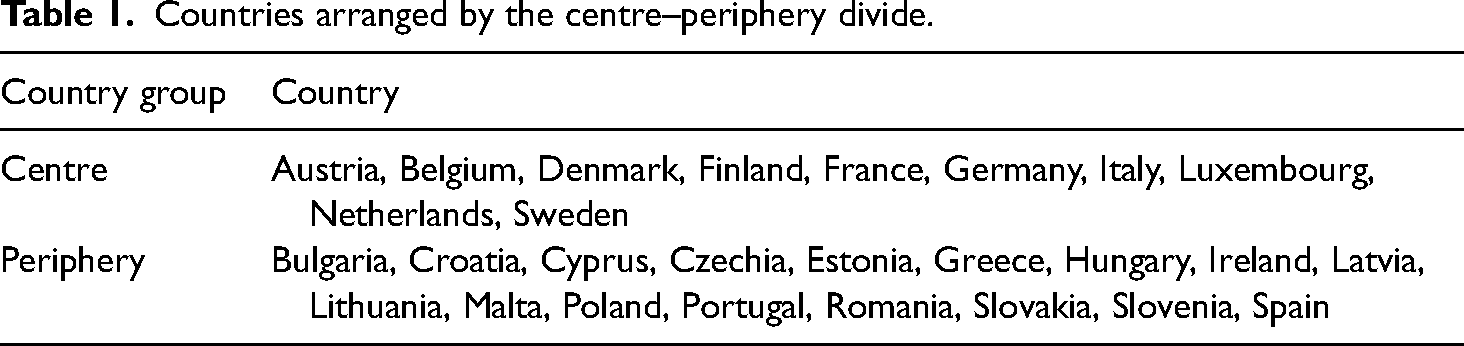
Any classification of countries has its challenges (for a good discussion on the challenges of classification, see Gräbner and Hafele, 2020). Some countries, such as Italy and Ireland, constitute fringe cases. For these countries, arguments could be made to assign them to the other group. For instance, Italy did not require any financial assistance during the European debt crisis, although it struggled fiscally, and its economic model resembles that of other countries of the Southern periphery. Ireland, in turn, did require financial assistance during the European debt crisis, but it rebounded quickly and did not have to endure the drastic reform conditions that Greece, Portugal or Spain had to go through. Some countries may be particularly influential on either side of the divide, for instance, Germany, Hungary and Greece. As a robustness check, the analysis was performed changing the group categorisation of Ireland and Italy, respectively, and excluding influential countries, without any substantial changes in the findings. As a further robustness check, the two peripheries are treated as distinct country groups. The results of these additional analyses can be found in the Online appendix.
It is further necessary to include factors that may confound the effect of the divide. First, dummy variables that capture whether a country is a member of the eurozone – both for the respondent's country and for the recipient country – are included. Second, the centre–periphery divide is closely related to economic development, with the centre being richer and the periphery poorer. The inclusion of the national GDP per capita in 2020 (data from Eurostat) ensures that the country group variable is not just an imperfect measurement of national income. This variable has been rescaled so that the highest value in the sample (Luxembourg) is 1 and the lowest value (Bulgaria) is 0. Table 2 presents the bivariate correlations of macro level attributes of recipient countries. As Table 2 shows, the correlation between the GDP and the country group is very high. It should be noted that the bivariate correlations among the 13 respondents’ countries are not substantially different.
Bivariate correlation of macro variables.
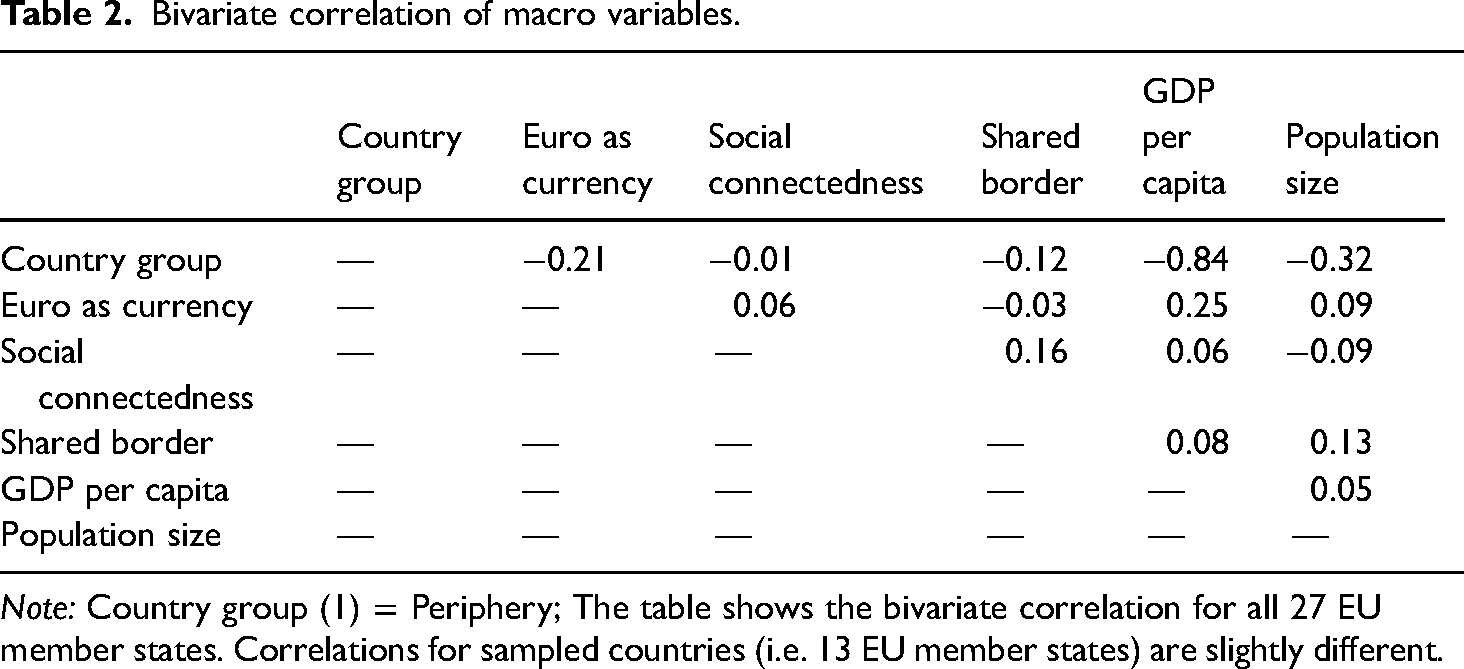
Note: Country group (1) = Periphery; The table shows the bivariate correlation for all 27 EU member states. Correlations for sampled countries (i.e. 13 EU member states) are slightly different.
Finally, the centre–periphery divide clusters countries that are geographically and culturally close. To disentangle the effect of the divide from the effect of these factors, a dummy variable that measures whether two countries share a common border is introduced. Further, the Social Connectedness Index measures the intensity of social connections on Facebook between two locations (here, between countries) (Bailey et al., 2018; see also Afonso and Negash, 2024). This variable does not provide an ideal fit with the theoretical concept of cultural proximity and is influenced, inter alia, by large diaspora communities. But it is, to the best of the author's knowledge, the only measure with complete data for the countries under investigation. As a robustness test, the analysis was confirmed using a measure of cultural distance (Kaasa et al., 2016), although this has missing values for four EU countries. The inclusion of this alternative variable leads to substantively similar results.
Further, individual-level variables are included. It is hypothesised that the centre–periphery divide has an indirect effect on European fiscal solidarity through sociotropic political efficacy. The survey includes the following item: ‘Please tell us how far you agree or disagree with the following statement? [Country] is influential in European affairs.’
Identity is included as a control variable. It is likely to influence the probability of expressing European solidarity and is likely to be correlated with the sociotropic political efficacy of an individual. Respondents can indicate that they identify as ‘European’, ‘national only’, ‘European and national’, ‘national and European’ or as ‘none of these’.
In addition, socioeconomic variables are included – namely gender, age, subjective income and political ideology (seven-point scale recoded to three categories ‘Left’, ‘Centre’, ‘Right’). Unfortunately, the survey does not include variables to measure formal education, which is a shortcoming of the data. That being said, it is unlikely that the omission of the education variable leads to biased results as concerns the key variables of interest, given that the centre-periphery divide is a variable on the macro level. Since the dataset contains two survey waves, a dummy variable for the survey year is also included.
Operationalisation of variables of the selection model
The dependent variable of the selection model is based on the same survey item as the dependent variable of the outcome model. However, respondents are encoded as having expressed an opinion (1) or as having used the ‘Don’t know’ answer option (0).
For the independent variables of the selection model, all independent variables of the outcome model are included. Given that previous studies found external political efficacy and satisfaction with national democracy as determinants of knowledge about the EU, such variables are also included in the model. In the relevant survey item for political efficacy, respondents are presented with the following statement: ‘People like me have a voice in the European Union’. They either answer on a four-point Likert scale or answer that they don’t know. Concerning their satisfaction with national democracy, respondents are asked to evaluate how satisfied they are with the way in which democracy works in their own country on an end-labelled scale from 0 (‘Extremely dissatisfied’) to 10 (‘Extremely satisfied’). To avoid concerns regarding the linearity assumption, the variable has been recoded to three categories: low, medium and high satisfaction. At the macro level, the population size of the country is included, in addition to the macro variables of the outcome model.
Regression analysis
Table 3 shows the estimated average marginal effects based on the complete model, including the two interaction effects. The model has been constructed using stepwise extension, including the interaction terms, one by one. The Online appendix includes information about the underlying probit coefficients of all models performed. To test whether the inclusion of the interaction terms improves the models, Likelihood-Ratio (LR) tests have been performed. The tests show that the full model presented in Table 3 provides a better fit than the smaller models.
Average estimated marginal effect of the multi-level probit selection model.
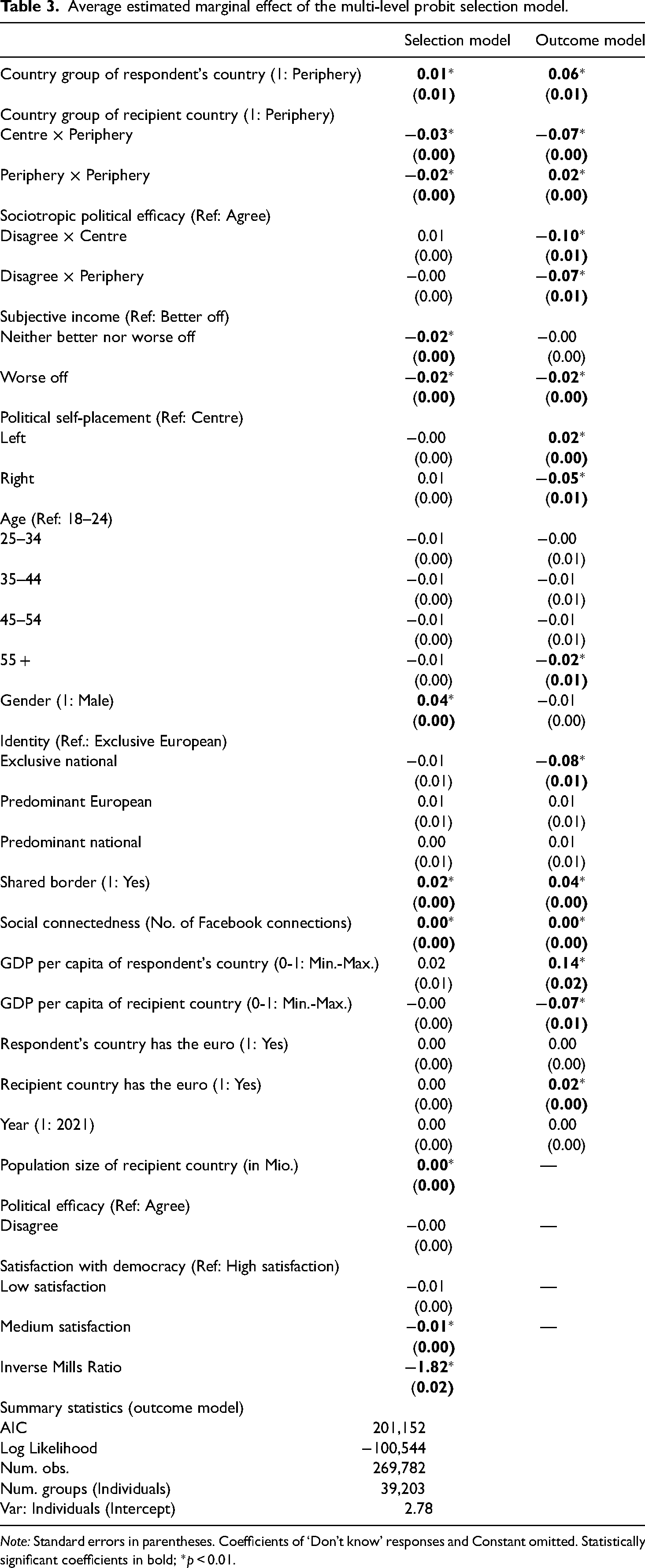
Note: Standard errors in parentheses. Coefficients of ‘Don’t know’ responses and Constant omitted. Statistically significant coefficients in bold; *p < 0.01.
The analysis provides strong support for the argument that citizens are more likely to show solidarity with countries in their own group (H1a and H1b). Figure 1(a) shows the estimated marginal effect of the interaction between the country groups for the respondent's country and the recipient country. The x-axis denotes the country group of the respondent country. The graph shows the point estimates and the 99% confidence intervals for the respective country groups of the recipient country. Citizens in the centre countries are more likely to express solidarity with other central countries than with peripheral countries. The inverse applies for citizens in peripheral countries, although to a much lesser extent. In fact, the solidarity for centre countries does not differ at all between respondents at the centre and at the periphery. The interaction effect stems solely from the difference of solidarity for peripheral countries. While citizens in the centre countries show less solidarity for this group of countries, those at the periphery show more solidarity. This suggests that the centre–periphery divide is driven mostly by a handicap of the peripheral countries among citizens in the centre. In other words, the results suggest that citizens in the centre countries have a two-class Europe in mind, according to which some countries ‘deserve’ less solidarity because of their peripheral position.
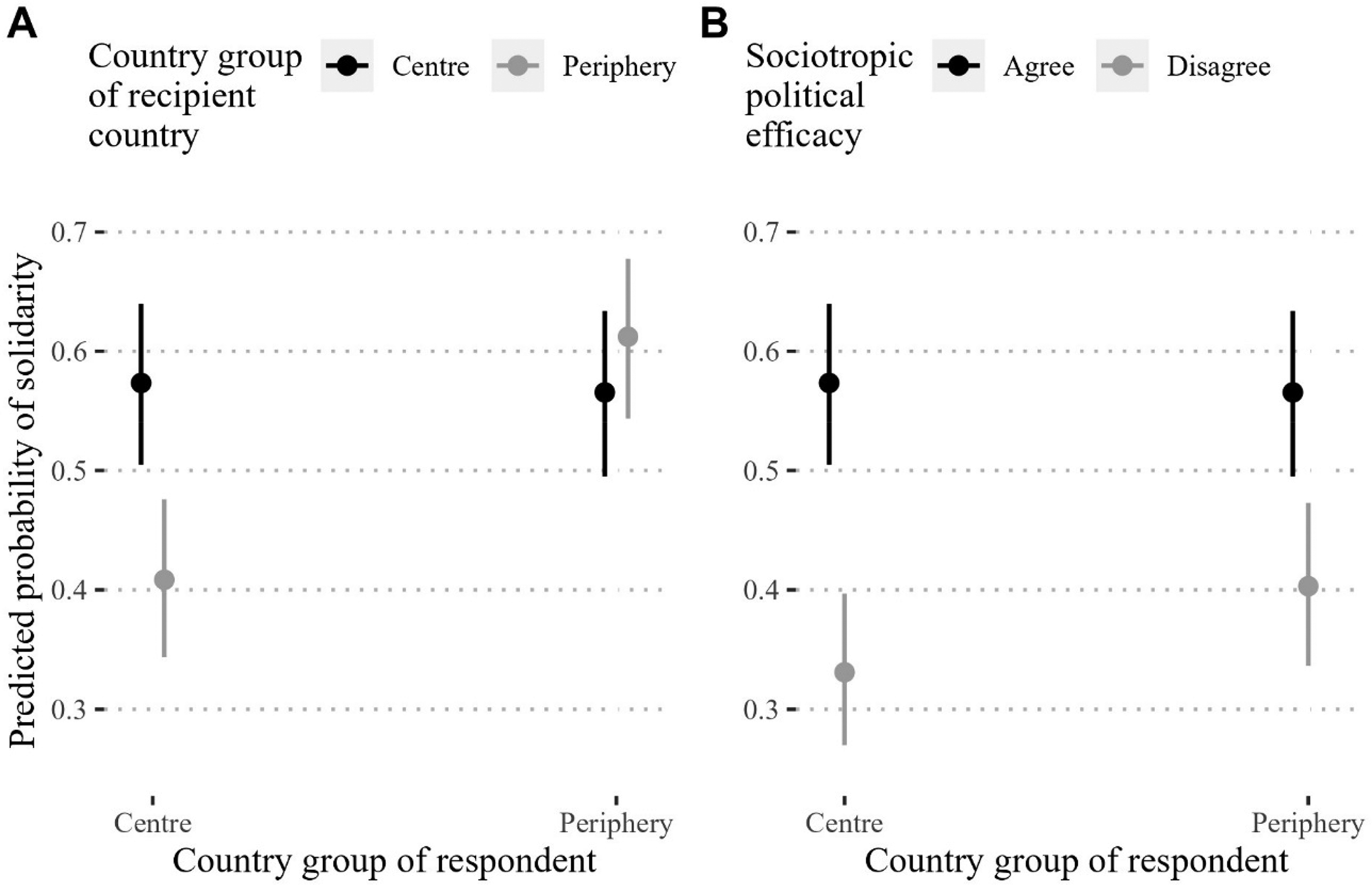
Estimated marginal effects based on the outcome model. 99% confidence intervals.
This effect shows even when controlling for a wide range of variables with a confounding effect. The model considers the effect of both a shared border and cultural proximity, which are positive and statistically significant. Citizens are more willing to express solidarity with countries in their own country's neighbourhood as well as with those with which they share cultural traits. The GDP per capita of both the respondents’ and the recipient countries, as well as whether either the respondent's or the recipient country is in the eurozone, has also been controlled for.
The theoretical model suggests further that citizens who consider their countries to be influential in the EU are more likely to express solidarity with other EU countries (H2a and H2b). This effect was expected to be particularly strong in centre countries. The empirical analysis lends support for these hypotheses. The coefficient has the expected sign and is statistically significant across all models. All else being equal, citizens who believe that their country is influential in the EU are on average 8.7% more likely to express solidarity with other countries. The statistically significant interaction term suggests that this effect is stronger in centre countries than in peripheral countries. As mentioned before, LR tests confirm that the inclusion of the interaction term improves the model. Figure 1(b) shows what this means in terms of the predicted probability of solidarity with other countries. The x-axis denotes the country group of the respondent's country. In peripheral countries, the effect of sociotropic political efficacy is significant, but modest in size in comparison. Whereas among respondents from the centre countries, those who do not think their country is influential are 9.9% less likely to express solidarity. Among citizens from the peripheral countries, this effect is reduced to 6.5%: still a very strong effect. As Table 3 shows, no other individual-level variable has such a large effect on solidarity.
The Inverse Mills Ratio is negative and statistically significant, which is evidence for a selection bias. The findings of the selection model approach do indeed differ from previous studies. The model suggests that those with an exclusive national identity are less likely to show solidarity, as expected, however, difference between the remaining identities is non-significant. This is surprising, given that previous research has emphasised the relevance of European identity for European solidarity (e.g. Kuhn and Kamm, 2019). Second, the effect of gender is not significant. Men are just as likely as women to express solidarity with other countries. Again, some studies (e.g. Katsanidou et al., 2022) report that men are more likely to express European solidarity. In both cases, these divergent findings can be explained by the inclusion of the selection parameter. Both gender and an exclusive national identity show significant effects in the selection model (although in the latter case only at p < 0.05). Women, and those with an exclusive national identity, are less likely to give a response to the survey question. Running the probit regression without the selection parameter increases the effect size of an exclusive national identity by about 15% and shows a statistically significant positive effect of male gender. This contrasts with the reported findings of the probit model with sample selection (see the Online appendix).
H3 stipulates that citizens are more likely to have an opinion about solidarity with a centre country than with a periphery country, regardless of whether they are from the centre or the periphery. Empirical results support this claim. Across all models, the respondents’ likelihood to express an opinion about countries of the periphery is lower than for centre countries. While the interaction term of the country groups is statistically significant, it is socially not meaningful. Even when taking into account the interaction effect, the estimated marginal mean of the propensity to has an opinion about solidarity differs by 0.9% between respondents at the centre and respondents at the periphery.
Lastly, citizens who consider themselves to be better off are more likely to express an opinion. As mentioned, the effect of gender is also statistically significant and has the largest effect among all variables in the model: men are 3.6% more likely to express an opinion than women. It should however be noted that the models could not control for the effect of formal education.
Robustness tests
As previously noted, several robustness checks were performed. Material included in the Online appendix provides an overview of the regression outputs of all alternative model specifications. The regression analysis has been performed excluding countries (either as the respondent country or the recipient country) that could be deemed as influential cases (see above). None of these models differs in substance from the original model. Given their fringe status, Ireland and Italy have been re-categorised to the opposing category. The findings are largely robust to this re-categorisation. One difference is that, when Italy is categorised as a peripheral country, the differential treatment of peripheral countries among respondents in peripheral countries becomes statistically significant at p < 0.01. Furthermore, the dichotomous country group variables have been replaced by a numeric variable that captures the years a given country has been in the EU. The idea is that the centre–periphery is notably based on the time of accession of a country, so it can be conceptualised as a continuous variable as well. The analysis replicates the finding of a ‘groupness effect’ of the country groups. Citizens in newer member states are more likely to express solidarity with other newer EU countries, and vice versa. In contrast, this model does not replicate the interaction effect with sociotropic political efficacy. Further, it has been investigated how a conceptualisation of countries into two peripheries rather than one affects the results. This specification provides evidence for a between-periphery solidarity. In other words, respondents in the Southern periphery are more likely to help an Eastern country than a centre country, and respondents in the Eastern periphery are more likely to help a Southern country than a centre country. This supports the argument that there is a shared understanding of being in the periphery among these countries, which is further corroborated by the finding that the interaction term between the respective peripheral groups and the sociotropic political efficacy is almost identical.
Next, the multi-level model has also been run to include a third level in the data structure at the level of the respondents’ country. Again, this does not affect the substance of the results. One potential issue with the findings is the high correlation of the GDP variables with the country group variables, because centre countries tend to be richer than peripheral countries (see Table 2). Selection models are particularly vulnerable to multicollinearity problems, because multicollinearity may lead to misspecification for these models (Lennox et al., 2012). Specification tests indicate that the variance inflation factor (VIF) values fall within acceptable limits, with the highest VIF recorded for the GDP variable of the respondent's country at 4.79. As a further robustness test, the models were run without the GDP variables. The most notable difference is that the main effect of the country group of the respondent's country becomes statistically significant and negative, compared to a non-significant effect in the original model. This was expected, as centre countries tend to be the richer countries. Without the GDP variable, the model attributes part of the variance – explained by economic income of a country – to the country group. As for the remaining variables, differences are trivial. Most importantly, both interaction effects are nearly identical compared with the original specification of the model.
Lastly, the outcome model was also run without the selection parameter. While the central hypotheses of this article are also supported by this model, many of the coefficients – notably concerning gender and European identity – are biased upwards. Beyond gender and identity, omitting the selection parameter leads to statistically negative effects of subjective income and age. These disappear once the selection bias has been accounted for. Further, the effect of the country group of the respondent, the effect of the GDP variable and the effect of a shared border on the solidarity attitudes would be larger.
These additional analyses underline the robustness of the empirical findings. There is strong evidence that citizens perceive a centre–periphery divide in EU politics, and that they structure their fiscal solidarity with other EU countries accordingly. Moreover, the analysis shows that sociotropic political efficacy is an important determinant of these solidarity attitudes. Finally, it needs to be emphasised that not taking the selection bias into account leads to coefficients that may be inflated.
Conclusions
The article outlined the argument that there is a spatial dimension to European solidarity, and that a centre–periphery divide polarises European citizens. The findings provide evidence for a structuring effect of the centre–periphery divide. Citizens are more likely to show solidarity with countries that are on the same side of the centre–periphery divide as their own country. This is particularly true for citizens of the centre countries, who are much less likely to show solidarity with peripheral countries than with central countries. In other words, peripheral countries are handicapped when it comes to receiving European solidarity. One possible explanation is that peripheral countries are considered less deserving in the centre. Future research should expand on this. In terms of policy, these results underscore the challenges facing the EU in achieving greater fiscal solidarity. They also highlight the need to address the structural inequalities between rich, ‘old’ member states and poorer, ‘new’ countries.
Furthermore, this article shows that EU citizens gauge how influential their country is within the EU and adjust their solidarity accordingly. The more influential they believe their country is, the more likely they are to be willing to show solidarity, particularly with countries in the centre. No other individual determinant had a stronger effect on solidarity.
Finally, by explicitly modelling the propensity of citizens to have an opinion, a selection bias has been corrected that was not considered in previous research. The analysis shows that an exclusive national identity is less relevant for European fiscal solidarity, and gender is not relevant at all. These results are in contradiction to previous findings and suggest that a selection model is a choice worth considering when dealing more generally with EU attitudes.
One challenge to the arguments proposed here is that the centre–periphery divide is merely shorthand for the economic income of countries. Indeed, centre countries tend to be richer and peripheral countries tend to be poorer. Citizens may view certain countries as rich or poor, rather than having the more sophisticated concepts of centre and periphery in mind, as proposed in this article. Both conceptually and in terms of data, the two concepts are closely connected. However, the fact that respondents have a level of identification with their country group – they express more solidarity with countries in their group than with those not in their group – is difficult to explain based solely on macro-economic terms.
Future research needs to be done to understand the intricacies of the centre–periphery divide. While I have suggested here that the divide stems from an economic and political imbalance, it is unclear how far this divide turns into a cultural divide. While this article provides evidence for the existence of such a divide, the exact mechanism, and the mental representations that citizens have of centre and periphery, remain undiscovered, and should be the subject of future research. Combining a centre-periphery perspective and the deservingness literature promises to be a productive way forward.
Supplemental Material
sj-docx-1-eup-10.1177_14651165241251833 - Supplemental material for Solidarity on a divided continent: Perceptions of ‘centre’ and ‘periphery’ determine European citizens’ willingness to help other EU countries
Supplemental material, sj-docx-1-eup-10.1177_14651165241251833 for Solidarity on a divided continent: Perceptions of ‘centre’ and ‘periphery’ determine European citizens’ willingness to help other EU countries by Patrick Clasen in European Union Politics
Supplemental Material
sj-zip-3-eup-10.1177_14651165241251833 - Supplemental material for Solidarity on a divided continent: Perceptions of ‘centre’ and ‘periphery’ determine European citizens’ willingness to help other EU countries
Supplemental material, sj-zip-3-eup-10.1177_14651165241251833 for Solidarity on a divided continent: Perceptions of ‘centre’ and ‘periphery’ determine European citizens’ willingness to help other EU countries by Patrick Clasen in European Union Politics
Footnotes
Acknowledgements
The author is indebted to Achim Goerres for his constant feedback and invaluable advice. Previous versions of this paper were presented at the ECPR General Conference 2022 in Innsbruck, the research colloquium at the working group for empirical political science at the University of Duisburg-Essen, the Solidarity in Europe conference 2023 in Florence, the Solidarity and Just Financing Workshop in Antwerp 2023, the Politologenetmaal in Leuven 2023 and the EPSA Annual Conference 2023 in Glasgow. The author thanks participants of those events, as well as Laurin Berresheim for helpful comments and suggestions.
Funding
The author(s) disclosed receipt of the following financial support for the research, authorship, and/or publication of this article: Funding was received for proof-reading fees by the European Research Council (ERC; grant number 864818) through the Consolidator Grant POLIT-SOLID (2021-2025,  ) and for the open access publication fees by the University of Duisburg-Essen.
Data availability statement
Supplemental material
Supplemental material for this article is available online.
Notes
References
Supplementary Material
Please find the following supplemental material available below.
For Open Access articles published under a Creative Commons License, all supplemental material carries the same license as the article it is associated with.
For non-Open Access articles published, all supplemental material carries a non-exclusive license, and permission requests for re-use of supplemental material or any part of supplemental material shall be sent directly to the copyright owner as specified in the copyright notice associated with the article.
