




Abstract
Using new experimental panel data for Germany, I investigate the role of income misperceptions for welfare restrictive preferences toward European Union immigrants. A majority of respondents misperceive their relative income position in Germany and the European Union and demand that European Union immigrants work and pay taxes before obtaining equal rights to social benefits. Randomized treatments inform subjects about their position in the national and European Union income distribution. My results provide evidence that welfare restrictive preferences are formed in the context of misperceived own income positions: Respondents become more welfare restrictive when they learn about a higher national or lower European Union income position. Information about European Union misperceptions has a persistent treatment effect after 3 months, driven by respondents with larger initial misperceptions, but becomes insignificant after one year.
Introduction
What I want is for Europe to have a social triple-A rating: that is just as important as an economic and financial triple-A rating.
Intra-European Union (EU) immigration has been steadily rising over the last two decades. Close to 12 million EU citizens of working age now live in a member state other than their country of citizenship, the majority of whom are from Southern and Eastern Europe, residing in richer countries like Germany or Sweden (Eurostat, 2019). In accordance with EU law, these citizens obtain social benefits if they comply with qualifying periods of contribution through employment. The welfare rights of EU immigrants have therefore become an important topic in the public debate, representing not only the breeding ground for anti-immigrant agendas (e.g. Schumacher and Van Kersbergen, 2016) but nurturing also far-reaching political campaigns, such as the Brexit referendum to leave the Union. The widely ignored question behind this politically exploited debate is what EU citizens think about the welfare rights of their co-citizens from other member states. Are they in favor of granting them access to social benefits and if so, under which conditions? To what extent do the large economic disparities between EU citizens drive their preferences?
A common theory that relates income inequality to attitudes toward immigrants is (realistic) group conflict theory. It states that actual or perceived group competition over scarce resources fosters social identification with one’s in-group and negative attitudes toward potential out-groups (Sherif, 1966; Levine and Campbell, 1972; Böhm et al., 2020). This in-group bias is particularly strong among citizens with a lower economic standing, since they are more likely to compete with immigrants for things such as housing, jobs, or cultural values (Stephan and Stephan, 2000). Following group conflict theory, a lower income position should therefore translate into a higher disposition to restrict the access of EU immigrants, the out-group, to social benefits. In contrast, economic models like the Meltzer–Richard model (Meltzer and Richard, 1981) predict that richer individuals should be less in favor of redistribution, as they benefit less from it. In line with this rationale of self-interest, individuals should become more welfare restrictive with rising income, since they will increasingly bear the cost to the welfare system that stems from EU immigration (Facchini and Mayda, 2009). Either mechanism, self-interest or group conflict, might be reinforced by the skewed perceptions of Europeans who generally overestimate the share of immigrants that are dependent on welfare, unemployed, or poor (Alesina et al., 2023).
In this article, I analyze the role of perceived income positions for the formation of welfare restrictive preferences toward EU immigrants in Germany. The study design follows two relatively new research strands. First, the theories of group conflict and self-interest both make the (implicit) assumption that individuals know where they rank relative to their co-citizens. More recent empirical studies reject this assumption and find that individuals greatly misperceive their own national income position and that these misperceptions affect their redistributive preferences (e.g. Cruces et al., 2013; Karadja et al., 2017; Engelhardt and Wagener, 2018; Bublitz, 2022; Hvidberg et al., 2023). In line with this research, I analyze to what extent individuals’ income misperceptions also play a role for their welfare preferences toward EU immigrants. Second, studies on European comparisons show that individuals use foreign out-groups as a frame of reference when they evaluate their own living conditions (e.g. Delhey and Kohler, 2006; Fahey, 2007; Lahusen and Kiess, 2019). Following this research strand, I test if cross-national comparisons between EU citizens also play a role for the formation of their welfare preferences toward each other. Combining the misperceptions literature with research on European comparisons, a major focus of my analysis is therefore on the role of cross-national income misperceptions for welfare restrictive preferences.
I use experimental survey data of up to 832 respondents in Germany, obtained in three-panel waves in March 2020, in June/July 2020, and in April 2021. In the first wave, the baseline survey, subjects were asked to indicate their income and to estimate their own income positions in Germany and in the EU. Based on their stated income, I calculate respondents’ actual income positions and measure their misperceptions at the national and EU levels by subtracting in each case their actual from their perceived income position. Welfare restrictiveness is elicited by the question as to how many years EU immigrants should work and pay taxes to obtain equal rights to social benefits as natives.
To investigate the role of income misperceptions in shaping welfare restrictive preferences, respondents were randomly assigned to two different information treatments. The first treatment informed one-third about their actual income position within the EU. This treatment allows me to investigate, if, and to what extent, subjects use the EU as a frame of reference when evaluating the welfare rights of their co-citizens from other EU member states. In the second treatment, another third were additionally informed about their actual income position in Germany. With this treatment, I test whether misperceptions are differently related to welfare restrictive preferences at the national compared to the cross-national level. The last third received no information. In the two follow-up surveys, respondents were again asked about their welfare restrictive preferences in order to examine the persistence of the treatment effects.
The information experiment is not intended to estimate the direct effect of income misperceptions on preferences. Rather, it is designed with the idea that by informing subjects about their true positions in the EU and national income distributions, it corrects their own income misperceptions of these positions. This exposure to their true income ranks allows me to investigate a suggested causal link between respondents’ income misperceptions and their preferences: whether correcting their own income misperceptions affects their welfare restrictive preferences.
I report that a majority of respondents misperceive their income rank in Germany and in the EU and could be categorized as welfare restrictive, that is, they demand from EU immigrants to work and pay taxes before obtaining equal access to social benefits. Information on their national and EU income positions has opposing effects on respondents’ preferences toward the contributions EU immigrants should make. In line with group conflict theory, subjects in the first treatment group who learn about a lower income rank in the EU favor more years of contribution. The effect is large, increasing their welfare restrictiveness by around 34% relative to the mean of the control group. In contrast, and consistent with the self-interest rationale, subjects are also more welfare restrictive when they learn with the second treatment that they have a higher national income position. They obtain a welfare restrictive stance similar to that of subjects who learn in the first treatment that they have a lower position in the EU. Furthermore, the information treatment on their EU income misperceptions has a larger effect among respondents who misperceive their position by more than 5 percentiles, and this effect persists after three months but becomes insignificant after one year.
Overall, the results show larger welfare restrictiveness among subjects who are economically less well-off within the EU, suggesting that an in-group bias further aggravates conflicts between natives and immigrants. However, the different effect of the second treatment reveals that shifting the focus to the national level lowers the importance of inter-group conflicts. Here, welfare restrictive preferences arise from distributional conflicts between potential welfare contributors, where the former, driven by self-interest, seek to limit access to the welfare state while viewing the latter as potential welfare beneficiaries.
My article contributes to the literature on welfare restrictive preferences. Traditionally, most studies have relied on correlation analysis and focused on immigrants in general, not distinguished by their region of origin or their characteristics (e.g. Mewes and Mau, 2012, 2013; Eger and Breznau, 2017; Degen et al., 2019). To my knowledge, only three studies exist to date that provide evidence that cultural factors, such as perceived ethnic threat (Kros and Coenders, 2019) or ethnocentrism (Ford, 2016; Hjorth, 2016) underlie welfare restrictiveness. Most importantly, Hjorth (2016) focuses on attitudes toward immigrants from other EU member states and shows that Swedes favor welfare restrictions toward their EU co-citizens and that they are particularly exclusionary toward immigrants from Eastern Europe. My article is the first to analyze welfare restrictive preferences toward EU immigrants in relation to income inequality. I find that relative income positions have important explanatory power for the extent of welfare restrictiveness in Germany. My results therefore hint at obstacles for political projects, which aim to dissolve national borders in the process of European integration and to establish supranational social policymaking (Baute and Meuleman, 2020), as long as (cross-national) income inequalities persist.
Furthermore, I contribute to the growing literature on income misperceptions (Ciani et al., 2021). To my knowledge, only Fehr et al. (2022) have analyzed the relevance of both national and cross-national income misperceptions for welfare attitudes. However, they analyze global income misperceptions, whereas my study focuses on income misperceptions within the EU. Distinguishing between misperceptions at the national and EU levels reveals different channels for the formation of welfare restrictive attitudes. Respondents follow with a self-interest rationale at the national level, while inter-group conflicts seem to drive their welfare restrictive preferences at the cross-national level. This suggests that the frame of reference, national or supranational, makes a significant difference in how Germans, if not EU citizens in general, form their welfare preferences.
Lastly, my article provides further evidence on the persistence of survey experimental effects on social policy preferences. Fehr et al. (2022) reported no effect one year after providing subjects with information on their national and global income position. Grigorieff et al. (2020) and Alesina et al. (2023) find (some) persistence in the treatment effects on immigrant shares and characteristics one week after the information is provided. Coppock (2017), in turn, analyzes a number of survey experiments and shows that, across all studies, the treatment effect on average persists after 10 days, but only at around half its magnitude. In line with the literature, the treatment effects in my study diminish over time. They persist after three months, but disappear one year after the baseline survey.
Data and survey design
I use data from the research project Socioeconomic analyses of perceptions of (re-)distribution in Europe (SOECBIAS) (Beblo et al., 2023). The baseline survey consists of 1535 participants and was conducted between 6 March and 31 March 2020. The first follow-up survey took place around three months later, from 23 June to 12 July 2020. The second follow-up survey was conducted around one year later, from 12 April to 28 April 2021. Of all respondents who participated in the baseline survey, 85% could be re-contacted after three months and around 67% after around one year. Data were collected by YouGov Deutschland, a commercial survey institute that invited participants from its panel via email. Subjects were first channeled through screening questions on gender (male and female), age (18 to 33, 35 to 54, 55 or older), education (low, middle, and high), and income (12 categories), which ensures a nationally representative sample on these characteristics.
The main survey was structured around the treatments. 1 Respondents were first asked about their income and their perceived national and EU income positions. They were then randomly allocated to the three treatment groups. Subsequently, they were asked about their welfare restrictive preferences and other potential outcome variables related to research within the SOECBIAS project. The follow-up surveys repeated questions on the perceived income positions, relevant outcome variables (including welfare restrictiveness), and a battery of questions with regard to COVID-19. The data and questionnaires are described by Beblo et al. (2023).
For my outcome variable, I use the following question to measure welfare restrictive preferences toward EU immigrants: If you think of people who come to live in Germany from other EU member states (e.g. Denmark, France, Portugal, Bulgaria). How long should they work and pay taxes before they get the same rights to social benefits as citizens who already live here?
The wording is based on a variable in round four and eight of the ‘welfare attitudes’ module in the European Social Survey (ESS). The answer categories stem from a variable in the Welfare State Under Strain (WESTUS) data (Kros and Coenders, 2019), ranging from 0 ‘Immediately on arrival’ to 11 ‘They should never get the same rights’. Answer categories in between specify the number of years (1 to 10). I selected representative countries from different income levels within the EU income distribution, spanning from Denmark (higher income) to Bulgaria (lower income) and covering all geographical regions (North, West, South, and East). Including these countries in the question aimed to increase the likelihood of respondents having a more diverse perspective on EU foreigners, who migrate from various locations within the EU. This wording therefore helps disentangle the question of EU foreigners’ welfare entitlements from their country of origin.
Furthermore, the question takes up established legal regulations in Germany where social benefits eligibility is gained mostly through employment. For instance, EU citizens are exempt from unemployment benefits upon arrival but obtain equal rights as natives after at least one year of legal employment (Schnabel, 2020). Though social benefits include a variety of services, such as housing, unemployment, or pension benefits, I refrain in the question from any specification, so that subjects are free to have a rather broad association of the welfare state in mind.
Figure 1 depicts the distribution of welfare restrictive preferences. It shows that more than 85% of respondents are in favor of imposing restrictions on EU immigrants before they obtain the same rights to social benefits as natives. Around 15%, in turn, are rather welfare inclusive and want to grant EU immigrants social benefits immediately upon arrival.
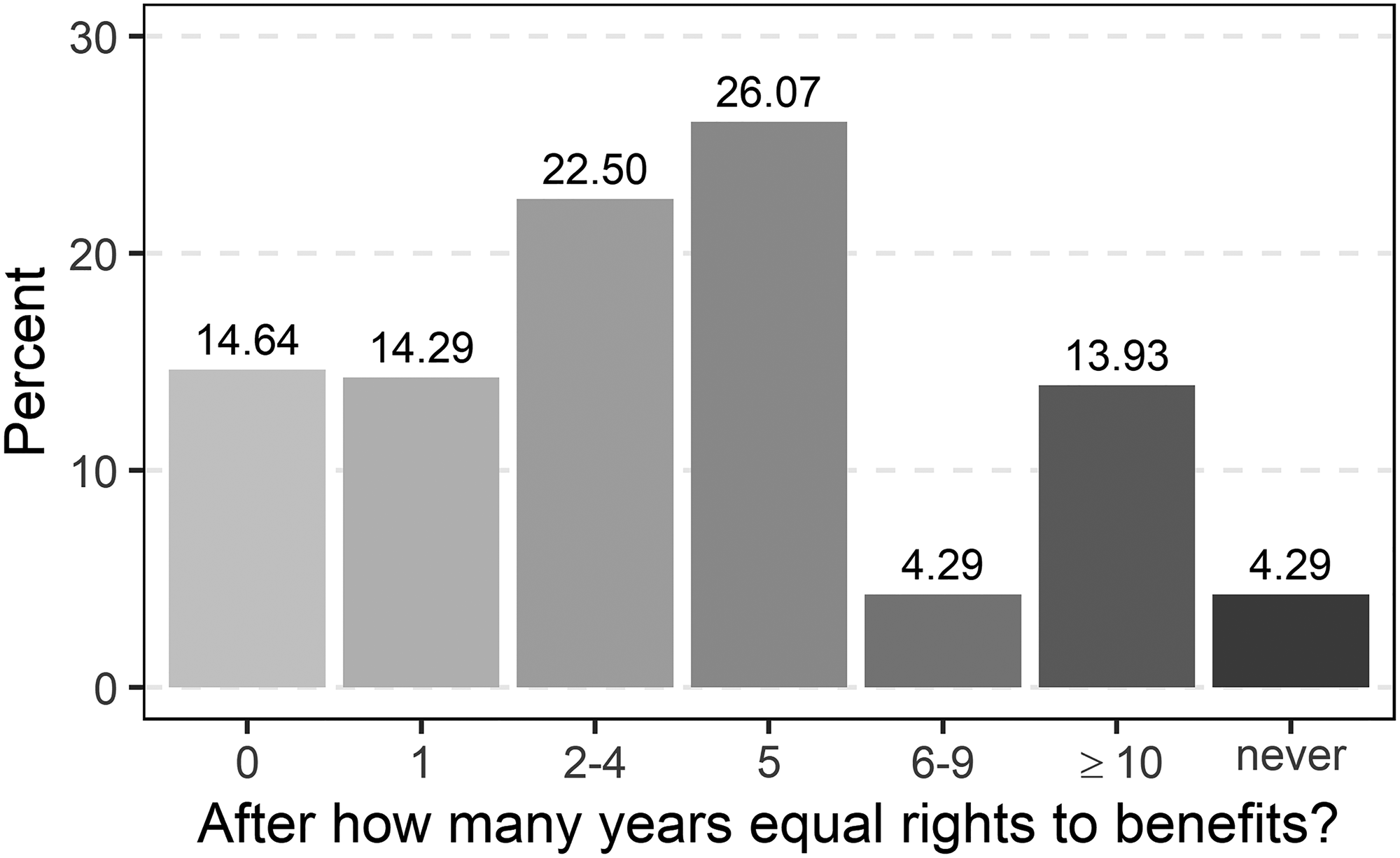
Welfare restrictive preferences toward EU immigrants. Note: Distribution of the years respondents indicate that EU immigrants should work and pay taxes until they obtain equal rights to social benefits as natives. The sample is restricted to the 280 respondents in the No Info group from the baseline survey.
To measure their income perceptions, respondents had to first indicate their total net household income of the previous year (2019). I provide a detailed description of the income variable in the Online appendix. After, they estimated their national and cross-national income positions (e.g. how many percent of the German population had a total yearly net household income lower than their own in the previous year). Subjects were then analogously asked how many percent of the EU population were poorer than themselves. Following the operationalization of previous studies on income misperceptions (e.g. Karadja et al., 2017; Engelhardt and Wagener, 2018; Bublitz, 2022; Hvidberg et al., 2023), I define the respondents as underestimating their position if they perceive themselves to be in a lower than actual income position. Those who perceive that they are in a higher than actual income position, in turn, overestimate their position.
Two information treatments were implemented in the baseline survey in accordance with the idea of correcting respondents’ misperceptions about their own relative income position. In the EU treatment, one-third were informed about their actual personal income position within the EU. First, respondents were shown a figure depicting the EU income distribution and a text below, which explained how to interpret the figure. They were then shown information on their estimated income position as well as their actual one (see the Online appendix). This allowed the subjects to directly compare their estimated with their actual position and to see if and to what degree they misperceived it. Their actual income position (in percentiles) had been calculated based on the income they stated before in the survey and European Union Statistics on Income and Living Conditions (EU-SILC) data on the distribution of yearly net household incomes in Germany from 2018. In the EU+Nat treatment, another third were informed about their personal income position in the EU and additionally about their position in Germany with similar texts as before (see the Online appendix).
The information treatments were designed to inform respondents about their own income misperceptions. For this reason, the treatments provided sufficient information only to subjects who had previously disclosed their own income and estimated their income positions at both the EU and national levels. I exclude respondents with missing values on any of these three variables because they received incomplete information in the treatments. My primary objective in analyzing the treatments is to investigate whether the correction of misperceptions influences welfare restrictive preferences. Therefore, I also excluded subjects who did not express any preferences. Additionally, I include several control variables in the regression models (refer to Table 1 for the list of variables). Consequently, subjects with missing values on any of these control variables were excluded. By omitting these respondents, I obtain 832 subjects in the baseline survey, 713 in the first follow-up survey, and 559 in the second follow-up survey.
Sample characteristics and balancing.
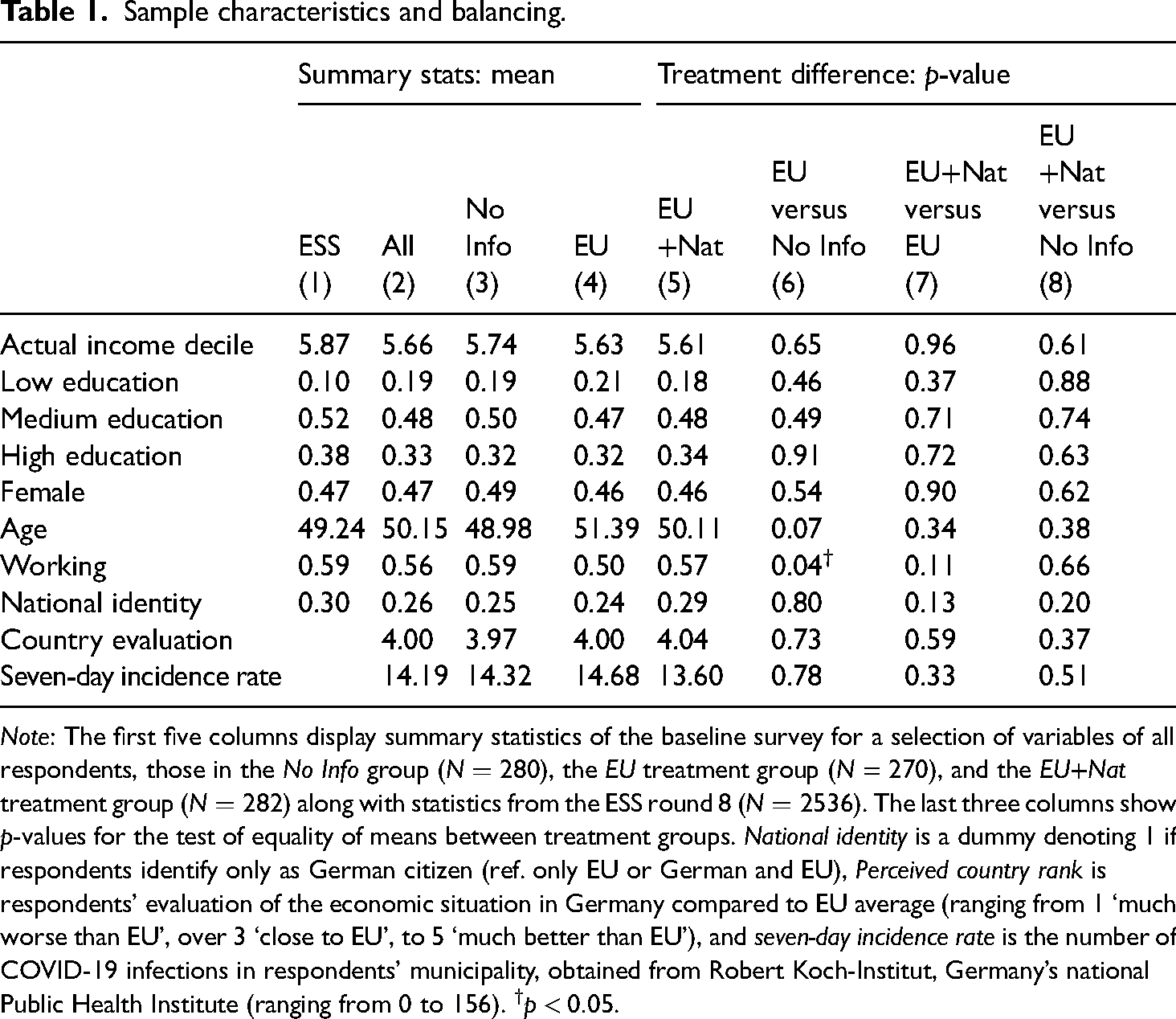
Note: The first five columns display summary statistics of the baseline survey for a selection of variables of all respondents, those in the No Info group (
The Online appendix reveals that income and income perceptions account for the greatest share of missing values, leading to a sample size reduction of around 35% in the baseline survey, 35.5% in the first follow-up survey, and around 34% in the second follow-up survey. The remaining missing values are largely attributed to welfare restrictive preferences, constituting around 3% in the baseline, 1.5% in the first follow-up, and 3% in the second follow-up survey. Excluding respondents with missing values on any of the controls results in an additional reduction of around 1% of the original sample in each wave. Nevertheless, non-response behavior does not harm the interval validity of the results, as missing values are random across the treatment groups (see the Online appendix).
Columns (1) to (5) in Table 1 show the mean values of a collection of covariates for all respondents and those in the treatment groups in the baseline survey and for the nationally representative sample from the ESS round eight (obtained in 2016/2017). These covariates include socio-demographics as well as subjects’ national identity, their evaluation of Germany’s overall economic situation, and the COVID-19 seven-day incidence rate in one’s municipality, since the field phase took place during the COVID-19 pandemic. Compared to the ESS data, the sample exhibits a slightly lower income, though this difference is only weakly (p-value < 0.1) statistically significant (see the Online appendix). Conversely, the lower educated and those with a nationalist identity are moderately overrepresented (p-value < 0.05). However, these differences are not large, making my data comparable to the well-established international survey data of the ESS along the displayed variables.
The last three columns of Table 1 show p-values of t-tests for the equality of means across treatment groups. Treatment groups are balanced along almost all of the observable covariates. Thus, we have little reason to suspect that these imbalances reflect systematic differences between experimental groups. Minor imbalances exist between respondents in the EU treatment and the No Info group for age and employment status. To account for the small imbalances, I add the covariates in Table 1 as control variables in the regression models. I include the employment status (repeatedly asked in both follow-up surveys), the actual income decile (repeatedly asked in the second follow-up survey), and the incidence rate as time-variant controls to account for potential economic changes across the three waves due to the pandemic. Furthermore, including control variables can increase statistical power by reducing the variability of the error term. This is particularly important for my analysis of the follow-up surveys, which have smaller samples sizes. Finally, I test whether the treatments had an effect on participation in the follow-up surveys. There are no significant differences in attrition rates between subjects in the treatment groups. The waves also do not substantially differ along the covariates displayed in Table 1, except that those in the follow-up surveys are, on average, slightly older (see the Online appendix).
Results
Income misperceptions
Where do respondents rank themselves in Germany and in the EU? Panel a of Figure 2 depicts the distribution of the perceived national (dark gray) and EU (light gray) income positions in deciles. The shape of the national distribution confirms findings from previous studies that few subjects in Germany rank themselves in the bottom and the top, but show a tendency toward the middle income (Engelhardt and Wagener, 2018; Bublitz, 2022; Fehr et al., 2022). I find that this pattern also exists at the EU level, that is, a larger share sees themselves in the middle deciles than at the margins of the EU income distribution. At the same time, the distribution of the perceived EU deciles is to the right of the perceived national deciles, revealing that German respondents place themselves higher within the EU than nationally. This difference in perceptions indicates that they are aware of living in an economically richer country (see the Online appendix for the distribution of the actual deciles).
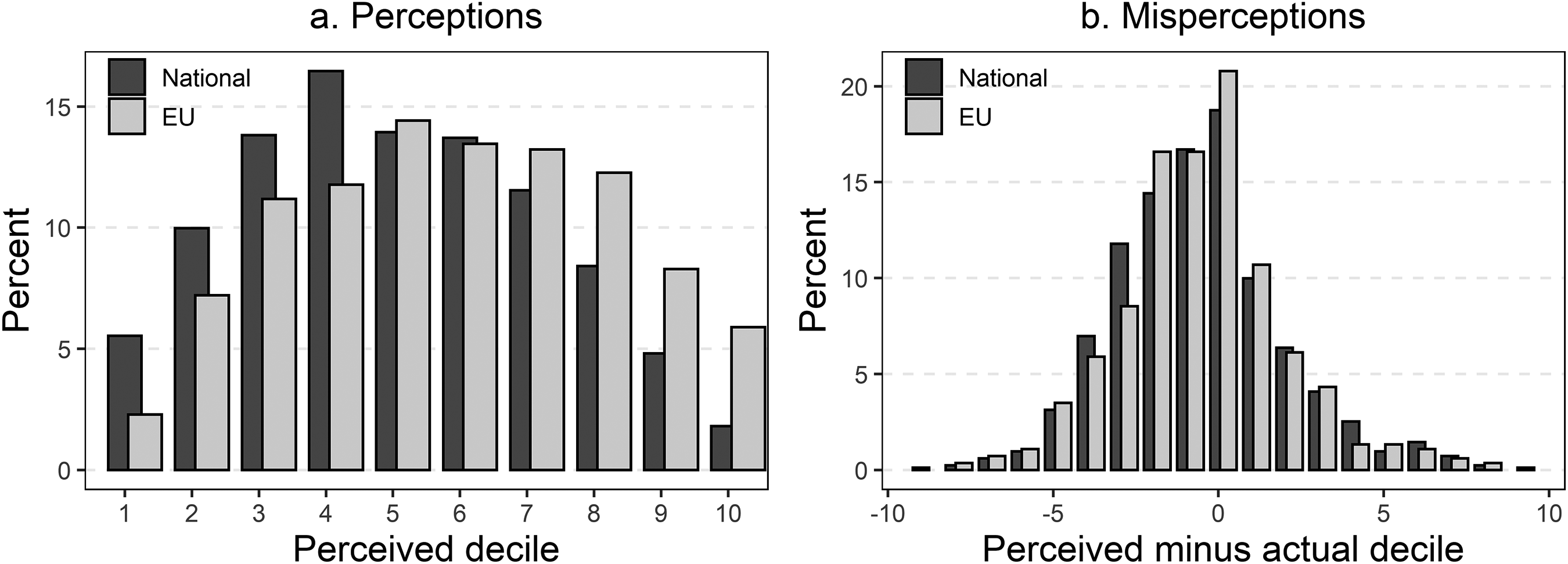
Income perceptions and misperceptions at national and EU levels. Note: Distribution of perceptions (panel a) and misperceptions (panel b) at the national and EU levels in deciles in the baseline survey.
Panel b of Figure 2 depicts the distribution of national and EU income misperceptions, defined by subtracting the actual from the perceived decile. There is a large overlap between the two misperceptions, both in terms of magnitude (length of the bars) and direction (below or above zero). In fact, a very large share of 85% of the subjects in the baseline survey misperceive their national and EU income positions in the same direction. The overlap is equally large in the first (84%) and second follow-up surveys (86%). Thus, while respondents perceive a higher EU income position than a national income position and are aware of their better economic position within the EU, they misperceive both income positions very similarly.
Welfare restrictive preferences
Model specifications
I test both theories with the information experiment and analyze whether respondents’ welfare restrictive preferences change when they are informed about their actual income position in the EU (EU treatment) and additionally in Germany (EU+Nat treatment).
In my main analysis, I estimate the treatment effects by comparing the mean values among the following treatment pairs:
EU and No Info group: This comparison tests whether informing subjects about their actual EU income position affects their preferences relative to receiving no information. EU+Nat and EU group: This comparison examines whether informing subjects about both their EU and national position affects their preferences with reference to those who were only informed about their EU income position. This allows me to isolate the causal effect of being additionally informed about the national income position from being informed only about the EU position.
I analyze the average treatment effects on all respondents and the conditional average treatment effects on those who overestimated or who underestimated their income positions. Given the reported substantial overlap between misperceptions at the national and EU levels, my focus is on two specific sub-groups: those who overestimated and those who underestimated their positions at both the national and EU levels.
2
This choice allows me to investigate potential differences in how subjects within each misperception sub-group react to the two treatments. Specifically, I can compare the differences in reactions toward the treatments on the same sub-set of respondents: those who only learn to have overestimated (underestimated) their EU position (EU treatment) and those who learn to have overestimated (underestimated) both their EU and national position (EU+Nat treatment).
I estimate two distinct regression models for each treatment pair separately for each wave: the baseline survey and the first and second follow-up surveys (the results are largely robust to different model specifications, see robustness checks chapter).
The first model estimates the average treatment effects. I regress welfare restrictive preferences on the treatment indicator, respondents’ income misperception, and several control variables:
The second model estimates the conditional average treatment effects. I regress welfare restrictive preferences on an interaction term between the treatment and the misperception dummy and the control variables:
EU treatment: group conflicts as an explanation at the cross-national level
In this section, I analyze if information about respondents’ actual EU income positions affects their welfare restrictive preferences. In a first step, I investigate whether simply informing subjects about their actual income position in the EU changes their preferences. Panel a of Table 2 reports the results of equation (1) for the EU treatment in the baseline survey and the two follow-up surveys. Column (1) reveals a positive but statistically insignificant treatment effect of the EU treatment in the baseline survey. In the two follow-up surveys, the effects turn to almost zero (columns (3) and (5)). 4 In each wave, the effect is even smaller, relative to the control group mean (No Info mean), for the sub-sample of respondents who misperceived their income position by more than 5 percentiles, that is, allowing for a tolerance corridor in misperceptions by up to 5 percentiles (columns (2), (4), and (6)).
EU treatment effect on welfare restrictive preferences.
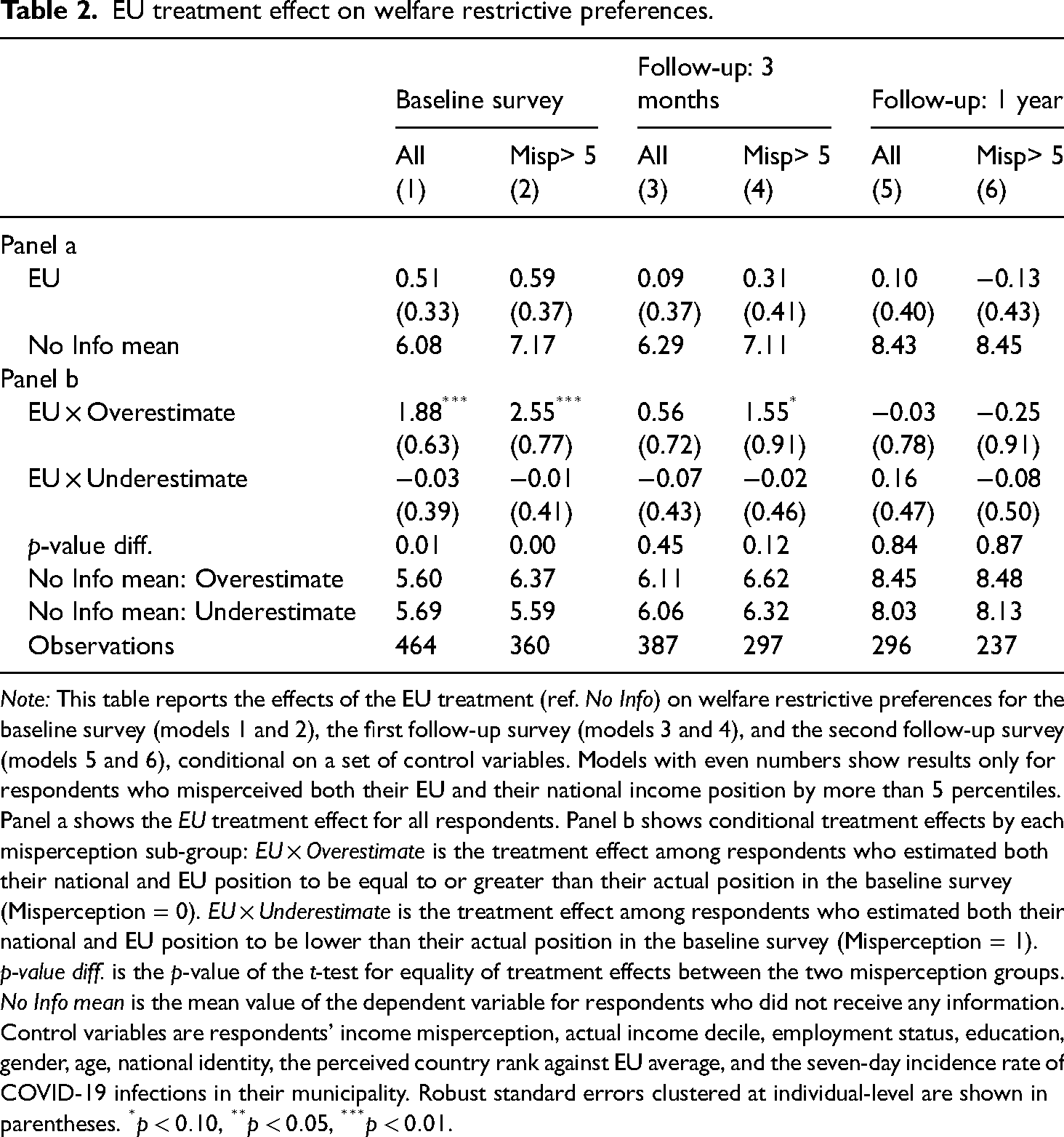
Note: This table reports the effects of the EU treatment (ref. No Info) on welfare restrictive preferences for the baseline survey (models 1 and 2), the first follow-up survey (models 3 and 4), and the second follow-up survey (models 5 and 6), conditional on a set of control variables. Models with even numbers show results only for respondents who misperceived both their EU and their national income position by more than 5 percentiles. Panel a shows the EU treatment effect for all respondents. Panel b shows conditional treatment effects by each misperception sub-group: EU × Overestimate is the treatment effect among respondents who estimated both their national and EU position to be equal to or greater than their actual position in the baseline survey (Misperception = 0). EU × Underestimate is the treatment effect among respondents who estimated both their national and EU position to be lower than their actual position in the baseline survey (Misperception = 1). p-value diff. is the p-value of the t-test for equality of treatment effects between the two misperception groups. No Info mean is the mean value of the dependent variable for respondents who did not receive any information. Control variables are respondents’ income misperception, actual income decile, employment status, education, gender, age, national identity, the perceived country rank against EU average, and the seven-day incidence rate of COVID-19 infections in their municipality. Robust standard errors clustered at individual-level are shown in parentheses. *
Based on the results in panel a, it is evident that informing subjects about their EU income position does not alter their preferences toward the welfare rights of EU foreigners. This finding is consistent with my argument that the primary goal of the information treatments is to correct misperceptions of one’s income positions, rather than simply to inform about these positions.
In a second step, I therefore examine the role of EU income misperceptions in shaping welfare restrictive preferences. Panel b of Table 2 reports the results of regression equation (2). Results of column (1) show that respondents become significantly more welfare restrictive when they are informed about a lower income rank in the EU than they initially estimated. In particular, those who overestimated their position are by around 34% more welfare restrictive than subjects in the No Info group (mean: 5.60). 5 The average treatment effect is driven by respondents below and above the middle category (those who say five years), namely by a lower proportion who think EU immigrants should get equal rights after zero to four years and a higher proportion who say six or more years, or never (see the Online appendix). In contrast, the treatment effect is zero for subjects who underestimated their position and thus learned with the EU treatment to have a higher cross-national income position. The difference in the treatment effects between both groups is statistically significant (p-value = 0.01). The second column reports results for the subsample of respondents who misperceived their income position by more than 5 percentiles. The coefficient is substantially larger and remains statistically significant for those who overestimated their position. The effect for subjects with a negative misperception, in turn, remains close to zero.
Furthermore, I test with the models in columns (3) and (4) if the EU treatment effect persists in the first follow-up survey. Results of column (3) show that the obtained effect for respondents who overestimated their position substantially reduces in size and becomes statistically insignificant after three months. However, focusing only on the sample who overestimated their position by more than 5 percentiles (column (4)) sharpens the picture: the treatment effect remains positive and large, with an increase of around 23% compared to the No Info group mean (6.62), and (weakly) statistically significant. In contrast, the treatment effect for those who underestimated their position remains close to zero (column (3)) and is again not substantially different when restricting the sample to those who misperceived their position by more than 5 percentiles (column (4)). Lastly, results of columns (5) and (6) show no persistence of the treatment effects in the second follow-up survey. For both groups, the treatment effects are statistically insignificant and close to zero one year after they were treated.
Overall, the results provide evidence that group conflicts underlie welfare restrictive preferences at the cross-national level: respondents who learn about a lower rank within the EU perceive larger conflicts with citizens from other member states and are therefore more in favor of restricting their access to the welfare state. Furthermore, this effect persists even three months later, though smaller in size, among those who overestimated their EU income position by more than 5 percentiles.
EU+Nat treatment: self-interest as an explanation at the national level
In this section, I analyze whether informing respondents about both their EU and national income position changes to their welfare restrictive preferences. In the first step, I investigate potential differences in the welfare restrictive preferences between respondents in the EU+Nat with reference to the EU group (regression equation (1)). Results of panel a of Table 3 show, as for the EU treatment, no significant treatment effects on subjects’ preferences when they are additionally informed about their national income position. This holds for the baseline and the two follow-up surveys, for all respondents and for those who misperceive their income positions by more than 5 percentiles.
EU+Nat treatment effect on welfare restrictive preferences.
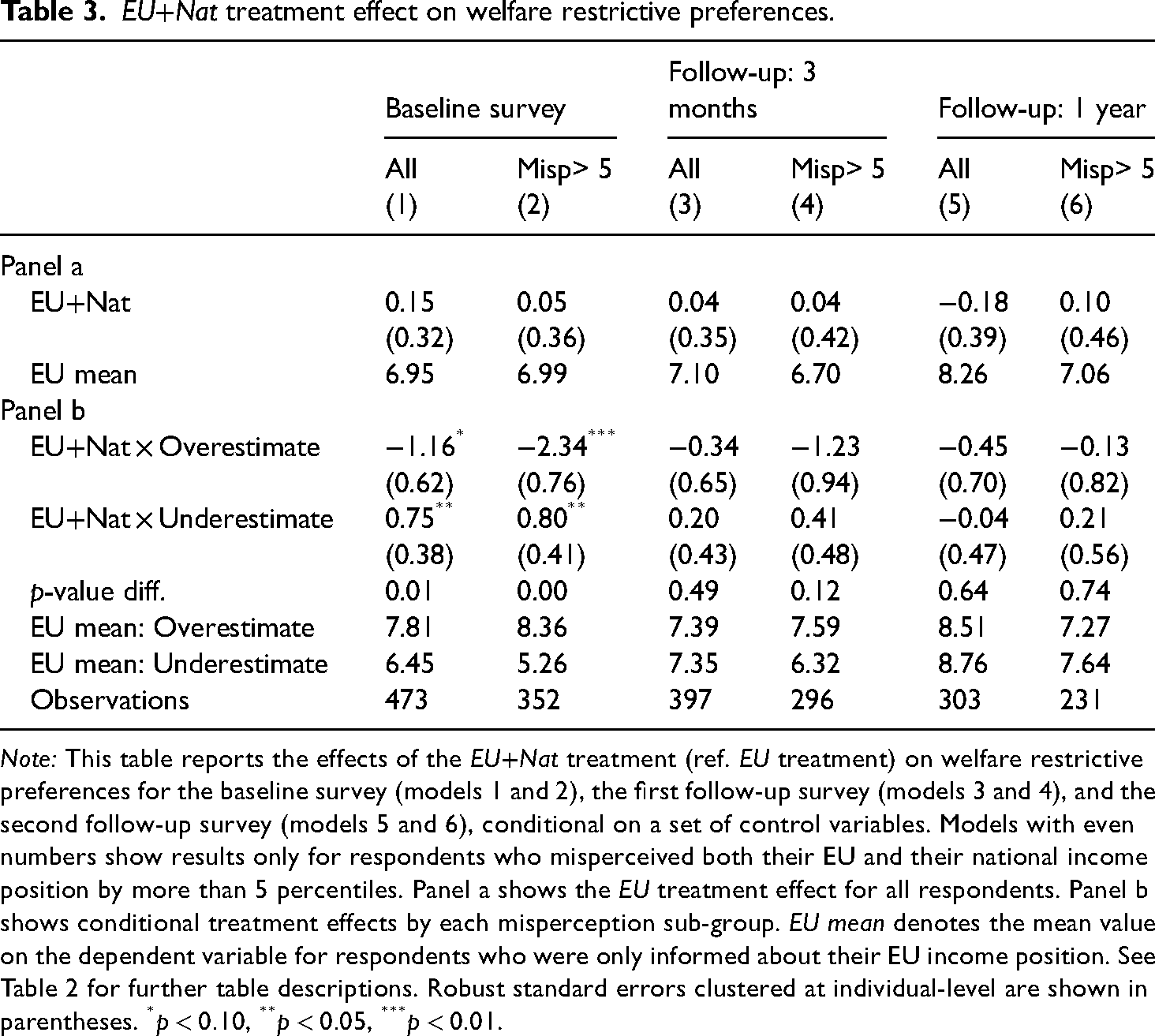
Note: This table reports the effects of the EU+Nat treatment (ref. EU treatment) on welfare restrictive preferences for the baseline survey (models 1 and 2), the first follow-up survey (models 3 and 4), and the second follow-up survey (models 5 and 6), conditional on a set of control variables. Models with even numbers show results only for respondents who misperceived both their EU and their national income position by more than 5 percentiles. Panel a shows the EU treatment effect for all respondents. Panel b shows conditional treatment effects by each misperception sub-group. EU mean denotes the mean value on the dependent variable for respondents who were only informed about their EU income position. See Table 2 for further table descriptions. Robust standard errors clustered at individual-level are shown in parentheses. *
In the second step, I analyze potential differences in respondents’ preferences along with their misperceptions. Findings in column (1) of panel b show that subjects become significantly more welfare restrictive when they receive the additional information that they rank higher nationally. Specifically, those who underestimated their national position are by around 12% more welfare restrictive. In total, they obtain a welfare restrictive stance (
Results of column (3) reveal that none of the effects are statistically significant three months later. However, coefficients in column (4) are in size relatively large (more than half the size of the baseline survey effect) for respondents who overestimated their position by more than 5 percentiles. Due to the smaller sample size, the standard errors are larger than in the baseline survey and the results in column (4) might be indicative for a longer-lasting EU+Nat treatment effect three months later. In contrast, results of columns (5) and (6) show no statistically significant differences in the second follow-up survey. So, as for the EU treatment, the EU+Nat treatment effect becomes insignificant after one year.
The results for the EU+Nat treatment are in line with the rationale of self-interest. Respondents who learn about a higher national position have larger welfare restrictive attitudes compared to those who only received information about a higher position in the EU. In line with that, those who additionally learn about a lower national rank have a significantly smaller welfare restrictive stance compared to subjects who learn about a lower income rank only within the EU.
Additional results and robustness checks
In my main estimation, I used a two-step approach, analyzing the difference in welfare restrictiveness between the No Info and EU treatment groups and the difference between the EU and EU+Nat treatment groups. As an alternative estimation, I regress welfare restrictive preferences on the EU+Nat treatment with reference to the No Info group. The results in the Online appendix are consistent with the main findings. Specifically, respondents who learn that they had initially underestimated their positions become significantly more welfare restrictive compared to those who were not informed. On the other hand, subjects who discover that they had overestimated both their positions do not show a significant reaction to the EU+Nat treatment. This finding is consistent with results from the main specifications, since those who learn to have overestimated their EU position exhibit higher welfare restrictive preferences (as shown in Table 2). However, when they are additionally informed about a higher national position, they display lower restrictiveness (as shown in Table 3). Results on the respondents who learn to have underestimated, in turn, are driven by the information on their national income position (as shown in Table 3), but not their EU one (as shown in Table 2).
The results are to a large extent robust to excluding control variables and re-weighting the sample (see the Online appendix). Only one slight difference exists for the EU treatment effect after three months among respondents who overestimated their income positions by more than 5 percentiles, which, in the absence of controls, is now only borderline significant (p-value = 0.13). The results are also robust to different model specifications, that is, interacting each treatment with a national and EU misperception dummy separately (
Due to technical limitations in implementing the survey experiment, respondents’ income could not be corrected for their respective household size. In the survey, they were therefore told to have the whole population of Germany in mind when estimating their own income positions. However, it is still possible that subjects erroneously considered their household size in their estimations. 6 As a result of this, the treatments may have informed some respondents in larger households about a different actual income position than they had estimated, simply because they considered the household size in their estimations. To address this concern, I used data on the number of household members and conditions the treatment effects on the household size. The results show that the treatment effects are robust and not distorted by respondents who may have had their equivalent household income in mind when estimating their own income positions (see the Online appendix). It must be noted that I cannot account for distortions that may arise between subjects with similar household income and the same household size who are informed with the treatments about a similar actual position but a different size of their misperception, because some of them considered their household size in their estimations.
I also took into consideration potential speeders in the survey completion process. To do this, I excluded the top 5% of the fastest respondents within each wave (see the Online appendix for results). Furthermore, I also tested the impact of excluding those who took an abnormally long time to complete the survey, that is, the slowest 5%. The results reported in the Online appendix remain robust to this exclusion, with the only exception that the EU treatment effect among subjects who initially overestimated their position becomes statistically insignificant when the fastest top 5% are excluded. This outcome is plausibly driven by the smaller sample size, which subsequently leads to a higher standard error.
My results provide evidence that the treatment effects are stronger among respondents who overestimated their positions by more than 5 percentiles in the baseline and the first follow-up survey, but similar among those who underestimated their positions. To further analyze this heterogeneity along the size of misperceptions, I ran a number of regressions and sequentially restricted the sample from all to include only subjects who misperceive their positions by more than 8 percentiles (sample sizes would become too small to allow for even larger misperceptions). These robustness tests confirm my main result that respondents who overestimated their positions more also react more strongly to the EU and EU+Nat treatments in both waves. In contrast, the effects for those who underestimated their positions are stable along different misperception sizes (see the Online appendix).
Discussion
In this section, I address potential concerns with my interpretation of the treatment effects. In particular, I show that my results fit well into the experimental literature on priming effects and I provide non-experimental evidence, which is consistent with my explanation of the treatment effects.
Priming explains difference in treatment effects
Income misperceptions drive welfare restrictive preferences differently at the national and EU levels: respondents who learn about a lower cross-national or higher national rank become more welfare restrictive. However, the opposing effects do not stem from information about different EU and national income misperceptions, since they learn with the EU+Nat treatment, only that, they also over- or underestimated their national income position (in addition to over- or underestimating their EU position).
The significant difference in the treatment effects rather hints at a priming (or salience) effect. Priming denotes the subtle effects of individuals’ environment on their perceptions, behavior, or judgments (e.g. Logan, 1980; Eitam and Higgins, 2010; Molden, 2014). Applied to my study, both treatments provide subjects with similar information on their income misperceptions but expose them to different environments. The EU treatment primes them to think about their income rank within the EU, invoking potential conflicts between natives and EU+Nat treatment, in turn, shifts the focus from the EU level to the national level, resulting in a change of the dominant mechanism that shapes respondents’ welfare restrictive attitudes. This shift weakens the importance of inter-group conflicts between natives and immigrants and brings distributional conflicts between net contributors and beneficiaries to the fore. 7
Testing the treatment effects: perceptions and welfare restrictive preferences
One caveat challenging my interpretation of the EU treatment effect is that the treatment simply omits relevant information, most importantly on respondents’ national income position. If this was true, my interpretation of the EU treatment effect would be premature, since it does not properly grasp the treatment’s underlying mechanism. A concern with the EU+Nat treatment, in turn, might be that its effect is simply noise and results from overburdening them with simultaneous information on both their EU and national income positions.
I address both criticisms by investigating if and how national and EU income perceptions associate with welfare restrictive preferences. Pooling subjects in the No Info group (who were not treated) from the three waves, I regress welfare restrictive preferences sequentially on the perceived national and EU income position, the perceived country ranking, and additional control variables (education, gender, age, employment status, national identity, and the COVID-19 seven-day incidence rate in one’s municipality).
The non-experimental results depicted in Table 4 largely confirm my interpretation of the treatment effects: in column (1), respondents who perceive a higher national position are more welfare restrictive, providing evidence for the rationale of self-interest to be at play. However, the higher they perceive their rank within the EU, the lower are their welfare restrictive preferences, providing evidence for group conflict theory. The variance inflation factor for Model 1 is 2.29 and, therefore, does not raise concerns about multicollinearity. Column (2) shows that the association between EU position and welfare restrictive preferences is driven by subjects’ perceived rank of their country (Germany) against the EU average. The coefficient for the perceived country rank is negative and highly statistically significant, while the coefficient for the perceived EU position reduces by around 40% in size and becomes statistically insignificant. 8 Thus, and in line with group conflict theory, natives who rank Germany (the in-group) lower than the EU average perceive EU immigrants (the out-group) as a particular threat to their country and become more restrictive toward them. The results in column (2) are highly robust to adding, step-by-step, wave fixed effects (column (3)), control variables (column (4)), and municipality fixed effects (column (5)).
Perceptions and welfare restrictive preferences.
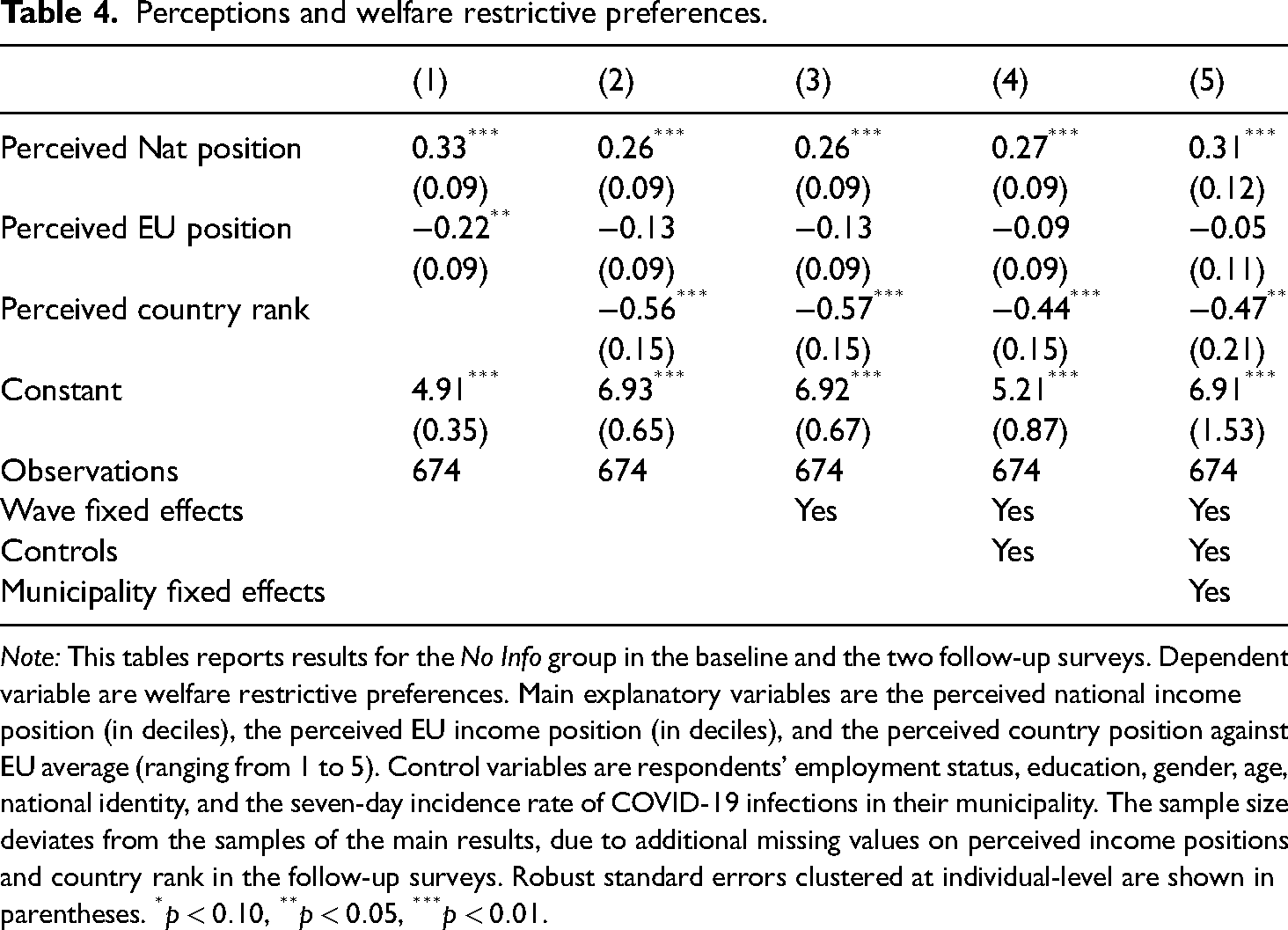
Note: This tables reports results for the No Info group in the baseline and the two follow-up surveys. Dependent variable are welfare restrictive preferences. Main explanatory variables are the perceived national income position (in deciles), the perceived EU income position (in deciles), and the perceived country position against EU average (ranging from 1 to 5). Control variables are respondents’ employment status, education, gender, age, national identity, and the seven-day incidence rate of COVID-19 infections in their municipality. The sample size deviates from the samples of the main results, due to additional missing values on perceived income positions and country rank in the follow-up surveys. Robust standard errors clustered at individual-level are shown in parentheses. *
These results provide further evidence that self-interest drives the relationship between welfare restrictive preferences and income perceptions at the national level and that group conflicts drive their relationship at the EU level. The results additionally suggest that respondents have primarily their country as their in-group in mind when they are treated with information about their own EU income position. Consistent with my previous interpretation, those who learn from the EU treatment about a lower cross-national rank may perceive their country as more threatened by immigrants. This perception, in turn, reinforces their welfare restrictiveness toward immigrants.
Conclusion
I report the results of an online survey experiment that measures the role of national and cross-national income misperceptions for welfare restrictive preferences. I document that around 85% of the German respondents are welfare restrictive, that is, they want to restrict the access of EU immigrants toward social benefits. In line with other experimental studies, my results provide evidence that welfare restrictive preferences are formed in the context of misperceived own income positions. Individuals who are informed that they rank lower cross-nationally or higher nationally than they thought become more welfare restrictive. Information on EU misperceptions has a persistent treatment effect after three months, though smaller in size, but loses significance in the second follow-up survey conducted one year after the baseline survey.
My results are consistent with two different mechanisms of attitude formation. Group conflict theory bears explanatory power at the cross-national level: informing respondents about a lower income rank in the EU triggers an in-group bias, resulting in stronger preferences for excluding EU immigrants from social benefits. At the national level, on the contrary, a rationale of self-interest seems to be driving welfare restrictiveness. Subjects who learn that they have a higher national position are more likely to see themselves as contributors to society than they initially thought. As a result, they tend to support more restrictions on the access of EU immigrants (as potential welfare beneficiaries) to social benefits in society. In both cases, my findings show that attitudes toward immigrants’ welfare rights are (at least partly) driven by economic factors, that is, one’s personal income rank. My article therefore suggests that large-scale support for an EU with shared social responsibilities is contingent on addressing the income inequalities that exist between EU citizens.
There are certain limitations of my study that may be taken up in future research. First, social protection is a multi-faceted field and includes different types of social benefits. It is plausible to assume that income misperceptions relate differently to different kinds of social benefits, for example, health insurance and unemployment benefits. It would be fruitful for future studies to examine whether welfare restrictive preferences also depend on the type of social benefits provided. Second, individuals might perceive stronger or weaker group conflicts depending on the member states they have in mind where EU immigrants migrate from. For instance, individuals may perceive less distributional conflicts with immigrants from richer member states than their own one. So, investigating how the interplay of income misperceptions and immigrants’ economic origin affects welfare restrictive preferences could be particularly promising.
Supplemental Material
sj-zip-1-eup-10.1177_14651165241229593 - Supplemental material for Social benefits for European Union immigrants? A survey experiment on misperceptions
Supplemental material, sj-zip-1-eup-10.1177_14651165241229593 for Social benefits for European Union immigrants? A survey experiment on misperceptions by Julian Jäger in European Union Politics
Supplemental Material
sj-zip-2-eup-10.1177_14651165241229593 - Supplemental material for Social benefits for European Union immigrants? A survey experiment on misperceptions
Supplemental material, sj-zip-2-eup-10.1177_14651165241229593 for Social benefits for European Union immigrants? A survey experiment on misperceptions by Julian Jäger in European Union Politics
Supplemental Material
sj-pdf-3-eup-10.1177_14651165241229593 - Supplemental material for Social benefits for European Union immigrants? A survey experiment on misperceptions
Supplemental material, sj-pdf-3-eup-10.1177_14651165241229593 for Social benefits for European Union immigrants? A survey experiment on misperceptions by Julian Jäger in European Union Politics
Footnotes
Acknowledgements
I am grateful for detailed and valuable comments on earlier drafts of the article to Miriam Beblo, Elisabeth Bublitz, Luise Görges, Felix Kersting, Henning Lohmann, Elias Naumann, and Hequn Wang. The article has benefited from comments from participants at the workshop Advances in empirical analyses of family, education and social policy (Universität Hamburg, 2020), at the ESPAnet (European Network for Social Policy Analysis) conference (2021), the Lüneburg Workshop in Economics (2021), and the EALE (European Association of Labor Economists) conference (2022).
Funding
The author(s) disclosed receipt of the following financial support for the research, authorship, and/or publication of this article: This project received funding from the German Federal Ministry of Labor and Social Affairs.

Supplemental material
Notes
References
Supplementary Material
Please find the following supplemental material available below.
For Open Access articles published under a Creative Commons License, all supplemental material carries the same license as the article it is associated with.
For non-Open Access articles published, all supplemental material carries a non-exclusive license, and permission requests for re-use of supplemental material or any part of supplemental material shall be sent directly to the copyright owner as specified in the copyright notice associated with the article.
