



Abstract
We examine the effects of European integration on economic redistribution in Central and Eastern Europe. While accession to the European Union provided new economic opportunities, it also imposed considerable constraints. Using cross-sectional time-series analysis of 11 post-communist countries between 2004 and 2018, we focus on the impact of trade flows, cohesion policy funds, emigration, remittances, and Economic and Monetary Union membership. We find that emigration and commercial reorientation toward the European Union are associated with greater efforts to alleviate income inequality. In contrast, the adoption of the euro induces lower redistribution. Finally, the receipt of European Union cohesion funds does not affect income differentials. To our knowledge, this is one of the first systematic analyses of how the European Union shapes inequality dynamics in Central and Eastern Europe.
Introduction
1 May 2004 marked a momentous occasion for eight Central and Eastern European (CEE) countries. After more than a decade of difficult negotiations and demanding reforms, Czechia, Estonia, Hungary, Latvia, Lithuania, Poland, Slovakia, and Slovenia joined the European Union (EU) as equal member states. Bulgaria, Romania, and Croatia followed in 2007 and 2013. EU accession culminated the challenging transition to democracy and market capitalism that those states embarked on after the fall of communism in 1989 and the disintegration of the Soviet Union in 1991.
A rich literature has explored the implications of European integration for democratic consolidation, economic prosperity, and political reorganization in CEE (Vachudova, 2005; Bohle and Greskovits, 2007, 2012; Myant and Drahokoupil, 2012; Orenstein, 2009; Appel and Orenstein, 2016). Nevertheless, despite the EU's enormous transformative potential, few studies have directly examined the effect of EU membership on economic redistribution, or the extent to which the government reduces income differences between the rich and the poor through taxes and transfers, in the region. Indeed, scholarship on post-communist welfare states has recognized the guidelines for social policy embedded in the acquis communautaire,1 the constraints imposed by the Single Market and the Economic and Monetary Union (EMU), and the inspiration that CEE policymakers drew from their Western European neighbors in the design of their social programs (Inglot, 2008; Deacon and Hulse, 1997; Aidukaite, 2009; Cook, 2010). Yet, existing work has so far not analyzed whether, and how, joining the EU has affected post-communist countries’ ability to alleviate income inequality. Recent studies have hinted at a possible effect, showing that CEE governments have used social policy to accomplish strategic goals related to European integration (Bohle and Greskovits, 2012; Aidukaite, 2021), but this research has mostly focused on a few countries over a short period of time. Systematic analyses have considered the entire EU, centering on broader political and economic processes and ignoring the specific challenges new member states face (Tober and Busemeyer, 2022). As a result, we lack a comprehensive picture of the complex, multifaceted way in which EU membership has shaped social policy outcomes in former socialist states. This paper seeks to fill this gap.
Viewing EU membership holistically, we posit that EU accession simultaneously imposes considerable limitations and creates significant economic opportunities whose short- and long-run repercussions in new member states often move in different directions. We focus on five distinct channels through which the EU can shape redistributive outcomes: trade, the free movement of people within EU borders, EMU-related budgetary constraints, access to EU funds, and EU social policy requirements. Commercial reorientation might exacerbate economic risk and increase public demand for compensatory social policies (Tober and Busemeyer, 2022; Petrova and Sznajder Lee, 2022). Similarly, emigration might undermine long-run competitiveness (Atoyan et al., 2016; Krasteva, 2019), threaten solvency, and induce governments to invest in family support. In contrast, EMU membership might subvert redistributive efforts by forcing budget discipline. The effect of EU funds is unclear, as they can either free up resources or decrease the amount of funds available for redistribution by generating project co-financing obligations. Finally, social policy requirements can either hamper efforts to alleviate inequality by limiting the scope of acceptable policy options or promote lower income differentials by requiring governments to ensure a basic level of benefit provision and risk protection.
We test these hypotheses with a cross-sectional time-series analysis of the 11 CEE countries that joined the EU in the 2004, 2007, and 2013 enlargement waves. The time horizon of our analysis lies between 2004 and 2018. We complement our findings with insights from 68 expert interviews with academics, politicians, policy advisers, trade union leaders, and business association representatives in Bulgaria and Czechia. Our models indicate that European integration has important implications for states’ ability to alleviate income differentials. Consistent with our expectations, emigration and commercial flows are associated with higher redistribution while EMU membership is linked to lower reductions in economic inequality. Access to EU funds, in contrast, does not meaningfully affect economic redistribution. More disaggregated expenditure data suggest that governments spend more on family support when faced with more people leaving the country. Higher manufacturing exports to the EU are, in turn, related to lower spending on unemployment benefits. Furthermore, different countries respond to the opportunities generated by the EU differently: while the Baltics have used European funds to update their education systems to facilitate their transition to knowledge-based economies (Aidukaite, 2021; Toots and Lauri, 2022; Avlijaš, 2022), the Visegrád Four (Czechia, Hungary, Poland, and Slovakia) appear to have relied on social spending to nurture their specialization in industry. These findings imply that EU membership has played an important role in shaping welfare state dynamics in the region.
This project contributes to a rich literature on the impact of globalization on income inequality and social policy in young democracies. In particular, it provides one of the first systematic analyses of the effect of EU membership on economic redistribution in CEE. Recent research finds that the EU has constrained social policy across member states (Tober and Busemeyer, 2022). We examine the specific channels linking European integration to states’ ability to reduce income differentials while acknowledging the unique historical legacies and modern challenges that set post-communist countries apart from their Western European neighbors. Some of these mechanisms, like emigration, economic specialization, and EU funds, have remained understudied and undertheorized. Broadly speaking, our work thus zooms in on the multifaceted impact of regional integration and the likelihood of continued social policy differentiation in small open economies.
Illuminating this impact in the context of the post-communist world is profoundly important given that the pursuit of accession was partly motivated by the objective of attaining the elusive European social model. Implementing the often-painful economic reforms that EU membership required was meant to promote convergence with the average standard of living in the EU-15. Redistribution is one of the main tools for shielding people from risk, decreasing economic inequality, and easing hardship. As such, it has far-reaching consequences, not only in terms of shaping individual wellbeing and aggregate socio-economic outcomes, but also for molding popular evaluations of the European integration project.
Theory and hypotheses
We view European integration as a multidimensional process that creates significant economic opportunities and imposes considerable constraints. On the one hand, EU membership has given former socialist countries access to a dynamic market, supported economic restructuring through foreign direct investment, provided financial assistance through the cohesion policy instruments, allowed post-communist citizens to work in other European countries, and encouraged investment in an—at least minimal—social safety net (Cerami and Vanhuysse, 2009; Vachudova, 2005; Inglot, 2008; Kuitto, 2016). It could have thus promoted the development of CEE welfare states by reinforcing commitment to equity and inclusion, putting forth diverse policy blueprints, stimulating economic activity, and freeing up resources for social programs. On the other hand, the EU has intensified the competitive pressures that the region faced during the transition, contributed to the demographic strain felt after 1989, and required strict fiscal discipline from the countries participating in the European Semester and eager to join the EMU (Cerami and Vanhuysse, 2009; Appel and Orenstein, 2016; De La Porte and Pochet, 2014; Busemeyer and Tober, 2015; Tober and Busemeyer, 2022). Thus, it could have hindered redistribution by decreasing the funds available for social benefits and undermining the feasibility of a generous social protection framework.
The effect of European integration on redistributive dynamics in new member states is therefore variegated and multi-directional. We argue that this impact crystallizes through five distinct channels: social policy requirements introduced by the acquis, budget constraints exacerbated by membership in the EMU, production profiles shaped by the EU's Single Market, additional resources available through the cohesion and structural funds, and migratory pressures facilitated by the free movement of people across EU borders. While some of these factors affect the welfare state directly, others influence it in more subtle ways, by encouraging emigration and, concomitantly, remittances. The rest of this section discusses each channel individually.
The acquis communautaire profoundly molded domestic institutions. Virtually no area of socio-economic life was left untouched by the legal requirements attached to EU membership. Social goals appeared in the Treaty of Rome and in the 1974 Social Action Programme, which confirmed that “social policy intervention [was] an integral part of European integration” (Falkner, 2010: 293). Nevertheless, existing measures are largely regulatory, aiming to support economic competition rather than promote social rights (Scharpf, 2002; Golinowska and Żukowski, 2009; Martinsen, 2020). Despite socio-economic challenges that require solutions at the European level, member states continue to invoke the principle of subsidiarity, resisting the creation of a common European welfare state. Regardless of national institutional differences and policy preferences, however, the Nice European Council defended a “European social model” characterized by a “high level of social protection, […] social dialogue and […] services of general interest covering activities vital for social cohesion” (European Parliament, 2000).
To comply with existing European legislation, accession countries adopted binding social regulations in the domains of work conditions, gender equality, and workers’ health and safety (Falkner, 2006). The design of their welfare states, however, was largely left to their own decisions (Inglot, 2008). Subsequent reforms were a function of historical legacies, domestic politics, and external advice, where the EU represented one of several voices (Inglot, 2008; Orenstein, 2009; Kvist and Saari, 2007; Deacon and Hulse, 1997). Although its specific priorities in the social sphere were unclear, the EU did not force a significant withdrawal of the state from socio-economic life. Rather, it pursued a “level playing field” across member states and encouraged applicants to establish an adequate social safety net to safeguard economic reform and democratic consolidation (Deacon and Hulse, 1997; Falkner, 2010).
Social policy gained prominence on the EU agenda only after the conclusion of all accession negotiations (Potůček, 2020). The 2000 Lisbon Strategy decoupled social policy from market measures, highlighted social cohesion, and introduced the open method of coordination (OMC), a non-regulatory, discourse-based strategy that provided input to policymakers and set benchmarks that governments were encouraged to adopt (Kvist and Saari, 2007). While controversial in terms of its efficacy (Daly, 2008), the OMC delineates the goalposts of the European social model, especially in terms of social inclusion, pensions, healthcare, and long-term care (Golinowska and Żukowski, 2009; Scharpf, 2002). As a result, case studies conclude that the “EU has contributed to a reorientation of national social protection towards more modern, universal and active policies” (Kvist and Saari, 2007: 241). In a similar vein, De La Porte and Pochet (2014) argue that the EC has sought to maintain the European Social Model and re-launch a social agenda after the sovereign debt crisis, highlighting social investment.
H1: EU membership is associated with higher economic redistribution in the post-accession period.
The EMU, in contrast, has primarily emphasized fiscal discipline. It combines national-level fiscal policy with centralized monetary policy that is only weakly responsive to economic circumstances in individual countries (De Jong and Gilbert, 2020). Recognizing the risks of this approach, the 1992 Maastricht Treaty introduced supranational rules capping budget deficit and government debt levels at 3% and 60% of GDP, respectively. The 1997 Stability and Growth Pact (SGP) further reinforced this commitment (De Jong and Gilbert, 2020). Despite numerous amendments throughout the 2000s and the 2010s, the SGP remains strongly focused on fiscal discipline. It has recently been embedded in the European semester, which has strengthened EU institutions’ regulatory powers, giving the Commission and the Council the authority to invoke the excessive imbalance procedure. Member states are thus expected to “abide by the medium-term budgetary objective of [balanced budgets]” and “correct excessive deficits as quickly as possible after their emergence” (European Council, 1997).
Existing work has shown that these stipulations have important implications for fiscal decision-making and social policy. De Jong and Gilbert (2020) find that the Excessive Deficit Procedure is effective at inducing fiscal consolidation. Koehler and König (2015) estimate lower amounts of new debt among EMU countries. When it comes to redistribution, Filippin and Nunziata (2019) reveal that the early adopters of the euro decreased the amount of resources allocated to social spending. Busemeyer and Tober (2015), Beckfield (2019), Kvist and Saari (2007), and Tober and Busemeyer (2022) all suggest that European integration in general and EMU membership in particular has limited the room to maneuver available to European policymakers, hindering redistribution and obstructing their ability to act on economic inequality. Strikingly, Herwartz and Theilen (2014) demonstrate that partisan differences in social expenditures have disappeared entirely with the emergence of supranational institutions. Drawing on this work, we expect membership in the EMU to act as a deterrent to social policy expansion in CEE, strengthening existing fiscal constraints and discouraging policymakers from increasing spending on policies meant to reduce income differentials.
H2: Economic and Monetary Union membership is associated with lower economic redistribution.
The constraints that EMU accession imposes make joining the Union and adopting the euro a high-stake decision that can engender resistance and subsequent backlash. In addition to the already arduous, comprehensive reforms that post-communist countries had to implement before joining the EU, prospective Eurozone members also had to accept the loss of their monetary policy sovereignty and commit to extraordinary fiscal discipline. Indeed, although they have gone through some stages of integration, several CEE—and Western European—countries continue to use their own currency. This decision is in large part rooted in domestic politics and influenced by a combination of electoral cycle dynamics, elite preferences, central bank politics, and public opinion (Dandashly and Verdun, 2018). Thus, of the 11 post-communist states in our sample, only half—Slovenia, Slovakia, and the Baltics—have joined the Eurozone. While the latter have generally adhered to a minimalist, strongly neoliberal developmental model, which has greatly reduced the size of the state in socio-economic life and made keeping fiscal deficits low relatively easier, since their transition in 1991, Slovenia and Slovakia saw the benefits of Eurozone membership as outweighing its potential costs.
The EU can also affect welfare state dynamics in member states through the economic infrastructure it has put in place. Two institutions are particularly important: the Single Market and the EU Cohesion Fund. The former obliges countries to open up to commercial and investment flows from other EU economies. This requirement accelerated CEE's re-orientation toward its western neighbors. The loss of the Soviet-era Council for Mutual Economic Assistance (Comecon) in the 1990s meant that post-communist states had to establish new commercial partnerships. Their cheaper labor force, existing specialization in manufacturing, and proximity to the European Economic Community expedited trade liberalization and facilitated CEE's incorporation into the global economic system as a periphery—and industrial hub—of Western Europe (Myant and Drahokoupil, 2012; Bohle and Greskovits, 2012). The early 2000s thus saw the region grow rapidly, develop new comparative advantages, and attract high levels of foreign direct investment.
Even so, the process of economic liberalization came at a high social cost. Opening to trade with more economically developed EU partners exposed the region to strong competitive pressures, led to substantial job losses, and forced entire industries to restructure (Vachudova, 2005). After decades of relative economic security, post-communist citizens grappled with rising economic insecurity (Ivanova, 2007; Orenstein, 2009; Inglot, 2008). Recognizing the real risks that public discontent posed for the reform process, domestic governments often opted for a multidimensional approach, which saw policymakers pursue economic liberalization in combination with compensatory measures designed to soften the impact of economic reforms (Bohle and Greskovits, 2012; Kuitto, 2016). Social policies—e.g. early retirement schemes, unemployment benefits, and social assistance programs—were thus used to ameliorate the effect of economic rebuilding. The substantial disruptions that trade reorientation entailed and the expectation of social backlash against the reform agenda in general, and any proposed cutbacks to welfare programs in particular, might have induced political elites to invest in a relatively more comprehensive social safety net. We expect that the incentive to shield citizens from trade-induced socio-economic risks persisted (Petrova and Sznajder Lee, 2022).
H3: Higher trade with the EU is associated with higher redistribution in Central and Eastern Europe.
Apart from goods and services, the Single Market also stipulates the free movement of people. EU citizens are allowed to live, work, and travel anywhere within the EU's borders. This right was highly controversial in the early 2000s, when many in the EU-15 feared that the considerable disparities in wealth during the enlargement process would lead to massive immigration, which would ultimately displace domestic workers and induce a race to the bottom in taxes and public spending (Kvist, 2004; Busemeyer and Tober, 2015; Kvist and Saari, 2007). Indeed, CEE countries, most of which remain poorer than their western neighbors, experienced substantial emigration following their accession in 2004 and 2007, losing nearly 20 million people, or 5.5% of their population, between 2000 and 2020 (Atoyan et al., 2016; Lim, 2023). Bulgaria, Estonia, Latvia, and Lithuania saw between 16% and 26% of their population leave between 1991 and 2015 (Lutz et al., 2019). Combined with a sharp drop in fertility rates during the first decade of the transition (Ivanova, 2007), this exodus has exacerbated the demographic crisis in former socialist states, contributing to population aging and labor shortages.
Apart from fueling the rise of the radical right (Lim, 2023), emigration carries serious economic consequences that affect social policy. A large number of working-age adults leaving the country implies lower economic activity, lower tax revenues, and a lower age dependency ratio, threatening the long-term solvency of the welfare state. Recognizing this, political elites might decrease redistribution to comply with increasingly tight budget constraints. Lower redistribution requires a lower financial commitment, which is more feasible in the context of austerity. Alternatively, policymakers might invest more in social policies to boost citizens’ standard of living and convince them to stay in the country, especially if emigration would further shrink the size of skilled labor force and hurt international competitiveness (for a recent discussion of these two arguments, see Kyriazi and Visconti, 2023 and Kureková, 2013). Given the political costs of retrenchment (Bagashka et al., 2022), the popularity of the welfare state in CEE (Pop-Eleches and Tucker, 2017; Alesina and Fuchs-Schündeln, 2007; Mason et al., 2000), and the pressure of international competition, we expect the latter scenario to be more likely.
H4: Higher emigration resulting from the Single Market's free movement of people is associated with higher redistribution in Central and Eastern Europe.
Lastly, the fifth mechanism through which the EU might affect CEE welfare dynamics revolves around cohesion policy. Designed to combat regional disparities between and within its member states (Falkner, 2010), EU funds can stimulate economic activity and relax budget constraints. This could plausibly induce higher redistribution as incumbents have access to additional resources. Nevertheless, EU funds rarely go to the central government; they are mainly destined for individual recipients. Furthermore, they may not substitute for national funding (Šlander and Wostner, 2018). In fact, they often require a fiscal commitment by member states. This means that EU funds cannot be used to support ongoing governmental expenditures, even if these contribute to long-term growth (Halasz, 2018). Rather than relaxing budget constraints, they might actually decrease the resources policymakers allocate to redistribution. On the other hand, growth-promoting investments in areas such as infrastructure might result in a crowding-in effect (Šlander and Wostner, 2018), leading to greater economic growth, higher employment, and larger tax revenue available for redistribution.
H5: The net effect of EU funds on redistribution in Central and Eastern Europe is not statistically significant.
Empirical strategy
Data
We test these hypotheses with cross-sectional time-series analysis of the 11 CEE countries that joined the EU in the 2004, 2007, and 2013 accession waves. Although Bulgaria, Croatia, Czechia, Estonia, Hungary, Latvia, Lithuania, Poland, Romania, Slovakia, and Slovenia differ in terms of their economic structures, political institutions, and levels of economic development, they share two important historical legacies. First, all of them pursued liberalizing reforms throughout the 1990s and the 2000s. While the type, speed, and comprehensiveness of these reforms varied, they were similar in their emphasis on promoting political competition and limiting government involvement in the economy. Second, all of these states initiated negotiations to join the EU within a decade of the fall of communism. Consequently, they faced similar external pressures as they restructured their political, economic, and legal systems in accordance with European standards.
Our qualitative evidence comes from expert interviews in Bulgaria and Czechia. The two countries can be seen as diverse cases (Gerring, 2007) in terms of wealth, EU accession timing, industrial profile, emigration, and proximity to the European core. Bulgaria joined the Union in 2007, after a protracted reform process (Vachudova, 2005). Its economy is largely dependent on tourism, services, and light industry (Myant and Drahokoupil, 2012; Bohle and Greskovits, 2012). Despite rapid growth throughout the 2000s, it remains the poorest EU member state, which has propelled significant emigration, with between 880,000 and 1.3 million people leaving the country in the last 30 years (Angelov and Lessenski, 2017; Krasteva, 2019). Czechia, on the other hand, was among the frontrunners of the reform process (Vachudova, 2005; Grzymała-Busse, 2007). Taking advantage of its strategic location in the heart of Europe, it quickly reinvented itself as a manufacturing hub specializing in medium—and high-skill technology-intensive industrial goods (Myant and Drahokoupil, 2012; Bohle and Greskovits, 2012). Today, its GDP per capita places it closer to Spain and Italy than to Hungary and Poland. Its high standard of living and vibrant labor market mean that it does not face the same migratory pressures as its poorer post-communist neighbors. These two countries thus allow us to examine pressures that either affect most post-communist EU member states or are specific to some of them. In other words, they enable us to discuss both region-wide dynamics and intra-regional heterogeneity.
Our analysis focuses on the years between 2004 and 2019. This period begins when most countries in our sample had already joined the EU or were concluding negotiations for accession.2 Thus, they had presumably established democratic political systems and functioning market economies. They had also largely overcome the transitional recessions that dominated the early 1990s and had started transforming their systems of social provision. The end point in 2019 enables us to account for the 2008 global economic crisis, the 2010 European sovereign debt crisis, the economic recovery of the 2010s, the 2015 migration crisis, Brexit, and the recent illiberal turn in Poland and Hungary. These 16 years therefore offer remarkable variation in both political and economic conditions.
Our dependent variable is the level of relative economic redistribution, or the difference between the market and the disposable income GINI coefficient, divided by the former and multiplied by 100, per given year. Market income generally accounts for income from salaries, self-employment, rental property, land, interest, capital investments, and pensions from individual pension plans. Disposable income adds any financial benefits received from the state and subtracts any taxes paid. Relative redistribution thus captures the degree to which governments alleviate income inequality through the instruments of fiscal policy. The variable is calculated for the working-age population using the European Union Statistics on Income and Living Conditions (EU-SILC) database. The high-quality, individual-level data collected by EU-SILC allow us to apply the same definitional standards and equalization procedures to all country-years. The earliest year in which we can start our analysis using the EU-SILC database is 2004.
Figure 1(a) and 1(b) below show the relative redistribution in the 11 countries in our sample between 2004 and 2019. The variable exhibits interesting variation across time and space. Some states, such as Czechia, Hungary, Slovakia, and Slovenia, reduce income differentials by a lot. Bulgaria and Latvia, in contrast, seem to struggle to alleviate economic inequality. Croatia, Estonia, Poland, and Romania fall between these two groups, with redistribution levels between 30% and 40%. Furthermore, although different states exhibit different trends, some common patterns emerge. The second half of the 2000s witness greater efforts to suppress income differentials. This suggests that CEE governments responded to the global economic crisis by expanding access to social benefits or that automatic stabilizers in the region were effective at reducing inequality. In contrast, the late 2010s see decreases in redistribution across our sample, which implies the expiration of any emergency policies adopted to address economic hardship.
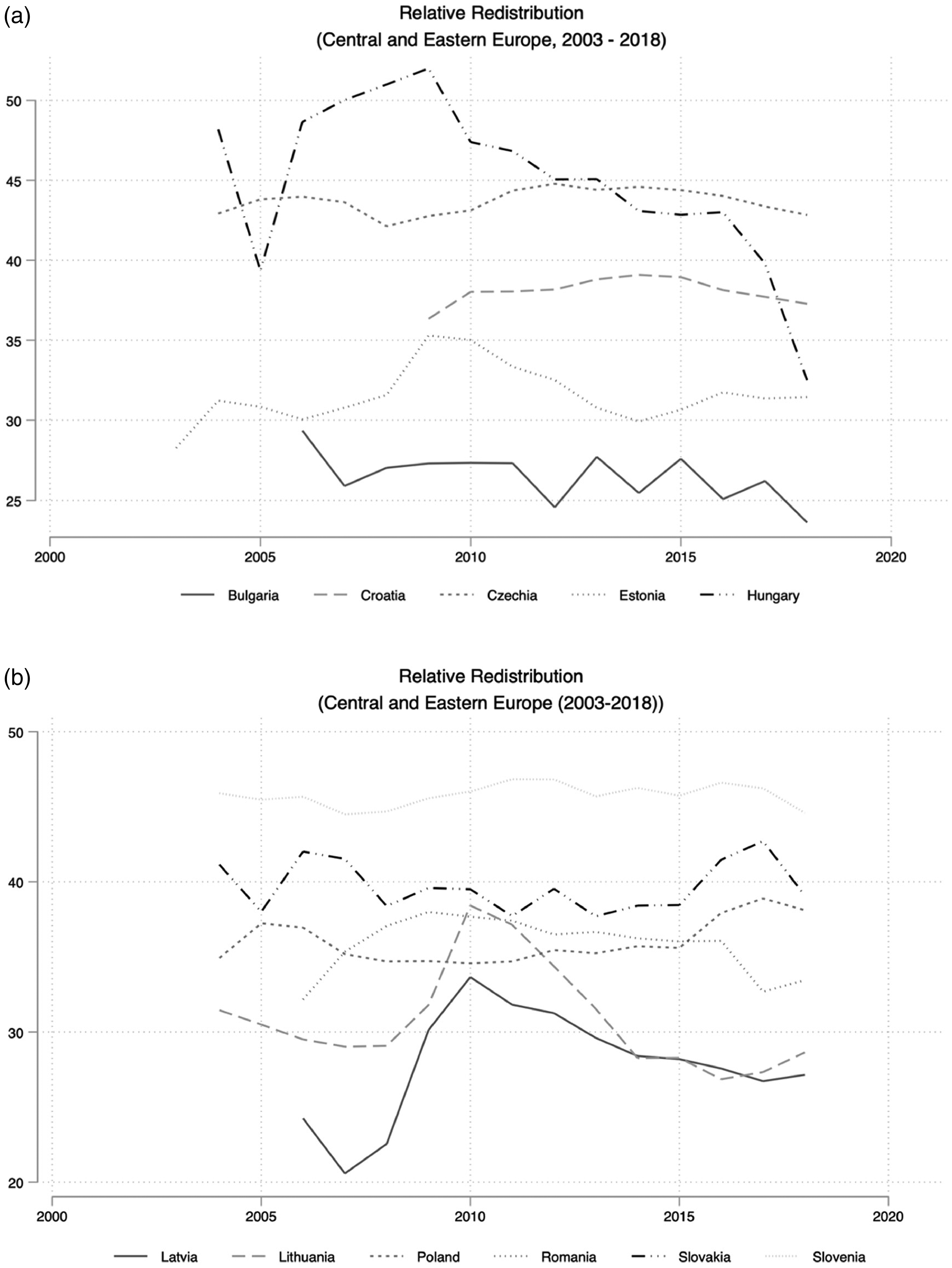
(a, b) Relative redistribution in Central and Eastern Europe (2003–2018).
Our main independent variables center around the multiple channels through which European integration can influence social policy development in the region. As a first step, we include two dummy variables reflecting membership in the EU and the EMU.3 Due to data limitations, we cannot extend our analysis to the 1990s and the first years of the 2000s. The inclusion of the EU dummy therefore only accounts for the change in membership status of the three countries in our sample that joined the EU after 2004. As such, it should be interpreted with caution. In fact, both dummies tell us little about the dynamics of European integration. We incorporate them to avoid omitted variable bias and to capture any other effects associated with EU / EMU membership that are not already covered by our models, but we mainly highlight the variables described below.
As a second step, we consider the economic opportunities generated by European integration. Most directly, we look into the amount of EU funds received by each of the countries in our sample in a given year as a fraction of GDP. Trade (imports and exports of goods and services) with the EU reflects CEE's commercial reorientation after the disintegration of the Comecon. Manufacturing imports from and exports to the EU indicate whether specialization in industrial production has been accompanied by compensatory measures to address socio-economic insecurity (Bohle and Greskovits, 2012). Additional analyses in the Supplemental material draw from even more detailed data.4 Further, emigration explores whether migratory flows affect redistribution. Lastly, remittances, or financial resources sent back home by CEE nationals working abroad,5 capture external resources. Remittances data disaggregated by origin are, unfortunately, very scarce. We are thus forced to use data that do not differentiate between financial flows coming from the EU vis-à-vis other regions. Nevertheless, given that emigration from CEE has mostly been to neighboring European states once border restrictions were removed, we think that this cumulative measure fairly accurately estimates the actual amount of remittances originating in the EU.
In line with existing research, we control for a variety of political, economic, and demographic factors that affect economic redistribution. Electoral democracy and left-wing parties’ seat share capture the effect of regime type and government partisanship (Iversen, 2010; Huber and Stephens, 2001, 2012). Veto points account for the fragmentation of the political system (Immergut, 1992; Enns et al., 2014). Voter turnout reflects public pressures stemming from political participation. Union density—an interpolated measure based on Institutional Characteristics of Trade Unions, Wage Setting, State Intervention and Social Pacts (ICTWSS) data (OECD, 2021)—indicates labor strength (Korpi, 1983; Stephens, 1979; Huber and Stephens, 2001). Lastly, the age dependency ratio controls for potential constraints on spending generated by decreasing contributions to the social protection system.
In terms of economic variables, trade, capital account openness, and foreign direct investment inflows capture the effects of globalization (Rodrik, 1998; Cameron, 1978; Garrett, 1998; Petrova and Sznajder Lee, 2022). GDP growth and unemployment rates account for changing economic conditions. Budget deficit and GDP per capita levels reflect resource availability. The market-income GINI coefficient allows us to test the Meltzer-Richard model, which posits that more unequal societies engage in higher redistribution (Meltzer and Richard, 1981). Lastly, a dummy variable assuming the value of 1 between 2009 and 2013 captures the impact of the economic crises of the late 2000s and the early 2010s.
Estimation strategy
We run fixed effect models (FEMs) with country and year fixed effects. Contrary to other modeling techniques, FEMs focus on within-panel variation, exploring the determinants of outcomes over time. This is particularly appropriate for our analysis given our interest in the effects of European integration since accession. FEMs generally account for time-invariant characteristics and allow these to be correlated with other covariates (Bollen and Brand, 2010). This reduces omitted variable bias by controlling for differences in the historical development of the states in our sample without violating any methodological assumptions. Year dummies address temporal shocks that might have affected all 11 countries in our analysis. Our findings are largely robust to differences in model specification and estimation techniques. Additional analyses are presented in the Supplemental material.
Results
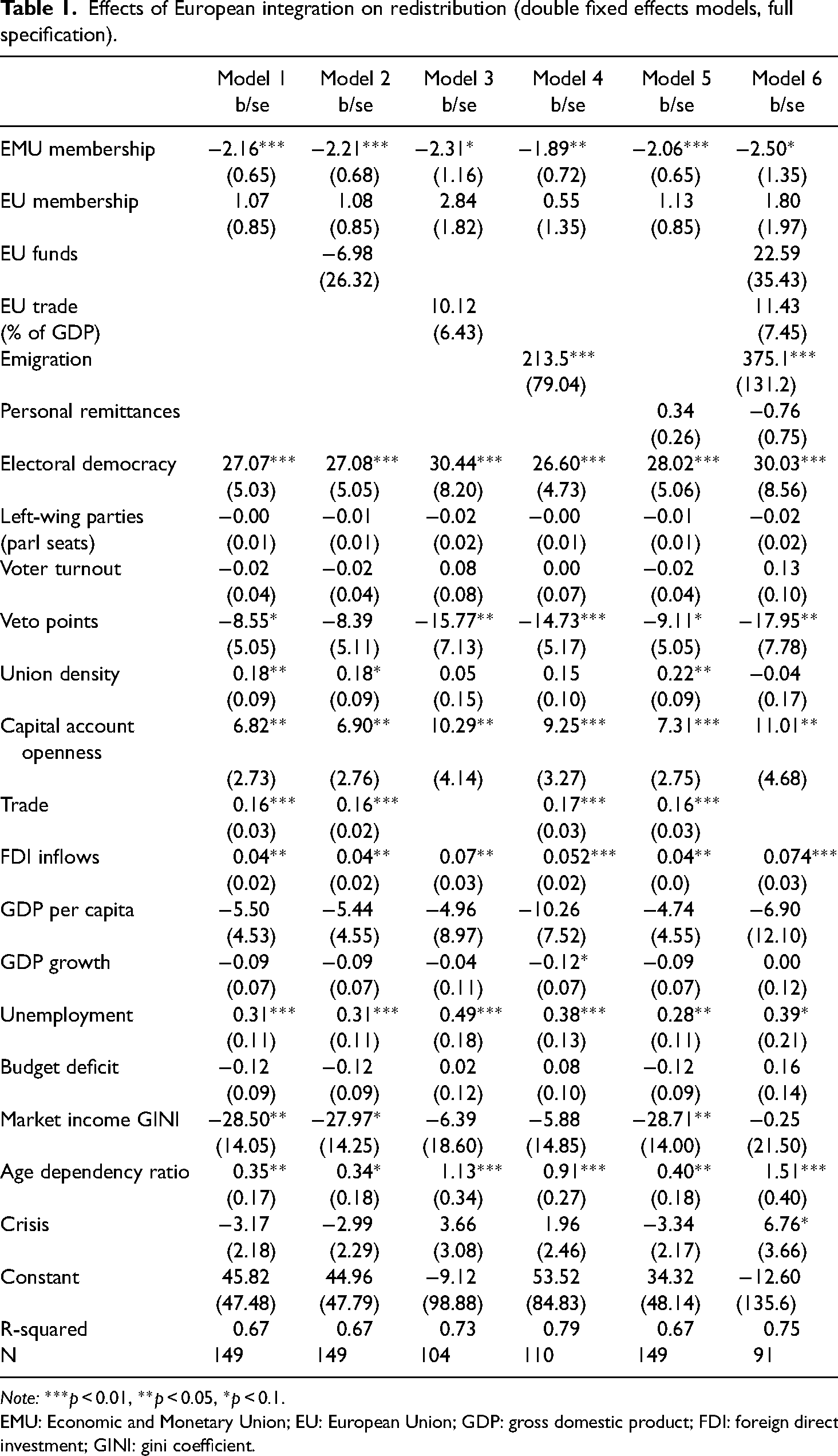
Table 1 presents our findings. Model 1 focuses on the effect of EU and EMU membership. Model 2 adds EU funds. Model 3 includes EU trade in goods and services.6 Models 4 and 5 explore the impact of remittances and emigration. Model 6 brings all of these variables together.7
Effects of European integration on redistribution (double fixed effects models, full specification).
Note: ***p < 0.01, **p < 0.05, *p < 0.1.
EMU: Economic and Monetary Union; EU: European Union; GDP: gross domestic product; FDI: foreign direct investment; GINI: gini coefficient.
In line with H2, our results suggest that membership in the EMU is related to lower redistribution. The EMU dummy returns a negatively signed and statistically significant coefficient in four out of six models. This effect is not negligible; EMU countries attain levels of redistribution that are, on average, approximately 2 percentage points lower than those reached by non-member states. This finding is consistent with the literature on the Eurozone, which has established that the strict criteria attached to EMU accession pushed national governments to adopt fiscal austerity (Falkner, 2010), especially in the aftermath of the European sovereign debt crisis. Contrary to Western Europe, where social forces successfully shielded social programs from retrenchment pressures (Bolukbasi, 2021), CEE countries appear to not have been able to effectively protect their welfare states from the EMU's budgetary requirements. Nevertheless, it is important to note that, the obligation of EMU membership notwithstanding, countries might have selected into joining the EMU early. In fact, those that joined were the Baltics, where popular support for a strong welfare state was weaker than in Central Europe (Backe and Mooslechner, 2004), and Slovakia and Slovenia, where EMU membership may have furthered the political objectives of governments interested in maintaining a fiscal straightjacket (Kvist and Saari, 2007; Národná Banka Slovenska, 2004).
EU accession, by contrast, does not seem to have affected redistribution in Bulgaria, Croatia, and Romania after 2007 and 2013 (hypothesis 1). The variable is insignificant in five models. Unfortunately, the limited temporal scope of our data—particularly the few observations prior to 2004 and 2007—does not allow us to test this argument more effectively. In other words, we cannot assess if formal accession was associated with any meaningful changes in redistribution in the eight states that joined in 2004. Due to data constraints, neither can we compare dynamics in the post-2007 period with a longer timeframe including the 1990s. This result should therefore be seen as strongly dependent on our sample.
Our interviews in Czechia begin to shed light on the implications of EU membership for economic redistribution in the region, though. A representative at the Confederation of Industry noted that the EU “has little to go on to interfere in social affairs” as “education and social affairs are within the purview of member states.” Nevertheless, according to them, the EU does try to take complementary action. They pointed out that the Commission issues recommendations in some policy domains with the expectation that action will be taken. A civil servant at the Ministry for Labor and Social Affairs (MPSV) confirmed that the EU affects decision-making in Czechia and “elevates some topics [such as social inclusion and minority integration] that would otherwise be neglected.” Furthermore, they pointed out that EU financing improved the delivery and implementation of social services. An MPSV expert agreed, suggesting that EU membership in general, and EU funding opportunities in particular, encourage the Czech state to take greater interest in certain issue areas. A civil servant in another division of the MPSV even acknowledged that “big pressure” from the European Commission resulted in more generous financial allocation to certain social policy projects, like pre-school childcare facilities, than the government originally intended. Although not necessarily overtly or directly, the EU thus does promote certain social policy priorities.
Building on these findings, Models 2 through 6 explore specific channels through which the EU can influence redistribution in CEE. Lending support to H5, access to European cohesion policy funds does not appear to shape governments’ ability to reduce income differentials. This is not unexpected in light of the principle of additionality: while EU funds provide resources to less developed regions, they should not alleviate budget constraints. Interviewees in Bulgaria and Czechia confirmed this logic. A government advisor in Prague explained that while EU funds often sustain initiatives that foster gender empowerment, diversity and inclusion, minority integration, and disability care, the latter are not strictly speaking redistributive policies, and EU funds do not pay for benefits. Similarly, an activist working for a civil society organization clarified that EU resources often fund education, housing, and minority-oriented programs, but they do not fall under the government's redistributive framework. They are also temporary in nature, forcing entire structures—including their extensive staff—to live in uncertainty between funding periods. Relatedly, academics and policy experts in Bulgaria argued that EU programs had reinvigorated declining rural areas in the country, building (not always) crucial infrastructure and generating new employment opportunities. Nevertheless, the interviewees also emphasized the pervasive corruption that surrounds the use of EU funds (for a broader empirical evaluation, see Fazekas and King, 2019). Rather than enhance redistribution, structural funds are therefore more likely to shape the pre-tax-and-transfer income distribution by stimulating economic activity and diverting income streams to particular social groups. Furthermore, a number of projects that are initially financed by the EU budget later transition to the national budget, which makes disentangling national and European influences challenging.
In line with H4, emigration is associated with higher redistribution. The size of this effect is not negligible - a two standard deviations change is related to a 1.05 to 1.7 percentage point increase in redistribution. The effect of remittances, by contrast, is insignificant, provisionally suggesting that there has been no noticeable shift from public to private welfare provision. This finding requires an important qualifier: while remittances capture the potential effect of seasonal work and personal transfers, they might leave out any financial resources handled outside of formal channels (e.g. the banking system). Given the geographic proximity between CEE states and their Western European neighbors and the proliferation of cheap travel options, CEE emigrants might hand over financial resources in person, when they return to their home countries. Emigration, rather than remittances, might thus be more informative when drawing conclusions about the public/private tradeoff. Our emigration finding suggests that more people leaving the country is correlated with more concerted attempts to reduce income differentials. Emigration, it seems, incentivizes political elites to introduce or strengthen redistributive policies.
This relationship, however, could also run in the opposite direction. The lack of an effective social protection framework might motivate citizens—especially those facing a higher risk of unemployment—to leave, which in turn incentivizes governments to spend more on a social safety net (Kureková, 2013). Emigration and remittances could thus be a function of—and reaction to—the social policy regime post-communist countries adopted during the early years of the transition. To address this possibility, we calculate the moving average of these two variables for the previous 3 years (see Supplemental material). They return statistically significant coefficients, which suggests that they are correlated with efforts to alleviate economic inequality. When emigration and remittances are regressed on the 3-year moving average of redistribution in models that include country and year fixed effects, however, redistribution emerges as a statistically significant predictor of emigration (results in the Supplemental material). This implies that these two variables are probably endogenous.
Interviews from Bulgaria lend support to this conclusion. While most of our Czech interviewees pointed out that emigration was not a big concern because the Czechs were satisfied with their quality of life, many in Bulgaria mentioned a looming demographic crisis. Business association representatives insisted that labor shortages were already being felt in some sectors as of 2016. Politicians, academics, policy advisors, and union leaders expressed concern about the number of (often young and educated) people leaving the country. In many cases, the decision to emigrate was attributed to the lack of “good”— well-paid and offering favorable working conditions—employment opportunities at home. In a context of inadequate support from the state for the young and the unemployed, most interviewees saw leaving as a logical choice, especially given the few border restrictions that EU citizens have to navigate within the Union. Many analysts argued that the government should adopt policies to incentivize young people to stay in the country and, crucially, have children. These interviews thus support the idea that, by promoting free movement across European countries, European integration might have exacerbated demographic pressures, putting additional stress on national authorities to create attractive programs for young families.
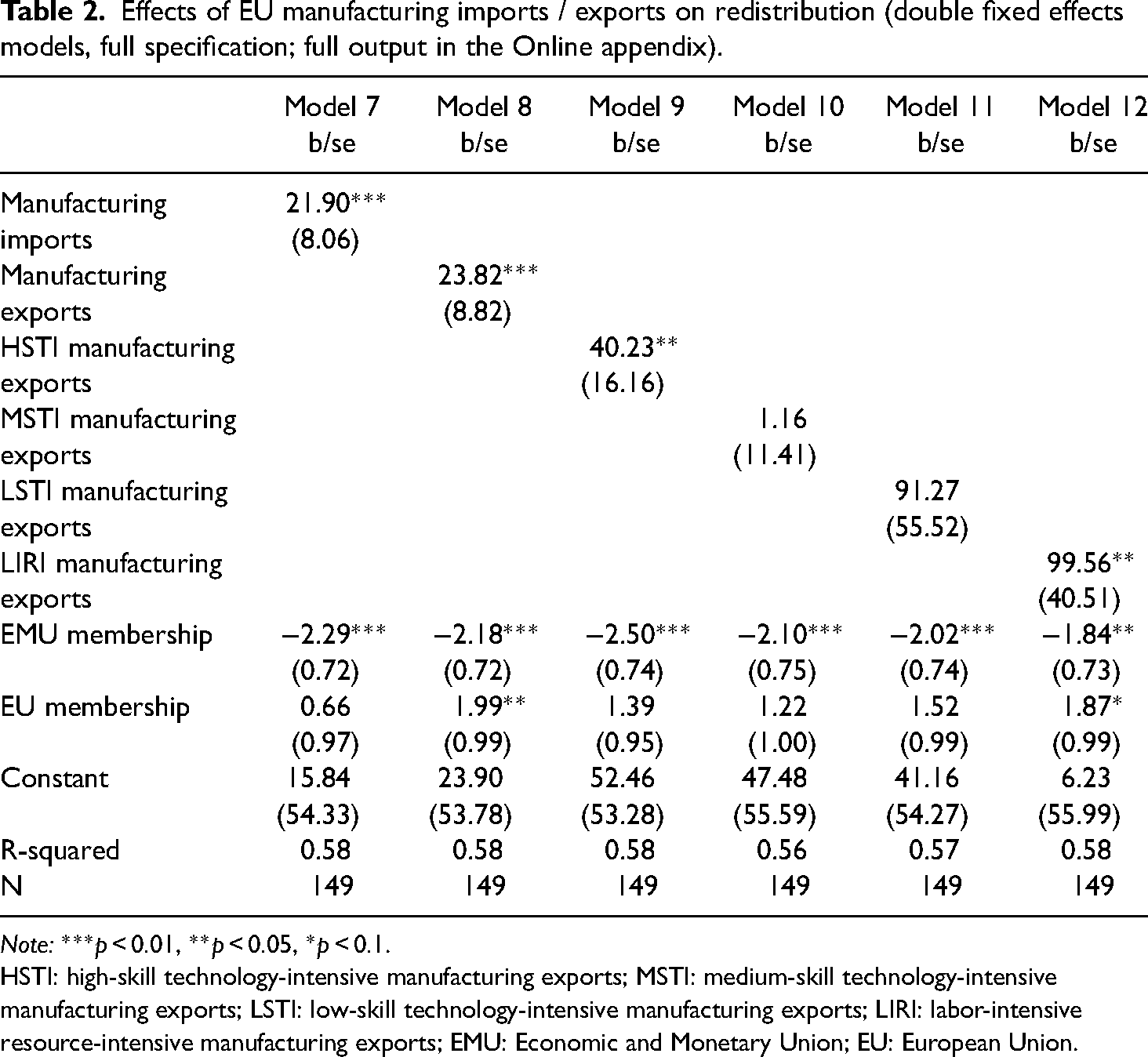
When it comes to commercial reorganization (H3), while aggregate trade with the EU does not seem to significantly affect redistribution, Table 2 reveals greater complexity. Model 7 looks into manufacturing imports from the EU while Models 8 to 12 focus on manufacturing exports. Because most of our findings remain the same, we only present our EU-related variables to save space. The full output is included in the Supplemental material. Taken together, they suggest that CEE governments have combined industrial production-oriented economic restructuring with social policies to compensate vulnerable groups (Bohle and Greskovits, 2012). Manufacturing imports and exports are both associated with greater efforts to reduce income inequality. When we move to more disaggregated categories, it becomes clear that this effect is mainly driven by dynamics in the high-skill technology-intensive and the labor-intensive resource-intensive subsectors. This points to a developmental model that prioritizes integration into European value chains from a position of higher value added, addresses the social costs imposed by the development of this comparative advantage, and remains cognizant of the concentration of labor in resource-intensive sectors. It also implies that governments strive to maintain the (highly skilled) labor pool required for international competitiveness in these crucial industries.
Effects of EU manufacturing imports / exports on redistribution (double fixed effects models, full specification; full output in the Online appendix).
Note: ***p < 0.01, **p < 0.05, *p < 0.1.
HSTI: high-skill technology-intensive manufacturing exports; MSTI: medium-skill technology-intensive manufacturing exports; LSTI: low-skill technology-intensive manufacturing exports; LIRI: labor-intensive resource-intensive manufacturing exports; EMU: Economic and Monetary Union; EU: European Union.
Our interviews partly confirmed this logic. Economists, policy advisors, business association representatives, and union leaders in Bulgaria decried that the country had fallen behind its Central European neighbors in terms of its industrial capacity. They highlighted that the Visegrád Four had behaved more strategically during the first decade of the transition, becoming a manufacturing hub wealthy enough to both sustain its competitive advantage and compensate the losers of the post-communist transition with generous social policies. Politicians and policy experts in Czechia seemed to have a different understanding of their country's historical trajectory. They did not link Czechia's social policy framework to any particular effort to maintain competitiveness in strategic sectors. They did, however, point out that Czechia's welfare state was generous and financially feasible because of the country's wealth. Interestingly, in line with the demonstration effect of the European social model, Czech interviewees overwhelmingly used Austria and Germany, rather than other CEE countries, as their point of reference regarding economic wellbeing.
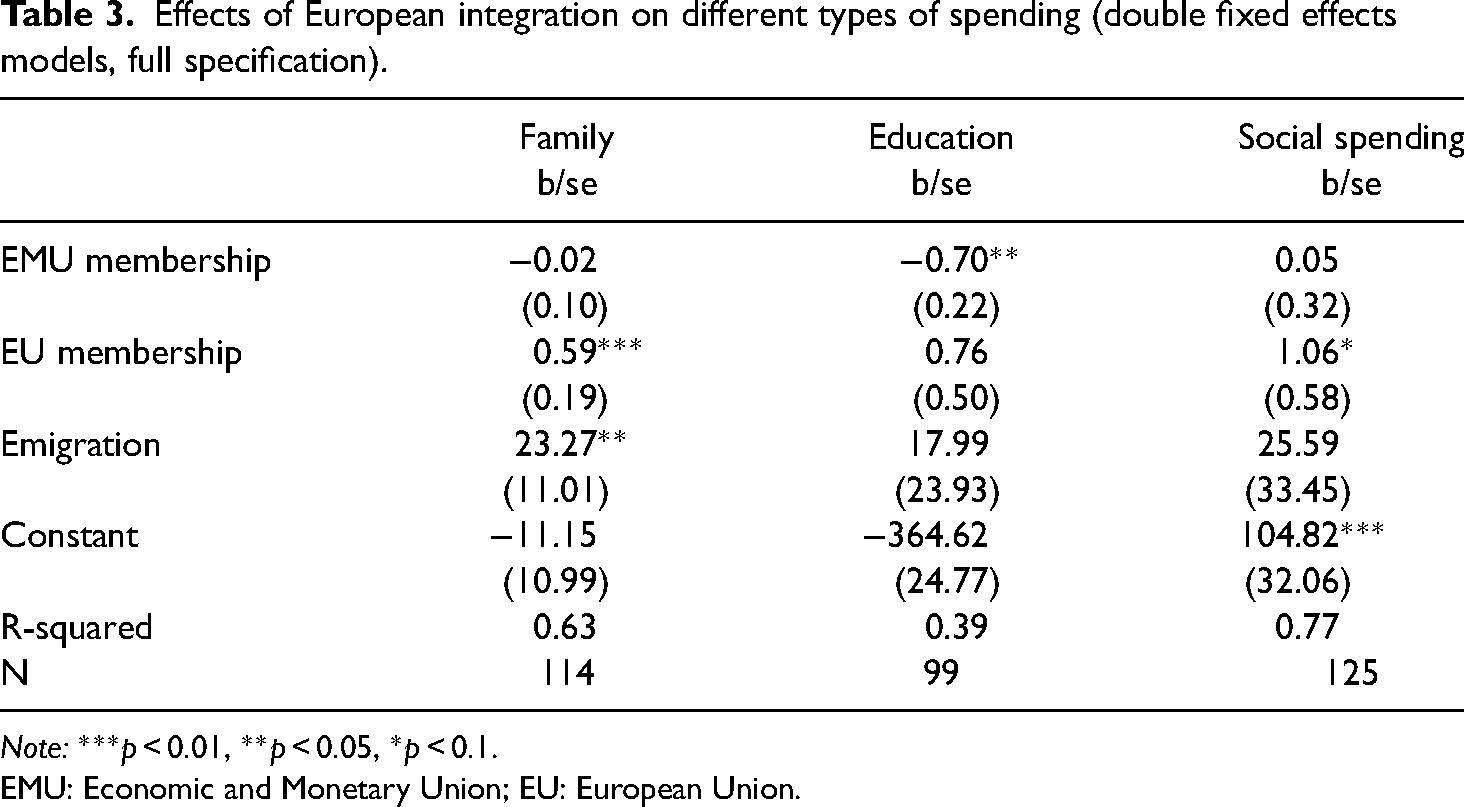
Are there any policy areas that are particularly responsive to European integration? As noted, economic restructuring in anticipation of EU membership might have induced national governments to invest in education to improve their countries’ competitiveness and attract foreign capital. Furthermore, population ageing and high levels of emigration might have created incentives to develop more generous family-oriented programs to boost fertility and slow down the demographic crisis looming over CEE. To check whether this is the case, we replace our dependent variable, relative redistribution, with three different spending categories—family benefits, education expenditure, and total social expenditure.8,9 We keep our original specification with country and year fixed effects, but we drop voter turnout, union density, and market income inequality as they are not clearly related to our new outcomes of interest.10
Table 3 partly confirms these expectations. EU membership emerges as a statistically significant predictor of family benefits and broader social spending. As Cook and Inglot (2021) note, the EU's emphasis on gender equality, work-family reconciliation, children's rights, and support for single parents has given family policy a strong, if unexpected, boost in recent years. Incumbents also appear to have raised social spending after accession. Furthermore, higher levels of emigration are associated with higher spending on family benefits. This implies that CEE governments might have resorted to more generous or inclusive programs to convince citizens to stay or have more children.
Effects of European integration on different types of spending (double fixed effects models, full specification).
Note: ***p < 0.01, **p < 0.05, *p < 0.1.
EMU: Economic and Monetary Union; EU: European Union.
While the analysis so far suggests that European integration has affected redistributive dynamics in former communist states, it does not account for intra-regional differences. The 11 CEE countries that joined the EU in 2004, 2007, and 2013 differ in their economic structure and political configurations (Myant and Drahokoupil, 2012). Existing research has argued that political elites in the region employed different strategies to re-insert their economies in the global system of production and to convince their electorate to accept the social costs of reform. Baltic states, for example, invested in human capital in an attempt to speed up the transition to a knowledge economy. Indeed, Avlijaš (2022) posits that Estonia, Latvia, and Lithuania have used European structural funds to modernize their educational systems and develop information and communication technology (ICT) competencies. In contrast, the Visegrád Four bet on their manufacturing sector, wagering on their proximity to Western Europe, highly educated labor force, and lower production costs to attract foreign direct investment in medium- and high-skill technology-intensive manufacturing (Bohle and Greskovits, 2012).
These differences point to a possible variegated impact of European integration on redistributive dynamics in CEE. To account for this possibility, we include two interactive terms. First, we re-run Model 6 by interacting manufacturing exports to the EU with a dummy variable for the four Visegrád states. Second, we regress education spending on an interaction between European funds and a dummy for Baltic countries (Estonia, Latvia, and Lithuania).
Figure 2 lends support to Avlijaš (2022) and Bohle and Greskovits (2012). Manufacturing exports to the EU are associated with higher redistribution in Czechia, Hungary, Poland, and Slovakia. In contrast, their impact in the rest of our sample is not statistically distinguishable from zero.11 This implies that the Visegrád Four combined restructuring with redistributive social programs in the 2000s. Similarly, European funds have a positive and statistically significant effect on education spending in Latvia, Lithuania, and Estonia, suggesting that national governments used EU resources for social investment purposes and promoted the acquisition of general and digital skills. Indeed, Avlijaš (2022) has argued that incumbents financed knowledge economy-oriented projects with European money, developing a specialization in ICT services with European help.
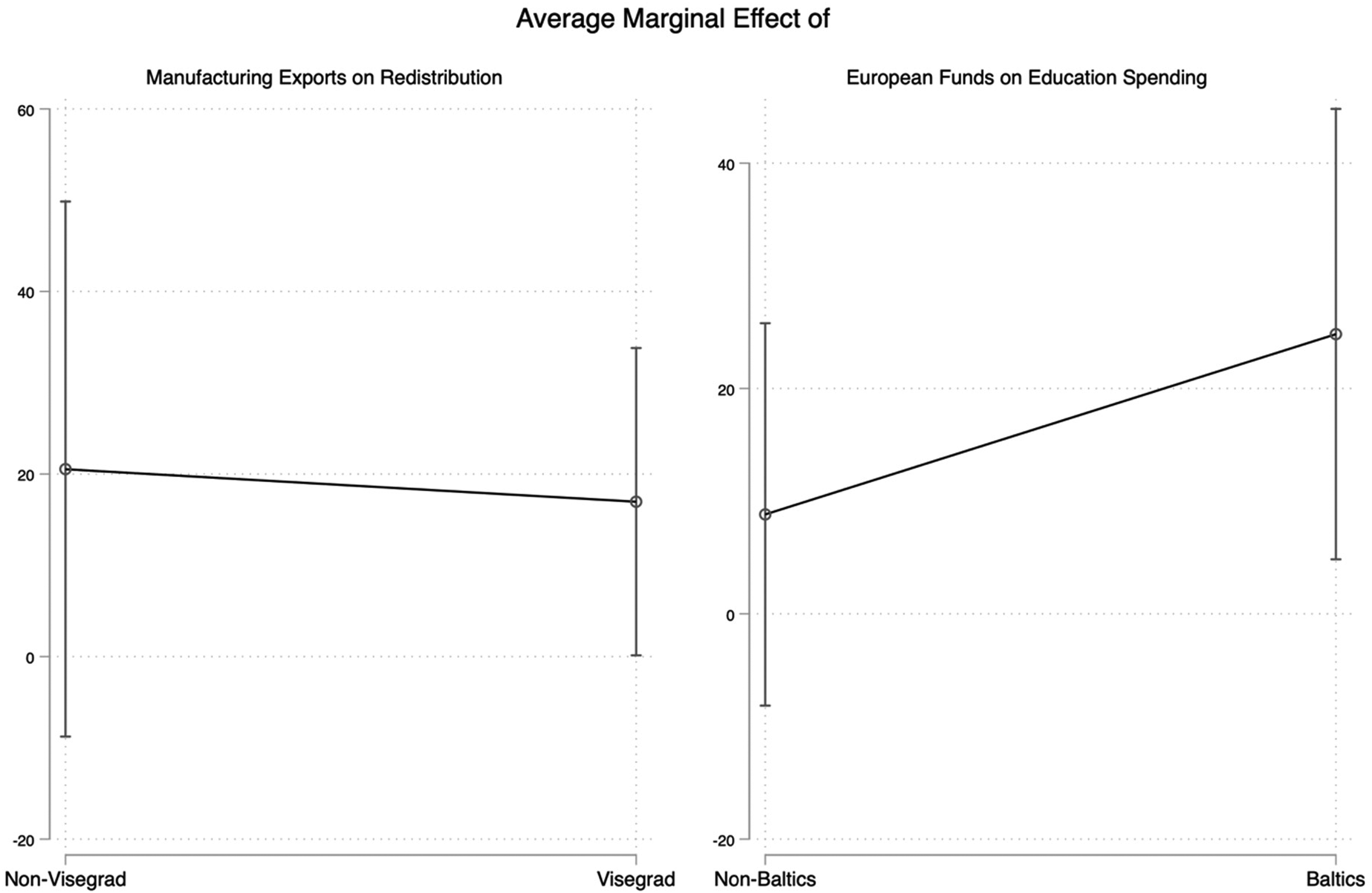
Average marginal effect of manufacturing exports and European funds on redistribution and education spending in Central and Eastern Europe.
Conclusion
The effect of regional integration on the development of social policy is particularly salient for the post-communist countries that joined the EU in 2004, 2007, and 2013. In less than 20 years, these states rebuilt their political systems, restructured their economies, and adopted the acquis communautaire. Despite the enormous challenges that these processes entailed, the EU did not prescribe compensatory welfare policies. Indeed, although it recognized the importance of a redistributive framework for the success of democratic consolidation and arduous economic reform, it did not recommend a common approach to social policy.
Even so, accession shaped the opportunities and constraints that molded the evolution of CEE welfare states. While illuminating some of these dynamics, existing scholarship has so far looked into a small number of countries and policy areas (Kvist and Saari, 2007; Cerami and Vanhuysse, 2009; Golinowska et al., 2009; Fischer and Strauss, 2021; Inglot et al., 2022). We adopt a broader focus, providing a comprehensive quantitative assessment of five important channels through which the EU affects redistribution in the region: EU membership as such, EMU membership, trade flows, emigration, and cohesion policy funds. In doing so, we draw on elite interviews to account for policy specificity and subregional heterogeneity.
We find that governments are more likely to redistribute income in economies that specialize in manufacturing exports, especially if the latter are of the more technologically- and labor/resource-intensive variety. Similarly, emigration is linked to efforts to alleviate economic inequality, which suggests that policymakers use fiscal policy—especially family benefits—to stop the depletion of the labor force. These results should inspire confidence in the process of EU enlargement and dispel fears of a looming race-to-the-bottom in welfare provision (Kvist, 2004).
Cohesion funds also fail to reach statistical significance, implying that the principle of additionality works as intended: EU funds are not used for redistribution. Nevertheless, some countries, like the Baltic states, have relied on these resources for specific developmental objectives, such as technology-geared social investment policies. In contrast, EMU membership constrains redistribution. Still, we note that the countries where austerity would be particularly politically difficult are yet to enter the Eurozone.
Our work provides a baseline for further investigation as it sheds light on the ways in which regional integration inspires, hinders, and, ultimately, shapes welfare state dynamics in new democracies that faced challenges that set them apart from their western neighbors. This assessment of EU effects is particularly timely in light of recent, unprecedented developments, that will shape the future of EU social policy. First, the articulation of a separate European Pillar of Social Rights in 2017 explicitly decouples social from economic interests. Even though still based on voluntarism, it reinforces the framework for the values and standards inherent in the European social model. Second, investments in the instruments of social services provision encourage the approximation of institutional standards in specific issue domains across the EU. Finally, challenges, such as environmental degradation, population aging, and redirection of energy sources resulting from the war in Ukraine, call for finding common solutions that have implications for the future of the European social model and the popular perception of European integration.
Supplemental Material
sj-docx-1-eup-10.1177_14651165231210943 - Supplemental material for The effect of European integration on economic redistribution in Central and Eastern Europe
Supplemental material, sj-docx-1-eup-10.1177_14651165231210943 for The effect of European integration on economic redistribution in Central and Eastern Europe by Bilyana Petrova and Aleksandra Sznajder Lee in European Union Politics
Supplemental Material
sj-dta-2-eup-10.1177_14651165231210943 - Supplemental material for The effect of European integration on economic redistribution in Central and Eastern Europe
Supplemental material, sj-dta-2-eup-10.1177_14651165231210943 for The effect of European integration on economic redistribution in Central and Eastern Europe by Bilyana Petrova and Aleksandra Sznajder Lee in European Union Politics
Supplemental Material
sj-do-3-eup-10.1177_14651165231210943 - Supplemental material for The effect of European integration on economic redistribution in Central and Eastern Europe
Supplemental material, sj-do-3-eup-10.1177_14651165231210943 for The effect of European integration on economic redistribution in Central and Eastern Europe by Bilyana Petrova and Aleksandra Sznajder Lee in European Union Politics
Footnotes
Acknowledgements
The authors thank Mitchell Orenstein, Gerald Schneider, David Weisstanner, Monika Martišková, Ana Petrova, participants at the 2021 CES, 2021 ECPRGEU and 2022 Southwest Workshop on Mixed Methods Research annual meetings, interviewees who generously shared their time, and three anonymous reviewers for their helpful feedback. All remaining errors are our own.
Funding
The author(s) disclosed receipt of the following financial support for the research, authorship, and/or publication of this article: Bilyana Petrova gratefully acknowledges funding from Texas Tech University's Department of Political Science. Aleksandra Sznajder Lee thanks the University of Richmond's School of Arts and Sciences for the Sabbatical Fellowship and the Faculty Research Committee for its support.

Supplemental material
Supplemental material for this article is available online.
Notes
References
Supplementary Material
Please find the following supplemental material available below.
For Open Access articles published under a Creative Commons License, all supplemental material carries the same license as the article it is associated with.
For non-Open Access articles published, all supplemental material carries a non-exclusive license, and permission requests for re-use of supplemental material or any part of supplemental material shall be sent directly to the copyright owner as specified in the copyright notice associated with the article.
