




Abstract
This article analyses the categorical and spatial linkages within migration policy areas across 31 European countries from 1990 to 2020, examining over 5000 migration policy changes. It reveals distinct patterns of policy diffusion across space and contrasting trends between different migration policy areas. While migrant admission policies have experienced a trend towards liberalisation over the past three decades, border and return policies have become more restrictive. The research identifies spatial policy dependencies primarily in border enforcement, with some presence in admission, integration, and return policies. The findings underscore the structured nature of the European migration policy mix and contribute to a deeper understanding of the complexities and interdependencies within migration governance.
Introduction
National governments grapple with policy dilemmas in the realm of migration, leading to the proliferation of diverse migration-related policy instruments aimed at managing and influencing migration and human mobility. These policy dilemmas are evident in the contrasting trajectories of various policy areas. For example, while border enforcement measures have grown increasingly restrictive across Europe, post-entry integration policies have shifted towards a more liberal and rights-based approach (de Haas et al., 2018). Similarly, policies designed to attract and select skilled foreign workers often coincide with measures that restrict labour market access for low-skilled workers or asylum seekers (Czaika, 2020). Furthermore, policies that support the retention and integration of certain foreigners coexist with measures that encourage or enforce the departure and return of others. A good illustration of the diversity of the migration policy mix is the situation in Germany in 2016. As a major European destination, Germany responded with various policy changes in different areas at the height of the so-called refugee crisis. Among the two dozen migration policy changes, we identified 11 changes towards more restrictive regulations in border policy, admission, integration, return and readmission, and eight changes towards more liberal admission, integration and resettlement regulations. A similar political activity took place in 31 European Union (EU) and EU-neighbouring countries we examined for this study, for which we identified more than 450 national migration policy changes and adjustments in 2016 alone, 189 towards less restrictive and 178 towards more restrictive regulations (Schreier et al., 2023). The fundamental question is: to what extent are these policy changes independent of each other, or are they rather interlinked across policy areas and countries?
The European migration governance system employs an increasing array of national and supranational measures to influence the migration and integration behaviour of an often unspecified migrant population. It relies not only on policies regulating entry, stay, integration and return but also on provisions that indirectly influence migration and that have, as such, migration relevance. However, unlike research on the conjoint impact of migration policies, there is little research on whether, and how, the design of these policies is linked and forms a coherent or incoherent migration policy mix.
This study examines whether, and how, migration and migration-relevant policies are categorically and spatially associated. Consistent with the literature on policy instruments, we understand migration policy mixes not merely as unstructured (i.e. random) assemblages of multiple policy instruments aimed at different objectives in different policy areas but as a complex portfolio of policies (Howlett and Del Rio, 2015) that have an integral functional relationship with each other. This means that the design of some migration policies is influenced by other migration-relevant policies. Functional relationships can exist between internal and external policies, but also between direct and indirect policies. The distinction between internal and external focuses on the spatial location of policy implementation, i.e. within a state or outside EU borders. Moreover, we can also distinguish policies based on whether they directly aim at influencing the migration behaviour of a target population (Czaika et al., 2021) or whether they indirectly affect migration patterns and processes, although their objectives do not primarily target migration.
To exploratively examine the functional relationships between different migration policy areas, we first update and combine different datasets on internal and external migration policies and describe the trends in European migration policy over the past 30 years in more detail. This way, we identify possible policy interdependencies within and between 31 European countries from 1990 to 2020. This analysis forms the basis for theoretical considerations on the migration policy mix. In order to derive the most plausible explanations for the observed patterns, we empirically examine the trajectories of various migration policy areas. In doing so, we contribute to researching the important – and still too little theorised – public policy's concern ‘to understand how combinations of policy instruments emerge […] and which design principles are necessary to determine the portfolio structure’ (Howlett and Del Rio, 2015: 88). Conceptually and empirically, this article underlines the importance of examining policy mixes and the relevant ‘interdependencies between policy developments in different policy subsystems’ (Knill and Steinebach, 2022: 27).
Our analysis identifies both categorical and spatial linkages in the design and evolution of migration policies over time. Categorical linkages refer to links between policies within migration's internal and external dimensions. Policy areas with strong categorical linkages – such as border enforcement policies and policies regulating the admission of migrants – tend to evolve in the same direction regarding their restrictiveness or openness to migrants. Similarly, spatial linkages describe connections between one or more policies across (spatially) proximate countries. We provide evidence that European migration policies are spatially and categorically interlinked, albeit to varying degrees, and that there are some striking patterns both within the national migration policy mix and across European countries. Conversely, the trajectories of change in and across policy areas that are categorically weakly linked, such as border control and integration policies, describe more fragmented patterns.
These findings bear on the ongoing debate about building a ‘fortress Europe’ versus building a ‘Europe of rights’ (Block and Bonjour, 2013). They also provide further support for the claim that these two visions of Europe are compatible (Block and Bonjour, 2013) but show that the construction of the ‘Europe of rights’ has been much more uncoordinated, both within and between European countries, than the construction of a ‘line of defence’ (Torpey, 1998: 15) of a ‘fortress Europe’. A fine-grained explanation of the drivers of policy change within and across policy mixes is beyond the scope of this article. However, these trends (or lack thereof) suggest the extent to which the policy design process, and arguably the decision-makers themselves, is interconnected or insular.
Conceptualising migration policy interlinkages
The politics of internal and external migration policy changes
The growing literature on migration governance reflects political dynamics. Scholars acknowledge that migration governance regimes ‘evolve over long periods of time’ (Czaika, 2020: 299). Nevertheless, they also suggest that they have become denser over the past few decades. They address multiple policy objectives regarding migration and integration of increasingly mobile populations (Czaika and De Haas, 2013; De Haas and Vezzoli, 2011; Zolberg, 1989). Political science research has sought to capture and conceptualise the complexity of migration policy (Scholten, 2020). In doing so, however, it has mostly looked at specific policies. When it has studied linkages, it has examined ‘policy pairs’, such as migration and aid (Lanati and Thiele, 2018), admission and citizenship (Balch and Geddes, 2012), or return and readmission (Stutz and Trauner, 2022). Focusing on single policy areas or links between two policy areas neglects the importance of subsystems that often characterise complex processes of policy change (Knill and Steinebach, 2022). Likewise, focusing on policy pairs can lead to losing sight of the overall functioning of comprehensive immigration policy mixes.
The concept of policy mix recognises the multidimensional nature of migration policy and the interaction of different instruments, which can have complementary or opposing effects (Schultz et al., 2021). It is conceived as a combination of policies that can individually and collectively affect migration patterns. It can also help explain the policy dilemma of combining inclusive and exclusive policies, known as the liberal paradox (Hollifield, 2004). However, in contrast to environmental, economic or innovation policy, where the concept has been widely applied (Howlett, 2022), there have been few attempts to decipher the design of policy mixes within and across countries in the area of migration (Giguère, 2006; Schultz et al., 2021).
In this article, we understand migration policy mixes not only as unstructured (i.e. random) combinations of several measures in different policy areas, but also as potential packages with integral functional linkages. We conceptualise functionality along the internal versus external and direct versus indirect dimensions.
Helbling et al. (2017) introduce the concept of ‘locus operandi’ to differentiate policies that control and regulate migration at European countries’ borders and those implemented within the national territory. To unpack migration policy mixes, we distinguish between internal and external migration policies, analogous to Helbling et al. (2017). Given the broader scope of our study, however, our two loci operandi are the territory of states – including their borders – and the territories beyond national borders. This distinction helps describe patterns of policy change and interrelationships in a more theoretically grounded way. It allows us to account for the two- or three-level game described by Reslow and Vink (2015), i.e. the interaction between different levels of government that characterises the elaboration and negotiation of different policy packages. Based on this taxonomy, internal migration policies include border enforcements, admission and entry, integration and inclusion and return and exit policies, as they are primarily implemented and targeted at a population within a national territory. Conversely, we operationalise visa, readmission and resettlement policies as external migration policies.
Furthermore, we focus on policy objectives and recognise that the policy mix consists not only of internal and external policies that directly target the ‘migration behaviour of a population in an intended direction’ (Czaika et al., 2021: 2), which we refer to below as direct migration policies. It is also formed by other migration-relevant policies that have a more indirect impact on the target population. These encompass internal and external policies, such as labour market, social policies, trade or development aid policies.
Categorical and spatial migration policy trends
Four types of possible linkages can be distinguished after categorising functionality according to the type of policy objective and the location of implementation. The first type is categorical linkages between migration policies. Interactions between migration policies have been studied in various ways, particularly at the level of their combined effects. However, a systematic longitudinal analysis of all policies directly impacting migrant behaviour has not yet been conducted. A good example is the link between labour migration policies and family (reunification) policies, as many countries have separate migration policies for skilled workers and family reunification, which can exhibit categorical dependence. Consider the following scenario: countries with in-demand skills for filling labour market gaps and driving economic growth often implement selective skilled worker programmes to attract foreign professionals. For this purpose, countries often offer streamlined visa processes, preferential access to employment opportunities, and additional benefits for skilled workers. However, the policies implemented for skilled workers can affect family reunification when a skilled worker successfully obtains a work visa but may desire to bring immediate family members, such as spouses and children. In this context, the migration policy for family reunification will depend on the policies for skilled workers. The existing skilled worker programme will influence the eligibility criteria, processing procedures, and benefits provided for family reunification. For example, a country may have specific provisions allowing expedited family reunification applications for skilled workers as opposed to other categories of migrants.
Conversely, changes in the family reunification policies can also affect the skilled worker programme. If a country imposes stricter requirements or reduces the benefits for family reunification, it may impact the attractiveness of the skilled worker programme. Skilled workers may be less willing to migrate to a country if they perceive challenges in bringing their families. This example illustrates how migration policies for different categories, such as skilled workers and family reunification, can be interlinked and influence each other. Changes in one category can have ramifications for the other, highlighting the categorical dependence in migration policies.
The second type recognises the growing importance of the external dimension of European migration policies (Gammeltoft-Hansen, 2006) and assumes that policy linkages exist between internal and external policies.
For instance, countries’ border policies aim to prevent irregular migration, such as unauthorised border crossings or undocumented entry. These policies act as a deterrent and attempt to ensure that individuals enter the country through proper channels, following visa and admission procedures and regulations. Similarly, return and readmission policies interact in the context of assisted and enforced return.
The third type of interconnectedness describes the interactions between migration and migration-relevant policies. For example, labour market needs often influence countries’ migration policies. A specific skill-selective migration policy is designed to address specific skill shortages or sectors with a demand for foreign workers. The labour market conditions, such as job vacancies or skills gaps, shape the eligibility criteria and preferences within the migration policy.
At the same time, implementing a skill-selective migration policy affects the labour market dynamics as skilled migrants may enter the labour market in more significant numbers and contribute to the workforce, potentially filling labour shortages. This impacts the labour market policy, as regulations and programmes may need to be adjusted to accommodate the integration and fair treatment of migrant workers, ensuring equal employment opportunities and protection for all workers.
It is increasingly argued that migration outcomes are influenced by policies specifically targeting migration and policies not designed and implemented to manage migration (Czaika et al., 2021; De Haas and Vezzoli, 2011; Kuschminder and Koser, 2017). The fourth level assumes a transnational interaction of migration policies, drawing on theses from the policy diffusion literature. In the EU, member states have developed policies and engaged in various forms of policy interaction to address migration challenges and facilitate cooperation, for instance, in the area of border protection or asylum (Common European Asylum System), but also on visa, readmission, and other policies of the external dimension. These interactions contribute to the development of common approaches to migration management and influence policy outcomes in both EU and non-EU countries.
Categorical interlinkages between internal migration policies
We examine the relationship between internal migration policies, i.e. border control rules, admission, migrant integration, and return. These policy areas are driven by different actors, rationalities and institutional constraints, and this fragmentation underlies many reports of inconsistencies in migration policymaking. However, policymakers do not act in isolation, and many factors such as similar beliefs (Castles, 2004), decision-making arenas – both national and European – similar constituencies or epistemic communities can influence the joint development of policies to receive and integrate migrants or to deter and return them. Constructivist accounts of policymaking (Zürn and Checkel, 2005; Culpepper, 2008; Saurugger, 2016) would therefore suggest that we find the most robust links in the realm between internal policies with narrower goals and weaker links when decision-makers have limited learning and ‘socialisation’ opportunities. At the same time, more rationalist explanations have shown how states’ decisions are determined by a trade-off in which it is cost-effective to admit more (low-skilled) labour migrants but grant them relatively fewer rights (Ruhs and Martin, 2008). Securing borders is a prerequisite for states to liberalise their residence and integration policies within a dynamic determined by the logic of numbers versus rights. With all the appropriate caveats regarding the exploratory nature of this approach, we extend this argument beyond the usual dynamics of low-skilled labour migration. We assume that policy developments in the admission and enforcement of border controls may diverge from trends in providing post-entry rights and generous integration support.
Interlinkages between internal and external migration policies
Trends in migration policy in Europe show that countries are becoming increasingly active in so-called external policies. This process is often referred to as the externalisation of migration policy and has triggered a lively academic debate. In her analysis of the EU migration agenda, Lavenex (2006: 330) points out that the shift to extraterritorial control is ‘not so much a new phenomenon as a continuation of the transgovernmental logic of cooperation’. However, she agrees that external policy is closely linked to internal migration policy, as it serves as an ‘escape route’ for domestic constraints. The link between external and internal migration policies has also been conceptualised as the internal-external security nexus (Trauner and Carrapiço, 2012), based on the idea that the EU can increase its problem-solving capacity for combating irregular migration through enhanced cooperation with third countries (Hoffmeyer-Zlotnik et al., 2023; Bigo, 2014; Gammeltoft-Hansen, 2006; Trauner and Carrapiço, 2012). The complexity of migration issues in their internal and external dimensions is well illustrated by the dynamics of issue linkages in international agreements between destination and sending countries (Jurje and Lavenex, 2014; Scholten, 2020). For example, the parallel discussion on the revised Blue Card Directive and the EU Framework for Talent Partnerships is a notable example of internal and external linkage at the EU level (García Andrade, 2020).
Existing explanations of the internal-external nexus do not allow us to infer a clear pattern of policy convergence or divergence. Therefore, we allow for the possibility of complementarity and substitution relationships. States often rely on restrictive external migration policies as a precondition for more liberal internal policies, as suggested by the numbers versus rights logic. Internal and external migration policies would thus develop in opposite directions. Increasing (decreasing) restrictiveness of external policy would thus be accompanied by decreasing (increasing) restrictiveness of internal policy in each EU country. At the same time, the venue-shopping logic (Guiraudon, 2000) instead suggests a complementary relationship between internal and external policies, as states would try to circumvent or complement internal restrictions by (additionally) pursuing goals externally.
Categorical interlinkages between migration and migration-relevant policies
As mentioned earlier, migration outcomes are not only the result of measures directly targeting migration. There are a variety of measures that are not aimed at managing and controlling migration itself, whose side effects can influence migration's drivers, processes and outcomes. Consequently, migration is managed through a variety of policies that ‘have a direct or indirect impact on migration, whether or not they were introduced with a migration-related objective’ (Czaika et al., 2021: 35). Although research has not directly addressed the concept of migration-related policies, it has already addressed this type of interdependency. For example, the welfare magnet hypothesis (Borjas, 1999) assumes that the existence of a welfare state and the level of social benefits can influence the extent and composition of migration flows. Accordingly, more generous welfare benefits tend to attract (relatively more low-skilled) migrants (Allard and Danziger, 2000; Razin and Wahba, 2015). This logic leads policymakers to use social policies to influence migration outcomes strategically. More recently, Ataç and Rosenberger (2019: 1) have also discussed in detail how ‘migration control is increasingly done through the proposal and practice of restricting irregular migrants’ access to social benefits’. Similarly, but focusing on the external dimension of migration, despite growing evidence that foreign aid can also stimulate migration (Berthélemy et al., 2009; Lanati and Thiele, 2018; Parsons and Winters, 2014), aid policies are mostly treated as viable instruments to strengthen migration control (Lanati and Thiele, 2018). Conditional development assistance, for example, has become a tool to overcome third countries’ unwillingness to cooperate on readmission (Cassarino, 2010; İçduygu and Aksel, 2014). We, therefore, hypothesise functional interdependencies between direct migration policy measures and indirect migration-relevant measures in the internal and external spheres.
Spatial migration policy linkages across Europe
An important hypothesis in migration research is that countries’ migration policies have converged over time due to internal and external pressures and incentive structures (Hollifield et al., 2014; Meyers, 2002). This is particularly true in regional contexts such as Europe and the EU (Arcarazo and Geddes, 2014), where the progressive Europeanisation of migration policies has contributed to migration policy diffusion (Block and Bonjour, 2013; Scholten and Penninx, 2016). Building on these findings, we focus on how internal and external migration policies have co-evolved and become more liberal or restrictive across borders. In line with the literature on policy diffusion, we assume that policymakers do not act in isolation and that migration policy decisions are influenced by policy decisions in other jurisdictions (Gilardi and Wasserfallen, 2019). Furthermore, we consider geographical proximity as a strong influencing factor for similar policy developments and alignments across jurisdictions. We expect migration policies between countries that are geographically close to each other to be mutually reinforcing and to develop in the same direction. This expectation applies to internal and external policies and depends on the perceived risk of potential negative externalities resulting from policy changes in neighbouring countries. Convergence in border protection, asylum or visa policy could be explained by increasing supranationalisation due to a Europeanisation effect. Conversely, the diffusion and alignment of integration measures in geographically close countries, which are limitedly coordinated at the EU level, could be due to learning, imitation and replication processes triggered by horizontal policy networks, a partisan effect or institutional (dis)similarities. While identifying the primary explanation for spatial convergence is beyond the scope of this article, we suspect that the perceived risk of negative externalities triggered by decisions in neighbouring countries plays an important role and may have driven the ‘race to the bottom’ in European asylum policy.
The European migration policy mix: data and method
Developing, adapting, reorienting and implementing policy objectives is the raison d'être of national governments. In the field of migration, policy changes are a frequent phenomenon, sometimes with several policy adjustments per year, influencing and regulating the means and conditions of entry, residence, integration, exit and return of the migrant population.
Data and descriptives
Internal migration policy fields include border control, entry and admission, post-entry integration, as well as return and exit policies, commonly regarded as crucial instruments of internal migration policy (De Haas et al., 2015). Information on measures within these policy fields comes from the migration database DEMIG-QuantMig (Schreier et al., 2023). This database captures migration policies for all EU member states plus the United Kingdom, Switzerland, Norway and Iceland from 1990 to 2020. In line with the original DEMIG methodology, policies have been coded by policy area and by the change in restrictiveness they imply for migrants’ rights. The qualitative direction of policy change is captured with the categories restrictive or liberal, i.e. a change in restrictiveness within the existing legal and regulatory system, whereby the reference point for identifying a legal change is always the legal status quo. This variable can take three values (–1, 0, + 1). A policy change is recorded when a policy is introduced or adapted that expands or restricts the rights of a migrant target group.
In addition, our dataset contains a variable that captures the extent of policy change. This variable assesses on a four-point scale whether a particular policy change is a fine-tuning (+/–1), a small change (+/–2), a medium change (+/–3) or a major change (+/–4). The database includes 5131 policy changes between 1990 and 2020 for 31 European countries. Most of these concern the area of admission (3198), followed by policy adjustments in the area of integration (872), border policy (570) and policy changes in the area of return (491). In the area of domestic policy, the average number of changes per year and country shows a steady increase in policy activity in all 31 European countries. While our database shows less than four policy changes per year in the 1990s, this number more than doubled in the 2010s.
The post-2015 period has been an exceptionally intense political dynamism, with a high degree of political activity in most European countries. At the same time, the significance or extent of political change has moved towards small-scale adaptations. On average, political changes in the 1990s had greater significance for migrants’ rights than in the 2000s.
Overall, the following patterns and policy dynamics can be observed in the domestic policy areas studied since 1990 (see Figure 1): The restrictiveness of border policies has increased disproportionately over the past three decades, while the increasing restrictiveness of return policies in the 31 European countries follows a relatively linear trend. However, while the liberalisation of admission policies accelerated across Europe, the frequency and extent of implementation of pro-integration policies slowed.
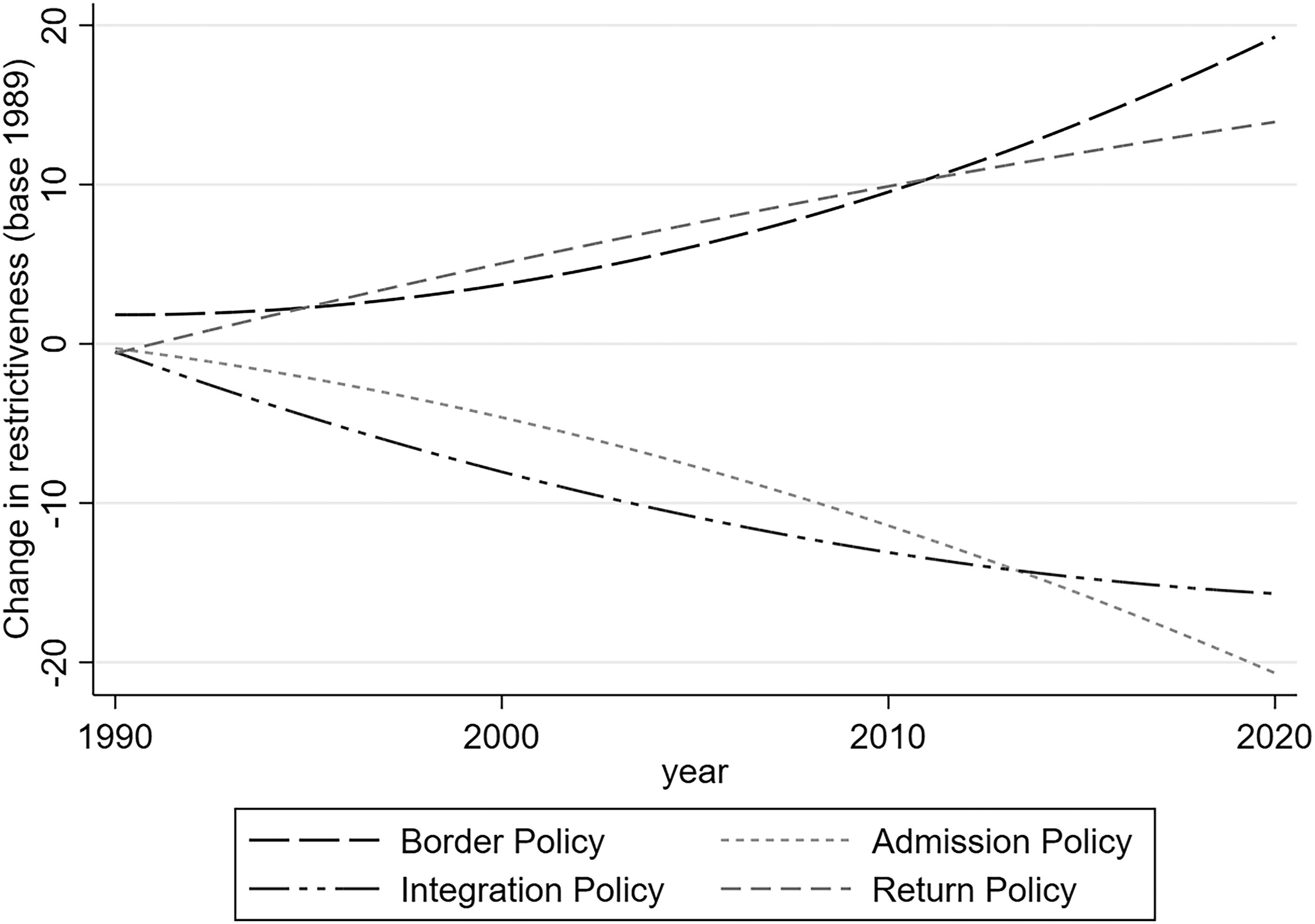
Trends in restrictiveness of internal migration policies, by policy area. Own extension of the DEMIG policy database (2021).
The Europe-wide trend toward increasingly restrictive border control, enforcement and return policies is largely consistent, but not for all 31 countries. Denmark, for example, has a restrictive admission policy and only slightly liberalised return policy (contrary to the general trend). The United Kingdom has also become more restrictive in integrating migrants but has not significantly adjusted its repatriation policies. Interestingly, Iceland, Malta and Cyprus have kept their internal migration policies relatively ‘stable’, balancing changes toward more restrictive regulations with changes in the opposite direction.
European governments are increasingly supplementing their migration policy mixes with policies that address the external dimension of migration, including travel visas, mechanisms and agreements that regulate the readmission of illegally residing migrants or the resettlement of refugees and vulnerable persons from non-European third countries. In addition, other migration-related external policies include development assistance, as policymakers regularly justify and use these policies to influence the so-called root causes of international migration.
Visa restrictions have been described as the ‘first line of defence’ (Torpey, 1998: 15) in controlling migration. Countries can usually decide which nationalities require a valid travel visa to enter the country. In the Schengen area, member states agree on a list of nationalities that require a temporary visa to enter the area and the country. Between 1995 and 2008, the Schengen area grew from seven to 26 member states. Overall, 30 of the 31 European countries (Schengen and non-Schengen) covered by this study have significantly liberalised their visa policies, except for the United Kingdom.
Over the past 30 years, European states have concluded many bilateral or multilateral readmission agreements. These have been signed with dozens of non-European countries where many undocumented migrants originate and complement internal policies to facilitate or enforce return. Although all 31 European countries in this study have used readmission agreements in some legal form, there are differences between countries in the overall extent and speed with which such agreements have been signed. While Cyprus, Iceland, Ireland and Finland can still point to relatively few agreements, Switzerland and France are at the forefront, having signed around 60 readmission agreements.
Another external migration policy is resettlement. This policy is used very selectively as an alternative way for refugees and asylum seekers to find protection on European territory. Only a few (Western and Northern) European countries frequently resettle refugees. While Norway and Sweden have resettled protection-seekers regularly over the past two decades, Germany and the United Kingdom have resettled only occasionally and relatively recently. The resettlement of third-country nationals in Europe is a policy area still reluctantly used to receive migrants.
Finally, development assistance is a policy area often highlighted as a tool to address the so-called root causes of irregular migration to Europe. Although the evidence is still inconclusive (De Haas, 2007; Lanati and Thiele, 2018), European and Western donor countries often see aid as a tool to reduce irregular migration through its impact on livelihoods in countries of origin of irregular migrants. Official development assistance (ODA) from the EU and its national member states amounted to more than 75.2 billion EUR in 2019, representing more than half of the global ODA. However, not all EU member states are established aid donors. Most Eastern European countries are not (yet) significantly involved in disbursing development aid to non-European partner countries. On the other hand, Western and Northern European countries are among the world's leading donors in terms of their gross domestic product (GDP).
Method
In the following, we estimate the direction and intensity of categorical and spatial interlinkages between internal and external migration-relevant policies. Formally, we estimate panel fixed effects models of the following specification:

where
We first created spatial lag variables for each indicator to test for spatial policy linkages across the 31 European countries. We used the inverse distance between European destination countries as our weight measure, assuming migration policies are geographically linked and possibly clustered. This procedure follows the method of Plümper and Neumayer (2010). The population-weighted bilateral distance (the geographical distance between the most populated cities) comes from the CEPII GeoDist dataset (Mayer and Zignago, 2011).
The data on domestic policies come from the new extended DEMIG-Quantmig policy dataset covering the period 1990 to 2020; the unit of analysis is the country year (Schreier et al., 2023). The raw policy data identifies weighted policy changes by internal migration policy area; that is, the direction of annual policy changes towards more (–1) or less (+1) restrictiveness is weighted by the magnitude of the change (1 to 4). We have aggregated annual policy changes over time to estimate absolute levels of policy restrictiveness, using 1989 as the baseline. For the subsequent analysis, our main dependent variables are the four internal migration policy areas of border (and land) control, admission (including legal entry and stay), integration and return, and a composite of the four. As the other external policy indicators come from different sources and follow different measures, we have standardised all (internal and external) policy indicators into z-scores. We include all other internal migration policies as explanatory variables to identify categorical links between different internal migration policy areas. We also include other migration-relevant policies, such as unemployment and education policy indicators, to analyse their association with the four internal migration policy areas.1
To control for other internal migration-relevant policies, we draw data from the Comparative Political Data Set (CPDS) (Armingeon et al., 2021). Specifically, we use the proxy variable for unemployment policy (unemployment benefits), measured as cash expenditure on unemployment benefits as a percentage of GDP. We also include a policy indicator measuring total public and compulsory private expenditure on housing as a percentage of GDP (housing expenditure) and a policy indicator measuring general government expenditure on education (Armingeon et al., 2021). As data for all these variables were only available up to 2018, we extrapolated for 2019 to 2020. However, no data were available for the EFTA countries, reducing the sample.
In addition to internal migration policies, we use data on three external migration policies: information on visa restrictions from the extended and extrapolated DEMIG Visa database (2021), the annual number of resettlements from UNHCR (UNHCR, 2021) and some signed and active readmission agreements from Cassarino's (2010, 2021) inventory of bilateral agreements.2 The visa policy indicator describes the percentage of countries for which each European country requires a short-stay visa to enter its territory. As development aid is often associated with addressing the root causes of irregular migration, we include international aid as another policy variable relevant to external migration. We multiply the annual amount of Official Development Aid (ODA) provided by each European country for the sectors humanitarian aid and social infrastructures and services as a percentage of the European donor country's GDP, based on data available in the OECD/DAC database (2021). We also include the number of peacekeeping deployments as a percentage of a country's population. This information comes from the IPI Peacekeeping Database (International Peace Institute, 2021).
In order to also control for contextual factors, such as migration demographics or the economic situation, which may influence policy change and restrictiveness (e.g. Natter et al., 2020), we include in all models the stock of non-EU immigrants as a percentage of the total number of immigrants in each EU country. Second, we add the number of asylum applications relative to the population of each European country based on data from UNHCR datasets (2021). In addition, we control for the economic situation in the European destinations by including real income growth and the unemployment rate extracted from the World Bank,3 as it has generally been argued and shown that the economic situation influences policy restrictiveness (e.g. Van Setten et al., 2017).
Trends and patterns in the European migration policy mix
Interlinkages between internal migration
The first aim of our study is to understand whether, and how, internal migration policies are interlinked.
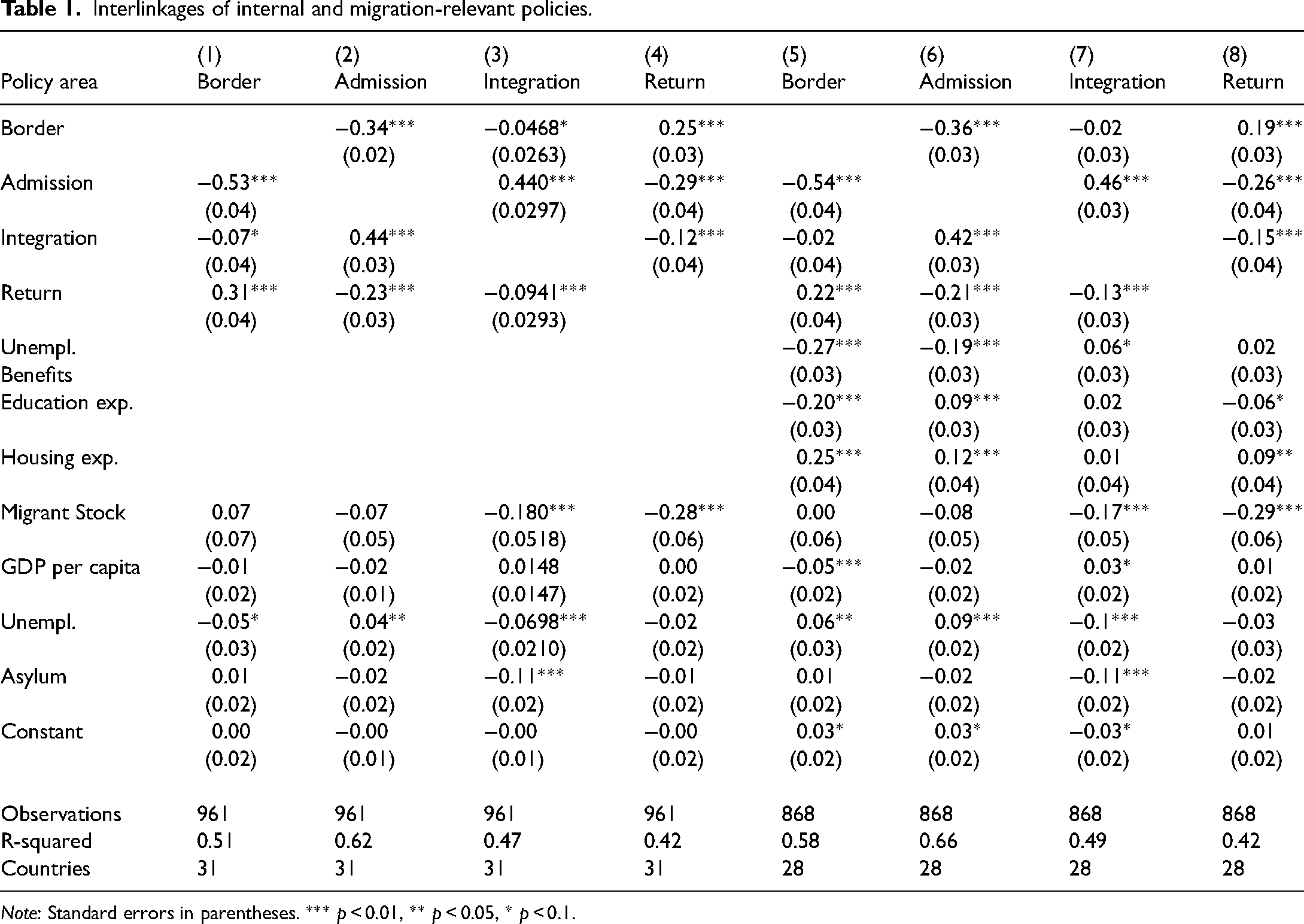
Table 1 presents the results of our panel fixed effects models, which report point estimates on z-transformed policy and control variables. Model 1 shows the results for the border policy area, Model 2 for admission, Model 3 for integration and Model 4 for return. Table 1 shows that the four internal migration policy areas (Models 1 to 4) are significantly related. Migration policy regimes are more than a random mix of policy areas. Instead, policies on border control, admission, integration and return co-evolve and are characterised by some patterned interlinkages. However, not all these policy areas move in the same direction regarding restrictiveness.
Interlinkages of internal and migration-relevant policies.
Note: Standard errors in parentheses. *** p < 0.01, ** p < 0.05, * p < 0.1.
Admission policies, for example, are negatively related to border and return policies, as seen in Models 1 and 4. A one standard deviation change in admission policy is typically associated with a 0.53 standard deviation change in restrictive border policy but only a 0.29 standard deviation change in the restrictive return policy. The negative association between border policies and admission and integration policies points to the ‘fortress Europe’ idea of secure borders on the one hand and internal liberalisation of admission and integration policies on the other. While identifying the full range of policy change drivers is beyond this analysis’ scope, we find evidence that cross-policy changes do not occur in a vacuum: actors in the migration policy system consider developments in related policy areas. Our data show that governments are restricting border policies and trying to reduce the number of (irregular) migrants while at the same time granting more rights to admitted migrants by liberalising integration policies. The identified (negative) link between admission and border policies is the strongest of all possible internal migration policy area combinations. This can be explained by the fact that both are concerned with redirecting irregular entry of migrants towards more regular channels.
Similarly, we observe that categorically or functionally, more distant policy areas – in terms of ultimate objectives such as border enforcement and integration policies – are loosely linked.
The analysis suggests that internal policies are functionally interlinked, not just a random mix of policies. For example, despite the differences between European countries in terms of types of migration and forms of welfare states (Bommes and Geddes, 2000), we find that admission policies tend to be positively related to integration policies. In most of the 31 countries studied, the liberalisation of entry regulations was supported by more liberal integration policies. The positive association between border and return policies towards more restrictive regulations speaks to the securitisation debate: migration is a potential threat to Europe and is increasingly controlled by border and return policies (Bigo, 2014; Huysmans, 2000). A one standard deviation change towards more restrictive border policies is typically associated with a 0.25 standard deviation change towards more restrictive return policies.
Within internal migration policy, we find that a higher percentage of the non-European immigrant population is only relevant for integration and return policies but not for border enforcement or admission policies. A larger non-European population tends to be associated with more restrictive integration and return policies. The relative importance of asylum applications is associated with more restrictive integration policies but not with other internal migration policies. Finally, the unemployment rate is negatively significant for almost all internal migration policies except return but positively significant for admission policies. Moreover, income growth does not seem to affect internal migration policies. These findings may seem surprising given the xenophobic sentiments in many parts of Europe in recent years and the economic-driven narrative of the securitisation discourse. However, they are in line with recent studies (Kolbe, 2021; Natter et al., 2020) showing that ideologies tend to influence only some areas of migration policy, in particular integration, and that ‘objective migration pressure’ does not play a central role in migration policymaking (Grande et al., 2019).
In terms of other internal policies relevant to migration, i.e. those where migrants may only be indirectly affected, the results reported in Table 2 of the panel fixed effects Models 5 to 8 for the policy areas of border enforcement, admission, integration and return confirm links between migration and migration-relevant policies (measured here by social, housing and education benefits), albeit to varying degrees.
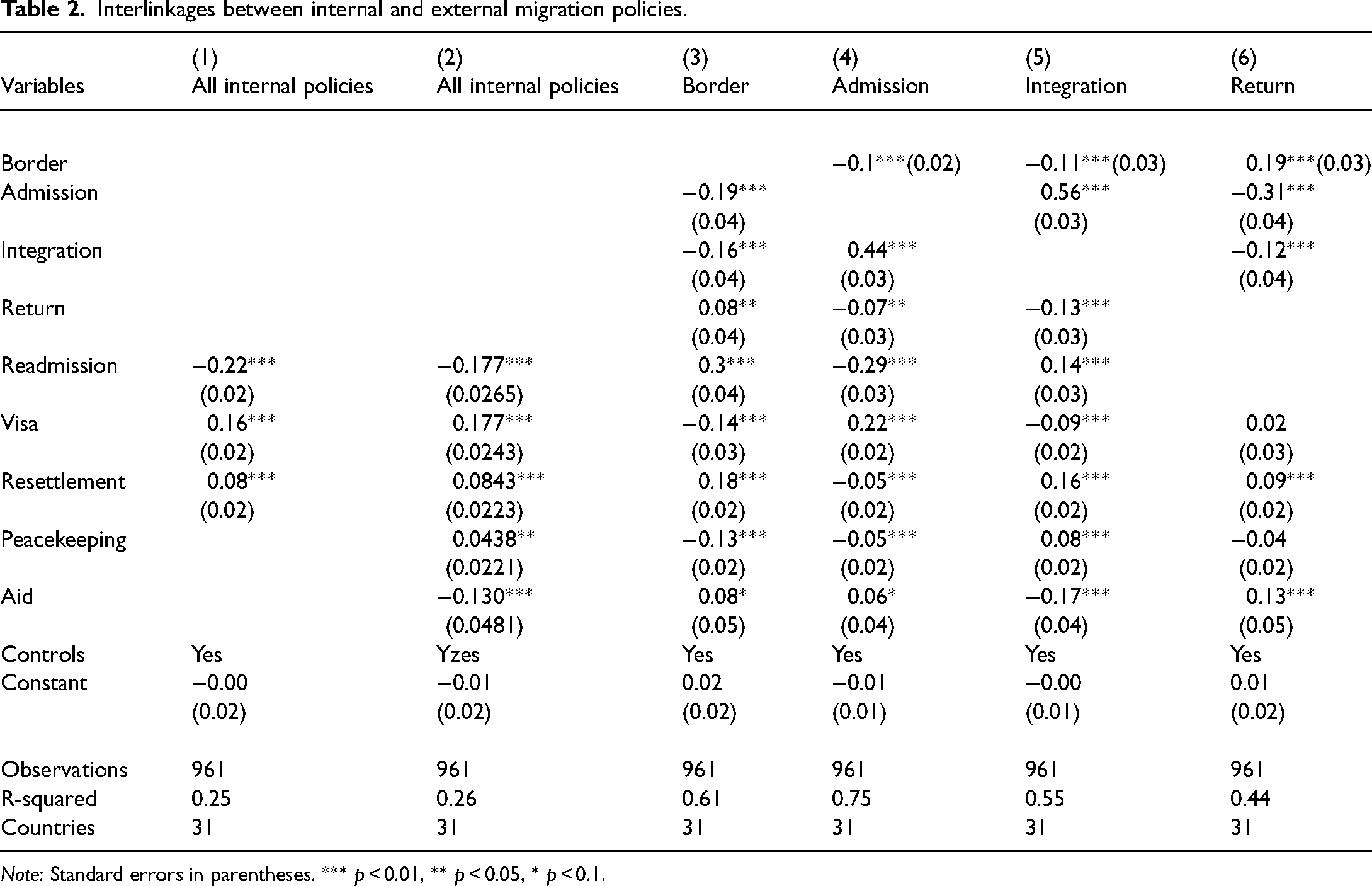
Interlinkages between internal and external migration policies.
Note: Standard errors in parentheses. *** p < 0.01, ** p < 0.05, * p < 0.1.
The strongest link revealed by our analysis is between housing and border policies, as shown in Model 5. As housing expenditure increases, border enforcement, admission and return policies become more restrictive. These results support the conjectures of the welfare magnet argument, according to which governments can protect their welfare systems by restricting access (Borjas, 1999). Contrary to expectations, however, education and unemployment expenditures are negatively associated with border policies. The provision of unemployment benefits is also negatively associated with admission policies, suggesting that fears of welfare migration do not translate into restrictive migration policies. Thus, while there are apparent linkages, the different policy areas relevant to migration do not evolve coherently with internal migration policy trends.
Interlinkages between internal and external migration policies
The coefficients in all model specifications confirm an internal-external nexus, i.e. internal and external migration policies are seemingly functionally linked. But how exactly? In Table 2, we further report estimates of the linkages between internal migration and external migration policies in panel fixed effects models.
Models 1 and 2 show the results for all internal policies together, and Models 3 to 6 show them separately for each policy area. The results show a link between internal and external migration policies, as evidenced by the significant coefficients of all external migration policies of readmission, visa and resettlement in almost all Models 1 to 6. However, the results show a mixed picture when comparing trends in external migration policies with the different internal policy areas of border control, admission, integration and return. Given the ‘escape logic’ arguments (Trauner and Carrapiço, 2012), we would expect that increased restrictiveness within external policies would be associated with increased liberalisation of internal policies, but this is not confirmed in all cases.
Our data show that while an increased focus on readmission is associated mainly with intensifying border enforcement policies, it is also consistent with more restrictive integration policies but more liberal admission policies. Moreover, of all the external policies considered in our analysis, active resettlement is the least functionally linked to other internal migration policies, largely because European governments set few resettlement quotas and resettle only small numbers, if at all.
In addition to the links between direct internal and external migration policies, we find that internal and indirect external migration policies do not consistently follow the same trend shown in Models 2 to 6. Increased aid disbursements seem to be associated with stricter border and return policies. At the same time, participation in peacekeeping missions tends to be associated with changes towards more liberal arrangements in these policy areas, although this is not statistically significant in return. Furthermore, European donor countries’ financial or technical involvement in the form of development aid may be ‘traded’ for peacekeeping and peace enforcement, as both policy areas consistently show the opposite relationship with the respective internal migration policy areas. The strong but negative link between aid and integration implies that supporting actual migrants (integration) and potential migrants (aid) is not necessarily seen as a trade-off. This may also support the idea of using aid as a migration control tool (Lanati and Thiele, 2018) and justify more liberal internal migration policies in terms of integration. Although inconsistent, we provide evidence that policy linkages between internal and external migration (relevant) policies may exist. Given the lack of systematic measurement and evaluation of the relationship between the internal and external domains of migration policy, this is, per se, a new area of research that should be further explored for different case countries and situations.
Spatial convergence of migration policies across Europe
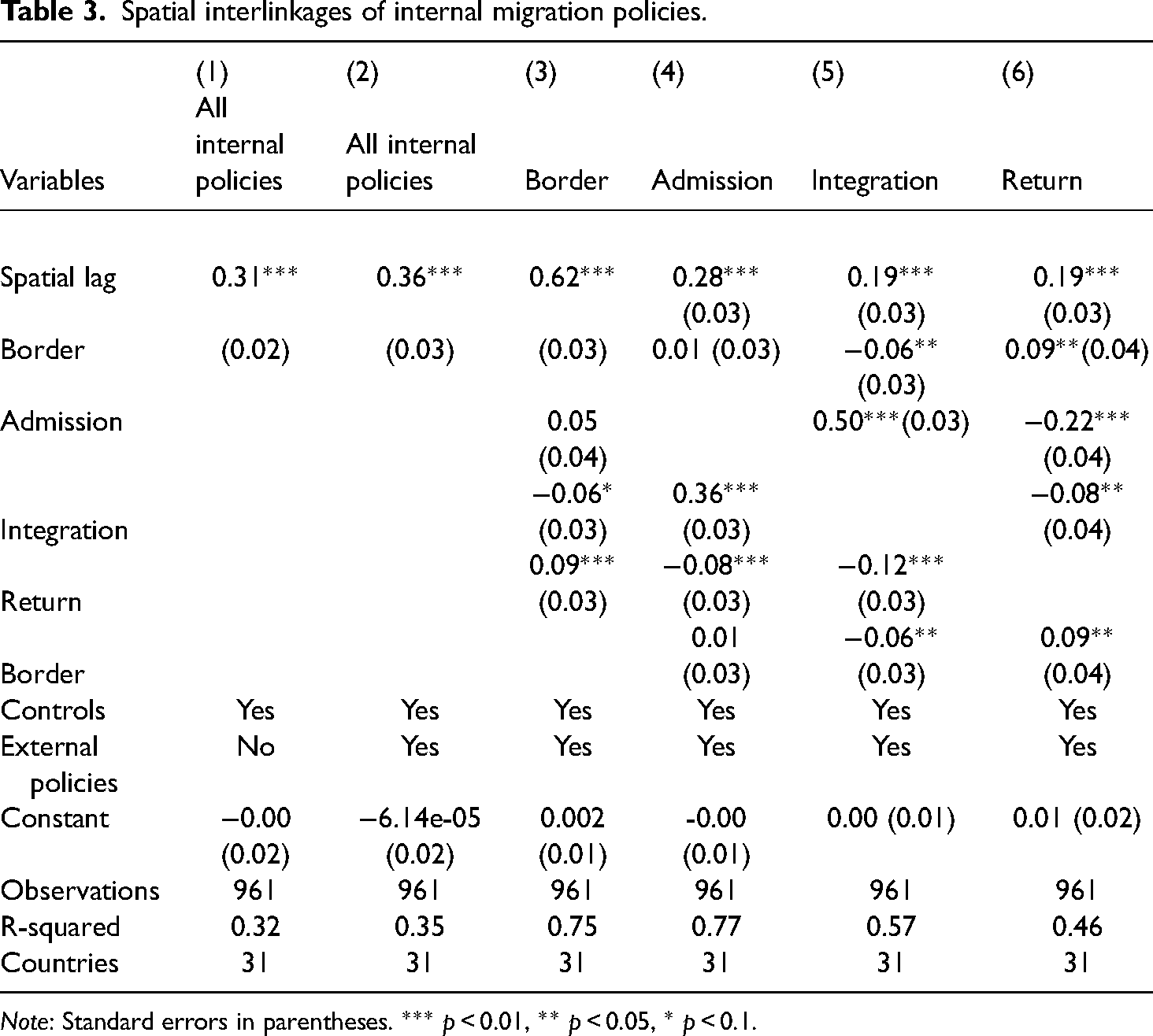
Finally, our analysis shows that internal migration policies are not only categorically but spatially interlinked. Table 3 presents the results of the cross-European spatial linkages of internal migration policies, including external migration policies as independent variables. Our results show significant spatial linkages between policies of geographically close European countries, as indicated by the positive and significant coefficients on all spatial lag terms. We, therefore, find supportive evidence that migration policy changes diffuse and possibly converge, or at least follow similar trends across Europe (Hollifield et al., 2014; Meyers, 2002). Consequently, migration policy changes in one European country will likely align with changes in other (geographically proximate) EU countries.
Spatial interlinkages of internal migration policies.
Note: Standard errors in parentheses. *** p < 0.01, ** p < 0.05, * p < 0.1.
The strongest spatial link we identify is in the area of border enforcement policies. This implies that more restrictive border policies in geographically close countries generate policy spillovers to other European countries. This result is consistent with the expectation derived from the diffusion debate but also shows how increasing coordination at the EU level in this policy area affects national policymaking. The permanent state of crisis of EU migration governance has indeed shifted the enforcement of border control to Brussels, mainly through the increasing role of EU agencies such as Europol, Eurojust and Frontex (Meissner, 2021) and private actors (Jeandesboz and Pallister-Wilkins, 2014). This activity at the supranational level has, directly and indirectly, strengthened cross-border coordination. This is less the case in the area of admission policies and least so in the area of integration policies. The observed proximity effect between admission policies suggests that, although governments retain a firm grip on the quantity and selection of migrants to be admitted, the increased coordination between like-minded groups of European countries may have contributed to strengthened linkages. It is not surprising that there is limited co-evolution in migrant integration policies, given the weak coordination at the supranational level. Nevertheless, this finding is significant in light of the debate on ‘fortress Europe’ and ‘Europe of rights’. While it is true that these representations of Europe may well coexist (Block and Bonjour, 2013) – and our findings support this claim – the spatial analysis also suggests that efforts to strengthen a ‘Europe of rights’ are still far less coordinated than crisis-driven efforts to secure EU borders.
Conclusion
The analysis of the European migration policy mix shows two main results. Firstly, it highlights the lack of coherent alignment in migration policies across policy areas, both internally and externally. This finding complements existing accounts of the development of migration policies in Europe and beyond (De Haas et al., 2015). It expands them, arguing that incoherence applies to the internal and external dimensions of migration and relevant policies. Secondly, it demonstrates that changes and trends in migration policy are not random or unstructured. Instead, we observe policy mixes with presumably integral functional linkages in their design and thus co-evolving in a patterned way along the restrictive-liberal spectrum.
Drawing on a compilation of new and updated policy datasets on internal and external migration-relevant policies, we have examined interlinked trends in a sample of around 5000 migration policy changes in and across 31 European countries between 1990 and 2020. Our findings suggest that functional linkages exist to varying degrees but can lead to either policy convergence or divergence, depending on the factors conditioning the functional relationship between (sets of) migration policies. We identify links between internal migration policies, encompassing border enforcement, admission, integration and return regulations. They are measurable between internal and some external migration policies and between migration and migration-relevant policies. As part of a broad migration policy mix, migration policies co-evolve along similar trends of restrictiveness within and between countries. Thus, we find evidence that migration policy processes can influence each other and either reduce or increase their specific effectiveness, depending on their functional linkage's relative strength and direction.
Policy mixes can develop in a conscious, intentional way or through a more haphazard process (Howlett, 2022). The patterns we have identified support the intentionality hypotheses formulated in our conceptualisation of interlinkages. However, the direction of policy change described by our data suggests that linkages are clustered. For instance, while countries seem to rely on a combination of border enforcement and return policies to control the number of migrants entering and residing in Europe, they also tend to coordinate on the ‘qualitative composition’ of the migrant population through the combination of their admission and integration policies. The analysis of internal and external policy areas shows less consistent trends. A discernible trend towards a ‘fortress Europe’ becomes evident, characterised by using visa policy restrictions as an initial defence line and as a prerequisite for European governments to relax border enforcement, expand admission opportunities and bolster integration support policies. Nevertheless, this ‘internal-external nexus’ does not manifest uniformly across all policy areas within our dataset.
While the strong spatial interlinkage towards restrictive borders and intensifying efforts to facilitate return witnessed across European countries contribute to the narrative of a ‘fortress in the making’, cross-country interlinkages and common trends in some policy areas like admission, visa, and integration are weaker and do not hint at a general liberalisation of the internal migration policy dimension. A fine-grained explanation of these policy areas’ substantial independence is beyond this article's scope. However, it is worth highlighting how those areas, unlike return and readmission, pertain to the core of state sovereignty; they are loosely coordinated at the supranational level and involve overly complex policy agendas.
To further explain the complementarities and trade-offs identified in this article, one cannot ignore the manifold array of actors, institutions, and norms that drive or constrain policy formation and change. However, refining our understanding of European migration policies through the lens of policy mix has emerged as a compelling and encouraging conceptual approach for future theorisations of the migration policy mix.
Footnotes
Author contributions
All the authors contributed equally to the article.
Funding
The authors disclosed receipt of the following financial support for the research, authorship, and/or publication of this article: This work was supported by the European Union's Horizon 2020 Research and Innovation Programme (Grant no. 870299: QuantMig: Quantifying Migration Scenarios for Better Policy).

Data availability statement
Data sharing not applicable to this article as no datasets were generated or analysed during the current study.