



Abstract
This article advances research into mass Euroscepticism by investigating the role of distributive justice. Drawing on cross-national survey data from 23 countries, the study shows that perceived injustice of individual opportunities (i.e. educational and job opportunities) and outcomes (i.e. earnings) nourish Eurosceptic sentiments, independent of objective inequalities. However, the public response to distributive injustice varies across European Union (EU) member states, as high domestic corruption levels dampen the apparent link to EU accountability. Perceptions of injustice concerning earnings provide a potential breeding ground for Euroscepticism in member states with low levels of corruption, while EU scapegoating regarding earnings injustice does not manifest itself in member states with the highest levels of corruption. These results are supportive of a justice-based approach in understanding varieties of Euroscepticism across Europe.
Introduction
The literature on mass Euroscepticism can be broadly divided into three dominant approaches: economic self-interest, identity and cue-taking theory (Abts et al., 2009; Anderson, 1998; Foster and Frieden, 2021; Gabel, 1998; Hobolt and de Vries, 2016; Hooghe and Marks, 2005; Lubbers and Scheepers, 2005; McLaren, 2004; Sánchez-Cuenca, 2000). These theoretical perspectives attribute Euroscepticism to economic, cultural and political factors, respectively. Yet, the social roots of mass Euroscepticism have received little attention in scholarship to date (Lahusen, 2020; Sørensen, 2007). This is somewhat surprising, because the European Union (EU) has expressed an explicit social objective (Ferrera, 2017; Vandenbroucke et al., 2017), which was reinforced by the announcement of the European Pillar of Social Rights (EPSR) in 2017 (European Commission, 2018). The EPSR aims to provide new and more effective social rights for all Europeans, directly touching on the notion of social justice through its premise to promote fair wages and equal opportunities in a more digital and sustainable economy. 1
Against this background, an important question that arises is whether justice-based Euroscepticism constitutes a distinct threat to the EU. As a consequence of the gradual shift of decision-making power from national to EU institutions in the multi-level governance architecture, Europeans may increasingly blame the EU for perceived distributive injustice. In a similar vein, scapegoating of the EU could be sparked by structural flaws in its governance. The EU's predominant focus on economic integration through the internal market (Scharpf, 2010) – that is, the embodiment of free trade liberalization – has mainly left issues of distributive justice to the markets (Luo, 2017). From this point of view, the EU can be seen as a cosmopolitan project that benefits elites and mobile citizens, whose rights and opportunities have increased (Kriesi et al., 2006; Vandenbroucke, 2019), whereas, for others, European integration results in fear of job losses and reduced social security (Baute, 2021; Baute et al., 2018; Grauel et al., 2013). This resonates with popular views of the EU as an elitist project that has contributed to inequality (Beaudonnet, 2015; Beckfield, 2019; Kuhn et al., 2016; Simpson, 2019).
Previous research has not directly investigated the link between distributive justice and Euroscepticism. The Eurosceptic vote of people who feel ‘left behind’ is often assumed and has become increasingly included in empirical research, particularly focusing on emotions such as anger and fear (Garry, 2014; Magni, 2017; Rico et al., 2017; Vasilopoulou and Wagner, 2017). However, perceptions of distributive injustice often remain implicit and poorly conceptualized (Capelos and Demertzis, 2018; Capelos and Katsanidou, 2018; Fanoulis and Guerra, 2017). Other studies have investigated the role of inequality at the individual (Halikiopoulou and Vlandas, 2018; Hooghe and Marks, 2004; Sani and Magistro, 2016), regional (Lipps and Schraff, 2020) and country level (Burgoon, 2012; Kuhn et al., 2016; Schraff, 2020) in explaining Euroscepticism and trust in EU institutions. However, research into the psychology of social justice shows that inequality is not always perceived as unjust (Hegtvedt and Isom, 2014; Jost et al., 2004; Stephenson, 2000). 2 Hence, the extent to which Eurosceptic sentiments are sparked by distributive injustice – capturing normative evaluations of the actual distribution of resources in society – rather than inequality per se, remains unclear. Furthermore, whether and how the national context tempers or fuels the rise of justice-based Euroscepticism is unknown.
This article addresses these lacunae in previous literature by focusing on two research questions. First, to provide a fine-grained insight into the nexus between perceptions of distributive justice and Euroscepticism, the current article distinguishes between the justice of opportunities and justice of outcomes, and draws on detailed measurements of these concepts. The first research question is thus: how do perceptions of distributive injustice relate to Eurosceptic sentiments among citizens? Second, the article investigates whether the prevalence of justice-based Euroscepticism varies between national contexts, by focusing on the role of corruption. Hence, the second research question is: to what extent does corruption moderate the relationship between distributive justice perceptions and Euroscepticism? I expect that perceptions of distributive injustice create a stronger breeding ground for Euroscepticism in EU member states with low levels of corruption, because a greater need for outward scapegoating arises when people perceive that they are not being given what they deserve in contexts where domestic institutions are performing well. The hypotheses are tested by means of multilevel modelling, using data from the European Social Survey 2018 that includes 23 EU member states. The results confirm that when citizens perceive greater injustice of opportunities and outcomes regarding their own situation, they hold stronger Eurosceptic attitudes, net of their objective socio-economic position. This justice-based Euroscepticism is more likely to occur in countries with low levels of corruption. These findings indicate that the distinction between inequality and injustice is not merely a conceptual one, but is crucial in gaining a better understanding of the social roots of mass Euroscepticism. The implications for the social legitimacy of the European integration project are discussed.
Distributive injustice: A road to Euroscepticism?
Distributive justice refers to the just distribution of valuable resources across members of society (Cropanzano and Molina, 2015: 380; Jasso, 1980; Jasso et al., 2016; Olsaretti, 2018; Rawls, 1971; Sabbagh and Schmitt, 2016: 6). These resources are important for citizens’ life chances, and concern economic goods (income and property), opportunities (education and job opportunities) and recognition (status and honour). Scholars have identified distinct principles of distributive justice including equality, equity, need and entitlement (Deutsch, 1975; Forsé and Parodi, 2009; Hülle et al., 2018; Van Hootegem et al., 2020) These principles may guide citizens’ judgements on whether a given distribution of resources is fair or unfair. Distributive justice theory postulates that inequality is perceived as fair or unfair to the extent that it meets or violates normative expectations about how valuable resources are distributed across society (Jasso et al., 2016). Hence, how citizens evaluate given allocations of resources depends on their preferences for different principles of distributive justice and on the divergence between the expected and actual outcomes (Hegtvedt and Isom, 2014).
A wide range of empirical studies have shown that experiences of distributive injustice shape political attitudes and behaviour, and thereby lead to social consequences that can affect the functioning of institutions and society as a whole. For instance, perceptions of distributive injustice in society erode trust in political institutions and actors (Zmerli and Castillo, 2015), and a greater sense of injustice regarding a person's own earnings is found to decrease their intention to participate in elections (Liebig and Schupp, 2005). Furthermore, people's perceptions of not getting what they deserve are positively related to political cynicism (Van Hootegem et al., 2021) and distrust in political leaders and institutions (Rasinski, 1988; Tyler et al., 1985; Zmerli and Castillo, 2015). Other studies also show that generalized feelings of being treated unfairly relate to higher levels of radicalization and political violence (Pauwels and Heylen, 2020; van den Bos, 2018).
Whereas questions of distributive justice have historically been asked only within the nation state (Blake, 2018: 620), the consequences of perceived distributive injustice may easily transcend the state level. In the current multi-level governance structure of the EU, it is not inconceivable that perceptions of distributive injustice could result in Eurosceptic sentiments. This reasoning is in line with empirical studies showing that citizens not only hold national governments accountable, but also attribute responsibility to the EU for various policy outcomes, including economic conditions, healthcare and social welfare in their country (Devine, 2021; Goldberg et al., 2021; Hobolt and Tilley, 2014; León et al., 2018; Wilson and Hobolt, 2015).
Although distributive injustice can be perceived at the negative end of the distribution (i.e. relative disadvantages) as well as at the positive end (relative advantages), only the former directly relates to grievances and the act of blame attribution. Hence, this article focuses on perceptions of distributive injustice that link to perceived disadvantages. It distinguishes two interrelated feelings: the injustice of opportunities and injustice of outcomes. Accordingly, a disadvantage in outcomes and opportunities is perceived as an undeserved injustice or an unfair discrepancy between what is and what ought to be.
Perceptions of distributive injustice of earnings may be projected towards the EU. The European integration project predominantly focuses on economic integration through the internal market (Scharpf, 2010), and it was built on the premise that it would bring prosperity and foster cohesion among member states. However, literature dealing with the winners and losers from European integration – and globalization more generally – suggests that the growth has not been inclusive (Kriesi et al., 2006; Teney et al., 2014). Citizens may therefore look to attribute blame by holding the hostile external world responsible for perceived earnings injustice. In this regard, Burgoon et al. (2019) found that individuals who experience positional deprivation – in which their growth in income is outpaced by that of others in society – are more likely to support radical-right political parties. These researchers argue that radical ideologies draw easy scapegoats for the (allegedly) unjust deprivation that individuals face (Burgoon et al., 2019: 58). Moreover, they contend that outgroup scapegoating may be directed towards the EU because supranational institutions constrain national-level autonomy whereas political identities are overwhelmingly national. Hence, citizens – especially those who feel left behind by the European integration process – may project their perceptions of earning injustice towards a superordinate scapegoat such as the EU.
Similarly, perceptions of distributive injustice of opportunities may be targeted at the EU. Elites and mobile citizens are considered privileged in being able to take advantage of the new opportunities that European integration offers (Haller, 2008). With regard to educational opportunities, inequalities are being produced and reproduced through education policies, including the EU's Erasmus programmes to support student mobility (Schnepf and Colagrossi, 2020). The distribution of educational opportunities is far from trivial since educational success gives individuals access to other advantages, such as more fulfilling and better-paid jobs (Clayton, 2018: 438). Moreover, the question of who will receive what type of educational resources, based on which principles, affects the socioeconomic welfare of citizens across the life cycle (Connell, 1993). In terms of employment opportunities, the European internal market has led to job creation and labour mobility for some people, while increasing competition for others (Gabel, 1998; Kriesi et al., 2006). As a result, the European integration process may be perceived by the latter as a project denying them opportunities that would otherwise be available to them. The growing frustration and disillusionment of citizens who feel they have been disadvantaged to the benefit of others may consequently spur Eurosceptic sentiments. This aligns with empirical research that has found that citizens who feel they are being relatively disadvantaged in society are more Eurosceptic (Abts and Baute, 2021), as well as with more general research showing that relative deprivation appears to be conducive to populist attributions of blame and responsibility (Pettigrew et al., 2007; Smith et al., 2012; Spruyt et al., 2016).
In sum, I expect that perceptions of distributive injustice are associated with stronger Euroscepticism among citizens. Since I argue that outcomes and opportunities are distinct components of the distributive justice complex, I expect them to have an independent effect on Euroscepticism that holds above and beyond objective measurements of socio-economic status. This leads to the following two hypotheses:
Perceptions of earning injustice are positively related to Euroscepticism.
Perceptions of opportunity injustice are positively related to Euroscepticism.
Distributive justice in a procedural context: The moderating role of corruption
There are good reasons to expect that the national context in which distributive injustice is perceived matters for the viability of justice-based Euroscepticism. More specifically, it can be expected that the likelihood of EU scapegoating for perceived distributive injustices will depend on the level of corruption within an EU member state, because corruption affects the distributive practices of domestic institutions (Gupta et al., 2002) and undermines the redistributive capacities of national welfare states (Smith, 2010). As a result, corruption erodes the procedural justice within societies.
Corruption here refers to the abuse of public power for private gain (Tanzi, 1998: 8). Since acts of corruption contravene the ‘rules of the game’, corruption is closely tied to the stratification system and to problems of poverty and social exclusion (Gupta et al., 2002). For instance, corrupt practices undermine the redistributive functions of the national state by siphoning off public financial resources, reducing the state's capacity to fight economic inequality and provide basic services for its citizens (Smith, 2010: 450). Corruption accordingly affects the distribution of opportunities, as well as outcomes across members of society. Numerous studies have established an effect of corruption on inequality (Apergis et al., 2010; Gupta et al., 2002; Jain, 2001; Jong-Sung and Sanjeev, 2005). Corruption is likely to increase inequality, because it allows well-positioned individuals to take advantage of government activities at the expense of the rest of the population (Tanzi, 1998: 26). Since corrupt practices cheat the distributive system, as they steal resources from the people who deserve them (Smith, 2010: 450), perceived injustice concerning the distribution of resources will be blamed on the self-serving elite for not acting in the interest of the ordinary people.
What does that imply for Euroscepticism? In countries with high levels of corruption, perceptions of distributive injustice may primarily trigger social resentment towards domestic rather than supranational actors and structures. Moreover, in member states in which the level of corruption is high, further steps towards European integration could be considered as a strategy to curb corruption, compensate for deficient institutions and achieve more distributive justice in society. In the current multi-level governance system, citizens are likely to take their domestic institutions into account when strategizing how they can get what (they believe) they deserve. In this regard, it has been found that in contexts with higher levels of corruption, citizens have more trust in the EU (Arnold et al., 2012; Muñoz et al., 2011; Obydenkova and Arpino, 2018) and prefer faster European integration (Sánchez-Cuenca, 2000), while having lower levels of trust in national institutions (Donovan and Karp, 2017; Pellegata and Memoli, 2016). These studies suggest that how citizens seek to resolve domestic problems is contingent on national institutional quality. Citizens living in countries where institutions are plagued by corruption, inefficiencies or lack of responsiveness may embrace the EU integration project to increase procedural and ultimately distributive justice.
By contrast, in countries with low levels of corruption, the EU scapegoating for what is perceived unfair is more plausible. In these countries, in which national institutions and procedures are believed to operate fairly, transparently and predictably, remaining perceptions of distributive injustice are more likely to be attributed to external forces that are believed to intrude on and disturb the distributive practices and existing rules for allocating opportunities and rewards. Hence, where the quality of government is high and public service delivery is efficient, people's feelings that they do not get what they deserve – in terms of earnings, and education and employment opportunities – may be projected more easily towards outgroups and supranational actors such as the EU. For the reasons outlined above, the EU may be seen as a more credible scapegoat for distributive injustice when domestic corruption levels are low. This logic can be expected to hold true for the injustice of opportunities (relating to education and labour market inclusion) as well as for injustice of outcomes (relating to economic rewards). Thus, a third hypothesis is derived:
The positive association between Euroscepticism and perceptions of distributive injustice of outcomes (H3a) and perceptions of distributive injustice of opportunities (H3b) is stronger in countries with lower levels of corruption.
Data and methods
Data
To test the hypotheses, this article draws on data from the European Social Survey (ESS) 2018, which includes a ‘Justice and Fairness in Europe’ module. 3 Because the measurements of distributive justice perceptions are part of this thematic module, which was exclusively fielded in Round 9 of the ESS, the data analysis is restricted to a single ESS survey wave. All 23 EU countries that participated in the 2018 survey were selected for the analysis. These include Austria (AT), Belgium (BE), Bulgaria (BG), Croatia (HR), Cyprus (CY), Czech Republic (CZ), Estonia (EE), Finland (FI), France (FR), Germany (DE), Hungary (HU), Ireland (IE), Italy (IT), Latvia (LV), Lithuania (LT), the Netherlands (NL), Poland (PL), Portugal (PT), Slovenia (SI), Slovakia (SK), Spain (ES), Sweden (SE) and the United Kingdom (UK). The survey data contains responses obtained via face-to-face interviews, conducted among probability samples of the population aged 15 and over and residents in private households.
Variables
The dependent variable, Euroscepticism, is measured by a widely-used item: ‘Now, thinking about the European Union, some say that European unification should go further. Others say that it has already gone too far. Using this card, what number on the scale best describes your position?’ Responses were given on an 11-point scale, ranging from 0 (‘Unification has already gone too far’) to 10 (‘Unification should go further’). The responses were recorded, so that higher scores indicate stronger Eurosceptic attitudes. This item captures Euroscepticism among respondents, defined by Paul Taggart (1998: 366) as ‘the idea of contingent or qualified opposition, as well as incorporating outright and unqualified opposition to the process of European integration’. The Online appendix shows the mean scores for Euroscepticism by country. As a robustness check, analyses were performed using trust in the European Parliament as the dependent variable. This item is measured on an 11-point scale, ranging from ‘no trust at all’ to ‘complete trust’.
Distributive injustice perceptions of individual earnings are captured by respondents’ evaluation of how fair they consider their net pay or net income from a pension or from social benefits. Responses were measured on a scale ranging from −4 to 4, in which negative values indicate unfairly low pay and positive values indicate unfairly high pay. Both ends of the scale include the following four response categories: extremely unfair, very unfair, somewhat unfair and slightly unfair. The ‘unfairly high pay’ categories were combined with the neutral category because of the theoretical interest in the negative end of the distribution (i.e. grievances) as well as the very small number of respondents in the ‘unfairly high pay’ categories. Thus, a score of zero indicates that actual earnings are perceived as fair or unfairly high, and positive scores indicate perceptions of under-rewarding (1 = slightly unfair, 2 = somewhat unfair, 3 = very unfair, and 4 = extremely unfair). This operationalization of earnings injustice is more inclusive than that used in previous research, as it has exclusively covered earnings injustice linked to employment, thereby excluding other social groups, notably the unemployed and pensioners. 4 Distributive injustice perceptions of individual opportunities are measured using two components, educational opportunities (Clayton, 2018; Resh and Sabbagh, 2016) and employment opportunities (Gomberg, 2018), as these are important for citizens’ life chances in Europe. Distributive justice perceptions of educational opportunity are measured by the item ‘Compared to other people in [country], I have had a fair chance of achieving the level of education I was seeking’. Respondents who have not completed a level of education yet were removed from the analysis. Employment opportunity was measured by the item ‘Imagine you were looking for a job today. To what extent do you think this statement would apply to you? Compared to other people in [country], I would have a fair chance of getting the job I was seeking’. Responses on both items range from 0 (‘Does not apply at all’) to 10 (‘Applies completely’), and were recoded so that high values indicate strong perceptions of distributive injustice. The correlations between the three justice variables and their descriptive statistics by country are shown in the Online appendix. The weak to moderate correlations between the three items of distributive injustice (Pearson's r ranging between 0.22 and 0.51) suggest that they capture distinct dimensions which should not be aggregated in a composite index.
1Individual-level controls include conventional determinants of Euroscepticism in order to isolate the effects of distributive injustice perceptions. First, generalised political disaffection is controlled for in order to take into account that opposition to European integration may reflect general political discontent stemming from perceived distributive injustice. To this end, I include satisfaction with the national government, since Euroscepticism has been shown to be channelled through people's assessments of the national government (Anderson, 1998; Muñoz et al., 2011). Responses range from 0 (‘Extremely dissatisfied’) to 10 (‘Extremely satisfied’). As a second general indicator of political disaffection, the models control for external political efficacy. This is measured by an index of two items on individuals’ beliefs that the political system in their country is responsive to people like them, with responses ranging from 1 (‘Not at all’) to 5 (‘A great deal’). To account for identity, a variable was constructed that captures exclusive national identity, since this has been found to be related to stronger Eurosceptic attitudes (Garry and Tilley, 2009; Hooghe and Marks, 2005; McLaren, 2007). This variable is based on two items measuring respondent's emotional attachment to Europe and their country, with responses ranging from 0 (‘Not at all emotionally attached’) to 10 (‘Very emotionally attached’). Left-right ideology is included as self-placement on a 0 to 10 scale, to account for respondents’ general ideological orientation. Furthermore, various social-structural characteristics are included, since these may explain variations in the perceptions of distributive injustice as well as Eurosceptic sentiments. Income is operationalized as the equivalent household income, using the OECD-modified equivalence scale (OECD, 2005). To enable comparisons of income between countries, the variable is categorized into country-specific quartiles and a separate category for missing values is included. This operationalization captures the relative income position of households within countries. Occupation is included as a categorical variable, based on a slightly modified version of the Erikson-Goldthorpe-Portocarero (EGP) scheme (Ganzeboom et al., 1992) and comprising (a) higher service class; (b) white collar; (c) blue-collar; (d) self-employed; (e) unemployed; and (f) a residual category including those who are retired and other non-employed people. Education is categorized as low (lower-secondary or less), medium (upper-secondary) or high (advanced vocational and tertiary), based on the ISCED classification for the highest educational qualification achieved. The last two controls are age and gender (0 = male; 1 = female).
Macro variables. The level of corruption is measured by the widely-used Corruption Perceptions Index (CPI) from Transparency International. The CPI is a composite index, based on expert assessments and opinion surveys, that measures how corrupt the public sector is perceived to be. 5 It ranges from 0 to 100, with the value 0 indicating the highest level of corruption and 100 the lowest level. Robustness checks provided in the Online appendix use the Control of Corruption Index (CC) from the World Bank Governance Indicators as an alternative indicator for corruption. This index is collected from elite and mass surveys (Kaufmann et al., 2010). The CPI and CC are highly correlated (Pearson's r = 0.98). At the macro-level, I control for GDP per capita in purchasing power standards (Eurostat code nama_10_pc) to take into account that national corruption levels in Europe are related to economic development (Christos et al., 2018). Furthermore, the level of income inequality within countries is controlled for, using the Gini coefficient (Eurostat code ilc_di12). Lastly, social spending as a percentage of GDP is included to account for welfare state generosity (Eurostat code spr_exp_sum).
Descriptive statistics of individual-level and country-level variables, and correlations between macro-variables, are presented in the Online appendix. All continuous variables are standardized to have a zero mean and a standard deviation of one to allow for comparison of effect sizes. Hence, the effect estimates of the continuous variables can be interpreted as the predicted change in standard deviations in Euroscepticism for a change of one standard deviation in the independent variable. The effect estimates of the categorical variables can be interpreted as the predicted change in standard deviations in Euroscepticism for a given group compared with the reference group. The unstandardized coefficients are reported in the Online appendix.
Statistical model
Multilevel analyses are performed to take into account the hierarchical data structure and to estimate individual-level and country-level effects simultaneously. The intra-class coefficient of the null model indicates that 5.6% of the variance of Euroscepticism is attributable to country-level differences. The hypotheses were tested using a stepwise approach, starting from a baseline random-intercept model with only controls (Model 1, Table 1). Subsequently, the variables of theoretical interest at the individual level – that is, perceived distributive injustice – were included (Model 2, Table 1). Lastly, random-slope models were specified, including the interaction effects between the distributive injustice variables and corruption levels (Models 3–5, Table 1). 6 Robustness checks excluding the set of attitudinal control variables are reported in the Online appendix.
Multilevel model: Determinants of Euroscepticism.
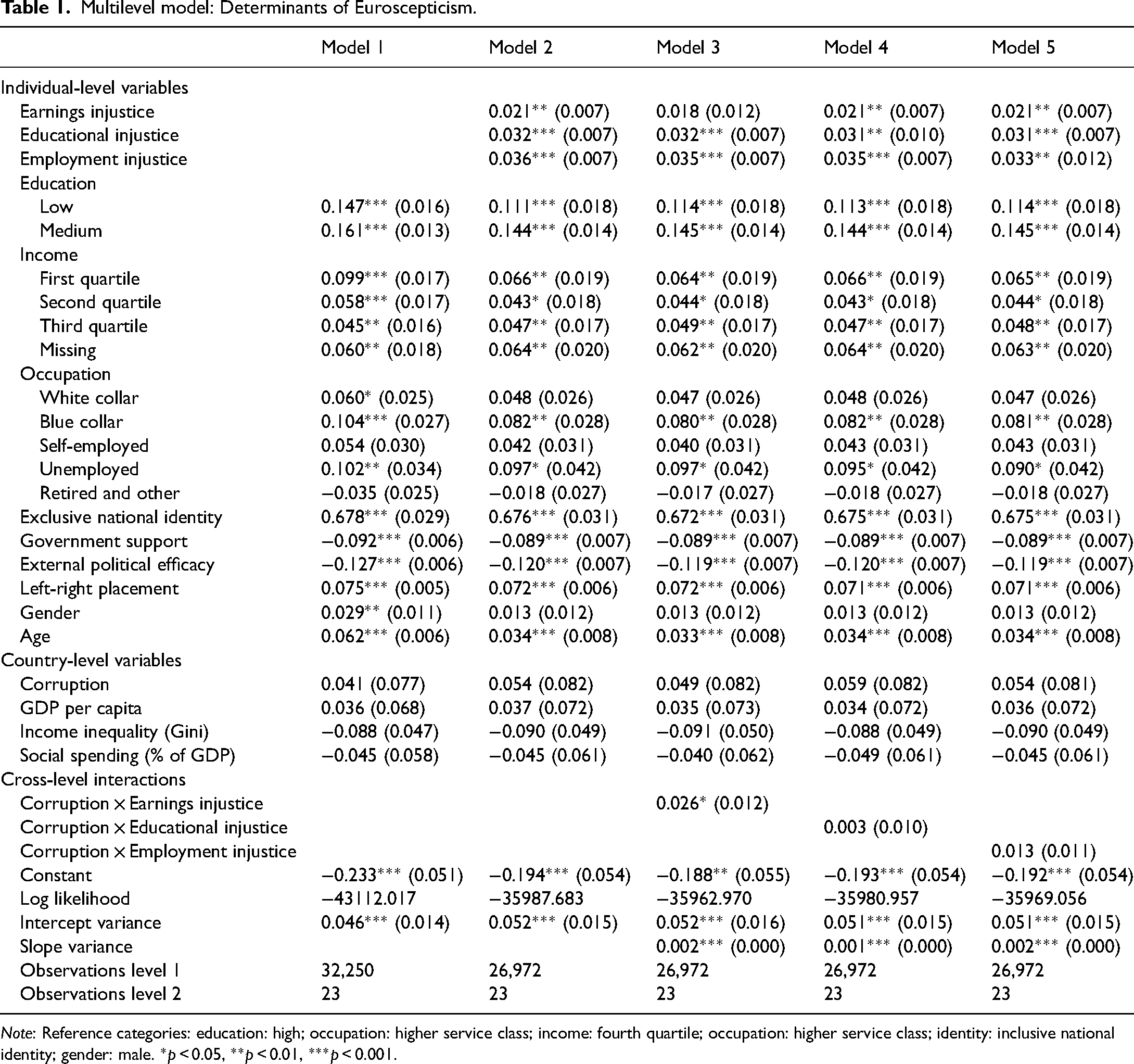
Note: Reference categories: education: high; occupation: higher service class; income: fourth quartile; occupation: higher service class; identity: inclusive national identity; gender: male. *p < 0.05, **p < 0.01, ***p < 0.001.
Results
How do perceptions of distributive injustice relate to Eurosceptic sentiments? Table 1 presents the results of the multilevel models. Starting from the baseline model with only controls, the effects of the three distinct components of distributive injustice under investigation are presented in Model 2 (Table 1). With regard to the effect of injustice of outcomes, the analysis shows that people who perceive greater earnings injustice are more Eurosceptic, confirming H1. To facilitate the interpretation of individual predictors of Euroscepticism, the Online appendix reports the unstandardized effects. With all other variables held constant, people who perceive their earnings as extremely unfairly low (scoring 4 on the scale of earnings injustice) score 0.16 points higher on the 11-point scale for Euroscepticism compared with those who perceive their earnings as fair or unfairly high (scoring 0 on the scale of earnings injustice).
Furthermore, people with stronger perceptions of injustice in educational and employment opportunities similarly show higher levels of Eurosceptic attitudes. Those who perceive the highest levels of educational injustice (in other words, indicating that they have not had a fair chance at all of achieving the level of education they were seeking) score 0.31 points higher on the Euroscepticism scale than those who do not perceive any educational injustice. In a similar vein, those who perceive the highest level of employment injustice score 0.33 points higher on the Euroscepticism scale than those who do not perceive any employment injustice. These findings confirm H2. The Online appendix reports the models with one of the three independent variables at a time and confirms that the coefficients of earnings, educational injustice and employment injustice remain significant when entered separately into the model.
Interestingly, the perceptions of distributive injustice seem to mediate the effects of social-structural variables. The positive effects of having a lower education, occupational status or income position (as shown in Model 1, Table 1) are somewhat weakened after adding the distributive injustice perceptions into the model. In other words, the reason that people with lower socio-economic status tend to be more Eurosceptic than higher socio-economic status groups can partly be explained by the former perceiving greater distributive injustice.
Altogether, the results from the pooled sample of 23 EU member states are consistent with the argument that perceptions of distributive injustice increase Euroscepticism. However, is the link between distributive justice and Euroscepticism moderated by corruption within the country? To empirically test this, Table 1 (Models 3–5) presents the interaction effects between the extent of corruption at the national level and perceptions of distributive injustice. The results of Model 3 show a positive and significant interaction effect between earnings injustice and corruption on Euroscepticism.
To facilitate the interpretation of this interaction effect, Figure 1 displays the marginal effects of perceived distributive injustice on Euroscepticism at various levels of corruption in the country. Figure 1(a) shows that when corruption levels are low (a high CPI score), perceptions of earnings injustice are positively related to Eurosceptic sentiments. By contrast, when corruption levels are high (a low CPI score), there is no significant relationship between earnings injustice and Euroscepticism, since the 95% confidence intervals around the marginal effects contain the value zero. These findings lend partial support to H3a.
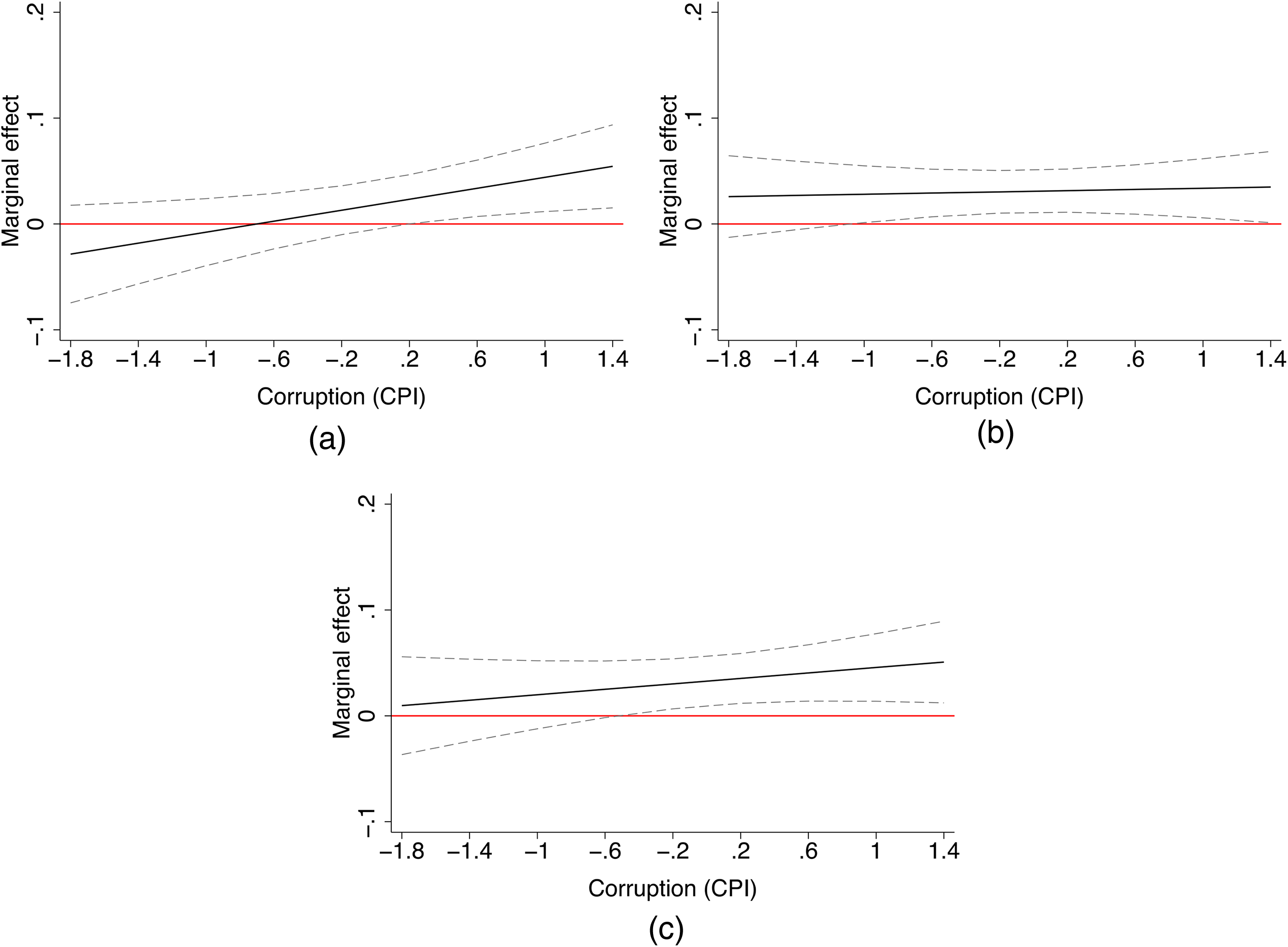
Marginal effects of (a) earnings injustice; (b) educational injustice; and (c) employment injustice on Euroscepticism by different levels of corruption.
Contrary to expectations, this picture does not hold true when it comes to distributive injustice of opportunities. The results of Models 4 and 5 (Table 1) show that the interaction effects are non-significant, meaning that the effects of perceived educational injustice (Figure 1(b)) and employment injustice (Figure 1(c)) on Euroscepticism do not differ significantly between countries with high and low levels of corruption. Figure 1(b) and (c) nevertheless illustrate that while distributive injustice of opportunities is slightly positively related to Euroscepticism in member states with lower corruption (a higher CPI score), this is not the case in countries with high levels of corruption (a low CPI score). In the latter, the 95% confidence intervals around the marginal effects contain the value zero. Robustness checks using the CC as an alternative indicator for corruption, reported in the Online appendix, yielded similar findings. However, when using trust in the European Parliament as the dependent variable (see the Online appendix), all the interaction effects are significant, indicating that perceptions of distributive injustice find a stronger breeding ground for negative EU sentiments in countries with low levels of corruption. Altogether, the results suggest that perceptions of distributive injustice provide a stronger breeding ground for Euroscepticism in national contexts where corruption is less prevalent. However, no conclusive evidence is found in support of H3b.
Discussion
This article contributes to the literature on mass Euroscepticism by investigating the role of distributive justice. More specifically, the analysis clarifies how perceptions of distributive injustice are related to Euroscepticism and the extent to which corruption moderates this linkage. Drawing on data from the European Social Survey 2018, it is confirmed that Europeans who perceive higher levels of injustice of earnings and opportunity – concerning education and employment – hold stronger Eurosceptic views than their counterparts who perceive less distributive injustice. In other words, people project their personal experiences of distributive injustice towards the EU, making them more likely to hold anti-EU sentiments, whereas they are more likely to endorse further European integration steps if their normative expectations about the distribution of resources in society are met. These findings complement previous studies on the roots of mass Euroscepticism that have predominantly focussed on economic, political and cultural determinants. Controlling for these conventional explanations of Euroscepticism, the current study provides correlational evidence for the argument that distributive justice is a distinct, yet underexplored, source of Euroscepticism. Thus, expanding on previous research, citizens consider not only the economic, political and cultural consequences of European integration, but also anticipate its impact on social issues such as injustice.
Nevertheless, the context in which the perceiver of distributive injustice is embedded also matters. In countries with high levels of corruption, perceptions of distributive injustice are not significantly positively related to Eurosceptic sentiments among the population, suggesting that higher levels of corruption dampen this apparent link to EU accountability. Perceptions of distributive (in)justice thus seem to interact with procedural (in)justice in their corollary to anti-EU sentiments, and what citizens expect from the EU varies from one member state to another. Overall, these patterns illustrate that considering citizens’ perceptions of distributive justice allows us to gain a better understanding of the differentiated drivers of mass Euroscepticism across Europe.
The findings of this article have implications for EU policymaking, as they reveal that the responses to distributive injustice go beyond national boundaries. When people feel that they are not getting what they deserve, they are less inclined to embrace European integration. This implies that perceptions of injustice could be damaging to the cohesion and legitimacy of the European project; however, not to the extent of destabilizing it, given the relatively small effect sizes found in this study. The finding that the relationship is somewhat dependent on the national context challenges the policy options for the EU. On the one hand, addressing social injustice could be expected to be beneficial to secure support for further European integration steps in the EU member states with low corruption levels. Yet, the question remains as to what extent perceptions of distributive injustice are malleable. On the other hand, perceived distributive injustices appear not to undermine support for European integration in member states with high corruption levels. This cross-national variation in the roots of Euroscepticism refines our knowledge about the relationship between institutional quality and support for European integration.
This article leaves two main paths open for future research. The first question that remains is what reference groups Europeans use when assessing the fairness of their own opportunities and economic outcomes. In the current study, the reference frames of the items on perceived earnings injustice and opportunities injustice differ in scope. Whereas the perceived injustice of opportunities was measured in relation to the national community, the perceived earnings injustice variable did not specify a reference group. Therefore, future research is needed in order to identify the extent to which citizens compare themselves with fellow nationals or with fellow Europeans, and what repercussions this has for the popular legitimacy of the European project. To this end, future research could apply transnational notions of justice (Bansak et al., 2017; Blake, 2018; de Witte, 2012), including inter-state (sociotropic) and inter-personal (egocentric) conceptions. If inequality is perceived as fair or unfair to the extent that it meets or violates normative expectations about how valuable resources are distributed, then what does this entail for justice at the European level? After many decades of European integration, one could expect that citizens have expanded their scope of justice beyond national boundaries (Guinjoan and Rico, 2018). Hence, future research should clarify how normative evaluations of inequality in Europe shape citizens’ attitudes towards the EU's role in social policymaking, starting out from the idea of the EU as its own site of justice. Such endeavours could also expand the scope of perceptions covered in the current study, by including recognition as a distinct component of distributive justice.
Second, since the results of this article are based on cross-sectional data, an additional endeavour for future research would be to explore the causal mechanisms behind justice-based Euroscepticism, as well as the dynamic relationship between distributive justice and Euroscepticism. This could include causal inference methods that measure in a direct way to what extent respondents attribute responsibility to the EU or the national government for distributive injustice, and test through which processes perceptions of distributive injustice awaken anti-EU sentiments. Relatedly, future research should expand on the relationship between distributive injustice and Euroscepticism over time, to explore whether trends in Euroscepticism align with temporal changes in perceptions of distributive injustice. With the increasing visibility of the EU and its policies, blame attributions towards the EU level may become more prevalent over time. Depending on the EU's response to the social consequences of the multiple crises Europe is facing, perceived injustices of outcomes and opportunities could be projected more strongly against the EU in the future. In this regard, citizens may increasingly evaluate the EU in terms of its social performance, paving the way for justice-based Euroscepticism. In short, this study should be seen as part of a broader research agenda on the social roots of Euroscepticism. The current study nevertheless advances the field by showing that the way in which citizens evaluate the distribution of resources in society has implications for the popular legitimacy of the EU, above and beyond objective inequalities.
Supplemental Material
sj-docx-1-eup-10.1177_14651165231170789 - Supplemental material for Mass Euroscepticism revisited: The role of distributive justice
Supplemental material, sj-docx-1-eup-10.1177_14651165231170789 for Mass Euroscepticism revisited: The role of distributive justice by Sharon Baute in European Union Politics
Supplemental Material
sj-log-2-eup-10.1177_14651165231170789 - Supplemental material for Mass Euroscepticism revisited: The role of distributive justice
Supplemental material, sj-log-2-eup-10.1177_14651165231170789 for Mass Euroscepticism revisited: The role of distributive justice by Sharon Baute in European Union Politics
Supplemental Material
sj-dta-3-eup-10.1177_14651165231170789 - Supplemental material for Mass Euroscepticism revisited: The role of distributive justice
Supplemental material, sj-dta-3-eup-10.1177_14651165231170789 for Mass Euroscepticism revisited: The role of distributive justice by Sharon Baute in European Union Politics
Supplemental Material
sj-do-4-eup-10.1177_14651165231170789 - Supplemental material for Mass Euroscepticism revisited: The role of distributive justice
Supplemental material, sj-do-4-eup-10.1177_14651165231170789 for Mass Euroscepticism revisited: The role of distributive justice by Sharon Baute in European Union Politics
Footnotes
Funding
The author(s) disclosed receipt of the following financial support for the research, authorship, and/or publication of this article: This work was supported by the H2020 Marie Skłodowska-Curie Actions awarded to Sharon Baute (Grant number: 840191).

Supplemental material
Supplemental material for this article is available online.
Notes
References
Supplementary Material
Please find the following supplemental material available below.
For Open Access articles published under a Creative Commons License, all supplemental material carries the same license as the article it is associated with.
For non-Open Access articles published, all supplemental material carries a non-exclusive license, and permission requests for re-use of supplemental material or any part of supplemental material shall be sent directly to the copyright owner as specified in the copyright notice associated with the article.
