



Abstract
To provide accountability, Members of Parliament (MPs) are expected to publicly communicate European Union (EU) affairs. Yet, parliamentary communication of EU affairs remains underexplored and existing analyses are conflicting. Against this background, this article sheds light on what drives MPs to talk about the EU, utilizing a novel dataset based on over 20,000 plenary protocols from 17 parliaments during 2006–2019. The study highlights that EU mentions increase in connection to referendums, summits, treaty ratifications, and European elections. Additional drivers include transfers of authority to the EU level, EU legislation, and political incentives. The findings provide some nuance to more pessimistic evaluations of the EU's accountability deficit, but major legitimacy challenges remain concerning national elections and Eurozone integration.
Introduction
National parliaments (NPs) are vital contributors to the democratic legitimacy of the European Union (EU). In EU affairs, their democratic functions include holding their governments accountable through parliamentary oversight and debate while providing a deliberative forum to connect citizens to the EU. Some scholars have thus argued that weak NPs contribute to the EU's democratic deficit (Follesdal and Hix, 2006). While the formerly dubbed “losers” (Maurer and Wessels, 2001) or “victims” (O’Brennan and Raunio, 2007) of European integration have long started to “fight back” (Raunio and Hix, 2000) by actively engaging in EU affairs (Auel et al., 2015), the Eurozone crisis and the emergence of executive dominance have posed new legitimacy challenges (Puntscher Riekmann and Wydra, 2013; Sánchez-Cuenca, 2017). Particularly in the increasingly politicized and crisis-ridden EU, it is paramount that NPs “take ownership” (Auel and Höing, 2015) of EU decision-making to legitimize it domestically.
In modern democracies, parliaments fulfill several key functions, such as exerting influence on policymaking, electing the government, and oversight (Auel et al., 2015: 284). However, in EU affairs, NPs retain little direct policy influence, governments are rarely chosen based on their EU positions, and oversight is toothless if scrutinized decision-makers are not publicly held accountable for their actions. This leaves a key role for parliamentary communication as an indispensable tool for NPs to facilitate public accountability. The communicative function not only serves to hold governments accountable and for Members of Parliament (MPs) to “give account” (Bovens, 2007) of their EU stances. It also allows NPs to serve as a forum for public deliberation, present political alternatives, inform citizens about key developments, foster a connection to the EU project, and provide an outlet for grievances (Raunio, 2011: 306). By utilizing their communicative function, parliaments provide an essential prerequisite for public accountability in EU affairs, enabling citizens to form preferences on European integration and vote accordingly.
Previous studies on the drivers of parliamentary communication of EU affairs have been either limited in scope and country sample or confined to analyzing pre-Eurozone and refugee crisis trends. Besides, studies often display conflicting findings. Whereas Auel and Raunio (2014) conclude that public Euroscepticism and strong political conflict stifle debate on the EU, Auel et al. (2016) partly contradict this by asserting that strong parliamentary oversight institutions, high public Euroscepticism, and high salience of the EU in public opinion are conducive to EU debate. Conversely, Hoerner (2019) finds no significant effect of oversight institutions on the salience of EU policy evaluation, maintaining that public Euroscepticism only encourages Eurosceptic parties to communicate EU affairs. In contrast, Rauh and de Wilde (2018) conclude that plenary debate on the EU is dominated by government parties and diminishes in response to increasing domestic Euroscepticism and before national elections. While this gaping “opposition deficit” in EU affairs paints a bleak picture of public accountability, they do find that MPs increase EU debate in response to authority transfers to the EU level, authority exercise at the EU level, important events, and increases in internal party dissent. Contesting these findings, Winzen et al. (2018) show that the exercise of authority and internal party dissent do not increase debate, but they cautiously concur that EU debate decreases before elections. The overview illustrates that there is surprisingly little consensus on the drivers of parliamentary communication of EU affairs.
Against the backdrop of these conflicting findings and an increasingly politicized crisis-ridden EU, this study sheds light on the drivers of plenary EU salience, defined as “the importance attributed to the EU and European integration” (De Wilde et al., 2016: 6), by asking: what factors drive MPs to talk about the EU in the plenary? I address the limitations of previous research by examining data from over 20,000 plenary protocols from 17 European national parliaments during 2006–2019, covering the Eurozone and refugee crisis, as well as pre-and post-crisis periods, and including an extensive set of variables in the analysis.
The results highlight that MPs are most consistently responsive to elections and key decision-making moments. Nuancing some of the more pessimistic conclusions of previous research, this study finds that EU references increase before European elections. Still, some persistent challenges to public accountability remain, including a decrease in plenary EU salience following deeper Economic and Monetary Union (EMU) integration and related to increases in the number of adopted EU directives. Another worrisome finding is that MPs do not talk more about the EU before national elections.
Theoretical framework and hypotheses
This article adopts a principal-agent framework that understands the EU as an extension of the chain of delegation and accountability (Strøm et al., 2003). In a principal-agent relationship, a principal delegates authority to an agent, expecting to generate higher outputs and reduce transaction costs by benefitting from the agent's superior capacity, problem-solving ability, and area-specific expertise (Pollack, 1997: 103; Strøm, 2003). In turn, the agent is accountable to the principal. Two principal–agent relationships are of relevance to this article. First, citizens, as the “ultimate principal” (Auel, 2007: 495), delegate authority to their NPs through national elections. Second, the parliaments, in their role as agents of the people, delegate part of their authority to the government, thus becoming its principal.
In EU affairs, these relationships are complicated by several agency problems, which can result in agency loss. NPs suffer from an information deficit as they operate primarily outside the EU framework, whereas governments are directly involved in decision-making at the EU level (Raunio, 2011: 304; Winzen, 2013: 298). Contrarily, NPs enjoy an informational advantage over citizens, who rely on lawmakers and the media for information on EU issues. To overcome asymmetrical information, it is paramount for MPs to not only hold national governments publicly accountable but also to publicly “give account” (Bovens, 2007) by informing citizens about their stances on European integration and key policies. This enables citizens to form preferences and sanction MPs with diverging interests (Rauh, 2015: 117). Following Bovens (2007: 450), this article understands accountability as “a relationship between an actor and a forum, in which the actor has an obligation to explain and to justify his or her conduct, the forum can pose questions and pass judgement, and the actor may face consequences.” This is essential to democratic accountability because it prevents decision-makers from acting with disregard for those they serve and those affected by their actions (Barnett and Finnemore, 2012: 171; Papadopoulos, 2010: 1032).
National parliaments facilitate delegation and accountability as the chain link between citizens and governments, functioning as the forum to hold governments accountable and, simultaneously, give account to the public (Auel, 2007: 496–498; Auel et al., 2016: 155). In parliamentary democracies, consequences are mostly delivered at the ballot box by “throwing the rascals out” or re-electing well-performing MPs (Papadopoulos, 2010: 1032). This becomes unfeasible if NPs do not communicate EU affairs. Insufficient debate and information on EU matters impede the voters’ ability to identify parties that represent them (De Wilde and Raunio, 2018: 313) and also limit collective will formation concerning multi-level policymaking. The plenary functions as the primary outlet for parliamentary communication, providing an arena for public deliberation, debating EU issues, presenting political alternatives, confrontation with the government, and connecting with citizens. The next sections apply this principal-agent framework to derive several hypotheses.
Authority transfers and EU legislation
The transfer of authority from the national to the EU level is expected to prompt NPs as principals to increase control over their governments as agents to prevent agency loss. One way to exert influence is through publicly questioning and exposing the governments’ EU positions and actions. As agents of the citizens, MPs are also expected to publicly communicate key developments and give an account of their EU stances. As the EU gains salience, citizens are likely to demand more information and justification from their MPs regarding multi-level policymaking to circumvent preference divergence (Rauh, 2015: 119; Rauh and De Wilde, 2018: 198). EU treaties entering into force constitute the most straightforward delegation of parliamentary competencies to the EU. As NPs are further removed from direct involvement in policy areas pooled at the EU level, their demand for justification from governments for their EU-level actions rises as governments remain directly involved in policymaking at the EU level.
Deepening EMU integration, understood as the transfer of monetary or fiscal authority from the national to the EU level, constitutes an additional major transfer of competencies (Raunio and Hix, 2000: 146), constraining the monetary and budgetary sovereignty of member states (Crum, 2018). To avert agency loss, MPs are expected to compensate for the resulting lack of direct involvement and information asymmetries by asking the government for justification. Besides, key EMU legislation such as the Fiscal Compact and the Two- and Six-Pack legislation require close coordination between the national and EU level, further necessitating parliamentary debate and scrutiny. Concurrently, the electorate is expected to pressure MPs to ensure that their interests are represented at the EU level.
Beyond that, the exercise of authority at the EU level through proposing and adopting EU legislation creates “discursive opportunities” (De Wilde and Zürn, 2012) to debate EU issues. EU directives are impactful policies that member states must implement domestically and have in the past catalyzed the politicization of EU affairs in NPs (Miklin, 2014; Rauh and De Wilde, 2018: 209). Thus, MPs are expected to react to increases in the number of adopted EU directives by asking the government for justification, debating their implementation, and informing citizens. MPs, aiming to exert tangible influence on EU-level policymaking (Auel, 2007: 488), are also expected to scrutinize EU legislation directly after its proposal at the EU level. Taking these considerations together, I hypothesize that plenary EU salience increases both with the entry of EU treaties into force and the level of EMU integration (H1a), as well as with the number of EU directives and proposed legislative acts at the EU level (H1b).
Elections and key decision-making moments
Several scholars argue that the politicization of the EU is cyclical, driven by major events and developments (e.g., De Wilde and Zürn, 2012: 147; Hutter and Kriesi, 2019; Kriesi and Grande, 2016). During these episodes, national parliaments are expected to limit agency loss by exercising control to guarantee that the government's preferences are not diverging. The media spotlight increases visibility and salience, prompting the public to demand information to ensure that lawmakers act in their best interest. Major EU-related political decision-making requires thorough debate. Failure to communicate and legitimize these developments domestically could, therefore, spur resentment towards the EU.
Arguably, the events with the biggest impact on the future of European integration are elections. Citizens require adequate information to hold lawmakers accountable and identify which party represents their preferences on EU issues. Hence, it is crucial that NPs inform the electorate about their voting options by engaging in rigorous debate, justifying their EU stances, and offering policy alternatives. This has gained importance as core parliamentary competencies have been pooled at the EU level.
Nevertheless, for a long time, the EU has been seen as a “sleeping giant” in national elections (De Vries, 2007; Grande and Hutter, 2016; Van Der Eijk and Franklin, 2004). Scholars argued that domestic issues and politicians would remain front and center until the dormant European cleavage would be activated by skilled political entrepreneurs (De Vries and Hobolt, 2012; Hobolt and De Vries, 2015; Van Der Eijk and Franklin, 2004: 32–33).
One supporting argument stresses that mainstream parties strategically depoliticize European integration domestically (Schimmelfennig, 2020). Rauh and de Wilde (2018) demonstrate that plenary EU salience diminishes before national elections as parties attempt to “crowd-out” EU matters by emphasizing salient national issues. Consequently, MPs could be left without a clear electoral mandate concerning EU affairs, implicating accountability.
Conversely, initial evidence of the politicization of European integration in national elections (De Vries, 2007; Kriesi, 2007) has received renewed empirical support. For instance, Grande and Hutter (2016) contend that EU membership has been politicized in national elections, while Hutter and Kriesi (2019) and Silva et al. (2022) highlight the importance of crises as drivers of domestic EU politicization.
European elections have long been characterized as second-order national elections, contested on domestic issues and politicians (Reif and Schmitt, 1980). Empirically, the thesis is strongly supported (e.g. Hix and Marsh, 2007; Schmitt et al., 2020; Schmitt and Toygür, 2016). Yet, some recent studies suggest that the EU is slowly gaining importance (e.g. Hobolt, 2015; Plescia et al., 2020), and De Vries (2018) demonstrates the existence of a link between different types of Euroscepticism and voting choice during the 2014 European elections. Therefore, I derive the hypotheses that plenary EU salience increases during national (H2a) and European election campaigns (H2b).
Key decision-making moments come in two forms. For one, they arrive through critical junctures – major unique events or developments with immense potential to determine the future of European integration. Two critical junctures are, for instance, the ratification of EU treaties and legislation deepening EMU integration. Ex-ante, major authority transfers from the national to the EU level are expected to prompt citizens to demand justification from their MPs for extending the chain of delegation. In response, MPs may raise the issue in the plenary to ensure that governments act in accordance with their preferences. Ex-post, MPs are expected to either criticize or justify the increased integration. While H1a examines the effect of long-term changes resulting from authority transfers from the national to the EU level on plenary EU salience, this hypothesis investigates the immediate effect of key treaties and legislation during the months in which they are negotiated and ratified.
EU-related referendums present another critical juncture (Rauh and De Wilde, 2018: 199). In the country holding the referendum, parties are likely to attempt to persuade and mobilize voters for their preferred outcome. Referendums also offer an opportunity for parties to advocate their vision of European integration. Concurrently, citizens are expected to demand information on the consequences of the possible outcomes. Referendums may also affect observing countries, as increased attention to the issue on the ballot may enable parties to mobilize support for similar referendums or related policy changes.
In addition, recurring events, most notably, EU and Euro summits, the appointment of a new Commission, and holding the Council of the EU presidency, can also present key decision-making moments (Rauh and De Wilde, 2018: 199) as the media spotlight incentivizes MPs to challenge or justify the government's EU positions and connect citizens to the EU.
EU and Euro summits are key for setting a direction for the course of European integration (Auel and Raunio, 2014: 17), creating the necessity for NPs to thoroughly hold their governments accountable to ensure that their interests are represented. Similarly, the selection of a new Commission has the potential to deeply impact the path of European integration, presenting MPs with a key moment for engaging in EU affairs. MPs are especially incentivized to exert influence over the commissioner appointed by their government. Holding the Council of the EU presidency also calls for parliamentary scrutiny as the position generates agenda-setting power for governments. Besides, the Council presidency presents an opportunity for government parties to advocate and connect citizens to their vision of European integration. To summarize, I expect that plenary EU salience increases in connection to critical junctures, such as EU-related referendums, treaty ratifications, and ratification of legislation to deepen EMU integration (H2c), as well as key recurring events, like EU or Euro summits, Commission appointments, and holding the Council presidency (H2d).
Political incentives
Research shows that the strategic political incentives of MPs and parties determine whether parliaments use their opportunity structures to communicate EU affairs (Auel et al., 2015, 2016; Auel and Raunio, 2014; Hoerner, 2019; Rauh and De Wilde, 2018). These two vote-seeking actors have scarce resources, requiring good reasons to engage with often low-salience and opaque EU issues (Miklin, 2014: 82).
As the “constraining dissensus” has replaced the “permissive consensus” (Hooghe and Marks, 2009), citizens increasingly care about EU-level decision-making, and Euroscepticism has become widespread. Yet, most mainstream parties are more Europhile than their public (Hooghe and Marks, 2009). Hence, the demand for accountability to preempt agency loss rises with the level of public Euroscepticism. To hold power, MPs and parties are incentivized to justify their EU positions to ensure the public that their views are compatible (Auel et al., 2016: 159). Contrarily, MPs and parties whose views on European integration are out of touch might instead try to keep the issue off the agenda to avoid electoral consequences (Rauh and De Wilde, 2018: 199–200).
One consideration largely ignored by the literature is that parties that share similar positions on European integration have little reason to compete on EU issues. However, incentives to exploit the EU dimension are markedly high in polarized parliaments where parties take widely diverging stances. Parties on the fringes of the left-right spectrum, in particular, may try to exploit the orthogonally running European cleavage, hoping to reap electoral outcomes which would be unattainable by solely competing on the traditional cleavages (De Vries and Hobolt, 2012; Hobolt and De Vries, 2015; Schimmelfennig, 2020). Even in the absence of extreme parties, parliamentary polarization on EU affairs might encourage debate if there are two camps with diverging stances, one of which expects to win over voters by representing the more popular position on European integration. Thus, I hypothesize that the higher the level of public Euroscepticism (H3a) and the higher the level of parliamentary EU polarization (H3b), the higher the level of plenary EU salience.
Data
The empirical analysis builds on time-series cross-sectional data generated through computer-assisted keyword-based manual coding of over 20,000 stenographic plenary protocols in 17 lower chamber plenaries. The novel data were enriched with self-collected and existing variables from several data sources. The dataset was constructed using country-month panels, covering an extensive time frame of 14 years (168 months) from 2006 to 2019, enabling the inclusion of member states that joined the EU during the Eastern enlargement in 2004 and have so far been excluded by most previous studies. Additionally, it allows for the comparison of plenary EU salience before and after the Lisbon Treaty entered into force in late 2009. Based on data availability, 2019 was chosen as the cut-off.
Dependent variable
As the resources of MPs, particularly speaking time, are limited, plenary EU salience, defined as the “importance attributed to the EU and European integration” (De Wilde et al., 2016: 6), is assumed to increase with the number of relative EU mentions. Thus, to measure plenary EU salience, a baseline dictionary was created and translated to all relevant languages, consisting only of the stems “europ” and “EU,” to capture all direct references to the EU. I refrained from including terms with a more contextual connection to the EU (e.g. “Brussels”). After conducting searches on all stenographic plenary protocols, the monthly number of references to the EU was divided by the overall word count to account for length differences. The resulting EU salience score is a proportion and naturally skewed toward zero as EU matters compete with every other imaginable issue. Therefore, the variable was log-transformed (see Hoerner, 2019; Rauh and de Wilde, 2018).
One downside of this very encompassing approach is that the “europ” search term entails some noise. It was, for example, not possible to exclude references to the European continent or the Council of Europe. Luckily, the stem “EU” does not significantly suffer from this issue. Based on that, I conducted a correlation analysis of the two baseline search terms (see Online appendix). The high levels of correlation (0.76–0.86) give confidence that the search term “europ” primarily captures references to the EU.1
Independent variables
The Lisbon Treaty is the only major treaty adopted by all member states during the timeframe. The corresponding variable Lisbon Treaty takes the value 0 until the treaty entered into force in December 2009, from where it takes the value 1. The Lisbon Treaty provides a special case as it may have been conducive to debate on the EU in multiple ways. Besides transferring authority from the national to the EU level, it constitutionalized the role of national parliaments as the “guardians of the subsidiarity principle” and expanded information rights (Auel and Christiansen, 2015: 262, 267), further enabling NPs to engage in EU affairs. Besides, EU member states can be involved in the EMU to varying degrees (see Auel and Höing, 2015). EMU integration adds the value 1 for participation in the Fiscal Compact, Six-pack legislation, and Eurozone (0 = no involvement to 3 = membership in all three). I consulted EUR-Lex to retrieve a moving average of the number of EU directives adopted at the EU level and legislative acts introduced by the Commission during the preceding six months (see Rauh, 2015). The resulting variables EU directives and EU proposed legislation exclude corrigenda, but include amendments.
As concerns elections and key decision-making moments, the event markers for national and European elections take the value of 0.5 six months prior to the election month. They are assigned the value 1 during the month of and before the election, as the electoral campaigns heat up and media coverage increases. The treaty ratification event marker takes the value of 0.5 in the month leading up to and following a country's ratification of the Lisbon Treaty and the value of 1 in the month of ratification, to ensure that the variable captures ex-ante and ex-post EU mentions without choosing a timeframe that would be too broad to pick up on punctual increases in salience. The same procedure is applied to construct the variable EMU ratifications, which encompasses key EMU-related decisions, most notably the ratification of major legislation significantly deepening EMU integration (European Council decision on Eurozone accession, Fiscal Compact, European Stability Mechanism, Six-and Two-pack legislation, European Financial Stability Facility (EFSF), Euro Plus Pact, Single Resolution Fund, and Single Supervisory Mechanism) and domestic and external EU referendums (see Rauh and de Wilde, 2018). Council presidency takes the value 1 for the country holding the Council of the EU presidency. Commission appointment takes the value 1 starting in the month the European Commission President is confirmed until the entire Commission is inaugurated. This period offers a window of opportunity for NPs to debate their government's nominee. The variable takes the value of 0.5 for the month after the Commission is inaugurated to account for ex-post scrutiny. EU/Euro summit takes a value of 0.5 a month before and after the summit and a value of 1 in the month of the respective summit (see Rauh and de Wilde, 2018).
Moving on to political incentivizes, public Euroscepticism was measured by the percentage of respondents that consider EU membership “a bad thing,” using the Standard Eurobarometer (EB) surveys 65–92 (see Winzen, 2013). By directly asking about views on membership, this item addresses the most fundamental form of Euroscepticism. As the item is usually included in multiple EB surveys a year, the values were averaged to derive a constant yearly score. Parliamentary EU polarization scores were assigned based on the standard deviation and kurtosis of the Chapel Hill Expert Survey (CHES) scores on party positions on European integration for parliamentary parties (see Down and Han, 2021). Values were taken from the CHES surveys conducted in 2006, 2010, 2014, and 2019, using the CHES trend file (Jolly et al., 2022). A high kurtosis implies heavy tails in the distribution. Correspondingly, parties tend to be closely aligned on the EU dimension, with few outliers. In this case, the party system is less polarized than a system with a low kurtosis, which indicates a more bimodal distribution. Higher standard deviations indicate a more dispersed distribution of party positions on European integration and, hence, a more polarized party system (Down and Han, 2021: 15).
Control variables and data interpolation
The analysis controls for two additional political incentives that capture party characteristics and have been shown by previous studies to influence the level of parliamentary communication of EU affairs. First, internal party dissent on European integration may incentivize party leaders to keep the EU off the agenda to avoid electoral backlash by hiding internal conflict (Auel and Raunio, 2014). Second, I control for the level of parliamentary Euroscepticism as mainstream parties commonly hold more favorable views toward European integration than the general public, incentivizing Eurosceptic parties to compete on EU issues (Auel and Raunio, 2014; Hoerner, 2019).
Scores for the two indicators were taken from the 2006–2019 CHES data. To derive a country-level score, the party-level values were multiplied by the seat shares of parliamentary parties based on the Parliaments and governments composition database (ParlGov) (Döring and Manow, 2020) and then added up for each survey. Parliamentary Euroscepticism is based on CHES expert evaluations of the stances of party leadership toward European integration (1 = strongly opposed to 7 = strongly in favor). The signs were reversed so that higher values correspond to higher parliamentary Euroscepticism. Internal party dissent relies on CHES expert evaluations of the internal division of parties on European integration (0 = Party was completely united to 10 = Party was extremely divided).
Since the CHES-derived variables are not collected yearly, the dataset was linearly interpolated based on the composition of the parliaments at the time of data collection (2006, 2010, 2014, and 2019). To avoid creating excess artificial variation, the values within a year were held constant so that monthly observations clustered in one year do not vary.
Statistical model
The data are clustered in 17 countries and 168 months. Therefore, the statistical model tests the hypotheses using Prais-Winsten estimates with panel-corrected standard errors to account for heteroscedastic error terms, first-order autocorrelation caused by serial correlation within panels, and contemporaneous cross-sectional correlation (Beck and Katz, 1995). The Prais-Winsten estimator was chosen over including a lagged dependent variable proposed by Beck and Katz (1995), as the latter has been shown to underestimate the confidence of the results (Plümper et al., 2005: 342, 352). I opted for panel-corrected standard errors as they have been shown to outperform other estimators in estimating confidence intervals, generating reliable results (Beck and Katz, 1995; Hoechle, 2007: 284; Reed and Ye, 2011: 994, 996). As cross-country comparison is problematic due to significant differences in language and parliamentary culture, I control for country-specific effects by including country dummies. One downside of this approach is that the effect of time-invariant or slowly changing variables, like parliamentary institutions, could not be examined. To study the effects of the time-based event variables, year effects are assumed to be accounted for by the included variables.
Results
Before discussing the regression results, this section analyzes some descriptive findings on how the salience of the EU in the plenaries of national parliaments evolved during the period of examination. The following analysis is based on country-month panels with word counts exceeding 50,000. Country-month panels with lower word counts, typically found during summer and winter breaks or before elections, contain very large outliers, reducing the reliability of the results.
Figure 1 shows the average plenary EU salience from 2006 to 2019 for each country. The two vertical lines mark the years 2008 and 2016. In 2008, all countries except Ireland ratified the Lisbon Treaty, while 2016 witnessed the EU-Turkey deal and the Brexit referendum, putting a hold on the ongoing refugee crisis. The trend lines reveal widely diverging trends. Some countries, like France, Austria, and the United Kingdom, show clear increases corresponding to the debates surrounding the Lisbon Treaty; Ireland and Belgium peaked in 2016; several countries experienced elevated salience during the Eurozone crisis; some did not follow a recognizable path. This demonstrates that key EU developments are taken up to varying degrees by the different NPs, indicating that EU politicization is highly country-specific.
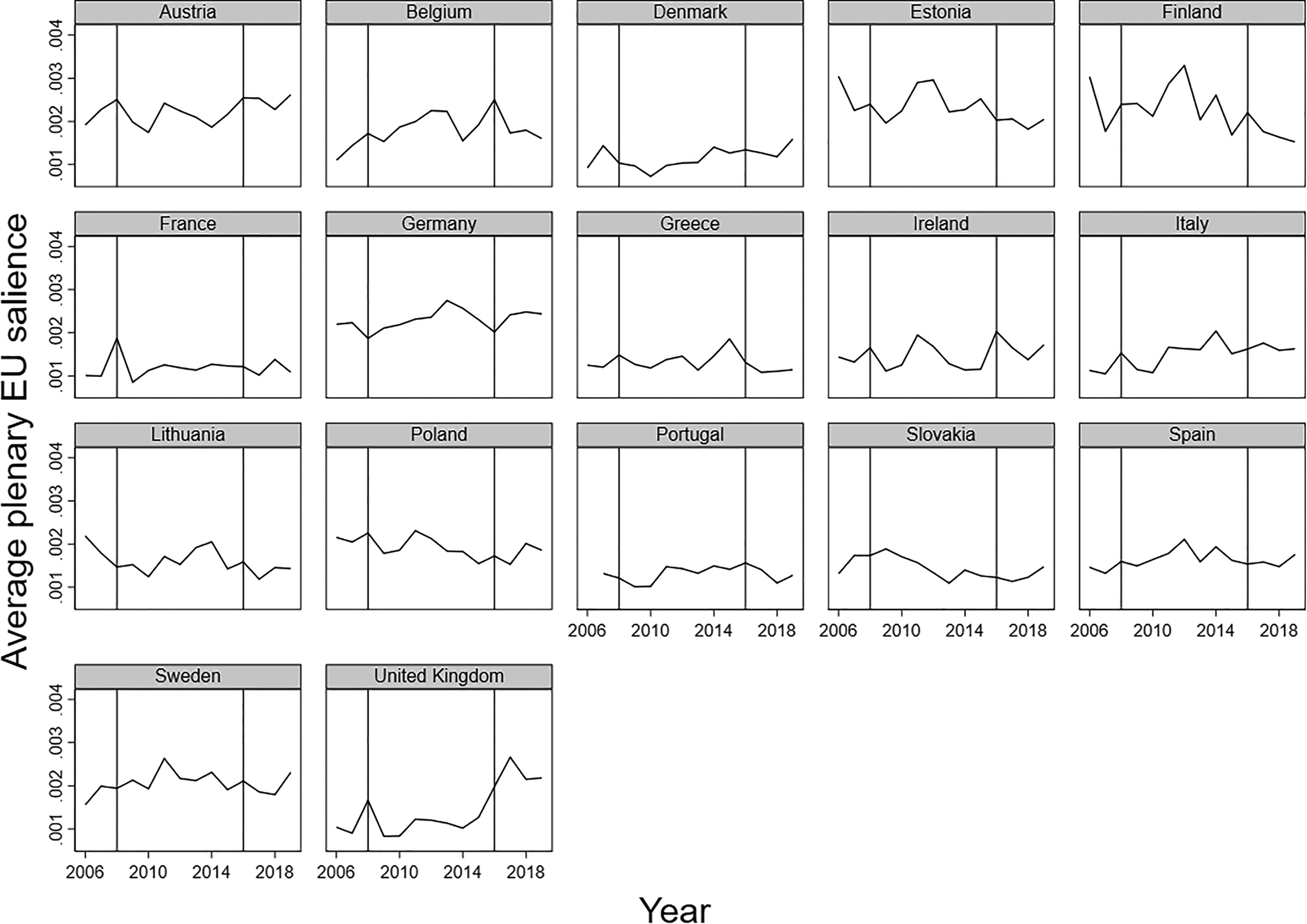
Average plenary EU salience by country during 2006 to 2019.
Figure 2 aggregates the average plenary EU salience from all 17 parliaments. The graph shows biannual scores (January–June/July–December). The trend line suggests that plenary EU salience loosely follows an upward trajectory. However, when excluding the United Kingdom from the analysis, with its highly politicized post-Brexit environment, this trend completely disappears (see the Online appendix). This further underlines the deeply country-specific nature of EU politicization.
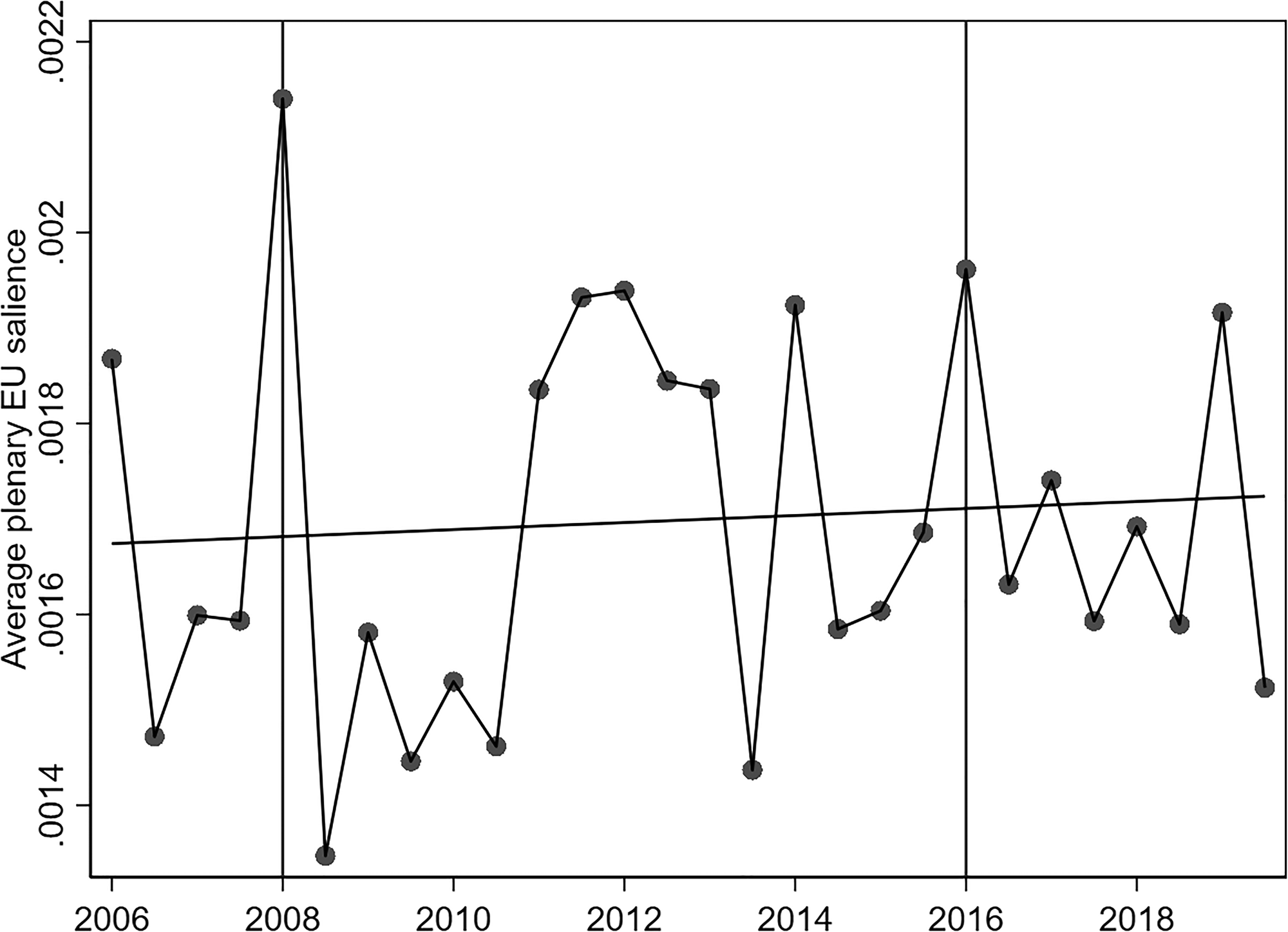
Average plenary EU salience during 2006 to 2019.
There are four visible peaks: two during the Eurozone crisis in 2011 and 2012 and two other notable ones in 2008 and 2016. Overall, this lends credence to the notion that EU politicization is cyclical and driven by critical junctures, instead of increasing linearly over time. The only two years that do not fit this pattern are 2010 and 2015, which, despite witnessing the unfolding of major crises, display very low levels of plenary EU salience.
In May 2010, the first Greek bailout completed the turn of the Global Financial Crisis into the Eurozone crisis. Apart from the bailout and the related establishment of the EFSF, the EU remained deadlocked as states ended up in a “chicken game” with hard bargaining and brinkmanship to ensure their preferences would reign supreme at the EU level (Schimmelfennig, 2015). As a result, most crisis instruments were adopted after 2010 as the deadlock became politically and economically unsustainable. Accordingly, some scholars argue that 2011 was the first year in which EU-level developments “had a profound and widespread impact on the national level of governance” (Dinan, 2012: 85).
In 2015, multi-sourced mass immigration culminated in a full-blown refugee crisis. However, stuck in a deadlock due to diverging preferences among member states (Zaun, 2018), the EU initially reacted slowly. The key EU-Turkey deal was only adopted in March 2016. Thus, one plausible explanation of the low levels of plenary EU salience in 2010 and 2015 is that national parliamentary attention to the EU follows key EU-level actions and not simply the emergence of crises. However, more research is needed to support this idea.
Regression analysis
Table 1 summarizes the regression results. The model illustrates the change in the dependent variable in response to a one-unit increase in each independent variable, holding all other variables at their means. The log transformation of the dependent variable makes it necessary to inverse the log function for each coefficient to obtain the percent change in plenary EU salience induced by a one-unit increase in the independent variables. The first three models test H1–H3 in isolation. Model four combines the three sets of factors. All four models include country dummies, most of which are highly significant. The substantive effects mentioned in the following are all based on regression model 4 (Table 1).
Determinants of plenary EU salience.
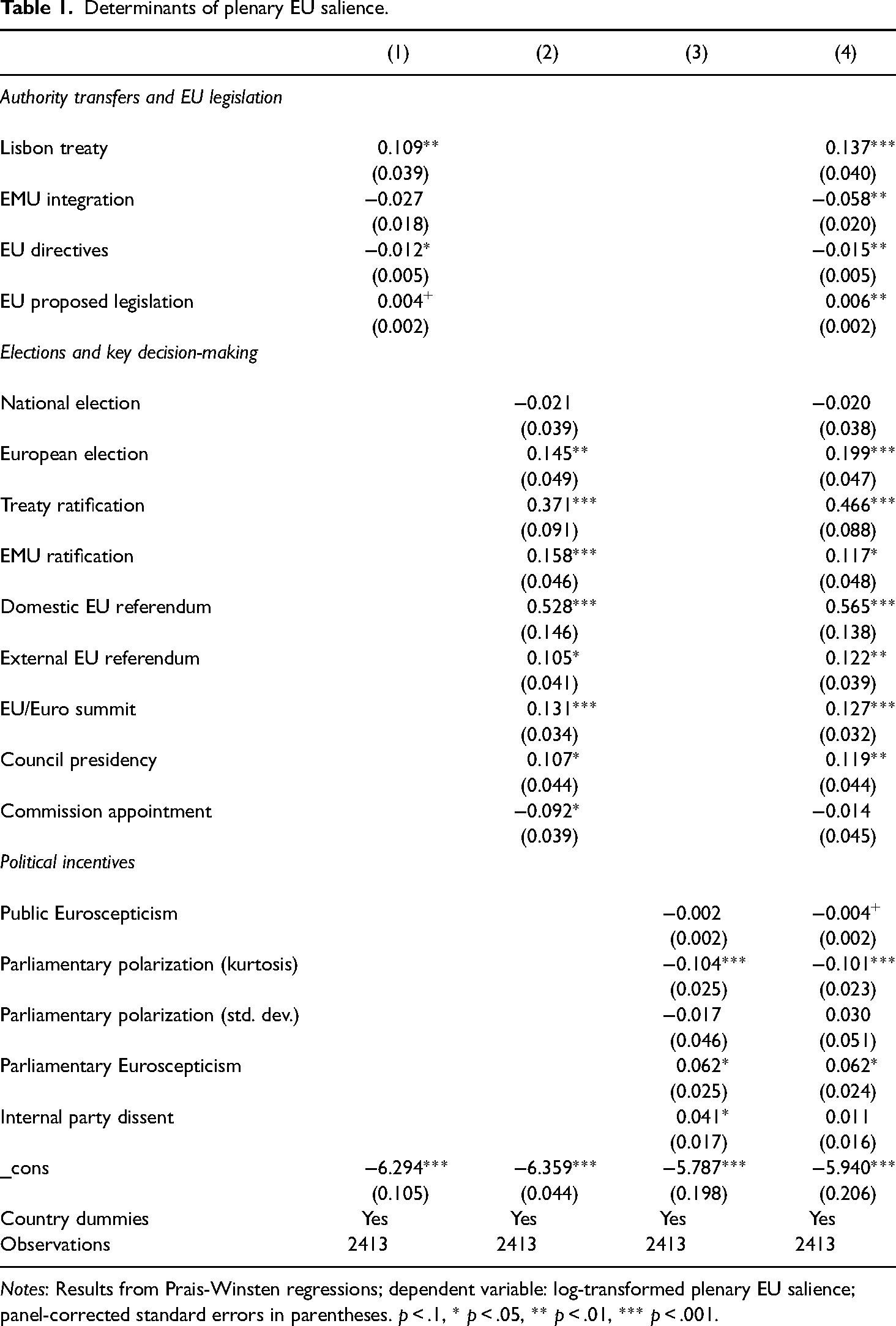
Notes: Results from Prais-Winsten regressions; dependent variable: log-transformed plenary EU salience; panel-corrected standard errors in parentheses. p < .1, * p < .05, ** p < .01, *** p < .001.
The regression results only partly support the notion that authority transfers and EU legislation are associated with increased EU mentions. All four variables reach statistical significance in model 4, and only the EMU integration measure fails to reach significance in model 1.
As expected, the transfer of authority from the national to the EU level through the Lisbon Treaty induced a 14.7% increase in plenary EU salience (95% CI = 0.06, 0.22). Yet, an increase in the level of EMU integration has the opposite effect, decreasing plenary EU salience by 5.6% (95% CI = −0.1, −0.02). These findings suggest that whether MPs increasingly talk about the EU depends on the type of authority transfer, drawing a distinction between European and Eurozone integration. Accordingly, H1a is only partially supported. Similarly, the results only partially support H1b. Following my hypotheses, an increase of one standard deviation in the six-month rolling average of proposed legislation at the EU level (7.2) increases plenary EU salience by 4.2% (95% CI = 0.01, 0.7). However, an increase of one standard deviation in the six-month rolling average of passed EU directives (3.8) decreases salience by 5.5% (95% CI = −0.09, −0.02), indicating that MPs debate proposed EU legislation but, once passed at the EU level, tend to avoid debates.
In contrast, the results strongly support the hypothesis that MPs are responsive to elections and key decision-making moments. Seven out of the nine variables have the expected effect and are highly significant in models 2 and 4 (Table 1). The two notable exceptions are the indicators for national elections and commission appointments. The national election variable fails to reach significance and carries a negative coefficient, leading to a rejection of H2a. Conversely, H2b is strongly supported as plenary EU salience increases by 22% before European elections (95% CI = 0.11, 0.29). In support of H2d, which hypothesized that MPs are responsive to recurring key EU events, holding the Council presidency is associated with a 12.6% increase in plenary EU salience (95% CI = 0.03, 0.21), and salience also increases by 13.5% around EU and Euro summits (95% CI = 0.06, 0.19). Commission appointments significantly predict plenary EU salience, but against H2d, the variable carries a negative sign in model 2 and loses significance in model 4. Overall, the strongest support can be found for H2c as all examined critical junctures are associated with significant increases in plenary EU salience. The ratification of the Lisbon Treaty marked a high point in EU debate in many parliaments, eliciting a 59.4% increase (95% CI = 0.29, 0.64). The ratification of legislation to deepen EMU integration evokes a 12.4% increase (95% CI = 0.02, 0.21). Furthermore, referendums appear to be widely debated domestically and abroad, increasing salience by 75.9% (95% CI = 0.29, 0.84) and 12.9% (95% CI = 0.05, 0.2) respectively. Even excluding the United Kingdom and, thereby, the highly salient Brexit referendum leaves the effect of a domestic referendum at 66% (see the Online appendix). Taken together, these results demonstrate that MPs are highly responsive to key decision-making moments, especially critical junctures. The picture is more nuanced for elections, as salience increases before European but not national elections.
Likewise, the results paint a mixed picture concerning the effect of political incentives. While not significant in model 3, in model 4, an increase of public Euroscepticism by one standard deviation (7.5) decreases plenary EU salience by 3,2% (95% CI = −0.06, 0), contradicting H3a. On the contrary, H3b, which tests the effect of parliamentary EU polarization, receives moderate support. An increase of one unit in the country-level kurtosis score of party positions on European integration decreases plenary EU salience by 9.6% (95% CI = −0.14, −0.6). This indicates that a more bimodal distribution and, correspondingly, higher levels of polarization are conducive to debate on the EU, lending credence to H3b. Parliamentary EU polarization measured by the standard deviation does not have the same effect. Against my hypotheses, a more dispersed distribution of parties on European integration does not increase EU debate, and the coefficient changes signs between models, adding a caveat to H3b.
Concerning the control variables, internal party dissent reaches significance in model 3 but loses it in model 4, whereas a one-unit increase in parliamentary Euroscepticism amounts to a 6.4% increase (95% CI = 0.01, 0.11) in salience.
To check if these results hold up to scrutiny, I conducted a wide range of robustness tests (detailed in the Online appendix). First, I included the Lisbon Treaty, EMU integration, and public Euroscepticism variables with different lag structures, as MPs might require time to adjust to changing public opinion or major institutional changes induced by treaties or major reforms. Second, I ran the regression, including country-month panels with under 50,000 words, which contain some of the larger outliers. Third, I tested whether the findings are robust to different estimation methods. Fourth, I ran the regression without the interpolated variables to ensure that the results are not driven by artificial variation. Fifth, I included closely related variables in separate models to ensure that they do not absorb each other's effect. Sixth, I used alternative operationalizations for the variables measuring public Euroscepticism, EU directives, and proposed EU legislation. Finally, I ran the regression without the United Kingdom as a potential outlier.
Overall, with few notable exceptions, the main findings of this article are highly robust to different model alterations. Major caution is warranted when interpreting the effect of public Euroscepticism as the variable loses significance in many alternative models, carrying a minute coefficient. Thus, the result that increased public Euroscepticism diminishes EU debate in the plenary stands on very shaky ground. Further supporting H3b, the standard deviation measure of parliamentary polarization on European integration becomes a significant predictor of plenary EU salience when excluding the kurtosis measure from the model. In this model, a one-unit increase in the standard deviation is associated with a 12.3% increase (95% CI = 0.02, 0.21) in salience (see the Online appendix). In contrast, the measure becomes a significant negative predictor when excluding the United Kingdom.
Furthermore, when including months with under 50,000 words, upcoming national elections are associated with a 16% decrease (95% CI = −0.25, −0.1) in plenary EU salience (see the Online appendix). This finding should be regarded with caution because, as previously stated, these months are prone to strong outliers and are frequently placed right before national elections, potentially explaining the newly gained significance. Unfortunately, it was not possible to exclude the possibility that part of the positive effect of EMU integration on plenary EU salience was absorbed by the Lisbon Treaty variable. When excluding the Treaty variable from the model, the indicator for EMU integration keeps its negative sign but loses significance. The same happens when running the regression without the United Kingdom. Concerning the control variables, parliamentary Euroscepticism loses significance, and internal party dissent gains significance in some model alterations.
Conclusion
This article sheds light on the drivers of the parliamentary communication of EU affairs, utilizing a novel dataset based on over 20,000 plenary protocols from 17 European national parliaments during 2006–2019. Theoretically, I built on the previous literature to test three sets of factors that are hypothesized to drive the salience of the EU in national plenaries: authority transfers and EU legislation, elections and key decision-making moments, as well as political incentives. The following findings and their implications for public accountability in the EU are worth highlighting.
The descriptive analysis demonstrates that the salience of the EU in parliamentary plenaries follows highly country-specific trends, hinting at diverging levels of EU politicization. Increases in salience are cyclical and appear to be driven by EU-level activity in connection to critical junctures like major EU treaties and crises. The robust regression results show that MPs are most consistently responsive to elections and key decision-making moments, thereby facilitating a crucial precondition for establishing temporal linkages to important events and developments. Two exceptions here are that MPs do not increasingly talk about the EU before national elections or during the selection process for a new European Commission. In contrast to previous studies (Rauh and De Wilde, 2018; Winzen et al., 2018), I do, however, find that European elections elicit EU mentions. Concerning authority transfers and EU legislation, the results paint a mixed picture. As expected, MPs are responsive to authority transfers from the national to the EU level via treaties. However, at odds with Auel et al. (2015), I find that MPs talk less about the EU following deeper EMU integration. Increases in proposed EU legislation exert a positive effect on plenary EU salience, while increases in adopted directives diminish it. Last, as regards political incentives, I find some evidence that parliamentary EU polarization is associated with increased EU debate. Contrasting previous research (Auel et al., 2016; Auel and Raunio, 2014; Rauh and De Wilde, 2018), I find little evidence that MPs avoid talking about the EU when their party is internally divided on European integration or in the presence of a Eurosceptic public.
What do these results tell us about the state of accountability in the EU? Previous studies on the parliamentary communication of EU affairs have uncovered numerous legitimacy issues, such as an opposition deficit (Rauh and De Wilde, 2018), declining debate near national elections (Rauh, 2015; Rauh and De Wilde, 2018; Winzen et al., 2018), and diminishing communication in the presence of public Euroscepticism and internal party conflicts (Auel and Raunio, 2014). In contrast, the findings of this study nuance some of these grim results, even though major challenges remain in connection to national elections and EMU integration. A lack of EU debate before national elections is highly problematic, indicating that domestic elections remain dominated by national issues and politicians. As EU policymaking has shifted from Pareto-efficient market building to policies with real distributive consequences (Hix, 2008: 94) and EU issues have increased in public salience, it has become integral to the democratic legitimacy of the EU that citizens are sufficiently informed on the parties’ EU positions before national elections, not least because of the strengthened role for governments in EU affairs post-Eurozone crisis (Crum, 2013). Otherwise, it becomes infeasible for citizens to vote based on their preferred version of the EU, encouraging further Euroscepticism. Declining levels of debate in response to deeper EMU integration present another challenge, as it not only entails significant delegations of powers in key areas, such as the national budget, but also frequently necessitates increased coordination between parliaments and the EU institutions.
The results of this article must be viewed in light of several limitations. No claims can be made regarding whether the examined EU mentions substantively contribute to public accountability. Mentioning the EU in the plenary is merely a precondition for public accountability and has little intrinsic value. Clearly, it does not only matter that MPs talk about the EU, it also greatly matters what they say. Thus, a downside of employing countries as the unit of analysis is that it does not allow for the generation of insights into who is talking, thereby ignoring government-opposition and mainstream-Eurosceptic dynamics. Moreover, the plenary, while extremely important, is not the only outlet for parliamentary communication: This study has excluded several outlets, such as the EACs, parliamentary questions, and public hearings. Concurrently, parliamentary communication has limited value if the national media does not publicize it.
Future studies can address these limitations by paying closer attention to the content of parliamentary communication of EU affairs, studying the strategic interactions of parties in the plenary, and analyzing potential regional differences in EU debate. Beyond that, future research should expand the analysis to include a broader range of communication outlets. For instance, scholars could further explore the role of the media by combining analyses of parliamentary communication with an examination of the conditions under which the media picks up EU debate. To conclude, this article has provided tentative insights into the drivers of EU debate in national parliamentary plenaries, but causal mechanisms remain underexplored and more research is needed to complete the picture.
Supplemental Material
sj-do-1-eup-10.1177_14651165221143962 - Supplemental material for Talking about Europe? Explaining the salience of the European Union in the plenaries of 17 national parliaments during 2006–2019
Supplemental material, sj-do-1-eup-10.1177_14651165221143962 for Talking about Europe? Explaining the salience of the European Union in the plenaries of 17 national parliaments during 2006–2019 by Felix Lehmann in European Union Politics
Supplemental Material
sj-dta-2-eup-10.1177_14651165221143962 - Supplemental material for Talking about Europe? Explaining the salience of the European Union in the plenaries of 17 national parliaments during 2006–2019
Supplemental material, sj-dta-2-eup-10.1177_14651165221143962 for Talking about Europe? Explaining the salience of the European Union in the plenaries of 17 national parliaments during 2006–2019 by Felix Lehmann in European Union Politics
Supplemental Material
sj-pdf-3-eup-10.1177_14651165221143962 - Supplemental material for Talking about Europe? Explaining the salience of the European Union in the plenaries of 17 national parliaments during 2006–2019
Supplemental material, sj-pdf-3-eup-10.1177_14651165221143962 for Talking about Europe? Explaining the salience of the European Union in the plenaries of 17 national parliaments during 2006–2019 by Felix Lehmann in European Union Politics
Footnotes
Acknowledgments
I would like to thank Thomas Persson, Christer Karlsson, and Moa Mårtensson for their excellent suggestion on earlier drafts of this article. I would furthermore like to thank the editors and anonymous reviewers for their helpful comments.
Funding
The authors received no financial support for the research, authorship, and/or publication of this article.

Supplemental material
Supplemental material for this article is available online.
Notes
References
Supplementary Material
Please find the following supplemental material available below.
For Open Access articles published under a Creative Commons License, all supplemental material carries the same license as the article it is associated with.
For non-Open Access articles published, all supplemental material carries a non-exclusive license, and permission requests for re-use of supplemental material or any part of supplemental material shall be sent directly to the copyright owner as specified in the copyright notice associated with the article.
