




Abstract
What are the policy consequences of constitutional differentiation in core state powers? We argue that the most important consequence is not necessarily the exclusion of the constitutional outs from the policies of the ins, but their reintegration by different means. The outs often have strong functional and political incentives to re-join the policies they opted out from, and the ins have good reasons to help them back in. We develop a theoretical framework that derives the incentives for reintegration from the costs of a policy exclusion. We use a novel dataset of reintegration opportunities to map trends and patterns of reintegration across policy fields and member states. We analyze selected cases of reintegration to probe the plausibility of our theoretical argument.
Constitutional differentiation and policy reintegration
The Post-Maastricht era has been characterized by two broad trends, the rise of differentiated integration (Leuffen et al., 2013) and the increasing involvement of European Union (EU) institutions in core state powers (Genschel and Jachtenfuchs, 2016). Both trends are related. As the EU claimed authority over core functions of sovereign government – money, defence, foreign policy, migration, internal security – some particularly sovereignty-minded member states were granted formal opt-outs to allow integration to proceed.
Opt-outs were not a new policy instrument. Since the early years of integration, new and/or poor member states were regularly granted temporary exemptions from selected EU policies to build up the requisite capacity for implementation. The opt-outs in core state powers, by contrast, responded to postfunctional concerns of identity and sovereignty rather than functional concerns of governance-capacity and efficiency. They were constitutional rather than instrumental, and they were permanent rather than temporary (Schimmelfennig and Winzen, 2020).
High hopes have been pinned on constitutional differentiation (European Commission, 2017; Schimmelfennig et al., 2023). Some claim it increases efficiency by reducing intergovernmental conflict, improving decision-time, and helping tailor EU policies to heterogeneous national preferences (Alesina et al., 2005). Others highlight how differentiation increases legitimacy by protecting member states from EU domination and interference in key policy fields (Bellamy, 2019; De Blok and De Vries, 2023; Schraff and Schimmelfennig, 2020). Whether and to what extent these hopes are borne out depends on the policy effects of constitutional differentiation on the ground. What difference does it make for ins and outs?
The answer may seem obvious: the outs are excluded from the policies of the ins. This is the key assumption behind the efficiency and legitimacy arguments in favour of constitutional differentiation, and one of the key claims of the most important empirical research in the field (Duttle et al., 2017; Schimmelfennig and Winzen, 2020). Yet, as we argue in this article, this claim is wrong. We show empirically that constitutional differentiation does not always imply full and lasting policy exclusion and explain theoretically why the outsiders have various instruments of reintegration at their disposal and often use them. We define reintegration as the effective inclusion of a member state into a field of EU policy-making from which it is formally excluded by a constitutional opt-out. We distinguish three main instruments of reintegration:
(1) Reintegration by default makes the practical application of an opt-out contingent on conditions that are not presently met. For instance, the application of the Danish constitutional opt-out from Justice and Home Affairs (JHA) of 1992 was premised on the introduction of qualified majority voting to that field. Hence, Denmark continued to fully participate in police and judicial cooperation in criminal matters until the Lisbon Treaty finally put an end to unanimity almost 20 years later. Policy reintegration is the default until some trigger decision is made. (2) Reintegration by legal engineering exploits the complexities of EU primary law to mitigate the exclusionary effect of an opt-out. It draws on ‘[h]itherto unused, overlooked or reinterpreted rules’ of EU law (The Economist cited in De Witte, 2021: 680) to bring the outs back into the fold. For instance, by basing the European Defence Fund (EDF) on Treaty provisions on industry rather than defence, Denmark was allowed to participate despite its opt-out from common policies with ‘defence implications’ (cf. Protocol 22 on the Position of Denmark, Art. 5). Reintegration occurs by shifting the policy frame and hence the treaty base in unorthodox ways. (3) Reintegration through separate agreement reincorporates the outs by specifying the scope and the conditions of their participation in policy areas from which their constitutional opt-outs formally exclude them (cf. De Búrca and Scott, 2000; Witte et al., 2017). Separate agreements paved the way, for instance, for the selective participation of the United Kingdom in important aspects of JHA policy (until Brexit). Reintegration occurs through a specific contract that limits the exclusionary effect of the general constitutional opt-out.
Partly at least, constitutional differentiation is symbolic politics because it brings policy reintegration in its wake. This does not mean, of course, that it has no effect at all. Even in cases of extensive reintegration, the outs will still be less involved in the policy of the ins than under uniform integration. Yet, the extent of exclusion is less extreme than the constitutional façade of differentiation may suggest.
The theoretical puzzle is to explain why the outs insist on constitutional differentiation first and dilute its policy effects later. After all, constitutional opt-outs often result from a domestic constraining dissent mobilized around principled convictions which are unlikely to change quickly (Schimmelfennig and Winzen, 2020). Yet, any benefit in terms of sovereignty and identity has to be traded off against the functional and political disadvantages of an effective policy exclusion. Opting out is not cost-free. As we argue, the constitutional outs often have incentives to reintegrate with the policies of the ins. The configuration of exclusion costs (i.e. the net-benefits of policy inclusion foregone) explains whether the former will seek a way back in, and whether the latter will help them find it. In the remainder of the article, we develop a theoretical framework for the analysis of reintegration and apply it to quantitative and qualitative evidence on the policy consequences of constitutional differentiation.
Why constitutional differentiation?
Differentiated integration refers to the non-uniform application of formal EU rules across member states (Schimmelfennig and Winzen, 2014). Uniform, non-differentiated law is valid for all member states equally, whereas differentiated law is valid only for a subgroup of insider-states, while outsider-states remain excluded from application. Differentiated integration can be instrumental: new member states receive a temporary opt-out from parts of the Acquis Communautaire to help them develop the required implementation capacity. Yet, differentiation can also be constitutional: old member states obtain a permanent opt-out to avoid the sovereignty costs of the integration of core state powers.
Constitutional differentiation has become a common feature of European integration (Schimmelfennig and Winzen, 2014, 2020). As the EU has extended its purview to core state powers since the 1990s, some, usually Northern, member states began to fear for their sovereignty. These laggards were granted permanent, constitutional opt-outs in order to allow the more federalist member states (Jensen and Slapin, 2012) to integrate Common Security and Defence Policy (opt-out for Denmark), JHA (opt-outs for Denmark, the United Kingdom and Ireland) and Economic and Monetary Union (opt-outs for Denmark, the United Kingdom and Sweden).
Constitutional differentiation was sometimes driven by the ins seeking to bypass opposition to deeper integration (e.g. Schengen). At other times, it was initiated by the outs opposing seemingly federalist integration projects (e.g. European Monetary Union, EMU) (Jensen and Slapin, 2012). In most cases, the opt-outs were motivated by identity concerns and fears of domestic backlash: the United Kingdom, Sweden and Denmark refused to join the EMU because of popular opposition to sovereignty loss (Schimmelfennig and Winzen, 2020: 122). Occasionally, opt-outs were also driven by asymmetric interdependence. Arguably, Ireland opted out of Schengen not to protect its sovereignty and identity but to keep intact the common travel area with Britain after the British opt-out from Schengen (Donoghue and Heinl, 2009; Jensen and Slapin, 2012).
Once agreed, constitutional differentiation tends to be durable (Schimmelfennig and Winzen, 2020). Intergovernmental conferences that could repeal opt-outs are rare. And when they take place, they tend to reinforce differentiation. Except for the British opt-out from the Social Chapter of the Maastricht Treaty (1997) and the Danish opt-out from the Common Security and Defense Policy (CSDP, 2022), no constitutional opt-out has ever been repealed.
As Schimmelfennig and Winzen (2020: 121) argue, constitutional differentiation is durable because it has policy consequences that reinforce incentives of differentiation. First, by removing the veto threat of sovereignty-minded outs, it facilitates policy integration among the more federalist ins. This increases the gap between the level of policy integration among the ins and the level of integration acceptable to the outs. As the divide between the federalist identities of the ins and the sovereigntist identities of the outs deepens, the political costs of reintegration increase. Second, by strengthening the functional interdependence between the ins and by weakening interdependence between ins and outs, differentiated integration decreases the functional benefits of re-joining: the outs no longer face the same policy challenges as the ins. This is not to say that the outs do not face any political or functional costs of exclusion at all (Laursen et al., 2007; Wallace, 1997). Yet, these costs are low and decreasing relative to the self-reinforcing benefits of exclusion.
The history of EMU illustrates the argument (Schimmelfennig and Winzen, 2020: 121–135). Once established, EMU exposed the ins to endogenous dynamics and exogenous shocks that did not affect the outs in the same way. The result was a deepening of integration within EMU, most dramatically during the Eurozone crisis. This deterred not only Denmark, Sweden, and the United Kingdom from reconsidering their opt-outs but also discouraged member states from joining which originally had only been excluded on instrumental grounds, such as Poland and Hungary.
A revisionist strand of the literature suggests, by contrast, that the policy exclusion implied by constitutional differentiation is more apparent than real. For instance, evidence suggests that the Brussels-based representatives of opt-out countries remain well-connected to colleagues from insider countries and routinely get involved in the policy-making of the ins (Adler-Nissen, 2009, 2014; Naurin and Lindahl, 2010). Most Danish policies in JHA mimic the EU’s policies despite the Danish opt-out (Migliorati, 2021). We add to this revisionist literature in two ways. First, we theorize the conditions under which the outs will seek, and the ins will accept, policy reintegration (or not). Second, we evaluate our theory against evidence of the reintegration of constitutional outs (Denmark, Ireland, Sweden, and the United Kingdom) into EU policies in core state powers (JHA, EMU and CSDP).
Costs of exclusion and incentives for reintegration
Why would member states with constitutional opt-outs seek a (selective) reintegration into the policies of the insiders? And why would the insiders allow them back in? Our explanation takes opt-outs as exogenously given and focuses on the conditions under which they trigger reintegration. Two conditions are central to our theory. First is the (net-)costs of exclusion (i.e. political and functional costs of exclusion minus political and functional costs of inclusion) for the outs. These costs may be low and decreasing because the outs benefit from positive externalities from the integration of the ins. In this case, the outs have little incentive to seek reintegration. According to Schimmelfennig and Winzen (2020), this is the standard case. In their view, constitutional differentiation tends to trigger a self-reinforcing dynamic of the formal opt-out and effective policy exclusion that increases switching costs and entrenches the divide between ins and outs. Conceivably, however, the net costs of exclusion can also be high and increasing, for instance, because the enhanced integration of the ins produces political or functional benefits from which the outs are excluded, and/or because differentiated integration creates negative externalities for the outs (Genschel and Plümper, 1997; Kölliker, 2001; Schimmelfennig et al., 2023). The costs of policy exclusion may then eventually swamp any benefit the outs derive from their opt-out, and prod them to seek policy-reintegration.
The second condition is the net-costs of exclusion for the ins. The costs may be functional. For instance, the non-participation of the outs may reduce the economies of scale and scope available to the ins from resource sharing or policy coordination. The costs of exclusion can also be political. The non-participation of the outs signals European disunity, undermines trust in the EU, and erodes its credibility as a device for joint problem-solving. Again, the costs of exclusion are likely to be variable. Arguably, the British, Danish, and Swedish opt-outs from the EMU are associated with high costs of exclusion for the ins because the participation of these wealthy countries would greatly increase the resilience and credibility of the Eurozone. By contrast, Denmark’s formal opt-out from CSDP is associated with moderate costs for the ins because, if needed, NATO provides a backchannel for policy coordination and resource sharing. If the ins face high net-costs of exclusion, they have an incentive to encourage the policy reintegration of the outs; if the costs of exclusion are low, the ins are indifferent or may even oppose reintegration because of the associated transaction costs. Table 1 summarizes the main costs of exclusion for ins and outs and compares them to the costs of inclusion.
Costs of differentiation for ins and outs.
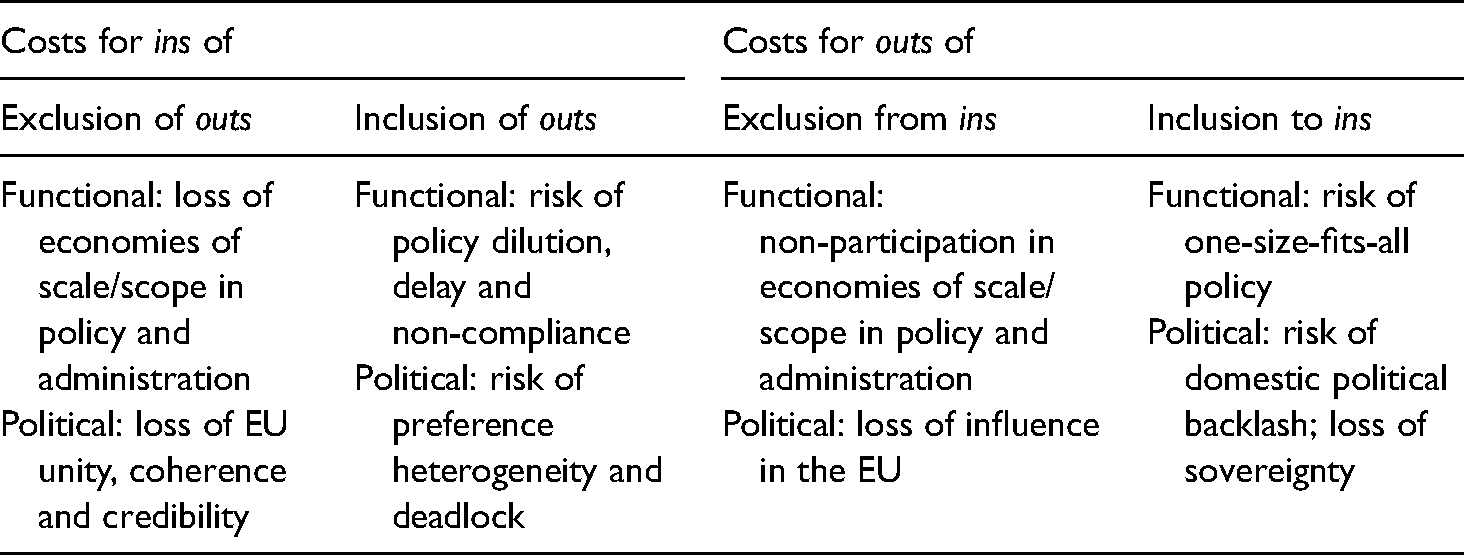
Our argument is simple: whether the outs will seek reintegration, and whether the ins will support it, depends on the constellation of costs. When the outs face high (low) costs of exclusion that exceed (are inferior to) the prospective costs of inclusion, they will seek reintegration (insist on differentiation). Contrariwise, when the ins face high (low) costs of exclusion, they will try to lure the outs into reintegration (accept differentiation). Cross-tabulating the net-costs of exclusion (i.e. the costs of exclusion minus the costs of inclusion) for the outs and the ins, we obtain four basic constellations (Table 2):
(1) Symmetric reintegration: the net-costs of exclusion are high for ins and outs. Both parties have incentives to collude on reintegration. (2) Asymmetric reintegration: the net-costs of exclusion are high for the outs but low for the ins. The outsiders will seek reintegration, but the insiders have limited incentives to support them. (3) Asymmetric differentiation: the net-costs of exclusion are low for the outs but high for the ins. The ins will encourage reintegration, but the outs will refuse to follow. (4) Symmetric differentiation: the net-costs of exclusion are low for ins and outs. Both parties are indifferent to reintegration. The outs will not seek it and the ins have no incentive to encourage it.
Cost constellations and incentives for differentiation and reintegration.

The conventional wisdom assumes that constitutional differentiation generally ends in the lower row of Table 2 (Leuffen et al., 2013; Schmidt, 2019; Winzen, 2016): the permanent opt-out of a member state at the treaty-level implies its effective exclusion from the joint policy. Given the low costs of exclusion, the out lacks incentives to seek reintegration – even if this leaves the ins aggrieved (asymmetric differentiation). In this article, we focus on the upper row, that is constellations in which the out has incentives to seek reintegration with the policies of the ins, and the ins encourage their re-entry (symmetric reintegration) or not (asymmetric reintegration). In the next section, we explore the upper-row outcomes descriptively. How prevalent is policy reintegration? In the following section, we use micro case studies to assess whether policy reintegration is driven by the cost considerations suggested by our theory (Table 2).
Mapping reintegration
We measure the prevalence of policy reintegration in two steps. First, we identify reintegration opportunities, that is decision points at which constitutional-outs could potentially seek, and integration-ins could potentially accept, the de-facto participation of the former in policy fields from which they are ostensibly excluded 1 . Then, we measure reintegration choices, that is the decisions to use reintegration opportunities (or not) and by what means: default, legal engineering, or separate agreement.
Reintegration opportunities: trivially, only member states with a constitutional opt-out have reintegration opportunities: no reintegration without prior differentiation. This restricts our investigation to four countries: Denmark, Ireland, Sweden and the United Kingdom (Schimmelfennig and Winzen, 2014, 2020). From the universe of reintegration opportunities these countries have in JHA, CSDP or EMU, we sample what arguably are the least likely cases – that is opportunities for the outs to join costly capacity-building projects of the ins. Capacity-building refers to policy measures requiring participating states to pay up real money for common instruments or institutions such as the European Defense Fund, Frontex or the various Eurozone bail-out funds (EMU). If outs join such costly programs, there is reason to suppose that they will also use reintegration opportunities in less costly areas of constitutional differentiation.
Drawing on extensive primary and secondary sources, we collected an original dataset of reintegration opportunities in capacity-building measures (see the Online appendix for information on case selection and coding). The benchmark for inclusion in the dataset was that a policy measure requires monetary payments from the EU budget, from the member states or from both: European-level measures that do not involve expenditures on staff, equipment, organization or infrastructures are excluded. We relied on various sources including Eurlex, Commission publications, the EU budget, agency reports, as well as the secondary literature to identify our cases (see the Online appendix for more information). The resulting dataset contains 81 capacity-building measures adopted since Maastricht for a total of 187 reintegration opportunities for the four out-countries combined.
Reintegration choices: once we had identified the reintegration opportunities, we coded for each of them whether it was taken (reintegration) or not (no reintegration) and by which instrument (default, legal engineering, or separate agreement). Finding the relevant information was not trivial. Reintegration either leaves no legal paper trail (reintegration by default and by legal engineering do not involve any new legislation) or leaves a trail that is not directly connected to the original opt-out (separate agreement). Hence, Eurlex was of little help. Most information had to be gleaned from policy acts, documents, reports, secondary publications, and expert interviews (Migliorati, 2021). The main risk of this procedure was to assign false negatives, that is the coding of reintegration opportunities as not taken because information on their effective reintegration was unavailable or overlooked. Still, we managed to identify a pro-reintegration choice in 136 of the 187 reintegration opportunities in our dataset (roughly 73%). To the extent that false negatives bias our findings, at all, the bias is against our empirical expectation because it leads to an underreporting of reintegration in our data.
Figure 1 maps reintegration choices across outsiders and policy fields. The number of reintegration opportunities varies across countries depending on the precise scope of their opt-outs (Figure 1(a)): Denmark has the highest number of reintegration opportunities (91) because it has opt-outs from JHA, CSDP and the EMU; Sweden has only opted out from the EMU and, hence, the lowest number of reintegration opportunities (9). The number of reintegration opportunities also varies across policy fields (Figure 1(b)): It is highest in JHA (122) and lowest in EMU (27). Arguably, ‘the “lumpy” all-or-nothing quality’ (Moravcsik, 2018: 1168) of the Euro offers fewer opportunities for outsiders to fine-tune their non-participation. JHA is less lumpy and offers more opportunities for selective reintegration. The generally low level of policy activity in CSDP may help account for the low number of reintegration opportunities in this field.
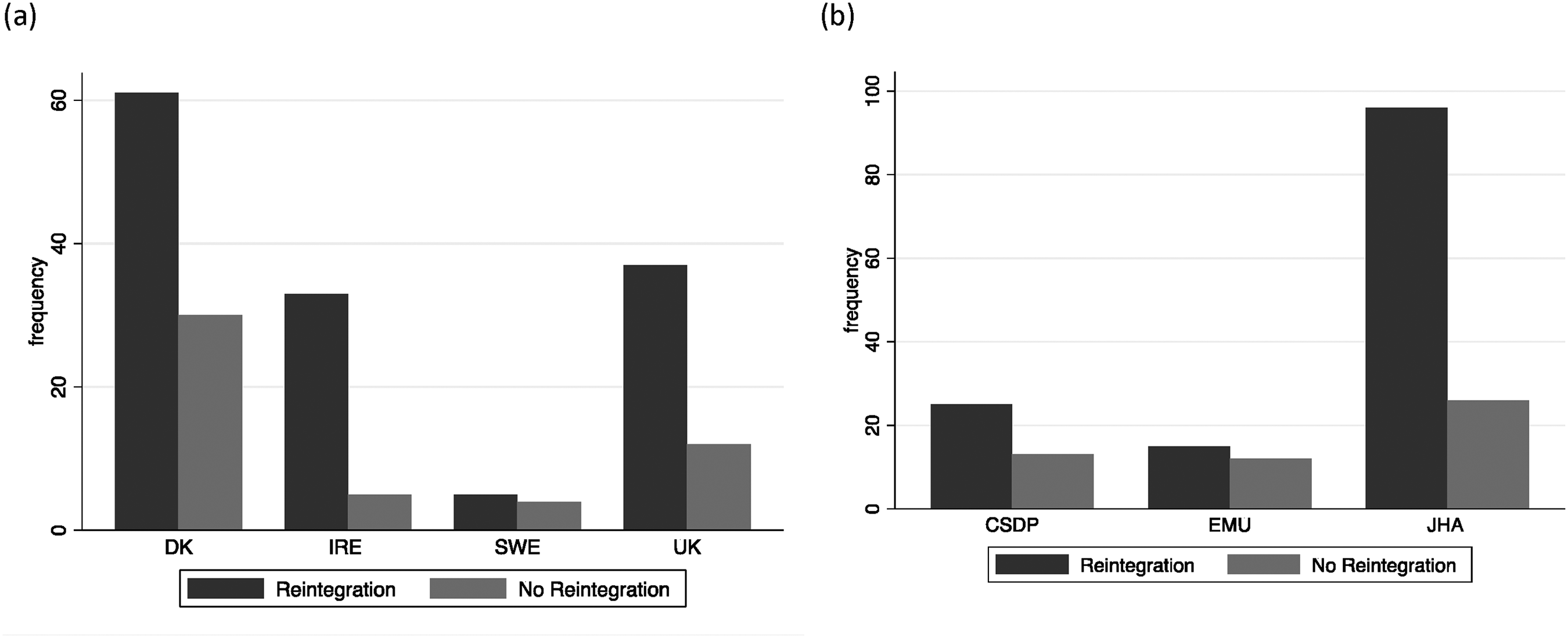
Reintegration and no reintegration cases, by country (a) and policy area (b).
Perhaps most importantly, Figure 1 shows that the use of reintegration opportunities dominates their non-use across all relevant member states and policy areas. Policy reintegration seems to be a very common correlate of constitutional differentiation. Opt-outs should not be taken at their constitutional face value because they tend to bring a string of selective policy opt-ins in their wake.
Figure 2 maps the incidence of different strategies of reintegration. It shows that cases of reintegration by default and by separate agreements are almost equally frequent. The former reduces the costs of constitutional differentiation ex ante by delaying its practical application. The latter allows adjusting reintegration ex-post as new reintegration opportunities develop. Legal engineering also serves for reintegration ex-post. However, it is somewhat less frequent than separate agreements perhaps because legal constraints are more stringent.
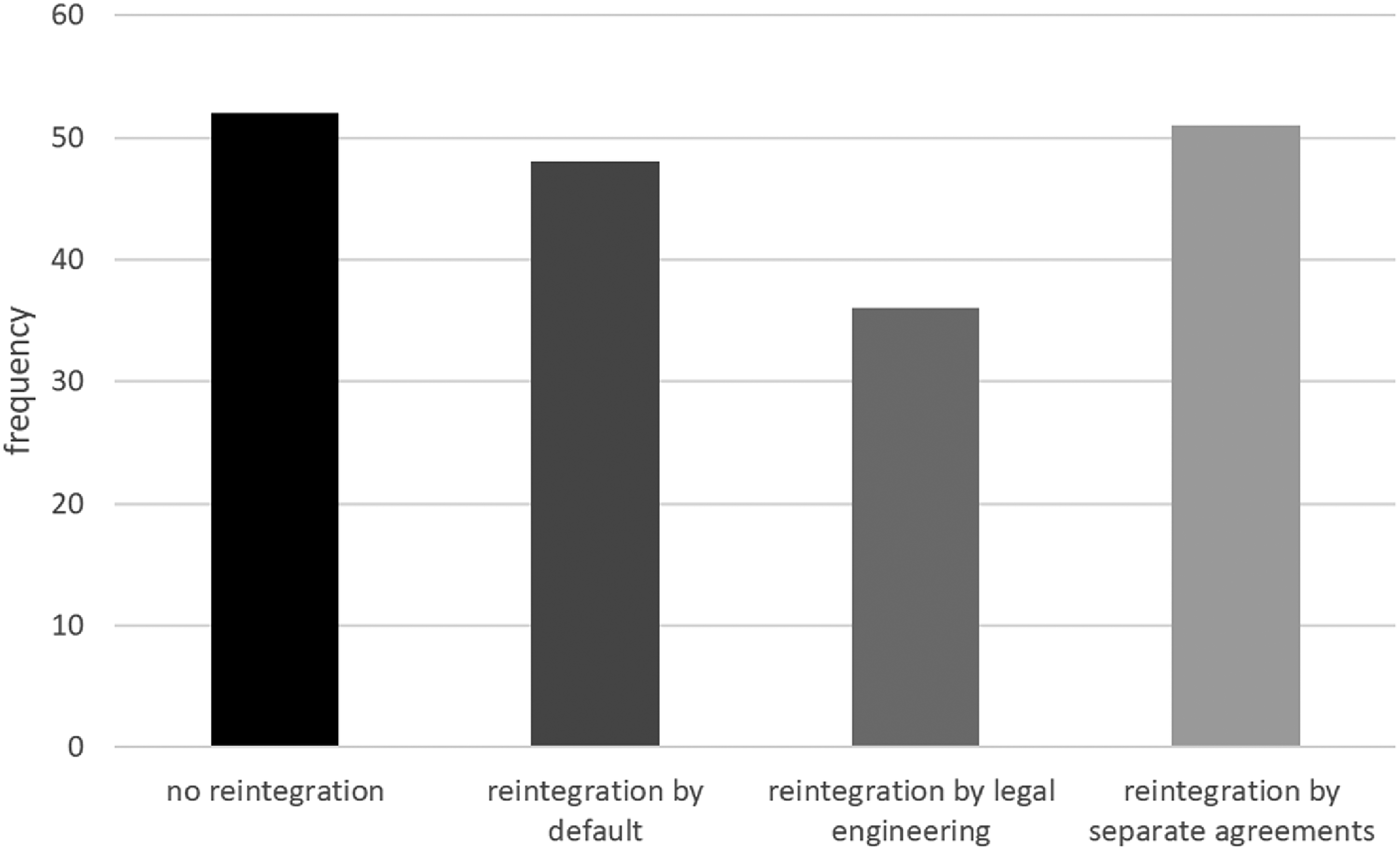
Instruments of reintegration.
Figure 3 visualizes the complexity of reintegration arrangements. The three instruments of reintegration are utilized across almost all countries and policy fields. Yet, it also reveals variance across cases. While, for instance, patterns of (no) reintegration are very similar across outs in EMU, there is large heterogeneity in JHA.
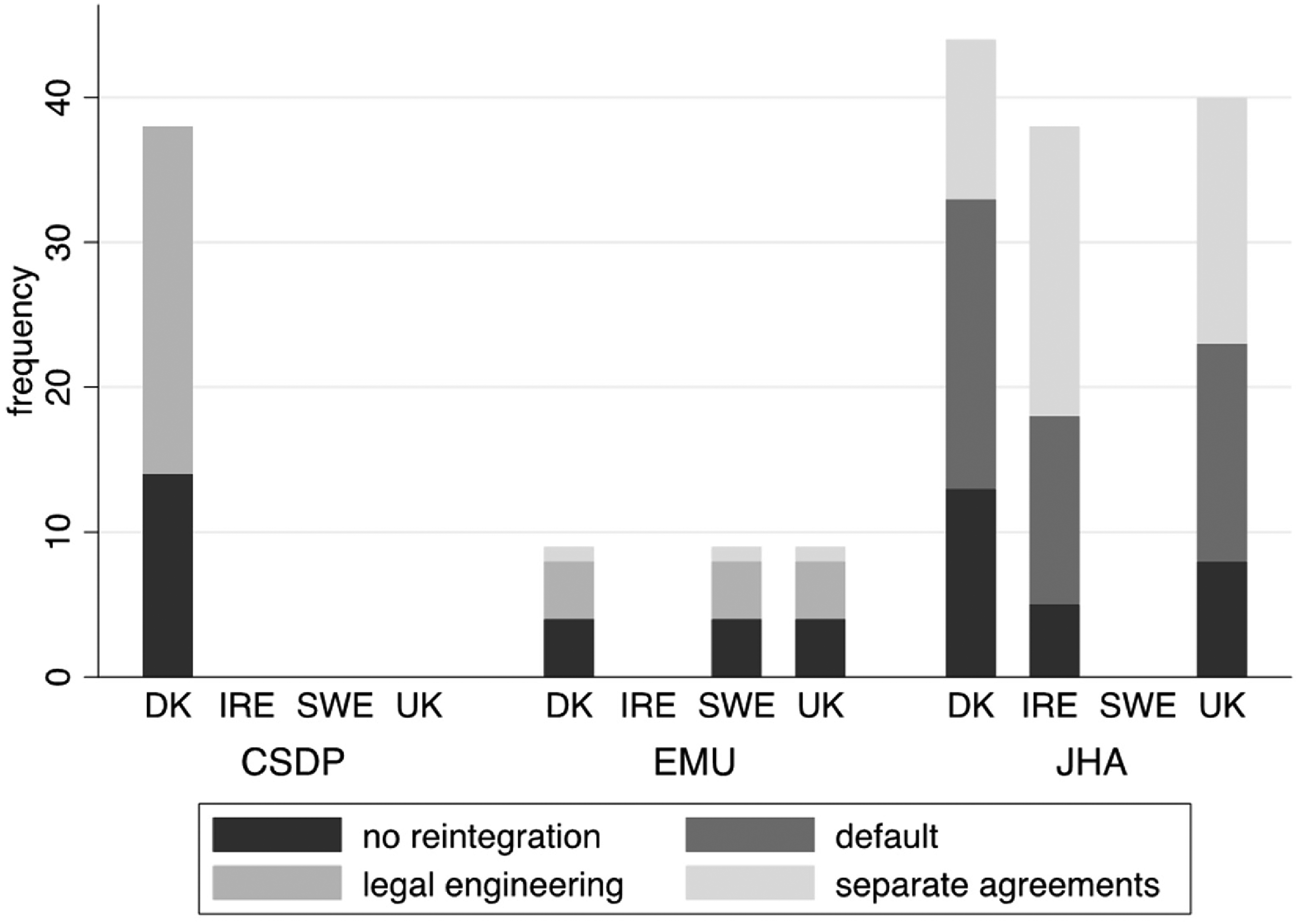
Reintegration and no reintegration by country, policy area and instrument.
Pathways to reintegration
Does our theory help to understand the incidence of reintegration reported in the previous section? The theory suggests that outsiders will seek reintegration if they face high net costs of exclusion. Whether reintegration follows, and on what terms, depends on the net costs of exclusion for the insiders. If the policy exclusion of the outs is costly for the ins, they are more likely to offer reintegration on favourable terms than if the costs of policy exclusion are low. The costs of exclusion can be functional, reflecting the density and asymmetry of interdependence between the ins and the outs, but also political. For instance, the political costs of reintegration are lower if ample opportunities for reintegration by default or by legal engineering exist The ins and outs can then collude on reintegration without leaving visible traces in the legal record. Reintegration by separate agreements is more visible, and more likely to attract political attention.
In the following section, we trace the relationship between constitutional differentiation, costs of policy exclusion and arrangements for reintegration for a diverse set of cases, involving all opt-out countries and the three major fields of core state power: Schengen/JHA, EMU and CSDP.
Reintegrating the United Kingdom into Schengen and JHA
Constitutional differentiation
The Amsterdam Treaty of 1997 greatly increased the level of integration in JHA. It incorporated the Schengen Acquis into the EC/EU Treaties (Peers, 2011) and introduced qualified majority voting for matters of asylum, immigration, external border controls and civil law (i.e. policies related to the Area of Freedom and Security and Justice, AFSJ). Only police and judicial co-operation in criminal matters remained under unanimity. The United Kingdom negotiated an opt-out from Schengen and from the AFSJ but not from cooperation in criminal matters (den Boer, 1997; Jensen and Slapin, 2012). Yet, when the Lisbon Treaty extended majority voting to these matters in 2009 (Peers, 2016), the United Kingdom asked for, and was granted, an opt-out also for this field (Protocol 21).
Costs of exclusion
The net costs of policy exclusion varied not only between the United Kingdom (the out) and the other member states (the ins) but also between Schengen and JHA, and over time.
Schengen: when the opt-out was decided in 1997, the functional costs of exclusion were generally low for both the United Kingdom and the rest of the EU (symmetric differentiation, see Table 2). Given its ‘island geography’ (Emerson, 2011), the abolition of border controls was less of an issue at the UK border than at borders in continental Europe. The undifferentiated EU rules on the free movement of persons guaranteed that neither side would be completely cut off, putting a floor under policy exclusion (Peers, 2015). The opt-out also offered political benefits to all parties. It allowed the UK government to signal its commitment to border-sovereignty, and allowed the continental European member states to move ahead with Schengen unimpeded by the UK opposition (Peers, 2015). Yet, as the Schengen states started implementing policies with positive security externalities such as the information exchange systems on asylum seekers and criminal matters, the functional costs of exclusions started to mount for the United Kingdom. Of course, the exclusion was also functionally disadvantageous for the ins. But political concerns about British cherry-picking meant that the ins remained lukewarm about reintegration. In terms of Table 2, the initial constellation of symmetric differentiation was progressively overlaid by elements of asymmetric reintegration.
JHA: the initial cost constellation in JHA was similar to Schengen. The immediate functional costs of exclusion were low for both the ins and the United Kingdom (the out) because the EU did not have a JHA policy to speak of: the United Kingdom was not missing out much, especially because it was still fully integrated into cooperation in criminal matters under unanimity decision making; the ins were happy to grant the British opt-out in order to pre-empt a possible veto against the incorporation of the Schengen Acquis into the Treaties (Best, 2002). Both sides faced the risk, however, that the functional cost of exclusion would increase as the body of AFSJ policies developed over time (Monar, 2001). The risk intensified when the Lisbon treaty extended the British opt-out to criminal matters. In terms of Table 2, the initial constellation of symmetric differentiation was overlaid by elements of symmetric reintegration.
Reintegration arrangements
The different cost incentives for reintegration into Schengen and JHA (asymmetric versus symmetric) resulted in different arrangements for reintegration.
Asymmetric reintegration into Schengen: the potential future costs of policy exclusion from Schengen were already discussed in Amsterdam. The United Kingdom was granted the option to re-join selected aspects of the Schengen Acquis, provided the Council agreed unanimously. Control over reintegration was thus distributed unevenly: the ins reserved to themselves the power to block any British rapprochement. After the Amsterdam Treaty entered into force, the British government applied for reintegration into various aspects of Schengen (Bulmer, 2008). To formalize these policy opt-ins, a Council Decision was adopted in 2000 2 , followed by an Implementing Decision in 2004. While most of the United Kingdom’s applications were granted, the Council vetoed some of them. Perhaps most importantly, it rejected the British plea to join Frontex (Dodd, 2007). According to the House of Lords, the British government wanted ‘to have the benefits of being a Schengen State without weakening the United Kingdom’s external borders’ (Harrison and Henig, 2007: 23). From the perspective of the ins this was cherry-picking. In the end, a compromise was struck which allowed the United Kingdom to participate in some Frontex activities without, however, enjoying any voting rights (Smyth, 2006).
Symmetric reintegration into JHA: the Amsterdam Treaty provided for a future British reintegration not only into Schengen but also into JHA. The arrangement was quite different, however, in that it did not grant veto power to the Council. Instead, it allowed the United Kingdom to simply re-join selected policy measures by formal notification. In practice, this gave the United Kingdom the freedom to contribute to, and benefit from, JHA as it saw fit (Peers, 2011). As our dataset shows, the United Kingdom has used this freedom to opt-into most instruments concerning asylum, illegal immigration, and civil law, but only a few policies on visas, borders, and legal migration (e.g. they opted into all funds for the former, and none in the latter). The resulting policies were complex and not always consistent.
Take the Prüm Convention, a treaty providing information exchange on fingerprints, DNA, and other information for crime-fighting purposes within the Schengen Area. The Convention was initially concluded as an international law treaty in 2005. In 2008, however, parts of it were incorporated into the JHA provisions on criminal matters in the treaty (Council Decision 2008/615/JHA – so-called Prüm Decision). When cooperation in criminal matters was moved to qualified majority voting in Lisbon in 2009, the British government made a point of returning ‘criminal justice powers, among others, from the EU to the UK’ (House of Lords, 2013). Hence, the United Kingdom left the Prüm Convention, which it had entered with the Prüm Decision just a year earlier. Once out, however, it quickly applied for readmission, and was allowed back in 2015 (House of Lords, 2015) – shortly before its final exit through the Brexit referendum.
Reintegrating Denmark, Sweden, and the United Kingdom into EMU during the European sovereign debt crisis
Constitutional differentiation
EMU has been differentiated from the start. The reasons were partly instrumental: less developed Southern and Eastern member states were kept in the anteroom until they fulfilled the Maastricht criteria of admission (Afxentiou, 2000). Yet, in important cases, the motivation was constitutional: Denmark, Sweden, and the United Kingdom could have joined EMU easily but decided against it. The United Kingdom had already obtained its opt-out at Maastricht. Denmark followed one year later (Edinburgh agreement of 1992). Sweden, by contrast, never negotiated an official opt-out, but has always remained outside (Leruth et al., 2019).
Costs of exclusion
The costs of exclusion were low for the outs. In all three countries, the government faced strong constraining dissensus at home. Denmark and Sweden held referenda on EMU membership in 2000 and 2003 respectively (Friis, 2002; Potton, 2003). Both were lost by sizeable margins. While the political establishment of all three countries was in favour of joining EMU, the functional costs of not joining were generally held to be low (cf. Schimmelfennig and Winzen, 2020). The costs for the ins were more serious. The refusal of three high-capacity member states to join EMU undermined the political credibility of the project. It also had functional disadvantages for stability and resilience. The combination of relatively low costs for the outs and relatively high costs for the ins corresponds to what we call asymmetric differentiation in Table 2.
The Eurozone crisis changed the cost calculation of the outs (Schimmelfennig and Winzen, 2023). While the solvency issues of peripheral Eurozone member states were formally irrelevant to them, factually they were highly concerning because of strong functional interdependence. The United Kingdom wanted a swift bailout of Ireland and was prepared to pay for it (Breen, 2012). As George Osborne, the chancellor of the exchequer, explained: ‘We are not part of the euro, but Ireland is our very closest economic neighbour’ (quoted in Kollewe, 2010). British small savers were particularly exposed to risk in the Irish banking market, not least because a popular saving scheme offered by the Post Office in cooperation with the Bank of Ireland had attracted 500,000 savers (Bourke, 2009). British banks also held large debt in Spain (Gocaj and Meunier, 2013). The situation in Denmark was similar. Danske Bank was strongly engaged in the Irish market. In 2010, it held more than 62.6 billion Danish Krones in Irish loans (Danske Bank, 2011). Sweden was less directly exposed but keenly interested in saving Ireland nevertheless (RTE, 2010) to prevent the spread of the crisis to the Baltics where Swedish investors were heavily engaged (Reuters, 2011). Hence, even though the outs had arguably less appetite for joining EMU than before the crisis, they had strong incentives to contribute to the financial stability of the Eurozone. Obviously, this interest was shared by the ins. Hence, the asymmetric differentiation of EMU was overlaid by symmetric incentives to join specific crisis-fighting measures of the ins (symmetric reintegration, Table 2).
Reintegration arrangements
The symmetry of the cost constellation was reflected in the symmetry of the reintegration arrangements. Denmark, Sweden, and the United Kingdom contributed to the financing of the EMU crisis-fighting in two major ways: through the European Financial Stabilisation Mechanism (EFSM) and through bilateral loans to Ireland.
EFSM: This temporary facility (in place until 2013) was funded through up to €60 billion of bonds issued by the European Commission on behalf of the EU. It constituted an integral part of the various rescue packages for the Eurozone (Alcidi et al., 2017), and contributed €22.5 billion of the €85 billion bailout package to Ireland (Breen, 2012). As the EFSM was guaranteed through the EU budget, the outs faced the same liability as the ins (Thompson, 2011). Nevertheless, the EFSM (Council Regulation (EU) No 407/2010) was agreed upon on the first reading as an ‘Item A’ (an uncontroversial item) on an undifferentiated treaty basis (Art. 122 TFEU) by the Council for Education, Youth and Culture without any substantive expertise in the matter 3 .
Bilateral loans: on top of their EFSM contributions, the three outs offered bilateral loans to Ireland (Breen, 2012). The Loans to Ireland Act of 2010 authorized a British contribution of €3.8 billion to the bail-out scheme (Parliament UK, 2010). Denmark chipped in with €400 million. Sweden contributed €600 million in addition to its bilateral loans to Latvia and Iceland (Reuters, 2011). Given the level of emergency, the ins had no objections to the contributions of the outs (Hume, 2010).
Reintegrating Denmark into the European Defence Fund
Differentiated integration
The Edinburgh Agreement of 1992 granted Denmark a full opt-out from activities with ‘defence implications’ including EU-military missions, the European Defence Agency or the Athena financing mechanism. Given that defence issues generally fall under the unanimity rule, the comprehensive Danish opt-out was quite remarkable.
Costs of exclusion
In 1992, the priority of both, Denmark and the rest of the EU was the ratification of the Maastricht treaty. This required a Danish opt-out from defence in order to appease the broad public opposition that had led to the rejection of the Treaty referendum earlier that year (Cramer and Franke, 2021; Worre, 1995). 4 The functional costs of exclusion were low for both sides. NATO provided a convenient alternative venue for organizing military cooperation between Denmark and other EU member states (Bailes et al., 2006; Euractiv, 2018). Also, the military opt-out did not prevent Denmark from actively participating in the so-called civilian missions (Danish Ministry of Foreign Affairs, 2019; Jakobsen, 2009). In short, differentiation was symmetric: no great harm for either side.
The situation changed when the Juncker Commission pushed for – and the member states agreed to – the creation of an EDF (Juncker, 2016). The purpose of the EDF is to strengthen competitiveness and technical innovation in the European defence industry through joint European funds for research and development (Haroche, 2020; Hoeffler, 2023). The exclusion would have been painful for Denmark’s defence industry because NATO did not provide similar funds (Danish Ministry of Defence, 2019). The ins had no incentive to exclude Denmark. Danish participation could only strengthen the project.
Reintegration arrangements
The symmetry of interests facilitated the partial reintegration of Denmark by legal engineering. The EDF was based on the ‘conditions necessary for the competitiveness of the Union's industry’ (Article 173 TFEU) rather than the CSDP provisions of the TEU. This was politically convenient but legally tricky. The TEU (Article 41.2) explicitly prohibits the use of the EU budget for ‘expenditure arising from operations having military or defence implications’. Yet, the EDF is funded through the Security and Defence section of the EU’s Multiannual Financial Framework (MFF, 2021-2027) (Rynning, 2020: 5). While the Danish government was happy about its inclusion in the EDF, it took its lawyers more than six months to clarify whether its participation was actually legal (Nissen, 2020). Also, the legal service of the European Commission was doubtful about the legality of the EDF’s treaty base (Haroche, 2020: 862). Denmark’s inclusion in the EDF was a constant source of confusion, as it seemed to blatantly contradict Denmark’s opt-out from defence-related activities.
Case comparison
Our case study findings are broadly in line with our theory: the costs of exclusion predict whether the outs will seek reintegration and on what terms the ins will agree to it (Table 3).
Costs of exclusion and incentives for reintegration at the time of constitutional opt-out (T1) and later (T2).
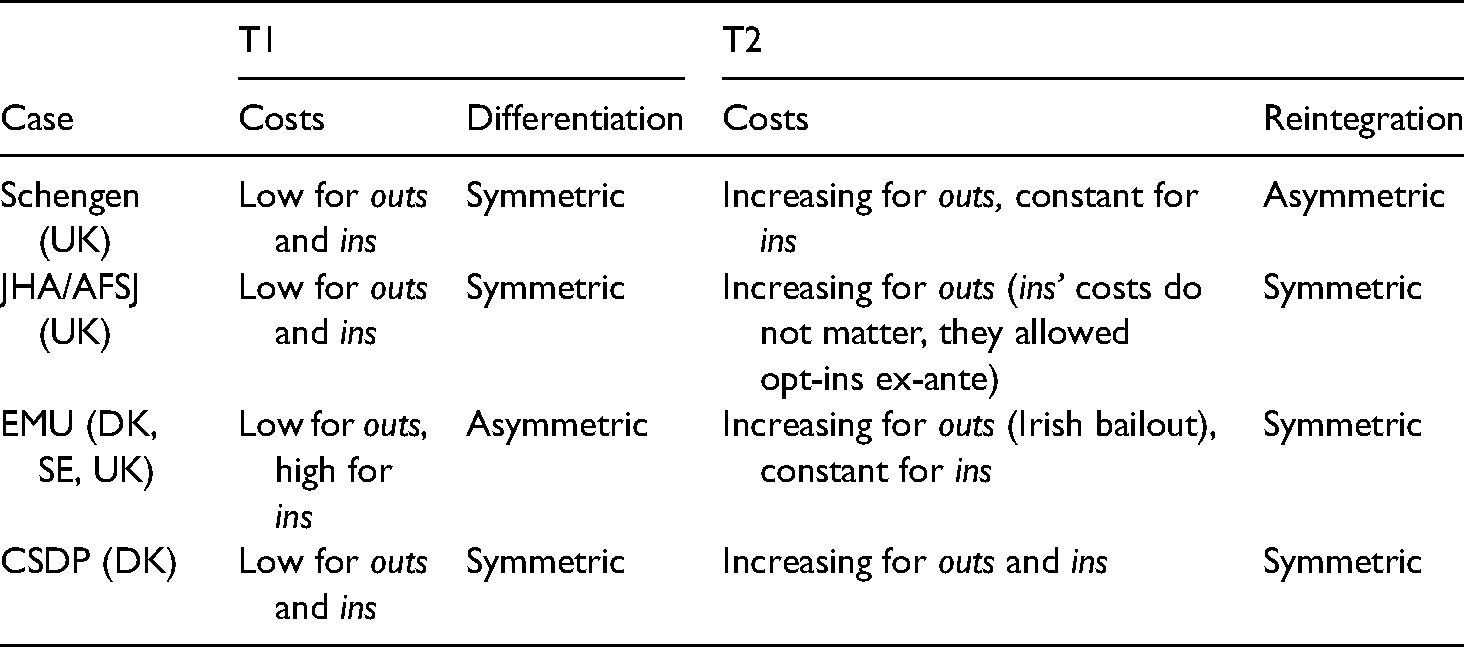
The case studies yield two additional findings that may warrant closer inspection. First, the process of reintegration is driven by the outs. If the outs want reintegration, the ins usually accept it. We didn’t find a single case where the ins flatly denied a request for reintegration. In the case of Frontex, Britain was refused reintegration on equal terms with the ins. Yet, it was reintegrated. In other areas, including parts of JHA, the outs were given almost complete freedom to decide on reintegration unilaterally with no interference by the ins. Arguably, the pliability of the ins reflects the strong norm of non-discrimination baked into the constitutional construction of the EU: no member state that wants to participate in common policies should be kept out. ‘Second-class membership’ (Bellamy, 2019; Schimmelfennig et al., 2023) is not acceptable 5 . This allows the outs to make copious use of reintegration opportunities. See Figures 1–3 usually with little resistance from the ins.
Second, policy exclusion seems to prevail only where it does not matter for the outs because the costs of exclusion are low. Interestingly, the case studies suggest that the exclusion costs are often also low for the ins. EMU is the only obvious case of asymmetric differentiation, that is a case in which the ins suffer from the non-participation of the outs. It is also the only case of strict policy exclusion: countries either use the Euro or have their national currencies but not a mix of both. Given its substantive importance, EMU has attracted considerable attention in the literature on differentiated integration. Yet, the case studies cast doubt on the assumption that it constitutes a paradigmatic case of differentiation. The strictly binary choice of the national currency is clearly unique and distinguishes the EMU from other policy fields offering more graduated choices, and, hence, more options for selective reintegration. Where EMU-choices are not strictly binary, for instance in bail-out programs for EMU member states, reintegration happens as in other policy fields. This is borne out not only by the participation of outs in the Irish bailout of the 2010s but also, more dramatically, by the complete marginalization of the (differentiated) ESM by the (uniform) Support to mitigate Unemployment Risks in an Emergency and the Next Generation EU programs during the COVID-19 crisis (De Witte, 2021: 679; see also Fromage, 2020).
Slightly pregnant all the time
European Commission Vice President Frans Timmermans wanted to be abundantly clear with his Danish audience: ‘You can’t be slightly pregnant, you’re either pregnant or you’re not. If you vote to be out of Europol, you’re out of Europol. I don’t see on the basis of the legal situation any alternative for that’ (quoted in Reuters, 2016). In 2015, Denmark had decided after a popular referendum to reject a flexible opt-in/opt-out arrangement to JHA, similar to the one enjoyed by the United Kingdom. This implied, inter alia, a loss of membership in Europol (Sørensen, 2015). How could anyone expect that Denmark would be allowed back into Europol just one year later? Yet in spring 2017, only a few months after Timmermanns’ intervention, Europol and Denmark signed a bilateral ‘Agreement on Operational and Strategic Cooperation’ which readmitted Denmark for most practical intents and purposes if only without full rights and privileges.
Europol is not a special case. As we have demonstrated in this article, constitutional opt-outs often bring policy reintegration in their wake: the outs remain involved in the policies of the ins if only by more byzantine and less transparent arrangements – by default, by legal engineering or by a separate agreement. To a large extent, constitutional differentiation is symbolic politics, suggesting more and stricter policy exclusion than it actually entails. This has important implications for positive and normative theories of differentiated integration.
First, our findings warn against a purely legalistic approach to studying constitutional differentiation. To be sure, opt-outs are a legal phenomenon. They cannot be studied without data on primary and secondary law (Schimmelfennig and Winzen, 2020). However, the practice of differentiation is often shaped by reintegration arrangements that have a light legal footprint, but effectively reduce the exclusionary effect of opt-outs. Ignoring these arrangements biases research towards overrating policy exclusion and underestimating the symbolic dimension of constitutional differentiation.
Second, our findings warn against treating functionalism (Moravcsik, 2018; Sandholtz and Stone Sweet, 2012) and post-functionalism (Hooghe et al., 2019) as competing theories of integration. Rather than supporting one theory over the other, they suggest that both matter for differentiated integration – but in different ways. When issue salience is high, and anti-EU mobilization is strong, governments cannot simply ignore the mass politics of sovereignty and identity; they will seek a constitutional opt-out to avoid electoral punishment or the loss of a referendum. When the costs of exclusion are high, by contrast, governments will look for inconspicuous ways of reintegration; they will seek modes of policy participation that allow for cooperation with the ins short of a formal repeal of the opt-out. Often, the political and functional challenges emerge in sequence: first high salience and politicization lead to a formal opt-out, then growing functional incentives for policy participation lead to reintegration by separate agreement or legal engineering. Sometimes, however, pressures for differentiation and incentives for reintegration are present simultaneously. Governments will then try to mitigate the trade-off by combining a formal opt-out with reintegration by default. The high visibility of the opt-out and the low visibility of reintegration help to hide the inconsistency between the two. In short, neither does a political backlash lead to clear-cut differentiation and disintegration as post-functional theories seem to suggest, nor do issue-specific functional incentives for integration dominate the policy process as functional theories imply. Rather, functional and post-functional factors interact in peculiar ways to produce specific mixes of constitutional differentiation and reintegration by stealth.
Finally, the symbolic politics of differentiation reflect a normative dilemma of European democracy. On one hand, it fuels organized hypocrisy of formal out and informal in, which can easily be denounced as contradicting the will of the people. For instance, the 2015 referendum increased the perceived legitimacy of the EU in Denmark (Schraff and Schimmelfennig, 2020). But this was perhaps not because the voters wanted their country to leave Europol and then re-enter it on worse terms than before. More likely it was because they thought they had achieved more policy exclusion than they actually received. On the other hand, popular decisions for constitutional differentiation are not always based on an enlightened understanding of the policy issues involved (Dahl, 1989). It is unlikely, for instance, that British or Danish savers supported the opt-out of their countries from EMU because they wanted to put their investments in Ireland and other Eurozone countries at risk. More likely they simply did not know that this could be one of the consequences. The organized hypocrisy of symbolic differentiation can mitigate the dysfunctional consequences of ill-informed decisions: It sacrifices input legitimacy to maintain output legitimacy.
In any event, organized hypocrisy is vulnerable to scandalization, politicization and functional failure. It is a fragile state of affairs. Political elites prefer to avoid it if they can. If incentives for policy reintegration are strong and an opportunity for reversing the formal opt-out presents itself, they will use it. The 2022 Danish referendum on ending their defense and security opt-out is testimony to that.
Supplemental Material
sj-docx-1-eup-10.1177_14651165221128291 - Supplemental material for Differentiated integration as symbolic politics? Constitutional differentiation and policy reintegration in core state powers
Supplemental material, sj-docx-1-eup-10.1177_14651165221128291 for Differentiated integration as symbolic politics? Constitutional differentiation and policy reintegration in core state powers by Philipp Genschel, Markus Jachtenfuchs and Marta Migliorati in European Union Politics
Supplemental Material
sj-do-2-eup-10.1177_14651165221128291 - Supplemental material for Differentiated integration as symbolic politics? Constitutional differentiation and policy reintegration in core state powers
Supplemental material, sj-do-2-eup-10.1177_14651165221128291 for Differentiated integration as symbolic politics? Constitutional differentiation and policy reintegration in core state powers by Philipp Genschel, Markus Jachtenfuchs and Marta Migliorati in European Union Politics
Supplemental Material
sj-dta-3-eup-10.1177_14651165221128291 - Supplemental material for Differentiated integration as symbolic politics? Constitutional differentiation and policy reintegration in core state powers
Supplemental material, sj-dta-3-eup-10.1177_14651165221128291 for Differentiated integration as symbolic politics? Constitutional differentiation and policy reintegration in core state powers by Philipp Genschel, Markus Jachtenfuchs and Marta Migliorati in European Union Politics
Footnotes
Acknowledgements
The authors would like to thank the audiences at the Hertie School and at ECPR as well as two anonymous reviewers and the editors for their comments. We are grateful to Franziska Loschert, Lewis Miller, Yaning Zhang, Etienne Höra and Christoffer Branzén for research assistance as well as to Frank Schimmelfennig and Thomas Winzen for providing us with the EUDIFF datasets.
Funding
The author(s) disclosed receipt of the following financial support for the research, authorship, and/or publication of this article. This work was supported by the Horizon 2020 Framework Programme (grant number 822304).

Supplemental Material
Supplemental material for this article is available online.
Notes
References
Supplementary Material
Please find the following supplemental material available below.
For Open Access articles published under a Creative Commons License, all supplemental material carries the same license as the article it is associated with.
For non-Open Access articles published, all supplemental material carries a non-exclusive license, and permission requests for re-use of supplemental material or any part of supplemental material shall be sent directly to the copyright owner as specified in the copyright notice associated with the article.
