




Abstract
How far and under what conditions may experimentalist governance be an efficient and legitimate means of responding to diversity among EU member states, in comparison to both conventional uniform regulation and differentiated integration? By comparing two major domains where the challenge of integrating national diversity has arisen prominently, electricity and banking, we find that under conditions of high interdependence and high uncertainty, diachronic experimentalism may be a necessary condition for synchronic uniformity. Uniform rules can be accepted as efficient and legitimate by member states, provided that they are regularly revised based on implementation experience through deliberative review processes in which national officials themselves participate. Our findings on EU banking regulation further suggest that experimentalist governance and differentiated integration may also be complementary, but asymmetrically so, in that the latter depends on the former to accommodate diversity within and across member states, but not vice versa.
Keywords
Introduction: Alternative approaches to integrating diversity within the European Union
How can advances in European integration be reconciled with diversity among member states? Rightly or wrongly, European Union (EU or Union) regulation has acquired an increasingly contested reputation, at least within the Union itself, where the ‘Brussels rule factory’ has become a term of abuse even among committed supporters of the European project. This contested reputation is partly due to the perceived technocratic character of EU rule making, and its perceived distance from national parliaments and citizens. It is likewise partly due to the politically contested character of EU rules, which may involve value conflicts and distributive consequences for member states, firms, and taxpayers. But it is also due in no small measure to concerns about misfits between one-size-fits-all, centrally imposed uniform regulation (UR) and heterogeneity of socio-economic conditions, institutional structures, and policy preferences in an increasingly diverse Union of 27 member states (Matthijs et al., 2019).
One widely canvassed solution to this dilemma is differentiated integration (DI). Its underlying assumption is that deeper integration of markets and societies within the EU requires uniform, centrally determined rules, which some member states may be unwilling or unable to accept, at least initially. Where other member states wish nonetheless to push ahead, the result is DI: policies and rules that apply only to some member states (internal DI), as well as in some cases to certain non-member states (external DI). Recent research has shown that most such internal DI is temporary, resulting from transitional exemptions from EU rules in accession agreements or secondary legislation, which are eventually scheduled to expire (‘multi-speed’ integration). However, other forms of internal DI are more durable, especially where they reflect ‘constitutional’ reservations among some member states about the integration of the so-called ‘core state powers’, in fields such as foreign and defense, interior and justice, or monetary policies. Among the best-known and most visible forms of such durable ‘multi-tier’ integration are the Eurozone and the Schengen Area (Schimmelfennig and Winzen, 2020; Schimmelfennig et al., 2023). 1
Recent literature has identified several scope conditions for such enduring DI. Beyond the heterogeneity of national preferences, variations in political salience are crucial to understanding why some member states choose to opt out from further integration in specific policy fields, while others forge ahead. So too is the degree of mutual interdependence, which must be sufficient to motivate closer integration among the vanguard, but not so high as to create externalities (whether negative or positive) that outweigh the expected benefits of DI. Another crucial scope condition is modularity: The key policy choice must be reducible to a binary option, which member states can choose to embrace or reject. Enduring, multi-tier DI thus appears most likely under conditions of heterogeneous preferences, high but asymmetrical politicization, moderate interdependence, and high modularity (Schimmelfennig and Winzen, 2020; Schimmelfennig et al., 2015; Schimmelfennig et al., 2023).
DI, defined in these ways, offers both advantages and disadvantages for European integration (Schimmelfennig et al., 2023). On the positive side, DI may allow a closer match between EU policies and rules as well as member state preferences and conditions. Hence, it allows greater self-determination for national demoi within the Union and may help to blunt Euroscepticism and secessionist movements, such as Brexit. DI may also help to avoid suboptimal, lowest common denominator solutions at the EU level by permitting national opt-outs or closer cooperation among avant-garde member states (Bellamy and Kröger, 2017; De Vries, 2018; Schimmelfennig and Winzen, 2020; Schimmelfennig et al., 2023). However, on the negative side, DI could also divide member states and EU citizens into separate and unequal groups. It may also fail to address (unanticipated) externalities resulting from national policies and functional spillovers between interdependent policy fields (Schimmelfennig and Winzen, 2020; Schimmelfennig et al., 2023). Finally, where DI becomes durably entrenched, it may fragment the European market and create opportunities for regulatory arbitrage by transnational firms (Howarth and Quaglia, 2020).
Yet, DI is not the only available approach to accommodating diversity within the EU. A growing body of research has shown that in many key policy domains, EU governance is not characterized by top-down imposition of rigid UR, but rather by an experimentalist architecture of provisional goal setting and revision, based on recursive learning from a comparative review of implementation in different local contexts (Sabel and Zeitlin, 2008, 2010; Zeitlin, 2015, 2016). In this iterative, multilevel architecture, the EU institutions and the member states, typically following consultation with relevant stakeholders, jointly establish framework goals, rules, and metrics for assessing their achievement. ‘Lower-level’ units (such as national administrations and regulatory authorities) are given substantial discretion to pursue these goals in ways adapted to their local contexts. In return for this autonomy, they must report regularly on their performance and participate in a peer review in which their results are compared to those of others following different means toward the same ends. Where member states are not making good progress, they are expected to take corrective measures, based on a plausible plan for improvement informed by the experience of their peers. The goals, rules, metrics, and decision-making procedures are then periodically revised in response to the problems and possibilities revealed by the review process, and the cycle repeats. Figure 1 offers a diagrammatic representation of this experimentalist architecture as an iterative multilevel cycle.
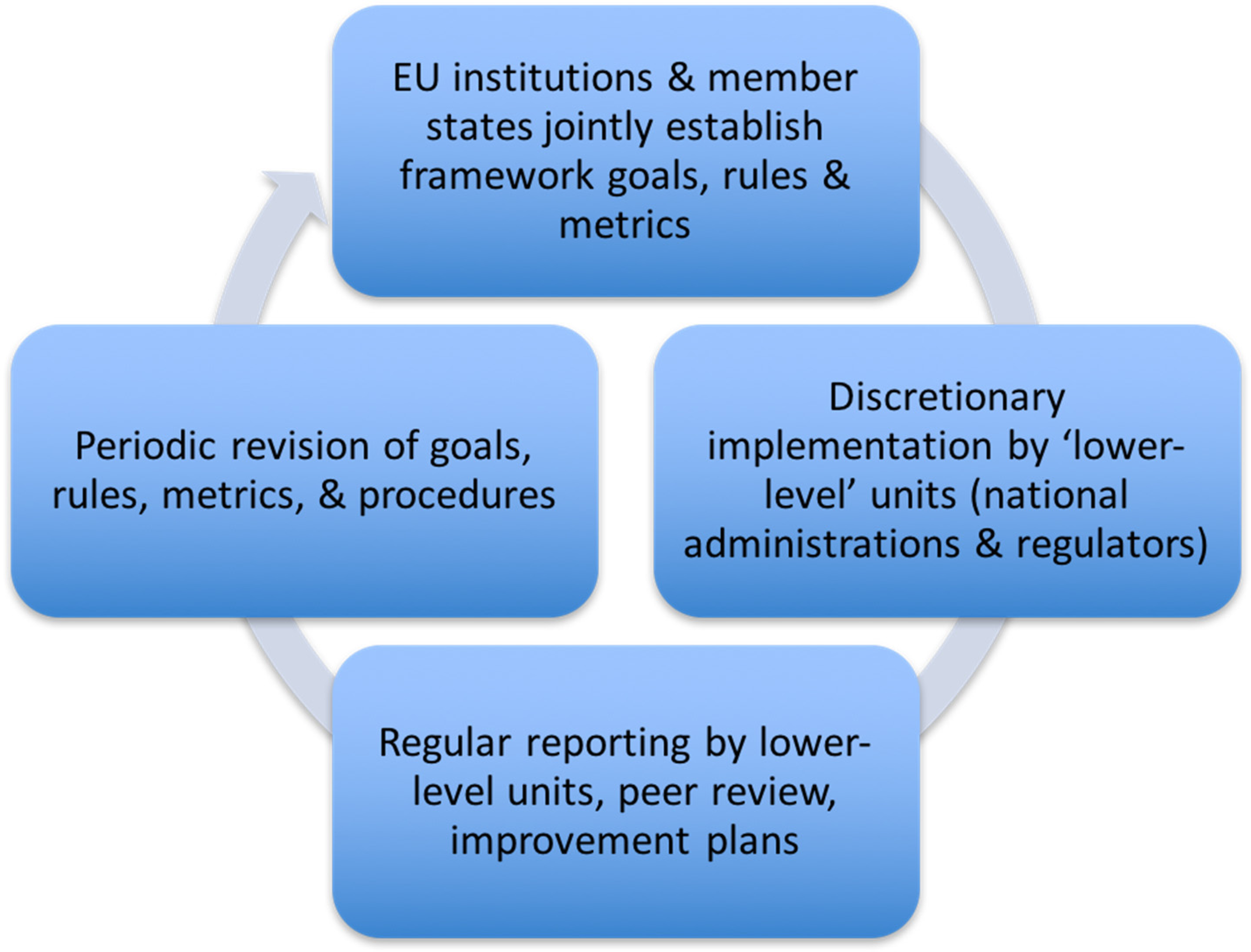
EU experimentalist governance (XG) as an iterative, multilevel architecture.
Like DI, experimentalist governance (XG) in this form also depends on several scope conditions. The first is strategic uncertainty, where policymakers cannot define their precise goals or the best way to achieve them ex ante, but must instead discover both in the course of problem-solving because they are operating in a turbulent, rapidly changing environment. A second is a polyarchic or multipolar distribution of power, in which no single dominant actor is able to impose its own preferred solution without taking into account the views of others. A final scope condition concerns interdependence, which must be sufficient to motivate actors to collaborate in seeking joint solutions to common problems, but not so high as to preclude decentralized experimentation by local units (Rangoni and Zeitlin, 2021: 823–4; Sabel and Zeitlin, 2012: 174–5).
Where these scope conditions are met, XG architectures have several fundamental advantages in terms of efficiency and legitimacy, relative both to conventional UR and to DI. First, they accommodate diversity by adapting common goals and rules to varied local contexts, rather than seeking to impose one-size-fits-all solutions or dividing member states into separate groups of ‘Ins’ and ‘Outs’. Second, they provide a mechanism for coordinated learning from local experimentation through disciplined comparison of different approaches to achieving the same goals, which can be used to generate new policy solutions and regulatory frameworks that may then be applied in contextually specific ways across the Union as a whole. Third, the same processes of mutual monitoring, peer review, and joint evaluation that support learning from diverse experience also provide dynamic, non-hierarchical mechanisms for holding both central and lower-level actors accountable for their actions in pursuit of agreed goals. Finally, because both the goals and the means for achieving them are explicitly conceived as provisional and subject to revision in light of experience, problems identified in one phase of implementation can be corrected in the next iteration.
Although XG architectures of this type are neither universal nor ubiquitous in the EU, they are widely diffused across a variety of policy domains. Well-documented examples include regulation of competition, energy, telecommunications, and finance; food, drug, chemicals, and maritime safety; environmental protection; employment promotion and social inclusion; justice and home affairs; data privacy, anti-discrimination, and fundamental rights (Sabel and Zeitlin, 2008, 2010). These architectures also play a growing role in EU external governance, where the revisable framework rules they generate are frequently extended to third-country actors (Zeitlin, 2015). A typical pattern in recent years has been the progressive formalization of EU regulatory networks, without full supranational centralization. In some sectors, under conditions of high interdependence coupled with high uncertainty, concern for the integrity of integrated markets has led to the creation of a single set of harmonized but provisional rules, revisable through ongoing monitoring and review of implementation experience, as for example in chemicals regulation. These developments in turn raise the possibility, which we will explore further in this article, of the emergence in such cases of simplified XG architectures, combining synchronic uniformity with diachronic revisability (Rangoni and Zeitlin, 2021; Zeitlin, 2016).
In the introduction to this special issue, Schimmelfennig et al. (2023: 8, 11) define efficiency in terms of the match between member state preferences and gains from integration, expecting that DI: ‘(a) facilitates agreement in the EU; (b) shortens decision-making time; (c) increases the depth of integration; (d) improves the implementation of EU policies’. They also define legitimacy in terms of social acceptance of EU policies and the EU itself among EU actors and citizens. Building on these definitions, we address the following question: How far and under what conditions may XG represent an efficient and legitimate mean of responding to diversity of preferences and conditions among EU member states, in comparison to both DI and conventional UR? The next section briefly outlines and motivates our research strategy, including the case selection and methods employed.
Cases and methods
Drawing on new empirical research, the article tackles this question through a comparative analysis of EU regulatory governance in two major policy domains: electricity and banking. Although there are significant differences between these domains on various dimensions, 2 in each of them, the challenge of how to accommodate national diversity in EU policy-making has emerged prominently. High levels of strategic uncertainty, associated with rapidly changing markets and technologies characterize the electricity and banking domains (positive scope condition for XG). Each domain belongs to the internal market, where interdependence and the resulting demand for uniform rules are strong (negative scope condition for both DI and XG in its classic form; positive for UR). Each is likewise politically salient and controversial to varying degrees across member states (positive scope condition for DI). In short, key features of both policy domains make expectations of each of the three governance models theoretically plausible. Therefore, the comparison between these domains offers valuable analytical leverage in responding to the core research question about the relationship between XG, UR, and DI in the integration of diversity within the EU, as well as their efficiency and legitimacy. In this article, following the definitions by Schimmelfennig et al. (2023), we focus particularly on how far XG, in comparison to DI and conventional UR, enhances the match between EU policies and member state preferences, facilitates policy agreement, increases the depth of integration, improves policy implementation, and is accepted by national as well as EU policy actors and stakeholders. 3
Our study follows a comparative process-tracing approach, which combines a wide range of expert interviews with European and national policy actors with an extensive review of official documents and literature. The goal is to reconstruct the evolution of EU regulatory governance in each domain, assess the balance between XG, UR, and DI within and between such domains, and draw out broader implications for efficiency and legitimacy. 4 As the recent methodological literature (Beach and Pedersen, 2013; Bennett and Checkel, 2015) has argued, process tracing allows not only to evaluate the empirical fit of observable regulatory approaches in these domains with different governance models (XG, DI, UR) but also to uncover their causal relationship to the theoretical scope conditions postulated for each model.
In the remainder of this paper, we briefly present the key findings in each domain, focusing on the incidence of XG relative to UR and DI, both in formal institutional structures and in organizational practices. The final section draws some comparative conclusions from the cases about the extent to which we may in fact consider XG an efficient and legitimate alternative—or complement—to both UR and DI.
Electricity: Uniform rules made and revised experimentally
The need to keep electricity demand and supply in balance at all times (due to the currently very limited storage possibilities), the fact that electricity follows the ‘laws of physics’ rather than political boundaries, and the risk of negative externalities and cascading effects make this an especially interdependent sector (Dillon and Wright, 2005; Roe and Schulman, 2008). Such interdependence has only grown over time, as European markets have become more interconnected and unscheduled flows of electricity from renewable sources have increased. If the familiar need to avoid regulatory arbitrage and foster a ‘level playing field’ in the European internal market already calls for uniform rules across countries, the high interdependencies of electricity make such a demand particularly strong. Yet, electricity is no exception to the diversity of preferences, institutional structures, and socio-economic conditions at the heart of Europe. As part of the broader energy domain, it is also politically sensitive and subject to high-profile regulatory conflicts, at both national and European levels. Historically, member states jealously guarded their sovereignty over what they considered a strategic sector, and sought to protect ‘national champion’ firms from foreign competition and takeovers. Today, political debates over fuel mix, nuclear power, renewable energy, and the fight against climate change remain highly salient (Hancher, 1997; Solorio and Jörgens, 2020), with the worldwide energy price crisis offering yet another demonstration of the politically sensitive nature of electricity. In addition, electricity is also a complex and rapidly changing sector, characterized by high levels of uncertainty about the future development of markets, technologies, and consumer behavior. Within the EU, the challenges of managing interconnected cross-national power grids on a continental scale have raised a series of regulatory and operational problems to which no solution was available in advance (Eberlein, 2008; Rangoni and Zeitlin, 2021).
Our research on EU electricity regulation examined the relationship between uniform, differentiated, and experimentalist governance across five key policy issues. These include, first, the conditions and, second, the tariffs for using cross-border electricity networks, as both are essential to promote market competition and integration. Indeed, along with natural gas, electronic communications, rail transport, and water, electricity is considered a ‘network industry’, characterized by naturally monopolistic infrastructures that are economically inefficient to duplicate. Under these conditions, the possibility for new players to compete on the market depends on non-discriminatory access and pricing for using networks, which publicly owned incumbents typically control. However, since electricity regulation extends beyond ‘market rules’ such as network access and pricing, the third issue examined concerns ‘operational rules’, that is, regional security coordination of electricity flows on high-voltage networks. Although such coordination has a long history (e.g., to avoid blackouts), its importance has grown in recent years as European electricity markets have become more interdependent, and shares of renewables have risen. Fourth, we examined the regulation of market manipulation based on insider trading, the major additional task—at the crossroads between energy and financial regulation—that was entrusted in 2011 to the newly formed EU Agency for the Cooperation of Energy Regulators (ACER) and its constituent national authorities. Fifth, in collaboration with the European Commission and the European Network of Transmission System Operators (ENTSO), ACER's foundational task is to produce and revise guidelines and network codes for a series of substantive areas, which together constitute the EU ‘rulebook’ for governing cross-border electricity trade. 5
Table 1 summarizes our findings about UR, DI and XG in EU electricity regulation across these five issues on three dimensions that are relevant to the three governance models considered: the uniformity or differentiation of the rules (i.e., UR or DI), their detailed or framework character (the latter being typical of XG in its classic form), and the processes through which they have been developed and revised (experimentalist or hierarchical). The results are strikingly consistent. Across all five policy issues there is virtually no evidence of DI while on the contrary the rules generally apply uniformly to all member states (with a partial, temporary exception in network tarification). Furthermore, on all issues (with the partial exception of regional security coordination) these uniform rules are rather detailed, and have become progressively more so. Thus, the ‘depth of integration’ has increased. However, at the same time, the rules always leave some discretionary room for local adaptation, whether explicitly or implicitly, which helps their legitimacy among national actors. Finally, in each of these subcases, the uniform and increasingly detailed rules have not been developed and imposed by EU institutions, i.e., through the hierarchical processes normally associated with such rules. Surprisingly, polyarchic networks of EU and national stakeholders have defined and revised these rules through experimentalist comparisons of different local implementation experiences, which has aided both legitimacy, often thanks to voluntary and always reversible choices, and efficiency, facilitating agreement as well as improvement of rules based on implementation reviews.
Rules and processes in EU electricity regulation: Comparative findings.
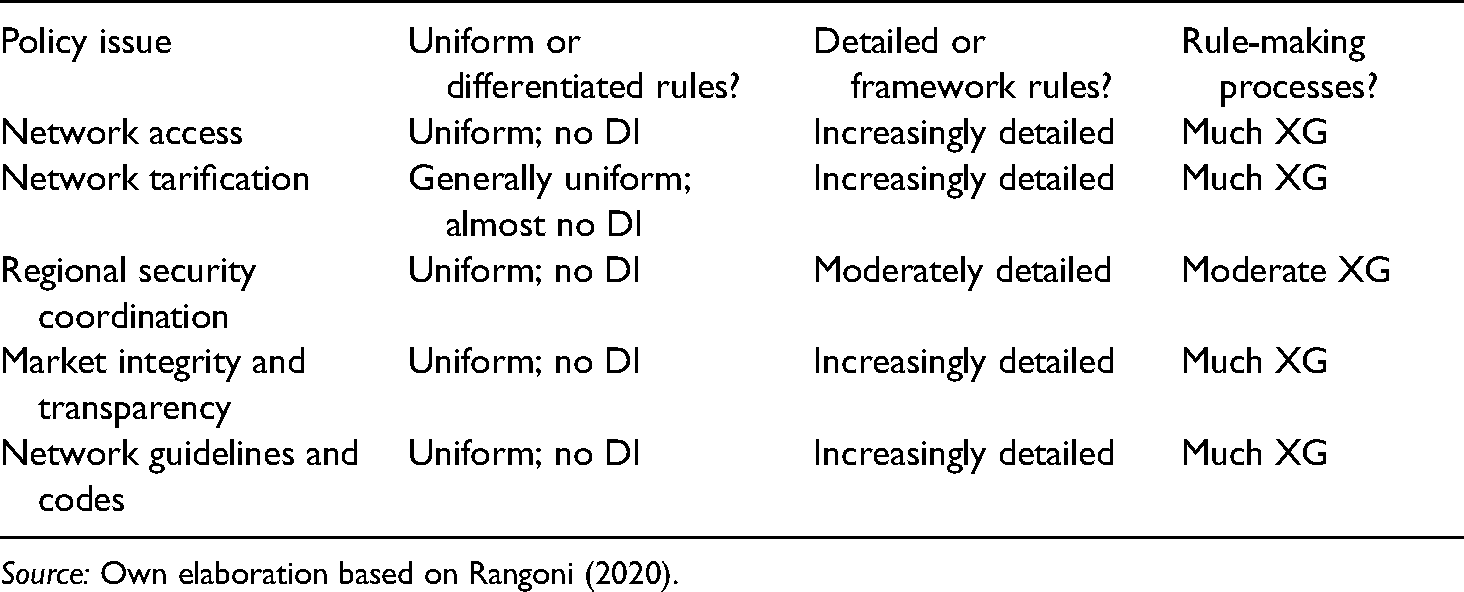
Source: Own elaboration based on Rangoni (2020).
A first key finding is that across all the policy issues analyzed, rules have generally been uniform rather than differentiated. For any given issue, EU rules apply homogeneously to all member states, instead of dividing them into groups of ‘Ins’ and ‘Outs’, as in DI. No matter whether one looks at network access, network pricing, regional security coordination, market integrity and transparency, or network guidelines and codes, their EU regulation applies in the same manner to all countries. Moreover, such formal uniformity has remained constant over time. To illustrate with two examples, EU rules on network access and tarification initially established that rights to transport electricity over cross-border networks should be allocated and priced to market players in a non-discriminatory manner [1]. Thereafter, EU rules mandated on the one hand market-based auctions, and on the other the abolition of transit fees and the compensation of Transmission System Operators (TSOs) for the costs incurred to host cross-border energy flows on their networks [2]. More recently, EU rules on network access have imposed ‘implicit auctions’ based on ‘price coupling’, and EU institutions have recommended that inter-TSO compensation should focus on existing infrastructures and that network charges levied on generators should be set to zero [3]. What is striking therefore is that, aside from a temporary exception concerning only one aspect of network tarification [4], at each moment in time, in both subcases the same set of EU rules applied across all member states (ACER 2013, 2014: 1-2; Commission Regulation (EU) No 838/2010: Annex Part B; Commission Regulation (EU) 2015/1222: recs. 13, 18; Directive 96/92/EC: ch. VII; Rangoni, 2020: 14–15, 16–19; Regulation (EC) No 1228/2003: arts. 3-4, 6, Annex). The other subcases, too, exhibit such striving for uniformity [5].
A second key finding is that across most of the issues analyzed, these uniform rules have been quite detailed and indeed progressively so. To continue with the previous examples, as anticipated, EU regulation of network access at first only mandated the very generic solution that this should be non-discriminatory (Directive 96/92/EC: ch. VII). Afterward it was clarified that such non-discriminatory network access should be granted based on auctions (Regulation (EC) No 1228/2003: art. 6, Annex). Years later, this uniform solution became even more specific, mandating that such auctions should be of a certain type, namely ‘implicit’, and should be implemented through a specific arrangement, known as ‘price coupling’ (Commission Regulation (EU) 2015/1222: recs. 13, 18). Similarly, EU regulation of network tarification initially only established the general requirement that this be non-discriminatory (Directive 96/92/EC: ch. VII). A few years later, it was specified that transit fees ought to be eliminated, TSOs compensated for the costs resulting from hosting of electricity, and network charges levied on generators comprised within a given range (Commission Regulation (EU) No 838/2010: Annex Part B; Regulation (EC) No 1228/2003: arts. 3-4). More recently, recommendations have further specified that the inter-TSO compensation should be limited to existing infrastructures, and that network charges levied on generators be set directly to zero (ACER, 2013, 2014). But the progressive specification of harmonized rules is perhaps at its clearest when one looks at network guidelines and codes governing all cross-border electricity exchanges. Not only are these hundreds-of-pages-long rules impressive, when compared with the ten-page-long initial EU rules (e.g., cf. Commission Regulation (EU) 2015/1222 with Directive 96/92/EC). They have led to the establishment of ever more detailed rules and procedures called ‘terms and conditions or methodologies’, which constitute the latest generation of EU energy rules and bring their detail to unprecedented levels. In short, while rules have always been uniform (the first key finding), the level of detail or scope of harmonization has been growing over time [6]. In the terminology of Schimmelfennig et al. (2023), the depth of integration has clearly increased.
Yet, our research also reveals that no matter how detailed and uniform EU rules may be, they always leave some discretionary space for local contextualization, either explicitly or implicitly (or both). This is not only the case for the ‘moderately detailed’ rules on regional security coordination, which leave TSOs discretion over whether or not to follow the remedial action recommended by the relevant Regional Coordination Centre (RCC), when a potential operational security is diagnosed (Rangoni, 2020: 20–21; see also Regulation 2019/943: art. 35.5). Equally, whereas the very first set of EU rules mandated that network access should be non-discriminatory, they did not clarify how this should be achieved (Directive 96/92/EC); discretion did not end with the commonly broad, initial directives. The next set of EU rules mandated the use of market-based auctions, but allowed the use of two types of auctions, ‘explicit’ and ‘implicit’ (Regulation (EC) No 1228/2003: Annex). Most recently, EU rules clarified that implicit auctions based on ‘price coupling’ should be used, but they have also tasked actors to define the terms and conditions or methodologies under which such arrangements should be implemented (Commission Regulation (EU) 2015/1222: rec. 30, art. 9). Similarly, in the case of network tarification, initial EU rules established the principle of non-discrimination, yet left member states free to choose between a ‘regulated’ and a ‘negotiated’ approach domestically (Directive 96/92/EC: ch. VII). The next generation of rules set up a common tarification approach, which included an Inter-TSO Compensation (ITC) mechanism and largely harmonized charges for generators, which however explicitly allowed discretion within a certain range (Commission Regulation (EU) No 838/2010: Annex Part B). Despite the most recent EU recommendations on setting these charges to zero (ACER 2014), national regulators still retain considerable say, for instance on cross-border cost-allocation agreements for new investments, ex post compensation for the losses induced by unscheduled ‘loop flows’ of electricity, ‘connection charges’ levied on generators, as well as distribution tariffs that play an increasingly important role in decarbonization by incentivizing households to alter their consumption behavior (Rangoni, 2020: 16–19) [7]. This role of national regulators in rule formulation and revision helps to maintain the match between member states’ preferences and EU policies, as well as the acceptance of the latter by the former.
A third key finding is that the uniform and increasingly detailed rules found in these policy issue areas were not developed and imposed unilaterally by central actors such as the European Commission, as typical of UR. Instead, a polyarchic combination of actors in a multi-stakeholder regulatory forum agreed and revised these rules based on a deliberative comparison of different local implementation experiences. Continuing with the network access example (Rangoni, 2020: 17–19), following biannual discussions at the Florence Forum, the European Commission, European networks of national regulators and TSOs, and European associations of generators, power exchanges and consumers agreed in the late 1990s that the market-based auctions pioneered at the Spanish–French border were preferable to the then most-used ‘pro-rata’ and ‘first-come, first-served’ methods (Florence Forum, 2000) [8]. Using the same architecture during the 2000s, these actors then monitored the implicit auctions successfully experimented—especially by the ‘Trilateral Market Coupling (TMC)’ project connecting France, Belgium, and the Netherlands—eventually judging them more effective than the more-widely used explicit auctions [9]. Thereafter, these actors developed consensus on the price-coupling arrangements tested by the TMC project, as opposed to alternative volume-coupling arrangements which had delivered disappointing results at the German-Danish border (Florence Forum, 2009) [10]. Thus in network access, as in tarification [11], social acceptance was supported by the fact that reforms were voluntarily agreed within the Forum by the relevant actors before being codified. Similarly in the market integrity field, the uniform rules laid down in the founding regulation have been elaborated through non-binding guidance documents, which are frequently revised by ACER in response to feedback on implementation from national regulators and other stakeholders (ACER, 2021; Rangoni, 2020: 25–30; Regulation 1227/2011) [12]. Since 2011, the broader set of harmonized rules governing every aspect of cross-border electricity exchanges has been developed through inclusive experimentalist processes orchestrated by the ACER, ENTSO, and the European Commission, but drawing on the expertise of national regulators, TSOs, and stakeholders (Regulation (EC) No 714/2009: art. 6). Today, these codes are overseen by a joint implementation and monitoring group (ACER-ENTSO-Commission), which in consultation with multistakeholder committees has issued guidance and may propose amendments based on problems encountered and lessons learned through application (European Commission et al., 2017; Rangoni, 2020: 30–33) [13]. Regional security cooperation likewise involved experimentalist processes, though these could be developed further [14].
Taken together, the findings of our research on the evolution of EU electricity regulation across these five key policy issues display a striking pattern, with major implications for both efficiency and legitimacy, as defined in the introduction to the special issue (Schimmelfennig et al., 2023). There is a clear trend toward the development of increasingly uniform, detailed rules which apply to all member states without formal DI even if the rules themselves still leave some space for local discretion, whether explicitly, implicitly, or both. Surprisingly, however, these rules have been developed through deliberative comparison of different local approaches by polyarchic networks of European and national stakeholders, rather than being centrally designed and imposed on member states by the EU institutions. Moreover, the concerned actors explicitly conceive the rules as provisional—i.e., to be regularly revised based on lessons learned from the comparative review of implementation experience in local contexts. Thus, the findings from electricity regulation show the efficiency strengths of XG, demonstrating how it has regularly facilitated agreement in the EU, progressively deepened integration, and improved EU rules based on a review of their own implementation. Equally, the findings reveal the legitimacy merits of XG, given that reforms often stemmed from voluntary choices among EU and national actors in architectures such as the Florence Forum, and are open to reversal by design. In the conclusion, we will discuss this distinctive pairing of synchronic uniformity with diachronic experimentalism, which arguably reflects the combination in this sector of high interdependence with high uncertainty, as well as its implications for XG's efficiency and legitimacy.
Banking: Experimentalist governance within DI
Similarly to electricity, banking regulation is subject to a high level of interdependence, especially within the Eurozone, but also within the EU internal market. The Global Financial Crisis (GFC) and the European sovereign debt crisis (henceforth: euro crisis) dramatically exposed the dangers of regulatory arbitrage and cross-border contagion in open, interconnected banking markets with incompletely harmonized rules and weak arrangements for supervisory cooperation and crisis management across EU member states (Ferran, 2012). At the same time, however, banking regulation is also a highly politically sensitive field, closely linked to monetary policy, public finance, economic development, and other core state powers over which national governments have been historically reluctant to relax sovereign control (Howarth and Quaglia, 2015). Despite the reduction of legal barriers to the free movement of capital, moreover, national banking markets within the EU remain significantly diverse in terms of ownership mix, business models, concentration rates, and consumer behavior, reinforced by regulatory variations in adjacent areas such as accounting, insolvency, housing, and corporate governance (Miklaszewska, 2017). Finally, banking regulation is widely agreed to operate under conditions of high uncertainty, in the face of volatile and rapidly changing financial markets, technologies, and business strategies (Black, 2012). Therefore, in terms of scope conditions, the characteristics of this sector might be considered ex ante both favorable and unfavorable in different respects to all three forms of regulatory governance analyzed (UR, DI, and XG).
In practice, the EU has opted since 2012 for a distinctive form of DI in this sector: a Banking Union for the Eurozone, comprising a Single Supervisory Mechanism (SSM) attached to the European Central Bank (ECB) and a freestanding Single Resolution Mechanism (SRM), nested within the Single Market and EU-wide financial regulation. 6 In this article, we concentrate on the most institutionally developed component of the Banking Union, the SSM. This was explicitly designed to break up the ‘cozy relationships’ between banks and national supervisors, which were deemed to have contributed through lax oversight to the GFC, as well as to cut the ‘doom loop’ between banks and sovereigns, which had become a key source of contagion during the euro crisis (Howarth and Quaglia, 2015; Moloney, 2014; Veron, 2015). Participation is obligatory for countries within the Euro Area, but other EU member states may also apply to join the SSM (and the SRM) under a system of ‘close cooperation’ with the ECB. So far, only Croatia and Bulgaria have joined the SSM on this basis, as part of their preparations to adopt the euro, though Romania has announced its aspirations to follow suit in the mid-2020s. Denmark and Sweden are both considering entering the Banking Union as non-euro member states, but neither has yet decided for reasons that appear to be more related to domestic political sensitivities than substantive concerns about the governance and functioning of the SSM itself. The other non-euro member states (Poland, Hungary, and the Czech Republic) show no current interest in joining, because of political preferences for ‘banking nationalism’ combined with broader ‘constitutional’ concerns about sovereignty and the integration of core state powers (Danish Ministry of Industry, Business, and Finance, 2019; Government of Sweden, 2019; Mack, 2020; Méró and Piroska, 2016; Schimmelfennig and Winzen, 2020: 130–131).
The SSM (and the Banking Union project more generally) are thus closely linked to euro membership and display an element of path dependency in which DI in one area may lead to further DI in an adjacent functionally interdependent policy field (Schimmelfennig and Winzen, 2020: 122–124; Schimmelfennig et al., 2023). Not only was the Banking Union originally proposed during the euro crisis as a condition for allowing the newly created European Stability Mechanism (ESM) to provide funds for bank recapitalization, but the exemption of non-euro member states from mandatory participation was undoubtedly crucial to allow the project to proceed despite the opposition from countries such as the UK with stronger preferences for retaining national control (Schimmelfennig and Winzen, 2020: 130–135).
Like other national supervisors outside the Banking Union, the SSM is expected to apply EU financial regulation equally to all member states. Oversight of the EU's ‘Single Rulebook’ in this field remains the purview of the European Banking Authority (EBA), created after the GFC to promote stronger convergence of national supervisory practices and improve coordination among National Competent Authorities (NCAs). The EBA is empowered to propose binding technical standards for the elaboration of EU banking regulation, which the European Commission must endorse or present compelling reasons to reject. It is likewise empowered to develop a body of non-binding guidelines on the implementation of EU banking regulation, with which supervisory authorities (including the SSM itself) are required to ‘make every effort’ to comply, subject to peer review of national practice. The EBA Board of Supervisors, which includes representatives of all NCAs, has adopted a double majority voting arrangement to safeguard the interests of non-euro member states, with the ECB as a non-voting participant (Ferran, 2012, 2016).
The creation of the SSM reflects variations in member state preferences toward stronger and more integrated European banking supervision, rooted in the higher level of interdependence within the Eurozone and in the differential intensity of concerns for preserving national sovereignty in this field. At the same time, however, joining the SSM is a binary choice, which in itself does nothing to address the very significant challenges of integrating diversity in banking markets and business models among the participating member states. In this respect, the efficiency of DI in matching member state preferences with integration choices is intrinsically limited. Our research investigated how the SSM has sought to reconcile the pursuit of stronger and more uniform supervision of Eurozone banks with the accommodation of banking diversity within volatile and rapidly changing financial markets. Thus, we analyzed the evolution and functioning of the SSM's institutional structures, decision-making processes, and organizational practices, from its inception in 2014 to the present. In the remainder of this section, we summarize our findings in relation to three overlapping perspectives on the SSM: first, as a centralized hierarchy seeking to impose and enforce uniform rules, standards, and procedures across the Banking Union; second, as a polyarchic network seeking to orchestrate intensive cooperation between the ECB and NCAs; and finally, as an experimentalist organization seeking to accommodate and learn from diversity by adapting common rules and procedures to the specificities of individual banks, and revising them regularly through peer review of implementation experience at multiple levels.
The SSM was explicitly designed as a more centralized and hierarchical institution than the EBA. The ECB has final authority to grant and withdraw banking licenses within the SSM and is directly responsible for supervising the largest and systemically most important Eurozone banks. It can also take over supervision of Less Significant Institutions (LSIs) from NCAs where it deems this necessary to ‘ensure consistent application of high supervisory standards’. The SSM is committed to ‘intrusive, hands-on’ supervision of significant credit institutions (SIs), through Joint Supervisory Teams (JSTs) of ECB and national officials, supported by on-site inspection missions and central benchmarking. Through its annual Supervisory Review and Evaluation Process (SREP) decisions, the SSM can require SIs to hold additional capital to cover specific risks, as well as to revise their governance arrangements, planning processes, controls, and other internal systems. The SSM has created a large body of detailed and prescriptive internal manuals, operational guides, and guidance documents to promote harmonization and convergence of supervisory approaches across participating units. It has likewise sought to develop ‘joint supervisory standards’ to steer and harmonize national supervision of LSIs. The ECB has consistently sought to enhance the uniformity of the Single Rulebook for EU banking regulation and harmonize its implementation at national level, notably by restricting the use of options and discretions provided to NCAs under EU legislation. Such harmonization and supervisory convergence is considered crucial to advance the SSM's mission and strategic aims of ‘contributing to the safety and soundness of credit institutions and the stability of the financial system’ while ‘promoting European financial integration’ by reducing opportunities for regulatory arbitrage, removing national barriers to cross-border operations, and ensuring a level playing field for all Eurozone banks (ECB Banking Supervision, 2015: 5, 2016, 2018: 4-6, chs. 3-5; Zeitlin, 2021: 11–14).
Alongside these centralized hierarchical features, the SSM also displays significant characteristics that support an alternative view of Eurozone banking supervision as a polyarchic network. Thus, its Supervisory Board must approve all major decisions of the SSM, where NCA representatives account for 21 of 27 votes. Hence, important SSM initiatives and policies are developed through joint working groups, task forces, and drafting teams convened by ECB divisional networks, but often led by NCA officials, thus facilitating agreement and social acceptance of decisions within the Supervisory Board [15]. The ECB has never exercised its powers to take over supervision of LSIs from national authorities and prefers the co-development of joint supervisory standards to the imposition of binding instruments, which are slow and difficult to change [16]. The ECB does not directly employ or control the large numbers of NCA staff involved in off- and on-site supervision through the JSTs and inspection missions [17]. NCAs themselves retain an independent voice on EU banking regulation through their dominant position in the EBA, which they value as a means of ensuring that distinctive national preferences and concerns are taken into account in framing the rules the SSM is expected to apply [18]. The institutional design of the SSM can thus be said to encourage a cooperative rather than a hierarchical approach by the ECB to joint supervision with the NCAs, thereby enhancing its legitimacy and social acceptance (Gren, 2018; Petit, 2019; Zeitlin, 2021: 14–19).
Like EU electricity regulation, the SSM clearly diverges in significant respects from the classic experimentalist architecture identified in previous studies of EU governance (represented graphically in Figure 1). Rather than setting open-ended framework goals and giving national or subnational actors substantial autonomy to pursue them in ways adapted to their own local circumstances, the SSM has developed increasingly detailed and prescriptive rules and methods, which banking supervisors are expected to apply as consistently as possible across credit institutions and jurisdictions. However, within these limits, experimentalist practices of learning from diversity, peer review, and continuous revision based on local implementation experience are central to its operations. The adoption of these experimentalist practices follows directly from the SSM's deliberate efforts to adapt its rules, methods, and procedures to banks’ diverse business models on the one hand, and to update them constantly in response to uncertain and rapidly changing markets and technologies on the other.
Thus, despite the SSM's emphasis on regulatory harmonization and supervisory convergence, it does not seek to homogenize banks’ business models or impose a one-size-fits-all approach to their supervision. Instead, it seeks to accommodate banking diversity across the Eurozone by tailoring common rules and methods to firms’ specificities by ‘balancing uniform supervisory anchor points with constrained supervisory judgment’ while combining the ‘deep specific knowledge of national supervisors with the broad-ranging experience of the ECB’ (ECB Banking Supervision, 2015: 5) [19]. To advance these objectives, the design of the SSM's supervisory model was itself the outcome of joint deliberation and comparison of national practices by mixed ECB-NCA teams [20]. The development of the JSTs and on-site inspection missions has similarly involved an intensive process of cross-fertilization and ‘learning from difference’ among supervisors from different national systems [21]. To foster this multiperspectival approach to bank supervision, the SSM systematically combines multiple forms of comparison both nationally and cross-nationally through ongoing peer review and benchmarking within and between JSTs, onsite inspectors, and ECB divisional networks [22]. NCAs of banks with subsidiaries or headquarters in other member states appreciate the deeper insight into each other's national markets and supervisory approaches provided by the JSTs [23]. Systematic peer review and benchmarking play crucial roles in resolving disagreements between ECB and national officials about the SREP decisions on individual banks, and in ensuring consistent outcomes across the SSM thereby increasing both effective implementation and social acceptance of EU banking regulation (Zeitlin, 2021: 20–24) [24].
From the outset, the SSM has sought to engage in ‘forward-looking’ supervision aimed at identifying emerging prudential risks and threats to financial stability rather than ‘looking backward towards audited accounts’. Its manuals and guides are therefore regarded as ‘living documents, subject to continuous review and improvements’ in light of implementation experience and new developments (ECB Banking Supervision, 2015: 5, 56; 2018: 4, 6) [25]. Peer review and benchmarking at multiple levels serve as powerful mechanisms for clarifying reasons for disagreement, exposing blind spots, and identifying opportunities for improvement, which should be addressed in subsequent iterations. In this process, front line supervisors can and regularly do propose revisions to rules, procedures, and methodologies based on problems and possibilities revealed by local application, which are then taken up through joint ECB-NCA networks (Zeitlin, 2021: 24–28) [26]. The EBA, whose own peer review and supervisory convergence activities are likewise conducted on experimentalist lines, provides a complementary framework for learning from difference among NCAs across the Banking Union divide in drafting, overseeing, and revising the EU's Single Rulebook (Bozina Beřos, 2021; Ferran, 2016; Zeitlin, 2021: 28) [28]. Here again, the iterated, deliberative character of experimentalist rule making and revision, in which national officials and front line supervisors participate directly, enhances both the efficiency and legitimacy of EU banking regulation.
The SSM, as we have seen, represents a distinctive form of DI, in which integrated supervision of banks within participating member states is nested within EU-wide financial regulation. This dual arrangement in turn reflects asymmetries in national preferences and interdependence in this field, path-dependently linked to euro membership, together with concerns to safeguard the integrity of the Single Market and limit negative externalities for non-participating member states. Within its sphere of authority, however, the SSM is firmly committed to the development of uniform rules, methodologies, and procedures, which supervisors are expected to apply as consistently as possible across banks and jurisdictions. Such uniformity and consistency, its leaders firmly believe, are crucial to advance the SSM's overarching goals of financial stability and market integration, by reducing opportunities for regulatory arbitrage, removing barriers to cross-border operations, and ensuring equal treatment for credit institutions across the Banking Union.
Yet, as our research has shown, the SSM does not seek to impose a ‘one-size-fits-all’ approach on Eurozone banks, but instead to calibrate its supervision ever more finely to the latter's diverse business models and risk profiles, by combining local knowledge with broader comparative perspectives through the JSTs and the ECB's horizontal benchmarking services. Despite the far-reaching powers over Eurozone banks and NCAs granted to the ECB, the SSM's common policies, rules, methodologies, and procedures have been collaboratively developed by a dense network of joint working groups, task forces, and drafting teams of European and national officials. Such collaboration is rooted in the SSM's polyarchic governance structure in which all major policies and decisions must effectively be agreed by the NCAs, while the supervision of individual banks depends in large measure on tasks carried out by national officials over whom the ECB lacks direct hierarchical control. The ECB and NCAs created these elaborate joint structures for feeding local knowledge into the design and application of common methods and procedures not merely because they felt obliged to do so for legitimacy reasons; they considered them functionally efficient for tackling the diversity of business models and conditions across the Banking Union while adapting to rapid changes in financial markets, technologies, and lending practices. The SSM has accordingly instituted a remarkable array of experimentalist processes for recursive revision of its rules, methodologies, and procedures through continuous peer review and benchmarking of their application at multiple levels. While at any given moment, the SSM seeks to apply uniform policies, processes, and practices across Eurozone banks, as in conventional UR, these are regularly updated and revised based on learning from the comparative review of implementation experience in different local contexts, as in the classic XG architecture.
Conclusions
EU electricity and banking regulation clearly diverge on one key point. In electricity, EU-wide policies and rules for cross-border exchange and management of interconnected power grids apply equally to all member states, with no possibility for opt-outs. In banking, by contrast, supervision of Eurozone credit institutions has been integrated into a single authority under the aegis of the ECB, with far-reaching powers over bank licensing, capital holdings, governance, and internal processes, but nested within EU-wide financial regulation. Participation in the SSM is mandatory only for the Euro Area, though other EU member states may also apply to opt-in under a system of ‘close cooperation’ with the ECB. This distinctive form of DI reflects asymmetries in national preferences and interdependence—path-dependently connected to the binary choice for euro membership—coupled with concerns to safeguard the integrity of the Single Market and limit externalities for non-participating member states. Although energy policies are likewise historically linked to core state powers and remain highly sensitive politically, it has nonetheless proved possible to extend European integration of electricity regulation step-by-step, without dividing member states into separate groups of ‘Ins’ and ‘Outs’.
This finding has implications for the relationship between XG and DI. The SSM is obviously an instance of DI, whose creation would not have been possible without an opt-out for non-euro member states, especially the UK. Nevertheless, if DI allowed the Banking Union to move forward initially, it does not contribute to addressing the substantial efficiency and legitimacy challenges of integrating diversity among participating member states, for which the SSM's experimentalist organization and practices are essential. The EBA, whose own peer review and supervisory convergence activities are conducted on experimentalist lines, likewise provides a parallel framework for ‘learning from difference’ among NCAs across the Banking Union divide. The case of EU banking regulation thus suggests that XG and DI may be complementary, but asymmetrically so, in that the latter depends on the former to accommodate diversity within and across separate groups of member states, but not vice versa.
However, beyond this crucial cross-sectoral difference, the evolution of EU regulatory governance displays a similar trajectory across these two major sectors. In both electricity and banking, the integrated rules themselves and the methodologies for their application have become progressively uniform and detailed. Nonetheless, there is still room for local adaptation and contextualization, whether through an explicit or implicit margin of discretion for national authorities (as in electricity), or through customization to firm specificities and direct participation in their application by national supervisors, who can flag misfits and propose changes in response to local conditions (as in banking). In both sectors, moreover, the common policies, rules, and methods are not centrally designed and hierarchically imposed by the EU institutions, as in conventional UR, but are instead developed collaboratively by polyarchic networks of European and national officials, with varying degrees of participation from other stakeholders. 7 In both sectors, finally, these increasingly uniform policies, rules, and methods have been developed through experimentalist comparisons of different national and regional approaches, and are regularly updated and revised through a joint review of their implementation in different local contexts.
The cases of EU electricity and banking regulation thus show that the conjunction of high interdependence with high uncertainty may indeed result in the emergence of simplified XG architectures, combining synchronic uniformity with diachronic revisability. In such simplified XG architectures, framework rules and procedures may be progressively specified and discretion for lower-level actors at any given moment narrowed, but the rules and procedures themselves remain contestable in light of local application. Revisions over time based on learning from the comparative review of implementation experience provide a crucial source of improvement and adaptability for the governance system as a whole. Such architectures have previously been identified in sectors like chemicals, where member states are obliged to accept the commercialization of a single harmonized list of authorized substances, but which is open to challenge and regularly revised through review processes involving not only national and European regulators but also a wide range of stakeholders within and beyond the EU (Biedenkopf, 2015). Simplified XG architectures of this type may also become increasingly prevalent in other sectors of EU regulation subject to rapid and unpredictable changes in markets and technology, where concerns to promote a level playing field and prevent regulatory arbitrage are similarly strong, such as competition or telecommunications (Mathieu and Rangoni, 2019; Svetiev, 2020). Indeed, the differences in other dimensions between the electricity and banking cases strengthen confidence in the generalizability of our common cross-sectoral findings.
Our analysis of EU electricity and banking regulation supports the view that conditions of high interdependence coupled with high uncertainty require efficient rules and practices to be both uniform and revisable. At the same time, however, our analysis of these cases shows that EU member states can accept such uniform rules and practices as legitimate, provided that they are applied in contextually sensitive ways and regularly revised based on local implementation experience through deliberative review processes in which national officials themselves participate. In this sense, these two cases further suggest that far from uniformity and experimentalism being antithetical to one another, diachronic experimentalism may be a necessary condition for synchronic uniformity of regulation within a heterogeneous polity like the EU.
Supplemental Material
sj-docx-1-eup-10.1177_14651165221126387 - Supplemental material for EU regulation between uniformity, differentiation, and experimentalism: Electricity and banking compared
Supplemental material, sj-docx-1-eup-10.1177_14651165221126387 for EU regulation between uniformity, differentiation, and experimentalism: Electricity and banking compared by Jonathan Zeitlin and Bernardo Rangoni in European Union Politics
Footnotes
Acknowledgements
The authors acknowledge the support provided by funding from the European Union’s Horizon 2020 research and innovation program under grant agreement No 822304 for the project on “Integrating Diversity in the European Union (InDivEU)”. Both authors warmly thank the interviewees for their generous cooperation with the research. Earlier versions of this paper were presented to seminars, workshops, and conferences organized by the Amsterdam Centre for European Studies (ACES); the European Consortium for Political Research (ECPR); the ECPR Standing Group on the European Union (SGEU); the European Union Studies Association (EUSA); the Hebrew University, Jerusalem; the Hertie School of Governance, Berlin; the Leibniz Institute for Financial Affairs (SAFE), Frankfurt; the Norwegian Business School (BI), Oslo; the Political Studies Association (PSA); and the Society for Advancement of Socio-Economics (SASE). We are grateful to the participants in these meetings, especially the discussants, for helpful comments and suggestions. We would also like to acknowledge the helpful suggestions and support provided by the special issue editors throughout the drafting process.
Funding
The author(s) disclosed receipt of the following financial support for the research, authorship, and/or publication of this article: This work was supported by the European Commission, (grant number Grant Agreement No 822304).

Supplemental material
Supplemental material for this article is available online.
Notes
EU Legal Acts
Commission Regulation (EU) No 838/2010 on laying down guidelines relating to the inter-transmission system operator compensation mechanism and a common regulatory approach to transmission charging.
Commission Regulation (EU) 2015/1222 establishing a guideline on capacity allocation and congestion management.
Directive 96/92/EC of the European Parliament and of the Council concerning common rules for the internal market in electricity.
Regulation (EC) No 1228/2003 of the European Parliament and of the Council on conditions for access to the network for cross-border exchanges in electricity.
Regulation (EU) No 1227/2011 of the European Parliament and of the Council on wholesale energy market integrity and transparency.
Regulation (EU) 2019/943 of the European Parliament and of the Council on the internal market for electricity.
References
Supplementary Material
Please find the following supplemental material available below.
For Open Access articles published under a Creative Commons License, all supplemental material carries the same license as the article it is associated with.
For non-Open Access articles published, all supplemental material carries a non-exclusive license, and permission requests for re-use of supplemental material or any part of supplemental material shall be sent directly to the copyright owner as specified in the copyright notice associated with the article.
