



Abstract
Much like Brexit, the Greek bailout referendum of 2015 could have been a watershed event that significantly affected the European Economic and Monetary Union and possibly the European Union as a whole. While the referendum did not live up to the hype, the fact remains that the Greek people decided to risk ‘exit’ and reject their international creditors’ bailout terms. In this article, we explore how the cycle of sovereign debt crisis, the externally imposed austerity and the resulting recession affected the outcome of that referendum. We further provide a limited test for the ‘left-behind’ hypothesis, which has been a prominent explanation for recent ‘unexpected’ or ‘surprising’ choices that have been made at the polls. Using municipality data and novel data sources, such as night-time light transmission, we provide aggregate-level support for our expectations.
Introduction
Political events such as the British referendum on leaving the European Union (EU) or the United States (US) presidential election of 2016 are examples of events that have astonished academics and pundits alike. Citizens have defied party cues, and frequently the choices made have flown in the face of expert advice and informed reasoning regarding their potential consequences. In this article, we focus on a similar case that is part of the same narrative: the Greek referendum of 2015. The relevance of this case stems not least from its potential to force Greece to leave the Eurozone and possibly the EU as a whole. Subsequent accounts of the referendum suggest that ‘Grexit’ was a wholly plausible scenario and for many citizens it represented the ‘question’ they actually voted on (Walter et al., 2018). Explanations for the outcome, thus far, mainly originate from journalistic accounts, opinion pieces, analyses of exit polls or political party press releases. Scholarly accounts are still scarce with some exceptions (Hansen et al., 2017; Rontos et al., 2016; Sambanis et al., 2018; Tsatsanis and Teperoglou, 2016; Walter et al., 2018).
The Greek bailout referendum is in the same class of events such as the surge of populist parties or the observed non-cooperative voting in foreign policy referendums exemplified by the Brexit referendum. The explanations that have been offered for both classes of events are similar. First, economic anxieties brought about by large-scale changes in the labour market through technological progress and openness to trade (Autor et al., 2016b; Ballard-Rosa et al., 2017; De Vries, 2018; Inglehart and Norris, 2017). Second, cultural anxieties resulting from the pressures wrought by immigration and the increased emphasis on progressive values in the developed world since the 1970s (De Vries, 2018; Inglehart and Norris, 2017). Third, evidence points to increased demands for sovereignty as citizens and elites seek to regain national governments’ room for manoeuver in (mainly economic) policy making (Ballard-Rosa et al., 2017). Finally, globalization (in the form of financial integration) has accentuated the effects of global economic crises. What follows in many cases is large-scale austerity imposed by debtor countries on their populations and state assets liquidation through privatizations, as has been the case in countries in Latin America (Rodrik, 2018).
In this article, we are interested in the economic root cause of the ‘No’ vote in the 2015 referendum. We test the widely shared hypothesis that the outcome of the referendum reflects economic developments that have taken place during the 2009–2015 Greek sovereign debt crisis. These are exemplified in the prolonged austerity policies and the ensuing recession that has followed (an economic deprivation thesis). These developments have significantly impacted politics and society in the post Great Recession Greece (Kosmidis, 2018; Matsaganis and Leventi, 2014; Nezi, 2012).
Our ability to test hypotheses such as these in the Greek context is constrained by various factors. Publicly available surveys on behaviour, attitudes and socio-economic characteristics, while not entirely absent (Walter et al., 2018), are quite limited. Also, individual-level survey data, while useful, are not wholly suitable for answering such questions due to the inherent problems of item non-response and endogeneity, especially during polarized choices such as referendums. Finally, in this case, they lack the time-series structure necessary to ‘track’ the effect of economic change. A research design focused on aggregate economic indicators is an appropriate alternative to address some of these shortcomings. The problem is that we simply lack information on official economic indicators at the geographical levels necessary to match these to aggregate levels of the ‘No’ or ‘Yes’ vote (e.g. municipality level).
In order to address this issue, we explore the possibility of using non-conventional data sources such as satellite imagery (i.e. night-time light [NTL] data) which has been successfully employed as a measurement of economic development for more fine grained geographical locations. The analyses show that these data allow us to observe changes in economic activity throughout the five years of the crisis (2010–2015) and map economic trends during these years.
The contribution of our analysis is twofold. First, we introduce a novel (for the case under investigation) measure of economic conditions, that can be termed ‘austerity/recession effects’, at the municipal level. We show that even in the case of a developed country, night-light satellite imagery can offer a solution to these measurement problems. Second, this examination contributes to the literature on economic explanations regarding the vote on foreign policy. Findings suggest that (1) the deterioration of economic conditions in some municipalities increases the likelihood of a ‘No’ vote and that (2) this effect is robust alongside political explanations, such as party cues. Additionally, we provide evidence in support of the ‘left behind’ hypothesis. Inside the socio-economically polarized region of Attica, we find that municipalities hosting a larger number of ‘globalization losers’ were more inclined to risk ‘Grexit’.
Voting in referendums and the Greek case
In approaching the Greek referendum of 2015, 1 one has to take into account that it is a multifaceted event. This complicates analysis because the previous literature offers distinct explanations depending on the specific character of the event. They relate to (a) the type of the electoral event per se, (b) the scope of the referendum and (c) the implied ramifications from either outcome.
First, as with any other plebiscite in which voters have the power to reject or endorse legislation, it was a pure expression of direct democratic procedures that are unlike local, national or EU-wide electoral contests. In that respect, the standard literature on voting in referendums and the explanations that it offers for participation or outcomes is a useful guide.
Second, this was a national referendum that regulated the relationship between national and international actors. Actors, both inside and outside the country, could have a stake in the outcome of the plebiscite. In that respect, it was a foreign policy referendum that has a lot in common with other EU referendums, such as the 2005 (non-ratification) of the European constitution or the two referendums on the 1992 Maastricht treaty in Denmark. Again, we have a solid body of research that helps us to develop expectations regarding this type of referendum.
Third, and possibly unique to the Greek referendum, for many voters there was the distinct possibility that the ultimate ramification of the referendum was not part of the question posed. Citizens were asked to accept or reject an agreement between the Greek government and their international creditors. However, there were clear indications that what was at stake was membership in the Eurozone and possibly in the EU in general. As mentioned earlier, this puts it in a different class of events: Brexit, as the prime example of non-cooperative foreign policy referendum (De Vries, 2018; Walter et al., 2018) is possibly the closest ‘relative’. It also shares similarities with other major political upsets such as the election of Donald Trump in the United States of America (USA), which can also be classified as surprising breaks from the status quo. Therefore, the theory that guides our choice of model needs to be informed by our understanding of these similar events.
It would be a mistake to treat the Greek referendum of 2015 solely as a standard ‘second-order event’ (Franklin et al., 1994) whereby voters went to the polls to express (dis)satisfaction with the current government and its policies. Neither would it be reasonable to approach it only from a pure issue-voting perspective whereby the outcome of the referendum should reflect predominant preferences for and attitudes towards European integration. Our contention is that economic and social developments, owed to the Greek debt crisis and the successive years of austerity, are an important component of this story, as they are in the other examples mentioned earlier.
The explanations that have been offered for this class of events are largely similar and underline the interplay between economic and identity issues. They are also very frequently subsumed under a ‘globalization and its consequences’ type of framework.
First, they appear to be rooted in economic anxieties brought about by several factors, e.g. large-scale changes in the labour market as a result of technological changes and openness to trade (Autor et al., 2016b; Ballard-Rosa et al., 2017; De Vries, 2018; Norris and Inglehart, 2019). For example, the ‘Chinese Import Shock’ (Autor et al., 2016a,b; David et al., 2013) has driven party polarization in trade-exposed US districts and is responsible for the decrease of moderate legislators in Congress. In the United Kingdom (UK), strong import competition from China accounts to some extent for the outcome of the Brexit referendum (Colantone and Stanig, 2018: 217). Similar patterns are reported for Germany as regards the extreme right-wing vote shares (Dippel et al., 2016). If globalization has limited national governments’ room for manoeuvre in economic policy, then the electoral outcomes that we observe across Europe and the USA are attempts to regain control and strengthen national sovereignty. Some find stark differences between Leave and Remain voters over the locus of sovereignty for policy making on a national versus EU dimension (Ballard-Rosa et al., 2017; Colantone and Stanig, 2018). Finally, financial globalization has accentuated the effects of global economic crises: boom cycles fuelled by the accumulation of large amounts of external debt (the narrative of the countries in the Eurozone's south) are followed by sustained economic collapses once access to bond markets is restricted and credit dries up (Rodrik, 2018). This has led to large-scale externally imposed austerity and state assets liquidation through privatizations (Rodrik, 2018). These developments gave rise to niche political forces ready to mobilize the demand for ‘punishment’ of the political parties responsible for the resulting loss of income and the high levels of unemployment. Following these crises, whole party systems are shaken up and mainstream coalitions are being replaced by more radical actors (Katsanidou and Otjes, 2016; Kosmidis, 2018).
Whether it is related to economic globalization or not, poor economic performance in the form of low wages, unemployment, inequality or poverty at the national, regional or local level, has significantly affected politics and electoral outcomes inside the EU. For example, research suggests that the outcome of the Brexit referendum can be traced to processes that have been at work for the last three decades exemplified in declining employment shares in manufacturing and other sectors, such as agriculture, mining or construction (Langella and Manning, 2016). Consequently, the Leave vote was much stronger in regions characterized by high inequality or poverty (Colantone and Stanig, 2018). Macroeconomic change, in the form of rising unemployment, also accounts for voting in favour of non-mainstream parties and declining trust in national and European political institutions (Hernández and Kriesi, 2016).
These developments further shape economic interests and influence attitudes towards international cooperation. Under a utilitarian framework (Ehin, 2001; Gabel, 1998, 2009), it is a cost–benefit analysis that drives voting behaviour in referendums where further integration efforts are at stake. In this sense, voters take into account their ‘individual competitiveness’, which is a proxy for their ability to derive benefits (or losses) from further integration or membership (Gabel, 2009). Richer, highly educated people, and those with marketable and exportable skills and occupations who stand to gain more from international cooperation are expected to cast ‘cooperative’ votes, whereas individuals with lower education and/or skills are expected to see themselves as ‘losers’ and therefore cast non-cooperative votes (Goodwin and Heath, 2016).
In tandem with the structural changes happening at the pure economic level, the role of immigration has also been a prominent explanation for the class of events discussed in this section. Immigration increases the economic anxiety felt by the native population and represents a threat to established identities (Norris and Inglehart, 2019). In the case of Brexit, immigration from EU countries is positively associated with a Leave vote (Colantone and Stanig, 2018). Others find that exposure to immigration or trade provided less predictive power for the Brexit vote compared to structural characteristics like low income, high unemployment, the level of education or the historical reliance on manufacturing employment (Becker et al., 2017). This is in line with the narrative of immigration increasing economic anxiety rather being a threat to national identity. Finally, Autor et al. (2016a) suggest that immigration is relevant only because it exacerbates a competition for resources between different groups, pushing white voters to more conservative and immigrant voters to more liberal choices.
While some of the above explanations fit the Greek case well, we consider others to be irrelevant. For example, the refugee crisis in the eastern part of the country was indeed acute during 2015 and it has dominated party competition ever since. However, its character was that of a humanitarian crisis and was not related to the competition for resources between natives and immigrants as described above. Neither is Greece, or was it at the time, in a position to attract large enough numbers of intra-EU immigrants that would pose an economic or value threat to the local population.
The referendum was framed essentially as a response to less or more austerity. After six consecutive years of negative growth, with a quarter of the country’s gross domestic product (GDP) lost, citizens were faced with a decision that suggested more of the same in the case of a ‘Yes’ vote. While voters placed a large part of the responsibility for the crisis on national political elites (Kosmidis, 2014; Tsirbas, 2016), for a large majority the lasting austerity policies were mainly driven by Greece’s international creditors (Rüdig and Karyotis, 2013). This referendum was a unique opportunity for voters to ‘punish’, however ineffectively, those responsible for their current plight.
Our main question therefore is: how did the economic downturn in the aftermath of the financial crisis affect the outcome of a key foreign policy referendum such as the one in 2015? As such, our research adds to the literature on the political economy of outcomes such as Brexit by focusing on a very unique context, i.e. during the unfolding of an economic crisis in Greece.
Our research design does not lend itself to an easy test of the ‘cultural backlash’ hypothesis but as mentioned above, we are not convinced that such a process is at play here. The ‘economic anxieties’ or ‘left behind’ hypothesis is also not easily testable in an aggregate-level study such as this one but we make some effort to address this hypothesis as well. In order to do this, we make use of the variation in education found in one specific region – that of Attica – compared to the rest of Greece.
Alternative explanations
Party cues
Participation in any electoral contest incurs information costs for voters and referendums can frequently compound this problem. Citizens might have limited detailed knowledge about the issue at hand and, since they are unable to gauge future implications of each outcome, they tend to rely on heuristics (Lupia, 1994; Sniderman et al., 1993). There is a long debate in the literature on how information shortcuts help ‘uninformed voters’ to make ‘informed decisions’ (Bartels, 1996; Clarke et al., 2013; Hobolt, 2007; Kuklinski and Quirk, 2000). In the case under investigation one would expect an increased need for political shortcuts. Uncertainty about the implications of a ‘No’ vote was high among both national and international elites and experts, let alone voters. On top of that, it would be absurd to expect that voters were able to evaluate the draft agreement or make an informed decision based on their reading of the ‘Preliminary Debt Sustainability Analysis’ during the ultra-short referendum campaign of 8–10 days.
The evidence shows a strong relationship between partisanship and vote choice in the referendum (Tsatsanis and Teperoglou, 2016; Walter et al., 2018). Previous voters of the parties that supported the ‘No’ vote (Coalition of the Radical Left, Independent Greeks, Golden Dawn, Greek Communist Party) voted for the party’s recommended position in overwhelming majorities (Tsatsanis and Teperoglou, 2016). On the other hand, voters of the right wing and centrist parties (New Democracy, Panhellenic Socialist Party, The River) were less likely to side with the government on the issue (Walter et al., 2018). Analyses of survey data show that the partisan effect in this case was much stronger than in previous similar studies (Hobolt, 2007; Hug and Sciarini, 2000; Walter et al., 2018).
Attitudes towards Europe
Issue preferences are expected to play a big role in referendums that ask voters about their position on complex matters that are reduced to a binary choice. In foreign policy referendums related to the membership in an international organization, attitudes towards European integration are a key component of the decision (Franklin et al., 1994; Hobolt, 2007; Svensson, 2002). That the referendum of 2015 was potentially a plebiscite on membership in Eurozone was not only how some elites framed the issue but also how citizens approached it: in some surveys, over 30% of the population were of the opinion that a ‘No’ vote will lead to exit from the Eurozone (Walter et al., 2018). Unsurprisingly, Euroscepticism or attitudes towards the Euro were, indeed, at play in July 2015 (Walter et al., 2018).
Regional patterns
Some studies suggest there are regional patterns that should be taken into account as well (Buch and Hansen, 2002; Pierce et al., 1983). These are attributed to the differential values, interests or attitudes that separate centre and periphery. The dynamics of the vote in higher population density areas tend to deviate to various degrees from those in rural areas. In the membership referendums of Sweden, Finland and Norway, the centre showed a clear preference for the ‘Yes’ vote while the opposite was the case in Denmark (Buch and Hansen, 2002; Pesonen et al., 1998). In the case of the 2009 referendum on the minaret ban in Switzerland, larger cities went against the national result voting clearly against the ban (Antonsich and Jones, 2010). It is not entirely clear in the case of Greece what the ‘geographical’ effect might be. To the degree that larger cities are said to reflect values (e.g. cosmopolitanism) and interests (e.g. trade) that are more in line with EU membership, the ‘No’ vote should be suppressed in those areas. On the other hand, stakes were high for rural areas as well where a large proportion of European regional funding and subsidies goes.
We take the above considerations into account and in the models below we control for these alternative expectations to the extent the availability of data permits. We expect the ‘No’ vote to be higher in areas where the main governing party or governing coalition is strong and where Euroscepticism has won larger percentages of the vote in the past. Regarding the economic effects, places hardest hit by the 2010–2015 debt crisis (as measured by our night-light transmission indicator) should register higher support for rejection of the bailout terms. By contrast, in municipalities with a larger share of higher education voters, we expect the ‘No’ vote to be suppressed. We remain somewhat agnostic about the potential centre and periphery effects.
Research design
In this article, we contribute to the body of evidence regarding the effects of economic downturns on referendum outcomes at the local level. In particular, we are interested in the explanatory power of local economic losses due to the economic crisis (2010–2015) in the context of the Greek referendum of 2015. The main methodological challenge for this project is the fact that the economic crisis was not randomly assigned to municipalities, but was rather connected to a host of variables, such as the structure of the local economy. However, our main objective is not to make causal claims. Instead, we use a novel NTL data set to proxy economic activity at the local level in order to predict plausible variation in the ‘No’ vote share. In our analysis, we rely on a design that compares referendum voting behaviour in municipalities that were more or less affected by the crisis. We use the difference in average economic activity

Our main outcome Y is the share of ‘No’ votes in each municipality. To predict the ‘No’ vote share in municipality i, our empirical model estimates a linear regression

‘Athenian exceptionalism’?
In the analysis, we run separate models for the Attica region for three main reasons. First, the spatial distribution of the Greek economy is heavily tilted towards the metropolitan area of Athens, itself part of the Attica region, which accounted for 50% of national GDP in 2012 (Petrakos and Psycharis, 2015a). Looking at NUTS III regions within Greece, Petrakos and Psycharis (2015b) find that the crisis had a larger negative effect in regions based on manufacturing industry (Central Macedonia and part of Continental Greece, Thrace and Thessaly) and tourism (Aegean, Ionian Islands, although not in Crete) compared to regions based on agriculture (Epirus, part of Western Greece, and the Peloponnese). One exception, however, is Athens. While heavily dependent on industrial production and connected to international markets, the average economic losses were less pronounced compared to other industrial regions (Petrakos and Psycharis, 2015b). As we show below, this pattern does not hold using NTL data. Second, the NTL data suggest that Attica is an outlier in terms of NTL change throughout the years of the crisis. In the pre-crisis years, NTL demonstrates almost a constant ‘ceiling’ pattern and the area exhibits a much larger ‘economic’ shock during the crisis years when compared to the gradual loss in the case of the rest of Greece (see the Online appendix). Third, regarding socio-demographics, the larger metropolitan area of Athens exhibits unique social segregation and economic polarization patterns (Rontos et al., 2016). For example, municipalities in the northern and eastern parts of the larger metropolitan area are considerably more affluent and with a high concentration of educated professionals (Psycharis and Pantazis, 2016). The reverse is the case for a number of municipalities in the western part of Attica and the area of Piraeus. Therefore, the Attica region is most likely the area where the conflict between economic winners and losers is most intense. If the ‘left behind’ hypothesis carries some water, it should manifest itself more clearly inside this polarized region. Therefore, we expect a more polarized voting pattern in municipalities hosting more ‘competitive’ populations voting ‘Yes’ and municipalities hosting less skilled populations casting non-cooperative votes (‘No’ votes).
Data
In this section, we validate the NTL measure as a proxy for local economic activity before and during the crisis years for the Greek case. We first turn to the measurement of our outcome variable (‘No’ vote), before providing a detailed discussion of the measurement of our treatment variable (change in local economic activity). Finally, we present the control variables included in the models.
Outcome: Share of the ‘No’ vote in the referendum
Figure 1 plots the spatial (a) and relative (b) distributions of our outcome of interest, the ‘No’ vote in 322 Greek municipalities. 2 The ‘No’ vote was well above 50% in almost all municipalities showing the strongest result in the regions of Attica, Crete, Peloponnese and the north of Greece.
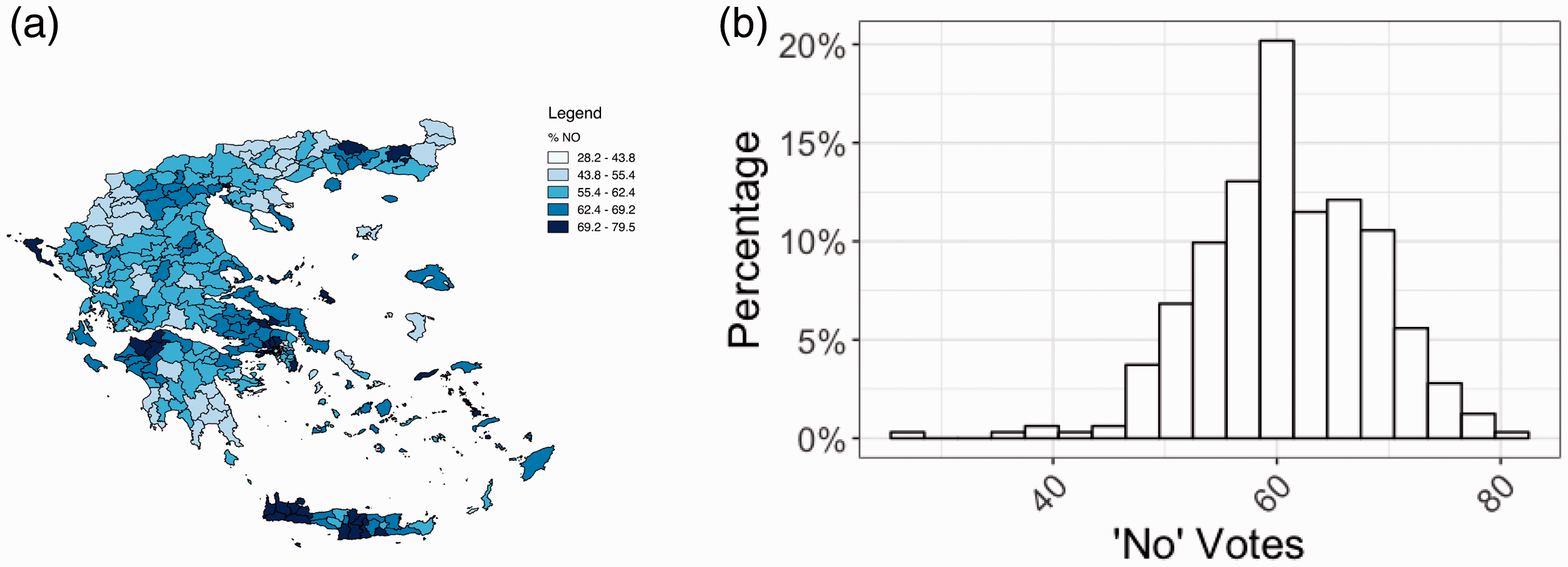
Spatial (a) and relative (b) distributions of the outcome variable: ‘No’ vote in the 2015 referendum at the municipality level.
Treatment: Change in local economic activity
The main independent variable/treatment of the study is the change of local economic activity at the municipality level, comparing years before and after the financial crisis. Because we lack official statistics at the municipal level, we explore the possibility of using satellite imagery of NTL. We use the measure from the Defense Meteorological Satellite Program Operational Linescan System provided by the National Oceanic and Atmospheric Administration’s National Geophysical Data Center. It uses satellite images from around the globe at night and records the amount of light emitted from each pixel. The measure encodes each pixel with an integer value between 0 (no light) and 63 (maximum light). The data have a spatial resolution of approximately 1 km2. In principle, the measurements are taken every 24 h. Subsequently, the measurements are processed and aggregated to generate a yearly average. For the analysis, we obtained the processed data from Goodman et al. (2016) that were aggregated to the average NTL at the municipality level (N = 322). An example of the satellite imagery from 2008 and 2012 for all Greek municipalities is included in the Online appendix. Figure 2(a) shows changes in night-light transmission in the whole of Greece with a longer perspective, between 2001 and 2013 (the last year night-light transmission data were recorded). Since the variable is highly skewed, we follow earlier work (Chen and Nordhaus, 2011; Michalopoulos and Papaioannou, 2013; Weidmann and Schutte, 2017) and estimate all statistical models on the logarithm of the NTL.
3
The data reveal that a downward pattern had already begun in 2005, which, after a brief recovery between 2007 and 2008 declines rapidly until 2010. During the years of the crisis (2010–2013 in our data), the measure exhibits some instability and bounces back and forth around the same average. As we can see in Figure 2(b) and (c), this trend also holds when we look at the disaggregated data. For details, please see the Online appendix

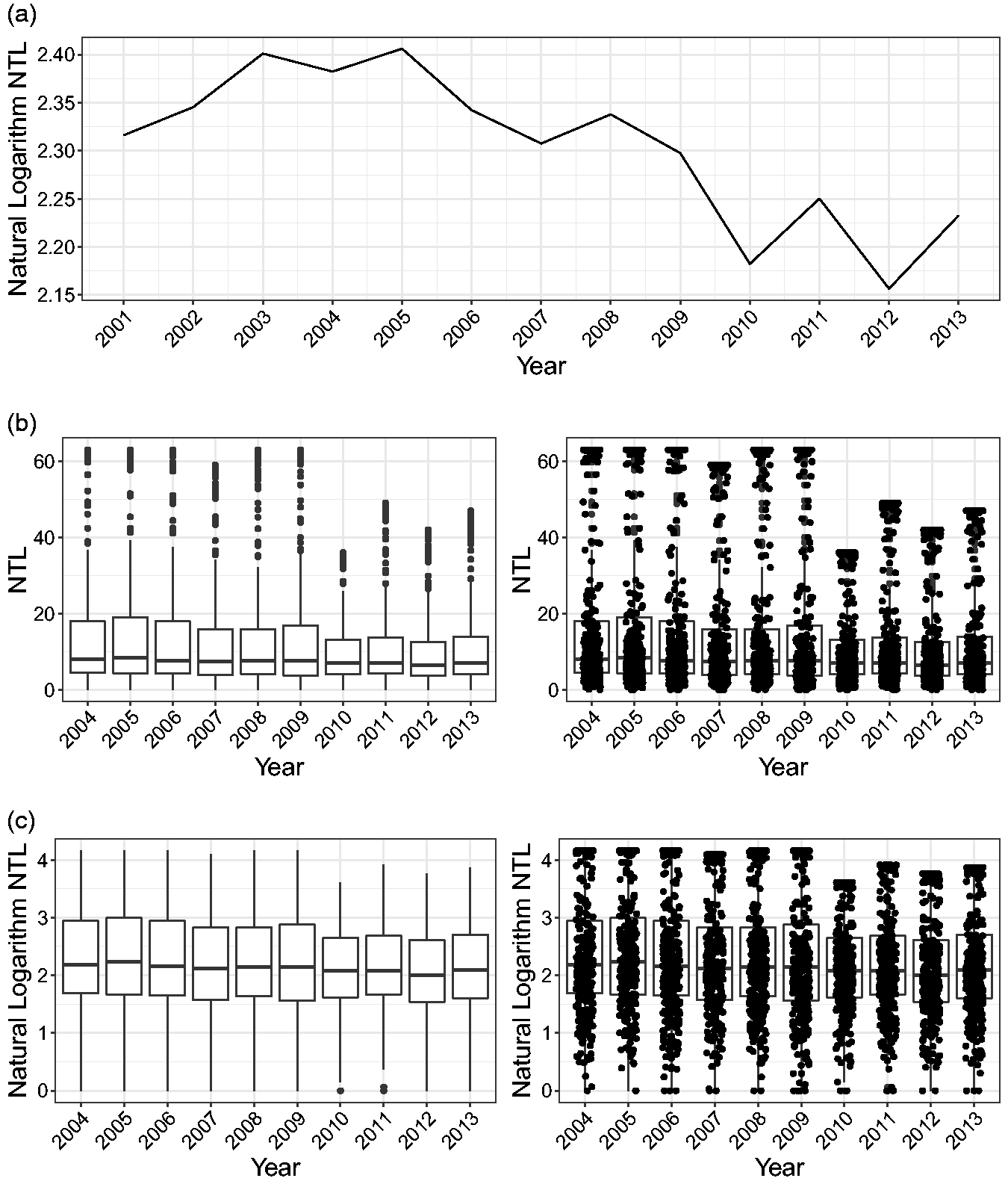
(a) Average NTL transmission in Greece, 2001–2013; (b) box whisker plots NTL 2004–2013; (c) box whisker plots natural logarithm of NTL 2004–2013. The right plots display the same box whisker plot as the left-hand side but also include jittered raw data.
The measure of NTL change is constructed by subtracting pre-crisis levels of NTL (a five-year average between 2004 and 2009) from those that have prevailed during the crisis (a four-year average from 2010 to 2013, the year of the last available NTL data). The measure takes on negative values if a municipality experienced an average economic downturn during the crisis compared to the pre-crisis period. Higher values indicate improvements of economic conditions. 4 About 80% of the municipalities register some degree of decline in NTL in these years while in about 18% NTL increases. An inspection of the regions in which we observe an increase in NTL (see the Online appendix) suggests that this happens mostly in rural areas indicative of an intra-country, small-scale migration consistent with anecdotal evidence.
Previous validations of NTL as a measure of income and wealth
There have been several attempts to validate NTL as a proxy for income or wealth. 5 First, the logarithm of light intensity per area has been shown to be linearly correlated with the logarithm of total GDP at the global country level (Henderson et al., 2012) and at the sub-national region level (Hodler and Raschky, 2014). Second, light intensity per area has been validated for less developed countries using a wealth index from the Demographic and Health Surveys (DHS). The results suggest a strong average correlation (0.7) (Michalopoulos and Papaioannou, 2013). Third, Mellander et al. (2015) investigated the relationship between population, business density, and income and NTL data in Sweden. They found that saturated NTL correlates highly with the density of night-time population (0.73), day-time business (0.72) and performs somewhat worse for take-home wage income (0.67). Our causal mechanism assumes a negative effect of the financial crisis on both wages and business density. However, thus far, we lack evidence for the local validity of NTL measures in high-income countries outside of Sweden.
Validation of NTL in the Greek case
To validate the NTL measure, we use several sources of evidence. First, we compare the night-light measure aggregated to the national level to the information that we have from official statistics about national GDP per capita growth. Figure 3(a) plots the logged NTL data (solid line) against the per capita growth (dashed line) at the national level. The trend is similar in both lines, with some exceptions (e.g. around 2006 and 2011).
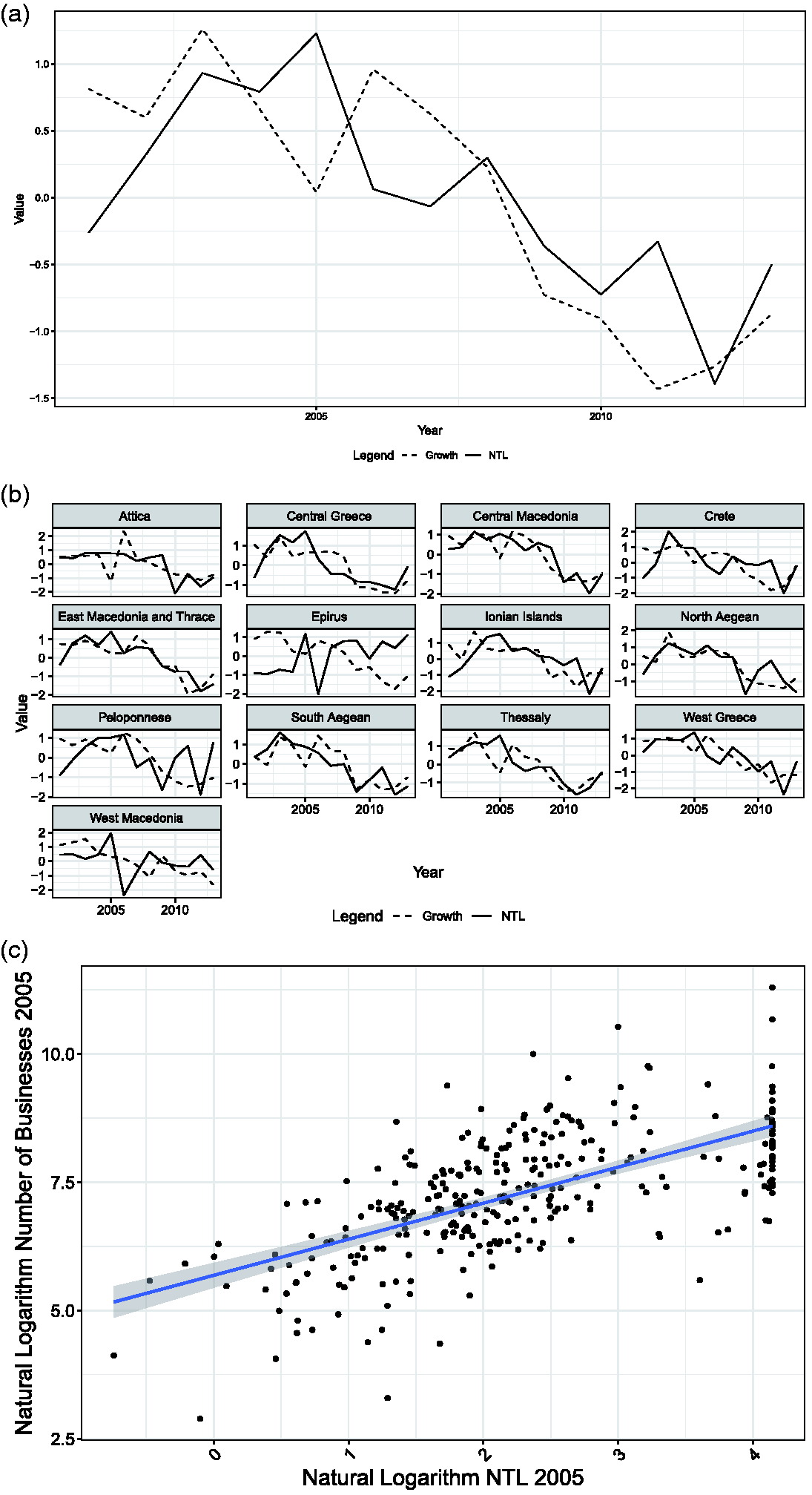
(a) NTL data and per capita growth in Greece, 2000–2013; (b) night-light transmission and per capita growth in Greece by NUTS II region, 2001–2013; (c) scatter plot of the natural logarithm of NTL and natural logarithm of the number of businesses within Greek municipalities in 2005. Correlation: 0.64.
Second, we perform the same exercise with data from 13 NUTS II regions (Figure 3(b)) for which official statistics exist. Again the two measures track each other well for at least 10 out of the 13 regions. Only in the case of Epirus do the trends in the two lines appear to deviate from each other significantly. 6
Third, to examine the relationship between the NTL measure and economic activity at the municipality level, we use data on the number of businesses per municipality. The data are limited to the year 2005 which prevents us from evaluating the validity of the NTL measure over time. Nevertheless, we can examine its cross-sectional validity. As we see in Figure 3(c), the correlation is strong (0.64) and the variation around the regression line is relatively tight, indicating that NTL is closely linked to the number of businesses. Given that the number of businesses is correlated to the personal economy of citizens through employment, the NTL measure serves as a good proxy for the average economic well-being of citizens within a municipality. We can conclude that the NTL measure is a good proxy for national and regional GDP growth and municipality level business density for the Greek case. 7
Covariates: Political and socio-demographic data
We expect voting in the referendum to be strongly correlated with party support in each municipality. We use data on party support in each municipality to test both the party cues and ideology hypothesis. To do so, we sum up, respectively, the percentage that (a) the governing coalition and (b) the Eurosceptic parties received in the elections immediately preceding the referendum (25 January 2015). To control for other socio-demographic effects, we use data from the most recent census (2011). Following previous studies, we include data on the percentage of citizens with tertiary education and above and the logarithm of the municipality population (see e.g. Goodwin and Heath, 2016). 8
Results
Table 1 presents the results from voting models regressing the ‘No’ vote on the five variables: NTL change, government coalition support, Eurosceptic party support, education and population size. Models 1, 2 and 3 show the full model specification for all municipalities, municipalities outside Attica and the Attica region, respectively. The table confirms suspicion about regional differences between, essentially, the Athens area and the rest of Greece. In model 1, effects of variables are all significant and signed as expected. An approximate 7% increase in the government share of the vote in a municipality results in about 5 extra percentage points in favour of the ‘No’ vote in the referendum. A similar increase in support for Eurosceptic parties in the area has a slightly lower effect of 3.5 points. Levels of the ‘No’ vote, as suggested in model 1, were lower in municipalities with larger shares of higher education citizens. As the population coefficient shows, in larger cities the effect is similar to that of education. In the case of NTL, the negative sign suggests that municipalities exhibiting losses of night light between 2010 and 2013 (i.e. negative values in our NTL measure) record higher levels of a ‘No’ vote. It is not easy to substantially interpret the effect of NTL change. The standardized regression coefficient (–0.21, not shown) suggests that one standard deviation increase in the logged NTL (0.15) would result in about 1.4% decrease of the ‘No’ vote. Essentially, this means that if we moved from a municipality that has lost ‘no light’ during the crisis to a municipality that has experienced the maximum light loss (0.41), this would account for an increase of about 4% in the ‘No’ vote; not a decisive but neither a negligible quantity.
Full models, split by region.
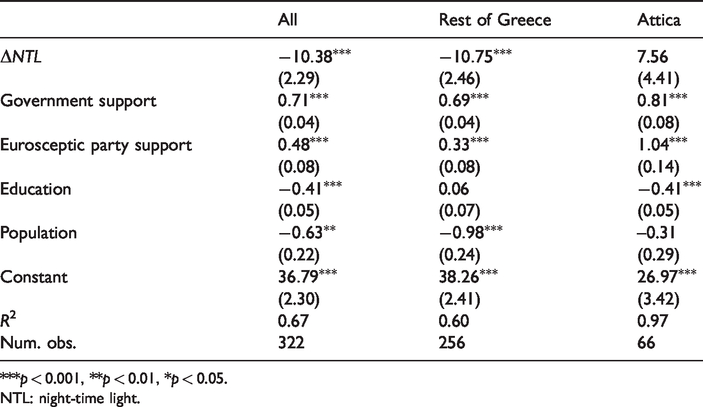
***p < 0.001, **p < 0.01, *p < 0.05.
NTL: night-time light.
However, when we compare the performance of the model inside and outside Attica, results vary somewhat. First, the NTL finding seems to hold mostly further away from Athens (model 2) while education seems to be more important in the Attica region (model 3).
These differences between the two areas are statistically significant and these conditional effects are plotted in Figures 4 and 5 (see the Online appendix, for the full models). Figure 4 graphs the marginal effect of NTL inside Attica (b) and the rest of Greece (a). While in the case of Attica the effect is clearly insignificant, Figure 4(a) presents a strong negative effect on the ‘No’ vote suggesting that in the rest of Greece the economic crisis had a significant effect on the outcome of the referendum. In the case of education, the situation is somewhat reversed (see Figure 5(a) and (b)). In Figure 5(a) the line is almost flat, while in Attica (b) there appears to be a strong negative effect of education suggesting that in the Athens area education suppresses the ‘No’ vote. This pattern is possibly a product of a stronger segregation along income and social class lines in Attica (Rontos et al., 2016). Indeed, the data suggest that the concentration of university graduates is higher in the traditionally affluent and upper middle class mostly northern municipalities of the Attica region. Such strong patterns are not observed in the rest of Greece (see the Online appendix). This is potentially an indication of the ‘left behind’ hypothesis that has been part of the explanation in similar studies on, for instance, the Brexit referendum (Goodwin and Heath, 2016). Municipalities with populations better connected to the international markets and more competitive are more reluctant to support a ‘No’ vote. On the other hand, municipalities with larger numbers of low-skilled workers vulnerable to international competition seem more ready to risk a potential ‘Grexit’ (or are indifferent as to whether it happens or not). The reasons we do not observe a similar pattern in the rest of Greece are probably twofold. One has to do with the distribution of the education variable which outside Attica presents limited variation. The second reason has to do with the salience of socio-economic characteristics for individual voters. It is in the area of Athens where globalization forces, as described earlier, mostly operate (e.g. due to the stronger connection to the international markets and/or reliance on industry), and therefore behaviour is likely to be driven to a larger extent by these processes in this specific region.
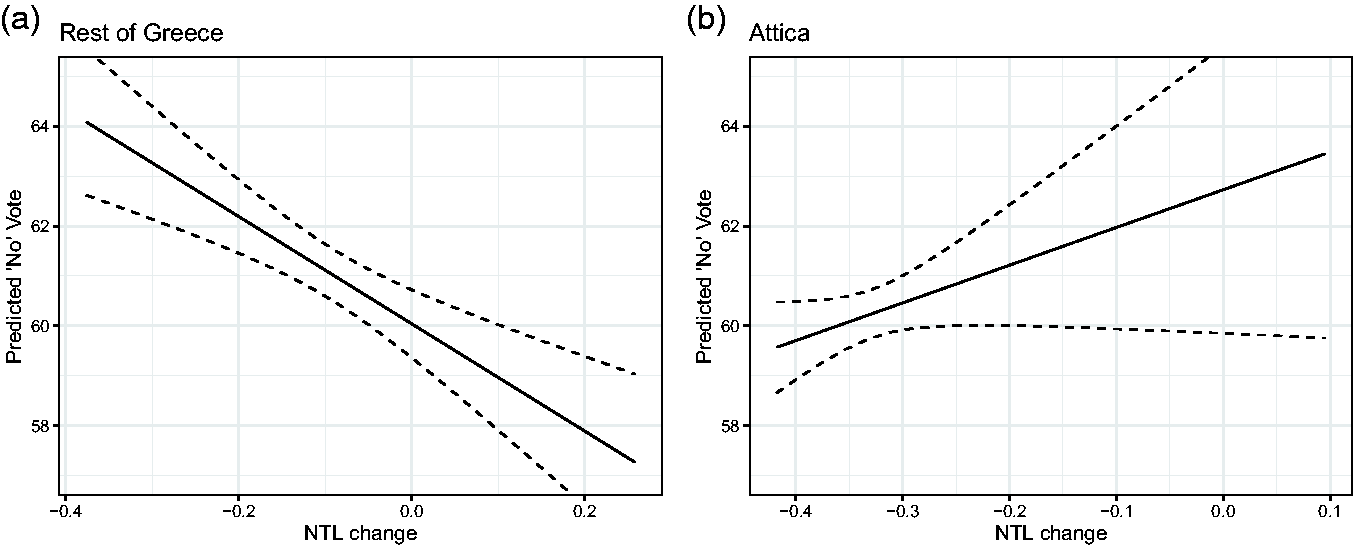
The marginal effect of change in NTL conditional on region: (a) Greece excluding Attica and (b) Attica region only.
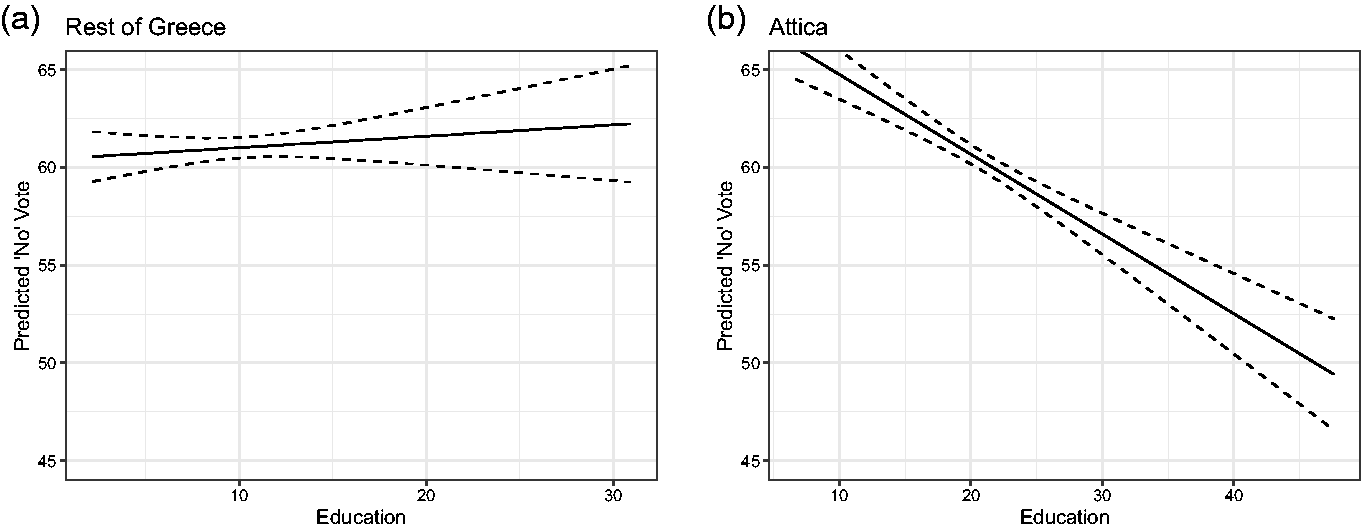
The marginal effect of education conditional on region: (a) Greece excluding Attica and (b) Attica region only.
We examine the economic effect further by comparing the model fit across various specifications in Table 2. We use the Bayesian Information Criterion (BIC) to check for model fit. Lower BIC values indicate a better performance. We start with the ‘political factors’ model (model 1) estimating the relationship between the ‘No’ vote and support for the government or Eurosceptic parties and proceed by adding socio-demographics. NTL change enters last in model 3. We observe that the model fit improves gradually from 1977 to 1898. The addition of NTL in the last model accounts for about a 14 point decrease from model 2, which is considered a ‘very strong’ improvement (Kass and Wasserman, 1995). Adding the night-light data, therefore, significantly improves the fit of the model.
Performance across models.
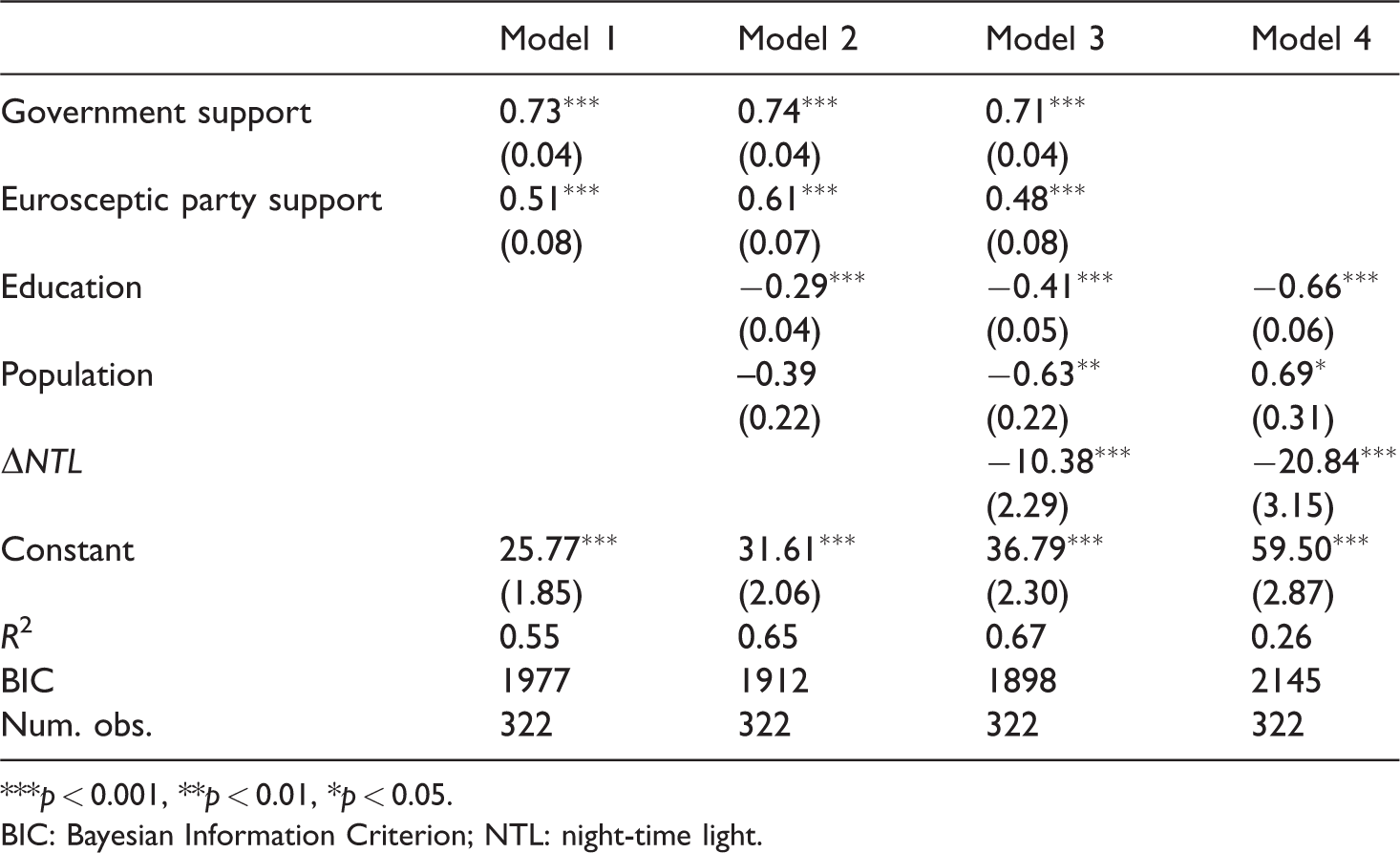
***p < 0.001, **p < 0.01, *p < 0.05.
BIC: Bayesian Information Criterion; NTL: night-time light.
Finally, it is plausible that the worsening of economic conditions drives the vote for the success of the Coalition of the Radical Left, for the punishment of mainstream parties and the increase in the vote share of Eurosceptic parties in the previous election (see e.g. Kosmidis (2014)). Including variables that are potentially affected by the treatment (NTL change) into a linear regression specification may introduce post-treatment bias (Rosenbaum, 1984). In model 4, we exclude the post-treatment covariates. We observe no substantive differences.
Discussion
The Greek bailout referendum was far from being a second-order event. It took place in a very polarized environment. National and international pressure on voters was high as were the stakes for this contest. By proxying local economic conditions with NTL data, we test how economic changes from pre-crisis levels have affected the vote. Our models show that this effect has been far from negligible even when party choice and certain socio-demographics are taken into account. The substantial loss of income during the austerity years did move a part of the Greek population towards a potential ‘exit’ vote. Such a final outcome was far from certain but there were strong signals that a ‘No’ vote was a ‘No’ to Europe. As we note in the literature review section, we take these results to indicate austerity effects that are related to the Global Financial Crisis of 2008.
Our results have also revealed some patterns that merit further probing, as is the case with the conditional effects that are observed in the Athens area which hint towards inequality effects and support for the ‘left-behind’ hypothesis. The limitations of our aggregate-level design should not caution us away from potentially fallacious claims such as the latter. We do believe that for the reasons explained previously regarding the peculiarities of the Attica region, the risk of ecological fallacy is, if not absent, certainly diminished. We are also confident that our NTL measure reflects the economic experience and economic perceptions of the individuals living in these localities. Finally, as regards the actual NTL measure, this article has convincingly demonstrated the usefulness and validity of non-conventional data sources that can provide remedies to data problems and opportunities for cross-time tests such as the one performed here.
Utilizing this research design, we have been unable to test for alternative hypotheses that focus mostly on values and the potential ‘cultural backlash’ that seems to drive the vote in recent elections and plebiscites and which is considered one of the main causes of the success of populist parties (Inglehart and Norris, 2016). We do believe, however, that this framework is better suited to models of elections and party support rather than to the very unique nature of the Greek referendum.
One implication of our findings may be that the economic crisis had more lasting effects on attitudes towards the EU and membership of the Euro area. However, recent polls in Greece suggest that the overall tendency is to ‘remain’ (Dianeosis, 2018). This was also clear from the Prime Minister’s decision not to decline the lenders’ terms essentially going against the referendum outcome. What is more, the 2019 elections in Greece returned the mainstream Conservative Party to government while populist and/or Eurosceptic parties such as the Independent Greeks and Golden Dawn did not manage to overcome the 3% electoral threshold. In the long run, there was indeed not ‘too much drama’ after a ‘No’ vote.
Supplemental Material
sj-zip-1-eup-10.1177_1465116520924477 - Supplemental material for Economic downturns and the Greek referendum of 2015: Evidence using night-time light data
Supplemental material, sj-zip-1-eup-10.1177_1465116520924477 for Economic downturns and the Greek referendum of 2015: Evidence using night-time light data by Georgios Xezonakis Department of Political Science, University of Gothenburg, Gothenburg, Sweden Felix Hartmann in European Union Politics
Supplemental Material
sj-pdf-2-eup-10.1177_1465116520924477 - Supplemental material for Economic downturns and the Greek referendum of 2015: Evidence using night-time light data
Supplemental material, sj-pdf-2-eup-10.1177_1465116520924477 for Economic downturns and the Greek referendum of 2015: Evidence using night-time light data by Georgios Xezonakis Department of Political Science, University of Gothenburg, Gothenburg, Sweden Felix Hartmann in European Union Politics
Footnotes
Acknowledgements
We would like to thank Sebastian Nickel for his valuable technical support in this project. We are grateful to Michelle D’Arcy, Oliver Heath, Stratos Patrikios, participants at the Oxford University workshop on the Performance of Democracies (May 2017), our colleagues at the Quality of Government Institute, the editors of European Union Politics and three anonymous reviewers for their comments and suggestions.
Funding
The author(s) disclosed receipt of the following financial support for the research, authorship, and/or publication of this article: Georgios Xezonakis would like to recognize funding from the European Research Council (ERC) under the European Union’s Horizon 2020 research and innovation program (grant agreement no. 339571).

Supplemental material
Supplemental material for this article is available online.
Notes
References
Supplementary Material
Please find the following supplemental material available below.
For Open Access articles published under a Creative Commons License, all supplemental material carries the same license as the article it is associated with.
For non-Open Access articles published, all supplemental material carries a non-exclusive license, and permission requests for re-use of supplemental material or any part of supplemental material shall be sent directly to the copyright owner as specified in the copyright notice associated with the article.
