



Abstract
Turnout in second-order elections, like those for the European Parliament, is notoriously low, especially among younger voters. This study compares five pathways in which exposure to poll coverage can affect turnout: bandwagon voting, strategic turnout, increased information efficacy, campaign cynicism and perceived electoral importance. The mediation analyses are combined with Covariate Balancing Propensity Score matching to better account for selection effects. Analyses of a four-wave panel survey of young voters (N = 747) in the 2014 European Parliament Election show that exposure to polls in election coverage predominantly stimulates interest and turnout among young voters. This is in line with the perspective that poll coverage increases perceived electoral importance. Poll coverage can thus play a beneficial role in activating the potential among young voters to engage with (second-order) elections.
Poll coverage and young voter turnout
Declining turnout rates of young voters are a growing concern both in the academic literature and in political debates (see Phelps, 2005). Habit plays an important role in determining turnout, so starting that habit to vote at one’s first election is important for future electoral participation (Cutts et al., 2009; Franklin, 2001; Plutzer, 2002). Nowadays, poll coverage is a major part of media reporting of election campaigns, but its role in either mobilizing or demobilizing participation is a controversial one. It has been criticized for portraying elections as a horse race or game, and turning off voters over time by making them cynical about the political process (Cappella and Jamieson, 1997). However, the ‘virtuous circle’ literature argues instead that exposure to campaign coverage draws potential voters into more engagement with the campaign (Norris, 2000). For younger voters, this initial step to engagement may be especially important. This article will take a step back and compare five different pathways in which poll coverage might affect young voter interest and turnout, in order to answer the question: Does poll coverage help or hurt efforts to make more young voters show up at the ballot box?
The first pathway supposes that polls provide substantive information in and of themselves about likely election winners and losers. Young voters might use this information as a cue for bandwagon voting (Hardmeier, 2008). Polls enable them to anticipate the gratification of voting for the winner, which entices them to get involved in the campaign. The second pathway is that voters might use poll information for a strategic turnout decision (Clarke et al., 2002; Downs, 1957). For such voters, turnout will be depressed when they support a winning party. If the outcome will be as desired, then why pay the cost of voting? The third pathway is that the experience of engaging with poll information might enhance a feeling of information efficacy, i.e. that one has the ability to understand the information provided in the campaign sufficiently to influence the political process (cf. Kaid et al., 2007). Poll information is relatively easy to understand, and, through increased information efficacy, might be a stepping stone into further engagement with the campaign. The fourth pathway is that interpreting poll coverage might implicitly instill an image of self-interested politicians in the minds of voters, since poll coverage emphasizes personal winners and losers, rather than substantive issues (Cappella and Jamieson, 1997). Consequentially, exposure would increase cynicism and depress turnout. Finally, for the fifth pathway, we propose that poll coverage will (also) implicitly convey the message that it matters who wins the election. The increased perceived importance of the election may induce voters to find out more about what’s at stake, increase interest and engagement with the campaign and thereby their probability to turn out to vote.
This study evaluates the effect of poll exposure on turnout for young voters in the 2014 European Parliament (EP) election. It contributes theoretically by emphasizing the role of campaign interest within several of the mechanisms discussed above, as well as theorizing that poll coverage sends an implicit message of election relevance, especially to voters with higher information efficacy. The focus on campaign interest fits into a growing literature that finds a reciprocal relation between engagement and media exposure, which might be especially relevant for young voters who are still in the process of developing political interest (Atkin et al., 1974; Boulianne, 2011; Hillygus, 2005; Kruikemeier and Shehata, 2017; Strömbäck and Shehata, 2010). Higher interest is likely to contribute to more poll exposure, but poll exposure could in turn increase interest in a positive spiral (Norris, 2000; Slater, 2004, 2007). This process could increase the probability of turnout over time. This study contributes methodologically by using a Covariate Balancing Propensity Score (CBPS) (Imai and Ratkovic, 2014), in combination with a four-wave panel survey to be extra sensitive to selection effects, i.e. those more interested are already more likely to be exposed to polls and show higher turnout.
Case
The data used for this study stem from a representative four-wave panel survey among young Dutch voters (De Vreese et al., 2014). These young adults (aged from 18 to 19) were allowed to vote for the first time in the 2014 EP elections. EP elections are second-order elections and attract much less media attention and achieve lower turnout compared to national parliament elections (Hix and Marsh, 2011; Van der Brug et al., 2016). The Netherlands forms a good case, since it is an ‘average’ member state in terms of both visibility in the media and turnout (Schuck et al., 2011). 1 Söderlund et al. (2011) show that political interest is of extra importance for turnout in such low salience EP elections. In the 2014 EP elections only 42.6% of the European electorate went to the ballot box, the lowest figure in the history of EP elections. Within our own survey the average campaign interest among young voters directly before the campaign (wave 3) is only 2.9 on a scale from one (no interest at all) to seven (very interested) for young voters in our sample, which suggests that this might be a relevant factor to look at in terms of youth engagement in EP elections. Especially, because interest plays such a large role in political behavior over the life span and is still developing among young voters, this is an ideal case to study the influence of poll exposure on turnout via campaign interest. Results show that young voters indeed become more interested in the EP campaign as a consequence of poll exposure, and this higher interest in turn increases their odds of voting. Since the mediating effect of campaign interest cancels out the mediating effect of campaign cynicism and information efficacy, the most likely explanation for this result is that poll coverage implicitly signals the importance of the election to voters, and thereby prompts interest and engagement.
Theory
There has been little empirical research explicitly examining the effect of exposure to media poll coverage on turnout. There is a strong literature investigating the effect of poll information on turnout, but these studies tend to look at exit polls and/or instantaneous effects (Großer and Schram, 2010; Klor and Winter, 2007; Morton et al., 2015). There is also a strong literature on the effect of ‘horse-race’ coverage on turnout, but this includes many other aspects besides polls (Adriaansen et al., 2012; Cappella and Jamieson, 1997; Elenbaas and De Vreese, 2008). As will be explained below, we believe there is good reason to assume that interest plays an important role in the effect of exposure to poll coverage on turnout. Therefore, we start by reviewing the literature on interest as a potential mediator, and then discuss each of the five different potential mechanisms linking poll exposure to turnout.
Interest as a mediator
Surprisingly, the large literature of campaign media effects on turnout pays only scarce attention to the role of interest as a potential mediator (e.g. Aarts and Semetko, 2003; Goldstein and Freedman, 2002; Wattenberg and Brians, 1999). Interest is usually included in the list of control variables and accounts for a large share of the explained variance, but it is not discussed theoretically. This is in contrast to findings that, when asked, people state the lack of interest as one of the most important reasons for not voting (Shaffer, 1981). Moreover, in empirical studies, political interest is one of the variables most consistently found to have a positive influence on turnout (Smets and van Ham, 2013). Many studies appear to assume that political interest is a trait-like characteristic, and stable over time (Prior, 2007). However, like turnout, it is only believed to be a stable variable after a voter reaches a certain age (Bhatti et al., 2012; Strömbäck and Johansson, 2007).
From this perspective, how interest forms in young voters is extra important, as it is an important predictor of turnout which then persists throughout the life cycle. Consequently, several authors have argued for more research into the antecedents of political interest among young voters (Maier et al., 2016; Prior, 2007). Election campaigns provide a good opportunity for young voters to develop such interest, since media carry richer political media content in campaign periods, and young voters are likely more motivated to start looking into this content as it is directly relevant in the light of the upcoming election.
Taking up the challenge of exploring such antecedents, an increasing number of studies report findings that contradict the perspective of political interest as a constant factor (e.g. Boulianne, 2011; Hillygus, 2005; Strömbäck and Shehata, 2010). Instead, they point to a reciprocal relation between political interest and media use, with the more interested consuming more political media and consequently reinforcing their interest. Hillygus (2005) specifically recommends to take better account of the dynamics of campaign attention by looking at interest in the campaign rather than interest in politics in general. Campaign interest is conceptually closer to the specific election in question, compared to general political interest. It is also more likely to be related to attention, as interested people are more likely to be attentive to the news they are exposed to. Various studies find that news attention yields stronger media effects compared to news exposure (Chaffee and Schleuder, 1986; Slater and Rasinski, 2005; Strömbäck and Shehata, 2010). Taken together, this study will test whether campaign interest mediates the effect of poll exposure on turnout, yielding the following hypotheses: H1: Exposure to poll coverage increases the probability of turnout of first time voters. H2: Campaign interest mediates the positive relation between exposure to poll coverage and turnout.
Five mechanisms
Based on the literature, we outline four different mechanisms in this section that are established in the literature and predict an influence of poll exposure on turnout. However, we believe poll exposure can also be expected to trigger a different effect: poll coverage might implicitly signal the relevance and importance of the election and thus provide a reasonable justification for why it is important to invest (cognitive) resources in the campaign and participate in voting. This effect is especially likely in a low salience election, such as that for the EP, and among a young voter population with a low initial interest in the campaign. Before proposing this additional fifth mechanism, this section first outlines the four mechanisms that are currently established in the literature and link poll exposure to turnout. All five possible mechanisms are thus pitched as possible alternative explanations to explain the effect of poll coverage on young voter turnout.
Bandwagon voting
The first mechanism linking poll coverage to interest and turnout considered here is bandwagon voting, defined as seeking gratification. Gratification is often seen as an emotional process: voters are seeking emotional rewards. Positive poll coverage has been associated with a bandwagon effect in which voters are drawn into the enthusiasm of the winning party (Robinson, 1937), while negative poll coverage is associated with inciting fear of the prospect of a liked party losing or a disliked party winning (Moy and Rinke, 2012; Stolwijk et al., 2016). Poll coverage offers voters the option to find gratification in an election by joining the bandwagon, and reduce their fear of voting for a losing party. The scholarly findings are mixed on whether such enthusiasm or anxiety in turn contributes to interest and information search (Ladd and Lenz, 2011; Marcus et al., 2000). If bandwagon voting drives the effect of poll coverage we would expect the following: H3a: Exposure to favorable poll coverage for a favored party increases turnout.
Strategic turnout
The information polls provide about likely winners and losers might also have the opposite effect on engagement: when polls show one’s preferred party winning already, then why bother to turn out to vote oneself? A voter might prefer to avoid the cost of voting and free-ride by relying on other voters(Clarke et al., 2002; Downs, 1957). Accordingly, such voters are unlikely to be interested in the campaign.
There is a solid literature on this potential strategic relation between poll exposure and turnout. However, as Großer and Schram (2010) note, the focus of such studies is on how voters act strategically to express their preference after it has formed, and they neglect the influence of campaigns and especially that of poll coverage on the preference formation process. Recent studies tend to show a slight increase in turnout for the majority candidate, but only in close races or under public voting rules (e.g. Klor and Winter, 2007; Morton and Ou, 2015).
However, EP elections do not rely on public voting and, moreover, use a complex nation-tiered proportional system of voting which obscures the direct relation of a particular vote on the eventual outcome. These elections select members for a multi-party parliament in which each party consists of various national sub factions. The election outcome is also not related to the formation of a government, so, all in all, a close race between two clear parties or candidates is not probable. Strategic turnout considerations found in these experiments are thus unlikely to have much influence on turnout decisions in EP elections. Still, if strategic turnout drives the relation between poll coverage and turnout, we would expect the opposite from H3a: H3b: Exposure to favorable poll coverage for a favored party decreases turnout.
Information efficacy
Exposure to poll coverage could also influence campaign interest in a more indirect way. For one, such coverage is less complicated to interpret compared to complex issue coverage and so has a lower accessibility threshold (for a similar argument, see Liu and Eveland, 2005). Poll coverage in itself is considered relevant to voters and thereby lures people in (Robinson and Sheehan, 1983; Zhao and Bleske, 1998). In this way, exposure to poll coverage could provide a way into news consumption as it can help increase information efficacy and make consequent coverage easier to understand (Kaid et al., 2007; Möller et al., 2014). If the information efficacy-route best links poll coverage to turnout, we expect it to be the main mediator, with interest being more of a by-product: H4: Information efficacy is a stronger mediator between exposure to poll coverage and turnout, than campaign interest.
Cynicism
Poll coverage might also have an implicit effect. The classic work on the effect of (poll-related) so-called strategic news coverage on political engagement is Cappella and Jamieson’s (1997) ‘The Spiral of Cynicism’. Such strategic news reports on winning and losing, the performances of politicians and parties, and campaign strategies and tactics (Aalberg et al., 2012). Cappella and Jamieson argue that a focus on strategic news over substantive issues leads to a greater attention for politician’s self-interest, which in turn increases political cynicism and decreases political involvement. Subsequent studies have offered mixed support, with some supporting the hypothesis that strategic news exposure decreases turnout, while others find a contrary or null effect (Adriaansen et al., 2012; Lengauer and Höller, 2012; Valentino et al., 2001a).
To help clarify the findings, Aalberg et al. (2012) argue that scholars should separate the game frame from the strategy frame. While game frame coverage focuses on who will win, strategy coverage expands on the motives and tactics of politicians. The latter is conceptually closer to the kind of coverage that should increase cynicism and decrease involvement. The game frame, on the contrary, might increase involvement because of its appealing nature. Indeed, Iyengar et al. (2004) find that voters pay far more attention to such game frame news over issue and strategy news. Polls, as the dominant element of this frame, even appear to be so interesting that they suppress attention for issue news. Valentino et al. (2001b) compared different parts of the strategy frame and find experimentally that including poll information to an article distracts attention from the substantive issues also mentioned in that article. Over time, the attractiveness of poll coverage appears to have a positive effect on interest. In two of the few studies specifically on poll coverage, Zhao and Bleske (1998) found a positive relation between poll exposure and interest in other election messages, and Meyer and Potter (1998) find that knowledge of polls in one wave positively predicts issue knowledge in the next wave. Poll coverage could thus both be attractive and might stimulate future campaign interest. These findings suggest that the effect of poll coverage may very well be different from other forms of strategic coverage. Over time, poll coverage might increase both interest and involvement (Norris, 2000; Slater, 2007; Zhao and Bleske, 1998). Still, if cynicism would define the path from exposure to poll coverage to turnout, we would expect the following: H5: Campaign cynicism is a stronger mediator between exposure to poll coverage and turnout, than campaign interest.
Election importance
Exposure to poll coverage might also have a different implicit effect, which increases interest and turnout. We propose that poll coverage does not only signal that politics is about winning and losing, but also that it matters who wins. In their decision to cover pre-election polls journalists suggest that the outcome of the election is important, relevant and worthy of attention. Especially in the current case of a second-order EP election, this might be an important factor in motivating voters to pay attention and turn out to vote. We, thus, extend the horse race frame connotation of poll coverage with that of relevance of the election. If election importance is the driving mechanism, we expect poll exposure to increase interest and thereby turnout. This leads to a counter hypothesis to H4 and H5: H6: Campaign interest is a stronger mediator between exposure to poll coverage and turnout, than either campaign cynicism or information efficacy.
Information efficacy as a moderator
If it is indeed the case that exposure to poll coverage increases the perceived importance of the election, some young voters are more likely to respond to this than others. We propose that this mechanism is more likely to apply to those who feel that they are competent to make an informed voting decision, and thus feel that they have an opportunity to help steer the outcome of the election in a beneficial way (cf. Kaid et al., 2007). For these voters, putting in extra effort is more likely to pay off: H7: The mediating effect of campaign interest on the relation between poll exposure and turnout is stronger for those with higher levels of information efficacy.
Method
Sample
The study uses the 2014 European Parliament Election campaign study data (De Vreese et al., 2014). A four-wave panel survey was carried out in the Netherlands by Kantar Public, a research institute that complies with European Society for Opinion and Marketing Research (ESOMAR) guidelines for survey research and holds the relevant International Organization for Standardization (ISO) approvals. Respondents were interviewed about six months prior, four months prior, and one month prior to the May 2014 elections for the EP and immediately after the elections. Fieldwork dates were 13 December 2013 to 19 January 2014 for the first wave, 20–30 March 2014 for the second wave, 17–28 April 2014 for the third wave, and 26 May to 9 June 2014 for the fourth wave. The survey was conducted using Computer Assisted Web Interviewing (CAWI).
A total of 1433 respondents participated in wave 1, 1013 respondents participated in wave 2, 836 participated in wave 3, and 747 in wave 5. The sample was drawn from the Kantar Public database. The population was defined as born between 12 September 1994 and 22 May 1996. The database consists of 200,000 individuals that were recruited through multiple recruitment strategies, including telephone, face-to-face, and online recruitment. Quotas (on age, gender, and education) were enforced in sampling from the database. The average response rate was 65% in wave 1, the re‐contact rate 70.7% in wave 2, 82.5% in wave 3, and 89.4% in wave 4. The sample shows a slight deviation in distribution in terms of gender (more females) compared to census data. Panel attrition did not lead to a significant difference in the composition of the panel with regard to age, gender, and education.
Approach
As political interest can be both a cause and consequence of media use (e.g. Boulianne, 2011), selection effects are likely to play a large role. Evaluating the effect of exposure to poll coverage on turnout by just comparing turnout between those who saw and those who did not see polls could be biased, as people, de facto, self-select into seeing polls. Those who are more likely to cast a vote are more interested in the campaign and more likely to see polls. Regression analysis with control variables is the most often used way of taking care of these selection effects. If certain characteristics predict whether an individual takes the treatment and these same characteristics also influence the dependent variable, then using panel data with lags of these variables as controls is an appropriate choice.
However, control variables are estimated to have the same effect on all people, but if the composition of treated (i.e. exposed to poll coverage) and untreated (i.e. not exposed to poll coverage) groups is inherently different, this assumption might not hold. In the present analysis, the group of people, who saw polls, can, on average, be expected to be more interested in politics, higher educated, etc., than those who did not. To address this problem various matching procedures are being developed. This study will go beyond previous research in addressing these potential problems and report results using a CBPS (Imai and Ratkovic, 2014).
The CBPS method is most suitable for this purpose as it represents the propensity for each participant to be exposed to polls based on her background characteristics (the CBPS). To calculate the CBPS, we used as much relevant information from the three waves preceding the EP14 campaign as feasible (see the Online appendix for a full list of the estimates for each of the predictors used to calculate the CBPS). The predictors include intention to turn out, campaign cynicism, interest in the campaign, information efficacy, and whether or not one saw polls before wave 3 of the survey. Since multiple waves of these variables are included, CBPS does not only serve as a control for different starting values of these variables at the start of the campaign, but also for any rising, or falling trends in these variables over time.
Main dependent and independent variables
Turnout was measured directly after the elections (wave 4) by asking respondents whether they had voted (n = 319/43%) or not (n = 428/57%) in these elections. 2 Turnout intention was measured in waves one to three on a scale from one (certainly will not vote) to seven (certain to cast a vote) (see the Online appendix for descriptives for all variables used in this study). With regard to polls, each participant was asked (both in wave 3 and 4) whether or not opinion poll results were seen in the last four weeks. 3
Mediators
Interest in the campaign was measured in both waves on a ‘not at all interested’ (= 1) to ‘very much interested’ (= 7) scale for the question: ‘In May 2014 the elections to the European Parliament will be held: To what degree are you interested in these elections?’. Political Information efficacy was measured by four 7-point strongly disagree-strongly agree items based on those used by Kaid et al. (2007), but adapted to better fit the current election context (measured in each wave; wave 1 Cronbach’s alpha = 0.89; see the Online appendix). Campaign cynicism was measured by five 7-point strongly disagree-strongly agree items. Adapted for the current context, one item read (translated from Dutch) ‘Politicians are too pre-occupied with their poll ratings during the campaign for the European elections’ (measured in waves 3 and 4; wave 3 Cronbach’s alpha = 0.81; see the Online appendix).
Moderators
Party rating was measured in all waves for each party on a 10-point very unlikely-very likely scale for the question: ‘How likely is it that you would ever vote for each of the following parties’. For those who reported to have seen polls in wave 4, we measured perceived party poll performance for five parties on a seven-point very bad-very good scale in response to ‘How good or bad did the following parties perform in the last poll you remember’.
Results
To test H1 on the effect of self-reported poll exposure on self-reported turnout, Table 1 shows the results of logistic regressions with and without control variables using a standard model, and with CBPS as a control. All models estimate the effect to be significant at p < 0.01, though the size of the effect varies between 1.25 for the basic logit model down to 0.57 for the CBPS-controlled model. The results uniformly support H1: exposure to poll coverage increases turnout.
Logistic regression of poll exposure on turnout.
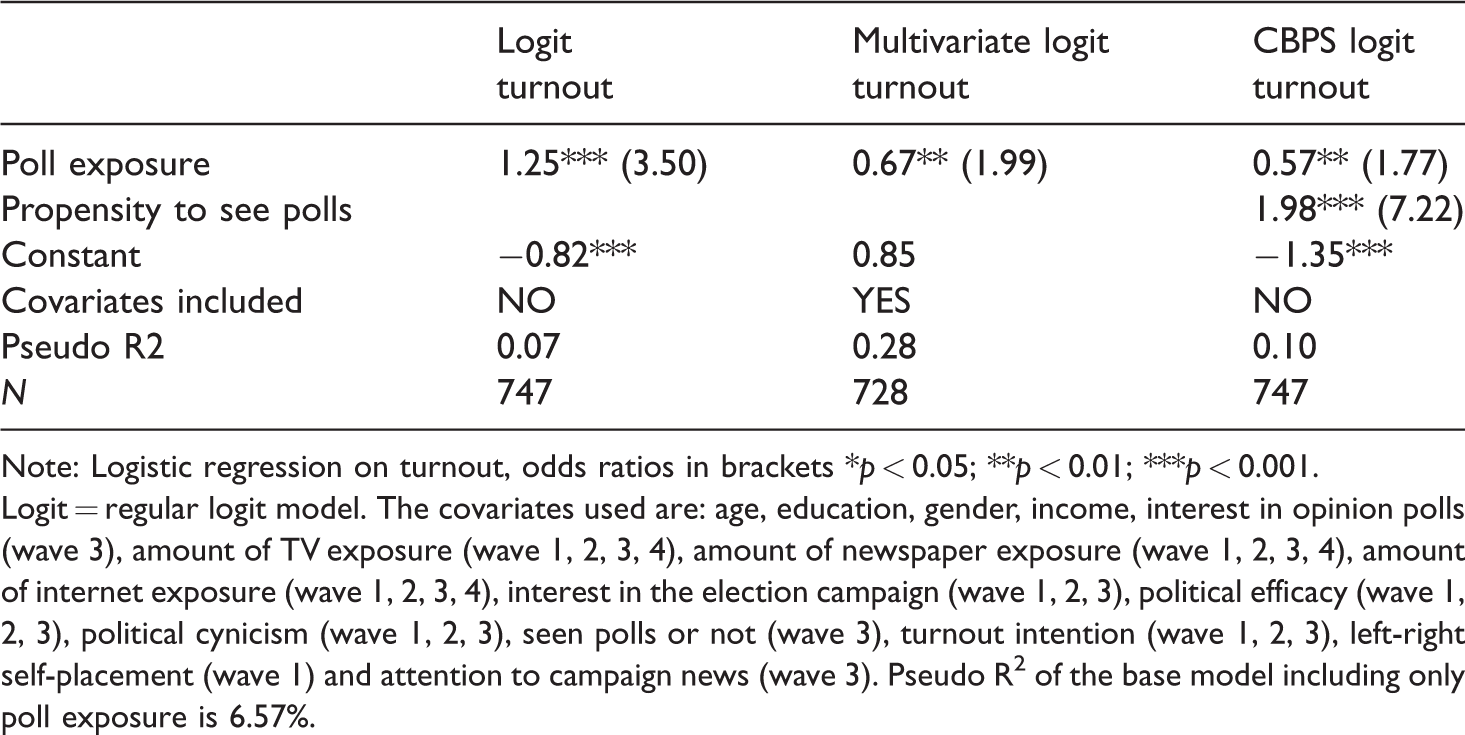
Note: Logistic regression on turnout, odds ratios in brackets *p < 0.05; **p < 0.01; ***p < 0.001. Logit = regular logit model. The covariates used are: age, education, gender, income, interest in opinion polls (wave 3), amount of TV exposure (wave 1, 2, 3, 4), amount of newspaper exposure (wave 1, 2, 3, 4), amount of internet exposure (wave 1, 2, 3, 4), interest in the election campaign (wave 1, 2, 3), political efficacy (wave 1, 2, 3), political cynicism (wave 1, 2, 3), seen polls or not (wave 3), turnout intention (wave 1, 2, 3), left-right self-placement (wave 1) and attention to campaign news (wave 3). Pseudo R2 of the base model including only poll exposure is 6.57%.
The first column of Table 1 shows the difference in turnout between those who did and did not see polls. Being exposed to polls increases the predicted probability of turnout from 30.1% (not seen polls) to 60.5% (did see polls). Poll exposure explains about 7% of the variance in turnout. As argued above, this effect is likely driven by differences in sample composition of those who did and did not see polls. The logit models in the second and third columns confirm the presence of selection effects. The effect size of this selection effect is shown explicitly by CBPS in the third column: young voters who were most likely to see polls (CBPS = 1) are over seven times as likely to turn out as those who were least likely to see polls (CBPS = 0) to begin with. The second column of Table 1 shows the estimates that would usually be reported: that of a multivariate regression with control variables (it has a slightly lower N, due to missing values on left-right self-placement). The more precise CBPS approach for correcting sample composition yield estimates which are a little lower (third column). Based on the CBPS logit model, being exposed to polls increases the predicted probability of turnout from 36.5% (not seen polls) to 50.4% (did see polls) when controlling for the prior probability of being exposed to polls. In the CBPS and multivariate logit models, poll exposure explains between 1% and 2% of the variance in turnout. Given how modest poll coverage was in this campaign (see the Online appendix), this can be considered a substantial effect.
The second hypothesis on the mediating role of campaign interest is tested using Hicks and Tingley’s (2011) mediation package in STATA 13.1. This method provides the option of clustered standard errors to better account for the panel nature of our dataset. The main results are displayed in Figure 1. The indirect effect of poll exposure via campaign interest on turnout is significant (mean indirect effect = 0.07; 95% confidence interval (CI) [0.03; 0.11]; based on 1000 simulations). 4 This path accounts for 54% (95% CI [0.31; 1.53]) of the total effect of poll exposure on turnout in this model. The remaining direct effect is not significant (see the Online appendix for full results), confirming H2.
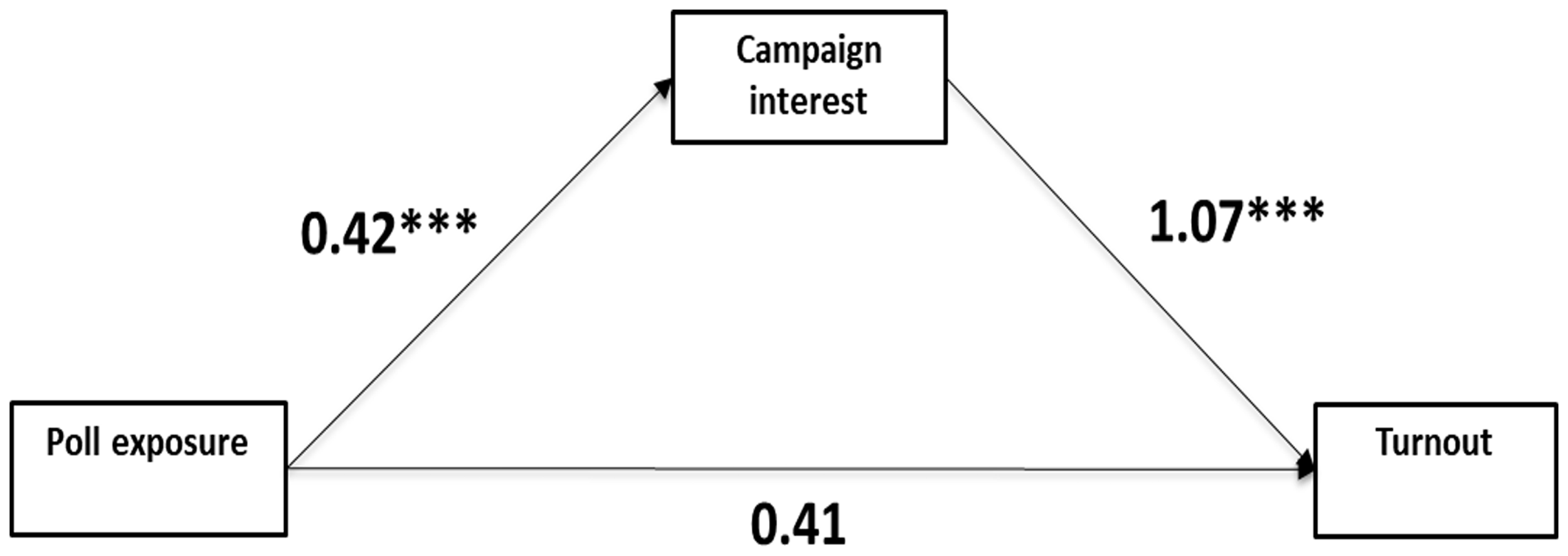
Mediation results of the effect of exposure to poll reports on turnout via campaign interest. Note: effects on turnout are estimated as logit. The model controls for CBPS, campaign interest (wave 3) and turnout intention (wave 3) (not shown). N = 747, ***p < 0.001, using standard errors clustered on the individual.
To test whether the effect of poll exposure on interest and turnout is a consequence of strategic reasoning, we evaluated whether those who reported to have observed polls became more or less interested in the campaign and likely to turn out if their favored party performed better in the polls, compared to when it did less well. Table 2 reports the interaction effects of party rating and self-reported poll performance for five separate parties (see the Online appendix for full results). These parties include the mainstream rightwing (Volkspartij voor Vrijheid en Democratie (VVD)) and mainstream leftwing (Partij van de Arbeid (PvdA)) parties that, at the time of the EP14 election, formed the governing coalition at the national level, and three opposition parties: a right wing populist Eurosceptic party (Partij voor de Vrijheid (PVV)), a main stream pro-European Union (EU) party (Democraten ’66 (D66)), and a left wing populist Eurosceptic party (Socialistische Partij (SP)). The table shows that those who indicated that a party they liked did well in the polls, did not differ in their interest for the campaign or probability to turn out, from those who liked this party less, and vice versa, for any of these five parties. 5 This makes it unlikely that the effect of poll exposure on turnout is a consequence of strategic reasoning, rejecting both H3a and H3b.
Moderating effects of party rating and poll performance on campaign interest and turnout.
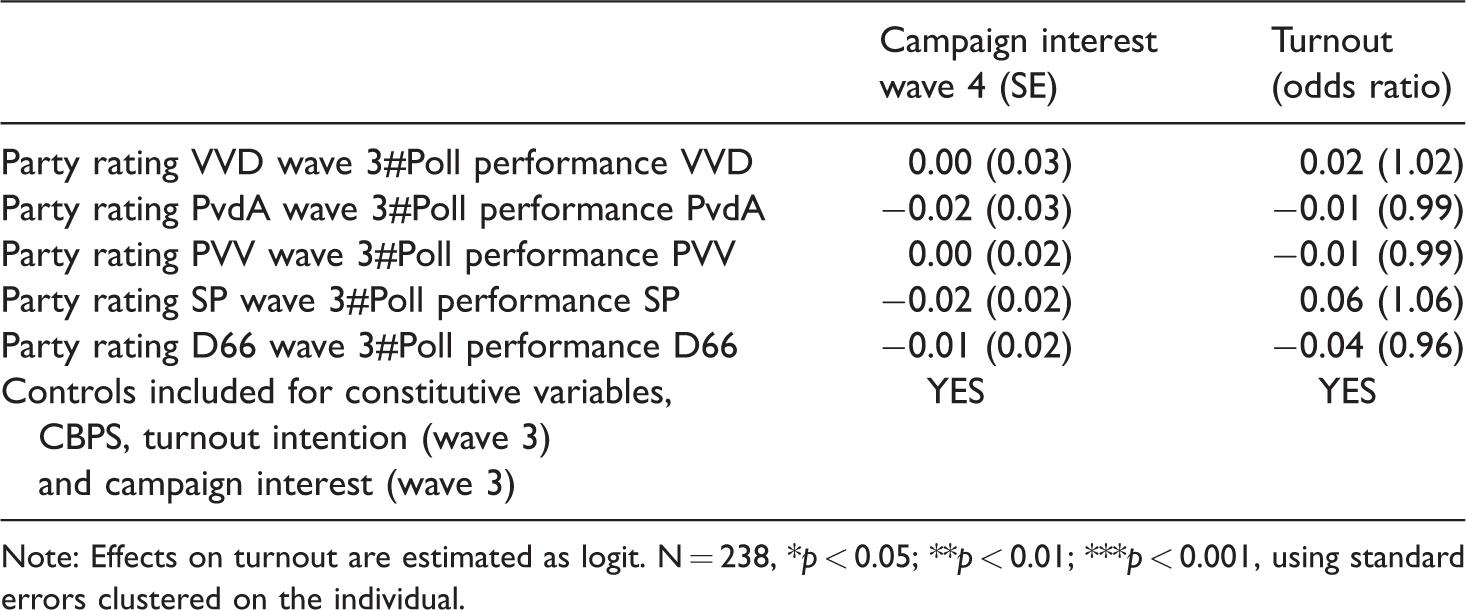
Note: Effects on turnout are estimated as logit. N = 238, *p < 0.05; **p < 0.01; ***p < 0.001, using standard errors clustered on the individual.
Hypotheses 4, 5 and 6 hold opposing expectations on the relative importance of information efficacy, campaign cynicism and campaign interest as mediators between poll exposure and turnout. We used Preacher and Hayes’ (2008) method to evaluate the respective indirect effects, since this method allows for multiple mediators and gives bootstrapped bias-corrected and accelerated confidence intervals for each. 6 The respective indirect effects for each mediator are displayed in Table 3. It is clear from these results that campaign interest is the dominant mediator, it accounts for nearly the full indirect effect. 7 The path through information efficacy is also significant, but it accounts for only 5% of the total indirect effect. The path through campaign cynicism is negative (as predicted), but not significant. 8 Consequently, based on these results, H4 and H5 are not supported, while H6 is confirmed.
Mediating effects of information efficacy, campaign cynicism and campaign interest on the relation between poll exposure and turnout.
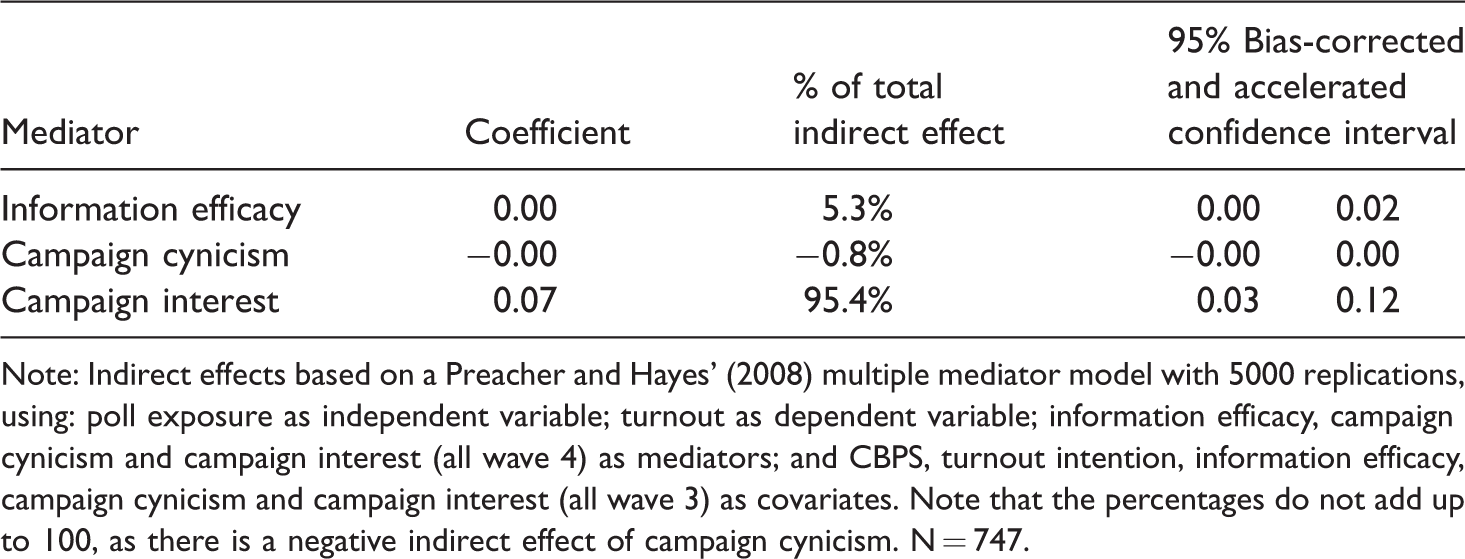
Note: Indirect effects based on a Preacher and Hayes’ (2008) multiple mediator model with 5000 replications, using: poll exposure as independent variable; turnout as dependent variable; information efficacy, campaign cynicism and campaign interest (all wave 4) as mediators; and CBPS, turnout intention, information efficacy, campaign cynicism and campaign interest (all wave 3) as covariates. Note that the percentages do not add up to 100, as there is a negative indirect effect of campaign cynicism. N = 747.
The final hypothesis (H7) specified a moderation effect of initial information efficacy on campaign interest as a mediator between poll exposure and turnout. To test this we have run a moderated mediation model using Tingley et al.’s (2014) mediation-package in R, as this allows us to estimate effect sizes and significance-levels for moderated mediations. The results related to the moderating effect of initial (wave 3) information efficacy are displayed in Table 4. 9 The first row shows that for those who were low on information efficacy at the start of the campaign (wave 3), being exposed to poll reports did little to interest them in the campaign and turnout. In contrast, the second row shows that for those initially high on information efficacy, being exposed to polls did make them more interested in the campaign and consequently more likely to turn out. When we test whether the difference between these two groups is significant (row 3), we see that it is. This confirms H7. Note that these effects are controlled for CBPS; so, in this model, those initially high or low on information efficacy are estimated to have the same chance of being exposed to polls, only the effect of exposure differs between them.
Moderation effects of information efficacy on the mediating effect of campaign interest in the relation between poll exposure and turnout.
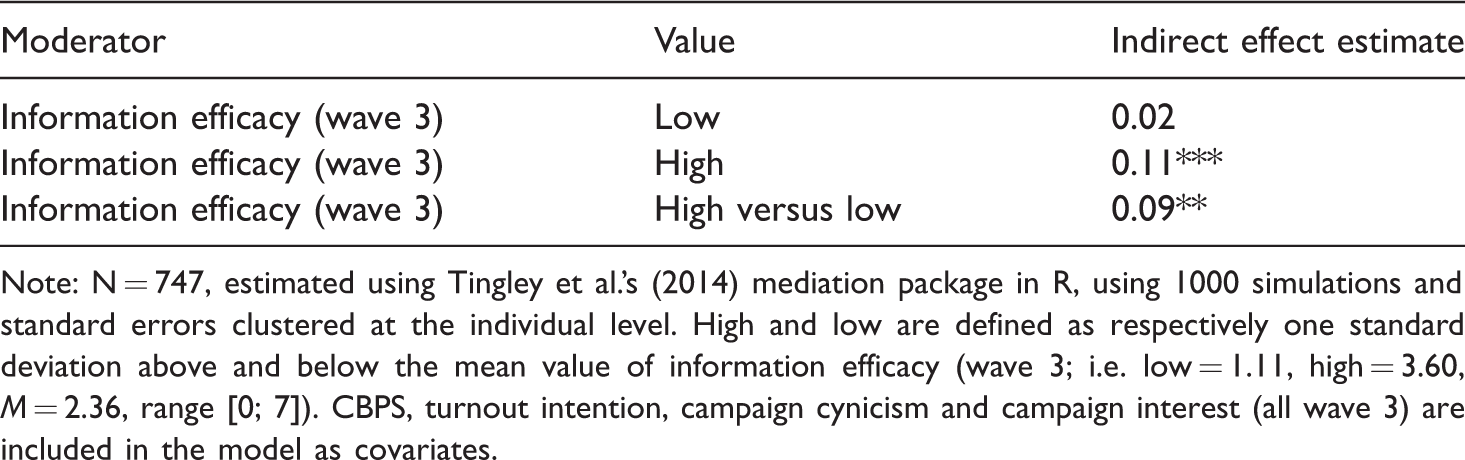
Note: N = 747, estimated using Tingley et al.’s (2014) mediation package in R, using 1000 simulations and standard errors clustered at the individual level. High and low are defined as respectively one standard deviation above and below the mean value of information efficacy (wave 3; i.e. low = 1.11, high = 3.60, M = 2.36, range [0; 7]). CBPS, turnout intention, campaign cynicism and campaign interest (all wave 3) are included in the model as covariates.
Discussion
This paper has examined the effect of exposure to poll coverage on young voter turnout via five potential mechanisms. Poll coverage plays a controversial role in election campaigns and in scientific debate, but the results presented here suggest it deserves a more positive image. Poll exposure has a positive effect on turnout for young voters, mainly through increasing campaign interest, and mainly for those with already higher levels of information efficacy: it taps into the potential among young voters who feel they have what it takes, to get them interested in the campaign and turnout to vote.
Five mechanisms that might explain the effect of exposure to poll coverage on turnout were considered. The first, bandwagon voting, assumed that voters find gratification in the positive feeling of voting for the winner: the bandwagon effect. Although other studies document the role that emotions might play in the effect of poll exposure (e.g. Stolwijk et al., 2016), it played little role for young voters in this campaign. As suggested above, this might be because the complex electoral system of the EP complicates determining clear winners and losers (cf. Hobolt, 2014). So in other types of elections, especially first-order ones, this effect might be more prominent.
The second mechanism, strategic turnout, was also not found to play a major role. Voters exposed to polls they perceive as positive regarding the chances of their preferred party did not turn out less often than when such polls were more negative. This is in line with experimental research suggesting that strategic turnout only has an effect when incentives are particularly high: in close races or under public voting rules (e.g. Klor and Winter, 2007; Morton and Ou, 2015). As discussed, this is an unlikely characterization of any EP election. Therefore, our findings do not rule out that strategic turnout might play a role in other elections, but not in the current context and the literature suggests effects to be relatively small.
The third (information efficacy), fourth (campaign cynicism) and fifth (election importance) mechanisms suggested opposing expectations regarding the most important mediator between poll exposure and turnout. When put in a direct comparison in our analysis, campaign interest was shown to play a much stronger role than either information efficacy or campaign cynicism. This finding supports the expectation that poll coverage implicitly signals to voters that the election is an important one, and worth investing (cognitive) effort into, resulting in increased campaign interest and turnout. As argued throughout this paper, campaign interest might be conceptually related to the other two: those with a higher information efficacy are likely to be more interested and less cynical. However, if interest was a by-product of the effects of either of these other mediators, its influence would be cancelled out when they are all included in the same model. However, the opposite effect was found. This suggests that campaign interest might play a more important and distinct role. A potential explanation for this is offered by the fifth mechanism proposed in this paper: that poll coverage implicitly suggests to voters that the election is important and relevant. This might prompt voters to become more engaged, which then causes increased information efficacy and decreased cynicism, but only as a side effect which largely disappears when interest is controlled for in the analysis. This interpretation is supported by the finding that the effect of poll exposure on interest and turnout is most pronounced for those voters with higher levels of information efficacy, since these are the voters most likely to respond to this importance cue. We encourage future research to directly measure how voters perceive the importance of the election over time to evaluate whether this is indeed the case.
Whether campaign interest plays a similar role in the effect of poll exposure on turnout for other (i.e. older) voters compared to young voters is an open question. As argued above, young voters generally have difficulty understanding the complex issues in election campaigns, and the difficulty of the European institutions and electoral system likely exacerbate these problems, which may make them different from more mature voters. However, Maier and Bathelt (2013) report that young voters actually know more about the EU than older voters. So knowledge and experience may trade off against each other and produce similar levels of initial information efficacy for both groups of voters (cf. Kaid et al., 2007). This was indeed the case for the Netherlands in the 2014 EP election. The survey used in this paper was part of a larger project which also included a random sample of the whole Dutch voting population. In that ‘adult’-sample the initial (wave 1) information efficacy was significantly higher than in the youth sample (2.83 vs. 2.53, p = 0.004, two-sided). Moreover, interest in polls is generally higher among adults, which is confirmed when comparing these two surveys (2.60 vs. 2.26, p = 0.02, two-sided). Both these differences would suggest the odds of poll exposure to be higher for mature voters, and the consequences on turnout to be larger. Taken together, we believe there is good reason to assume the effects reported here apply to the voting population at large.
Whether campaign interest plays a similar role in the effect of poll exposure on turnout in different types of elections is difficult to say. Söderlund et al. (2011) show that political interest is of particular importance for turnout in low salience EP elections. According to Moy and Rinke (2012), the effects of polls as a consensus heuristic, i.e. indicating the popularity of a party, is most likely in ‘rare’ situations, such as low-profile elections where little substantive issue information is available. Furthermore, the mechanism via increased perceived election importance is most likely to apply to those elections that are not already believed to be very important. Nevertheless, future studies might investigate whether this is indeed the case.
Low levels of turnout among young voters are a concern for the future of representative democracy as scholars warn that the current dip is likely to persist across the lifespan of this generation (Putnam, 2001). Whereas many other efforts to increase turnout have failed, this study shows that more poll coverage in secondary elections can be a good way to initiate the habit of voting through stimulating campaign interest, at least for those with higher levels of information efficacy. As campaign interest is not only associated with turnout but also with various civic values, such as political participation and knowledge, the results of this study present an optimistic perspective regarding the future of civic engagement, or the potential thereof, but also draws attention to the role of efficacy and the important differences between those feeling competent and informed enough to participate in democratic processes and those who do not.
Supplemental Material
Supplemental Material1 - Supplemental material for More interest in interest: Does poll coverage help or hurt efforts to make more young voters show up at the ballot box?
Supplemental material, Supplemental Material1 for More interest in interest: Does poll coverage help or hurt efforts to make more young voters show up at the ballot box? by Sjoerd B Stolwijk and Andreas RT Schuck in European Union Politics
Supplemental Material
Supplemental Material2 - Supplemental material for More interest in interest: Does poll coverage help or hurt efforts to make more young voters show up at the ballot box?
Supplemental material, Supplemental Material2 for More interest in interest: Does poll coverage help or hurt efforts to make more young voters show up at the ballot box? by Sjoerd B Stolwijk and Andreas RT Schuck in European Union Politics
Footnotes
Acknowledgements
An earlier version of this article was presented at the 2016 Annual Conference of the International Communication Association, Fukuoka, Japan. We like to thank the participants of the respective panel for their helpful comments. In addition, we like to thank the three anonymous reviewers and the editor of EUP for their constructive suggestions.
Funding
The author(s) disclosed receipt of the following financial support for the research, authorship, and/or publication of this article: This research project was supported by a Graduate Program Grant from the Dutch Science Foundation (NWO; grant number 022.003.037).
Supplemental material
Supplemental material for this article is available online.
Notes
References
Supplementary Material
Please find the following supplemental material available below.
For Open Access articles published under a Creative Commons License, all supplemental material carries the same license as the article it is associated with.
For non-Open Access articles published, all supplemental material carries a non-exclusive license, and permission requests for re-use of supplemental material or any part of supplemental material shall be sent directly to the copyright owner as specified in the copyright notice associated with the article.
