




Abstract
This article examines Lebanon’s informal, often opaque, migration governance in response to the Syrian refugee crisis (2012–2024), shaped significantly by EU external migration policies. Lebanon’s approach relies on elite bargains and back-door agreements, sidestepping formal policy processes within its sectarian, consociational political system. The EU’s influence, grounded in extensive financial aid, aims to contain refugee movements within Lebanon, aligning with its broader migration control objectives. However, Lebanon’s fragmented political structure enables it to selectively implement policies, leveraging its strategic position to secure funding without committing to strict compliance as a part of the country’s informal migration diplomacy. The result is a highly informalized, ad hoc governance model where NGOs play a critical role, but where elite corruption and clientelism continue to hamper effective policy. This dynamic underscores the power asymmetry between the EU and Lebanon, and reveals the limitations of externally driven governance models in contexts marked by political division and elite capture.
Keywords
I. Introduction
In a recent article, Zardo and Wolff (2021: 1) note that ‘research on migration in the Mediterranean has been very Eurocentric [and, despite] growing interest in non-European and non-European contexts, these are primarily conceived as targets of EU policies rather than as agents and loci of governance processes’ (italics in original). Importantly, they also point out that unlike policy processes typical of Western (European) countries, ‘written sources are not easily accessible, either because they are not included in public archives, or they are not even part of political bureaucratic practice’ (Zardo and Wolff, 2021: 10). This opens for an understanding of what they term ‘repertoires of migration governance’. This approach has important implications for studying externalization, a concept widely used to describe how the EU delegates migration control (functions), ‘in part or in whole, outside its territory’ (Cantor et al., 2022: 120). Despite the extensive literature on EU externalization, there is ‘very little knowledge of both frames and framing of migration beyond the EU’ (Zardo and Wolff, 2021: 11).
To better understand migration governance beyond Europe, Zardo and Wolff advance a three-part agenda aiming to decentre the study of migration governance in the Mediterranean. Theoretically, this involves ‘decentring agency’ by bringing in perspectives from non-EU countries beyond the policymaking elite, including both everyday resistance and contestation and marginalized perspectives or groups to uncover migration dynamics (Zardo and Wolff, 2021: 2) Methodologically, it involves decentring Eurocentric concepts and approaches for a new understanding of migration beyond Europe that takes account of the historically asymmetric power relations between Europe and former colonies turned ‘Southern partners’. Empirically, decentring involves including variables both within Europe (internal) and beyond as migration policies are applied to Middle Eastern states (external), here, in particular, Lebanon, a country that is part of the EU’s ‘Southern Neighbourhood’, a region reshaped by Syria’ displacement crisis, and since 2015 a geopolitical space defined as a transit for irregular migration towards Europe (Zardo, 2023). Linked to this, the EU employs policy instruments that reconfigure the EU funding landscape, in particular, the multi-layered migration governance in the Southern Mediterranean (Zardo, 2023: 118), with financial instruments targeting both sending states (here Syria) and neighbouring host countries such as Lebanon.
This article investigates a central paradox of EU–Lebanon relations: How does Lebanon manage to amass substantial donor funding from the EU despite its strategic non-regulation of refugee governance? And what does this reveal about informal migration diplomacy in asymmetric political contexts and the ways in which ambiguity and elite bargaining serve as tools of negotiation and resistance. While this study focuses on Lebanon, the dynamics observed are not unique to this context. Similar informal governance patterns have emerged in countries like Jordan, where refugee policies rely on informal coordination with donors and humanitarian actors and Egypt, where migration is governed through securitized bilateral arrangements (Tsourapas, 2019, 2020). These cases illustrate a broader trend in which states use ambiguity and informal negotiation to mediate external demands without fully institutionalizing formal refugee policy. This comparative perspective helps situate Lebanon within global patterns of migration governance under asymmetry.
To this end, this article examines EU migration governance in Lebanon in response to the Syrian displacement crisis (2012–2024). The analysis draws on recent advances in migration policy research, in particular, strategic non-regulation (Natter et al., 2023) and migration diplomacy (Ceccorulli, 2022; Tsourapas, 2025) to explain policy repertoires and host-state responses in the Middle East and North Africa (MENA). Migration diplomacy refers to the strategic instrumentalization of cross-border mobility by states to achieve domestic, bilateral and supranational objectives (Tsourapas, 2025). Extending from bilateral diplomacy frameworks (Adamson and Tsourapas, 2019; Tsourapas, 2019), it conceptualizes migration governance as a multi-level game, wherein states leverage their roles as host or transit countries to negotiate political, economic and security gains. They show how financial incentives are used to engage ‘Southern Neighbours’, a part of a broader ‘spatialization’ and containment of refugees in the MENA region (Zardo, 2023).
Thus, rather than viewing Lebanon’s refugee response solely through the lens of domestic inaction and non-regulation (Natter et al., 2023), we argue that informal refugee governance serves as a form of migration diplomacy enabling Lebanon to navigate EU containment pressures while retaining control over its sovereignty and funding flows. This shift from ‘strategic non-regulation’ to ‘informal migration diplomacy’ brings to light the ways in which fragile host states negotiate power asymmetries and extract concessions from international donors through ambiguity, informality and elite-level bargaining. This dynamic is emblematic of what has been termed ‘non-performativity in migration diplomacy’, where rhetorical commitments to refugee return are not matched by concrete implementation, thus capturing how both EU and Lebanese actors engage in symbolic posturing while avoiding substantive policy shifts (Stel, 2025). Examples from Middle Eastern states suggest that strategic non-regulation can be understood as a regional mode of migration governance where evasion, displacement and standoffish approaches are not only commonplace but also systemic.
The article begins with an overview of the Syrian displacement crisis, followed by an outline of the EU–Lebanon collaboration frameworks and funding modalities and a review of the external (EU) and internal (Lebanon) policy contexts. The methods section provides details of the qualitative research design, interview data and methods. The findings from the analysis of interview data are detailed in three sections covering the EU–Lebanon’s lopsided partnerships, discursive control and policy informalization, and securitization of migration governance. The article ends with a conclusion and policy implications.
Syria’s Displacement Crisis
Lebanon is a ‘non-signatory state’ having ratified neither the 1951 UN Refugee Convention nor its extension, the 1967 Protocol. Lebanon does not have a national refugee law, and its refugee policies are based on the 2003 Memorandum of Understanding (MoU) that grants refugees temporary asylum under the patronage of the UNHCR (Janmyr, 2017a). Consequently, asylum is time-limited and should be followed by resettlement. Owing to other international legal obligations, however, Lebanon is required to protect refugees from forcible return (‘non-refoulement’).
Lebanon’s status as a refugee host state was cemented after 2011 when more than a million Syrians displaced by the country’s conflict-turned-civil-war sought refuge in Lebanon, leading to the largest demographic change in the country’s history. 1 Using the refugee label for Syrian refugees was highly contentious (Janmyr and Mourad, 2018). Syrian refugees are in legal terms defined as ‘displaced’ (Ar. nazihun) rather than as refugees (Ar. lajiun) and do not have the right to asylum (Janmyr, 2017a, 2018; Mourad and Norman, 2020). The first MoU between the government and the UNHCR included a provision that refugees recognized by UNHCR should be resettled within a year; hence, it fell short of safeguarding protection consistent with the refugee convention and was later seen as a mistake by the UNHCR. In 2011, the UNHCR attempted to renegotiate the MoU and bring it closer to the convention, but this was rejected by the government. The UNHCR therefore remains caught between international refugee law and Lebanese policies on Syrian displacement (Janmyr, 2017b, 2018).
From 2014, security issues following the massive Syrian refugee influx led to a convergence of interests among politicians and the start of a more assertive policy position by the government (Geha and Talhouk, 2018). In parallel, host–refugee relations soured in the face of a contracting economy, lack of affordable housing and unemployment. In October 2014, the Council of Ministers issued the Policy on Syrians (‘October Policy’) restricting entry into Lebanon (Fakhoury, 2017: 686). The October Policy was the only formal policy agreed to and produced at the behest of the EU, without which it was impossible to agree on an aid package for Lebanon (Fakhoury, 2014). In January 2015, the General Security Directorate, acting on behalf of the government, issued a directive to change the regulations for entry and residency of Syrians in Lebanon, and in May of the same year ordered the UNHCR to stop registering Syrians. Despite internal crisis and power struggles, the Syrian refugees were turned into a bargaining chip with new demands for funding. This coincided with the EU boosting funding to keep refugees in Lebanon and prevent secondary migration towards Europe and host states, leveraging the Syrian displacement crisis to access more donor funding (Tsourapas, 2019).
Despite the UNHCR’s initial push for establishing refugee camps in response to the Syrian displacement, the Lebanese government refused, considering their experience with Palestinian camps and militancy (Fawaz, 2017). The situation for self-settled Syrians in Lebanon has gradually deteriorated due to restrictions on employment, residency and mobility (Mourad, 2017). There is political, economic and social pressure for Syrians to leave Lebanon, fuelled by the spiralling debt, economic crisis and xenophobia. 2 The result has been a diversification of legal status and an increase in irregular entry and residency among Syrians in Lebanon (Janmyr and Mourad, 2018). Internal power struggles shifted the Syrian refugee file from the legislative to the executive branch, restricted refugee arrivals, ended refugee registration and instituted a new and restrictive admissions system modelled on the sponsor system used for migrant labourers (Ar. kafala), pushing Syrian families further into debt due to lack of legal residency and unemployment. In response to the refugee influx, the EU increased development funding to Lebanon on the condition that it serves both Lebanese and Syrian communities.
Lebanon has voiced opposition and dissented on refugees, seeing permanent settlement of the refugees as an existential threat, hence seeking their rash and unconditional return. The EU only supports ‘uncoercive’ return when conditions allow and as part of a political settlement in post-Assad Syria. In Lebanon, politicians have criticized donor aid for perpetuating the refugee presence and preventing their return. As an interim solution, the EU proposed a ‘resilience-building agenda’ centred on new development aid. Disagreements over refugee return have since continued, with both parties reaffirming their opposing stance on refugee return, with Lebanon seeing its sovereignty undermined as well as domestic laws on employment overridden or challenged.
In May 2019, the government announced that all Syrians arriving irregularly before 24 April 2019 would be deported (Fakhoury and Ozkul, 2019). The EU and UNHCR have warned against forced return due to the conditions in Syria but have no authority to intervene. To facilitate the voluntary return of Syrians, Lebanon adopted a National Return Plan in 2020 (Topalian, 2020). The plan contradicts the country’s international commitment to ‘non-refoulment’ and amounts to a soft deportation of Syrian refugees (Fakhoury and Stel, 2023: 1025). In July 2022, Lebanon’s caretaker government announced plans to return thousands of Syrian refugees, a move decried as unsafe and unlawful and in breach of the country’s international obligations. In practice, the EU has deferred to Lebanon’s resistance to becoming a permanent host state and, by implication, left safe and dignified return to be managed by the UNHCR.
Much of the existing research on Lebanon’s handling of the Syrian displacement crisis has focused on the so-called ‘no-policy’ or ‘policy of non-policy’, arguing that Lebanon did not take any steps to control the flow of refugees, nor their self-settlement across the country (Knudsen, 2017). However, the country’s policy approach is more strategic and complex than what is commonly acknowledged (Mourad, 2017; Nassar and Stel, 2019; Sanyal, 2017), and from 2015 changed from a mere recipient of aid to a ‘player’ capitalizing on the crisis (Geha and Talhouk, 2018).
Partnerships and Funding Instruments
The EU’s policies towards the Mediterranean region date from launching the Global Mediterranean Policy in 1972, which over the coming years shifted from ‘region building’ to target irregular migration and border management (Zardo, 2023: 120). The EU–Lebanon partnership policies date from the 1995 Barcelona Declaration that established the Euro-Med Partnership (EMP), the Common Strategy on the Mediterranean (2000) and the European Neighbourhood Policy (ENP). The 2002, EU–Lebanon Association Agreement is the only legally binding document that governs migration between the EU and Lebanon (Seeberg and Zardo, 2020: 4). EU and Lebanon have since signed several policy agreements, action plans and partnership platforms supported by financial instruments and donor conferences (Table 1). The current framework for EU–Lebanon policy relations on migration is implemented under the New Agenda for the Mediterranean (2021) and the Pact on Migration and Asylum (2022), aiming to strengthen Southern partnerships and manage migration according to the EU’s new asylum regulations finalized by the EU Council in May 2024.
EU–Lebanon Migration Governance Framework, 1995–2024.*
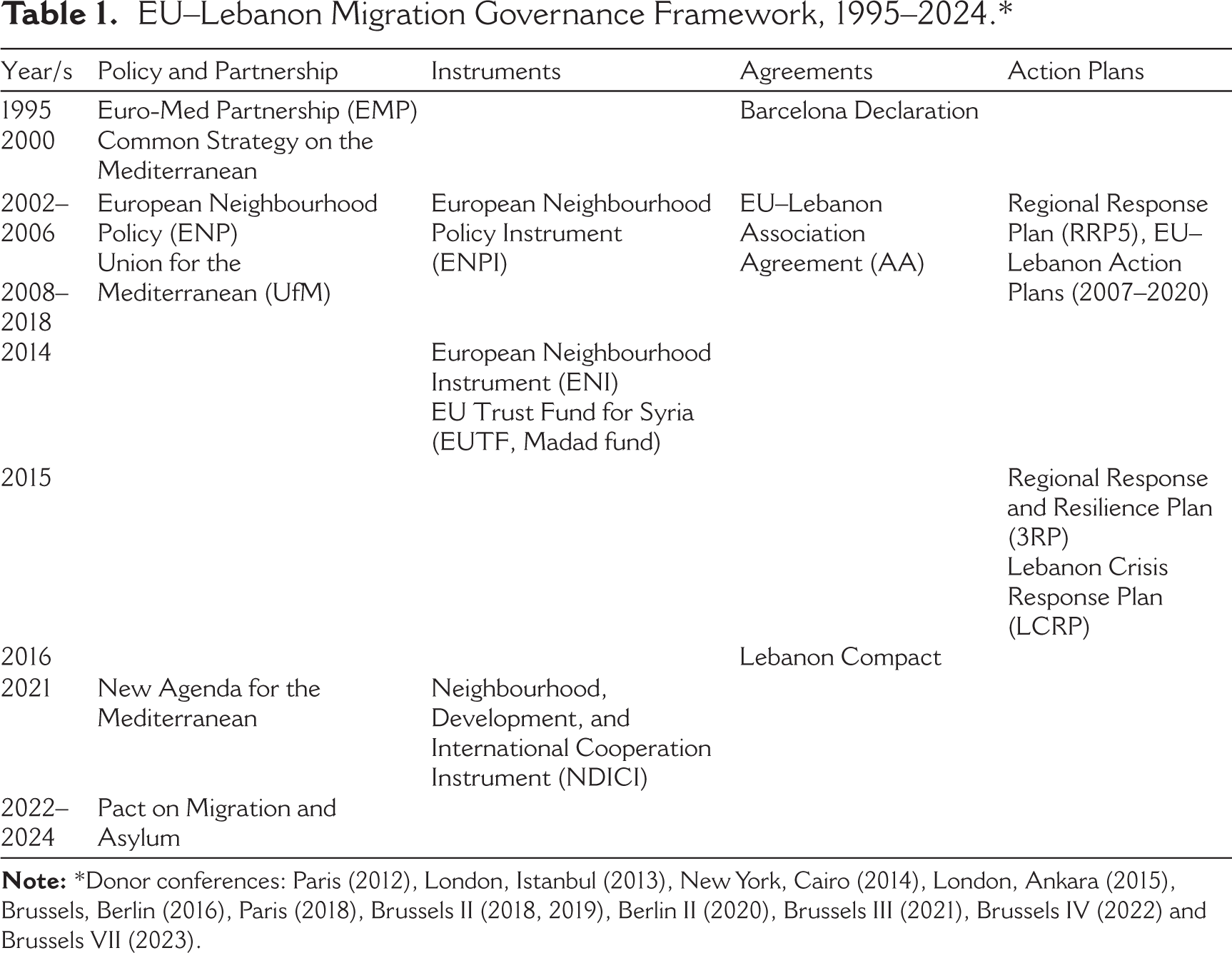
Following the Syrian displacement crisis, the Regional Response and Resilience Plan (3RP), the Lebanon Crisis Response Plan (LCRP) and the EU Trust Fund (EUTF) aimed to support Syria and neighbouring host countries and improve livelihoods for Syrian refugees and impoverished host-state communities (Table 1). 3 The total grant funds to Lebanon across regional, bilateral and multilateral (multi-donor trust funds) platforms is difficult to ascertain, but a crude estimate amounts to about €15b since the start of the Syria crisis in 2011 4 and mainly raised by the EU member and non-member states under the Neighbourhood, Development and International Cooperation Instrument (NDICI) (€3.5b), 5 with an additional €9.4b in loans pledged at the 2018 Paris donor conference. The largest multi-year grant is the LRCP (€8.5b), Lebanon’s share of the 3RP facility for Syria, the United Nations’ largest aid platform disbursing US$26b since its inception in 2015 (3RP, n.d.).
From 2019, Lebanon suffered from cascading shocks—the COVID-19 pandemic, political and economic crises, followed by the devastating Port of Beirut blast. From 2020, Lebanon lobbied for more funding in the face of imminent breakdown and government collapse, and in 2024 was granted an additional €1b from the EU Commission. 6 The total grant volume and modalities testify to the EU’s incentive-based policy response (Zardo, 2023: 120–22), aimed at influencing migration governance in Lebanon. The EU is also Lebanon’s largest trading partner, valued at €6.1b in 2023. At the Brussels Conference hosted in May 2022, Lebanon informed the UNHCR that it no longer could remain a refugee host state. This demonstrates that European efforts to first ‘stabilize’ and later ‘strengthen resilience’ in Lebanon had failed (Fakhoury and Stel, 2023).
II. Policy Context
External Migration Governance
In the context of the Middle East, external governance approaches involve transferring EU policies, laws and rules to Southern states and MENA countries, with the EU acting as a ‘normative power’ (Del Sarto and Tholens, 2020: 9). However, alternative approaches argue that the EU is a ‘realist actor in normative clothes’, meaning that the EU in its dealing with partnership countries in the South has relaxed normative objectives such as democratization promotion. In the case of Lebanon, the country’s ‘dual power situation’, failed power-sharing mechanisms and political system regressing from the turn of the 2000s (Seeberg, 2009: 83) made the EU pursue a more pragmatic democratization agenda. Although acknowledging that Lebanon is less autocratic than other states in the Middle East region, the ultimate decision-making and veto power are held by the country’s elite. To understand the trajectory of EU–Lebanon relations in the field of migration, the Syrian refugee issue is a ‘critical juncture’ in EU–Lebanon relations, one displaying a definite ‘path dependency’ that can help identify and explain institutional stability and change vis-à-vis migration management and policy (Seeberg, 2018).
Lebanon, a small and precarious state, has not been a passive agent but reappropriated the EU’s externalization policy, adapting and adjusting it to fit elite priorities and domestic challenges, and with formal policies co-existing with informality (Fakhoury, 2021b: 263). The large, strategically important MENA states such as Turkey and Morocco have resisted the EU’s migration directives yet remained trusted partners of the union (Cassarino, 2020), while Lebanon’s resistance to Syrian labour integration and demand for refugee return has led to a policy overstretch where the country has overplayed its hand and lost influence with the EU.
Central to the understanding of EU policy and migration governance is the nature of the EU borders, bordering practices and the creation of new ‘borderlands’ (Del Sarto, 2010). Westphalian borders have been replaced by overlapping ‘border regimes’, a part of new and hybrid ‘border geometries’ that have been extended beyond the EU’s borders to its southern periphery or ‘neighbourhood’, thereby outsourcing EU border controls where migration control and combatting illegal immigration is key. This entails expanding and exporting the EU’s legal boundaries to third countries that are excluded from the its decision-making process, but the unequal power relations have been concealed and blurred by the literature on ‘Europeanisation’ and ‘normative power’. There is a duality in the sense that the drivers of migration (inequality and conflict) are located outside of the EU, while the drivers of migration policy are located within the union, leading to a policy of externalization with non-EU members as Southern partners.
In the relations between the EU and third countries, conditionality has been replaced by a ‘more for more’ principle that links partnership development with democratization progress (Fakhoury, 2020b: 142). Still, the EU policies from 2011 gravitated towards security and border practices and migration compacts that came at the expense of refugee protection. The EU migration policies have been contested by Southern states and partners and compliance ranges from dissidence and rejection to implicit neglect and disregard. The EU policies on refugees clashed with local perceptions and ‘sheds light on … the power of contestation as a bargaining tool … often at the expense of refugee protection needs and rights’ (Fakhoury 2020b: 157).
The EU’s hardline migration policies stopped migrants in their tracks but clashed with the union’s values emphasizing the protection of migrants. The migration-cum-refugee crisis also challenged the ‘internal and international legitimacy of the European Union’ (Seeberg and Zardo, 2020: 5). Internally, the EU was faced with a ‘triple crisis’—Euro, refugees and Brexit—the union’s institutions successfully overcame the eurozone crisis, but not the internal divisions over the latter two, with the refugee crisis in particular exposing internal cleavages between the member states (Caporaso, 2018: 1359).
Actor-based analysis of EU migration governance finds that since 2015 the ‘new normal’ of high migration pressure towards the union was framed as driven by economic inequality (‘choice’) rather than persecution (‘necessity’), which constrained the union’s policy repertoires (Geddes and Hadj-Abdous, 2018). Despite being committed to a so-called comprehensive approach, the EU’s deterrence policies and security-driven approaches influenced mobility partnerships with MENA states. Rather than dealing with the underlying drivers of migration, the EU’s ad hoc policies resembled a ‘whack-a-mole game’ (Geddes and Hadj-Abdous, 2018: 157). The ad hoc approach to migration also underwrote the EU’s Global Approach to Migration and Mobility (GAMM). Launched in 2005 and amended over the next couple of years, GAMM is a framework for cooperation between EU and third countries on migration and asylum (European Commission, n.d.). However, the ‘triple-win’ outcomes benefitting sending, destination states and migrants failed to materialize, with the security-driven approaches ‘only allowing restricted, temporary, and highly selective forms of migration’ (Geddes and Hadj-Abdou, 2018: 153).
The EU has toned down the ‘deep democracy’ policy adopted after the Arab Spring in 2011 and shifted to a stabilization agenda to contain the fallout of the Syrian conflict in Lebanon. Resilience building involved bilateral dialogue aiming towards policy convergence, that is, harmonizing Lebanon and EU policies in the field of migration and refugee governance as well as establishing cross-sectoral linkages between ‘migration, mobility, trade, security, and development’ (Geddes and Hadj-Abdou, 2018: 147). In this context, Lebanon as a transit country was re-framed as a bulwark against irregular migration towards Europe and the EU became one of the main funding bodies in Lebanon. This approach was justified as part of a ‘broader politics of resilience-building’ (Fakhoury, 2020a: 3) that after 2015 ‘offer[ed] avenues to outsource migration control and prevent onward migration by offering refugees the solutions of self-reliance and resilience’ in the countries of reception (Forster and Knudsen, 2022: 22).
The EU has been constrained by a widening gap between the union’s asylum laws and the practices of disunited member states. Failing to overhaul the union’s asylum policies has overburdened Southern member states turned refugee host countries such as Lebanon (Trauner, 2016). A review of the EuroMed partnership from 2008 onwards characterizes the EU’s partnership policies towards the Middle East region ‘as disjointed, even chaotic’ (Cardwell, 2011: 220). The reasons can be found in the three processes or tracks: the EuroMed Barcelona Process (1995), the European Neighbourhood Policy (2004) and the Union for the Mediterranean (2008), all involving different meanings ascribed to the term ‘Mediterranean’ and involving a different set of member states. The same fuzziness applies to the term ‘governance’ and its corollary ‘good governance’, which can be interpreted as specific legal and rule-based interactions between diverse state and institutional actors.
A study of elite perceptions of the EU in Lebanon found that most are unaware of the legal frameworks underwriting the EU–Lebanon relationship: the EU was not an ‘active political player’ in Lebanon, but rather a ‘funding source’ and ‘soft player’ (Goulordava, 2019: 157). There was also a perception that bilateral relations were guided by the policies of individual European states. The Middle East served as a physical barrier against onward migration towards Europe, in effect ‘outsourcing securitisation’ and making local governments such as Lebanon ‘do their dirty work’ (Goulordava, 2019: 159). The Syrian refugee crisis undermined the EU’s soft power appeal in policy negotiations with host countries such as Lebanon against Europe’s history of colonialism in the region. In Lebanon, the EU’s restrictive policies were interpreted as a move towards the regional containment of Syrian refugees, a securitized process underwriting a lopsided, rather than a reciprocal, relationship between the EU and host states.
Host State Agency and Policy Repertories
Studies of the EU’s externalization policies argue that they combine ‘incentives and massive pressure to nudge their “Mediterranean partners” into adopting policies and legislation that correspond with European preferences, not to mention training, regular dialogues, and persistent attempts to selectively transfer European rules and practices’ (Del Sarto, 2021: 123). This does not mean that MENA states lack ‘agency’. Rather than accepting whatever the EU and member states suggest or seek to impose in fields such as trade, banking, security sector reform (SSR), democracy promotion and border management, the host states have challenged, altered, cherry-picked and paid lip service to policies according to their means and interests (Del Sarto, 2021: 129). There are also examples of ‘externalization in reverse’, where MENA states have successfully marshalled the EU’s security concerns to ward off migration interventions they do not approve of, forcing the EU to prioritize stability over reform. Migration diplomacy, defined as ‘the strategic use of migration flows as means to obtain other aims or the use of diplomatic methods to achieve goals related to migration’ (Adamson and Tsourapas, 2019: 116), shows how the EU leverages geopolitical agendas, consolidates domestic rule and asserts power over neighbouring countries by instrumentalizing migration mobility (Tsourapas, 2025).
The field where the MENA states have the most leverage with the EU is migration and border management. In recent years, MENA states have strengthened their bargaining power, as exemplified by Turkey’s 2016 deal with the EU (Tsourapas, 2025: 136–38), yet the bilateral relations are mediated by a complex interdependence. The fact that the relationship between the EU and its partners is asymmetrical, with the EU the stronger actor, does not mean that the EU can do as it pleases. In the fields of migration management, border and security, MENA states have considerable bargaining power that they can leverage in the negotiations with the EU (Zardo and Wolff, 2021: 6).
Indeed, host states may draw on, strategically employ and even thrive on fragmentation and informality to blur responsibility over safe and dignified return (Fakhoury, 2021a: 164). This ‘indifference as policy’ can in part be explained by the nature of Lebanon’s fragmented and hybrid polity marked by ‘complementary governance’, ‘dual-power situation’ and continuation of political clientelism, leaving little room for bureaucratic autonomy. Fragmentation hence results from political divisions and competing legacies as refugee hosts, resulting in conflicting views on refugee returns, tempered by the country’s need for donor grants and loans from the EU. The outcome is a de facto policy where fragmentation and informality enable Lebanon to shirk its international commitments, contest legal norms and externalize refugee responsibility. As a system of migration governance, strategic non-regulation takes place outside formal channels and includes inaction, indifference and ambivalence (Natter et al., 2023: 7). Rather than evidence of state failure, strategic non-regulation persists because it serves the interest of ruling elites and state actors. In the same vein, states contest the EU’s attempt to ‘regulate regions hence better understood as policy agents than passive policy recipients’ (Fakhoury, 2022: 2908).
Lebanon’s political system is based on consensus across sectarian divides with intractable conflicts solved by foreign intervention, third-country diplomacy or elite deals and bargains. When political compromises are not found or not forthcoming, political violence is the last resort, as evidenced by Lebanon’s post-2005 crisis after the assassination of former prime minister Rafik Hariri. The assassination locked the country in a state of prolonged crisis involving stalemate between political parties, sectarian groups and interim coalitions (8 March, 14 March), as well as long periods without government and the postponement of elections (Fakhoury, 2017). These internal divisions had not been resolved by the time of the Syrian conflict and the start of the displacement crisis in 2011–2012.
The political stalemate also results from the limitations to consociational power sharing in deeply divided societies (Baumann, 2023; Fakhoury, 2014; Nagle, 2016). According to the classic treatise of Lijphart (1977), consociational polities have four general characteristics: grand decision-making coalition, mutual veto, proportionality (in representation, civil and government posts, public funds) and internal autonomy. As a system of government, consociational polities depend on inter-elite collaboration, a willingness and capability to solve problems, and dependent on a ‘relatively low total load on the decision-making apparatus’ (Lijphart, 1969: 218; italics in original). The Syrian uprising and displacement crisis were deeply divisive, with one government partner, Hizbollah, involved in advising and fighting alongside the Assad regime. This overloaded the power-sharing system and led to governmental deadlocks.
As a deeply divided country, the political system is vulnerable to deadlocks and ‘immobilism’ (Lijphart, 1969: 218), especially when foreign powers and backers are at loggerheads. Lebanon’s political system has regressed since the murder of Prime Minister Hariri in 2005 (Seeberg, 2009: 83), and the country has since been governed by ‘national unity governments’, that is, grand coalitions of all parties represented in parliament (Knudsen and Kerr, 2012). This brings friends and foes into (dis-)unity governments, squabbling for months over the division of bloated minister posts, often more than 30 for a country of five million citizens. Governmental deadlocks are solved by the elite’s informal deal-making outside of governmental channels. Consociationalism has become obsolete, and the lack of elite circulation has enabled a system of ‘communitocracy’, whereby the country’s elites consolidate political clientelism and entrench sectarianism to stall reform (Cortés and Kairouz, 2023: 11). The elites infiltrate, besiege and coopt CSOs which appropriate funds bypassing the government and, as the main recipient of foreign funding, capitalize on the Syrian refugee presence (Clark and Salloukh, 2013). The political elite acts as a party cartel, which despite internal and ideological differences, forms power-sharing coalitions to protect their political and economic interests but are unable to agree on public policies (Assouad, 2023).
The EU’s pragmatic policy and funding modalities have mostly ignored the endemic corruption, fragmentation and mismanagement within the Lebanese political system, which ranks as one of the most corrupt in the world (Transparency International, n.d.). Overall, EU policy choices were largely disconnected from the events unfolding on the ground and were used to uphold the political elite rather than improve livelihoods. The EU’s policy directives empowered the political elite outside the institutions of the state and amounted to an authoritarian upgrading like that found in many Middle Eastern states in the period before the Arab Spring (Geha, 2016; Heydeman and Leenders, 2013).
III. Methods
This study draws on 28 semi-structured interviews conducted with civil servants, academics, CSOs, INGOs and government officials and representatives. The fieldwork was supplemented by a literature review of national and international (EU) migration policy in Lebanon (Forster and Knudsen, 2022), as well as information collated from a stakeholder seminar in Beirut attended by academics, NGOs, INGOs and executives leading the EU’s media section and Arab NGO networks. The interviews were collected over a 6-month period (January–June 2023) and preceded by field testing pilot interviews in December 2022. Most interviews were conducted in Arabic, with the majority recorded, translated and transcribed into English. The interviewees were informed in writing of the project’s aim and the right to retract consent to interview and review transcriptions. The interviews were recorded after securing verbal consent, recorded as part of the interviews. In the few cases where the interviewees did not consent to be recorded, the summaries relied on written notes. Anonymized English transcripts were shared among the research team, while original audio files were securely stored at the host institution. Ethical approval was granted by both the Norwegian Data Protection Services (Sikt) and the Institutional Review Board (IRB) at the American University of Beirut in Lebanon (SBS-2022-0369).
The interview guide was based on a generic list of interview themes defined by the project’s regional and thematic scope (CMI, n.d.) and adapted to fit the policy context in Lebanon by the authors. The interviews were analysed for content and coded (codebook) through a combination of deductive and inductive approaches. Initial codes were drawn from the interview guide and relevant literature on EU migration governance and subsequently refined through close reading of transcripts to capture emergent, context-specific themes. Codes were applied manually to identify patterns in policy narratives, institutional responses and local interpretations of EU engagement.
While most of the local and international organizations are in the capital Beirut, a few migration-specific interviews were conducted in Tripoli (North Lebanon). Local accounts are critically analysed not merely as expressions of local voices, but as situated narratives embedded within Lebanon’s fragmented and politically complex governance landscape, highlighting how decentralization processes both empower and constrain local actors. A few senior-level actors and institutional stakeholders declined to be interviewed for the study or failed to return interview requests. The reasons for this cannot be ascertained but may reflect the political sensitivities and securitized environment surrounding migration governance in Lebanon. Despite this caveat, the interviews represent a cross-section of relevant agencies and stakeholders and provide a nuanced local perspective of how the EU migration policies have been instrumentalized and resisted in Lebanon.
IV. Findings
Lopsided Partnerships
In 2002, Lebanon signed the EU–Lebanon Association Agreement and joined the Euro-Med Partnership. Lebanon was supposed to reform certain sectors including agriculture and services to comply with the EU standards. Unfortunately, ‘Lebanon wasn’t able to do any of these reforms, because they were interrupted by the [2005] assassination of [Prime Minister] Rafik Al Hariri’ (Government advisor, GA01). Despite the Association Agreement’s focus on human rights and democracy promotion, Lebanon did not take steps to ensure civil society participation, public transparency or democratic elections; hence, ‘the whole process was a mess’ (GA01). Moreover, the volatile security context in the region led to the ‘securitization of the Neighbourhood Policy, where instead of increasing the political role and supporting the transition and political movement, the EU went for more security. This meant an increase in security budgets, and in preventing human mobility’ (GA01).
From 2008, the Union for the Mediterranean aimed to create new transportation networks, infrastructure and services between EU and Southern partners, but due to the ‘deadlock of the peace process mainly with Israel, everything was interrupted’ (GA01). The Arab Spring (2010–2011) took Europe’s leaders by surprise, and the challenge to authoritarian rule and the new security concerns that followed in its wake made the EU focus regional policies on democracy promotion, elections and strengthening the judiciary. Due to the internal problems in the EU and among member states, the union’s policies turned more Eurocentric. This, in turn, influenced the collaboration with the Southern partners, some in a crisis like Lebanon, others delayed or deferred for political reasons, and made the EU opt ‘for a bilateral instead of multilateral or regional framework’ (GA01). Dealing with states bilaterally, ‘Lebanon alone, Jordan alone, Tunisia alone’ weakened the states’ bargaining power vis-à-vis the EU (Local analyst, LL04).
From 2011–2012, the Syrian civil war led to acute political instability, realignment and readjustment in Lebanon with long periods of parliamentary deadlocks and presidential vacancies. This partly explains why Lebanon was unprepared to tackle the wave of Syrian refugees self-settling across the country. The government was divided over how to handle the fallout from Syria’s civil war but concluded that the conflict would end quickly by either regime win or defeat; hence, there was no need for taking sides or formulating a policy (Government official, GO02). When the displacement crisis began in 2012, internal divisions and polarization over the Syrian civil war precluded consensus and the government stopped refugee registration to remain neutral, and the General Security Directorate instructed the UNHCR to stop registering new arrivals. This deliberate inaction created a policy vacuum that allowed international actors to assume responsibility for refugee management, signalling minimal state compliance while preserving Lebanon’s political neutrality (NGO staffer, LNGO03). 7 This led to a privatized response with the UNHCR, INGOs and CSOs filling the void. The only red line was not allowing refugee camps, to avoid repeating the indefinite settlement of camp-based Palestinian refugees. Historically, the non-integration of Palestinian refugees has been one of the few issues where Lebanon’s parliamentarians agree. With Syrian refugees self-settled across thousands of sites across the country, this led to the support for Lebanon as the host country and a series of donor conferences where EU member states committed funding under the regional and national response plans (Table 1).
Admitting one million Syrian refugees burdened the country’s infrastructure and contracted the economy, amidst massive EU funding benefitting the UNHCR. In one year, the funding to the UNHCR increased nearly 10-fold from US$49m in 2012 to US$362m in 2013, but the UNHCR did not press for reform to avoid confrontation with the government (Janmyr, 2018: 396). Both the massive funding and the agency’s role in stewarding the displacement crisis are controversial and likened to ‘managing an [aid] bazaar (Ar. dukan)’ (Government official, GO02).
There is also the problem of who are the EU’s interlocutors in policy processes. When the EU bypasses the government in favour of NGOs filling in for the state, the decentralization of decision-making ‘creates chaos, [and] duplication of work’ (Local analyst, LL02). Because the EU considers Lebanon a failed, even a corrupt, state, the ‘EU is not paying directly to the Lebanon’s government but paying NGOs and think tanks’. This arrangement not only reflects donor mistrust but also serves the Lebanese state’s strategic interests. By directing and facilitating EU funding flows towards NGOs and international organizations, the government shifted both the administrative burden and the political accountability away from state institutions. In practice, this outsourcing created a dual effect: it reassured European donors that humanitarian needs were being addressed while simultaneously enabling the Lebanese authorities to maintain a minimal policy stance and avoid implementing politically contentious reforms. The diversion of EU funding to NGOs also defers policymaking to the NGO sector, thereby sidelining or bypassing the state. This, however, raises accountability challenges on the part of the NGOs. While the government is elected every fourth year, ‘who elects NGOs, who elects think tanks? What’s their accountability? Nothing! Lebanon is a paradise for NGOs’ (Local analyst, LL04). The NGOs, on their part, complain that they must fill in for the government’s inaction, which leads to a ‘bottom-up process’ when there should have been state-led (legal) implementation mechanisms (CSO board member, LCSO02).
Discursive Control and Informality
The EU not only controls research agendas and funding but also displays a discursive control and hegemony to the detriment of Lebanon: ‘They [the EU] get to control the discourse [on migration], because it’s all about conditionalities. You are going to study refugees? Sure! You are going to study healthcare? Sure! You want to study the political economy of profiteering? No way!’ (Local analyst, LL04). The power imbalance on the part of the EU is also evident in the frequent visits to Lebanon by EU staff who, earning many times the local salaries, are tasked with analysing data, designing and ultimately framing the policies that ‘externalize the refugee [problem] as a humanitarian issue’ (LL04). The power imbalance on the part of the EU is symptomatic of European unilateralism, and rather than a reciprocal relationship, ‘the EU determines the budget and tells us this is what you must work with. There is no agency [on the part] of Lebanon and a power dynamic [that is skewed] in the interest of Europe’ (Local analyst, LL02) On a regional level, this may also be related to the country’s isolation and falling out of favour with the EU. Despite the country’s historical importance to the West, Lebanon ‘is losing its position and as a point of reference for the EU’ (Local analyst, LL06).
The policies that are agreed upon and implemented benefit the rich and privileged elites, often in the form of ‘back door’ policies that ‘are carried out covertly, without public or official knowledge and approval’ (Local analyst, LL02), with informal and formal policymaking co-existing. There are also examples of policies being proposed that are intended to be neither passed nor implemented; indeed, laws ‘are only implemented when they serve elite interests and not when they benefit the people’ (NGO advisor, LNGO03). Lebanon’s parliament is rarely able to legislate by passing bills into law. For instance, rather than enacting binding legislation or a comprehensive framework which would require cross-sectarian consensus and reduce discretionary power, elites rely on temporary circulars, ad hoc decrees and non-binding policy papers to signal nominal alignment with EU priorities (GoL 2014). For this reason, what amounts to a ‘policy’ is vague and often limited to a set of practices that are neither written nor passed as law and thus institutionalized (Government official, GO02).
Political decision-making takes place outside of the formal political fora and institutions, with internal divisions paralysing the parliament for weeks and months and MPs staying away, which creates a lack of quorum. This explains why policymaking is opaque, informal and ‘contained within a black box’ (Local analyst, LL02). There is a low level of policy institutionalization; therefore, informal and formal policymaking act in unison, with ‘informal politics becoming an integral part of the system’ to the degree that ‘the informal is becoming systematized’ (LL02). The state is complicit in this process, with informality persisting because the political system ‘has not fully taken shape and continues to be dominated by elite and communal interests to ensure their persistence in government’ (Local analyst, LLO5). Due to the lack of institutionalization of the political system, ‘the formal track, that is using the parliament, or having a ministry take action, is secondary in Lebanon’. There are no comprehensive rights-based policies; instead, informal politics prevail and cater to the priorities of the country’s elites and ‘address the needs of powerful actors like the private sector, countries like the EU, politicians, and groups’ (LL02).
The main aim of the EU policies towards Lebanon is to constrain secondary settlement of refugees towards Europe and use economic aid to ensure continued government support for hosting them: ‘The EU’s principal interest in negotiating with Lebanon is to keep migrants in Lebanon, [using] the carrot and stick, carrots can be development aid, or funding from the donor conferences’ (Local analyst, LL04). In 2024, the EU pledged over US$1b in aid to Lebanon as part of the regional refugee response, illustrating how the combination of Lebanese informal political practices including limited registration, selective deportations, xenophobic campaigns and elite-controlled discourses on refugees aligned with EU objectives to contain migration within Lebanon. The EU funding is used to incentivize elites to support Lebanon as a hosting solution for refugees destined for Europe, with Lebanon at ‘the receiving end of both migration and migration aid’ (LL04). As one government official put it, ‘Lebanon does not have a strategic policy, but it surely has an interest to increase the financial help it is getting, because of the Syrian presence’ (GO03).
The EU–Lebanon engagement on refugee return exemplifies what Stel (2025) conceptualizes as non-performativity in migration diplomacy, a mode of governance in which the performance of policy commitment substitutes for actual implementation. Through rhetorical excess and strategic inaction, both actors maintain the status quo. This logic is reflected in the EU’s creation of an extensive infrastructure to fund NGOs and promote a discourse of resilience. ‘This is because they don’t want refugees coming to Europe. They prefer to have them here [which] reflects the profound political and economic power imbalance on the part of the EU’ (LL04). In this respect, Lebanon can be labelled ‘a laboratory of humanitarian governance in the region’. The states are no longer the only actors; instead, there are NGOs, social movements, trade unions and others, where refugees have become chips in a wider bargain. Since the EU does not have a common policy, ‘the policies are formulated internally and imposed or negotiated country by country [with] one state at a time, rather than with Arab states [collectively]’. In this way, migration is filtered by the EU to curb migration and contain migrants within Lebanon (LL04). Indeed, the ‘EU wants Lebanon to be a “buffer zone,” a country where migrants don’t leave’ (Government advisor, GA01).
Securitization of Irregular Migration
Despite seeking to curb migration and contain refugees in Lebanon, the precarious situation facing not only Syrian refugees but also the country’s poor incites them to leave irregularly by boat, despite the risks and high stakes involved (Local analyst, LL08). The tragic deaths at sea illustrate the deadly consequences of restricted mobility and limited legal pathways (Diab and Jouhari, 2023). The disasters have been blamed on the army under orders not only to stop the boats but also intentionally sink them. Although unproven, similar accusations have been raised concerning UNIFIL patrols in South Lebanon to stop irregular migration and deter smugglers (Local analyst, LL08). Until the 2012 Syria crisis, the border between Lebanon and Syria was open and un-demarcated, but since then entry and exit points have been secured and closed, with the Lebanese Armed Forces (LAF) involved in border management and patrols (INGO advisor, IO01). When INGOs are contracted to do capacity building with the government, they strive to remain neutral and do not ‘interfere with internal politics. We take part in a consultative and implementing role’ (IO01). Both municipalities and mayors lack the resources to plan, coordinate and prevent irregular migration and offer alternatives to aid the desperate migrants. Neither has there been support from ‘the elites, the private sector or the politicians who are expected to provide support. This support is unfelt. People are left to their fate’ (Local analyst, LL08). ‘Unfortunately, our central government is following an “ostrich policy,” that is to say, turning a blind eye, as if nothing is happening. This is a frightening migration phenomenon’ (Government official, GO03). This vacuum of action illustrates how securitization measures, tightened borders, deportation campaigns and selective enforcement are pursued in parallel with deliberate governmental inaction on structural solutions. Such policies leave both migrants and host communities in limbo, while enabling political elites to deflect responsibility and maintain the status quo.
Rather than trying to resolve the situation, the government seeks to deport Syrian refugees who cannot prove their legal entry before 24 April 2019. Indeed, ‘refugee displacement has been at the heart of Lebanon’s policymaking, since 2011, and Lebanon has gone through several policy cycles regarding Syrian refugees’ (Lebanese analyst, LL09). ‘Right now, we are in the phase of acute securitization, with the Lebanese government seeking to deport Syrians, and implement a full-fledged return policy against the backdrop of wider geopolitical trappings’. Lebanon’s policymaking is blurry and incoherent, including deportations responding to political exigencies. Overall, Lebanon has remained vague about its host-state obligations, which is an example of the government’s ‘deliberate ambiguity’ on the issue of refugees, ‘[while] the EU uses partnerships to externalize its migration policy and enlist third countries like Lebanon and Jordan in externalization to effect refugee containment’ (LL09).
The political system is deadlocked and has not been able to pass a budget law over the past decade. The parliament (legislative) does not act as a checks-and-balances on the executive; internal divisions blocking political action with ‘the [refugee] return issue is the elephant in the room’ (INGO official, IO01). Not only is the political system deadlocked, but audits and calls for reform are stopped because they would expose the mismanagement, illicit transfers of funds and personal enrichment at the country’s and citizens’ expense. In this sense, the Port of Beirut blast on 4 August 2020 reflected the collapse of the state. This is symptomatic of the impossibility of reform under elites who block reforms ‘because this would go against their interests’ (NGO rep., LNG001).
The EU’s externalization agenda reinforces securitization by funding Lebanese security forces and casting Lebanon as a migration ‘filter’, prioritizing containment over rights-based solutions. As a Lebanese MP remarked, ‘securitization is not a solution’, though he admitted, ‘[the EU] protect themselves and protect us at the same time. It’s a shared interest’ (Government official, GO03). However, as a member of an international organization noted, ‘the EU wants to listen … but with donor-identified priorities’ (INGO official, OI01). This suggests that the EU sees the role of Lebanese actors as ‘consultative, while those providing the funds are setting the agenda’.
The EU policy on Syrian displacement is seen as driven by the unspoken priority of preventing migration to Europe, though never officially acknowledged. While return is framed as the most durable solution, the EU outsources the definition of ‘safe and dignified’ return to the United Nations, avoiding accountability (Fakhoury and Stel, 2022). This dual agenda—publicly resilience and rights, implicitly containment—shapes perceptions in Lebanon. Stakeholders view EU actions as opportunistic, weakening legitimacy and enabling Lebanese policymakers to leverage fears for funding while dismissing criticism. Lebanese policy is marked by ambiguity and ‘a policy of no policy’ and ‘zero parliamentary initiatives’ reinforced by claims that Lebanon is neither a resettlement nor a hosting country, with vague documents like the Lebanese Compact reflecting this strategic evasion, and highlights Lebanon’s deliberate reliance on external actors while contesting and subverting EU agendas on migration and return.
V. Conclusion
This study has examined Lebanon’s informal and decentralized governance of Syrian refugees as a critical arena where domestic political dynamics intersect with external EU migration governance. It demonstrates how Lebanon’s strategic non-regulation has enabled it to maintain access to international funding while resisting formal donor conditionalities, employing a form of migration diplomacy that relies not on formal agreements, but on elite bargains, informal implementation and selective cooperation. Such practices reveal how Global South states like Lebanon assert autonomy in asymmetrical aid relationships through informal governance tools rather than formal institutional reform.
By decentring the EU’s perspective and foregrounding Lebanese agency, this study contributes to broader debates on migration governance and diplomacy. It shows that informalism is not simply a by-product of weak institutions, but a deliberate governance strategy. Similar dynamics, where host states instrumentalize refugee presence for diplomatic and financial leverage, indicate a broader regional pattern of three-level migration diplomacy within the EU–MENA framework (Tsourapas 2025). As such, this study of Lebanon adds to the universe of cases that could be characterized as migration policy and shows how national interests influence the diplomatic strategies of host states (Adamson and Tsourapas, 2019: 124–25).
Since the start of the Syria displacement crisis, Lebanon has received approximately €15b from the EU–Lebanon programmes, multi-donor resilience and response plans, with most of the funds bypassing the government and transferred to civil society actors now facing accountability challenges. The EU’s migration policy framework combines resilience and stabilization, yet Lebanon is wary of ‘resilience’, which signals a continuation of its host-state role. The failure of the EU’s resilience framework to safeguard refugee rights and dignified returns has been attributed to Lebanon’s fractured political environment and economic malaise. The EU’s approach to migration has been riveted by internal divisions, and migration policies contradict the union’s norms and regulations. Rather than being a ‘norm provider’ or ‘normative power’, the EU has instrumentalized the migration issue and used MENA states as hosting solutions to prevent refugees and migrants from reaching Europe and securitized of migration management following the 2015 ‘Mediterranean migration crisis’.
There is a definite power imbalance on the part of the EU, yet Lebanon has used evasion, foot-dragging and ambiguity to deflect the union’s policy dictates, demonstrating nonperformative compliance where threats of legal alignment do not translate into actual enforcement: only a single piece of migration legislation has been passed during the period under study. The interlocutors’ ‘contestation narratives’ attest to a widespread disillusionment with the government’s handling of the refugee issue and giving in to the EU’s policy dictates. The EU controls the funding, discourse and framing of migration governance with little concern for Lebanon’s domestic challenges. Lebanon’s shifting refugee policies are marked by ad hocism, back-door deals and elite bargains at the public’s expense, and a ‘communitocracy’ replacing consociational politics faltering under domestic and regional pressures following Syria’s civil war.
The non-institutionalization of the country’s refugee policy enables Lebanon to deflect the EU’s policy dictates while remaining a major recipient of donor funding in the Syria crisis response. The EU’s regional and neighbourhood funds and instruments increased corruption, elite predation and rent-seeking, appropriating public funds for private economic and political gain but remained secondary to preserve the country’s stability and resilience. Leapfrogging formal procedures of policy institutionalization, informality has become systematized. This empowers elites, hinders reforms and comes at the expense of refugee protection with the General Security Directorate taking charge of refugee registration and the move towards deportation. The policy processes bypass bureaucratic and legislative channels, with informal policymaking, elite deals and securitization being the norm. Policy informalization is linked to the country’s consociational political system, in crisis since 2005, and was overloaded by the sudden and divisive mass displacement of Syrian refugees across the country, resolved through elite deals, back-door policies and a privatized refugee response. The analysis confirms that policy informalization is a key feature of Lebanon’s migration diplomacy. As shown, the EU influences Lebanon’s migration governance through financial incentives, aiming to curb refugee movement towards Europe. However, this influence is often constrained by Lebanon’s autonomy and selective policy implementation. Due to the country’s political fragmentation, the consociational political system has been weakened by sectarian divides and elite clientelism, in turn creating obstacles to a coherent refugee policy and governance reform.
To that end, Lebanon’s internally driven reforms must contend with elite fragmentation, clientelism and the systemic role of informalism. Reform is not a matter of institutional design alone, but of navigating entrenched interests and donor contradictions. Rather than relying on informal elite bargains, a rights-based, formalized policy framework rooted in local legitimacy and refugee participation could help balance sovereignty with protection obligations. International actors, including the EU, must recalibrate their approaches not only to incentivize reform but also to engage more meaningfully with Lebanon’s governance realities. This requires acknowledging informalism as a systematized governance strategy rather than a temporary dysfunction. Ultimately, it is the local political order marked by informalism, elite bargains and fragmented legitimacy, not external templates, that shapes migration governance in contexts of chronic crisis and state fragility. Lebanon’s informal governance and elite bargains create barriers to effective refugee management and policy reform. The EU’s external migration policies have made Lebanon leverage its refugee burden to secure increased funding and maintain autonomy, a strategy also used by other Middle East transit-turned-host states. Indeed, addressing Lebanon’s fragmented governance and entrenched clientelism is critical for sustainable migration policy and crisis management. Israel and Hizbollah’s devasting cross-border war and the fall of the Assad regime in Syria have altered the dynamics of refugee return from Lebanon and heighted the importance of policy frameworks securing voluntary return and durable resettlement.
Footnotes
Declaration of Conflicting Interests
The authors declared no potential conflicts of interest with respect to the research, authorship and/or publication of this article.
Ethical Approval
The project was approved by the Norwegian Data Protection Services (Sikt). All interviewees were informed in writing of the project’s aim, the right to withdraw consent, review transcriptions and/or delete interview notes and files (MP3). All interviews and files are anonymized (interview code) in compliance with the GDPR. Consent was also recorded orally as part of taped interviews.
Funding
The authors disclosed receipt of the following financial support for the research, authorship and/or publication of this article: This project was funded by NordForsk (Grant number: 95288).