




Abstract
Multilateral development bank (MDB) engagement with ‘gender’ is controversial in review and uneven in practice. The authors analyse 1,928 gender-focused projects financed by the World Bank and regional development banks between 1967 and 2021. We propose three eras into which MDB gender engagement divides and argues that isomorphic pressures have aligned their approaches. The article concludes that gender is not an investment priority and projects have conceptually narrowed over time to focus on private entrepreneurship at the expense of addressing systemic gendered inequalities. This is significant for what the MDB finance signals to investors the feasibility of development projects.
I. Introduction
International development is gendered. Women and girls are disproportionately impacted by economic, social and political inequalities, exacerbated by a relative lack of decision-making opportunities, inadequate health and education services that prioritize men and boys, and gender-based violence (GBV). Vulnerabilities are worsened by gendered poverty impacts, human rights violations and heightened susceptibility to crises (UNDP, 2021). Yet not only are inequalities gendered but so is development practice, as seen in the lending operations of the multilateral development banks (MDBs), international financial institutions that provide financial and technical assistance to support the development of their member countries.
The approach of the MDBs to gender remains controversial. While they have arguably improved their gender credentials over time, their primarily instrumentalist approach remains a concern. For many Global South countries, the MDBs are vital sources of finance for development projects (Engel and Bazbauers, 2020). With private capital often reluctant to invest in non-traditional sectors and many countries unable to secure project financing due to poor credit ratings, the MDBs fill-the-gaps where private capital is unwilling to incur risk and catalyse public and private investment through co-financing arrangements. Yet the MDBs themselves are risk-averse financiers, favouring projects capable of timely repayment (Humphrey, 2017), while also shaping how development is conceptualized and practiced (see Bazbauers, 2018; Goldman, 2001; Park, 2006). This means that what they are willing to finance signals to other actors the feasibility of investments; they are market-makers.
This article adopts a mixed qualitative/quantitative analysis of 1,928 gender-focused investment projects approved between 1967 and 2021 by the World Bank, Inter-American Development Bank (IADB), African Development Bank (AfDB), Asian Development Bank (AsDB), European Investment Bank (EIB) and European Bank for Reconstruction and Development (EBRD). It does so by evaluating the number of projects approved, investment timeframes, financial commitments, and objectives and components. The purpose is to construct a historical account of how the MDBs have financed ‘gender’ across several decades.
The existing scholarship on development and gender divide into three relevant strands to this article. First, there is feminist scholarship which considers the deepening relationship between neoliberalism, capitalism and the ways in which gender has become part of international development (Calkin, 2015; Chant and Sweetman, 2012; Das, 2009; Elias, 2013; Ferguson, 2010); the reduction of women’s empowerment and gender equality to measures of economic growth and competitiveness. Second, there are analyses of development organizations that discuss institutional power struggles and the ways in which gender as a theme loses out in everyday bureaucracy, complementing the literature on gender mainstreaming in revealing a complex picture of losses and gains (see Moser and Moser, 2005; Porter and Sweetman, 2005; Fraser, 2009; Kunz and Prügl, 2019; Razavi, 1997; Sandler and Goetz, 2020; Altan-Olcay, 2020; Rao and Kelleher, 2005; Bedford, 2007); the ‘professionalization of feminist knowledge in governmental institutions’ tends to require that ‘gender’ adjust to organizational processes and not the opposite (Kunz and Prügl, 2019: 5). Third, there is literature analysing development project implementation and the contradictory outcomes of gender-focused projects, which often adopt instrumentalist approaches that constrain transformative potential (see Ferguson, 2010; Ferguson and Alarcón, 2015; Ferguson and Harman, 2015).
This article makes two contributions to scholarship on development and gender: first, it proposes three eras into which MDB gender engagement divides and, second, it analyses the MDBs—often evaluated as singular case studies—as a complex network of organizations operating in a common institutional field. First, the three eras we propose are women in development (WID) 1977–1993, gender and development (GAD) 1994–2007 and retroliberal WID 2008–2021. We periodize the WID and GAD eras from review of MDB documents. Importantly, the MDBs define their own gender actions as either WID or GAD between 1977 and 2007. Yet, critically, the construction of WID and GAD by the MDBs does not neatly align with definitions originally coined by academic feminist discourse. The third era—retroliberal WID—is developed by the authors in adaptation of scholarship on ‘retroliberalism’ (see Murray and Overton, 2016; Mawdsley et al., 2018; Overton et al., 2020; Sims, 2021). This original definition is applied because the 2010s see the MDBs evolve their gender actions and no longer clearly refer to their approaches as either WID or GAD, requiring the authors to interpret MDB behaviours between 2008 and 2021 as encompassing a new approach called ‘retroliberal WID’. Second, we argue that isomorphic pressures have not only led the MDBs to reactively engage with the global governance of gender but have produced their institutional alignment across the WID, GAD and retroliberal WID eras. The significance here is that the relative homogeneity of MDB gender actions has led to approved projects aligning behind a common and very limited construction of gender that signals to public and private finance what is and is not feasible in development practice.
II. The Multilateral Development Banks and Gender
There are 32 MDBs (see Bazbauers and Engel, 2021). While not the only actors in international development, they are influential. Owned by member countries that serve as shareholders and governance board representatives, the MDBs provide loans, shape policy and popularize norms (Babb, 2009; Bazbauers, 2018; Wihtol, 2014). This article analyses the World Bank, which is comprised of the International Bank for Reconstruction and Development (IBRD) and International Development Association (IDA) and five regional development banks (for details, see Table 1).
The Multilateral Development Banks.
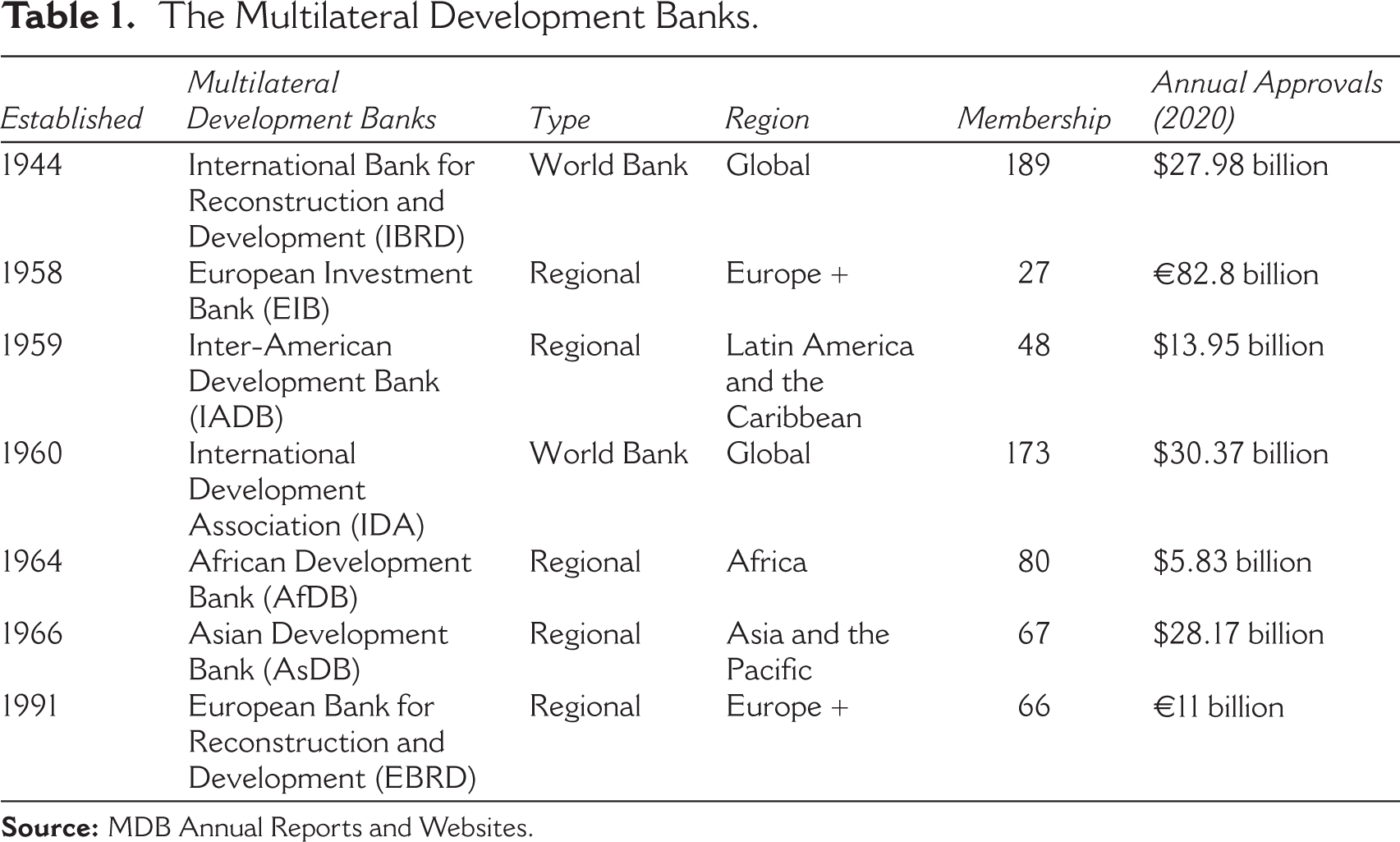
Established in 1944, IBRD set the blueprint for later MDBs. It was joined in 1960 by IDA as the concessional lending arm of the World Bank; their current mission is ending extreme poverty and boosting shared prosperity. The regional development banks, which emerged between 1958 and 1991, are aligned in the promotion of regional economic development and integration and include the Global South-focused IADB, AfDB and AsDB and primarily Europe-focused EIB and EBRD. The Global South-focused banks were founded between 1959 and 1966 and operate in regional developing countries in Latin America and the Caribbean, Africa and the Asia-Pacific. EIB and EBRD operate mainly in Europe, with EIB created by the 1958 Treaty of Rome and EBRD established in 1991 to support post-communist reconstruction following the collapse of the Soviet Union. Despite their individual distinctiveness, the MDBs share a common definition: their ownership is multilateral, their focus is economic growth, and they are banks prioritizing investment loans (Babb, 2009: 6).
The MDBs operate within the institutional field of multilateral development finance. From the expectations of shareholders, professionalization of development practice and requirements of capital markets, they are conditioned—to adopt a phrase from sociological institutionalism (see DiMaggio and Powell, 1983, 1991)—by coercive, mimetic and normative isomorphic pressures leading to well-documented patterns of convergence across their organizational practices and lending operations (see Acharya, 2009; Finnemore and Sikkink, 1998; Park, 2006, 2014); they are ‘networked in a myriad of ways’ (Bazbauers and Engel, 2021: 270) and demonstrate considerable organizational alignment, being more alike than not. Yet, while they are isomorphic leaders in infrastructural development (Engel and Bazbauers, 2020; Wihtol, 2014), they have been reactive to changes in the global governance of gender. 1
Since the 1970s, successive United Nations (UN) conferences on women and gender have influenced the MDBs, with the 1975 World Conference of the International Women’s Year held in Mexico City being an oft-cited originating point for their engagement with women. While conference sequels occurred in 1980 and 1985, it was the 1995 Fourth World Conference on Women in Beijing, which produced the Beijing Declaration and Platform for Action (see Charlesworth, 2005: 3 for details), that pivoted the MDBs to gender mainstreaming (True, 2003). In the 2020s, the Beijing Declaration remains the framework for gender-focused policymaking action (Esquivel and Enríquez, 2020), with MDB governance documents continuing to reference it as their baseline for action, even as their approach to gender has evolved across the WID, GAD and retroliberal WID eras.
We propose three eras into which MDB gender engagement divides: WID (1977–93), GAD (1994–2007) and retroliberal WID (2008–21). The WID and GAD eras are identified by the MDBs in their policy and strategy documents produced between 1977 and 2007; AsDB refers to its 1985 Policy on the Role of Women in Development as a WID policy and AfDB states its 2001 The Gender Policy is a GAD policy. Importantly, how the MDBs understand WID and GAD differs from how feminist academic scholarship does. The retroliberal WID era is proposed by the authors in adaptation of scholarship on retroliberalism. During the 2010s, the MDBs no longer identified their approach as either WID or GAD and so we propose a new framework to classify recent changes.
Academic WID is associated with Ester Boserup’s Women’s Role in Economic Development (1970). Prior to the 1970s, development organizations tended to view women as not part of productive development (Jaquette and Staudt, 2006), since ‘economic modernization’ equated productivity ‘with the cash economy and so most of women’s work was ignored’ (Momsen, 2004: 11). WID argues for integrating women into development to lift their economic standing and support economic growth. Common WID strategies highlighted by the literature include women-focused projects that increase productivity and income, as well as initiatives to create women-only organizations, improve women’s rights and status, build education and employment opportunities, strengthen health and welfare services, and expand political and social participation (Brown, 2007; Kilby and Olivieri, 2008; Koczberski, 1998; Razavi and Miller, 1995; Tinker, 1990). Critiques of WID claim it uncritically advances Western liberal understandings of equality and does not challenge structural inequalities (Brown, 2007; Chowdhry, 1995; Koczberski, 1998; Mohanty, 1988), treating women as a ‘special target group’ and advocating ‘the integration of women into the existing structures of development’ without questioning ‘the biases built into these structures’ (Charlesworth, 2005: 2).
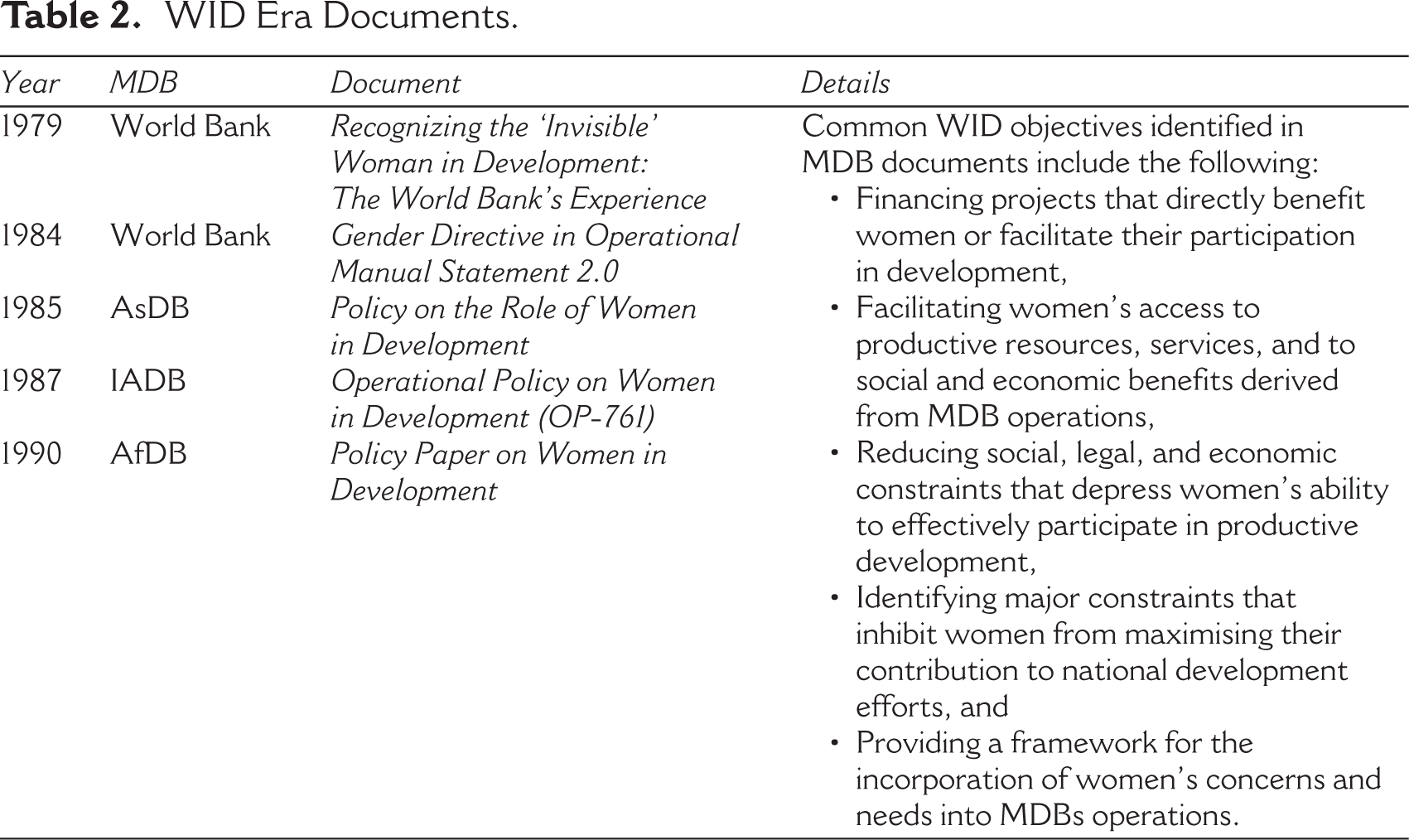
For the MDBs, the WID era lasted from 1977 to 1993 as per their policy documents (see Table 2). 2 The 1970s UN conferences on women catalysed MDB engagement with WID (Miller and Razavi, 1995). After hiring its first WID Advisor in 1977, the World Bank published its first WID report, Recognizing the ‘Invisible’ Woman in Development (World Bank, 1979: 11 and 12), ‘invisible’ because women ‘in many developing countries tend to be economically invisible’ and ‘are isolated in “female” employment’. Next, between 1984 and 1990, the World Bank, IADB, AfDB and AsDB adopted self-declared WID directives and policies. To illustrate, AsDB’s (1985) WID policy states the need to ‘undertake efforts to promote WID awareness among staff’. Importantly, the successive WID policies reference earlier policies, demonstrating isomorphic influences in that each WID policy was drafted to align with other MDBs and adapt to the changing expectations of international development assistance. Common amongst their WID approaches (for details, see Table 2) was isolating women as a ‘special target group’ in lending operations, a group to be better integrated into development—to benefit women, to facilitate women, to maximize women’s contributions, and to incorporate women’s concerns. AfDB’s (2001: 7) GAD policy makes this clear: its ‘first WID policy emphasised women as a special target group’. Yet, given ‘institutional resistance to feminist approaches’ in organizational settings (Calkin, 2015: 297), the adoption of WID tended to be ad hoc and limited in impact; the World Bank’s (1984) Gender Directive called for the consideration of women’s issues as appropriate prior to project approval, an optional review lacking staff compliance mechanisms. And, so, while broadly reflecting common approaches from academic WID, organizational integration was limited.
WID Era Documents.
Academic GAD emerged as a critique of WID. It argues that WID overlooks women’s productive, reproductive and community burdens, which are socially constructed (Brown, 2007; Koczberski, 1998; Moser, 1989; Rai, 2013). Recommending actions to reframe gendered social relations, GAD shifts analysis from women to the gender dynamics between women and men (Vavrus and Richey, 2003). GAD saw two main changes from WID. First, although WID activities were often ‘ghettoized’ in specialized offices (Jaquette and Staudt, 2006), GAD advocates ‘gender mainstreaming’, a practice popularized by the 1995 Beijing Declaration (True, 2003). Second, it argues against treating women as a ‘special target group’ and for adopting approaches that advance human rights, gender equality and women’s empowerment (Brown, 2007; Jaquette and Staudt, 2006). GAD has, however, been subject to criticism, notably that its translation into practice has been circumscribed; initiatives often fall short of challenging systemic inequalities, favouring women-focused interventions previously advocated by WID (Risby and Keller, 2012; Vavrus and Richey, 2003).
For the MDBs, the GAD era lasted from 1994 to 2007, with the World Bank’s 2006 Gender Equality as Smart Economics action plan serving as an important transition point to the retroliberal WID era. Like the WID era, the GAD decade saw only the World Bank and Global South regional development banks draft policies, strategies and action plans (see Table 3). Their new actions were self-declared GAD in approach—the World Bank’s 1994 Policy Paper on Gender, the first MDB GAD policy, states that it revised its earlier WID policy and replaced it with a new GAD policy—and attempted to mainstream gender in organizational structures and lending operations (Winters et al., 2018). For example, when AsDB adopted its 1998 GAD policy, which replaced its 1986 WID policy, the priorities were to secure gender equity as a cross-cutting issue and entrench gender mainstreaming as an organizational directive (Son, 2016). Several isomorphic pressures led the MDBs to introduce GAD, including: the 1995 Beijing Declaration and calls for gender mainstreaming, the Millennium Development Goals and calls to improve gender equality, internal reviews of MDB WID projects and mechanisms identified significant shortcomings, especially in approaching women as a ‘special target group’, and the importance of harmonizing policies and strategies between the MDBs to ensure compatibility in co-financed projects.
GAD Era Documents.
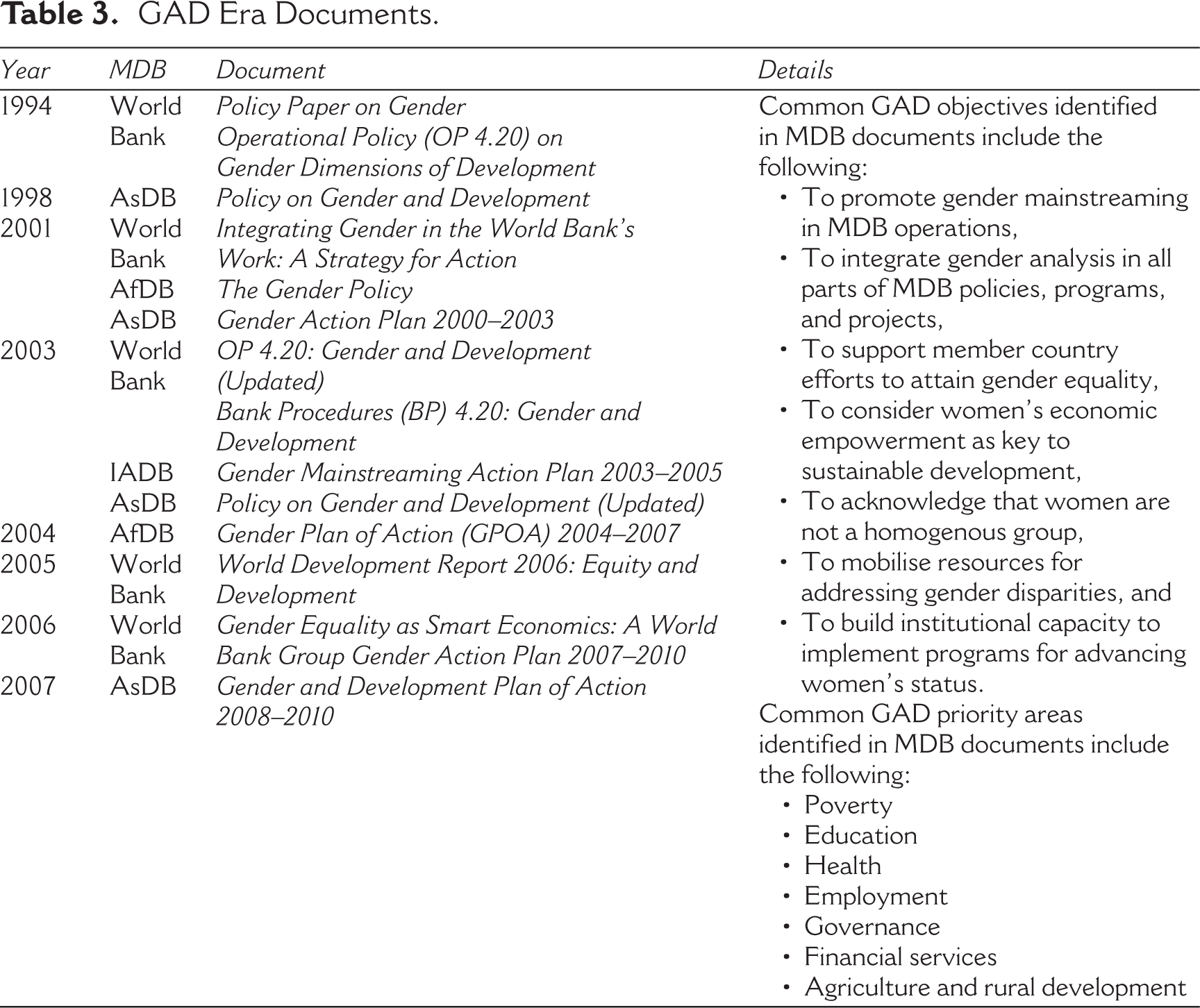
Complementary to the emergent post-Washington Consensus, which sought to ‘soften’ neoliberal austerity measures by ‘bringing back in the state’ to support free trade, privatization and social welfare programs, GAD aspired to address gendered inequalities and alleviate gendered poverty more comprehensively (for details, see Table 3). Yet, GAD for the MDBs did not challenge market-centric development but instead reinforced the centrality of market-based growth, with women to become empowered market participants (Elias, 2013; Ferguson, 2010; Rao and Kelleher, 2005).
Importantly, the MDBs struggled to effectively include men and boys in their GAD approaches. While Bedford’s (2007) exceptional analysis of the World Bank’s GAD interventions in Ecuador highlight the integration of women and men in practice, successive MDB GAD documents emphasize women: in AsDB’s 1998 GAD policy, ‘men’ occurs 32 times and ‘women’ 457 times and in AfDB’s 2001 GAD policy, ‘men’ occurs 148 times and ‘women’ 503 times.
Beyond numerical incidences, the documents highlight that women are the central unit of analysis, with men referenced as relative to women; ‘GAD does not dislodge women as the central subject’ (AsDB, 1998: 28). GAD documents state their rationale as being to ‘systematically operationalize [the] strategic objective of improving the status of women’ (AsDB, 1998) and address the ‘feminization of poverty’ (AfDB, 2001); the focus is on women relative to men, how to improve women’s position relative to men. The World Bank’s 2001 Strategy for Action prescribes interventions to provide financial services to women, increase women’s participation in labour markets, improve women’s health and expand girls’ and women’s access to education and health services. This is a logical conclusion, given that women are disproportionately impacted by economic, social and political inequalities, but it does reiterate that MDB GAD approaches remained primarily focused on women. This contrasts with academic GAD where the emphasis is on the gender dynamics between women and men.
The 2008 Global Financial Crisis arguably led to emergence of the retroliberal aid regime. Coined by Murray and Overton (2016) and since adopted by others (see Mawdsley, 2018; Mawdsley et al., 2018; Overton et al., 2020; Sims, 2021), the retroliberal aid regime departs from the 2000s post-Washington Consensus and towards an ‘increasingly financialized, privatized and profit-oriented’ model (Sims, 2021: 1788–89). Retroliberalism is defined by several characteristics, including a return to economic growth as a principal development outcome, a revised role for the state in sponsoring and facilitating the private sector, the reframing of the private sector as an active development partner, and a central focus on profitable infrastructural investment. We propose the 2008 to 2021 era of MDB gender engagement is best articulated as retroliberal WID. What defines the era is a return by the MDBs to approaching women as a ‘special target group’ to be integrated into economic development but in this case as entrepreneurial private sector actors with the potential to increase economic growth as opposed to GAD-aligned rights-based concerns for their quality of life. Such thinking emerged initially in the World Bank’s 2006 Gender Equality as Smart Economics action plan, which argues that gender equality is ‘smart economics’ because economic growth would be faster if women were better integrated—as a ‘special target group’—into economic development as private sector entrepreneurs. As the action plan notes, ‘Economic empowerment is about making markets work for women (at the policy level) and empowering women to compete in markets (at the agency level)’ (World Bank, 2006: 4 original emphasis). This is a women- and not gender-focused throwback to the WID era but with a singular focus increasingly emerging from MDB documents, highlighting the necessity of women’s economic empowerment, employment opportunities, financial markets access, entrepreneurship and asset ownership and control; gender equality is thus reduced to market engagement while ignoring the structural inequalities perpetuated by market forces.
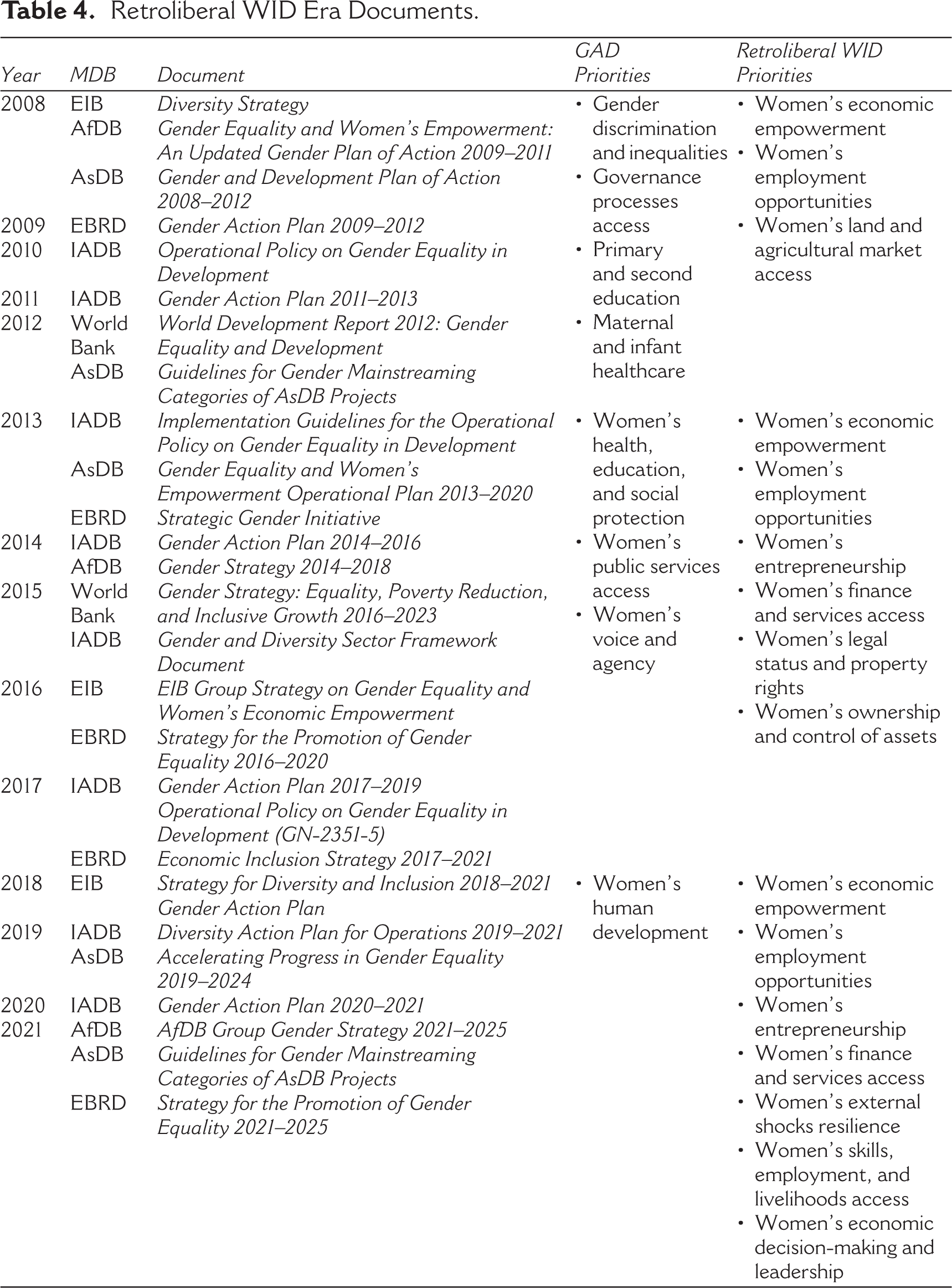
‘Retroliberal WID’ is not a term used by the MDBs but a concept we propose. The MDBs since 2008 no longer refer to WID or GAD in their policy or strategy documents. Of the 28 documents listed in Table 4, none refer to WID or GAD. Thus, we advance retroliberal WID as articulating changes taking place throughout the 2010s. Importantly, however, while GAD as an acronym disappears, GAD-like priorities remain but are steadily replaced by what we propose to be retroliberal WID priorities (for details, see Table 4). Increasingly, entrepreneurship, employment opportunities, productive skills development and asset control replace GAD era priorities like women’s agency and human well-being. 3
Retroliberal WID Era Documents.
III. Methodology
Of the 32 MDBs, only six make publicly available substantive gender-focused lending data through online project databases: the World Bank and five regional development banks. The online project databases include IADB’s Projects portal, AfDB’s Projects & Operations website and EBRD’s Project Finder database. The authors analyse 1,928 projects financed by the six MDBs between 1967 and 2021, thematically organizing the projects into WID, GAD and retroliberal WID categories. It does so through mixed qualitative/quantitative document analysis of two documentary evidence types: project documents, including loan agreements and implementation status reports which contain information on project purposes, components and financial allocations; and project websites which contain project summary statements, sectoral and thematic allocations, and basic loan details.
Document analyses require clear protocols for identifying and analysing documents, especially when evaluating multiple case studies. The two evidence types were selected because the six MDBs produce standardized project documents and websites which provide substantive details on project timeframes, financial commitments and objectives and components. This study limits analysis to publicly accessible materials. This is not a methodological weakness, however, as document analysis sampling often involves a large record of documentary evidence (Frey, 2018) and this study identifies and analyses 1,928 projects.
Projects were identified through MDB online project databases involving two approaches: filtered searches, or the restriction of project results to a specific sector or theme; and keyword searches, or the entering of keywords into search engines. Filtered searches were limited in utility. Only the World Bank and AsDB have ‘gender’ filters in their project databases. In contrast, the IADB, AfDB, EIB and EBRD project databases do not have ‘gender’ filter options. Thus, keyword searches formed the primary approach to project identification. Through an iterative process of coding and recoding—a common document analysis practice (Bowen, 2009)—determined by review of MDB project documents and websites, four keywords were entered: gender, women, girls and sex. The search terms ‘men’ and ‘boys’ were also entered but did not yield results.
Project screening followed, adopting a manual user process. Across the six MDBs, far more projects were screened out than in. This is because keyword search results yielded projects with very small gender sub-components, that is, an infrastructural project financing a rail network that includes a minor study to assess the network’s impact on women’s economic productivity. Our aim was to evaluate qualitatively and quantitatively gender-focused investment projects and thus we excluded projects that incidentally engage with gender. Because of this, the screening process required review of ‘project percentages’—a standard metric in loan documents whereby the relative percentages allocated to different sectors are noted—and project objectives and components. To illustrate, the World Bank project database yielded 6,305 results as per ‘gender’ keyword searches but only 555 results under its ‘gender’ sub-theme as of August 2021. The manual user process of reviewing each project individually was necessary to thematically organize projects into WID, GAD and retroliberal WID categories.
Once the 1,928 projects were screened in, data were drawn from the two documentary evidence types. A combination of iterative content (quantitative) and thematic (qualitative) analysis was adopted. Content analysis is the process of organizing data into categories relevant to research domains—in this study, quantitative content analysis was limited to simple calculation of number of projects identified and number of search term incidences. Thematic analysis is the process of qualitative pattern recognition in documentary evidence—coding and categorizing followed an inductive approach to identifying common themes within documents and then reworking analysis to ensure the appropriateness and completeness of coding, which is a common document analysis approach (Bowen, 2009). Data collection focused on sectors and themes, objectives and components, financial allocations and co-financing arrangements, timeframes and loan types. The objective thus became to construct a historical account of MDB gender financing across several decades.
The MDB literature tends to focus on the MDBs as stand-alone organizations. For this study, while the World Bank ‘leads’ the other MDBs throughout the three eras, our analysis expands to appraise several development banks as a complex network. The priority here is thus on organizational convergence as opposed to divergence; this is a defining trait of new institutionalist analyses of institutional isomorphism (DiMaggio, 1998; DiMaggio and Powell, 1983) and aligns with a recent trend in MDB scholarship that examines the global architecture of multilateral development finance (see Bazbauers and Engel, 2021; Wihtol, 2014; Humphrey, 2019; Engel and Bazbauers, 2020); the aim becomes, as Bazbauers and Engel (2021: 1 emphasis added) comment, ‘to understand…the system of multilateral development banks’. The remainder of the article divides into four discussion areas: number of projects, timeframes, financial commitments and objectives and components.
IV. Discussion
Number of Projects
The aggregate number of WID, GAD and retroliberal WID projects approved between 1967 and 2021 reveal gender to be a low MDB priority. Of the identified projects by keyword search, there are 555 World Bank projects and 1,373 regional development bank projects. The World Bank, IADB and AsDB are the largest gender-focused project approvers, EBRD and AfDB lag distantly behind, and EIB barely registers. The small EBRD and EIB gender portfolios align with their relatively recent drafting of gender strategies, although EIB’s poor engagement is significant since it is the second oldest MDB and in 2020 its total annual approvals exceeded the other regional development banks combined. AfDB is similarly disappointing, for it published its first WID policy in 1990 but that did not translate over the next three decades—and five GAD and retroliberal WID strategies—into project investments.
Despite drafting gender policies and strategies since the 1980s, gender-focused investments are a small aspect of MDB lending. This is the main takeaway of the aggregate number of project approvals. The World Bank’s ‘Sustainable Development, Gender & Inclusion’ theme did not exceed 8.5% of annual approvals between 2000 and 2016 during the GAD and retroliberal WID eras and had an annual average of 4.3%. IADB and AfDB keyword searches yielded 450 and 25 projects results. The results are disappointing, especially when contextualized against IADB’s project database listing over 24,000 pipelines, active, completed and cancelled projects and AfDB’s listing over 8,800.
EBRD project data differs from the World Bank and Global South regional development banks but maintains gender as a low operational priority. No results yielded for ‘girls’ or ‘sex’ keyword searches and only 42 by ‘women’ and seven by ‘gender’. Significantly, the 49 results are Women in Business (WiB) projects. EBRD’s first Strategic Gender Initiative and Women Access to Finance (A2F) Programme were launched in 2013 to enhance the capacity of domestic banks in borrowing countries to finance women entrepreneurs and support the design of non-financial services for women-owned and -managed small and medium enterprises (SMEs), thus adopting an approach to gender empowerment defined by public finances sponsoring and facilitating the private sector; a retroliberal WID strategy. WiB is EBRD’s specialized financing line for the A2F Programme. Bibler (2013: 3) offers the critique that by ‘focusing exclusively on private sector participation’, EBRD ‘overlooks social impacts that gender insensitive investments might have on women’s health, safety and rights’. Disappointingly, again, between April 2013 and December 2015 only 39 gender-focused investments were approved by EBRD, a small portion—3.4%—of 1,150 total project approvals.
Timeframes
The earliest identified MDB gender-focused project is the 1967 IADB Training Program for Leading Women regional technical cooperation (TC) project. Predating the WID era, it was a small $7,500 loan financing a training program for women with little supplementary data available, other than its intent to better ‘integrate’ women into development. All other projects identified were approved from 1984 onwards, from when the World Bank and Global South regional development banks drafted their first WID policies. Of these, IADB approved three ‘women’ projects between 1984 and 1989, AsDB a ‘girls’ TC project in 1987 and a ‘women’ TC project in 1988, and IDA five projects in 1988 and 1989. As per the search criteria, only these MDBs approved WID projects prior to 1990, revealing that the 1980s saw limited translation of WID policy into action, illustrating the difficulty gender experts face in achieving organizational outcomes (Ferguson, 2010; Ferguson and Alarcón, 2015).
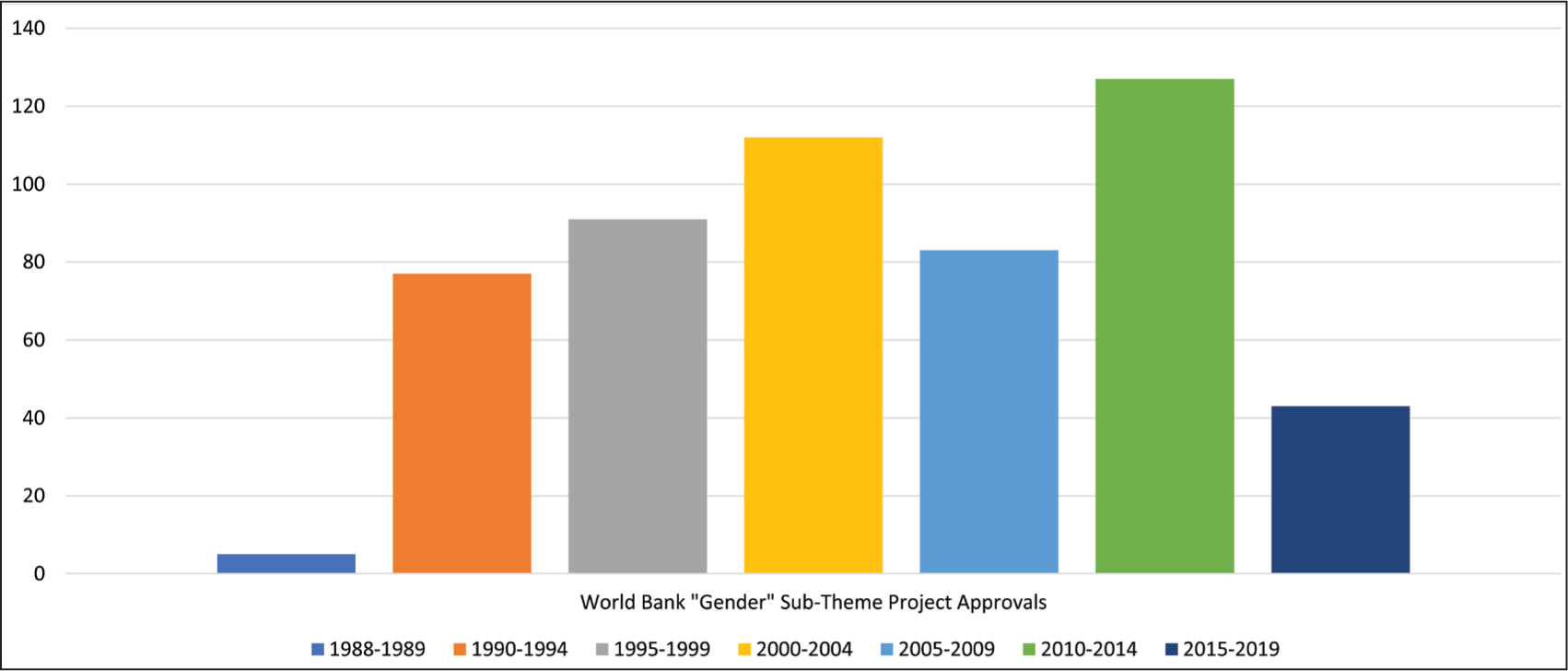
For the World Bank, ‘gender’ sub-theme project approvals are broadly consistent across the 1990s (168 projects), 2000s (195 projects) and 2010s (170 projects), with most loans approved during the GAD and retroliberal WID eras. In comparison to the 170 ‘gender’ projects approved during the entire 2010s, the World Bank approved 354 total projects in 2010 and 445 in 2020. This reveals that while GAD and retroliberal WID approvals remained relatively static, overall project approvals increased. More is revealed upon reviewing sub-theme approvals by five-year intervals. There was a consistent increase in WID, GAD and retroliberal WID approvals from 1990 to 2014, except during the 2008 Global Financial Crisis (see Figure 1). Yet, there was a considerable decrease between 2015 and 2019. This endured in 2020 and 2021 with the World Bank approving no new ‘gender’ sub-theme projects during the first two years of the COVID-19 pandemic. An issue requiring further analysis, this is concerning as a report by the UN Entity for Gender Equality and the Empowerment of Women shows that the COVID-19 Crisis widened gender inequality and worsened the feminization of poverty (UN Women, 2020). Furthermore, while ‘Human Development and Gender’ theme approvals increased as a percentage of total annual approvals between 2017 (14.1%) and 2020 (27.6%), ‘gender’ sub-theme approvals declined. This suggests that while the World Bank increased its human development lending operations, it reduced its gender-focused project portfolio.
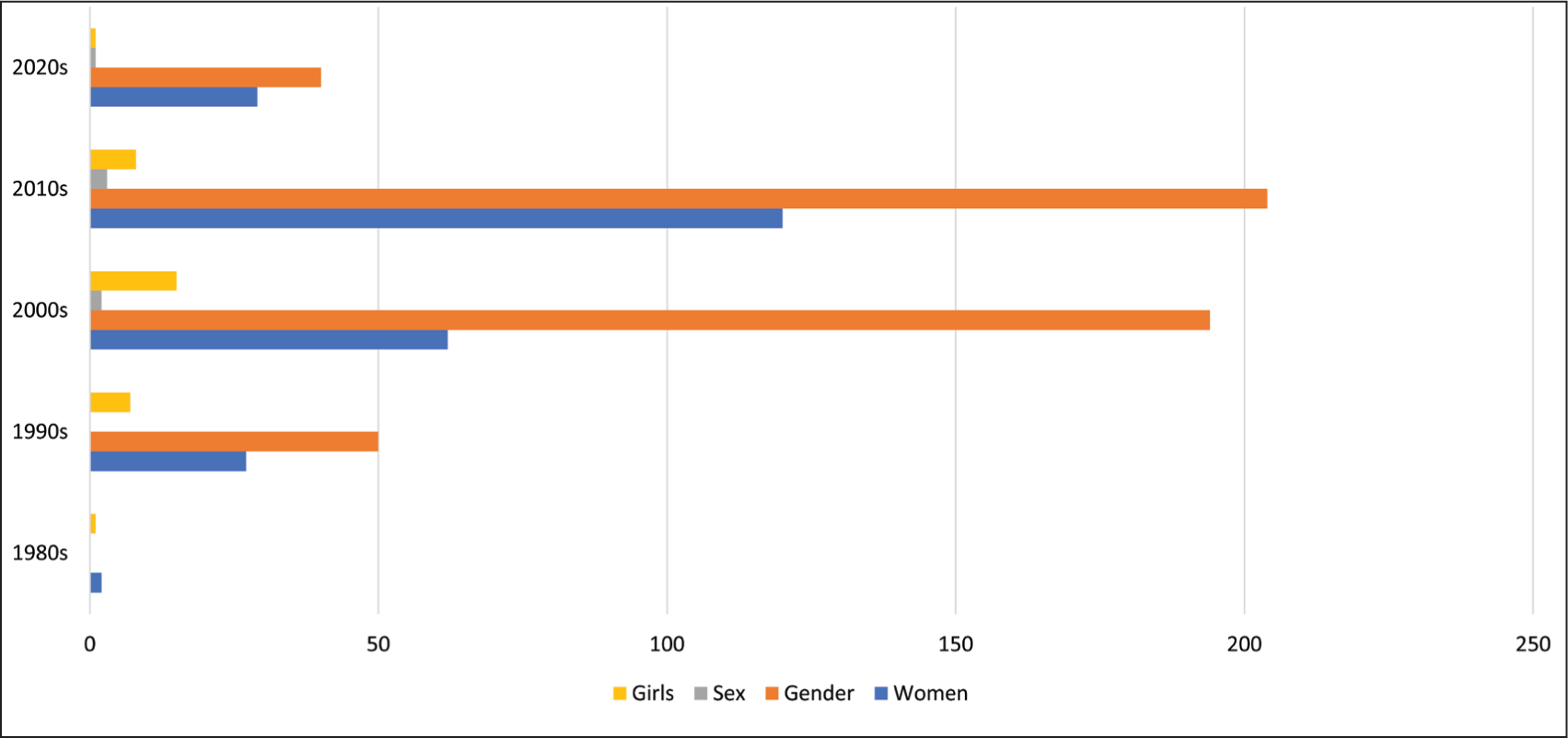
AsDB keyword search results yield 535 ‘gender’ projects, 271 ‘women’ projects, 32 ‘girls’ projects and 6 ‘sex’ projects. As per Figure 2, after a modest 1990s, the Asia-Pacific development bank increased ‘gender’ and ‘women’ project approvals during the GAD and retroliberal WID eras, with 2020 to 2021 approvals nearly exceeding the 1990s. The increase in project approvals aligns with organizational reforms enacted after the 1995 Beijing Declaration, suggesting the importance of institutionalizing gender to escalate project approvals despite continued resistance to organizational reforms (Fraser, 2009; Kunz and Prügl, 2019; Razavi, 1997). While AsDB first adopted a WID policy in 1985, it did not introduce a new strategy until its 1998 GAD policy. Since 1998, it has either adopted new or updated existing gender policies every few years; nine institutional documents were adopted between 1998 and 2021. IADB reveals a similar trend. Its ‘women’ keyword search results, which form the largest portion of its identified projects (72%), show consistent approval levels during the 1990s (89 projects) and 2000s (85 projects) before increasing to 120 approvals throughout the retroliberal WID 2010s, an increase aligning with an expansion in gender strategies, from two institutional documents produced between 1987 and 2003 to eight between 2010 and 2020.
EBRD and EIB approved their first ‘gender’ and ‘women’ projects during the retroliberal WID era. The earliest identified EBRD project is a September 2012 WiB investment to Turkey, which financed a senior unsecured $60 million loan to GarantiBank, Turkey’s second-largest private bank, to be on-lent to women-owned and/or -managed SMEs. In total, 49 WiB loans were approved between September 2012 and July 2021, with an average of five projects annually. Releasing its first Gender Action Plan in 2009, EBRD’s gender portfolio is a product of the retroliberal WID era. Notably, it tends to invest in what it calls ‘special target’ sectors through specialized financing streams. Recognizing that gender mainstreaming often requires the establishment of specialized departments to produce organizational action (Altan-Olcay, 2020; Bedford, 2007; Rao and Kelleher, 2005), it must also be noted that WiB conceptualizes women narrowly as a retroliberal WID ‘special target group’ of private sector entrepreneurs rather than adopting a more comprehensive GAD era rights-based approach that promotes women’s wellbeing, equality and empowerment beyond market engagement.
Financial Commitments
The MDBs are international financial institutions whose influence in large part derives from their material resources—the loans, credits and guarantees approved to public and private sector borrowers (Babb, 2009; Bazbauers and Engel, 2021; Wihtol, 2014). As public banks with capital bases drawn from member country subscriptions, MDB financial allocations provide strong indications of their operational priorities. The evidence gathered reveals that gender-focused projects tend to be both small financially and a minor portion of MDB lending portfolios and, while project approvals peaked during the retroliberal WID era, financial commitments were largest during the GAD era.
World Bank gender-focused financing since the 1980s varies over time but remains a minor lending stream. From 1993 to 1999, it allocated $2.36 billion to its Social Development, Gender & Inclusion (SDGI) theme. Yet, during the same period, its cumulative approvals totalled $50.31 billion. This trend persisted from 2000 to 2016, peaking in 2001 at 8.5% of annual approvals before declining to an annual average of 2.7% in the retroliberal WID era. SDGI received the smallest percentage of total annual approvals of any lending stream following the 2008 Global Financial Crisis. Given that the World Bank did not approve any ‘gender’ sub-theme projects during the first two years of the COVID-19 pandemic, it is arguable that gender is not a priority for the MDB during periods of economic crisis.
Close to 470 of the 555 identified World Bank ‘gender’ sub-theme projects are either co-financed or fully financed by partner organizations. Co-financing is a common feature of MDB lending, proposed as a mechanism to reduce project risk and catalyse public and private investment, notably in non-traditional sectors (Mendez and Houghton, 2020), demonstrating that what the MDBs are willing to finance signals to other actors project feasibility. Gender co-financing commitments tend to be less than World Bank allocations; a 2016 $63 million Socioeconomic Empowerment of Adolescent Girls and Young Women project to India received $27 million from the borrowing government. Occasionally, however, the World Bank is a minority lender, such as in the 2004 Education for All project to Nepal, with IDA contributing $50 million to the $614 million committed by the borrowing member country, British Department of International Development, and three Nordic development agencies. Into the retroliberal WID era, the World Bank increasingly acted as executor of gender grants financed by partner organizations, including the Japan Social Development Fund, Development Grant Facility and Gender Trust Funds. Typically, these grants do not exceed $3 million and on average are less than $2 million. The increasing reliance on partner-financed projects aligns with the downturn in World Bank allocations for gender-focused projects and the diminution of gender as a priority for the MDB.
IADB is a unique gender financier due to the project types approved. Of 322 identified projects by the keyword ‘women’, 36 are investment loans and 3 are investment grants. The remaining 283 are TC projects, which tend to be financially small—almost all identified are less than $1 million each. With the majority of ‘women’ projects delivered as TC, the focus is on policy design, feasibility studies and public servant training programs—the transference of ‘gender expertise’ (Fraser, 2009; Kunz and Prügl, 2019; Moser and Moser, 2005)—as opposed to allocating investments to women and girls.
EBRD’s WiB projects and EIB’s investments overlap in financial allocation and sectoral priority. Of the six MDBs in this article, the European regional development banks are the most aligned to retroliberal WID, having approved their first gender-focused loans in the early-2010s. Both EBRD and EIB primarily approve gender-focused loans to financial intermediaries to be on-lent; the transformative potential of gender interventions become reduced to a novel approach to banking and investment (Ferguson, 2010; Ferguson and Alarcón, 2015). With only 49 EBRD and 5 EIB projects identified, gender again is revealed to be a low priority. In 2020, EBRD approved €11 billion in new loans across all sectors and EIB €82.8 billion. Yet, WiB projects range from €1 to €80 million, with an average of €30 million and half being less than €10 million. EIB’s gender investments range from €2 to €10.3 million, except for a €200 million Gender COVID-19 Response loan to Brazil. The Brazilian loan is indicative of retroliberal WID priorities: it is a loan to Banco do Nordeste do Brasil—a regional development institution—with funds to be on-lent to women’s micro-enterprises impacted by the COVID-19 Crisis. Thus, rather than investing in the well-being of women and girls, the Gender COVID-19 Response loan supplements the balance sheet of a mixed public/private investment firm, illustrative of retroliberal WID actions to promote national economic development via women’s entrepreneurial private sector activity.
Objectives and Components
MDB loan objectives and components detail the primary purpose of a project (objectives) and actions pursued to achieve that purpose (components). Both are required to track project milestones and quantify success rates, thus determining loan efficacy. Tracing project objectives and components across time reveals common trends. During the WID era, projects tended to regard women as a ‘special target group’ and, as Goetz (1994: 30) argues of WID interventions generally, calculate ‘what development needs from women’ and not the needs of women themselves. WID projects sought to integrate women into development through education, health and economic opportunities, improve women’s contributions to development and support the long-term goals of countries. During the GAD era, projects expanded their conceptual focus to women’s empowerment—not just economic but social and political as well—and poverty alleviation through market engagement. GAD projects conceptually shifted from integrating women into development to addressing comparatively more robustly gender inequalities, poverty and marginalization. Interventions included improving women’s socioeconomic status, strengthening gender mainstreaming and promoting gender equity, but within market-centric development logics—entrepreneurial skills development, microenterprise training and income generating activities; this is indicative of academic GAD’s ‘diminishment’ in organizational settings (Calkin, 2015; Rai, 2013) and that in practice it did not challenge ‘assumptions about the role of the market in development’ (Ferguson, 2010: 4). During the retroliberal WID era, projects narrowed conceptual scope significantly, a return to integrating women and girls as a ‘special target group’ into development but with a primary focus on entrepreneurship and business skills training; gender equality and empowerment were ‘squeezed out’ in favour of economic growth and competitiveness (Elias, 2013: 166).
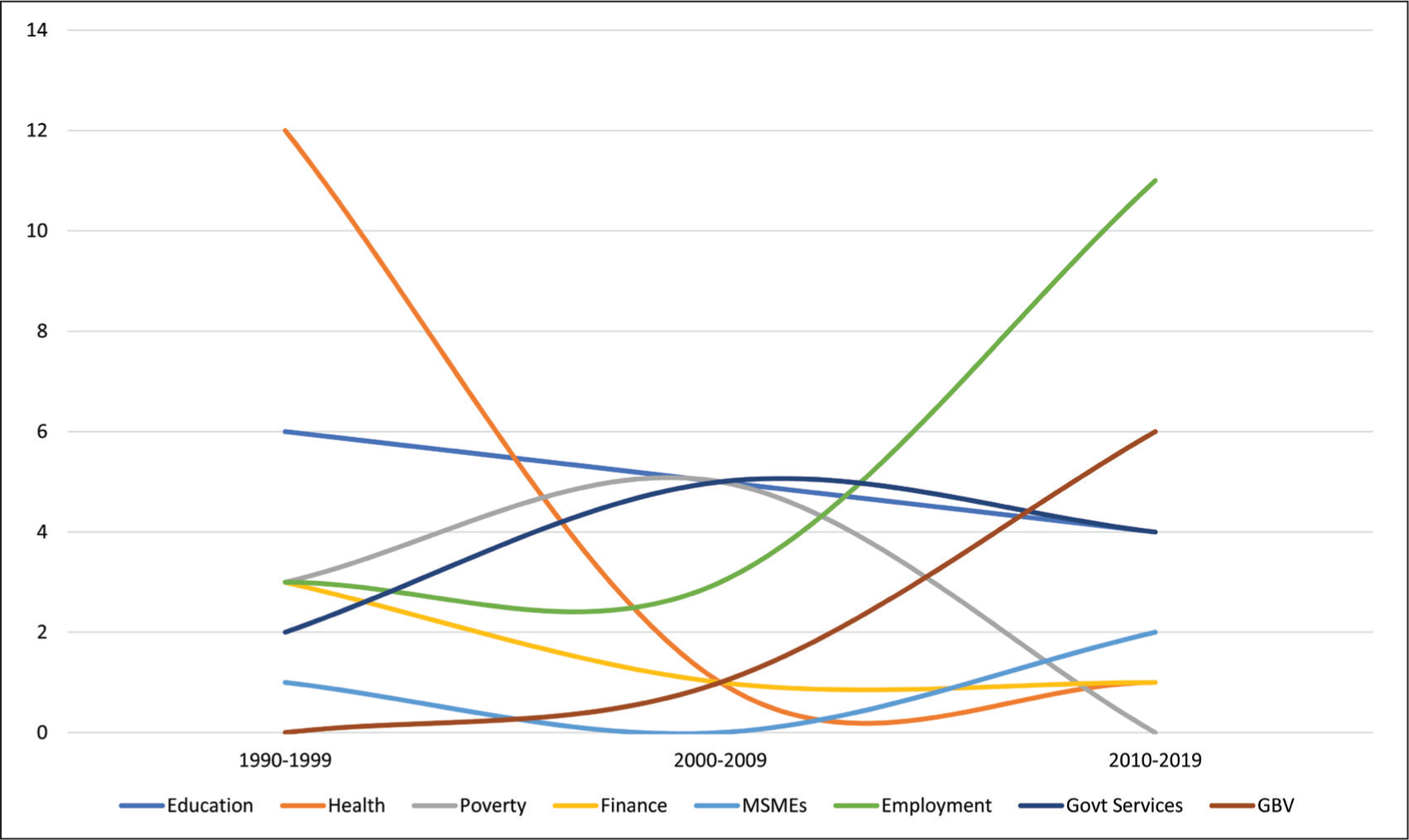
World Bank gender-focused projects approved between 1989 and 2019 reveal clear trends. This article isolates 80 of the 555 ‘gender’ sub-theme filter results, selected as they hold the largest gender project percentages. As per Figure 3, the 80 projects cluster by decade into the following eight categories: education: primary, secondary and vocational; health: maternal, infant and nutritional; poverty; finance: micro-finance, access to finance and private sector investment; micro, small and medium enterprises (MSMEs); employment: income-earning opportunities and entrepreneurship; government services: capacity building and judicial support; and GBV. From the data, the World Bank in the WID 1990s primarily approved health and education projects, focusing on nutrition, maternal and infant health, HIV/AIDS and population planning. The GAD 2000s saw an increase in poverty alleviation and government service projects and a decrease in education, finance, health and MSMEs. In the retroliberal WID era, there was a sharp decline in poverty alleviation and a spike in GBV and entrepreneurial employment initiatives, ranging from formal and non-formal job skills training to the government-led creation of income-earning opportunities.
IADB, AfDB and AsDB reveal trends comparable to the World Bank. Their WID projects financed education and health programs, including teacher training and primary, secondary and vocational education opportunities, and improvements to maternal and infant health service delivery. By the GAD era, this had shifted to a mix of education and health loans and entrepreneurship, finance and GBV projects. Differing from the previous era, GAD projects targeted community development, social inclusion, judicial education and initiatives to address gendered inequalities, such as reviewing laws prohibiting women from owning land. With the retroliberal WID era, education and health programs largely disappeared in favour of employment, finance, entrepreneurship and GBV projects that focused on training for labour market inclusion, workforce readiness and microentrepreneur finance. Even initiatives to address GBV were drafted as interventions increasing microfinance opportunities; the 2013 IADB Preventing Violence Against Women through Microfinance TC project to Peru proposed that microfinance access and women’s economic empowerment would likely reduce the prevalence of intimate partner violence.
EBRD and EIB align in narrowly prioritizing select retroliberal WID interventions. EIB’s ‘gender’ and ‘women’ keyword projects approved between 2014 and 2020 are all microfinance loans supporting local financial institutions to on-lend to women’s microenterprises. Similarly, EBRD’s WiB projects—almost all of which are commercial and not sovereign loans—align with its 2016–2020 Strategy for the Promotion of Gender Equality to increase access to finance and business support for women-led businesses and increase women’s access to employment opportunities, skills and services. WiB projects finance actions that provide women entrepreneurs with the resources to build private business. With projects approved in 14 countries and financing totalling €526.6 million, WiB loans are all financial institution investments. An indicative example is the 2019 WiB II Forte Bank private loan to Kazakhstan’s Forte Bank, with committed funds used for on-lending to eligible women-led MSMEs. The project is complemented by training provided to Forte Bank—and not the women-led MSMEs—to develop sustainable credit mechanisms. The beneficiary of the project is thus Forte Bank that then on-lends finances to women-led businesses. This encapsulates the dubious retroliberal WID narrative that building income-earning opportunities and promoting market engagement will somehow address systemic gendered inequalities (Elias, 2013; Prügl, 2017; Sandler and Goetz, 2020).
V. Conclusion
This article reviewed 1,928 gender-focused projects approved by the World Bank and regional development banks between 1967 and 2021, paired with 47 institutional documents drafted over four decades. We propose three eras into which MDB gender engagement divides—WID, GAD and retroliberal WID—and that the MDBs have demonstrated consistent organizational convergence. Building upon feminist scholarship on the relationship between neoliberalism, capitalism and development, analyses of development organizations and literature on project implementation, our analysis leads to four primary takeaways. First, the number of gender-focused projects approved over the past several decades has not only been a very small portion of total project approvals but also has not substantively increased as a percentage of annual approvals. Second, the GAD and retroliberal WID eras have been the most active for the MDBs, with the 2010s seeing the largest provision of gender-focused projects compared to the WID and GAD eras. Third, gender-focused projects have received small financial allocations compared to other sectors and, while project approvals peaked during the retroliberal WID era, financial commitments were largest during the GAD era. Fourth, tracing the WID, GAD and retroliberal WID eras reveals close MDB organizational alignment. For example, while EBRD and EIB may adopt more ‘hardline’ retroliberal WID approaches, the MDBs between 2008 and 2021 collectively demonstrate increasing alignment with retroliberalism.
Unsurprisingly, the evidence reveals that gender-focused investments are not a core business for the MDBs, despite a considerable expansion in gender policies and strategies throughout the 2000s and 2010s, with what little commitments approved emerging primarily in the retroliberal WID era. While this does constitute a degree of progress, the concern here is that the greatest expansion in gender-focused interventions has been during a period of considerable conceptual narrowing. Though hardly a halcyon era (with feminist scholarship critiquing the 2000s as failing to live up to its potential), the GAD era saw gender in development practice expand to include targeted poverty alleviation, gender equality programs and community outreach initiatives, albeit constrained by market-led approaches. This changed during the retroliberal WID era. Gone were the relatively progressive GAD interventions and instead came attempts to create better economic units of women and girls for national development. By ‘enhancing women’ to be more efficient and productive economic actors, the neue WID returns to othering women as a ‘special target group’ to be integrated into development to increase economic growth. This has left the MDBs dedicating the little resources they make available for gender largely to create private entrepreneurship opportunities and not improving quality of life, alleviating gendered poverty or addressing systemic gendered inequalities.
It is a well-worn argument to say that the neoliberal cast of the MDBs has not created much space for feminist inroads into development, with ‘gender’ being reduced to matters of economic utility. This is significant, for where the MDBs invest signals to other actors the feasibility of project investments and what is currently being financed is so limited in conceptual scope as to not substantively address—or even distantly pass by—the reasons that led the MDBs to engage with gender in the first place. The history of the MDBs reveals them to be incapable of developing innovative and comprehensive responses to gender inequalities on their own; substantive, progressive change is unlikely to come from within. They have, however, made the best inroads following external isomorphic pressures, specifically UN conferences and the 1995 Beijing Declaration. In the absence of global gender initiatives, the MDBs revert to relying on economic modelling, which led to ‘smart economics’ and the retroliberal WID era. Perhaps a new global gender compact is well past due to motivate the MDBs to better engage with gendered inequalities and the gendered nature of international development.
Footnotes
Declaration of Conflicting Interests
The authors declared no potential conflicts of interest with respect to the research, authorship and/or publication of this article.
Funding
The authors received no financial support for the research, authorship and/or publication of this article.